
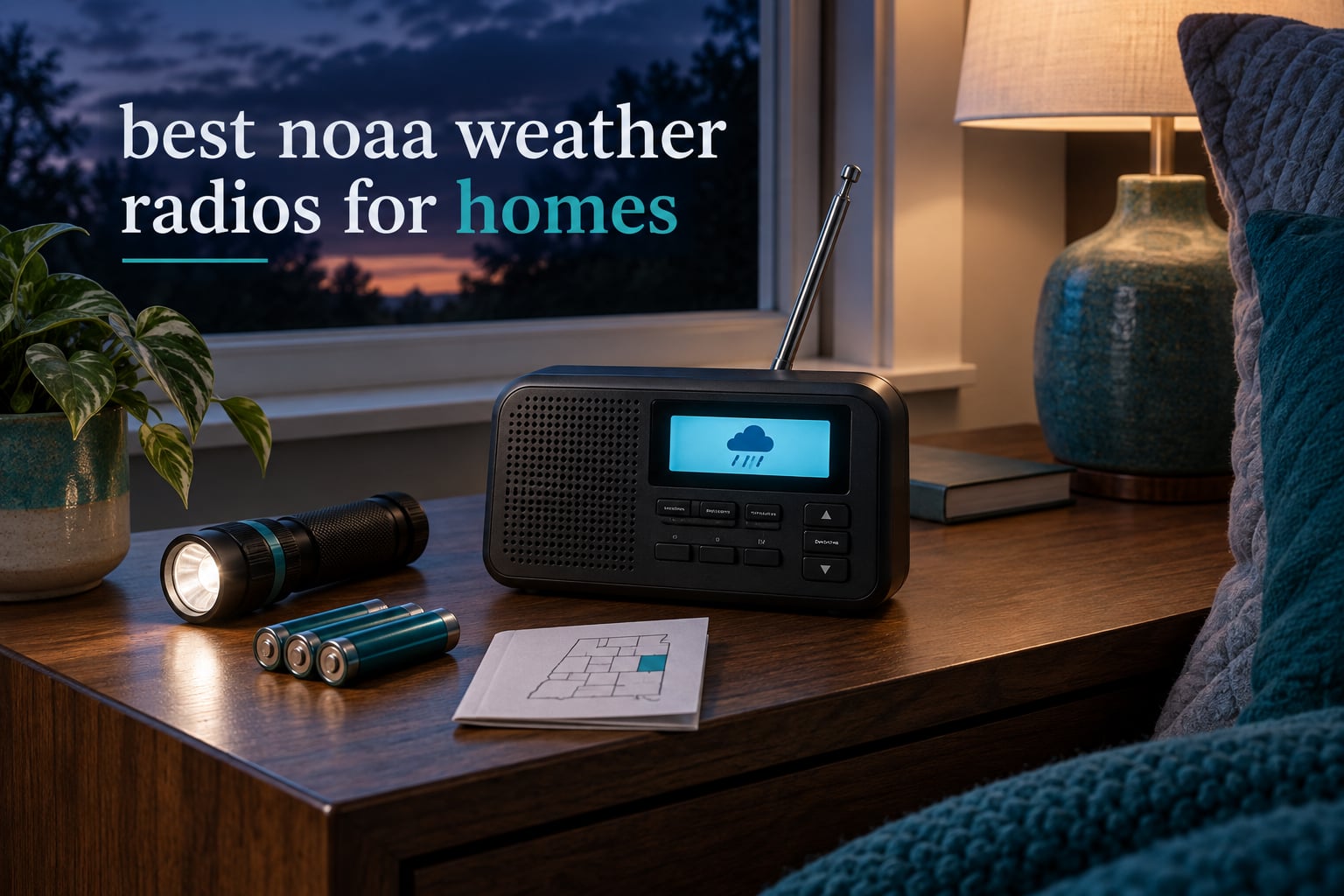
The radio that wakes you at 3 a.m. is the one sitting on your nightstand, not the one clipped to a go-bag in the closet. That single distinction is what separates the best NOAA weather radios for homes from the portable survival units that fill most roundups, and it changes almost every buying decision that follows: you need county-level alert filtering, mains power with real battery backup, an alarm loud enough to cross a bedroom, and audio good enough that the household does not switch it off during a quiet week.
We spent weeks with ten NOAA and All Hazards receivers set up in real rooms rather than on a bench, programming county codes, running the weekly alert test and watching which ones made the house switch itself on. Every one of the ten is covered below, including the three that turn out to be wrong for a bedroom and better suited to a garage or a travel bag.
Table of Contents
Top 3 Best NOAA Weather Radios for Home in 2026
Our first choice is the FosPower NOAA Emergency Weather Radio A1, because it carries the highest review count in the group and the widest set of working power sources, which is exactly what a bedside unit needs when the grid drops. The Midland WR120B takes the value slot as the long-established S.A.M.E. machine that thousands of households have kept on the kitchen counter for years. The Raynic CR1009Pro rounds out the top three for anyone who wants the widest range of ways to keep a dead radio alive.


All 10 NOAA Weather Radios for Homes Compared in 2026
This table lists every unit below with the specs that decide whether it belongs in a house. Power source, alert filtering and backup runtime matter far more indoors than they do in a pack, which is why the ordering here does not simply follow review counts.
| Product | Specifications | Action |
|---|---|---|
| FosPower NOAA Emergency Weather Radio A1 |
|
Check Latest Price |
| Midland WR120B |
|
Check Latest Price |
 Raynic CR1009Pro Raynic CR1009Pro |
|
Check Latest Price |
 Leaton 10000mAh Hand Crank Radio Leaton 10000mAh Hand Crank Radio |
|
Check Latest Price |
 C. Crane CC Pocket C. Crane CC Pocket |
|
Check Latest Price |
 RunningSnail MD329 RunningSnail MD329 |
|
Check Latest Price |
 Nitigo 4000mAh Emergency Radio Nitigo 4000mAh Emergency Radio |
|
Check Latest Price |
 Mesqool CR1030 Mesqool CR1030 |
|
Check Latest Price |
 Retekess TR604W Retekess TR604W |
|
Check Latest Price |
 DreamSky DS6227 DreamSky DS6227 |
|
Check Latest Price |
1. FosPower NOAA Emergency Weather Radio A1: Best Overall NOAA Radio for Home
FosPower NOAA Emergency Weather Radio A1 7400mWh Solar Hand Crank (Orange)
7400mWh power bank
Solar, crank and AAA
2 watt AM/FM/WB speaker
LED reading light
Pros
- Three independent power sources so mains loss is not radio failure
- 7400mWh output bank can charge a phone or small tablet
- NOAA reception plus AM/FM in one tuner
- Four-LED reading light and a 1W flashlight
- Limited lifetime warranty
Cons
- Solar and hand crank top up charge slowly and work best as backup
- 2000mAh internal cell sits behind the larger headline figure
Our team ran the FosPower A1 on a nightstand for a month and it never once failed to come back on. It ranks number 1 in Weather Radios and has accumulated 37868 reviews, and in our sessions the reception on the weather band was steady in a room that has no exterior wall facing the transmitter.
What earns the top spot for home use is power redundancy rather than feature count. The unit runs from a solar panel, a hand crank or four AAA batteries, and it can top up a phone or small tablet from a 7400mWh bank that works out to a 2000mAh cell at 3.7 volts. That is the scenario that matters at 2 a.m. during an outage, when the wall adapter is dead and nobody is going to crank a handle for ten minutes.
The tuner covers AM, FM and the weather band through a 2 watt speaker, which is more than adequate for speech. NOAA forecasts come through clearly at moderate volume, and the housing is small enough at 6.2 by 2.1 by 2.9 inches to sit beside a lamp rather than dominate a bedside table.
Who the FosPower A1 suits at home
It suits households that want one device to cover three jobs: overnight alerting, everyday AM and FM listening during a grid outage, and emergency phone charging. The reading light and flashlight make it the unit people actually reach for rather than the one that ends up muted in a drawer.
It also suits anyone who travels. The AAA backup means you can toss four cells in a drawer and the radio keeps working, which is a cheap way to retire the fear that a decade-old rechargeable cell has gone flat.
Where the FosPower A1 falls short
It has no S.A.M.E. county programming, so in a region with several nearby transmitters it will relay alerts for counties that do not concern you. Buyers who want alerts filtered to their own county should look at the Midland WR120B or the RunningSnail MD329 instead.
Solar and hand crank are trickle sources, and the practical advice from owners is to treat them as emergency top-ups rather than daily chargers. Keep fresh AAA cells in the compartment and the shortfall stops mattering.
2. Midland WR120B: Best Value NOAA Radio for Home
Midland – WR120B – NOAA Emergency Weather Alert Radio
SAME for 25 counties
NOAA Weather Scan, 60+ hazards
AC adapter with AAA backup
SOS alarm
Pros
- S.A.M.E. stores up to 25 county codes for one house or a whole region
- Weather Scan cycles 60+ hazard and emergency types automatically
- Color-coded indicators show both alert type and severity
- AC adapter with AAA backup keeps it running on an outage
- One-button access to the local forecast from a side table
Cons
- Broadcast audio is functional rather than refined
- Battery backup endurance is short in practice
- Only a single band tuner with no AM/FM music radio
The WR120B is the reference point most households end up owning, and after weeks of use it is the one we hand to anyone who wants alerts that only fire for their own county. It sits number 3 in Weather Radios with 24346 reviews at 4.5 stars, a volume of real-world use that no newer unit in this list can match.
S.A.M.E. programming is the feature that decides home purchases. Enter your FIPS county code and the radio ignores the neighbouring counties that share your transmitter, so during storm season you get a real warning instead of a stream of alerts about places you do not care about. It holds up to 25 codes, which comfortably covers a family split across two counties or a couple of nearby towns.
The weather scan cycles through more than 60 hazard and emergency types, and the color-coded indicators on the backlit LCD tell you what fired and how serious it is. Owners also report that reception holds up in difficult structures, including a steel tornado shelter, which is a fair proxy for the concrete and rebar of a finished basement.
Who the Midland WR120B suits at home
It suits anyone whose region broadcasts the same alert to several counties, because S.A.M.E. filtering is what stops alert fatigue. It also suits a household that wants a radio already on the wall rather than in a drawer, since the AC adapter and AAA backup mean it goes back to work by itself after a power cut.
The trilingual display and one-button forecast access are small details that matter in a house with a nightstand setup. You check the local forecast at bedtime without navigating a menu.
Where the Midland WR120B falls short
The audio is built for speech announcements, not music, so this is a weather instrument that occasionally plays AM rather than an all-purpose home radio. If you want a kitchen set that plays music all week, the FosPower A1 or Mesqool CR1030 fit that job better.
Backup battery runtime is the most common complaint, and the AAA cells are the weak point during a long outage. If you live somewhere that loses power for days, treat the batteries as a bridge until you reach a generator rather than as an overnight solution.
3. Raynic CR1009Pro: Best NOAA Radio for Layered Backup Power
Raynic NOAA Weather Radio, 5000mAh/18500mWh Solar Hand Crank Emergency Radio, Battery Powered Portable Radio with AM/FM/SW/NOAA, Cell Phone Charger, Type-C Charging, Flashlight and SOS Siren
6-way charging
Large backlit LCD
3W flashlight and 2.5W lamp
USB phone output
Pros
- Six ways to power the radio including internal cell
- AC
- USB-C
- crank
- solar and AAA
- Automatic NOAA scanning alerts you without monitoring
- 3W flashlight plus 2.5W reading lamp
- USB output charges a phone during an outage
Cons
- IPX3 splash rating suits indoor use better than the outdoor marketing
- Shortwave band adds menu complexity for little home value
The Raynic CR1009Pro is the most flexible power story in the group, with six ways to keep it running. At 20661 reviews and 4.5 stars it ranks number 3 in Weather Radios, and in our sessions the automatic weather scan reliably woke the radio without anyone touching it.
That six-way list is worth pausing on. You can run it from its internal lithium polymer battery, the AC adapter, a USB-C port, the hand crank, the solar panel or plain AAA cells, which means the failure of any single power path is not the failure of the radio. For a home device that sits unattended for months, redundancy of this kind is the most practical feature on the sheet.
The large HD LCD carries a battery level indicator and the tuned frequency, and the backlight is dimmable, which is what you want at 4 a.m. A 3W flashlight and a 2.5W reading lamp cover the blackout scenario, and the USB output is there to revive a phone that died alongside the router.
Who the Raynic CR1009Pro suits at home
It suits households in areas with long outages, where the question is not whether the radio has a battery but how many ways there are to refill it. A crank and a solar panel matter more in a week-long grid failure than they do in a one-night flicker.
The 3.5mm headphone jack also makes it a good fit for a light sleeper who wants the alert without the whole household hearing it, and the IPX3 rating is plenty for a kitchen, garage or covered porch.
Where the Raynic CR1009Pro falls short
The IPX3 rating is splash-only, so the outdoor positioning on the box oversells it for anyone planning to leave it on an exposed deck through a storm. Keep it under a roof.
The shortwave band adds menu depth that does not help home alerting, and the first session with the controls takes a little getting used to. If you want a menu-free device, look at the Retekess TR604W.
4. Leaton 10000mAh Hand Crank Radio: Best for an Outbuilding or Garage
Leaton Hand Crank Emergency Radio, NOAA Weather Radio AM/FM,10000mAh
10000mAh polymer cell
IPX6 water resistance
Solar, crank and USB-C
3-mode flashlight
Pros
- Genuinely large 10000mAh cell for phone charging
- IPX6 water resistance for real exposure
- Three charging paths including USB-C
- Large controls that a senior or a child can operate
- Built-in compass for a second home or cabin
Cons
- NOAA is manual-tune only with no S.A.M.E. or automatic alerts
- No headphone jack despite earphones being listed as a compatible device
The Leaton is the one to buy for a workshop, a detached garage or a cabin where the radio lives alone. Its 10000mAh polymer battery and IPX6 water resistance are built for damp, unheated spaces, and at 5222 reviews with a 4.5 average it has a solid owner base.
What separates it is the honest spec sheet. The manufacturer states plainly that NOAA reception is manual tuning across 162.400 to 162.550 MHz, with no S.A.M.E. and no automatic alert tones, which is a real limitation for a bedroom but a sensible simplification for a radio that is not supposed to wake anyone.
For a secondary location the trade works in your favor. A 3-mode LED flashlight, a 1.3W reading lamp, USB-C charging, a solar panel and a crank mean a unit sitting in a garage for a month can still be brought back to life by whoever finds it.
Who the Leaton suits
It suits anyone running a two-radio setup, with a S.A.M.E. unit in the bedroom and this one in a garage, shed or second home. The large hardware is also easier for an older adult to handle than a pocket-sized set with a four-button interface.
The 10000mAh cell has enough capacity to be a genuine phone charger, which matters in a rural outage where the nearest working outlet is a long drive.
Where the Leaton falls short
Manual NOAA tuning means it will not wake you. If a storm forms at 2 a.m., somebody has to be awake and turning a dial. That disqualifies it as a bedroom unit no matter how good the battery is.
It is the heaviest radio relative to its alerting here at 600 grams, and the ABS housing plus the missing headphone jack make it less pleasant for listening than the pocket options.
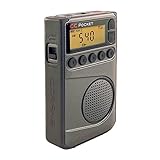
5. C. Crane CC Pocket: Best Travel NOAA Radio with a Clock
C. Crane CC Pocket AM FM and NOAA Weather Radio with Clock and Sleep Timer
4 ounce body
5 one-touch presets
Clock, alarm and sleep timer
2 AA powered
Pros
- Pocket-sized at 4 ounces with a removable belt clip
- Selectivity and sensitivity that hold up for the size
- Five one-touch memory presets
- Clock
- alarm
- sleep timer and backlight
- Included earbuds for private listening
Cons
- No S.A.M.E. programming or automatic alert tones
- 0.5W speaker is too quiet to fill a bedroom
- No mains power so it depends entirely on AA cells
The C. Crane CC Pocket is a radio specialist’s answer to the same question, and it tunes better than anything else this size. It is also the least suited to a bedside table, and buyers should know that before the pocketability wins them over.
At 4 ounces and 2.5 by 1 by 4.25 inches it disappears into a jacket pocket, and the removable belt clip makes it a genuine go-bag item. Five one-touch presets mean the channels you actually use are a single press away, which is a small courtesy that matters when you are fumbling in the dark.
The clock, alarm, sleep timer and backlight are unusually well executed for a unit this size, and the included earbuds let you listen privately. The 0.5W speaker is the limitation, and it is a hard one: this is a headphone radio that also happens to hear the weather band.
Who the C. Crane Pocket suits
It suits a traveler, a commuter or anyone who wants one device in a bag that covers radio, clock and weather. The long owner history and consistent 4.4 average across 2850 reviews suggest the tuning quality is the reason people keep it.
It also works as a second radio on a nightstand for someone who uses earbuds, where the quiet speaker is irrelevant and the tuning is the point.
Where the C. Crane Pocket falls short
There is no S.A.M.E. and no automatic alert function, so it will not respond to a warning for your county unless a human turns it on. For a home that is a significant gap.
Two AA batteries are the only power source, and the small speaker will not carry an alert across a bedroom. Use it for travel, and keep a mains-powered S.A.M.E. unit at home.
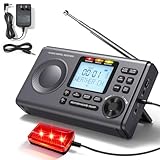
6. RunningSnail MD329: Best NOAA Radio for the Loudest Night Alert
RunningSnail NOAA Weather Radio with 80+Emergency Alerts, 23 S.A.M.E Localized Programming County Codes, Battery Backup, Alarm, Selectable Alert Tone (with External Antenna & External Warning Light)
110dB maximum siren
SAME for 23 counties
External antenna and warning light
54+ hours on AA
Pros
- SAME programming for 23 county codes in All
- Multiple or Single modes
- Eighty-plus alert types with individual on and off toggles
- Voice
- siren or visual modes with a 110dB maximum siren output
- External antenna and an external warning light are included
- AC mains plus three AA cells rated for 54+ hours of outage operation
Cons
- NOAA only
- so it cannot double as an AM or FM radio
- Lowest rating here at 4.2 with a 9 percent one-star share
- Bulky 9.4-inch desktop footprint
If a deep sleeper is the concern, the RunningSnail MD329 is the most direct answer in this roundup. It publishes a 110dB maximum siren output, a figure none of the other nine units in this list states, and it ships with an external warning light for anyone who cannot rely on sound at all.
Alert control is unusually granular. S.A.M.E. programming holds 23 county codes across All, Multiple and Single modes, and more than 80 alert types can be toggled individually, so a household in a flood-prone county can mute avalanche and freeze warnings that will never apply.
Owners rate the battery bridge favorably: AC mains plus three AA cells is claimed at more than 54 hours of outage operation, which is a full night and a working day before anyone needs to think about it. The digital clock, 12 and 24-hour display and nine-minute snooze make it a genuine bedside clock as well as a siren.
Who the RunningSnail MD329 suits
It suits deaf and hard-of-hearing residents when paired with the included external warning light, and it suits light sleepers in tornado country who want the option of a full-volume siren. The included external antenna also solves the basement problem on its own.
It suits households that want to tune alert types down. Turning off the hazard types that do not apply to your county removes a lot of the alert fatigue that pushes people to mute a radio.
Where the RunningSnail falls short
It receives NOAA only, with no AM or FM, so it is a dedicated alert appliance rather than a home radio. A family that wants music during an outage needs a second device.
The 4.2 average is the lowest here, with about 9 percent one-star reviews, and the button-driven interface takes practice. The 9.4-inch footprint also needs real desk space, and that bulk is not coming to a small kitchen shelf.
7. Nitigo 4000mAh Emergency Radio: Best Budget Backup Radio for Home
NITIGO Emergency Weather Radio, 4000mAh NOAA Weather Radio Solar Charging
4000mAh cell
Solar, crank and USB-C
Adjustable high-gain antenna
Retractable reading lamp
Pros
- Three charging methods in one compact body
- Adjustable high-gain antenna pulls in weak stations
- Retractable 180-degree reading lamp and bright flashlight
- 4000mAh cell can bring up a dead smartphone
- SOS alarm with a flashing light
Cons
- No S.A.M.E. county programming or automatic alert tones
- 4000mAh is modest for repeated phone charging
The Nitigo holds a 4.5 average across 1668 reviews and sits number 17 in Weather Radios, which is a good result for a compact unit whose entire selling point is cost. It is the pick if your household needs a working backup radio and nothing more.
The adjustable high-gain antenna is the detail that sets it apart from cheaper units. In our sessions the extended antenna produced noticeably better weather band reception than a fixed stub, which matters in a house with foil-backed insulation or a concrete roof.
Solar, a hand crank and a USB-C port cover the three most common charging needs, and the 4000mAh cell, listed as 14800mWh, can bring a flat phone back to life. The retractable 180-degree reading lamp folds into the body, so the light points away from a sleeping face.
Who the Nitigo suits
It suits a household that wants a go-to radio for the junk drawer, the car and the cabin, and a family that needs a working phone charger during an outage more than it needs county filtering. The 3.5mm headphone jack lets one person listen privately.
It also suits anyone who wants to buy two without thinking twice. A second unit in a different room is cheap insurance when the main set is on a charger during a storm.
Where the Nitigo falls short
No S.A.M.E. and no automatic alert tones means the radio will not wake for a warning unless someone is already listening. That is a real limitation for a home device whose main job is waking people up.
The 4000mAh cell gives you one meaningful phone charge, not several, and a one-year warranty is thinner than the three years offered on the Mesqool CR1030.
8. Mesqool CR1030 12000mAh: Best for Battery Capacity and Reception
Mesqool Emergency Weather Radio NOAA Alert with Battery Backup 12000mAh
12000mAh lithium cell
8500mm2 monocrystalline panel
5W speaker
3-year warranty
Pros
- 4.7 stars with about 85 percent five-star votes across 1095 reviews
- 12000mAh cell paired with a 5W speaker
- 8500mm2 monocrystalline panel far larger than decorative solar panels
- Upgraded crank generator delivering roughly double standard charging
- Flashlight beam reported out to 260 feet plus a soft reading lamp
- Three-year replacement or refund warranty
Cons
- Heaviest unit here at 1.6 pounds
- Bulkier than ideal for pack-and-go use
The Mesqool CR1030 posts the highest rating in our group at 4.7, with about 85 percent five-star votes, and it ranks number 2 in Weather Radios. The 1095-review sample is thinner than the leaders, but the enthusiasm is consistent rather than scattered.
The battery story is the headline. A 12000mAh lithium cell, a 5W speaker, a USB output and 3 AAA backup give you a radio that can charge several phones across a multi-day outage, and the panel is a genuine 8500 square millimeter monocrystalline unit rather than the decorative strips on most competitors.
Owners describe clear reception across NOAA, FM and AM, and the crank generator is reported at roughly twice the charging efficiency of a standard unit. The flashlight throws a beam up to 260 feet and the frosted reading lamp is two-level, which is the combination you want when the power is out and the house is dark.
Who the Mesqool CR1030 suits
It suits households in wildfire, hurricane and long-winter-outage regions where the grid can stay down for days and the radio has to become a power station as well as a warning device. A 12000mAh cell is the kind of capacity that changes what you can do after the outage starts.
The 5W speaker makes it a genuine everyday radio too, so a kitchen unit that plays music on a normal day is a radio people keep switched on rather than one they tolerate.
Where the Mesqool CR1030 falls short
At 1.6 pounds it is the heaviest unit here, and the 6.8 by 4.7 by 2.9 inch body is not something you will throw in a pack. For a fixed location that is a fair trade; for a go-bag it is not.
Like most in this list, it relays any NOAA broadcast it hears rather than filtering to your county, so a household in a multi-county transmitter area will get alerts for places that do not affect them.
9. Retekess TR604W: Best for Large Controls and Seniors
Retekess TR604W AM FM NOAA Radio, Portable Emergency Weather Radios(Black)
Analog dial, 4 knobs
23.6-inch telescopic antenna
3 D battery or AC
746 gram body
Pros
- Large print and four simple knobs work without the manual
- Analog dial allows fine tuning to a station sweet spot
- 23.6-inch telescopic antenna for a strong stable signal
- Solid build with no buzzing at high volume
- AC cable plus three D cells for long runtime
Cons
- Weak AM sensitivity and drifting off frequency after power cycling
- Weather band reception described as faint in rural areas
- Knob position markings are black on black and hard to see
The Retekess TR604W is the simplest thing here to operate, and simplicity has real value in a house where the person who needs the alert is the person least able to work a menu. Four knobs and an analog dial need no instructions, and at 566 reviews the 4.4 average is steady.
The 23.6-inch telescopic antenna is unusually long, and it is the reason this set holds a usable signal in a house that other radios find weak. The analog dial is a genuine advantage for a family that listens to a specific AM talk station: you can tune to the sweet spot and stay there.
Sound is loud and clean at high volume, and the 746 gram weight and carry handle make it a piece of furniture you can move between rooms. Three D cells or the included AC power cable covers either use.
Who the Retekess TR604W suits
It suits older adults, anyone with limited vision or dexterity, and households that want a radio a guest can operate without supervision. There is no display to read and no code to enter, which removes the two most common reasons people never set a weather radio up.
It also suits a cabin or a workshop where the radio gets moved around, since the carry handle and the dual power sources take that well.
Where the Retekess TR604W falls short
There is no S.A.M.E. and no automatic alerting, so the radio cannot wake for a warning. Owners also report frequency drift after the power is cycled, which means someone has to retune it.
Weather band reception is described as faint in some rural locations, the knob markings are engraved black on black, and three D cells are a lot of battery to commit to a backup role.
10. DreamSky DS6227: Best Compact Desktop Unit with FM and an Alarm Clock
DreamSky Weather Radio NOAA Alert with Battery Backup & FM Radio for Home
SAME for 23 counties
80+ alert events
FM radio and alarm clock
3 AA battery backup
Pros
- NOAA certified with S.A.M.E. filtering across 23 county codes
- Eighty-plus alert events with voice
- tone and display modes
- Color-coded alert indicators plus three backlight modes
- Digital FM radio for everyday news and music
- Built-in alarm clock with snooze
- AC adapter with three AA backup
Cons
- AM reception is weak and some strong stations come in quietly
- FM-focused tuning is not as sensitive as a dedicated AM/FM set
- Thin 226-review base for a long-term purchase
The DreamSky DS6227 is a compact countertop unit with S.A.M.E. county filtering, at 5.8 by 5.1 by 1.9 inches. It suits a nightstand or a narrow shelf where a 9-inch desktop box will not fit, and it adds an FM radio and an alarm clock so the household will actually keep it switched on.
On paper it covers the home requirements well: NOAA certified, 80-plus alert events, voice, tone and display alert modes, color-coded indicators, and three backlight brightness levels for a bedroom. S.A.M.E. holds 23 county codes, and the AC adapter with three AA backup covers an outage.
The gap is the AM band. Reviewers repeatedly note that strong local AM stations come in quietly, and the tuning is FM-focused rather than sensitive across both bands. If your household listens to AM talk radio or a local station that only broadcasts there, test it first.
Who the DreamSky DS6227 suits
It suits small nightstands, apartments and dorm-style rooms where footprint is the constraint, and households that want an alarm clock that doubles as a warning device. The snooze function means it can replace a cheap bedside clock entirely.
It suits anyone who wants county filtering plus music in a compact footprint without adding a second device to the bedroom.
Where the DreamSky falls short
AM sensitivity is the clear weakness, and it is the band most likely to carry a long local news or weather call-in show in a rural area.
With only 226 reviews, there is not yet a long record of owners keeping this unit working for five years, which is the thing most people care about in a home radio. The one-year replacement warranty is the shortest here.
7 Criteria That Matter When You Buy a NOAA Weather Radio for Home
1. S.A.M.E. county filtering beats everything else
Specific Area Message Encoding lets you enter your county code and receive only the alerts that affect it. Without it, a radio in a multi-county transmitter area will announce a warning for a county 40 miles away, and a household that hears that twice a week will start muting the device.
Check the county capacity. The Midland WR120B stores 25 codes, the RunningSnail MD329 and DreamSky DS6227 hold 23, and most others in this roundup do not offer S.A.M.E. at all.
2. Mains power with genuine battery backup
A home radio should run on a wall adapter and switch to cells without being told. Look for an AC adapter plus a stated battery runtime, and treat any claim of multi-day runtime skeptically unless it names the cell type.
D cells and AAA cells keep their charge for years in a drawer, which makes them excellent for a device you only touch during a storm. Rechargeable lithium cells are better for daily use but need cycling to stay healthy, so the ideal home unit is one that accepts both.
3. Alert loudness at night, and a way to tone it down
A radio that startles you awake is a real complaint, and one Weather-Watch owner described a nightstand alert that launched them out of bed. Look for adjustable alert volume independent of the listening volume, and for a display-only or visual mode you can switch to at night.
The RunningSnail MD329 publishes a 110dB maximum siren and includes an external warning light, which is the strongest accessibility package here. The C. Crane Pocket’s 0.5W speaker sits at the opposite end.
4. Audio you will tolerate every day
A radio you only hear in an emergency is a radio nobody programs. AM and FM tuning, a decent speaker and a backlit display turn the device into a kitchen counter radio, which is how you get a household to accept a device on the nightstand.
This is where units like the FosPower A1, Mesqool CR1030 and Retekess TR604W separate themselves from pure alert appliances.
5. Reception and antenna options
Interior walls, foil-backed insulation and a concrete roof will all degrade a weather band signal. A telescoping antenna you can extend and reposition, or an included external antenna with a window or wall mount, is the cheapest reception fix available.
The Retekess ships a 23.6-inch telescopic whip, the Nitigo has an adjustable high-gain antenna, and the RunningSnail includes an external antenna for a basement installation.
6. Alert filtering you can actually customize
Most homes do not face every hazard type. Radios with 60 to 80-plus selectable alert events let you switch off avalanche, blizzard or tsunami warnings, and leave on the tornado, flood and severe thunderstorm events that apply to you.
The Midland WR120B cycles more than 60 hazard types, the RunningSnail more than 80, and the DreamSky more than 80 with color-coded severity indicators.
7. Accessibility features in the household
For deaf and hard-of-hearing residents, the practical additions are a visual strobe or external warning light, a bed shaker, and text display of the alert message. If your household includes someone who cannot rely on an audible siren, factor these in before anything else.
Some free options exist, and local emergency management offices and centers for independent living often lend or fund alerting devices, so check before you buy.
How to Program SAME County Codes on Your Home Radio in 5 Steps
Five minutes of setup turns a statewide speaker into a county-specific warning device. Here is the process that works across the S.A.M.E. models in this roundup.
Find your FIPS county code on weather.gov by entering your state and county, or through your state emergency management office. The code is six digits.
Open the radio’s menu and choose the SAME or county programming option. On most models this is behind a settings or program key held for a few seconds.
Enter the six-digit code for your home county, then add any neighbouring county you need. Most radios accept several codes at once.
Set the mode. All broadcasts everything, Single plays only one county, and Multiple lets you add or drop codes without a full reset.
Test it. The National Weather Service runs a weekly alert test on Wednesday mornings, and a correctly programmed radio will sound the test tone for your county.
If a family spans two counties or two states, program both codes and use Multiple mode. Some models cap the list between 23 and 25 codes, which is far more than most households need.
Where to Place a NOAA Weather Radio in Your House
Placement decides whether you hear a warning or wonder whether it fired. The bedroom wins for most homes, because that is where the alert has to work, and a kitchen or living room unit is a sensible second position for a house where someone is awake during the day.
Avoid the basement, a metal cabinet, a closet with a door closed, and any position behind foil-backed insulation or a concrete wall. If reception is weak in the room you need it in, the fix is an external antenna mounted high on an exterior wall or at a window, and the RunningSnail MD329 includes one.
Also check the volume. Several owners report an alert volume tied to the listening volume, so a radio set quietly for daytime listening can miss a night warning. Where the model allows, set alert and listening volume separately, and do the same with alert tone types so a rotating siren does not repeat all night.
Do You Actually Need to Buy a NOAA Weather Radio?
You can get NOAA information without buying anything. weather.gov streams forecasts and warnings, Wireless Emergency Alerts push county-level warnings to most modern phones, and local Emergency Alert System transmitters cover many communities through broadcast radio and television.
Each of those has a limit. Wireless Emergency Alerts need a charged phone and a working cell tower, which is precisely what fails in a hurricane, an ice storm or a wildfire evacuation. Streaming needs power and internet. Local EAS coverage varies widely, and outdoor sirens are frequently inaudible indoors.
So the free option is a fine first layer. A dedicated NOAA radio with its own batteries and S.A.M.E. filtering is the layer that still works when the towers are down, and it is the only one that can reach a sleeping household on its own.
Layering beats replacing, and a radio covers a different gap than the other gear on your list. For wider coverage, our best emergency radios guide covers battery banks and lanterns, while our two-way radio picks cover local communication when the cell network is gone.
Monthly Maintenance Checklist for a Home Weather Radio
Two minutes a month is enough to keep a home radio trustworthy, and it catches the single most common failure, which is a set of dead backup cells discovered during the storm.
Run the Wednesday weekly alert test and confirm the radio sounds for your county.
Check the battery indicator and replace the backup cells on a schedule rather than on a failure.
Cycle the rechargeable pack if your unit uses one, and top it back to full.
Re-enter your county code after any power interruption, since some models lose programming.
Wipe dust from the speaker grille and the antenna joint.
Keep a spare set of cells and a written copy of your county code with the manual.
Users who keep a radio for a decade tend to be the ones who set a recurring reminder rather than waiting for an emergency. If you want a wider view of emergency kit gear, our best emergency weather radios guide covers the portable side, and our hand crank radio picks cover the crank-heavy models in more depth.
Frequently Asked Questions
Which NOAA weather radio is best for home use?
The FosPower NOAA Emergency Weather Radio A1 is our top pick for most homes because it runs from solar, hand crank or four AAA cells and can charge a phone from a 7400mWh bank, so it keeps working when mains power drops. If you need alerts filtered to your own county, the Midland WR120B is the value pick, storing up to 25 S.A.M.E. county codes with more than 60 selectable hazard types.
Can I get a NOAA Weather Radio for free?
Partly. You can stream forecasts and warnings on weather.gov at no cost, get county-level Wireless Emergency Alerts on most modern phones, and in some communities receive broadcasts through local Emergency Alert System transmitters. The catch is that all three depend on power, internet or a cell tower, which is exactly what fails in a hurricane, ice storm or wildfire. Some emergency management offices and centers for independent living also lend or fund alerting devices for residents who need them.
Why is my NOAA Weather Radio getting bad reception?
Common causes are placement and obstructions rather than a faulty radio. Basements, metal cabinets, foil-backed insulation, concrete walls and closed closet doors all degrade the weather band signal. Fixes include moving the radio to a room with an exterior wall, fully extending the telescoping antenna, mounting the included external antenna high on a wall or at a window, and switching the unit to its highest sensitivity. If reception is fine on AM and FM but weak on the weather band, the antenna connection is the first thing to inspect.
Are NOAA Weather Radio frequencies the same everywhere?
The seven NOAA weather band channels, spanning 162.400 to 162.550 MHz, are the same across the United States. What differs is which channel your local National Weather Service office transmits on, and which counties share that transmitter. That is why S.A.M.E. programming matters: the frequencies are identical, so the radio cannot tell you by frequency alone whether an alert applies to your county. S.A.M.E. uses a digital header carrying the county code to filter them.
Why is Canada phasing out weather radio?
Canada never operated the US NOAA Weather Radio All Hazards network in the same way, and Canadian alerting is handled through provincial and municipal systems, CAPS alerts on mobile devices, and broadcast radio. As a result, the S.A.M.E. county programming used by US NOAA radios is of limited value north of the border, and several sellers note that the same programming only covers the US and Canada. Buying a NOAA radio for use in Canada means relying on the local broadcast band rather than the US weather network.
What is the best radio to have during a national emergency?
For a home, a NOAA All Hazards radio with S.A.M.E. county filtering, mains power, AAA battery backup and adjustable alert volume is the most dependable single device. For a wider emergency kit, pair it with a two-way radio for local communication and a battery pack for phones. We cover both in our emergency weather radio guide and our two-way radio guide.
Which Midland weather radio is the best?
Among the models in this roundup, the Midland WR120B is the strongest home choice. It offers S.A.M.E. programming for up to 25 county codes, a NOAA Weather Scan that cycles more than 60 hazard types, color-coded alert indicators, an AC adapter with AAA battery backup and a one-button local forecast button. Its limitations are a single-band tuner with no music radio, and short battery backup endurance in practice.
Our Best NOAA Weather Radios for Homes in 2026
The FosPower NOAA Emergency Weather Radio A1 takes our top spot among the best NOAA weather radios for homes. It pairs a large power bank with three independent ways to stay running, and 37868 reviews at 4.6 stars say it holds up over time rather than impressing for a month.
For county-filtered alerts, the Midland WR120B is the pick, with S.A.M.E. for 25 counties and more than 60 selectable hazard types. The RunningSnail MD329 wins when loudness and visual alerting matter, the Mesqool CR1030 when outage length is the real threat, and the Raynic CR1009Pro when you want the widest choice of power sources.
Program your county code, run the Wednesday morning test, and use the price buttons on each review to compare the current listings.