
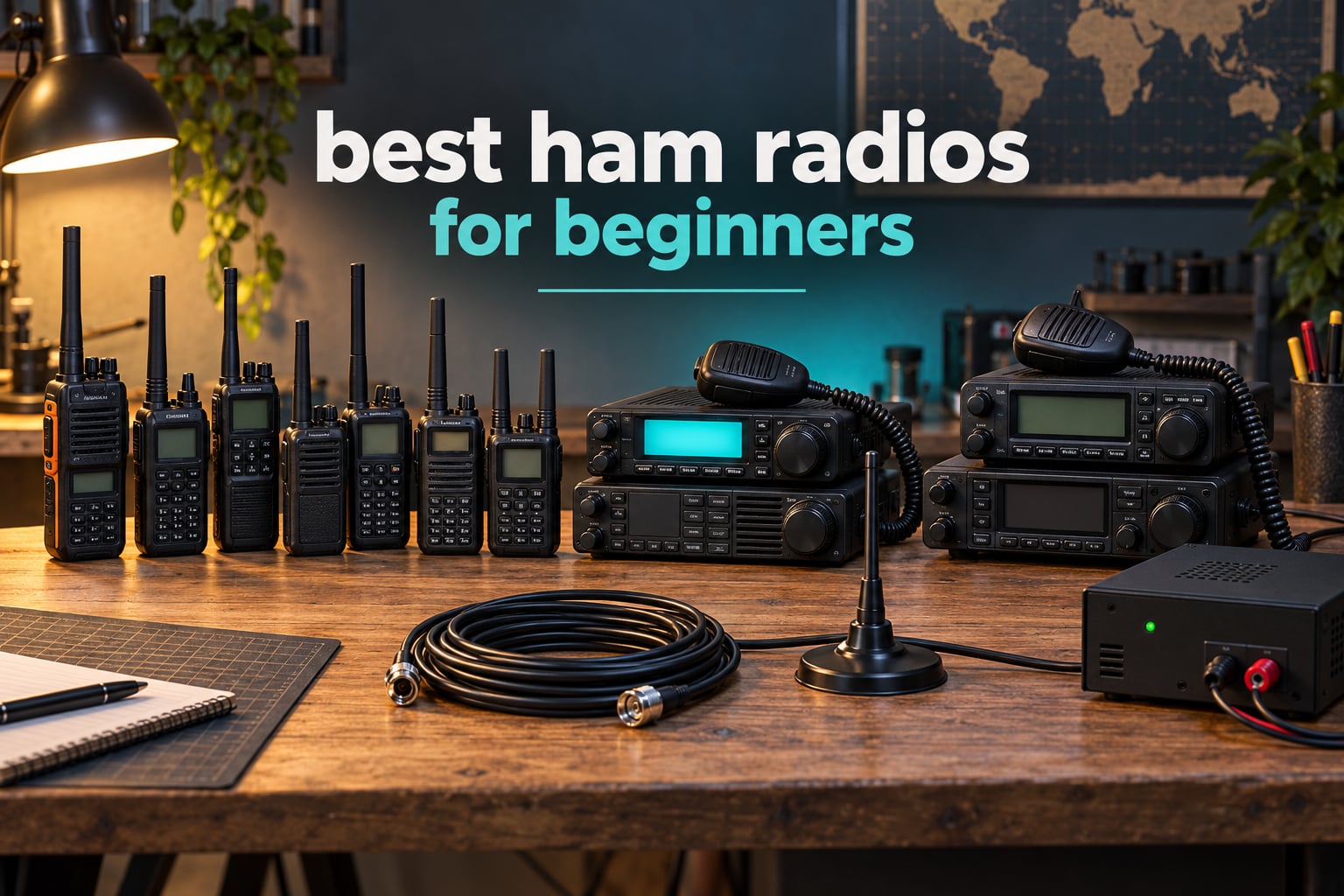
The short answer: the BAOFENG BF-F8HP is the best ham radio for beginners overall, the BAOFENG UV-82HP is the best value pick if you want two-channel monitoring, and the BAOFENG BF-F8HP PRO is the easiest to set up if menus intimidate you. All three are handheld VHF and UHF transceivers, and all three are what a new Technician licence actually lets you get on the air with.
That is the whole argument, and the rest of this guide exists to prove it. We compared these ten radios across menu depth, transmit power, receiver behaviour and battery life, plus what each one actually costs you in antennas and cables before your first transmission. One pattern emerged: beginners rarely fail because they picked the wrong radio. They fail because they pick a radio that is too complicated, or one that only does a job they do not have yet.
So before the reviews, one piece of context that removes the biggest barrier to buying anything: you do not need a license to listen. You can buy a ham radio transceiver today, put it on a scanner frequency or a local repeater output, and hear real amateur conversations without transmitting a single syllable. That is also the single best way to learn what a contact sounds like before you are the one on the air.
The FCC issues three license classes, and the entry-level Technician class is where almost everyone starts. It grants transmit access to the VHF 2 meter and UHF 70 cm amateur bands, plus a slice of HF that includes the entire 10 meter band. General and Amateur Extra open more of the HF spectrum, but a large share of operators never bother upgrading, which matters when you are budgeting accessories.
One more thing to settle early: listening first is not a cop-out, it is the shortcut. Veterans on the amateur radio forums repeatedly tell newcomers to spend a few weeks receiving before they transmit. It costs almost nothing, it teaches you what good audio and bad audio sound like, and it means your first transmission is not your first exposure to the medium. If you also want a receive-only rig to start, our picks for the best two way radios cover the same ground at lower power.
Table of Contents
Top 3 Best Ham Radios for Beginners (2026)
These three are the handhelds, ordered from most proven to most beginner-friendly. All three cover the VHF and UHF amateur bands, which is what a Technician licence lets you transmit on, and all three are CHIRP-programmable with a cable you will need to buy or that ships in the box.

BAOFENG BF-F8HP 8W Handheld
- 8W/4W/1W selectable power
- VHF 136-174 and UHF 400-520 MHz
- 2100mAh battery
- CHIRP programmable
BAOFENG UV-82HP Dual Display
- 7W/4W/1W selectable power
- Dual display and dual PTT
- 1800mAh battery
- CHIRP programmable

BAOFENG BF-F8HP PRO Tri-Band
- 1000 memories in 10 zones
- Clear English menus
- USB-C charging
- Airband and NOAA reception
None of these three is the highest rated radio in the group. That is worth explaining, and we do it in the reviews: a 15,000-review sample tells you far more about long-term reliability than a small pool of near-perfect scores does.
All 10 Best Ham Radios at a Glance (2026)
This is the comparison table none of the ranking pages we studied bother to build. Radio, form factor, bands, transmit power, and the job it was picked for — all ten, one place.
| Product | Specifications | Action |
|---|---|---|
| BAOFENG BF-F8HP Handheld |
|
Check Latest Price |
| BAOFENG UV-82HP Handheld |
|
Check Latest Price |
| BAOFENG BF-F8HP PRO Handheld |
|
Check Latest Price |
 AnyTone AT-778UV Mobile AnyTone AT-778UV Mobile |
|
Check Latest Price |
 Retevis RT95 Mobile Kit Retevis RT95 Mobile Kit |
|
Check Latest Price |
 Yaesu FT-65R Handheld Yaesu FT-65R Handheld |
|
Check Latest Price |
 Radioddity QT60 Pro 10 Meter Radioddity QT60 Pro 10 Meter |
|
Check Latest Price |
 Retevis Ailunce HS4 Base Station Retevis Ailunce HS4 Base Station |
|
Check Latest Price |
 Radioddity QT80 10 Meter Radioddity QT80 10 Meter |
|
Check Latest Price |
 Xiegu G90 HF Transceiver Xiegu G90 HF Transceiver |
|
Check Latest Price |
Two things jump out immediately. First, six of these ten are VHF and UHF radios and four reach up into HF, which is close to the right ratio for a first purchase. Second, the power numbers span 5 watts to 80 watts, and the higher numbers come with a catch: they are all mobile or base radios that need a real antenna at height to mean anything.
1. BAOFENG BF-F8HP — Best Overall Ham Radio for Beginners
BAOFENG BF-F8HP (UV-5R 3rd Gen) 8-Watt Dual Band Two-Way Radio (136-174MHz VHF & 400-520MHz UHF) Includes Full Kit with Large Battery
8W/4W/1W TX
VHF 136-174 and UHF 400-520 MHz
2100mAh battery
128 channels
Pros
- 8 watts of output with three selectable power levels
- 2100mAh battery plus CH-5 desktop charger
- Full kit with dual band antenna earpiece and manual
- Largest review sample of any handheld here
Cons
- Menu system is not intuitive without radio experience
- Keypad programming is difficult without a cable
- 128 memory channels with no bank grouping
I started with the BF-F8HP because the forum consensus is blunt about it: experienced operators say you cannot go wrong with one as a first handheld, and then immediately add that it is only as good as its antenna. That caveat turned out to be the most important sentence in this entire guide. The radio is a fine platform. The little flexible whip that ships in the box is not what makes your contacts work.
At 8 watts with selectable 8/4/1 watt levels, this is one of the more powerful handhelds you can start with, and the extra headroom is real on hilltop or line-of-sight paths. Transmit and receive audio are both clean, the 2100mAh battery runs about 18 hours on average, and the included CH-5 charger tops it up reliably.
It covers VHF 136-174 MHz and UHF 400-520 MHz, which is the entire beginner-legal world on two meters and 70 cm. Wideband and narrowband modes are both selectable, so you can listen to wide-area FRS-style traffic as well as amateur channels. With more than 15,000 reviews averaging 4.5 stars and roughly three quarters of those at five stars, this is the sample size no other radio in the roundup can match.
The honest weakness is programming. The 128 memory channels fill up fast, there is no bank or scan-list grouping, and entering frequencies from the keypad is genuinely unpleasant for a first-timer. The fix is well documented across the amateur forums: buy a PC03 FTDI programming cable and use the free CHIRP software, and the whole process takes about twenty minutes once. The FTDI cable is sold separately, so treat it as part of your first purchase rather than an accessory you might want.
Reviewers single out the included V-85 high-gain dual band antenna as a better starting point than the thin factory whips on some competitors, but it is still a short whip. A single aftermarket SMA whip of the correct length is the highest-value upgrade in the hobby, and it is the difference between talking to the local repeater and talking past the county line.
What the BF-F8HP gets right for a first-time operator
The power headroom means you are not stuck at 5 watts, which matters on any mildly obstructed path. Three selectable levels let you drop to 1 watt for indoor or in-store use without switching the radio off.
Battery life at 18 hours average means a weekend of casual listening without a charger, and the included earpiece kit lets you keep the radio clipped to a belt or a pack strap. For emergency use — a good reason to buy amateur gear in the first place — that combination of battery life and a wired earpiece is exactly what you want. Our best emergency radios guide covers the wider preparedness picture.
Where it will frustrate you
The menu system is the first friction point. Nothing is where a first-timer expects it, and there is no guided setup mode. Budget an hour with a printed menu reference from the online community, not the tiny manual, and you will be fine.
The 128-channel limit with no scan groups is a real constraint if you plan to travel and load repeaters for a whole region. The BF-F8HP PRO below fixes exactly this problem, so if regional travel is part of your plan, read both reviews before buying.
2. BAOFENG UV-82HP — Budget Pick Dual-Display Handheld
BaoFeng UV-82HP High Power Dual Band Radio: 136-174mhz (VHF) 400-520mhz (UHF) Two-Way Radio
7W/4W/1W TX
VHF 136-174 and UHF 400-520 MHz
Dual display and dual PTT
1800mAh battery
Pros
- Dual display and dual PTT for two-channel monitoring
- Loud distortion-free speaker at 1 watt
- Programmable with free CHIRP and an FTDI cable
- Handles a full day of intermittent transmitting
Cons
- Memory scanning is slow at about three channels per second
- 128 channels with no bank grouping
- Included battery does not support USB-C charging
The UV-82HP exists because the BF-F8HP does one thing well and this one does two things well. It carries two displays and two push-to-talk buttons, so you can listen to one channel and transmit on another without switching. For a beginner who is also monitoring a scanner channel or a favourite repeater, that dual watch is the feature you will use daily.
At 7 watts with 4 watt and 1 watt alternatives, transmit power sits between a 5 watt Yaesu and the 8 watt BF-F8HP. The included 1800mAh battery and CH-8 charger are adequate, and the V85 antenna covers both bands properly. Audio is genuinely loud — reviewers comparing it against a Yaesu VX-6R report comparable output and signal performance on 2 meters and 70 cm.
CHIRP with a PC03 FTDI cable handles the UV-82HP cleanly, and the channel layout maps over without fighting the software. It is rated 4.4 across more than 4,800 reviews, with about 70 percent at five stars.
The dual PTT button is a two-stage design and some buyers find the feel flimsy. Also worth knowing: memory scanning runs at roughly three channels per second, which feels slow once you have a full memory loaded, and named channels hide the underlying frequency unless you look it up in the menu.
The 128-channel memory has no scan-list grouping either, so the same limitation as the BF-F8HP applies. And the included battery tops up on the proprietary charger rather than USB-C, so plan on a spare battery purchase eventually or accept the wall charger as the primary path.
Why dual watch is worth more than raw power for a beginner
Seven watts and eight watts is a difference you will rarely notice on a local repeater. Listening to two channels at once is a difference you will notice every single day. The UV-82HP makes the second capability the default rather than a menu trick.
It also has VOX, busy channel lock-out, time-out timer, TX off, frequency reverse and squelch tail elimination already exposed. That is a longer feature list than the BF-F8HP has in a readable form, which matters when you are learning what each function does by deliberately triggering it.
Where the value stops
None of this rescues the slow scan rate, and the two-stage PTT is a small quality gap against a Yaesu handheld in the hand. If you care about how the radio feels to press as much as how it performs, look at the FT-65R further down before deciding.
It is also worth being honest that this and the BF-F8HP share the same foundational weakness: neither is built around anyone who finds menus stressful. If that is you, the next radio is a better fit than either.
3. BAOFENG BF-F8HP PRO — Easiest Menus and 1,000 Memories
BAOFENG BF-F8HP PRO Tri-Band Ham Radio, Clear English Menus, 1,000 Memories, Updatable Firmware, Airband & NOAA Reception, USB-C Charging
Tri-band VHF 1.25m and UHF
1,000 memories in 10 named zones
USB-C charging
2500mAh battery
Pros
- Clear English menus with 1000 memories in 10 named zones
- Receive-only Airband NOAA weather and broadcast FM
- USB-C charging plus a cradle option
- Metal internal frame is a real build step up
Cons
- Analog only scanning with a slow scan cycle
- Squelch is a fixed number with no adjustment
- Firmware updates need a Windows PC and the PC03 cable
This is the radio to buy if you read forum threads about programming and felt your stomach drop. The BF-F8HP PRO was built with the beginner in mind: the menus are in plain English, the memory structure actually makes sense, and the 1,000 channels are split into ten named zones that you can scan independently.
Zones are the feature that sells it. Instead of one flat list of 128 channels, you can dedicate a zone to local repeaters, one to a region you are visiting, one to emergency nets, and one to whatever you are testing. You scan the zone you care about instead of the entire memory. On the two radios above, this is simply not possible.
It also transmits tri-band — VHF, 1.25 meters, and UHF — and receives Airband AM from 108 to 137 MHz, NOAA weather alerts, and broadcast FM. Receiving is not transmitting on those bands, so you can follow airband traffic and local broadcast without any licensing question at all. There is also direct radio-to-radio location sharing between compatible units, which is a neat feature for a group of friends buying together.
Charging is USB-C, and the 2500mAh battery plus dual charging options mean you are not hunting for a proprietary wall brick. The metal internal frame is a clear step up in feel from earlier BF models, and the real-time dBm signal display paired with a name-plus-frequency dual view is the kind of readout a scanner enthusiast would appreciate.
Reviewers report the receive sensitivity compares well with dedicated scanners, and roughly 70 percent of more than 1,500 reviews are five star. Firmware is updatable through BTECH CPS or CHIRP-next, though that path still assumes a Windows PC and the separately sold PC03 cable.
There are real immaturities in the software. Scanning is analog only with a fairly slow cycle, so no DMR or trunking decode. Squelch is a fixed arbitrary number rather than a control you can adjust. There is no display brightness adjustment, and the boot screen takes about three seconds to appear.
One more disappointment worth flagging: Airband reception audio is muddy, and the included antennas need replacing before the aviation band reception means anything. Treat the Airband feature as a curiosity rather than a working scanner band.
Why zones matter more than transmit power
For a beginner, the difference between one flat memory list and ten named zones is the difference between a radio you use and a radio you abandon in a drawer. It is also the feature that most reduces the learning curve in this entire roundup.
Combined with the clear English menus, this is the radio we would hand to someone who says they find spec sheets overwhelming. It does less on the fringes than the radios further down this list, and much less than the HF rigs, but it does what a first radio needs to do without making you feel stupid.
Where the newer firmware shows
Fixed squelch, no brightness control, analog-only scanning and a three-second boot are all small things individually. Together they suggest the software team is still catching up with the hardware, and a few of them will be fixed in future firmware.
The 5 mile talking range listed for this radio is also notably conservative next to the other handhelds here. Real-world reach depends almost entirely on the antenna and your height, not the published figure, so do not let that number steer your decision either way.
4. AnyTone AT-778UV — Best Truck Mobile With 25W of Power
AnyTone AT-778UV Dual Band Transceiver Mobile Radio VHF/Uhf Two Way Radio
25W/15W/5W transmit
144-148 and 420-450 MHz
180 degree color TFT
Alloy body with cooling fan
Pros
- 25 watts of real VHF and UHF power with three selectable levels
- Bright rotatable color TFT with brightness control
- Loud clear audio with good signal reports
- Small enough to serve as mobile and home base
Cons
- No DTMF function which some amateur operators consider essential
- Factory programming software must be requested separately
- Some units have developed a keypad lock-up
It is also the most straightforward way in this roundup to get antenna height on a vehicle. A magnetic mount on a roof swaps the thin factory whip for a longer one sitting well above anything you can hold in your hand, and 25 watts of output is five times what a 5 watt handheld gives you. Owners report contacts out to 40 miles from a good rooftop position.
It is FCC compliant under Part 15B and Part 97 with FCC ID T4K-778UV, which matters if you care about compliance paperwork. Transmission covers 144-148 and 420-450 MHz with receive extended to 136-174 and 400-490 MHz. You select 25, 15 or 5 watts on the fly, so you can drop to 5 watts in a parking garage and go full power on the open road.
The 180 degree rotatable color TFT display with brightness control is unusually good for a radio in this class, and the alloy body heat sink with a built-in cooling fan runs cool under sustained transmission. It runs on 13.8 volts DC, so you need a proper power supply at home rather than a wall adapter.
About 73 percent of its 695 reviews are five star, and owners consistently frame it as strong value in a real VHF and UHF mobile radio. Programming works through AnyTone factory software or CHIRP, though CHIRP support is described as limited compared with the pure handhelds.
Two documentation problems stand out. The factory programming software is not linked from the product page and has to be requested, and the manual is terse enough that it does not properly explain the shortcut functions. Budget time with the community documentation instead of the supplied booklet.
There is no DTMF capability, and a minority of amateur operators treat that as a deal breaker, so check whether your local repeaters or nets depend on it. A small number of these radios have developed a keypad lock-up or an unexpected password prompt shortly after purchase, which is worth knowing about before you reach for the warranty.
Volume and squelch adjustment require pressing a function key before turning the knob, which is an easy habit to miss on day one. It is a small design decision, not a defect, but it produces a few minutes of confusion for first-time mobile operators.
What changes when you move from handheld to mobile
Everything about propagation changes. On the roof, line-of-sight replaces handheld range, and the same 25 watts that reached a local repeater now reaches a repeater 30 miles out. Nothing else in this roundup changes your reach as much without asking you to learn a new mode.
It is also the point where accessories become mandatory. You need a magnetic or trunk mount antenna, a fused power cable, and at home a 13.8 volt power supply. Those three items are where the real cost of a mobile setup lives, and no competitor counts them for you.
Where it falls short
The missing DTMF function is the deal-breaker for some operators, and the documentation is worse than the hardware deserves. The radio itself performs well for the money; the paperwork around it does not.
If you have no vehicle and no interest in installing a radio in a truck, this is the wrong purchase. The Retevis RT95 below is a better fit for a fixed home position because it ships as a complete kit.
5. Retevis RT95 — Best Ready-Made Home Base Station Kit
Retevis RT95 Dual Band Mobile Radio, Ham Radio Base Station Starter kit
200 channels with dual watch
180 degree color TFT
16 programmable buttons
RT95 starter kit with magnet mount
Pros
- Large rotatable color screen readable in direct sunlight
- Illuminated keypad and microphone buttons for night work
- 16 user-programmable buttons across face and mic
- CHIRP compatible with USB cable included
Cons
- Scanning is slow compared with most radios
- Manual and menu system are not very descriptive
- Some users report low transmit audio level
The RT95 answers a different beginner problem than the radios above it. Some people do not have a truck and do not want to install a radio in one. They want something that sits on a desk, works as a base station, and can move to a vehicle later. The RT95 ships as a starter kit with the magnet mount antenna, power cable and handheld microphone in the box.
That completeness is the point. Every other mobile radio in this roundup requires you to source an antenna and cable separately before it is useful, and the RT95 hands you a working setup instead. It is the least intimidating first radio here for someone whose first goal is a home desk position.
It covers 144-148 MHz and 420-450 MHz across 200 channels with dual watch, and the 180 degree rotatable TFT color screen has multi-level brightness control for daylight and dark rooms. The 645 gram body and 4.88 by 6.42 by 1.54 inch dimensions are compact enough for a desk.
Customisation is unusually strong for the price: six programmable front panel keys plus customisable microphone keys, 16 user-programmable buttons in total, dual speakers, adjustable microphone gain and RCA audio output. CHIRP compatibility with an included USB programming cable removes the usual cable-purchase friction, and a two year body warranty covers the radio with one year on accessories.
About 72 percent of its 178 reviews are five star. That is a much smaller review pool than the budget handhelds carry, so treat the consensus with slightly more caution, but the reports are consistent rather than scattered.
The passive heat-sink case runs cool with no fan to pull in dust, which is a genuine advantage over the fan-cooled AT-778UV in a dusty vehicle. The selector knob defaults to channel change rather than volume, though you can remap it.
The negatives cluster around documentation. The manual and menu system are not very descriptive, so there is a real learning curve, and scanning is slow next to most comparable radios. Some users report a low transmit audio level with no setting available to correct it, and one review reports a unit defaulting to low power and not exceeding 10 watts.
What the kit gets right that buying a bare radio does not
Antenna height is the whole game in amateur radio, and shipping a magnet mount means you can experiment with placement immediately. Moving the radio around a window, a desk, and eventually a rooftop teaches you more about propagation than any book will, and the RT95 is the only kit here that lets you do it out of the box.
The 16 programmable buttons are the sleeper feature. On a base station you leave the radio in one place, so you can map keys to your most-used channels and functions permanently, and the illuminated keypad and microphone buttons make night operation practical.
Where to spend the money instead
If you are buying a fixed home radio, an external antenna at height beats almost every other upgrade. A simple vertical or dipole mounted as high as you can manage will outperform any desk placement, and the RT95 gives you the radio half of that equation already.
Two cautions: the slow scan is the most common complaint, and low transmit audio has no menu fix. If you plan to run voice nets regularly, test the mic level early rather than discovering it on air.
6. Yaesu FT-65R — Best Built Handheld for the Long Haul
Yaesu Original FT-65 FT-65R 144/440 Dual-Band Rugged & Compact Handheld Transceiver, 5W – 3 Year Warranty
5W/2.5W/0.5W TX
144-148 and 440-450 MHz
IP54 and MIL-810 rated
1950mAh battery
Pros
- Genuine Yaesu construction with a three year warranty
- Large accurate signal meter that is genuinely readable
- Excellent included whip that performs on both bands
- Good receive sensitivity with clear signal reports
Cons
- Keypad programming is tedious without a cable
- Scan speed is slow and squelch can be too tight
- Speaker audio could be clearer at high volume
The FT-65R carries a 4.6 star rating, tied for the highest in this roundup, with 82 percent of its 477 reviews at five stars. It is also one of the most compact radios here, at 1.2 by 2.1 by 4.1 inches and 9.17 ounces, and it is the one on this list I would describe as a purchase you make once and stop thinking about.
Build quality is the reason. It meets IP54 dust and water protection plus MIL-810-C, D and E standards, and it comes with a three year warranty. Long-time members of the amateur community treat Yaesu, Icom and Kenwood as the safe tier for a reason that has nothing to do with specifications: these are radios built to be carried, dropped, and used for twenty years.
At 5, 2.5 and 0.5 watts on 144-148 and 440-450 MHz, the power is modest compared with the Baofengs above. What you get instead is a large, accurate signal meter that is easy to read at a glance, receive sensitivity that holds up in real use, and an included whip that reviewers single out as unusually good for a factory antenna.
Audio is a 1 watt output from the large front speaker, and signal reports describe it as clear and solid. Battery life runs over 9 hours on the supplied 1950mAh lithium-ion battery, extending past 11.5 hours with the SBR-26LI pack.
Feature-wise it is well equipped for a beginner: ARTS, DTMF, CTCSS and DCS, busy channel lock-out, VOX, automatic power-off, priority monitoring, weather alert scanning for US channels, an FM broadcast receiver, and a large white LED flashlight with an alarm. All of that is done to a standard you can feel.
What you give up for that build quality
Programming from the keypad is tedious, and a Yaesu SCU-35 cable is optional rather than included. Budget for that cable in your first order, and note the SCU-36 for cloning between radios if you plan to program more than one.
Scan speed is slow and squelch can be too tight even at its lowest setting, which is a common Yaesu characteristic across their handheld line. Speaker audio could be clearer at high volume, and one reviewer reported a loose antenna connection causing a short on both receive and transmit.
Who should buy this instead of a Baofeng
Buy the FT-65R if you intend to be an operator for years rather than months, if you operate outdoors in wet conditions, or if you simply dislike the idea of a radio that might need replacing. The three year warranty and the repair ecosystem behind it are real advantages.
Skip it if you want maximum transmit power from a handheld, or if you are on a tight budget and can accept a radio that will never be sold again. The 5 watts here is honest and adequate, just not impressive next to an 8 watt unit.
7. Radioddity QT60 Pro — Most Direct Path to 10 Meter SSB
Radioddity QT60 Pro 10 Meter Mobile Ham Radio SSB/AM/FM/PA 60W, NOAA Alert
60W on 10 meter
FM AM SSB USB/LSB and PA
Large LCD
Five-level noise reduction
Pros
- 60 watts of clean output in a compact 10 meter radio
- Genuine SSB with both USB and LSB sidebands
- Large display that suits in-vehicle use
- Most settings made from the onboard menu without a computer
Cons
- Not water resistant for outdoor mounting
- Programming software and PC cable are sold separately
- Far fewer customer reviews than the budget handhelds
This is where the guide turns a corner. Everything above is VHF and UHF, which means local and regional. The QT60 Pro operates on 28.000 to 29.700 MHz — the 10 meter band — and at 60 watts with real SSB, it opens a way to transmit a voice contact across hundreds of miles that no handheld here can match.
The 10 meter band is the piece of HF that a Technician license holder can use without an upgrade, and during a strong solar cycle it opens worldwide. That is a genuinely different experience from working a local repeater: you call CQ, someone answers from a different continent, and the band is crowded with stations you have never heard of.
It carries 60 watts of high power output under FCC ID 2AN62-QT60, with FM, AM, SSB on both USB and LSB, and a PA mode. Five-level adjustable transmit and receive noise reduction plus automatic squelch control keep audio clean, which matters a great deal on SSB where background noise is the main complaint.
Around 83 percent of its 176 reviews are five star, and the consistent themes are genuine SSB at 60 watts, a large easy-to-read LCD, and effective noise reduction on a rig from a maker well outside the big three. The 18 month warranty and IP54 rating are both reasonable for a mobile unit.
Most settings are made from the onboard menu without touching a computer, which is exactly what a beginner wants from a more advanced radio. CTCSS and DCS encode and decode, NOAA weather alerts, and a programmable channel scanner are all present across 200 channels.
Two limitations stand out. It is not water resistant, so outdoor mounting needs a sheltered position. And the programming software and PC cable are sold separately, so add that to your first order if you want computer programming at all.
The third limitation is the review pool itself: it carries 176 reviews, far fewer than the budget handhelds above. The consensus is clear and positive, but you are trusting a smaller sample. That is an acceptable trade for a radio that does something none of the entry-level handhelds above can do.
Why SSB on 10 meters changes the hobby
FM voice on VHF is forgiving. Your receiver hears the signal or it does not, and there is no tuning involved. SSB is a different skill entirely — you find the signal, adjust the pitch until the voice sounds natural, and hold that adjustment. Learning it on a 10 meter mobile is a far gentler introduction than learning it on a full HF transceiver.
It is also a band that rewards patience. The 10 meter band goes from dead silent to wide open depending on the time of day and the state of the ionosphere, and watching that happen teaches propagation in a way no explanation can.
Where the limits are
Sixty watts is a meaningful amount of power for a mobile, but the reach still comes down to antenna height and band conditions. Without a properly mounted antenna, the extra power mostly helps you be heard on a local 10 meter net rather than reaching a continent.
It is also single-band. If your interest is CW or digital modes on HF, this radio has no SSB-only limitation to worry about but also no wide HF coverage. Look at the Xiegu G90 for that, and read the license section in the buying guide before committing either way.
8. Retevis Ailunce HS4 — Best Multi-Mode Box With CW and PA
Retevis Ailunce HS4 10 Meter Radio, SSB CW AM FM PA Ham Radio Base Station
360 channels across six bands
CW SSB AM FM and PA
1500 grams with cooling fan
SWR monitoring and voltage protection
Pros
- Full multi-mode operation including CW SSB AM FM and PA
- Clean SSB modulation with roughly 38-50 watts on a 13.8-14.5V supply
- Sensitive selective receiver that compares well with costlier sets
- Handles 10 and 11 meter bands with a button combination at power-up
Cons
- Build quality feels cheap next to the QT60 and QT80
- Included microphone is poor and benefits from an upgraded element
- Transmit output measured slightly below advertised on some modes
The HS4 is the only 10 meter radio in this roundup with a built-in CW mode alongside SSB, AM, FM and PA, and that single fact makes it a different proposition. Learning CW on a box that transmits CW means you can practise without a separate key and without a second radio, and the PA mode lets you drive a public address speaker at an event or a club gathering.
It covers 28.000 to 29.700 MHz across 360 channels, organised into six frequency bands of 60 channels each. It handles both 10 and 11 meter operation through a simple button combination at power-up, which matters because 11 meter is where much of the CB action lives and where a lot of new operators start.
Advanced noise reduction, echo, mic gain and automatic squelch control are all present, along with intelligent SWR monitoring and 13.8 to 15.9 volt protection. A large backlit LCD with a VFO tuning knob and VOX makes it usable as a home base station, and the built-in cooling fan is appropriate for a 1500 gram desktop chassis.
About 80 percent of its 89 reviews are five star. That is the smallest review pool in this roundup, so the picture is less certain. The consistent reports are worth listening to though: a sensitive, selective receiver that holds up against much more expensive sets, and clean SSB modulation once the microphone is replaced.
Estimated output runs roughly 38 to 50 watts on a stable 13.8 to 14.5 volt supply, which sits below the advertised figure. Two year body warranty and one year on accessories are the terms, and the microphone, mount brackets and power cable are all included.
The most common criticism is honest to admit: the chassis and the supplied microphone feel cheap next to the Radioddity QT60 and QT80. Replace the microphone element early and much of that impression goes away, since the transmit audio chain downstream of it is good.
Long-time operators also note the receive noise floor lacks the polish of newer designs. On SSB with noise reduction engaged it is not a problem, but if you are comparing directly against a receiver from a major brand you will hear the difference.
Who this radio is actually for
Choose the HS4 if you specifically want CW on 10 meter without buying a full HF transceiver, if you run public address at club events, or if you want one box that covers AM, FM, SSB and CW rather than a separate rig for each.
It is a genuinely multi-mode machine that covers AM, FM, SSB and CW in one box, and on hardware capability alone it delivers what most of the higher-tier radios in this roundup do at a fraction of the capability.
Pass on it if the physical quality of the radio matters to you. There is a real difference in feel and in perceived longevity between this and the QT80 below, and the review data says the QT80 owners notice it.
What to add to make it a working station
A 13.8 volt power supply of decent quality, a proper mounted antenna, and an upgraded microphone element. Those three additions turn a bare box into a station that other operators will hear clearly, and they are the same three items every mobile and base radio here requires.
If you want to run public address, a standard 8 ohm speaker and a simple cable are all that stands between this radio and a working PA. The PA mode exists for exactly that.
9. Radioddity QT80 — Best 10 Meter Power and SSB Clarity
Radioddity QT80 10 Meter Mobile Ham Radio SSB/AM/FM/PA 80W, CTCSS/DCS
80W on 10 meter
FM AM SSB USB/LSB and PA
7-color LCD
CTCSS and DCS
Pros
- Delivers its advertised 80 watts sometimes more verified with power meters
- Excellent receive sensitivity with reports from Europe and across the US
- Superb modulation with bandwidth selectable to 4 kHz
- Compact chassis that fits under a dashboard
Cons
- Programming software is Windows-oriented and needs WINE on Linux
- Receive performance is only adequate for some reviewers
- Not water resistant
The QT80 takes the QT60 Pro’s formula and adds 20 watts, a colour screen and wider bandwidth control. In practice it is the better radio in three specific ways that matter more than raw output.
First, the modulation. Selectable bandwidth up to 4 kHz gives you a genuinely narrow SSB signal that does not sound over-compressed, and owners describe the audio as superb by any standard. On a band where a lot of radios are running with fat audio, sounding good is a real differentiator.
Second, the receive side. Sensitivity is strong enough that owners report clean five-by-five signal reports from Europe and across the United States, and that claim is repeated across its review base rather than appearing once.
Third, verified output. Owners measuring the radio with power meters confirm the advertised 80 watts and sometimes more, under FCC ID T4K-AT6666PRO. An effective noise blanker works on both receive and transmit, and the chassis is compact enough to mount under a dashboard without dominating the cabin.
About 77 percent of its 219 reviews are five star, and the 18 month warranty matches the QT60.
A simple button procedure opens 10-15 meter operation, so a single unit covers 10, 12 and 15 meters rather than just the one. A USB cable is included for PC programming, which is one less thing to buy than the QT60 requires.
There is real disagreement on receive performance: a minority of reviewers feel it is merely adequate next to similarly priced President and Stryker sets. If you listen more than you transmit, read the newest reviews on the receive side before deciding.
Two smaller friction points: the programming software is Windows-oriented and needs WINE on Linux, and the channel and frequency selector steps can feel awkward to operators coming from a true HF transceiver. It is also not water resistant, so an outdoor position needs shelter.
When 80 watts on 10 meters is worth the extra spend
It is worth it when you want to be heard through a band that is crowded and noisy, and when you run a mobile installation where the power difference is the difference between getting through a pile-up and adding to it. The extra 20 watts also buys you some tolerance for a poorly matched antenna.
It is not worth it if your interest is receiving. Sensitivity, not power, drives what you hear, and the QT80 is strong but not exceptional on the receive side. Anyone who mostly listens should spend that money on an antenna instead.
How it compares to the QT60 Pro
If you are choosing between the two Radioddity 10 meter radios, the decision is straightforward. The QT60 is simpler to set up because most settings are made from its own menu, and it carries more reviews. The QT80 gives you more power, better audio control, a colour display and an included programming cable.
Both share the same core limitation: neither is water resistant, and both depend on a proper antenna. Buy the better antenna first, then the radio.
10. Xiegu G90 — Best HF Radio With a Built-In Antenna Tuner
Xiegu G90 HF Radio Transceiver 20W SSB/CW/AM/FM SDR Structure with Built-in Auto Antenna Tuner
20W HF with SSB CW AM FM
48 kHz SDR spectrum display
Built-in ATU and SWR analyzer
Detachable display unit
Pros
- Wide-range internal tuner handles almost any wire antenna
- Waterfall display makes finding signals far easier than blind tuning
- 20 watts reaches worldwide contacts with a resonant antenna
- Light at 3.53 pounds for portable operation
Cons
- Menu-driven SDR interface has a steep learning curve
- Only 20 watts so a decent antenna at height is essential
- Some units showed manufacturing inconsistencies
The G90 is the only transceiver here that covers the full range of HF bands, and it is also the one with the most capable built-in antenna tuner. Twenty watts of SSB, CW, AM and FM output across the HF bands is enough for worldwide contacts on a resonant antenna, and at 3.53 pounds and 8.26 inches long it is light enough for portable operation.
The tuner is the headline. Owners describe the wide-range internal automatic antenna tuner as exceptional, and the fact that it tunes almost any wire antenna is the difference between a rig you can put on any hilltop and one you can only use with a dedicated setup. Paired with the onboard SWR analyzer, it means you can see what your antenna is doing without any external equipment.
The SDR architecture gives a 48 kHz wide spectrum display with a waterfall, and this is the feature that changes how you operate. Instead of tuning blindly and hoping, you watch signals appear as moving lines on the screen. Finding a station becomes visual rather than a guessing game. For a beginner this is worth more than any amount of extra transmit power.
The display unit detaches, so you can mount the radio body somewhere convenient and put the screen where you can see it — a genuine advantage in a vehicle or a small shack. A built-in mediumwave AM broadcast high-pass filter suppresses local broadcast interference that plagues HF receivers at night, and Quick Mode function keys plus a colour LCD keep the front panel manageable.
Roughly 83 percent of the 430 reviews are five star, with an 18 month warranty. Reviewers repeatedly point out that the internal tuner and built-in analyzer are features usually seen on far more expensive rigs, and that 20 watts runs all day from a small lithium battery.
There is a real caveat, and it is the one that matters most in this entire review. The menu-driven SDR interface carries a steep learning curve for first-time HF operators. Reviewers who came to HF fresh often suggest it suits operators with some CW or digital mode experience better.
Twenty watts is modest, and a decent antenna at real height is not optional. A minority of these radios have shown manufacturing inconsistencies including a loud relay click, unstable transmit power and a slow tuner, and the computer software can be buggy and occasionally need a restart. The radio also runs warm during long digital transmissions without an external cooling stand.
It is a 20 watt radio, not a 100 watt one. If you want to be the loudest signal on the band, this is not the rig. It is the rig for someone who wants to work the bands and understand what is happening while they do it.
Why the waterfall and tuner matter more than power
Because an antenna that is mismatched wastes power, and a receiver that is fighting interference cannot hear weak signals no matter how much power you have. The G90 puts the tools to fix both problems on the radio itself, which removes the most common reasons a beginner’s first HF station does not work.
Twenty watts into a resonant dipole at height will work the world. Twenty watts into a random wire on a desk will not. That is the whole lesson of this radio, and it applies to every radio in this roundup.
When the G90 is the wrong first radio
If you have never operated a radio at all, the SDR menu system is a lot to absorb before you understand what the settings do. Consider a month or two with a handheld first, or the QT60 Pro as a stepping stone to HF on a single band.
You also need to think about the license. The 10 meter band is accessible to a Technician, but the rest of HF is not. Check the licence section below before ordering, because the G90 is capable of far more than a Technician license lets you transmit on.
How to Choose Your First Ham Radio Without Overspending?
Start with the form factor, not the brand. Four categories cover almost every decision you will make, and the honest truth is that most beginners want the first one.
Handheld transceivers are the entry point for almost everyone. They come in at the lower end of this list, they work anywhere, they need no antenna installation, and they survive being dropped. Expect local and regional contacts, roughly a 5 to 10 mile working range in typical handheld conditions, and the majority of your learning here. Four of the ten radios in this roundup are handhelds for that reason.
Mobile radios mount in a vehicle and run at 25 to 80 watts. The extra power plus a rooftop antenna is a genuine step in reach, and a mobile can be moved indoors to serve as a base station. The AnyTone AT-778UV and the Retevis RT95 are the two affordable entry points, while the three 10 meter radios deliver serious HF reach from a vehicle.
Base station radios are fixed installations with a proper antenna at height. They are the natural second purchase rather than a first one, because the antenna and coax costs deserve to be spread across a station you already understand. The Retevis Ailunce HS4 is the one here that works well as a desktop base station out of the box.
HF transceivers reach long distance on the high-frequency bands. They require a licence level above Technician for most of their capability, they need a resonant antenna, and they have the steepest learning curve. The Xiegu G90 is the beginner-appropriate option here, and it is still better suited to someone who already understands the basics.
Check the licence before you buy. This is the single most common expensive mistake. The FCC offers three classes, and the entry-level Technician licence is where nearly everyone starts. It grants transmit access to the VHF 2 meter and UHF 70 cm bands, plus a slice of HF that includes the entire 10 meter band. That is why seven of the ten radios here are VHF and UHF only: they use everything a Technician licence allows.
General and Amateur Extra open progressively more of the HF spectrum. A large share of operators never upgrade past Technician, which means you are not buying yourself a limitation by starting there. Do not buy an all-HF radio on a Technician licence and then wonder why you cannot transmit on the bands you read about. Community consensus across the amateur forums is that Technician is sufficient for most beginners, permanently.
Do you need a licence to listen? No. Receiving a ham radio requires nothing at all. You can buy, own and listen to a transceiver before you pass the exam, including Airband, NOAA weather and broadcast FM on several of the radios above. Only transmitting requires a call sign. Vendors on the amateur forums are asked this question constantly, and the answer has not changed in decades.
Budget for the antenna, not just the radio. This is where beginners consistently under-budget, and it is why the same radio produces wildly different results for two people. A handheld comes with a short flexible whip commonly called a rubber duck, and it is the single biggest limit on your reach. A purpose-built SMA whip of the correct length for your bands is the highest-value upgrade in the hobby and costs very little. For a mobile or base radio, the antenna and the coax are the entire difference between a working station and an expensive box.
Programme the radio before you need to. Programming is the number one stumbling block reported on the forums, and the reason beginners stall right after buying. The pattern is always the same: proprietary software, a cable sold separately, and a learning curve they were not expecting. The fix is to use CHIRP, which is free, open source, and supported by most of the radios in this roundup including the BF-F8HP, the UV-82HP, the BF-F8HP PRO and the Retevis RT95.
You need a Windows PC, a PC03 FTDI programming cable or the cable the manufacturer includes, and about twenty minutes. Download CHIRP, confirm your radio model appears in the supported list, read the frequency and tone values from the repeater or channel you want, and save them to a memory channel. Write the same channel down on paper. Do this before your first club meeting and the radio stops being a mystery object.
There is a partial workaround on several of these radios, and it is underused. Dual watch on the UV-82HP and the Retevis RT95 lets you monitor two channels without storing anything, which is a reasonable way to operate for the first few weeks while you learn what the bands sound like.
Start with analog voice and add digital later. DMR, D-Star and C4FM System Fusion are all common in the hobby, and all three appear in almost every beginner forum question. The straightforward advice is to start on analog FM, which is what nearly every repeater carries and what every radio in this roundup supports. Digital voice modes add a second programming layer, a second compatibility layer, and a learning burden before you have made a single contact.
Add APRS and GPS only if something pulls you toward them. Position reporting and automatic beacons are genuinely fun and appear on higher-tier radios, but they are not prerequisites for a first station. Learn to make and take a contact reliably first. Once you are bored of talking, that is the moment to look at what digital voice and positioning can add.
Understand what the community saying actually means. The “3-3-3 rule” is not an FCC regulation and not a technical law. It is an informal approximation among operators that roughly three feet of antenna height buys you about three miles of reliable VHF range. It is useful as intuition and useless as specification, since real range depends on terrain, frequency and the other station’s equipment too. Anyone treating it as a hard limit is mistaken.
Do you need to worry about the Baofeng controversy? Understand it and move on. The criticism is real and worth taking seriously in one specific way: these are low-cost VHF and UHF transceivers whose emissions on the amateur bands run above what the FCC specification allows. That is why the models carry the FCC Part 95 certification for amateur use and why the type approval ID matters. The rest of the criticism, that a Baofeng is not real ham radio, is a category error: three of the ten picks in this roundup are Baofengs, and two of them exist precisely because they fix the menu and memory problems of earlier models. Judge on the individual model’s certification, construction and after-sales support, not on the badge.
Is ham radio dying out? No, and your purchase will not change that. The hobby’s membership has been flat to slowly growing for years, driven mostly by license renewals rather than new entrants. The genuine concern raised on the forums is the ageing of the existing membership, not a collapse. For a beginner this is good news: clubs are actively looking for new members, examiners are volunteer-run, and the local club is usually the single most useful thing you can join in your first month.
Buy the accessories in this order. For a handheld: the programming cable, a spare or extended battery, a proper SMA antenna whip, and a case. For a mobile or base radio: a quality 13.8 volt power supply, a mounted antenna with the right connector and coax length, a better microphone element, and a ferrite bead or choke if your receiver suffers from hash noise.
For emergency use, the maths is simple. A handheld with a charged battery and an accessible antenna will get you local and regional traffic when cell towers are down. That is the same job our best emergency weather radios and best hand crank radios cover, and the two categories complement rather than replace each other. A licensed operator with a radio plus a charged spare battery is a meaningfully useful asset in a week-long outage.
Finally, buy a club membership and a local Elmer. An Elmer is an experienced operator who agrees to help a new one. This is the oldest and most effective support system in amateur radio, it costs nothing, and it will save you more time than any manual. Between a club, an Elmer and a programmed radio with a decent antenna, a beginner is not actually taking a risk.
Frequently Asked Questions
What is the easiest ham radio to operate?
The easiest ham radio to operate is the BAOFENG BF-F8HP PRO, because its menus are written in plain English and its 1,000 memory channels are split into 10 named zones you can scan separately. The BAOFENG BF-F8HP is the easiest for its price, while the Yaesu FT-65R is the easiest to use for years because of its build quality and readable signal meter.
What is the best ham radio setup for a beginner?
A complete first setup is four items: the radio, a programming cable, a proper antenna, and spare power. For a handheld that means the radio, a PC03 FTDI cable for CHIRP programming, an SMA antenna whip of the correct length instead of the included rubber duck, and a spare battery. Add a 13.8 volt power supply and a mounted antenna with coax if you are buying a mobile or base radio.
What is the most popular ham radio?
The most popular ham radio for beginners is the BAOFENG BF-F8HP, which is also sold in many markets as the third generation UV-5R. It is the most reviewed handheld in this roundup with over 15,000 ratings averaging 4.5 stars, and experienced operators on amateur radio forums consistently recommend it as a safe first purchase.
What is the best handheld ham radio for beginners?
The best handheld ham radio for beginners is the BAOFENG BF-F8HP, with 8 watts of selectable power across the VHF 136-174 MHz and UHF 400-520 MHz bands, a 2100mAh battery and 128 memory channels. If menus intimidate you, the BAOFENG BF-F8HP PRO is easier to navigate with clear English menus and 1,000 memories in 10 zones. For build quality that lasts, choose the Yaesu FT-65R.
Do I need a ham radio license to listen?
No. You do not need a licence to receive, only to transmit. You can buy and operate a ham radio transceiver as a listener immediately, including Airband, NOAA weather and broadcast FM reception on several models. A Technician class FCC licence and a call sign are required before you transmit on amateur frequencies, and that class grants access to the 2 meter, 70 cm and 10 meter bands.
What is the 3-3-3 rule for ham radio?
The 3-3-3 rule is an informal saying among operators, not an FCC rule or a technical law. It suggests that roughly three feet of antenna height corresponds to about three miles of reliable VHF range. It is useful intuition for beginners, but real range also depends on terrain, frequency, antenna design and the equipment at the other station.
Final Verdict on the Best Ham Radios for Beginners
The best ham radios for beginners are not the ones with the longest feature lists, and they are not spread evenly across every form factor. Buy the BAOFENG BF-F8HP if you want the safest, most proven first handheld in the hobby. Buy the BAOFENG BF-F8HP PRO if menus stress you out, the Retevis RT95 if you want a complete home station kit in one box, and the Xiegu G90 only if you are ready for the HF learning curve and have checked your licence class covers the bands you want.
Whatever you choose, spend the money you saved on the antenna and the programming cable. That is where the difference between a radio that works and a radio that disappoints actually lives, and it is the one piece of advice that applies equally to all ten picks in this 2026 guide.