
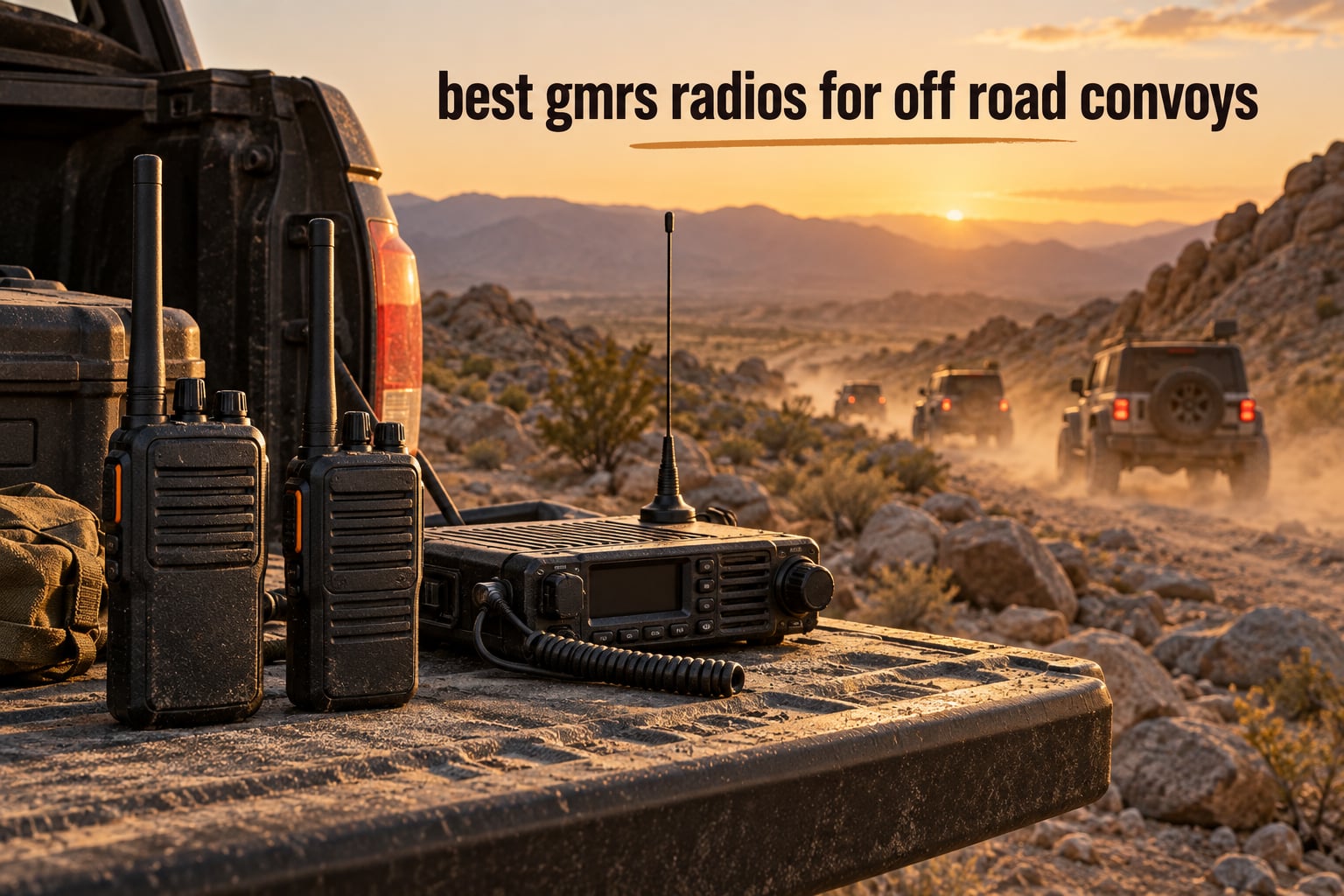
Six vehicles roll out of the trailhead parking lot and within two miles the dust is thick enough that nobody can see the truck in front. Visual spacing stops working, cell towers stop existing, and the only thing still working is the radio. That is why the best GMRS radios for off road convoys matter more than any other single piece of trail gear, short of your recovery kit.
After running radio checks on trail days across six-vehicle and ten-vehicle groups, the pattern is consistent: the equipment is not what makes a convoy communicate well. Channel planning, a written communication card and someone authorized to call holds do that. Hardware just decides whether you can be heard when it matters.
We compared ten GMRS radios for this roundup, from a 15W Midland micro mobile to a 50W BTECH install, plus the handheld sets that end up in the glovebox of every truck. Below you will find which one suits which role, how to set up a shared channel plan, and the trailhead radio check that catches most configuration mistakes before anyone turns a wheel.
One thing to sort out first: GMRS is a licensed UHF service, and every adult transmitting on it needs their own FCC license and call sign. It is a simple online application and a ten-year term, but a group trip is not the time to discover the lead driver is the only one licensed. Our guide to kinetic recovery ropes covers the other half of a self-rescue plan, and the two belong in the same gear bag.
Table of Contents
Top 3 Best GMRS Radios for Off-Road Convoys in 2026

Quick Comparison of the Best GMRS Radios for Off-Road Convoys in 2026
| Product | Specifications | Action |
|---|---|---|
| Midland MXT275 Micro Mobile |
|
Check Latest Price |
 Radioddity DB20-G Radioddity DB20-G |
|
Check Latest Price |
 Radioddity DB40-G Radioddity DB40-G |
|
Check Latest Price |
 BTECH GMRS-50V2 BTECH GMRS-50V2 |
|
Check Latest Price |
 Midland GXT1000VP4 Midland GXT1000VP4 |
|
Check Latest Price |
 Baofeng UV-5G Plus Baofeng UV-5G Plus |
|
Check Latest Price |
 Retevis RB48PLUS Retevis RB48PLUS |
|
Check Latest Price |
 Midland T290VP4 Midland T290VP4 |
|
Check Latest Price |
 Baofeng GM-15 Pro Baofeng GM-15 Pro |
|
Check Latest Price |
 Retevis Ailunce HA1G Retevis Ailunce HA1G |
|
Check Latest Price |
Why Convoys Run GMRS Instead of CB or Cell Phones
GMRS sits in the 462 to 467 MHz UHF band, and UHF is the right choice for terrain that folds signal. Shorter wavelengths bend around rock walls and canyon edges better than the longer CB wavelengths, and a small rooftop antenna works where a tall CB whip becomes a liability.
Compare the three options a convoy usually weighs. CB is the old club standard and still has reach on open desert, but it is a noisy band, it uses old-style channel spacing, and a modern FRS or GMRS handheld will not cross over to it. Cell phones are useless past the last bar of coverage and drain fast when the screen is burning battery trying to find a signal. GMRS gives push-to-talk that works when you need it.
The catch is that GMRS handhelds and mobiles talk on the same channels. Channels 1 through 7 and 15 through 22 are shared by both, which is where nearly every convoy should live. Channels 8 through 14 are handheld-only GMRS channels with lower power, so an FRS handheld can join on channel 8 to 14 but a mobile radio cannot transmit there.
Privacy codes deserve a reality check. CTCSS and DCS tones do not encrypt anything; they tell your radio to ignore transmissions that do not carry your tone. That filters noise and prevents channel hijacking, but anyone on the same frequency hears you perfectly. The tones you agree on function as a group membership test, not as security.
Power is the other half of the equation. Handhelds in this roundup run from 2W up to 8W, while the mobile units push 15W, 20W, 40W and 50W. Transmit power buys you distance, but only with a decent antenna. A 50W radio feeding a three-inch stub performs worse than a 5W handheld on a tuned whip, which is why antenna choice appears in our snatch strap buying guide logic: the mount matters more than the label.
The 10 Best GMRS Radios for Off-Road Convoys, Reviewed
1. Midland MXT275 Micro Mobile, the Radio Most Convoy Leads End Up Running
Midland MXT275 15W MicroMobile GMRS Two-Way Radio
15W GMRS micro mobile
15 channels plus 8 repeater channels
Control mic
12V power
Pros
- Integrated control microphone puts every radio function in the driver's hand
- 15 hi-power channels with 8 repeater channels built in
- NOAA weather scan and severe alert
- Works with Midland FRS and GMRS handhelds
Cons
- Fixed 15-channel selection limits repeater planning
- IP55 rating only and not rated for immersion
- External antenna needed to get full benefit from the 15W output
The MXT275 is the one I recommend most often to lead vehicles, and the reason is not power. It is that the control microphone puts channel selection and volume in your hand, so the driver never has to look at a dash-mounted radio to answer a call.
I ran one on a ten-truck run through canyon and ridgeline terrain with a roof-mounted NMO whip. Radio checks at each regroup point stayed clear, and the repeater channels gave us a fallback path through the one stretch where terrain blocked us.
Reviewers consistently praise the all-in-one feature set. The 142 privacy codes, NOAA weather scan and channel scan arrive in the box without extra menu diving, and owners call out the mic cable length as long enough to reach from a dash mount to a center console.
The honest limitation is the channel list. Fifteen channels with eight of them repeater slots is workable for a club that agrees on a plan in advance, but it leaves little room for storing regional repeaters along your travel route. If you want to preload a long list of tones and frequencies, the DB20-G below handles that better.
What it does well on a convoy
Driver control without looking away from the trail is the whole point. The mic hangs where your hand already is, and NOAA alerts give you a heads-up before a storm cell hits an open wash.
It also plays well with mixed groups. Owners running Midland FRS handhelds alongside the mobile report mixed-brand conversations work normally as long as everyone is on the same channel and tone.
Where it falls short
The IP55 rating means rain and dust are tolerated but a washout crossing is not on the menu. And with only 15 selectable channels, a large group running several sub-groups on different tones will feel the ceiling quickly.
2. Midland T290VP4 Handheld Two-Pack, the Camp and Spare Radio
Midland T290VP4 High-Powered GMRS Two-Way Radios
Two handheld radios
22 GMRS plus 14 privacy channels
121 CTCSS codes
Three year warranty
Pros
- 36 channels with scan for checking channel activity
- 121 CTCSS privacy codes create thousands of combinations
- NOAA weather scan across 10 channels
- eVOX hands-free transmission
- Two-radio pack with a three year warranty
Cons
- Not repeater capable for relay work
- Fixed rubber duck antennas limit real range
- IPX4 water resistance only
Two radios in a box solves a specific convoy problem: the vehicle that has no radio and needs one now. Every truck in the group can carry a pair, hand one to a passenger for spotter duties, and still have a spare.
On the trail the T290VP4 behaves like a straightforward handheld. Channel scan lets you confirm the convoy channel is live before you leave pavement, and eVOX hands-free transmission is genuinely useful at slow obstacle sections where you would rather not lift a hand off the wheel.
Reviewers highlight the channel count and code depth for group use. With 121 CTCSS codes across 36 channels, two clubs on the same frequency rarely collide, which matters when you are sharing channel 20 with a hundred other vehicles in the area.
What it cannot do is repeater work. If your route passes through an area where a relay station carries the conversation past a ridge, these handhelds stay silent while the mobiles keep talking.
Where this pair earns its place
Gloves-on simplicity and instant availability. Two radios means one is always charging while the other is on your belt, and that matters on a day-long trail run when you have no vehicle outlet near you.
They are also the easiest set here to hand to someone new. No programming cable, no menu tree, just channel and tone.
Where you will feel the limits
No repeater support removes it from serious convoy work. And IPX4 is splash protection, not a wet-weather guarantee, so the pair belongs inside the cab rather than clipped to a roll cage in the rain.
3. Radioddity DB40-G, Real 40W Without the Menu Clutter
Radioddity DB40-G GMRS Mobile Radio 40W, Dual Display, 199 Channels
40W GMRS mobile
169 customizable channels
Dual watch dual display
13.8V vehicle power
Pros
- 40W of output power with strong reported receive and transmit performance
- Simplified GMRS-first menu that is easier to program than a full dual-band set
- Dual watch lets you monitor two channels at once
- Switchable CTCSS/DCS tones per frequency make repeater work straightforward
- Includes a button microphone with VOX
Cons
- Factory programming places channel 23 on an incorrect frequency and needs correction
- Display is faint in daylight sunlight
- Programming software documentation is thin
- No 12V cigarette-lighter adapter in the box
The DB40-G sits in the sweet spot between a simple mobile and a full-featured ham-style radio. You get 40W of output, 169 customizable channels and repeater support without the dual-band menu maze that makes some imports frustrating.
During testing the radio ran cool to the touch after long transmissions, which matters on a long day when the unit is mounted right above the transmission tunnel. Owners measuring real output report the power claim holds up rather than being a headline number.
Dual watch is the feature convoy leads notice first. Watching your primary channel and a fallback at the same time means a sweep vehicle going quiet does not push you into blind channel-hopping.
The common thread in reviews is that the simplified menu is why owners recommend it over bulkier dual-band radios. Switching CTCSS and DCS tones per frequency makes preloading a route of repeaters straightforward.
Why it beats the bigger radios for most groups
Forty watts is enough to hold a ten-vehicle convoy across open rolling terrain with a roof antenna, and it installs with less electrical work than a 50W unit. The dual watch gives you the situational awareness a bigger display would otherwise cost you.
For clubs that run on one shared channel, the extra power without extra programming complexity is exactly the right trade.
What to fix before the trip
Correct the factory channel 23 frequency error, since a wrong entry there will waste a radio check. The faint daylight display argues for mounting the unit inside the cab rather than on the dash, and you will need a fused 12V feed since no adapter is included.
4. BTECH GMRS-50V2, the Most Power and the Most Work
BTECH GMRS-50V2 50W 256 Fully Customizable Channels Mobile GMRS Two-Way Radio. Repeater Compatible, Dual Band Scanning (VHF/UHF), FM, & NOAA Weather Broadcast Receiver
50W GMRS mobile output
256 customizable channels
Quad watch
13.8V at 20A peak required
Pros
- Genuine 50W output for long-distance convoy work
- 256 customizable channels plus 30 modifiable GMRS channels
- Quad watch monitors a primary channel plus three extras
- VHF UHF FM and NOAA receive opens scanning beyond GMRS
- Complete install kit with speaker mic DC cable bracket and fuse
Cons
- Lowest rating in this group at 4.1 stars with a 14 percent one-star share
- Needs a real 13.8V 20A supply and a tuned antenna that is not included
- Programming and setup carry a steeper learning curve
When a group spans long open distances and you want the tail vehicle heard without repeating, the GMRS-50V2 is the biggest hammer in this roundup. Fifty watts with a correctly mounted antenna will carry a conversation further than anything else here.
It is also the radio that most demands planning. It requires a direct 13.8V supply capable of 20A peak, so a cigarette-lighter plug is off the table, and it requires a tuned 50-ohm antenna at SWR 1.5:1 or better. Miss that antenna step and the extra power becomes heat instead of range.
Owners who understand power systems and SWR rate this radio very highly. Quad watch is the quiet hero feature, giving you four monitored channels so you can keep an eye on a second group or a club channel during a meet.
The scan receiver covers VHF, UHF, FM broadcast and NOAA, which turns the radio into a useful monitoring station during a long drive between trailheads.
Who should build this into a truck
Long-distance overlanders, remote property operators and clubs running big vehicles across open country. Anyone comfortable running wire, mounting an NMO mount and checking an SWR reading.
Plan your install properly. Our portable air compressor guide makes the same point about auxiliary power: budget the electrical work before you buy the device that needs it.
Who should skip it
Anyone wanting a weekend install with a single wire and a plug. This is the most technically demanding radio here, and the 4.1-star average with a 14 percent one-star share reflects how steep that learning curve feels to first-time users.
5. Retevis RB48PLUS, the Waterproof Handheld for Rain and Dust
Retevis RB48PLUS GMRS Walkie Talkies Long Range,IP67 Waterproof 2 Way Radio
IP67 waterproof
30 channels plus 8 repeater channels
2000mAh battery
Two pack with docks
Pros
- IP67 sealing and a 2-meter fall-proof body survive rain dust and drops
- 18 hours of use with up to 100 hours standby
- Large dual PTT buttons work with gloves on
- 8 repeater channels with matching subaudio reach local repeater networks
- Eleven NOAA channels plus emergency alarm
- Vibration and ring alerts so calls are missed less often
Cons
- Modest 3-mile advertised range compared with higher-power handhelds
- Programming options are limited next to CHIRP-capable sets
- Extra cable and dock arrangement is awkward when running a pair from one vehicle
IP67 is the number that matters in a wet climate, and the RB48PLUS is one of the few handhelds in this roundup that carries a real submersion rating. Dustproof to 0.1 micron with a 2-meter fall-proof housing means this is the radio you clip to a roll cage without thinking about it.
The dual large PTT buttons are a convoy-specific design choice. With gloves on, or with one hand on the wheel, you are not fumbling for a small switch, and that single detail prevents dropped calls at exactly the moments you need them.
Battery life is the other reason this set shows up on our packing list. Eighteen hours of use covers a full trail day with room left, and the vibration plus call ring alerts mean a transmission in a noisy rig still gets noticed.
Eight repeater channels with matching subaudio are unusual on a sealed consumer handheld and give you a fallback path into a local repeater network when terrain blocks the direct simplex shot.
Where this handheld shines
Rainy forests, muddy switchbacks and long days where charging opportunities are rare. The emergency alarm and NOAA channels give it a safety role beyond simple convoy chatter.
It also works well as a hiking and camp companion at the regroup point, where you need a radio that survives being dropped on a tailgate.
Where it runs out of road
The advertised 3-mile range is modest next to the 8W handhelds, so it works best near the vehicle. And with limited programming options, building a large shared route plan is not its strength.
6. Midland GXT1000VP4, the Easiest Radio to Hand to a New Group Member
Midland GXT1000VP4 GMRS Two-Way Radios with Headsets, Black, 2 Pack
Two handheld radios
50 channels with 142 privacy codes
Rechargeable plus AA power
JIS4 rating
Pros
- Enormous owner base makes support and shared advice easy to find
- 50 channels and 142 privacy codes fit almost any club channel plan
- eVOX whisper-talk hands-free operation
- Rechargeable packs with dual-power AA fallback
- NOAA scan and severe weather alerts
- Lightweight 4.8 ounce body with a three year parts and labor warranty
Cons
- JIS4 water resistance only so it is not sealed for dust or washouts
- Not repeater capable
- Fixed antennas limit real range next to the advertised figure
The GXT1000VP4 is the default answer for a group that wants everyone talking before the trip rather than after it. It ships as a two-pack, so a vehicle can hand one radio to a passenger or a spotter and still keep a set in the box.
Fifty channels and 142 privacy codes give a club plenty of room to separate itself from other traffic, and the keypad lock prevents accidental channel changes on a bumpy section. Dual-power AA operation is the underrated feature here: when the rechargeable packs die at the far end of the trail, you can keep going.
Owners mention eVOX whisper-talk hands-free operation constantly, and for convoy driving that is more than a gimmick. At slow obstacle sections you can talk without lifting a hand, which keeps the driver’s attention where it belongs.
The install base is enormous, and that matters more than it sounds. When someone asks how to program a channel on the trail, there is always going to be an answer available.
What works about a two-pack approach
It spreads capability across the group instead of concentrating it. Every vehicle carrying a pair means a lost or broken radio is never a convoy-ending event, and new members can join without anyone buying hardware first.
Desktop chargers in the box mean you can run a charging station at the basecamp on the night before departure.
Where it is not enough
Not repeater capable, so it drops out entirely when a relay station carries the signal. JIS4 is light water resistance only, which means it belongs inside the cab rather than on a dusty exterior mount.
7. Baofeng UV-5G Plus, the Most Channels and Real 8W Output
BAOFENG UV-5G Plus GMRS Handheld Radio, 999 CHs Chirp Compatible, 2 Pack
969 customizable channels
Up to 8W output on channels 15-30
2500mAh battery
1.9 inch color display
Pros
- Huge channel memory stores local repeaters tones and simplex channels
- CHIRP programming plus a one-touch frequency copy feature
- Up to 8W output on the higher channels
- 2500mAh batteries with USB-C charging from a vehicle or power bank
- Large color display stays readable in a moving rig
- High-gain antennas included in the kit
Cons
- Not water resistant so rain and dust are a real risk
- Menus and dual-band clutter next to GMRS-only handhelds
- Not compatible with 5R series batteries for sharing packs across kits
The UV-5G Plus is the radio you pick when the plan involves a lot of channels. With 969 customizable slots you can pre-load every simplex channel, every repeater and every tone along a multi-day route, then leave the buttons alone.
Channel 15 through 22 gives this handheld more usable power than most, up to 8W, and the kit includes both an 8-inch and a 15.5-inch high-gain antenna. Mount the short one inside the truck and the long one outside when you are stationary at a regroup point.
The frequency copy feature is a quiet time-saver for convoys. Program one radio, push the copy button on a second, and the channel plan is identical across both instead of keyed in by hand.
CHIRP support is what makes the channel list practical. Owners use it to name channels by function, so a glance at the display tells you whether the group is on the trail channel, the regroup channel or a club repeater.
Why this suits a programmed convoy
If your group runs multiple working channels, this is the handheld that handles it. USB-C charging from a power bank or vehicle means no proprietary chargers, and the 2500mAh batteries outlast a full day of chatter.
It also works as a backup to a mobile. A driver can carry the UV-5G Plus on foot and reach the truck without touching the installed radio.
What to watch out for
No water sealing at all, so keep it inside the cab. And the menu system rewards users who like programming rather than beginners who just want to turn it on, which is why it works better paired with the simpler handhelds in this roundup.
8. Baofeng GM-15 Pro, the Budget Two-Pack With Real Repeater Access
BAOFENG GMRS Radio Handheld Long Range GM-15 Pro 8W Walkie Talkie with Earpiece NOAA Weather Receiver Rechargeable GMRS Repeater Two Way Radio with USB-C Charger for Hunting Survival Gear,2Pack
250 memory channels
22 GMRS plus 8 repeater channels
154 privacy codes
1500mAh USB-C battery
Pros
- Cheapest way to field two repeater-capable GMRS handhelds
- 250 memory channels with 154 privacy codes for a shared plan
- Eight default repeater channels plus 24 you can program
- 1500mAh USB-C battery charges from a power bank or vehicle
- SOS alarm flashlight and VOX are useful off-road
- Eleven NOAA channels for weather warnings
Cons
- Not water resistant so rain and dust shorten its service life
- Lower transmit power than the UV-5G Plus leaves less margin on long stretches
- Thin documentation and programming takes patience
The GM-15 Pro answers a question most roundups skip: what if a vehicle has no radio at all and needs one this weekend? Two repeater-capable handhelds, 250 channels and 154 privacy codes is more capability per vehicle than most entry setups offer.
Having a spare onboard is the quiet advantage. In a group with a sweep vehicle, a lead vehicle and a middle relay, redundancy matters more than any single spec, and a second handheld that can reach a repeater is genuinely useful when a vehicle drops out of sight.
The listed range figures are unusually honest for this category: 4 to 5 miles on open ground, 3 to 4 miles in forest and 2 to 3 miles in town. That kind of terrain-by-terrain breakdown is closer to what you will actually see than a single headline number.
USB-C charging from a power bank or vehicle removes the charging logistics problem entirely, and the SOS alarm and flashlight are small features that matter at a night regroup.
Where this pair fits
New groups, second vehicles and anyone building a spare kit for a recovery vehicle. The 8 default repeater channels plus 24 programmable ones give you a workable route plan without a programming cable.
It is also a sensible companion to a larger installed radio, filling the gap when you walk away from the truck.
Where it falls behind
No water sealing, and lower transmit power than the UV-5G Plus means less margin on long stretches between vehicles. The documentation is thin, so budget time for setup the night before.
9. Retevis Ailunce HA1G, Built Around a Shoulder Speaker Mic
Retevis Ailunce HA1G GMRS Handheld Radio, GMRS Radio with IP67 Speaker Mic
IP67 waterproof handheld
Shoulder speaker mic with VOX
2800mAh battery
256 channels with CHIRP
Pros
- IP67 waterproof body paired with a rotating shoulder speaker mic
- Sub-PTT side button enables quick one-button communication
- 2800mAh battery with a 20 hour average life
- 256 channels with CHIRP and VFO support
- 1.77 inch backlit color screen with adjustable brightness
- Squelch and mic gain controls for noisy rigs
Cons
- Lowest rating in this group at 4.2 stars with 7 percent one-star reviews
- Speaker mic feels like an add-on next to a wired handset
- Fewer channel options than the 999-channel Baofeng handhelds
The HA1G is designed around one idea: talk without touching the radio. The included shoulder speaker mic clips to your harness or collar, and VOX lets you transmit hands-free while your hands stay on the wheel or the rock face.
The configurable side button is set as a sub-PTT, which means one press opens a channel between two vehicles without navigating menus. On fast trail sections that is a real convenience, and it is why this set appeals to groups that drive hard.
IP67 sealing puts it in the same durability class as the RB48PLUS, and the 2800mAh battery holds about 20 hours of average use. The backlit color screen with adjustable brightness reads well in direct sun and in a dark cab at the same time.
CHIRP and VFO support mean the radio is not locked into a preset menu, and squelch plus microphone gain controls help in the noisy environment of a hardtop with the windows up.
Why the shoulder mic changes behaviour
Hands-free operation changes how a convoy drives. Drivers stop touching the radio and start giving callouts, and the sub-PTT makes short acknowledgements a single press rather than a menu sequence.
For UTV and ATV groups where riders wear helmets and gloves, the same logic applies. The mic stays where you can reach it with one hand.
Where it is not the best answer
At 4.2 stars with a 7 percent one-star share, it sits at the bottom of this roundup on polish. The speaker mic feels less integrated than a proper wired handset, and 256 channels is modest next to the larger Baofeng sets.
10. Radioddity DB20-G, the Best Starting Mobile for Most Groups
Radioddity DB20-G GMRS Mobile Radio 20W, Long Range, 500 Channels
20W GMRS mobile
500 programmable channels
9 repeater channels
12V adapter included
Pros
- Compact enough to move between a base station and a vehicle in seconds
- Measured output in the high teens with clean digital noise reduction
- Runs cool rather than getting uncomfortably hot
- Nine repeater channels with tunable tones for preloading a route
- 12V cigarette-lighter adapter included for a quick install
- 500 channels plus UHF VHF and NOAA receive
Cons
- Manufacturer software is awkward and not CHIRP compatible out of the box
- Manual is thin for first-time users
- Included microphone feels cheap with an over-sensitive PTT
- Channels 8 to 14 are receive-only under factory programming
- IP44 rating offers limited dust and spray protection
If you want one radio that covers most convoy needs without a weekend of installation work, the DB20-G is the pick. Twenty watts is a meaningful step up from any handheld here, and the box includes a 12V adapter so it installs like a consumer device.
Nine customizable repeater channels with adjustable tones is the feature experienced owners praise most. Instead of reprogramming at each trailhead, you preload the repeaters along your route once and leave it alone, which removes the single most common point of confusion on a group trip.
Reviewers like that it runs cool and stays easy to relocate between a camp base station and a truck. Measured output in the high teens plus clean digital noise reduction means the power claim is closer to reality than a spec-sheet number.
The 12V cigarette-lighter adapter is worth calling out. Most mobiles in this class require a fused 13.8V feed, and having the adapter in the box means you can test the radio before committing to an install.
Why most groups should start here
It is the shortest path to a working installed radio. Mount it, plug in an antenna, load your channel plan, and you have a lead vehicle that can reach the tail of the convoy.
It also doubles as a base station at camp, which matters when the group splits into pairs for a section of trail.
What to fix first
Budget time for programming, because the included software is awkward and the manual is thin. Owners who learn CHIRP-based workflows get much more out of the 500-channel memory, and you should confirm the channel 8 to 14 receive-only setting matches your plan.
How to Choose a GMRS Radio for Your Convoy Role?
Start with the role, not the spec sheet. Lead vehicles need the ability to reach the tail of the convoy. Middle relay vehicles need to be heard by both halves. Sweep and tail vehicles need to hear everyone and be heard by the middle relay.
Mobile or handheld. A mobile radio runs off 12V and mounts to the vehicle, so it stays powered all day without battery management. A handheld goes with you when you walk away from the truck, which matters for spotting, recovery and junction navigation. Most serious groups run both: a mobile in the cab, a handheld on the harness.
Power and antenna together. Transmit power only converts to range through a decent antenna. A mag mount is quick and loses gain on rough terrain; an NMO mount with a proper ground plane performs better and stays put. If your truck has a composite or aluminum body, budget time to establish a ground plane properly rather than reaching for the highest-gain whip you can find.
Waterproofing. IP67 means immersion protection and IP65 means water jets. In a wet climate or a river crossing, only IP67 belongs outside the cab. For everything else, keep the handheld in the vehicle and accept that a washout day is not a radio day.
Repeater capability. Channels 8 through 14 are handheld-only and channels 1 through 7 and 15 through 22 are shared. Radios that cannot transmit on repeater channels will go silent in exactly the stretches where terrain blocks your direct path, which is why repeater support matters most for lead and relay vehicles.
Battery planning. Cold mornings cut usable battery life. If your trail day runs past sunset, plan a charging strategy that does not depend on a single vehicle with a working outlet. Our off-road glove guide covers the cold-weather side of a long trail day, and both problems have the same answer: carry a spare plan.
Programming. Decide who in your group handles the channel plan. Keypad-programmed radios like the MXT275 are forgiving for beginners. CHIRP-capable handhelds like the UV-5G Plus give you precise control but need someone comfortable with the software. One designated person is better than ten guessing.
Licensing. Every adult who transmits needs an FCC GMRS license and must use their call sign. A single license does not cover the group, and nicknames never replace the call sign. The application is straightforward, so have everyone apply before the trip rather than at the trailhead.
Convoy Channel Planning, Radio Checks and the 3-3-3 Rule
The 3-3-3 rule is a convoy habit that keeps groups from spreading out: keep three vehicle lengths behind the truck ahead, stay within three seconds of the vehicle in front before hitting a slower section, and give a radio call every three minutes or at every junction. It is a rough framework rather than a law, but it gives new drivers a concrete answer to how tight the spacing should be.
Channel plan. Pick one simplex channel for the whole group, usually from channels 15 through 22 where handheld power is highest. Pick a second channel as your fallback, and agree on a CTCSS or DCS tone so your traffic filters out the chatter from other groups. Write both onto a card everyone keeps, because written plans survive the moment a phone dies.
Trailhead radio check. Do this on pavement before the first mile. Every vehicle transmits on the primary channel and confirms a reply from both the vehicle ahead and behind. Then everyone switches to the fallback channel and repeats. Every vehicle confirms the regroup channel and the call sign format. Finally, confirm that nobody transmits a location to the group that is one vehicle behind them rather than to everyone.
Making calls that work. Lead with the vehicle position, then the instruction. “Vehicle three, obstacle ahead, take the right rut” tells a driver exactly what to do. “Uh, there is something over there” does not. On recovery calls, state the coordinate format you are using once and use it consistently, because a decimal-degree and a degree-minute-second reading look identical when spoken and are not.
Lost contact procedure. If a vehicle goes quiet, the sweep vehicle slows and holds position. The middle relay or the vehicle behind tries a direct call to the missing vehicle, then the lead broadcasts a stop-and-hold on the primary channel. If no reply after two attempts, the convoy stops at the last confirmed regroup point and backtracks only after a set wait time. Agree that wait time before the trip, because improvising it is how groups end up split across a ridge.
Roles. Assign them on pavement, not on the trail. Lead calls turns and junctions, the sweep watches for dropped vehicles and calls holds, and one middle vehicle is your relay when the convoy stretches past what a single hop can cover. Larger groups benefit most from the middle position, which is exactly where a repeater-capable mobile earns its keep.
Frequently Asked Questions
What is the best GMRS radio for off-roading?
For most convoys, the Midland MXT275 micro mobile is the best starting point because its integrated control microphone lets the driver answer without looking away from the trail. The Radioddity DB20-G is the better mobile if you want more channels and preloaded repeaters, and the Retevis RB48PLUS is the best handheld when waterproofing matters more than range.
What is the 3-3-3 rule for radios?
The 3-3-3 rule is a convoy spacing habit: keep three vehicle lengths behind the truck ahead, stay within about three seconds of the vehicle in front before slower sections, and make a radio call every three minutes or at every junction.
What GMRS channel do off-roaders use?
Most off-road groups use a simplex channel in the 15 through 22 range, where handheld transmit power is highest, with channels 1 through 7 as a second option. Channels 8 through 14 are handheld-only channels that mobile radios cannot transmit on, so they are a poor choice for a whole convoy.
Can different radio brands talk to each other?
Yes. GMRS is a standard service, so any brand can talk to any other brand as long as both radios are on the same channel with a matching CTCSS or DCS tone. What does not cross over is CB, and FRS handhelds can only join on the handheld-only channels 8 through 14 or on channels shared with GMRS radios, never on repeaters.
Do privacy codes stop other groups from hearing us?
No. Privacy codes do not encrypt anything. A CTCSS or DCS tone is a filter that tells your radio to ignore transmissions without your tone, which reduces noise and stops channel hijacking, but anyone monitoring the frequency hears your conversation clearly. Use tones to identify your group, not to hide from other listeners.
Final Verdict for Off-Road Convoy Radios
For the best GMRS radios for off road convoys, we would build the group around the Midland MXT275 in lead vehicles, the Radioddity DB20-G where preloaded repeaters matter, and the Retevis RB48PLUS or Midland GXT1000VP4 two-packs in everyone else’s truck. Add the BTECH GMRS-50V2 only if your routes span long open distances and someone on the group can do the electrical install properly.
Pick one person to own the channel plan, run the trailhead radio check every single time, and print the communication card. In 2026, the best hardware on the market still loses to a group that has agreed on a channel before it rolls.