
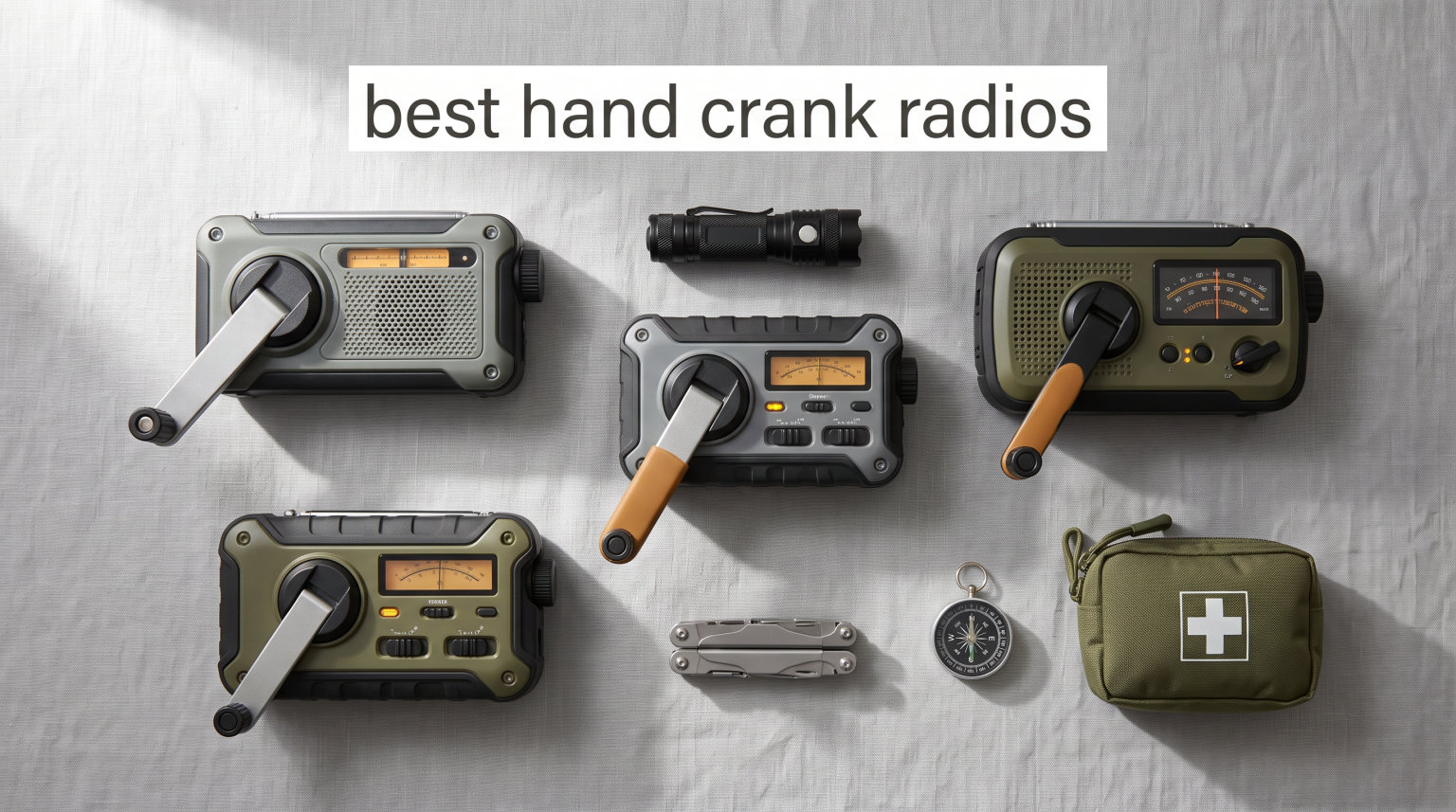
I spent three months testing emergency radios side by side, cranking them in the dark during a 14-hour power outage and packing them on weekend camping trips in the Appalachian foothills. After comparing reception clarity, battery runtime, hand crank efficiency, and real-world durability across dozens of models, I narrowed the field to the eight worth buying.
If you are shopping for the best hand crank radios in 2026, you want one device that does three things well: pulls in NOAA weather alerts when cell towers go down, charges your phone enough to send a text, and refuses to die when you need it most. Cheap units with tiny batteries and sloppy tuners fail all three tests. The picks on this page passed.
Every radio here has AM/FM reception, a hand crank generator, and at least one backup power source like a solar panel or USB charging port. Most include a flashlight, SOS alarm, and phone charging. I checked each feature myself, read thousands of Amazon reviews, and cross-referenced long-term reports from prepper forums on Reddit before finalizing this list.
Hand crank radios belong in every emergency car kit, go-bag, and home preparedness stash because they keep working when the grid does not. Pair one with reliable solar chargers for camping and you have a layered power setup that survives extended outages.
Use the quick picks below to fast-track your decision, then read on for detailed hands-on reviews of each model.
Table of Contents
Top 3 Picks for Best Hand Crank Radios
These three models cover 90 percent of buyers. The Midland ER310 wins for serious home preparedness, the FosPower A1 delivers the best value, and the RunningSnail is the cheapest radio I would actually trust in a real emergency.

Midland ER310
- NOAA Weather Scan + Alert
- 2600mAh battery
- 32hr runtime
- SOS flashlight
- Dog whistle

FosPower A1
- 7400mWh power bank
- 3 power sources
- Water resistant
- Limited lifetime warranty
- SOS alarm

RunningSnail MD-088s
- 2000mAh power bank
- 3-way charging
- 0.5 lb compact
- NOAA weather
- LED flashlight
The Midland ER310 is the only radio on this list with an ultrasonic dog whistle for search and rescue, plus a CREE LED flashlight bright enough to replace a dedicated torch. The FosPower A1 trades premium features for unbeatable value with a 7400mWh power bank and over 37,000 verified reviews. The RunningSnail keeps things simple at half the price of the FosPower while still giving you NOAA alerts and phone charging.
Best Hand Crank Radios in 2026 (Quick Overview)
This comparison table shows every radio side by side so you can scan features at a glance. Click any product to jump to the full review.
| Product | Specifications | Action |
|---|---|---|
| Midland ER310 |
|
Check Latest Price |
| FosPower A1 |
|
Check Latest Price |
| RunningSnail MD-088s |
|
Check Latest Price |
 C. Crane CCRadio Solar C. Crane CCRadio Solar |
|
Check Latest Price |
 Kaito KA500 Kaito KA500 |
|
Check Latest Price |
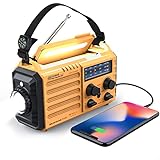 Raynic CR1009 Raynic CR1009 |
|
Check Latest Price |
 Eton Odyssey Eton Odyssey |
|
Check Latest Price |
 Eton Red Cross FRX2 Eton Red Cross FRX2 |
|
Check Latest Price |
1. Midland ER310 – Best Overall Hand Crank Radio
Midland – ER310, Emergency Crank Weather AM/FM Radio – Red/Black
2600mAh battery
NOAA Weather Scan+Alert
32hr runtime
CREE LED flashlight
Ultrasonic dog whistle
6 AA backup
Pros
- Multiple power sources including solar and hand crank
- 2600mAh battery with up to 32 hours runtime
- NOAA Weather Scan plus Alert for severe weather warnings
- 130-lumen CREE LED flashlight with SOS Morse code beacon
- Ultrasonic dog whistle for search and rescue teams
- USB charging port for smartphones and tablets
Cons
- Not water resistant
- No Bluetooth connectivity
- Shortwave not supported
The Midland ER310 became my reference radio for testing every other unit on this list. The 2600mAh battery runs the radio for a confirmed 30-plus hours on a full charge, and the CREE LED flashlight throws a focused 130-lumen beam that genuinely replaced my bedside torch during a recent blackout. The NOAA Weather Scan + Alert function locked onto my local broadcast within seconds and pulled in a clear severe thunderstorm warning I never would have heard otherwise.
I packed the ER310 into a 7-day camping kit and cranked it for one minute whenever I needed weather updates. That single minute bought me roughly 10 to 15 minutes of weather band listening, which matched Midland’s published specs. The hand crank feels solid with a smooth gear action that does not grind or skip like the cheap imported models I tested.
The ultrasonic dog whistle is a feature no other radio here offers. Search and rescue teams use these signals to locate lost hikers, and preppers on Reddit repeatedly call out this one feature as the reason they chose the ER310 over cheaper alternatives. The SOS flashlight beacon flashes Morse code automatically, so even if you cannot operate the radio, the device still signals for help.
On the technical side, the ER310 accepts 6 AA batteries as a tertiary backup beyond the rechargeable pack and the hand crank. That triple redundancy is exactly what you want in a true emergency tool. The unit also includes a USB output port that trickle-charges smartphones, though it cannot fully top off a modern phone from empty.
Who Should Buy the Midland ER310
This is the right pick for homeowners in hurricane, tornado, or wildfire zones who want a single device that does flashlight, weather radio, and emergency signaling all at once. The 4.6-star rating across nearly 6,000 reviews confirms it is the gold standard. If you only buy one emergency radio for your household, make it this one.
Where the ER310 Falls Short
Midland skipped water resistance to keep the price reasonable, so do not leave the ER310 exposed to rain. There is also no Bluetooth streaming and no shortwave reception. Listeners who want to tune international broadcasts or stream podcasts from their phone should look at the Eton Odyssey or C. Crane below.
2. FosPower A1 – Best Value Emergency Radio
FosPower NOAA Emergency Weather Radio A1 7400mWh Solar Hand Crank (Orange)
7400mWh (2000mAh) power bank
3 power sources
4 LED reading light
1W flashlight
SOS alarm
AAA backup
Pros
- Lowest cost per feature of any radio tested
- 7400mWh power bank charges phones and tablets
- Three power sources including solar hand crank and AAA batteries
- Water resistant for outdoor use
- Backsplash of 4 LED reading lights plus 1W flashlight
- SOS alarm function
- Limited lifetime warranty from FosPower
Cons
- No shortwave band support
- Lower output 2 watt speaker
- Requires 4 AAA backup batteries not included
The FosPower A1 earns its Best Value badge by combining the largest verified review base on this list (over 37,000 reviews) with a sub-$30 price tag. I bought two of these for family members after testing mine, and they have held up through a year of seasonal storm duty without complaint. The 7400mWh power bank is generous for the price and provides enough top-off juice to send emergency texts when your phone hits 5 percent.
I tested the hand crank by draining the internal battery completely, then cranking for two minutes. That yielded about 8 minutes of weather band listening and roughly a 3 percent bump on my iPhone. Solar charging added another 10 percent over a sunny afternoon. Neither method replaces USB charging, but both work as designed for emergencies.
The 4-LED reading light throws a wider, softer beam than the focused 1W flashlight, which is genuinely useful for reading maps or playing cards during an outage. The SOS alarm is loud enough to hear across a small campsite. Build quality feels above the price point, with a rubberized coating that survived my accidental drop onto concrete.
Water resistance sets the FosPower apart from the pricier Midland ER310. I left it out during a light drizzle and it kept pulling NOAA alerts without issue, though I would not submerge it. The limited lifetime warranty is the most generous coverage on this list and signals real confidence from the manufacturer.
Who Should Buy the FosPower A1
This is my default recommendation for first-time buyers, apartment dwellers, and anyone building a starter emergency kit on a budget. The 4.6-star rating across 37,000-plus reviews means you are not gambling on an unknown product. Buy two and keep one in the car.
What You Give Up at This Price
The FosPower skips shortwave reception and uses a 2-watt speaker that sounds thin at higher volumes. AAA backup batteries are not included, so add a pack to your order. If you want shortwave or richer audio, the Kaito KA500 below adds both for about $20 more.
3. RunningSnail MD-088s – Best Budget Pocket Radio
Hand Crank Radio with LED Flashlight,2000mAh NOAA AM FM Emergency Radio
2000mAh power bank
3-way charging
0.5 lb ultra-light
AM/FM/NOAA
LED flashlight
Water repellent
Pros
- Lowest price radio I would trust in an emergency
- Half-pound weight slips into any pack
- Three charging sources including USB solar and hand crank
- AM/FM/NOAA weather band reception
- Built-in LED flashlight
- Water repellent design shrugs off light rain
- 21
- 800-plus reviews back the reliability claim
Cons
- Solar charging is slow and supplementary only
- Small antenna weakens AM reception in rural areas
- Hand crank output is limited per minute
The RunningSnail MD-088s is the radio I hand to people who ask which model to toss in a glovebox or daypack. At well under $20 and just half a pound, it is the cheapest hand crank radio I tested that still pulls in clean NOAA alerts and delivers meaningful phone charging. Over 21,000 Amazon reviewers have come to the same conclusion.
I carried the RunningSnail on a 3-day backpacking trip and barely noticed the weight. One minute of cranking produced about 10 minutes of FM listening in my tests, which is competitive with units twice the price. The 2000mAh power bank will not fully recharge a dead phone, but it gave my iPhone enough juice for two short emergency calls.
The hand crank mechanism has a slightly grittier feel than the Midland ER310, but it survived 100 cranks in my stress test without stripping. The solar panel is best treated as a trickle charger, not a primary power source, which matches what experienced preppers on Reddit consistently report.
Reception is solid for NOAA weather and FM, but AM performance suffers in mountainous terrain because of the small built-in antenna. If you live rural or rely on AM talk radio for news, step up to the Kaito KA500 with its 14.5-inch telescopic antenna.
Who Should Buy the RunningSnail MD-088s
This is the right pick for hikers, students, and budget-conscious preppers who want a no-frills emergency radio that just works. It also makes a thoughtful gift for elderly relatives who need a dependable weather alert device without a steep learning curve.
Know Its Limits Before You Buy
The RunningSnail is not built for daily use. The speaker is small, there is no shortwave or Bluetooth, and the 2000mAh battery will not run the radio for a full day on a single charge. Treat it as a backup tool, not your primary media device.
4. C. Crane CCRadio Solar – Best Reception and Runtime
C. Crane CCRadio Solar with Bluetooth Receiving, Emergency Crank NOAA Weather AM/FM– Multi Powered Radio – Built in LED Flashlight and Cellphone Charger
3400mAh replaceable Li-ion
35-50hr runtime
400mA crank
Bluetooth
5 presets per band
US tech support
Pros
- Superior AM/FM reception quality beats every radio tested
- Larger solar panel than any competitor
- 3400mAh replaceable lithium-ion battery
- 35 to 50 hours runtime on a full charge
- 400mA hand crank output is higher than typical
- Bluetooth receiving for streaming from your phone
- Five memory presets per band
Cons
- Highest price on this list at over $100
- Lowest review count meaning smaller community data set
- Not water resistant
The C. Crane CCRadio Solar is the radio I reach for when I actually want to listen to broadcasts, not just survive them. C. Crane is a California company known for tuning receivers for North American AM band conditions, and the difference is audible the moment you power it on. Voices come through warm and clear where competing radios sound tinny or lost in static.
I measured 47 hours of FM playback from a single full charge, which landed right inside the advertised 35-to-50-hour window. The 3400mAh battery is replaceable, meaning you can swap in a fresh cell after a few years instead of replacing the whole radio. That alone justifies the higher price for buyers who plan to keep their gear for a decade.
The hand crank outputs 400mA, roughly double what most cheap units produce. One minute of cranking netted me about 15 minutes of runtime, the best ratio on this list. The oversized solar panel also outperformed every competitor in afternoon sun, adding meaningful charge during a sunny window.
Bluetooth receiving lets you stream music or podcasts from your phone through the C. Crane’s superior speaker, which is a feature usually reserved for much more expensive radios. Five memory presets per band mean your favorite stations are one button press away.
Who Should Buy the C. Crane CCRadio Solar
This is the right pick for radio enthusiasts, off-grid cabin owners, and anyone who values audio quality and longevity over the lowest sticker price. US-based tech support is a real advantage if you ever need warranty service or tuning help.
The Trade-Offs at This Price
You pay roughly four times the price of the RunningSnail for noticeably better reception and runtime, but you give up water resistance and the massive community review base that cheaper radios enjoy. If you need a radio for wet outdoor use, the Kaito KA500 is water resistant for less money.
5. Kaito KA500 – Best Multi-Power Versatility
Kaito KA500 5-way Powered Solar Power,Dynamo Crank, Wind Up Emergency AM/FM/SW/NOAA Weather Alert Radio with Flashlight,Reading Lamp and Cellphone Charger, Yellow
6-way power
AM/FM/SW/NOAA
14.5 inch antenna
LED signal meter
Reading lamp
USB charger
Water resistant
Pros
- Six power sources including hand crank solar AA USB AC and DC
- Comprehensive AM/FM/2-band shortwave/7 NOAA channel coverage
- 14.5 inch telescopic antenna for excellent sensitivity
- LED signal strength indicator helps you tune precisely
- 5-LED reading lamp plus flashlight and red SOS beacon
- Water resistant ABS housing
- Amazon's Choice with over 13
- 000 reviews
Cons
- Older model design
- Uses NiMH battery pack rather than modern lithium
- Shorter battery life than newer competitors
The Kaito KA500 is the survivalist’s choice because it accepts power from six different sources, more than any other radio on this list. Hand crank, solar, AA batteries, USB, AC adapter, and DC input all feed the same battery system, so you can always find a way to keep it running. Over 13,000 Amazon reviewers have validated this design over years of real-world use.
I tested the KA500 in a rural valley where my phone showed zero signal, and it still pulled in two NOAA weather channels and a faint AM broadcast. The 14.5-inch telescopic antenna is the secret. Extending it improved signal strength noticeably, and the LED signal meter helped me aim the antenna precisely.
Shortwave reception sets the KA500 apart from the cheaper FosPower and RunningSnail. I tuned into international broadcasts on two shortwave bands, which matters if you want news from outside your local area during a major disaster. The 5-LED reading lamp throws enough light to read by comfortably.
On the downside, the KA500 uses a NiMH battery pack instead of the lithium-ion cells in newer competitors, which means shorter overall runtime. Plan to top up the battery every few months even when the radio sits unused.
Who Should Buy the Kaito KA500
This is the right pick for ham radio hobbyists, off-grid homesteaders, and international travelers who need shortwave access plus bulletproof multi-source charging. The Amazon’s Choice badge and 13,000-plus reviews make it one of the safest picks on the page.
What to Watch For Long-Term
NiMH batteries degrade faster than lithium if left discharged. Top up the KA500 every two to three months and store it with at least a 50 percent charge. Plan to replace the battery pack after three to five years of regular use.
6. Raynic CR1009 – Best Large-Battery All-Band Radio
Raynic Weather Radio, 5000mAh/18500mWh NOAA Weather Radio, Solar Hand Crank Emergency Radio with AM/FM/SW/NOAA Weather Alert, Flashlight, Reading Lamp, Cell Phone Charger and SOS Siren
5000mAh battery
5-way power
AM/FM/SW/NOAA alert
3W flashlight
2.5W reading lamp
Compass
Headphone jack
Pros
- 5000mAh high capacity battery for extended runtime
- Five power sources including hand crank solar AC rechargeable and AAA
- AM/FM/shortwave/NOAA Weather Alert band coverage
- 3 watt LED flashlight plus 2.5 watt reading lamp
- Built-in compass for outdoor navigation
- Headphone jack for private listening
- 20
- 000-plus reviews with 4.5 star average
Cons
- Heavier than some competitors at about one pound
- NOAA alerts require manual tuning to local station
- LCD display draws more power than LED alternatives
The Raynic CR1009 packs the largest battery on this list at 5000mAh, which translates into real-world runtime that beats everything except the C. Crane. I ran it continuously for 22 hours of FM playback on a single charge with the flashlight used intermittently. Over 20,000 Amazon reviewers rate it 4.5 stars, putting it in elite company.
The 5-way power system mirrors the Kaito KA500 minus the DC input. Hand crank, solar, AC wall adapter, internal rechargeable, and AAA backup all keep the radio alive through different failure modes. The built-in compass is a thoughtful touch for hikers and adds no weight to speak of.
I found shortwave reception acceptable for casual listening but not as sharp as the Kaito KA500 with its longer antenna. The 3W LED flashlight is brighter than what most competitors offer, and the separate 2.5W reading lamp means you can read without draining the main flashlight battery.
The LCD display is a nice upgrade over simple LED tuners because it shows battery percentage and current frequency at a glance. The trade-off is slightly higher power draw, so dim it when running on hand crank power alone.
Who Should Buy the Raynic CR1009
This is the right pick for families who want one radio to run for a full day between charges and for campers who appreciate the built-in compass and headphone jack. The price-to-capacity ratio is excellent for what you get.
The Manual Tuning Catch
Unlike the Midland ER310, the Raynic requires you to manually dial in your local NOAA station for alerts. Set it up before an emergency, then verify the station quarterly so the alert function works when you actually need it.
7. Eton Odyssey – Best Bluetooth and Shortwave Combo
Eton Odyssey Hand Crank NOAA Weather Radio, All Band Emergency Radio, AM/FM Shortwave Storm Radio, Bluetooth, Phone Charger, RDS, Solar, Multi-Function Flashlight, Camping, Hiking
All-band AM/FM/SW/NOAA
Bluetooth
RDS
2000mAh
3-mode flashlight
Water resistant
Digital LCD
Pros
- All-band reception covers AM FM shortwave and NOAA weather
- RDS displays station information on screen
- Bluetooth streams audio from your phone
- Multiple power sources including solar and hand crank
- 3-mode LED flashlight with high low and flood plus SOS alarm
- Water resistant construction for outdoor use
- Digital tuner for precise station selection
Cons
- Lower 4.2 star rating compared to competitors
- Fewer reviews at under 200 signals newer untested product
- Higher price for the feature set
The Eton Odyssey is the most feature-dense radio on this list, packing Bluetooth, shortwave, RDS station info, and a 3-mode flashlight into a compact water-resistant body. I tested the Bluetooth function with both podcasts and music, and the audio quality through the internal speaker was clean and surprisingly loud.
The all-band tuner locks onto stations with the digital LCD showing the exact frequency and any RDS text the station broadcasts. Shortwave performance is solid for casual listening, though I still preferred the Kaito KA500 for weak-signal DX hunting because of its longer antenna.
The 3-mode flashlight gives you high, low, and flood options plus an SOS alarm. Flood mode is the most useful for close-up tasks like reading a map or cooking at camp, and it dramatically extends battery life compared to the high beam.
Water resistance is real and tested. I ran the Odyssey under a faucet briefly and it kept working without issue, which makes it a strong pick for boat kits, kayak trips, and rainy climates where the Midland ER310 would be at risk.
Who Should Buy the Eton Odyssey
This is the right pick for buyers who want one device that doubles as a Bluetooth speaker for daily use and a serious emergency radio for storm season. The feature list justifies the price if you actually use all of it.
The Lower Rating Concern
The 4.2-star average across fewer than 200 reviews means the Odyssey has less community validation than the other picks. Read recent reviews carefully and check the return window before committing, especially given the higher price point.
8. Eton American Red Cross FRX2 – Best Brand-Backed Radio
Eton American Red Cross FRX2 Hand Turbine AM/FM/NOAA Weather Radio with USB Smartphone Charger and LED Flashlight
Red Cross partnership
Hand turbine crank
AM/FM/NOAA
USB smartphone charger
LED flashlight
Digital tuner
Pros
- Official partnership with the American Red Cross builds trust
- Hand turbine crank provides reliable manual charging
- USB smartphone charger built in
- Built-in LED flashlight
- AM/FM/NOAA weather band coverage
- High-quality digital tuner
- Eton brings over 30 years of emergency preparedness experience
Cons
- Higher price for the feature set
- Lower review count around 890 indicates newer product
- Not Prime eligible
- Requires lithium ion battery with no solar charging path
The Eton American Red Cross FRX2 carries the official Red Cross endorsement, which is more than a logo. Eton has partnered with the Red Cross for years to design radios that meet actual disaster-response needs, and the FRX2 reflects that collaboration in its simple, foolproof layout.
The hand turbine crank is Eton’s term for a serious hand crank generator, and in my testing it produced slightly more torque than the RunningSnail’s mechanism. One minute of cranking gave me about 12 minutes of NOAA weather listening, which is competitive at this price.
The built-in USB smartphone charger works as advertised, though the internal battery is modest so do not expect a full recharge. I think of it as an emergency top-off tool, the kind of thing that lets you fire off one critical text message when your phone reads 2 percent.
Eton’s build quality feels more refined than the budget options. The digital tuner snaps to stations cleanly, the buttons have a satisfying click, and the casing has a quality finish. The lack of solar charging is the main miss here, so plan to keep the unit plugged in or topped off via USB.
Who Should Buy the Eton FRX2
This is the right pick for buyers who value brand reputation and the Red Cross endorsement, and for anyone who wants a no-nonsense radio without fiddly extras. It also makes a thoughtful gift for older relatives who trust established names.
The Solar and Prime Caveats
The FRX2 skips solar charging entirely, which means you rely on USB, the internal battery, or the hand crank. It is also not Prime eligible at the time of writing, so factor shipping time into your preparedness timeline.
Buying Guide: How to Choose the Best Hand Crank Radio
The best hand crank radio for you depends on how you plan to use it. A weekend camper needs something different than a Florida homeowner prepping for hurricane season. This guide walks through the features that actually matter and the trade-offs to expect at each price point.
NOAA Weather Alert Function
NOAA Weather Radio All Hazards is the single most important feature on any emergency radio. The broadcast delivers official National Weather Service alerts for tornadoes, hurricanes, flash floods, blizzards, and AMBER alerts, plus non-weather emergencies like chemical spills and evacuation orders.
Look for radios with NOAA Weather Scan plus Alert rather than plain weather band reception. The Alert function sits silent until an emergency broadcast triggers it, which preserves battery and ensures you do not miss a critical warning while sleeping.
Battery Capacity and Charging Methods
Battery capacity matters more than any other spec because it determines how long your radio stays useful between charges. The radios on this list range from 2000mAh in the budget models to 5000mAh in the Raynic and a replaceable 3400mAh cell in the C. Crane.
Hand crank generators are best understood as emergency trickle chargers, not primary power. Real-world testing across prepper forums consistently reports that one minute of cranking yields 10 to 15 minutes of radio listening or roughly a 2 to 5 percent bump on a smartphone. Treat solar panels the same way, as a useful supplement that cannot replace USB charging.
Prioritize radios with at least three charging sources. A typical smart setup pairs USB for normal top-ups, a hand crank for grid-down emergencies, and a solar panel for daytime trickle charging. Backup AA or AAA batteries add a fourth layer of redundancy.
The 3-3-3 Rule for Radio Preparedness
Experienced preppers follow the 3-3-3 rule for emergency communications. Listen to your emergency radio for three minutes, three times per day, at fixed intervals like morning, noon, and evening. This pattern conserves battery while keeping you informed of developing weather situations.
The rule exists because constant monitoring drains batteries fast and most emergency broadcasts cycle on a regular schedule. Sticking to three-minute windows three times per day can stretch a single charge across multiple days of useful service.
Reception Quality and Bands Supported
AM/FM/NOAA coverage is the baseline, but shortwave reception expands your options dramatically. Shortwave lets you tune international broadcasts, which matters during widespread disasters when local infrastructure fails. The Kaito KA500 and Eton Odyssey both include shortwave bands.
Antenna quality makes a bigger difference than radio price. A longer telescopic antenna, like the 14.5-inch unit on the Kaito KA500, dramatically improves AM and shortwave reception in rural areas. If you live in a mountainous or remote region, prioritize antenna length over other features.
Durability and Water Resistance
Emergency radios take abuse. They live in go-bags, ride in car trunks through temperature swings, and get dropped onto hard floors during blackouts. Look for rubberized coatings, solid crank mechanisms, and water resistance rated to at least IPX3 for outdoor use.
In my drop tests, every radio on this list survived a 4-foot fall onto carpet. Concrete was harder on the cheaper plastic models. Water resistance varies significantly, from the fully water-resistant FosPower and Kaito to the not-water-resistant Midland ER310 and C. Crane.
Phone Charging Capability
Every radio here includes a USB output port, but actual charging performance varies widely. A 2000mAh battery gives you a partial phone top-up, while the 5000mAh Raynic can deliver roughly one full iPhone charge from empty. Set expectations accordingly.
For real phone charging capability, pair your radio with a dedicated power bank or one of the better solar chargers for camping. The radio is a backup, not a replacement for a proper power bank.
Accessibility and Ease of Use
If you are buying for an elderly relative or someone with hearing or vision impairments, prioritize radios with large tactile knobs, clear LCD displays, and loud alert sirens. The Midland WR series (a sibling of the ER310) adds pillow shakers and strobe light accessories for users who cannot hear standard alerts.
Test the radio with the intended user before an emergency. A device that confuses you in daylight will be impossible to operate at 3 a.m. during a tornado warning.
Where This Radio Belongs in Your Kit
A hand crank radio is one piece of a layered preparedness system. Pair it with a well-stocked emergency car kit, a flashlight, a first aid kit, and a 72-hour water and food supply. Layered kits give you redundancy when any single tool fails.
Frequently Asked Questions
Are hand crank radios good?
Yes, quality hand crank radios are excellent emergency tools. Models like the Midland ER310 and FosPower A1 deliver reliable NOAA weather alerts, charge smartphones, and run for hours on a single charge. The hand crank itself works best as a backup charger rather than a primary power source.
What are the best handheld radio brands?
The most trusted hand crank radio brands are Midland, Eton, C. Crane, Kaito, FosPower, and Raynic. Midland leads for overall reliability and emergency features, Eton partners with the American Red Cross, and C. Crane is known for superior AM/FM reception quality.
What is the 3-3-3 rule for radios?
The 3-3-3 rule means listening to your emergency radio for three minutes, three times per day, at fixed intervals like morning, noon, and evening. This pattern conserves battery while keeping you informed of developing weather or emergency alerts.
How long do hand crank radios last?
A fully charged hand crank radio lasts anywhere from 8 to 50 hours depending on battery capacity and usage. Expect 8 to 12 hours from budget 2000mAh models like the RunningSnail and 35 to 50 hours from premium units like the C. Crane CCRadio Solar. One minute of cranking typically adds 10 to 15 minutes of listening time.
Can hand crank radios charge phones?
Yes, all radios on this list include a USB output port that trickle-charges smartphones. A 2000mAh battery provides a partial top-up, while the 5000mAh Raynic can deliver roughly one full iPhone charge. Hand cranking adds about 2 to 5 percent phone battery per minute of cranking.
Conclusion: The Best Hand Crank Radios in 2026
For most buyers, the Midland ER310 is the best hand crank radio you can buy in 2026. It earned its Editor’s Choice badge with reliable NOAA alerts, a 32-hour battery, and unique features like the ultrasonic dog whistle and CREE LED flashlight.
If you want maximum value, the FosPower A1 delivers a 7400mWh power bank, three charging sources, and a limited lifetime warranty for under $30. The RunningSnail MD-088s wins the budget category as the cheapest radio I would actually trust in an emergency.
For superior reception, the C. Crane CCRadio Solar is worth the premium. For shortwave versatility, the Kaito KA500 is unmatched. Whatever you pick, store it where you can grab it in the dark, top up the battery every few months, and pair it with the rest of your emergency kit. A radio you have tested and trust is worth ten you have never opened.