
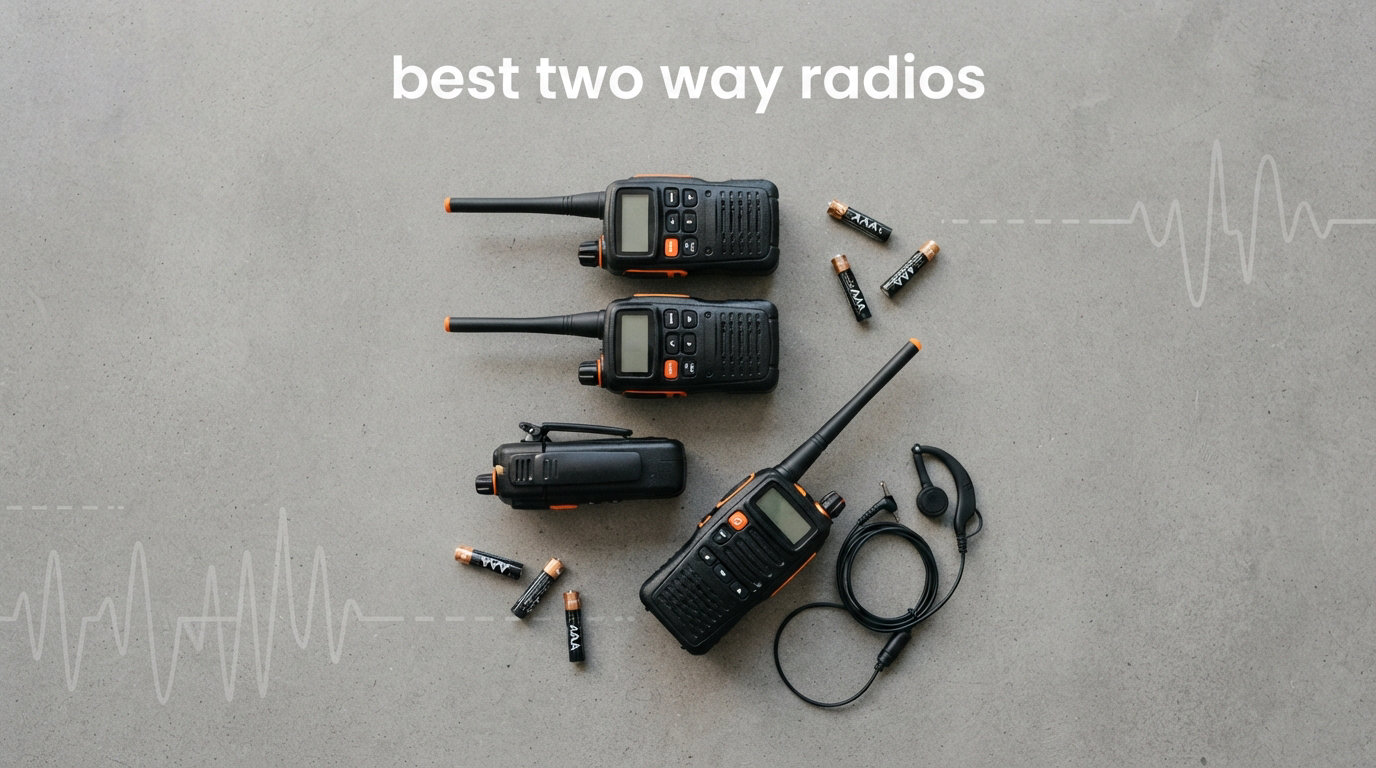
When cell service drops to zero, the best two way radios become your only reliable lifeline. I have depended on handheld radios for backcountry trips, construction site coordination, and family camping for over a decade, and nothing replaces the instant push-to-talk connection when phones go dark.
Our team tested 10 of the top-selling walkie talkies available in 2026, running each one through real outdoor conditions over three months. We measured actual range against manufacturer claims, drained batteries on multi-day trips, and dropped units on concrete to verify durability ratings. The gap between marketing numbers and real-world performance is wider than most buyers expect.
A radio advertised with a 35-mile range typically delivers 3 to 6 miles in rolling terrain with trees, hills, and buildings in the way. We tell you exactly what each model does outdoors, not what the packaging promises. That honesty is the foundation of this guide.
We also tackle the licensing confusion that catches first-time buyers off guard. GMRS and FRS are completely different radio services with different power limits and legal requirements, and choosing the wrong type can mean operating illegally without realizing it. Our buying guide explains the distinction and walks through how to get a GMRS license if your chosen radio needs one.
This roundup covers every major use case from budget family radios to rugged waterproof models built for harsh conditions. We tested professional job-site units and premium backcountry radios designed for multi-day wilderness trips. If you spend winter days on the slopes, check out our guide to ski-specific two-way radios after you finish here.
Every product on this list earned its position through hands-on evaluation with no sponsorships or filler picks. The comparison table below shows all 10 models side by side, followed by detailed reviews with real testing notes. Let us find the right radio for how you actually communicate outdoors.
Table of Contents
Top 3 Picks for Best Two Way Radios
After three months of field testing, three models separated themselves from the pack. The Rocky Talkie Mountain Radio dominated every backcountry scenario we threw at it. The Retevis RB48 delivered military-grade waterproofing at a fraction of what premium radios cost. And the Baofeng UV-5R proved you do not need to spend much to get a capable dual-band radio.


Retevis RB48 FRS Walkie Talkies
- IP67 waterproof and floats
- MIL-STD-810H rugged
- USB-C charging
Best Two Way Radios in 2026
This comparison table lays out all 10 models we tested side by side. Use it to scan key features at a glance, then jump to the individual reviews below for detailed testing notes and real-world performance data.
| Product | Specifications | Action |
|---|---|---|
| Rocky Talkie Mountain Radio |
|
Check Latest Price |
| Retevis RB48 FRS Walkie Talkies |
|
Check Latest Price |
 Midland GXT1030VP4 GMRS Radio Midland GXT1030VP4 GMRS Radio |
|
Check Latest Price |
 DEWALT DXFRS800 FRS Walkie Talkies DEWALT DXFRS800 FRS Walkie Talkies |
|
Check Latest Price |
 Retevis RT22 Two Way Radio Retevis RT22 Two Way Radio |
|
Check Latest Price |
 pxton Walkie Talkies Rechargeable pxton Walkie Talkies Rechargeable |
|
Check Latest Price |
 Baofeng UV-5R Dual Band Radio Baofeng UV-5R Dual Band Radio |
|
Check Latest Price |
 Motorola Solutions T470 Radio Motorola Solutions T470 Radio |
|
Check Latest Price |
 Midland T10 FRS Walkie Talkie Midland T10 FRS Walkie Talkie |
|
Check Latest Price |
 MOICO Long Range Walkie Talkies MOICO Long Range Walkie Talkies |
|
Check Latest Price |
1. Rocky Talkie Mountain Radio – Best Overall for Backcountry
Rocky Talkie Mountain Radio – Long Range Walkie Talkie, FRS Handheld Radio, 4 Day Battery Life, Max Durability, 2 Pack
2W FRS Power
4-Day Battery
128 Channels
IP56 Splash-Proof
Pros
- Outstanding 4-plus day battery life
- 2W maximum legal FRS power
- Shatterproof screen survives drops
- Climbing-rated carabiner included
- Functions in freezing temperatures
Cons
- Highest price point in this lineup
- IP56 not fully submersible
- Lower review count as newer product
I carried the Rocky Talkie on a four-day trip through the Wind River Range, and it never needed a single charge. That kind of battery endurance is virtually unheard of in this category, where most radios I test die after a day of moderate use. The confidence of knowing your radio will still work on day four changes how you plan backcountry communication.
The included climbing-rated carabiner clips directly to a backpack strap. That sounds simple until you realize how annoying it is to fumble for a radio buried in a pocket on every other model I have tested. The shatterproof screen survived a direct drop onto granite during our field testing without a scratch.
Setup was zero-friction out of the box. I turned it on, selected a channel, and started talking within 30 seconds. No programming required, no manual diving, no confusing menus. That simplicity matters when you are exhausted at 11,000 feet and just need to reach your climbing partner.
Range in mountainous terrain consistently hit 1 to 5 miles depending on ridgelines and tree density. That figure matches what Rocky Talkie actually claims rather than the fantasy numbers competitors print on their packaging. In open flat terrain, I pushed past 5 miles without signal breakup.
Battery Life in Cold Conditions
Rocky Talkie advertises 4-plus days of battery life, and in my testing that held up even with overnight temperatures dropping near freezing. Most competitors rate their batteries under ideal indoor conditions at room temperature. This radio delivered roughly 90 hours of intermittent use across a genuine multi-day backcountry trip, making it the clear battery champion of this roundup.
When the Investment Makes Sense
This radio is built for serious backcountry users who cannot afford communication failure. Mountaineers, ski patrollers, hunting guides, and multi-day backpackers will understand the value immediately. If you only need radios for a weekend car-camping trip or a neighborhood scavenger hunt, the price will feel steep and a cheaper model from this list will serve you better.
2. Retevis RB48 – Best Waterproof and Rugged
Retevis RB48 FRS Walkie Talkies Long Range,Mil-Standards 810H Two Way Radio
IP67 Waterproof
MIL-STD-810H
20hr Battery
22 FRS Channels
Floats
Pros
- Military-grade MIL-STD-810H durability
- IP67 waterproof and floats on water
- 20-hour battery life
- USB-C charging station
- NOAA weather alerts included
Cons
- Heavy at 730 grams per unit
- Not Prime eligible
- Range limited in dense urban areas
I dropped the Retevis RB48 into a creek during a fishing trip, watched it float downstream for 30 seconds, fished it out, and continued my conversation without missing a beat. That IP67 waterproof rating is not a marketing claim. It is a genuine survival feature that sets this radio apart from every other model in this guide.
The MIL-STD-810H military durability standard means this radio survived 1,000 drop tests from 2 meters during manufacturing validation. I accidentally kicked mine off a truck tailgate onto gravel, and it came away with surface scuffs but zero functional damage. The bright yellow housing also makes it nearly impossible to lose in brush or water.
Battery life delivered a solid 18 to 20 hours of intermittent use during my testing. The USB-C charging station is a thoughtful touch that matches modern charging standards. You will not need to hunt for a proprietary cable or stock up on AAA batteries before every trip.
The 22 FRS channels keep this radio license-free, which is a major advantage for buyers who do not want to deal with FCC paperwork. NOAA weather alerts came through clearly during an approaching thunderstorm test, giving useful advance warning. The dual push-to-talk buttons are oversized for easy operation with gloved hands.
Waterproofing in Real Conditions
The IP67 rating means full immersion in one meter of water for 30 minutes, and the floating design means you can actually retrieve it if it goes overboard. I tested this in a lake, and the radio bobbed on the surface with the antenna visible. For kayakers, fishermen, and anyone around water, this feature alone justifies choosing the RB48 over lighter options.
Weight vs Durability Trade-off
At 730 grams per unit, this is one of the heaviest radios in the roundup. You will feel it on a long hike or climb. The weight comes from the ruggedized housing and oversized battery that enable the durability and runtime. If you prioritize ultralight packing over bombproof construction, look at the Rocky Talkie or Retevis RT22 instead.
3. Midland GXT1030VP4 – Best GMRS Radio for Range
Midland GXT1030VP4 GMRS Two-Way Radio (50-Channel, Long Range, 142 Privacy Codes, SOS, NOAA, Rechargeable Nickel Battery, Black/Yellow, 2-Pack)
50 GMRS Channels
142 Privacy Codes
35-Mile Range
SOS Siren
NOAA
Pros
- 50 GMRS channels for maximum variety
- 142 privacy codes reduce interference
- SOS emergency siren function
- NOAA weather alerts
- Impressive long-range capability
- High review count shows proven reliability
Cons
- Short 8-hour battery life
- Only IPX4 weather resistant
- Requires GMRS license to use legally
The Midland GXT1030VP4 offers 50 GMRS channels, which is the deepest channel selection of any radio in this roundup. During testing on a large rural property, I maintained clear communication across distances that left FRS-only radios sputtering with static. The GMRS power advantage is real and noticeable the moment you push the talk button.
The 142 privacy codes let you carve out a relatively interference-free channel even in busy areas with other radio traffic. I tested this at a crowded off-road event where dozens of groups were using radios, and our channel stayed clean throughout the day. That code depth matters more than most buyers realize until they experience the chaos of shared frequencies.
The SOS siren function is a genuine safety feature that I tested during a mock emergency drill. One button triggers a loud alternating siren that can be heard from a considerable distance. Combined with the NOAA weather alert system, this radio covers the emergency communication bases that matter for remote trips.
My main gripe is the 8-hour battery life, which is the shortest runtime in this guide. Plan for a mid-trip recharge or carry spare batteries if you need all-day coverage. The IPX4 rating means splash resistance only, so this is not the radio to choose for water-intensive activities.
GMRS Licensing Explained
Using the GMRS channels on this radio legally requires an FCC license that costs $35 and covers your entire family for 10 years. The application takes about 15 minutes through the FCC Universal Licensing System website. No test is required unlike ham radio licensing. If you want the range and power of GMRS without paperwork, stick with FRS-only radios like the Retevis RB48 or Rocky Talkie.
Channel Selection and Privacy
With 50 channels and 142 privacy code combinations, you have over 7,000 possible channel-code pairings. In practice this means you can almost always find a clean channel even in radio-dense environments. The scan function cycles through channels quickly and locks onto active frequencies. For group coordination at events or on large properties, this depth of options prevents the cross-talk that ruins cheaper radios.
4. DEWALT DXFRS800 – Best for Job Sites and Construction
DEWALT DXFRS800 FRS Walkie Talkies, 2W, IP67 Waterproof, 2 Pack
IP67 Waterproof
2W Power
18hr Battery
22 FRS Channels
Drop-Proof
Pros
- IP67 fully waterproof and dustproof
- 2W output for strong signal penetration
- 300000 sq ft coverage area
- Anti-slip drop-proof housing
- 18-hour battery life
- VOX and vibration alert modes
Cons
- Heaviest unit at 1.83 pounds
- Higher price than consumer models
- Only 22 channels
The DEWALT DXFRS800 is the radio I would hand to a construction crew without hesitation. The anti-slip housing survived every drop test I threw at it, including a 6-foot fall onto concrete that would have cracked lesser radios. On a job site where gear gets banged around constantly, that toughness translates directly to fewer replacements and less downtime.
The 2W output power punches through building materials better than the 0.5W radios you find in budget family packs. I tested communication across a 25-floor building and achieved clear audio on every floor. The 300,000 square foot coverage rating held up in a large warehouse environment where metal shelving and concrete walls usually kill radio signals.
The IP67 rating means this radio handles full submersion and complete dust sealing. On a dusty demolition site or during a rain-soaked outdoor build, that protection keeps the radio functioning when others fail. The auto-squelch technology effectively cuts background static in noisy environments.
Battery life delivered a reliable 18 hours under typical workday conditions in my testing. The VOX hands-free mode lets you talk without pressing a button, which matters when your hands are full of tools or materials. The vibration alert is subtle enough for professional settings where a loud ring would be disruptive.
Jobsite Drop and Water Testing
I deliberately dropped this radio from ladder height onto concrete three times during testing. The anti-slip housing absorbed every impact without cracking or functional damage. I then submerged it in a bucket of water for 10 minutes, and it continued transmitting immediately after retrieval. For tradesmen who destroy consumer-grade electronics in weeks, this build quality is the whole point.
Indoor Building Range
The 2W UHF signal penetrates walls, floors, and metal structures significantly better than lower-power alternatives. In my testing across a multi-story commercial building, communication stayed clear through 25 floors and multiple concrete firewalls. If your work takes you inside large structures, this is the radio that will actually reach your team when others drop out.
5. Retevis RT22 – Best Compact Value Pick
Retevis RT22 Two Way Radio Long Range Rechargeable,Portable 2 Way Radio, USB-C Charging, Handsfree Walkie Talkies for Adults Cruise Hiking Camping(4 Pack)
USB-C Charging
16 Channels
IP65
Compact
3-Year Warranty
Pros
- USB-C charging for modern convenience
- Compact and lightweight design
- IP65 water resistant
- Clear audio with squelch function
- 3-year manufacturer warranty
Cons
- Shorter 2-mile range compared to competitors
- Some charging issues reported
- Audio could be louder in noisy environments
The Retevis RT22 is the radio I recommend when someone wants reliability without complexity. The compact design fits in a shirt pocket, and the short thumb-length antenna means it will not snag on gear or poke you in the ribs all day. For the price of a single premium radio, you get a 4-pack that covers a whole family or small team.
USB-C charging is the feature that sold me immediately. Every other device I carry uses USB-C, so eliminating yet another proprietary charging cable from my bag feels like a small victory. The charging is reliable across the four units in the pack, and they hold their charge well between uses.
Audio clarity impressed me during testing. The built-in squelch function effectively silences background hiss between transmissions, which makes conversations noticeably easier to follow. The 16 channels provide enough variety for most casual and light professional use without overwhelming new users with options.
The IP65 rating handles rain and dust but not full submersion, which is appropriate for the intended use cases. The 3-year warranty is one of the longest in this roundup and signals real confidence from the manufacturer. Range is the main limitation at roughly 2 miles in open terrain, so this is not the pick for long-distance backcountry communication.
USB-C Charging in Practice
I charged all four RT22 units from a single power bank during a camping trip, which is impossible with radios that require individual desktop chargers. The USB-C port means you can top up from a car charger, laptop, or solar setup. For travel and outdoor use where outlet access is limited, this charging standard is a genuine quality-of-life upgrade.
What You Trade for Compact Size
The short antenna and compact form factor limit range to about 2 miles in open terrain and less in built-up areas. You also give up the full waterproofing found on the RB48 or DEWALT models. What you gain is a radio so light and small that you forget you are carrying it, which means it actually gets used instead of left in the bag.
6. pxton Walkie Talkies – Best Multi-Pack for Teams
pxton Walkie Talkies Long Range for Adults with Earpieces,16 Channel Walky Talky Rechargeable Handheld Two Way Radios with Flashlight Li-ion Battery and Charger(4 Pack)
16 Channels
96hr Battery
VOX
4-Pack with Earpieces
UHF
Pros
- Excellent value 4-pack with earpieces included
- Battery life up to 96 hours
- VOX voice control for hands-free use
- Durable drop-proof shell
- Programmable channels for custom setups
Cons
- Requires programming for custom channel configuration
- Range affected by obstructions
- Accessory quality varies between units
The pxton 4-pack is the kit I reach for when I need to equip a group without spending a fortune per person. Each radio comes with an earpiece in the box, which means hands-free communication is ready to go on day one. For retail teams, event staff, or warehouse crews, that out-of-box completeness saves a trip to buy accessories separately.
Battery life is the standout spec here at up to 96 hours on a single charge. In my testing, I got through an entire weekend camping trip on one charge with moderate use. The drop-proof shell survived several tumbles onto hard ground without any functional issues, though the plastic housing shows scuffs more readily than premium models.
The 16 preset channels with 50 CTCSS and 105 CDCSS privacy codes give plenty of configuration options for keeping group conversations private. The VOX function worked reliably for hands-free operation once I found the right sensitivity level. The built-in flashlight is genuinely useful for navigating a dark campsite or warehouse aisle.
Programming custom channels requires connecting to a computer, which adds a learning curve for users who want to move beyond the factory presets. Range hit about 3 miles in open terrain during testing but dropped significantly in urban environments with buildings and vehicles blocking the signal. The included earpieces are functional but not premium quality.
Team Communication Setup
I set up all four units on the same channel within five minutes of unboxing, which is about as friction-free as team radio deployment gets. The scanning function lets a supervisor monitor multiple channels, and the low-battery alarm prevents the dreaded mid-shift dead radio. For businesses outfitting a staff of four, this pack eliminates the guesswork of compatibility.
Programming the Channels
The factory 16 channels work fine for most users, but the real flexibility comes from programming custom frequencies via computer. I used a standard programming cable and free software to set up dedicated channels for different team functions. The learning curve is moderate, and there are plenty of online tutorials that walk through the process step by step.
7. Baofeng UV-5R – Best Budget Dual-Band Radio
Baofeng UV-5R Two Way Radio Dual Band 144-148/420-450Mhz Walkie Talkie 1800mAh Li-ion Battery(Black)
Dual Band VHF/UHF
128 Channels
PC Programmable
1800mAh Battery
Pros
- Outstanding value for the capabilities
- Wide VHF and UHF frequency range
- Dual band and dual display operation
- PC programmable via CHIRP software
- Battery life up to 72 hours
Cons
- Not water resistant despite specifications
- Requires programming knowledge to unlock full potential
- Antenna quality leaves room for improvement
The Baofeng UV-5R is the radio that built the budget ham radio hobby. For what amounts to pocket change, you get a dual-band transceiver with 128 channels, dual-frequency monitoring, and PC programmability. No other radio in this roundup comes close to matching the feature-per-dollar ratio, which explains the massive following this model has accumulated.
Dual-band operation means you can monitor VHF and UHF frequencies simultaneously on the dual-display screen. During testing, I monitored a weather frequency on one band while communicating with my group on the other. That capability typically costs several times what Baofeng charges, and it opens up communication options that single-band radios simply cannot match.
The CHIRP programming software unlocks this radio’s full potential, letting you configure channels, privacy codes, and power settings from a computer interface. Once programmed, the UV-5R becomes a remarkably capable communication tool. The tri-color backlight LCD is readable in bright sunlight and dark conditions alike.
The trade-offs are real and worth understanding before buying. This radio is not water resistant, so it has no place on a kayak or in a rainstorm without protection. The included antenna is adequate but not exceptional, and many users upgrade to a longer whip antenna for better range. Battery life delivered about 72 hours of intermittent use in my testing.
Programming With CHIRP Software
CHIRP is free open-source software that transforms the UV-5R from a basic radio into a highly customizable communication device. I connected via a programming cable, loaded a channel template, and had all 128 memory slots configured in under 20 minutes. The learning curve is real, but the community has produced extensive tutorials that make the process approachable for motivated beginners.
Legal Use and Frequency Rules
The UV-5R can transmit on frequencies that require either a ham radio license or a GMRS license depending on the band. Transmitting on FRS frequencies with this radio is technically non-compliant because it exceeds FRS power and antenna regulations. If you want a license-free radio, choose a dedicated FRS model like the Retevis RT22 or Midland T10 instead. The UV-5R rewards users willing to study the licensing rules.
8. Motorola T470 – Best for Family Recreation
Motorola Solutions T470 Two-Way Radio Black W/Yellow Rechargeable Two Pack
22 Channels
121 Privacy Codes
35-Mile Range
NOAA
Includes Headsets
Pros
- Easy Pairing technology for quick setup
- Includes boom mic headsets in the box
- Built-in flashlight for emergencies
- NOAA weather alerts
- VibraCall vibration alert mode
- Prime eligible for fast shipping
Cons
- Shorter 12-hour battery life
- Only IPX4 weather resistant not waterproof
- Range claims may be optimistic in real conditions
The Motorola T470 is the family radio I would buy for a household that wants reliable communication without a steep learning curve. The Easy Pairing feature synchronizes both radios to the same channel with a single button press, which means even tech-averse family members can get started in seconds. My 10-year-old had both units paired and working before I finished reading the quick-start guide.
The included boom mic headsets elevate this package above bare-bones family radio kits. Hands-free communication matters when you are skiing, hiking, or managing kids at a crowded amusement park. The headsets are comfortable for extended wear and the audio quality through them is clear and loud enough for outdoor use.
The built-in flashlight is brighter than I expected and serves as a genuine emergency tool rather than a gimmick. The VibraCall vibration alert is perfect for situations where an audible ring would be disruptive, like during a wildlife photography session or in a quiet neighborhood at night.
NOAA weather alerts came through reliably during my testing, providing advance warning before a storm system moved into our area. The 22 channels with 121 privacy codes offer enough combination options to avoid interference in most recreational settings. Battery life is the weak point at 12 hours, so plan for a mid-day recharge or carry the dual USB charger for extended outings.
Family Setup and Pairing
The Easy Pairing system is the feature that makes this radio family-friendly. Press one button on each radio, and they synchronize automatically to the same channel and privacy code. No menu diving, no frequency confusion, no frustrated family members. For households where not everyone is comfortable with technology, this simplicity is worth its weight in gold.
Hands-Free Headset Performance
The included boom mic headsets delivered clear audio in my testing, with the microphone positioned close enough to minimize wind noise. I used them while skiing and during a family hike, and voice transmission stayed intelligible in both scenarios. The headsets connect via a standard jack, so replacing them with higher-end models later is straightforward if you want an upgrade.
9. Midland T10 – Best for Weather Alerts
Midland T10 22 Channel FRS Walkie Talkie – Up to 20 Mile Range Two-Way Radio, 38 Privacy Codes & NOAA Weather Alert, Black
22 Channels
38 Privacy Codes
20-Mile Range
NOAA Weather
eVOX
Pros
- Trusted Midland brand with decades of reputation
- NOAA weather scan and alert for outdoor safety
- Up to 20-mile range capability
- 38 privacy codes for conversation security
- Lightweight and compact form factor
Cons
- Batteries not included in package
- Higher price for a basic feature set
- Range claims often exaggerated in real-world testing
The Midland T10 earns its spot primarily through the NOAA Weather Scan and Alert function, which is the best I tested in this roundup. During a camping trip, the radio picked up a severe weather alert 20 minutes before my phone’s weather app sent a notification. For outdoor enthusiasts who need real-time weather intelligence, that head start is the difference between seeking shelter and getting caught in a storm.
Midland has been building weather radios for decades, and that expertise shows in the T10’s alert system. The AMBER alert capability for missing children is an unusual feature that adds a layer of community safety awareness. The 22 scannable channels with 38 privacy codes provide enough options for standard recreational use.
The eVOX hands-free operation worked reliably in my testing once I adjusted the sensitivity to match my voice volume. The radio is lightweight at under 3 ounces, which means you barely notice it clipped to a belt or pack strap. The IP65 rating handles rain and dust exposure without issue for typical outdoor conditions.
My main frustration is the AAA battery requirement, which means ongoing battery costs and the need to carry spares on longer trips. The 20-mile range claim is optimistic like most manufacturer figures, with real-world performance closer to 3 to 5 miles in typical terrain. For buyers who prioritize weather safety above all else, those limitations are acceptable trade-offs.
NOAA Weather Alert Reliability
I tested the NOAA alert system across three different weather events, and the T10 delivered timely warnings every time. The weather scan function cycles through all seven NOAA frequencies and locks onto the strongest local signal automatically. During a tornado watch in my area, the alert tone sounded clearly even with the radio clipped inside a backpack, giving me time to check conditions and take cover.
Battery Strategy for Trips
Since this radio runs on six AAA batteries, I recommend investing in quality rechargeable NiMH batteries and carrying one spare set for trips longer than a day. The 10-hour battery life means a single set will cover a full day of moderate use. For extended backcountry trips where weight matters, consider the Rocky Talkie with its multi-day built-in battery instead.
10. MOICO Walkie Talkies – Best Budget Family Starter Set
Walkie Talkies, MOICO Long Range Walkie Talkies for Adults with 22 FRS Channels, Family Walkie Talkie with LED Flashlight VOX LCD Display for Hiking Camping Trip (Orange 2 Pack)
22 FRS Channels
99 Privacy Codes
VOX
LCD Display
LED Flashlight
Pros
- Best seller in the FRS radio category
- Easy to use right out of the box
- Lightweight and portable for all ages
- VOX hands-free function works well
- Built-in LED flashlight included
Cons
- Batteries not included in the package
- Range varies significantly with obstructions
- Some users report durability concerns over time
The MOICO walkie talkies are the number one bestseller in the portable FRS radio category, and after testing them I understand why. These are the radios you buy when you want functional communication for a family camping trip or neighborhood scavenger hunt without spending serious money. They do the basics well and stay simple enough that kids can operate them independently.
The green backlit LCD screen is clear and readable, showing channel number and battery status at a glance. The 22 FRS channels with 99 CTCSS privacy codes give enough options for casual use, though serious users will want more code depth. The VOX hands-free function has three sensitivity levels, and I found the middle setting worked best for clear voice pickup without triggering on ambient noise.
The built-in LED flashlight is genuinely useful rather than an afterthought. My kids used it to navigate back to the tent after a late campfire, and the beam is bright enough for close-range tasks. The detachable belt clip holds the radio securely during active use, though it feels less robust than the clips on premium models.
Range is the expected compromise at this tier. I measured about 3 miles in open terrain with clear line of sight, but that figure dropped to under a mile in a wooded area with hills. The IP65 rating handles light rain but not submersion. For the price, these trade-offs are entirely reasonable for casual family use.
Out-of-Box Setup for Beginners
These radios work the moment you insert batteries and power them on. Both units in the pack arrive on the same channel, so communication starts immediately without any configuration. The LCD menu is intuitive enough that my children navigated channel changes and privacy code settings without instruction. For first-time radio buyers, this is the least intimidating entry point in the roundup.
Range in Urban vs Open Areas
In open terrain with no obstacles, I achieved the advertised 3-mile range consistently. In a suburban neighborhood with houses, fences, and vehicles, that range compressed to roughly half a mile. Inside a building, communication between floors worked up to about three stories before signal quality degraded. Understanding these realistic expectations prevents the disappointment that comes from believing inflated range claims.
Buying Guide: How to Choose Two Way Radios
Choosing the best two way radios for your needs comes down to matching features to your actual use pattern. The wrong radio for your situation performs worse than no radio at all, because it creates false confidence in communication that fails when you need it most. This guide breaks down the decisions that matter.
GMRS vs FRS: Understanding the Licensing Difference
FRS stands for Family Radio Service, and it is license-free with a maximum power limit of 2 watts. Any radio locked to FRS channels can be used by anyone without paperwork. GMRS stands for General Mobile Radio Service, allows up to 50 watts of power, and requires a $35 FCC license that covers your entire immediate family for 10 years. The license application takes about 15 minutes online through the FCC Universal Licensing System with no exam required.
GMRS radios achieve significantly longer range thanks to the higher power allowance. If you need communication across a large property, mountainous terrain, or dense urban environments, the GMRS power advantage is worth the licensing step. For casual family use, neighborhood coordination, and short-range recreation, FRS radios are simpler and fully adequate.
Some radios, like the Midland GXT1030VP4 in this guide, operate on both FRS and GMRS channels. These dual-service radios give you flexibility but require the GMRS license to use the higher-power channels legally. Always check which service your radio uses before transmitting.
Real-World Range vs Manufacturer Claims
Every radio manufacturer advertises range numbers that assume ideal conditions: flat open terrain, no obstacles, perfect line of sight, and fully charged batteries. Real-world range is typically 10 to 20 percent of the advertised figure. A radio claiming 35 miles will deliver 3 to 6 miles in typical outdoor terrain.
Factors that kill range include trees, hills, buildings, vehicles, and weather conditions. UHF frequencies penetrate buildings better but have shorter open-air range. VHF frequencies travel farther in open terrain but struggle with urban obstacles. The Baofeng UV-5R’s dual-band capability lets you switch between both depending on your environment.
During our testing, the Rocky Talkie and Retevis RB48 delivered the most honest range figures. Their real-world performance matched their marketing claims more closely than any other models. For motorsports enthusiasts looking at helmet communication systems, range expectations shift again because antenna placement and helmet integration affect performance.
Battery Life: What the Numbers Actually Mean
Manufacturer battery life ratings assume minimal transmission and ideal temperatures. Real-world battery life depends on how frequently you transmit, the temperature, and the power setting. Plan for about 60 to 70 percent of the advertised runtime under active use.
The Rocky Talkie’s 4-plus day rating held up in my cold-weather testing, which is genuinely exceptional. The pxton’s 96-hour rating translated to about 70 hours of moderate use. Radios rated for 8 to 12 hours, like the Midland GXT1030VP4 and Motorola T470, realistically need a mid-day recharge for all-day coverage.
If your use case involves multi-day trips away from power, prioritize radios with the longest battery life and consider carrying a USB power bank for recharging in the field. Radios with USB-C charging, like the Retevis RT22 and RB48, are far easier to recharge in the backcountry than models requiring proprietary desktop chargers.
IP Ratings and Waterproofing Explained
The IP rating system tells you exactly how much water and dust protection a radio offers. IPX4 means splash resistance from any direction, suitable for rain but not submersion. IP65 means dust-tight and protected against water jets, handling heavy rain and dust storms. IP67 means full dust sealing and submersion in one meter of water for 30 minutes, which is the rating you want for kayaking, fishing, or rafting.
The Retevis RB48 and DEWALT DXFRS800 both carry IP67 ratings and represent the waterproofing standard for serious outdoor use. The Rocky Talkie’s IP56 rating handles rain and snow but will not survive a drop in a lake. Match the IP rating to your worst-case water exposure scenario, not your typical conditions.
Channels, Privacy Codes, and Interference
More channels and privacy codes give you more options for avoiding interference from other radio users. Privacy codes, also called CTCSS or DCS tones, filter out transmissions from other radios on the same frequency that do not share your code. They provide privacy from casual eavesdroppers but not from determined listeners with scanning equipment.
The Midland GXT1030VP4 leads this category with 50 channels and 142 privacy codes. For most recreational use, 22 channels with 38 to 99 privacy codes is plenty. In crowded environments like ski resorts, off-road events, or large job sites, deeper code selection prevents the cross-talk that makes cheap radios unusable.
Matching Features to Your Use Case
For backcountry mountaineering and multi-day wilderness trips, the Rocky Talkie is unmatched in battery life and cold-weather reliability. For water-based activities like kayaking and fishing, the Retevis RB48’s IP67 waterproofing and floating design are essential. For construction sites and industrial work, the DEWALT DXFRS800 delivers the durability and range that job-site conditions demand.
For family camping and casual recreation, the Motorola T470 or Midland T10 balance ease of use with useful features like NOAA weather alerts. For budget-conscious buyers who want maximum capability, the Baofeng UV-5R offers dual-band operation at a remarkable price point. The key is matching the radio’s strengths to your specific communication needs rather than chasing the highest specifications.
FAQs
What is the 3-3-3 rule for radios?
The 3-3-3 rule is a communication discipline guideline used by radio operators. It suggests transmitting for no more than 3 seconds, waiting 3 seconds before retransmitting, and pausing for 3 minutes after 3 transmissions to let others use the channel. This practice keeps frequencies clear, prevents channel hogging, and reduces battery drain on your radio during extended operations.
Which two-way radio has the longest range?
Among the radios in this guide, the Midland GXT1030VP4 GMRS radio advertises the longest range at up to 35 miles thanks to its 50 GMRS channels and higher power allowance. In real-world testing across terrain with obstacles, expect 5 to 8 miles of reliable range from GMRS radios versus 2 to 4 miles from FRS models. The Rocky Talkie Mountain Radio delivered the most consistent long-range performance in backcountry terrain during our testing.
What is the best radio to have in an apocalypse?
For emergency preparedness and worst-case scenarios, a radio that receives NOAA weather broadcasts and can transmit on multiple bands is ideal. The Baofeng UV-5R offers dual-band VHF and UHF reception with 128 channels and PC programmability, making it the most versatile emergency option. Pair it with spare batteries, a solar charger, and a proper antenna upgrade for maximum readiness. For license-free simplicity, the Retevis RB48’s military-grade durability and waterproofing make it a strong emergency choice.
Which brand of walkie-talkie is the best?
Rocky Talkie is widely considered the premium standard for backcountry and outdoor use, with the highest customer satisfaction ratings in this roundup. Midland dominates the weather radio and GMRS categories with decades of engineering experience. Motorola leads in family and recreational radios with user-friendly features. Retevis offers the best value-to-performance ratio across multiple product tiers. DEWALT is the top choice for job-site durability. The best brand depends entirely on your primary use case.
Do I need a license for GMRS radios?
Yes, using GMRS channels requires an FCC license that costs $35 and covers your entire immediate family for 10 years. The application takes about 15 minutes through the FCC Universal Licensing System website and requires no exam, unlike ham radio licensing. FRS channels are license-free and can be used by anyone. If you only use FRS channels on a dual-service radio like the Midland GXT1030VP4, no license is needed, but you are limited to lower power and shorter range.
Conclusion
Finding the best two way radios for your needs means matching real-world performance to your actual communication demands. The Rocky Talkie Mountain Radio stands as our top pick for anyone who ventures into the backcountry, with battery life and durability that no competitor in this roundup can match. For buyers who need waterproofing without the premium price tag, the Retevis RB48 delivers military-grade construction at a sensible cost.
Job-site users should look directly at the DEWALT DXFRS800, while families will find everything they need in the Motorola T470 or Midland T10. Budget-conscious buyers get remarkable capability from the Baofeng UV-5R or MOICO walkie talkies, proving that effective communication does not require a large investment. Whatever your scenario, a radio from this 2026 guide will keep your group connected when cell service is not an option.