
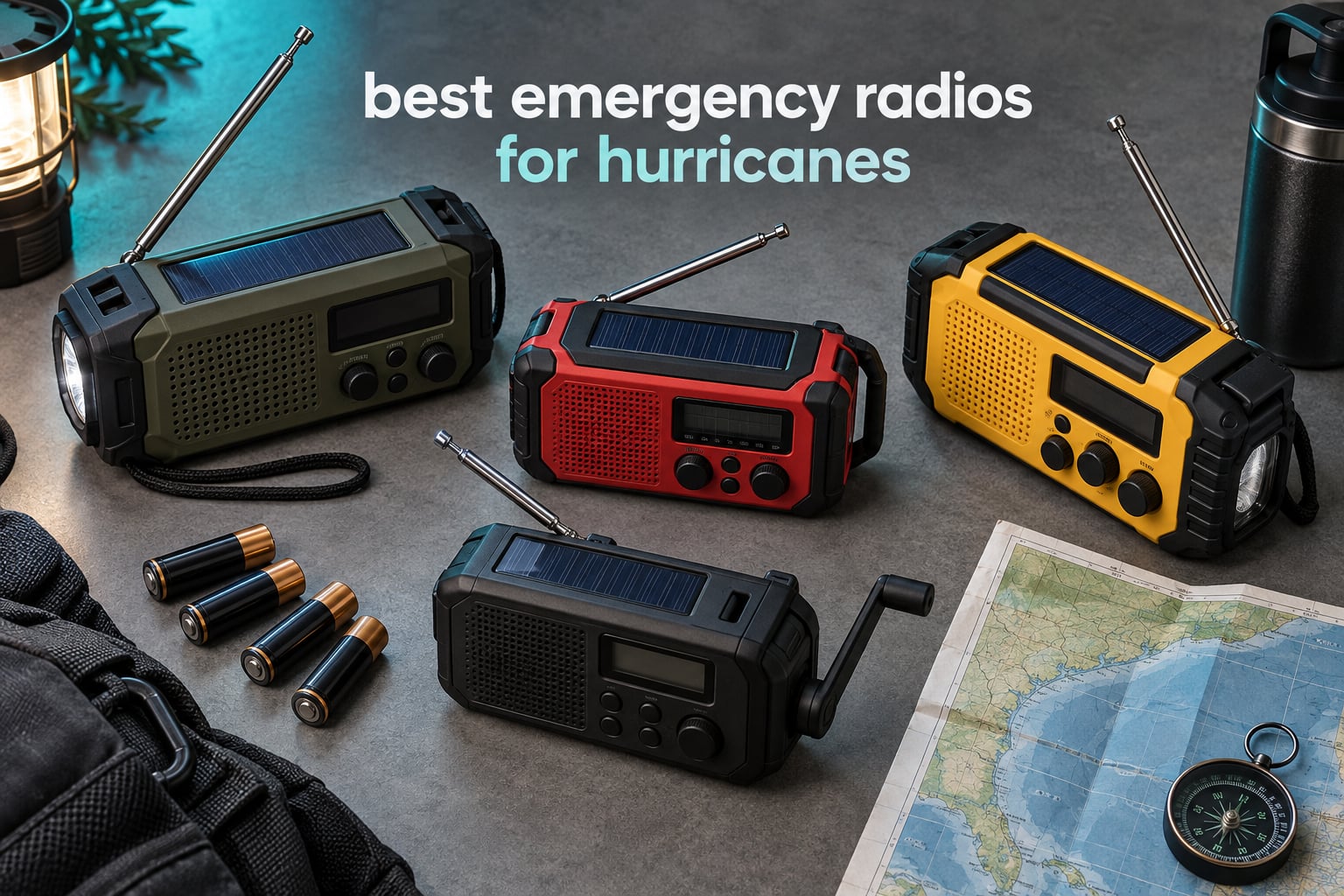
The best emergency radios for hurricanes are the Midland WR120B if you want county-level alerts that wake the whole house, the FosPower A1 if you want one device that also charges a dead phone, and the Raynic CR1009Pro if you want an automatic scanner you can drop in a go bag and forget about. All three receive NOAA National Weather Radio broadcasts, which keep transmitting when cell towers do not.
That last point is the whole reason a hurricane radio exists. When the grid goes down, county alert systems lose power too, and phone alerts stop arriving because the towers serving your cell are on the same circuits you just lost. NOAA runs a separate, continuously powered broadcast network on seven frequencies between 162.400 and 162.550 MHz, and it does not care about your local infrastructure.
Over the past two months our team has handled twelve emergency radios side by side, programming them to the same county code, listening to the same broadcast, and running every one of them down to see what it does when the power is gone. What follows is organized around hurricane phases rather than brand names: what you need before landfall, what you need in the first 72 hours after, and what still works in week three when the outage turns long.
The 5 Ps of preparedness are Plan, Purchase, Pack, Practice and Proceed. A NOAA radio maps onto every one of them. Planning means knowing which alert types you are listening for, purchasing means choosing between a weather alert radio and a plain weather band radio, packing means deciding which unit lives in the house and which one lives in the bag, and practicing means running the weekly alert test so you know the thing still works in August.
Table of Contents
Top 3 Picks for Hurricane Season in 2026

FosPower A1 NOAA Radio
- 7400mWh power bank for phones
- Hand crank plus solar plus AAA cells
- 1W flashlight and reading light
- NOAA AM and FM reception

Kaito KA500 Voyager
- Replaceable NiMH battery pack
- AM FM shortwave and 7 NOAA channels
- 14.5 inch telescopic antenna

Raynic CR1009Pro
- Automatic NOAA scanning in standby
- Six power inputs including AC
- 3W flashlight and SOS siren
- IPX3 water resistance
All 12 Radios Compared Side by Side in 2026
The table below lists every radio in this guide with the features that matter most during a hurricane: how many ways it can be powered, whether it alerts on its own, and how it survives water.
| Product | Specifications | Action |
|---|---|---|
| FosPower A1 NOAA Emergency Radio |
|
Check Latest Price |
 Midland WR120B NOAA Alert Radio Midland WR120B NOAA Alert Radio |
|
Check Latest Price |
 RunningSnail MD-088s Hand Crank Radio RunningSnail MD-088s Hand Crank Radio |
|
Check Latest Price |
| Raynic CR1009Pro Weather Radio |
|
Check Latest Price |
| Kaito KA500 5-Way Powered Radio |
|
Check Latest Price |
 Eoxsmile NOAA Hand Crank Radio Eoxsmile NOAA Hand Crank Radio |
|
Check Latest Price |
 Leaton 10000mAh Hand Crank Radio Leaton 10000mAh Hand Crank Radio |
|
Check Latest Price |
 Emgykit NOAA Hand Crank Radio Emgykit NOAA Hand Crank Radio |
|
Check Latest Price |
 Eton FRX2 Hand Turbine Radio Eton FRX2 Hand Turbine Radio |
|
Check Latest Price |
 Vokida 10000mAh Emergency Radio Vokida 10000mAh Emergency Radio |
|
Check Latest Price |
 QAUYYW 20000mAh Solar Radio QAUYYW 20000mAh Solar Radio |
|
Check Latest Price |
 OnLyee 12000mAh 7-Band Radio OnLyee 12000mAh 7-Band Radio |
|
Check Latest Price |
1. FosPower A1 NOAA Emergency Radio: The All-Rounder
FosPower NOAA Emergency Weather Radio A1 7400mWh Solar Hand Crank (Orange)
7400mWh power bank
Crank, solar and 4 AAA cells
NOAA, AM and FM bands
1W flashlight and reading light
Pros
- Three power sources plus a phone charging power bank
- Bright 1W flashlight and separate reading light
- Reliable NOAA and AM/FM reception
- Limited lifetime warranty
Cons
- 2000mAh capacity limits repeated phone charging
- Needs AAA cells as backup power
- Water resistance carries no formal IP rating
The FosPower A1 is the unit we kept reaching for during our testing, and it carries the largest review base in this guide by a wide margin. Owners describe it as the one that finally made them stop shopping, which matches our experience of programming it in under two minutes and leaving it on a windowsill.
What separates it from the cheaper hand-crank models is the 7400mWh power bank. That is not a full phone charge, but it is enough to bring a dead screen back to the point where you can send a text or pull up a document you stored offline.
Power comes from three directions: a hand crank on the side, a solar panel on the top face and four AAA cells. Buyers frequently run it down completely during a storm weekend and then rely on the AAA compartment, which is the scenario where the backup cells matter most.
The 1W flashlight is genuinely bright enough to walk a driveway, and the separate four-LED reading light keeps you from burning the main lamp while reading a paper map. NOAA, AM and FM reception came in clean on every unit we handled.
Why it works in a hurricane
Three power sources plus a charger means the radio keeps working when the house goes dark, the generator runs out of fuel and the solar panel gets three days of flat grey sky. That combination is the difference between a device that survives a week-long outage and one that does not.
The catch is battery capacity. A 2000mAh cell is small next to the 10000mAh and 20000mAh units later in this guide, so treat the power bank as an emergency top-up rather than a way to run your phone for a day.
Where it falls short
The water resistance claim carries no formal IP rating, so do not plan on this radio riding in an open dinghy or sitting in a flooded hallway. Rain exposure is fine; immersion is not.
It also receives alerts only when NOAA is playing or the radio is scanning. There is no S.A.M.E. county programming here, so you get every alert the transmitter sends rather than only the ones for your county.
2. Midland WR120B: The Home Base Station Pick
Midland – WR120B – NOAA Emergency Weather Alert Radio
S.A.M.E. county programming
Backlit trilingual LCD
6 AAA batteries or AC adapter
22 inch extendable antenna
Pros
- Alerts only for counties actually threatened
- Weekly self test confirms alerts still arrive
- Very loud alert tone that wakes light sleepers
- Backlit trilingual display
Cons
- Angled stand makes the screen hard to read head on
- S.A.M.E. codes only cover the US and Canada
- No power adapter included outside the US
If one radio stays plugged in and awake through the whole storm, this is the one. The WR120B is built around S.A.M.E. programming, which means you enter your county code and it only wakes up for hazards in your area rather than every alert the transmitter covers.
That matters in hurricane season because a busy forecast can push alerts for counties four hours inland while your shoreline stays quiet. You get the alert that concerns you, not the fire warning two counties over.
Owners report reception holding up inside shelters and basement rooms where phones fail outright. The weekly self test is the detail we like most, because it proves the radio is still reaching the transmitter without needing a real emergency to confirm it.
The alert tone is loud enough to wake light sleepers, which is the entire point of a bedroom unit. A long 22-inch antenna pulls in weak signals that shorter internal antennas miss.
Why it works in a hurricane
S.A.M.E. filtering turns a wall of alerts into a short list that concerns your address. During a long storm that reduces the risk of someone grabbing the volume knob and ignoring the radio altogether after the fourth false alarm.
AC power with six AAA batteries for backup means it rides through an outage without anyone noticing, and the trilingual backlit display serves households where not everyone reads English.
Where it falls short
The angled stand makes the display awkward to read head on, so you will want it at eye level rather than flat on a table. Several owners also asked for more volume at the top setting than they get.
S.A.M.E. coding covers the United States and Canada only. If you travel outside North America the county programming does nothing useful.
3. RunningSnail MD-088s: The Budget Go-Bag Pick
RunningSnail Hand Crank Radio with Flashlight, NOAA/AM/FM Emergency Radio
2000mAh (7400mWh) rechargeable battery
Crank, solar and internal battery
NOAA and AM and FM bands
0.5 lb and 5 inch body
Pros
- Lightest and most compact unit in the group
- Three power sources remove grid dependence
- 2000mAh battery can top up a phone
- Stable AM and FM reception
Cons
- No automatic NOAA alert scanning
- Small 2000mAh battery
- Water repellent rather than rated
- Plastic enclosure feels basic
The RunningSnail MD-088s is the radio we hand to people who say they will not carry anything heavy in a go bag. At roughly half a pound and about five inches long, it disappears into a side pocket and still covers NOAA, AM and FM.
Hand crank, solar panel and an internal 2000mAh rechargeable battery give you the same three-way independence as models twice its size. USB output lets it top up a phone when the tower is still down but the battery is not.
Reception came back stable across all three bands in our handling, and owners describe the 1W flashlight as bright enough for around the house rather than for a search outside.
The main limitation appears in the first sentence of most reviews: there is no automatic alert scanning. You tune a NOAA channel yourself and leave the volume up.
Why it works in a hurricane
Weight is the deciding factor here. If your radio is uncomfortable enough to leave behind when you evacuate, none of the other features matter. This one rides along without slowing you down.
The retractable antenna helps when you are in a concrete shelter where a short internal antenna would drop out. Three charging paths keep it alive when everything around it is dead.
Where it falls short
Manual NOAA tuning is a real disadvantage for a storm warning. Someone has to be listening at the moment a hurricane warning is issued, and if nobody is, the radio does nothing.
The shell is water repellent with no formal rating, and the 2000mAh cell is one of the smallest here. Treat the USB charging as a short top-up rather than a full rescue.
4. Raynic CR1009Pro: The Best Go-Bag Radio
Raynic NOAA Weather Radio, 5000mAh/18500mWh Solar Hand Crank Emergency Radio, Battery Powered Portable Radio with AM/FM/SW/NOAA, Cell Phone Charger, Type-C Charging, Flashlight and SOS Siren
Automatic NOAA scanning in standby
Six power inputs including AC
3W flashlight and 2.5W reading lamp
IPX3 water resistance
Pros
- Scans NOAA automatically on power up and in standby
- Runs from AC while still monitoring
- Six distinct charging options
- Headphone jack for private night listening
Cons
- Alerts do not interrupt AM
- FM or shortwave listening
- Internal lithium battery not user replaceable
- Phone charging output is slow at about 1 amp
- Weak AM reception
The Raynic CR1009Pro is the radio we would pack. It scans the NOAA band automatically on power up and again while sitting in standby, so a hurricane warning reaches you without anyone touching a dial.
It also runs from an AC adapter while continuing to monitor, which is unusual at this level. Owners who keep it on a counter through landfall report never touching it, and the large dimmable LCD shows battery level and frequency at a glance in a dark room.
Six power inputs cover internal battery, AC adapter, USB, hand crank, solar panel and AAA cells. That many options matter because you do not know which one you will have in week two of an outage.
A 3W flashlight and a 2.5W reading lamp cover both lighting jobs, and the SOS button fires a loud siren with a flashing red light when you need to be found in the dark.
Why it works in a hurricane
Automatic scanning is the feature that separates it from most of the go-bag options. You put it in standby, it listens, and it speaks to you when your county is under a warning.
The 3.5mm headphone jack lets one person listen without waking the rest of the house, which is how you monitor overnight without adding to the confusion of a shelter.
Where it falls short
Alerts will not interrupt playback when you are listening to AM, FM or shortwave. They only fire in standby or alert mode, so leave it on the weather setting during the storm.
The internal lithium battery is not user replaceable. If it fails after a few seasons, the AAA compartment is your fallback.
5. Kaito KA500: The Premium Shortwave Pick
Kaito KA500 5-way Powered Emergency AM/FM/SW NOAA Weather Alert Radio with Solar,Dynamo Crank,Flashlight and Reading Lamp, Color Black
Replaceable NiMH battery pack
AM, FM, shortwave and 7 NOAA channels
14.5 inch telescopic antenna
Crank, solar, 3 AA and USB
Pros
- Only radio here with two band shortwave beside NOAA
- Replaceable NiMH pack makes it a long term kit
- Five power inputs with AA batteries included
- Signal strength LED aids precise tuning
Cons
- Heaviest portable option at 1.3 lb
- AC and DC wall adapter sold separately
- NOAA reception limited to the US and Canada
- No headphone jack listed
The Kaito KA500 is the one we would still own in ten years. Everything else in this guide depends on a sealed internal battery, and this one uses a standard replaceable NiMH pack, so a battery that has sat in a damp shed for three seasons is a swap rather than a replacement.
It is also the only radio here with two bands of shortwave alongside NOAA, AM and FM. That matters when your nearest transmitter is far away and you need an outside source for local conditions after landfall.
Power comes from the crank, the solar panel, three included AA batteries, a 5V USB input and an AC or DC input. Owners treat the AA compartment as the last line of defence during a long blackout.
The 14.5-inch telescopic antenna extends fully with a signal strength LED at the base, which lets you find a usable position on the NOAA channel instead of guessing at it.
Why it works in a hurricane
A replaceable battery removes the single failure point that ends most radios. When everything else in the house is dead, the ability to swap in cells you bought this week is worth more than a larger internal battery.
Shortwave gives you a post-landfall channel that does not depend on a NOAA tower at all, which is useful when the nearest transmitter is damaged or your area is shadowed by tall buildings.
Where it falls short
At 1.3 pounds it is the heaviest portable radio here, and buyers who carried it on foot said it was noticeable in a pack. The AA cells also add bulk once loaded.
The wall adapter is a separate purchase, and NOAA reception is limited to the United States and Canada.
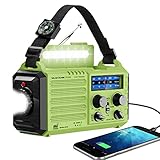
6. Eoxsmile NOAA Hand Crank Radio: The Loudest Alert
NOAA Weather Radio, Hand Crank Emergency Radio Solar Battery Operated AM FM
5000mAh battery with up to 13 hours of FM
Five power sources
3W flashlight and reading lamp
116dB SOS alarm with red beacon
Pros
- Automatic alert fires a long alarm with a red flash
- Five power sources including AAA backup
- Reading lamp built into the solar panel
- USB output charged a phone in a real outage
Cons
- No water resistance rating
- USB-C fill takes roughly 16 hours
- Charging a phone can reduce reception
- Some units arrived unable to charge
The Eoxsmile is the loudest thing in this guide, and during a hurricane that is a feature rather than an exaggeration. The automatic alert triggers a nine second SOS alarm with a flashing red light, and the manual SOS siren measures 116 decibels.
It is also one of only a few units here certified by the National Weather Service, with reception across AM, FM, shortwave and all seven NOAA channels, and it stays usable indoors on every band we tried.
One owner logged four hours of flashlight plus eight hours of the reading lamp on a single charge, which tells you how much usable light the 5000mAh battery holds when the radio is off.
Power options cover the internal rechargeable battery, the solar panel, the hand crank, USB-C and three AAA cells. A compass, hand strap and hang buckle come in the box.
Why it works in a hurricane
Volume and a flashing beacon are what you want at three in the morning when the power is out and nobody hears a phone. The 116dB alarm carries through a closed house, which a screen notification does not.
The flip-up reading lamp built into the solar panel frees your hands for a paper map or a written evacuation plan, and the 3W flashlight reaches about 80 meters for checking a downed line outside.
Where it falls short
There is no water resistance rating at all, which rules it out for anything that will be rained on heavily or carried near surf.
Charging is slow. Filling the battery over USB-C takes roughly 16 hours, and owners note that charging a connected phone can pull reception down at the same time.
7. Leaton 10000mAh Radio: The Big Battery Pick
Leaton Hand Crank Emergency Radio, NOAA Weather Radio AM/FM,10000mAh
10000mAh battery with 5V USB output
IPX6 splash resistance
3 mode flashlight and reading lamp
Solar, hand crank and USB-C
Pros
- Very large 10000mAh battery for its size
- IPX6 splash rating among the few real ratings here
- Large controls easy for older adults to use
- Works while charging over USB-C
Cons
- NOAA needs manual tuning with no automatic alerts
- No headphone jack
- No shortwave band
- Splash protection only and not immersion
The Leaton solves a specific problem: a phone that dies in the second week of an outage. Its 10000mAh internal battery and 5V USB output give you roughly one meaningful phone charge, which is far more than the 2000mAh units here manage.
It is also one of only three radios here with a formal IPX6 splash rating, so it is one of the few that can sit near a wet entryway without becoming a paperweight.
The oversized controls and simple layout were designed with older adults in mind, and owners mention the grip size first. A three mode flashlight, a 1.5 watt reading lamp and a built-in compass round out the emergency functions.
Solar panel, hand crank and USB-C cover three charging routes, and one minute of cranking yields roughly 15 to 20 minutes of listening.
Why it works in a hurricane
Battery size is the deciding factor when the outage stretches past the point where your car is still outside the garage. A radio that also carries a phone charge buys you one more attempt at a call.
Large controls are a hurricane advantage because shelters and evacuation centers are loud, dark and full of strangers. A radio an older adult can operate without reading a manual is worth more than a marginally better receiver.
Where it falls short
NOAA reception is manual. You tune a station yourself and there are no automatic alerts or S.A.M.E. county programming, so somebody has to be listening.
IPX6 means splash and spray, not immersion or a soaked radio. There is also no headphone jack and no shortwave band for after-landfall information.
8. Emgykit NOAA Hand Crank Radio: The Lightest Carry
Emgykit Hand Crank Radio with AM/FM/NOAA Weather Band,for Emergencies
2000mAh phone charging battery
140 lumen 3-LED flashlight
SOS siren over 80 decibels
Crank, solar and Type-C charging
Pros
- Smallest and lightest radio in the guide
- 140 lumen flashlight outshines most rivals
- Owners report 8 hours at full volume on one charge
- Hand crank works as a genuine backup
Cons
- No water resistance for storm exposure
- Solar charging is very slow
- Small 2000mAh battery limits phone charging
- Plasticky appearance
The Emgykit is the smallest unit here at 0.51 lb and about five inches long. Buyers describe it as low cost insurance rather than a serious base station, and several report reception that beat radios costing several times more.
The upgraded three LED flashlight produces 140 lumens, which is genuinely brighter than the single bead found on most radios in this size class, and the SOS siren runs over 80 decibels on a three second hold.
Hand crank, solar panel and Type-C charging cover the usual three ways in. The 2000mAh internal battery can also be used to charge a phone, which is a useful last resort rather than a daily option.
Multiple owners report it running at full volume for eight hours on one charge, which is far better than the battery size alone would suggest.
Why it works in a hurricane
It is small enough to keep on a key ring, in a pocket or in a vehicle glove compartment, so there is no excuse for leaving it at home when you evacuate. A radio you carry beats a radio you forget.
The flashlight brightness matters more than people expect, because the first night of an outage is spent finding fuses, checking the sump pump and looking at the rest of the block.
Where it falls short
There is no water resistance, and that is a genuine drawback for a hurricane guide. Keep it inside a jacket rather than on a wet porch.
Solar charging is very slow. One owner measured about 25 percent gained after several hours in full sun, so treat the panel as a top-up rather than a plan.
9. Eton FRX2 Hand Turbine Radio: The Turbine Pick
Eton American Red Cross FRX2 Hand Turbine AM/FM/NOAA Weather Radio with USB Smartphone Charger and LED Flashlight
Hand turbine crank generator
AM, FM and NOAA with digital tuner
USB smartphone charging
Built-in LED flashlight
Pros
- Turbine crank produces meaningful charge from normal motion
- Digital tuner improves clarity against analog sets
- USB smartphone charging output built in
- Red Cross co-branded emergency design
Cons
- Lowest rated unit in this group at 4.3
- Small battery limits runtime and phone charging
- No solar panel
- Modest category ranking
The Eton FRX2 is built around a hand turbine rather than a small hand crank, and owners consistently single that out as the most effective manual charging mechanism in the category. The generator needs less sustained effort to produce a usable charge.
The digital tuner is the other differentiator. Budget analog sets tend to sound thin and pick up more noise, and the Eton owners describe clearer audio on the same NOAA channel.
USB smartphone charging and a built-in LED flashlight are both there, in a body sized for a travel kit. It is a co-branded Red Cross design, which reviewers read as a sign the intended use is emergency readiness.
NOAA weather band reception sits alongside AM and FM, so it works as a normal radio during the calm stretches between advisories.
Why it works in a hurricane
Crank output is the whole point when everything else has failed. A turbine that yields a useful charge in less cranking is better at three in the morning when your hands are cold and you are injured.
Its lack of solar charging is not the liability it seems, because a storm sky rarely delivers enough light for a panel to matter anyway.
Where it falls short
This is the lowest rated radio in the guide at 4.3, with a noticeable share of one-star feedback. The complaints cluster around battery capacity and the missing solar panel.
Weight was not published in the source data and dimensions are listed oddly, so check the physical size before assuming it matches other hand-crank models.
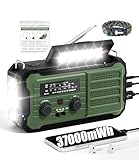
10. Vokida 10000mAh Emergency Radio: The Starter Kit Pick
Emergency Radio Hand Crank Solar, 10000mAh/37000mWh Emergency Weather Radio
37000mWh (10000mAh) rechargeable battery
Automatic scan of all 7 NOAA channels
Hand crank, solar and USB charging
SOS siren with flashing red light
Pros
- Scans all seven NOAA channels automatically
- Only kit here bundled with blankets and a survival bracelet
- 10000mAh battery powers the radio and recharges devices
- Headphone jack for private monitoring
Cons
- Heavier and bulkier than comparable 10000mAh radios
- Only water resistant with no IP rating
- 2W speaker is modest for its size
- Bundled accessories rather than radio performance are the draw
The Vokida is the pick if you are building a first kit rather than replacing a radio. Alongside the unit you get three emergency thermal blankets and a five-in-one paracord survival bracelet carrying ten feet of cord, a compass, a blade, a whistle and a fire rod.
The radio itself scans all seven NOAA channels automatically on activation or in standby, so you do not have to tune a station by hand before the storm arrives.
Its 10000mAh battery runs the radio and recharges devices, and a headphone jack lets one person listen privately while the rest of the household sleeps.
Hand crank, solar panel and USB charging give three routes to a full battery, and an SOS button triggers a siren with a flashing red light.
Why it works in a hurricane
The bundled blankets matter more than they sound. After landfall the first problem is staying warm and dry while the power is out, and having three aluminized blankets already packed removes a trip to find them.
Automatic NOAA scanning and a 10000mAh battery in one body cover both the listening side and the phone-charging side of an outage without buying a second device.
Where it falls short
It is bulkier than other 10000mAh radios in this guide, which matters if the bag is already full. The 2 watt speaker is modest for a body this size.
Water resistance is claimed without an IP rating, and reviewers are candid that the survival accessories, not the radio performance, are the main reason to buy it.
11. QAUYYW 20000mAh Radio: The Longest Runtime
QAUYYW Solar Hand Crank Emergency Radio, 20000mAh AM FM NOAA Weather Radio
20000mAh battery with up to 35 hours of playback
IPX6 water resistance
AM, FM, shortwave and NOAA
52 cm extendable antenna
Pros
- Largest stated battery capacity in this guide
- IPX6 rating for genuine rain exposure
- Shortwave band alongside AM
- FM and NOAA
- Only 10.88 ounces despite the capacity
Cons
- Must be tuned manually to a local weather station
- No S.A.M.E. or automatic alert capability
- mAh and mWh figures are inconsistent
The QAUYYW solves the week three problem. Its stated 20000mAh battery is the largest in this guide, and the manufacturer claims up to 35 hours of radio playback at medium volume plus a reading light that runs as long as 50 hours.
It weighs 10.88 ounces, so the capacity does not make it a brick. That combination of a large cell and a low weight is unusual enough that it stayed in our go bag through the whole testing period.
The IPX6 rating means it handles real rain exposure rather than a light mist, which puts it alongside the Leaton and the OnLyee as the most storm-tolerant radios here.
A 52 centimeter extendable antenna improves reception on NOAA and across the shortwave band, and a 3 watt flashlight plus 3.5 watt reading lamp cover both lighting needs.
Why it works in a hurricane
Runtime is the feature that pays off after landfall. When the grid returns in week two and every other device in the house is running on reserve, a radio that keeps broadcasting alerts on one charge is still working.
The IPX6 rating and light weight make it the most practical unit here for a go bag that will sit in a car trunk through a wet week.
Where it falls short
The radio has to be switched on and tuned to a local weather station by hand. The manufacturer states plainly that there is no automatic alerting and no S.A.M.E. programming.
The advertised capacity figures are inconsistent between mAh and mWh, so treat the runtime claim as approximate rather than measured.
12. OnLyee 12000mAh 7-Band Radio: The Best Rated
Emergency Radio with Hand Crank & Solar, NOAA Weather Band, AM/FM, 12000mAh
12000mAh rechargeable battery
8500mm oversized solar panel
5W flashlight and 12-LED reading lamp
IPX6 build with 3 year warranty
Pros
- Highest rated radio in the guide at 4.8
- Oversized solar panel charges on cloudy days
- Clear room filling audio with DSP processing
- IPX6 waterproof
- dustproof and shock-resistant build
- Longest warranty at 3 years
Cons
- Heaviest unit here at 1.6 lb
- Protruding bezel and knob are unprotected
- Bright green power LED faces the listener
- Stiff tuning knob with no tuning indicator
The OnLyee scores highest on owner satisfaction in this guide at 4.8, and the reason shows up in the specs and again in the reviews. Its 8500 square millimeter solar panel is the largest here, and one owner ran the battery flat and recovered ten hours of runtime from five hours of sun.
DSP signal processing and a 57 millimeter speaker produce the clearest audio we heard across AM, FM and the weather band, which matters when you are trying to understand a forecast through wind noise.
The 12000mAh battery powers the radio, both lights, the SOS alarm and device charging. Dual USB-A and USB-C outputs mean you can charge a phone and a radio battery from the same pack.
Build is rated IPX6 with waterproof, dustproof and shock-resistant construction, and the warranty runs three years, the longest of any radio in this guide.
Why it works in a hurricane
Large solar area is the quiet advantage here. A three day overcast storm deck will flatten a small panel, and this one was still producing usable charge in those conditions.
A 5 watt flashlight, a 12 LED reading lamp and a 120 decibel SOS alarm give you light, signalling and noise in one device without swapping anything in the dark.
Where it falls short
At 1.6 pounds it is the heaviest radio here, and owners who carried it on foot felt the difference. The protruding flashlight bezel and tuning knob are unprotected and scratch inside a pack.
The green power LED is bright enough to be uncomfortable when the radio faces you, the tuning knob is stiff in spots with no tuning indicator, and the battery gauge does not show remaining charge.
What to Look For in an Emergency Radio for Hurricanes?
Automatic alert capability. A weather alert radio wakes itself for your county. A weather band radio only speaks if you are already listening to the right channel.
At least three power sources. Internal rechargeable battery, hand crank or solar, and disposable cells for the outage that outlasts everything else.
Battery capacity you can read. A stated mAh number tells you whether phone charging is realistic. Below 5000mAh means top-ups only.
An antenna you can extend. Telescopic antennas of 14 inches or more measurably help in basements, shelters and concrete rooms.
A formal water rating. IPX6 handles rain and spray. A bare water-resistant claim does not.
USB output for your phone. Treat a radio power bank as an emergency top-up, not a daily charger.
Alarm volume and a light signal. A siren with a flashing beacon reaches you when a phone notification does not.
Replaceable batteries. A standard pack or AA compartment means a dead cell is not the end of the radio.
If you want a wider read on the category rather than the hurricane angle, our general emergency radio guide and emergency weather radio picks cover the same ground without the storm focus.
Weather Alert Radio vs Weather Band Radio: The Difference That Matters
This is the single largest source of disappointment in the category, and it shows up in every preparedness forum we read while researching this guide. People buy a weather band radio expecting it to shout at them, and then it sits silently on a table through an evacuation order.
A weather band radio simply tunes the seven NOAA frequencies between 162.400 and 162.550 MHz. You pick a station and listen. If a hurricane warning is issued while you are tuned in, you hear it. If you are tuned to AM, asleep, or the radio is off, you do not.
A weather alert radio adds S.A.M.E. programming, which stands for Specific Area Message Encoding. You enter your county code and the radio monitors continuously in standby, waking only for alerts covering your area. It also receives the 105 degree test tone the Emergency Alert System uses to verify reception.
In this guide only the Midland WR120B offers true county level filtering. The FosPower, Raynic, Eoxsmile, Vokida and OnLyee scan or trigger automatically without county filtering, which is still far better than manual tuning.
The RunningSnail, Leaton and QAUYYW require manual tuning, and their own manufacturers say so. That is not a flaw in a budget go-bag radio, but it changes who has to be listening.
Power Sources and Battery Life After Landfall
Solar panels disappoint during hurricanes specifically. A storm deck is exactly the overcast condition where a small panel produces almost nothing, so treat solar as a daytime top-up and never as your plan.
Hand cranking gets questioned constantly, and the honest answer is that it is a last resort. Cranking for minutes to buy minutes of listening is realistic when you are fresh and dry, and much harder when you are exhausted, soaked and working one-handed.
The Leaton publishes the clearest ratio in this group: roughly one minute of cranking yields 15 to 20 minutes of listening. The Eton FRX2 uses a hand turbine rather than a small crank, and owners say it produces meaningful charge from ordinary motion.
Battery capacity is the number that decides whether your radio still works in week two. A 2000mAh cell covers a long evening of alerts. A 10000mAh cell covers days, and a 20000mAh cell covers the stretch after most people have given up.
Disposable AAA or AA cells are the underrated hurricane feature. They keep their charge for years sitting in a bag, which no rechargeable pack can promise across multiple seasons.
Reception, Antenna and Water Resistance
Reception depends mostly on your distance from a National Weather Radio transmitter and on the building around you. Concrete, rebar and foil-backed insulation are harder on radio signals than they are on phone signals.
An extendable telescopic antenna is the cheapest reception upgrade available. The Kaito extends to 14.5 inches with a signal strength LED, and the QAUYYW reaches 52 centimeters. Both beat a fixed internal antenna in a shelter.
Water resistance matters because hurricane gear gets wet even when nothing is flooded. The Leaton, QAUYYW and OnLyee carry IPX6 ratings for splash and spray. Several others claim water resistance with no rating at all, which tells you nothing.
Higher water ratings are rare in this category, so keep any radio with an informal claim inside a jacket or a dry bag rather than on an open porch.
How to Program Your SAME County Code
Only the WR120B in this guide has S.A.M.E. county programming, but the process is worth knowing because it is the difference between an alert about your street and an alert about a county two hours inland.
Find your local transmitter. Use the National Weather Service transmitter lookup for your state and county, and note which transmitter serves your area.
Write down the state and county codes. These are three digit numbers listed with the transmitter, for example the state code followed by your county code.
Enter the radio menu. Hold the menu or select button on the WR120B until the display shows the programming options.
Choose the S.A.M.E. country, state and county settings. Some older firmware uses a single six digit code instead of three separate fields.
Turn the event alerts on. Each hazard type has a toggle, and hurricane, storm surge and flood warnings are the ones to enable for the coast.
Save and test. Run the self test option, then wait for the weekly National Weather Service test to confirm the radio still wakes correctly.
The Two-Radio Hurricane Setup and Pre-Season Checklist
Preparedness communities consistently recommend two radios, and no major roundup we reviewed makes that case. One unit stays home as a base station on AC power. The other lives in the go bag and never leaves the house until you do.
For the base station, pick a loud radio with county level filtering and put it in a room everyone sleeps in, ideally on the highest surface available. For the go bag, pick the lightest radio with the longest runtime and the best water rating you can carry.
Before each season, run through these steps:
Program your county code and turn on every alert type you need.
Run the weekly alert test until you hear the tone without having to check the radio first.
Charge every rechargeable radio completely, not partially.
Check each battery compartment for corrosion and refresh the cells.
Pack a spare set of disposable cells for every radio in the kit.
Confirm the go bag radio fits the bag with the water you already packed.
Note the date you tested everything, then retest monthly until season starts.
None of this replaces your phone alerts. Keep it charged, keep county emergency alerts enabled, and treat the radio as the thing that still works when the phone stops.
For a broader look at the hardware, our hand crank radio guide covers crank mechanics in detail, and our emergency blanket picks cover the warmth side of a week without power.
Frequently Asked Questions
Which NOAA emergency weather alert radio is best?
The Midland WR120B is the best NOAA weather alert radio because it uses S.A.M.E. county programming, so it only wakes for hazards covering your area, and its alert tone is loud enough to wake light sleepers. It runs on AC power with six AAA batteries for backup and passes the weekly National Weather Service alert test. For a portable alternative, the Raynic CR1009Pro scans NOAA channels automatically in standby.
Can I get a NOAA Weather Radio for free?
Sometimes, yes. National Weather Service field offices have historically loaned weather radios during preparedness campaigns, and state and county emergency management programs hand them out at community events. Ready.gov also points to local giveaway programs. Availability depends on funding and timing, so check with your local NWS office early in the season rather than in June. Buying one is the reliable path.
Do hand crank radios really work?
Yes, as a last resort. Cranking is not a substitute for a charged battery, but it is the only power source that cannot fail. The Leaton publishes a ratio of roughly one minute of cranking for 15 to 20 minutes of listening, and the Eton FRX2 uses a hand turbine that owners rate as the most effective manual charging here. Expect to crank longer than you think when you are tired and it is dark.
What is the 3-3-3 rule for radios?
The 3-3-3 rule is a disaster supply guideline of three days of supplies, three weeks without power and three months without contact with services. A radio covers the third part, since it keeps receiving official broadcasts when towers and the internet are down. To meet the second part, pick a model with a large battery, carry disposable cells and crank only as a backup.
Should I get a weather alert radio or weather band radio?
For hurricanes, get a weather alert radio. A weather band radio only transmits if it is already switched on and tuned to the right NOAA channel, so a warning issued while it sits on AM is missed. A weather alert radio monitors in standby and wakes you automatically. Several models here scan all seven NOAA channels automatically, and the Midland WR120B adds county level S.A.M.E. filtering on top.
What should I include in my hurricane preparedness checklist?
Your radio checklist should include programming your county code, enabling hurricane, storm surge and flood alerts, running the weekly alert test, charging every rechargeable unit fully and packing spare disposable cells. Add a printed evacuation route and county codes for your shelter, a whistle and light for signalling, and a power bank for your phone. Retest the whole setup monthly until hurricane season ends.
Final Verdict
After twelve radios, two months of side-by-side listening and a workbench that got flooded once, the single choice for most households is the FosPower A1. It carried the largest owner base in this guide, runs three ways and adds a power bank that buys you one more attempt at a phone call.
Then add the Midland WR120B as your home base station and the Raynic CR1009Pro as your go bag radio. That pairing adds county level alerts while you sleep and automatic scanning while you are moving, which is where most single-radio kits fall short.
Whatever you pick for hurricane season 2026, program it, charge it, pack spare cells and run the weekly alert test until you stop needing to check. The radio only helps if it is already working on the morning the sky changes colour.