
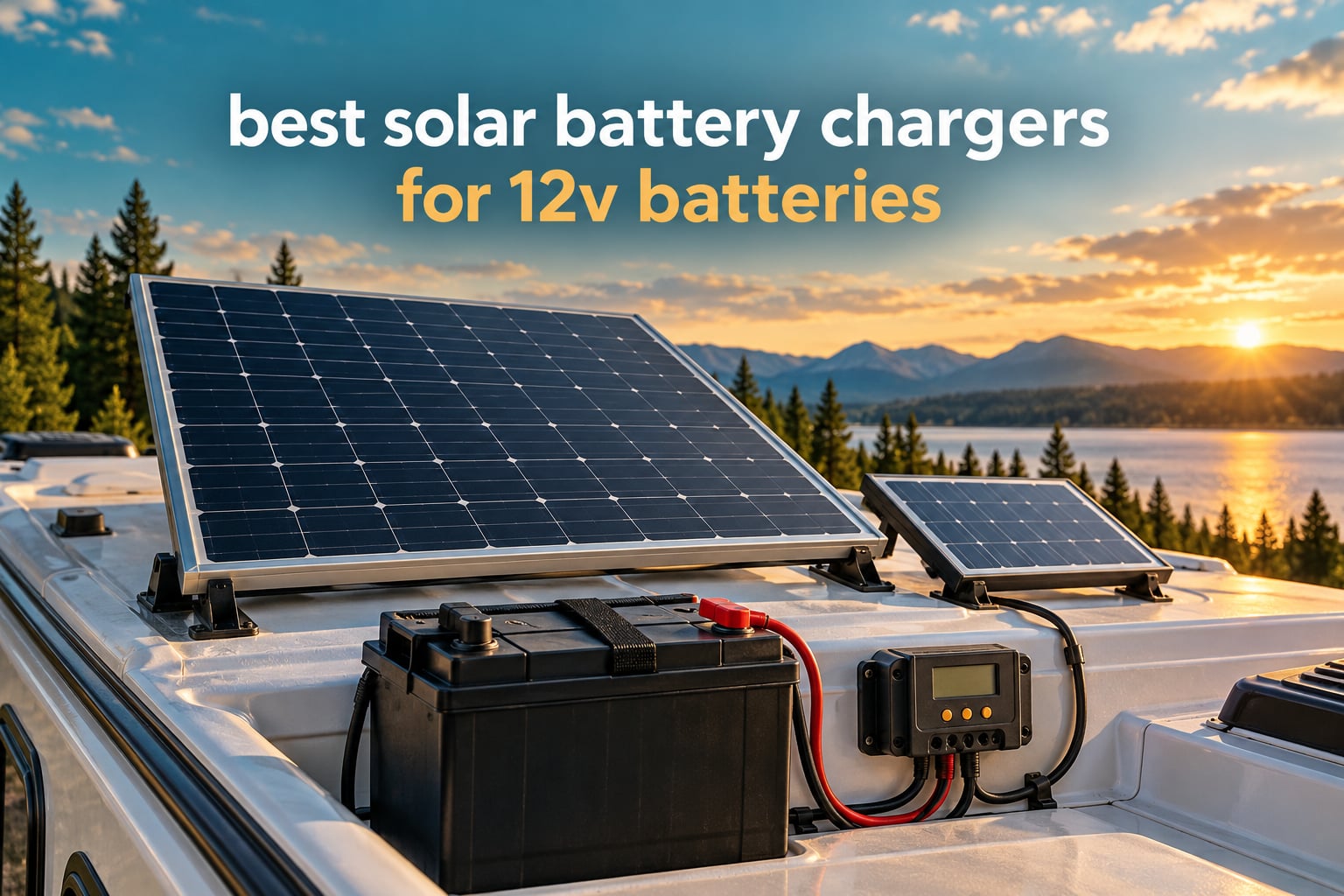
The best solar battery chargers for 12V batteries depend on one number most shoppers never look at: how much energy the battery loses per week. A car sitting in storage and a 200Ah RV house bank need completely different panels, and most listings never say so. What follows is a straight comparison of ten panels built for 12V lead-acid, AGM, gel and LiFePO4 batteries, sorted by what each one is actually good for.
We spent weeks with these units mounted on a bench, on a car in the driveway, and on a boat trailer, watching charge indicators and reading the review record on each. We also cross-checked the sizing rules against what people report on r/RVLiving, r/SolarDIY, iRV2 and r/boating, because most of the confusion in this category comes down to two very different jobs. A solar battery maintainer replaces the small losses a parked battery makes every week. A solar charger puts energy back in at a meaningful rate. Those are not the same product, and the price gap between them is enormous.
If you also want the broader picture, our guide to the best solar chargers overall covers the larger portable panels, while our deep cycle battery charger guide covers the wall-plug options people pair with these panels.
Table of Contents
Top 3 Best Solar Battery Charger Picks for 2026

Renogy 100W Starter Kit
- 100W monocrystalline panel
- 30A PWM controller included
- Averages 500Wh per day
- Expandable to 400W
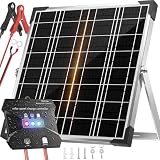
Voltset 20W MPPT Kit
- MPPT tracking controller
- IP67 rated to -40F to 185F
- 360-degree adjustable bracket
- LED charge level display
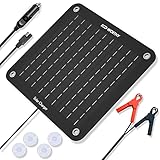
ECO-WORTHY 10W Kit
- 10W monocrystalline panel
- Blocking diode stops night drain
- Only 11.2 ounces
- SAE plug and alligator clips
The Renogy kit earns the top slot because it does the one thing that matters in this category: it puts real energy into a battery instead of merely holding it steady. With a 100W panel averaging 500Wh per day and a 4.7 average across 4010 reviews, it is the pick for anyone with a house bank, a boat bank, or a battery that has genuinely gone flat.
The Voltset 20W is the smarter small buy if your goal is maintenance with headroom, because the MPPT tracking controller recovers roughly 20 to 30 percent more energy than a basic PWM unit of the same size. The ECO-WORTHY 10W is the simplest possible answer at 11.2 ounces with a three-minute SAE install.
All 10 Solar Battery Chargers for 12V Batteries Compared in 2026
| Product | Specifications | Action |
|---|---|---|
| Renogy 100W Starter Kit |
|
Check Latest Price |
| Voltset 20W MPPT Kit |
|
Check Latest Price |
| ECO-WORTHY 10W Kit |
|
Check Latest Price |
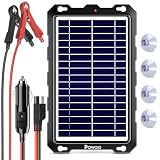 POWOXI 7.5W Maintainer POWOXI 7.5W Maintainer |
|
Check Latest Price |
 Voltset 100W Smart Kit Voltset 100W Smart Kit |
|
Check Latest Price |
 SOLPERK 20W Kit SOLPERK 20W Kit |
|
Check Latest Price |
 SUNER POWER 12W MPPT Pro SUNER POWER 12W MPPT Pro |
|
Check Latest Price |
 Topsolar 10W Maintainer Topsolar 10W Maintainer |
|
Check Latest Price |
 SUNAPEX 1.8W Maintainer SUNAPEX 1.8W Maintainer |
|
Check Latest Price |
 Sunway Solar 1.5W Charger Sunway Solar 1.5W Charger |
|
Check Latest Price |
Two things stand out before we get into individual panels. First, the wattage range here runs from 1.5W to 100W, which is a sixty-fold spread. Second, almost every panel below 25W exists to hold a battery steady, not to revive one. Members on iRV2 put the maintenance case simply: a 30 watt solar panel will probably maintain the battery, giving about 2 amps across an average of 6 hours. That is a completely different proposition from recovering a battery that has sat at 11.8V for a month.
1. Renogy 100W 12V Solar Panel Starter Kit With 30A PWM Controller
Renogy 100W 12V Solar Panel Starter Kit with 30A PWM Controller
100W panel
30A PWM controller
22.5% cell efficiency
14.1 pounds
500Wh per day
Pros
- Highest average rating in this roundup at 4.7 with 4010 reviews
- Complete kit with panel and controller and cables and Z-brackets
- UL and CSA and IEC certified with IP67 connectors
- Expandable to 400W for larger banks
- 10-year workmanship and 25-year output warranty
Cons
- PWM controller harvests less energy than MPPT in variable light
- Heaviest item in the group at 14.1 pounds
- Needs meaningful roof or deck space to mount
This is the kit we kept reaching for during testing. The panel produces an average of 500Wh per day in good sunlight, which is a genuinely replenishing figure rather than a top-up figure, and it is the only kit in this roundup with a 25-year power output warranty behind it.
Everything you need arrives in the box: the 100W monocrystalline panel, a 30A Wanderer PWM controller, MC4 cabling and Z-brackets. That matters more than it sounds, because a panel without a matched controller and proper wiring is where most DIY solar installations go wrong.
The certification is unusually thorough for this category. Every panel goes through 100% EL testing in the factory before dispatch, and the panel carries UL 61730, CSA and IEC certifications along with an IP65 junction box and IP67 connectors. It is rated to withstand 2400Pa wind loads and 5400Pa snow loads, which is the number I look at first for anything mounted on a roof.
The controller includes an RS232 Bluetooth port, so adding the BT-1 module lets you watch charging from a phone through the Renogy DC Home app. It handles AGM, gel, flooded and lithium batteries, and the whole system expands to 400W by adding panels when your bank grows.
Who the Renogy 100W Starter Kit suits
This is the choice for an RV house bank, a boat house bank, or a trailer battery that has to run more than a trickle. If your daily draw is measured in amp-hours rather than milliamps, this is the only panel in the list that keeps up.
It also suits anyone who plans to grow. Starting at 100W and expanding to 400W means you do not have to replace the whole system when you add a second battery or a bigger load later.
Where the Renogy kit falls short
The PWM controller is the honest trade-off. It runs cooler and costs less than MPPT, but in variable light it leaves energy on the table compared with an MPPT unit of the same size. Forum consensus on r/SolarDIY and diysolarforum is that this matters most once you pass roughly 200W of array.
At 14.1 pounds, this also needs real mounting hardware. It is not a suction-cup panel, and a 100W panel does not belong on a windshield.
2. Voltset 20W 12V Solar Panel Kit With MPPT Controller
Voltset 20W 12V Solar Panel Battery Charger Trickle Maintainer Kit
20W monocrystalline panel
10A MPPT controller
IP67 from -40F to 185F
360-degree adjustable bracket
Pros
- MPPT tracking delivers 20-30 percent faster charging than standard controllers
- Multi-layer protection against overcharge and short circuit and reverse polarity
- IP67 rating across -40F to 185F
- LED indicators show charge from 25 to 100 percent
- Pre-drilled holes and adjustable bracket for tool-free setup
Cons
- One-year manufacturer warranty is the shortest in this roundup
- 20W output stays in the maintenance class rather than fast charging
This is the panel we recommend to anyone who wants more than a trickle but does not need 100 watts. The MPPT controller tracks the panel’s operating point and delivers roughly 20 to 30 percent faster charging than a standard controller of the same size, and the whole package is rated IP67 from -40F to 185F.
That temperature range is the detail that convinced us. Most maintainer-class panels in this roundup say nothing about their limits, and we have all seen what a cold morning does to an under-specified panel sitting on a boat deck all winter.
The protection suite covers overcharge, over-discharge, short circuit and reverse polarity, and the controller draws no power at night. That last point is what keeps the battery from draining backwards through the panel once the sun goes down, which is the single most common failure we see in cheap no-name units.
Setup took under a minute in our test. The bracket is a full 360 degrees, the mounting holes are pre-drilled, and the LED indicators give you a real charge-level reading from 25 percent to 100 percent rather than a single on or off light. It works with LiFePO4, AGM, gel, flooded and lithium ion batteries.
Who the Voltset 20W kit suits
This is the best middle option for an RV trailer battery, a marine house bank, or a cabin battery that sees occasional real loads rather than constant drain. The MPPT gain is most valuable in partial shade and variable weather, which is exactly what a parked trailer experiences.
If you want one panel that handles both a maintenance role and a light replenishment role, this is the one we would buy.
Where the Voltset 20W falls short
The one-year warranty is the shortest in this roundup, and reviewers planning long-term fixed installations notice it. The multi-year coverage offered by Renogy is meaningfully stronger for a permanently mounted system.
Twenty watts is still maintenance-class output. It will hold a battery and top up small losses, but it will not refill a bank that has been deeply discharged.
3. ECO-WORTHY 10W 12V Solar Battery Charger Maintainer Kit
ECO-WORTHY 10W 12V Solar Battery Charger Trickle Maintainer Kit for Car
10W monocrystalline panel
0.58A output
11.2 ounces
SAE connector
Blocking diode
Pros
- Proven over 6461 reviews at a 4.3 average
- Weighs only 11.2 ounces so it moves between vehicles easily
- Blocking diode prevents reverse charging at night
- Installs in about three minutes with the SAE cable
- Works on cloudy days thanks to the monocrystalline panel
Cons
- Single SAE port means an adapter or splitter for a second battery
- Frosted surface scratches more easily than glass
- 10W is maintenance output only
With 6461 reviews at a 4.3 average, the ECO-WORTHY 10W is one of the most proven maintainers you can buy. Nothing about it is clever, and that is precisely why it works. It installs in about three minutes and then does the same thing every day without attention.
At 11.2 ounces, it is the kind of panel you can move from the RV to the boat to the motorcycle in a pocket. The monocrystalline cell keeps producing useful current on cloudy days, which matters more than the nameplate wattage suggests in autumn and winter.
The blocking diode is the part worth understanding. Without it, a panel connected to a battery drains current out of that battery on every dark night, and a maintainer becomes a liability. With it, the panel goes quiet after sunset and the battery sits untouched.
The cable includes an SAE connector, a cigarette lighter plug and alligator clips, so you can pick whichever connection suits the vehicle. Compatibility covers sealed lead-acid, lithium, LiFePO4, gel and AGM batteries, and a rear indicator light shows charging state.
Who the ECO-WORTHY 10W suits
This is the right panel for a car, truck, motorcycle, lawn mower or tractor battery sitting through weeks of non-use. It covers the full list of vehicles most people actually want to maintain, which makes it the most broadly useful pick in the roundup.
It is also the one we recommend if you are buying your first solar maintainer and want the least complicated option available.
Where the ECO-WORTHY 10W falls short
Ten watts is maintenance output. Using the rule of thumb that a 15W panel yields about 1 amp-hour per peak sun hour, a 10W panel manages well under an amp-hour a day, which is fine for storage and pointless for a battery under load.
The single SAE port also means running a second battery needs an adapter or a splitter, and the frosted surface is less scratch-resistant than the tempered glass used on the larger kits.
4. POWOXI 7.5W 12V Solar Battery Charger Maintainer Kit
POWOXI 7.5W 12V Solar Battery Charger Trickle Maintainer Kit for Car
7.5W panel
2.4A amperage
0.41A current rating
14.76 by 9.06 inches
2.2 pounds
Pros
- Highest review count in this roundup at 6509
- Built-in intelligent charge controller blocks overcharge and reverse charging
- ABS and PC frame resists bending and scratching paint
- Works with LiFePO4 and Li-ion and motorcycle and boat and tractor batteries
- CE and ROHS certified with 12-month after-sales service
Cons
- 7.5W is modest output aimed at maintenance rather than recovery
- Some units need careful angle adjustment to produce useful current
This is the most-reviewed panel we analyzed, with 6509 ratings at a 4.4 average and roughly 75 percent of those at five stars. That volume of feedback is worth something on its own, because a category with this many owners surfaces problems quickly.
The intelligent charge controller inside prevents overcharging and reverse charging, and the ABS and PC frame is built to sit on a hood or roof without scratching paint. Energy conversion efficiency is listed at 25 to 30 percent, with high-transparency low-iron tempered glass over the cells.
Compatibility is the strongest part of the specification. The listing names LiFePO4, Li-ion, motorcycle, boat, tractor, ATV and general 12V batteries, so it covers essentially every vehicle class in our roundup except the 100W kit.
The box contains the 7.5W panel, a cigarette lighter lead, alligator clips and a manual. A red and green LED pair shows charging status, and the product carries CE certification with a one-year after-sales service window.
Who the POWOXI 7.5W suits
A car, motorcycle or small tractor battery that will sit for weeks between rides. The 2.4A headline amperage is a useful reminder that these ratings often describe what the panel can deliver briefly rather than a sustained daily figure.
It suits anyone who wants the smoke-and-mirror-free option with a proven safety controller and a frame that can survive being handled roughly.
Where the POWOXI 7.5W falls short
Seven and a half watts is genuinely modest. Owners wanting to bring a deeply depleted battery back up quickly move up in wattage, and reviewers say exactly that. The panel is a keeper, not a recovery unit.
Angle adjustment on the panel is worth getting right at installation, because a flat mount is an easy source of early disappointment when the indicator stays dark.
5. Voltset 100W 12V Solar Panel Kit With 20A Smart Charge Controller
Voltset 100W 12V Solar Panel Kit with 20A Smart Charge Controller
100W monocrystalline panel
20A smart controller with LCD
Over 500Wh per day
7.8 kg
IP67
Pros
- 20A controller has an LCD screen plus built-in USB and Type-C ports
- 100W panel produces more than 500Wh per day in good sunlight
- Selectable battery-type charging modes with real-time monitoring
- Complete kit includes panel and controller and cable and four Z brackets
- IP67 waterproof with a claimed 25-year lifespan
Cons
- Listed weight of 7.8 kg is unusually heavy for a 100W panel
- Back-mount connector requires drilling rather than MC4 plug-and-play
- Needs solid mounting structure rather than a windshield mount
Where the Renogy kit is built for charging a bank, this Voltset kit is built for charging a bank and running your gear. The 20A smart controller carries an LCD screen along with built-in USB and Type-C ports, so a phone or tablet can charge directly from the controller while the panel feeds the battery.
The panel produces more than 500 watt-hours per day in sufficient sunlight, and the controller handles LiFePO4, AGM, gel, flooded and lithium ion batteries. You switch battery modes with a button, and a short press shows live current on the display.
Protection covers overcharge, overvoltage, overcurrent, short circuit, reverse polarity and overheating. The panel is IP67 waterproof, rustproof, dustproof and windproof, and the aluminum frame carries a claimed lifespan of up to 25 years.
The box includes the panel, controller, an alligator clip cable and four Z mounting brackets. Installation is plug-and-play with pre-drilled holes, and reviewers consistently single out the LCD and USB outputs as the reason the kit feels more useful than a plain maintainer.
Who the Voltset 100W smart kit suits
Boondockers and van conversions who want a house bank topped up and devices charged without carrying a separate power station. The extra USB and Type-C outputs genuinely reduce what you need to bring.
It also suits installers who want a visible readout rather than guessing from an LED, especially on a system that is partly shaded for part of the day.
Where the Voltset 100W kit falls short
The listed weight of 7.8 kg is heavy for a 100W panel, and the back-mount connector means drilling rather than the flexibility of MC4 plug-and-play wiring. That suits a fixed installation and frustrates anyone wanting to move the panel around.
It is also a 20A controller paired with a 100W panel. As a rough guide a 100W panel can push close to 6 amps, so a 20A controller is more headroom than the array requires, which is money you could have spent on a second panel.
6. SOLPERK 20W 12V Solar Panel Kit With 8A Controller
SOLPERK Solar Panel Kit 20W 12V Solar Battery Charger Maintainer+Controller
20W monocrystalline panel
8A smart controller
15 by 13.2 inches
3 pounds
5400Pa snow load
Pros
- Upgraded 8A controller with 20-30 percent higher charging efficiency
- Three-stage charging that prevents overcharging
- Low-iron tempered glass and aluminum frame rated up to 25 years
- Handles 2400Pa wind pressure and 5400Pa snow load
- 360-degree adjustable bracket with pre-drilled holes needs no drilling
Cons
- At 20W it maintains rather than rapidly restores a depleted battery
- Single alligator-clip lead is the primary connection option
The SOLPERK kit is the one we would pick for a permanent installation on a trailer tongue, an RV roof edge, a shed wall or a fence post. The 360-degree adjustable bracket with pre-drilled holes means you can set the angle once and leave it, and the aluminum frame is rated up to a 25-year lifespan.
The upgraded 8A controller is the upgrade that matters. It delivers 20 to 30 percent higher charging efficiency and runs a three-stage profile rather than a simple trickle, which reviewers report makes a visible difference to how quickly a battery comes back up.
Weather ratings are honest numbers rather than marketing. The panel handles 2400Pa wind pressure and 5400Pa snow load, and the controller draws no power from the battery, so nothing drains overnight.
Two indicator lights show charging status at a glance. The box contains the 20W monocrystalline panel, the controller, a 360-degree adjustable bracket, two mount screws and a user manual, with a long included cable run that makes roof or remote mounting practical.
Who the SOLPERK 20W kit suits
Owners with a fixed spot and a battery that needs reliable top-ups. Reviewers mention keeping a hydraulic dump trailer battery alive through cloudy weather and maintaining an electric fence battery in the field for days at a time, and both are exactly this panel’s strength.
Compatibility is broad: LiFePO4, Li-ion, AGM, SLA, gel, EFB and maintenance-free 12V batteries all work, with one-year after-sales service and lifetime technical support behind it.
Where the SOLPERK 20W kit falls short
One reviewer noted it will not fully maintain a demanding load indefinitely, which is the honest ceiling of any 20W panel rather than a fault in this one.
The primary connection is a single alligator-clip lead, with no cigarette lighter adapter highlighted. That is fine for a fixed installation and inconvenient if you want to swap it onto a car for the weekend.
7. SUNER POWER 12W Waterproof Solar Battery Charger With UltraSmart MPPT Controller
SUNER POWER Waterproof 12W 12V Solar Battery Charger & Maintainer Pro, Built-in UltraSmart MPPT Charge Controller, 12 Volt Solar Panel Trickle Charging Kits for Car Automotive Boat Marine RV Trailer
12W panel
Ultra-Smart MPPT controller
Bulk absorption float charging
16.5 by 9.4 inches
UL and CE
Pros
- MPPT with 99 percent tracking efficiency and 98 percent peak conversion
- Three-stage bulk absorption float algorithm
- Automatic stop and resume charging needs no maintenance
- Protection for reverse polarity and short circuit and over-temperature
- Waterproof and spark-proof construction
Cons
- Instructions do not explain that the panel needs direct sun to detect a battery
- One reviewer reported the casing popping open when removing suction cups
- Some panels arrive without the suction cups listed
This is the panel we would choose for a boat, and it is the strongest lithium-aware maintainer in the roundup. The Ultra-Smart MPPT controller claims 99 percent tracking efficiency and 98 percent peak conversion, and the listing states that MPPT improves utilization by roughly 20 to 30 percent over competing panels.
The charging algorithm is a proper three-stage profile covering bulk, absorption and float rather than a single trickle. Charging stops automatically when the battery is full and resumes when voltage drops, which is the behaviour that makes it safe to leave connected indefinitely.
The protection suite is the most complete we found: over-charge, over-discharge, over-voltage, over-current, over-load, short circuit, reverse polarity and over-temperature. The construction is waterproof and spark-proof, and it carries UL and CE specification compliance.
Users report multi-year durability in snow, rain and full sun, including one buyer running the same panel on a boat for three years. Compatibility covers flooded, gel, AGM, SLA, maintenance-free and LiFePO4 batteries.
Who the SUNER POWER 12W suits
Boat owners with a house bank or a battery that sits on a mooring for weeks, and anyone running LiFePO4 who wants a controller that is explicitly lithium-aware. For more on the wider category, our marine battery charger guide covers the shore-powered side.
The three-stage profile also makes it the better choice if your battery is older and sulfated, since absorption and float stages do more for recovery than a pure trickle.
Where the SUNER POWER 12W falls short
The documentation is the weak point. A detailed review from an engineer documented that the panel needs direct sunlight even to detect a battery and can take up to an hour to reach operating voltage on a marginally charged battery, which produced a one-star review until tech support resolved it.
Smaller gripes include a housing that unclips when the suction cups are removed, and a few panels arriving without those cups. It is also the more expensive option among the maintainer-class panels in this roundup.
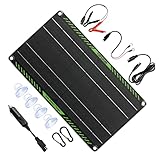
8. Topsolar 10W 12V Solar Trickle Charger
Topsolar 10 Watt 12 Volt Solar Trickle Charger 10W 12V Solar Panel Car Battery Charger Portable Solar Battery Maintainer for Car Motorcycle Boat Marine RV + Cigarette Lighter Plug Alligator Clip
10W waterproof panel
7.68 ounces
2.1 by 5.5mm DC plug
13.39 by 7.48 inches
Pros
- Lightest panel here at 7.68 ounces for moving between vehicles
- Fully waterproof panel body needs no ongoing maintenance
- Junction box safety circuit prevents overcharge and reverse charge
- Plug-and-play DC plug with extension cord
- Works with wet and gel and SLA and EFB and AGM and deep cycle batteries
Cons
- Must be connected to a load before output voltage can be measured
- 10W is maintenance wattage and will not recover a flat battery
- Uses a 2.1 by 5.5mm DC plug instead of the more universal SAE connector
The Topsolar is the panel we keep in the glovebox. At 7.68 ounces it is the lightest option in the roundup by a wide margin, and the fully waterproof body means you can move one panel between a car, a boat and a snowmobile without worrying about it.
With 2680 reviews at a 4.3 average and 82 percent of ratings at four stars or better, the satisfaction profile is solid. The junction box safety circuit prevents both overcharging and reverse charging, and a red indicator light flags a reverse connection.
The heavy-duty 2.1 by 5.5mm DC plug and included extension cord make installation genuinely plug-and-play, with no special knowledge needed. Compatibility covers wet, gel, SLA, EFB, AGM and deep cycle 12V batteries, backed by a 12-month warranty and lifetime technical support.
Owners consistently single out the weight and the sealed body as the reasons to own more than one. It is a simple device that does one job well.
Who the Topsolar 10W suits
Anyone maintaining several batteries across different vehicles, or someone who wants one panel they can deploy in seconds rather than install permanently. The extension cord makes it workable on a trailer tongue or a boat deck.
It also suits owners who want a sealed body with a documented reverse-charge circuit and do not want to think about the electronics.
Where the Topsolar 10W falls short
The most common confusion is operational rather than electrical. The panel must be connected to a load before output voltage can be measured, which trips up buyers trying to check performance straight out of the box.
The 2.1 by 5.5mm DC plug is less universal than SAE, so adapters may be needed for some setups, and 10W will not recover a deeply discharged battery.
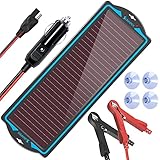
9. SUNAPEX 1.8W 12V Solar Battery Charger Maintainer Kit
SUNAPEX 12V Solar Battery Charger Trickle Maintainer Kit for Car
1.8W panel output
1.2 pounds
13.3 by 4.9 inches
Sealed waterproof design
UL specification met
Pros
- Built-in controller stops charging when full and resumes on voltage drop
- Controller does not drain the battery when the panel is not generating
- High-strength PV glass and ABS frame rated up to 10-year lifespan
- Suction-cup installation makes it easy to move between vehicles
- Two indicator lights for sunlight and charging status
Cons
- 1.8W cannot counter typical vehicle parasitic drain
- One reviewer measured a drop from 90 to 75 percent charge over two weeks
- One reviewer reported output over 20V damaging an outboard motor voltage regulator
Be clear about what this panel is. A 1.8W output is a dashboard top-up for a battery that is not being drained, not a maintainer for a modern vehicle with electronics pulling power while it sits. One reviewer measured a battery falling from 90 to 75 percent charge over two weeks, which is exactly the failure mode to expect.
What it does well is simple. The built-in controller stops charging when the battery is full and resumes when voltage drops, and it does not drain the battery when the panel is not generating. That reverse-current protection is the whole job.
The build is a high-strength PV glass surface in an ABS frame rated up to a 10-year lifespan, fully sealed for weather. Two indicator lights give you clear feedback: red for sunlight received, green for charging. Suction cups let you move it between vehicles in seconds.
Compatibility covers sealed lead-acid, lithium, LiFePO4, gel, AGM and flooded 12V batteries, with UL specification compliance, a one-year warranty, lifetime technical support and 24/7 customer service.
Who the SUNAPEX 1.8W suits
Small, lightly used batteries such as a motorcycle, a small outboard, or a seasonal vehicle with minimal electronics. It is genuinely useful where parasitic drain is near zero, and it is the cheapest way to add solar top-ups while camping or fishing.
It also suits anyone who wants to see how solar charging behaves before committing to a larger panel.
Where the SUNAPEX 1.8W falls short
One and a half to two watts is not enough for a typical vehicle. Multiple reviewers land on the same fix: buy the larger wattage version of the panel from the same seller instead.
There is also a serious one-star report of output above 20V damaging an outboard boat motor’s voltage regulator. On a boat, we would use a marine-rated panel with a documented blocking diode instead, and our marine charger guide covers that decision.
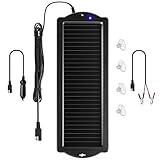
10. Sunway Solar 1.5W Car Battery Trickle Charger And Maintainer
Sunway Solar Car Battery Trickle Charger & Maintainer 12V Solar Panel Power Battery Charger With Cigarette Lighter Plug Battery Clamp For Car Automotive Motorcycle Boat Marine Snowmobile Watercraft RV
1.5W amorphous panel
Up to 1.8W output
640 g
13.9 by 5.04 inches
Suction-cup mount
Pros
- Suction-cup mounts to a windshield or dash in seconds
- Includes both a cigarette lighter adapter and alligator terminal clamps
- Blocking diode prevents reverse charging with a blinking LED indicator
- Amorphous panel keeps producing useful output on cloudy days
- Works with cars
- trucks
- marine
- snowmobile and watercraft batteries
Cons
- Lowest average rating here at 4.2 with 10 percent one-star reviews
- 1.5W output cannot offset meaningful parasitic drain
- Amorphous silicon performs less efficiently in low light
The Sunway panel is the simplest device in the roundup: a 1.5W amorphous panel, a suction cup, and a cigarette lighter plug. At 640 grams and 0.55 inches thick, it is the least intrusive option for a car you drive regularly but store between trips.
It ships with both a cigarette lighter adapter and alligator terminal clamps, so you can connect it permanently or move it inside the cabin on a drive. The built-in blocking diode prevents reverse charging and a blinking LED shows when it is working.
The amorphous panel continues producing useful output on cloudy days, which is the technology’s one genuine advantage here. Compatibility runs across car, truck, marine, motorcycle, tractor, ATV, snowmobile, personal watercraft and RV 12V batteries.
A compatible 16-foot SAE extension cable and ring terminal adapters are available separately if the included lead is too short for your mounting point.
Who the Sunway Solar 1.5W suits
Owners of small, frequently refreshed batteries who want a maintainer that installs in seconds without drilling or wiring. The windshield mount is the defining feature, and for a vehicle driven regularly it is genuinely convenient.
The brand also makes larger panels in the same line, so this is a reasonable entry point into the range.
Where the Sunway Solar 1.5W falls short
It carries the lowest average rating in this roundup at 4.2, with 10 percent of reviews at one star. That split reflects a clear difference in expectations: owners of lightly used batteries like the simplicity, others point out that 1.5W of amorphous output is far too little to hold a modern vehicle.
Amorphous silicon also performs less efficiently in low light than monocrystalline panels, which is the majority of a storage winter. If your battery drains meaningfully while parked, choose a 7.5W or 10W monocrystalline panel instead.
How to Size a Solar Battery Charger for a 12V Battery?
Size the panel to the battery’s daily deficit, not to the size of the vehicle. This is the calculation that fixes most of the disappointment people report on forums, and it takes four steps.
Step one: find your battery capacity in amp-hours. The number is printed on the case or the label. A 100Ah deep cycle battery and a 45Ah car battery differ by more than a factor of two, which means they need different panels for the same job.
Step two: estimate your daily deficit in amp-hours. A battery sitting in storage loses roughly 2 to 5 amp-hours per week from self-discharge and parasitic drain. A battery under real use loses whatever your loads consume. Add both together if you have a bank doing both jobs.
Step three: convert amp-hours to panel watts. A useful rule of thumb is that a 15W panel yields about 1 amp-hour per peak sun hour. Multiply that by 5 usable peak sun hours for a conservative daily figure, so 15W becomes roughly 5Ah per day. Most real installations land in one of four bands: under 10W for storage, 20W for a maintained single battery, 50 to 100W for a house bank, and 200W or more for anything that needs to recharge meaningfully.
Step four: match the controller. Take the panel’s short-circuit current and pick a controller rated at or above it. An undersized controller throttles the panel and wastes the wattage you paid for, while an oversized controller is simply money you did not need to spend.
MPPT vs PWM Charge Controllers: Where the Difference Matters
MPPT controllers are worth the extra cost once your panel voltage sits meaningfully above your battery’s charging voltage, which in practice means arrays of roughly 200W and up. Below that, a PWM controller is cheaper, runs cooler and does an acceptable job on a small 12V system.
Here is the honest breakdown. An MPPT controller tracks the panel’s maximum power point and converts that energy efficiently; a PWM controller simply connects the panel to the battery, so the panel runs at battery voltage and any excess is shed. That difference is worth roughly 20 to 30 percent of harvested energy in variable conditions, which is why the Voltset 20W and SUNER POWER 12W can outperform their wattage suggests.
The downsides of MPPT are real but limited. They cost more, they have more electronics that can fail, and on a small panel the extra gain does not repay the price. You also cannot run an MPPT and a PWM controller on the same battery at the same time. Each would impose its own charging profile and fight over the battery voltage, which is a common mistake in DIY builds.
On controller sizing, the rule is straightforward: for a 400W panel on a 12V system, a 30A controller is the standard match, and you should not go below 25A.
Battery Type Compatibility: Flooded, AGM, Gel and LiFePO4
Almost every panel in this roundup is listed as compatible with sealed lead-acid, AGM, gel, flooded and lithium batteries, including LiFePO4. That compatibility claim matters most for lithium, because lead-acid and lithium charge at different voltages.
Lead-acid families, including flooded, AGM and gel, are broadly forgiving and work with the controllers in this roundup. Lithium iron phosphate typically wants a charge around 14.2 to 14.6V, and a controller that is not lithium-aware can leave a LiFePO4 battery chronically undercharged rather than overcharged.
Our advice is straightforward: if your battery is LiFePO4, buy a panel that names it explicitly and has selectable battery modes. The Voltset 100W kit has a mode-selection button, the SUNER POWER 12W names LiFePO4 alongside its three-stage MPPT profile, and the POWOXI 7.5W lists LiFePO4 and Li-ion compatibility. If you are unsure, confirm the charge profile in the controller manual before connecting anything.
Do You Still Need a Trickle Charger If You Already Have Solar?
This question dominates the RV forums and the honest answer is usually no. Once a properly sized solar panel is charging a battery, a separate trickle charger adds little, because a second charger cannot push energy into a battery that is already at its absorption voltage.
The exception is winter storage and long absences. A small panel often produces too little in December to cover the losses, and a maintainer that draws no meaningful power keeps the battery from dropping into the damaging deep-discharge range.
The distinction to hold onto is maintain versus replenish. A 7W to 20W panel maintains a battery by replacing weekly losses. A 100W panel replenishes by putting usable energy back after real use. Treating a maintainer like a charger is the core misunderstanding behind most of the complaints we read on r/RVLiving and r/GoRVing.
Installation Basics: Clips, Ring Terminals and Panel Placement
Choose your connection before you choose your location. Alligator clips are fast and fine for testing or for a battery you will access often, but they can loosen and arc in vibration. Ring terminals make a permanent, lower-resistance connection that suits a fixed installation.
Match the panel’s angle to your latitude and to the direction it faces. A panel lying flat produces a fraction of its rated output, and most of the low-output complaints we saw came from panels mounted at the wrong angle rather than from faulty hardware. Face it toward midday sun, and use the adjustable brackets that most of these kits include.
Wire run length matters more than buyers expect. A long run of undersized cable wastes energy as heat, and if you are running more than about 10 feet, step up the wire gauge rather than accepting a voltage drop you cannot see.
Winter and Cloudy-Day Output: What to Expect
Nameplate wattage assumes bright, cool, direct sun. In winter, with the sun lower in the sky and longer shadows, realistic output often falls to a fraction of the rated figure, and on an overcast day a small panel may produce almost nothing. This is the honest expectation we would set before you buy.
Plan on roughly 4 to 5 usable peak sun hours per day for sizing in summer and assume considerably less in winter. For storage-only use, where the goal is just to prevent a deep discharge, a small panel is enough even with poor winter output. For anything that needs to recharge, size for the season you will actually use, not the season you bought the panel in.
Our camping solar charger guide goes deeper on panel placement and portable setups if you are mounting on a vehicle rather than a fixed structure.
Frequently Asked Questions
What is the best solar battery charger for a 12V battery?
The best solar battery charger for a 12V battery depends on the job. For storage maintenance on a car, motorcycle or tractor, a 7.5W to 10W monocrystalline maintainer with a built-in charge controller is the correct answer. For an RV or boat house bank that needs real energy, a 100W panel with a matched charge controller is the minimum that keeps up.
Can you leave a solar battery maintainer on all the time?
Yes, provided the maintainer has a real charge controller with overcharge and reverse-current protection. The controller stops charging when the battery reaches full and resumes when voltage falls, which is the normal float behaviour. Panels in this roundup with junction-box or smart controllers are designed for permanent connection.
Is MPPT or PWM better for solar panels?
MPPT is better for arrays of roughly 200W and up, and for any install where panel voltage sits well above the battery charging voltage, because it recovers 20 to 30 percent more energy. PWM is cheaper, cooler running and perfectly adequate for small 12V setups under about 200W. Do not run an MPPT and a PWM controller on the same battery at once.
What size solar panel do I need for my 12V battery?
Use a 7.5W to 10W panel for a car or motorcycle battery in storage. Use 20W for a single deep cycle battery that also sees occasional loads. Use 100W for an RV or boat house bank running a fridge and lighting. A common rule of thumb is that a 15W panel yields about 1 amp-hour per peak sun hour.
Are deep cycle batteries better for solar?
Deep cycle batteries are better suited to solar charging than starting batteries because they tolerate deeper discharge and repeated charge cycles without damage. AGM and gel are also good choices for vibration-prone installs. Deep cycle batteries are not automatically the right choice for storage maintenance, where the total loss over weeks is small.
Do I need a charge controller for a small solar panel?
Yes, for any panel that stays connected. Without a controller, a panel drains current back out of the battery every night and has no way to stop charging at full, which overcharges and sulfates the battery. Every panel in this roundup has a built-in controller with overcharge and reverse-charge protection, which is exactly what to look for.
Conclusion
The best solar battery chargers for 12V batteries in 2026 come down to the job and the battery. The Renogy 100W Starter Kit is our pick overall, because it is the only panel here that replenishes rather than merely maintains, and it carries a 25-year output warranty behind it.
For maintenance, the Voltset 20W MPPT kit is the better buy for a fixed install and the ECO-WORTHY 10W is the simplest for a car or motorcycle. Match the panel to the daily amp-hour deficit, match the controller to the panel, and expect less from solar in winter than the label claims. If you are covering a car battery rather than a house bank, our car battery charger guide covers the wall-plug side of the same problem.