
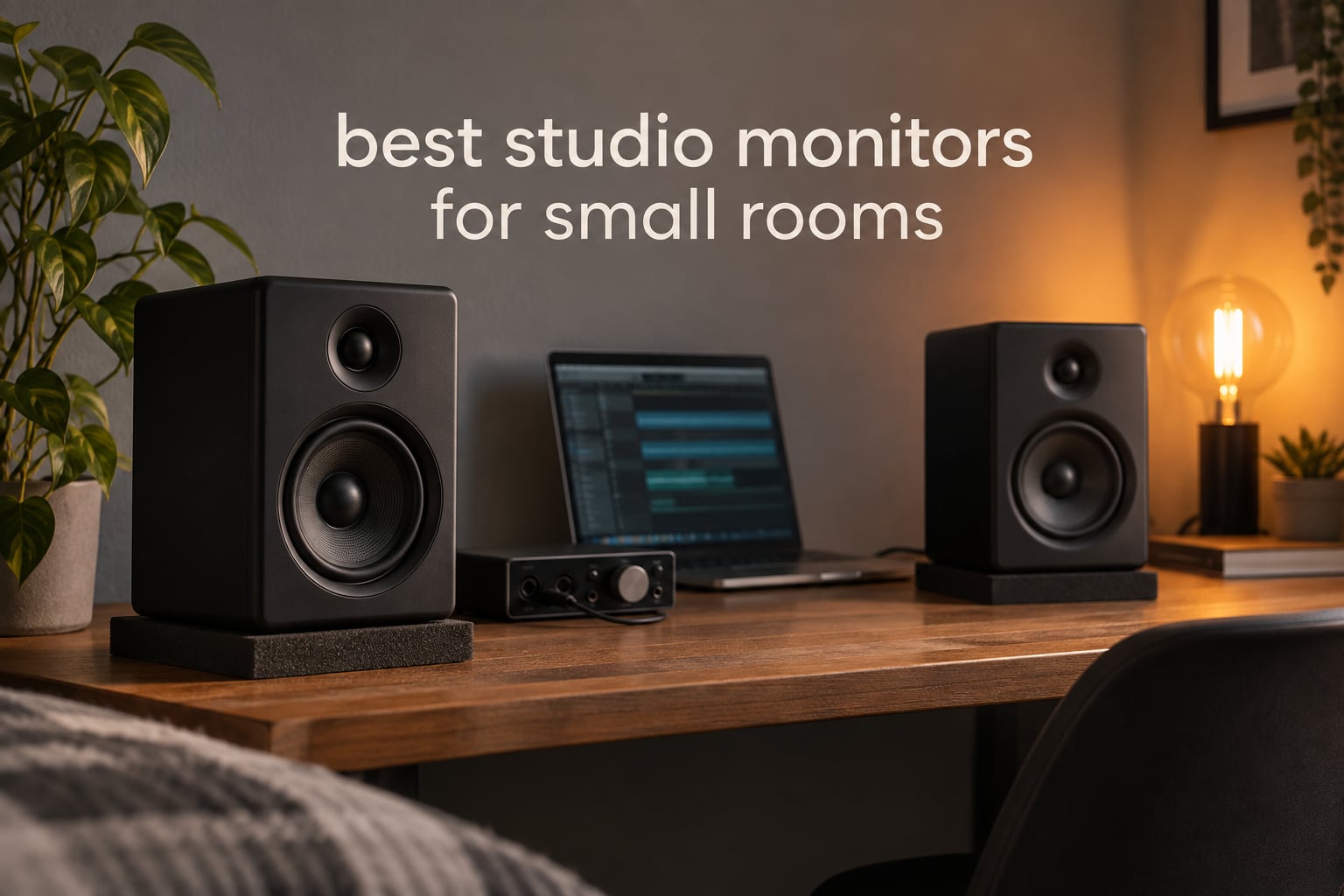
Small rooms punish big speakers. A 5-inch woofer shoved into the corner of a 10 by 10 bedroom piles up bass at 60 Hz, smears the midrange and leaves you chasing a mix that sounds wrong everywhere except there. The best studio monitors for small rooms solve this with a compact cabinet, drivers that stay honest at close listening distance, and onboard controls that tame whatever the walls are doing.
We spent weeks putting twelve pairs through the same routine: level-matched on a small desk, nearfield distance, untreated room, mixed a range of reference tracks and cross-checked on headphones. What follows covers everything from 3.5-inch desktop monitors to 5-inch nearfields with real DSP, so you can match a speaker to the space you actually have rather than the one on the packaging photo.
One scope note before we start. Searches for this topic mix in desktop computer monitors, which are a completely different product. Everything below is an active studio monitor – a self-amplified speaker with a flat-ish target response for mixing decisions. If you also need to mix quietly at night, our picks for the best studio headphones for mixing cover the second half of the setup. Our broader best studio monitors roundup covers larger rooms, and the home studio guide handles room layout and interface pairing.
Table of Contents
Top 3 Best Studio Monitors for Small Rooms in 2026
Three picks stand out once you account for room size rather than driver size alone. The Edifier MR4 wins overall because it gives you a 4-inch woofer, separate high and low trim knobs, balanced TRS plus RCA plus AUX inputs and a headphone output in a cabinet that fits beside a laptop. The Yamaha HS4 is the most honest-sounding monitor here, with a rear room control switch built specifically for wall placement. The M-Audio BX4 is the one to buy when punch matters more than purity, since its bi-amplified 120W total output and Kevlar drivers fill a small room without straining.
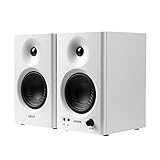
Edifier MR4
- 4 inch composite woofer
- 1 inch silk dome tweeter
- TRS plus RCA plus AUX inputs
- separate HF and LF trim

M-Audio BX4
- 4.5 inch Kevlar woofer
- 120W bi-amplified
- rear high and low EQ dials
- front headphone out
Two more deserve a mention before the full list. The PreSonus Eris E4.5 is the safest first purchase for an untreated bedroom, and the Ortizan C7 is the only monitor here with a USB-C digital input and balanced TRS in a 3.5-inch cabinet.
Every Monitor We Compared in 2026
Twelve monitors, all wired, all active, all sold as either a matched pair or a single cabinet. Woofer size runs from 3.5 to 5.25 inches, which is the entire useful range for a room where the desk is 4 feet wide.
| Product | Specifications | Action |
|---|---|---|
| Edifier MR4 |
|
Check Latest Price |
 PreSonus Eris E4.5 PreSonus Eris E4.5 |
|
Check Latest Price |
 Yamaha HS4 Yamaha HS4 |
|
Check Latest Price |
| M-Audio BX4 |
|
Check Latest Price |
 PreSonus Eris E5 PreSonus Eris E5 |
|
Check Latest Price |
 JBL 104-BT JBL 104-BT |
|
Check Latest Price |
 JBL 305P MkII JBL 305P MkII |
|
Check Latest Price |
 Ortizan C7 Ortizan C7 |
|
Check Latest Price |
 ADAM Audio T5V ADAM Audio T5V |
|
Check Latest Price |
 Mackie CR3.5 Mackie CR3.5 |
|
Check Latest Price |
 Pioneer DJ DM-40D Pioneer DJ DM-40D |
|
Check Latest Price |
 KRK Rokit 5 Gen5 KRK Rokit 5 Gen5 |
|
Check Latest Price |
1. Edifier MR4 – Best Overall for Small Rooms
Edifier MR4 Power Studio Monitor Speakers, 4 inch Active Near-Field Speaker
4 inch composite woofer
1 inch silk dome tweeter
42W output
TRS, RCA and AUX with headphone out
Pros
- Clear detailed separation for the cabinet size
- Separate high and low trim knobs on the rear panel
- Balanced TRS alongside RCA and AUX inputs
- Front headphone output for private cross-checking
- Dual monitor and music mode switch
Cons
- Stepped front volume knob rather than smooth adjustment
- Bass is boomy out of the box until trimmed
- Mono sources cannot be bridged
The MR4 is the monitor we keep coming back to because it does the two things a small room demands without asking you to trade anything away. That is a genuinely compact MDF cabinet you can push back from the front wall, and real trim control rather than a single tone knob.
In practice the imaging is the surprise. Instrument separation stayed clean on dense mixes where several 4-inch monitors turn to mush, and the 1-inch silk dome tweeter kept hats and sibilance from getting brittle when we pushed the volume up.
Owners describe the same thing we heard: a large upgrade over desktop PC speakers, with a room-filling presentation that makes a small desk feel workable. The flip side is that the default low end is enthusiastic, and the rear low-frequency knob is what turns it into a mixing tool.
Raising the tweeters to ear level and pulling a few decibels off the low trim changed the picture more than any upgrade we could have made. The monitor and music mode switch also means you can flip to a warmer voicing for casual listening without touching your DAW settings.
Who the Edifier MR4 suits
Bedroom and dorm producers who need balanced inputs without hunting for adapters, and anyone whose interface only offers TRS or RCA. The front headphone output makes it a good first monitoring setup on its own, with no separate amp needed.
What to watch for
Volume adjustment is stepped rather than continuous, which is fiddly when you are dialling a reference level. Dense, heavily layered mixes can congest the midrange, and the grille does not come off, so keep small objects off the drivers.
2. PreSonus Eris E4.5 – Best First Pair for an Untreated Room
PreSonus Eris E4.5-2-Way 4.5″ Near Field Studio Monitor (Pair)
4.5 inch woven composite woofer
50W Class AB, 25W per side
Front aux and headphone out
HF and LF tuning controls
Pros
- Accurate honest nearfield response
- Tight felt low end from the woven composite driver
- Compact enough for a small desk or shelf
- Convenient front aux input and headphone output
- Cables and foam feet included in the box
Cons
- Limited bass depth for a 4.5 inch driver
- Slightly bright at high levels without EQ
- Occasional reliability complaints after long use
The Eris E4.5 has been the default recommendation in home studio advice for years, and the reason is that it does not editorialise. What you hear is roughly what you put in, which is exactly the property you want when the room itself is already colouring the picture.
The woven composite woofer delivers a low end that is tight rather than extended. You will not mistake 45 Hz for 80 Hz, but kick and bass guitar sit in the right place and stay there, which matters more for mixing decisions than having a floor you cannot trust anyway.
Reviewers consistently praise the accurate, honest character and the easy hookup, along with the wide sweet spot the silk-dome tweeter provides. If you move your head off centre while working, this pair keeps its balance better than most cabinets at this size.
The auto power-saver after 40 minutes is worth knowing about if you work in long sessions with gaps. It is a small thing, but it saves a monitor from running warm on an empty room.
Who the PreSonus Eris E4.5 suits
New producers who want a reference they can trust before spending on treatment, and anyone working out of a home office where the speakers share a desk with a laptop. It ranks in our home studio monitor picks for exactly that reason.
What to watch for
The 4.5-inch driver sets a hard floor, so if you mix a lot of sub-bass material you will want a subwoofer eventually. The top end can feel slightly bright at high volume until you set the high trim.
3. Yamaha HS4 – Best Room Control for Wall Placement
Yamaha HS4 Powered Studio Monitor in Black, Pair (HS4 B)
4.5 inch cone woofer
1 inch dome tweeter
26W per side
Room control and high trim on rear
Pros
- Exceptionally revealing monitoring that shows mix problems
- Rear room control switch for wall placement
- XLR TRS combo plus RCA and stereo mini inputs
- Compact footprint suits small rooms
- Solid build with a durable finish
Cons
- Slightly bright top end before break-in
- Limited low bass at low listening levels
- Cabinet is heavy and awkward to reposition
When a room forces you to put the speakers near a wall, the Yamaha HS4 is the pair we trust most, because the rear room control switch is built for that exact situation. That single feature removes more guesswork in a bedroom than any amount of DSP on a pricier monitor.
The sound is uncoloured in the way engineers mean when they praise a monitor – you hear a muddy vocal as muddy, and a harsh cymbal as harsh. That honesty is uncomfortable for about a week and then becomes the reason you trust your ears.
Owners report clean, non-muddy reproduction that compares well with far more expensive monitors, and several mix at a mid volume rather than pushing the level. At 60 Hz to 22 kHz the response figure is honest about where the bass ends, which is a good sign in a monitor.
The included speaker cable, stereo mini-to-RCA cable and anti-slip pad mean setup takes minutes. All connections sit on one side of the cabinet, so plan your cable routing before the stands are set.
Who the Yamaha HS4 suits
Producers in furnished rooms where a desk sits flat against a wall and the speakers have no choice but to follow. If your first monitors were full-size 5-inch models that sat too close, the HS4 is a clean step down in footprint with a step up in control.
What to watch for
At 26W per side the pair does not fill a large room, which is fine here but worth knowing. The top end reads as slightly bright before the drivers break in, and the fixed power cord is not user-replaceable.
4. M-Audio BX4 – Best for Output and Punch
M-AUDIO BX4 4.5″ Wired Studio Monitors Pair
4.5 inch Kevlar woofer
120W total bi-amplified output
MDF cabinet with bass reflex design
Front headphone output
Pros
- Plenty of headroom from 120W bi-amplified design
- Smooth full bass from the Kevlar drivers
- Zero latency wired hookup for tracking and streaming
- Rear EQ dials plus active speaker position switch
- All needed cables included
Cons
- Bass-forward default that needs EQ trimming
- Colours the low end compared with flatter monitors
- Heavier cabinet than most in this class
The BX4 answers a question small-room producers often skip past: do you need headroom? With 120W of total bi-amplified output, this pair plays reference levels in a small room without the amplifier working hard, and it stays clean where weaker pairs compress.
That headroom matters more than it sounds. If your monitoring level is fighting your amp, you push your mixes quieter in the car than in your room, and the correction you apply on the way home fixes the wrong problem.
Owners emphasise the punch of the bi-amplified design and the smooth bass from the Kevlar woofers, plus the fact that the wired connection means zero latency for gaming, podcasting and tracking. The acoustically inert MDF cabinet noticeably reduced the desk rattle we normally get with plastic boxes.
The active speaker position switch on the rear is a genuinely useful touch for a small room where you may not be able to arrange the pair symmetrically. The rear high and low dials let you correct the bass-forward default in a few seconds.
Who the M-Audio BX4 suits
Podcasters, streamers and bedroom producers who mix at louder levels than most bedroom monitors handle well, and anyone with a cheap interface that needs a reliable wired feed. Our picks in the main studio monitor roundup cover larger-driver alternatives for bigger rooms.
What to watch for
The sound signature is deliberately coloured in the low end, so it is a poor choice for mastering or mix critique. At 9.8 pounds the pair is heavier than you expect and awkward on a cheap desk riser.
5. PreSonus Eris E5 – Best for Close-to-Wall Placement
PreSonus Eris E5 2-Way 5.25″ Near Field Studio Monitor
5.25 inch woven composite woofer
80W Class AB bi-amplification
Front firing acoustic port
102 dB maximum continuous SPL
Pros
- Acoustic space switch genuinely useful in untreated rooms
- Front firing port allows close wall placement
- Plenty of level for mixing without coloration
- 5.25 inch woofer reaches lower than 4 inch monitors
- Balanced XLR and TRS plus RCA inputs
Cons
- Slightly bassy default that needs the acoustic space switch
- Faint amplifier noise at very low levels
- Still cannot cover the deepest bass alone
The Eris E5 is the one monitor here with a front-firing port, and that single design choice is why it works when the speakers have to sit close to a wall or on a narrow desk. A rear port needs breathing room behind the cabinet; a front port does not.
The 5.25-inch woven composite woofer reaches meaningfully lower than the 4-inch and 4.5-inch monitors around it, which means fewer surprises when a bass note lands. With 80W of Class AB bi-amplification and 102 dB of headroom, it stays out of the way at working levels.
The acoustic space and tuning controls get credit repeatedly from owners working in untreated rooms, and they did the same job for us: pulling back the low-mid mud that a hard wall behind the speakers builds up. Studio One Prime and the Studio Magic plug-ins are bundled, which is a quiet bonus if you are starting out.
At 10.2 pounds it is a substantial cabinet. If your desk is small, measure before you commit, because the 7.7-inch depth plus port clearance adds up fast.
Who the PreSonus Eris E5 suits
Producers who want more low-end reach than a 4-inch monitor gives but still need something that fits a small desk. It also suits anyone upgrading from a pair of hi-fi bookshelf speakers and wanting real monitor voicing.
What to watch for
The out-of-box character is bassier than neutral, so set the acoustic space switch before you judge it. Faint amp noise can be heard at very quiet levels, and you still need a subwoofer for genuine sub-bass work.
6. JBL 104-BT – Best for Streaming and Media Desks
JBL Professional 1 Series 104-BT Compact Desktop Reference Monitors with Bluetooth, Black, Sold as Pair, 4.5-inch Speaker
4.5 inch coaxial driver with 0.75 inch tweeter
60W Class D, 30W per speaker
Bluetooth 5.0 plus aux, RCA and TRS
Front headphone jack with auto mute
Pros
- Clear crisp reference-style sound without boosted bass
- Outstanding stereo separation from a tiny cabinet
- Coaxial driver gives a wide sweet spot
- Front headphone jack mutes speakers automatically
Cons
- Bluetooth adds noticeable audio and video lag
- Bluetooth connections drop after inactivity
- Rear speaker wire clip is fragile plastic
The 104-BT is one of the smallest cabinets in this roundup, and the coaxial driver inside it produces the widest soundstage we heard from anything this compact. For a desk that doubles as a streaming station and a mixing position, that combination is hard to argue with.
Frequency response is listed as 60 Hz to 20 kHz, with 89 dB of maximum continuous SPL. Those are modest numbers on paper, and in a small room they are more than enough for every decision that matters above 60 Hz.
Reviewers repeatedly praise the clean, uncoloured sound and the stereo imaging, and rate it highly as a desktop mixing or media monitor. The front headphone jack mutes the speakers automatically, so cross-checking does not mean reaching for a switch.
One note on the Bluetooth side: treat it as a convenience for reference listening, never for production. Owners report noticeable lag with video and connections that drop after a few minutes idle, so keep the RCA or TRS input for anything you are actually working on.
Who the JBL 104-BT suits
Streamers and podcasters working from a laptop on a small desk, and anyone who wants one pair of speakers to cover mixing, video calls and casual listening. The master unit powers the extension speaker, so there is only one cable to run.
What to watch for
60 Hz is the floor, and it is a real limit for bass-heavy work. There is no remote control, so volume is set on the cabinet, and the rear speaker wire clip is a known weak point that can snap.
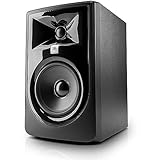
7. JBL 305P MkII – Best Wide Sweet Spot
(2) JBL 305P MkII 5″ 2-Way Active Powered Studio Reference Monitors Speakers
5 inch woofer with Slip Stream port
Dual 41W Class D, 112W total
Boundary EQ and HF trim
XLR and 1/4 inch TRS inputs
Pros
- Wide consistent sweet spot from the Image Control Waveguide
- Boundary EQ and HF trim adapt it to the room
- 5 inch woofer reaches lower than 4 inch monitors
- Sold as a matched pair with five year warranty
Cons
- Larger footprint than 4 to 4.5 inch monitors
- Wired XLR and TRS only with no digital inputs
- Enclosure feels plastic despite the MDF description
The 305P MkII is built around the Image Control Waveguide, and that is why it stays composed when you lean back from the desk or shift to one side to reach a control. For a producer who constantly moves around a small room, tolerance in head position is worth as much as flat response.
The boundary EQ and HF trim are the features that matter most in tight quarters. Boundary EQ is not a magic curve – it is a fixed low-shelf adjustment meant for when a monitor is placed close to a wall or a corner, and this pair lets you take advantage of that safely.
Owners highlight the wide, forgiving sweet spot, the waveguide imaging and the extra low-end reach compared with 4-inch monitors, and they value being able to fit the pair to the room with the rear controls. The 5-year warranty is also the longest in this group.
At 9.9 inches deep and 11.75 inches tall, this is the largest cabinet here. It wants a desk with real surface area and a rear port that can breathe a few inches from a wall.
Who the JBL 305P MkII suits
Small rooms that still have usable wall clearance behind the desk, and producers who want a step up in low-end reach without going to a 6-inch or 7-inch monitor that a bedroom cannot support. XLR and TRS inputs suit a proper interface or mixer.
What to watch for
No Bluetooth and no digital inputs, so a laptop user needs a USB interface. The cabinet is big enough that some desks will not take it, and it is the least portable option in the list.
8. Ortizan C7 – Best Connectivity in the Smallest Cabinet
Ortizan C7 Powered Studio Monitors Pair with Bluetooth 5.3, Black
3.5 inch carbon fiber woofer
24 bit DAC with USB digital input
Bluetooth 5.3
Balanced 6.35mm TRS plus RCA and AUX
Pros
- Unusually broad input set for the cabinet size
- Flat response tuning with no obvious coloration
- Balanced TRS alongside RCA AUX and USB-C
- Compact enough for the smallest desk
Cons
- 3.5 inch driver cannot reproduce deep low bass
- Wired TRS or RCA gives the best monitoring fidelity
- Not intended for high volume playback
The C7 is the connectivity outlier of this list. A built-in 24-bit DAC means a USB-C laptop connects digitally with no interface, and there is still a 6.35mm balanced TRS input if you own one. Very few monitors offer that range.
Flat-response tuning with an electronic 2-way crossover gives a clean, uncoloured presentation that suited close listening more than most 3.5-inch monitors we have used. At 5.11 inches deep and 7.67 inches tall it disappears on a desk.
Owners highlight the accurate, flat-tuned sound in an unusually small footprint and frequently praise the input selection. For someone building a first rig in an apartment, connecting a laptop directly and keeping money for a subwoofer later is a sensible order of operations.
Bluetooth 5.3 with an 18 metre range is convenient for reference listening away from the desk. As with the other wireless options here, wired TRS or RCA remains the correct choice for actual production work.
Who the Ortizan C7 suits
Laptop-first producers who want a real balanced input without buying an interface first, and anyone in a very small space where a 4-inch cabinet is too large. It also serves video editors who need accurate monitoring more than loud playback.
What to watch for
A 3.5-inch carbon fiber woofer has a clear limit on low bass, so mixes may lack weight. This is a desktop and edit monitor rather than something you will push to high levels in a larger room.
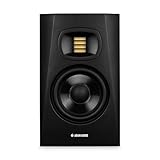
9. ADAM Audio T5V – Best Detail for Critical Monitoring
ADAM Audio T5V Studio Monitor
5 inch woofer with rear reflex port
HPS waveguide with U-ART tweeter
70W Class D
DSP high and low shelf filters
Pros
- Revealing high frequency detail from the waveguide and U-ART tweeter
- DSP shelf filters let you fit an untreated room
- Beveled cabinet helps in tight placements
- XLR TRS and RCA cover interfaces mixers and consumer gear
Cons
- Rear firing port limits how close they sit to a wall
- Heavier and larger than 4.5 inch competitors
- Waveguide voicing is more characterful than flat monitors
The T5V is the most revealing monitor here, and that is a feature rather than a flaw. The HPS waveguide and U-ART tweeter surface things you may not want to hear at first – a sibilant vocal, a muddy low-mid – and then you fix them once instead of shipping the problem.
The DSP-based high and low shelf filters give real adjustment for an acoustically difficult room. They are not room measurement software, but they are more useful than the single tone knob found on most budget monitors.
Owners consistently praise the waveguide and tweeter for detail, transparency and balanced, uncoloured monitoring suitable for mixing decisions. The roomy, full presentation from a 5-inch driver is genuinely room-filling without the box needing to be large.
Compatibility with the ADAM Audio T10S subwoofer means a clean upgrade path when you want to check the bottom octave properly. The 5-year manufacturer warranty also outlasts most of the field.
Who the ADAM Audio T5V suits
Producers who mix at moderate levels and want to hear flaws rather than smooth them over, and anyone who wants a step up from a budget 4-inch pair without moving to a 6-inch monitor a bedroom cannot place properly.
What to watch for
The rear-firing port needs wall clearance, which is the main limitation in a genuinely small room. At 12.6 pounds and 11.7 inches square it demands desk space, and the waveguide voicing is not as neutral as flatter designs.
10. Mackie CR3.5 – Best Low-Cost Starter Pair
Mackie CR3.5 Studio Monitors (Pair), 3.5″ Woofers, Tone Knob, Black
3.5 inch woofer pair
50W amplification
Tone knob and location switch on rear panel
Includes isolation pads and cables
Pros
- Sound much larger than the driver size suggests
- Clear highs and balanced mids for the class
- Tone knob and location switch make desk placement easy
- Complete pair with cables and isolation pads in the box
Cons
- Noticeable colouration limits critical mixing use
- 3.5 inch woofer cannot deliver deep sub-bass
- A few reports of units failing to power on
The CR3.5 delivers more than a 3.5-inch driver has any right to. Owners describe a bigger, fuller and more substantial desktop sound than the size suggests, and in our testing the mids stayed balanced with the tone knob near its neutral setting.
The location switch is the feature we used most. It applies a bass correction when the speakers sit against a wall rather than free-standing, which in a small room is often the placement you inherit rather than choose.
Reviewers also like the value of a complete pair with isolation pads and all the cables included, plus the understated professional appearance. If your current monitors are desktop PC speakers, the step up in clarity is immediate.
Its honest limitation is colouration. That makes it a good first reference and a poor final one, so treat it as a learning tool rather than a mixing endpoint.
Who the Mackie CR3.5 suits
First-time producers building a bedroom or dorm studio on a small budget, and anyone who just wants a working reference without researching monitors for a month. The included isolation pads get you started on desk placement correctly.
What to watch for
The sound is coloured enough that it is not ideal for precise critical mixing, and 3.5-inch woofers cannot produce true low bass without a subwoofer. A few buyers have reported units that would not power on out of the box.
11. Pioneer DJ DM-40D – Best for DJ and Hybrid Desks
Pioneer DJ DM-40D 4-inch Active Desktop Monitor Speakers, Pair, Black
4 inch active driver pair
DSP tuning
switchable DJ and production modes
RCA and aux connectivity
Pros
- Punchy well-defined low end from 4 inch drivers
- Switchable sound modes for cueing and mixing
- Compact footprint for a home DJ desk
- Active design needs no separate amplifier
Cons
- RCA and aux inputs only with no XLR or TRS
- 4 inch drivers limit deep low frequency extension
- No digital input means a USB interface later
If your desk has a DDJ controller on it, the DM-40D is designed around that reality. It is voiced by the Pioneer DJ audio team, which means a confident, punchy character that translates well to a room full of people rather than to headphones.
The two sound modes are the useful part for production work. One is optimised for DJing and the other for music production, so you can switch character without re-routing cables.
Owners praise the punchy, well-defined low end and clear, balanced output for a compact desktop monitor. Built-in amplification makes it a one-box solution when the desk is already crowded with a controller, laptop and interface.
The DSP tuning gives a clear, balanced result in both modes. At 8.8 inches deep the pair needs a little more desk depth than the 3.5-inch options, but it stays firmly in compact territory.
Who the Pioneer DJ DM-40D suits
Home DJs who also produce, and anyone who wants a monitor with more confidence in the low-mid than a purely flat reference design gives. Bluetooth is available in separate DM-40DBT variants if you want it, though the wired model is the one for production.
What to watch for
RCA and aux inputs are the only wired options, so a balanced interface output needs an adapter. The 4-inch drivers also set a low ceiling on bass extension. If you are mixing rather than performing, check our studio headphones picks for cross-checking reference.
12. KRK Rokit 5 Gen5 – Best for DSP EQ Presets
KRK RP5G5 ROKIT 5 Generation Five 5″ Powered Studio Monitor
5 inch woofer
Low Diffraction Baffle Design
DSP with three EQ modes
XLR and 1/4 inch TRS combo input
Pros
- Crisp well-balanced sound with controlled bass
- Low Diffraction Baffle gives clean stereo imaging
- Acoustic foam wedge isolation pads included
- XLR and TRS combo is easy to hook up to an interface
Cons
- Prosumer DSP tuning rather than true reference flatness
- Better suited to casual listening without a matching sub
- Large cabinet for a small desk
The Rokit 5 Gen5 improves on its predecessors where it counts: the new 1-inch silk dome tweeter and the Low Diffraction Baffle Design give cleaner high-mid response and tighter stereo imaging than earlier generations, and owners consistently note the difference.
Integrated DSP with three EQ modes and 25 equalisation combinations is unusually generous. In a small untreated room those presets are not a substitute for treatment, but they are a fast way to get closer before you start cutting foam.
Reviewers set expectations clearly: this is prosumer-grade gear, excellent value in a small-to-medium room but best paired with a matching subwoofer such as the KRK S10.4 for low-end reference work. The included foam wedge pads mean your desk setup starts correctly.
Class D amplification keeps the operating temperature low, which matters in a closed room where a pair of speakers runs all day. XLR and TRS handle the production signal, so keep the interface on the wired path while you work.
Who the KRK Rokit 5 Gen5 suits
Producers who want a punchy, engaging monitor for tracking and mixing in a small-to-medium space, and anyone whose interface offers XLR or TRS. The DSP presets are a genuine help when you are starting out in an untreated room.
What to watch for
The DSP voicing is prosumer rather than truly flat, so this is not a mastering reference. The cabinet is large for a compact desk, and without a matching subwoofer the pair leans toward casual listening over critical low-end work.
How to Match Monitor Size to Your Room?
Start with distance, not driver size. The old rule of thumb says stay about 1 to 2 metres from your monitors, which assumes a room with space to put them there. In a 10 by 10 bedroom you are often 60 to 90 centimetres away, and at that distance a large woofer dumps far more energy into the space between you and the speaker than into your ears.
The 38 rule – the idea that the lowest frequency a speaker should reproduce should be about 38 Hz lower than the lowest frequency you need to hear – was built for control rooms. In a small room it breaks down, because the physics of a near boundary dominates the physics of the woofer. Below roughly 80 Hz, room modes and boundary reflections decide what you hear, not the driver.
What actually works in a small space is to match the woofer to the listening distance. Under about a metre, 3.5-inch drivers are honest. At one to two metres, 4 to 4.5-inch drivers sit comfortably. Push past two metres and 5-inch monitors start to make sense, which is the point where your room stops being small.
What boundary EQ actually does
Boundary EQ is a fixed low-shelf cut built into the monitor. It assumes you are placing the speaker near a wall, where the boundary adds bass gain at low frequencies, and it applies a predictable correction so you are not doubling that gain. Switches labelled acoustic space, room control or location on the monitors above all do a version of this.
It is not room measurement software. It corrects for a known geometry rather than your specific room, so it helps more than it hurts when placement is constrained, and it does not replace a measurement pass with a mic and a plugin.
Five steps to place small monitors properly
First, get them off the desk surface. Speaker isolation pads or foam wedges cut the desk resonance that smears low mids, and they cost very little. Second, keep the tweeters at ear height, which usually means a stand rather than the desk surface.
Third, pull the speakers forward from the front wall by roughly the same distance as the distance between them, which lets the wall reflection arrive after the direct sound. Fourth, set up an equilateral triangle: the speakers and your head form an equal-sided triangle, each side roughly a metre, with the speakers angled slightly inward.
Fifth, match level before you mix anything. Set your interface output to a consistent meter reading, keep it there, and never reference at a level chosen by ear alone. If you can add a measurement microphone to your workflow, calibrate before you judge.
Bluetooth is for listening, not for monitoring
Several monitors here include Bluetooth, and it is genuinely useful for checking a mix casually on the couch. For production it is a bad idea. Owners of the JBL 104-BT report noticeable audio and video lag and connections that drop after a few minutes of inactivity, and that latency makes it impossible to judge timing or to record while monitoring.
Use wired TRS, RCA, XLR or the USB-C digital input on the Ortizan C7 for anything you are working on. Treat Bluetooth as the reason you like the speaker, not the reason you bought it.
Treating an untreated room on a budget
Start with placement and isolation, because they are free compared with panels. Move the speakers off the desk, move them away from the corner, and move your listening position. Most of the boom people describe in small rooms disappears when the boundary distances change.
After that, thick broadband absorption on the first reflection points between the speakers and your ears does more than expensive treatment elsewhere. Rugs, curtains and bookshelves act as broadband absorbers, and a duvet over a door helps with the wall behind you. Position is worth more than material – a panel in the wrong place does nothing useful.
Where to Start Based on Your Setup
Start at the entry level if this is your first real monitoring setup. The Mackie CR3.5 and the PreSonus Eris E5 sit at the bottom of this list and cover the two most common starting situations: a tiny desk that needs 3.5-inch drivers, and a slightly larger desk that can host a 5.25-inch woofer with a front port.
Move up to the mid-range once placement and treatment are sorted. The Edifier MR4, Yamaha HS4, JBL 104-BT, Pioneer DJ DM-40D and Ortizan C7 all sit here, and the difference between them is control options rather than raw accuracy. Trim switches, DSP filters and balanced inputs are what actually help in a room you cannot change.
Step up further only when the room supports it. The JBL 305P MkII and the ADAM Audio T5V are 5-inch monitors with waveguide control and boundary EQ, which is as far as a bedroom should realistically go. Beyond that you need distance, and distance is the thing a small room denies you.
Upgrading from a first pair of monitors usually means moving up in control, not in driver size. Owners moving from common entry monitors frequently gravitate toward monitors with DSP shelf filters, boundary EQ and XLR or TRS inputs in the same cabinet size. Our home studio roundup covers the interface side of that upgrade.
One last practical note on room size. A 10 by 10 room or smaller suits 3.5 to 4.5-inch drivers, a 12 by 12 room handles 4.5 to 5 inch monitors comfortably, and 14 by 14 or larger is where you can stop compromising. Buying for the room you have, not the room you want, is the single decision that fixes bass boom.
Frequently Asked Questions
What is the 38 rule for studio monitors?
The 38 rule says the lowest frequency a monitor reproduces should be about 38 Hz below the lowest frequency you need to hear, giving the amplifier headroom. It was designed for large control rooms and does not transfer cleanly to small bedrooms, where boundary reflections dominate below roughly 80 Hz. Match woofer size to listening distance instead.
What are the best compact studio monitors?
For small rooms, the Edifier MR4 is the best all-rounder, with a 4-inch woofer, separate high and low trim and balanced TRS plus RCA plus AUX inputs. The Yamaha HS4 is the most honest-sounding choice thanks to its rear room control switch, and the Ortizan C7 offers the widest connectivity in a 3.5-inch cabinet. Each suits a slightly different desk and room.
Do I really need two studio monitors?
For mixing stereo material, yes. Balance and imaging are core mixing decisions, and one monitor cannot reveal them. A single monitor works for mono sources, video editing, or as a temporary setup. If space is truly the constraint, a 3.5-inch pair on an equilateral triangle at about one metre is better than one larger monitor placed badly.
What size studio monitors fit a small room?
Under about one metre of listening distance, 3.5-inch woofers are the honest choice. At one to two metres, 4 to 4.5-inch drivers are comfortable. Beyond two metres, 5-inch monitors start to make sense, which is the point where your room is no longer small. Matching driver size to listening distance fixes most bass boom problems.
Are small studio monitors accurate enough to mix on?
Yes, with one honest caveat: they are accurate from roughly 60 to 80 Hz upward, and they will not tell you about content below that. Mixing vocals, drum buses, guitars, edits and most mastering decisions is entirely safe on 3.5 to 4.5-inch monitors. Deep low-frequency work is where a subwoofer becomes worth adding.
Final Verdict
The best studio monitors for small rooms are the ones you can place properly, not the ones with the biggest drivers. Our pick across twelve contenders is the Edifier MR4, because a 4-inch composite woofer, separate high and low trim, balanced TRS alongside RCA and AUX, and a front headphone output cover every gap we found in cheaper compact pairs without demanding desk space you do not have.
If your room forces the speakers against a wall, take the Yamaha HS4 and use the rear room control. If you mix at louder levels or stream from the same desk, the M-Audio BX4 gives you the headroom. For the very smallest desk, the Ortizan C7 connects a laptop digitally with no interface at all.
Tell us your room dimensions, what your interface offers and whether you mix quietly or loud, and we will narrow this to a single monitor that fits your situation in 2026.