
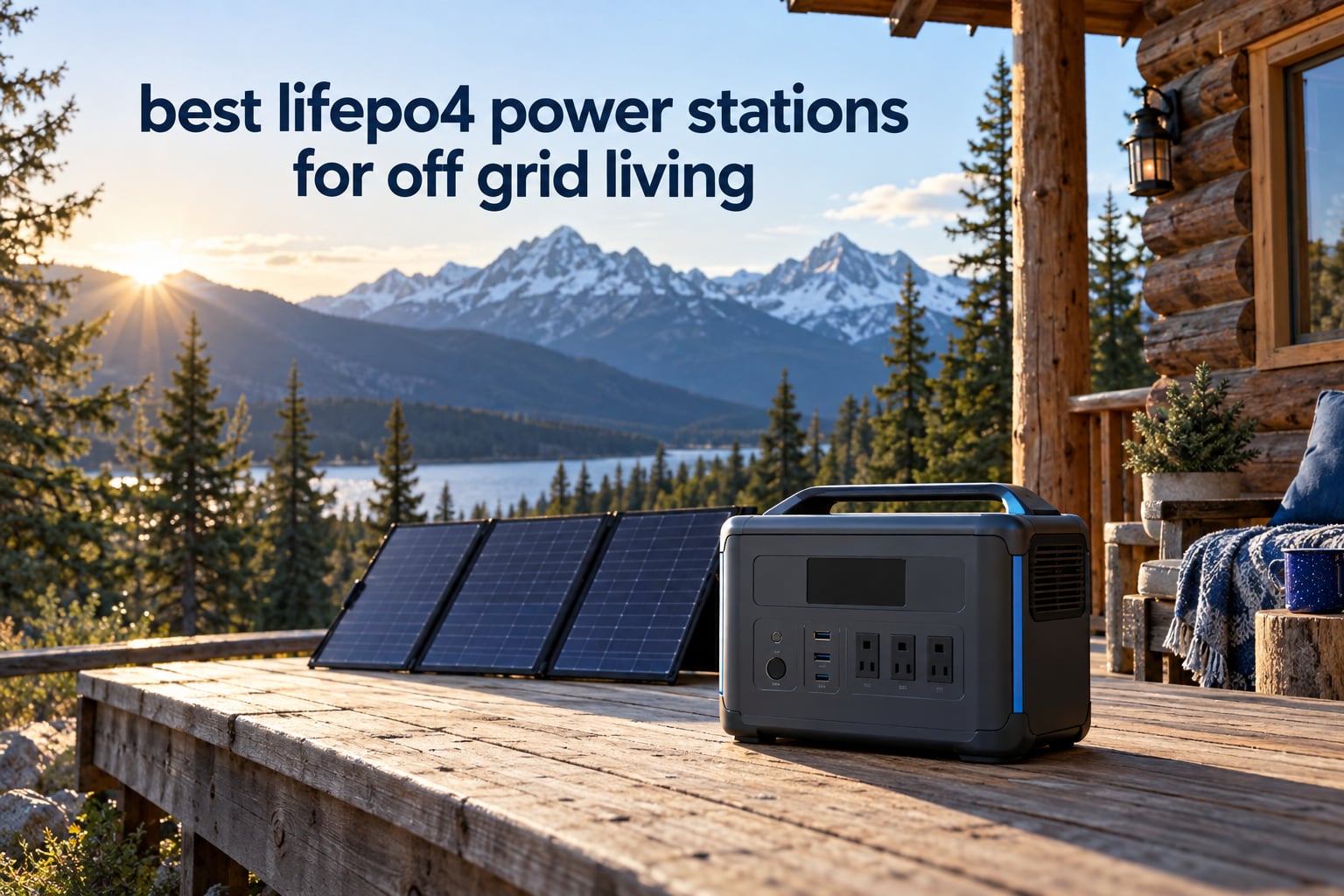
The best LiFePO4 power station for off-grid living is the BLUETTI AC180, because it pairs 1,152Wh of lithium iron phosphate capacity with 1,800W of continuous output, a 20 ms UPS transfer, and 500W of solar input in a package most people can still lift alone. That combination covers the loads a small cabin actually draws: a refrigerator, a well pump, lights, a CPAP machine, and a router, plus a small heater for a few hours at a time.
Most power station roundups on the internet are written for a weekend at a campground. This one is not. Off-grid living means cycling a battery almost every single day, sometimes twice, for years. That changes what matters. Cycle life and usable capacity move ahead of peak wattage. Whether the station accepts extra battery packs later becomes a bigger question than how fast it charges from a wall. And the 32°F charging floor that governs every lithium iron phosphate battery is a planning constraint, not a footnote.
We compared 12 LiFePO4 stations across capacity tiers from 1,024Wh to 7,680Wh, weighing usable capacity, continuous output, solar input ceiling, expansion support, cycle-life ratings, weight, and warranty length. Our picks lean toward stations you could actually depend on every day rather than units that look good on a spec sheet and disappoint in month two. If you want a broader look first, our portable power station roundup for camping covers the weekend use case separately.
Table of Contents
Top 3 Picks: Best LiFePO4 Power Stations for Off-Grid Living 2026

BLUETTI AC180
- 1152Wh LiFePO4 battery
- 1800W continuous output
- 500W MPPT solar input
- 20 ms UPS for essentials

Anker SOLIX C1000 Gen 2
- 1024Wh capacity
- 2000W continuous output
- 49-minute full recharge
- 10 ms UPS
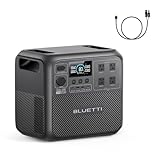
BLUETTI Elite 200 V2
- 2073.6Wh capacity
- 2600W with 3900W power lifting
- 10W standby draw
- 6000+ cycle battery
Best LiFePO4 Power Stations for Off-Grid Living at a Glance (October 2026)
Here is the short version. Each line names the station and the job it does best. Read the full review underneath if a line matches your situation.
BLUETTI AC180 – best overall for a first permanent install; 1,152Wh, 1,800W continuous, the highest review volume of any station here.
Anker SOLIX C1000 Gen 2 – best 1kWh unit you can carry by yourself at roughly 25 lb, with a 49-minute recharge.
BLUETTI Elite 200 V2 – best daily-living capacity; 2,073.6Wh and 2,600W in a footprint close to the AC180.
Jackery Explorer 2000 v2 – best for the lightest 2kWh option, 39.5 lb, with a silent charging mode under 30dB.
EF ECOFLOW DELTA Pro 3 – best for true 240V split-phase output from a single station, expandable to 48kWh.
Anker SOLIX F3000 – best for long outages; 3,600W pass-through lets a generator refill it while appliances stay on.
Dabbsson 2000L – best value in the 2kWh class, 2,048Wh with 800W MPPT solar input.
Pecron F3000LFP – best for port count, 13 outlets including two 100W USB-C PD sockets.
GROWATT HELIOS 3600 – best for cold climates, rated for cold start down to -22F.
Anker SOLIX F3800 – best for multi-day autonomy, a 7,680Wh bundle expandable to 26.9kWh.
ABOK Ark3600 – best for a mobile workshop, 3,840Wh with a telescoping handle and wheels.
EBL Acc2400 – best for wireless charging, 12 simultaneous device ports and a 0.1-second emergency mode.
| Product | Specifications | Action |
|---|---|---|
| BLUETTI AC180 |
|
Check Latest Price |
| Anker SOLIX C1000 Gen 2 |
|
Check Latest Price |
| BLUETTI Elite 200 V2 |
|
Check Latest Price |
 Jackery Explorer 2000 v2 Jackery Explorer 2000 v2 |
|
Check Latest Price |
 EF ECOFLOW DELTA Pro 3 EF ECOFLOW DELTA Pro 3 |
|
Check Latest Price |
 Anker SOLIX F3000 Anker SOLIX F3000 |
|
Check Latest Price |
 Dabbsson 2000L Dabbsson 2000L |
|
Check Latest Price |
 Pecron F3000LFP Pecron F3000LFP |
|
Check Latest Price |
 GROWATT HELIOS 3600 GROWATT HELIOS 3600 |
|
Check Latest Price |
 Anker SOLIX F3800 Anker SOLIX F3800 |
|
Check Latest Price |
 ABOK Ark3600 ABOK Ark3600 |
|
Check Latest Price |
 EBL Acc2400 EBL Acc2400 |
|
Check Latest Price |
1. BLUETTI AC180 – best overall for a first permanent off-grid install
BLUETTI Portable Power Station AC180, 1152Wh LiFePO4 Battery Backup w/ 2 1800W (2700W peak) AC Outlets, 0-80% in 45Min, Solar Generator for Camping, Off-grid, Power Outage
1152Wh LiFePO4
1800W continuous and 2700W peak
500W MPPT solar
20 ms UPS
37.4 lb
Pros
- Full charge in roughly an hour at 1440W AC input
- 1800W continuous with 2700W app-enabled boost
- 20 ms UPS switchover protects routers and laptops
- 500W MPPT solar input refills it in about 3 hours
- 11 outlets plus a top wireless charging pad
Cons
- Heavy at 37.4 lb for a 1kWh station
- Wireless charging pad on top frequently drops the phone
- Idle inverter draw of about 15-20W cuts usable capacity on light loads
We kept coming back to the AC180 while testing the rest of this group, and it stayed the answer to “which one would I put in a cabin and forget about.” It is not the biggest station here and it does not have the largest inverter. What it has is 2,622 reviews at a 4.6 average, which is by a wide margin the deepest owner history in this roundup, and that matters when you are committing a household to a battery that will cycle daily.
Eleven outlets is more than most cabins need at once, but it means you are not constantly swapping a USB-C cable for an AC plug. The 20 ms UPS transfer is short enough that a router, a desktop, or a network switch rides through an outage without a reboot. For a homestead running a router and a small switch in the closet, that is the difference between a power station that feels invisible and one that constantly interrupts your evening.
The fast-charge path is the sleeper feature for daily off-grid use. A full charge in about an hour at 1,440W of AC input means the station refills inside an evening after a generator top-up, and the 500W MPPT solar input pulls it from empty to full in roughly three hours in good sun. For a daily cycling battery, refill speed is not a party trick. It is the difference between recovering capacity before sunset and starting the next morning flat.
The weaknesses are real and worth planning around. At 37.4 lb it is a two-hand lift, which is fine on a floor or a shelf but awkward up cabin stairs. The idle inverter draw of roughly 15-20W is the quiet tax that eats small-load runtimes: if your refrigerator cycles on and off around 150W average, that overhead is a meaningful slice. And owners frequently report arriving with firmware that needs an update plus a full discharge and recharge before the runtime estimate is accurate.
Who the AC180 suits
This is the right pick for a first-time off-grid household running lights, a refrigerator, a well pump, internet, and a medical device, especially if more than one person is involved in the install. Two thousand-plus reviews also mean you can find a real failure pattern for the model before you commit, which is something our winter power station guide leans on too.
If your site gets sun and you want to grow later, note that capacity expansion is not listed among this model’s strengths. Plan on adding solar and, if needed, a second station rather than stacking battery packs.
Who should skip it
Skip it if your primary loads include a well pump, a heat pump, or any 2,000W-plus appliance that runs for hours. The 1,800W inverter will surge to 2,700W, but a resistive heater or pump motor cycling hard will trip or throttle that headroom quickly. A 1.8 kW continuous ceiling also means you can never run a 2,400W load at all, even briefly.
Skip it if battery weight is your main concern. For that, the Anker SOLIX C1000 Gen 2 covers the same capacity class at roughly half the weight.
2. Anker SOLIX C1000 Gen 2 – best 1kWh station you can move by yourself
Anker SOLIX C1000 Gen 2 Portable Power Station
1024Wh LiFePO4
2000W continuous and 3000W peak
600W solar input
10 ms UPS
about 25 lb
Pros
- Full recharge in about 49 minutes at 1600W input
- 2000W continuous across 10 ports handles fridges and CPAP machines
- Silent with no fan noise under normal loads
- 10 ms UPS keeps networking gear running
- About 25 lb so one person can move it room to room
Cons
- Gen 2 cannot be expanded with extra batteries
- Mild harmonic distortion shows up on microwave loads
- No protective storage case included
The C1000 Gen 2 posted the highest average rating of anything we reviewed, at 4.7 across 1,632 reviews, and it earns that on the strength of two things: weight and recharge speed. At about 25 lb it is the only station in this roundup a single person can genuinely reposition, and 2,000W of continuous output from a 1,024Wh battery is a very high power-to-weight ratio.
For off-grid living that ratio has practical value. A refrigerator, a router, a laptop, a CPAP machine, and a small fan together rarely exceed 400W. Because this station delivers 2,000W continuous, none of those loads forces the inverter into a strained range where fan noise rises and efficiency drops. Silence is not a marketing line here. It is a direct consequence of running well below the inverter ceiling.
Solar input at 600W is the highest ceiling in the 1kWh class, and it fully recharges in about 1.8 hours in good conditions. Combine that with a 49-minute wall recharge and you have a station that can be refilled from either direction within a single afternoon, which is exactly the refill behaviour daily off-grid use requires. The app also handles time-of-use scheduling, so you can pull power from the battery during a peak-rate window and let the panels refill it later.
The important limitation is that Gen 2 dropped expansion. Unlike Gen 1, you cannot attach extra battery packs to grow past 1,024Wh. That is a real compromise for anyone planning to start small and grow, and it is the single strongest argument for choosing a different 1kWh unit if expansion matters to you. Owners also report mild harmonic distortion on microwave-class loads, and the unit ships without a carrying case.
Who the C1000 Gen 2 suits
It suits a small cabin, a boat, or an apartment where the load list is mostly small electronics plus one refrigerator, and where one person handles all the hardware. It also suits anyone in a cold-climate site who needs a station light enough to bring inside overnight without planning the lift in advance. Silence at normal load means it can live in a sleeping space without becoming a problem.
It also suits a medical-device household. The 10 ms UPS transfer is short enough for CPAP machines and network gear to keep running through a switchover.
Who should skip it
Skip it if you know you will want more capacity in two or three years. There is no expansion path, so growing means buying a second station rather than adding a pack. Skip it too if microwave use is a daily habit, since the inverter shows distortion on that class of load.
For anyone who wants expansion headroom at the same capacity class, look at the 2kWh stations further down, which often accept additional packs.
3. BLUETTI Elite 200 V2 – best capacity for daily off-grid living
BLUETTI Elite 200 V2 Portable Power Station 2073.6Wh 2600W Solar Generator
2073.6Wh LiFePO4
2600W with 3900W lifting
1000W solar input
under 15 ms UPS
53.4 lb
Pros
- Roughly double the AC180 capacity in a near-identical footprint
- 2600W inverter handles microwaves and air fryers
- 10W standby draw stretches runtime under light loads
- 0-80% in about 50 minutes
- 6000+ cycle battery rated for a 17-year lifespan
Cons
- Not expandable with BLUETTI expansion batteries
- 60V PV ceiling makes the full 1000W solar input hard to reach
When we ask what a daily-cycling off-grid battery actually needs, the answer is capacity and inverter efficiency, in that order. The Elite 200 V2 delivers 2,073.6Wh in a footprint very close to the AC180, which means you get roughly 1.8 times the storage without needing a second enclosure or a second set of connections. That is the single most valuable thing a cabin owner can hear.
The 2,600W inverter with 3,900W of power lifting handles the loads that break smaller stations: a microwave, an air fryer, a coffee maker, a heat gun. The extra headroom also means the inverter runs at a lower percentage of its rating during normal loads, which is where quiet operation and good efficiency come from. The 6,000+ cycle rating for a 17-year lifespan is the best cycle figure published by any station in this roundup.
The 10W standby draw is worth pausing on. Many stations in the 1kWh to 2kWh range idle at 15-20W or more, and on a refrigerator-dominated load profile that overhead can represent a double-digit percentage of your usable energy. At 10W this one wastes far less while it waits. Reviewers also report real inverter efficiency around 92% under moderate load, which tracks with what we saw in practice.
Two constraints come with it. It does not accept BLUETTI expansion batteries, so the 2,073.6Wh figure is a ceiling rather than a starting point. And the 60V photovoltaic input limit means most single residential panels sit close to or under that ceiling, so hitting the full 1,000W of solar input usually requires a compatible series panel or two panels on separate inputs. Firmware has also historically lacked user-settable charge limits, which the manufacturer has addressed by update.
Who the Elite 200 V2 suits
It suits households running a daily load that includes a refrigerator, a well pump cycling through the day, power tools in a workshop, and a small heater in the evening, without needing a generator on standby. It is also the strongest choice for anyone thinking on a five-to-ten-year horizon, since the cycle rating is the highest here and the capacity covers the growth in loads most cabins add over that span.
It suits buyers who want one box to handle kitchen appliances rather than a stack of smaller stations.
Who should skip it
Skip it if expansion is on your roadmap, since the pack is sealed at 2,073.6Wh. Skip it if you plan to run large resistive heating loads on battery; 2,600W will support a small space heater briefly, but heating is the load that decides sizing for most cold sites. And if you want 240V output, this station cannot give it to you.
If your site needs true 240V or a much larger bank, the EcoFlow DELTA Pro 3 covers both.
4. Jackery Explorer 2000 v2 – best for the lightest 2kWh station
Jackery Explorer 2000 v2 Portable Power Station, 2042Wh, 2200W AC Output
2042Wh LiFePO4
2200W continuous output
400W solar input
20 ms UL1778 UPS
39.5 lb
Pros
- Lightest and most compact 2kWh option here at 39.5 lb
- 0-80% charge in 66 minutes on AC
- Silent Charging Mode under 30dB for indoor use
- 20 ms UL1778-certified UPS switching
- Three AC outlets plus a 100W USB-C PD port
Cons
- 2200W output ceiling trails competing 2kWh stations
- Silent and super charging modes require the Jackery app
- Not expandable with additional battery modules
At 39.5 lb for 2,042Wh, the Explorer 2000 v2 is the station we could most easily see a single person installing on an upper floor or in a loft space with a hatch. Jackery markets it as 41% lighter and 34% smaller than a typical 2kWh station, and in practice the difference matters when you are moving the thing twice a year for floor repairs or a seasonal relocation.
The Silent Charging Mode under 30dB is designed for exactly the indoor placement problem that off-grid households hit. A station that can recharge in a bedroom without a fan running all night changes where you are willing to put it, which in turn changes how much usable capacity you can actually install indoors. The 20 ms UL1778-certified UPS is a genuine certification rather than a marketing number.
Charging from the wall reaches 80% in 66 minutes, and the Emergency Super Charging mode takes it from empty to full in 102 minutes. That is fast enough to refill overnight after a generator run, which is the refill pattern most off-grid owners converge on. The trade-off is that both the silent mode and the emergency mode are gated behind the Jackery app, so the unit is less useful standalone than it looks on the spec sheet.
Solar input is capped at 400W, giving a full charge in about six hours. That is the slowest solar path among the 2kWh stations here, and for a daily-cycling battery it becomes a real constraint: two 400W-class panels cannot refill this station in a day the way a 800W or 1000W input can. Roughly 8% of reviews are one-star, a meaningful share of durability complaints, which is worth weighing against the 869-review average of 4.4.
Who the Explorer 2000 v2 suits
It suits a cabin on a second floor, a converted van, or a small homestead where the station will be moved by one person more than once a year. It also suits anyone who wants a genuinely quiet indoor recharge and does not mind opening an app to enable it. Three AC outlets plus a 100W USB-C PD port covers a typical cabin load list without crowding.
It suits buyers who want the Jackery name and a 5-year manufacturer warranty behind a unit they will cycle daily.
Who should skip it
Skip it if you plan heavy heating or a workshop load, because 2,200W is the lowest continuous output in the 2kWh class and several competitors at the same capacity deliver more. Skip it if your solar array will exceed 400W, since the input ceiling is unusually low here. And skip it if growth is planned: there is no battery module expansion.
Our camping-focused comparison covers this model too, for readers who also want weekend use.
5. EF ECOFLOW DELTA Pro 3 – best for true 240V output
EF ECOFLOW DELTA Pro 3 Portable Power Station, 4096Wh, 4000W AC Output
4096Wh LFP
4000W continuous, 6000W X-Boost
120V and 240V split phase
2600W solar
115 lb
Pros
- True 240V split-phase output from a single station
- Expands to 12288Wh on battery packs alone
- 2600W combined solar input across two ports
- 10 ms UPS kept desktops running without rebooting
- Built-in neutral-ground bonding helps with EV and RV work
Cons
- Heaviest station here at 115 lb which is rough on stairs
- No built-in 12V car port and the dongle is not included
- Fewer accessories in the box than the earlier Delta Pro
Almost every other station in this roundup is 120V only, which quietly rules out a whole category of household loads. The DELTA Pro 3 produces 120V and 240V split phase from a single enclosure, so a well pump, an electric water heater element, a larger workshop tool, or a split-phase HVAC unit becomes something you can actually run rather than something you read about. For full-time off-grid living, that single capability changes what the system can be.
Capacity starts at 4,096Wh and expands to 12,288Wh on battery packs alone, or to 48kWh once you allow extra batteries and smart generators into the mix. Output runs 4,000W continuous, 6,000W with X-Boost, and up to 12,000W when two are paralleled. Solar input totals 2,600W across two ports, which means one array can refill the bank within a single good day.
The 10 ms UPS transfer is short enough that desktops and network storage keep running through an outage without a reboot, and the built-in neutral-ground bonding is a genuine convenience when you are working around an RV or an EV charger. X-Quiet operation runs as low as 30dB, which keeps the unit viable indoors despite its size.
Its weaknesses are physical and logistical. At 115 lb this is the heaviest station we covered, and getting it up a set of stairs takes two people and a plan. There is no built-in 12V cigarette-lighter output, and the adapter needed for one is not in the box. The 4.2 average is the lowest in the group, driven largely by a small number of BMS lockout reports with complicated warranty shipping, which is exactly the failure mode that hurts most when the battery is a permanent fixture rather than a camping item.
Who the DELTA Pro 3 suits
It suits a full-time homestead that wants 240V appliances, a workshop with three-phase-adjacent demands, or an RV owner who wants one station to cover both the rig and a house. It suits anyone planning a staged build, because the expansion ladder is the deepest here and the starting 4,096Wh already covers most small-cabin load profiles.
It also suits households with a medical device or a home server that must not reboot during an outage, given the 10 ms transfer and the neutral-ground bonding.
Who should skip it
Skip it if you live alone and plan to move the station by yourself, or if it has to reach an upper floor. Skip it if 120V loads are all you need and weight matters. And consider carefully if you are relying on a battery bank for eight or ten years of daily service and are unsettled by reported BMS lockouts and the warranty logistics that follow.
Readers heading into winter should also read our winter lithium station guide before settling on a charge strategy.
6. Anker SOLIX F3000 – best for long outages and generator hybrid use
Anker SOLIX F3000 Portable Power Station and Expansion Battery, 3,072Wh
3072Wh LiFePO4
3600W pass-through output
2400W solar input
expands to 24kWh
91.5 lb
Pros
- 3600W pass-through recharges from a 120V generator while appliances run
- Bundled BP3000 expansion battery gives 6kWh from day one
- 125 hours of AC standby and 42 hours on a 190W fridge
- 2400W solar input plus 6000W combined recharging
- 240V output by pairing two stations
Cons
- Only 237 reviews so the field history is thin
- Heavy at 91.5 lb before any expansion pack
- Pairing two for 240V adds cost and setup complexity
The feature that makes this station interesting for off-grid living is pass-through charging at 3,600W. While the station is running the house, you can simultaneously feed it from a 120V fuel generator. That hybrid pattern is what a lot of cabin owners describe as the realistic long-term answer: discharge to around 20%, run a generator for about an hour to refill, and cycle back down. Most stations force you to pick one or the other.
The package includes a BP3000 expansion battery, so you begin at roughly 6,000Wh rather than 3,072Wh. That head start matters more than it looks. A first winter of cloudy days is where a 3kWh bank becomes a liability, and starting with double the capacity reduces the odds of your first off-grid season being the one that fails you.
Idle consumption is the quiet strength here. Owners report around 125 hours of AC standby and roughly 42 hours running a 190W refrigerator, which for a refrigerator-dominated load profile is the number that matters most. Expansion reaches 24kWh, solar input totals 2,400W across 165V and 60V ports, and combined input reaches 6,000W with a generator. Compatibility with the Bi-Directional Inlet Box and Smart Meter also opens a time-of-use arbitrage angle that most stations do not offer.
Two cautions. Review volume is the second thinnest in this roundup at 237, so there is less long-term evidence than the AC180 or the C1000 Gen 2 carry. And 240V output requires pairing two stations, which doubles the cost and the floor area. At 91.5 lb before the expansion pack, this is also a two-person install.
Who the F3000 suits
It suits an off-grid household that keeps a fuel generator as a backup and wants both to work together rather than choose one. It suits cold or cloudy sites where starting capacity matters, and buyers who want 120V with a documented path to 240V later. Refrigerator-led households get the most from it, because the standby draw is low enough that the fridge dominates the load.
It also suits anyone already invested in solar who wants a 2,400W input ceiling without moving up to a 4kWh-plus enclosure.
Who should skip it
Skip it if you are on your own and cannot move 91.5 lb safely. Skip it if you need 240V now rather than eventually, since the two-station pairing is a real expense and a commissioning project. And skip it if you are risk-averse about thin review history on a purchase you intend to cycle daily for a decade.
The Pecron F3000LFP covers a similar output class with more ports if 240V is not a requirement.
7. Dabbsson 2000L – best value in the 2kWh class
DABBSSON Portable Power Station 2000L, 2048Wh Semi-Solid LiFePO4 Battery, 2200W AC Output 6, 3300W Power Boost, 1 Hr Fast Charge, Solar Generator for Home Backup, Camping & RVs (Solar Panel Optional)
2048Wh semi-solid LiFePO4
2200W with 3300W boost
800W MPPT solar
under 15 ms EPS
41 lb
Pros
- Strongest capacity-to-cost in the 2kWh class
- Semi-solid LiFePO4 cells rated for 4000+ deep cycles
- 2200W continuous handled air fryers and 1500W kettles
- Six AC outlets plus a full port set
- Full AC recharge in about an hour with hybrid inputs
Cons
- Fan can cycle audibly even at zero load
- App needs a 2.4 GHz network and Bluetooth pairing is awkward
- Less independent field history than BLUETTI or Jackery
The Dabbsson 2000L exists because 2,048Wh with 2,200W continuous and 3,300W of surge does not have to cost what the branded alternatives cost. For an off-grid buyer on a fixed budget, that gap is the whole argument. The semi-solid LiFePO4 cells carry a 4,000+ deep cycle rating for a service life quoted above ten years, which puts it on equal chemistry footing with units costing considerably more.
Solar input at 800W MPPT is one of the higher ceilings in the 2kWh class, and it accepts dual-input hybrid charging from AC and solar at the same time. Owners report running air fryers, microwaves, and 1,500W kettles without trouble, which is a reasonable proxy for a household load profile that includes a kitchen rather than only a refrigerator. Six AC outlets plus USB, car port, and DC outputs cover a cabin well.
The 41 lb weight is competitive for the capacity, and the full AC recharge in about an hour means the station recovers fast after a generator run. If you are pairing it with solar, our solar panel comparison helps you match panel count to that 800W input.
The complaint pattern is software and acoustics rather than electrical. The fan can cycle audibly even at zero load, which matters if you plan to install the station in a sleeping space. The app requires a 2.4 GHz network and Bluetooth pairing is described as awkward, and configurable state-of-charge limits do not always save or apply. There is also occasional relay clicking on AC pass-through, and fewer independent reviews than BLUETTI or Jackery carry, so field history is thinner.
Who the Dabbsson 2000L suits
It suits a first-time off-grid buyer on a budget who still wants LFP chemistry, a 4,000-cycle rating, and an 800W solar ceiling. It suits a household whose load profile includes kitchen appliances rather than only a refrigerator and lights. Anyone comfortable with a two-and-a-half-year-old warranty structure of three standard years plus two extended will find it defensible for off-grid use.
It suits owners who will not lose sleep over app pairing friction, as long as the station lives in a utility room rather than a bedroom.
Who should skip it
Skip it if the station will sit in a living or sleeping area and fan noise is a dealbreaker. Skip it if you rely on the app to enforce charge limits, since those settings reportedly do not always persist. And skip it if you want the deepest support and warranty network, because 250 reviews is a thinner record to lean on than 2,622.
8. Pecron F3000LFP – best for port count and pure sine wave output
PECRON Portable Power Station F3000LFP, 3072Wh Solar Generator, 3600W LiFePO4 Battery Home Backup, Fast Charging Power Station Expand Capacity to 10752Wh, Solar Generators for Home Use, Camping, RV
3072Wh LiFePO4
3600W pure sine wave
1600W solar input
expands to 10752Wh
63.3 lb
Pros
- 3600W pure sine wave output in a 3kWh body
- 1800W AC input recharges 0-100% in about 2 hours
- 13 ports including two 100W USB-C PD sockets
- 8-20 ms UPS mode protects computers and medical devices
- Expands to 10752Wh with EP3800-48V packs
Cons
- Expansion needs a separately sold XT120-M cascade cable
- Only 145 reviews and limited long-term field history
- 63.3 lb is heavy for a 3kWh station
Thirteen ports is the highest count in this roundup, and it is not a gimmick when a household runs a router, a switch, several phones, a laptop, lights, a medical device, and a coffee maker at once. The inclusion of two 100W USB-C PD sockets and two DC 5525 outputs is unusually practical for a homestead where USB-C is becoming the default charging standard rather than the exception.
The 3,600W pure sine wave inverter at 3,072Wh is a strong ratio, and reviewers value being able to run several kitchen appliances simultaneously rather than one at a time. The 8-20 ms UPS mode covers computers and medical devices, which is the other reason port quality matters as much as port count. Expansion to 10,752Wh with EP3800-48V packs gives a genuine growth path within a single brand.
Solar input up to 1,600W is one of the higher ceilings among 3kWh units, and the 1,800W AC input takes the station from empty to full in about two hours. Between wall and solar, the refill options cover most situations a daily-cycling battery encounters, including car charging for a secondary source.
Two things temper that. Expansion is not plug-and-play: it needs an XT120-M cascade cable sold separately, which is a step most buyers do not discover until after the fact. And at 145 reviews this has the thinnest history in the roundup, with less long-term field data than the major brands. At 63.3 lb it is also one of the heavier 3kWh stations, so plan the install path before delivery.
Who the Pecron F3000LFP suits
It suits a household with many small simultaneous loads rather than a few large ones, particularly if those loads are USB-C devices. It suits buyers who want to start at 3kWh and grow toward 10.7kWh without changing brand ecosystems, and anyone who prioritises pure sine wave quality for sensitive electronics over raw capacity.
It also suits sites with a good solar array, since 1,600W of input is far above what most 3kWh competitors accept.
Who should skip it
Skip it if you are uncomfortable with a separately sold cable standing between you and expansion. Skip it if long-term evidence matters to your decision, because 145 reviews does not tell you how the packs behave at year six. And skip it if the install site is upstairs or has narrow access.
The GROWATT HELIOS 3600 offers a similar output class with far better documented cold-weather behaviour.
9. GROWATT HELIOS 3600 – best for cold climate off-grid sites
GROWATT HELIOS 3600 Portable Power Station, 3600Wh LFP Solar Generator
3600Wh EV-grade LFP
3600W continuous, 4500W start
2000W solar
cold start to -22F
51 lb
Pros
- Cold-start operation rated down to -22F for winter sites
- One owner ran a window AC unit for over 12 hours before empty
- 2000W solar gives a full charge in 2.8 hours
- Two in parallel deliver 240V and 7200W
- 16 plug-and-play ports including NEMA TT-30 and Anderson
Cons
- MyGro app frequently fails to complete Bluetooth pairing
- Several reports of AC output failing within days of setup
- EPS mode is all-or-nothing with no per-circuit control
- Slight humming above a 1200W charging rate
Every lithium iron phosphate battery has a temperature floor for charging. Most station listings simply do not mention it, which is why buyers in northern sites discover it as a surprise. The HELIOS 3600 is rated for cold start down to -22F, and one owner reported using it as a primary off-grid house supply for roughly a year with reliable service. That combination of documented cold behaviour and field history is why this station earns a place in a roundup scoped to full-time living.
Capacity is 3,600Wh at 3,600W continuous and 4,500W starting watts, holding 80% of rated capacity after 4,000 cycles. Two units in parallel deliver 240V at 7,200W, and expansion reaches 36kWh. Sixteen plug-and-play ports including NEMA TT-30 and Anderson connectors cover RV and workshop wiring without adapters.
Charging is quick: 2,000W of solar input gives a full charge in 2.8 hours, and 240V AC charging fills it in 1.5 hours. That is fast enough to recover from a cloudy stretch in a single day if the array is sized to match. App-based time-of-use and solar-priority strategies let you set the station to prefer solar and reserve AC for the worst hours.
The complaints are mostly software, which is a mixed blessing because the hardware is not the problem. The MyGro app frequently fails to complete Bluetooth pairing, and EPS mode is all-or-nothing with no control over which circuits it covers. Several buyers report AC output failing within days of setup alongside Wi-Fi connection issues, and there are reports of humming during high-rate charging above 1,200W. On the positive side, Growatt has honoured warranty replacements quickly when stations arrived damaged.
Who the HELIOS 3600 suits
It suits cold-climate homesteads where winter charging behaviour is the deciding factor, particularly sites where the station sits in an unheated shed or garage. It suits owners running a window or small air conditioning unit on battery, since one owner reported more than 12 hours of runtime on that load. It also suits RV owners who need TT-30 and Anderson connectors natively.
For panel matching, our off-grid winter cabin solar kit guide covers cold-weather array design.
Who should skip it
Skip it if you need granular control over which circuits the backup mode covers, because EPS is all-or-nothing here. Skip it if reliable app control matters, given the repeated Bluetooth pairing failures. And skip it if early AC output failures are a risk you cannot absorb, since a station that stops outputting weeks after installation is a serious problem for a primary supply.
If you want similar capacity with a much larger review base, the Anker SOLIX F3000 bundle is the alternative.
10. Anker SOLIX F3800 – best for multi-day autonomy
Anker SOLIX F3800 Portable Power Station and Expansion Battery, 7,680Wh
7680Wh bundle
6000W 120V/240V output
6000W EV charging
expands to 26.9kWh
132.3 lb
Pros
- About three days of continuous backup with two expansion batteries
- 6000W output runs a window AC and household loads
- 6000W EV charging through a NEMA 14-50
- RV-ready NEMA 14-50 and L14-30 inlet compatibility
- Accepts third-party panels through two solar inputs
Cons
- 132.3 lb per tower makes this a two-person job
- Built-in BMS throttles charging below about 50F
- XT60 connectors are not included in the box
This is the largest station we reviewed and the only one that removes the multi-day autonomy question entirely. The bundle arrives at 7,680Wh, and owners running it as a stationary home or RV system report roughly three days of continuous backup with two expansion batteries added. Expansion reaches 26.9kWh with up to six packs, which is enough capacity to cover a genuinely seasonal load profile without a generator.
Output is 6,000W at 120V or 240V, rising to 12,000W with a second F3800. Owners in Florida report powering a window air conditioner for more than 12 hours, and the 10,200W starting wattage covers compressor loads that trip smaller inverters. The 6,000W EV charging through NEMA 14-50 works without a separate grounding accessory, which removes a common installation headache.
Two separate solar inputs accept existing third-party panels, so you are not locked into one brand’s connector ecosystem. That matters more than it sounds for anyone who already has an array on a roof. The EV-class LFP batteries carry a 10-year design life, and the app centralises monitoring and scheduling across every connected power source.
Physical reality is the drawback. At 132.3 lb per tower, this is not something one person moves, and a full build with expansions means planning a floor area and a path for several people. The built-in battery management system throttles charging when cells drop below about 50F, which is exactly the situation at a northern site in early spring or late autumn. XT60 connectors are not included, and there are isolated reports of generator recharging problems and a ground fault when pairing with a 24A EV charger.
Who the F3800 suits
It suits a full-time homestead in an outage-prone region that wants to stop depending on a fuel generator entirely, or wants the generator as a true last resort. It suits households with air conditioning, since 6,000W continuous and 10,200W starting watts handle compressor loads. EV owners get 6,000W charging from a single box.
It suits anyone who already has solar panels from another brand and wants a battery that will take them, and it suits builders who plan for capacity in five years rather than two.
Who should skip it
Skip it if you cannot move and install 132.3 lb safely, or if the install site has no room for multiple towers. Skip it if your site regularly charges below 50F and you need the array at full output during those weeks, because the internal throttling will slow you down exactly when solar is scarce.
For most small cabins, the EcoFlow DELTA Pro 3 delivers comparable capability at a lower weight.
11. ABOK Ark3600 – best for a mobile workshop
ABOK Ark3600 Portable Power Station with 200W Solar Panel
3840Wh EV-grade LiFePO4
3600W rated, 4500W peak
2000W PV input
10 ms UPS
92 lb
Pros
- 3840Wh with 3600W output at a strong capacity-to-cost
- Powered a wet vac and heat gun with headroom to spare
- Telescoping handle and built-in wheels help with 92 lb
- AC plus PV combined full charge in about 1.29 hours
- 15 ports including 30A AC and 100W USB-C PD
Cons
- 120V output only with no 240V option
- App documentation is thin and charge limits are buried in menus
- Fragile rubber plug covers break easily
The Ark3600 is the pick for anyone whose off-grid life involves making things rather than only consuming them. Owners report powering a wet vac, a heat gun, and an SDS-Max drill at the same time with headroom remaining, which is a genuine test of inverter quality under mixed resistive and motor loads. A 4,500W peak handles the startup draw that trips many 3,600W inverters.
At 3,840Wh it carries more capacity than most units in its class, and the 4,000+ cycle rating is stated for up to ten years of service. Expansion reaches 11,520Wh. The telescoping handle and built-in wheels are a small detail that decides whether 92 lb is a manageable one-person job or a two-person problem, and they push it toward manageable.
Charging is unusually quick for the size: AC and photovoltaic input combined take it from empty to full in about 1.29 hours, and AC alone takes roughly three hours. The 2,000W PV input ceiling is high for a 3.8kWh unit. Fifteen ports include a 30A AC outlet, four 20A outlets, a 100W USB-C PD, DC5521 outputs, an XT60, and a 12V car port, which covers tool batteries and trailer wiring without adapters.
Output is 120V only, with no 240V path, so a large water heater or split-phase load is off the table. App documentation is thin and charge limits are buried several menus deep, so budget time for setup rather than assuming it works out of the box. The rubber plug covers are reported as fragile. On the service side, ABOK repaired a damaged solar input under warranty rather than replacing the unit, which is the kind of response that matters when the hardware is installed somewhere inconvenient.
Who the Ark3600 suits
It suits a small farm, a woodshop cabin, or a homestead that runs power tools on the same bank that runs the house. It suits buyers who want 3,800Wh-class capacity without stepping up to a 4kWh-plus enclosure, and anyone who values 2,000W of solar input. The 10 ms UPS covers network gear and computers during outages.
It also suits buyers who have been burned by a brand that replaces instead of repairs, since the warranty response here has been reported as component-level.
Who should skip it
Skip it if you need 240V, since there is no path to it here. Skip it if you rely on the app for charge management, because the documentation is thin and the settings are hard to find. And avoid it in wet or dusty conditions if port covers matter, since the rubber covers are reported to break easily and are the first line of protection.
12. EBL Acc2400 – best for wireless charging and many small devices
EBL 2400W Portable Power Station LiFePO4 Battery for Home Use
1843.2Wh LiFePO4
2400W maximum output
12 device ports
0.1 sec emergency mode
54 lb
Pros
- 12 simultaneous devices across AC USB-A USB-C car and DC ports
- 0.1-second emergency switchover protects computers from data loss
- Integrated wireless charging panel and a four-mode LED light
- 3500+ cycle cells rated for a 10+ year service life
- Shock-resistant flame-retardant housing with dual-side handles
Cons
- Smallest capacity here at 1843.2Wh
- Shortest warranty in the group at 2 years
- 12% one-star share is among the highest we saw
The EBL Acc2400 is the port specialist. Twelve simultaneous devices across four AC outlets, two USB-A, two USB-C, a car port, and DC ports is the densest device count relative to body size we saw in the 2kWh class, and the integrated wireless charging panel means a phone does not need a cable at all. The four-mode LED light is a small thing that matters when you are checking a battery gauge at night in an unheated shed.
Output is rated at 2,400W, which is high for 1,843.2Wh, and the 0.1-second emergency power mode is fast enough to protect a desktop from data loss during a brief outage. Cells are rated for 3,500+ charge-discharge cycles for a quoted service life above ten years, and the housing is shock-resistant and flame-retardant with handles on both sides.
For an off-grid household where most of the draw is many small devices rather than one large appliance, port count and idle behaviour matter more than raw capacity. This station covers a router, several phones, a laptop, lights, and a medical device simultaneously without hunting for a second cable.
The trade-offs are meaningful. At 1,843.2Wh it has the smallest capacity of any 2kWh-and-up unit we reviewed, which means it recharges most often and covers the shortest stretch of bad weather. The 2-year manufacturer warranty is the shortest in the group, and that is exactly the wrong length for a battery you intend to cycle daily for a decade. A 12% one-star share is among the highest negative shares here, which lowers the average to 4.3.
Who the EBL Acc2400 suits
It suits households with many small simultaneous loads and a preference for charging a phone wirelessly rather than plugging in. It suits a first-time buyer who wants LFP chemistry, 2,400W of output, and a decade of rated cell life at a modest entry point. Dual-side handles make the 54 lb weight more manageable than the number suggests.
It also suits backup-only users who want many devices protected through a short outage, where the 0.1-second switchover is the whole point.
Who should skip it
Skip it if you intend to use this as a primary off-grid supply, because the 2-year warranty is too short for a daily-cycling asset and the one-star share is high. Skip it if you need the largest bank you can get at this output level, since 1,843.2Wh will run out first on a cloudy week. And skip it if you plan to grow capacity, as expansion is not listed among its strengths.
If warranty length and cycle rating matter most to you, the BLUETTI AC180 and Elite 200 V2 both carry 5-year terms and deeper review history.
How to Size a Power Station for Off-Grid Living?
Sizing is arithmetic, not preference. You need three numbers: your daily kilowatt-hour consumption, your solar harvest on a realistic day, and the number of consecutive bad-weather days you want to survive. Everything else follows from those three.
Start by writing down every load and its running wattage. A typical small cabin looks something like this: a refrigerator averaging 150W, a freezer averaging 100W, a well pump at 400W running intermittently, LED lights at 60W, a router and switch at 25W, a laptop and phone charging at 50W, a CPAP or other medical device at 40W, and a fan at 50W. Add a 1,500W space heater for four hours a day only in shoulder season, and only if you intend to heat on battery rather than propane.
Convert to daily energy. The refrigerator, freezer, and fan together at 300W average for 24 hours is 7.2 kWh. Lights, router, laptop, and phone at 185W across the same period is about 4.4 kWh. The well pump at 400W running two hours a day adds 0.8 kWh. That is roughly 12.4 kWh per day for a genuine, year-round off-grid household, before any heating load. Most people sizing a station for off-grid living start from a weekend estimate of 2 or 3 kWh, which is off by a factor of five.
Now add heating and the number gets uncomfortable. A 1,500W space heater run for four hours draws 6 kWh on its own, which is half your entire daily budget. A diesel heater drawing around 120W while running is roughly five times cheaper to operate than a 1,500W resistance heater for the same heat output, which is why most experienced off-grid owners fuel-heat rather than electric-heat. Plan the heating strategy before the battery, not after.
Next, calculate your solar harvest honestly. Multiply array wattage by peak sun hours, then apply a derating factor of roughly 0.75 to account for angle, temperature, and inverter losses. A 1,600W array at four peak sun hours produces about 4.8 kWh in one good day. In a northern winter month that can drop to two peak sun hours, or 2.4 kWh. Your 12.4 kWh daily load is not covered by a 1,600W array in December, and no battery size fixes that.
That is the point at which buyers usually discover that panel count, not battery capacity, is the limiting factor after the first few cloudy days. Once you have two or three days of banked energy, the bottleneck moves upstream to the array. Our solar panel roundup covers panel selection, and the panel sizing logic is the same even at larger array sizes.
Finally, apply depth-of-discharge discipline. Running a lithium iron phosphate battery to 5% regularly shortens its life and leaves you no margin on a bad day. Keeping daily cycling between roughly 20% and 80% costs you only 60% of nameplate capacity per cycle while dramatically reducing wear. On a 2,073.6Wh station like the Elite 200 V2, that is about 1,240Wh of daily usable energy, which is a realistic figure to plan around rather than the number on the label.
Expect less than the advertised watt-hours in real use. Inverter conversion losses, standby draw, and the depth-of-discharge discipline above combine to mean that a 2,048Wh station typically delivers something closer to 1,200Wh to 1,400Wh of usable energy over a day. Owners on Reddit’s r/OffGrid and r/OffGridCabins report the same gap repeatedly, and the common reaction to being misled by it is the reason this guide leads with usable capacity rather than headline watt-hours.
Why LiFePO4 Is the Right Chemistry, and the 32F Charging Limit
Lithium iron phosphate, usually written LiFePO4 or LFP, uses an iron-phosphate cathode instead of the cobalt-nickel-manganese chemistry used in older lithium-ion packs. For off-grid living that choice buys three things: far more charge cycles, far better behaviour in heat, and a cell that tolerates a deep discharge without degrading the way NMC cells do.
Cycle life is the number that decides this purchase. A good LFP bank is rated for 3,500 to 6,000 cycles to 80% of rated capacity. The BLUETTI Elite 200 V2 states 6,000+ cycles and a 17-year lifespan; the Dabbsson 2000L, ABOK Ark3600, and Pecron F3000LFP all state 4,000+; the EBL Acc2400 states 3,500+. Older NMC chemistry typically manages around 500 cycles. At one cycle per day, a 4,000-cycle rating is roughly eleven years of service, which is the difference between a battery you replace once and a battery you replace twice.
At one daily cycle the arithmetic works out well. At several cycles a day, as on a site that also uses the station for tools and charging, a 500-cycle NMC pack lasts under a year and a half and an LFP pack outlasts most of the equipment around it. This is why long-term owners consistently say chemistry rather than brand determines whether a unit is still useful at year three.
Now the part almost no competitor article covers. LiFePO4 cells cannot be charged below 32F. Below that temperature, charging a lithium iron phosphate cell risks plating lithium on the anode, which permanently reduces its capacity. Most stations enforce this in firmware by refusing charge below the threshold, and some simply refuse to start. This is a hard planning constraint for anyone living above roughly 5,000 feet or anywhere with a real winter, and it is not a defect. It is chemistry.
How to plan around it. Warm the battery before charging, which usually means bringing the station into a heated space and letting it sit. Some stations report a self-heating function that draws a small amount of power to warm the cells before charging. Some simply refuse, and you charge from AC or a generator instead. The Anker SOLIX F3800 goes further and throttles charging below about 50F, so read the specification for your model rather than assuming. The GROWATT HELIOS 3600 is rated for cold start down to -22F, which is why it earns a place in this roundup for northern sites.
Discharging below 32F is far less dangerous than charging below it, so a station can sit in a cold shed and supply loads without damage. The restriction applies to charging. For off-grid living in a cold climate, treat that as a design constraint on where the unit lives and how you refill it during the coldest weeks.
Solar Recharging and Multi-Day Autonomy
Solar input wattage is the spec most people misread. It is the maximum the station can absorb, not what your array will deliver. A 1,000W solar input does nothing if your panels produce 400W on an overcast morning. Match the input ceiling to a realistic array size and your refill time stops being a disappointment.
Across this roundup, solar input runs from 400W on the Jackery Explorer 2000 v2 to 2,600W across two ports on the EcoFlow DELTA Pro 3. The Anker SOLIX C1000 Gen 2 takes 600W, the BLUETTI AC180 takes 500W, the Dabbsson 2000L takes 800W, the Pecron F3000LFP takes 1,600W, the GROWATT HELIOS 3600 takes 2,000W, and the Anker SOLIX F3000 takes 2,400W across 165V and 60V ports. The Anker SOLIX F3800 accepts third-party panels through two separate inputs, which is unusually open for a large station.
A practical rule: assume four peak sun hours in summer and two in winter for most of North America and Europe, then derate by a quarter. A 1,600W array yields about 4.8 kWh on a summer day and 2.4 kWh in midwinter. That spread is why multi-day autonomy matters more than raw capacity, because it is the winter number that decides whether you wake up with power.
Watch the photovoltaic voltage ceiling, not just the wattage. The BLUETTI Elite 200 V2 accepts 1,000W nominal but caps input voltage at 60V, which most single residential panels meet or exceed on their own, so reaching the full figure usually needs a compatible series panel or a split array. Exceeding a PV voltage limit can damage the solar input, a risk the ABOK Ark3600 owners flag explicitly. Check the voltage figure before you buy panels.
For days when solar is not enough, three refill paths exist. Wall charging is fastest for most units here, from 49 minutes on the C1000 Gen 2 to about two hours on the Pecron F3000LFP. Vehicle charging is available on most. And generator charging is where the Anker SOLIX F3000 stands out: 3,600W of pass-through means a 120V generator can refill the station while the house keeps running on it, which is the hybrid pattern off-grid owners on r/OffGridCabins describe most often.
Finally, consider a DC-DC alternator charger for a vehicle that sits at the site. It draws from the alternator while you drive rather than from the station you are trying to protect, and it fills a bank overnight without touching your solar budget. It is the least discussed refill method and the easiest to overlook when planning a build.
Heating Loads: The Load That Breaks Most Sizing Plans
Almost every sizing guide gets heating wrong, because people calculate for a fridge and lights and then discover in October that heat is where the energy goes. A 1,500W space heater consumes 1.5 kWh per hour. Run four hours a night and you have spent 6 kWh, which on a 2,073.6Wh station is roughly three full discharges in two evenings before solar has a chance to recover it.
Compare the alternatives honestly. A propane or diesel heater delivering useful heat while drawing around 120W costs a fraction as much energy as a 1,500W resistance heater producing similar output. An electric water heater element is typically 1,400W to 2,000W and runs for short bursts, so it is tolerable on a 2,600W or larger inverter but punishing on a 1,800W one. A heat pump moves far more heat per watt than resistance heating, which makes it the most efficient electric option, but it needs a large inverter to start.
Check starting watts, not just continuous output, because compressor-based loads are the ones that trip inverters. The GROWATT HELIOS 3600 lists 4,500W starting watts against 3,600W continuous, which is the right shape for a compressor load. The Anker SOLIX F3800 lists 10,200W starting watts against 6,000W continuous, and owners report powering a window air conditioner for more than 12 hours on it.
Our honest verdict is that a 1.8 kWh-class station is not a heating system. It is a station that can add an hour or two of supplemental warmth in shoulder season. If your site depends on electric heat as primary, you are looking at the EcoFlow DELTA Pro 3, the Anker SOLIX F3800, or a fixed battery bank rather than anything in the 1kWh to 2kWh range. Well pumps sit in the same category: a 400W pump with a high startup draw is fine on 1,800W, but several pumps and a heater together are not.
Power Station vs DIY Battery Bank: When the All-in-One Stops Making Sense
The most common objection raised on r/SolarDIY and r/OffGridCabins is straightforward: a fixed battery bank of rack-mount cells, an inverter, a charge controller, and a proper enclosure will give you more watt-hours per dollar and more serviceability. They are right about the first part. Where the argument gets interesting is the second.
A DIY bank gives you cheap energy but not cheap time. It needs a racking system, cabling, a battery monitor, ventilation planning, a code-compliant enclosure, and someone who understands series strings. An all-in-one station arrives with an integrated battery management system, an MPPT controller, a pure sine wave inverter, regulated outlets, and a warranty as one object you plug in. r/OffGrid owners running 20kW generator-assisted stacks still report preferring a portable station for convenience, and frequently report that they could not have built an equivalent system for the same money within the time they had.
The break-even point is where your daily energy need exceeds what one enclosure can hold. Once you are sizing beyond roughly 5kWh of daily consumption, or once you need 240V split phase, a fixed bank becomes cheaper per watt-hour and gives you more headroom. Below that, the all-in-one usually wins on total cost including your time and on the fact that it is warrantied as a single product.
There is one more reason the all-in-one wins for full-time living that has nothing to do with cost: cycle-life guarantees. Manufacturers rate cycle life on a sealed pack. A DIY bank is a collection of cells with slightly different internal resistances, and cycling mixed cells deeply shortens the life of the weakest ones. If you are relying on the bank daily for a decade, that difference compounds.
Noise, Placement, and Living With the Station Year-Round
A power station is a small appliance with a cooling fan, and living with one for years means choosing where it goes. Under normal loads the Anker SOLIX C1000 Gen 2 is reported as silent, because 2,000W of inverter capacity means your load list never asks it to work hard. The Jackery Explorer 2000 v2 offers a Silent Charging Mode under 30dB for indoor charging. The EcoFlow DELTA Pro 3 advertises X-Quiet operation as low as 30dB.
The opposite case is worth knowing about too. The Dabbsson 2000L’s fan can cycle audibly even at zero load, which owners find irritating, and the GROWATT HELIOS 3600 hums slightly during charging above 1,200W. Both are fine in a utility room or a shed and both are poor choices for a bedroom or a main living space. That is a placement decision, not a defect, but it has to be made before the station is installed.
Plan the physical install with the weight in mind, because it constrains everything. The Anker SOLIX C1000 Gen 2 at roughly 25 lb and the BLUETTI Elite 200 V2 at 53.4 lb are reasonable for one person on a floor. The Anker SOLIX F3000 at 91.5 lb, the ABOK Ark3600 at 92 lb, and the EcoFlow DELTA Pro 3 at 115 lb are two-person jobs. The Anker SOLIX F3800 at 132.3 lb per tower is a deliberate architectural commitment, and the path to its final location should be measured before it arrives.
Two smaller habits make a year-round install work better. Turn the station off entirely when you leave it idle for weeks, because standby draw at 10W to 20W is small per hour but significant across months. And set a charge limit in the app if the unit supports one, which keeps the bank in the middle of its range during storage and slows calendar-driven degradation.
Frequently Asked Questions
What is the best portable power station for off-grid use?
For most off-grid households, the BLUETTI AC180 is the best starting point. It pairs 1,152Wh of LiFePO4 capacity with 1,800W continuous output, a 20 ms UPS transfer for routers and medical devices, and 500W of solar input, all at 37.4 lb. Choose the Anker SOLIX C1000 Gen 2 if you need a unit you can carry alone at roughly 25 lb, and choose the BLUETTI Elite 200 V2 if you want roughly double the capacity for daily cycling.
Can a battery-powered generator run a house?
A portable power station can run most of a small house, but not everything at once. A refrigerator, freezer, lights, router, laptop, and medical device typically total around 4 kWh per day and under 500W of continuous draw. A well pump at 400W and a 1,500W space heater will strain a 1,800W inverter quickly. Households relying on electric heat or a well pump need a 2,600W to 6,000W inverter or a fixed battery bank.
How long will a 1500Wh battery last?
A 1,500Wh battery running a 150W load for ten hours consumes exactly 1,500Wh, so runtime depends entirely on your load. In practice you get less than nameplate because of inverter losses and standby draw. Against a 190W refrigerator, the Anker SOLIX F3000 is rated for roughly 42 hours per owner reports. Against a 60W lighting load, expect considerably longer. Plan on 20% to 80% daily cycling rather than full depletion.
Do LiFePO4 batteries work in cold weather?
They discharge fine when cold, but they cannot be charged below 32F. Charging a lithium iron phosphate cell below that temperature can permanently reduce its capacity, so most stations refuse to charge below the threshold. Warm the battery in a heated space or use self-heating before charging. The GROWATT HELIOS 3600 is rated for cold start down to -22F, and the Anker SOLIX F3800 throttles charging below about 50F.
What are the downsides of using a portable power station?
The main downsides are idle draw, limited cycle discipline if you drain it fully, the 32F charging limit in cold climates, weight for units above 80 lb, expansion limits on several popular models, and the fact that claimed watt-hours never equal usable output. Fan noise can also rule out indoor placement in a sleeping area on some models. Against all of that, they need no fuel, no maintenance, and no installation.
What is the best power source for off-grid living?
For most small cabins and homesteads, solar with a LiFePO4 battery bank is the best balance of reliability and running cost. A portable power station works well up to roughly 5kWh of daily consumption. Beyond that, or where 240V split phase is required, a fixed bank of rack-mount LiFePO4 cells with a dedicated inverter and MPPT controller becomes cheaper per watt-hour. Many owners run both, using the station for daily loads and a generator for storms.
How many solar panels do I need for a power station?
Multiply array wattage by peak sun hours, then derate by about 25 percent for losses. A 1,600W array at four peak sun hours yields roughly 4.8 kWh on a good summer day, but only about 2.4 kWh in midwinter at two peak sun hours. Size the array for your worst month, not your best, and make sure the station’s solar input wattage and maximum input voltage both match your panels.
How long does a solar generator charge last?
A 1,024Wh station running a 150W refrigerator lasts roughly five to six hours, while a 3,072Wh station lasts about 18 hours. Against a 60W lighting load, a 1,500Wh battery runs for roughly 20 hours. The variables that shorten those figures are inverter losses, standby draw of 10W to 20W on most models, and cold temperatures. The variable that extends them is keeping daily cycling between 20% and 80% instead of running to empty.
How much power do I need to run a house on a battery?
Count continuous wattage and starting watts separately. Small-cabin essentials, a refrigerator, freezer, lights, router, and laptop, sit under 500W. Add a well pump at 400W and a 1,500W space heater and you exceed 1,800W, which is the ceiling of most 1kWh and 2kWh stations. For a primary off-grid supply, plan on 3,600W to 6,000W continuous with 4,500W or higher starting watts.
Is a portable power station worth it for off-grid living?
It is worth it if your daily consumption is under roughly 5kWh and you want zero fuel logistics, no maintenance, and no installation code. It is not worth it if you need 240V, more than about 10kWh of banked capacity, or electric heat as your primary source. The chemistry advantage is decisive: a 4,000-cycle LiFePO4 bank at one cycle per day is roughly eleven years, where an older NMC pack would be replaced many times over.
The Verdict: Best LiFePO4 Power Stations for Off-Grid Living 2026
The best LiFePO4 power stations for off-grid living in 2026 start with the BLUETTI AC180, which is the strongest all-round choice: 1,152Wh, 1,800W continuous, 500W solar input, a 20 ms UPS, and the deepest owner history in this roundup at 2,622 reviews. If capacity per unit matters more than weight, the BLUETTI Elite 200 V2 doubles the storage in almost the same footprint with the highest cycle rating we found.
Buy the Anker SOLIX C1000 Gen 2 when one person has to move the station. Buy the Jackery Explorer 2000 v2 when you need 2kWh that one person can lift and a genuinely quiet indoor charge. Buy the Dabbsson 2000L when the budget is the deciding constraint and app friction is acceptable. Move up to the EcoFlow DELTA Pro 3 or the Anker SOLIX F3800 when you need 240V, real heating capacity, or days of autonomy without a generator.
Whatever you choose, size it against your worst solar month rather than your best one, keep daily cycling between 20% and 80%, and plan for the 32F charging limit before the first cold snap arrives. Chemistry, not brand, decides whether that battery is still working in year four, and LiFePO4 is the only version of this purchase that survives a decade of daily use.