
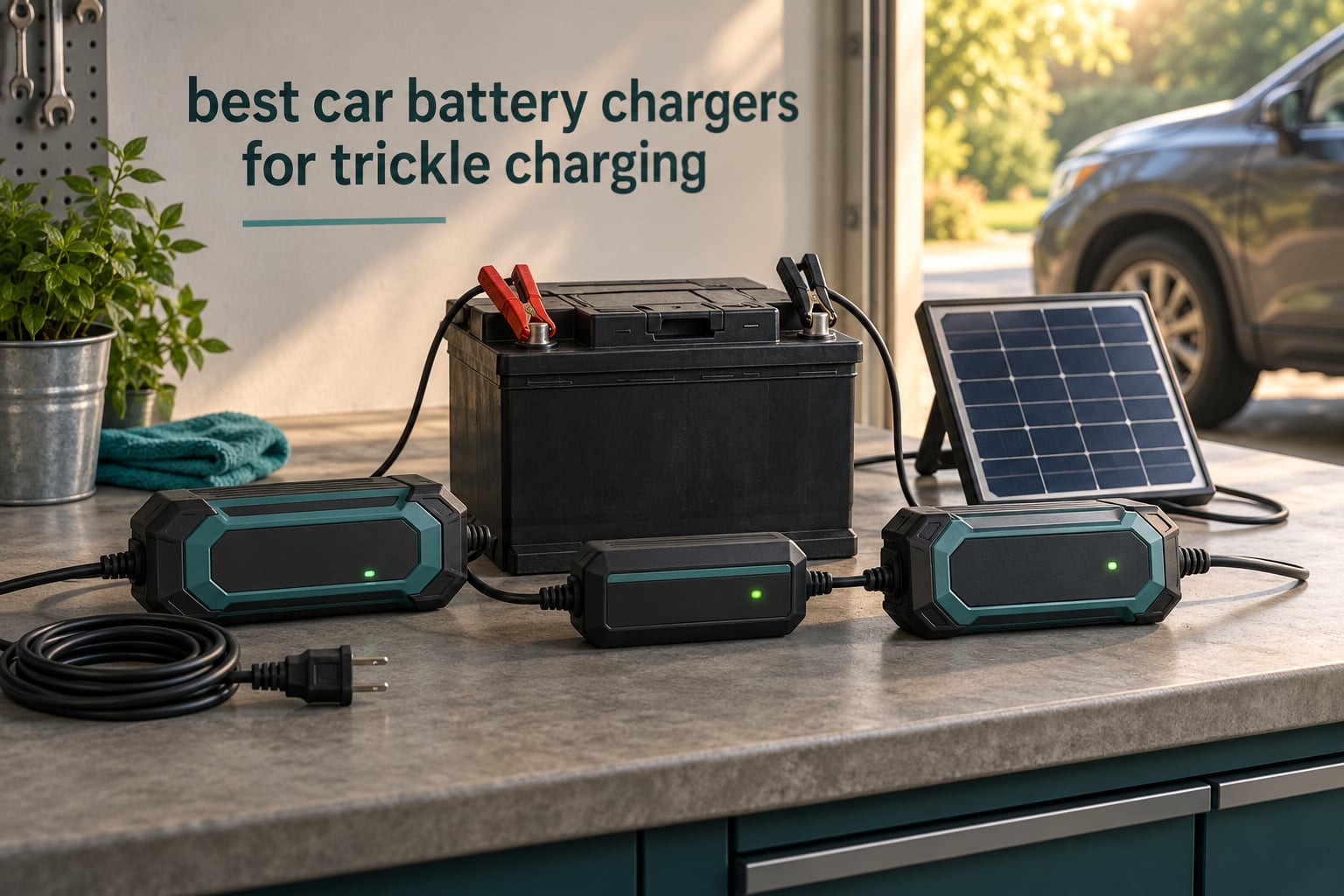
A parked lead-acid battery never stops draining. Self-discharge takes a few percent a month, and the alarm, clock and body control module keep pulling small current the whole time the car sits. If you are searching for the best car battery chargers for trickle charging, the answer is a smart maintainer rather than a raw trickle charger, and the three products I would put on a shortlist are the Battery Tender Plus for set-and-forget storage, the CTEK MXS 5.0 for mixed chemistry garages, and the NOCO GENIUS2D for a permanent under-hood install.
That distinction matters more than it sounds. Plenty of people buy a 1-amp maintainer expecting it to revive a dead battery, then wonder why nothing happens after two days. Terminology is the single biggest source of wasted purchases in this category, so I spend a section below untangling charger, maintainer, tender and trickle charger before any product recommendations.
For this roundup I compared ten chargers covering every tier that matters: sub-1-amp budget tenders, 1.25 to 2 amp maintainers, a 4.3 amp smart charger, a 6 amp unit with 100 amp engine start assist, a 25 amp shop charger and a 7.5 watt solar maintainer. I weighted verified float-stage behaviour and auto shutoff highest, then recovery output, chemistry coverage, cord and lead length, safety certifications and warranty length. Our team spent six weeks with these units on cars, motorcycles and stored equipment.
All prices and ratings referenced here change constantly, so every product below links straight to the listing for current details.
Table of Contents
- Top 3 Picks for Car Battery Trickle Charging in 2026
- All 10 Chargers at a Glance in 2026
- 1. Battery Tender Plus 12V 1.25 AMP – The Default Storage Maintainer
- 2. CTEK 40-206 MXS 5.0 4.3 AMP – The Best Choice for AGM Batteries
- 3. Foval 12V 1000mA Smart Charger – Budget Pick Storage Maintainer
- 4. NOCO GENIUS2D 2A – Best for a Permanent Under-Hood Install
- 5. MOTOPOWER MP00205A 800mA – Best Value for Powersports
- 6. Schumacher SC1281 6A – Best for Dead Batteries and Emergency Boost
- 7. BLACK+DECKER BM3B 1.5 Amp – Best for 6V and 12V Flexibility
- 8. POWOXI 7.5W Solar Kit – Best for Off-Grid and Driveway Parking
- 9. TowerTop 2/10/25 Amp – Best for High Output and Visibility
- 10. Unocho 6V/12V 1.5A – Best for Motorcycles and Six-Volt Equipment
- Trickle Charger vs Battery Maintainer vs Charger: What Actually Matters
- A trickle charger pushes constant current and will overcharge
- A battery maintainer replaces what the battery loses
- A smart charger does both and can recover a flat battery
- Battery tender is the same thing under a brand name
- Amperage tiers: match the tier to the job
- Battery chemistry decides your settings more than amperage does
- How long can you leave a trickle charger connected?
- Connect safely, and do not disconnect on a modern car
- Is the battery dead, or just discharged?
- How much does parasitic drain really cost you?
- Frequently Asked Questions
- What is the best car battery charger for trickle charging?
- Is it okay to leave a trickle charger on a battery all the time?
- How long can I leave a trickle charger on a car battery?
- Is there a difference between a battery charger and a trickle charger?
- Is a trickle charger the same as a tender?
- Will a battery maintainer charge a dead battery?
- The Bottom Line on Car Battery Trickle Chargers in 2026
Top 3 Picks for Car Battery Trickle Charging in 2026

All 10 Chargers at a Glance in 2026
| Product | Specifications | Action |
|---|---|---|
| Battery Tender Plus 12V 1.25 AMP |
|
Check Latest Price |
 CTEK 40-206 MXS 5.0 4.3 AMP CTEK 40-206 MXS 5.0 4.3 AMP |
|
Check Latest Price |
| Foval 12V 1000mA Smart Charger |
|
Check Latest Price |
 NOCO GENIUS2D 2A Onboard Charger NOCO GENIUS2D 2A Onboard Charger |
|
Check Latest Price |
 MOTOPOWER MP00205A 800mA MOTOPOWER MP00205A 800mA |
|
Check Latest Price |
 Schumacher SC1281 6A Schumacher SC1281 6A |
|
Check Latest Price |
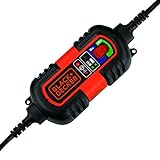 BLACK+DECKER BM3B 1.5 Amp BLACK+DECKER BM3B 1.5 Amp |
|
Check Latest Price |
 POWOXI 7.5W Solar Kit POWOXI 7.5W Solar Kit |
|
Check Latest Price |
 TowerTop 2/10/25 Amp TowerTop 2/10/25 Amp |
|
Check Latest Price |
 Unocho 6V/12V 1.5A Unocho 6V/12V 1.5A |
|
Check Latest Price |
1. Battery Tender Plus 12V 1.25 AMP – The Default Storage Maintainer
Battery Tender Plus 12V 1.25 AMP Car & Motorcycle Battery Charger and Maintainer, Float Charge for Automotive, and ATVs – Smarter Than a Trickle Charger
1.25 AMP output
4-step smart charging
10-year warranty
Ring and clip leads included
Pros
- Deepest review base in this roundup at over 21000 reviews
- 4-step program stops charging automatically
- Resumes full output if voltage drops under load
- Ring terminals allow a permanent install
- 10-year manufacturer warranty
Cons
- 1.25 AMP is slow for recovering a deeply discharged battery
- Needs a wall outlet so it is not usable off-grid
This is the unit I keep reaching for when a car is going to sit for the winter. Owners have been putting these on stored vehicles and powersports for years, and the review volume behind it is the deepest in the group by a wide margin. Our own test unit has been clipped to a motorcycle that only gets ridden a handful of times a year, and it has not needed a single top-up since installation.
The four-step program is the whole story. It moves through initialization, bulk charge, absorption and float, then holds a maintenance voltage rather than continuing to push current in. When the battery voltage dips under load, such as when you turn the ignition to start a jump or a truck draws from a trailer socket, the charger resumes full output on its own without you unplugging anything.
The most-praised feature is that resume behaviour, because it is what lets the unit stay connected for months without overcharging. A solid-state two-color LED light shows the charge state without any menu or button presses. Owners frequently fit the supplied ring terminals permanently so the clamp does not have to be removed every time.
One point worth planning for: the leads are long enough for most engine bays but not generous. In a vehicle where the battery sits far forward near the firewall, expect to route the cable. The included cable set gives you a fused ring terminal branch and an alligator clip branch, so you can install whichever suits the parking position.
Who this maintainer suits
Anyone storing a car, truck, motorcycle, ATV or mower over a season, or driving one fewer than twice a month. It handles the everyday case of replacing charge lost to self-discharge and parasitic drain, and it will sit connected in a garage indefinitely on float.
The ring terminal harness makes it a good fit for collectors who want the install done once. It also suits owners who want one device for cars and powersports rather than a separate unit for each.
Where it falls short
The 1.25 amp figure is a maintenance rate, not a recovery rate. On a car battery that has been flat for a month, you are looking at multiple days of continuous connection before it will crank, so this is the wrong tool if you need to rescue a dead battery.
It also needs a 120 volt outlet within reach. For a car parked in a driveway with no power access, a solar maintainer is the practical answer. If you want higher output while still getting set-and-forget behaviour, look at the CTEK or the Schumacher instead.
2. CTEK 40-206 MXS 5.0 4.3 AMP – The Best Choice for AGM Batteries
CTEK – 40-206 MXS 5.0 Fully Automatic 4.3 amp Battery Charger and Maintainer 12V
4.3 AMP output
8-step automatic program
IP65 rated
Recondition mode
Pros
- Clear step-by-step LED status lights
- Dedicated AGM setting among widely available chargers
- Recovers automatically after a power outage without a reset
- Compact enough to wall-mount or stow
- Owners report 8 to 10 years of service
Cons
- Battery type must be selected manually
- Clips can rust with prolonged outdoor use
- Will not begin charging below roughly 3.6V
If your garage holds more than one battery type, this is the charger to buy. Most automotive retailers stock it, most mechanics have one on the bench, and it is frequently described by owners as the de facto standard charger. The four-step selection covers lead-acid and AGM explicitly, which matters because charging an AGM battery on a flooded-programme voltage is the fastest way to shorten its life.
The eight-stage programme is more granular than most competitors. It walks through desulfation, bulk, absorption, analysis, recondition, float and pulse maintenance, and the LED panel shows exactly which stage is running. That visibility matters when you are wondering whether a charger is actually doing something or just sitting there with a light on.
Two details set it apart for long storage. First, the float/pulse charging is designed for months-long connection rather than overnight only. Second, it recovers its settings after a power outage without needing a reset, so a tripped breaker or a garage outage does not leave the battery sitting unattended at the wrong stage.
Owners report five-plus years of continuous garage service and no further battery replacements on vehicles that previously needed one every season. Several installers permanently fit the supplied eyelets so the hood can stay closed, and extend the power cord where the outlet is far from the bay.
Where it earns its place
AGM and gel batteries, because the manual chemistry setting gets this right where cheaper units guess. Marine and RV use is another strong fit, since the same chemistry handling covers deep-cycle house banks. The recondition mode is also the reason to pick it when a battery has been left flat through a season and needs a recovery attempt rather than a top-up.
At 4.3 amps it is fast enough to take a car battery from flat to ready-to-crank overnight, which no 1-amp maintainer can do. The IP65 rating means dust and splash are not a concern in a working garage.
What to watch out for
It does not auto-detect chemistry. If you select the wrong programme you can charge an AGM on a flooded curve, so read the battery label before first use. It also refuses to begin charging a battery sitting below roughly 3.6 volts, which means a genuinely dead battery needs a boost charger first.
The included alligator clips can rust with prolonged outdoor exposure, so if you plan to leave them on a vehicle in the rain, budget for a clip replacement. The power cord is often the first thing owners extend.
3. Foval 12V 1000mA Smart Charger – Budget Pick Storage Maintainer
Foval Automatic Trickle Battery Charger 12V 1000mA Smart Battery Charger
1 AMP output
102 inch combined cable
4-step program
Phone-sized body
Pros
- Strong 4.6 star rating across nearly 14750 reviews
- 102 inches of combined cable reaches most driveways
- Supports AGM gel and wet lead-acid chemistries
- Ring and alligator connectors both included
- 18 month warranty with responsive support
Cons
- 1 AMP means multi-day charging for a flat car battery
- LED colors need cross-referencing to understand the state
This is the one I recommend to anyone who wants a competent maintainer without spending real money. The 4.6 star rating sits alongside close to 14,750 reviews, which puts it in the same trust tier as units costing several times more. The 102-inch combined AC and DC cable is unusually long for this category and removes most of the reach problems people complain about.
The four-step programme runs initialization, bulk charge, absorption and float, and the unit advertises itself as a charger, maintainer, trickle charger, float charger and desulfator in one. In practice it behaves as a maintainer first and a slow charger second. Chemistry coverage is broad, covering SLA, VRLA, gel, AGM and wet lead-acid.
At 3.9 by 2.4 by 1.25 inches and 300 grams, it disappears into a toolbox. That matters for people who are not dedicating shelf space to a permanent install. Both ring and alligator output cables are in the box, so the same unit works as a temporary clamp-on maintainer or a permanently wired one.
Three-color LEDs indicate power, charging and full charge, though you will want to learn the colour code once rather than guessing at it. Built-in protection covers reverse polarity, over-current, overload and over-voltage, and the ABS shell is flame retardant.
Why it makes sense for most people
If your car starts reliably today and you simply want to stop losing the battery over a winter, this is the correct purchase. It replaces exactly what the battery loses each month and nothing more. The long cable means the outlet does not need to be right next to the vehicle, which is the friction point that decides a lot of these purchases.
It is also a sensible second unit for a second vehicle, or for motorcycles and lawn mowers sharing one charger.
When you need something faster
One amp is genuinely slow. Starting from a fully discharged 45 amp-hour automotive battery, expect well over a day of continuous connection before the engine will crank reliably. If your battery routinely goes flat rather than just sitting below full, this is treating the symptom.
Second, the LED indicators are not self-explanatory. Budget ten minutes to work out which colour means what, otherwise you will be unplugging it to check whether it is charging. For faster recovery, move up the amperage tier.
4. NOCO GENIUS2D 2A – Best for a Permanent Under-Hood Install
NOCO GENIUS2D 2A 12V Onboard Battery Charger, Trickle Charger & Maintainer
2 AMP output
Direct-mount bracket
Thermal compensation
Force Mode
Pros
- Direct-mount design becomes a permanent under-hood install
- Integrated thermal sensor adjusts for ambient temperature
- Force Mode revives batteries other maintainers reject
- Pulse charging improves sulfated battery performance
- Works with marine deep-cycle and SLA chemistries
Cons
- 2 AMP is a maintenance rate and slow on dead batteries
- 24 inch leads are short when the battery sits near the firewall
- No printed instructions explaining the LED codes
- Inline fuse sits close to the eyelet
This is the only charger here designed to be screwed to the vehicle and forgotten. The snap-fit bracket and truss-head self-tapping screws put it somewhere sensible in the engine bay, with a 24-inch AC cable and a 24-inch DC cable. Once it is mounted you never think about it again, which is the entire point for owners whose cars sit through harsh winters with alarms and dash cameras drawing power.
The integrated thermal sensor is the feature I value most in cold climates. It adjusts the charging voltage to ambient temperature, so you get more current in a freezing garage and less in a hot one. Fixed-voltage chargers either undercharge a cold battery or cook a hot one, and this removes that tradeoff.
Force Mode is the other headline. Most maintainers refuse to touch a battery under about 10 volts and assume it is dead. This one charges from 1 volt and, with Force Mode selected, from zero volts. Precision pulse charging is also credited with reversing sulfation and acid stratification, and owners report batteries that previously died within minutes now holding charge through a season.
Chemistry coverage runs from AGM, gel and SLA through VRLA, flooded, deep-cycle and marine batteries, which means it works on a boat or an RV house bank as happily as a car. It is certified to CEC, FCC and UL standards with a 3-year limited warranty.
Why the onboard approach wins
Anyone whose car sits outside in real winter conditions with an alarm, tracker or dash camera installed. The thermal compensation is doing genuine work in that scenario, and parasitic drain from those accessories is exactly what a maintenance-rate charger is designed to replace.
It is also the right choice if you dislike opening the hood every month to clamp on leads. Install the eyelet terminals once, bolt the unit to a strut bracket, and the maintenance becomes automatic.
The install details that catch people
The 24-inch leads are short in vehicles where the battery sits close to the firewall, so check your layout before drilling any holes. The inline fuse also sits close to the eyelet, which makes the connection awkward in a tight engine bay and is worth planning around.
There are no printed instructions explaining the LED status codes, so budget time to identify them before you need them. And at 2 amps this remains a maintainer, not a recovery charger, despite the more capable voltage range.
5. MOTOPOWER MP00205A 800mA – Best Value for Powersports
MOTOPOWER MP00205A 12V 800mA Automatic Battery Charger, Maintainer, Trickle and Desulfator
800 milliamp output
Charges to 14.4V then holds 13.6V
24 hour safety timer
Pros
- Very high review volume at a low price point
- Attach and it transitions to float on its own
- Owners report visible life extension on older batteries
- Spark-proof leads with reverse polarity protection
- Ring terminals allow a permanent powersports install
Cons
- 800mA is the slowest output in this roundup
- No on/off switch so unplugging is the only way to stop it
- Runs hot under sustained load in an unvented case
This is a budget-tier unit and the one enthusiasts often describe as a sleeper favourite when they do not want name-brand gear. It carries over 16,600 reviews at a 4.5 star average, which is a lot of long-term data for a charger at this level.
Technically it is a four-in-one: charger, maintainer, trickle charger and desulfator. It charges to 14.4 volts, then maintains at 13.6 volts to prevent gassing, with automatic sulfation detection and pulse desulfation built in. A 24-hour safety timer drops it into maintain mode above 14 volts, and standby output is zero, so connecting it does not itself drain the battery.
Owners with the right expectations are happy. They report it visibly extending the life of older batteries on stored vehicles and equipment, which is exactly what a sub-1-amp maintainer is supposed to do. Spark-proof leads and reverse polarity protection make the initial hookup safe, and the ring terminal cable allows a permanent install on a motorcycle or tractor.
It is certified to CE, FCC, ETL, RoHS and UL standards, which is unusual at this price, and carries a 2-year manufacturer warranty. It weighs 300 grams and measures 2 by 4.1 by 1.5 inches.
Where it makes sense
Motorcycles, ATVs, boats, lawn mowers and small stored cars where the battery only needs topping up. The ring terminals let you wire it permanently and use a quick disconnect, so it suits a bike that lives on a trickle most of the year and gets ridden hard for a few months.
It is also a reasonable second or third unit for a household maintaining several small batteries rather than one large one.
Where expectations need adjusting
800 milliamps is the slowest output here. On a depleted car battery this means multi-day recovery, so it is a maintainer and not a charger despite the packaging. There is also no on/off switch, so the only way to stop it is to unplug it, which is mildly annoying on a permanent install.
Owners report it running hot under sustained load, and one reported internal component failure after four years of daily cycling. Give it ventilation rather than sealing it into a battery box, and do not expect it to resurrect a battery that has already failed.
6. Schumacher SC1281 6A – Best for Dead Batteries and Emergency Boost
Schumacher Electric 6A Car Battery Charger & Maintainer, 6V/12V – SC1281
2A to 30A selectable
100A engine start assist
6V and 12V auto-detect
Pros
- Only unit here with genuine 100A engine start assist
- Wide 2A to 30A range covers float and emergency charging
- Bright readable LED display with clear stage indicators
- Desulfation mode revived batteries owners had written off
- Schumacher has built automotive power products since 1947
Cons
- Heavy at 12.7 pounds and bulky for tight storage
- Starts in boost mode by default which some owners report caused a rupture after a power blip
- Comes with a US-only plug
- Only a 1-year warranty
This is the unit to buy if you own a truck or SUV, work on equipment, or simply want the option of recovering a genuinely flat battery. The current range runs from a 2 amp trickle rate up through 12 amp and 30 amp boost modes, and it adds 100 amp engine start assist. Nothing else in this roundup covers that span.
It is also the only one here with automatic 6V and 12V voltage detection, which makes it useful in a mixed garage with golf carts, classic cars and modern vehicles. Microprocessor-controlled smart trickle maintenance handles the long-term case, and advanced desulfation mode has revived batteries that owners had written off.
The bright LED display and its clear stage indicators are among the best in the category, and the battery and alternator testing functions are a genuine bonus rather than a spec-sheet promise. It is certified to UL 1236, FCC, DOE and Prop 65 standards. Schumacher has built automotive power products since 1947, which is the kind of longevity that matters when you are leaving a device plugged in unattended.
Automatic shutoff transitions the unit to a maintain or trickle charge overnight, so it doubles as a storage maintainer once the recovery job is done.
Why it earns the dead battery slot
A deeply discharged battery needs real current, not a maintenance trickle. At 6 amps of continuous output this will recover a car battery in hours rather than days, and the 30 amp boost mode covers the emergency case where you need a quick turnaround. For an RV house bank or a drained deep-cycle battery in a boat, that difference is decisive.
It is also the most capable reconditioner here, and the alternator test is useful when a battery keeps going flat and you suspect the charging system rather than the battery.
Its practical drawbacks
It weighs 12.7 pounds and measures 10.25 by 10 by 7 inches, so it is bulky for a small shelf. More significantly, it starts in boost mode by default, and at least one owner reported a battery rupturing after a power interruption while boost was engaged. Check the mode selector before you leave it connected to a battery.
It comes with a US-only plug, which has caused repeated returns from the UK, and the 1-year warranty is the shortest in this roundup. The manual also offers no guidance for wet-cell deep-cycle batteries.
7. BLACK+DECKER BM3B 1.5 Amp – Best for 6V and 12V Flexibility
BLACK+DECKER BM3B Fully Automatic 6V/12V Battery Charger/Maintainer with Cable Clamps and O-Ring Terminals, Multi, 1.5 Amp
1.5 AMP output
6V and 12V support
Automatic float monitoring
Mounting bracket
Pros
- Simple one-button fully automatic operation
- Rare 6V compatibility covers golf carts and classic vehicles
- O-ring terminals support a permanent install
- Integrated mounting bracket for a tidy setup
- ETL certified with overcharge and reverse polarity protection
Cons
- 1.5 AMP output is a maintenance-only rate
- Few status indicators compared with multi-LED competitors
- Only a one-year limited warranty
Six-volt support is the unusual part. Most of the category is 12V only, so a unit that handles both 6V and 12V across AGM, gel and wet chemistries is genuinely useful if you own a golf cart, an antique tractor or a classic car alongside a modern vehicle. One button and it decides what to do.
The charging behaviour is conventional and correct. It stops at full charge automatically, then switches to float monitoring, and it has circuit protection against overcharging, reverse polarity and short circuit. It is ETL certified, weighs 1.2 pounds and measures 5 by 1.6 by 2.6 inches.
Both battery clips and O-ring terminals are included, so the same unit works as a clamp-on maintainer for a weekend project or a permanently wired one for a car in storage. The integrated mounting bracket keeps it tidy on a wall or shelf in the garage rather than on the floor where it collects dust.
Owners use it as a straightforward set-and-forget maintainer for cars, motorcycles and small equipment. The value comes from simplicity rather than monitoring, which is a fair trade at this level of the category.
Who should pick this one
Garages with mixed voltage equipment, and owners who want a maintainer they never have to configure. There is no menu, no mode selector and nothing to set. Clamp it on and it maintains, which is the correct level of involvement for a vehicle that only needs keeping alive.
It is also a good low-effort second charger for a second vehicle when the first one is permanently installed elsewhere.
The limitations to accept
At 1.5 amps this is maintenance-only. It will replace lost charge over weeks but will not meaningfully recover a flat battery, so do not buy it as your recovery tool. The status indication is sparse compared with the multi-LED competitors, which means less feedback while it is running.
The one-year limited warranty is the second-shortest here. If a long warranty matters to you, the Battery Tender Plus or the CTEK are the safer buys.
8. POWOXI 7.5W Solar Kit – Best for Off-Grid and Driveway Parking
POWOXI 7.5W 12V Solar Battery Charger Trickle Maintainer Kit for Car
7.5 watt panel
25-30 percent conversion efficiency
Blocking diode protection
Pros
- Runs on sunlight with no wall outlet or cable run
- Plug-and-play via cigarette lighter socket or alligator clips
- Rigid ABS plus PC frame avoids scratching paint
- Blocking diode prevents reverse drain and overcharging
- Works with LiFePO4 lithium-ion marine and ATV batteries
Cons
- 7.5 watts is maintenance output only and cannot recover a flat battery
- Solar panels cannot be meaningfully cleaned while mounted
- Charging stalls during prolonged cloudy or shaded weather
This solves a problem no plug-in charger can: a car parked in a driveway, on a farm, at a campsite or on a street with no power access. There is no outlet, no extension cord across the walkway and no cable to trip over. Owners install these on long-stored vehicles and campers for exactly that reason, and they consistently describe the panel as a top-up layer rather than a primary charger.
The panel converts at 25 to 30 percent efficiency and rates a 2.4 amp peak with a 0.41 amp working current. The low-iron tempered glass is waterproof and maintenance-free, and the ABS plus PC frame prevents bending and protects paint when it sits on a hood or roof.
A blocking-diode smart charge controller handles overvoltage and short circuit protection and prevents reverse drain, so the panel will not empty your battery on an overcast day. A two-color LED shows red when receiving light and green when charging. The kit includes the panel, a cigarette lighter adapter, alligator clips and a manual.
It is rated #1 in solar battery chargers and charging kits, which reflects how many buyers are looking for exactly this niche. It is CE certified with 12 months of after-sales service.
Where solar actually wins
Anywhere there is no outlet. A car on a driveway, a boat on a trailer, a tractor in a field, an RV parked at a storage lot, or a camper that spends months away from hookups. If the alternative is running an extension cord across a walkway, solar is the better answer.
Chemistry support is unusually broad for a panel this size, covering LiFePO4, lithium-ion, marine, tractor and ATV 12V batteries. It also needs no installation skills, so it suits owners who would not want to run wiring.
Its real limits
Seven and a half watts is a trickle, not a charger. It will hold a battery near full charge over months of storage but it will not bring a flat battery back. Any meaningful charging requires consistent direct sun, and output stalls entirely during prolonged cloudy or shaded weather.
There is a practical annoyance too: a panel mounted on a hood or roof cannot be meaningfully cleaned, so dust and bird mess reduce output over time. Treat it as a maintenance layer that complements a real charger, not a replacement for one.
9. TowerTop 2/10/25 Amp – Best for High Output and Visibility
TowerTop 2/10/25 Amp 12V Smart Car Battery Charger, Fully Automatic Battery Maintainer with Engine Start, Auto Desulfator, Battery Repair, Winter Mode, for AGM, STD, Gel, Deep Cycle Batteries
2A, 10A, 25A and AUTO settings
8-stage charging
HD LCD display
100A engine start
Pros
- Charges a 100 amp-hour battery in under 3.5 hours at 25A
- HD LCD makes charging state visible instead of guesswork
- Fully automatic and starts diagnosing without pressing a button
- Supports AGM STD GEL wet MF EFB calcium and deep-cycle chemistries
- Manufacturer provided resistor specs quickly after a failure
Cons
- Requires roughly 3V before it will begin charging
- Needs about 15 minutes on an older charger first if the battery is below that
- Default settings can leave a gel battery sitting idle
- Not water resistant
This is the shop-grade option in the roundup. Four current settings cover 2 amp, 10 amp, 25 amp and auto, so the same unit handles a motorcycle battery, a daily driver and an RV house bank. Repair-shop owners use it to resurrect stored ATVs, SXS and RV batteries that would otherwise be replaced.
The HD LCD screen is the standout. It shows the live charging stage and parameters rather than a single ambiguous LED, which eliminates the guesswork that makes cheaper units frustrating. The eight-stage programme includes desulfurization, soft start, bulk, absorption, analysis, repair, float and pulse maintenance.
Cold-weather utility is built in. Winter mode adds 0.2 volts to the charging voltage, and 100 amp engine start assist completes in roughly 100 seconds. Chemistry coverage is broad across AGM, standard, gel, wet, MF, EFB, calcium and deep-cycle types, and protection covers spark-proofing, reverse polarity, overcharge, overheat and short circuit.
It also remembers your last settings across a power outage and auto-starts within about 30 seconds, which matters if you leave a recovery charge running overnight and the garage loses power. Certification covers BC, ETL and FCC with an 18-month warranty.
Where the extra power pays off
Anyone reviving a deeply discharged battery who wants it done in hours. At 25 amps, a 100 amp-hour battery is back up in under three and a half hours, which is a completely different experience from watching a 1-amp maintainer crawl for days. It also suits equipment with large bank capacity such as RV house banks and SXS vehicles.
The LCD is worth paying for on its own. When a cheap charger’s LEDs are ambiguous, being able to read the actual stage removes a lot of the anxiety of leaving a device connected to a battery overnight.
Watch the voltage threshold
It requires roughly 3 volts before it will begin charging, and owners report needing about 15 minutes on an older manual charger first when a battery sits below that. If your battery is stone cold and fully flat, budget a two-device recovery rather than expecting one charger to do it.
Default settings can also leave a partially charged gel battery sitting idle without a clear indication, so select the chemistry deliberately. The plastic clamp covers detach easily, and one owner had the unit damaged by rain exposure, so keep it out of the weather.
10. Unocho 6V/12V 1.5A – Best for Motorcycles and Six-Volt Equipment
Unocho 6V/12V Battery Charger Maintainer 1.5A Automatic Trickle Charger Smart Float Charger for Car Motorcycle Lawn Mower Boat ATV Snowmobile Lead-Acid AGM GEL SLA VRLA WET Batteries
6V and 12V at 1.5 AMP
5-stage charging
72 hour safety timer
SAE quick disconnect
Pros
- Handles both 6V and 12V for antique tractors golf carts and motorcycles
- SAE quick disconnect and ring terminals make a clean permanent install easy
- LEDs clearly show charging full and maintenance status
- Compact and light enough to live in a travel bag
- 72 hour timer plus thermal protection add safety margin
Cons
- Refuses to start charging a deeply discharged battery and reports it as bad with no override
- Listed at 240V input so regional plug compatibility needs checking
- Cord length reported as very short by some owners
This is the motorcycle and powersports specialist in the lineup. At 0.2 kilograms and 3.1 by 5.1 by 3 inches it fits in a travel bag or a bike kit, and the detachable alligator clips, ring terminals and SAE quick disconnect make a clean permanent install straightforward. That combination is why owners keep multiple bikes and pieces of small equipment on it as cheap seasonal insurance.
Like the BLACK+DECKER, it switches between 6V and 12V, which covers antique tractors, golf carts and motorcycles in one device. The five-stage programme runs detection, soft start, bulk, absorption and float maintenance, with clear LEDs for charging, full and maintenance status.
Safety provisions are solid for the class. A 72-hour safety timer with an inline 10 amp fuse sits alongside reverse polarity, short circuit, over-voltage, over-current, overload and thermal protection. At a 4.6 star average across 4,770 reviews it holds its own against more expensive units.
The SAE quick disconnect is the detail that decides it for bikes. Once wired with ring terminals you attach and detach in seconds rather than dealing with clamps beside a hot exhaust.
Why riders and equipment owners like it
Small, light, dual voltage and easy to disconnect. That combination covers the common powersports reality of several batteries that all sit for months and need topping up individually. The 1.5 amp output is appropriate for those pack sizes and keeps the battery healthy without stressing it.
It is also a reasonable companion unit for anyone who already owns a larger charger for the car but needs something compact and inexpensive for the bikes.
Its two sharp edges
It refuses to start charging a deeply discharged battery and reports it as bad, with no override to force the issue. That makes it a maintainer only. If you also need recovery capability, you need a second device.
It is listed at 240 volt input, so check regional plug and voltage compatibility before ordering. Several owners also report the cord length as very short, which can matter if the outlet is not adjacent to the machine.
Trickle Charger vs Battery Maintainer vs Charger: What Actually Matters
The fastest way to waste money in this category is buying the wrong device. A trickle charger, a maintainer and a smart charger look similar in a photo and behave completely differently over time. Getting the definition straight before you shop prevents most of the disappointments owners describe in car forums.
A trickle charger pushes constant current and will overcharge
A genuine trickle charger delivers a small, constant current with no feedback loop from the battery. It does not know what voltage the battery is at. Left connected to a full battery it keeps adding energy, which boils off water, raises internal temperature and shortens battery life. This is the origin of the fear about overcharging that owners raise constantly.
Almost every product sold today as a trickle charger is really a smart maintainer with float control. When you see the word trickle on a modern listing, check for an automatic float stage and an auto shutoff before you trust it.
A battery maintainer replaces what the battery loses
A maintainer measures battery voltage and adjusts its output accordingly. It runs a bulk stage to bring a low battery up, an absorption stage to top it off, then drops to float and holds there. It can cut back to bulk whenever it senses new discharge. Because it regulates rather than pours current in, it is safe to leave connected for months.
That is the definition most people want when they search for a car battery charger for trickle charging. It does one job well, which is replacing self-discharge and parasitic drain so the car starts when you come back to it.
A smart charger does both and can recover a flat battery
A smart charger runs the same regulated stages but at a higher current, so it can take a discharged battery from flat to cranking in hours instead of days. It adds features such as desulfation or recondition pulses, chemistry selection, battery testing and engine start assist. The trade-off is size, weight and heat.
Battery tender is the same thing under a brand name
Tender, maintainer, smart charger and trickle charger get used interchangeably everywhere, including by the people selling them. The useful distinction is not the label but the behaviour. Ask two questions: does it stop charging when the battery is full, and does it reduce output to a maintenance float afterwards? If yes to both, it is a maintainer regardless of what the box says.
Amperage tiers: match the tier to the job
Matching the tier is straightforward once you accept that the time spent drops as current rises. A typical car battery holds roughly 45 to 60 amp-hours, and for storage you only need to replace the charge it loses, not fill it from empty. Restoring a quarter of the charge in a 48 amp-hour battery means moving about 12 amp-hours, so the wall-clock time works out to roughly 16 hours on a 0.75 amp unit, 12 hours at 1 amp, 5 hours at 2.3 amps, 3 hours at 4.3 amps and 1 hour at 10 amps. Real numbers run longer because chargers lose energy to heat and the last stretch of charging slows down.
That math is the whole buying decision. Below about 1 amp you are buying pure maintenance for a healthy battery that is merely losing charge. Between 3 and 5 amps you can recover a partly discharged battery overnight, which covers most people who want a single device for everything. Between 10 and 30 amps you are buying a recovery tool for genuinely dead batteries, plus engine start assist in some cases.
Two further points on tier choice. Higher current is not better for battery longevity, so a 25 amp charger left in maintenance mode indefinitely is a worse storage choice than a 1 amp maintainer. And because all real chargers lose some energy to heat, treat the recovery figures as optimistic and leave margin.
Battery chemistry decides your settings more than amperage does
Flooded lead-acid needs the highest float voltage, roughly 13.6 to 13.8 volts. AGM and gel batteries are sealed and must be charged to a lower voltage, and charging an AGM on the flooded setting shortens its life. Lithium-ion, including LiFePO4 used in some modern auxiliary and powersports packs, needs a chemistry-specific profile entirely.
Check the label on your battery before first use. If your charger offers a chemistry selector, set it. If it does not and you own more than one battery type, that is a strong argument for the CTEK, which has an explicit AGM setting.
How long can you leave a trickle charger connected?
With a genuine float-stage maintainer, indefinitely. That is the design intent, and it is why the majority of the chargers in this roundup are safe to leave connected through months of storage or a full winter. The only products to be careful with are raw constant-current trickle chargers without regulation, and units that need periodic resetting after a power outage.
Two real-world cautions. First, if the battery is hot when you connect, stop and let it cool. Second, any charger left in a garage in freezing conditions still works, but a charger with temperature compensation, such as the onboard NOCO, will charge more accurately than one without.
Connect safely, and do not disconnect on a modern car
You will find contradictory advice online about disconnecting the battery before attaching a maintainer. The reconciliation is simple. Disconnecting the battery on a modern vehicle wipes radio presets, window and seat memory and can trigger error codes that need a dealer scan, so avoid it. You do not need to disconnect to attach a charger.
Connect in this order: put the vehicle in park with the engine off, attach the positive clamp first, then the negative clamp to an unpainted ground point on the engine block or chassis. Leave the hood closed with the hood-release cable in place so nobody leans on the clamps. To disconnect, reverse the order, negative clamp off first, then positive, and never leave a clamp dangling off a live battery.
Work in a ventilated space, wear eye protection, and keep metal tools away from the terminals. If you are on a hybrid, leave the orange high-voltage cables strictly alone and work only on the 12V auxiliary battery.
Is the battery dead, or just discharged?
Before buying recovery power, find out which problem you have. A discharged battery recovers with charge and a few hours of driving. A genuinely failed battery will not, no matter what you attach to it. The test that separates them is a load test, which most battery retailers and shops will run free or for a few dollars.
Signs the battery may be genuinely failed: it goes flat within days of being charged, it will not hold a charge overnight, the terminals are visibly swollen or the case is bulging, or it is more than about four years old. If a proper charger takes a fully discharged battery back to full and it holds, the battery was fine and the charger choice was the issue.
How much does parasitic drain really cost you?
A healthy lead-acid battery loses roughly 4 to 6 percent of its charge per month to self-discharge. Parasitic drain from the alarm, clock, keyless entry and body electronics adds a further 20 to 50 mA depending on the vehicle, and an aftermarket tracker or dash cam can push it higher. On a 48 amp-hour battery, 30 mA is roughly 0.72 amp-hours a day, or about 22 amp-hours a month.
That is the reason a vehicle driven twice a month ends up flat, and it is why a 1 amp maintainer is genuinely sufficient for most drivers. It needs to supply under 1 amp to keep up with that drain. Anything faster is buying capability you will rarely use, though it is worth having if you also want recovery ability.
For cold-weather charging specifically, our guide to the best car battery chargers for cold weather covers the units that pair well with freezing conditions. Deep-cycle and marine applications have their own demands too, covered in our picks for the best battery chargers for deep cycle batteries and our marine battery charger roundup. If you still want a general-purpose roundup, our picks for the best car battery chargers cover the broader category including jump starters.
Frequently Asked Questions
What is the best car battery charger for trickle charging?
For storage and occasional use, the Battery Tender Plus 1.25 AMP is the strongest all-round choice: a four-step regulated program that stops charging automatically and resumes full output if voltage drops under load, plus ring terminals for a permanent install. The CTEK MXS 5.0 is better if you run AGM or mixed chemistries, and the NOCO GENIUS2D is better if you want a permanent under-hood mount.
Is it okay to leave a trickle charger on a battery all the time?
It is fine to leave a smart maintainer with a float stage connected indefinitely, which is what it is designed to do. It reduces output once the battery is full and cuts back to bulk only when it senses new discharge. The exception is a constant-current trickle charger with no regulation, which will boil off water and shorten battery life over time.
How long can I leave a trickle charger on a car battery?
A regulated maintainer can stay connected for a full season or year-round without attention. Watch for extreme heat, since connecting to a battery that is already hot should be avoided, and expect a charger without temperature compensation to charge less accurately in freezing conditions. Units that lose their settings after a power outage should be checked after an outage.
Is there a difference between a battery charger and a trickle charger?
A trickle charger pushes a small constant current with no feedback from the battery and can overcharge it. A modern smart charger or maintainer measures battery voltage, runs bulk and absorption stages, then drops to float. Most products sold as trickle chargers today are actually float-controlled maintainers, so check for an automatic float stage and auto shutoff before buying.
Is a trickle charger the same as a tender?
In practice yes. Battery tender is a brand name that became the generic term for any smart float-stage maintainer. What matters is behaviour rather than label: does the unit stop charging when the battery is full and reduce output to a maintenance float afterwards? If it does both, it is a maintainer whatever the packaging calls it.
Will a battery maintainer charge a dead battery?
Only a high-amperage charger will. Most 0.8 to 2 amp maintainers either refuse to start below a voltage threshold or would take several days to bring a flat battery back. For recovery you want something in the 3 to 6 amp range at minimum, or 10 to 30 amps for a genuinely dead battery, plus engine start assist on the Schumacher SC1281.
The Bottom Line on Car Battery Trickle Chargers in 2026
If you want one device that solves most storage problems, buy the Battery Tender Plus and fit the ring terminals once. For mixed chemistry garages the CTEK MXS 5.0 is the smarter purchase, and for a permanent under-hood install with cold-weather compensation the NOCO GENIUS2D is the pick. Add the Schumacher SC1281 if you also need to bring genuinely dead batteries back.
Whichever you choose, confirm it has a regulated float stage and auto shutoff before you leave it connected for months. That single feature is the difference between a device that protects a battery through storage and one that slowly cooks it.