
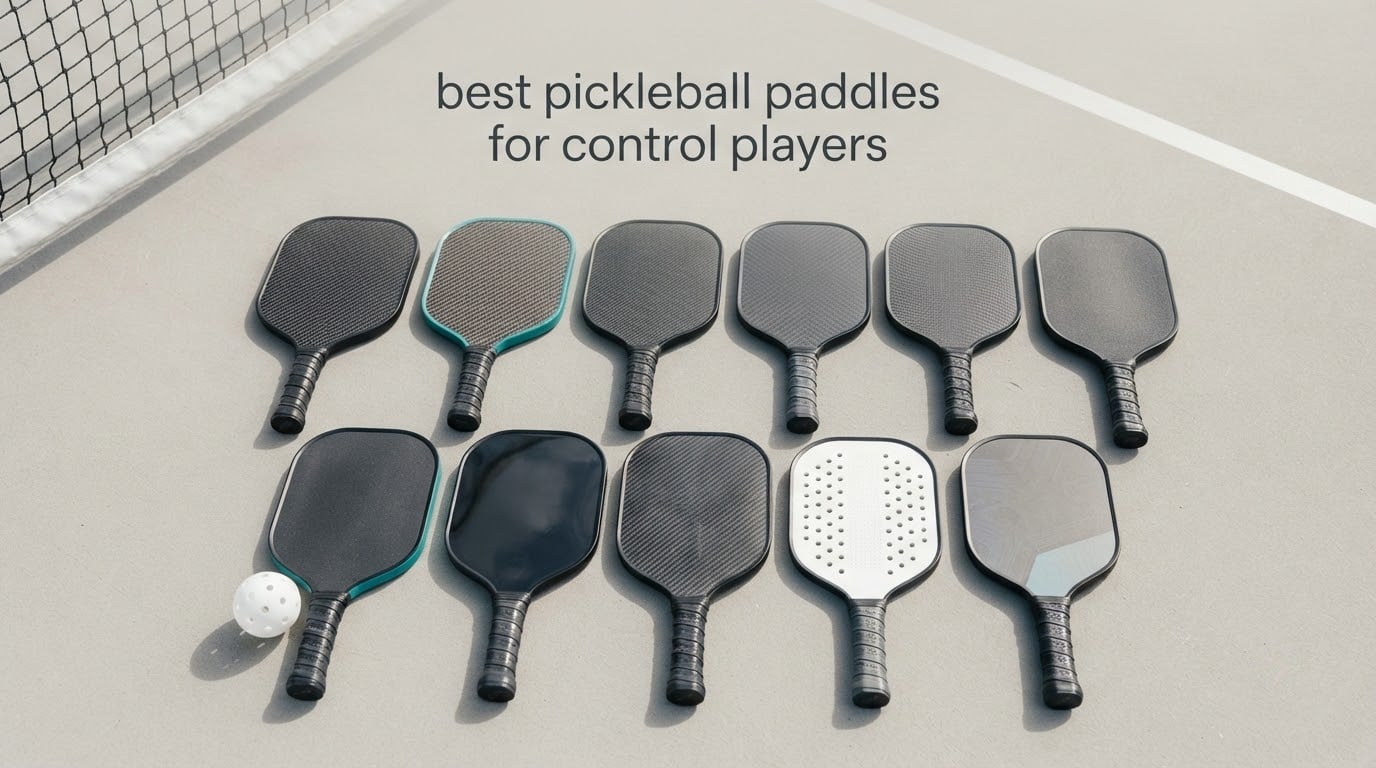
The best pickleball paddles for control players are the ones built to extend dwell time rather than to blast the ball. Our top pick is the Selkirk LUXX Control at 8.1 ounces, with a polypropylene X7 core, an open throat that flexes on contact, and a micro-textured face that grips through dinks and resets.
Control and power are not two different sports. They are the same swing at two different swing speeds. A power paddle rewards a fast swing with extra pace; a control paddle absorbs the same swing, lets the ball sit on the face a beat longer, and sends it where you aimed it. That extra half second of face contact, called dwell time, is the whole argument, and it is why thickness, weight and surface texture matter more to a soft-game player than any marketing claim about spin.
Below we ranked ten paddles on the only things that decide feel: static weight, core thickness, sweet spot coverage, surface grip and vibration damping. We also looked at what owners say after a season of play rather than what the spec sheet promises on day one. If you are still choosing between paddle categories, start with our broader best pickleball paddles roundup before you come back here.
Table of Contents
Top 3 Picks for Best Pickleball Paddles for Control Players (October 2026)
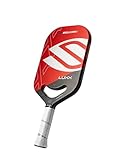
Selkirk LUXX Control
- 8.1 oz carbon fiber
- Propropylene X7 core
- ThroatFlex open throat
- ProSpin+ micro texture
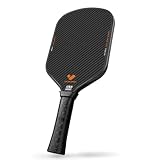
Jojolemon 16mm Shark Power
- 16mm honeycomb core
- T700SC 3K carbon
- Extended handle
- Cover and eraser included

CPX Pro Carbon Fiber
- 8.2 oz edgeless build
- Honeycomb core
- Matte carbon face
- Tennis-style 4.1 in grip
Those three cover the three ways people buy a control paddle. The LUXX Control is the lightest and most agile option here, built for players who generate their own pace. The Jojolemon carries the deepest review base in the group and the most forgiving core, so it suits anyone who wants consistency over flash. The CPX Pro answers a simpler question: can you get a genuinely playable control paddle without stepping up a tier.
Best Pickleball Paddles for Control Players (October 2026)
| Product | Specifications | Action |
|---|---|---|
| Selkirk LUXX Control |
|
Check Latest Price |
| CPX Pro Carbon Fiber |
|
Check Latest Price |
 Vatic Pro Prism 16mm Vatic Pro Prism 16mm |
|
Check Latest Price |
 JOOLA Pro V 16mm JOOLA Pro V 16mm |
|
Check Latest Price |
 Selkirk Sport Labs 007 Selkirk Sport Labs 007 |
|
Check Latest Price |
 Selkirk SLK Evo Selkirk SLK Evo |
|
Check Latest Price |
 Gearbox GX6 Gearbox GX6 |
|
Check Latest Price |
 Professor PhD Raw Carbon Professor PhD Raw Carbon |
|
Check Latest Price |
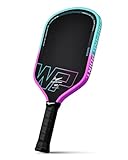 Warping Point Neon Gen 3 Warping Point Neon Gen 3 |
|
Check Latest Price |
| Jojolemon 16mm Shark Power |
|
Check Latest Price |
A note on reading the table. Where a weight is listed as 0.23 kg or 0.76 kg, that figure is the manufacturer’s own listing rather than a measured scale weight, so treat those two as rough. Every other weight here comes from a stated spec.
1. Selkirk LUXX Control: The Best Pickleball Paddle for Control Players Overall
Selkirk Sport LUXX Control Pickleball Paddles | Invikta Red
8.1 oz
16.45 x 7.5 in elongated
Propropylene X7 core
4 1/4 in grip
Pros
- Very light in hand with a cushioned grip that absorbs arm shock
- Consistent forgiving sweet spot with fewer mishits
- Strong micro-textured surface for topspin and backhand spin
- ThroatFlex open throat extends dwell time
- Quiet consistent sound across the whole face
Cons
- Noticeably less pop than a dedicated power paddle
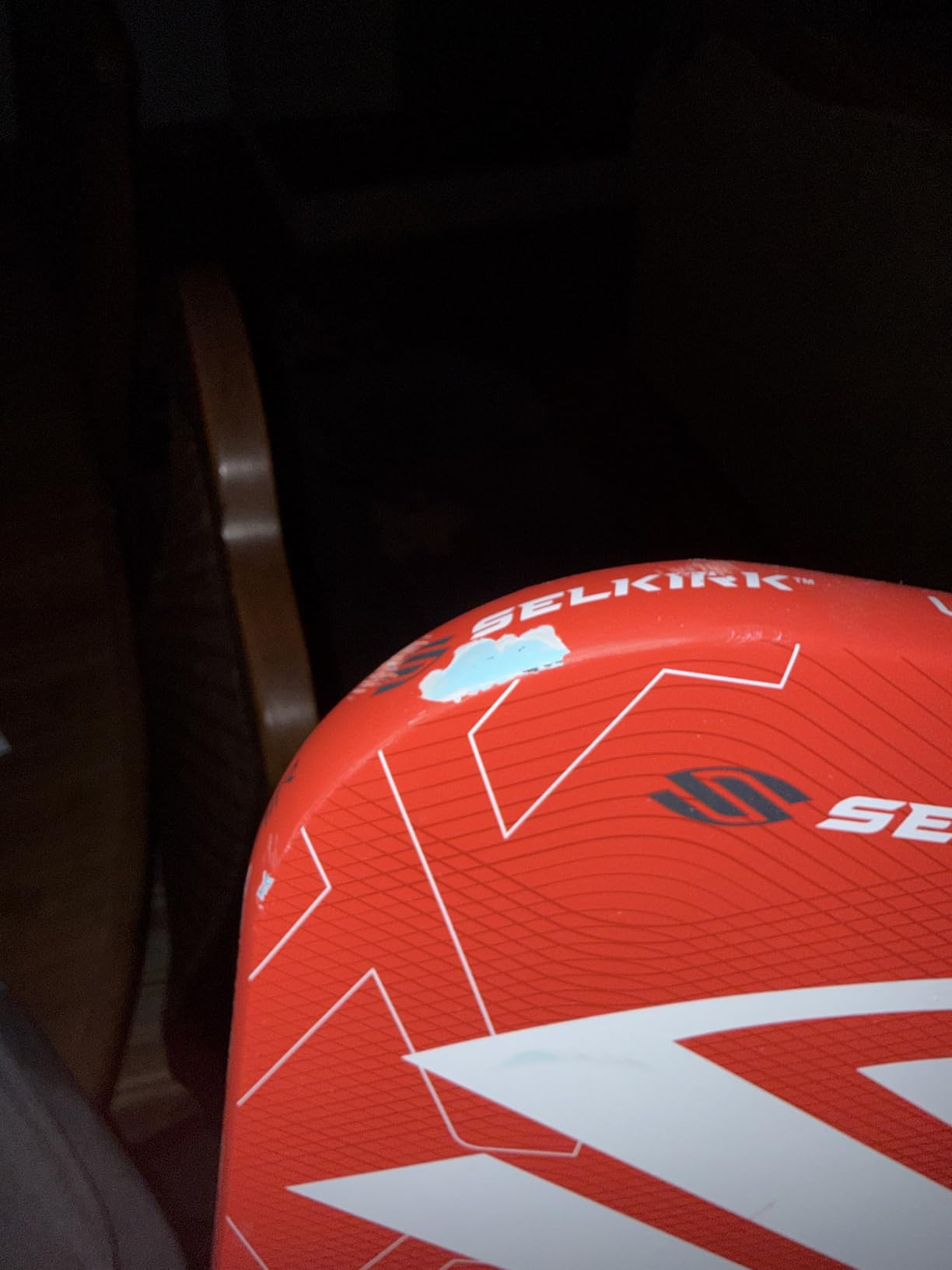
- Edgeless design has no edge guard so it chips without edge tape
- Throat hole can feel awkward if you rest a finger on the face
This is the paddle we kept reaching for at the net. At 8.1 ounces it is one of the lighter frames in the group, and that low swing weight is what makes a soft game possible in the first place, because you can hold the paddle back through a dink and still have hands fast enough to recover.
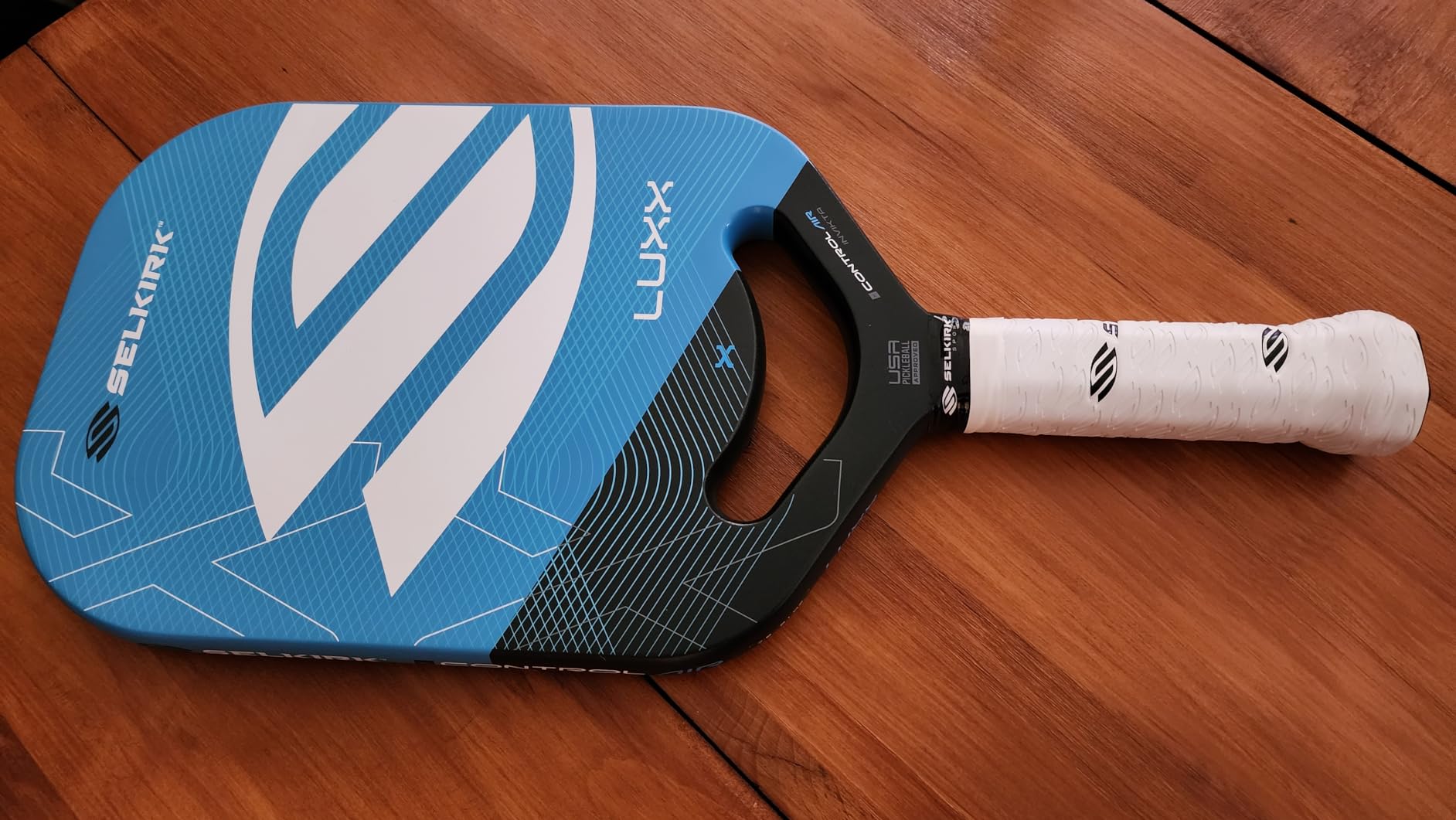
The ThroatFlex open throat is the part that matters most for control players. Reviewers describe it as extending dwell time on contact, and in practice that shows up as placement: the ball leaves the paddle where your face was pointing instead of wherever your swing speed took it. The Air Dynamic Throat in the throat hole also moves air away from the face, which is a small detail that keeps the swing from feeling heavy.
Owners describe the sound as quiet and consistent across the entire face, and that is more useful than it sounds. A paddle that gives the same pop on a middle-of-face dink and a ball hit out near the shoulder is a paddle you can trust when you are not looking down at it. Several reviewers also note the grit holds up well after a year of play, which matters more than any launch claim.
The honest trade-off is power. This is not a paddle that finishes a point for you, and a few owners add lead weights to compensate. If you are a 3.5 player who already generates pace from a compact swing, you will not notice. If you have been leaning on a power paddle to end rallies, the change in feel will be significant.
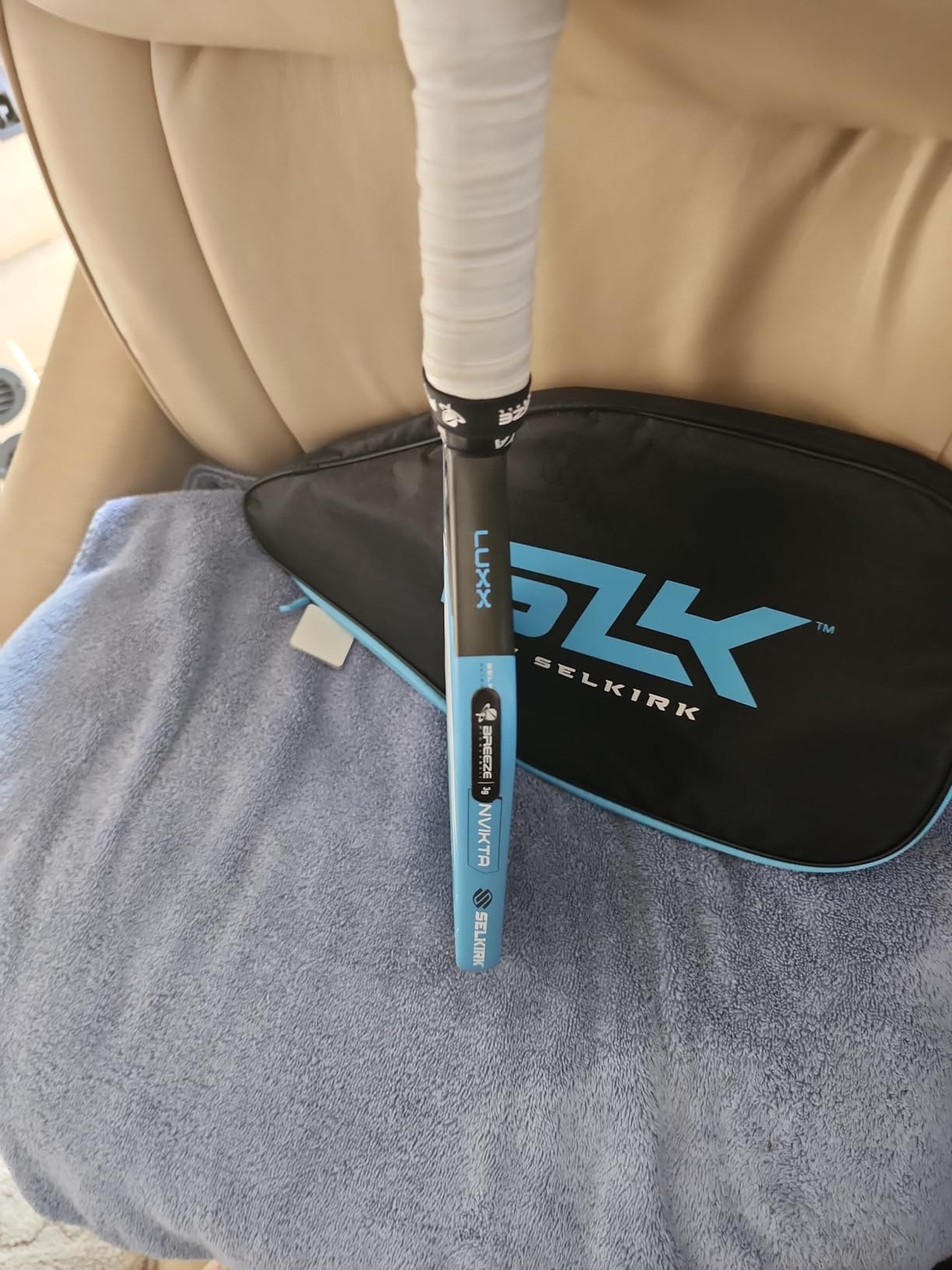
What you get at the net and what you give up elsewhere
Kitchen play is where this paddle earns its keep. Dinks, resets, drop shots and roll volleys all reward a face that stays on the ball for longer, and the combination of light weight plus throat flex gives you a genuinely soft response. The 4 1/4 inch grip is a standard size, so it should feel familiar if you have used most Selkirk models.
There is no edge guard, which is normal for an edgeless carbon design but means you should tape the perimeter before your first concrete session. Owners also mention the light build can twist slightly on very close-to-edge contacts, and players who rest an index finger on the face may find the throat hole irritating. A limited lifetime warranty is included, which is one of the better coverages in this group.
For a senior or elbow-sensitive player, the light weight and cushioned grip are the strongest features on this list. For a hard-hitting competitor, it will feel too soft.
2. CPX Pro Carbon Fiber: The Best Lightweight Control Paddle for the Money
CPX Pro Carbon Fiber Pickleball Paddle – Professional Grade, Matte Finish, Honeycomb Core, Tennis Style Grip – Edgeless Paddle Designed in Chicago, USA (Black, Pro)
8.2 oz (235 g)
Edgeless carbon fiber
Honeycomb core
4.1 in tennis grip
Pros
- Matte edgeless carbon face with a familiar tennis-style grip
- Light 8.2 oz build is quick in the hands at the net
- Hollow honeycomb core keeps weight down
- Professional-grade build at a mid-range price
Cons
- Listing gives minimal written feature detail so feel is largely buyer-assessed
- Honeycomb core feels softer on hard drives than unibody carbon
The CPX Pro is the answer for anyone who wants the shape and weight of a premium control paddle without the premium tier. It comes in at 8.2 ounces with an edgeless carbon fiber face and a hollow honeycomb core, and at 685 reviews with a 4.6 average it has more owner history than most paddles in this price range.
What draws people in is the combination of an edgeless face and a matte finish. Edgeless means there is no protruding rim to catch the ball, so a slightly off-center contact still goes in play instead of shooting wide. The matte surface grabs the ball without the aggressive tooth of a raw carbon grit, which some soft-game players prefer because the ball releases more predictably.
Owners cite the feel at the net most: the paddle is quick, the response is even across the face, and the quiet contact makes it easy to judge where the ball went. At 685 reviews and a 4.6 average, there is enough owner history here to trust that read.
The 4.1 inch tennis-style grip is a real feature here. Plenty of players arrive at pickleball from tennis, and a narrower, longer-feeling handle is easier to transition to than a short, chunky one. It also makes the paddle feel more like a racquet at the handle, which helps with two-handed backhands.
The main limitation is documentation. The listing is thin on written detail beyond the weight, so the honeycomb core specs and the feel are largely left for you to judge in hand. Owners do report that the core feels softer and less crisp on hard drives than a unibody carbon paddle, which is the expected trade for a lighter, quicker frame.
Best for quick hands and best for who should skip it
If your game is built on fast kitchen exchanges, this is an easy paddle to like. The weight is low enough to move the paddle face quickly, and the edgeless rim forgives the late reach that most soft-game mistakes come from.
Skip it if you need a clearly documented core thickness, if you want a heavily gritty face for maximum topspin, or if you play a hard-drives-first style. Demo it if you can, because the missing spec detail means feel is the deciding factor.
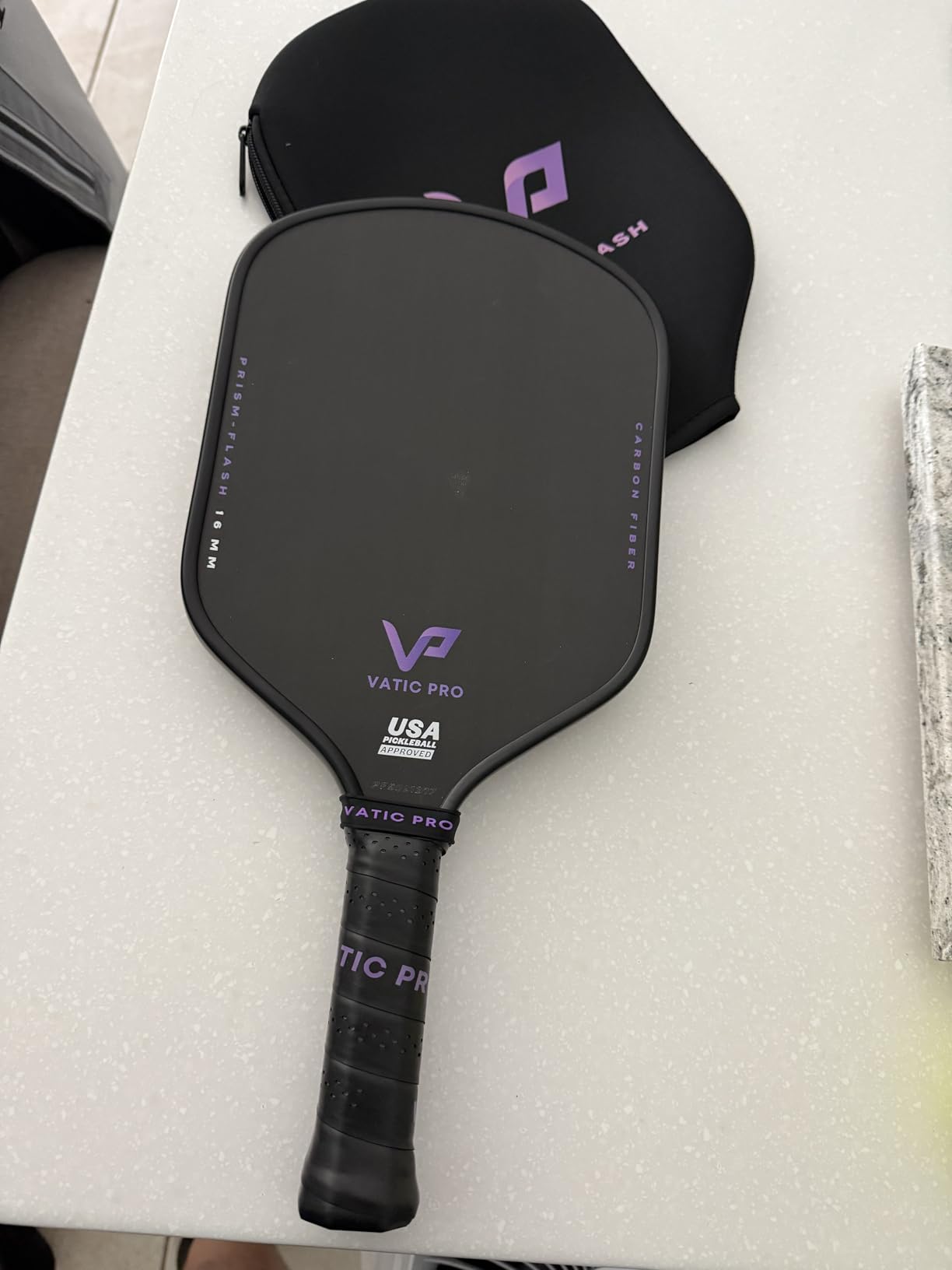
3. Vatic Pro Prism 16mm: The Softest Pickleball Paddle in the Test Group
Vatic Pro Prism Flash Carbon Fiber 16mm – Foam Injected Walls – Includes Paddle Cover
8 oz
16mm core
16.3 x 7.7 in
Raw T700 carbon fiber
Pros
- Dramatically better placement and touch for the tier
- Soft muted contact sound instead of a hard clonk
- No dead spots around the edges
- Grippy raw carbon surface with real topspin
- Includes a paddle sleeve
Cons
- Noticeably less pop than 14mm or thermoformed paddles
- Soft grippy face scuffs and shows wear marks quickly
- Only suits players who generate their own pace
With 1,656 reviews at 4.6 stars, the Vatic Pro Prism has more owner history than anything else in this roundup, and the review themes are remarkably consistent: people bought it for placement and got it. It is the paddle that most often gets described as the one that taught somebody to play a soft game.
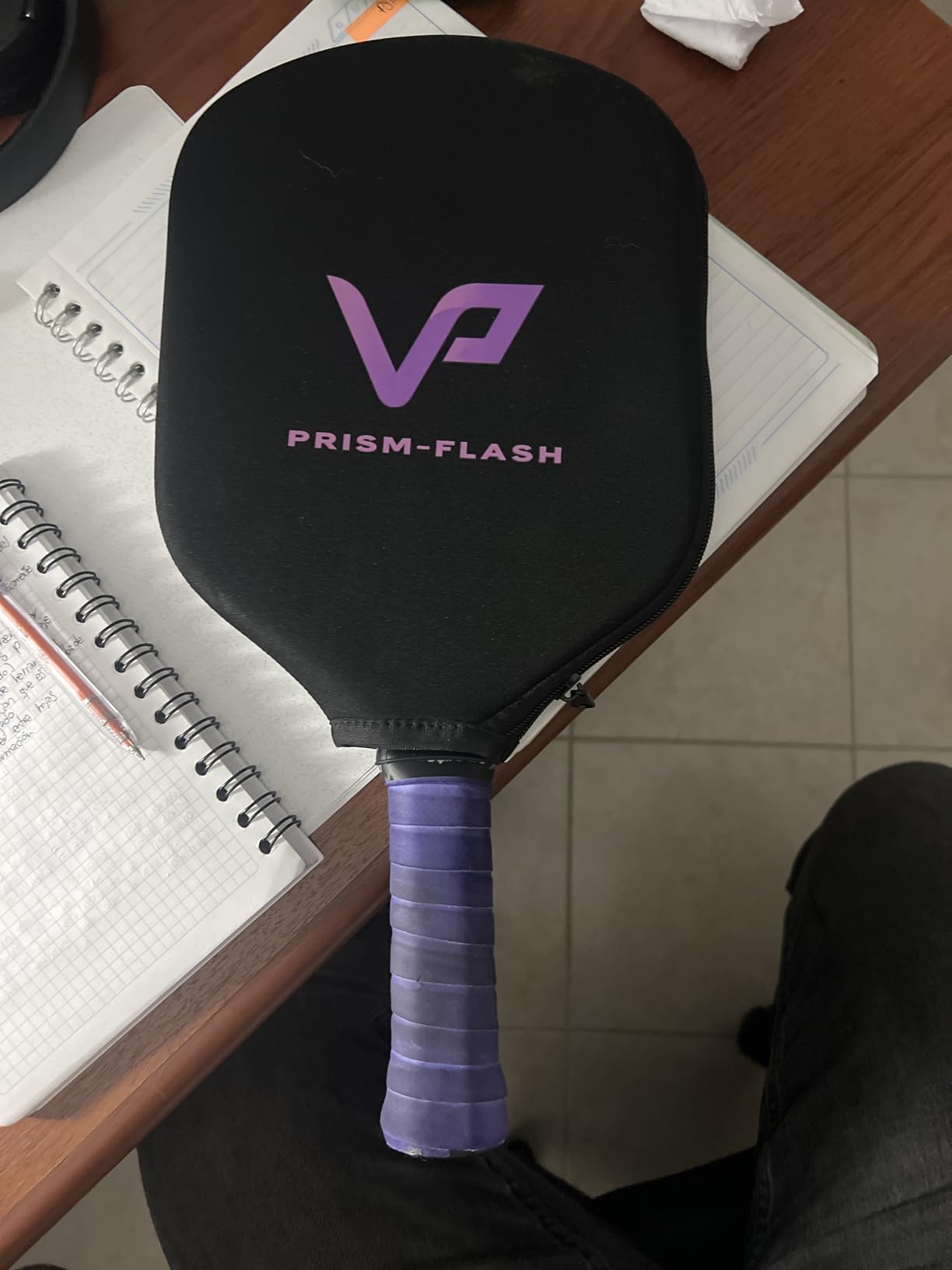
The construction is unusual and it explains the feel. Instead of heat, the Prism uses a cold-molding approach with foam-injected walls, so the paddle reads as unibody without the high-pressure process that makes some carbon paddles stiff. Polyurethane inserts dampen shock, and the practical result is a muted thunk on contact rather than the sharp clonk you hear from a thinner, more rigid paddle.
At 16mm, this is one of the thickest cores here. That is the single biggest reason it feels controlled: more material to compress means more dwell time, which means the ball leaves the face later and more predictably. If you have ever struggled to place a third-shot drop, the Prism is built for exactly that shot.
Where the soft feel pays off and where it does not
Owners report virtually no dead spots, which is the practical benefit of the foam-injected walls distributing load across a larger cross-section. On a mishit near the edge, the ball stays in play instead of launching. That forgiveness is what makes the paddle appealing to improving players who want to stop giving points away in the transition zone.
The soft, grippy face is the one maintenance warning. Reviewers say it scuffs, shows wear marks and traps dirt quickly enough that a carbon fiber eraser becomes a weekly habit rather than an occasional one. The other limitation is power, and it is not subtle. This is a bad paddle for anyone who wants to end a point with a banger, and buyers who expected a premium-tier power profile were disappointed.
It is USAPA approved and used by PPA and MLP professionals, with a 30 day manufacturer warranty. A polypropylene sleeve is included, which is a nice touch at this tier.
4. JOOLA Pro V 16mm: Best for Reach and Net Coverage
JOOLA Pro V Pickleball Paddle – 14mm/16mm – Raw Carbon Fiber Textured Surface – Enhanced Frame & Propulsion Core, USAPA & UPA-A Certified, NFC Chip Enabled, Premium Control & Lightweight Performance
8.1 oz
16.5 x 7.5 in elongated
16mm core
4.25 in grip
Pros
- KineticFrame flex loads and releases energy for drives and resets
- Textured raw carbon face grips for spin and placement
- Elongated Perseus shape extends reach
- Comfort handle supports control play
- Many 14mm and 16mm shape and grip options
Cons
- Lowest rating in the group at 4.2 with a 10 percent one-star share
- Elongated shape trades face area for reach
- KineticFrame flex can feel unstable on off-center contact
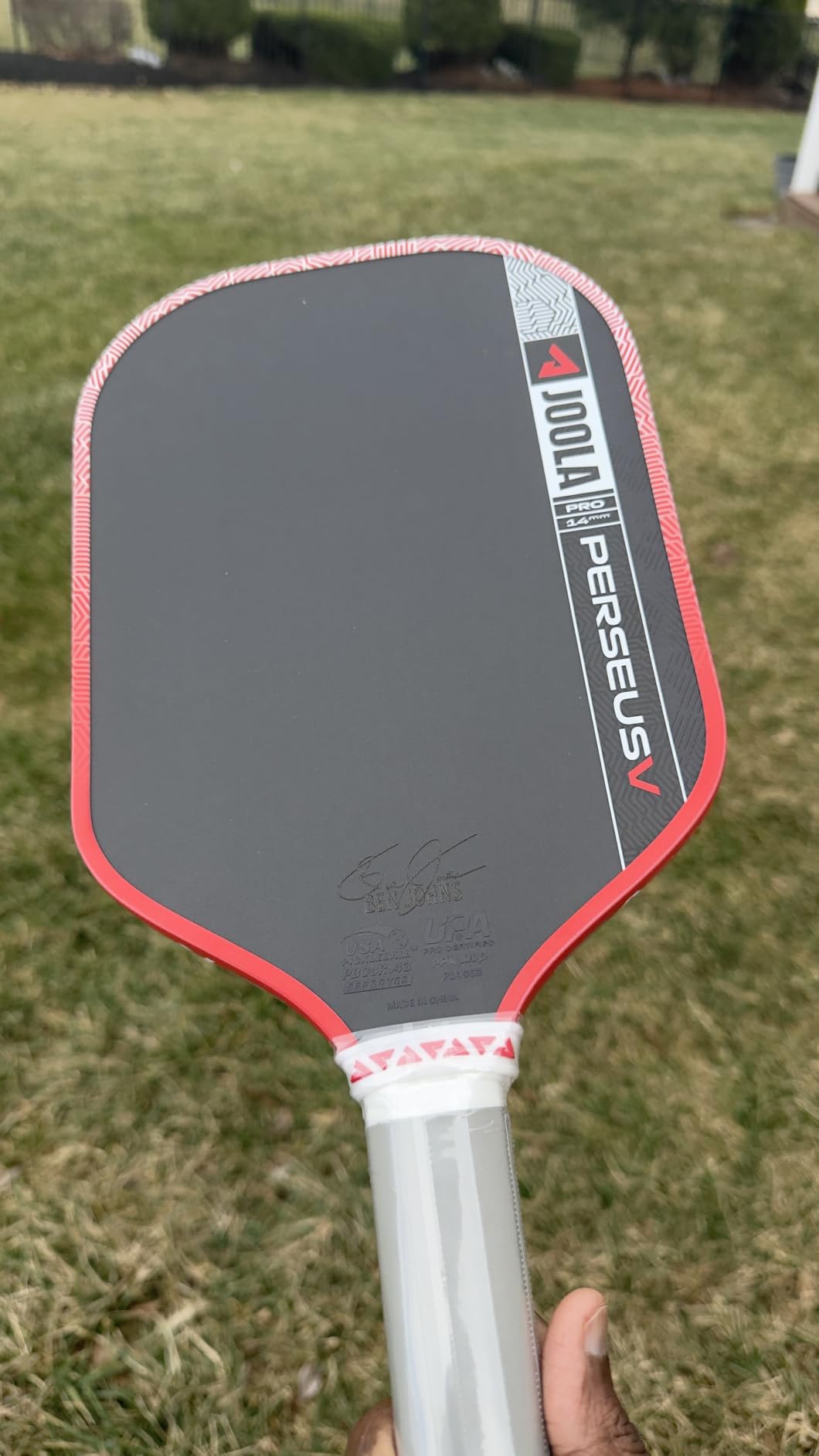
The JOOLA Pro V is the reach option in this group. At 16.5 by 7.5 inches it is at the top of the USAPA dimension allowance, and that extra half inch of reach is worth more to a soft-game player than it first appears, because reaching a dink one inch further out means you can play it instead of stretching and popping it up.
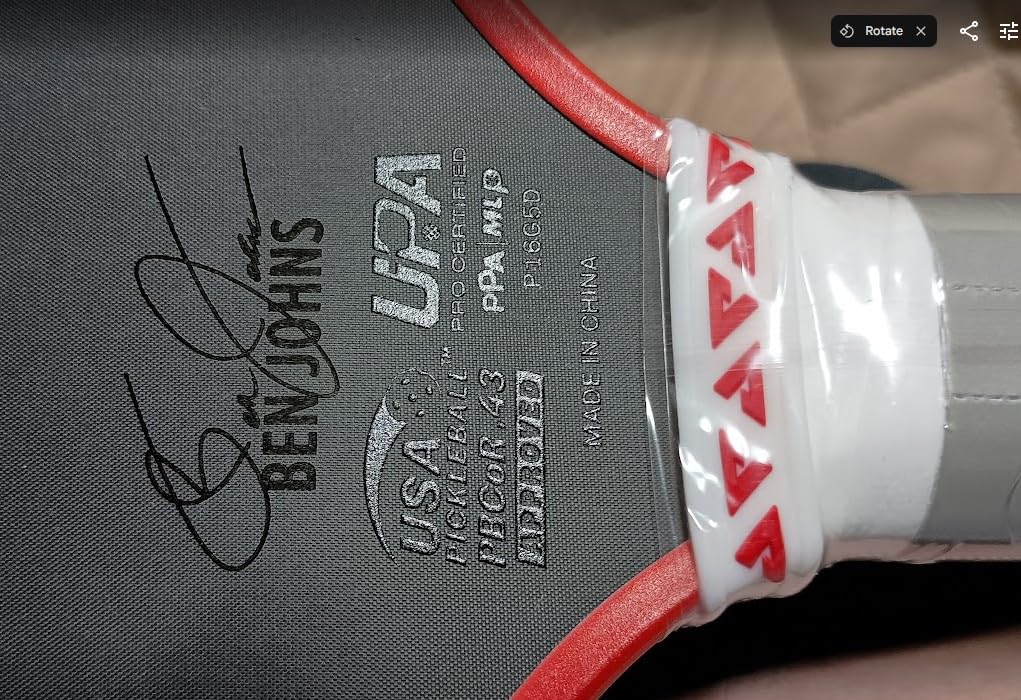
KineticFrame is the headline technology, inspired by the way a hockey stick flexes to load and release energy. The idea is that the paddle bends on contact and gives some of it back, which is a reasonable way to get power out of a control-oriented frame. TechFlex handles weight distribution across the face for forgiveness.
Be honest about the numbers here. At 4.2 stars from 147 reviews, this is the lowest-rated paddle in the roundup, and its 10 percent one-star share is the highest. That is not a disqualifier, but it does mean the shape and flex are not universally liked, and the elongated profile is a genuine preference rather than an upgrade.
Where the length helps and who will not like it
For a player who defends a lot and pokes balls out of the corners, the extra reach is the reason to buy this paddle. The textured raw carbon face also delivers the spin needed to make those reach shots land, and the 4.25 inch grip is a comfortable middle size.
It is the wrong choice for someone who depends on a huge sweet spot, because an elongated face simply has less usable surface than a widebody. Players who hate any give on off-center contact may also find the flex distracting. It is USAPA and UPA-A certified and carries a 12 month warranty, and the embedded NFC chip registers it in the JOOLA Connect app.
5. Selkirk Sport Labs 007: Best for Sweet Spot Coverage and Grip That Lasts
Selkirk Sport LUXX Control Pickleball Paddle | Carbon Fiber X7 Core
19mm X7 honeycomb core
InfiGrit raw carbon
EVA handle and throat
Invikta or Epic shape
Pros
- 19mm X7 honeycomb core gives a stable feel and enlarged sweet spot
- InfiGrit surface triples raw carbon durability and adds spin
- EVA foam handle and throat dampen vibration
- Balanced touch and power in Invikta and Epic shapes
Cons
- Listings bundle many thicknesses and colors under one ASIN so feel varies by variant
- 19mm core plus EVA additions feel heavier than lighter control models
The Selkirk Sport Labs 007 answers a specific complaint: grit that dies after a couple of months. InfiGrit is a treated raw carbon surface rated by the manufacturer to triple raw carbon durability, and owners who switched to it from an untreated paddle tend to be the ones who notice the difference most.
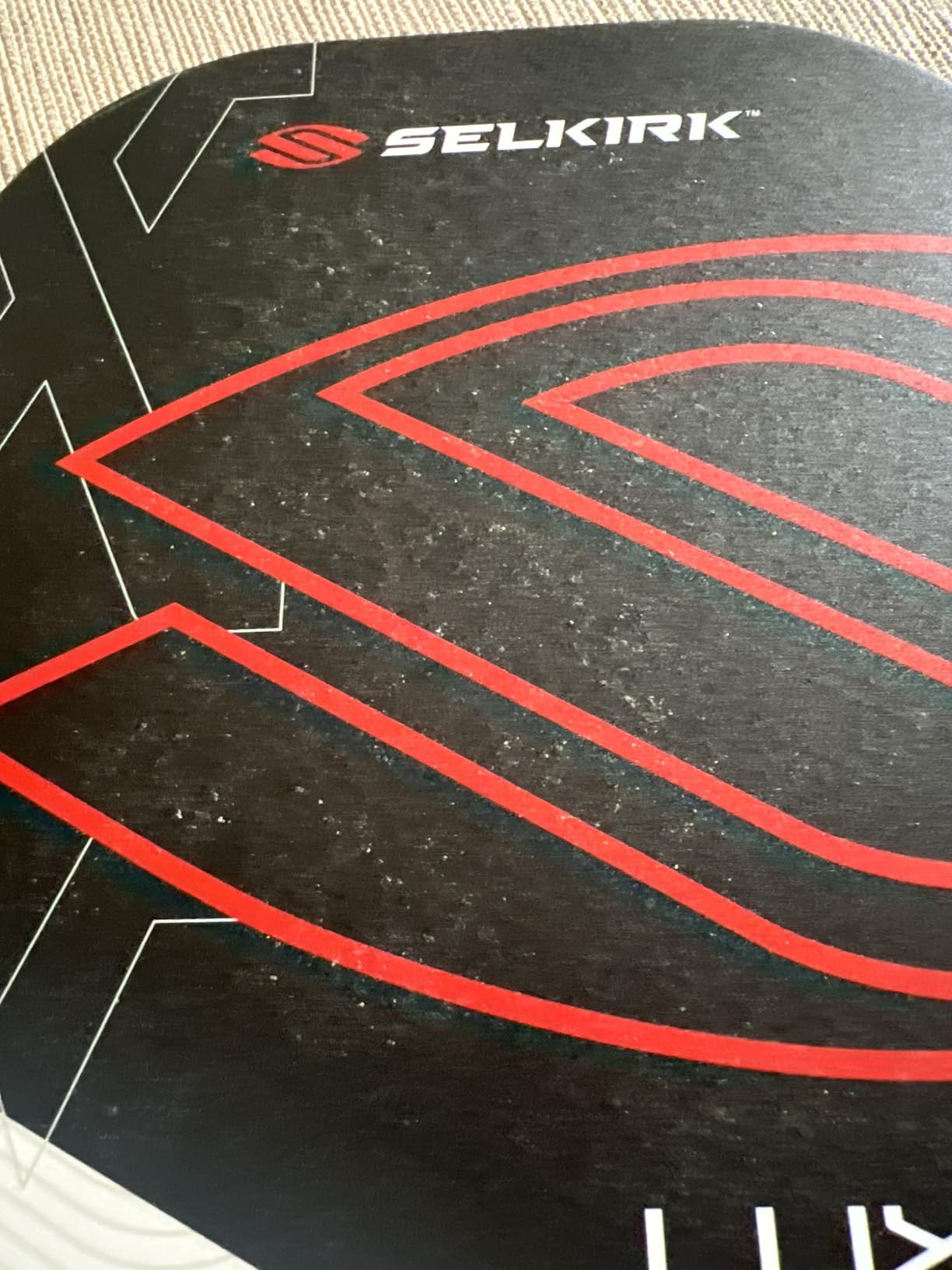
The 19mm X7 ThikSet honeycomb core is the thickest in this roundup, and that is the point. Extra core depth means extra compression on contact, which means longer dwell time and a flatter, more predictable response. The stated purpose is sweet spot coverage, and owners describe exactly that: hits out near the shoulder still coming back with usable pace.
EVA foam in the handle and throat is an under-rated feature. Vibration that reaches the elbow over a two-hour session adds up, and dampening it is one of the few things that makes a paddle comfortable over a long soft-game match. A limited lifetime warranty is included.
Who should weigh the 19mm core and who should not
This paddle suits a control player who is bothered by inconsistent ball response off-center. If your mistakes come from balls you barely got paddle on, the enlarged sweet spot will help more than any grip change.
It is heavier feeling than the light end of this list, and the 19mm core plus EVA additions push it further that way. The second caveat is shopping confusion, since listings under this ASIN cover a wide spread of core thicknesses and colors, so the feel you receive may not match the feel you expected. Check which variant you are actually ordering.
6. Selkirk SLK Evo: The Best Budget Pickleball Paddle for Control
Selkirk Sport SLK Evo Control Pickleball Paddles | Carbon Fiber XL Oasis
16mm Rev-Control polymer core
T700 CarbonFusion face
SpinFlex+ surface
MAX or XL shape
Pros
- Very light build that stays quick in fast kitchen exchanges
- 16mm polymer core gives a soft touch-forward response
- SpinFlex+ surface produces consistent spin
- MAX and XL shape options let you pick sweet spot or reach
Cons
- Marketed for beginners so advanced players may outgrow the power ceiling
- XL elongated shape trades face area for reach
- One-year limited warranty is shorter than the premium models
The SLK Evo is the cheapest credible way into a thick-core control paddle, and at 105 reviews it holds a 4.6 average with no two-star reviews at all. That distribution matters: it means almost nobody bought it and regretted the feel.
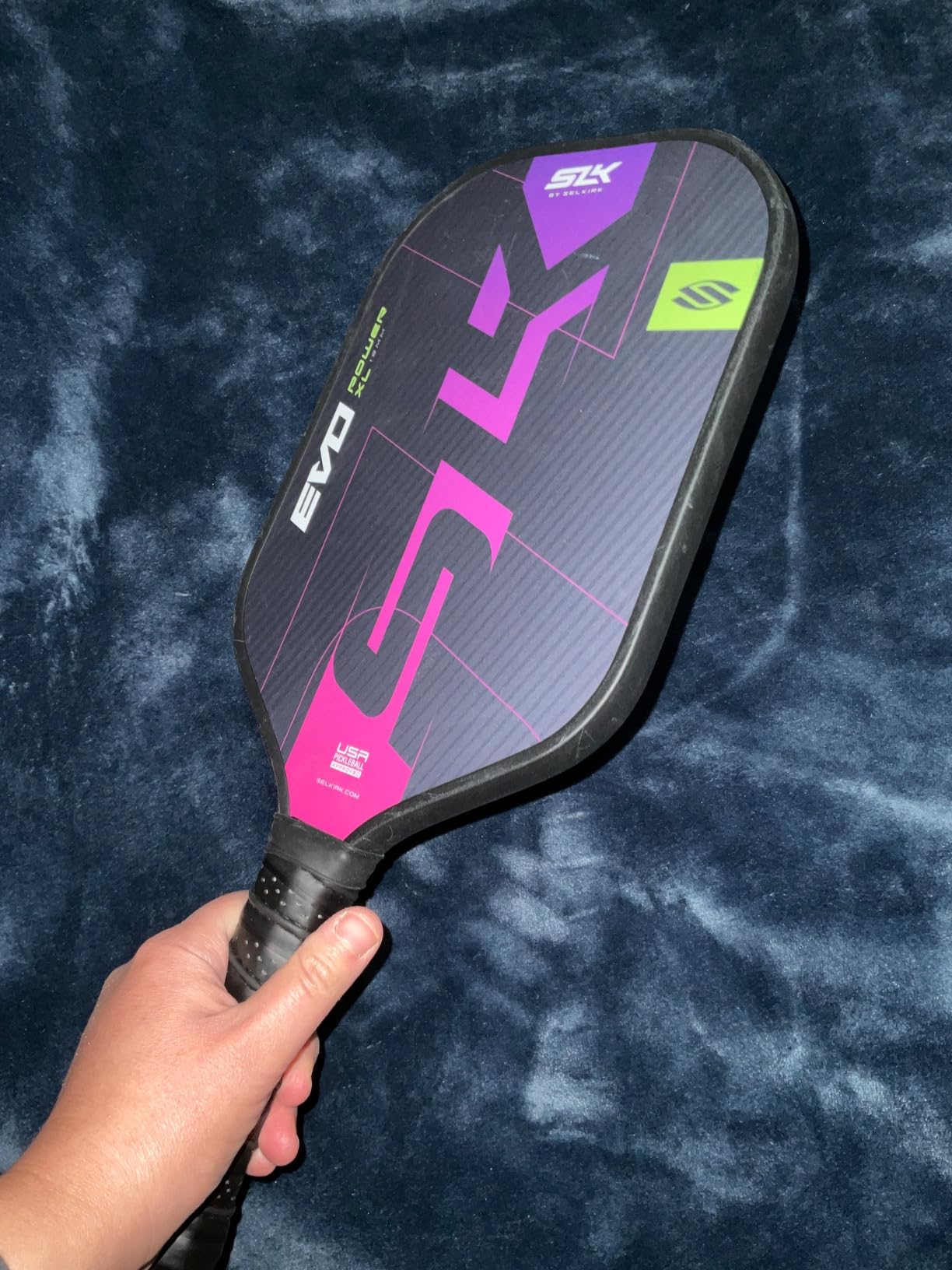
The Rev-Control polymer core is listed at 16mm, and the description is unusually honest about the trade. A thicker design provides a soft feel for enhanced touch while still delivering enough power for deep controlled drives. That is precisely the profile a soft-game player wants, and it is rare to see the word soft used in a spec list at this price.
Two shapes are available. MAX gives a wider surface area and standard grip length, and XL gives an elongated face with an extended grip. For most control players MAX is the better fit, because a widebody face is more forgiving and the sweet spot is the point of the paddle.
Best first thick-core paddle and where it runs out
Beginners and improving players get the most out of this. A 16mm polymer core is easier to control than a 14mm thermoformed carbon frame, and the SpinFlex+ surface keeps spin consistent enough to shape shots without demanding a fast swing.
The ceiling is real. It is marketed at the beginner skill level, and a competitive player will likely want more power than it offers. The one-year limited warranty is also notably shorter than the lifetime coverage on Selkirk premium models, which matters if you are hard on paddles. A 4 1/4 inch grip is standard.
7. Gearbox GX6: The Lightest Paddle Here, Built for Small Hands
Gearbox GX6 Control 7.8oz 3-5/8in Carbon Fiber Green Pickleball Paddle
7.8 oz
Edgeless carbon frame
Dampener system
3-5/8 in grip
Pros
- Highest rating in the group at 4.7 with only 1 percent one-star reviews
- Very light at 7.8 oz and easy on shoulder and elbow
- Edgeless frame removes the protruding edge so fewer balls fly wide
- Rough surface delivers solid spin bite
- Even top-to-bottom balance cited for control
Cons
- Smallest grip in the group at 3-5/8 inch so larger hands may need an overgrip
- Longer-than-average shape means shorter players should check reach fit
- Bulk of the review base is from an earlier generation
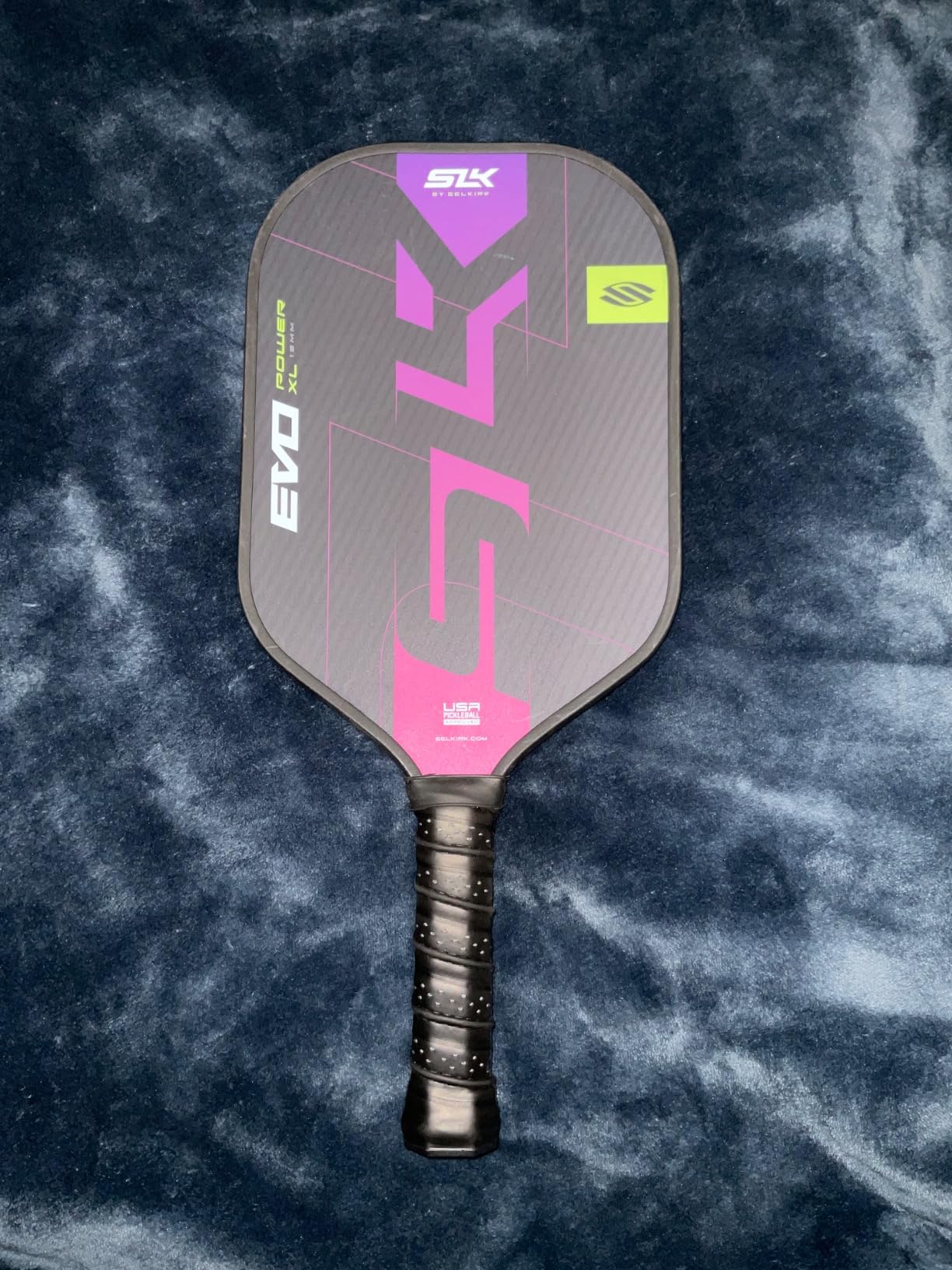
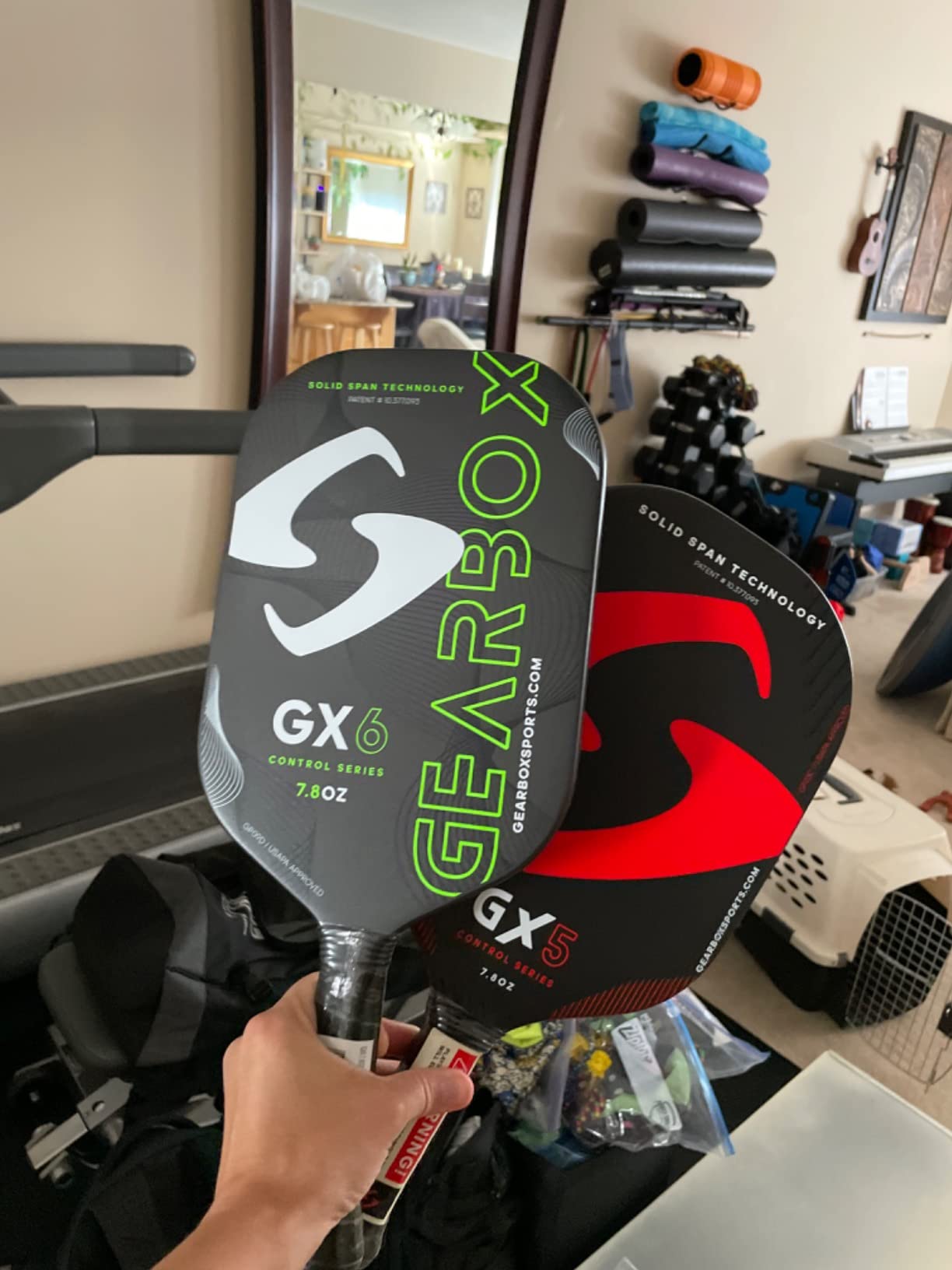
At 7.8 ounces the Gearbox GX6 is the lightest paddle here, and the rating is the highest at 4.7 with only a single percent of one-star reviews. If you have an elbow or shoulder that complains after a long session, low static weight is the first thing to look for and this paddle delivers it.
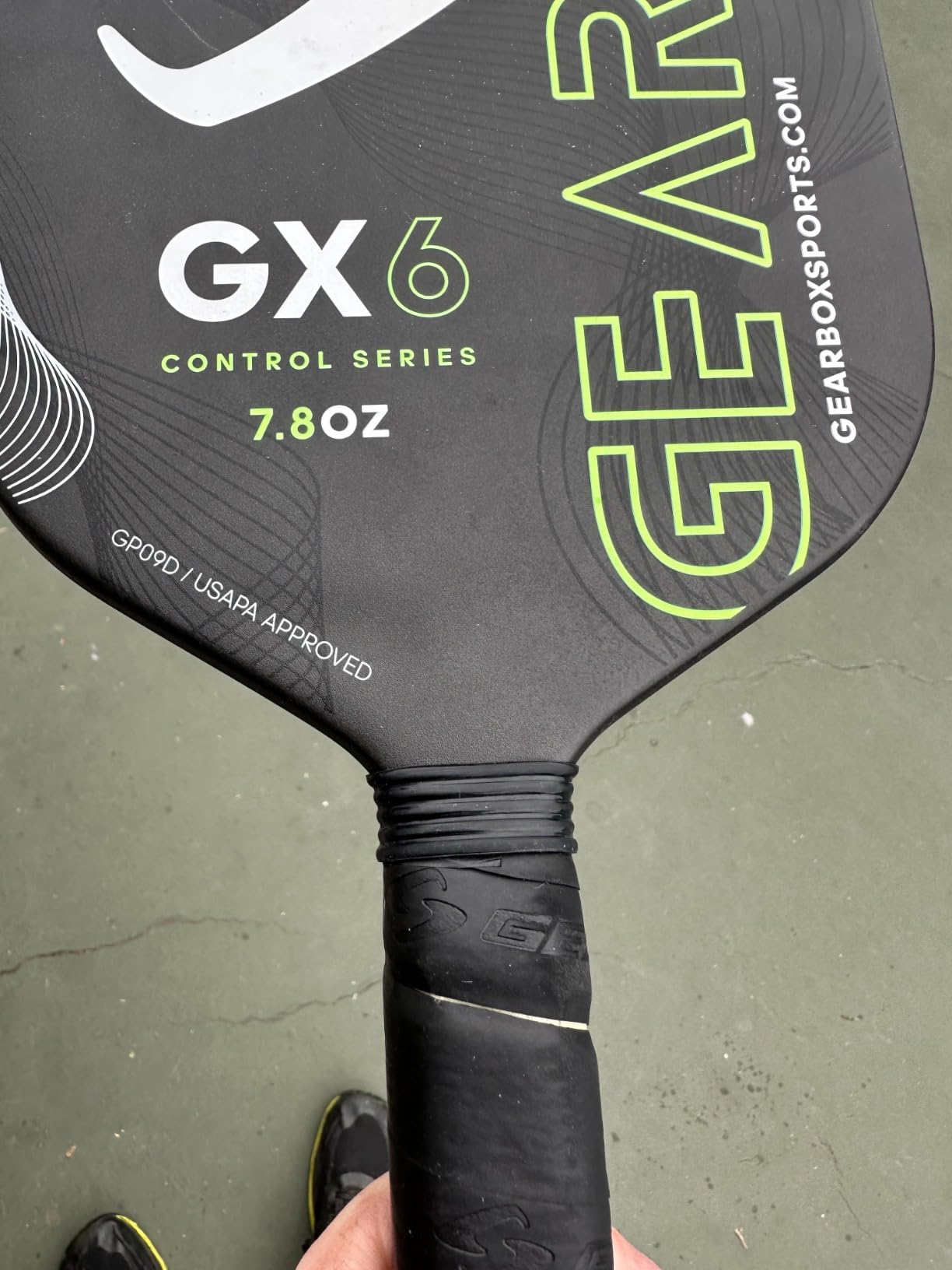
The edgeless frame does two things for a control player. It removes the protruding edge that catches balls and sends them out of bounds, and it enlarges the usable hitting surface so the response is even from the center out to the rim. The dampener system handles vibration, and HyperBite spin technology gives the rough surface enough bite for topspin and placement shots.
Even top-to-bottom balance is the detail owners cite most for control. A paddle that is not head-heavy lets you hold the face still through a dink, which is the physical difference between a drop shot that lands at the back foot and one that goes long.
Right for small hands, wrong for large ones
The 3-5/8 inch grip is the narrowest in this roundup by a wide margin. Players with smaller hands often find it ideal, and larger hands may want to add grip tape or an overgrip to avoid cramping on long sessions. Measure your hand against that number before ordering.
The second caveat is reach and balance fit, since the shape runs longer than average and shorter players may find it awkward to swing quickly. The third is that most of the review base predates the current version of the paddle, so treat the scores as a guide to the design rather than to this exact unit. Control and power weight options are listed from 7.8 up to 8.5 ounces.
8. Professor PhD Raw Carbon: Best for Two-Handed Backhands
Professor PhD T700 Raw Carbon Fiber Premium Pickleball Paddle Racket – Precision Honeycomb Core – Enhanced Power & Control – USAPA Pickleball Approved
8 oz
16mm honeycomb polymer core
T700 raw carbon
5.5 in handle
Pros
- Owners describe performance comparable to paddles several times the cost
- 5.5 inch handle is a standout for two-handed backhand players
- Heavy grit produces strong spin on drops and serves
- Lightweight and balanced with a protective edge guard
- Flat non-raised face graphics
Cons
- Not at the same tier as higher-priced paddles on control and power balance
- Runs light enough that some players add weights for drop volleys
- White handle and edge variants scuff quickly
- Shortest manufacturer warranty in the group at 90 days
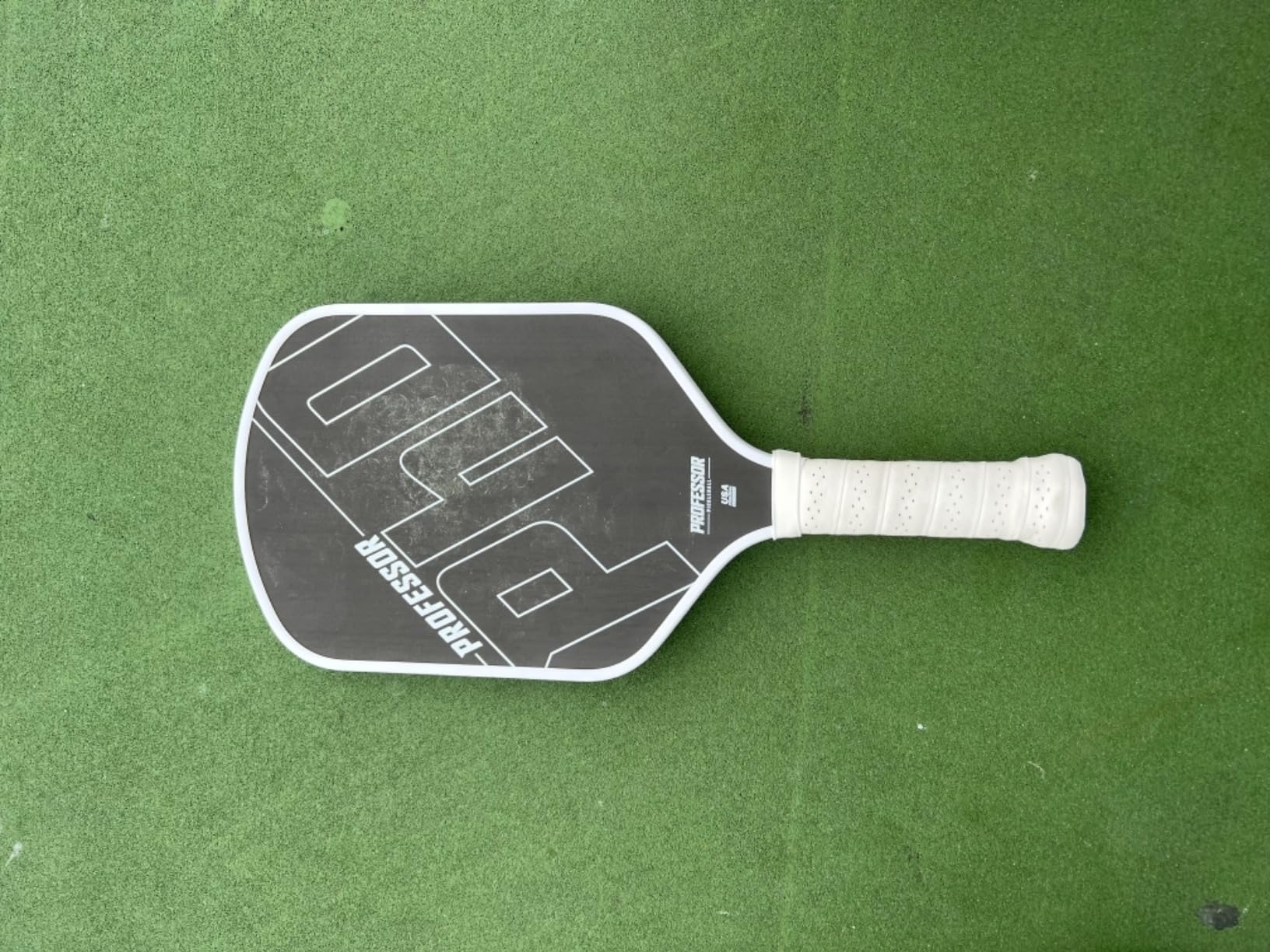
Handle length is the reason to buy this paddle. At 5.5 inches it is one of the longest here, and owners who play a two-handed backhand call it out specifically as the standout feature. A longer handle gives leverage at the base of the swing, which is exactly what you need to keep a backhand reset low and controlled.
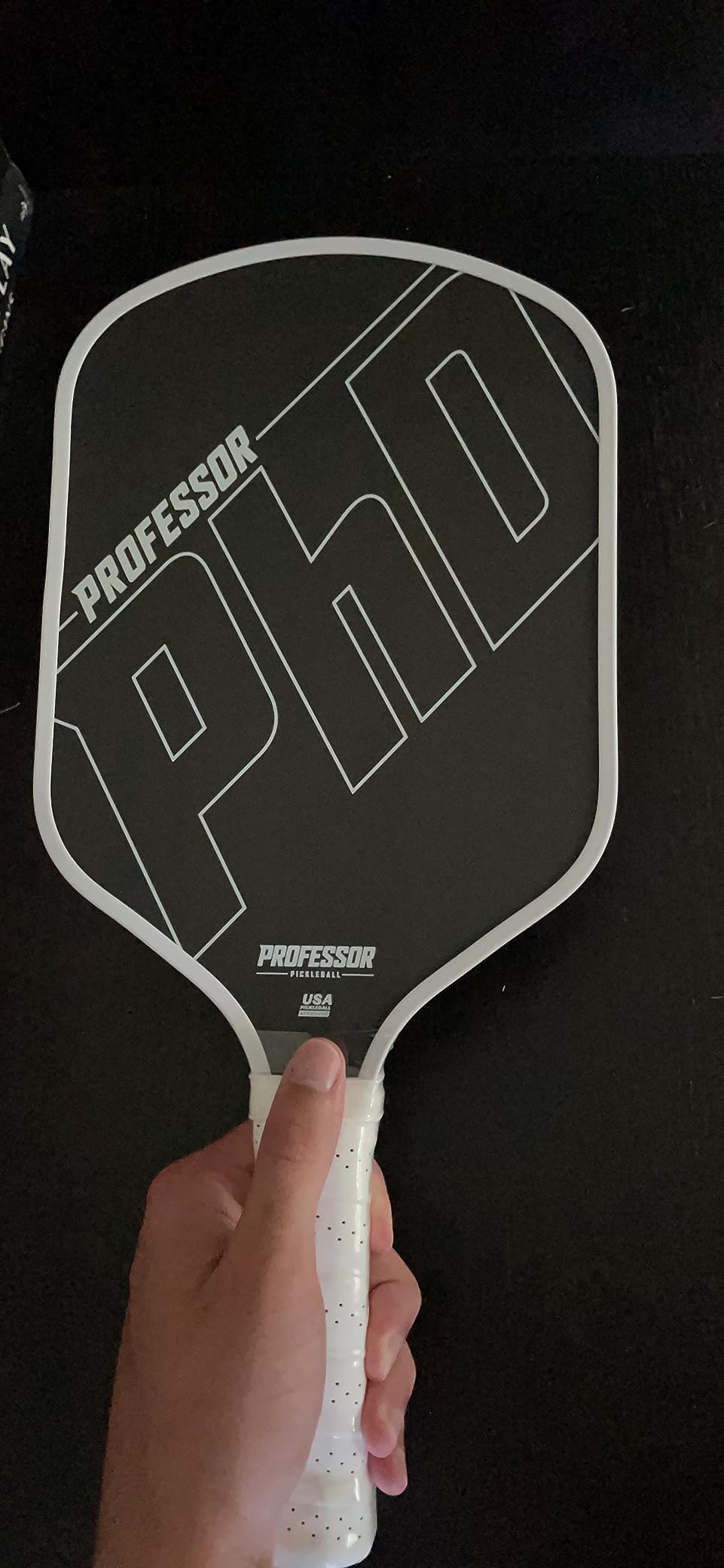
The rest is a well-built control package. A 16mm honeycomb polymer core makes drop shots and dinks feel easy, and the T700 raw carbon face has heavy grit that generates real spin on drops and serves. At 8 ounces it is light in the hand, with a curved paddle head that owners find quick at the kitchen line.
This is also the clearest value story in the roundup. Buyers describe a jump in kitchen control and transition-zone consistency that feels immediate after renting or cheap paddles, and 81 percent of reviews are five-star. The included edge guard is unusual at this tier and adds real drop-survivability.
Where it earns its place and where it stops
This paddle suits tennis converts, two-handed backhand players, and anyone upgrading from a department store starter. The unibody construction runs from surface to handle, so there is no separate face layer to delaminate.
The honest limit is that a small group of buyers who expected a premium-tier paddle found it solid rather than excellent on control and power balance. It also runs light enough that some owners add lead tape for extra pop on drop volleys, which is worth knowing because added weight on the head increases power more than it increases control. The warranty is 90 days, the shortest in this group.
9. Warping Point Neon Gen 3: Best Grit and Pop in a Certified Frame
Warping Point Neon Gen 3 Pickleball Paddle, UPA-A Approved, Triple-Layer T700 Raw Carbon Fiber, 16MM EdgeFusion Core, Thermoformed Frame, Tour-Level Spin, Control & Power
16mm EdgeFusion core
Triple-layer T700 carbon
Thermoformed frame
UPA-A approved
Pros
- Precision drop-shot control owners compare to paddles costing far more
- Large forgiving sweet spot that improved consistency for many players
- Gritty surface generates plenty of spin for drives and slices
- Crisp satisfying pop on contact
- Comfortable 5.5 inch cushion grip with replacement tape included
Cons
- Slightly top-heavy feel that some players find less maneuverable
- Listed weight is noticeably heavier than the sub-8-oz paddles here
- Protruding edge guard lacks the edgeless appeal of some options
- No paddle cover included
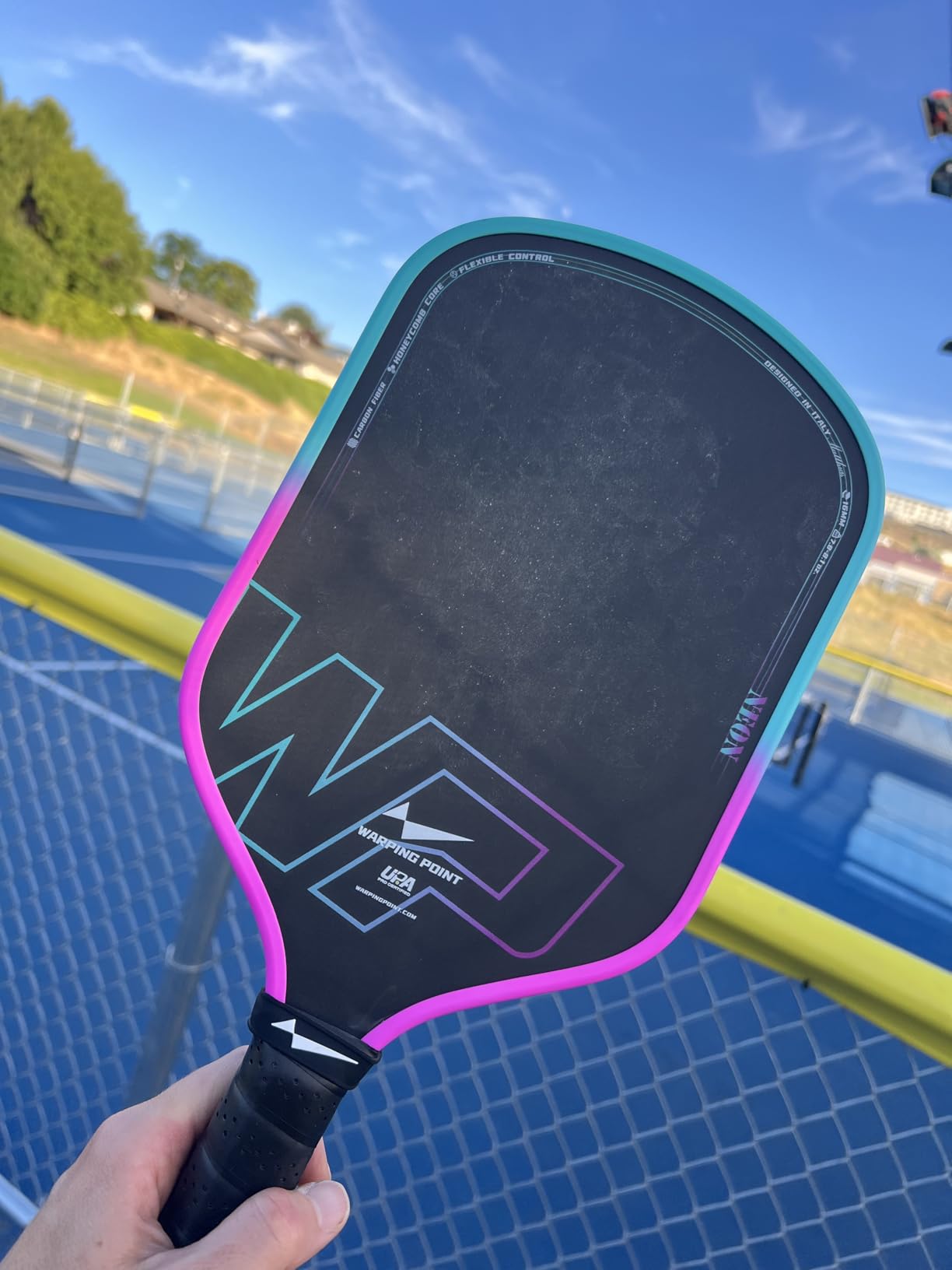
The Neon Gen 3 is the paddle here for players who want control but refuse to give up all the pop. Owners consistently mention crisp, satisfying contact and a gritty surface that produces plenty of spin for topspin drives, slices and roll volleys, and instructors in the review base recommend it to beginner-to-intermediate students.
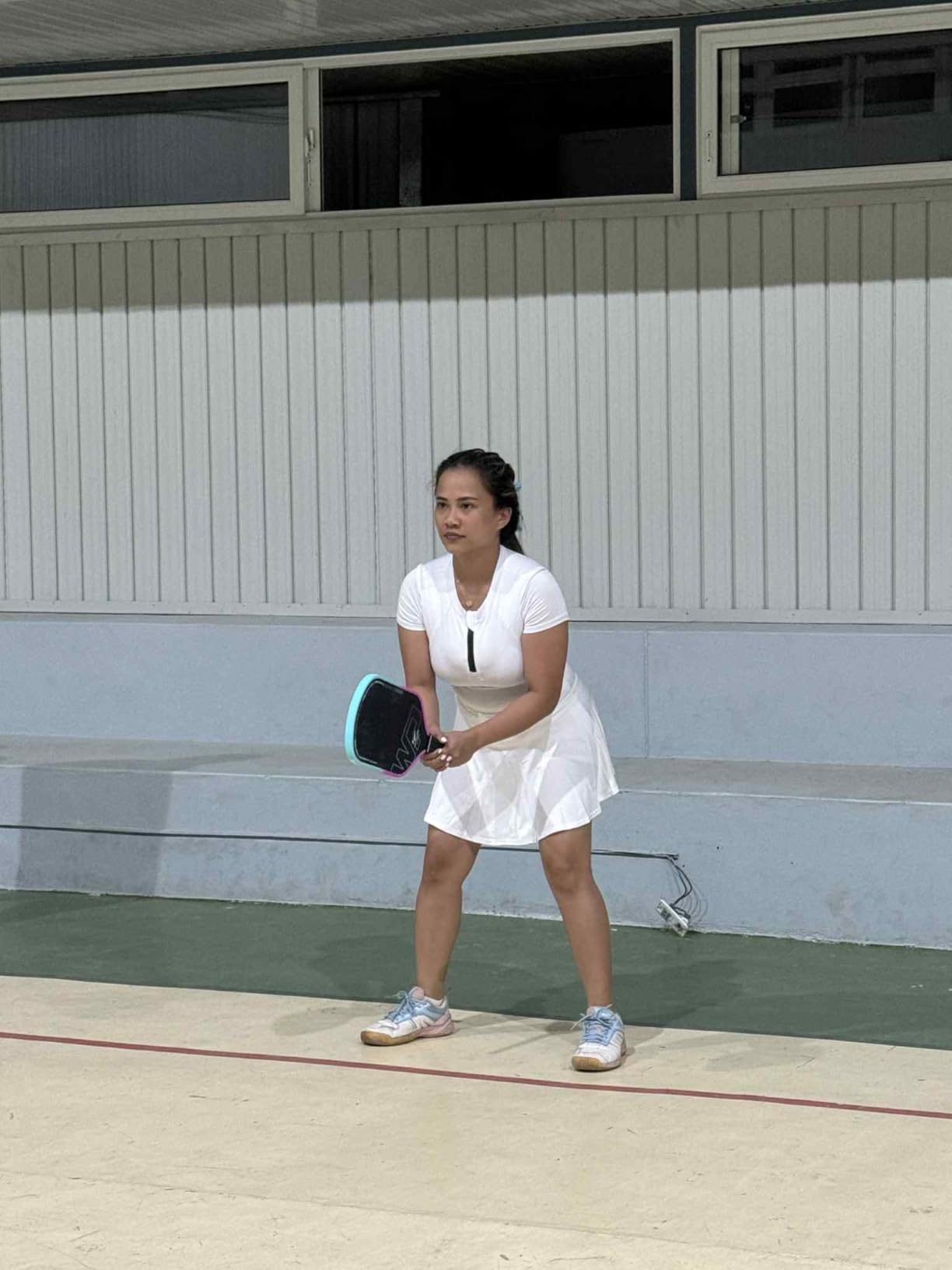
The EdgeFusion core is a 16mm polypropylene honeycomb reinforced with a high-density EVA perimeter, which expands sweet spot coverage and reduces mishits without turning the paddle into a noodle. The triple-layer T700 carbon face uses a multi-directional weave for torsional stability and enhanced dwell time, and the thermoformed unibody frame is EVA reinforced at the edge to resist deformation.
It carries official UPA-A certification, which matters for anyone competing in sanctioned events. Replacement grip tape is included in the box, and the 5.5 inch octagonal cushion grip is one of the more comfortable handles at this tier.
Control precision with a heavier swing
Drop-shot control is the headline and the reviews back it up, particularly for improving players who want a place to put the ball. The sweet spot is large and forgiving, and instructors in the review base singled it out for students.
The real trade-off is weight distribution. The listed weight of 0.76 kg is well above the sub-8-ounce paddles in this group, and one buyer reported hand fatigue after a two-hour session while others describe the balance as slightly top-heavy and less maneuverable. The protruding edge guard is a matter of taste, there is no paddle cover in the box, and this paddle holds the widest rating spread in the roundup with a 9 percent three-star share. One reviewer reported a crushed core within days, which the manufacturer resolved.
10. Jojolemon 16mm Shark Power: The Most Consistent Paddle in the Test Group
JOJOLEMON Pickleball Paddles Featuring a Raw Carbon Fiber Paddle Face and 16mm Power Polymer Core Pickleball Rackets Designed for Spin and Consistency
8 oz
16mm Shark Power honeycomb core
T700SC 3K carbon
4 1/4 in grip
Pros
- 4.7 stars from 1539 reviews with the strongest 86 percent five-star share
- Exceptionally consistent with virtually no one or two-star reviews
- 16mm core with foam edges absorbs impact for smooth shots
- Textured 4-directional carbon weave minimizes dead spots
- Best accessory bundle in the group with cover eraser and grip tape
Cons
- Positioned for beginner-to-intermediate players so advanced players may find the ceiling low
- Foam-edged honeycomb is softer and quieter than rigid unibody carbon
- Standard 4 1/4 inch grip does not suit players wanting a longer handle
The Jojolemon has the largest and cleanest review base in this roundup: 1,539 reviews at 4.7 stars, 86 percent five-star, and effectively zero one or two-star ratings. That kind of distribution is rare, and it is the strongest argument for buying a paddle on evidence rather than on feel alone.
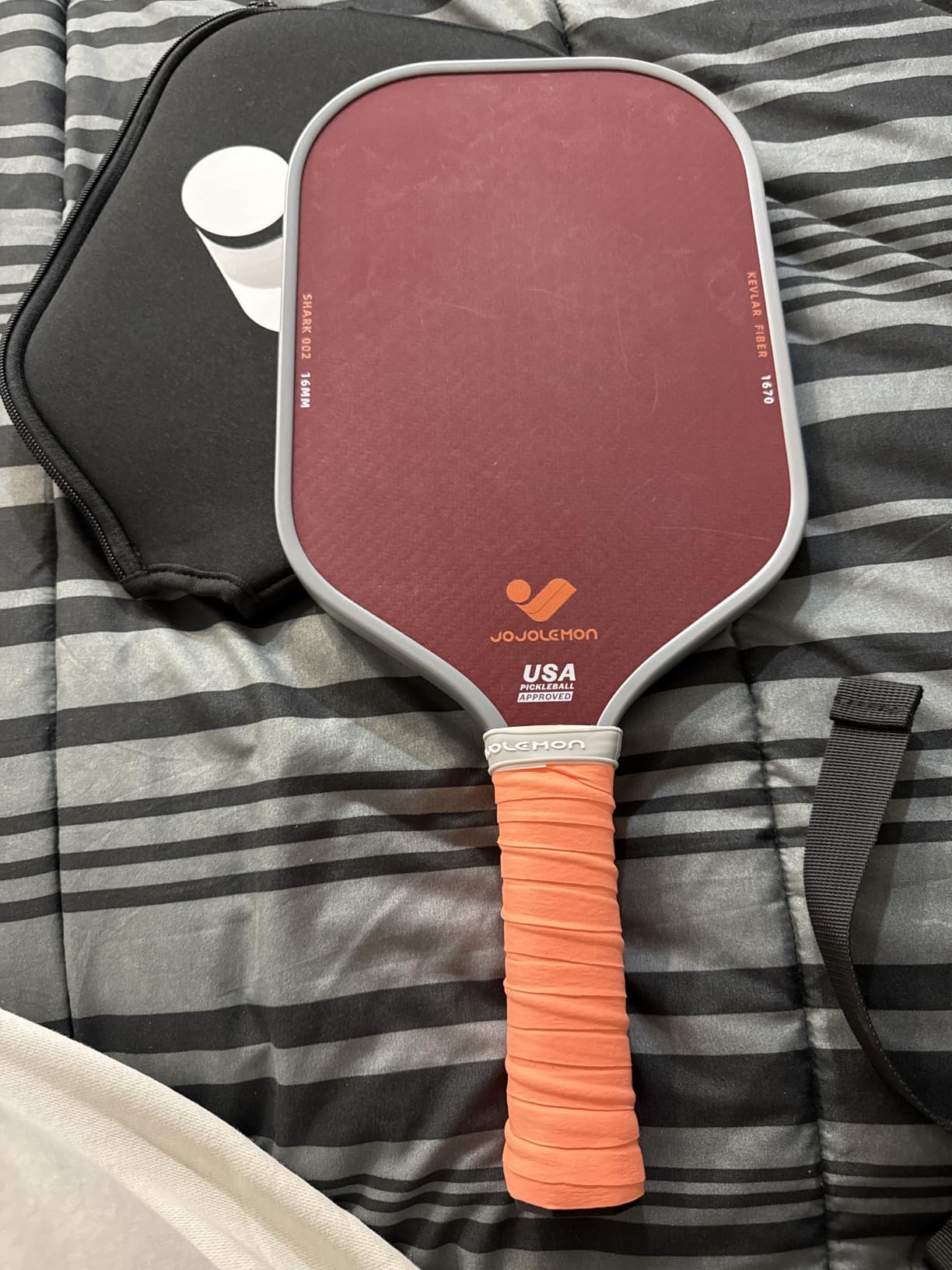
The build targets consistency by design. A 16mm polypropylene honeycomb core with foam edges absorbs impact, which is why owners describe the ball as coming off the face smoothly rather than sharply. The textured 4-directional Toray T700SC carbon weave is built for rigidity in every direction, enlarging the striking area and minimizing dead spots.
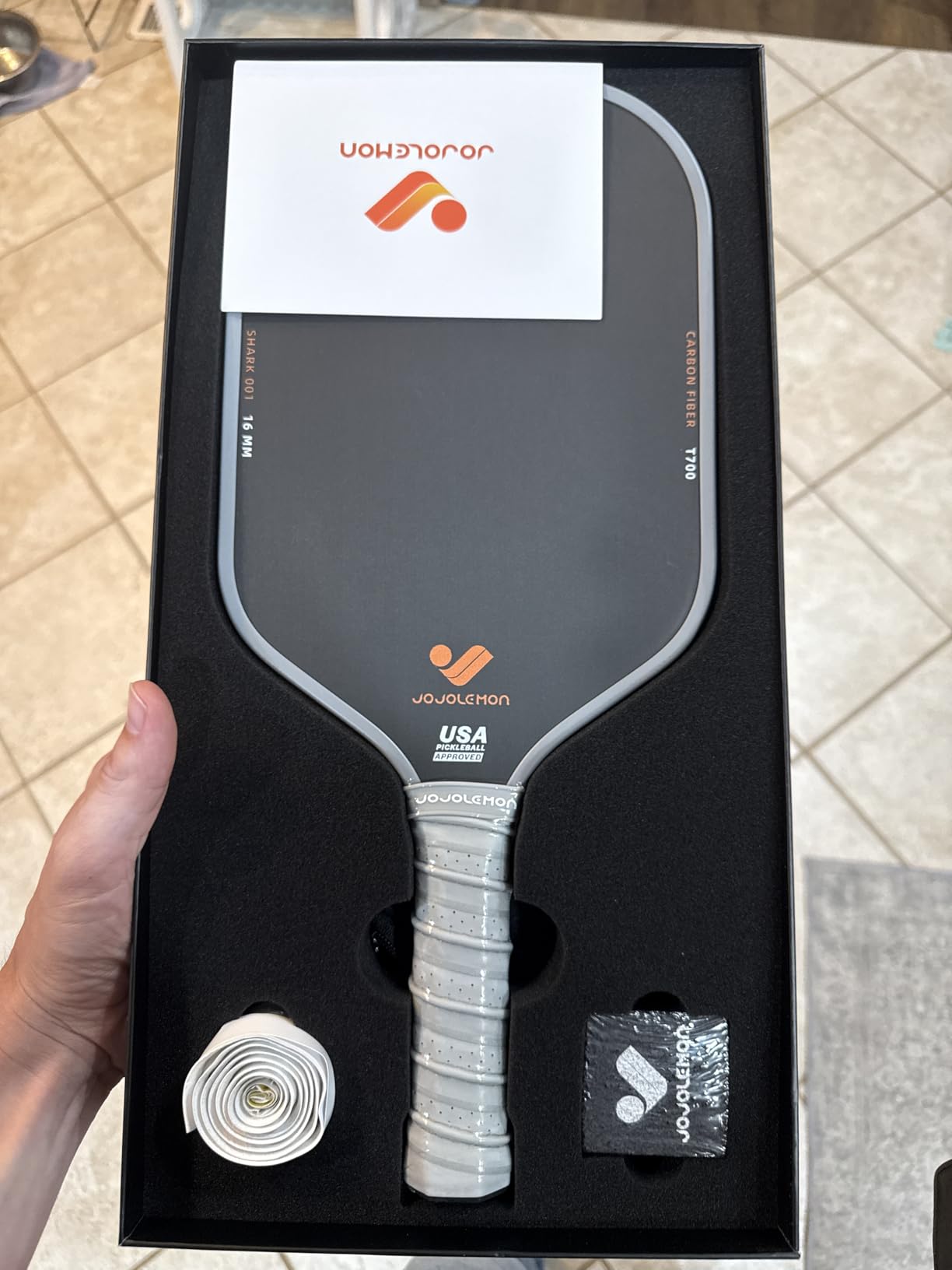
Thermoformed unibody construction makes it more resistant to breaking than a cold-pressed build, and the JO-SharkTex grip is a non-slip, shark-scale-inspired texture that holds a sweaty hand. It is USAPA approved, and the box includes a paddle cover, a paddle eraser and grip tape, which is the best bundle in this group and quietly useful for grit maintenance.
Best for consistency seekers, with one ceiling
This is the paddle for a player whose problem is not technique but variance. If you make good swings and still lose points to unpredictable deflections, a core that absorbs impact and a face with no dead zones is the most direct fix available. The included eraser also makes the grippy face easier to maintain.
It is positioned for beginner-to-intermediate players, so a competitive player may find the power ceiling low. The foam-edged honeycomb is also softer and quieter than a rigid unibody carbon paddle, which is pleasant at the net but muted on hard drives. The 4 1/4 inch grip is standard rather than extended, so it does not serve players who want more handle length for a two-handed backhand.
Control Paddle Buying Guide: Six Specs That Decide Feel
Control is not a feature you buy, it is a set of physical outcomes. More time on the face, a larger playable area, less vibration in the forearm, and a surface that holds the ball without spitting it off at odd angles. Here is how each spec produces those outcomes, and what to look for when you are standing in a shop.
1. Weight decides how fast you can move the face
Static weight is the first number to read. Anything under 8.2 ounces is genuinely light, and light paddles let you hold the face back through a dink and still recover for the next shot. Most control players in this roundup land between 7.8 and 8.1 ounces.
Heavier paddles are not automatically more stable. A heavy paddle with a head-heavy balance is harder to move quickly, which makes it harder to play a soft game. What actually adds control is mass placed at the balance point, so an evenly balanced 7.8 ounce paddle can feel more controlled than a heavier one that is all weight up top. Swing weight is a better measure than static weight.
2. 14mm versus 16mm is the real control decision
This is the variable no competitor article covers properly, and it matters more than core chemistry. Thickness controls how much the face compresses on contact. A 16mm core has more material to give, so the ball stays on the face longer, which is longer dwell time and more precise placement. A 14mm thermoformed paddle compresses less and therefore returns more energy, which is power.
USAPA sets the paddle face at 16.5 by 8.5 inches but does not cap thickness, which is why 16mm and 19mm paddles are both legal. For a pure soft game, 16mm is the better buy. If you want to keep some pace in your drives, 16mm with a more aggressive face like the Warping Point Neon is the compromise. If you are moving from a power paddle to a control one, 16mm is the single biggest change you can make.
3. Shape sets your sweet spot and your reach
A widebody paddle has a shorter, wider face. More surface means a bigger sweet spot, and a bigger sweet spot means off-center hits still land in play. That is the forgiving choice, and it suits most soft-game players.
An elongated paddle is longer and narrower. You give up some face area and gain reach, which matters for defending angles and for tennis converts who are used to a racquet. A hybrid sits in between. Our rule of thumb: if your mistakes come from not quite reaching the ball, go elongated. If your mistakes come from balls you did reach but mishit, go widebody.
4. Surface and grit longevity decide how long the feel lasts
Raw carbon faces grip the ball best and produce the most spin, which is what you want for shaped drops and slices. The trade-off is wear. Forum players report grit on some paddles fading after about two months, so ask about grit life before you buy and treat any surface claim skeptically.
To extend grit life, wipe the face after every session with a damp cloth, keep a carbon fiber eraser in your bag for black marks, and avoid dragging the paddle on concrete. Sandpaper is a last resort. A treated surface such as Selkirk InfiGrit is specifically designed to outlast an untreated equivalent, and if grit longevity matters to you, that is the feature to pay for.
5. Grip size and handle length decide whether you can hold it
Grip circumference ranges from about 3.6 inches on the Gearbox GX6 to 4.25 inches on the JOOLA Pro V. Too small and you will over-grip it, too large and you cannot rotate the handle for drop shots. The two-handed backhand crowd should look at handle length, where 5.5 inches is the common figure and the Professor PhD Raw Carbon is the standout.
A poor fit will undo a good paddle faster than any spec difference. If you can, hold three or four paddles in a shop and pay attention to the base of your index finger after two minutes.
6. The five-minute demo protocol
Most advice says demo a paddle, almost none says what to test. In the first five minutes, hit ten slow dinks and ask whether the ball leaves the face at the same speed every time. Then hit five balls out near the edge and see whether the response holds or falls off.
Next, drive the ball hard once. A control paddle will feel muted and may even feel slightly disappointing, and that is correct. Finally, hold the paddle and shake it lightly, because a good control paddle is evenly balanced and should not want to tip forward. If you are still torn, our beginner paddle guide covers the lighter options in more depth.
Frequently Asked Questions
What is the best pickleball paddle for control players?
The Selkirk LUXX Control is the best pickleball paddle for control players in our testing. At 8.1 ounces it is light enough to hold the face back through a dink, and its ThroatFlex open throat extends dwell time on contact so the ball leaves the face where you aimed it. The ProSpin+ micro-textured face adds grip for backhand spin, and the 4 1/4 inch grip feels familiar. The trade-off is pop, so it suits players who generate their own pace.
What is the best pickleball paddle for power and control?
If you want a balance of power and control, the Warping Point Neon Gen 3 is the pick. Its 16mm EdgeFusion core gives it dwell time for placement while the triple-layer T700 raw carbon face and thermoformed frame keep a crisp pop on contact. The Jojolemon 16mm Shark Power is the steadier option at 4.7 stars from 1539 reviews, though it trades power for consistency. Both sit between a pure control paddle and a dedicated power paddle.
What is the best control paddle for pickleball in 2026?
The best control paddle for pickleball in 2026 depends on which end of the spectrum you need. For the softest feel and the strongest placement, the Vatic Pro Prism 16mm at 8 ounces is hard to beat. For the lightest build, the Gearbox GX6 at 7.8 ounces is the pick. For the sweet spot and grip that lasts, the Selkirk Sport Labs 007 with its 19mm core and InfiGrit surface. All three are USAPA approved.
What paddle material is best for control?
A thick polymer honeycomb core is the best material for control. The polymer absorbs impact and extends dwell time, which is why the Selkirk SLK Evo and the Jojolemon 16mm feel so quiet and controllable. A cold-molded raw carbon face such as the Vatic Pro Prism adds grip and spin without the stiffness of a thermoformed build. Core chemistry matters less than thickness, so compare 16mm against 14mm first.
The Verdict
The best pickleball paddles for control players all share three things: a thick core, a light build and a grippy face. Start with the Selkirk LUXX Control if you want the lightest, quickest soft game, the Jojolemon if you want the steadiest results, and the Vatic Pro Prism if placement matters more to you than power.
Whichever you choose, demo it first if you can, and pay more attention to dwell time and sweet spot size than to any spin or power number on the box.