
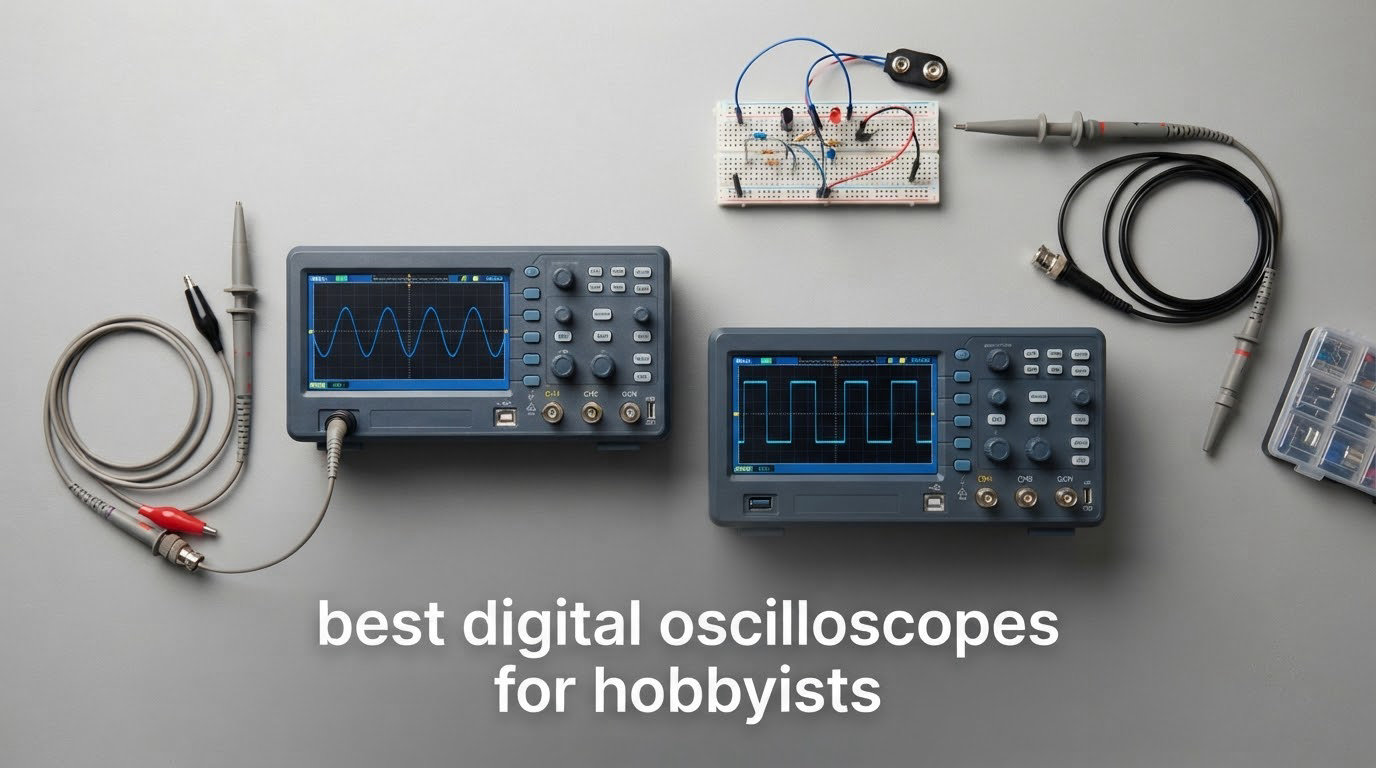
A good oscilloscope for a hobbyist is one that shows you timing, noise and shape, not just a number. A multimeter tells you what the voltage is at one instant; a digital oscilloscope plots that voltage against time so you can see whether a signal is ringing, whether your switching regulator is stable, and whether an I2C bus is holding a stretch of low bits. If you build circuits with an Arduino or an ESP32, repair audio gear, or debug a power supply on your bench, this is the single tool that changes what you can figure out on your own.
That is why the best digital oscilloscopes for hobbyists in 2026 fall into such distinct groups. Pocket units under a hundred cover low-frequency work and field troubleshooting. Bench models in the mid hundreds bring four channels, deep memory and free serial decoding. Handhelds sit in between, bundling a scope, a multimeter and a signal generator into one battery-powered box. None of them is universally right, and the honest answer depends on the signals you actually work with.
We compared all ten scopes in this roundup on bandwidth, sample rate, memory depth, channel count, serial decoding and total real-world cost, and we cross-checked our reading of each one against what owners report in r/AskElectronics, r/ElectricalEngineering and on the EEVblog forums. We also read the manual, trigger and screen behaviour that reviewers complain about, because those are the details that decide whether a scope is pleasant or frustrating after three months. Every spec below comes from the manufacturer’s own listing.
Table of Contents
Top 3 Picks for Hobbyist Work in 2026

Siglent SDS1104X-E
- 100 MHz and 4 channels
- 1 GSa/s
- 24 Mpts class
- I2C/SPI/UART/CAN/LIN decode standard
- Ethernet web server

Hantek DSO2D15
- 150 MHz and 2 channels
- 1 GSa/s
- 5 serial protocol decodes
- built-in waveform output
Best Digital Oscilloscopes for Hobbyists (October 2026)
All ten models appear below with the numbers that actually separate them. Bandwidth is the highest frequency the front end measures accurately, sample rate is how fast the digitiser reads it, and memory depth decides how long a capture survives on screen. The full buying framework that explains how to read these columns is later in the guide.
| Product | Specifications | Action |
|---|---|---|
| Siglent SDS1104X-E |
|
Check Latest Price |
 Rigol DS1202Z-E Rigol DS1202Z-E |
|
Check Latest Price |
| Rigol DS1054Z |
|
Check Latest Price |
 Siglent SDS1102CML+ Siglent SDS1102CML+ |
|
Check Latest Price |
 ZOYI ZT-703 ZOYI ZT-703 |
|
Check Latest Price |
 HANMATEK DOS1102 HANMATEK DOS1102 |
|
Check Latest Price |
 FNIRSI 2C53T FNIRSI 2C53T |
|
Check Latest Price |
 FNIRSI DSO152 FNIRSI DSO152 |
|
Check Latest Price |
 FNIRSI DSO-510 FNIRSI DSO-510 |
|
Check Latest Price |
| Hantek DSO2D15 |
|
Check Latest Price |
1. Siglent SDS1104X-E – Best Overall Scope for a Hobbyist Bench
Siglent Technologies SDS1104X-E 100Mhz Digital Oscilloscope 4 Channels Standard Decoder, Grey
100 MHz
4 analog channels
1 GSa/s real-time
24 Mpts class memory
4 passive probes included
Pros
- Dual ADC gives 1 GSa/s on two channels
- Serial decoding for I2C SPI UART CAN and LIN is unlocked
- Built-in web server and Ethernet for remote viewing
- Clean modern interface that does not cover the trace area
- Four passive probes and a calibration certificate in the box
Cons
- The adjust and select knob can bounce to the next menu item
- Optional MSO and AWG modules cost a lot on top
- Some settings do not survive a power cycle
This is the scope we would put on our own bench first. Four analog channels at 100 MHz with a dual-ADC architecture means you get 1 GSa/s on two channels and 500 MSa/s on all four, which is the difference between seeing a clean edge and seeing a smeared one when you have two signals in play.
What separates it from the Rigol at number three is the software. The serial decoders for I2C, SPI, UART/RS232, CAN and LIN are unlocked in the box rather than sold as a license, and the built-in web server with the Ethernet port means you can put the scope on your bench and view the screen from a laptop across the room. For a home lab that is a genuinely practical feature, not a spec-sheet nicety.
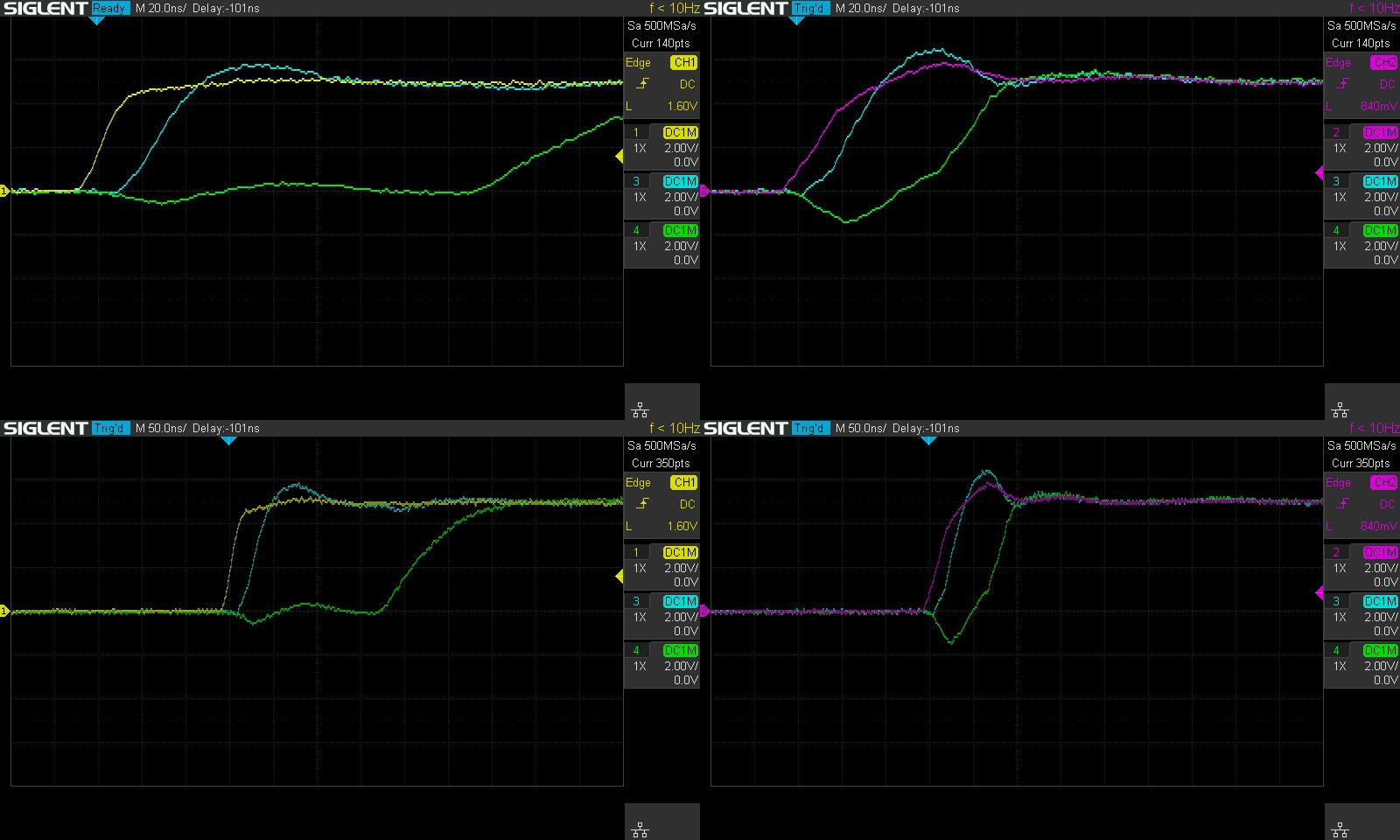
The 24 Mpts-class memory depth means a long capture at a slow timebase still holds enough samples to show you a glitch that happens once every few seconds. The screen is bright, the grid is clean, and the interface does not overlay menus on top of the waveform area, which sounds minor until you have used a scope where it does.
The complaints are consistent and mostly small. The multifunction knob is twitchy and can jump a menu level when you press it. The optional 16-channel MSO upgrade and the USB AWG module are expensive add-ons, so the real cost of a fully equipped unit climbs well past the base machine. Owners also note that settings like the screensaver timeout and NTP sync do not persist, and the clock shows 1970 until it talks to a network.
What the SDS1104X-E does well for a hobbyist
Protocol decoding on five bus types with no license fee is the feature hobbyists use most and vendors charge most for. If you are bringing up an Arduino, an ESP32 or any I2C or SPI sensor board, you can decode the bus on screen instead of counting bits by eye. Four channels also cover multi-rail debugging, where a 3.3 V rail and a ground-referenced signal need to be watched against each other. Remote viewing over LAN lets a second person, or you at the desk while the scope sits in the workshop, see the same display.
Where it falls short
Four channels at 500 MSa/s means the sample rate halves when you light up all of them, so it is not the scope to reach for when you need heavy multi-channel timing work. The paid MSO and AWG options are the expensive part of the Siglent ecosystem, and if you know you will want a logic analyzer, factor that into your budget before buying rather than after. Long timebase captures refresh slowly and the memory depth still runs out on very slow sweeps.
2. Rigol DS1202Z-E – Best for 200 MHz Headroom on Two Channels
RIGOL DS1202Z-E Digital Oscilloscope, 200MHz, 2 Channel, 1GSa/s Sampling
200 MHz
2 channels
1 GSa/s
24 Mpts memory
3-year warranty
Pros
- 200 MHz of bandwidth at a hobby-level price
- Deep 24 Mpts memory with 30000 wfms/s capture
- Intensity graded 7-inch display
- Dozens of on-screen automatic measurements
- Quiet fan and solid build
- Backed by a 3-year warranty
Cons
- The multifunction knob overshoots adjacent selections
- USB 2.0 makes full-resolution memory dumps slow
- Large capacity USB flash drives are not recognized
- The menu system has a real learning curve
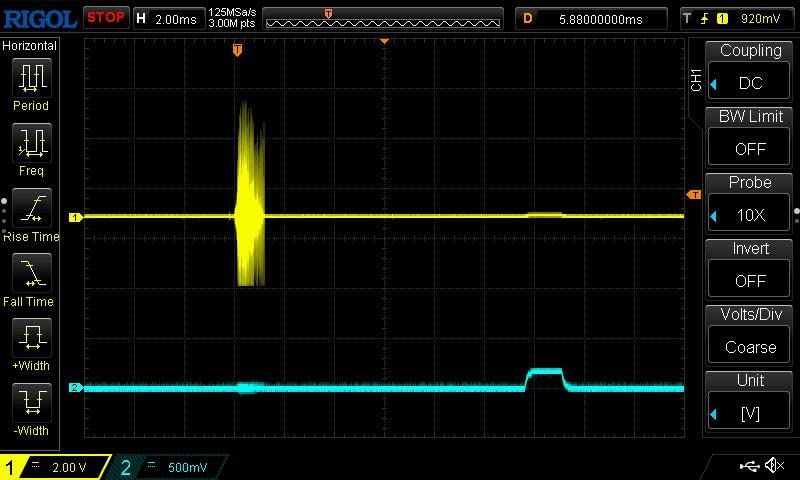
Two channels and 200 MHz is the combination that solves a specific problem: clock signals, fast digital edges, motor and inverter work, and anything where the harmonic content of a square wave matters. Reviewers consistently call this professional capability at a hobby price, and the spec sheet backs that up with 24 Mpts of memory and a 30,000 wfms/s capture rate.
The intensity graded 7-inch 800×480 display is the sleeper feature. It builds up a phosphor-like picture from many acquisitions, so a short glitch shows up as a bright band that a plain digital trace would miss. Combined with record and playback of up to 60,000 frames, it turns the scope into something you can use to hunt for an intermittent fault instead of staring at a single live screen.
On the connectivity side you get USB host and device plus LXI LAN, which means scripted control from a PC is realistic. Serial trigger and decoding for RS232/UART, I2C and SPI are included. The three-year warranty on the main unit is longer than most of the competition offers and is worth factoring into a total-cost comparison.
The single most repeated technical complaint is the USB 2.0 port. Pulling a full 24 Mpoint capture to a PC is slow, so if you plan to do automated measurements in software rather than read them on the display, plan for the wait. Large-capacity USB flash drives are also reported as unrecognised, and the multifunction knob has the same overshoot problem the other Rigol suffers from. There is no printed manual, which means an afternoon of learning the menu system before you are productive.
Where the 200 MHz bandwidth actually pays off
Bandwidth is about rise time, not about being able to see a higher frequency. At 200 MHz the scope resolves edges roughly three times faster than a 50 MHz instrument, so a 10 ns edge looks like an edge instead of a slope. That matters for clock quality, gate drive signals, motor control and any measurement where the shape of the transition carries the information you are chasing. For pure 3.3 V and 5 V digital work it is headroom you may never use.
Who should skip this one
If your work is Arduino, ESP32 and audio board bring-up, two channels will feel limiting the moment you want to compare a data line against a clock line while also watching the supply. The Rigol DS1054Z at number three gives you four channels for a similar outlay. Deep-memory power users who need fast screen dumps will also be slowed by the USB 2.0 interface.
3. Rigol DS1054Z – Best Value Four-Channel Scope
Rigol DS1054Z Digital Oscilloscope, 50MHz, 4 Channel, 1GSa/s, Best Value
50 MHz
4 analog channels
1 GSa/s
24 Mpts memory
60,000 frame playback
Pros
- Huge feature set including serial decoding and 24 Mpts as standard
- Built-in help system and strong online learning material
- Bright screen with channel colours matched to the input jacks
- Persistence shading and intensity grading reveal glitches
- Long-standing favourite with a large review base
Cons
- The intensity and select encoder jumps a step when pressed
- Channel 2 and channel 4 trace colours are too similar
- Cooling fan is noticeably noisy
- Included probes are of mediocre to poor quality
This is the scope that shows up most often when hobbyists argue about a first serious bench instrument. Across r/AskElectronics and EEVblog threads it is the pair of models recommended most often alongside the Siglent at number one, and the reason is simple: four channels, 24 Mpts of memory and serial decoding, all standard, with nothing important held back behind a license.
It is genuinely beginner-friendly in a way that is hard to quantify. There is a built-in help system on the unit itself, the screen colour coding matches the input jacks and the probe colours, and there is a large body of free tutorial material for it. For someone who has never used a scope, having help built into the instrument removes most of the early friction.
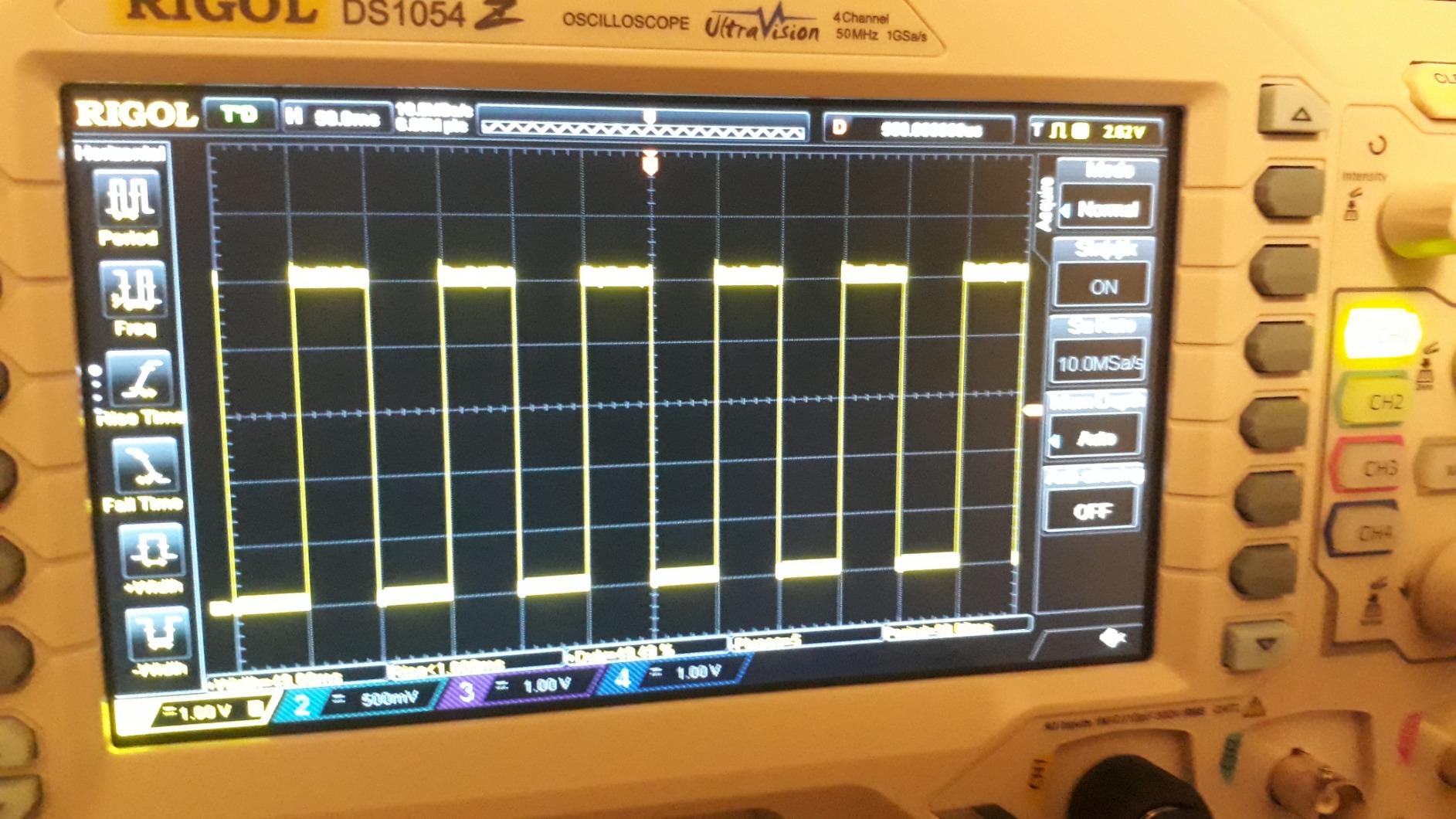
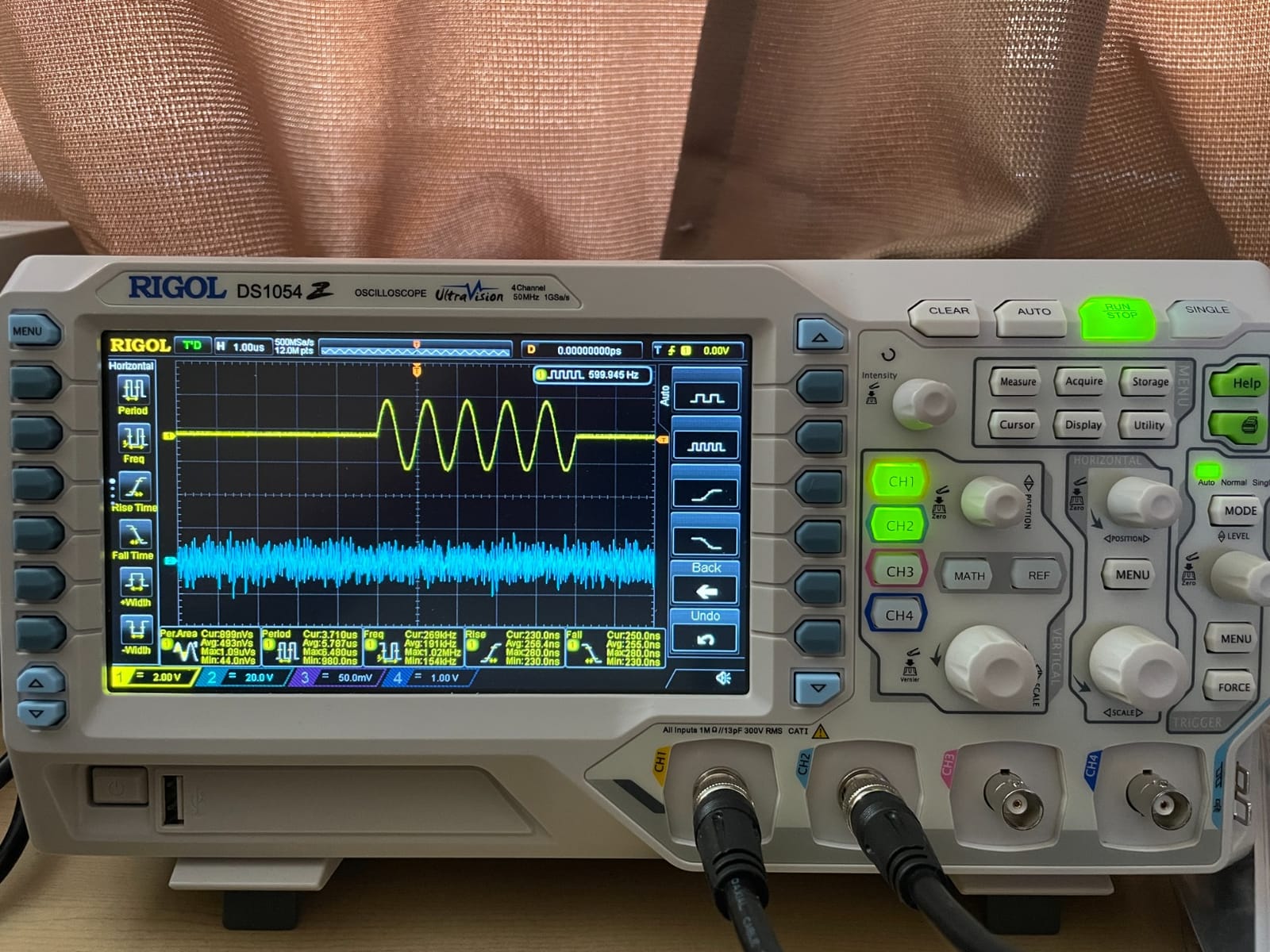
Memory depth scales with channel count: 24 Mpts single-channel, 12 Mpts dual, 6 Mpts on all four. The 30,000 wfms/s capture rate with intensity grading, plus record and playback of up to 60,000 frames, is a genuinely capable glitch-hunting setup for a four-channel scope. You also get FFT, filters, a hardware frequency counter, USB host and device plus LXI LAN.
The complaints are honest ones. The rotary encoder frequently jumps a step when you press it to confirm, and the channel 2 and channel 4 trace colours are close enough that you can mix them up on a busy screen. The cooling fan is noticeably noisy, which matters in a quiet room. The bundled probes are the weak link, and the vertical amplitude range feels limited when you zoom in on small signals. Rare USB interface hangs and full-unit freezes are also reported.
Why four channels changes what you can debug
Three rails and a ground, a UART line next to a chip select, or a three-phase motor driver all become measurable at once instead of requiring a second capture and a guess about what changed in between. The persistence and intensity grading is what makes a rare event visible: a millisecond-wide spike that appears once in ten thousand acquisitions leaves a bright mark that a normal sweep would never show you. For switch-mode power supply work, having input, switch node, output and enable on screen together is the whole game.
Where the value stops
Fifty megahertz is honest for digital, audio and low-frequency power work, but it is not enough for fast edge analysis, and the 6 Mpts you get with all four channels running is the real ceiling on long captures. Replace the bundled probes early, because they are the most common source of bad measurements. If noise in a shared room bothers you, this is also the pick most often criticised for fan noise.
4. Siglent SDS1102CML+ – Best for Build Quality and Tactile Controls
Siglent Technologies SDS1102CML+ Digital Storage Oscilloscope, 100 MHz
100 MHz
2 channels
1 GS/s
1 Mpts record
2.2 pound body
Pros
- Controls feel more expensive than the price suggests
- Per-channel independent vertical controls are rare at this level
- Bright matte display with accurate colour
- 100 MHz bandwidth and 1 GS/s cover most hobby work
- USB and LAN with two good 100 MHz probes included
Cons
- No serial protocol decoding at this level
- EasyScopeX requires installing Net Frame and NI-VISA first
- Channel 2 pink trace colour is hard to read
- The universal knob has almost no click feel
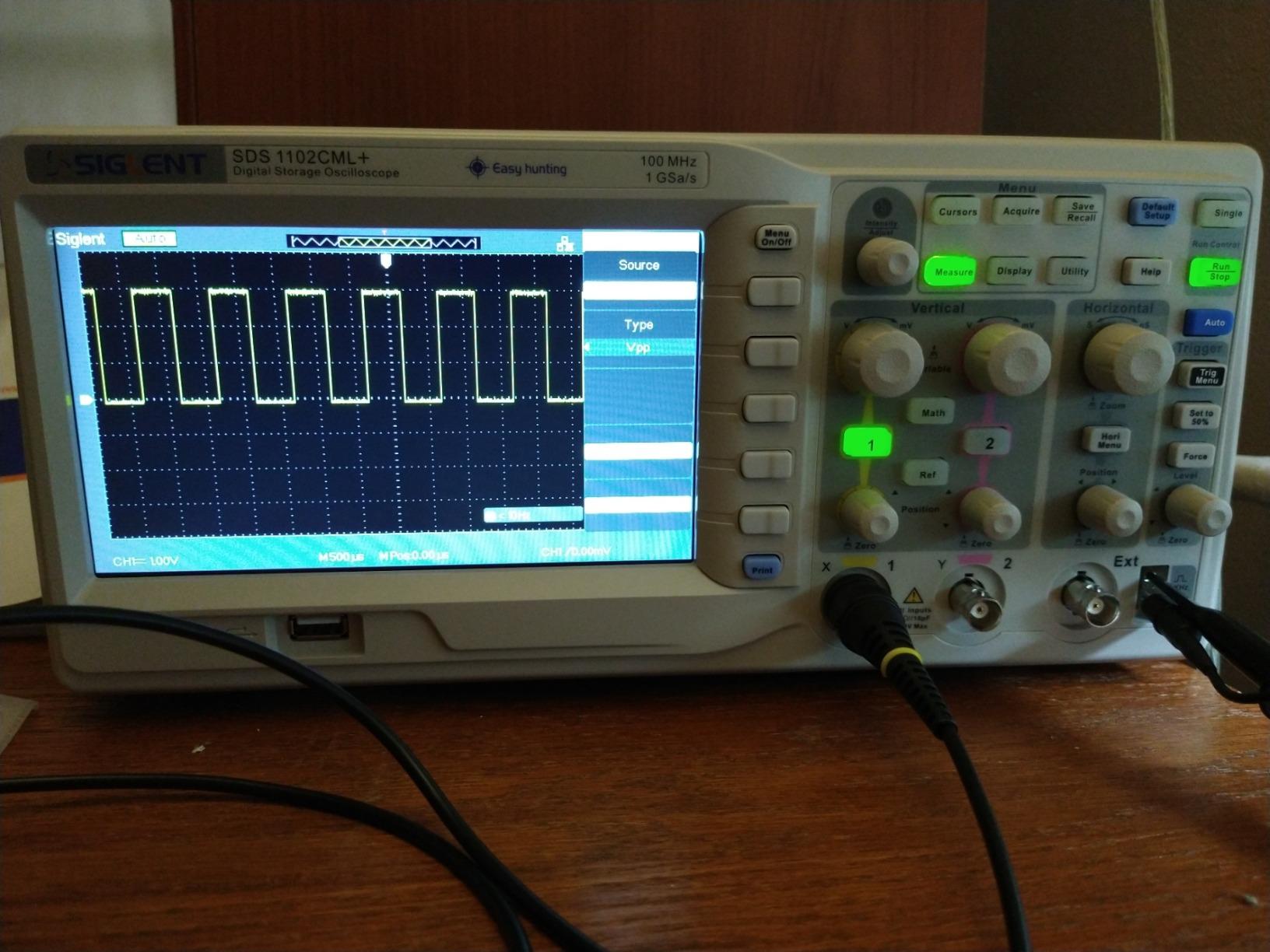
Where the two Siglent bench scopes above feel modern and busy, this one feels solid in the hand. Reviewers mention smooth controls, a chassis that feels heavier than the class average, and a matte display that is easy on the eyes in a bright room. Several owners with an electronics background describe it as the first real step up from analog gear they owned for years.
Per-channel independent vertical controls are the detail that stands out. Plenty of budget rivals tie the vertical position and scale of both channels to one shared control, and having each channel set on its own front-panel knob makes comparative work noticeably less fussy. The 2.2 pound body also means it is easy to move between the bench and the couch.
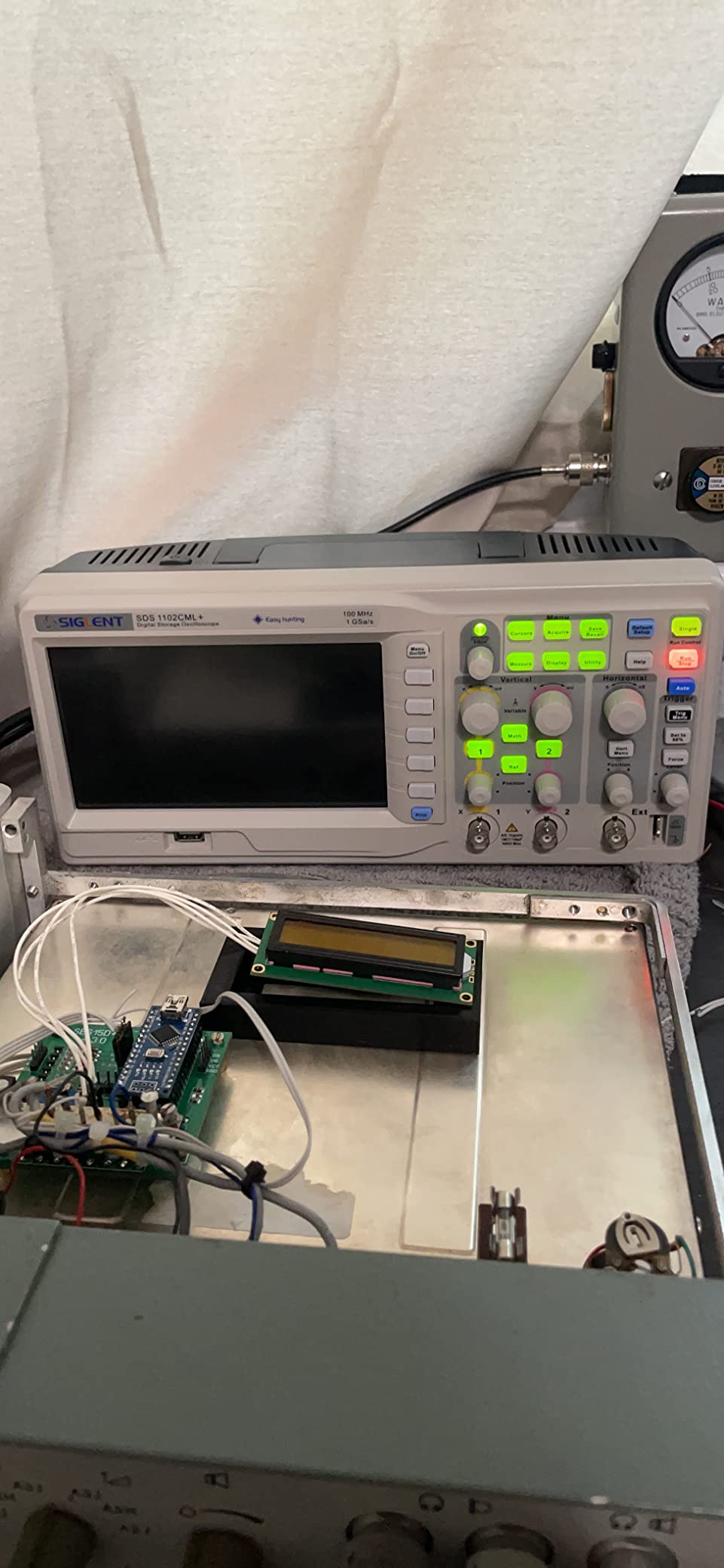
For spec coverage, you get 100 MHz, a maximum real-time sample rate of 1 GS/s, cursors, math functions, automatic measurements and a built-in frequency counter, plus USB and LAN for PC control through EasyScopeX. Two 100 MHz passive probes come in the box, and they are better than the probes bundled with several more expensive scopes.
The decisive limitation is the absence of serial protocol decoding. If you work with I2C or SPI, you are back to triggering on a pin edge and reading the bits yourself. Setting up EasyScopeX also takes a detour, since you have to install Net Frame and the NI-VISA drivers first. The channel 2 pink trace is hard to read against the display, the universal selection knob has almost no click feel and makes menu selection error-prone, and the documentation is sparse.
Who will be happiest with this scope
It suits someone who mostly watches analogue-ish signals: audio amplifiers, sensor conditioning, power rails, slow switching regulators and general repair. The per-channel controls, readable screen and solid build mean you can work quickly without fighting the interface. Retired technicians and people who learned on analog gear tend to rate it highly for exactly that reason. A light two-channel body is also a bonus if your bench is a corner of a desk.
What you give up for that comfort
One million points of record length is thin next to the 24 Mpts in the two models above, so long captures at slow timebases fill up quickly. No protocol decode means no I2C, SPI or UART reading without extra work. If your interest is microcontroller bring-up rather than analogue repair, the Rigol DS1054Z is the more capable buy for the money and you get the decode for free.
5. ZOYI ZT-703 – Best Handheld 3-in-1 for Automotive and Field Work
3 in 1 Handheld Oscilloscope Automotive Dual Channel 50MHz with Digital Multimeter and Signal Generator
Dual channel handheld
50 MHz max bandwidth
25,000-count DMM
Signal generator
Battery powered
Pros
- Excellent 25000-count auto-ranging multimeter built in
- Very solid construction with a bright screen for the size
- Genuinely portable with USB-C rechargeable battery
- Dual channel picks up low-frequency signals and levels accurately
- Carrying case
- probes
- test leads and cable included
Cons
- No physical dials
- everything runs through button menus
- Effective bandwidth is well below the advertised 50 MHz
- Square wave edges look deformed above a few MHz
- Screen sleep timeout is short
This is the pick for anyone whose oscilloscope lives in a car rather than on a desk. The 25,000-count multimeter is the star of the show, with auto-ranging resistance, capacitance, continuity, diode and current measurement, and owners treat it as an excellent portable meter with a useful low-frequency scope attached.
The scope section runs in two modes: normal mode at 200 MSa/s with 30 MHz of bandwidth, and high-speed mode at 280 MSa/s with 50 MHz. Memory depth is 128K, which is plenty for what this device is really for. AUTO waveform recognition will identify an unknown signal for you, which is helpful when you are not sure what you have clipped onto a sensor wire.
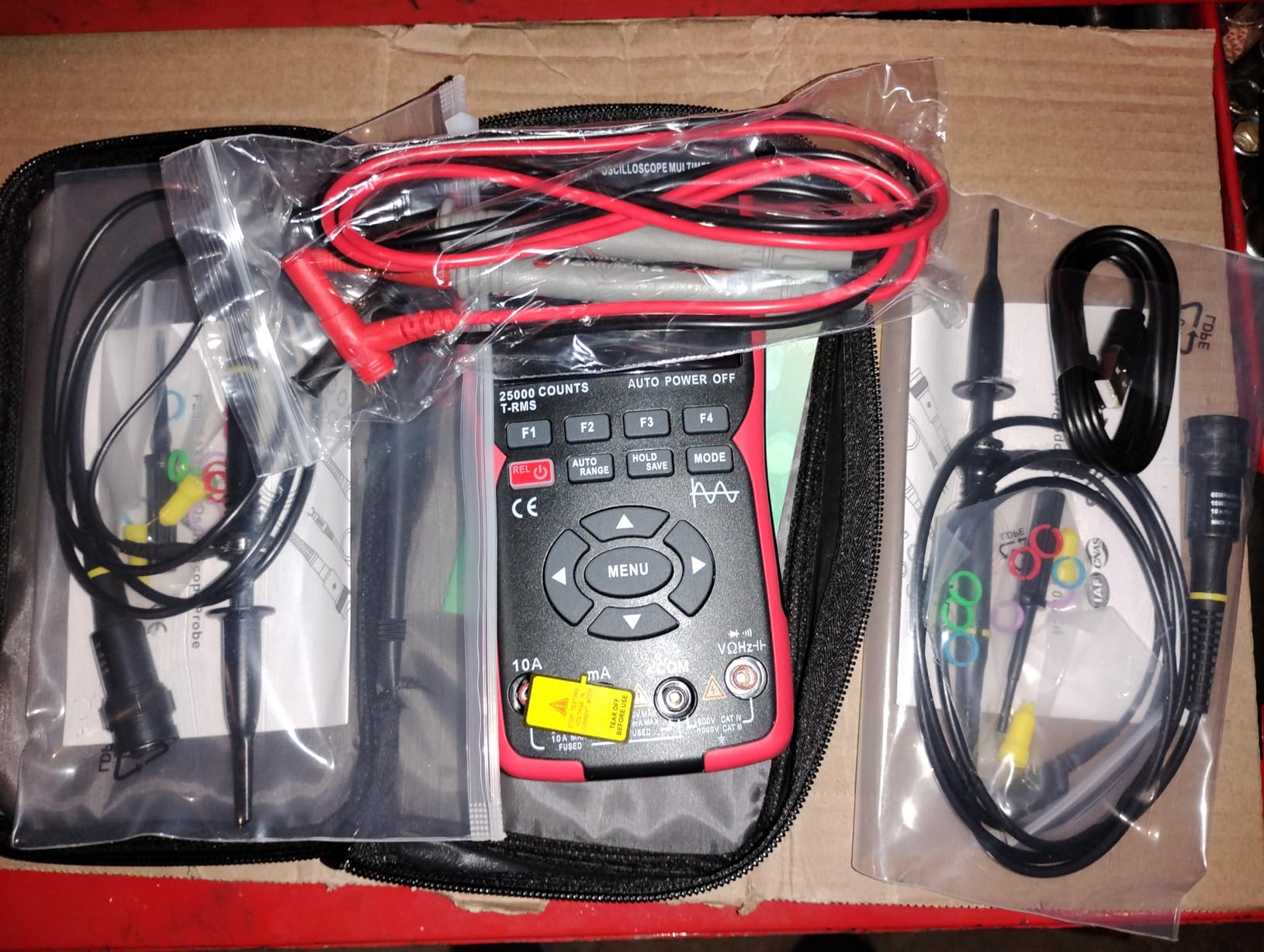
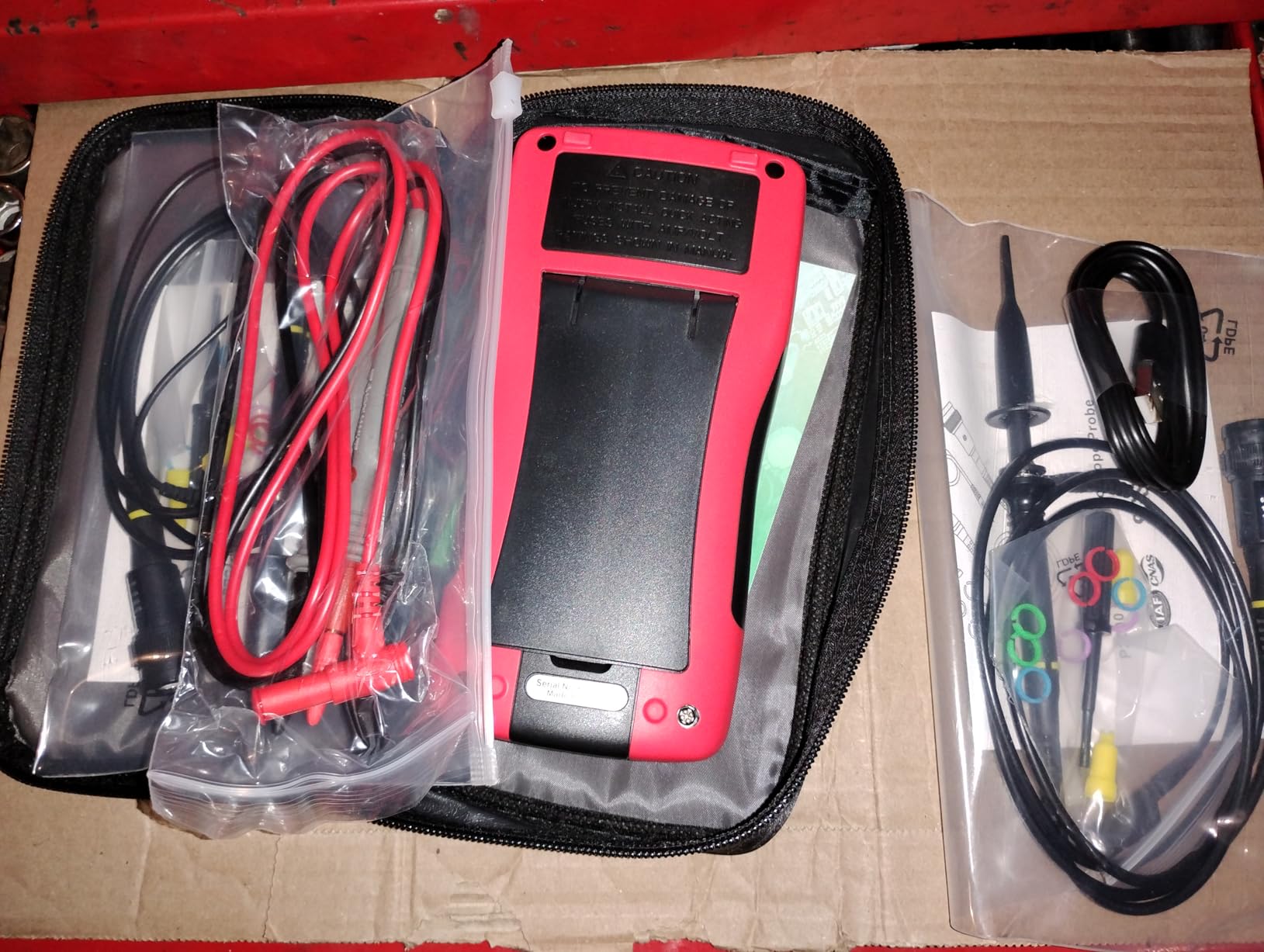
You also get a signal generator that outputs sine, square, triangle and other waveforms, plus a Type-C port for charging and data transfer and a rechargeable battery. The box includes the scope, a probe, test leads, a charging cable and a cloth bag, which is a complete kit for field work out of the box.
The honest limit is bandwidth. Reviewers are consistent that the effective performance sits well below the advertised 50 MHz, and square wave rise times and edges look deformed above a few megahertz. There are no physical dials, so divisions, cursors and settings are all buried in button menus, which is slow when you are working one-handed in a cramped footwell. The on-board signal generator handles only tamer waveforms, and the screen sleep timeout is short and awkward to change. On the r/CircuitBending and r/beneater threads, cheap units like this are described as fine for low-frequency analogue and audio work, but not for digital signals.
Where this handheld wins
Bench diagnostics on 12 V vehicle systems, sensor and actuator signals, charging circuits and slow switching regulators, all while the car is still running. A 25,000-count meter plus a two-channel scope plus a signal source in one hand removes the need to carry a bench multimeter, a meter and a generator separately. Recharge over USB-C and the carry bag means it lives in a glovebox.
Where it stops
Any signal above roughly 20 MHz is outside its comfort zone, and edges will not look right. There is no protocol decoding, so an in-vehicle CAN or LIN investigation is out of scope for the scope half. If your project work is at the bench with fast digital signals, buy the Siglent at number one instead and keep this one for the car.
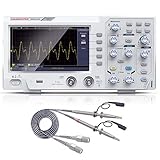
6. HANMATEK DOS1102 – Best Big-Screen Scope Below the Benchtop Tier
HANMATEK 110mhz Bandwidth DOS1102 Digital Oscilloscope with 2 Channels and Screen 7 inch / 18 cm, TFT-LCD Display, Portable Professional Oscilloscope Kit with 500 MS/s *2 Sampling Rate
110 MHz
2 channels
500 MS/s x 2
7 inch 800x480 TFT
2.4 pound body
Pros
- 110 MHz bandwidth and dual channel sampling in a portable body
- Large 7-inch 800x480 TFT color screen is unusual at this price
- 30 automatic measurements plus a hardware frequency meter
- Current measurement from 100 mA/V to 1 kA/V
- SCPI compliant with LABVIEW support
- U disk storage plus USB host and device
Cons
- Record depth is limited for this bandwidth class
- Documentation is thin and needs host software
- Menu-driven controls with few dedicated knobs
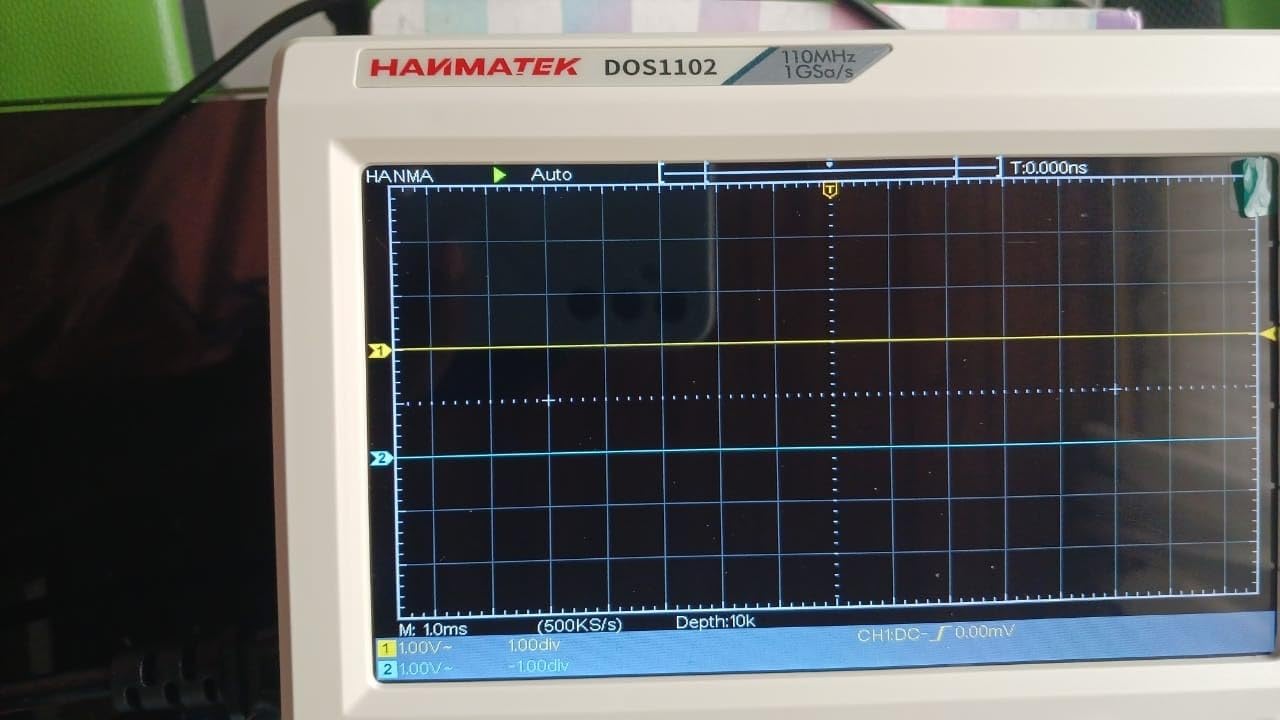
A 7-inch colour TFT at this level of bandwidth is unusual, and buyers point at the screen as the reason they chose it. At 110 MHz with 500 MS/s x 2 dual-channel sampling, it covers the same 3.3 V and 5 V digital territory as a much more expensive bench scope, with a 2 ns/div to 1000 s/div timebase and 20 mV/div to 5 V/div vertical range.
The measurement set is unusually good for the money. Thirty automatic measurement functions with a customisable menu, a 6-digit hardware frequency meter covering 2 Hz to 20 MHz, and a current measurement function scaled from 100.0 mA/V to 1 kA/V with a compatible current probe. For anyone who wants numbers as well as pictures, that is a lot of instrument in a 2.4 pound box.
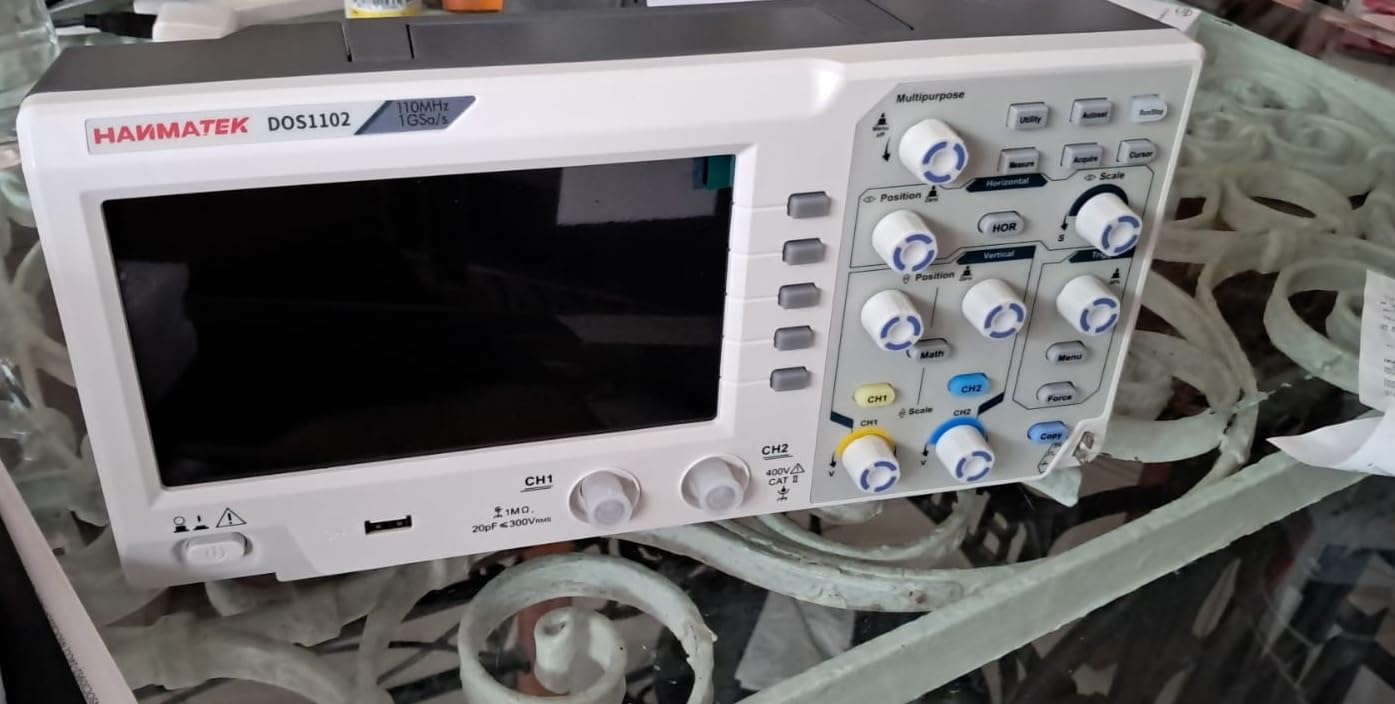
It is SCPI compliant and supports LABVIEW communication, so scripted measurement is genuinely on the table rather than theoretical. U disk storage alongside USB host and device ports means waveforms can be saved and moved. Probe attenuation is selectable across 1X, 10X, 100X and 1000X, which is more flexibility than most rivals at this size offer.
Against that, record depth is the weak point. A record length of at least 10K sampling points and storage for at least 16 waveform groups is thin next to the millions of points in the bench scopes above, so long captures at slow timebases will not hold much detail. Documentation is thin and requires downloading host software, and the controls are menu-driven with only a small number of dedicated knobs, which makes fine adjustment slower than on a real bench DSO.
What a large screen actually buys you
On a 7-inch panel you can comfortably read four measurement readouts, a channel label and a decent number of screen divisions at once, which matters when you are comparing two signals and do not want to keep opening menus. It also makes the unit pleasant to hand to someone else and show what a waveform actually is, which matters if you are teaching someone else electronics. DC powered at 18 W, it is light enough to move between rooms.
Where you will notice the limits
Memory depth is the first thing that hurts, because it decides how much of a long event you keep. Second is the interface: with few dedicated knobs, every setting change is a menu dive, and that friction adds up over a long session. If you are comfortable downloading SCPI scripts, this one has more scripted potential than its spec sheet suggests.
7. FNIRSI 2C53T – Best Budget Three-in-One Starter Kit
FNIRSI 2C53T 3-in-1 50MHz 2CH Oscilloscope Multimeter DDS Signal Generator
50 MHz
2 channels
250 MSa/s
19,999-count DMM
DDS generator to 50 kHz
Pros
- Three instruments in one body at a very low entry cost
- 19999-count multimeter with a high-voltage protection module
- DDS signal generator with 13 waveforms
- Reference waveform comparison and Type-C export
- Brightness adjustable grid for clearer trace reading
- Storage case and full accessory set included
Cons
- Only 1 Kpts of record depth limits analysis
- 2.8 inch display limits multi-channel viewing
- Standby time of about 6 hours is short
- Signal generator tops out at 50 kHz
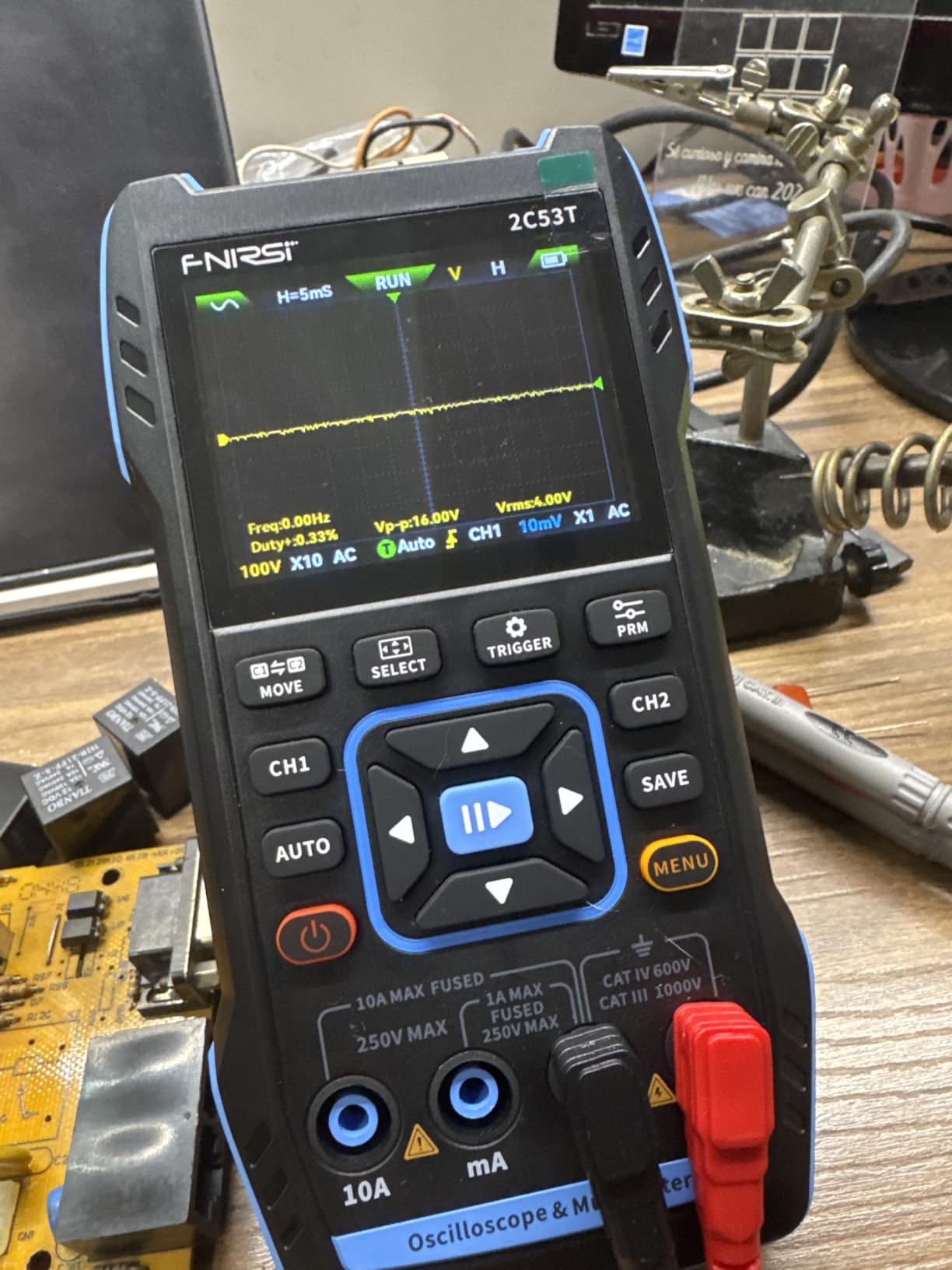
With the largest review base of anything in this roundup, the FNIRSI 2C53T is the budget device people actually buy in volume, and the reason is the packaging. A 50 MHz dual-channel scope at 250 MSa/s, a 4.5-digit 19,999-count multimeter rated for AC 0-750 V and DC up to 999.9 V, and a DDS signal generator with 13 waveforms up to 50 kHz, all in a 400 g body with a 3000 mAh battery.
The multimeter half is the strongest of the three. It measures DC and AC current to 9.999 A, resistance to 19.99 MOhm, capacitance to 99.99 mF and continuity, with a built-in high-voltage protection module rated to 400 V. Owners consistently single out the protection circuitry as a reason they trust it with live circuits.
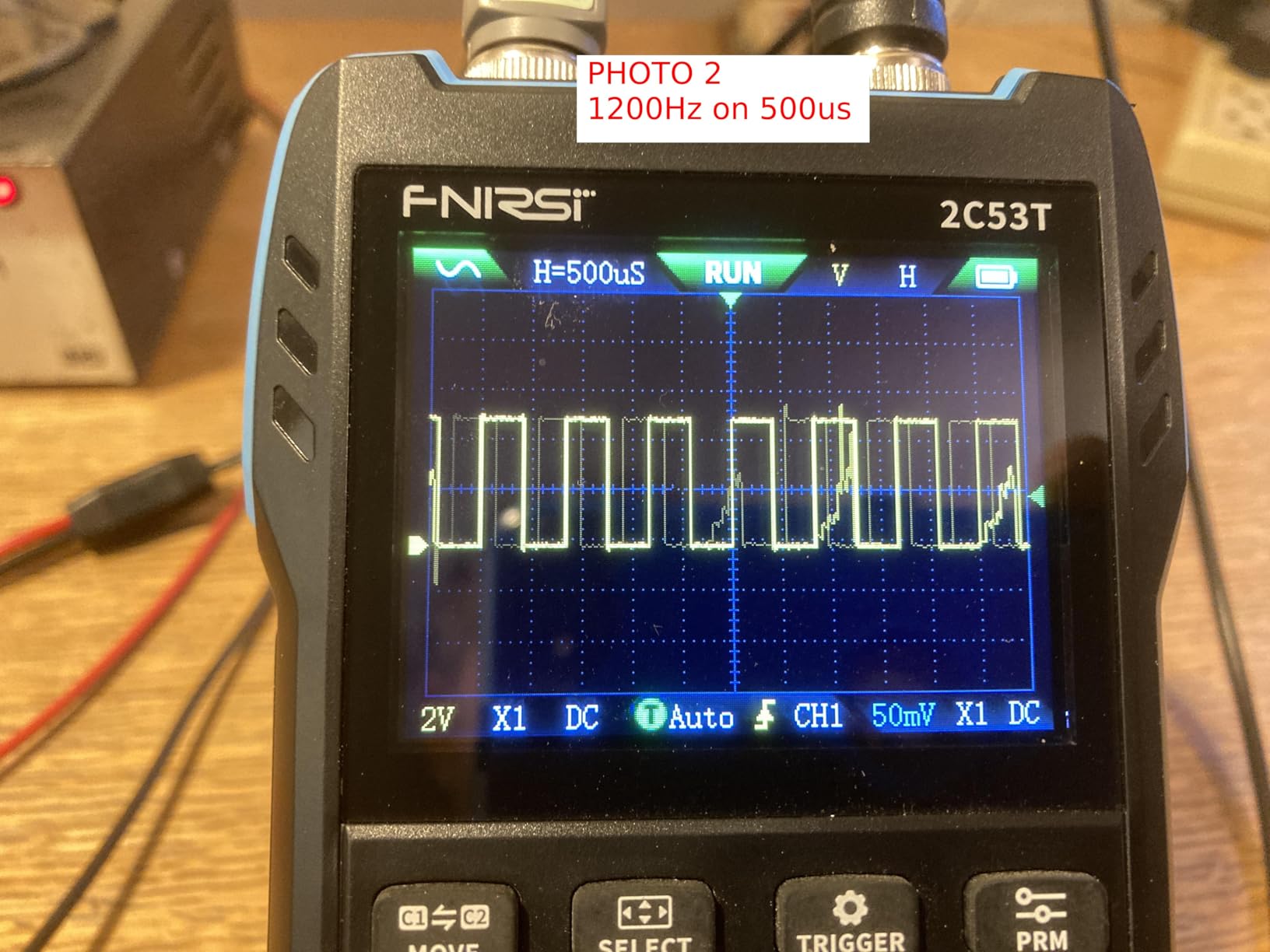
There are also details that are usually absent at this level: math operations, cursor measurement, persistence mode and XY mode, a brightness-adjustable grid, reference waveform comparison, one-click screen save and Type-C export to a PC. FPGA, MCU and ADC architecture underneath keeps the scope responsive. The box includes a 10X probe, crocodile clip probe, multimeter probe, Type-C cable and a storage case.
The 1 Kpts record depth is the specification that limits everything else. It is enough to see a shape, not enough to analyse a complex signal or look at a long capture. The 2.8 inch LCD makes viewing two channels at once awkward, the generator ceiling of 50 kHz rules out audio-range output, and roughly six hours of standby time is short for field use. The menus and controls also take real practice to learn.
What this kit is genuinely good for
Learning electronics. It is a complete bench of scope, meter and signal source before you have committed to a real bench DSO, and the generator lets you check a probe, verify a filter or confirm a 1 kHz reference without buying anything else. The reference waveform comparison is a good teaching feature, letting you overlay your circuit output against a known-good trace. For a hobbyist working on 5 V and low-frequency analogue circuits, it covers a lot of ground.
Where the limits bite
One thousand points of record depth and a 2.8 inch screen mean this is a shape-checker rather than an analysis tool. There is no serial protocol decoding, so microcontroller work will be slow. If your interest is Arduino and ESP32 bring-up, spend up and get a real four-channel bench scope; if your interest is understanding what a capacitor does to a waveform, this is more than enough and saves you money.
8. FNIRSI DSO152 – Best Pocket Scope for a First Taste
FNIRSI DSO152 Handheld Oscilloscope 200kHz Bandwidth, 2.5MS/s Sampling Rate
200 kHz bandwidth
2.5 MS/s
2.8 inch 320x240 LCD
1000 mAh battery
10x probe to 800 VPP
Pros
- Very low entry price for a fully assembled ready-to-use scope
- Lightweight and pocketable for field troubleshooting and teaching
- One-key AUTO setup removes almost all manual adjustment
- 10x probe rated to 800 VPP
- Type-C handles charging data and firmware upgrades
Cons
- 200 kHz bandwidth and 2.5 MS/s limit it to low-frequency signals
- Small 320x240 display limits detailed reading
- Battery life of roughly 4 hours is short
- No waveform generation or decoding
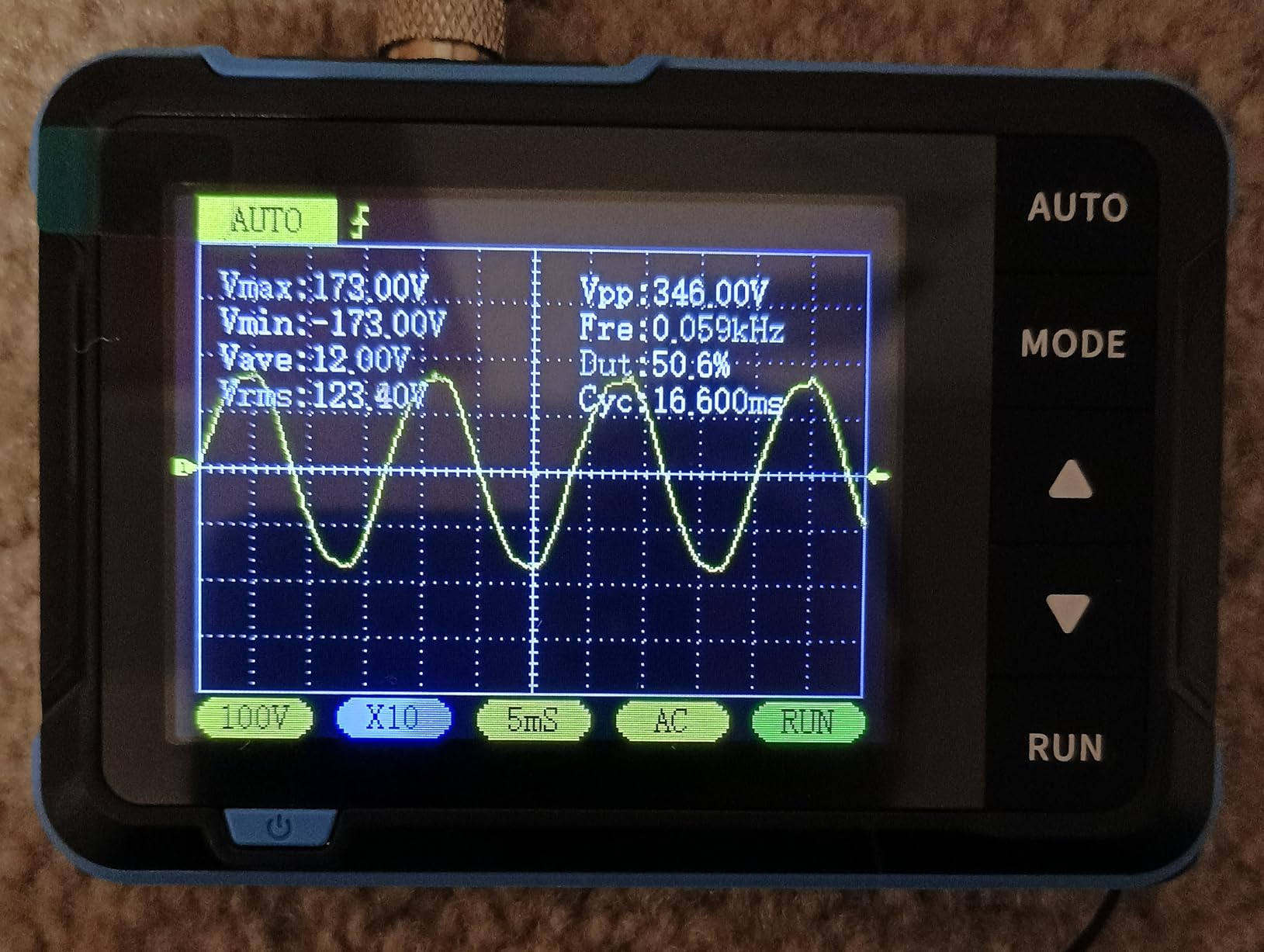
This is the cheapest serious way to find out whether you actually like using an oscilloscope. At 10.2 ounces and 3.78 x 2.64 x 0.79 inches, it lives in a pocket, runs about four hours on its 1000 mAh lithium battery, and sets itself up with one key. Buyers describe it as a dependable first scope or field tool rather than a serious instrument, and that framing is fair.
The one-key AUTO function sets all parameters for you, and a long-press on AUTO calibrates the baseline. Full Auto, Normal and Single trigger modes are present, which is more than many similarly cheap devices offer. The included 10x probe is rated to 800 VPP, roughly 280 V AC, and voltages up to 400 V can be measured.
The Type-C interface handles charging, data transmission and firmware upgrades, so the device is not a sealed box when the manufacturer improves it. The 2.8 inch HD LCD at 320×240 is serviceable for a trace and a couple of readings, and for teaching, field troubleshooting and in-vehicle signal work that is exactly the point.
The bandwidth figure tells the real story. At 200 kHz and 2.5 MS/s you are looking at slow signals: switching transients, sensor outputs, low-frequency oscillators, mains-adjacent ripple and automotive body signals. Anything resembling a fast digital edge is simply outside what the front end can resolve. Battery life of roughly four hours is short, the screen is small, and there is no waveform generation and no protocol decoding at all.
Who should buy this one
Someone who is on their first electronics project, a student, or a hobbyist who wants a meter-case-sized tool for the car or the toolbox. It is also a sensible second instrument, because it does not compete for bench space and it can go where a bench DSO would be too heavy. Given the low entry point, the risk of buying one and deciding it is not for you is also the lowest on this list.
Why most people should look higher
200 kHz is a hard ceiling. If you plan to work with microcontrollers, audio at 20 kHz and above, switch-mode converters or anything with fast edges, you will outgrow it in weeks. For a slightly larger outlay the FNIRSI 2C53T above adds a real multimeter, a signal generator and 50 MHz of bandwidth, which is a far better use of the same learning phase.
9. FNIRSI DSO-510 – Best Budget Scope With a Built-In Signal Generator
FNIRSI DSO-510 2-in-1 10MHz Handheld Oscilloscope DDS Signal Generator
10 MHz
48 MS/s
DDS generator to 50 kHz
2.8 inch 320x240 LCD
1000 mAh battery
Pros
- Scope and a working DDS signal generator in one inexpensive handheld
- Infinite afterglow and level display reveal transients
- One-key AUTO makes it usable for newcomers
- Bright readable 320x240 screen for the size
- Popular for car audio diagnostics and basic troubleshooting
Cons
- Generator frequency accuracy and amplitude are approximate at higher settings
- Generator frequency appears to reset lower when returning to scope mode
- Controls and trigger are confusing until learned
- Only one probe supported and the calibration screw is fragile
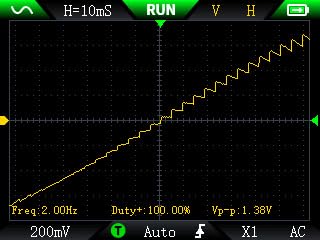
Ten megahertz at 48 MS/s with a 50 ns to 20 s timebase is a real upgrade on the pocket model above, and the built-in DDS generator with 13 waveform types up to 50 kHz is the feature that separates it. It lets you inject a known signal into a circuit without any other equipment, which is how you test a filter, an amplifier stage or a sensor input.
Infinite afterglow and level display are the two modes that make this more useful than its resolution suggests. Afterglow holds a decaying picture of the trace so a brief event stays visible, and level display draws the waveform in discrete height bands, which makes it easy to read amplitude and duty cycle at a glance. Both are genuinely useful when the screen is only 320×240.
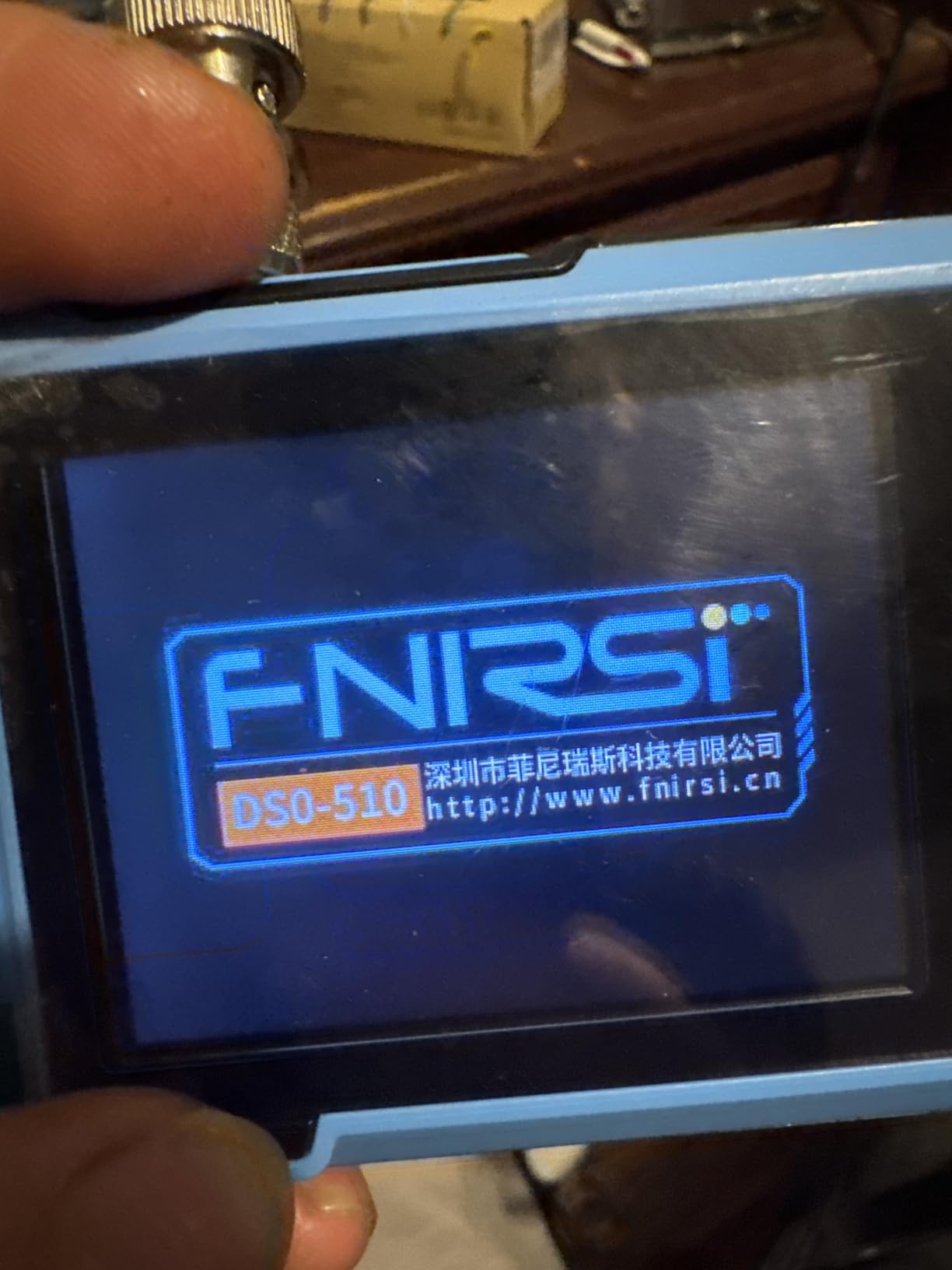
Waveform scaling, suspension, movement, image saving and export are all present, along with one-key AUTO, a 2.8 inch LCD at 320×240 with adjustable brightness, and a 1000 mAh lithium battery with Type-C charging. It is popular for car audio diagnostics, where a 10 MHz window comfortably covers audio-band signals and the generator lets you trace a fault stage by stage.
The generator is approximate. Frequency accuracy and amplitude are only rough at higher setpoints, and the generator frequency appears to reset lower when you switch back to scope mode, which is a recurring complaint. The controls and trigger mechanism are confusing until you learn them, only one probe is supported, and the probe calibration screw is fragile. Some units arrive without the scope probe, so check the box before you rely on it.
Best used as a two-tool kit
Pairing a generator with a scope turns a passive box into an active test bench. You can sweep a filter, confirm an oscillator stage is alive, check whether a bias point is right by looking at the response to a known input, and step through an amplifier chain. For car audio work and for anyone troubleshooting a board with audio-band signals, that combination is worth more than extra bandwidth would be.
The honest limits
Ten megahertz is a genuine ceiling for anything with fast edges, and the 320×240 screen limits how much you can take in at once. The generator inaccuracy means you should treat its output as approximate and calibrate with a meter if precision matters. A single supported probe and a fragile calibration screw are also a good reason to buy the probe you need separately rather than depending on what ships in the box.
10. Hantek DSO2D15 – Best 150 MHz Scope With Serial Decoding Standard
Hantek DSO2D15 Digital Storage Lab Oscilloscopes150MHz Bandwidth 2CH
150 MHz
2 channels
1 GSa/s
14 trigger modes
5 serial decodes
Pros
- 150 MHz bandwidth with a full set of serial decodes at a mid-range price
- Rock-solid internal square wave generator for probe compensation
- Good build quality with colour-coded channel buttons
- Dual-purpose knobs that also zero the trace
- Firmware updates resolve much of the earlier instability
Cons
- Slower CPU makes the display refresh slowly
- Can lock up if settings are misconfigured
- Not precise for measurements above roughly 5 MHz
- Both USB connectors share one port so only one works at a time
- Manual must be downloaded
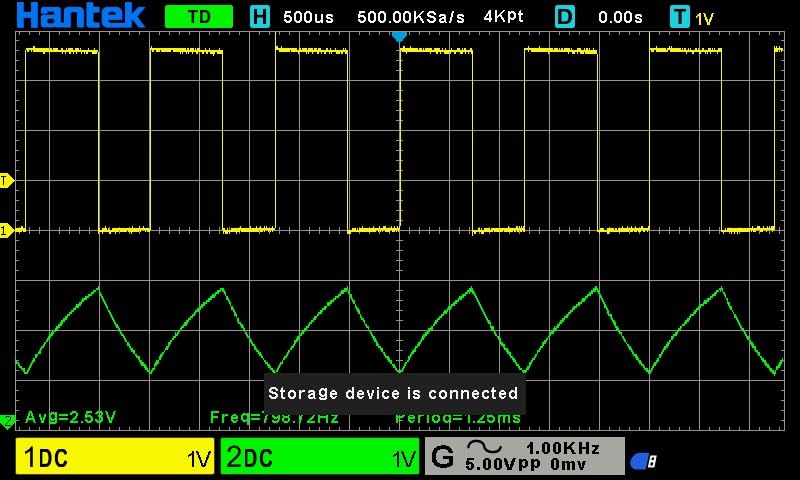
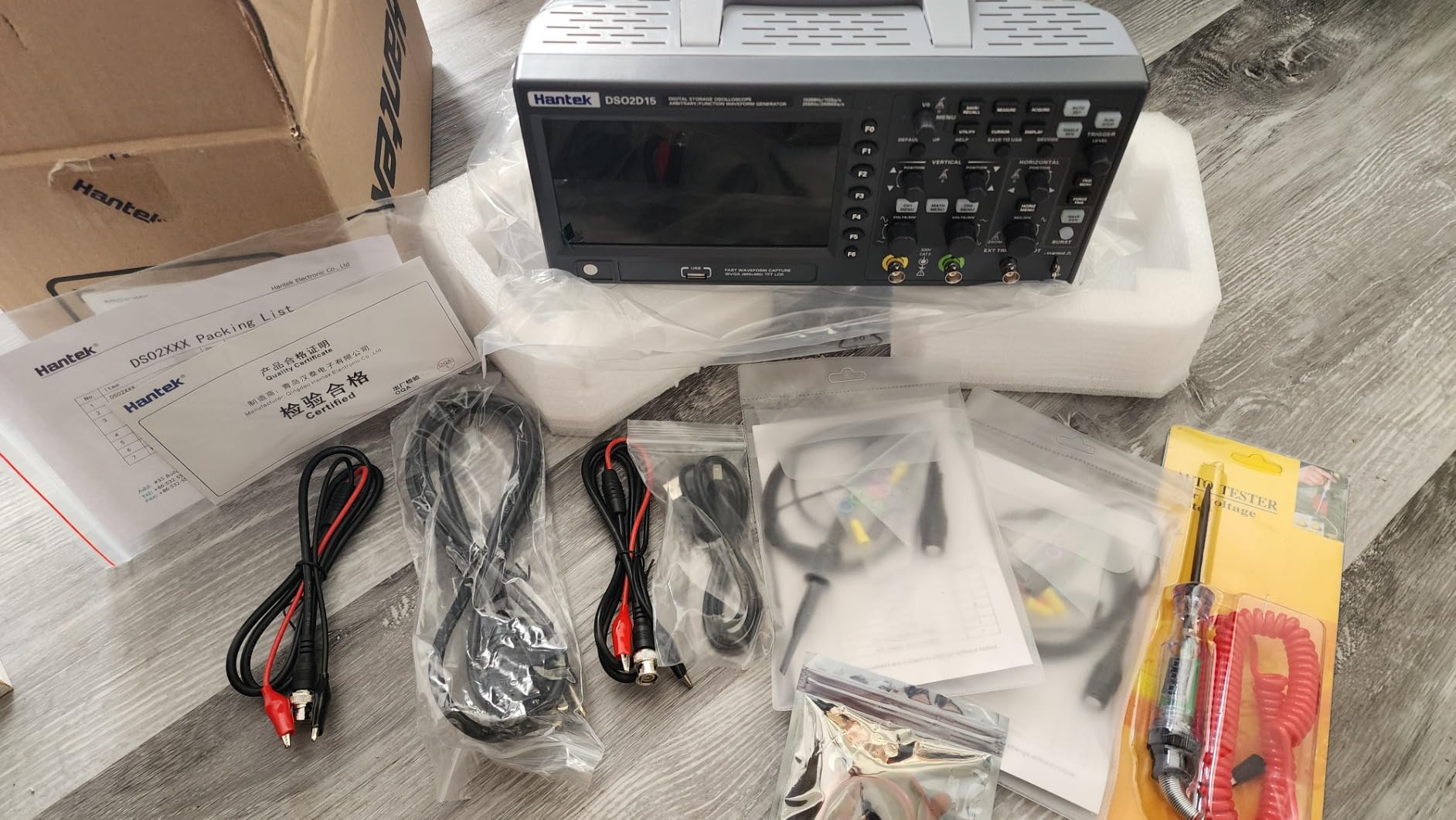
One gigahertz sampling at 150 MHz on two channels, with five standard serial protocol triggers and decodes and fourteen trigger modes, puts this unit in an unusual position: the bandwidth of a mid-range machine with the decode feature that most people in this class sell as an extra. Owners call it a dream come true for hobby and lab work at this price.
The internal square wave generator is a genuinely useful addition, not a gimmick. It is rock solid, which makes it the right tool for probe compensation and for checking components and circuits with a known reference. The Default Setup button makes exploring a long feature list painless, and firmware updates resolve much of the instability earlier generations of this line had.
Build quality is good for the class, with colour-coded channel buttons and dual-purpose knobs that also zero the trace. FFT mode and IQ analysis on synchronised channels add frequency-domain work, high input voltage protection and low input voltage sensitivity cover both ends of the range, and there is a downloadable 68-page manual from the manufacturer.
The honest caveat that appears in almost every review is accuracy above roughly 5 MHz. Treat the measurements as trustworthy in the low megahertz range and beyond that as a shape indicator. The slower CPU makes the display refresh more slowly than comparable scopes, it can lock up if settings are misconfigured and needs a power cycle, Auto Set does not do the work on complex signals, and the front and rear USB connectors share one port so you can only use one at a time. The usual forum advice is to apply the latest firmware and back up your setup first.
Why the standard decodes matter here
Five serial protocol triggers and decodes at this level means UART, I2C and SPI traffic can be read directly on screen, which removes the single most tedious task in microcontroller debugging. Combined with the internal generator, you can drive a bus and watch the response in the same session. The 14 trigger modes give you far more control over what the scope decides to keep on screen, which is what makes hunting for a specific glitch practical.
Where the two channels and slow processor hold you back
Two channels is the limit when you want a clock, a data line and a supply rail all visible at once, and the slower processor shows up as sluggish redraws compared with a Siglent or Rigol. There is also no printed documentation, so budget an evening with the downloadable manual. If you need four channels and more headroom, the Rigol DS1202Z-E at number two covers both.
How to Choose a Digital Oscilloscope for Hobbyist Use
Six numbers decide almost everything about how a scope feels on the bench. Here is how to read them, and how much each one matters for the kind of work hobbyists actually do.
Bandwidth: pick five times your highest signal frequency
Bandwidth is the highest frequency the vertical amplifier measures accurately, and it is really a statement about rise time rather than about seeing a higher pitch. The working rule is that scope bandwidth should be roughly five times the highest frequency component you care about, which gives the edge enough samples to look like an edge. For 3.3 V and 5 V Arduino and ESP32 signals, 50 MHz is already generous, because even a fast digital edge is well under 10 MHz. Audio work at 20 kHz needs far less again.
Sample rate: at least five times the bandwidth
The sample rate is how many points per second the digitiser reads, and it exists to avoid aliasing, where a fast signal folds back and displays as something that was never there. Anything at or above five times the bandwidth is a reasonable target, and most units in this roundup deliver one gigahertz of sampling on their fastest channels, which is why a 50 MHz scope sampling at 1 GSa/s is not oversold.
Memory depth: the number most buyers skip
Record length determines how much of a long capture is kept before the scope starts discarding. At 24 Mpts you can zoom into a millisecond-wide event inside a hundred-millisecond capture, and a glitch that occurs once in ten thousand acquisitions still shows up. At 1 Kpts, which is where the FNIRSI 2C53T sits, you are limited to seeing overall shape and nothing more. If your work involves hunting for intermittent faults, this matters more than bandwidth.
Channels: two is usually enough, four is a real upgrade
Two channels cover the overwhelming majority of hobbyist work, since most debugging involves one signal against another. Four channels only becomes necessary when you need a supply rail, a ground reference and two data lines visible in the same capture. A bench with a soldering station, a bench supply and good probes is worth building before the scope upgrade. Our soldering iron guide covers the other end of the bench-tool question.
Trigger and decode: where the real time is saved
The trigger is what decides which part of a repeating waveform gets held steady on screen, and fourteen or more trigger modes including serial bus triggers is a meaningful difference. Serial decoding is the feature that decides whether debugging a microcontroller board is quick or tedious. The Rigol DS1054Z and Siglent SDS1104X-E include I2C, SPI and UART decoding as standard, and that alone justifies their place in this roundup.
Connectivity, screen and total cost
USB device and host, plus LXI LAN, is what lets you script measurements, save screenshots and view the screen from another machine. Screen quality matters more than buyers expect: intensity grading and persistence reveal short glitches, a 7-inch panel is much easier to read than a 2.8 inch one, and colour coding that matches the input jacks prevents channel mix-ups. Finally, price the accessories honestly. Optional MSO channels, AWG modules and Wi-Fi dongles on some brands can add a substantial amount to the base machine, and a set of decent passive probes is a worthwhile first upgrade on any scope that ships with weak ones.
Is 100 MHz Enough?
Yes for almost all hobbyist work. Use the five-times rule: multiply your highest signal frequency by five and you have your answer. A 1 MHz clock needs about 5 MHz of bandwidth, 3.3 V Arduino and ESP32 signals need well under 10 MHz even with their fastest edges, and 20 kHz audio needs a tiny fraction of that. Go beyond 100 MHz only when you are working with fast clocking, motor drives, power converters with high switching frequencies, or signals where the edge shape itself is the measurement.
Do You Need 2 or 4 Channels?
Two channels unless you have a specific reason. Most debugging compares one signal against another, so a two-channel scope is the honest fit. Reach for four channels when you need a multi-rail power supply watched alongside a switch node and a feedback line, when debugging three-phase or motor signals, or when you are bringing up a board with a clock, a data line and a supply all interacting. If you cannot name that third signal, four channels is money spent on an empty screen.
Benchtop vs. Handheld: Which Style Suits Hobbyist Work?
The benchtop scopes in this roundup, the Siglents, the Rigols and the Hantek, are mains-powered instruments with proper knobs, deep memory and serial decoding. They are the right choice for bench work, and the honest downsides are fan noise on the Rigol DS1054Z, a twitchy multifunction knob on several of them, and slow USB 2.0 transfers on the DS1202Z-E.
Handhelds, the ZOYI ZT-703 and the FNIRSI units, run on a rechargeable battery and fold a multimeter and often a signal generator into the same body. They are unbeatable for field and automotive work, and forum consensus in r/CircuitBending and r/beneater is that they are fine for low-frequency analogue and audio work. What you give up is bandwidth, record depth, screen size and any form of protocol decoding.
Forum sentiment on r/AskElectronics consistently puts the sweet spot for a first serious scope in the middle range, where 100 to 200 MHz and two to four channels are available, rather than at the very bottom or the very top. On the EEVblog forums the recurring observation is that most good scopes sit at a similar price-to-bandwidth ratio, which means a cheaper scope is usually paying for it in memory, display or build quality rather than in bandwidth. One more piece of practical advice from those threads: a dedicated logic analyzer can be bought separately later, so do not let the absence of an MSO in the base machine stop you.
Frequently Asked Questions
What is a good oscilloscope for a hobbyist?
A good oscilloscope for a hobbyist gives you two channels, 50 to 100 MHz of bandwidth and a real-time sample rate around 1 GSa/s, with I2C, SPI and UART decoding included rather than sold as a license. Memory depth of 24 Mpts matters more than most buyers expect, because it decides how much of a long capture survives so you can find rare glitches. The Siglent SDS1104X-E and the Rigol DS1054Z are the two models hobbyists recommend most often for a first serious bench instrument.
What is a good, cheap oscilloscope for hobbyists?
For low-frequency and field work the FNIRSI DSO152 is the cheapest usable option, with 200 kHz of bandwidth and a pocketable body. The FNIRSI 2C53T adds a 19,999-count multimeter, a DDS signal generator and 50 MHz of bandwidth in the same box. For automotive diagnostics the ZOYI ZT-703 is stronger, with dual channels, a 25,000-count meter and a rechargeable battery. All of these are limited above roughly 20 MHz and none offers protocol decoding.
Is a 100 MHz oscilloscope enough?
Yes for almost all hobbyist work. Multiply your highest signal frequency by five and you have your answer. A 1 MHz clock needs about 5 MHz of bandwidth, and 3.3 V Arduino and ESP32 signals need well under 10 MHz even at their fastest edges. Go higher than 100 MHz only for fast clocking, motor drives, high-frequency switching converters, or any measurement where the edge shape itself matters.
Do I need a 2 or 4 channel oscilloscope?
Two channels unless you can name a third signal you need to see at the same time. Most debugging compares one signal against another. Four channels become necessary for multi-rail power supply work, three-phase or motor signals, or bringing up a board where a clock, a data line and a supply are all interacting. The Rigol DS1054Z and Siglent SDS1104X-E give you four channels with the serial decoding standard.
Do I need a waveform generator with my oscilloscope?
It helps but it is not essential, and it is cheaper to add later. A built-in generator, as on the Hantek DSO2D15 or the FNIRSI 2C53T and DSO-510, is most useful for probe compensation and for injecting a known signal into a filter or amplifier stage. If your scope lacks one, note that the optional AWG modules for some Siglent models are a significant extra cost, which is worth factoring into the budget before you buy.
Conclusion: The Best Digital Oscilloscopes for Hobbyists in 2026
The best digital oscilloscopes for hobbyists come down to what your signals actually are. The Siglent SDS1104X-E is our top pick: four channels at 100 MHz, 24 Mpts of memory and five serial decoders included, with Ethernet remote viewing on top. The Rigol DS1054Z is the value pick if you want the same four-channel and decoding capability on a tighter budget, and the Rigol DS1202Z-E is the answer when you need 200 MHz on two channels.
Below that, the ZOYI ZT-703 covers automotive and field work, the FNIRSI units cover the low end of the frequency range cheaply, and the Hantek DSO2D15 puts 150 MHz and serial decoding in the same box. Buy the fastest thing you can justify now, replace the bundled probes if they are weak, and add a logic analyzer later when you find you need one. Check the latest price on any of them before you commit, then put it on the bench and turn something on.