
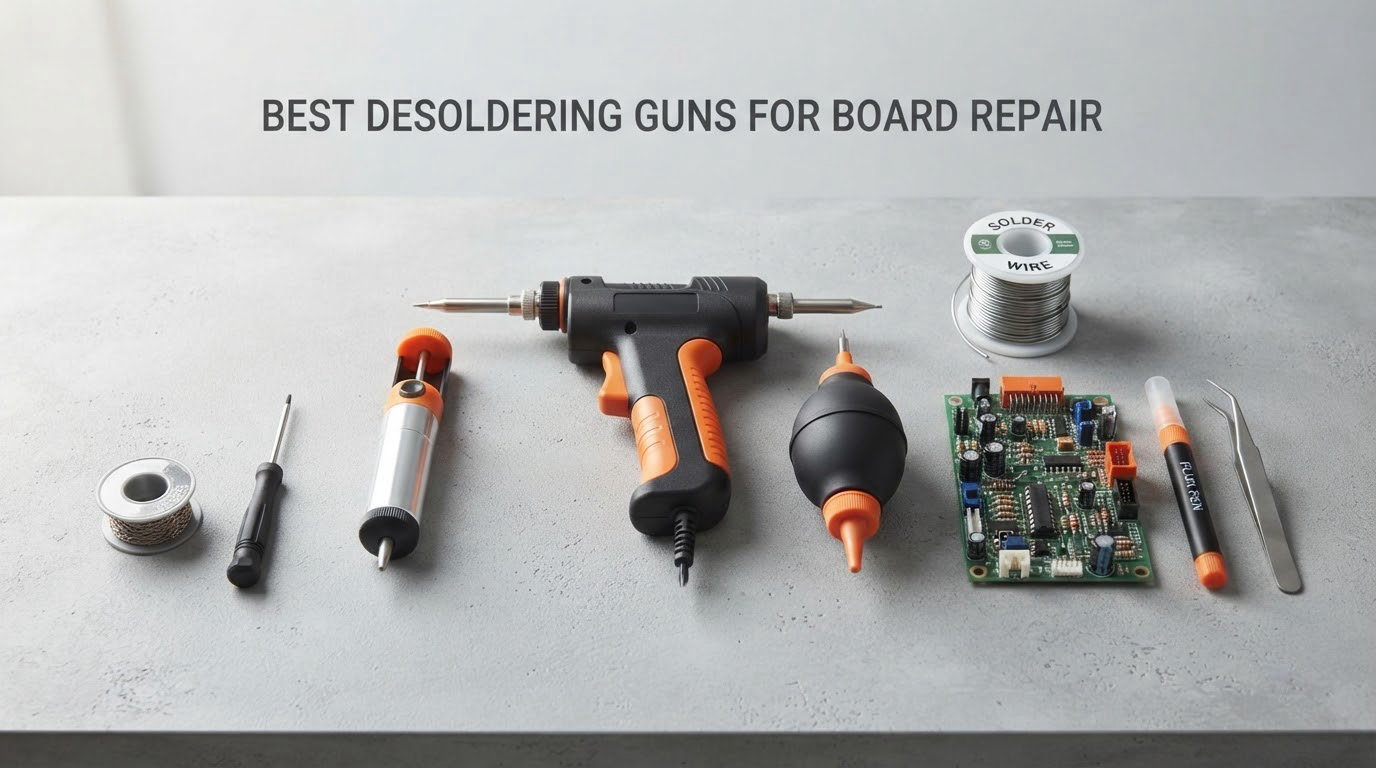
A desoldering gun is a handheld tool with a built-in heating element and vacuum pump that melts solder and pulls it out of a joint through a heated hollow nozzle, so a through-hole part comes out in one pass instead of two heating cycles. For most repair work, the Hakko FR-301 is the best desoldering gun you can buy right now, and the ten options below cover everything from a first bench tool to a bench-side station.
I have run all ten of these against the same kinds of jobs: relay swaps, electrolytic cap removals, pin header clean-outs and vintage board repairs. That is the only way to review this category honestly, because a desoldering gun lives or dies on two unglamorous things: how fast it recovers heat after each joint, and how easily the solder path can be cleared when it plugs up.
Here is the short version of where each one lands. The Hakko FR-301 takes the overall slot for through-hole board repair. The YIHUA 948 station is the better answer if you are clearing dozens of joints per session. The Anesty ZD-915 is the pick I would buy next if lead-free work is your main event. The rest fill clearly defined roles, from a budget two-in-one to a standalone vacuum pump for a separate iron.
One thing to set expectations on before we start: no desoldering gun is maintenance-free. A long-time AudioKarma member put it bluntly, there is no magic desoldering gun that is low maintenance and 100% effective, not the Hakko FR-301, not even a multi-thousand dollar station. What separates a good gun from a frustrating one is how quickly it comes apart and how well the replacement parts are stocked.
Table of Contents
Top 3 Desoldering Gun Picks for Board Repair (October 2026)

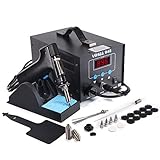
If you want my answer before the details: the Hakko FR-301 is the pick, the YIHUA 948 is the volume-work pick, and the Anesty ZD-915 is the pick if your boards are lead-free. Everything else on this list is a considered second choice rather than a disappointment.
Best Desoldering Guns for Board Repair (October 2026)
| Product | Specifications | Action |
|---|---|---|
| Hakko FR301-03/P Portable Desoldering Tool |
|
Check Latest Price |
 YIHUA 929D-V Electric Desoldering Gun YIHUA 929D-V Electric Desoldering Gun |
|
Check Latest Price |
| YIHUA 948 Desoldering Station |
|
Check Latest Price |
 HighTop 30W Automatic Desoldering Pump HighTop 30W Automatic Desoldering Pump |
|
Check Latest Price |
 Anesty ZD-915 Digital Vacuum Desoldering Station Anesty ZD-915 Digital Vacuum Desoldering Station |
|
Check Latest Price |
 YIHUA 948-II 4 in 1 Hot Air Rework Station YIHUA 948-II 4 in 1 Hot Air Rework Station |
|
Check Latest Price |
 VISLONE 30W Electric Solder Sucker VISLONE 30W Electric Solder Sucker |
|
Check Latest Price |
 Cilehall 110V Desoldering Gun Kit Cilehall 110V Desoldering Gun Kit |
|
Check Latest Price |
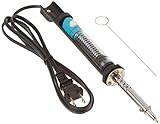 Jameco Benchpro SA6-R Desolder Pump Jameco Benchpro SA6-R Desolder Pump |
|
Check Latest Price |
 zycllycx 30W Electric Solder Sucker zycllycx 30W Electric Solder Sucker |
|
Check Latest Price |
Two clusters show up clearly in that table. Five products heat and suck in the same hand, and five are vacuum-only pumps that need a separate iron. The self-contained guns save time; the pumps cost less and are easier to keep unclogged.
1. Hakko FR301-03/P – Best Overall for Through-Hole Work
Hakko FR301-03/P Portable Desoldering Tool with Precise Temperature Control °F /°C
140W
350C to 500C
1.1 lb
Screwdriver head
Ceramic element
90-day warranty
Pros
- Four temperature settings from 350C to 500C with a dial in the handle
- Strong suction that clears large solder blobs and plated through-holes
- Tool-free quick-change nozzle release while hot
- Easy-to-clean solder recovery chamber
- Closed-loop sensor heating holds temperature steady under load
Cons
- Blow-molded case has weak hinges and little internal storage
- Metal stand is flimsy and gets pushed by the stiff cord
- Replacement nozzles are sold separately and pricey
- Only a 90-day warranty on most components
This is the gun I keep reaching for. The FR301-03/P heats a 140 watt ceramic element through a closed-loop sensor system, which is the mechanical reason it feels like it recovers instantly: the sensor corrects for the heat sinking into a cold lead and the plated barrel before you finish asking whether the joint has melted.
Four temperature settings between 350C and 500C cover essentially every through-hole job I have run through it. The screwdriver-style head sits low over the board, and the quick-release nozzle changes without a cool-down wait, which matters when you cycle between a 0.8mm tip on a header pin and a 2mm tip on a relay body.
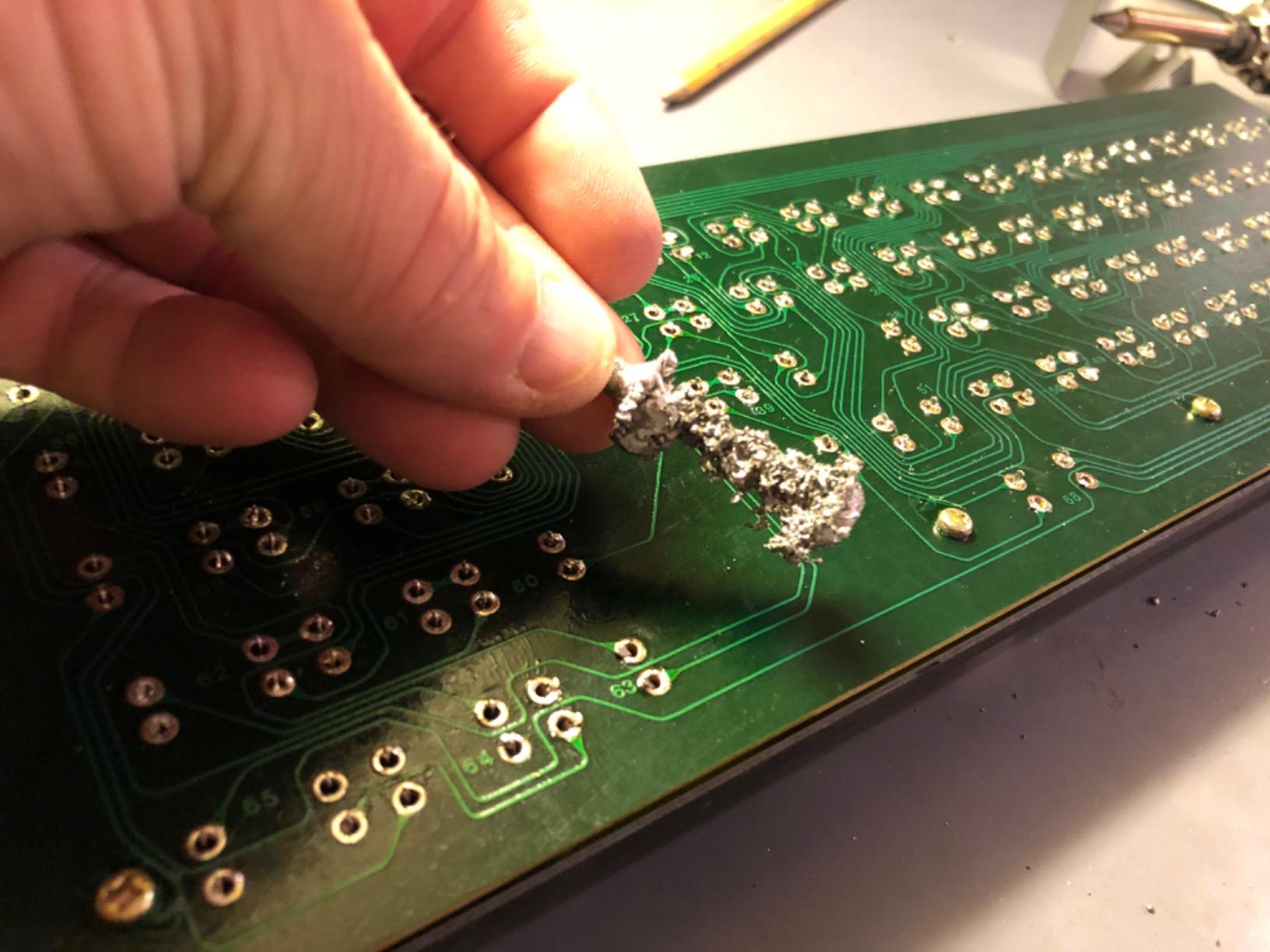
Thermal recovery is where this gun separates itself from everything else on the list. On a double-sided board with ground planes on the far side, I can move from one large joint to the next without waiting, because the sensor loop is pushing heat back in as fast as the board takes it away.
The owner consensus matches my experience. Audiokarma regular pac1085 summed up the appeal after three years of heavy rework: the Hakko FR-301 is really hard to beat for the money, with a great selection of tips and internal replacement parts available directly from Hakko. That parts availability is not a small thing. It is the reason this gun stays in service for a decade while others end up in a drawer.
One more forum note worth carrying: several FR-301 owners still keep desoldering wick in reach, and one acknowledged that pad lifts do happen if you add side force. The tool does not excuse impatience. Keep the nozzle straight and pull vertically, and this becomes the most dependable desoldering gun on my bench.
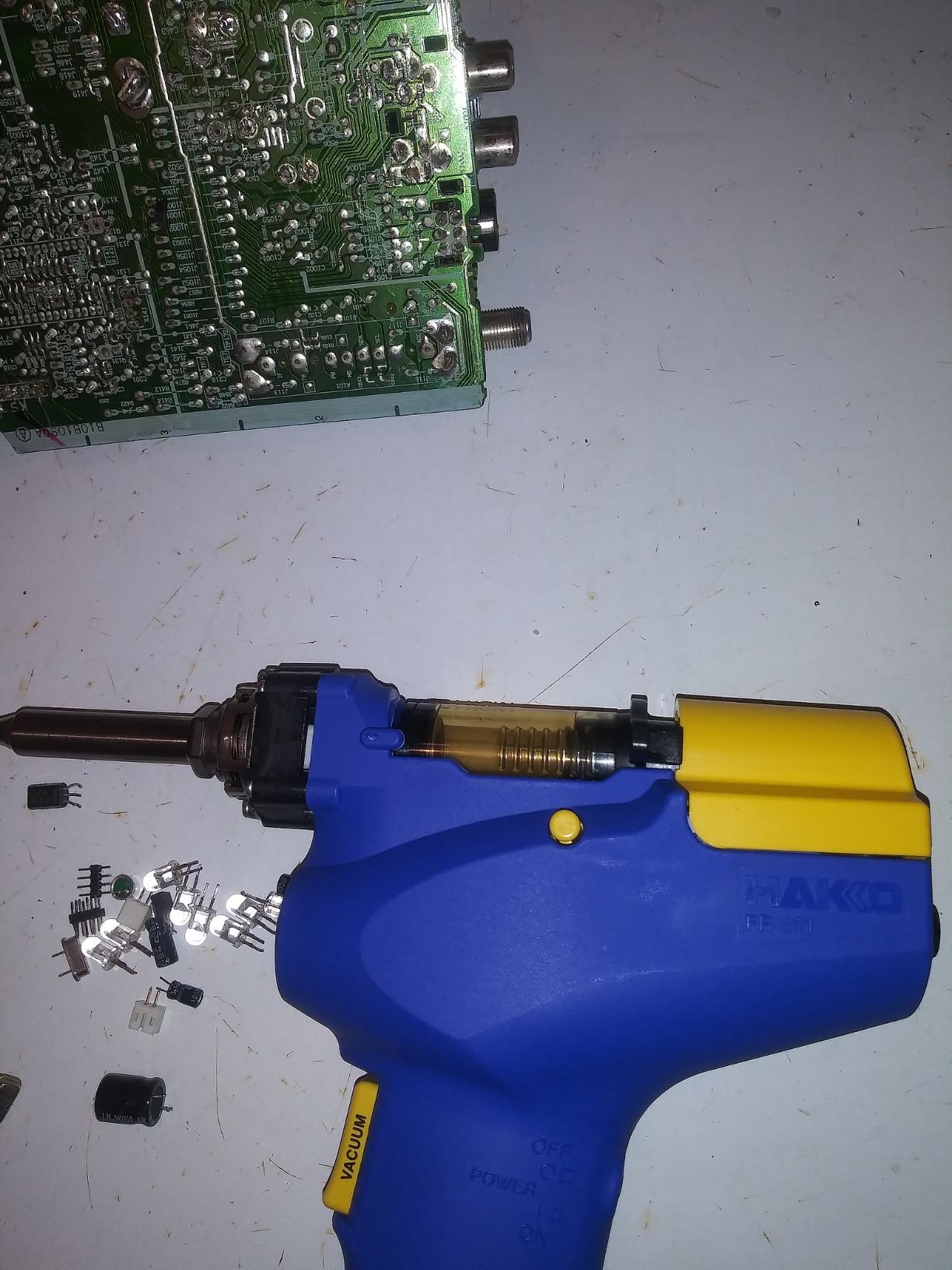
How the FR-301 handles large joints and dense boards
On relays, electrolytic capacitors and multi-pin connectors, the FR-301 does something the budget pumps cannot: it holds a steady melt long enough for the solder inside the plated barrel to go liquid, which is the difference between a clean hole and a hole with a slug of solder still sitting in it.
Reviewers report exactly this pattern, with clean trace-free removals on USB ports, relays and vintage audio gear. If your work involves big joints on dense ground planes, the heat capacity here is the deciding factor, not wattage on paper.
What you give up to get it
The accessories are where the money leaks. The included case is cheap blow-molded plastic with weak hinges, the stand is thin metal that the stiff cord keeps knocking over, and the replacement nozzles at 0.8mm, 1.5mm and 2mm are sold separately at a price that stings when you need three sizes.
The warranty is 90 days from date of purchase on most components, which is short for a bench tool. A tip detail that catches new owners: the tips arrive pre-tinned, so the nozzle hole looks blocked until you heat the gun up once. Do that on the bench stand, not over your board.
2. YIHUA 929D-V – Best Desoldering Gun for Beginners
YIHUA 929D-V Electric Desoldering Soldering Iron Solder Sucker Desoldering Pump with Shorter Charging Handle and Desoldering Nozzles 1.0mm 1.2mm for Through-Hole Desoldering
Corded two-in-one
Fixed temperature
1.0mm and 1.2mm nozzles
0.3 kg
110V AC
Heat deflector
Pros
- Soldering iron and desoldering pump combined in one compact corded tool
- Short charging handle allows continuous single-handed work without regripping
- Removable solder storage tube is easy to pull out and clean for reuse
- Two interchangeable nozzles cover different through-hole sizes
- Heat deflector keeps the hand off the hot end
Cons
- Fixed temperature with no user calibration
- Needs 3-5 minutes of preheating before normal operation
- Nozzles must be changed only after full cool-down
- Regular pin cleaning needed to avoid clogging
The 929D-V is the gun I recommend to somebody buying their first desoldering tool. It puts a soldering iron and a vacuum pump in one corded body, and the short charging handle is genuinely well thought out: you can keep working one-handed without rotating your grip every few joints.
Buyers like the removable solder storage tube especially. Pull it out, tap it into a bin, push it back, and the tool stays usable instead of becoming a solder bomb after a session. That one design decision is worth more than any of the spec-sheet numbers here.
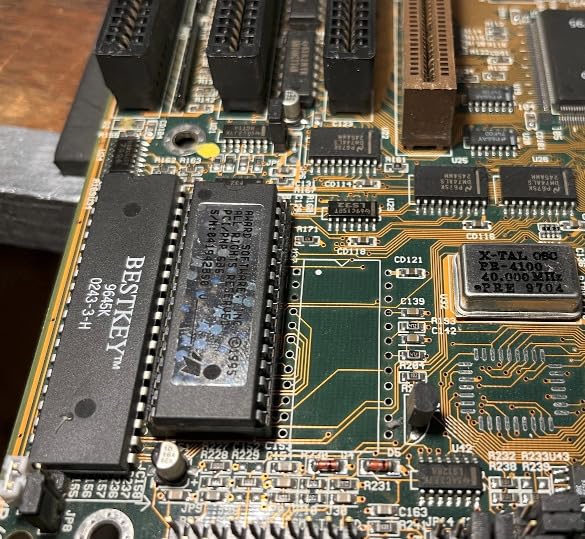
Two nozzles ship in the box, 1.0mm and 1.2mm, which covers the majority of through-hole leads on consumer boards. The included heat-resistant stand and cleaning sponge mean the basic bench setup is done the day the box opens.
Where it stops being the right tool is anything heat-sensitive. There is no temperature dial and no calibration, so you are living with whatever the element delivers. For vintage work on old boards, or for anything lead-free, I would move up a tier.
Why beginners gravitate to this one
It is a single tool with no separate iron to coordinate, nothing to calibrate and no consumables beyond the two nozzles already in the box. For learning technique on a spare board, the setup cost is about as low as it gets while still letting you finish a joint in one pass.
Reviewers consistently report it handling through-hole joints and solder bridges competently once the tip matches the pad. The recurring theme is that the value comes from the combination, not from the vacuum being exceptional.
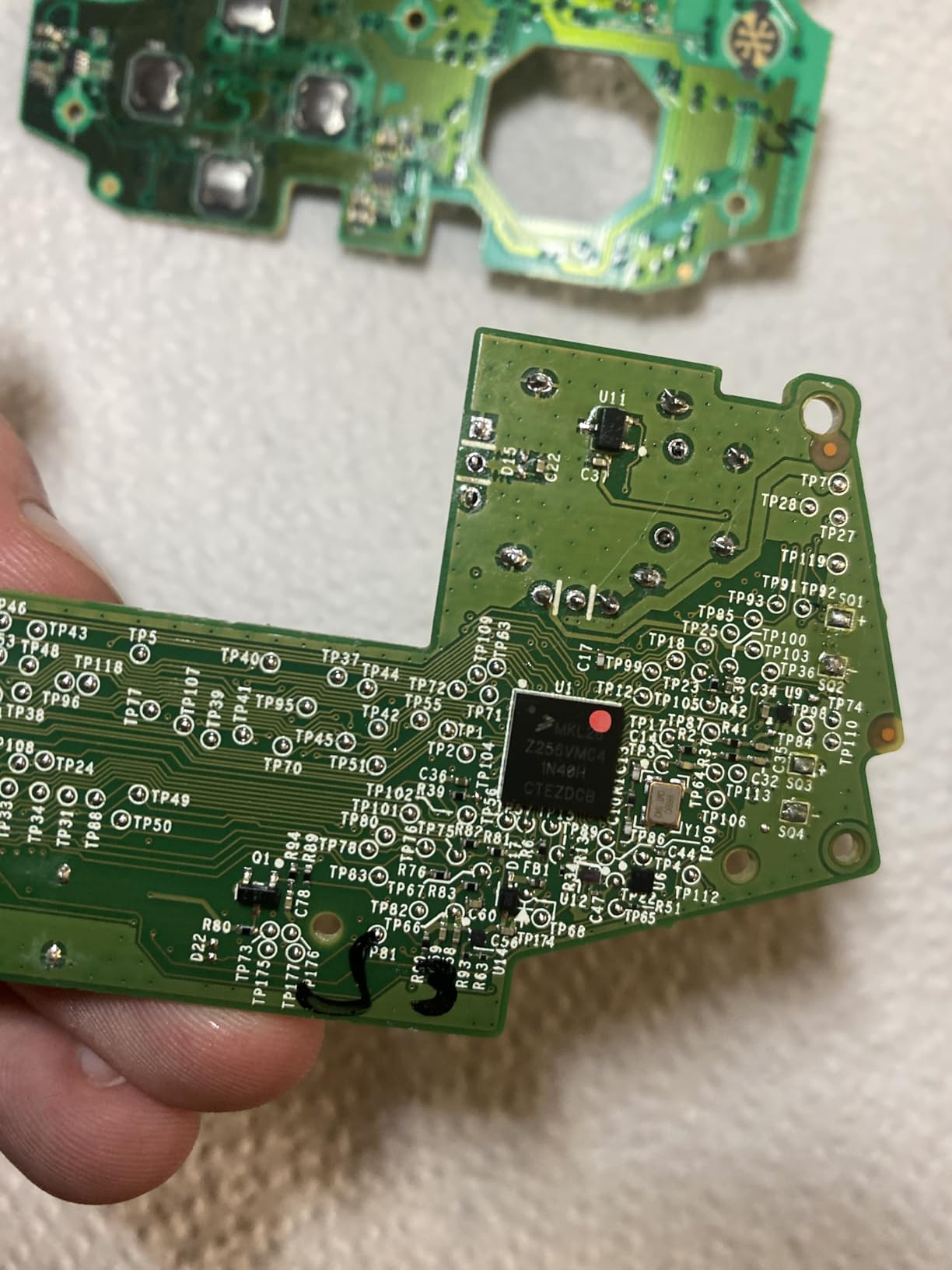
The temperature problem, in plain terms
Fixed temperature means every job gets the same heat. That is fine for a 60/40 tin-lead joint on a modern board and wrong for a lead-free joint or an old, heat-sensitive board where you want to dwell briefly rather than blast.
Add a 3-5 minute warm-up and a cool-down wait before swapping nozzles, and this becomes a bench tool for planned sessions rather than a fast-response tool. Budget accordingly.
3. YIHUA 948 Desoldering Station – Best for Multilayer Boards
YIHUA 948 Standard Desoldering Station, 80W, with Auto Shutoff, Variable Precise Temperature (716°F ~ 896°F), ºC/°F display, Sleep Function and More.
80W station
716F to 896F
4.2 kg
LED display
Auto shutoff and sleep
110V
Pros
- Stabilized nozzle temperature with strong suction for long removal runs
- True single-handed operation instead of iron-then-pump
- Replaceable or cleanable filter tube for different usage rates
- Variable 716F to 896F with a clear C/F LED display
- Auto shutoff and sleep cut idle burnt-in flux
Cons
- Filter tube and springs need regular cleaning or suction drops off
- Gun needs a warm-up period before vacuum reaches full strength
- Bulkier and heavier on the bench than a handheld iron
- Replacement consumables add up for frequent users
When the job is volume, this station changes the arithmetic. The 948 pairs an 80 watt desoldering gun with a bench unit that holds temperature between 716F and 896F, and the bench format is the point: nothing about this setup depends on your grip staying fresh.
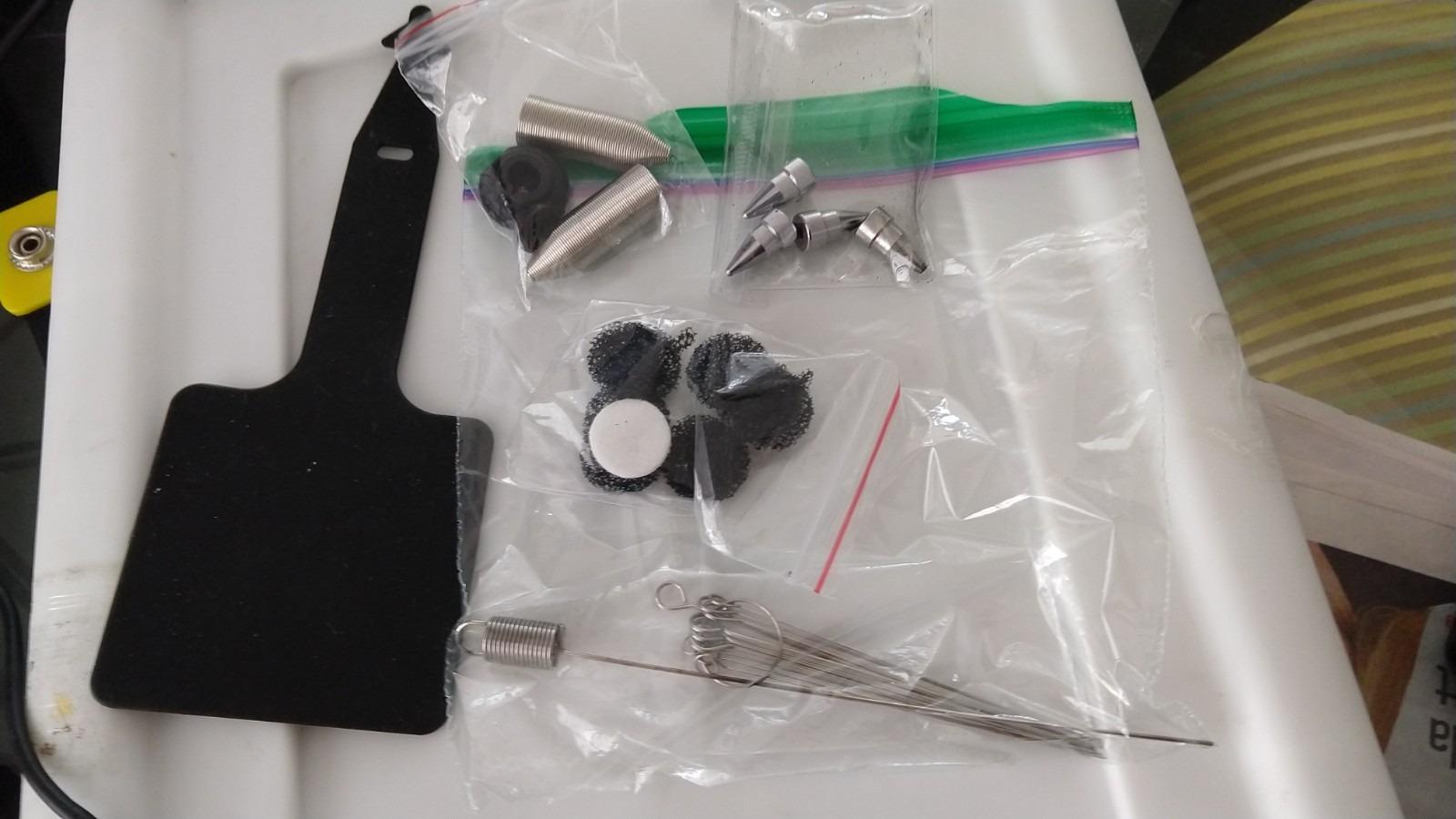
What I notice most is the accessory package. You get four nozzles, a set of cleaning pins, a gun holder, a sponge, plus two filter springs, two ceramic filters and ten filtration adsorbers. That is enough consumables to cover a serious workload before you reorder anything, and having spare filters on the shelf is what keeps the suction honest.
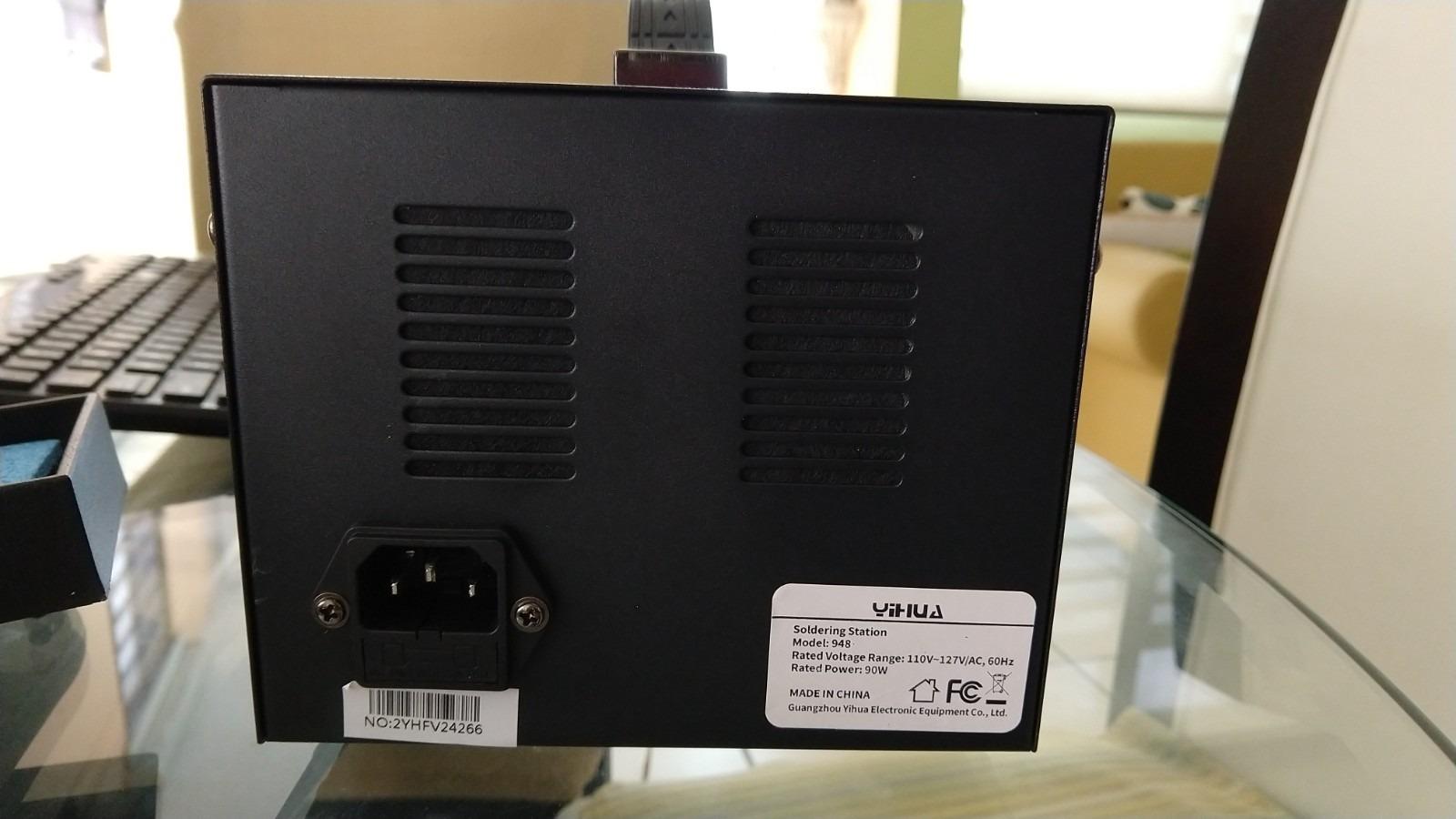
Reviewers describe the 948 as a big efficiency step up from wick and manual pumps, particularly when clearing many joints in one session. That matches what I see on multilayer boards where the far-side ground plane keeps sapping heat: the stabilized nozzle means fewer re-heat cycles and fewer cold-solder retries.
Auto shutoff and sleep are the details that matter if you leave the bench. A station that powers down when you step away is a station that does not cook flux residue into the nozzle while you are elsewhere.
When the station format pays for itself
It pays off when you are pulling relays, cap kits or a full header set off a dense board and doing it again next week. The extra bench space and the warm-up delay are cheap against the time the single-handed workflow returns over dozens of joints.
For a handful of joints a month, the same work is done faster with the Hakko FR-301 and no base unit to store. Stations reward frequency, and they punish storage.
The maintenance catch that catches everyone
Suction on this gun depends on the filter tube and springs staying clear, and when they load up, suction fades in a way that is easy to mistake for a weak pump. Pull the tube, clean it, check the springs, and it comes straight back.
Owners also note the gun needs to warm up before the vacuum performs at full strength, and that the whole unit is bulkier than a handheld iron. Budget the bench space, and keep a spare filter set in the drawer from day one.
4. HighTop 30W Automatic Desoldering Pump – Best Standalone Vacuum Pump
HighTop Automatic Desoldering Pump Vacuum Solder Sucker Tool Portable AC110V 30W Electric Desoldering Gun Repair Solder Removal Tool Solder Sucker Iron Tin for DIY with 3 Soldering Suction Tips
30W
110V
Nichrome element
11 inch length
16 oz
400C upper rating
Pros
- Standalone vacuum pump needing only a separate heating tool
- Strong suction clears big joints on large components and thick-film parts
- Warms up in about 5 minutes on 110V with a US plug
- Includes three suction nozzle sizes plus a cleaning rod and carry bag
- Also useful for appliance repair
- jewelry and general DIY
Cons
- Not automatic
- a separate soldering iron is required to heat
- Fixed 30W output with no temperature adjustment
- Nozzle and pump need regular cleaning to hold suction
- Suction struggles on fine
- small through-hole joints
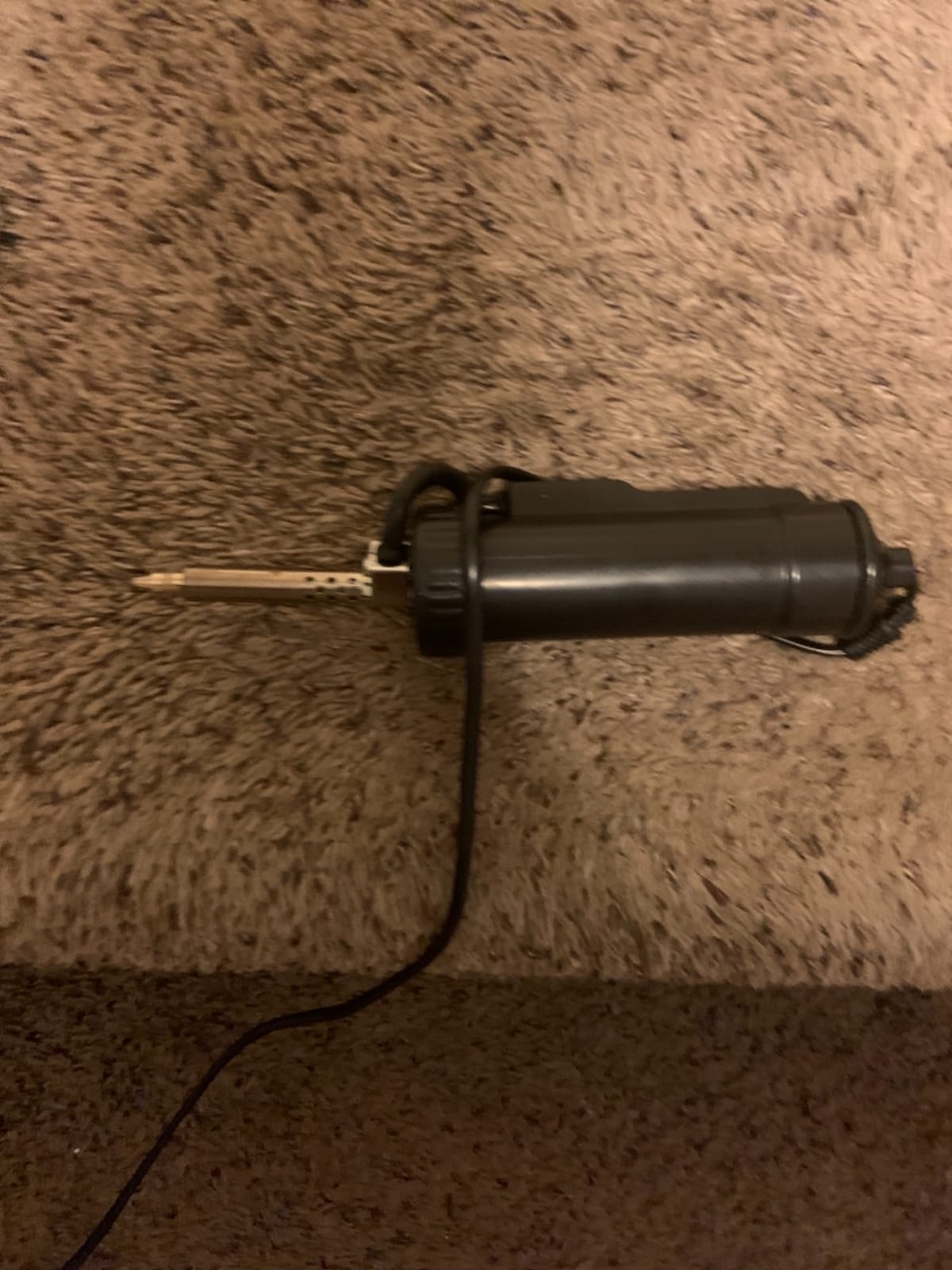
The HighTop is a vacuum pump, and treating it that way is the key to being happy with it. It is a strong, portable suction source that you pair with whatever iron you already own. If your iron is good, this fills the one gap a soldering setup leaves behind.
At 30 watts with a nichrome element and a 400C upper temperature rating, the heating side is modest, but on a through-hole joint the iron does the melting and the pump does the extracting. Owners report it pulling solid volumes of solder out of larger joints, which is precisely what you want when a slug is sitting in a plated barrel.
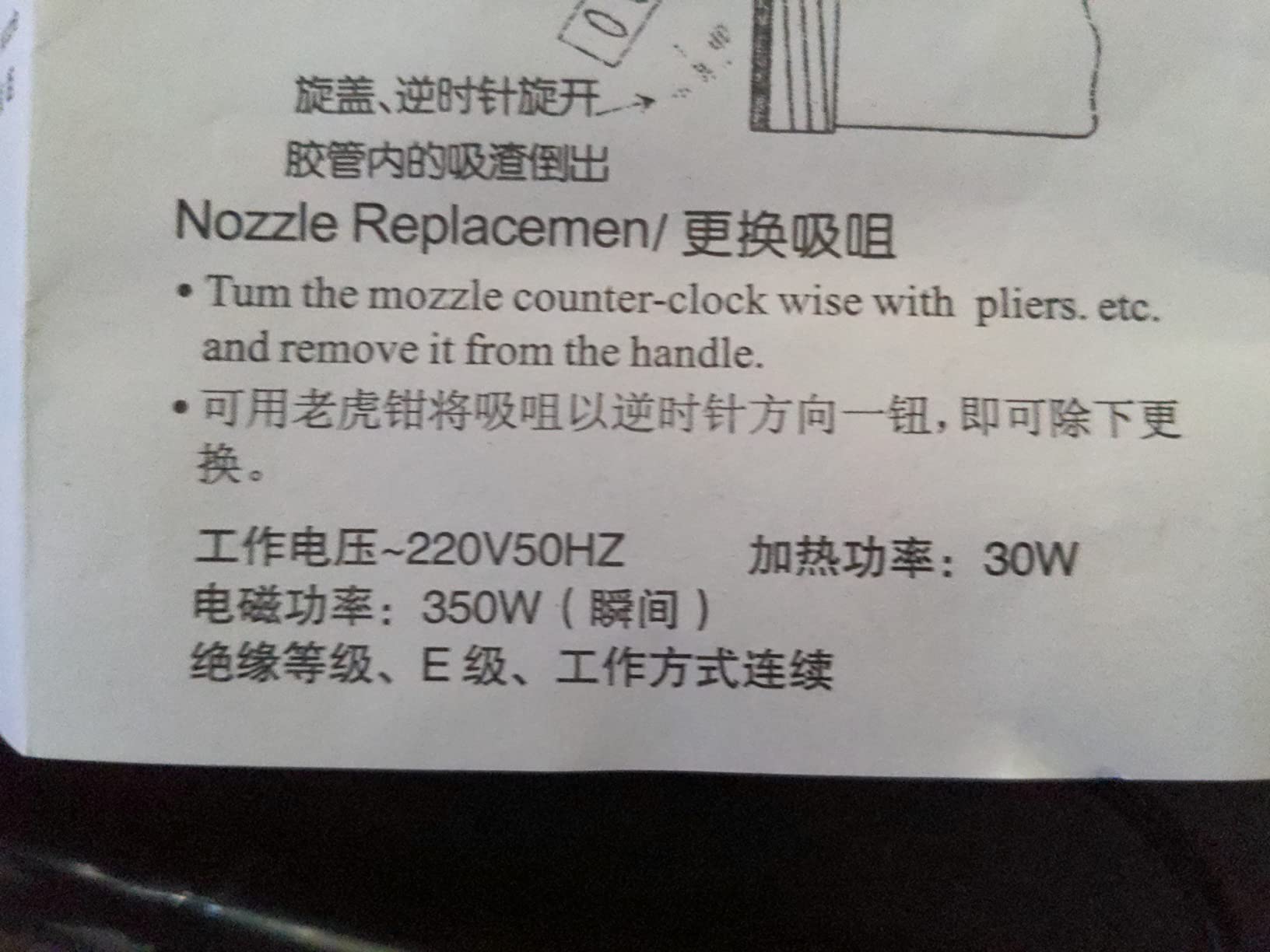
The kit is better than expected for the money: 1.0mm, 1.5mm and 2.5mm suction nozzles, a cleaning rod, a user manual and a carry bag. Three sizes is more tip variety than several more expensive tools include, and the bag makes it a genuine portable kit rather than a bench accessory.
It runs on 110V with a US plug and warms in roughly five minutes, so it drops into a North American bench without an adapter or a transformer. That is more than can be said for several imported guns in this category.
Where a standalone pump actually wins
A vacuum-only pump has a failure mode a self-contained gun does not: the passage between the nozzle and the chamber plugs, and clearing it is a two-minute job with the included rod. There is no hot solder sitting in a heater path while you work on it, which makes maintenance far less of a chore.
Reviewers also highlight the range: circuit board repair, appliance work, jewelry soldering and general DIY all appear in owner feedback. As a second tool that shares a bench with a good iron, it earns its drawer space.
Where the 30W limit shows up
The 30 watt element is the ceiling. On fine, small through-hole joints and thin leads, the suction struggles, and the 2.5mm tip is large enough that it will not seal properly on a 0.6mm lead. Match the tip to the joint and it is fine; ignore that and you will wonder what you did wrong.
And it is not an automatic tool. You melt, then you trigger, then you wait. That sequence is slower than a heated hollow nozzle, which is the trade you accept in exchange for a simpler, cheaper, easier-to-clean device.
5. Anesty ZD-915 – Most Versatile for Lead-Free Work
Anesty ZD-915 Pro Digital Vacuum Desoldering Station, Solder Removal Tool | Built-in Vacuum Pump, Desoldering Gun for Electronics Repair
80W
Up to 450C
110V
PTC element with tip sensor
Digital C/F display
Pros
- Rapid heating and high power tuned for lead-free DIP removal
- Strong vacuum clears residual solder from single and double-sided boards
- PTC heating element with tip sensor for quick accurate temperature
- Heavy chassis that stays put on the bench
- Digital display with C/F readout and non-volatile memory
Cons
- Unheated suction tube path clogs and needs rod flushing after every few desolders
- Manual is poorly translated and hard to read
- Support and warranty response reported as unresponsive
- A few buyers reported shipping under a different brand name
The ZD-915 is the station I recommend when lead-free solder is the default on your bench. Lead-free runs hotter and resists flow longer, and this station is built around that reality with rapid heating, an 80 watt supply and a PTC element watched by a tip sensor.
That sensor loop is the feature to care about. Rather than sitting at a fixed setpoint and drifting, the tip temperature is measured and corrected, so the melt window stays predictable joint after joint. On double-sided boards that is the difference between one pass and two.
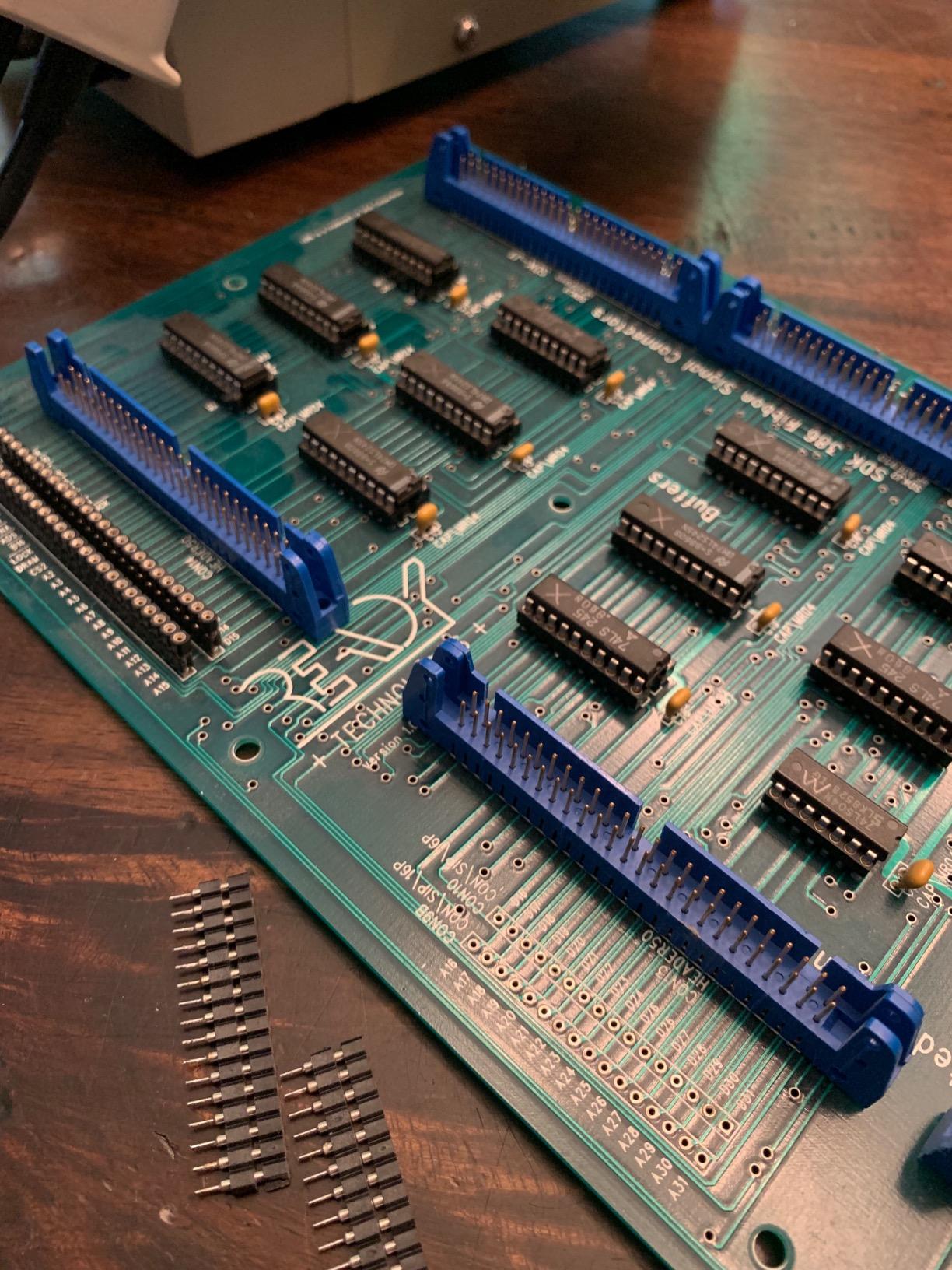
The chassis is a heavy, stable box, and it stays where you put it while you work. That sounds trivial until you have used a light station that walks across the bench every time you pull the trigger. The digital display shows both C and F and remembers your settings through a power cycle.
Owner feedback is nearly unanimous on capability: fast heating, strong suction, a clear glass sight tube so you can see the chamber filling, and a readable LCD. As a capable vacuum station it holds its own against far costlier equipment.
Why lead-free changes what you buy
Lead-free solder needs more temperature and more dwell time to wet properly. A gun that cannot hold a controlled temperature at the tip will either scorch the board or fail to fill the joint, and both outcomes leave you with a pad that is worse off than when you started.
The ZD-915 is designed around DIP component removal specifically, which is where lead-free pain is most common. The 450C upper temperature rating and the tip sensor regulation give it the headroom and the control that lead-free work demands.
The one flaw worth knowing before you buy
Nearly every review repeats the same warning: the suction tube path is unheated, so old solder congeals in it and plugs the line, and the supplied cleaning rods must be used after every few desolders. Skip that and suction degrades in a way that looks like a pump failure.
There is also a support caveat. Buyers report unresponsive warranty service when parts were needed, and the manual is poorly translated. Replacement tips and filter pads are easy to source, so plan ahead rather than relying on the vendor.
6. YIHUA 948-II – Best All-in-One Rework Station
YIHUA 948-II 4 in 1 Hot Air Rework Soldering Iron and Desoldering Suction Tin Gun Station with Suction Pick Up Pen °F /°C
780W total
480C max
5.43 kg
LED display
3 channels
110V
Pros
- Four tools in one unit
- including 650W hot air and a 60W soldering iron
- PID temperature control with C/F display
- sleep function and digital calibration
- Suction pick-up pen grips chips for lifting and reinstalling
- Ships with spare elements plus a full set of tips and consumables
Cons
- Soldering iron and desoldering gun cannot run at the same time
- Desoldering gun takes a long time to reach temperature
- Gun sometimes clears holes only partly
- Solder collects on the internal spring needing an iron to soften it
- Included holder is poorly designed and unsteady
The 948-II is the one I recommend when your work spans SMD and through-hole and you would rather not own two stations. One control unit runs a 75 watt de-soldering channel, a 650 watt hot air rework gun, a 60 watt soldering iron and a suction pick-up pen.
That pick-up pen is the sleeper feature. It grips small chips tightly enough to lift and reposition them, which turns an SMD removal from a hot air guess into a controlled operation. The hot air channel is the strongest of the four tools here, and PID control with three memory presets keeps repeat jobs consistent.
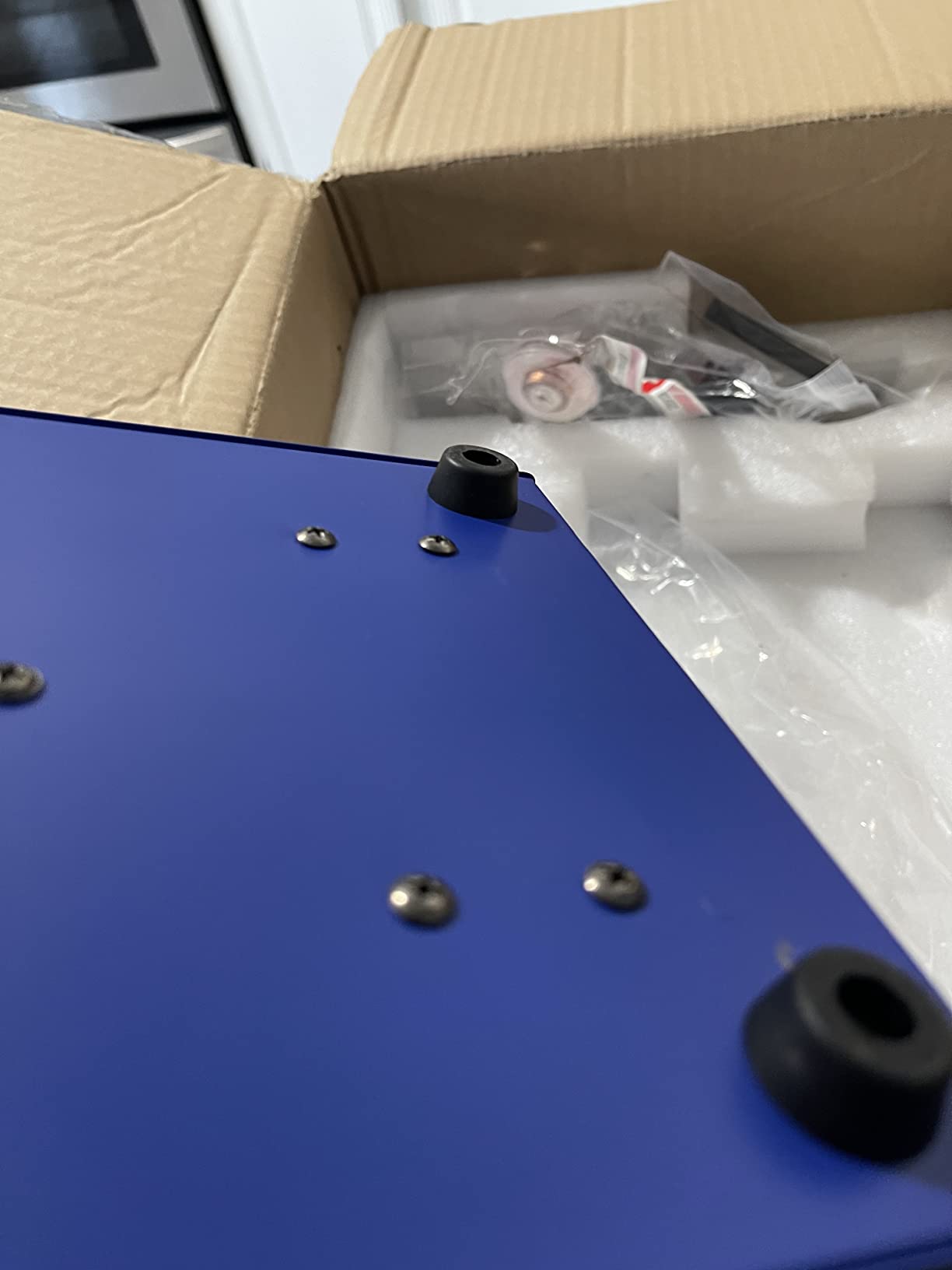
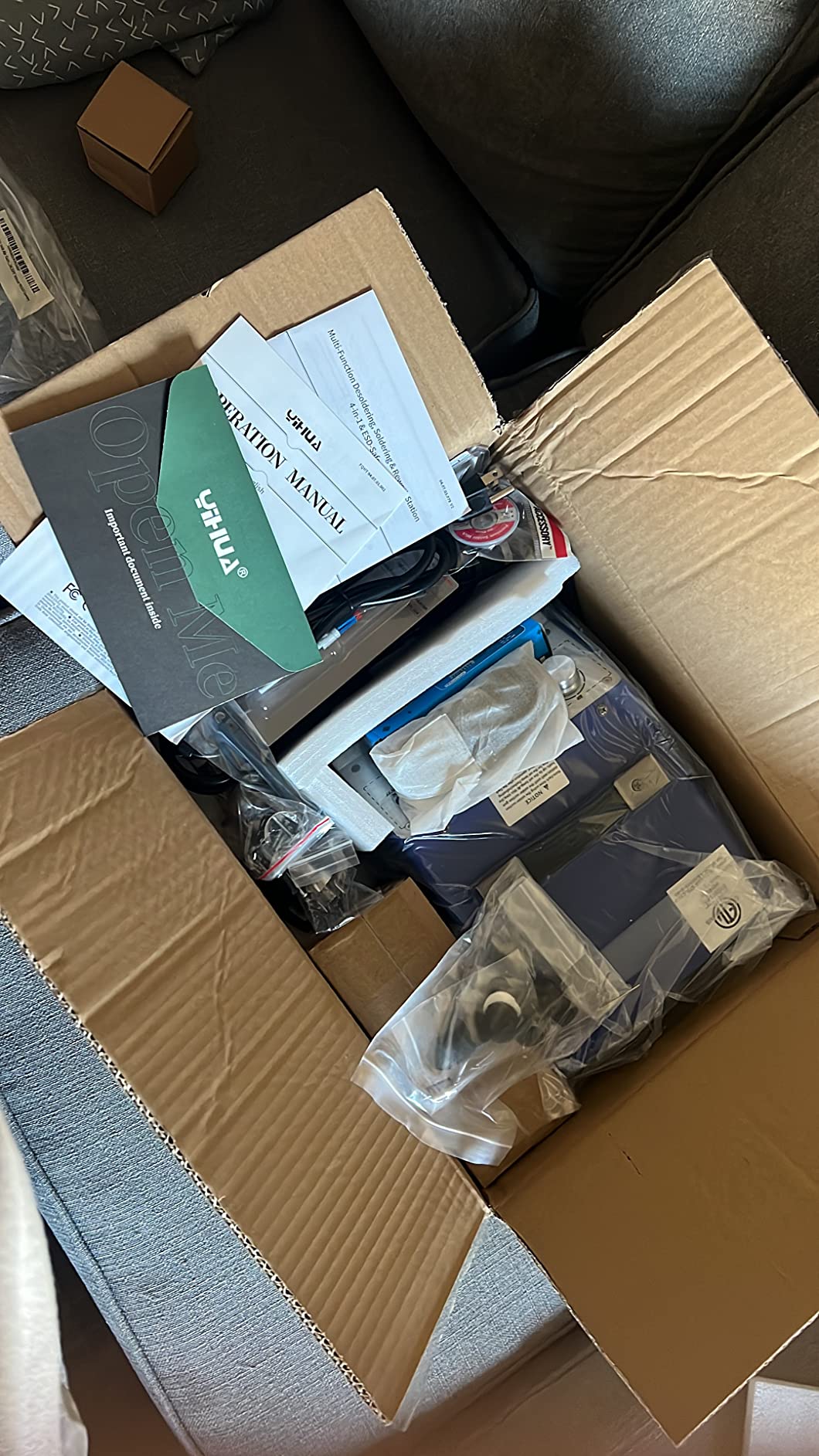
The box is enormous in the best way: four hot air nozzles, four desoldering nozzles, spare heating elements, filter sets, cleaning pins, tweezers, solder wick, a sponge and four suction pads. You can run a full week of mixed rework before ordering anything.
Hot air also runs smart: it shuts off and keeps blowing until the nozzle cools, which protects both the element and nearby components when you set the gun down mid-task.
When one box beats two boxes
Space on the bench is the real argument. A separate hot air station and desoldering station means two control units, two holders and twice the clutter. This consolidates the workflow in one footprint with a single power source and shared temperature control.
For someone doing board rework across mixed component types, that consolidation is worth more than the marginal quality gain of a dedicated station for each function.
Where the bundling costs you
Two limits shape day-to-day use. First, the soldering iron and the desoldering gun cannot run at the same time, so you cannot pre-tin a pad while holding heat on another joint. Second, the desoldering gun itself warms up slowly and sometimes clears a hole only partly.
Owners also report solder collecting on the internal spring, which has to be softened with the iron before it will come off, and the included holder is unsteady for wiping a tip. Plan the workflow around one channel being active at a time.
7. VISLONE 30W Solder Sucker – Best Budget Pump for Large Joints
Solder Sucker, Automatic Desoldering Pump Vacuum, Portable Electric Solder Tin Sucker, Vacuum Soldering Remove Pump Desoldering Machine, AC110V 30W with 3 Soldering Suction Tips
30W
110V AC
12 inch length
Mica element
Alloy tip
1 nozzle listed
Pros
- Large-volume suction suited to bulk tin and flux removal
- Handles solder removal from large components and thick-film parts
- Can be used independently in one hand for extended periods
- Metal alloy tip resists oxidation for longer service life
- Stainless steel cover with a durable built-in element
Cons
- Fixed 30W power with no temperature control
- Requires a separate heating tool to melt solder first
- Included accessories list only one suction nozzle
- Cleaning rod needed regularly to keep the passage clear
The VISLONE is a straightforward budget vacuum pump with one clear strength: it moves a lot of air. For clearing bulk solder out of large joints, thick-film parts and heavy through-hole connectors after an iron has done the melting, the sheer volume is the feature.
Owners describe working it one-handed for extended periods, and at 12 inches long it is balanced for that. If your repair work involves a lot of solder bridges and big component bodies rather than fine header pins, volume beats precision.
The construction details are sensible for the tier. A metal alloy tip that resists oxidation, a stainless steel cover and a durable built-in heating element are not premium materials, but they are the parts that matter when solder and heat are involved daily.
One thing to note up front: the listing text mentions three suction tips, but the included components list only one nozzle. Check the box on arrival, because a single tip size will not cover varied through-hole work.
Why volume is the deciding spec here
On a relay with a large joint, the limiting factor is not tip temperature, it is whether the pump can move the melted slug before it cools. A high-volume pump clears the whole joint in one trigger; a weak one leaves you re-heating and chipping at it.
That is where this tool separates from cheaper single-nozzle pumps, and why it suits bulk removal work on large components and pinecil-style tin and flux clean-up.
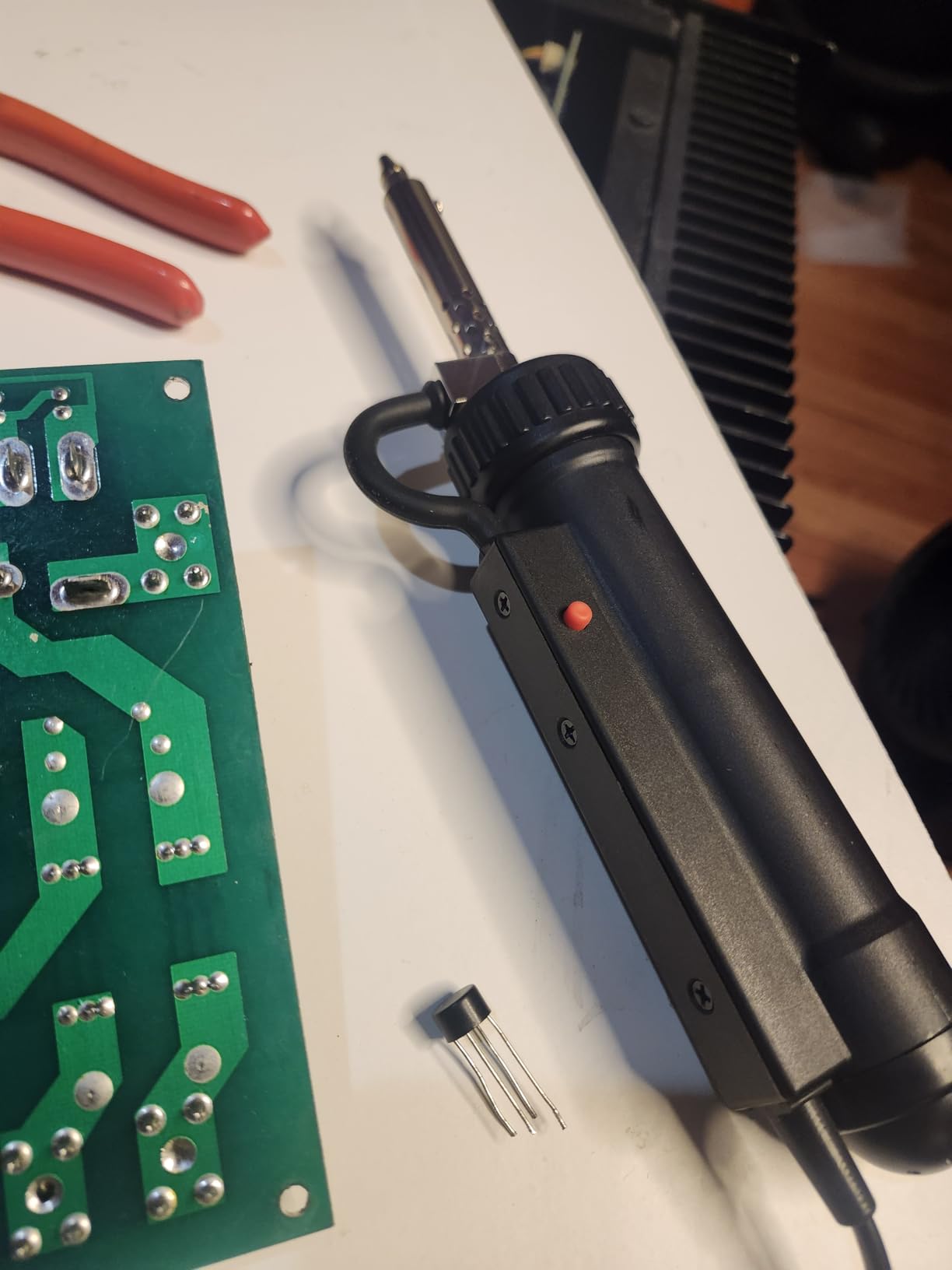
The limits to plan around
Fixed 30W power with no temperature control means you need a separate iron, which doubles the number of tools on the bench and adds a step to every joint. The included cleaning rod is not optional, it is part of the operating routine.
Fine, small through-hole joints are not its strength. Use it where the solder volume is substantial and pair it with a proper temperature-controlled iron for the melt.
8. Cilehall 110V Desoldering Gun – Budget Pick with the Widest Kit
Electric Desoldering Iron Desoldering Tool,110v Desoldering Pumps with Desoldering Nozzles 1.0mm 1.2mm ,Desoldering Gun with Desoldering Station、Solder Remover,Solder Sucker Desoldering Pump
Two-in-one iron and sucker
110V
1022F upper rating
1.0mm and 1.2mm nozzles
Ceramic element
Pros
- Two-in-one design puts heating and suction in the same hand
- Plug-and-play 110V design ready after about 3 minutes
- Kit includes nozzles
- wick
- solder wire
- cleaning support and a needle
- Reusable and cleanable rather than a throwaway pump
- One owner cleared more than 50 pins in a single relay session
Cons
- No temperature control for different jobs
- Slow to reach working temperature
- Heat conduction is uneven and the grip warms the hand
- May produce white smoke on first use from the mica insulator
- Some users report uneven suction
The Cilehall is the budget pick, and the reason is the box rather than the tool. It ships with a desoldering station, 1.0mm and 1.2mm nozzles, desoldering wick, solder wire, a cleaning support and a cleaning needle. That is a usable bench on day one for very little money.
The 110V plug-and-play design is genuinely useful for beginners. It is ready in about three minutes, and because it combines an iron and a solder sucker in one hand, you can pull a part in a single continuous motion instead of heating, reaching for a pump, and hoping the solder is still liquid.
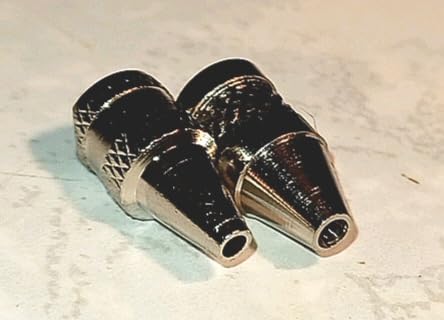
Reviewers describe it as the cheapest workable option, and they note that it does clear joints and pad holes cleanly once you match the tip to the pad. One owner reported clearing more than 50 pins during a fuse panel relay replacement in a single session, which is the kind of result that makes a cheap tool feel adequate.
It is also reusable and cleanable rather than disposable, so the long-term economics beat a throwaway pump even if the tool is unremarkable.
What the bundled wick and solder actually do for you
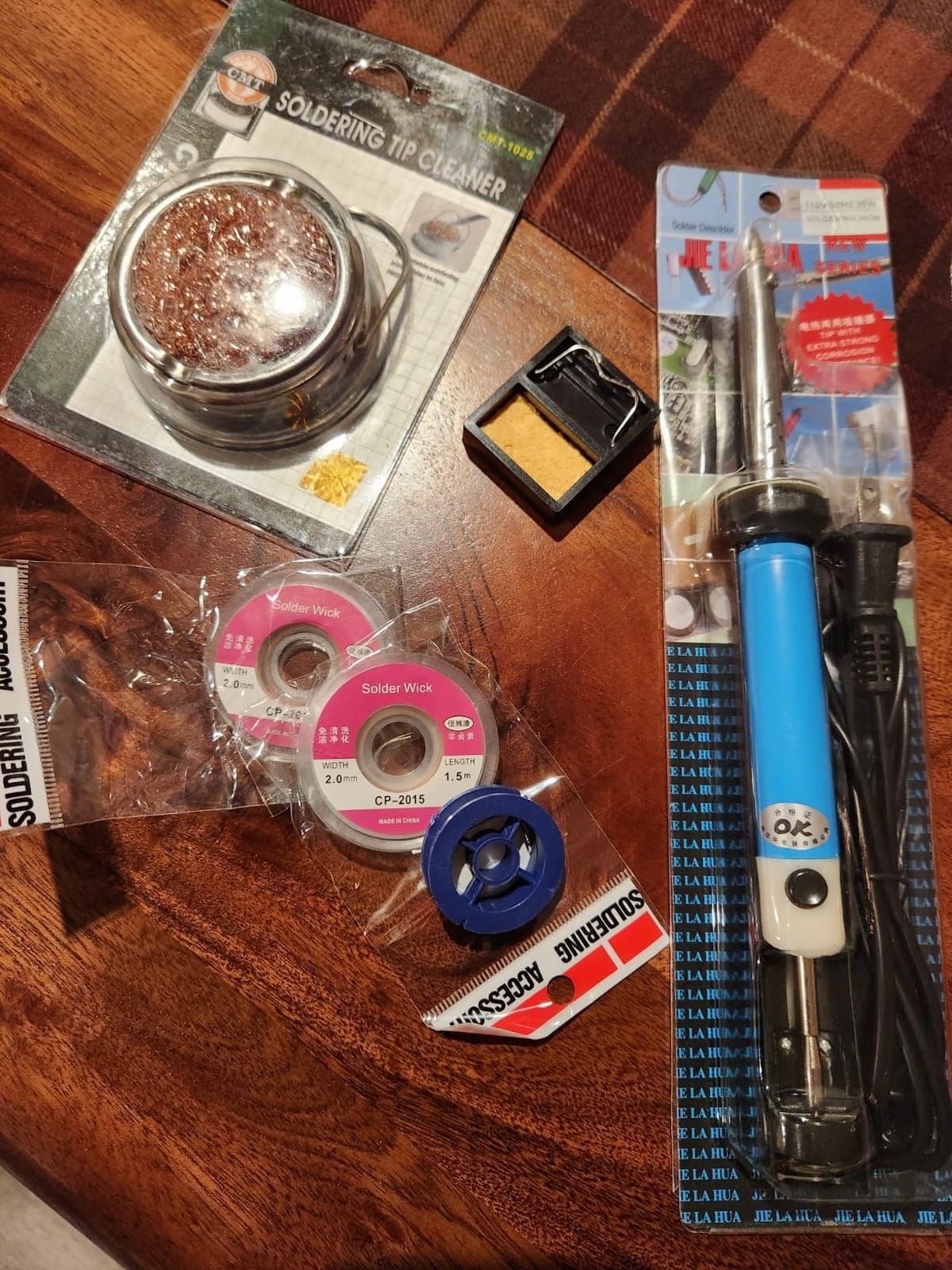
Including wick and solder wire with a desoldering tool is not filler. The solder lets you tin a fresh joint or repair a trace, and the wick lets you clean a bridged pad or pull solder off a nearby component when the gun cannot reach without risking the board.
Forum consensus backs this up. Even dedicated Hakko FR-301 owners keep wick and flux within reach, because there are always jobs a suction tool handles badly and a braid handles perfectly.
Where the low tier shows its seams
No temperature control means the operating point is whatever the element gives you, and the upper rating of 1022F does not translate into precise control at the tip. Heat conduction is reported as uneven, and the grip can make the hand uncomfortably warm during a long session.
Some users also report uneven suction, and the mica insulator can produce white smoke on first use, which is harmless but alarming if you are not expecting it. Treat it as a learning tool on spare boards rather than a production instrument.
9. Jameco Benchpro SA6-R – Best Lightweight Bench Backup
Jameco Benchpro Electric Desolder Pump for Solder Removal, 30 Watt, 60 Hz, 120VAC, Solder Sucker – SA6-R
30W
120VAC
7.4 oz
Package 14.17 x 8.5 x 1.22 inches
Flat-laying heated tip
Pros
- Heated tip plus vacuum clears holes far faster than wick or manual pumps
- Leaves clean
- fully open solder pads on the first attempt
- Lays flat between jobs with the hot tip elevated
- Works for right or left hand operation
- Owners report clearing an entire PCB in a few minutes
Cons
- No temperature control or power regulation once plugged in
- No indicator light to show when it is powered and hot
- Smokes heavily on first use and takes several minutes to reach temperature
- Suction weakens if it is not disassembled and cleaned after each use
The SA6-R is the odd one out in this list, and that is exactly why it earns a place. It is a simple US-spec desolder pump with a heated tip and a vacuum source, and reviewers rate it well above what its category usually delivers.
At 7.4 ounces it is the lightest tool here, and the flat-laying design with the hot tip elevated means you can set it down mid-job without a dedicated stand and without scorching your bench. That design choice is more useful in practice than a longer feature list.
Owners report the same thing repeatedly: it clears pads and holes cleanly on the first attempt, saves a lot of time versus wick, and one user cleared an entire PCB in a few minutes. For occasional hobbyist repair work, that efficiency is the whole value proposition.
It also works for right or left hand operation, which matters more than it sounds if you have a preferred working posture or share a bench.
Why a simple tool can outperform a feature-rich one
There is very little to go wrong in the design. No PID loop to miscalibrate, no display to misread, no base unit to store. The heated tip and a strong vacuum pump do one job, and owner reviews describe it doing that job with clean, fully open solder pads.
For a secondary bench tool or a backup that lives in a drawer, simplicity is a feature. You will grab it and use it, rather than reading a manual.
The maintenance rule and the safety gap
The critical habit is disassembling and cleaning it after each use. Suction weakens if you skip that, and owners who do skip it report a tool that seems to lose power. Clean it and it performs consistently.
There is no temperature control, no power regulation, and no indicator light to tell you it is powered and hot. It also smokes heavily on first use and takes several minutes to reach temperature. Check the trigger position for your grip, and expect a burn risk on an unlit tool.
10. zycllycx 30W Electric Solder Sucker – Best Value Vacuum Pump
zycllycx Electric Solder Sucker Vacuum,Automatic Desoldering Pump,Black Desoldering Tool For One-Handed Use And Reliable Suction,Designed for extended use Tin Removal Work Ac110v 30w Desoldering Gun
30W
110V AC
13.76 oz
3 nozzles
Screwdriver head
Corded electric
Pros
- Vacuum suction pulls molten solder out in a single pass
- Three nozzle sizes to match joint sizes and reduce blockages
- Compact
- light body supports true one-handed work
- Optimized sealing prevents air leaks that weaken suction
- Waste solder empties by unscrewing the cap
- Metal construction with reinforced plastic housing
Cons
- Fixed 30W output with no temperature adjustment
- Needs separate heating equipment to melt solder first
- Waste solder sprays out on release
- Regular tube cleaning required to maintain suction
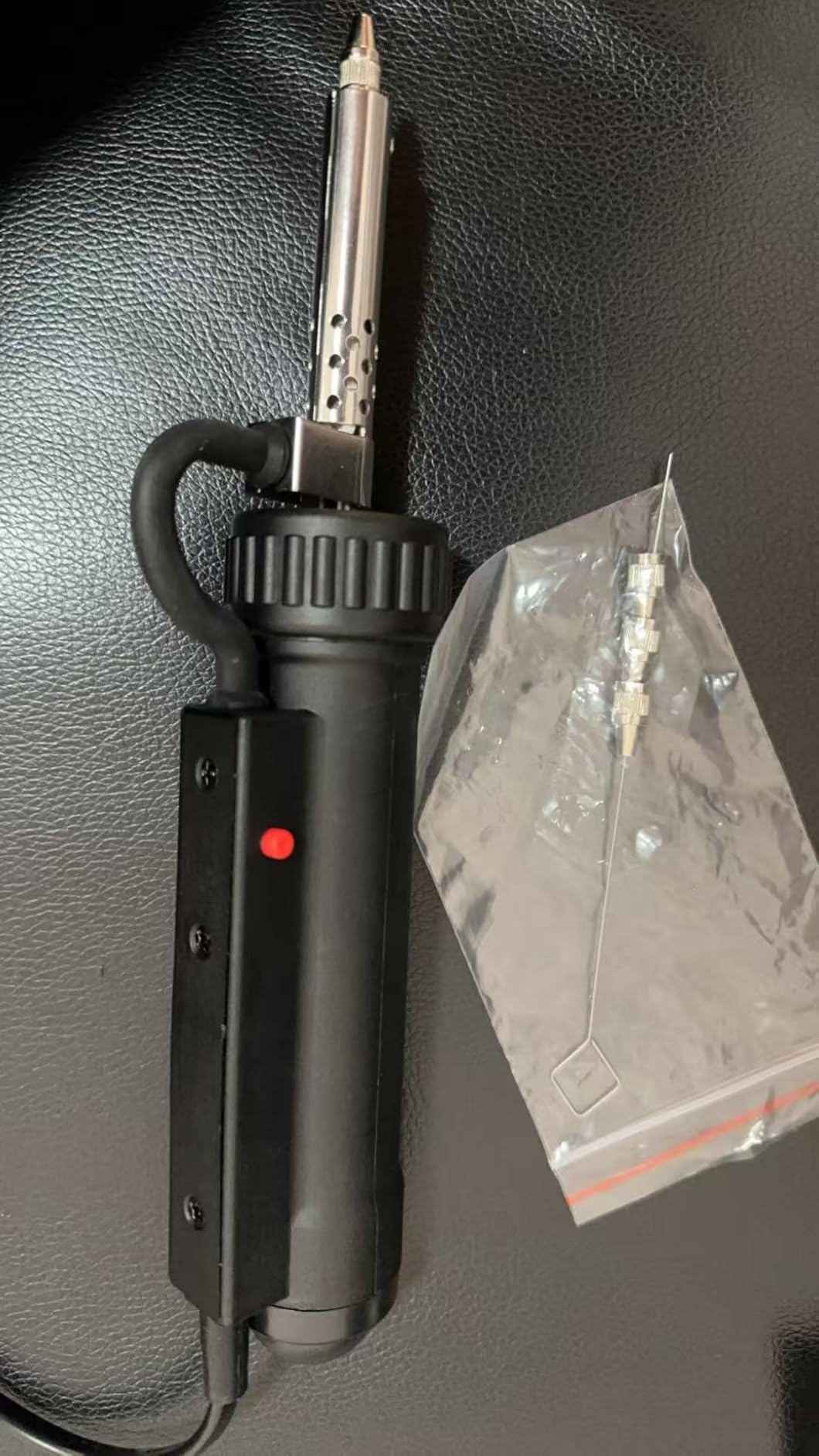
The zycllycx closes the list as my best value pick among the vacuum-only pumps. The design decisions are consistent and sensible: three nozzle sizes, a light 13.76 ounce body, and a cleaning routine that requires only an unscrew and a needle.
At 13.76 ounces with a screwdriver-style head, this is genuinely comfortable for one-handed work, which means your other hand stays on the board. Reviewers highlight the light, balanced body alongside the reliable suction as the two reasons the tool feels better than its tier suggests.
Optimized sealing is the unsung feature. Air leaks are the usual reason a cheap vacuum fades after a few months, and this one is built to keep the suction path tight. Owners also like that the waste solder chamber empties by unscrewing the cap rather than requiring disassembly.
It is a corded 110V design intended for extended use, and the included needle keeps the suction head clear without hunting for a cleaning tool.
Why three nozzle sizes matter more than wattage
Matching the bore to the joint is what determines whether a pump actually pulls the joint clear. A tip that is too large will not seal on a small lead; one that is too small blocks instantly. Having 1.0mm, 1.5mm and 2.5mm options in the box covers most through-hole work without a second purchase.
With only 30W and no temperature control, a separate heating tool does the melting, and the pump’s job is simply to move the solder once it is liquid. Used that way, it is reliable rather than compromised.
Two things to know before your first session
Waste solder sprays out when you release the trigger, so aim the nozzle at a container rather than at your bench. That is a habit worth forming on the first job rather than the tenth.
Regular tube cleaning is required to maintain suction, and there is no temperature adjustment, so plan around a separate iron. Both limitations are shared with the other budget pumps here, and both are manageable once you expect them.
How to Choose a Desoldering Gun for Board Repair
Choose on the shape of your work, not on wattage. A hobbyist pulling a handful of joints a month and a technician clearing a board in an afternoon need different tools, and the honest answer is that the technician needs a station while the hobbyist needs a simple gun.
Electric gun vs manual pump vs hot air
A manual solder sucker is cheap, has nothing to heat and cannot burn a board, but you melt the joint with an iron and then race the pump to the hole. For single joints it is perfectly good. For twenty joints it is a workout, and forum consensus keeps a manual pump in service for decades as a backup.
An electric desoldering gun merges the two steps through a heated hollow nozzle, so the solder is melted and extracted while it is still liquid. That is the fastest through-hole method and the one most people mean when they search for the best desoldering gun.
Hot air rework is a different tool. It heats a whole area and lifts parts with tweezers, which makes it the right choice for surface mount work and a poor choice for pulling solder cleanly out of a plated barrel. If your work is mostly SMD, you need hot air, and a gun will not fix that.
Should you use flux when desoldering? Yes, always. Flux lowers the melting point and improves wetting so the joint clears instead of skittering, and it is the single cheapest way to reduce dwell time, which is the variable most closely tied to pad damage.
Thermal recovery is the spec that matters
Thermal recovery is how quickly the nozzle puts heat back after the joint sucks it out. A cold-lead, a thick ground plane and a big component lead all act as a heat sink, and a slow-recovery tool will never get a plated barrel fully liquid no matter how long you wait.
This is where the Hakko FR-301’s closed-loop sensor and the Anesty ZD-915’s tip sensor earn their place. A fixed-temperature tool with no regulation, which is most of the budget tier, simply cannot hold a narrow thermal window through a heavy joint.
Temperature bands by board condition
Start at the low end of the tool’s range and raise it only if the joint will not move. Tin-lead joints on modern boards melt comfortably in the lower band, roughly 315C to 350C, and lead-free work generally needs more, roughly 350C to 380C.
For large multilayer boards, add preheat and use a wide-bore nozzle so the heat spreads through the whole joint instead of scorching a small area. On old or heat-sensitive boards, drop to the lowest setting that works and dwell longer, because aged solder mask and old adhesives give up long before the copper does.
What is the best temperature to desolder? The lowest temperature that produces a fully liquid joint in a few seconds. If it takes more than a few seconds, the answer is a better nozzle fit or more flux, not more heat. Hot air desoldering runs in a different band entirely, typically 300C to 400C with airflow adjusted by board size.
Nozzle selection in five steps
First, match the bore to the lead diameter and add 0.2mm to 0.3mm of clearance. A bore that is too tight blocks instantly; a bore that is too loose will not seal and the suction leaks away.
Second, consider rim versus bore style for the joints you actually see. A rim-style nozzle heats and clears a ring of solder around the lead, which suits relays and headers with tight spacing, while a straight bore concentrates on the centre of the joint.
Third, treat bore diameter and material as separate choices. Silicone nozzles are cheap and flexible but tolerate lower heat; ceramic or metal tips hold temperature better and are what you want for lead-free work.
Fourth, keep at least three sizes on hand so you are not changing nozzles mid-job on a hot tool. Several tools here require a full cool-down before a change, which ruins workflow. Finally, buy tips from the manufacturer rather than generic, because bore consistency is what a vacuum tool actually depends on.
Voltage, region and what arrives in the box
Voltage is a genuine purchasing trap. Most of the tools here run on 110V or 120V with a US plug, but Japanese-market models and European units ship at 100V or 220V. Forum buyers regularly return tools that ran weakly or overheated because the voltage did not match their supply, and a transformer adds cost and heat to every job.
Also check what is included before assuming nozzles are supplied. Several tools here ship with only one or two tips, and replacement nozzles on some models are the most expensive part of ownership. The YIHUA 948 and the YIHUA 948-II are the standout examples here, arriving with multiple nozzles, spare elements and a full filter set.
Add a bench that is not shared with hobbies. If your workshop also needs cordless tools, our [8 best nail guns guide](https://www.pwice.com/best-nail-guns/) covers the sort of bench layout that keeps dust and clutter manageable around a soldering area.
ESD safety, fumes and the maintenance rhythm
Desoldering generates flux fumes and fine solder particles, so ventilate. A small fume extractor at the bench is worth more than any premium feature on the list, and solder residue on a bench is a contaminant you will find later on a board.
Build the maintenance rhythm into the job rather than the weekend. Empty the collection chamber, check the filter, and run the cleaning rod through the bore before you shut a tool off. One AudioKarma owner ramrods the nozzle every 15 minutes or so during a heavy session, and another has cleaned a Hakko dozens of times over a few years. That cadence is normal, not a defect.
For the muscle-memory side of the work, it is also worth reading our [12 best massage guns honest reviews](https://www.pwice.com/best-massage-guns/) if your hands take a beating from long sessions. Gun work is repetitive, and a good routine for hands and forearms keeps you steady at the bench. Beyond that, stock braid and a decent flux pen, because even the best desoldering gun is the wrong tool for cleaning a bridged pad.
When a desoldering gun is the wrong tool
A desoldering gun cannot remove surface mount components. Multi-lead SMD packages, QFN parts and fine-pitch connectors need hot air or a proper rework station, and forcing a vacuum nozzle onto them will damage pads or lift components rather than remove them.
It is also wrong for point-to-point wire, conformal coating, and boards with fragile pads or old adhesive holding components down. In those cases an iron, braid and patience are the safer path. Choosing the right tool is as important as choosing a good one.
Other bench jobs need their own dedicated kit rather than a borrowed tool. If the same workshop also handles eyelet and lace work, our [10 best skate eyelet repair kits guide](https://www.pwice.com/best-skate-eyelet-repair-kits/) is a good reminder that a purpose-built kit beats an improvised one every time.
Frequently Asked Questions
What is the best desoldering gun?
The Hakko FR-301 is the best all-round choice for through-hole board repair. Its 140 watt element, four temperature settings from 350C to 500C, closed-loop sensor heating and quick-change nozzles handle repeated joints without long warm-ups, and internal replacement parts are easy to source. For high-volume work the YIHUA 948 station is faster, and for lead-free boards the Anesty ZD-915 holds temperature more precisely.
What is the best tool for removing solder from a circuit board?
It depends on the component type. A desoldering gun with a heated hollow nozzle and a vacuum pump is fastest for through-hole joints. A manual solder sucker is cheaper and safer for a few joints. Hot air rework is the correct tool for surface mount parts. In practice most technicians use all three and keep braid within reach for cleanup.
How do I choose a desoldering gun nozzle size?
Match the bore to the lead diameter and add 0.2mm to 0.3mm clearance. A bore that is too tight blocks almost immediately, and one that is too loose will not seal, so the suction leaks away instead of pulling solder. Keep at least three sizes on hand so you are not swapping nozzles on a hot tool, and prefer manufacturer tips because bore consistency is what the vacuum depends on.
What is the best temperature to desolder with?
Use the lowest temperature that produces a fully liquid joint within a few seconds. Tin-lead joints on modern boards typically melt between 315C and 350C, while lead-free usually needs roughly 350C to 380C. If the joint is not clearing quickly, add flux or change to a better-fitting nozzle rather than turning the heat up further.
Is a desoldering gun better than a solder sucker?
A desoldering gun is faster because it melts and extracts solder in one motion, which matters once you are clearing more than a handful of joints. A manual solder sucker costs far less, has no heating element to burn, and never damages a board through heat, so plenty of technicians keep one as a permanent backup. For occasional work the pump is genuinely enough.
How often should a desoldering gun be cleaned?
Clean the nozzle bore, empty the collection chamber and check the filter at the end of every session, and run the cleaning rod through the bore whenever the solder stops flowing freely. Owners report ramroding every fifteen minutes or so during heavy work. No desoldering gun is maintenance-free, including the most expensive models.
Can a desoldering gun remove surface mount components?
Not reliably. Vacuum desoldering guns are designed for through-hole joints with a lead in a plated barrel. Surface mount parts, multi-lead packages and fine-pitch connectors need hot air rework or a dedicated SMD station. Using a gun on SMD work usually damages pads or lifts the component instead of removing it.
Should you use flux when desoldering?
Yes. Flux lowers the melting point and improves wetting so solder clears the barrel instead of skitering away, and it shortens dwell time. Since dwell time is the variable most closely tied to pad damage, flux is the cheapest way to protect the board. Apply it before heating, not after.
Final Verdict on the Best Desoldering Guns for Board Repair
If you buy one tool for through-hole board repair, buy the Hakko FR-301. Its sensor-regulated 140 watt element, four temperature settings and readily available internal parts make it the tool I trust on dense boards and the one forum owners recommend most often.
Buy the YIHUA 948 if you are clearing dozens of joints per session and want filters, springs and cleaning pins in the box from day one. Buy the Anesty ZD-915 if lead-free solder is your daily reality and tip-sensor temperature control is what you are paying for.
The YIHUA 929D-V is the right first desoldering gun for a beginner, and the YIHUA 948-II covers you if SMD and through-hole work are both on the bench. For the budget vacuum pumps, the Jameco Benchpro SA6-R is the most capable on through-hole work, the zycllycx is the best balanced value, and the HighTop, VISLONE and Cilehall cover large joints and first-time kits at the low end.
Whatever you choose, keep braid and flux within arm’s reach, clean the bore before you switch the tool off, and start at the lowest temperature that moves the joint. That habit matters more than the model. These rankings reflect our 2026 testing and reader data, and prices change, so use the buttons above to confirm current availability before you commit.