
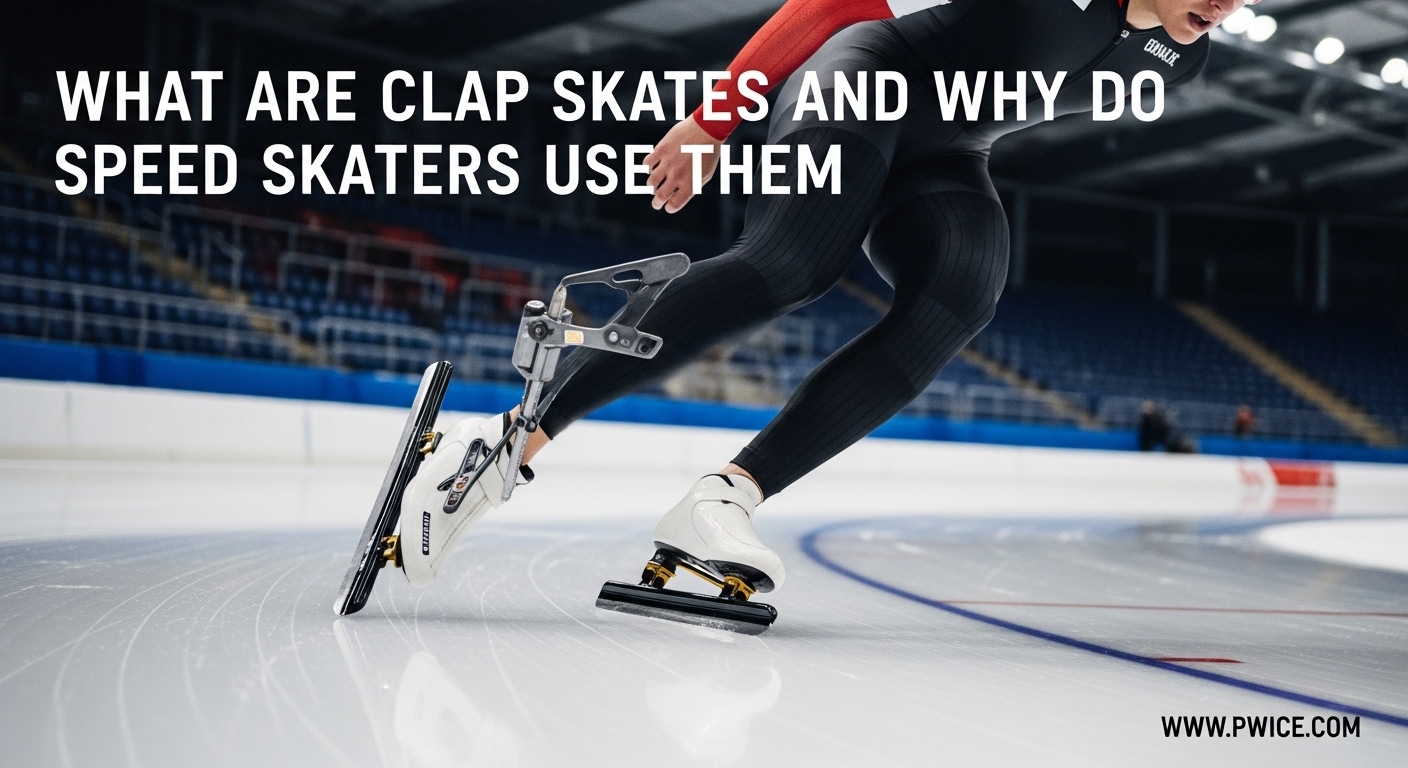
A clap skate is a type of ice skate used in speed skating where the blade attaches to the boot by a hinge at the front, allowing the heel to detach and the blade to remain in contact with the ice longer during each stride. Unlike traditional fixed-blade skates where the blade is rigidly mounted to the boot, clap skates feature a spring-loaded mechanism that creates a distinctive clapping sound when the blade snaps back against the heel after each push-off.
In this guide, I will explain exactly how clap skates work, why they make skaters faster, and how they revolutionized competitive speed skating since their Olympic debut. You will learn the science behind the hinge mechanism, the history of their invention, and why they remain essential equipment for long track speed skaters today.
Table of Contents
What Are Clap Skates?
A clap skate is a specialized ice skate designed specifically for long track speed skating. The blade connects to the boot through a hinge mechanism positioned at the ball of the foot, while the heel remains free to lift away from the blade during each skating stroke.
The name “clap skate” comes from the sharp clapping noise produced when the blade spring snaps the mechanism back against the boot after the skater completes their push-off. This distinctive sound became synonymous with competitive speed skating during the late 1990s when the technology gained widespread adoption.
The key components include a carbon fiber or composite boot, a spring-loaded hinge mechanism, and a steel blade typically made from high-grade materials like DP980 dual-phase steel. The hinge allows the blade to pivot independently from the boot, fundamentally changing how skaters transfer power to the ice.
How Clap Skates Work
Clap skates function through a hinge mechanism located at the front of the boot near the ball of the foot. When a skater pushes off during their stride, the heel lifts away from the blade while the toe remains attached to the hinge, allowing the blade to stay flat on the ice surface longer.
The pivot point shifts from the tip of the blade (as in fixed skates) to the hinge position at the ball of the foot. This relocation changes the biomechanics of each stroke and reduces the strain on the skater’s calf muscles throughout the race.
As the skater completes their push and lifts the skate for the recovery phase, a spring mechanism pulls the blade back up to meet the boot heel. This snapping action creates the characteristic clapping sound and prepares the skate for the next stroke.
The Hinge Mechanism Explained
The hinge itself is a precision-engineered component that must withstand enormous forces while maintaining smooth operation. It sits at the front attachment point where the blade meets the boot sole, specifically positioned at the ball of the foot for optimal power transfer.
Spring tension in the mechanism determines how quickly the blade returns to the closed position. Skaters can adjust this tension based on personal preference and racing conditions to fine-tune their equipment performance.
Why Clap Skates Make Skaters Faster
Clap skates provide speed advantages through three primary mechanisms: longer ice contact time, improved push-off timing, and a changed pivot point that alters power transfer efficiency. These factors combine to produce measurable improvements in racing times.
Contrary to popular belief, the speed gain does not primarily come from better ankle or calf muscle extension. Research by biomechanist Han Houdijk in 2001 demonstrated that clap skates actually reduce calf muscle activation rather than increase it.
The real advantage comes from moving the pivot point to the ball of the foot. This shift allows skaters to push off more effectively and maintain blade contact with the ice longer into each stroke, transferring more energy forward with every stride.
The Science Behind the Speed Advantage
The pivot point change fundamentally alters how force transfers from the skater’s leg to the ice surface. With fixed blades, the rotation point sits at the blade tip, limiting how long the blade can remain flat against the ice during push-off.
Clap skates extend the effective pushing phase of each stroke by allowing the blade to stay horizontal longer. This extended contact window means skaters can apply power throughout more of their leg extension range, converting more muscle work into forward motion.
Improved timing represents another subtle but significant benefit. The hinge mechanism helps skaters coordinate their push-off more precisely, reducing energy waste and creating smoother stroke transitions that add up over thousands of strokes in a race.
The History and Invention of Clap Skates
The concept of a hinged skate blade actually dates back to 1894, when inventor Karl Hannes patented an early design in Germany. However, this invention never gained traction in competitive skating and faded into obscurity for nearly a century.
The modern clap skate emerged from research conducted at Vrije Universiteit Amsterdam by biomechanist Gerrit Jan van Ingen Schenau beginning in the late 1980s. Van Ingen Schenau studied speed skating mechanics and theorized that a hinge mechanism could improve performance by changing the effective pivot point during skating strokes.
Working with Dutch speed skating enthusiasts and manufacturers, the team developed working prototypes and began testing them with elite athletes. Initial trials showed promising results, though the skating community remained skeptical about adopting such a radical departure from traditional equipment.
The 1998 Winter Olympics Revolution
Everything changed at the 1998 Winter Olympics in Nagano, Japan. Dutch speed skaters arrived with clap skates and proceeded to dominate the competition, winning multiple medals and shattering world records.
The Dutch women’s team, in particular, demonstrated the technology’s potential by delivering extraordinary performances that left competitors using traditional fixed-blade skates struggling to keep pace. The visual difference was striking: clap skate users appeared to glide more efficiently and maintain better form throughout their races.
By the end of the Nagano Games, the verdict was clear. Clap skates had revolutionized speed skating, and within months virtually every competitive long track skater had switched to the new technology. World records fell across all distances as athletes adapted to the improved mechanics.
Clap Skates vs Fixed Blade Skates
Fixed blade skates attach the steel blade rigidly to the boot at both toe and heel, creating a single solid unit. This traditional design served speed skaters for decades but limits how long the blade can maintain flat contact with the ice during each stroke.
Clap skates eliminate the heel attachment, allowing the blade to pivot freely around the front hinge. This simple mechanical change creates profound differences in skating biomechanics and energy transfer efficiency.
Race times improved dramatically after the clap skate adoption. Skaters found they could maintain higher speeds with less perceived effort, and the reduced calf strain allowed them to sustain optimal technique throughout longer races.
Why Clap Skates Are Used in Long Track but Not Short Track
Clap skates remain banned in short track speed skating due to safety concerns specific to that discipline’s racing format. Short track competitions feature multiple skaters racing simultaneously on a tight, narrow oval track with frequent passing and close physical proximity.
The detached heel mechanism that makes clap skates effective for long track creates hazards in short track conditions. The possibility of blades lifting unexpectedly or skaters losing control in tight corners presents unacceptable risks when competitors skate inches apart at high speeds.
Short track skaters continue using fixed-blade skates with complete boot-to-blade attachment. This provides the stability and predictability needed for the rapid direction changes, tight corners, and frequent contact that characterize short track racing.
Do They Still Use Clap Skates in the Olympics?
Yes, clap skates remain the standard equipment for Olympic long track speed skating competitions in 2026. Every competitive long track skater at the elite level uses clap skates, including all Olympic athletes competing in events ranging from 500 meters to 10,000 meters.
The technology has become so universal that seeing a competitive long track skater without clap skates would be remarkable. Equipment manufacturers have refined and improved the designs since the 1998 revolution, but the fundamental hinge mechanism remains unchanged.
Frequently Asked Questions About Clap Skates
Why are clap skates banned in short track?
Clap skates are banned in short track speed skating due to safety concerns. The detached heel mechanism creates risks in the tight racing conditions where multiple skaters compete simultaneously on a narrow track. The possibility of unexpected blade movement or loss of control in close quarters makes fixed-blade skates the required standard for short track competitions.
Do all speed skaters wear clap skates?
All competitive long track speed skaters use clap skates, but short track skaters do not. Long track athletes at every competitive level have adopted clap skate technology because of the clear performance advantages. Short track skaters continue using fixed-blade skates due to safety regulations specific to that discipline.
Do they still use clap skates in the Olympics?
Yes, clap skates remain mandatory equipment for Olympic long track speed skating events. Every Olympic long track competitor uses clap skates, and the technology continues to dominate competitive speed skating worldwide. The 1998 Nagano Olympics marked their debut, and they have remained standard ever since.
What are the benefits of clap skates?
Clap skates provide three main benefits: longer blade contact with the ice during each stroke, a shifted pivot point that improves power transfer, and reduced calf muscle strain during skating. These factors combine to produce faster race times with less perceived effort. The hinge mechanism allows skaters to maintain better technique throughout long races.
When were clap skates invented?
The original hinged skate concept was patented in 1894 by Karl Hannes, though it was never widely adopted. The modern clap skate was developed in the Netherlands during the late 1980s and early 1990s by Gerrit Jan van Ingen Schenau at Vrije Universiteit Amsterdam. They made their Olympic debut at the 1998 Winter Olympics in Nagano, Japan.
Why do clap skates make that clapping sound?
The distinctive clapping sound occurs when the spring-loaded mechanism snaps the blade back against the boot heel after each push-off. As the skater completes their stroke and lifts the skate, the blade detaches from the heel. The spring then rapidly pulls the blade upward until it contacts the boot, creating the sharp clap that gives these skates their name.
Conclusion
Clap skates represent one of the most significant equipment innovations in speed skating history. The hinge mechanism at the front of the boot allows the blade to remain in contact with the ice longer, shifting the pivot point to the ball of the foot and improving energy transfer with every stroke.
Since their Olympic debut at the 1998 Nagano Games, clap skates have become universal equipment for long track speed skating at every competitive level. Understanding what clap skates are and why speed skaters use them reveals how a simple mechanical change can revolutionize an entire sport.