
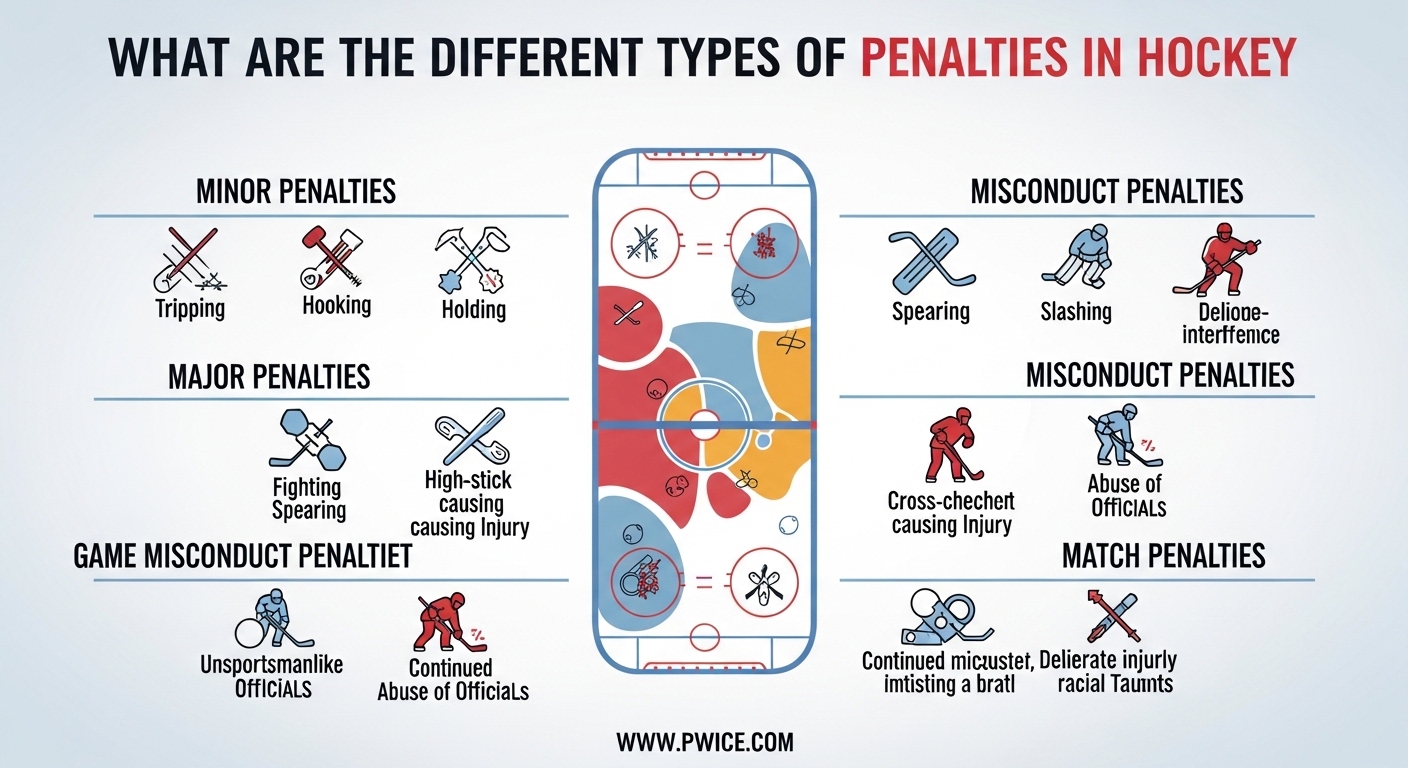
When I first started watching hockey, the penalty system seemed like a puzzle with too many pieces. The types of penalties in hockey range from simple two-minute infractions to game-ending ejections. Understanding these rules transforms how you experience the game, whether you are a new fan, a youth hockey parent, or tracking fantasy hockey stats.
A penalty in ice hockey is a punishment for rule violations that results in the offending player sitting in the penalty box. Their team must then play shorthanded, creating a power play opportunity for the opposition. Penalty minutes, or PIM, track these infractions in the official statistics.
Let me walk you through every type of penalty you will encounter in hockey. I will cover the five main categories, explain how enforcement works, and answer the questions that confuse most fans.
Table of Contents
Quick Reference: Hockey Penalty Types at a Glance
Before diving into the details, here is a quick comparison of all hockey penalty types, their durations, and their effects on the game.
| Penalty Type | Duration | Team Plays Shorthanded | Ends on Goal |
|---|---|---|---|
| Minor | 2 minutes | Yes | Yes |
| Double Minor | 4 minutes | Yes | Yes (after 2 min) |
| Bench Minor | 2 minutes | Yes | Yes |
| Major | 5 minutes | Yes | No |
| Misconduct | 10 minutes | No | N/A |
| Game Misconduct | Ejection | Yes (5 min major served) | No |
| Match Penalty | Ejection + suspension | Yes (5 min served) | No |
This table gives you the essentials at a glance. Keep reading for the detailed breakdown of each penalty type and what they mean for the game.
Minor Penalties (2 Minutes)
Minor penalties are the most common infractions in hockey. They last two minutes and send the offending player to the penalty box while their team plays shorthanded.
The key feature of a minor penalty is that it ends early if the opposing team scores a goal. This gives the power play team extra incentive to attack quickly. The penalized player returns to the ice immediately after the goal.
Common examples of minor penalties include tripping, hooking, holding, slashing, and interference. The referee raises one arm straight up to signal a minor penalty. The penalized player must remain in the box for the full two minutes unless the opposition scores.
If a team commits multiple minor penalties, they can end up in a five-on-three situation. This happens when two players from the same team are in the penalty box simultaneously. These are some of the most exciting moments in hockey, as the shorthanded team scrambles to defend while the power play team has massive space to operate.
Double Minor Penalties (4 Minutes)
Double minors are essentially two minor penalties served consecutively by the same player. They last four minutes total and are most commonly called for high-sticking that draws blood.
The unique aspect of double minors is that they can end partially. If the opposing team scores a goal in the first two minutes, only the first minor is wiped out. The player must then serve the remaining two minutes.
High-sticking is the most frequent double minor. When a player raises their stick above shoulder height and makes contact with an opponent, the referee calls a minor. If that contact causes bleeding, the penalty becomes a double minor. This rule emphasizes player safety around the face and head area.
Bench Minor Penalties (2 Minutes)
Bench minors are served by any player on the ice from the offending team, not the specific player who committed the infraction. These penalties are called against the team rather than an individual.
The most common bench minor is “too many men on the ice.” This happens when a team has more than six players (including the goalie) on the ice during play. Another common bench minor is unsportsmanlike conduct from the bench, such as abuse of officials or throwing objects onto the ice.
The coach chooses which player serves the penalty, and this selection can be strategic. Coaches often pick a player who just finished a shift or someone whose role is less critical during the penalty kill. Like regular minors, bench minors end when the opposing team scores.
Major Penalties (5 Minutes)
Major penalties are called for more serious infractions that endanger player safety. They last five minutes and, unlike minors, do not end early when a goal is scored.
Fighting is the most recognized major penalty in hockey. When two players drop their gloves and engage in a fight, both receive five-minute majors. These coincidental penalties result in both teams playing at even strength, not a power play.
Other major penalties include boarding, charging, cross-checking to the head, and spearing. These involve dangerous contact that could cause injury. The severity of the penalty reflects the potential harm to the victim.
Major penalties create five-on-three situations when combined with other penalties. If one team has a major and the other has a minor, the team with the minor plays shorthanded for the full five minutes. This can dramatically swing momentum and lead to multiple goals.
Misconduct Penalties (10 Minutes)
Misconduct penalties last ten minutes but do not cause the team to play shorthanded. Only the penalized player sits in the box, and their team can substitute another player immediately.
This penalty is primarily for unsportsmanlike behavior and disrespect toward officials. Players who argue excessively, use abusive language, or refuse to go to the penalty box when instructed can receive misconducts.
The key distinction is that misconducts punish behavior without putting the team at a competitive disadvantage. They serve as a cooling-off period for frustrated players. If a player receives a second misconduct in the same game, it becomes an automatic game misconduct.
Referees often use misconducts to manage game flow and prevent escalation. By removing a heated player for ten minutes, they give everyone time to calm down and reset.
Game Misconduct (Ejection)
A game misconduct results in immediate ejection from the game. The player must leave the ice and dressing room area immediately and cannot return.
Game misconducts accompany certain major penalties automatically. Boarding, charging, and head contact penalties often come with game misconducts in addition to the five-minute major. The combination ensures the dangerous player is removed while their team serves the penalty.
Players who accumulate multiple game misconducts face automatic suspensions. The NHL and IIHF have progressive discipline systems where repeat offenders receive longer bans. This deters dangerous play and protects player safety.
Interestingly, a substitute player serves the five-minute major while the ejected player sits in the locker room. This maintains the penalty advantage for the opposing team even though the offender is gone.
Match Penalties
Match penalties are the most severe punishments in hockey. They indicate that a player attempted to or deliberately injured an opponent.
When a match penalty is called, the player is ejected immediately and faces an automatic suspension pending review. Their team must substitute another player to serve a five-minute major penalty. Like other majors, this does not end early on a goal.
Match penalties are rare because they require clear evidence of intent to injure. Spearing with the stick blade, deliberate attempts to injure with the head, and extreme violence can trigger this call. The NHL Department of Player Safety reviews all match penalties for potential additional suspension time.
The five-minute major served by the substitute creates a significant disadvantage for the offending team. Even if they score during this time, the penalized player continues sitting. This makes match penalty situations particularly dangerous for the shorthanded team.
Penalty Shots
Penalty shots are unique among hockey penalties because they do not involve time in the penalty box. Instead, the fouled player gets an unimpeded breakaway attempt against the goaltender.
Penalty shots are awarded when a player with a clear scoring opportunity is fouled from behind. Common scenarios include being hooked on a breakaway or having a scoring chance denied by a thrown stick or illegal equipment.
The shooter starts from center ice and has one attempt to beat the goalie. No other players participate in the play. This creates a dramatic moment that can shift momentum regardless of the outcome.
If the shooter scores, the goal counts immediately and play resumes with a faceoff. If they miss, play continues with a faceoff at one of the end zones. The player who committed the foul receives no additional penalty beyond the shot being awarded.
Common Hockey Infractions and Their Penalties
Now that you understand the penalty types, let us look at the specific infractions that trigger them. Here are the most common violations you will see in any hockey game.
Tripping
Using the stick, knee, foot, arm, or hand to cause an opponent to fall. This is almost always a two-minute minor.
Hooking
Using the stick to impede an opponent’s progress by hooking their body or equipment. This is a two-minute minor.
Slashing
Hitting an opponent with the stick in areas other than the hands on the stick. Minor slashing is two minutes, but severe slashes to the hands or head can be majors.
High-Sticking
Carrying the stick above shoulder height and making contact with an opponent. Contact without blood is a double minor, while contact causing blood is a double minor. Intentional high-sticking can be a major or match penalty.
Boarding
Checking a defenseless opponent into the boards violently. Minor boarding is two minutes, but dangerous hits from behind are typically majors with game misconducts.
Charging
Taking multiple strides or traveling a distance to deliver a violent check. This is usually a two-minute minor, but severe cases result in majors.
Cross-Checking
Holding the stick with both hands and using it to check an opponent. Minor cross-checking is two minutes, while cross-checks to the head are majors with game misconducts.
Interference
Impeding the progress of an opponent who does not have the puck or preventing them from reaching the puck. This is a two-minute minor.
Holding
Grasping an opponent or their equipment to impede their movement. This is a two-minute minor.
Roughing
Excessive roughness not severe enough to be considered fighting. This is typically a two-minute minor but can escalate.
Elbowing
Using an elbow to foul an opponent. Minor elbowing is two minutes, but elbows to the head are majors with game misconducts.
Unsportsmanlike Conduct
Disrespectful behavior toward opponents or officials, including taunting, diving, or arguing. This is a two-minute minor or ten-minute misconduct.
Delay of Game
Actions that deliberately slow down play, such as shooting the puck over the glass from the defensive zone. This is a two-minute minor.
Goaltender Interference
Impeding the goaltender’s ability to defend the net or making contact inside the crease. This is a two-minute minor.
Too Many Men
Having more than six players on the ice during play. This is a two-minute bench minor.
Checking from Behind
Hitting a player who is unaware of the check from behind into the boards. This is a major penalty with automatic game misconduct due to the extreme danger.
Spearing
Jabbing an opponent with the blade of the stick. This is a double minor or major penalty depending on severity.
Kneeing
Using the knee to foul an opponent. This is typically a two-minute minor but can be upgraded for dangerous contact.
How Penalties Are Enforced
Understanding when penalties are called and how they are enforced adds another layer to appreciating hockey. The rules around enforcement create strategic situations that coaches and players must navigate.
Delayed Penalties
When a team commits a penalty but the opposing team still has possession of the puck, the referee raises their arm but does not blow the whistle immediately. This is called a delayed penalty.
The non-offending team can continue playing with an extra skater because the penalized team cannot touch the puck. They often pull their goaltender for a sixth attacker during this time.
Play stops when the offending team gains possession, the puck goes out of play, or a goal is scored. If a goal is scored during the delay, the minor penalty is wiped out, but major penalties are still served.
Coincidental Penalties
When both teams receive penalties at the same time, they are called coincidental penalties. When two players receive minors simultaneously, both teams serve the penalties, and play continues four-on-four.
Fighting majors are the classic example of coincidental penalties. Both players sit for five minutes, but neither team gains an advantage. This even-strength format encourages players to settle disputes without costing their team.
If the penalties are not equal, the difference determines the manpower situation. For example, if Team A gets a minor and Team B gets a double minor, Team A plays on the power play for two minutes after serving their own minor.
Stacked Penalties
When a team commits multiple penalties, the penalties stack. Only two players can be in the penalty box at once, so additional penalties wait in a queue.
If a team takes three minor penalties, they will be shorthanded for six minutes total. The third penalty begins as soon as the first one ends. This creates extended power play opportunities that can decide games.
Five-on-Three Situations
A five-on-three occurs when one team has two players in the penalty box simultaneously. This gives the power play team a massive advantage with twice as many skaters as their opponents.
Teams on a five-on-three typically work the puck around the perimeter looking for one-timer opportunities. The shorthanded team must block passing lanes and hope their goaltender makes saves until a penalty expires.
NHL vs IIHF: Key Rule Differences
Hockey rules vary slightly between leagues. Understanding the differences between NHL (North American) and IIHF (International) rules helps fans follow different levels of play.
The IIHF takes a stricter approach to hits to the head and checking from behind. Many plays that earn minors in the NHL result in majors and automatic game misconducts in international play. The IIHF prioritizes player safety over physicality.
Overtime penalties also differ. In IIHF play, any penalty in overtime results in a penalty shot rather than a power play. The NHL uses four-on-four or three-on-three overtime with traditional power plays.
Fighting rules are another major difference. The IIHF ejects players for fighting immediately, while the NHL allows fights with five-minute majors. International hockey discourages fighting entirely through harsher penalties.
Youth hockey leagues often adopt IIHF rules for safety reasons. Parents watching their children play should understand that body checking rules and penalty standards may differ from what they see on NHL broadcasts.
Frequently Asked Questions
What are the three types of penalties in hockey?
The three most commonly discussed penalty types are minor penalties (2 minutes), major penalties (5 minutes), and misconduct penalties (10 minutes). However, hockey actually has five main penalty categories: minor, major, misconduct, game misconduct, and match penalties. Each has different durations, effects on the game, and severity levels.
Why is 69 forbidden in the NHL?
The number 69 is not technically forbidden in the NHL, but no player has ever worn it in a regular season game. This is largely due to tradition and the unofficial understanding that the number carries inappropriate connotations. The NHL does not officially ban any numbers between 1 and 98, but players traditionally avoid 69.
What is the rarest penalty in hockey?
The rarest penalties include attempting to injure a match official (match penalty), throwing equipment at the puck (penalty shot awarded), and illegally playing the puck with a thrown stick (penalty shot). These occur so infrequently that many fans never see them called. Some penalty combinations, like a double minor plus a misconduct, are also extremely rare.
What is the slang word for goalie?
Common slang terms for goaltenders include ‘goalie,’ ‘netminder,’ ‘tender,’ and ‘keeper.’ More informal nicknames include ‘the masked man’ and ‘the last line of defense.’ In hockey culture, goalies are sometimes jokingly called ‘weird’ or ‘different’ because of the unique mentality required to play the position.
What is a 2 and 10 penalty in hockey?
A 2 and 10 refers to a combination penalty where a player receives both a two-minute minor and a ten-minute misconduct. The minor creates a power play for the opposing team, while the misconduct requires the player to sit for ten minutes without their team being shorthanded. The player must serve the full ten minutes regardless of whether goals are scored during the minor.
What is the difference between misconduct and game misconduct?
A misconduct penalty (10 minutes) removes the player from the ice but allows immediate substitution, so the team does not play shorthanded. A game misconduct ejects the player for the remainder of the game entirely. Game misconducts are always accompanied by a major penalty that must be served by a substitute, putting the team shorthanded.
Can a goalie go to the penalty box?
Goalies can receive penalties, but they do not serve them in the penalty box. When a goaltender is called for a penalty, a skater from their team serves the time instead. The goalie remains in net while their teammate sits. This rule ensures that teams always have a goaltender in position.
What is PIM in hockey stats?
PIM stands for Penalty Infraction Minutes or Penalty Minutes. It tracks the total time a player spends in the penalty box. Each minute served counts toward their PIM total. This statistic appears on player cards, box scores, and fantasy hockey platforms. High PIM totals indicate physical or undisciplined play.
What happens when a team gets too many penalties?
Penalties stack in hockey, meaning a team can be shorthanded for extended periods. If a team takes multiple penalties, they wait in a queue and begin as soon as previous penalties expire. In extreme cases, teams can be down two or even three players, creating five-on-three or five-on-two situations that heavily favor the power play team.
What is the penalty for fighting in hockey?
Fighting typically results in a five-minute major penalty for each player involved. These are coincidental penalties, meaning both teams serve five minutes but play remains even strength. Instigating a fight carries an additional two-minute minor and ten-minute misconduct. In international and junior leagues, fighting often results in automatic game misconducts.
Conclusion
Understanding the types of penalties in hockey transforms you from a casual viewer into an informed fan. You now know the five main penalty categories, how they affect the game, and the most common infractions that trigger them.
Minor penalties create two-minute power plays that end on goals. Major penalties are five minutes of full-strength disadvantage regardless of scoring. Misconducts remove players without hurting their team, while game misconducts and match penalties eject dangerous players entirely.
The penalty system exists to keep players safe while adding strategic drama to the game. Power plays and penalty kills are among hockey’s most exciting moments. The next time you watch a game, you will understand exactly what is happening when that arm goes up and the box door opens.