
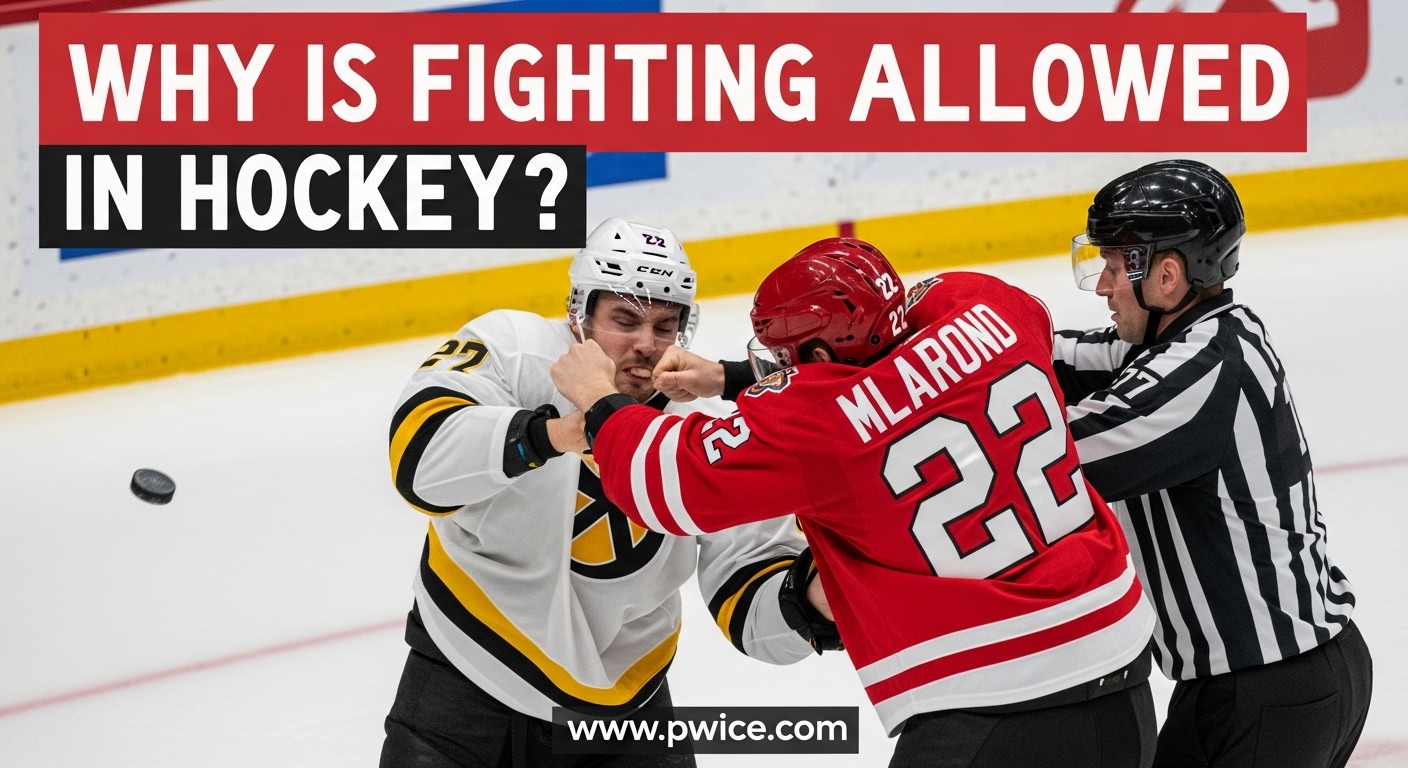
Why is fighting allowed in hockey when it would get you ejected or arrested in any other professional sport? I remember asking this exact question the first time I saw two NHL players drop their gloves and trade punches while the referees simply circled nearby, ready to intervene only when necessary.
The answer surprises most new fans: fighting isn’t technically “allowed” in the sense that it goes unpunished. Instead, it’s tolerated as a penalized infraction that serves specific purposes within hockey’s unique culture. Understanding why requires diving into the sport’s history, its unwritten rules, and the practical realities of policing a game played at high speeds with weapons in players’ hands.
Let me walk you through everything you need to know about why fighting remains part of hockey in 2026, from the self-policing concept that keeps star players safe to the NHL rules that govern when fists can fly.
Table of Contents
Why Is Fighting Allowed in Hockey? The Direct Answer
Fighting is allowed in hockey because it serves as a self-policing mechanism that proponents argue protects skilled players from dangerous hits, provides an emotional release valve during intense games, energizes both teams and crowds, and maintains a cultural tradition unique to the sport. While fighting results in a five-minute major penalty for both participants, it is tolerated rather than banned because the NHL and hockey culture view it as serving legitimate purposes that outweigh the drawbacks.
Here are the key reasons why fighting remains part of hockey:
Self-policing and player accountability: When players know they might have to answer for dirty hits with their fists, they think twice before taking cheap shots at star players.
Momentum shifts: A well-timed fight can energize a flat team, fire up the home crowd, and completely change the emotional trajectory of a game.
Protection of star players: Teams employ enforcers specifically to deter opponents from targeting their most skilled, highest-paid players.
Emotional release valve: Hockey is an intense, physical sport where tensions run high. Fighting provides a sanctioned outlet for that aggression before it escalates to dangerous stick work.
Cultural tradition: Fighting has been part of hockey since the early 1900s and remains embedded in the sport’s identity, even as other professional leagues have eliminated it.
The History of Fighting in Hockey
Fighting in hockey dates back to the sport’s earliest organized days in the early 20th century. Unlike other sports where fighting was always considered an aberration, fistfights became woven into hockey’s fabric almost from the beginning, evolving from spontaneous eruptions of temper into a semi-sanctioned part of the game.
The NHL, formed in 1917, never explicitly banned fighting, instead treating it as a penalized but accepted infraction. Throughout the 1920s and 1930s, fights were common and largely unregulated, with players settling scores without much interference from officials.
The role of the enforcer began taking shape in the 1970s and 1980s. Teams started rostering players specifically to protect their stars and deter opponents from rough play. These fighters, often called “goons” or “heavyweights,” became fixtures on NHL rosters, sometimes playing only a few minutes per game but serving a psychological purpose that coaches valued.
The 1990s brought increased attention to fighting safety, particularly after several high-profile injuries and deaths involving enforcers. The tragic deaths of players like Derek Boogaard, Wade Belak, and Rick Rypien between 2011 and 2015 sparked serious debates about CTE and the mental health toll of the enforcer lifestyle.
By 2026, the role of the pure enforcer has largely disappeared from the NHL. Teams now prioritize players who can both fight and contribute offensively or defensively. The “fourth-line fighter who can’t skate” archetype has been phased out as the game speeds up and skill becomes paramount.
The Self-Policing Concept: Hockey’s Unwritten Code
At the heart of why fighting is allowed lies the concept of self-policing. Hockey players exist within a code of conduct known simply as “The Code” – a set of unwritten rules that govern when, why, and how fights should happen.
The Code exists because referees cannot see everything on the ice. With players moving at speeds exceeding 30 miles per hour, wielding sticks that can cause serious injury, and engaging in constant physical contact, dangerous plays happen too quickly for officials to catch every infraction.
When a player takes a cheap shot at a star teammate, someone on the victim’s team is expected to challenge the offender to a fight. This creates accountability that doesn’t exist in sports where fighting is immediately broken up. The knowledge that you might have to answer physically discourages many dirty hits before they happen.
Key principles of The Code include:
Mutual consent: Most hockey fights involve two willing participants. Jumping an unwilling opponent breaks The Code and brings dishonor.
Target appropriate: Enforcers fight enforcers. Stars generally don’t fight unless provoked. You don’t attack a skill player who doesn’t fight.
Stop when it’s over: When a player falls, loses their equipment, or clearly stops defending themselves, the honorable fighter backs off.
No cheap shots: Pulling hair, biting, eye-gouging, or continuing to punch a downed opponent violates The Code.
Referees understand and respect this system. They don’t stop fights immediately because they recognize that allowing the conflict to resolve itself often prevents further, more dangerous retaliation later in the game.
NHL Rules and Penalties for Fighting
While fighting is culturally accepted in hockey, it is not legally “allowed” in the sense that it carries no consequences. NHL Rule 46 specifically governs fighting, establishing clear penalties and restrictions that distinguish it from simple assault on ice.
Here is how the NHL’s fighting rules actually work:
The Five-Minute Major Penalty
When two players fight, both receive a five-minute major penalty for fighting. Unlike minor penalties that leave teams shorthanded, major penalties for fighting do not create a power play. Both teams play at even strength, just minus one player each for five minutes.
This “five for fighting” structure is unique to hockey. The penalty acknowledges that fighting happened while not giving either team a significant advantage or disadvantage.
The Instigator Rule
The instigator rule, added to discourage staged fights and attacks on unwilling players, adds extra penalties to the player who starts the fight. An instigator penalty carries an additional two-minute minor plus a ten-minute misconduct.
Officials assess the instigator penalty when one player clearly starts the altercation, often by jumping an opponent who didn’t want to fight or continuing to pursue someone trying to skate away. This rule helps maintain that fights should be mutual agreements rather than ambushes.
Third Man In Rule
If a third player joins an ongoing fight, that player receives a game misconduct and is ejected immediately. This rule prevents line brawls and ensures fights remain one-on-one affairs.
The “third man in” penalty is strictly enforced because officials want to stop situations from escalating into dangerous melees involving multiple players.
Helmet and Equipment Rules
Players must keep their helmets on during fights. Removing a helmet to fight results in an additional minor penalty for unsportsmanlike conduct. This rule was implemented for player safety after studies showed that bare-headed fighting significantly increases concussion risk.
Players also cannot remove their jerseys or equipment to gain an advantage. Tape on hands must remain covered by gloves.
When Fighting Crosses the Line
Certain actions during a fight result in additional penalties or ejection:
Aggressor penalty: Continuing to fight an obviously overmatched opponent brings an extra major and game misconduct.
Leaving the bench: Players who jump off the bench to join a fight receive an automatic game misconduct and suspension.
Continuing after the whistle: Fighting after play has stopped brings extra unsportsmanlike conduct penalties.
Momentum Shifts and The Energy of a Fight
One practical reason teams tolerate fighting is the undeniable momentum shift that often follows. Anyone who has attended a game where a fight broke out can attest to the electricity that surges through the building.
Hockey is a game of emotional momentum. Teams that feel flat, disorganized, or passive can suddenly become energized after their teammate wins or even simply participates in a fight. The crowd roars, the bench wakes up, and the players seem to skate faster.
Coaches and players talk about this phenomenon constantly. A team trailing 3-1 might see their enforcer challenge an opponent, trade some punches, and suddenly the whole energy of the game changes. Within minutes, that team scores and gets back into the contest.
From an entertainment standpoint, fights give fans something to cheer about during slower moments. While purists prefer highlight-reel goals, the reality is that fights create engagement and excitement that keeps casual fans interested.
Some analysts dispute how real the “momentum shift” actually is, pointing out that statistical evidence shows teams don’t consistently score more after fights. But players themselves swear by it, and hockey culture treats the momentum argument as fact rather than speculation.
Why Fighting Is Allowed in Hockey But Not Other Sports
The obvious question newcomers ask: why does hockey allow fighting when the NFL, NBA, MLB, and even soccer immediately eject fighters and often suspend them for multiple games?
The difference comes down to culture, equipment, and practical necessity:
Equipment Protection
Hockey players wear significant protective gear that reduces injury risk during fights. Helmets (which must stay on), shoulder pads, elbow pads, and gloves cushion punches in ways that don’t exist in other sports. Fighting in hockey occurs on ice, which reduces punch power because players cannot plant their feet solidly like they could on a basketball court or football field.
Cultural History
Fighting has always been part of hockey’s identity in ways that never applied to other North American sports. Baseball brawls have always been considered disgraceful bench-clearing incidents. Basketball and football fights result in immediate ejections and often criminal charges if they occur outside the game context.
Hockey developed a culture where fighting served specific protective purposes that other sports addressed through different means.
The Stick Factor
No other professional sport involves players carrying weapons and using them as part of normal play. Hockey sticks can cause devastating injuries when used irresponsibly. The self-policing argument – that fighting prevents stick violence – applies uniquely to hockey.
International and Olympic Comparison
International hockey, including the Olympics and IIHF tournaments, bans fighting entirely. Players receive game misconducts and suspensions for fighting, just as they would in other sports. This creates an interesting split: NHL hockey tolerates fighting, while the same sport played under international rules does not.
Some fans argue this proves hockey doesn’t need fighting. Others counter that the NHL’s faster, more physical style creates tensions that require an outlet international hockey doesn’t generate.
College and Junior Hockey
NCAA hockey also bans fighting with automatic game misconducts. Junior hockey leagues vary, with some Canadian leagues tolerating fights similar to the NHL while others take stricter approaches.
The inconsistency between levels creates confusion for fans and developmental challenges for players moving between leagues with different fighting cultures.
Safety Concerns, CTE, and The Fighting Debate
The argument for allowing fighting faces its strongest challenge from growing awareness of brain trauma in contact sports. Chronic Traumatic Encephalopathy (CTE) has become a central concern in hockey just as it has in football.
A December 2024 study from Boston University’s CTE Center found that hockey players with significant fighting histories showed elevated rates of brain disease compared to players who rarely fought. While the sample size was smaller than football studies, the findings added fuel to calls for banning fighting entirely.
The Concussion Risk Reality
Fighting causes concussions. While players wear helmets, bare-knuckle punches to the head still transmit significant force. Multiple studies have documented higher concussion rates among players who fight frequently compared to those who don’t.
The NHL has implemented stricter protocols for concussion evaluation and return-to-play requirements, but critics argue these measures don’t address the root cause: allowing fistfights during games.
The Enforcer Health Crisis
The deaths of Derek Boogaard, Wade Belak, and Rick Rypien between 2011 and 2015 forced the hockey world to confront the mental health toll of the enforcer role. All three were known fighters who struggled with depression, addiction, and the unique pressures of knowing their job required them to be punched in the head regularly.
Boogaard’s autopsy revealed he had CTE at age 28, despite being relatively young for such diagnosis. This finding shocked the hockey community and led to genuine changes in how teams approach player mental health.
The Decline of Fighting as Response
These safety concerns have contributed to the dramatic decline in fighting frequency. In the 1980s, NHL seasons regularly saw over 800 fights. By 2026, that number has dropped to around 300 fights per season.
Teams no longer roster pure enforcers who play two minutes and fight. The modern NHL values speed and skill over intimidation. Fights that do happen tend to be emotional reactions to specific incidents rather than staged heavyweight bouts.
The Debate Continues
Proponents of fighting argue that banning it would lead to more stick-related injuries, as players would resort to cheap shots without fear of physical retaliation. They point to the low injury rate from fights compared to the high injury rate from hits and stick work.
Opponents counter that this is speculation unsupported by evidence, noting that international hockey bans fighting without experiencing epidemics of stick violence.
The debate remains unresolved, with the NHL essentially maintaining the status quo while quietly allowing fighting to decline naturally through reduced roster spots for enforcers.
Fighting in Women’s Hockey and The PWHL
The Professional Women’s Hockey League (PWHL), which launched in 2024, takes a different approach to physicality than the NHL. Fighting is prohibited under IIHF rules that govern women’s hockey, with automatic game misconducts for any player who drops the gloves.
However, the PWHL has embraced physical play within the rules, delivering hard body checks and aggressive forechecking that rivals the intensity of men’s hockey. This approach demonstrates that physical hockey doesn’t require fistfights.
Women’s hockey has traditionally emphasized speed and skill over physical intimidation, but that’s changing. The PWHL product in 2026 features frequent contact, battles along the boards, and aggressive play that excites fans without crossing into fighting.
Some analysts see women’s hockey as a potential model for a fighting-free version of the sport that maintains intensity and entertainment value. Others argue that men’s and women’s hockey are different products with different cultural expectations, and that what works for one may not apply to the other.
The PWHL’s success will be watched closely by both sides of the fighting debate as evidence for whether hockey can thrive without fistfights.
Fighting Statistics and Modern Trends
The numbers tell a clear story: fighting in hockey is declining significantly, even without an outright ban. Understanding these statistics helps explain where the sport is heading.
The Steady Decline
In the 1980s and early 1990s, the NHL saw approximately 800 to 900 fights per regular season. By the 2010s, that number had dropped to roughly 500 fights per season.
In 2026, NHL seasons typically feature around 300 fights total across all teams and games. With 1,312 regular season games (82 games times 32 teams divided by 2), that works out to roughly one fight every four games.
Many NHL games now occur with no fighting whatsoever. The days of guaranteed “fight nights” are largely over.
Playoff vs. Regular Season
Fighting drops dramatically in the playoffs when the stakes matter most. Players focus entirely on winning and avoid taking penalties that could hurt their team. The self-policing argument weakens here, as dangerous plays still happen in playoffs without the expected retaliatory fights.
Some see playoff hockey as proof that the sport works without fighting. Others argue that playoff intensity is unique and shouldn’t dictate regular season standards.
The End of the Enforcer
In the 1990s, every NHL team carried at least one player whose primary role was fighting. These players logged minimal ice time but served as deterrents to opponents.
By 2026, pure enforcers have virtually disappeared. Teams demand that every player contribute offensively, defensively, or on special teams. The fighter who can’t skate or score no longer has an NHL job.
This shift has happened organically through roster decisions rather than rule changes. The NHL has essentially phased out fighting through market forces rather than prohibition.
Frequently Asked Questions
Why do they let fights go in hockey?
Referees let fights go because of hockey’s self-policing tradition. The ‘Code’ allows willing combatants to settle disputes and deter dirty play. Officials intervene only when someone falls, equipment comes off, or the fight clearly ends. This system exists because hockey’s speed and stickwork create tensions that need outlets.
Why is fighting allowed in hockey but not any other sport?
Fighting is allowed in hockey because of unique factors: players carry sticks that can injure, protective gear reduces punch damage, ice surface limits punch power, and the sport developed a cultural tradition of self-policing. Other sports address similar tensions through different mechanisms without fistfights.
What is the Gretzky rule in hockey?
The Gretzky rule refers to an old NHL rule protecting Wayne Gretzky by allowing his teammates to defend him without extra penalties. While not formally named after Gretzky, it represented the era when superstars had dedicated protectors. The modern instigator rule partially replaced this protection system.
How is it legal to fight in hockey?
Fighting isn’t ‘legal’ in hockey – it is penalized with a five-minute major under NHL Rule 46. However, it is tolerated as a self-policing mechanism rather than banned entirely. The distinction matters: players receive penalties for fighting but aren’t automatically ejected or suspended as they would be in other sports.
Why do they still allow fighting in hockey?
Fighting remains allowed because it serves specific purposes in hockey culture: protecting star players from cheap shots, providing emotional release that prevents stick violence, creating momentum shifts, and maintaining tradition. Despite safety concerns, these perceived benefits have prevented an outright ban.
Why is 69 forbidden in NHL?
The number 69 is informally discouraged in the NHL due to its sexual connotations, though not officially banned. Very few players have worn it, and those who do often face locker room teasing. Unlike retired numbers, 69 remains technically available but culturally avoided.
Is fighting an allowed part of hockey?
Fighting is a penalized but accepted part of professional hockey, particularly in the NHL. It is not officially ‘allowed’ since it carries a five-minute major penalty, but it is culturally tolerated and strategically used. International and college hockey ban fighting with automatic ejections.
Will fighting ever be banned in hockey?
Fighting may eventually be banned due to CTE concerns and declining frequency, but the NHL has shown no indication of immediate prohibition. The sport is gradually phasing out fighting organically by eliminating pure enforcer roles. An outright ban would face resistance from traditionalists who believe fighting prevents dirtier play.
Conclusion: The Future of Fighting in Hockey
Why is fighting allowed in hockey? The answer combines history, culture, and practical arguments about player protection. Fighting serves as hockey’s unique self-policing mechanism, deterring cheap shots against stars while providing an emotional outlet that some argue prevents more dangerous stick work.
Yet the reality in 2026 is that fighting is already disappearing. The numbers have dropped from 800 fights per season to around 300. Pure enforcers no longer have NHL jobs. The sport is evolving toward speed and skill over intimidation, phasing out its fighting tradition without needing an official ban.
Safety concerns will continue pressuring the league to act. CTE research, concussion protocols, and player health advocacy push toward prohibition. Traditionalists counter that fighting protects players in ways statistics don’t capture.
Whether fighting eventually gets banned or simply fades into rarity, understanding why it exists helps fans appreciate hockey’s unique culture. The self-policing concept, The Code among players, and the momentum-shifting energy of a well-timed tilt all explain why this strange tradition has persisted while other sports eliminated it entirely.
The future likely holds less fighting either way, but the reasons it was allowed will remain part of hockey’s fascinating story.