
I remember the first time I watched curling on TV during the Winter Olympics. The players were sliding stones across ice, sweeping furiously, and shouting strange commands like “Hurry hard!” But what really confused me was the scoring. One minute the scoreboard showed nothing, and the next, a team had suddenly scored three points. If you are wondering how does scoring work in curling, you are not alone.
Curling scoring is actually simpler than it looks once you understand the basics. Only one team scores per end, points are counted based on stone position in the house, and the team with the most points after all ends wins the game. In this guide, I will break down everything you need to know about curling scoring, from the house and the hammer to blank ends and the 5-rock rule.
Table of Contents
What Is the House in Curling?
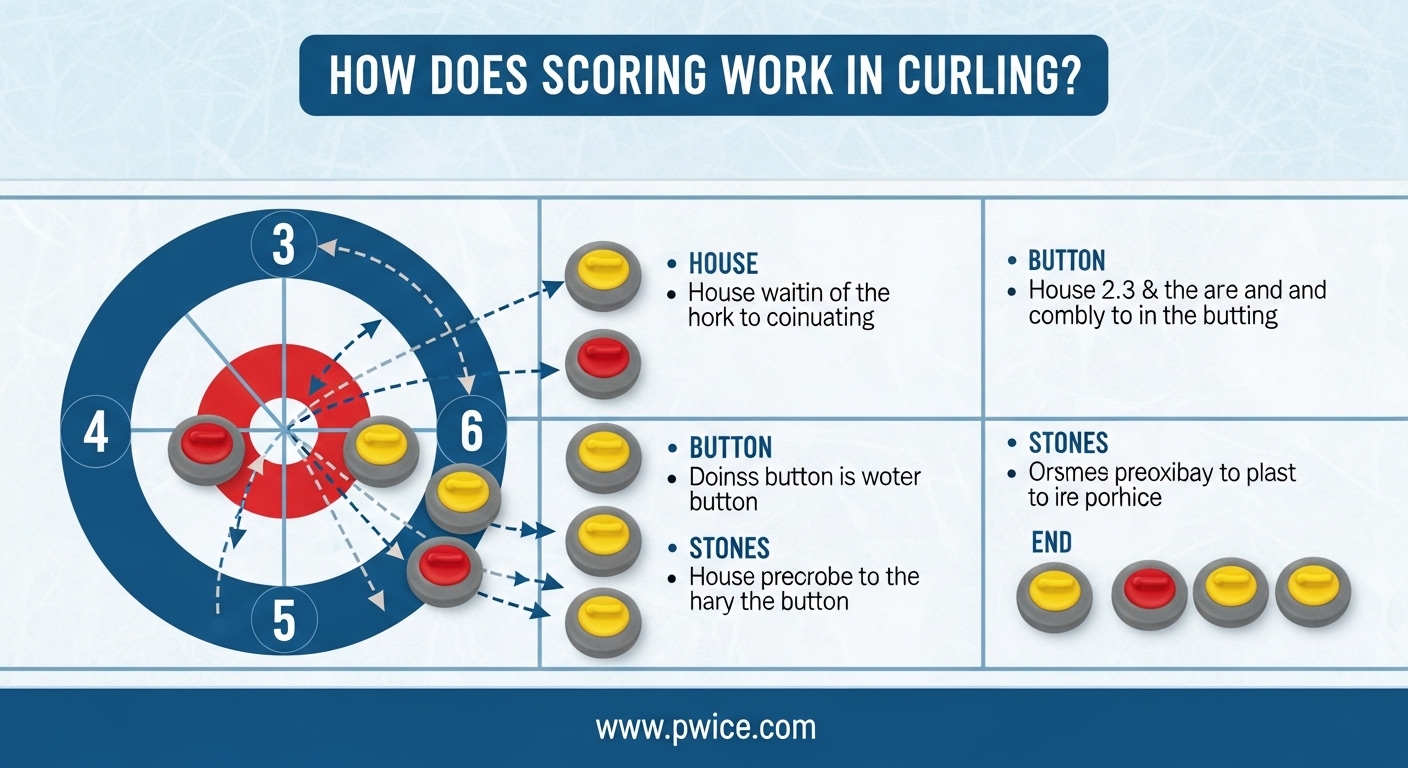
Before you can understand scoring, you need to understand the house. The house is the target area at each end of the curling sheet, a set of four concentric circles that looks like a bullseye painted on the ice.
The Four Rings and the Button
The house consists of four scoring rings measured from the center point, called the button or the tee:
- The Button (Center): The smallest circle, just 1 foot in diameter. This is the most valuable position in curling.
- The 4-Foot Ring: The circle that surrounds the button, 4 feet in diameter.
- The 8-Foot Ring: The next circle out, 8 feet in diameter.
- The 12-Foot Ring: The outermost circle, 12 feet in diameter. Any stone touching this ring or inside it is “in the house” and eligible to score.
Here is the key thing about the house: only stones fully inside or touching the 12-foot ring can score points. If a stone is outside the 12-foot ring at the end of play, it does not count for scoring, even if it is your team’s closest stone.
Why Stone Position Matters for Scoring
In curling, the exact ring a stone sits in does not determine how many points it is worth. Unlike darts where hitting the bullseye gives more points than the outer ring, every scoring stone in curling is worth exactly one point. What matters is which stones are closer to the button than any of the opponent’s stones.
Think of it this way: after all 16 stones are thrown (8 per team), you line them up by distance from the button. The team with the stone closest to the center wins the end. Then you count how many of their stones are closer to the button than the opponent’s closest stone. That is how many points they score.
How Does Scoring Work in Curling?
Now that you understand the house, let me explain exactly how scoring works. An “end” in curling is like an inning in baseball. Each team throws all their stones, and then you score. A standard game has 8 or 10 ends.
Step-by-Step Scoring at the End of Each End
Here is exactly what happens when scoring is determined:
- All 16 stones have been delivered (8 by each team, alternating shots)
- The vice-skip from each team walks down to the house to determine the score
- They visually determine which stone is closest to the button
- The team with the closest stone wins the end and scores at least 1 point
- They then count all additional stones of the same color that are closer to the button than the opponent’s closest stone
- Each qualifying stone counts as 1 point
For example, if Team Red has the closest stone, plus two more stones closer than Team Yellow’s closest stone, Team Red scores 3 points. Team Yellow scores zero.
The Simple Rule: Closest Stone Wins
If you remember nothing else about curling scoring, remember this: only one team can score per end, and they score 1 point for every stone they have closer to the button than the opponent’s closest stone.
It does not matter if your stone is in the 4-foot ring or just barely touching the 12-foot ring. If it is closer to the button than every stone of the other color, it counts as one point. Distance inside the house does not change the point value.
How Many Points Can You Score in One End?
A common question I get is about the maximum points possible. Since each team throws 8 stones, and only one team scores per end, you might wonder what the highest possible score is.
Maximum Points Per End (The 8-Point Rule)
The maximum points you can score in a single end is 8 points. This would require your team to have all 8 of your stones closer to the button than any of the opponent’s 8 stones. This is extremely rare and is called an “8-ender” in curling culture. It is like a perfect game in baseball or bowling.
In reality, most ends result in 0, 1, 2, or 3 points being scored. A 4-point end is considered a big score, and anything above 4 is unusual. If you watch Olympic curling, you will see mostly 1-point and 2-point ends, with the occasional 3-pointer when a team has a really good end or the opponent makes a mistake.
Real Examples of Multi-Point Ends
Let me give you some realistic scenarios:
1-Point End: Team A has the closest stone to the button. Team B’s closest stone is the third-closest overall. Team A scores 1 point.
2-Point End: Team A has the two closest stones. Team B’s closest is third. Team A scores 2 points.
3-Point End: Team A has stones in positions 1, 2, and 3 closest to the button. Team B’s closest is fourth. Team A scores 3 points.
The record for most points in an end at the Olympic level is typically 4 or 5 points, as teams are skilled at defensive play to prevent big ends.
What Is the Hammer in Curling?
The hammer is one of the most important strategic elements in curling, and it directly affects scoring. If you have watched curling, you have probably heard commentators talk about which team “has the hammer.”
Last Stone Advantage Explained
The hammer is the advantage of throwing the last stone in an end. Since you alternate shots with the other team, one team throws stones 1, 3, 5, 7, 9, 11, 13, 15, while the other team throws 2, 4, 6, 8, 10, 12, 14, 16. The team throwing stone 16 (the last stone) is said to have the hammer.
Having the hammer is a significant advantage because you get the final shot. If the score is tied after 15 stones, the team with hammer can throw their final stone to either score points or knock out the opponent’s scoring stones. Statistically, the team with hammer scores in about 70-75% of ends at the professional level.
How the Hammer Affects Strategy
The hammer transfers between ends based on who scores. Here is the rule: if you score points in an end, the other team gets the hammer for the next end. If you do not score (either because the other team scored or because it was a blank end), you keep the hammer for the next end.
This creates interesting strategy. If you have hammer and are up by 1 point late in the game, you might play defensively to prevent the opponent from scoring multiple points. If you are down by 2 points with hammer, you might play aggressively to try to score 2 or 3 points to take the lead.
What Is a Blank End in Curling?
Sometimes you will see an end where no points are scored at all. This is called a blank end, and it is often a strategic choice rather than an accident.
Why Teams Intentionally Blank an End
A blank end occurs when, after all 16 stones are thrown, there are no stones in the house at all, or the closest stones are equidistant from the button (which is rare). More commonly, the team with hammer will intentionally remove all stones from the house on their final shot to blank the end.
Why would a team choose to score zero points? Because of the hammer rule. If you blank an end, you keep the hammer for the next end. This is valuable if the current end situation looks bad, you are trying to set up for a bigger score later, or you are playing defensively with a lead.
Strategy Behind Keeping the Hammer
Here is a common scenario: Team A has hammer and is up by 1 point with 3 ends left. They get to the final stone of the current end, but the opponent has positioned their stones well. Team A could try to score 1 point, but then they would give up hammer for the next end.
Instead, they might choose to blank the end by shooting their final stone out of the house entirely. They keep the hammer, remain up by 1 point, and get another chance to score with hammer advantage in the next end. In competitive curling, blank ends happen regularly because teams value hammer possession highly.
What Is the 5 Stone Rule in Curling?
The 5-stone rule, officially called the Free Guard Zone rule, is a modern addition to curling that changed scoring strategy significantly. It was introduced to make games more offensive and exciting.
Free Guard Zone Explained
Here is how the 5-stone rule works: For the first five stones thrown in each end (stones 1 through 5), no stone in the Free Guard Zone can be removed from play by the opposing team.
The Free Guard Zone is the area between the hog line and the tee line, excluding the house itself. It is basically the middle section of the sheet where guard stones sit to protect stones in the house.
Before the 5-stone rule, teams with hammer could simply blast away any guard stones immediately, making it easier to score multiple points. With the rule in place, the team without hammer can place two guard stones that cannot be removed until at least the sixth stone of the end. This gives them a chance to build an offensive setup and potentially score or steal points.
How the Rule Changed Scoring Strategy
The 5-stone rule has made curling more offensive. Without it, teams with hammer could play a “peel” game, removing all guards and scoring easily. With the rule, the team without hammer can establish guards early and force the opponent to play around them, potentially stealing an end (scoring without hammer).
This rule applies to most competitive curling now, including Olympic play. It does not change how points are calculated, but it changes how teams approach scoring opportunities and defensive play.
How to Read a Curling Scoreboard
Curling scoreboards look different from most sports, and they can confuse new viewers. Let me explain the two main types you will see.
Baseball-Style vs Traditional Scoreboards
The baseball-style scoreboard is most common on TV broadcasts. It looks like a grid with numbers across the top representing each end (1, 2, 3, 4, etc.). Team names are on the left side. In each cell, you will see the points scored by that team in that end, or a blank if they did not score.
The traditional curling scoreboard looks different. It shows only the total score, and you will see numbers like “2” and “5” with “RED” or “YELLOW” above them. The numbers represent the end in which that team scored those points. If Red scores 2 points in end 3, you might see a “2” with “RED” above it in the third position.
Tracking Ends and Total Score
On most modern broadcasts, you will also see a small hammer icon next to the team that has last stone advantage for the current end. This helps viewers understand which team has the strategic advantage.
The total score is usually shown clearly at the bottom or right side of the scoreboard. Since curling does not have a set winning score (it is not “first to 10” like some other sports), the game continues until all ends are completed, and the team with the higher total wins.
How Many Ends in a Curling Game?
The length of a curling game varies depending on the level of competition and the time available.
8-End vs 10-End Games
Most league play and casual games use 8 ends. This keeps game time to about 2 hours, which is practical for club play and social leagues.
Championship curling, including the Olympics and World Championships, uses 10 ends. These games take about 2.5 to 3 hours and allow for more strategic depth. The extra two ends can be crucial for comebacks and strategy changes.
Regardless of whether it is 8 or 10 ends, the scoring works exactly the same way. Each end is a complete scoring opportunity, and the cumulative total after all ends determines the winner.
Extra Ends and Tiebreakers
If the score is tied after all scheduled ends, the game goes to extra ends. An extra end is played just like a regular end, with full scoring rules. If the score remains tied after one extra end, another is played until one team wins.
In extra ends, the hammer is determined by a draw to the button before the game starts (called the Last Stone Draw). Whichever team had their stone closer to the button in the pre-game draw gets the choice of hammer or stone color in the first extra end, should it be needed.
Curling Scoring Examples for Beginners
Let me walk you through three real scoring scenarios to make this concrete. These are the types of situations you will see when watching curling.
Example 1: Single Point End
It is the final stone of the end. Team Yellow has one stone sitting just in front of the button, protected by a guard. Team Red has hammer. The Red skip throws a draw (a gentle shot to land in the house) and manages to get their stone slightly closer to the button than the Yellow stone.
After all stones are counted, Red has 1 stone closer than Yellow’s closest. Red scores 1 point. Yellow scores 0. Because Red scored, Yellow will have hammer in the next end.
Example 2: Multi-Point End
Team Red has been building a strong position throughout the end. They have stones in good positions, and Team Yellow has been struggling to remove them. At the end of play, the stones are positioned as follows from closest to farthest from the button:
- Red stone (closest)
- Red stone (second closest)
- Red stone (third closest)
- Yellow stone (Yellow’s closest)
- Red stone
In this scenario, Team Red has three stones closer than Yellow’s closest stone. Red scores 3 points. This is a strong end for Red and puts them in a good position in the game.
Example 3: Blank End Scenario
Team Yellow is leading by 2 points with 2 ends remaining. They have hammer in the current end. After 15 stones, the situation is messy. Yellow has one stone barely touching the 12-foot ring, but Red has several stones around the house that could be promoted (moved in) with the final shot.
If Yellow tries to score 1 point, they risk giving up a steal of 2 or 3 points if they miss their shot. Instead, the Yellow skip decides to play a hit-and-roll on their final stone, removing their own scoring stone from the house and rolling out. The end is blank. No points are scored, and Yellow keeps the hammer for the next end.
They remain up by 2 points with hammer in the next end, which is a much stronger position than being up by 3 without hammer.
Frequently Asked Questions
How is scoring done in curling?
Scoring in curling is determined at the end of each end after all 16 stones are thrown. The team with the stone closest to the button (center of the house) wins the end. They score 1 point for that stone, plus 1 additional point for each of their stones that is closer to the button than the opponent’s closest stone. Only one team can score per end.
How are points earned in curling?
Points are earned by having stones closer to the button than your opponent’s stones at the conclusion of an end. Each qualifying stone counts as exactly 1 point, regardless of which ring of the house it sits in. The maximum points possible in one end is 8, though most ends result in 0-3 points being scored.
How to score in Olympic curling?
Olympic curling follows the same scoring rules as standard curling. Teams play 10 ends instead of the 8 used in club play. The 5-rock free guard zone rule is in effect. Points are determined by stone position in the house at the end of each end, with the team having the closest stone to the button scoring 1 point for each stone closer than the opponent’s nearest stone.
What is the 5 stone rule in curling?
The 5-stone rule, also called the Free Guard Zone rule, states that for the first 5 stones of each end, no stone in the Free Guard Zone (between the hog line and tee line, outside the house) can be removed from play by the opposing team. This prevents the team with hammer from immediately blasting away guard stones, making the game more offensive and strategic.
What is a blank end in curling?
A blank end occurs when no points are scored in an end, either because no stones remain in the house or because the closest stones are equidistant from the button. Teams often intentionally blank an end to keep the hammer (last stone advantage) for the next end, especially when scoring 1 point would mean giving up the strategic advantage of throwing last.
What is the hammer in curling?
The hammer is the advantage of throwing the last stone in an end. It is a significant strategic advantage because that team gets the final opportunity to score or remove opponent stones. The hammer transfers to the other team if you score points, but you keep it if you do not score (including blank ends).
How many ends are in a curling game?
Most club and league games consist of 8 ends and take approximately 2 hours. Championship and Olympic games use 10 ends and take about 2.5 to 3 hours. If the score is tied after the scheduled number of ends, extra ends are played until one team wins.
How do you read a curling scoreboard?
Curling scoreboards typically show either a baseball-style grid with end-by-end scoring, or a traditional format showing which team scored in each end. The total score is cumulative across all ends played. A hammer icon usually indicates which team has last stone advantage for the current end.
Conclusion
Understanding how does scoring work in curling opens up a fascinating world of strategy, skill, and sportsmanship. The basics are simple: closest stone to the button wins the end, count your stones closer than the opponent’s closest, and only one team scores per end. But the strategy that surrounds these simple rules is what makes curling such a compelling sport to watch and play.
The key concepts to remember are the house and its four rings, the importance of the hammer for last-stone advantage, the strategy of blank ends to preserve that advantage, and how the 5-rock rule has modernized the game. Whether you are watching the Olympics, joining a local league, or just trying to understand what is happening when you catch curling on TV, you now have the knowledge to follow along.
The next time you see those stones sliding down the ice and hear the skip calling out instructions, you will understand exactly what is at stake with every shot. That is the beauty of curling: simple rules, infinite strategy, and the thrill of seeing who can place their stone closest to the button when it matters most.