
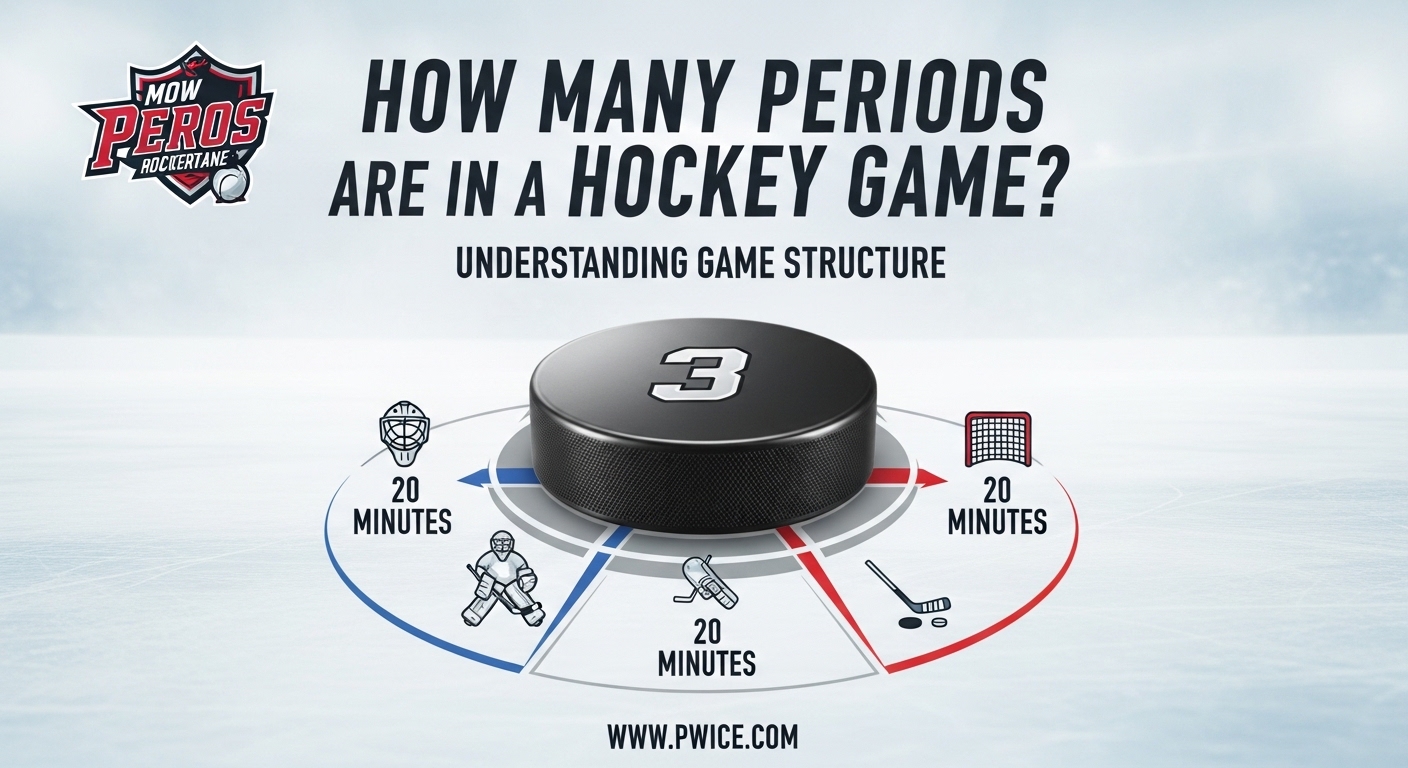
A hockey game consists of three 20-minute periods with 15-18 minute intermissions between each period. This creates 60 minutes of regulation play time, though most games last 2.5 to 3 hours in real time. Understanding the period structure helps new fans follow the action and know when to expect key moments in the game.
Whether you are watching your first NHL game, taking a child to their youth league match, or simply curious about the sport, knowing how many periods are in a hockey game will make your viewing experience more enjoyable. The three-period structure is unique among major team sports and exists for practical and strategic reasons that date back over a century.
Table of Contents
How Many Periods Are in a Hockey Game?
A standard hockey game has three periods. Each period consists of 20 minutes of game time at the professional and Olympic levels.
Unlike football with its four quarters or soccer with its two halves, ice hockey uses this three-period structure across virtually all levels of play. The format applies to NHL games, Olympic matches, college hockey, and most amateur leagues worldwide.
Women’s hockey follows the same three-period structure as men’s hockey. This has been standard across all competitive ice hockey since the early 20th century.
How Long Is Each Period in Hockey?
Each period in professional and Olympic hockey lasts 20 minutes. However, these are 20 minutes of “stop time,” meaning the clock pauses whenever play stops.
This stop-time format differs significantly from “running time” used in some youth leagues. When the puck goes out of play, a goal is scored, or a penalty is called, the referee stops the clock. This ensures that fans get exactly 60 minutes of actual gameplay during regulation.
In real time, a single period typically takes 30 to 45 minutes to complete. Stoppages for goals, penalties, video reviews, and commercial breaks all add to the duration. TV timeouts alone can add 10-15 minutes to each period in televised NHL games.
What Happens Between Periods?
Between the first and second periods, and again between the second and third periods, teams take an intermission break. In the NHL, these intermissions last exactly 18 minutes.
During intermission, the ice resurfacing machine (commonly called a Zamboni, though other brands exist) cleans and smooths the ice. This process is essential for player safety and game quality. Rough ice from skate cuts and snow buildup would make puck handling difficult and increase injury risk.
Teams retreat to their locker rooms for rest and coaching adjustments. Players rehydrate, receive medical attention if needed, and review video clips of key plays. The short change versus long change strategy, which we explain later, takes effect after each intermission as teams switch which goal they defend.
Why Does Hockey Have 3 Periods Instead of 2 Halves?
Hockey originally used two 30-minute halves, similar to soccer. The change to three periods happened in 1910, driven by brothers Lester and Frank Patrick.
The Patricks managed the Pacific Coast Hockey Association and faced a significant problem. In the early days of indoor hockey rinks, ice quality deteriorated rapidly during play. By the end of a 30-minute half, the ice surface was cut up with ruts, covered in snow from skate blades, and nearly unplayable.
The Patrick brothers proposed breaking the game into three 20-minute periods with two intermissions. This innovation allowed the ice to be resurfaced twice during each game instead of just once. Better ice quality meant faster play, fewer injuries, and a more entertaining product for fans.
The format also created additional revenue opportunities. More intermissions meant fans spent more time at concession stands. The Patrick brothers were innovative businessmen as well as hockey pioneers.
By the 1911-1912 season, the National Hockey Association (predecessor to the modern NHL) adopted the three-period format. It has remained standard ever since.
The Strategic Impact: Short Change vs Long Change
The three-period structure creates a unique strategic element that new fans often miss. Teams switch which goal they defend after each period, creating alternating “short change” and “long change” situations.
In the first and third periods, teams defend the goal closest to their own bench. This is called the “short change” because players travel a shorter distance when substituting. When a line change happens, new players hop over the boards and are immediately in position.
In the second period, teams defend the far goal from their bench. This “long change” requires players to skate 100 feet or more across the ice to reach their defensive position. Fresh legs take longer to join the play, which creates defensive vulnerabilities.
Coaches design specific strategies around these differences. During the second period long change, teams often play more conservatively to avoid getting caught with tired players on the ice. The long change period typically sees more scoring because of these defensive breakdowns.
Understanding this adds depth to your viewing experience. When you see a goal scored late in the second period with tired defenders caught out of position, you will recognize the long change effect at work.
How Long Does a Hockey Game Really Last?
While regulation play totals 60 minutes, a typical NHL game lasts 2.5 to 3 hours from start to finish. Several factors extend the real-time duration well beyond the clock time.
Two 18-minute intermissions add 36 minutes to the total. TV timeouts occur three times per period in nationally televised games, adding approximately 90 seconds each. Stoppages for penalties, goals, offside reviews, and puck retrieval all accumulate.
Playoff games can stretch even longer. With no shootouts and continuous sudden-death overtime periods, Stanley Cup playoff games occasionally extend past four hours. The longest NHL playoff game in modern history lasted over six hours with six overtime periods.
If you are planning to attend a game that starts at 7:00 PM, expect to leave the arena around 9:45 to 10:00 PM for a regular season contest. For playoff games, the end time is unpredictable.
Overtime Rules: What Happens When the Game Is Tied?
When regulation ends with the score tied, hockey enters overtime. The rules differ significantly between regular season and playoff games.
In the NHL regular season, teams play a five-minute sudden-death overtime period with 3-on-3 skaters (plus goalies). If no one scores, the game proceeds to a shootout. The shootout features three rounds of penalty shots, with the team scoring more goals declared the winner.
Regular season overtime periods are 20 minutes long in Olympic and IIHF international competition. Teams play 4-on-4 during this time. If still tied, they proceed to a shootout with five rounds instead of three.
Playoff overtime follows completely different rules. There is no shootout. Teams play continuous 20-minute sudden-death periods at full 5-on-5 strength until someone scores. These overtime periods feature full 15-18 minute intermissions between them.
Playoff overtime can theoretically continue indefinitely. The longest NHL playoff game occurred in 1936 when the Detroit Red Wings beat the Montreal Maroons in the sixth overtime period after nearly 176 minutes of total play.
Do Different Leagues Use Different Period Structures?
While three periods is the universal standard, the length and timing vary across different hockey levels. Understanding these differences helps when watching different competitions.
NHL: Three 20-minute periods with 18-minute intermissions. Stop time. 3-on-3 overtime in regular season.
Olympics / IIHF: Three 20-minute periods with 15-minute intermissions. Stop time. 4-on-4 overtime. No commercial timeouts during play.
NCAA College Hockey: Three 20-minute periods with 15-minute intermissions. Stop time. Rules closely mirror IIHF standards.
Youth Hockey: Period length varies by age group. Mites (8U) often play 12-minute periods. Squirts (10U) and Peewees (12U) typically play 12-15 minute periods. Bantams (14U) and Midgets (16-18U) usually play full 15-17 minute periods. Some youth leagues use running time to keep games moving.
Recreational / Adult Leagues: Highly variable. Many adult leagues play two 25-minute periods or three 15-minute periods to fit ice time rentals. Running time is common to prevent games from running long.
International professional leagues like the KHL (Russia), SHL (Sweden), and Liiga (Finland) follow the same 3×20 structure as the NHL and Olympics. This global consistency makes hockey one of the most standardized sports worldwide.
FAQ
Is hockey 3 periods or 4?
Hockey uses 3 periods, not 4 quarters. Unlike basketball which has four 12-minute quarters, ice hockey consists of three 20-minute periods. This structure has been standard since 1910 and applies to NHL, Olympic, college, and most amateur leagues worldwide.
How many periods are in a men’s ice hockey game?
Men’s ice hockey games have 3 periods of 20 minutes each at the professional and Olympic levels. This creates 60 minutes of total regulation play time. Women’s hockey follows the exact same three-period structure.
How many periods are in an NHL game?
An NHL game consists of three 20-minute periods with 18-minute intermissions between periods. If tied after regulation, regular season games have a 5-minute 3-on-3 overtime period followed by a shootout if necessary. Playoff games use continuous 20-minute sudden-death overtime periods instead.
How long is a hockey period?
A hockey period is 20 minutes of stop time at the NHL, Olympic, and college levels. In real time, each period typically lasts 30-45 minutes due to stoppages for penalties, goals, video reviews, and commercial breaks. Youth leagues use shorter periods ranging from 12-17 minutes depending on age group.
Why does hockey have 3 periods instead of 2 halves?
Hockey switched from two 30-minute halves to three 20-minute periods in 1910. Brothers Lester and Frank Patrick introduced the change to improve ice quality. Two intermissions allowed the ice to be resurfaced twice per game instead of once, creating better playing conditions and fewer injuries.
How long between periods in hockey?
NHL games have 18-minute intermissions between periods. Olympic and IIHF competitions use 15-minute intermissions. During these breaks, Zamboni machines resurface the ice while teams rest in their locker rooms. Youth and amateur leagues may have shorter intermissions of 10-12 minutes.
Conclusion
A hockey game consists of three 20-minute periods, a structure that has defined the sport for over a century. This format creates 60 minutes of regulation play, though real-time games stretch to 2.5 or 3 hours with intermissions and stoppages.
The three-period structure emerged from practical necessity in 1910 when the Patrick brothers sought better ice quality. Today it remains a defining characteristic that shapes game strategy through the short change versus long change dynamic.
Whether you are watching the NHL Stanley Cup Final, an Olympic gold medal game, or your local youth league, you will now recognize how the period structure influences everything from ice conditions to coaching decisions. The next time you watch how many periods are in a hockey game play out in real time, you will appreciate the history and strategy behind each break in the action.