
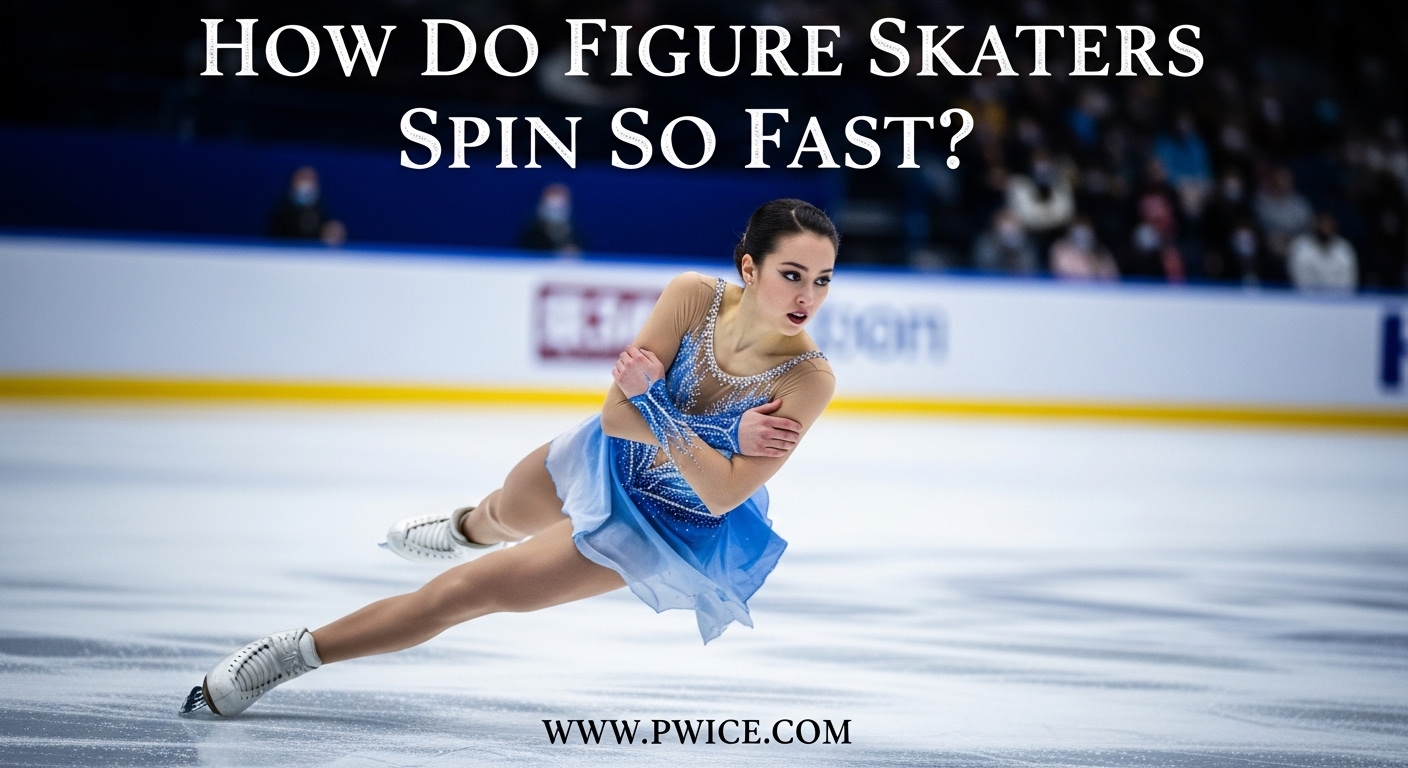
Have you ever watched a figure skater pull their arms tight against their body and suddenly blur into a spinning tornado? Elite skaters can reach rotational speeds exceeding 300 revolutions per minute. That is faster than a helicopter rotor.
I remember the first time I saw this at a local ice show. One moment the skater was gliding gracefully, and the next they were a human top. The crowd gasped as the spin accelerated impossibly fast.
How do figure skaters spin so fast? The answer lies in one of physics most elegant principles: the conservation of angular momentum. In this guide, I will explain exactly what is happening and why pulling your arms in makes you rotate faster. You will learn the science behind those breathtaking spins you see at the Olympics.
Table of Contents
How Do Figure Skaters Spin So Fast: The Physics Explained
Figure skaters spin so fast by exploiting a fundamental law of physics called the conservation of angular momentum. When a skater pulls their arms and legs closer to their body, they reduce their moment of inertia. Because angular momentum must remain constant, their rotational speed automatically increases.
This principle governs everything from spinning ice skaters to collapsing stars. Once you understand it, you will see angular momentum everywhere in the world of sports.
Understanding Angular Momentum
Angular momentum is the rotational equivalent of linear momentum. Think of it as the amount of spin motion an object has. Just as a moving car has momentum that keeps it rolling, a rotating skater has angular momentum that keeps them spinning.
The key insight is that angular momentum stays constant unless an outside force acts on the system. This is called the law of conservation of angular momentum. Ice provides very little friction, so once a skater starts rotating, their angular momentum remains nearly constant.
We can express this relationship with a simple formula:
L = I × ω
Where:
L is angular momentum (which stays constant)
I is moment of inertia (how mass is distributed)
ω (omega) is angular velocity (how fast you spin)
Since L must stay the same, when I decreases, ω must increase. That is the entire secret behind those lightning-fast spins.
The Role of Moment of Inertia
Moment of inertia is perhaps the most important concept for understanding figure skating spins. It measures how much an object resists rotational acceleration based on where its mass is located.
Mass far from the center of rotation creates high moment of inertia. Mass close to the center creates low moment of inertia. This is why the distribution of your body mass matters more than your total weight.
Imagine holding a heavy book. If you hold it close to your chest while spinning in an office chair, you will spin relatively fast. Extend your arms fully with that same book, and you will slow down dramatically. The book did not change weight. Its distance from your center of rotation did.
Figure skaters use this principle deliberately. They begin spins with arms extended to establish rotation. Then they gradually pull their arms inward, moving mass closer to their axis. This reduces moment of inertia and triggers an automatic speed increase.
Arms Extended vs Arms Tucked: The Speed Difference
The difference in rotational speed between arm positions is dramatic. A skater with arms fully extended might rotate at 60 revolutions per minute. Pull those arms tight against the torso, and the same skater can exceed 300 revolutions per minute.
That is a fivefold increase in speed without adding any energy. The skater is not pushing harder or using muscles to spin faster. They are simply redistributing their existing mass.
Elite skaters take this further by tucking their legs into a sit spin or pulling the free leg up into a Biellmann position. Every limb brought closer to the rotation axis further reduces moment of inertia and increases angular velocity.
The mathematics works out beautifully. If you bring your mass twice as close to the center, your rotational speed doubles. Bring it three times closer, and you triple your speed. Skaters optimize every inch of limb position to maximize this effect.
How Figure Skaters Generate and Control Their Spins
Understanding the physics is one thing. Watching how skaters actually apply it reveals the artistry behind the science. Every spin begins with a deliberate sequence of movements designed to maximize rotational speed.
Starting the Spin: The Toe Pick Entry
Skaters cannot simply start spinning from a dead stop. They need initial angular momentum. The most common method uses the toe pick, the serrated teeth at the front of figure skates.
A skater digs the toe pick into the ice and uses it as an anchor. They push off the ice with their other foot, creating torque that initiates rotation. Some spins use a backward entry where the skater generates momentum through a curved approach.
Once that initial angular momentum is established, the conservation law takes over. The skater will keep rotating at that initial speed until they change their body position or friction slows them down.
The Acceleration Sequence
Elite skaters do not pull their arms in all at once. They use a progressive tucking sequence to build speed gradually and maintain control.
Step 1: Begin with arms extended horizontally to establish a stable rotation.
Step 2: Gradually lower arms to shoulder height while keeping them spread.
Step 3: Pull arms in toward the torso, crossing them against the chest.
Step 4: Tuck the free leg into a tight position close to the body.
Each step reduces moment of inertia further, causing a noticeable jump in rotational speed. The skater experiences this as an invisible force pulling their limbs outward. They must engage core muscles to hold the tight position against this centrifugal effect.
How Fast Do Olympic Skaters Actually Spin?
Olympic-level figure skaters achieve impressive rotational speeds during competition spins. The fastest elite skaters reach approximately 300 to 350 revolutions per minute during their tightest positions.
To put this in perspective, that is about 5 to 6 complete rotations every single second. The skater becomes a blur to the naked eye. Slow-motion footage reveals the incredible control required to maintain form at these speeds.
Some skaters have pushed even further in exhibition performances. World records for rotational speed have exceeded 400 revolutions per minute, though these are not typical in competitive programs due to the difficulty of maintaining control and the dizziness factor.
Why Do Not Figure Skaters Get Dizzy?
One of the most common questions viewers ask is how skaters avoid becoming hopelessly dizzy. The answer involves both biological adaptation and a specific technique called spotting.
The Spotting Technique
Spotting is a technique dancers and skaters use to minimize dizziness during turns. The skater picks a fixed point in their visual field, such as a spot on the arena wall.
They keep their eyes locked on that point while their body begins to rotate. At the last possible moment, they snap their head around to find the spot again. This brief fixation gives the brain a stable reference point and reduces the sensory confusion that causes dizziness.
During extremely fast spins, spotting becomes difficult or impossible. The head would need to snap around too quickly. Skaters at this level rely on other adaptations.
Vestibular System Adaptation
The human inner ear contains the vestibular system, which detects rotation and helps maintain balance. When you spin, fluid in the semicircular canals moves and sends signals to your brain that you are rotating.
When you stop suddenly, the fluid keeps moving for a moment. This creates the sensation that the room is spinning while you are stationary. It is a mismatch between what your inner ear senses and what your eyes see.
Elite skaters train their vestibular systems over years of practice. Their brains learn to discount or suppress the confusing signals during and after spins. Studies of ballet dancers and figure skaters show they experience significantly reduced dizziness compared to untrained individuals.
Some skaters report that years of training have essentially rewired their vestibular response. They can perform multiple consecutive spins without the disorienting after-effects that would leave most people stumbling.
The G-Force Experience
At 300 revolutions per minute, figure skaters experience remarkable G-forces on their extremities. The acceleration at their fingertips can exceed 3 Gs, triple the normal force of gravity.
This means a skater hand that normally weighs a few ounces effectively weighs several pounds during the spin. The arms want to fly outward due to centrifugal force. The skater must engage significant muscle strength to hold the tight tuck position that keeps their spin fast.
The blood also pools in the extremities due to these forces, which is why skaters typically release their positions before the dizziness from blood pressure changes becomes overwhelming. The physical demands of a fast spin are far greater than they appear.
Angular Momentum in Other Sports
The same physics principle applies across many athletic disciplines. Once you recognize conservation of angular momentum, you will see it everywhere in sports.
Divers and Gymnasts
Platform divers use the exact same technique to complete multiple flips before entering the water. They begin their dive with arms extended, then tuck into a tight ball to increase rotational speed.
A diver who needs to complete four flips in limited time will pull into the tightest tuck possible. This minimizes moment of inertia and maximizes angular velocity. Just before entry, they extend their bodies to slow rotation and enter the water cleanly.
Gymnasts on floor exercise and trampoline use identical principles. The tuck position for backflips is all about reducing moment of inertia. A layout position slows the rotation for controlled landings.
Ballet Dancers
Ballet pirouettes demonstrate the same physics on solid ground. Dancers begin with arms in first or second position, then bring them together at the chest to accelerate their turn.
The friction of a dance floor is higher than ice, so dancers cannot sustain spins as long. But the acceleration principle works identically. Watch a ballerina pull her arms in during a fouette turn series, and you are seeing angular momentum conservation in action.
Spinning Chair Demonstrations
Physics teachers often demonstrate this principle using a rotating stool. A student sits on the stool holding dumbbells with arms extended. The teacher gives them a gentle spin.
When the student pulls the dumbbells inward, the stool dramatically speeds up. Extend the arms again, and it slows down. No external force is applied. The change in mass distribution alone causes the speed change.
This demonstration proves that the energy of the system remains constant. The student is not doing work to spin faster. They are simply converting the distribution of their rotational energy, trading moment of inertia for angular velocity.
Common Questions About Figure Skating Spins
How do figure skaters spin in the air so fast?
Figure skaters spin fast in the air by using conservation of angular momentum. When they pull their arms and legs closer to their body, they reduce their moment of inertia. Because angular momentum must stay constant, their rotational speed automatically increases to compensate. This is why you see skaters tuck into a tight ball position during jumps – it allows them to complete more rotations before landing.
How do figure skaters spin so fast without getting dizzy?
Figure skaters prevent dizziness through a combination of the spotting technique and long-term vestibular system adaptation. Spotting involves keeping their eyes fixed on a single point while rotating, then quickly snapping their head around to find that point again. Additionally, years of training rewires their inner ear vestibular system to become less sensitive to the confusing signals that cause dizziness in untrained individuals.
Why does pulling arms in make you spin faster?
Pulling arms in makes you spin faster because it reduces your moment of inertia. Moment of inertia measures how much an object resists rotation based on where its mass is located. Mass farther from the center creates higher resistance. When you pull mass closer to your rotation axis, your moment of inertia decreases. Due to conservation of angular momentum, your rotational speed must increase to keep the total angular momentum constant. This is described by the formula L = I × ω.
Conclusion
How do figure skaters spin so fast? The answer is conservation of angular momentum in action. When skaters pull their arms and legs closer to their body, they reduce their moment of inertia. Because angular momentum must remain constant, their rotational speed automatically increases.
This elegant physics principle explains why a skater can go from graceful glide to spinning blur in seconds. It is the same principle that lets divers complete quadruple flips and gymnasts stick multiple rotations. The next time you watch figure skating at the Olympics, you will understand exactly what is happening when that skater pulls into a tight spin.
The beauty of this concept lies in its universality. From spinning stars collapsing into neutron stars to children on playground merry-go-rounds, angular momentum conservation governs rotational motion everywhere in our universe.