
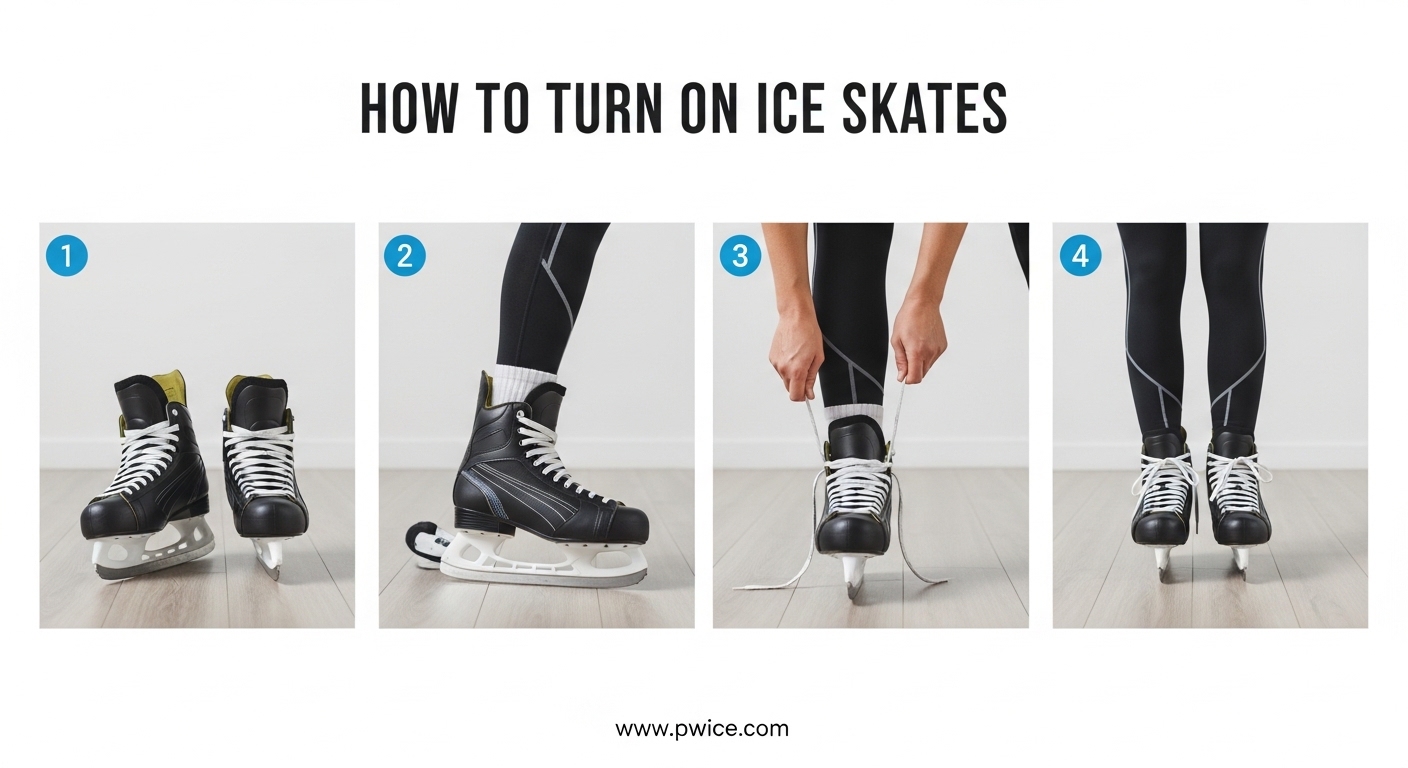
To turn on ice skates, shift your weight to the blade edges while rotating your upper body in the direction you want to go. Bend your knees, look where you want to travel, and let your feet follow your shoulder movement. This fundamental skill opens up the entire rink and keeps you safe from collisions.
I remember my first time attempting a turn. I was gripping the boards, terrified of letting go. After three sessions of practice, I could glide across the ice and change direction without panic. In this guide, I will walk you through every technique I learned from coaches and hours on the ice.
By the end of this article, you will know how to execute a basic two-foot turn, use your blade edges correctly, maintain speed during transitions, and practice effectively without fear. Whether you are stepping onto the ice for the first time or refining your technique, these steps will get you turning confidently.
Table of Contents
How to Turn on Ice Skates: The Basic Two-Foot Turn
The two-foot turn is the foundation of all ice skating turns. Every skater learns this first before advancing to one-foot turns or crossovers. It is the safest way to change direction while maintaining balance.
Step 1: Start with a Comfortable Glide
Begin by skating forward at a comfortable speed. You do not need to go fast. A slow, controlled glide gives you time to think through each movement. Keep your feet about shoulder-width apart and your knees slightly bent.
Step 2: Shift Your Weight
As you glide, shift your weight slightly to the foot on the side you want to turn toward. If turning left, put more weight on your left foot. This prepares that blade to carve into the ice and lead the turn.
Step 3: Rotate Your Upper Body
Turn your head and shoulders in the direction you want to go. Your body follows where your eyes look. Keep your arms relaxed and allow them to swing naturally with your shoulder rotation. This upper body movement initiates the turn.
Step 4: Apply Pressure to the Edges
Press gently into the inside edge of your leading foot and the outside edge of your trailing foot. Feel the blades bite into the ice. This edge pressure carves the arc of your turn. Do not lift your toes or heels.
Step 5: Complete the Turn and Glide Out
Let the turn happen naturally as your skates follow your upper body rotation. Once you have turned about 90 to 180 degrees, center your weight evenly on both feet again. Resume your forward glide in the new direction.
Understanding Blade Edges for Better Turns
Every ice skate blade has two edges: the inside edge and the outside edge. Knowing how to use them separates wobbly beginners from confident skaters. Edge control is the secret to smooth, controlled turns.
Inside Edge vs Outside Edge
The inside edge is the side of the blade closest to the big toe and the center of your body. Pressing here makes you turn toward that foot. The outside edge is the side near your pinky toe, away from your body center. Pressing here helps you turn away from that foot or stabilize during turns.
For a basic two-foot turn to the left, you apply pressure to the inside edge of your left skate and the outside edge of your right skate. The combination creates a curved path through the ice. Think of it like a bicycle leaning into a turn.
Edge Control Drills
Practice making ice shavings to learn edge control. While holding the boards, press your inside edge down and push gently. You should see a thin shaving of ice curl up. Do the same with your outside edge. This teaches your ankles how to apply controlled pressure.
Another drill is the “scooter” exercise. Push off with one foot and glide on the other, practicing inside and outside edges separately. Spend ten minutes on each edge during every practice session. Muscle memory builds faster with focused repetition.
Weight Shift and Balance Fundamentals
Your center of gravity determines how stable you are on the ice. Proper weight distribution keeps you upright and makes turning feel natural. Most beginners struggle because they skate too upright or lean back.
The Importance of Knee Bend
Bend your knees deeply. I am talking about a 90 to 110 degree angle at the knee joint. This low stance lowers your center of gravity and gives you stability. It also allows your ankles to flex and engage the blade edges.
When your knees are locked straight, you become a tall, unstable tower. Any wobble sends you falling. With bent knees, you absorb bumps and maintain control. Every coach I have worked with emphasizes knee bend above all else.
Weight Distribution During Turns
Start with your weight centered over both skates. As you initiate the turn, gradually shift about 60 percent of your weight to the leading foot. The trailing foot provides stability and pushes against its outside edge. This split weight distribution carves a clean arc.
Many beginners make the mistake of shifting all their weight to one foot. This causes the other skate to slide out uncontrollably. Keep both blades in contact with the ice throughout the turn. Even pressure distribution prevents slips.
Upper Body Rotation Technique
Your upper body leads the turn. Your lower body follows. This counter-rotation principle is fundamental to all skating maneuvers. When executed correctly, turning feels effortless.
Shoulder Rotation
To turn left, bring your right shoulder forward and your left shoulder back. This winds up your torso like a spring. As you release this rotation, your lower body naturally follows. The movement starts from your core, not your feet.
Your arms should swing naturally with your shoulder movement. Do not hold them stiff at your sides. Relaxed arms act as counterbalances. They help you recover if you start to wobble during the turn.
Head Position
Look where you want to go, not at your feet. Your head weighs about 11 pounds and affects your balance significantly. When you look down, your weight shifts forward and you lose stability. Keep your chin up and eyes focused on your target direction.
This head-up position also helps with spatial awareness. You can see other skaters, obstacles, and the boards. Safety on the ice depends on knowing what is around you at all times.
Forward to Backward Transition
The most intimidating turn for beginners is transitioning from forward skating to backward skating. It feels unnatural at first. With the right technique, you will maintain speed and control throughout the transition.
The Semicircle Method
Start by gliding forward in a straight line. Initiate a gentle turn to one side, carving a semicircle arc. As you reach the halfway point of the circle, allow your shoulders to continue rotating. Your feet will naturally transition to a backward glide as the turn completes.
The key is keeping the turn continuous. Do not stop halfway. Momentum carries you through the transition. If you slow down too much, you will feel stuck facing sideways and lose balance.
Maintaining Speed
Many beginners complain about losing all their speed when turning. The solution is edge pressure and commitment. Press firmly into your edges throughout the turn. Hesitation causes drag. Complete the movement decisively.
Practice this on a circle drawn on the ice or imagine one. Make continuous loops, transitioning from forward to backward and back again. Each lap builds confidence and maintains momentum. Speed comes from technique, not pushing harder.
Essential Practice Exercises
Structured practice accelerates your learning. Random skating around the rink builds some muscle memory, but targeted drills develop proper technique faster. Here are the exercises every beginner should master.
Stationary Edge Presses
Hold the boards and practice pressing your edges. Alternate between inside and outside edges on each foot. Feel how your ankle must tilt to engage each edge. Do twenty presses per edge before every skating session.
Two-Foot Glide Turns
Push off gently and glide slowly across the ice. Practice 90-degree turns while maintaining your glide. Turn left, glide straight, turn right, glide straight. Keep your speed minimal so you can focus on form rather than panic.
Circle Pattern Practice
Skate continuous circles around the rink. Start with large, gentle circles. Gradually make them smaller and tighter as you gain confidence. This exercise builds edge control and teaches you to link turns smoothly.
Barrier-Assisted Turns
Use the rink boards for support. Glide along the wall, then push off and attempt a turn before reaching the boards again. This gives you a safety net while practicing the full movement pattern. Many rinks have beginner corners designed for this.
Common Mistakes to Avoid
Recognizing errors early prevents bad habits. These are the most common turning mistakes beginners make and how to fix them.
Mistake 1: Looking Down at Your Feet
Your feet know where they are. Trust them. Looking down throws your weight forward and breaks your posture. Fix this by picking a focal point across the rink and keeping your eyes there throughout the turn.
Mistake 2: Stiff, Straight Legs
Locked knees eliminate your ability to absorb bumps and engage edges. You become a human bowling pin, ready to topple. Fix this by consciously checking your knee bend before every attempt. Touch your knees with your hands if needed to verify the bend.
Mistake 3: Lifting Your Toes
Some beginners try to turn by lifting their toes and pivoting on their heels. This catches the toe pick and causes you to trip. Keep all four wheels, or rather both blade edges, in contact with the ice throughout the turn.
Mistake 4: Turning Too Sharp Too Soon
Attempting 180-degree turns before mastering gentle 45-degree adjustments leads to falls. Build up gradually. Master small direction changes before attempting full direction reversals. Progression prevents injury.
Mistake 5: Forgetting Upper Body Rotation
Trying to turn with just your feet while keeping your shoulders square is nearly impossible. Your body fights itself. Always initiate the turn with your head and shoulders. Let your lower body follow naturally.
Safety Tips for Beginner Skaters
Fear holds back more skaters than physical ability. Managing that fear is part of learning. These safety tips keep you protected while building confidence.
Wear Proper Protection
A helmet designed for ice sports protects your head from falls and collisions. Many beginners skip this, but a single fall can cause serious injury. Wrist guards also help since instinct makes us put hands out when falling.
Learn to Fall Correctly
When you lose balance, bend your knees and lower your center of gravity. Try to fall forward onto your hands and knees rather than backward onto your tailbone. Tuck your chin to protect your head. Practice controlled falls during warm-up.
Skate During Less Crowded Sessions
Public skating sessions on weekend afternoons are chaos. Find early morning or weekday evening sessions with fewer people. Empty ice means less anxiety about hitting others and more space to practice wide turns.
Use the Rink Resources
Many rinks offer beginner classes or have staff who can provide quick tips. Some even have skating aids, those plastic walkers on blades, for absolute beginners. There is no shame in using every tool available to learn safely.
Take Breaks
Frustration builds when you are tired and cold. Step off the ice every 30 minutes to warm up and reset mentally. A fresh mind learns faster than an exhausted one. Progress happens over multiple sessions, not one marathon practice.
Frequently Asked Questions
How to turn on ice skates in hockey?
Hockey turns use the same fundamental technique but emphasize quickness and power. Hockey skaters often perform tight turns called “tight turns” or “quick turns” using deep knee bend and aggressive edge engagement. The key difference is maintaining speed throughout the turn to stay competitive. Practice the basic two-foot turn first, then work on tightening the radius and increasing speed.
How do I turn on skates?
To turn on skates, follow these steps: 1) Glide forward at a comfortable speed with knees bent. 2) Shift weight to the foot on your turning side. 3) Rotate your head and shoulders in the direction you want to go. 4) Apply pressure to the inside edge of your leading foot and outside edge of your trailing foot. 5) Let your skates follow your upper body rotation. 6) Center your weight and glide out in the new direction.
How to start moving on ice skates?
To start moving, march in place to get a feel for the ice. Then place your feet in a V position with heels together and toes apart. Push outward with your feet against the inside edges to propel forward. Take small steps initially, letting your skates glide between pushes. Keep your knees bent and your weight centered over your feet.
How to turn sharply on ice skates?
Sharp turns require deep knee bend, aggressive edge pressure, and quick upper body rotation. Lower your center of gravity by bending your knees to 90 degrees. Press firmly into your blade edges, digging into the ice. Rotate your shoulders quickly in the direction of the turn. Cross one foot over the other in a crossover motion for the tightest turns. Practice on circles, making them progressively smaller.
What is the forbidden move in ice skating?
The “forbidden move” refers to the backflip, which is banned in figure skating competitions by the International Skating Union. This ban exists for safety reasons, as the move is extremely dangerous on ice. Terry Kubicka performed the last legal backflip at the 1976 Olympics. The term sometimes gets mentioned in skating culture as a fun trivia fact among skaters.
Why do I lose speed when turning?
Speed loss during turns usually happens from hesitation or incorrect edge pressure. Commit fully to the turn instead of slowing down midway. Press firmly and continuously into your blade edges throughout the arc. Keep your knees bent to maintain a low center of gravity. Practice on continuous circles to learn how momentum carries through the turn.
How to turn without falling?
To turn without falling, maintain proper knee bend throughout the movement. Keep your weight centered over your skates rather than leaning too far in or out. Look in the direction of your turn, not down at your feet. Start with gentle, gradual turns before attempting sharp direction changes. Use the boards for support while learning, and wear wrist guards and a helmet for protection.
How long does it take to learn turning?
Most beginners can execute basic two-foot turns after 3 to 5 skating sessions. Consistent practice matters more than session length. Practicing for 30 minutes three times a week beats one marathon session. Everyone learns at different rates, so do not compare your progress to others. Focus on small improvements each time you step on the ice.
Conclusion
Learning how to turn on ice skates opens up the entire rink and transforms skating from stressful to enjoyable. The two-foot turn technique forms the foundation for all advanced maneuvers you will learn later. Master the basics of edge control, weight shift, and upper body rotation before rushing to advanced techniques.
Remember that every confident skater on the ice started exactly where you are now. They fell, got frustrated, and persisted through the learning curve. Your third session will feel dramatically different from your first. By your fifth session, turning will start to feel natural.
Take these techniques to the rink and practice them systematically. Start with stationary edge presses, progress to gentle glide turns, and work your way up to full direction changes. Focus on knee bend and looking where you want to go. Before you know it, you will be gliding effortlessly around the ice, turning with confidence and enjoying every moment on the rink.