
I remember the first time I watched a figure skating competition after the judging scandal at the 2002 Olympics. The scores flashed on screen, and I had no idea what I was looking at. Numbers like 85.42 and 92.17 replaced the familiar 5.8s and 5.9s I grew up with. The most confusing part? Two numbers appeared for every skater: one labeled TES and another labeled PCS. That second number, the program component scores in figure skating, determines almost half of every competitor’s fate.
Program Component Score (PCS) measures how well a skater performs their program beyond just landing jumps. It rewards artistry, skating quality, and presentation. The International Skating Union (ISU) introduced this system in 2004 to replace the old 6.0 format. Today, understanding PCS helps fans appreciate why their favorite skater won or lost.
This guide explains everything about program component scores. You will learn what judges evaluate, how scores get calculated, and what those numbers actually mean when you watch competitions like the 2026 Winter Olympics.
Table of Contents
What Are Program Component Scores in Figure Skating
Program Component Score (PCS) is the artistic and performance portion of a figure skater’s total score. Judges award marks based on how well the skater presents their program, not just what technical elements they complete. The ISU Judging System uses PCS alongside Technical Element Score (TES) to create a complete picture of each performance.
PCS accounts for roughly 50% of the total score in free skating programs. In short programs, the percentage varies by discipline but remains significant. A skater with perfect jumps can still lose if their PCS scores fall behind. Conversely, a skater with fewer technical elements can win through superior artistry and skating skills.
The Scoring Scale: From 0.25 to 10.00
Judges score each program component on a scale from 0.25 to 10.00 in increments of 0.25. A score of 1.00 indicates very poor performance. A score of 5.00 means average quality for the competition level. Scores of 8.00 to 10.00 represent world-class execution seen at Olympics and World Championships.
Most elite senior skaters score between 7.00 and 9.50 on each component. Junior and novice skaters typically range from 4.00 to 7.00. Adult recreational competitors often receive scores between 1.50 and 3.50. These ranges help contextualize what you see when scores appear on television broadcasts.
How PCS Fits Into Your Total Score
The complete scoring formula combines Technical Element Score and Program Component Score. TES measures jumps, spins, and step sequences with their base values plus grade of execution. PCS captures the subjective artistic quality through the three component categories.
A panel of nine judges typically evaluates each performance. For PCS, each judge awards one score per component category. The highest and lowest scores get removed through a trimmed mean calculation. The remaining seven scores are averaged to produce the final PCS for that component.
The Three Program Components Explained
In 2026, figure skating uses three program component categories. The ISU consolidated these from five components in 2018 to simplify the system. Each category evaluates different aspects of performance quality. Understanding all three helps fans appreciate what separates good skaters from great ones.
Composition
Composition evaluates how the program is designed and structured. Judges look at the arrangement of elements across the ice surface. They assess whether the program has a coherent theme or concept. The spacing and pattern variety throughout the rink matter significantly.
A well-composed program uses the entire ice surface effectively. Elements should not cluster in one area or feel randomly placed. The music should match the movements and create an overall impression. Choreography that tells a story or conveys emotion scores higher than disconnected sequences of jumps and spins.
Skaters and coaches spend months refining composition. Every movement gets planned to maximize both technical requirements and artistic impact. Poor composition can lower a skater’s PCS even if they execute every element perfectly.
Presentation
Presentation measures how the skater performs and projects to the audience. This component covers facial expressions, body language, and energy projection. Judges evaluate whether the skater engages with the music and communicates the program’s intent. The connection between performer and audience plays a major role.
Strong presentation makes viewers forget they are watching a judged sport. The skater becomes a performer conveying emotion through movement. Energy levels should match the music’s intensity throughout the program. Even subtle movements like finger positioning and head placement affect presentation scores.
Some skaters naturally excel at presentation. Others work with acting coaches to develop these skills. The best performers make difficult elements look effortless while maintaining character throughout the program.
Skating Skills
Skating Skills evaluates the quality of blade work and movement across the ice. This component reflects pure skating ability separate from jumps and spins. Judges assess edge quality, glide, speed variations, and multi-directional skating. Clean, powerful stroking and turns demonstrate superior skating skills.
The best skaters appear to float across the ice with minimal effort. Their edges are deep and controlled. They can skate equally well forwards and backwards, in both directions. Flow and glide between elements should appear continuous rather than choppy or labored.
Skating skills develop over years of training. Building proper technique early creates the foundation for everything else. Even skaters with amazing jumps cannot achieve high PCS without solid skating skills. This component often separates medalists from also-rans at major competitions.
How Program Components Are Scored
The scoring process involves multiple steps to ensure fairness and accuracy. Understanding this process helps explain why scores take time to calculate after a performance ends. The system balances subjective artistic judgment with mathematical precision.
The Judging Panel Process
Each competition uses a panel of nine judges for international events. These judges score all three program components independently. They enter their marks electronically during or immediately after the performance. No judge knows what scores other panel members award until after calculation.
Judges undergo extensive training and certification through their national federations and the ISU. They practice evaluating hundreds of programs to calibrate their scoring. ISU officials monitor judge performance and consistency across competitions. This oversight helps maintain scoring standards worldwide.
Trimmed Mean Calculation
The ISU uses a trimmed mean system to reduce outlier influence. For each component, the highest and lowest scores get discarded automatically. The remaining seven scores are averaged to produce the final mark. This prevents one unusually high or low score from skewing results.
Example: If nine judges award scores of 7.25, 7.50, 7.50, 7.75, 8.00, 8.00, 8.25, 8.50, and 9.00 for Composition, the 7.25 and 9.00 are removed. The remaining seven scores average to 7.93 for that component. The same process repeats for Presentation and Skating Skills.
Discipline-Specific Factors
PCS scores get multiplied by factors that vary by discipline and program segment. Singles and pairs skating use different factors for short programs versus free skates. Ice dance applies its own formula reflecting the discipline’s unique demands. These factors ensure appropriate weighting of components across different event types.
For singles skaters, free skate PCS factors range from 2.00 to 3.00 depending on the season’s rules. Short program factors are typically lower, around 1.00. After calculating the average component scores, the factor multiplies the total. This produces the final PCS number added to the TES for the segment score.
What Different PCS Scores Mean
Raw numbers on a scoreboard tell only part of the story. Understanding what scores represent at different levels helps fans interpret performances. I have watched competitions ranging from local club events to World Championships, and the score ranges vary dramatically.
Beginner Level: 1.00 to 3.50
Adult skaters and beginners typically receive PCS marks between 1.00 and 3.50. A score of 1.50 in Skating Skills indicates basic forward and backward movement with simple turns. Composition scores around 2.00 suggest elements are placed somewhat randomly without strong thematic connection.
These scores are not bad. They simply reflect the developmental stage of the skater. As forum users noted, adult skaters receiving 1.5-2.0 in components are performing appropriately for their level. Progress comes through continued training and performance experience.
Intermediate Level: 4.00 to 6.50
Competitive juvenile and intermediate skaters usually score between 4.00 and 6.50. At this level, skaters demonstrate consistent edge quality and beginning presentation skills. Composition shows intentional choreography with some ice coverage. Judges expect clean execution of basic program requirements.
A score of 5.00 represents solid intermediate work. The skater shows developing artistry alongside technical skills. Improvements in skating skills often drive overall PCS increases at this stage. Coaches focus on building the technical foundation that supports higher component marks later.
Advanced Level: 7.00 to 8.50
National-level competitors and junior international skaters typically range from 7.00 to 8.50. These marks indicate strong skating skills, well-constructed programs, and engaging presentation. The skater demonstrates consistent quality across all three components.
Scores in this range show readiness for senior international competition. Small improvements in each component can significantly impact total scores. Skaters at this level work on refining details like musical interpretation and complex choreography patterns.
Elite Level: 8.75 to 10.00
Olympic medalists and World Champions typically score between 8.75 and 9.75 across components. Perfect 10.00 scores are extremely rare but occasionally awarded for transcendent performances. These skaters combine flawless technique with artistic mastery.
Yuzuru Hanyu and Kaori Sakamoto have achieved component scores above 9.50 during their careers. Ilia Malinin has pushed his PCS upward while revolutionizing technical content. Watching these elite performances reveals what maximum component scores look like in practice.
From Five Components to Three: The System Evolution
Many fans and even some skaters remain confused about the component system history. Forum discussions frequently reference five program components, but the current system uses three. Understanding this evolution clarifies why sources sometimes contradict each other.
The Original Five-Component System (2004-2018)
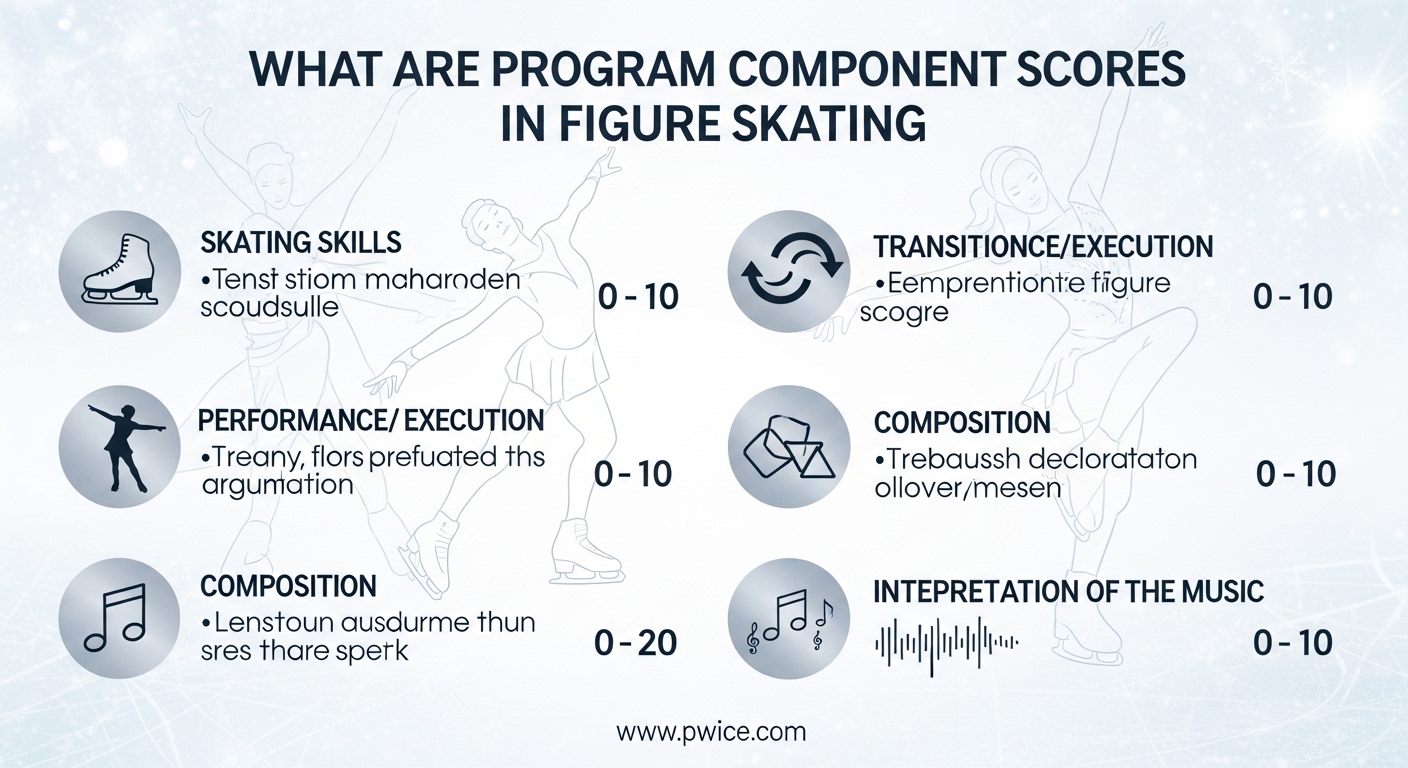
When the ISU introduced the current judging system in 2004, five program components existed. These were Skating Skills, Transitions, Performance/Execution, Composition, and Interpretation. Each component carried equal weight in the total PCS calculation. This structure lasted through the 2018 season.
Transitions measured how well skaters connected elements through difficult moves. Performance/Execution evaluated presentation quality and clean element completion. Interpretation focused specifically on musical expression and timing. These three components were consolidated in 2018.
The 2018 Consolidation
The ISU merged five components into three starting with the 2018-2019 season. Skating Skills remained as its own component. Composition absorbed the original Composition criteria. Presentation now combines what was formerly Performance/Execution, Transitions, and Interpretation.
The change aimed to simplify the system for fans, skaters, and judges. Many felt five components created unnecessary complexity without adding judging precision. The three-component system maintains comprehensive evaluation while being easier to explain and understand.
Some coaches and skaters initially resisted the change. They worried about losing specific feedback categories. However, the consolidated criteria still capture all important aspects of performance quality. Current judging panels provide the same detailed evaluations using the streamlined structure.
Frequently Asked Questions About Program Component Scores
What is the program component score?
Program Component Score (PCS) is the artistic portion of a figure skater’s total score that evaluates how well they perform their program. It measures composition, presentation, and skating skills on a scale from 0.25 to 10.00. Judges award PCS marks alongside Technical Element Score (TES) to create a complete assessment of each performance.
What does component score mean?
Component score refers to marks awarded for the non-technical aspects of figure skating performance. Unlike TES which rewards jump difficulty and execution, component scores reflect artistic quality, skating ability, and program construction. Higher component scores indicate better artistry, stronger skating fundamentals, and more engaging presentation.
What are components in figure skating?
The three program components in figure skating are Composition, Presentation, and Skating Skills. Composition evaluates program structure and ice coverage. Presentation measures performance quality and audience connection. Skating Skills assesses blade work, edges, and movement quality across the ice. Judges score each component separately from 0.25 to 10.00.
What is a good PCS score?
A good PCS score depends on competition level. Adult and beginner skaters typically score 1.50-3.50, which is appropriate for their development stage. Intermediate competitors range 4.00-6.50. Elite international skaters at Olympics and World Championships score 8.00-9.75. World-class performances occasionally approach 10.00 in exceptional cases.
Why do some skaters with harder jumps lose on PCS?
Skaters with difficult jumps sometimes lose because PCS accounts for roughly 50% of total scores. A skater landing quadruple jumps might receive lower composition or presentation marks if their artistry, program construction, or skating quality falls behind competitors. Conversely, skaters with fewer technical elements can win through superior component scores that reward their artistic mastery and skating fundamentals.
Conclusion
Understanding program component scores in figure skating transforms how you watch competitions. Those numbers flashing on screen represent artistic achievement alongside athletic accomplishment. PCS rewards the skaters who make us feel something beyond mere technical appreciation.
The three components, Composition, Presentation, and Skating Skills, capture everything that makes figure skating an art form. The scoring scale from 0.25 to 10.00 provides objective structure for subjective judgment. The trimmed mean calculation ensures fair results across nine-judge panels.
Whether you are a casual fan watching the 2026 Olympics or a competitive skater tracking your own progress, PCS knowledge enhances your appreciation of the sport. Next time you watch a competition, pay attention to the artistry between the jumps. That is where program component scores come to life.