
Standing in the lobby during your first hockey parent meeting, you hear terms being thrown around that sound like alphabet soup. AA, AAA, Tier I, Tier II – everyone seems to know what they mean except you. I remember that feeling when my son started hockey 2026 years ago. The difference between AA and AAA hockey determines everything from your weekly schedule to your family vacation plans to your bank account balance.
In this guide, I will break down exactly what separates these two competitive levels. You will learn the skill requirements, the real costs (with actual dollar amounts), the time commitments, and most importantly – how to choose the right level for your child and your family. Whether you are looking at tryouts this season or planning ahead for next year, this information will save you stress and help you make a confident decision.
Table of Contents
What Is AAA Hockey?
AAA hockey, also called Triple A or Tier I, represents the highest competitive level in youth hockey. This designation indicates elite-level competition where teams draw from larger geographic areas and compete at the state, regional, and sometimes national level. Players at this level have demonstrated advanced skills through competitive tryouts that typically eliminate 50-70% of applicants.
The “AAA” designation originated from the classification system used across North American youth sports, where additional letters indicate higher competitive tiers. In hockey specifically, AAA sits at the top of the pyramid for players under 18 years old. These teams operate under stricter requirements from governing bodies like USA Hockey and Hockey Canada.
A typical AAA team carries 15-18 skaters plus two goalies. The roster spots are fiercely competitive, with most programs holding 2-3 days of tryouts plus pre-tryout camps. Coaches at this level typically hold advanced certifications and often have played at collegiate or professional levels.
The competition schedule is intense. AAA teams usually play 60-80 games per season spanning September through March or April. Many programs also offer spring and summer development components. The travel radius expands significantly compared to lower tiers, with teams regularly driving 3-6 hours for league games and flying to national tournaments.
What Is AA Hockey?
AA hockey, or Double A, represents Tier II competitive youth hockey. This level sits one tier below AAA and serves as excellent competitive hockey for skilled players who may not make AAA rosters or prefer a more balanced lifestyle. AA teams typically draw from smaller geographic regions than AAA, often covering a single city or county.
The skill gap between AA and house league (recreational) hockey is substantial, while the gap between AA and AAA is narrower but still significant. AA players are solid skaters with good hockey IQ and competitive drive. They have successfully navigated tryouts, though the selection process is generally less cutthroat than AAA tryouts.
Most AA teams roster 15-20 players. Tryouts still exist and are competitive, but programs often field multiple AA teams at the same age level to accommodate more players. This creates a pathway for development while maintaining competitive standards.
The AA season typically runs 40-60 games from October through February or March. Travel is more regional, with most games within 1-3 hours of home. Some AA teams attend one or two overnight tournaments per season, but the travel burden is significantly lighter than AAA. Spring and summer play is optional and less structured.
AA vs AAA Hockey: Side-by-Side Comparison
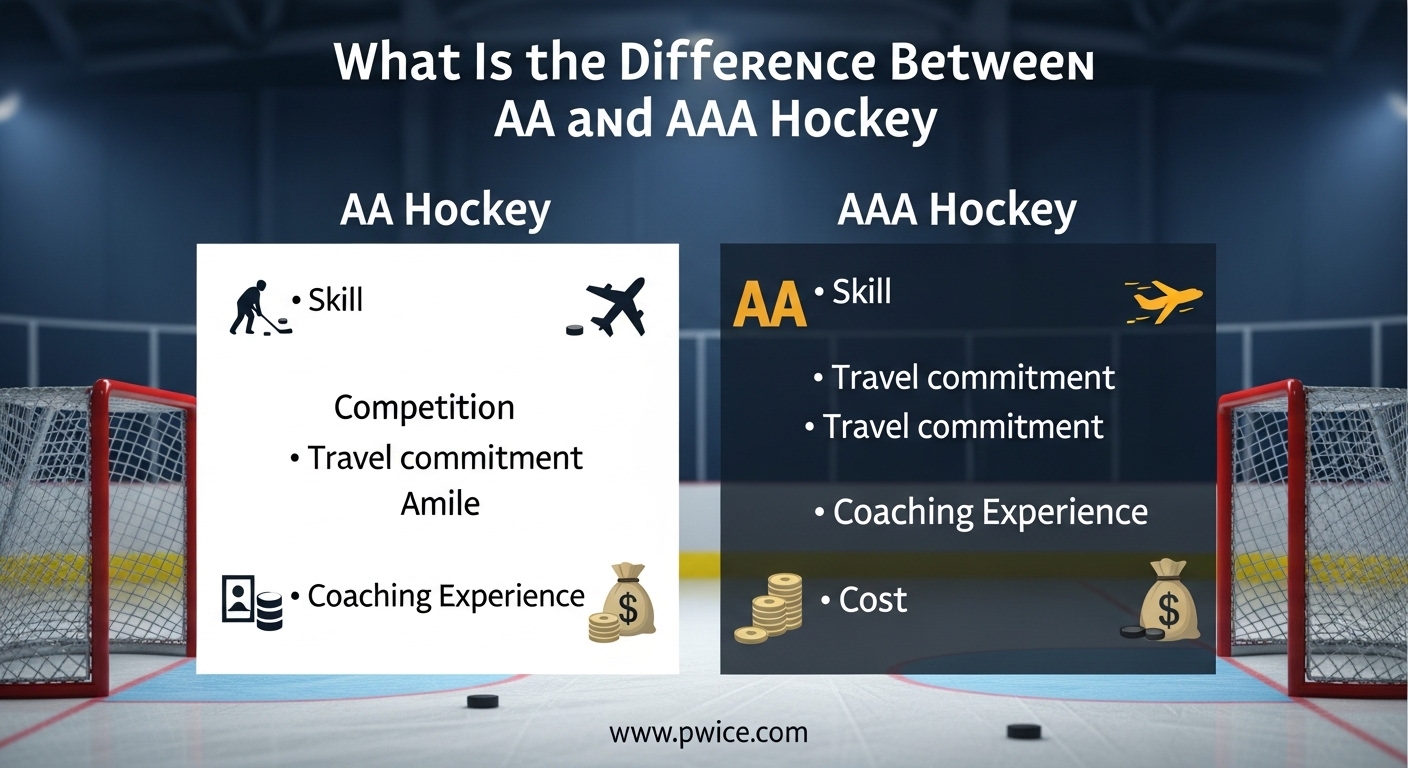
Before diving deeper into specific factors, here is a quick reference table comparing the key differences between AA and AAA hockey:
| Factor | AA Hockey (Tier II) | AAA Hockey (Tier I) |
|---|---|---|
| Competitive Tier | Tier II – Advanced | Tier I – Elite |
| Skill Level | Strong club players | Elite prospects |
| Tryout Difficulty | Moderate competition | Highly competitive |
| Season Cost | $3,000 – $8,000 | $8,000 – $20,000+ |
| Practice Frequency | 2-3 times per week | 3-4 times per week |
| Games Per Season | 40-60 games | 60-80 games |
| Typical Travel Range | 1-3 hours | 3-8 hours, some flights |
| Tournament Weekends | 2-4 per season | 6-10 per season |
| College Scout Presence | Rare | Common at older ages |
| Time Commitment | 8-12 hours/week | 15-25 hours/week |
This comparison shows the scale of difference between the two levels. The gap is not just about skill – it affects your entire family’s lifestyle for six to eight months each year.
Skill Level and Competition Differences
The on-ice differences between AA and AAA hockey are measurable and noticeable even to casual observers. At the AAA level, the pace of play is significantly faster. Passes arrive with more velocity, decisions happen quicker, and the physical gap closes rapidly as players hit puberty.
Skating ability represents the biggest separator. AAA players demonstrate elite-level edge work, acceleration, and top-end speed that AA players typically have not developed yet. While AA players are solid skaters, AAA players skate at a pace that demands constant adjustment from opponents.
Hockey IQ – the ability to read plays, anticipate movement, and make smart decisions under pressure – shows clear differentiation. AAA players consistently make better positional choices. They support the puck better, rotate through coverage seamlessly, and understand situational play at a deeper level.
Data from youth hockey advancement studies shows that roughly 15-25% of AA players successfully transition to AAA at the next age level. The reverse is also common – approximately 20-30% of AAA players move to AA each season due to roster cuts, family decisions, or burnout. Both levels produce excellent hockey players who continue to junior, collegiate, and even professional hockey.
At the 14U, 16U, and 18U levels, college scouts primarily attend AAA games and showcases. While this matters for players with NCAA aspirations, it should not be overstated for younger age groups. Scouts rarely attend 10U or 12U games regardless of tier.
Cost Comparison: AA vs AAA Hockey
The financial commitment represents one of the biggest practical differences between these levels. Understanding the full cost picture helps families make sustainable decisions.
AA Hockey Season Costs:
- Tuition/program fees: $2,000 – $5,000
- Travel (gas, hotels, meals): $800 – $2,500
- Equipment: $500 – $1,500
- Tournament fees: $300 – $800
- Extras (skills sessions, team gear): $200 – $500
Total AA Season: $3,800 – $10,300 (typical average around $6,000)
AAA Hockey Season Costs:
- Tuition/program fees: $5,000 – $12,000
- Travel (including flights for some teams): $2,500 – $6,000+
- Equipment: $800 – $2,000
- Tournament fees: $800 – $2,000
- Extras (skills, off-ice training, team gear): $500 – $1,500
Total AAA Season: $9,600 – $23,500+ (typical average around $14,000)
The cost gap widens further when you factor in the travel differences. AA teams might have 3-4 overnight trips per season. AAA teams often have 8-12, with some programs flying to showcases in different regions. Hotel costs add up quickly, especially when you factor in meals and incidentals.
Looking at cost per hour of ice time, the numbers become interesting. AA delivers competitive hockey at roughly $25-40 per hour of on-ice time. AAA runs $35-60 per hour but includes significantly more coaching expertise and exposure to elite competition. Neither level is cheap, but AAA requires serious financial planning for most families.
Time Commitment and Travel Requirements
Beyond the financial cost, the time investment affects the entire family. Here is how the schedules typically break down.
AA Hockey Weekly Schedule:
- Practices: 2-3 sessions (1.5 hours each)
- Games: 1-2 games per weekend
- Off-ice commitment: Minimal or optional
- Travel time: 2-6 hours per weekend
- Total weekly time: 8-12 hours
AAA Hockey Weekly Schedule:
- Practices: 3-4 sessions (1.5-2 hours each)
- Games: 1-2 games per weekend
- Off-ice training: Often required (strength, conditioning, skills)
- Travel time: 4-12+ hours per weekend
- Total weekly time: 15-25 hours
The impact on family life is substantial. AA hockey allows time for other activities, family dinners, and weekend flexibility. AAA hockey becomes the dominant scheduling force in your life from September through March. Siblings often get dragged to rinks, and parents juggle work commitments around travel schedules.
Travel distances vary significantly by region. In the Northeast or Great Lakes areas, AA teams might rarely stay overnight because population density allows same-day trips. In the Southeast or West, AA teams might travel 4+ hours routinely. AAA teams everywhere regularly face 5-8 hour drives or flights for league games and showcases.
School impacts deserve consideration. Missing school for hockey becomes normalized at the AAA level, with many programs scheduling Monday or Friday games that require travel. AA teams typically schedule around school hours more carefully. This matters for younger players particularly.
Which Level Is Right for Your Child?
After coaching and parenting through both levels, I have developed a simple framework for this decision. Consider these factors honestly before committing.
Choose AAA Hockey If:
- Your child was clearly one of the top 2-3 players on their previous team
- They demonstrate exceptional skating ability and hockey IQ for their age
- Your family can handle the financial commitment without hardship
- One parent has schedule flexibility for travel demands
- Your child genuinely wants this level of intensity and competition
- You have access to quality AAA programs within reasonable distance
- College hockey is a serious future goal
Choose AA Hockey If:
- Your child is a solid player but not consistently dominating games
- Family finances would be strained by AAA costs
- Your child participates in other activities they do not want to quit
- Travel hockey already feels like enough of a time commitment
- School academics need to remain the priority
- You value family weekend flexibility
- The local AA program has good coaching and development focus
The prestige factor often drives poor decisions. Parents sometimes push for AAA because it feels like a status symbol. This rarely ends well. Kids who struggle to keep up at AAA often lose confidence and enjoyment. Meanwhile, strong AA players develop leadership skills and confidence that serves them well.
Age matters significantly in this decision. At 10U and 12U, the differences between AA and AAA are less consequential for long-term development. Many excellent players spent these years in AA before moving up. At 14U and beyond, the levels diverge more significantly, and the decision carries more weight for aspiring collegiate players.
Moving Between Levels: AA to AAA and Vice Versa
Players move between these levels constantly. Understanding the pathways helps set realistic expectations.
Moving AA to AAA:
Most AA-to-AAA transitions happen during spring tryouts for the following season. The typical pathway involves dominating at the AA level, attending AAA tryouts, and earning a roster spot. Some players make this jump every season; others spend 2-3 years at AA before advancing.
Success at AAA tryouts requires more than just good stats. Coaches look for skating speed, compete level, and coachability. Players who put in off-ice work during the summer have much better odds. Many AA players attend AAA camps or clinics to get exposure to the coaching style and intensity.
Moving AAA to AA:
This direction happens more frequently than most people discuss openly. Reasons include being cut from AAA rosters, family financial changes, burnout, injury recovery, or simply wanting more balance. There is no shame in this transition – many players thrive after moving down a level.
Players who move from AAA to AA often become team leaders and top scorers immediately. The confidence boost frequently improves their development trajectory. College coaches would rather see a player dominating at AA than struggling at AAA.
Timing Considerations:
The best time to change levels is during normal tryout season (March-May for most programs). Mid-season moves are possible but disruptive to team chemistry and player development. If you are considering a level change, start researching programs and attending open skates months before tryouts.
Frequently Asked Questions
Which is better, AA or AAA hockey?
AAA hockey is considered the higher competitive tier and features more skilled players, but better depends on your child’s situation. AA hockey offers excellent competition with less financial and time commitment. Many players develop better in AA where they get more playing time and confidence, while others need the challenge of AAA to reach their potential.
Did all NHL players play AAA?
Most NHL players did play AAA at some point in their youth careers, but not exclusively. Some spent time in AA or even house leagues before developing later. The path to professional hockey varies significantly – some players are early bloomers in AAA, while others develop later through different pathways including junior hockey.
What is AAA and AA in hockey?
AAA (Triple A) and AA (Double A) are competitive tier designations in youth hockey. AAA represents Tier I – the elite level with the highest skill requirements, most travel, and highest costs. AA represents Tier II – advanced competitive hockey with strong players but less intensive schedules and lower costs than AAA.
What age can kids start playing AAA hockey?
Kids can typically try out for AAA teams starting at the 10U (Squirt) level, around age 9-10. However, the intensity and commitment level vary significantly by region. Some areas offer AAA at 8U, while others do not have formal AAA until 12U. The appropriate age depends on your child’s physical and emotional readiness.
Is AA hockey worth it?
AA hockey is absolutely worth it for players who want competitive hockey without the extreme commitment of AAA. It provides excellent skill development, meaningful competition, and a pathway to higher levels if desired. Many families find AA offers the perfect balance of hockey quality and lifestyle sustainability.
How much does AAA hockey cost per year?
AAA hockey typically costs between $8,000 and $20,000+ per season depending on your region, program, and travel requirements. Major costs include tuition ($5,000-12,000), travel ($2,500-6,000+), equipment ($800-2,000), and tournament fees. Families should budget for the higher end of estimates to avoid surprises.
Can you move from AA to AAA hockey mid-season?
Moving from AA to AAA mid-season is possible but uncommon. Most programs have set rosters and USA Hockey registration requirements make mid-season transfers complicated. If a AAA team has roster openings due to injuries or departures, they may add players from AA. The normal pathway is trying out during spring tryout season.
Conclusion
What is the difference between AA and AAA hockey? The answer spans skill level, financial commitment, time investment, and lifestyle impact. AAA represents elite Tier I competition with the best young players, intensive schedules, and significant costs. AA offers advanced Tier II hockey that delivers excellent development and competition with more manageable demands.
Both levels produce great hockey players and wonderful experiences. The right choice depends entirely on your child’s abilities, your family’s resources, and your collective priorities. Do not let ego drive you toward AAA if AA is the better fit. Some of the best hockey experiences happen at the AA level where players lead, develop confidence, and enjoy the game without overwhelming pressure.
As you evaluate tryout options for the upcoming season, use the framework in this guide. Be honest about your child’s current abilities and your family’s capacity for the commitment. Talk to parents at both levels in your specific area, as regional variations matter significantly. Most importantly, remember that hockey should build character and joy – regardless of whether the letter on the jersey is doubled or tripled.
Have you navigated the AA vs AAA decision in your family? I would love to hear about your experience in the comments. Your insights might help another parent facing this same choice.