
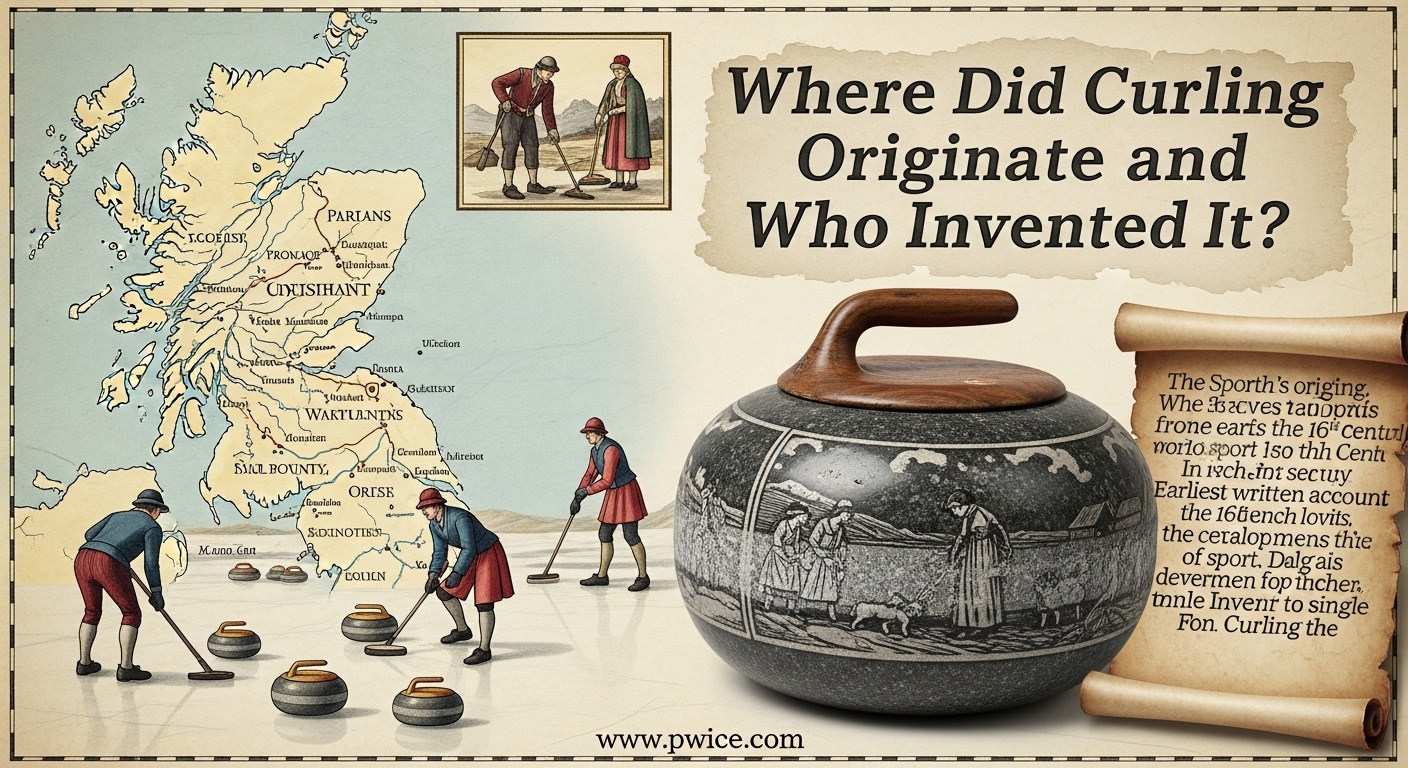
Have you ever wondered why curling is called the “roaring game”? That distinctive rumble of granite sliding across pebbled ice has echoed across frozen Scottish lochs for over five centuries. Where did curling originate and who invented it? The answer takes us back to 16th-century Scotland, where this unique winter pastime emerged from the mists of medieval history to become one of the world’s oldest continuous team sports.
I first became fascinated by curling’s history during the Winter Olympics, watching teams from around the world compete with stones that looked almost identical to those used centuries ago. The sport has this incredible ability to feel both ancient and modern at the same time.
Curling was not invented by a single person. The sport evolved organically among Scottish communities during the 1500s as a way to pass the long winter months. The first written evidence of curling dates to February 1540, when a Scottish notary named John McQuhin recorded a challenge match between a monk named John Sclater and a representative of the Abbot at Paisley Abbey. This document represents the earliest known record of the sport being played in any formal sense.
Table of Contents
16th Century Scotland: The Birth of the Roaring Game
Picture the Scottish Lowlands in the dead of winter, sometime around the year 1511. Frozen lochs and ponds became natural playing fields for communities seeking outdoor recreation during the coldest months. Early curling was played with whatever flat stones could be found along riverbeds and fields. There were no standardized rules. No two stones weighed the same. Players simply slid these crude rocks across the ice toward a target, competing for bragging rights and community pride.
The sport emerged naturally from Scottish winter life. In an era before television, organized sports leagues, or even reliable indoor heating, people sought ways to stay active and social during harsh winters. Curling provided both physical activity and community gathering. Whole villages would turn out to watch matches on frozen ponds. The sound of stone against ice created that signature “roar” that gives the sport its enduring nickname.
The earliest known curling stone bears the date 1511, discovered in a dried-up pond at Dunblane, Scotland. This stone, with its primitive shape and hand-carved date, represents physical proof that the sport existed in some form over 500 years ago. Historians debate whether this stone was actually used for curling or simply marked the year it was retrieved, but its existence anchors the sport to this early period.
Some art historians point to paintings by Pieter Bruegel the Elder from the 1560s as additional visual evidence of early curling. His famous winter scenes, including “The Hunters in the Snow” and “Winter Landscape with a Bird Trap,” depict figures on frozen ponds engaged in activities that resemble curling. These Flemish paintings suggest the sport may have had connections to the Low Countries as well as Scotland, though the Scottish claim remains the strongest documented origin.
The First Written Record: John McQuhin and 1540
If curling emerged gradually from Scottish winter traditions, when did it first appear in historical records? The answer lies in a single document preserved from February 1540. John McQuhin, a notary public in Paisley, Scotland, recorded a challenge between John Sclater, a monk, and Gavin Hamilton, a representative of the Abbot of Paisley Abbey.
This document, written in Latin and preserved in Scottish archives, describes a contest “jactu lapidum super glaciem” (throwing stones over ice). While brief, this notation represents the first confirmed written evidence of curling as an organized activity. McQuhin’s record tells us that by 1540, curling had evolved from casual recreation into something formal enough to warrant documentation.
The location matters as much as the date. Paisley Abbey, founded in the 12th century, sat in the heart of Scotland’s Lowlands where winters brought reliable freezes. The monks and local nobility had both the leisure time and the frozen ponds necessary for developing the sport. This religious and social context shaped curling’s early character as a genteel pastime rather than rough folk game.
I find it remarkable that this first match pitted a monk against an abbot’s man. There’s something poetic about religious figures helping launch a sport that would eventually reach the Olympic stage. That 1540 contest in Paisley set in motion a chain of events that continues 2026.
From Pastime to Organized Sport: The Rise of Curling Clubs
For nearly two centuries after McQuhin’s record, curling remained largely informal. Communities played by local rules with improvised equipment. That changed in 1716, when the Kilsyth Curling Club formed in Scotland, becoming the oldest documented curling club in history. This marked a turning point when curling transitioned from winter pastime to organized sport.
The formation of dedicated clubs brought standardization. Clubs established rules, organized competitions, and began recording results. The social aspect of curling flourished in this environment. Matches became community events, often followed by dinners and celebrations. The tradition of the “bonspiel” – a curling tournament – emerged during this period, creating a vocabulary that curlers still use 2026.
By the late 18th century, curling clubs had spread across Scotland’s central belt. The Grand Match, pitting teams from the north against the south, became an annual spectacle drawing thousands of spectators. Curling was becoming woven into Scottish cultural identity, a sport that represented both competition and community.
Equipment began evolving during this club era too. Players started seeking out specific types of stone that performed better on ice. The irregular field stones of the 16th century gave way to more carefully selected rocks. Some enterprising individuals even began fashioning handles from iron or wood to help deliver the stones more effectively.
Queen Victoria and the Royal Caledonian Curling Club (1843)
The 19th century brought curling its most influential patron. In 1838, several Scottish clubs united to form the Grand Caledonian Curling Club, an organization dedicated to standardizing rules and promoting the sport. Just five years later, Queen Victoria herself would transform curling’s status forever.
During a visit to her Scottish estate at Balmoral Castle in 1843, Queen Victoria witnessed a curling match on the frozen Loch of Aboyne. The sport captivated her. She was particularly impressed by the combination of athletic skill, strategy, and the picturesque Scottish setting. Within days, she had granted permission for the Grand Caledonian Curling Club to add “Royal” to its name.
The Royal Caledonian Curling Club became known as the “Mother Club” of curling worldwide. This designation recognized not just the Queen’s patronage but the organization’s role in governing and spreading the sport. The RCCC established standardized rules that would be exported wherever Scots settled in cold climates. Royal patronage gave curling social prestige and helped distinguish it from other folk sports.
Queen Victoria’s involvement had lasting effects. The sport attracted participants from across social classes, from farmers to aristocrats. This democratic character, combined with royal approval, created a uniquely Scottish sporting institution. The RCCC continues to operate 2026, maintaining archives and governance for Scottish curling.
The Stones of Ailsa Craig: How Equipment Shaped the Game
Every Olympic curling match relies on stones that share a common birthplace. Ailsa Craig, a small volcanic island off Scotland’s west coast, produces the granite used in virtually all competitive curling stones worldwide. This connection between a tiny Scottish island and Olympic competition represents one of sport’s most remarkable supply chains.
Ailsa Craig granite possesses unique properties that make it ideal for curling. The island produces two types of stone: blue hone granite, which is extremely dense and water-resistant, and common green granite. Modern curling stones use a composite construction, with a blue hone body capped with common green for the striking surface. This combination provides the durability, consistency, and “curl” characteristics that the sport demands.
The evolution of curling equipment tells its own story. Early players used whatever flat stones they could find, sometimes weighing as little as a few pounds or as much as 50 pounds. Standardization came slowly. By the 19th century, most stones weighed between 40 and 50 pounds (18-23 kg). Modern stones are precisely regulated at 38-44 pounds (17-20 kg) with a maximum circumference of 36 inches.
Handles appeared in the early 1800s, revolutionizing how players delivered stones. Before handles, players simply gripped the stone’s top surface, limiting control and accuracy. The addition of a handle allowed for the precise rotation that creates the “curl” – the curved trajectory that gives the sport its name.
Brooms and brushes have evolved dramatically as well. Early curlers used simple corn brooms for sweeping. Modern competitive curling uses specialized brushes with fabric heads and complex physics. The “hack,” a foothold that provides leverage for delivery, was another 19th-century innovation that transformed technique. Understanding this equipment evolution helps explain why modern curling looks different from its 16th-century origins while retaining the same fundamental appeal.
The Scottish Diaspora: Curling Goes Global
Scottish immigrants carried curling across the world. As Scots left their homeland seeking new opportunities, they brought their winter sport with them. The Scottish diaspora established curling in Canada, the United States, and eventually across Europe and Asia. This global spread created the international curling community we know 2026.
Canada embraced curling most enthusiastically. Scottish settlers introduced the sport in the 18th century, and it quickly became woven into Canadian winter culture. Today, Canada claims over one million curlers and dominates international competition. The country has won more Olympic curling medals than any other nation, with a particular strength in men’s and women’s team events. Canada recognizes curling as its national winter sport alongside ice hockey.
In the United States, Bemidji, Minnesota has earned the title of “Curling Capital of the USA.” Since 1935, the Bemidji Curling Club has produced over 100 state and national championship banners. The club sent a men’s team to the 2006 Olympics in Turin, where they won the first-ever Olympic bronze medal for American curling. This small Minnesota town embodies how Scottish immigrants and their descendants preserved and promoted curling across North America.
The World Curling Federation, formed in 1966 as the International Curling Federation, now governs the sport globally. Member nations span from traditional curling powers like Canada, Scotland, and Sweden to newer entrants like China, Japan, and Korea. The Federation standardized international rules and established the World Curling Championships that determine the best teams on ice.
Women’s curling has its own parallel history. While early curling was male-dominated, women formed their own clubs and competitions by the late 19th century. The Royal Caledonian Curling Club admitted women in the 20th century, and women’s curling became an Olympic medal event in 1998 alongside the men’s competition. This evolution reflects broader changes in sports participation while honoring curling’s inclusive traditions.
Olympic Journey: From Demonstration to Medal Sport
Curling’s Olympic story spans nearly a century of demonstration events, political complications, and eventual full recognition. The sport first appeared at the 1924 Winter Olympics in Chamonix, France, as a medal event. Great Britain and Ireland claimed gold, Sweden took silver, and France won bronze. Only three nations competed in this modest debut.
After 1924, curling disappeared from the Olympic program for decades. The 1932 Lake Placid Games featured curling as a demonstration sport, with Canada and the United States competing. Canada won both matches, but no medals were officially awarded. The sport’s Olympic future remained uncertain.
The 1988 Calgary Olympics and 1992 Albertville Games both included curling as demonstration sports. These appearances helped build international support for full medal status. Finally, at the 1998 Nagano Olympics, curling returned as a full medal sport with both men’s and women’s competitions. Canada won gold in the men’s event, while Sweden claimed the first women’s gold.
Curling has expanded at recent Olympics. Wheelchair curling debuted at the 2006 Turin Games, adding para-sport excellence to curling’s Olympic profile. Mixed doubles curling, featuring teams of one man and one woman, joined the program at the 2018 PyeongChang Olympics. These additions have brought new strategies and excitement to Olympic curling while honoring the sport’s traditions.
The Olympic journey transformed curling’s global profile. Television coverage introduced the sport to billions of viewers who had never seen it before. The strategic depth, sportsmanship, and unique terminology (“house,” “button,” “hammer,” “blank end”) intrigued audiences worldwide. Olympic curling has become one of the Winter Games’ most-watched events, with viewership rivaling hockey and figure skating in many markets.
Curling Today: A Sport Spanning Five Centuries
Where did curling originate and who invented it? We now know the full answer spans from 16th-century Scottish lochs to Olympic stadiums 2026. The sport that began with irregular stones on frozen ponds has become a global phenomenon with standardized equipment, professional athletes, and millions of devoted participants.
Modern curling embraces technology while honoring tradition. High-definition cameras analyze stone trajectories. Specialized ice technicians create perfect playing surfaces. Yet the fundamental act remains unchanged: players still slide 44-pound granite stones across pebbled ice, using brooms to influence their path. The “roar” that gave the sport its nickname continues 2026.
The Royal Caledonian Curling Club still operates as Scottish curling’s governing body. Kilsyth Curling Club celebrates over 300 years of continuous play. Ailsa Craig continues supplying the granite for Olympic stones, though the island is now a protected nature reserve with limited quarrying allowed. These connections to curling’s origins remain vital and visible.
Whether you are watching Olympic medal matches or trying curling at a local club, you are participating in a tradition that began over 500 years ago. The monk and the abbot’s man who competed at Paisley Abbey in 1540 could hardly have imagined their sport reaching a global audience. Yet that ancient contest set in motion everything that followed.
Frequently Asked Questions
Who invented curling as a sport?
No single person invented curling. The sport evolved organically in 16th-century Scotland as a winter pastime among communities seeking recreation on frozen lochs and ponds. The first written record dates to February 1540, when Scottish notary John McQuhin documented a challenge match between a monk named John Sclater and a representative of the Abbot at Paisley Abbey. This gradual evolution makes curling a sport born from collective tradition rather than individual invention.
Which town is the curling capital of the US?
Bemidji, Minnesota is widely recognized as the Curling Capital of the USA. Since 1935, the Bemidji Curling Club has produced over 100 state and national championship banners and numerous Olympic curlers. The town sent a men’s team to the 2006 Turin Olympics that won the first-ever Olympic bronze medal for American curling. This small Minnesota community embodies how Scottish immigrants and their descendants established curling traditions in the United States.
What country is famous for curling?
Canada is the country most famous for curling, with over one million active curlers and the most successful Olympic record with 14 medals. While Scotland invented the sport in the 16th century, Canada embraced it as a national winter sport through Scottish immigrants. Canadian teams dominate world championships and have pioneered many competitive innovations. Curling enjoys mainstream popularity in Canada with extensive television coverage and community participation that exceeds any other nation.
Is curling the oldest sport?
Curling is one of the world’s oldest team sports, dating to 16th-century Scotland with the oldest known stone inscribed 1511. However, it is not the oldest sport overall – activities like wrestling and archery predate it by thousands of years. Curling is recognized as one of the oldest established team sports still played today in a recognizable form, with continuous organized play spanning over 500 years from medieval Scotland to the modern Olympic Games.
The Enduring Legacy of Curling
Where did curling originate and who invented it? The complete answer reveals a sport that emerged naturally from Scottish winter life, evolved through community traditions, and spread globally through Scottish immigration. From John McQuhin’s 1540 record to the Olympic medals of 2026, curling represents one of humanity’s most remarkable sporting journeys.
The “roaring game” continues to captivate new generations. Whether you are drawn to the strategic depth, the social atmosphere, or simply the unique spectacle of stones gliding across ice, curling offers something rare in modern sports: a direct connection to centuries of continuous tradition. Every time a curler steps into the hack and delivers a stone, they participate in a lineage stretching back to those frozen Scottish lochs of the 1500s.
If this history has sparked your curiosity, I encourage you to seek out a local curling club. Most facilities offer learn-to-curl sessions where you can try the sport yourself. There is something profound about gripping a 44-pound Ailsa Craig stone, feeling its weight and history, and sliding it down the ice. You will understand why Scottish communities have loved this sport for over 500 years.
The monk and the abbot’s man who faced off at Paisley Abbey in 1540 began something extraordinary. Their contest, recorded by a diligent notary, launched a sport that would travel from Scottish lochs to Canadian prairies, from Minnesota towns to Olympic stadiums. Curling remains what it has always been: a celebration of winter, community, and the simple joy of sliding stone across ice.