
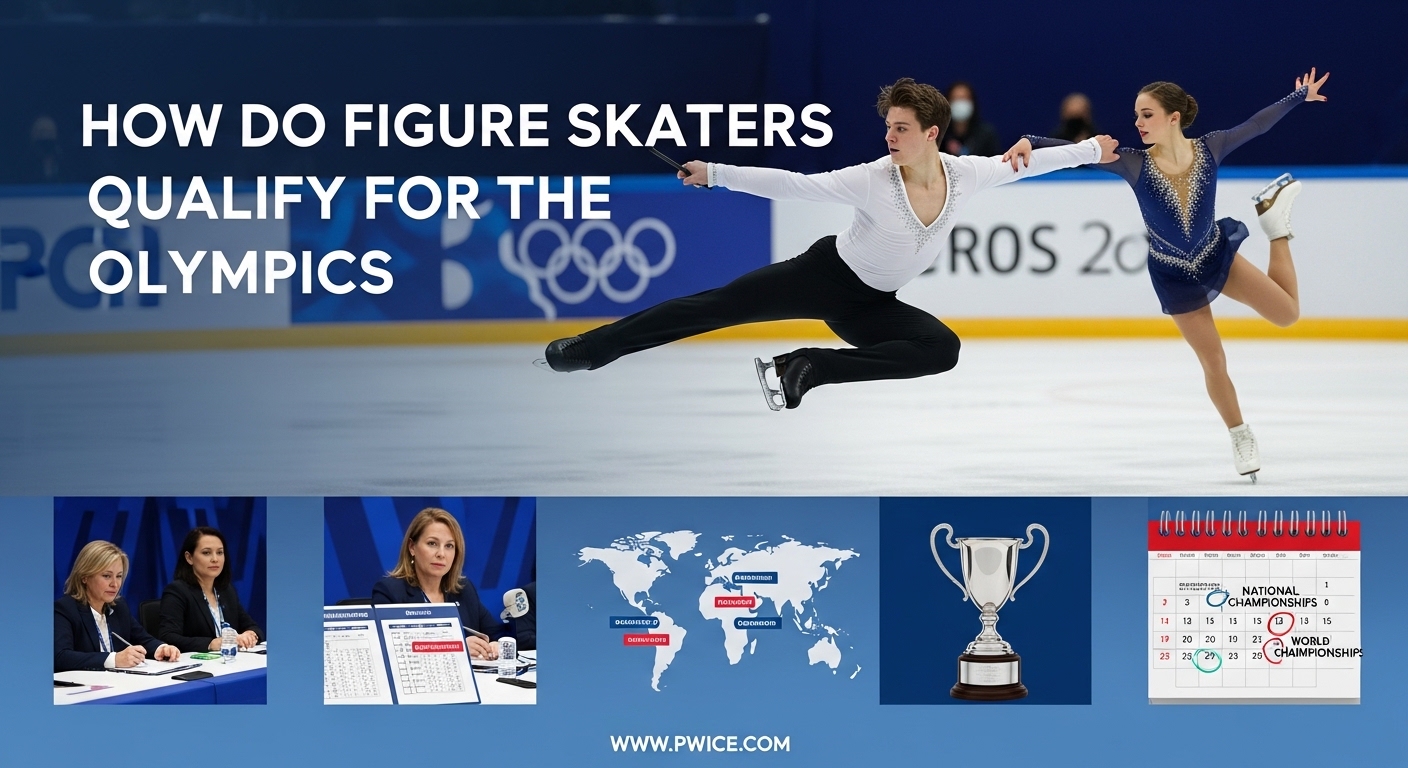
Figure skaters qualify for the Olympics through a two-step process that confuses many fans. Countries earn quota spots at ISU-sanctioned competitions, not individual athletes. Each country’s National Olympic Committee then selects which athletes fill those qualified spots based on their own criteria. This system applies to all figure skating disciplines: men’s singles, women’s singles, pairs, and ice dance.
I’ve followed Olympic qualification cycles for over a decade, and the most common misconception I hear is that a skater’s world ranking automatically gets them to the Games. The reality is more complex. A skater could be ranked 5th in the world but not compete at the Olympics if their country only qualified one spot and chose someone else.
Understanding this qualification system helps you follow your favorite skaters’ journey to Milano Cortina 2026. It also explains why some top-ranked skaters might watch the Games from home while lower-ranked competitors take the ice.
Table of Contents
Understanding the Two-Step Qualification System
The Olympic qualification system for figure skating operates in two distinct phases. First, countries compete for quota spots at designated ISU events. Second, each National Olympic Committee selects the actual athletes who will represent their country.
This structure exists because the Olympic Charter gives National Olympic Committees full authority over athlete selection. The International Skating Union determines how many spots each country receives, but the final decision on who fills those spots belongs to each nation’s federation.
Step 1: Countries Earn Quota Spots
Countries earn quota spots based on their skaters’ performances at two main competitions. The ISU World Championships serve as the primary qualification event. The Olympic Qualifying Competition, historically called Skate to Milano for the 2026 cycle, serves as the secondary pathway.
A country can earn up to three spots per discipline depending on their cumulative placement points at these events. The better a country’s skaters perform collectively, the more spots that country receives for the Olympic Games.
Step 2: NOCs Select Athletes
After earning quota spots, each National Olympic Committee decides which athletes will compete. Some countries hold Olympic trials where the top finishers automatically qualify. Others use a selection committee that considers multiple factors including international results, consistency, and competitive readiness.
The United States typically holds a national championships close to the Olympics where results heavily influence selection. Japan often combines national championship results with international competition scores. Russia historically used a combination of committee decisions and head-to-head competition results.
Primary Pathway: ISU World Championships 2025
The World Championships represent the primary route to Olympic qualification for figure skating. Held in Boston from March 24-30, 2025, this competition determined the majority of quota spots for the Milano Cortina 2026 Winter Olympics.
The qualification system uses placement points to determine how many spots each country earns. Countries accumulate points based on where their skaters finish in each discipline. The total points earned determines whether a country receives one, two, or three entries for the Olympics.
The Placement Points System
The ISU awards points based on final placement at World Championships. First place earns 16 points, second earns 15, and so on down to 16th place earning 1 point. Placements below 16th do not contribute points toward Olympic qualification.
Countries can send multiple skaters to Worlds, but only the best finishers count toward Olympic qualification points. The exact number of counting placements depends on how many entries a country has at the World Championships.
| Placement | Points Earned |
|---|---|
| 1st | 16 points |
| 2nd | 15 points |
| 3rd | 14 points |
| 4th | 13 points |
| 5th | 12 points |
| 6th | 11 points |
| 7th | 10 points |
| 8th | 9 points |
| 9th | 8 points |
| 10th | 7 points |
| 11th | 6 points |
| 12th | 5 points |
| 13th | 4 points |
| 14th | 3 points |
| 15th | 2 points |
| 16th | 1 point |
| 17th and below | 0 points |
How Many Spots Countries Can Earn
A country’s total placement points determine their Olympic quota for each discipline. The ISU sets specific point thresholds for earning multiple entries.
To earn three spots in a discipline, a country needs 13 or fewer placement points from their top two finishers. To earn two spots, they need 14 to 28 points from their top two finishers. Countries outside these thresholds receive one spot if they had any finishers in the top 16.
Worked Example: Calculating Spots
Let me walk you through a real-world scenario. Imagine Country A sends two skaters to the World Championships in men’s singles. Their first skater finishes 3rd, earning 14 points. Their second skater finishes 8th, earning 9 points.
The country adds the placement points from their two best finishers: 14 + 9 = 23 points. Since 23 points falls between 14 and 28, Country A qualifies two spots for the Olympics in men’s singles.
Now consider Country B. They also send two skaters, but one finishes 2nd (15 points) and the other finishes 5th (12 points). Their total is 15 + 12 = 27 points. This also falls in the two-spot range.
If Country C has skaters finishing 1st (16 points) and 3rd (14 points), their total is 30 points. This exceeds the two-spot threshold, so they only earn one Olympic spot despite having two strong finishers.
Country D with finishers at 1st (16 points) and 2nd (15 points) totals 31 points. They earn only one spot. But Country E with finishers at 2nd (15 points) and 10th (7 points) totals 22 points, earning them two spots.
Secondary Pathway: Olympic Qualifying Competition
Not all Olympic spots are allocated at World Championships. The Olympic Qualifying Competition, branded as “Skate to Milano” for the 2026 cycle, fills the remaining quota spots. This event typically takes place in December of the year before the Olympics.
The Olympic Qualifying Competition serves as a second chance for countries that didn’t maximize their spots at Worlds. It also provides opportunities for countries that had no finishers in the top 16 at the World Championships.
Who Competes at the Olympic Qualifying Competition
Countries that earned fewer than three spots at World Championships can send skaters to this event. The goal is to improve their quota allocation or secure additional spots they missed at Worlds.
Countries that earned no spots at Worlds because their skaters placed outside the top 16 can also compete here. This gives every ISU member nation a pathway to Olympic participation.
How Final Spots Are Allocated
The Olympic Qualifying Competition uses a similar point system to Worlds, though the available spots are more limited. Countries accumulate points at this event and combine them with any points from Worlds to determine their final quota.
The ISU publishes detailed communication documents explaining exactly how many spots remain available for each discipline at this competition. The number varies based on how many spots were claimed at Worlds and how many total athletes the IOC allows in each discipline.
| Pathway | When | Primary Purpose | Spots Allocated |
|---|---|---|---|
| World Championships | March 2025 | Primary allocation | Majority of spots |
| Olympic Qualifying Competition | December 2025 | Remaining spots | Remaining quota |
| Host Nation | Automatic | Guaranteed participation | 1 per discipline |
| Reallocation | January 2026 | Fill declined spots | Variable |
Quota Allocation by Discipline
The International Olympic Committee sets maximum athlete numbers for each figure skating discipline. These quotas ensure competitive balance while allowing broad international participation.
For the Milano Cortina 2026 Olympics, the maximum quota includes 114 athletes across singles events. This breaks down to approximately 58 men and 56 women in individual competitions. Pairs skating allows up to 16 teams, while ice dance permits up to 23 teams.
Singles Events: Men’s and Women’s
Men’s and women’s singles share a combined quota system with slight variations. Countries can earn up to three entries per singles discipline based on their World Championships and Olympic Qualifying Competition results.
The maximum of three entries per country per discipline exists to prevent any single nation from dominating the events. This rule has been in place since the 1990s and applies across all Olympic figure skating disciplines.
Pairs and Ice Dance
Pairs skating operates with a smaller maximum quota because teams require two athletes. With a maximum of 16 pairs teams, up to 32 athletes compete in this discipline.
Ice dance allows more teams because the discipline has grown in popularity and competitiveness. The maximum of 23 ice dance teams means 46 athletes can compete.
| Discipline | Maximum Entries | Max Athletes | Max Per Country |
|---|---|---|---|
| Men’s Singles | 30 | 30 | 3 |
| Women’s Singles | 30 | 30 | 3 |
| Pairs | 16 teams | 32 | 3 teams |
| Ice Dance | 23 teams | 46 | 3 teams |
Host Nation Provisions
The host nation receives special consideration under Olympic qualification rules. Italy, as the host of Milano Cortina 2026, receives automatic qualification of at least one entry per discipline if they don’t earn spots through the normal process.
This provision ensures the host country can participate in their own Olympic Games. However, any host spots still count against the total quota for each discipline. The ISU adjusts the qualification numbers to accommodate these provisions.
Team Event Qualification
The figure skating team event operates under separate qualification criteria from individual events. Introduced at the 2014 Sochi Olympics, this event requires countries to qualify as teams rather than earning individual spots.
The top 10 countries at the World Championships qualify for the team event. Countries are ranked based on their combined results across all four disciplines. A country needs competitive skaters in multiple disciplines to qualify for this event.
How Team Event Scoring Works
The team event consists of short program and free skate segments for each discipline. Countries earn points based on their placement in each segment. After all short programs conclude, only the top five countries advance to the free skate rounds.
Each country fields one entry per discipline in the team event. These can be the same skaters competing in individual events, or countries may substitute different athletes strategically.
Team Event Requirements
To qualify for the team event, a country must have earned spots in at least three disciplines at the World Championships. This prevents countries strong in only one or two disciplines from participating.
The scoring system rewards depth across all four disciplines. Countries like the United States, Japan, and Russia traditionally excel here because they field competitive skaters in men’s, women’s, pairs, and ice dance.
Athlete Eligibility Requirements
Earning quota spots is only the first step. Individual athletes must meet eligibility requirements set by both the ISU and the IOC to compete at the Olympic Games.
These requirements include age minimums, technical score minimums, and citizenship verification. Each National Olympic Committee also sets their own standards that may exceed the international minimums.
Age Requirements
For the Milano Cortina 2026 Olympics, figure skaters must have been born before July 1, 2011 to be eligible. This means athletes must have reached their 15th birthday before July 1 of the year before the Olympics.
The age requirement exists to protect younger athletes from the physical and mental demands of Olympic competition. The ISU and IOC established these rules after concerns about the welfare of very young competitors in previous decades.
Minimum Technical Element Score (TES)
All Olympic figure skaters must achieve minimum Technical Element Scores in their short program and free skate. These scores prove athletes can execute elements at the Olympic level.
The minimums vary by discipline. Singles skaters have different requirements than pairs teams or ice dancers. Athletes must achieve these minimums at ISU-sanctioned competitions during the current season or the preceding season.
| Discipline | Short Program/RD Min | Free Skate/FD Min | Combined Min |
|---|---|---|---|
| Men’s Singles | 28.00 | 53.00 | 81.00 |
| Women’s Singles | 23.00 | 42.00 | 65.00 |
| Pairs | 25.00 | 44.00 | 69.00 |
| Ice Dance | 25.00 | 44.00 | 69.00 |
These minimums ensure Olympic competition maintains high technical standards. A country could have earned three quota spots, but if their athletes don’t achieve the TES minimums, those spots could go unfilled or require the country to send different athletes.
Country Selection Process
After meeting international requirements, athletes must also satisfy their National Olympic Committee’s selection criteria. Each country develops its own process for choosing who fills their qualified spots.
The United States Figure Skating Association typically considers results from U.S. Championships, international competition records, and seasonal best scores. Canada uses a similar approach with designated selection events. European countries vary widely, with some using committee discretion and others holding trials.
Key Dates and Timeline
Following the Olympic qualification timeline helps fans understand when their favorite skaters will learn their Olympic fate. The qualification process spans nearly a full year before the Games.
The ISU World Championships 2025 took place March 24-30, 2025 in Boston. This event determined the majority of Olympic spots. Results were published immediately, giving countries months to prepare for the next phase.
The Olympic Qualifying Competition occurs in December 2025. This secondary qualification event fills remaining spots and gives countries a final chance to improve their quota.
The Milano Cortina 2026 Winter Olympics run from February 6-22, 2026. Figure skating events typically span the full Games period, with the team event early and individual events distributed throughout.
| Date | Event | Significance |
|---|---|---|
| March 24-30, 2025 | ISU World Championships (Boston) | Primary qualification – most spots allocated |
| December 2025 | Olympic Qualifying Competition | Secondary qualification – remaining spots |
| January 2026 | TES Achievement Deadline | Final date for athletes to achieve minimums |
| February 6-22, 2026 | Milano Cortina 2026 Olympics | The Games begin |
Special Provisions and Reallocation
The Olympic qualification system includes several special provisions for unique circumstances. These rules address host nations, political situations, and spots that countries decline.
Individual Neutral Athletes (AIN) Policy
The 2026 Olympics continue policies regarding Individual Neutral Athletes for certain countries under sanctions. These athletes compete without national representation if they meet specific criteria established by the IOC.
AIN athletes must qualify through the same process as other competitors. They earn spots at World Championships or the Olympic Qualifying Competition. However, they compete under a neutral flag and anthem.
Reallocation Process
When countries decline Olympic spots or fail to produce eligible athletes, those spots don’t go empty. The ISU operates a reallocation system to fill vacancies and maintain full competitive fields.
Declined spots first go to the next highest-placing country at World Championships. If spots remain unfilled, the Olympic Qualifying Competition results determine reallocation order. A waitlist maintains the priority sequence.
This process ensures maximum participation while respecting the qualification hierarchy. Countries on the waitlist often learn about their Olympic participation weeks or even days before the Games begin.
Frequently Asked Questions
How do figure skaters get picked for the Olympics?
Countries first qualify spots through ISU competitions like World Championships. Then each country’s National Olympic Committee selects which athletes fill those spots based on their own criteria, which may include national championship results, international competition records, or committee decisions.
How many figure skaters can each country send to the Olympics?
Countries can earn up to 3 spots per discipline (men’s singles, women’s singles, pairs, ice dance) based on placement points at World Championships and the Olympic Qualifying Competition. The exact number depends on how well a country’s skaters perform at these qualification events.
What is the minimum score to qualify for Olympic figure skating?
Athletes must achieve minimum Technical Element Scores (TES) set by the ISU. For 2026, men’s singles requires a combined 81.00 TES, women’s singles requires 65.00, and pairs and ice dance each require 69.00. These scores must be achieved at ISU-sanctioned competitions.
Can a skater qualify for the Olympics if their country didn’t earn a spot?
No. Figure skaters cannot individually qualify for the Olympics. Only countries earn quota spots through ISU competitions. If a country earns no spots, none of their skaters can compete, regardless of their individual talent or world rankings.
What happens if a country declines their Olympic spots?
Declined spots are reallocated to the next highest-placing country at World Championships or the Olympic Qualifying Competition. The ISU maintains a waitlist, and countries may learn they’ve received additional spots weeks before the Games.
What is the Olympic qualifying competition for figure skating?
The Olympic Qualifying Competition, branded as ‘Skate to Milano’ for the 2026 cycle, is a secondary qualification event held in December 2025. Countries that didn’t maximize their spots at World Championships can earn additional entries here.
How does the figure skating team event qualification work?
The top 10 countries at World Championships qualify for the team event. Countries earn team event spots based on combined results across all four disciplines. To qualify, a country must have earned spots in at least three disciplines.
What is the age requirement for Olympic figure skating?
For the 2026 Olympics, skaters must have been born before July 1, 2011, meaning they must be at least 15 years old as of July 1, 2025. This applies to all disciplines: singles, pairs, and ice dance.
Conclusion
Understanding how do figure skaters qualify for the Olympics requires grasping the two-step process that governs the sport. Countries earn quota spots through ISU-sanctioned competitions, primarily the World Championships and the Olympic Qualifying Competition. Each National Olympic Committee then selects the athletes who will fill those qualified spots.
This system balances international competition standards with national sovereignty over athlete selection. It ensures the highest caliber of competition while allowing each country to decide who represents them on the Olympic stage.
As the Milano Cortina 2026 Olympics approach, fans can now follow the qualification journey with a clearer understanding of the stakes at each competition. The spots earned at Boston 2025 and the final allocations at Skate to Milano will determine which athletes ultimately take the ice in February 2026.