
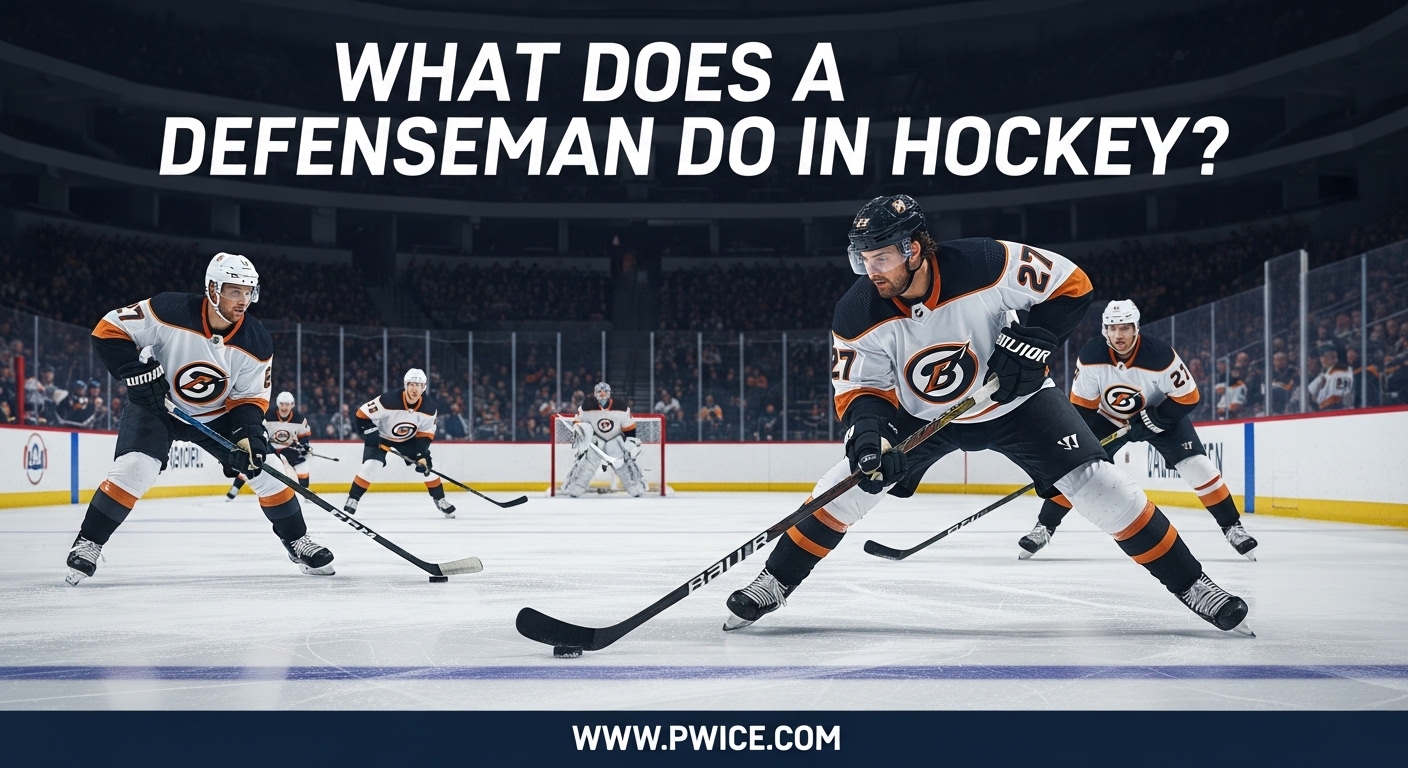
A defenseman in hockey serves as the team’s primary protector of the net and the architect of transitions from defense to offense. These blueliners stand as the last line of defense before the goaltender, tasked with preventing scoring chances while simultaneously starting the attack when possession changes hands. Understanding what a defenseman does in hockey transforms how you watch the game and how you play the position.
I have spent years studying hockey positions, and the defenseman role remains one of the most misunderstood by newcomers to the sport. This guide breaks down exactly what defensemen do across all three zones of the ice, the essential skills required, and the golden rules that separate good defensemen from great ones.
Table of Contents
The Core Purpose: What Does a Defenseman Do in Hockey?
A defenseman’s primary job is preventing the opposing team from scoring while enabling their own team to transition to offense. This dual responsibility makes the position both challenging and strategically vital to team success.
The key duties of a defenseman include:
1. Protect the net front area – Defensemen guard the space immediately in front of their goaltender, clearing rebounds and preventing opponents from establishing position for deflections and screens.
2. Win corner battles – When the puck goes into the corners in the defensive zone, defensemen must outmuscle opponents to gain possession and initiate the breakout.
3. Execute breakouts – Defensemen start the transition from defense to offense by moving the puck out of the defensive zone through passes or skating it themselves.
4. Control gap in the neutral zone – Defensemen maintain proper spacing between themselves and attacking forwards to limit time and space while angling puck carriers away from dangerous areas.
5. Manage the blue line in the offensive zone – Defensemen pinch to keep offensive pressure alive or retreat to prevent odd-man rushes against.
6. Communicate with their partner – Constant verbal and non-verbal communication ensures both defensemen cover their assignments without confusion.
These six core duties form the foundation of the position. How a defenseman executes each duty varies based on playing style, team system, and game situation.
Defensive Zone Responsibilities
The defensive zone represents a defenseman’s primary workplace. This is where the position earns its name and where mistakes translate directly onto the scoreboard.
Net Front Protection
Nothing matters more in the defensive zone than protecting the area directly in front of the net. I have watched countless goals result from defensemen losing track of their net front assignments.
The defenseman responsible for net front coverage must maintain body position between opposing players and the goaltender. This means physically boxing out opponents, lifting sticks to prevent deflections, and clearing rebounds immediately when the goalie makes a save.
Communication determines which defenseman takes net front duties on any given play. The general rule assigns coverage based on which side of the ice the puck attacks from. The weak-side defenseman (away from the puck) rotates to the net front while the strong-side defenseman (puck side) engages the puck carrier or covers the corner.
Corner Battles and Board Play
When the puck enters the defensive zone corners, defensemen must engage physically to win possession. This requires a combination of strength, technique, and competitive will.
Effective corner play starts with proper angling. The defenseman approaches the puck carrier from an angle that cuts off escape routes toward the net while maintaining a tight gap to prevent time and space. The goal is either to separate the opponent from the puck or pin them against the boards until support arrives.
Once a defenseman wins a corner battle, the next decision proves critical. Options include rimming the puck around the boards to a teammate, making a direct pass to a breaking forward, or carrying the puck behind the net to change the point of attack. Each choice carries risk and requires reading the positioning of teammates and opponents simultaneously.
The Breakout: Starting the Attack
The breakout represents a defenseman’s opportunity to transform defensive success into offensive opportunity. Mastering various breakout techniques separates elite defensemen from replacement-level players.
The wheel breakout involves the defenseman carrying the puck behind their own net and around the net to the opposite side before passing or skating up ice. This technique buys time for forwards to get open and changes the angle for passing lanes. The wheel works best when forecheck pressure is moderate and time exists to make deliberate plays.
The reverse breakout sees the defenseman pass the puck back to their defensive partner behind the net rather than carrying it themselves. This quick exchange forces forecheckers to adjust their routes and often opens space on the weak side for a forward to receive a pass in motion.
The rim breakout sends the puck hard around the boards to a waiting winger when no direct passing options exist. While considered a lower-percentage play because it gives opponents a chance to intercept, the rim effectively relieves pressure when executed with proper velocity and timing.
Direct breakout passes up the middle to a centerman or to a winger on the boards represent the highest-percentage plays when available. These passes maintain possession and enable controlled zone entries rather than chip-and-chase approaches.
Neutral Zone Play
The neutral zone serves as the transition area between defensive and offensive zones. Here, defensemen make critical decisions about whether to continue retreating or step up to engage attackers.
Gap Control and Angling
Gap control refers to the distance between a defenseman and the puck carrier during a rush. The ideal gap depends on speed differential, support availability, and game situation.
A tight gap of one to two stick lengths pressures the puck carrier immediately but risks getting beaten if the attacker possesses elite speed or makes a deceptive move. A loose gap of three to four stick lengths provides insurance against speed but gives the attacker time and space to make plays.
Elite defensemen adjust their gap dynamically based on reading the rush. When they identify a puck carrier with limited options and no passing support, they tighten the gap aggressively. When facing a skilled attacker with support, they maintain a moderate gap while taking away passing lanes with active stick positioning.
Angling refers to steering the puck carrier toward specific areas of the ice. Defensemen angle attackers away from the middle of the ice toward the boards. The boards act as an extra defender, limiting the attacker’s options and making physical contact more effective.
Defending the Rush
Rush defense situations test a defenseman’s decision-making under pressure. The most common challenging scenarios include 2-on-1s, 3-on-2s, and breakaways.
On a 2-on-1 rush, the lone defenseman must play the pass while containing the shot. This defensive dilemma requires taking the middle of the ice to cut off the passing lane while maintaining enough depth to challenge a shot if the puck carrier keeps it. Communication with the backchecking forward often determines whether the defenseman commits to the puck carrier or plays more conservatively.
3-on-2 situations give the defensemen more options because both defensemen remain involved. The key is maintaining tight gaps to prevent the rush from becoming a 3-on-1 against the goaltender. The strong-side defenseman engages the puck carrier while the weak-side defenseman takes the passing option and rotates to net front if the pass comes across.
Breakaway prevention starts well before the red line. Defensemen reading the play and recognizing odd-man situations early can angle attackers and use their sticks to disrupt passes before breakaways develop. When a breakaway does occur, the trailing defenseman backchecks hard to disrupt the shot or force a quicker release than the attacker prefers.
Offensive Zone Duties
Modern hockey demands defensemen contribute offensively while maintaining defensive responsibility. The offensive zone responsibilities differ significantly from defensive zone work.
Blue Line Control
The blue line serves as the battleground for offensive zone possession. Defensemen must decide whether to pinch down the boards to keep the puck in the offensive zone or retreat to prevent an odd-man rush against.
The pinch involves stepping down from the blue line into the offensive zone to win a puck battle or keep a loose puck from exiting the zone. Successful pinches maintain offensive pressure for extended shifts. Failed pinches result in 2-on-1 rushes against where the remaining defenseman faces impossible odds.
Defensemen must read multiple factors before pinching. These include the positioning of their defensive partner, the location of the opposing center, the speed of nearby forwards, and the game situation. Coaches often designate specific defensemen as aggressive pinchers based on their skating ability and defensive recovery speed.
Point shots represent another critical offensive zone duty. Defensemen at the point receive passes from forwards and either shoot for deflections, shoot for rebounds, or fake shots to open passing lanes. The modern game emphasizes wrist shots and snap shots over slapshots for quicker releases and better accuracy.
Power Play Responsibilities
The power play showcases offensive defensemen at their best. Typically one defenseman plays the point while four forwards work below the tops of the circles.
The quarterback role involves distributing the puck to open shooters, walking the blue line to open shooting lanes, and maintaining possession against penalty killers who press aggressively. Elite power play quarterbacks like Quinn Hughes and Cale Makar transform man advantages into goal production through their vision and passing accuracy.
One-timer opportunities arise when defensemen set up in the left or right circle for pass-and-shoot plays. Right-shot defensemen typically play the left circle for one-timers while left-shot defensemen play the right circle. This positioning enables one-motion shooting without turning the body.
Essential Skills Every Defenseman Needs
Technical skills separate players who can play defense from those who excel at the position. These skills require dedicated practice and continuous refinement.
Backwards Skating and Pivoting
Backwards skating forms the literal foundation of defensive play. Defensemen spend more time skating backwards than forwards do, making this skill non-negotiable for position competency.
Efficient backwards skating requires deep knee bend, full extension on each stride, and upper body stability to maintain vision of the entire ice surface. The C-cut technique provides explosive acceleration from a standstill while maintaining backward orientation.
Pivoting from backwards to forwards skating enables defensemen to transition immediately when possession changes. The tight turn pivot and the Mohawk pivot (heels together, toes out) both serve specific purposes depending on which direction the play moves and where support exists.
I have watched young players struggle defensively simply because their backwards skating limited their gap control and recovery ability. Spending dedicated practice time on backward acceleration and transitions pays enormous dividends for defensemen at every level.
Stickchecking and Body Position
Active stick work defines modern defensive play. Defensemen use their sticks to take away passing lanes, disrupt stickhandling, and block shots without committing to body contact.
The stick-on-puck technique involves placing the blade of the stick directly on the opponent’s puck to prevent controlled possession. This requires timing and reach but avoids the penalties and positioning risks of body checks.
Poke checking extends the defensive reach even further. A well-timed poke check knocks the puck away from an attacker without committing the body. However, missed poke checks leave the defenseman reaching and vulnerable to being beaten clean.
Body positioning matters even when not making direct contact. Taking away space by mirroring an opponent’s movements and maintaining proper angling forces puck carriers into less dangerous areas of the ice. Good body position makes the goaltender’s job easier by reducing high-danger scoring chances.
Communication with Your Partner
Defensemen play in pairs, and effective communication transforms a pair into a cohesive unit. Constant talking prevents coverage lapses and ensures both players understand their responsibilities on every play.
Key communications include calling “mine” or “yours” on loose pucks to avoid hesitation, shouting “switch” when assignments rotate, warning of backdoor passes with “behind you,” and calling “time” when a partner has space to make a play. Non-verbal signals like stick taps and pointing also communicate coverage assignments.
Developing chemistry with a defensive partner takes time and intentional effort. Studying video together, discussing tendencies, and practicing communication during drills builds the trust necessary for split-second coordination during games.
Defenseman Types: Stay-at-Home vs Offensive
Not all defensemen play the same style. The hockey world generally categorizes defensemen into two primary archetypes, though most players blend elements of both.
Stay-at-Home Defenseman
The stay-at-home defenseman prioritizes defensive reliability over offensive production. These players excel at clearing the net front, winning board battles, making simple breakouts, and rarely venturing deep into the offensive zone.
Stay-at-home defensemen typically play with a partner who handles more offensive responsibilities. Their value comes from consistency, physical play, and the trust they earn from coaches in critical defensive situations. Modern examples include Chris Tanev and Brady Skjei, though pure stay-at-home types have become less common as the game speeds up.
Offensive Defenseman
The offensive defenseman, sometimes called a puck-moving defenseman, drives play through skating, passing, and offensive creativity. These players join rushes, activate deep in the offensive zone, and quarterback power plays.
Elite offensive defensemen like Cale Makar and Adam Fox combine defensive competence with offensive flair. They skate the puck out of danger rather than just clearing it. They find passing lanes others miss. They make defense exciting to watch while still fulfilling core defensive responsibilities.
The best modern defensemen blend both styles effectively. Shutdown defensemen who can make a breakout pass and offensive defensemen who defend reliably both find success at the highest levels. The pure stay-at-home type without puck skills has become increasingly rare as the game evolves.
Common Mistakes to Avoid
Learning defense involves making and correcting mistakes. These common errors trip up beginners and even experienced players who lose focus.
Chasing the puck carrier out of position – Overcommitting to a puck carrier leaves dangerous passing lanes open. Defensemen must engage while maintaining awareness of threats away from the puck.
Watching the puck instead of their check – Losing sight of your assignment to follow the puck leads to backdoor tap-ins and deflection goals. Find the puck with peripheral vision while maintaining eye contact with your check.
Failed pinches at the blue line – Aggressive pinches that do not succeed result in odd-man rushes against. Defensemen must read the situation completely before committing down the boards.
Reaching instead of moving feet – Extending the stick while flat-footed leaves defensemen vulnerable to being beaten. Moving feet maintains proper gap control and angling.
Panic clears – Throwing the puck blindly up the boards or to the middle under pressure creates turnovers. Composure with the puck prevents unnecessary giveaways.
Silent play – Failing to communicate with partners leads to coverage confusion. Talking constantly prevents defensive breakdowns.
Frequently Asked Questions
What is the role of a defenseman in hockey?
A defenseman serves as the team’s primary defender, protecting the net from scoring chances while initiating offensive transitions through breakouts. They operate in all three zones with responsibilities ranging from net front protection in the defensive zone to blue line control in the offensive zone.
What are the golden rules of defenseman?
The golden rules include: 1) Always back up your partner, 2) Never pass across the middle in your own zone, 3) Maintain gap control on the rush, 4) Communicate constantly, 5) Clear the net front first, 6) Angle attackers to the boards, 7) Keep your head on a swivel to find threats away from the puck.
Where do you put your weakest player in hockey?
Many coaches place weaker players on the wing positions because these roles have simpler defensive responsibilities compared to center or defenseman. However, in youth hockey, rotating players through all positions develops well-rounded skills. Defense requires strong backwards skating and decision-making under pressure.
What is the hardest position to play in hockey?
Goaltender requires the most specialized skills and faces the highest pressure, but defenseman ranks as the most challenging skating position. Defensemen must skate backwards at high speeds, read developing plays in both directions, and make split-second decisions that directly impact the scoreboard.
How do I get better at defense in hockey?
Focus on backwards skating technique first, as this enables all other defensive skills. Practice gap control drills, study video of positioning in your defensive zone, work on stickchecking without reaching, and develop communication habits with your defensive partner. Playing regularly against better competition accelerates improvement.
Conclusion
What does a defenseman do in hockey? They protect the net, win battles, start transitions, control gaps, manage the blue line, and communicate constantly with their partner. The position demands skating skill, hockey intelligence, physical engagement, and mental discipline.
Whether you are a beginner learning the position, a parent helping your child understand their role, or a fan wanting deeper appreciation of the game, understanding defenseman responsibilities transforms how you see hockey. Great defensemen make the difficult look routine through positioning that prevents problems before they develop.
The best way to improve at defense is dedicated practice of backwards skating, deliberate study of positioning, and consistent communication with your defensive partner. Take these fundamentals to the rink and watch your defensive game reach new levels in 2026.