
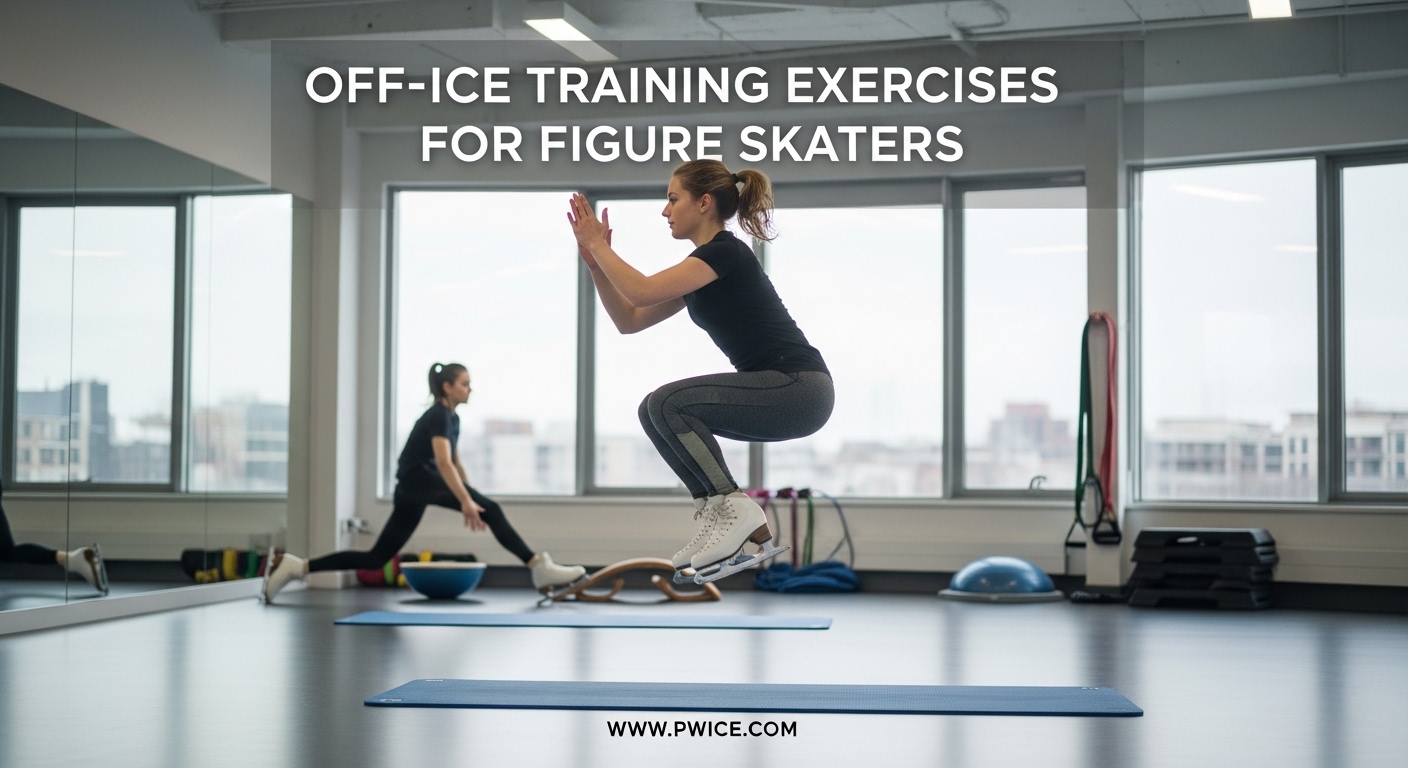
When I started skating as an adult, I quickly realized that ice time alone would not get me where I wanted to be. My coach kept emphasizing that off ice training exercises for figure skaters were the secret weapon behind every graceful jump and controlled spin I admired. After three years of experimenting with different workout routines, I have learned exactly what translates to better on-ice performance and what is just wasted effort.
This guide covers everything you need to build a complete figure skating workout you can do at home or at the gym. We will walk through strength training, plyometrics, flexibility work, balance drills, and endurance conditioning. By the end, you will have a clear weekly plan that fits into a busy schedule.
The best off-ice training exercises for figure skaters include six key categories: strength training for power, plyometrics for explosive jumps, balance work for stability, flexibility training for extensions, endurance conditioning for stamina, and sport-specific drills for spins and jumps. Most skaters see noticeable improvements within 4-6 weeks of consistent training.
Table of Contents
Why Off-Ice Training Matters for Figure Skaters?
Every jump, spin, and footwork sequence on ice demands specific muscle groups that need conditioning away from the rink. Off-ice training builds the strength, flexibility, and body awareness required for skills that take months or years to master. Without this foundation, skaters often plateau or develop compensating habits that lead to injury.
I learned this the hard way when attempting my first axle. My on-ice practice was not enough to build the explosive leg power needed. Once I added structured plyometrics and single-leg strength work, the jump started coming together within weeks.
Beyond skill development, off-ice conditioning protects your body. Skating places unique stresses on ankles, knees, and hips. Proper training strengthens the supporting muscles and improves joint stability, keeping you healthy through repeated landings and deep knee bends.
Warm-Up Protocol: Preparing Your Body for Training
Never skip your warm-up. Cold muscles are prone to strains and tears, especially when doing explosive plyometrics or deep flexibility work. A proper 5-minute warm-up activates your nervous system and increases blood flow to the muscles you will use.
Start with light cardio to raise your heart rate. March in place, do jumping jacks, or jog lightly for 2 minutes. Follow with dynamic stretching that mimics skating movements.
5-Minute Dynamic Warm-Up Sequence
- Arm circles – 30 seconds forward, 30 seconds backward to warm up shoulders
- Leg swings – 10 per leg front-to-back and side-to-side to activate hips
- High knees – 30 seconds to engage hip flexors and core
- Butt kicks – 30 seconds to warm up hamstrings
- Walking lunges with rotation – 8 per leg to open hips and activate core
Activation Exercises for Key Muscle Groups
Before your main workout, fire up the muscles that power your skating. Do 10 bodyweight squats focusing on proper knee tracking. Perform 5 single-leg balances per side, holding for 5 seconds each. Add 10 standing calf raises to activate your lower legs. These activation drills prime your muscles for the work ahead and improve movement quality.
Strength Training for Figure Skaters
Strength forms the foundation of every skating skill. Powerful jumps require explosive leg strength. Sustained spins demand core endurance. Even basic stroking benefits from strong hip stabilizers. This section covers the essential exercises every skater needs.
Lower Body Strength
Your legs generate all the power for jumps and provide stability for spins. Focus on single-leg exercises since skating is essentially a series of one-legged movements.
Single-Leg Squats: Stand on one leg with the other extended slightly forward. Lower into a squat, keeping your standing knee tracking over your toes. Start with 2 sets of 5 per leg. Progress to 3 sets of 8 as you gain strength. Hold onto a wall or chair for balance if needed.
Walking Lunges: Step forward into a lunge, lowering your back knee toward the ground. Push through your front heel to stand and bring your back leg forward into the next lunge. Do 2-3 sets of 10 per leg. Keep your torso upright and core engaged throughout.
Calf Raises: Stand with heels hanging off a step or sturdy book. Rise onto your toes, hold for 2 seconds, then lower below the starting position for a full stretch. Perform 3 sets of 15. This builds the ankle strength crucial for toe jumps and stability.
Single-Leg Deadlifts: Stand on one leg, hinge at your hips while extending the other leg behind you. Keep your back flat and reach toward the ground. Return to standing by squeezing your glutes. Do 2 sets of 8 per leg. This exercise targets the posterior chain essential for jump takeoffs.
Core Training for Stability and Spin Centering
A strong core keeps you centered during spins and maintains proper posture through footwork sequences. Your core includes more than just abs—it encompasses your entire midsection, lower back, and hip muscles.
Planks: Hold a forearm plank position with your body in a straight line from head to heels. Start with 3 sets of 30 seconds. Progress to 45 seconds, then 60 seconds as you build endurance. Focus on breathing normally and avoiding hip sag.
Russian Twists: Sit with knees bent and feet elevated slightly. Lean back slightly while keeping your spine straight. Rotate your torso side to side, touching the ground beside your hips. Do 3 sets of 20 twists total. This mimics the rotational demands of spins and rotational jumps.
Leg Raises: Lie on your back with legs extended. Lift both legs toward the ceiling, then lower slowly without touching the ground. Perform 3 sets of 10. This targets the lower abs and hip flexors used in jump takeoffs and spiral positions.
Side Planks: Lie on your side with forearm supporting your upper body. Lift your hips so your body forms a straight line. Hold for 20-30 seconds per side, 2 sets. This builds the lateral core strength needed for edge control.
Upper Body Conditioning
While skating is lower-body dominant, upper body strength matters for jump height, spin positions, and overall presentation. Your arms help generate lift in jumps and maintain positions in spins.
Push-Ups: Start with 2-3 sets of as many reps as you can perform with good form. If full push-ups are too challenging, modify by keeping knees on the ground. Focus on controlled lowering and explosive pushing.
Shoulder Taps: Hold a plank position and tap your opposite shoulder with each hand without rotating your hips. Do 3 sets of 20 taps total. This builds shoulder stability and anti-rotation core strength.
Perform strength training 2-3 times per week, allowing at least one day of recovery between sessions. Focus on proper form over heavy weight. For beginners, bodyweight exercises provide plenty of challenge.
Plyometrics and Jump Training
Plyometrics train your muscles to generate maximum force in minimum time. This explosive power translates directly to higher jumps and better jump combinations on the ice. Start conservatively with plyometrics—these exercises stress your joints and require proper conditioning before advancing.
Box Jumps
Box jumps develop the explosive leg power needed for all skating jumps. Use a sturdy box, step, or bench between 12-20 inches high depending on your fitness level.
Stand facing the box with feet shoulder-width apart. Bend your knees and swing your arms back. Explode upward, swinging arms forward, and land softly on the box with both feet. Stand fully at the top, then step down (do not jump down). Perform 2-3 sets of 6-8 reps.
Focus on landing quietly with soft knees. If you cannot land softly, the box is too high. Master double-leg box jumps before attempting single-leg variations.
Tuck Jumps
Tuck jumps mimic the airborne phase of jumps, teaching your body to pull in quickly and control landings.
Stand with feet hip-width apart. Jump explosively upward, driving knees toward your chest while keeping back straight. Land softly with knees bent to absorb impact. Immediately jump again upon landing. Do 2 sets of 8-10 reps.
Start with low height and focus on form. As you improve, jump higher and pull knees tighter to chest. This builds the muscle memory for jump rotations.
Single-Leg Hops
Since skating happens on one leg at a time, single-leg hops are essential for functional jump training.
Stand on your right leg with left knee bent and foot off the ground. Hop forward, landing on the same right leg with soft knee. Stick the landing for 2 seconds before hopping again. Do 2 sets of 5 hops per leg. Progress to lateral hops (side-to-side) and diagonal patterns.
Focus on landing control and balance. If you wobble significantly, work on basic single-leg balance before advancing to hops.
Skipping Rope
Skipping builds explosive calves, rhythm, and coordination. Many elite skaters skip daily as part of their training.
Start with basic two-foot jumps for 1-minute intervals. Progress to alternating feet (similar to running in place) and single-leg jumps. Do 3-5 rounds of 1 minute with 30 seconds rest between rounds.
Keep jumps low and quick rather than high and slow. Land on the balls of your feet with soft ankles.
Perform plyometric training 1-2 times per week on non-consecutive days. Always complete plyometrics after strength work when your muscles are fully warmed up.
Balance and Stability Exercises
Skating is essentially controlled falling on a thin blade. Superior balance separates good skaters from great ones. Balance training improves your proprioception—your body’s awareness of position in space—which directly translates to better edge control and spin centering.
Single-Leg Balance Drills
Practice standing on one leg with eyes open. Hold for 30 seconds per leg, 3 sets. Once mastered, progress to eyes-closed holds for 15 seconds. The eyes-closed variation dramatically increases difficulty and trains your internal balance systems.
Add challenges by standing on an unstable surface. Use a pillow, folded towel, or balance pad. The slight wobble forces your stabilizing muscles to work harder.
Arabesque and Spiral Position Holds
These positions mimic on-ice skating moves while building specific strength.
For Arabesque holds: Stand on your right leg, extend your left leg behind you while leaning forward slightly and extending arms out. Hold for 15-30 seconds per side, 3 sets. Focus on keeping hips level and core engaged.
For spiral simulation: Stand on one leg and extend the other behind you at hip height or higher while keeping your torso upright. Hold 15-20 seconds per side. This builds the hamstring and back flexibility needed for spiral positions.
Airplane Balance
Stand on your right leg with knee slightly bent. Hinge forward at your hips while extending your left leg straight behind you. Your body should form a T shape (or airplane) with arms extended to the sides for balance. Hold for 20-30 seconds per side.
This exercise combines balance, flexibility, and core strength in a skating-specific position. It directly improves your ability to maintain positions during footwork and transitions.
Train balance 3-4 times per week. You can incorporate balance work into rest days since it is low-impact and aids recovery by stimulating stabilizing muscles.
Flexibility and Stretching Routine
Flexibility determines how well you can achieve positions like spirals, Biellmann spins, and split jumps. It also prevents injuries by allowing your joints to move through their full range of motion. Split your flexibility work into dynamic stretches for warm-ups and static stretches for cool-downs.
Dynamic Stretching (Pre-Training)
Dynamic stretches involve controlled movement through your range of motion. They warm up your muscles while improving mobility.
- Leg swings: Hold a wall for support and swing one leg forward and backward 10 times, then side to side 10 times. Repeat on the other leg.
- Walking knee hugs: Walk forward, pulling each knee to your chest as you step. Do 10 per leg.
- Walking figure-4 stretches: Walk while placing your ankle on the opposite knee, creating a figure-4 shape. Step forward and switch legs. Do 10 per side.
- Arm circles with torso rotation: Make large arm circles while rotating your torso. Do 10 forward and 10 backward.
- Inchworms: From standing, walk your hands out to plank, walk feet to hands, and stand. Do 5-8 repetitions.
Static Stretching (Post-Training)
Static stretches involve holding a position for 30-60 seconds. These improve long-term flexibility when done after training when muscles are warm.
Hip Flexor Stretch: Kneel on your right knee with left foot forward in a lunge. Push your hips forward slightly while keeping your torso upright. Hold 30 seconds per side. This counteracts the tightness from skating’s constant knee bend position.
Hamstring Stretch: Sit with legs extended and reach toward your toes. Hold 30 seconds. Bend one knee and reach toward the extended foot for a deeper single-leg stretch, 30 seconds per side.
Figure-4 Glute Stretch: Lie on your back with knees bent. Cross your right ankle over your left knee. Reach through and pull your left thigh toward your chest. Hold 30 seconds per side. This opens tight glutes from all the single-leg work.
Butterfly Stretch: Sit with feet together and knees out to the sides. Gently press your knees toward the ground while keeping your back straight. Hold 30-60 seconds. This improves hip internal rotation used in crossovers and some spin positions.
Spinal Twist: Lie on your back, bend one knee and cross it over your body while keeping your shoulders on the ground. Hold 30 seconds per side. This releases tension in your lower back from jump landings.
Shoulder and Chest Stretch: Clasp your hands behind your back and straighten your arms while lifting your chest. Hold 30 seconds. This opens the front of your body for better posture and arm positions.
Dedicate 10-15 minutes to stretching after every training session. For faster flexibility gains, add a dedicated 20-minute stretching session on rest days.
Endurance and Cardio Training
A four-minute program feels like an eternity when your cardiovascular system is undertrained. Endurance work allows you to complete full programs without gasping for breath between elements. It also improves recovery between practice attempts.
HIIT for Skating-Specific Conditioning
High-Intensity Interval Training (HIIT) mimics the stop-start nature of skating programs. You perform short bursts of intense activity followed by brief rest periods.
Try this 20-minute HIIT routine: 30 seconds of burpees or mountain climbers followed by 30 seconds of rest. Repeat for 10 rounds. Alternatively, do 20 seconds all-out effort, 10 seconds rest (Tabata protocol) for 4 minutes, rest 2 minutes, and repeat.
Perform HIIT 1-2 times per week. These sessions are short but intense. Never do HIIT on days when you have hard on-ice practice.
Steady-State Cardio Options
Longer, moderate-intensity cardio builds your aerobic base. This can be jogging, cycling, swimming, or using an elliptical machine.
Aim for 20-30 minutes at a conversational pace (you can talk but would rather not). Do this 1-2 times per week. Many skaters prefer cycling since it builds leg endurance without the impact stress of running.
Skipping for Cardio
As mentioned in the plyometrics section, skipping rope provides both cardio and explosive leg conditioning. It is a favorite among elite skaters for good reason.
Work up to 5-10 minutes of continuous skipping. Alternate between two-foot bounces, alternating feet, and single-leg jumps. Keep a relaxed posture with shoulders down.
Spin and Jump-Specific Off-Ice Drills
Beyond general conditioning, you can practice specific skating skills off the ice. These drills create muscle memory that transfers directly to your on-ice performance.
Spotting Practice
Good spotting prevents dizziness during spins and maintains rotation control. Practice spotting anywhere with a focal point.
Stand with feet shoulder-width apart. Focus your eyes on a fixed point at eye level. Start turning slowly while keeping your head facing forward. When you cannot keep the focal point in view anymore, snap your head around quickly to find the point again. Practice 10 turns in each direction. Gradually increase speed as you improve.
Off-Ice Spinner Training
An off-ice spinner is a small, rotating disc that simulates spinning on ice. While not essential, it is highly beneficial for spin practice at home.
Place the spinner on a smooth floor. Step onto it carefully with one foot. Practice rotating while maintaining upright posture. Start with two-foot spins, then progress to one-foot spins. Work on arm positions and pulling in for faster rotation.
If you do not have a spinner, you can practice in socks on a smooth floor. Be extremely careful to avoid falling or sliding into furniture.
Position Holds for Spins
Build the strength to hold spin positions by practicing them statically.
Stand on one leg in an upright spin position (arms out, then pulled in). Hold for 15-30 seconds. Practice the sit spin position by squatting low on one leg with the other extended forward. Hold your free leg with both hands in a cannonball spin position for 10-15 seconds.
These static holds build the specific leg and core strength needed for sustained spins.
Waltz Jump Practice
The waltz jump is often the first full rotation jump skaters learn. You can practice the movement pattern off-ice.
Stand on your takeoff foot (usually right foot for right-handed skaters). Step forward onto your left foot while swinging your right leg and arms through. Practice the step-forward motion without jumping at first. Add a small hop as you get comfortable with the timing. Focus on the flowing movement rather than height.
Cool-Down and Recovery
Cooling down properly reduces muscle soreness and prepares your body for the next training session. Never go straight from intense training to sitting down.
5-Minute Cool-Down Sequence
- Light walking – 2 minutes to gradually lower heart rate
- Deep breathing – 1 minute of slow diaphragmatic breathing
- Static stretching – 2 minutes targeting the muscles you trained (see flexibility section)
Recovery Techniques
Consider foam rolling major muscle groups after training. Roll slowly over your quads, hamstrings, calves, and glutes. Pause on tender spots for 20-30 seconds until they release. Foam rolling improves circulation and reduces muscle tension.
Hydrate immediately after training. Drink water or an electrolyte beverage if you sweated heavily. Proper hydration aids muscle recovery and reduces next-day soreness.
Sleep is your most powerful recovery tool. Aim for 7-9 hours of quality sleep, especially on training days. Your body repairs and strengthens during deep sleep.
Minimal Equipment Guide
You do not need a gym membership or expensive equipment for effective off-ice training. Most exercises in this guide require only your bodyweight. Here is what actually helps versus what you can skip.
Essential Equipment (Under $50 Total)
- Resistance bands – A set of light, medium, and heavy bands adds resistance to strength exercises
- Yoga mat – Provides cushioning for floor exercises and stretching
- Jump rope – Inexpensive cardio and plyometric tool
- Sturdy box or step – 12-20 inches high for box jumps (a park bench works too)
Nice-to-Have Additions
- Light dumbbells – 5-15 pounds for upper body and weighted core exercises
- Off-ice spinner – For spin practice (around $30-50)
- Foam roller – For post-workout recovery
- Balance pad or pillow – For advanced balance training
Bodyweight-Only Alternatives
If you have zero budget, you can still train effectively. Use water bottles as light weights. Perform step-ups on stairs instead of box jumps. Use a towel on smooth floors for slider exercises that mimic skating movements. Do wall sits instead of weighted squats.
The most important equipment is consistency. A $5 jump rope used three times a week beats a $500 home gym used once a month.
Sample Weekly Off-Ice Training Schedule
Here are two training schedules based on different commitment levels. Both assume you are skating 2-3 times per week. Adjust based on your on-ice schedule and recovery needs.
Beginner 3-Day Schedule (30-40 minutes per session)
This schedule works for skaters just starting off-ice training or those with limited time. Consistency matters more than session length.
Monday: Strength and Balance – Warm-up, lower body strength (squats, lunges, calf raises), core work (planks, leg raises), balance drills (single-leg holds), cool-down stretch.
Wednesday: Plyometrics and Jump Training – Dynamic warm-up, box jumps, tuck jumps, skipping rope, single-leg hops, spin-specific drills, cool-down.
Friday: Flexibility and Recovery – Light cardio warm-up, extended stretching session (20-30 minutes), balance work, foam rolling.
Weekend: Optional light activity like walking, swimming, or yoga.
Intermediate 4-Day Schedule (45-60 minutes per session)
This schedule suits skaters with some off-ice training experience and more time to commit.
Tuesday: Lower Body Strength and Plyometrics – Squats, single-leg deadlifts, box jumps, tuck jumps, calf raises, cool-down.
Thursday: Core, Balance, and Flexibility – Planks, Russian twists, leg raises, airplane balance, arabesque holds, extended stretching.
Saturday: Full Body Conditioning – Strength circuit, plyometrics, spin-specific drills, skipping, cool-down.
Sunday: Active Recovery – Light cardio, yoga, or extended stretching session.
Integrating with On-Ice Practice
Balance your off-ice and on-ice training to avoid overtraining. If you have a hard on-ice session with lots of jumps, keep off-ice plyometrics light that day. Use off-ice strength training on days when your on-ice focus is on choreography or edges rather than jumps.
Never do heavy plyometrics right before skating. Your legs need to be fresh for on-ice training. Schedule plyometric and jump training for days when you do not skate, or at least 4-6 hours before an ice session.
Frequently Asked Questions
How can you practise figure skating at home?
You can practice figure skating at home through strength exercises like squats and lunges, balance drills on one leg, flexibility work including hip and hamstring stretches, jump training with box jumps, spin practice using a spinner or socks on smooth floors, and cardio for endurance. Focus on 20-30 minute sessions, 2-4 times per week.
Should figure skaters lift weights?
Yes, figure skaters can benefit from weight training. Light to moderate weights with proper form build muscle strength and power crucial for jumps, spins, and endurance without adding excessive bulk. Focus on exercises targeting legs like squats and lunges, core with weighted twists, and upper body with shoulder presses. Always prioritize technique to prevent injury.
What equipment do you need for off-ice figure skating?
Off-ice training requires minimal equipment: resistance bands for strength work, yoga mat for stretching, skipping rope for cardio, sturdy box or step for plyometrics, light dumbbells which are optional, balance board or pillow for stability work, and an off-ice spinner for spin practice. Most exercises can be done with body weight only.
How can you practise ice skating spins off-ice?
Practice spins off-ice by using an off-ice spinner or spinning in socks on a smooth floor, working on spotting by turning slowly while keeping eyes fixed on a point, holding spin positions like upright, sit, and camel for 30 seconds to build strength, practicing arm positions and pulling in motion, and doing rotation drills on one leg.
How often should you complete off-ice training?
For beginner to intermediate figure skaters, aim for 2-4 off-ice training sessions per week, each lasting 20-45 minutes. Consistency matters more than intensity. Regular shorter sessions are more effective than occasional long workouts. Balance different training types including strength, flexibility, balance, and cardio. Always include at least one rest day per week.
What are the best off-ice exercises for adult beginners?
Adult beginners should start with bodyweight squats, walking lunges, single-leg balances, planks, and basic stretching. Focus on building foundational strength and balance before adding plyometrics. Keep sessions to 20-30 minutes to prevent burnout. Prioritize exercises that translate directly to skating like single-leg work and core stability.
Can off-ice training replace on-ice practice?
Off-ice training complements but cannot fully replace on-ice practice. Ice time is essential for learning edge control, timing, and the feel of blade mechanics. However, off-ice training accelerates skill development, builds the physical foundation for advanced moves, and allows you to maintain conditioning when ice time is unavailable.
Conclusion: Your Path to Better Skating Starts Now
Off ice training exercises for figure skaters are not optional extras—they are essential building blocks for progress. The exercises in this guide target the exact strength, power, balance, and flexibility needed for every skating skill from basic stroking to triple jumps.
Pick one of the sample schedules and start this week. You do not need perfect form or expensive equipment to begin. You need consistency. Twenty minutes of focused training twice a week beats a perfect two-hour workout that never happens.
I have seen my own skating transform through dedicated off-ice work. The jumps that once felt impossible now feel controlled. The spins that used to travel now stay centered. The programs that left me gasping now feel manageable.
Your transformation starts with a single workout. Choose your first session from the schedules above, roll out your mat, and begin building the foundation for the skater you want to become.