
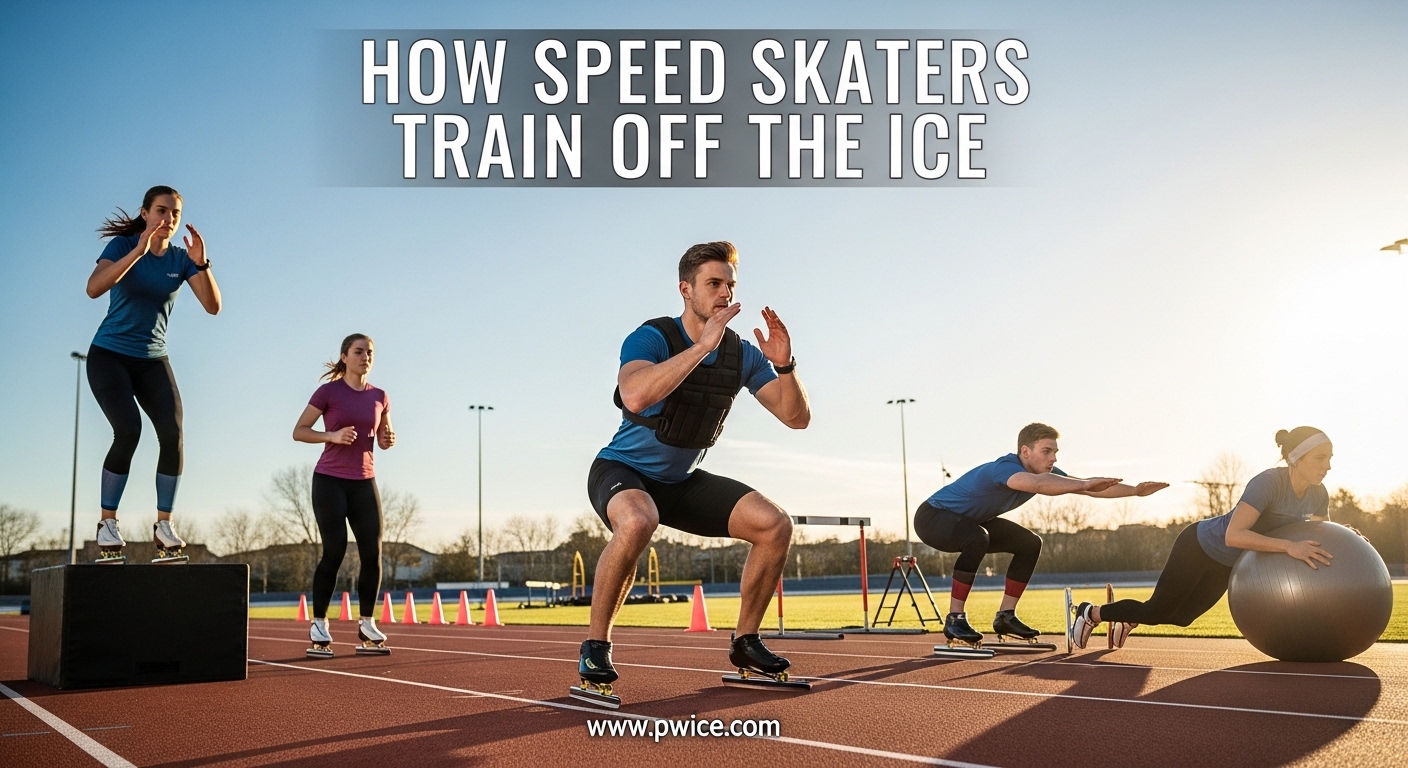
When you watch Olympic speed skaters explode off the starting line, you’re seeing the result of countless hours spent away from the ice. Learning how speed skaters train off the ice will transform your own skating performance, whether you’re a weekend warrior or training for competition. Our team spent months analyzing training programs from elite coaches and recreational clubs to bring you methods that actually work.
Most skaters face the same frustrating reality: ice time is expensive and limited. The good news is that dry-land training can build the explosive power, single-leg strength, and anaerobic capacity you need to skate faster and longer. The key is knowing which exercises transfer directly to your on-ice performance.
In this guide, we’ll cover everything from plyometric drills that develop explosive first steps to sample weekly schedules you can start following today. By the end, you’ll have a complete off-ice training system that makes every minute on the ice count for more.
Table of Contents
Why Off-Ice Training Matters for Speed Skaters
Ice time is the bottleneck for most speed skaters. Rink schedules fill up fast, sessions are short, and the cost adds up quickly. Off-ice training lets you keep improving even when you cannot get on the ice.
The physical demands of speed skating are unique. You need explosive quad strength for starts, hip stability for the deep gliding position, and the anaerobic capacity to maintain speed through a 500-meter sprint. These qualities are difficult to build in 45-minute ice sessions twice a week.
From forum discussions with competitive skaters, we heard this repeatedly: athletes who commit to consistent dry-land training see faster progress than those who only skate. One user noted that cycling on an indoor trainer became their secret weapon when winter weather limited ice access. Another emphasized that double kettlebell snatches developed the explosiveness that carried them through the first crucial steps of a race.
Plyometric Exercises for Explosive Power
Plyometric training focuses on developing explosive power through rapid stretching and contracting of muscles. For speed skaters, this translates directly to faster starts and more powerful strides. These exercises target your fast twitch muscle fibers, the same fibers responsible for those explosive first three steps that determine race outcomes.
Box Jumps
Stand facing a sturdy box or platform 12 to 18 inches high. Lower into a quarter squat, then explode upward, driving your arms forward to generate momentum. Land softly with both feet on the box, fully extending your hips at the top. Step down carefully and reset. Perform 3 sets of 6 to 8 reps with full recovery between sets.
Single-Leg Hops
This drill mimics the skating stride pattern perfectly. Stand on one leg with a slight knee bend. Hop forward, focusing on distance rather than height, and stick the landing on the same leg. Maintain your balance for 2 seconds before the next hop. Complete 3 sets of 5 hops per leg. Skaters from online communities consistently rank this among the most effective dry-land drills for building skating-specific power.
Lateral Bounds
Speed skating requires massive lateral push-off power. Stand on your right leg and bound laterally to the left, landing on your left leg. Focus on covering maximum distance with each bound. Immediately bound back to the right. Perform 3 sets of 6 bounds per direction. This exercise develops the hip abductor strength that keeps your glide position stable through corners.
Depth Jumps
Step off a low box or bench, land with both feet, and immediately explode into a vertical jump. The key is minimizing ground contact time. This develops reactive strength and the rate of force development that elite skaters display. Start with a 12-inch box and progress gradually. Do 3 sets of 4 to 5 reps with plenty of rest between sets.
Start plyometric training twice per week with at least 48 hours between sessions. These exercises stress your nervous system and connective tissues, so recovery is essential for adaptation and injury prevention.
Strength Training for Single-Leg Power
Every skating stride is essentially a single-leg movement. Your power comes from pushing off one leg while the other glides. Building single-leg strength in the gym creates the foundation for transferring that force to the ice efficiently.
Back Squats and Front Squats
Squats build the quad and glute strength that powers every push. Focus on depth rather than heavy weight initially. Your goal is building strength through a range of motion similar to the skating position. Work up to 3 sets of 5 reps at challenging but controlled weights. Front squats are particularly valuable because they reinforce the upright torso position you need while skating.
Bulgarian Split Squats
Place your back foot elevated on a bench, front foot forward in a lunge position. Lower your back knee toward the ground, keeping your front knee tracking over your toes. Drive through your front heel to return to standing. This exercise destroys your quads in the best way possible while building the single-leg stability skating demands. Do 3 sets of 8 reps per leg.
Single-Leg Romanian Deadlifts
Stand on one leg with a slight knee bend, holding dumbbells or a kettlebell. Hinge at your hips, lowering the weight while your free leg extends behind you for balance. Feel the stretch in your standing hamstring, then return to standing by squeezing your glutes. This builds posterior chain strength and the hip stability that prevents your gliding leg from collapsing inward. Perform 3 sets of 10 reps per leg.
Kettlebell Snatches
Based on repeated recommendations from competitive skaters in training forums, the kettlebell snatch deserves special attention. Swing a kettlebell from between your legs to overhead in one explosive movement. The hip snap mirrors the skating push, and the overhead lockout builds shoulder stability. Double kettlebell snatches performed with moderate weight develop the full-body explosiveness that separates good starts from great ones. Try 5 sets of 5 reps per arm.
Progressive overload matters more than exercise selection. Track your weights and aim for small improvements each week. A 5-pound increase on your squat, maintained for a month, translates to noticeably more powerful strides on the ice.
Core and Balance Training
Your core connects your upper body drive to your lower body power. Without adequate core strength, you leak energy with every stride. Balance training keeps your gliding position stable, especially when fatigue sets in during longer races.
Plank Variations
Standard planks build endurance, but side planks target the obliques that resist rotation during the skating stride. Start with 3 sets of 30 seconds for front planks and 20 seconds per side for side planks. Progress to longer holds or add weight plates on your hips for difficulty.
Pallof Press
Attach a resistance band or cable at chest height. Stand perpendicular to the anchor point, hold the handle at your chest, and press your arms straight forward. The band tries to rotate your torso; your core resists. This builds the anti-rotation strength that keeps your shoulders square while your legs push laterally. Perform 3 sets of 12 reps per side.
Single-Leg Balance Drills
Stand on one leg in a skating position: knee bent to approximately 90 degrees, torso forward, arms in skating position. Hold for 30 seconds per leg. Progress by closing your eyes, standing on a cushion, or adding small weight shifts. This drill ingrains the low skating position into your muscle memory.
Bosu or Stability Ball Work
Perform squats or practice your skating position on an unstable surface. The wobble forces small stabilizing muscles to fire constantly. These are the same muscles that keep your ankle and knee aligned when you hit rough ice or fatigue late in a race. Start with bodyweight only and add load gradually.
Dry-Land Skating Drills and Techniques
Dry-land training refers to exercises that mimic actual skating movements without being on ice. These drills build neuromuscular patterns that transfer directly to your stride mechanics. When you finally step onto the ice, your body remembers the movement.
Slideboard Training
A slideboard is a smooth, low-friction surface that lets you practice the lateral push of skating. You wear booties or socks and push side to side, staying low in the skating position. Elite skaters like Nils van der Poel have made slideboard work famous for developing the specific endurance and position strength skating requires. Start with 3 sets of 1 minute, focusing on low position and full extension.
Turn Cable Exercises
The turn cable is elastic resistance tubing that attaches to a harness around your hips. You skate in place against the resistance, emphasizing knee bend and push angle. This develops the specific hip and ankle mobility you need for efficient cornering. Perform 3 sets of 30 seconds.
Inline Skating
Inline skating is the closest off-ice activity to actual ice skating. The movement patterns are nearly identical, making it valuable for technique work when ice is unavailable. Many speed skating clubs organize inline training sessions during summer months. Focus on low position and full extension rather than speed initially.
Low Walk and Cross-Back Drills
From the Pittsburgh Speedskating Club program, the low walk drill reinforces the basic skating position. Walk forward staying as low as possible, maintaining a 90-degree knee bend. For cross-backs, practice the weight transfer and hip rotation needed for cornering. These bodyweight drills require no equipment and can be done anywhere.
Dry-land drills are about quality, not quantity. Five minutes of focused, low-position work beats thirty minutes of sloppy standing. Film yourself occasionally to check that your dry-land position matches what you want on the ice.
Flexibility and Recovery Methods
Recovery is where you actually get stronger. Training breaks your body down; rest builds it back up stronger. Most competitors skip recovery entirely, making this a real opportunity for you to gain an edge.
Dynamic Stretching Before Training
Before off-ice sessions, perform dynamic stretches that move joints through their full range of motion. Leg swings, arm circles, and walking lunges prepare your body for explosive work better than static stretching. Spend 5 to 10 minutes warming up before any plyometric or strength work.
Static Stretching After Training
After your workout, hold stretches for 30 to 60 seconds. Focus on hip flexors, which tighten from the skating position, and hamstrings, which work hard during the recovery phase of your stride. Consistent post-workout stretching maintains the range of motion you need for full stride extension.
Foam Rolling
Use a foam roller on your quads, IT bands, and calves to break up adhesions and improve tissue quality. Spend 1 to 2 minutes per muscle group, pausing on tight spots until you feel release. Foam rolling increases blood flow and can reduce next-day soreness significantly.
Sleep and Nutrition
Elite skaters prioritize sleep because it is when muscle repair happens. Aim for 7 to 9 hours per night, especially during heavy training blocks. Protein intake after training provides the building blocks for muscle adaptation. A simple protein shake within 30 minutes of your workout supports recovery without overthinking your diet.
Sample Weekly Training Schedule
Consistency beats intensity. The Pittsburgh Speedskating Club recommends 20 minutes per day, 3 days per week as a starting point. Here are schedules for different commitment levels.
Beginner Schedule (3 Days Per Week)
Day 1: Plyometrics and core. Box jumps 3×6, single-leg hops 3×5 each leg, lateral bounds 3×6, planks 3×30 seconds.
Day 2: Strength training. Squats 3×5, Bulgarian split squats 3×8 each leg, single-leg Romanian deadlifts 3×10 each leg.
Day 3: Dry-land drills and flexibility. Slideboard 3×1 minute or low walk 3×2 minutes, Pallof press 3×12 each side, full stretching routine.
Intermediate Schedule (4 to 5 Days Per Week)
Add a second strength day focusing on different movements like kettlebell snatches and front squats. Include inline skating or cycling for aerobic conditioning. Extend plyometric sessions to include depth jumps and more complex movements.
Advanced Schedule (6 Days Per Week)
Split training into specific focuses: explosive power days, strength days, and technique/dry-land days. Monitor fatigue levels and take recovery seriously. Consider working with a coach to periodize your training around competition schedules.
Progress gradually. If you miss a session, pick up where you left off rather than doubling up. Six months of consistent 3-day weeks beats two months of perfect 6-day weeks followed by burnout.
How to Translate Off-Ice Gains to On-Ice Performance
The ultimate test of your dry-land training is whether it shows up when you lace up your skates. Many athletes build impressive gym numbers that never transfer to the ice. Here is how to bridge that gap.
Focus on Movement Patterns, Not Just Strength
A 300-pound squat means nothing if you cannot access that strength in the skating position. Practice your skating stance during dry-land work. Stay low during plyometrics. Maintain torso angle during strength exercises. The pattern you practice is the pattern you perform.
Time Your Training
Schedule heavy strength sessions at least 48 hours before important ice sessions. Plyometrics can be done the day before skating because they activate your nervous system without causing heavy fatigue. Experiment to find what timing works for your body.
Video Analysis
Record yourself skating and compare it to video of your dry-land drills. Look for discrepancies in knee bend, hip position, or arm movement. Your goal is making the off-ice pattern and on-ice pattern identical.
Be Patient
Strength adaptations take 4 to 6 weeks to show up on the ice. Neurological adaptations happen faster, but the muscular changes you want for powerful strides require consistent work over time. Track your ice times monthly rather than daily to see the real trend.
FAQ
How do speed skaters train off ice?
Speed skaters train off ice using four main methods: plyometric exercises for explosive power, strength training for single-leg power, core and balance work for stability, and dry-land drills that mimic skating movements. A typical program includes box jumps and single-leg hops twice weekly, squats and split squats for leg strength, slideboard training for skating-specific endurance, and core exercises like planks and Pallof presses.
Can you train for speed skating at home?
Yes, you can train effectively for speed skating at home without any equipment. Bodyweight exercises like single-leg hops, Bulgarian split squats using a chair, low walk drills, and core work require only floor space. Adding a jump rope for plyometrics and a kettlebell for snatches expands your options significantly. Many elite skaters maintained fitness during lockdowns using nothing but bodyweight routines.
How long does off-ice training take to improve skating?
Most skaters notice neurological improvements within 2 to 3 weeks, but significant strength gains that translate to faster skating typically take 4 to 6 weeks of consistent training. Research suggests plyometric adaptations occur fastest, followed by strength changes. For maximum benefit, aim for at least 8 to 12 weeks of structured off-ice work before evaluating results.
What exercises help speed skating the most?
The highest-impact exercises for speed skating are single-leg hops (for stride power), box jumps (for start explosiveness), Bulgarian split squats (for skating-position strength), and slideboard training (for specific endurance). Kettlebell snatches also rank highly among competitive skaters for developing full-body explosiveness that transfers to the first three steps of a race.
How often should speed skaters do off-ice training?
Beginners should start with 20 minutes per day, 3 days per week. Intermediate skaters benefit from 4 to 5 weekly sessions, while advanced athletes may train 6 days with careful attention to recovery. Quality matters more than quantity. Three focused sessions beat five distracted ones, and consistent training over months beats sporadic intense weeks.
Conclusion
Understanding how speed skaters train off the ice gives you a blueprint for improving your skating even when you cannot get to the rink. The combination of plyometrics for explosive power, single-leg strength training, core stability work, and dry-land drills creates a comprehensive system that transfers directly to faster times on the ice.
The most important takeaway is consistency over intensity. Start with the beginner schedule of 20 minutes, 3 days per week. Focus on movement quality rather than how much weight you lift or how high you jump. Film yourself to ensure your dry-land position matches your on-ice goals.
Off-ice training is not a substitute for ice time; it is a force multiplier that makes every minute on the ice more productive. Whether you are training for your first competition or trying to beat your personal best, the work you put in away from the ice will show up when it matters most. Start your first session today, and you will be skating faster within weeks.