
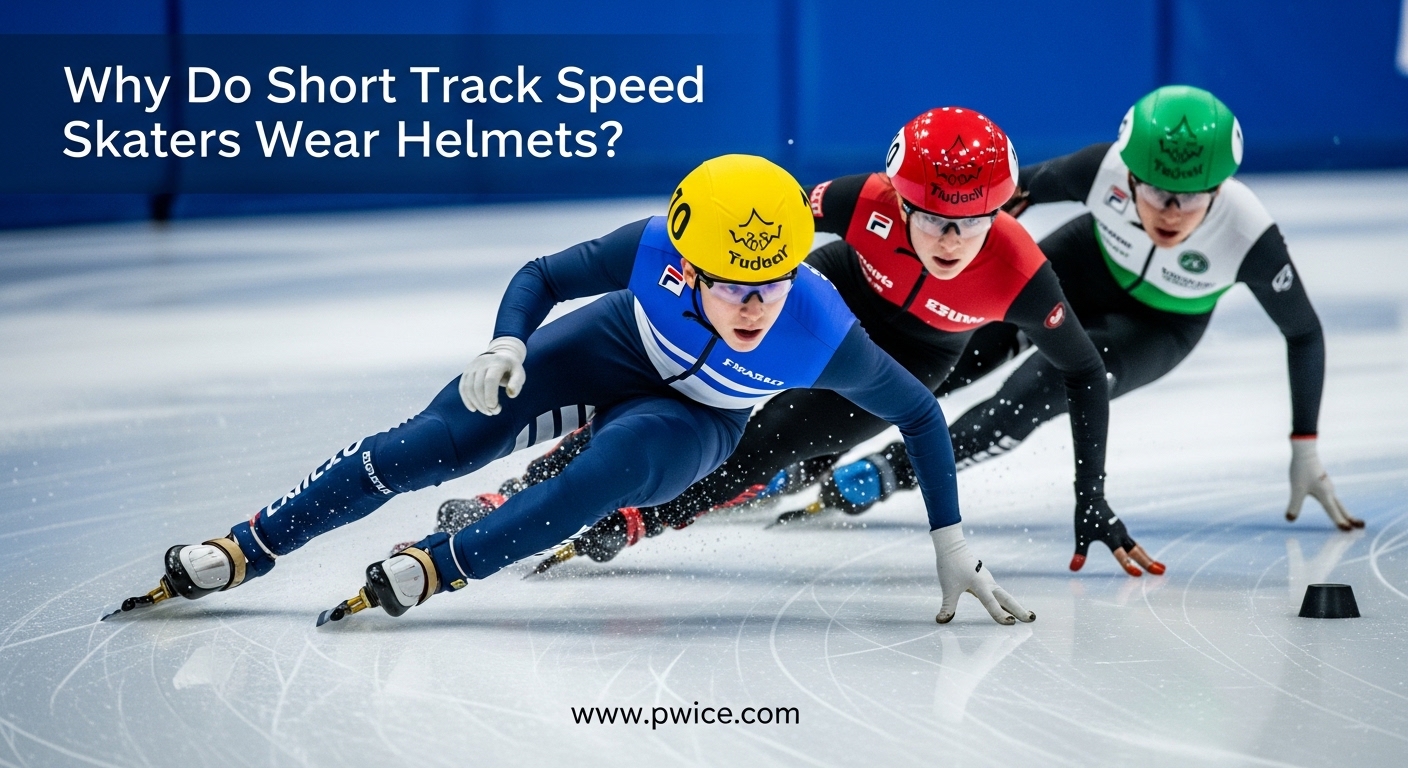
Short track speed skaters wear helmets because they are mandatory under International Skating Union (ISU) regulations for all short track events. The unique nature of pack-style racing on tight 111-meter ovals creates constant collision and fall risks that make head protection absolutely essential. Unlike long track speed skating where athletes race alone against the clock, short track involves multiple skaters competing simultaneously at speeds reaching 35+ mph with frequent physical contact.
I have watched countless hours of Olympic short track competitions, and the chaos of a mass start never fails to amaze me. The sport combines raw speed with tactical pack racing in a way that creates genuine danger every time the skaters enter a turn. Understanding why helmets are required helps explain what makes this sport both thrilling and perilous.
Table of Contents
Why Do Short Track Speed Skaters Wear Helmets? The Core Reasons
Helmets are required because the risk of falling is significantly greater in short track than in other forms of ice skating. The International Skating Union mandates helmet use for all short track competitors, from Olympic athletes to recreational beginners. This requirement exists due to three primary factors that create a perfect storm of danger.
Pack-style racing creates collision risks. Short track events use a mass start format where four to six skaters begin simultaneously and race against each other, not just the clock. This pack format means skaters frequently make contact while jockeying for position, leading to falls that can take down multiple competitors at once.
Tight curves demand extreme lean angles. The 111-meter oval features corners so tight that skaters lean at angles exceeding 45 degrees while maintaining speeds over 30 mph. This combination of centrifugal force and razor-thin blade edges creates constant instability. One wrong move, one clipped blade, and multiple skaters can crash into the padded walls or each other.
Speed-to-distance ratio amplifies danger. Short track combines relatively short straightaways with those tight corners, meaning skaters accelerate and decelerate constantly. The rapid changes in speed, combined with the pack format, leave almost no reaction time when something goes wrong. A fall at 35 mph on ice creates impact forces that can cause serious head trauma without proper protection.
The ISU recognized these dangers decades ago and made helmets non-negotiable for all sanctioned events. Current regulations require helmets that meet the ASTM F1849 standard, ensuring consistent protection across all competition levels.
The Unique Dangers of Pack-Style Racing
Pack-style racing transforms speed skating from an individual time trial into a contact sport. When multiple athletes share a narrow ice surface while traveling at high speeds, the potential for disaster multiplies exponentially. I have seen Olympic finals where six skaters entered the final turn and only two emerged upright.
The physics of pack racing create specific hazards that helmets directly address. Skaters draft behind each other to reduce air resistance, meaning they travel within inches of the skater ahead. This proximity leaves no margin for error when a blade slips or a skater loses balance.
Multi-skater falls are common. When one skater falls in a pack, they often take down competitors behind them who have no time to react. Chain-reaction crashes can send four or five athletes sliding across the ice simultaneously. Helmets protect not just from direct impacts with the ice, but from collisions with other skaters’ skates, knees, and elbows.
Blade contact poses severe injury risks. Speed skating blades are extremely sharp and rigid. During a fall, these blades can strike other skaters at high speed. While helmets primarily protect the head, they also provide some defense against glancing blows from blades that would otherwise cause serious lacerations or trauma.
The boards add another hazard. Short track ovals feature padded walls, but hitting them at racing speed still delivers significant impact. Skaters who lose control in turns often slide into these barriers, and helmets absorb much of the force that would otherwise transfer directly to the skull.
Recent incidents highlight these dangers. During the 2026 Winter Olympics, multiple falls occurred in nearly every finals race, with several athletes requiring medical attention despite their protective gear. The sport’s governing bodies continue refining safety requirements because the inherent risks of pack racing cannot be eliminated, only managed.
Tight Curves and Speed-to-Distance Ratio Explained
The 111-meter oval defines short track speed skating and creates its unique safety challenges. Unlike the 400-meter oval used in long track, short track’s compact dimensions force skaters into extreme physical positions that test the limits of human balance and equipment performance.
Understanding the geometry explains why falls happen so frequently. The turns on a short track oval have a radius of approximately 8 meters. At racing speeds of 30-35 mph, skaters must generate enormous centrifugal force to stay in the turn. They achieve this by leaning so far inward that their bodies are nearly parallel to the ice surface.
Centrifugal forces exceed 2 Gs in the turns. This means a 150-pound skater effectively weighs over 300 pounds during cornering, with all that force transmitted through blades only 1mm wide. The slightest miscalculation in lean angle or edge pressure causes immediate loss of control.
Speed-to-distance ratio creates acceleration demands. Short track’s brief straightaways mean skaters spend more time in the technically demanding turns relative to the full lap distance. They must accelerate hard out of each turn to maintain position, then immediately prepare for the next corner. This stop-and-go rhythm increases fatigue and error rates.
The crossover technique adds complexity. In turns, skaters must cross one leg over the other in a precise sequence while maintaining speed. This technique requires perfect timing. A delayed or premature crossover can cause blade contact with the ice or another skater’s foot, triggering a fall.
Helmets become essential because these factors combine to make falls both frequent and violent. When a skater loses balance at full lean in a turn, they fall from a low center of gravity but with significant forward momentum. The head often strikes the ice, the boards, or other skaters. Without helmet protection, these impacts would cause concussions, skull fractures, and potentially life-threatening injuries.
Short Track vs Long Track: Why Only One Requires Helmets
The difference in helmet requirements between short track and long track speed skating confuses many viewers. Both sports feature elite athletes racing on ice at high speeds, yet only short track mandates head protection. The distinction comes down to race format, track geometry, and risk profiles.
| Factor | Short Track | Long Track |
|---|---|---|
| Oval size | 111 meters | 400 meters |
| Race format | Pack-style (4-6 skaters) | Time trial (individual) |
| Turn radius | ~8 meters (extreme) | ~25 meters (gradual) |
| Contact risk | High (frequent collisions) | None (skaters race alone) |
| Helmet requirement | Mandatory (ISU rule) | Optional |
| Top speeds | 30-35 mph | 35-40 mph |
Long track speed skating uses a 400-meter oval with gentle turns that skaters navigate without the extreme lean angles required in short track. More importantly, long track athletes race alone against the clock, separated by starting intervals. No pack means no contact risk, and the wider track provides ample space for error recovery.
Long track focuses on pure speed. Athletes concentrate entirely on their own performance without worrying about blocking, passing, or defending position. This eliminates the tactical contact that causes most short track falls. A long track skater who loses balance usually slides harmlessly across a wide expanse of ice.
Short track emphasizes racing tactics. The pack format requires split-second decisions about when to pass, when to defend, and how to navigate traffic. These decisions happen while traveling at 30+ mph on a surface barely wider than a sidewalk. The combination of speed, proximity, and competition creates unavoidable collision risks.
Some long track skaters do choose to wear helmets, particularly during training or when attempting new techniques. However, the ISU only mandates helmets for short track because the objective risk factors justify universal protection. The sports may look similar to casual observers, but their safety profiles differ dramatically.
ASTM F1849: The Helmet Standard That Keeps Skaters Safe
Not just any helmet qualifies for short track competition. The International Skating Union requires all helmets to meet the ASTM F1849 standard, a specific certification designed for ice speed skating. This standard ensures helmets provide appropriate protection against the unique impacts the sport generates.
ASTM International, formerly known as the American Society for Testing and Materials, developed the F1849 specification to address gaps in general helmet standards. Traditional bike helmets or hockey helmets do not provide the right combination of protection, visibility, and aerodynamics that short track demands.
Hard plastic shell requirements. ASTM F1849 mandates a rigid outer shell that can withstand multiple impacts without cracking. This protects against both direct blows to the ice and glancing strikes from skate blades. The shell must maintain structural integrity at temperatures typical of ice rinks.
Impact absorption specifications. The standard requires specific foam densities that absorb impact force while remaining lightweight. Too dense and the helmet transmits excessive force to the skull. Too soft and the helmet bottoms out on hard impacts, offering no protection.
Secure chin strap systems. A helmet only works if it stays on during a crash. ASTM F1849 includes rigorous testing for strap strength and retention systems. Skaters must be able to fasten the helmet securely without obstructing breathing or visibility.
Field of vision standards. Short track skaters need excellent peripheral vision to monitor competitors in the pack. The ASTM standard mandates minimum visibility angles that helmet designs must meet. This prevents manufacturers from creating overly enclosed designs that protect at the cost of situational awareness.
ISU officials inspect helmets at competitions to ensure compliance. Skaters attempting to compete with non-certified helmets are disqualified until they obtain proper equipment. This strict enforcement reflects the sport’s commitment to athlete safety.
Beyond Helmets: Complete Protective Gear for Short Track
Helmets represent just one component of the comprehensive protective system short track skaters wear. The ISU mandates multiple pieces of safety equipment, and most athletes add optional gear beyond the minimum requirements. Understanding the full protective ensemble explains how seriously the sport takes injury prevention.
Cut-resistant gloves protect hands from blades. Short track skaters wear specialized gloves made with Kevlar or similar cut-resistant materials. When skaters fall, they instinctively put their hands out to break the fall. Without protection, sharp skate blades would slice through standard gloves and into flesh. The gloves also provide padding for the knuckles and palms.
Neck guards prevent lacerations to vital areas. A Kevlar-reinforced neck guard protects the throat and major blood vessels from blade contact. This piece of equipment became mandatory after several high-profile incidents involving neck injuries. The guard must cover the entire neck circumference while allowing full head movement.
Shin guards shield legs from contact. Hard plastic shin guards protect against direct blade strikes and impact with the boards. They strap securely to the lower leg without restricting the knee flexion essential for proper skating technique. Many skaters also wear padded knee pads for additional protection during falls.
Eye protection prevents debris and wind damage. Short track skaters wear specialized eyewear that protects against ice chips, wind, and accidental finger contact from other skaters in the pack. The goggles must fit comfortably under helmets without fogging during intense exertion.
Aerodynamic suits provide limited cut protection. While primarily designed for drag reduction, modern short track suits incorporate Kevlar panels in high-risk areas. The tight-fitting one-piece design also prevents loose clothing from catching on blades or equipment during falls.
Recreational skaters often ask whether they need all this equipment. The answer depends on skating level and risk tolerance. Anyone skating in organized short track programs should invest in full protective gear. Casual public skating does not require the same level of protection, though helmets remain a wise precaution for any ice activity.
FAQ
Why do some speed skaters wear helmets and some don’t?
Short track speed skaters wear helmets because pack-style racing on tight ovals creates collision and fall risks. Long track speed skaters race alone against the clock on wider 400-meter ovals with gentler turns, eliminating contact risks. The International Skating Union mandates helmets only for short track, though some long track athletes choose to wear them during training.
Do short track skaters wear Kevlar?
Yes, short track speed skaters wear multiple pieces of Kevlar-reinforced protective gear. Cut-resistant gloves contain Kevlar to protect hands from blade contact during falls. Neck guards use Kevlar to shield the throat and major blood vessels. Some aerodynamic suits also incorporate Kevlar panels in high-risk areas for additional cut protection.
Do short track speed skaters wear neck guards?
Yes, neck guards are mandatory for all short track speed skating competitions under ISU regulations. These guards use Kevlar or similar cut-resistant materials to protect against blade contact to the throat and neck. They must cover the entire neck circumference while allowing full range of head movement for proper visibility during racing.
What are the injuries in short track speed skating?
Common short track injuries include concussions and head trauma (prevented by helmets), lacerations from blade contact (prevented by cut-resistant gear), bruises and contusions from board impacts, and joint injuries from falls. Recent incidents include the February 2026 accident involving Polish skater Kamila Sellier, who suffered a blade cut to the face despite wearing a helmet and eyewear.
Are helmets required in short track speed skating?
Yes, helmets are absolutely mandatory for all short track speed skating events sanctioned by the International Skating Union. This requirement applies to Olympic competitions, World Championships, and all lower-level sanctioned events. Helmets must meet the ASTM F1849 standard and receive ISU approval. Skaters without proper helmets are disqualified from competition.
What is the difference between short and long track speed skating?
Short track uses a 111-meter oval with pack-style racing where 4-6 skaters compete simultaneously. Long track uses a 400-meter oval where skaters race alone against the clock. Short track requires helmets due to collision risks, while long track does not. Short track emphasizes tactical racing; long track emphasizes pure speed.
Can you use a bike helmet for ice skating?
Bike helmets do not meet the ASTM F1849 standard required for short track speed skating competition. They lack the specific impact resistance, field of vision, and structural integrity needed for ice racing. ISU-sanctioned events require helmets specifically certified for speed skating. Recreational skaters should use ice skating helmets rather than bike helmets for proper protection.
When did helmets become mandatory in short track?
The International Skating Union made helmets mandatory for all short track events decades ago as the sport evolved from its informal origins. The modern ASTM F1849 helmet standard was developed specifically to address the unique protection needs of ice speed skating. Current ISU regulations strictly enforce helmet compliance at all competition levels.
Conclusion
Short track speed skaters wear helmets because the International Skating Union mandates them for all sanctioned events. The combination of pack-style racing, tight 111-meter ovals, and high-speed cornering creates fall and collision risks that make head protection essential. Understanding why helmets are required helps explain the fundamental nature of this thrilling but dangerous sport.
Unlike long track speed skating where athletes race alone on wide 400-meter ovals, short track packs multiple competitors onto a tight surface where contact is inevitable. The ASTM F1849 helmet standard ensures all competitors receive consistent protection against the specific impacts short track generates. When combined with cut-resistant gloves, neck guards, and other mandatory protective gear, helmets form part of a comprehensive safety system.
Whether you are a competitive athlete, recreational skater, or Olympic spectator, respecting the safety requirements of short track speed skating matters. The sport’s governing bodies have implemented these rules through decades of experience with real injuries and near-misses. Helmets save careers and lives in a sport where fractions of seconds and fractions of inches separate victory from disaster.