
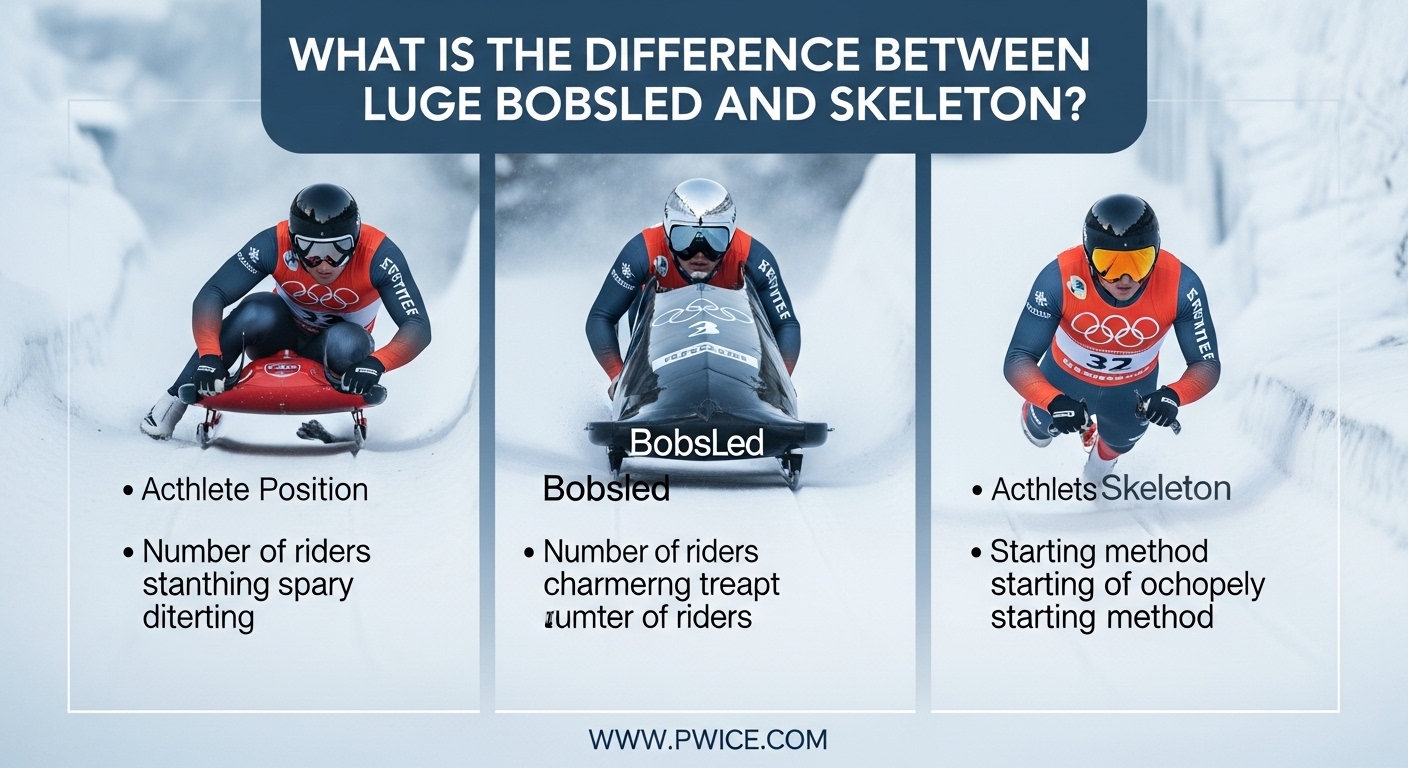
Every Winter Olympics, millions of viewers tune in to watch athletes hurtle down ice tracks at speeds exceeding 140 km/h. Three sports dominate these sliding events: bobsled, luge, and skeleton. While they share the same icy course and terrifying velocity, each demands completely different skills, body positions, and equipment.
Understanding what is the difference between luge bobsled and skeleton transforms how you watch these sports. You will notice the subtle steering techniques, appreciate the distinct starting methods, and understand why luge is considered the most technically challenging of the three.
Our team spent weeks analyzing competition footage, athlete interviews, and technical specifications to break down exactly how these sports differ. Whether you are preparing for the Milano Cortina 2026 Games or simply curious about extreme winter sports, this guide covers everything you need to know.
Table of Contents
At-a-Glance: Bobsled vs Luge vs Skeleton
Here is a quick comparison of the three sliding sports to help you visualize the key differences at a glance:
| Feature | Bobsled (Bobsleigh) | Luge | Skeleton |
|---|---|---|---|
| Body Position | Seated upright | Lying on back (supine) | Lying on stomach (prone) |
| Direction | Forward-facing | Feet first | Head first |
| Team Size | 2 or 4 athletes | 1 or 2 athletes | 1 athlete only |
| Top Speed | Up to 150 km/h (93 mph) | Up to 150+ km/h (95 mph) | Up to 130 km/h (81 mph) |
| Sled Weight | 170-230 kg max | 21-25 kg max | 43 kg max |
| Starting Method | Push start (standing) | Paddle start (seated) | Running sprint start |
| Steering | Rope/pulley system | Calf pressure & body weight | Shoulder & knee pressure |
| Sled Design | Enclosed with sides | Open, small seat | Open, minimal frame |
All three sports use the same ice track, but the experience differs dramatically depending on your position and equipment.
What is Bobsleigh (Bobsled)?
Bobsleigh is a team sport where athletes ride a large, enclosed sled down an ice track. Teams of two or four push the sled from a standing start before jumping inside for the descent.
The sport earned the nickname “Formula 1 on ice” because of its incredible speed and the precision required to navigate tight turns. A four-man bobsled can reach 150 km/h, generating forces up to 5G in the curves.
How Bobsled Teams Work
In a four-man bobsled, roles are clearly defined. The pilot steers using two ropes connected to the front runners. The brakeman at the rear pulls a lever to stop the sled at the finish. Two push athletes in the middle provide explosive power during the 50-meter start sprint.
Two-man bobsleds function similarly but with just a pilot and brakeman. The monobob event, introduced for women at the Beijing 2022 Games and now included for both genders, features a single athlete who both pushes and pilots.
Bobsled Steering and Equipment
The sled features a steering mechanism connected to the front runners via pulleys. The pilot pulls left or right to guide the sled through curves. The enclosed design protects athletes from wind resistance, contributing to higher speeds.
Sled specifications are strictly regulated. A four-man sled must weigh between 170-230 kg including the crew. The maximum length is 3.80 meters. These rules ensure competitive fairness while maintaining the sport’s inherent danger.
What is Luge?
Luge is the fastest and most technically demanding of the three sliding sports. Athletes lie on their backs on a small sled, racing down the track feet-first at speeds exceeding 150 km/h.
The feet-first position might seem less terrifying than skeleton’s head-first approach, but luge demands extraordinary precision. Athletes steer using subtle calf pressure against the sled’s runners, with millimeter adjustments determining success or disaster.
Luge Starting Method
Unlike the running starts in skeleton and bobsled, luge athletes begin seated. They grip two handles beside the starting line and paddle vigorously with spiked gloves against the ice to build initial momentum. After this seated push, they lie back and accelerate down the track.
The paddle start generates less initial speed than a running start, but luge makes up time through superior aerodynamics and the ability to maintain optimal racing lines.
Steering and Control
Luge sleds feature sharp, angled blades that bite into the ice. Athletes steer by pressing their calves against the runners or shifting body weight. The blades are significantly sharper than those on bobsleds or skeleton sleds, providing more control but also less forgiveness.
This sharp steering makes luge the most difficult sport to master. Athletes typically begin training as children, spending years developing the subtle muscle control needed to navigate tracks with 16+ curves at extreme speeds.
Singles and Doubles Luge
Individual luge features one athlete on the sled. Doubles luge pairs two athletes stacked on the same sled, with the taller athlete lying behind and on top of the front rider. Both must coordinate their steering movements precisely.
What is Skeleton?
Skeleton is the most visually dramatic sliding sport. Athletes sprint alongside their sled for 30-40 meters before diving head-first onto the tiny frame, lying on their stomachs for the descent.
The head-first, face-down position makes skeleton instantly recognizable. Athletes steer by shifting their body weight and applying pressure with their shoulders or knees against the sled frame. No steering ropes or handles exist.
The Running Start
Skeleton begins with an explosive sprint. Athletes run while gripping their sled handles, building speed before launching themselves onto the sled. This running start is unique among the three sports and demands both sprinting ability and perfect timing.
The start is crucial in skeleton. A strong sprint can provide the momentum difference that wins or loses races on tracks where total time differences often measure hundredths of seconds.
Steering Without Controls
Skeleton athletes have no mechanical steering system. They navigate entirely through body positioning. Tilting the head or shoulders initiates turns. Knee pressure against the sled sides provides fine adjustments.
Skeleton sleds are heavier than luge sleds (maximum 43 kg versus 25 kg) but narrower. The added weight provides stability but the lack of enclosure means riders experience more air resistance. This aerodynamic disadvantage makes skeleton slower than luge despite the more aggressive appearance.
Safety and Perception
Despite the head-first position, skeleton is generally considered safer than luge. The prone position offers better visibility and control. The heavier sled provides more stability. Athletes can also use their feet to slow down if needed, something impossible in luge or bobsled.
Key Differences Between the Three Sliding Sports
Understanding the distinctions helps appreciate each sport’s unique challenges. Here is how they truly differ beyond surface appearances.
Speed Comparison
Luge is consistently the fastest of the three sports. At the Cortina Sliding Centre built for the 2026 Olympics, luge athletes will exceed 150 km/h. Bobsleds match similar top speeds in four-man events. Skeleton remains slower, typically reaching 120-130 km/h due to aerodynamic drag from the prone position.
The speed difference surprises many viewers who assume head-first equals faster. The aerodynamics of feet-first luge actually create less drag, allowing higher velocities.
Which Sport is Most Dangerous?
Luge carries the highest injury risk despite skeleton’s dramatic appearance. The sharp blades and supine position make crashes particularly dangerous. Athletes have limited ability to protect themselves during accidents since they cannot see obstacles approaching behind them.
The 2010 Vancouver Olympics tragedy involving Georgian luge athlete Nodar Kumaritashvili highlighted these dangers. While safety improvements followed, luge remains statistically the most dangerous sliding sport.
Skeleton ranks second in danger. The head-first position creates risk, but athletes maintain better situational awareness. Bobsled is generally safest due to the enclosed sled design and team support during accidents.
Difficulty and Learning Curve
Luge requires the longest training period to master. Athletes often start as young teenagers, spending 5-10 years developing the subtle steering control. The sport demands precise calf muscle control and extraordinary balance.
Skeleton has a shorter learning curve but still requires years to perfect. The running start technique alone takes months to master. Bobsled pilots similarly need extensive training, though push athletes can transition more quickly from other sprint sports.
Equipment and Cost
Bobsleds are the most expensive, with competition sleds costing $30,000-50,000. Their complex steering mechanisms and reinforced construction drive prices up. Luge and skeleton sleds cost $3,000-8,000, making them more accessible.
All three sports require specialized helmets, racing suits, and spiked shoes. The total equipment investment represents a significant barrier to entry for aspiring athletes in all disciplines.
Do They Use the Same Track?
Yes, all three sports share the same ice tracks at Olympic venues. The Cortina Sliding Centre in Italy, built for the 2026 Games, hosts bobsled, luge, and skeleton competitions on its 1,745-meter course with 16 curves.
Track sharing makes economic sense, as building separate facilities would cost hundreds of millions. The ice preparation differs slightly for each sport, with track crews adjusting temperature and texture between events.
Sharing tracks also allows direct time comparisons between sports. Athletes appreciate racing on the same surface their competitors use, creating fair benchmarking across disciplines.
FAQ
Why is luge separate from bobsled and skeleton?
Luge is a separate sport because it uses fundamentally different equipment, body position, and steering mechanics. While all three are sliding sports on ice tracks, luge athletes lie on their backs feet-first and steer with calf pressure. Bobsled uses an enclosed sled with mechanical steering. Skeleton uses a head-first prone position. Each sport requires distinct athletic skills and training methods, justifying their separation as distinct Olympic disciplines.
Do bobsled luge and skeleton use the same track?
Yes, all three sports use the same ice tracks at Olympic venues. The shared track system allows venues like the Cortina Sliding Centre to host all sliding sports efficiently. Track crews adjust ice conditions between events to optimize for each sport’s specific requirements. Athletes in all three disciplines race down the same curves and straightaways, though their times and experiences differ dramatically.
What is the difference between skeleton and bobsled and luge?
The main differences are body position and direction. In bobsled, athletes sit upright in an enclosed sled facing forward, with 2-4 team members pushing to start. In luge, athletes lie on their backs feet-first, starting from a seated position and steering with calf pressure. In skeleton, a single athlete dives head-first onto a small sled after a running sprint start, steering with subtle body movements. Speeds also differ: luge is fastest (150+ km/h), followed by bobsled (150 km/h), with skeleton being slowest (130 km/h).
Why was the skeleton removed from the Olympics?
Skeleton has not been removed from the Olympics. The sport appeared in confusion may stem from temporary accreditation issues for the 2026 Milano Cortina Games regarding team personnel and administrative processing, not the sport itself. Skeleton has been a regular Winter Olympic sport since 2002 and remains fully scheduled for the 2026 Games alongside bobsled and luge events.
Conclusion
Now you understand what is the difference between luge bobsled and skeleton. These three sliding sports share ice tracks and Olympic prestige, but differ dramatically in technique, equipment, and danger level.
Luge offers the highest speeds and technical demands. Bobsled delivers team dynamics and raw power. Skeleton provides the most dramatic visual spectacle with its head-first diving starts.
Watch for these differences when the Milano Cortina 2026 Winter Olympics begin. You will appreciate the distinct skills each athlete brings to their discipline.