
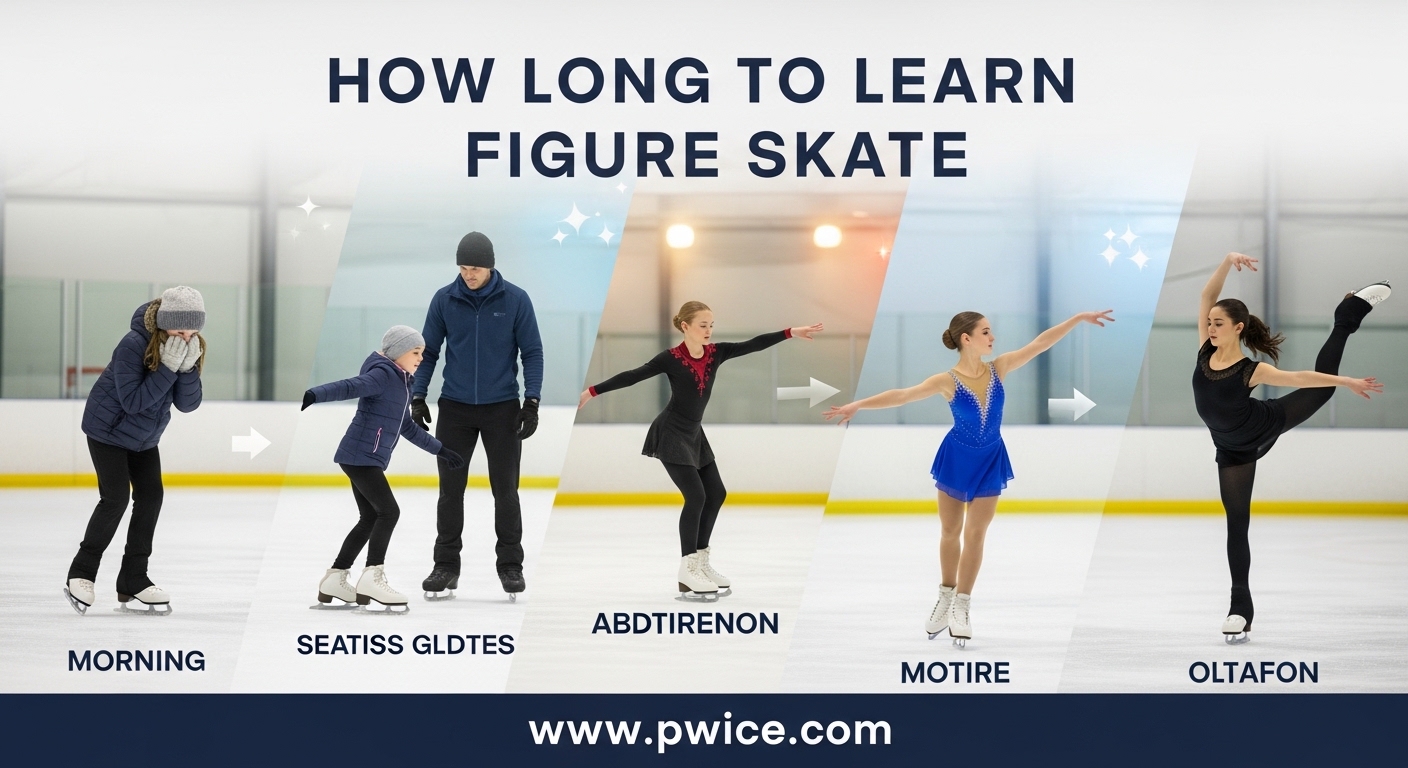
Learning to figure skate is a journey that varies dramatically from person to person. If you are wondering how long does it take to learn to figure skate, the honest answer is anywhere from a few weeks for basics to several years for advanced skills. Understanding realistic timelines helps set proper expectations, maintains motivation, and allows you to celebrate progress at every stage.
Our team spoke with skating coaches, analyzed forum discussions from real skaters, and reviewed actual progress timelines from adult beginners and children. What we found might surprise you. Progress depends far more on practice consistency and mental readiness than on natural talent or starting age.
Table of Contents
Quick Answer: Your Figure Skating Timeline
Most people can learn basic skating skills in 4 to 10 weeks with regular practice. Intermediate skills like spins and simple jumps typically take 6 to 24 months. Advanced figure skating skills require 1 to 5 years or more of dedicated training.
- Basic Skills: 4-10 weeks (forward/backward skating, stopping, gliding)
- Intermediate Skills: 6-24 months (edges, crossovers, waltz jump, simple spins)
- Advanced Skills: 1-5+ years (axel jump, combination spins, competition routines)
How Long Does It Take to Learn to Figure Skate? The Complete Breakdown
Breaking down the learning process into clear stages helps you track progress and set achievable goals. Each stage builds on the previous one, creating a foundation for more complex movements.
Stage 1: Basic Skating Skills (4-10 Weeks)
The first stage focuses on building comfort and confidence on the ice. Most beginners need 7 to 10 total hours on the ice before feeling comfortable standing, moving, and stopping without assistance.
Children typically master these basics in 4 to 8 weeks with regular lessons. Adults often take 8 to 10 weeks due to higher centers of gravity and greater fear of falling.
Key milestones in this stage include marching on the ice, two-foot gliding, forward skating across the rink, basic stopping techniques (snowplow stop), and backward skating fundamentals. You will also learn how to fall safely and get back up, which is an essential skill that builds confidence.
Practice frequency matters enormously here. Skating once per week for 30 minutes will stretch this stage to several months. Skating 2 to 3 times per week for 45 to 60 minutes helps you progress in the 4 to 10 week timeframe.
Stage 2: Intermediate Skills (6-24 Months)
Once you have mastered the basics, the real figure skating journey begins. This stage introduces the techniques that distinguish figure skating from recreational skating.
Learning forward and backward crossovers typically takes 3 weeks to 3 months depending on practice frequency and comfort with edges. Some skaters nail crossovers in three weeks. Others take three months. Both timelines are completely normal and valid.
During this period, you will develop stronger edges (inside and outside), learn three-turns and mohawks, attempt your first spin (usually a two-foot or one-foot upright spin), and master the waltz jump and possibly the salchow. Basic field moves and spirals also enter your practice routine.
A forum user we spoke with shared their Adult Basic 1-6 progression took about 11 months with 3 to 6 hours of ice time per week plus private lessons. This represents a realistic timeline for adults with consistent practice and professional instruction.
Stage 3: Advanced Skills (1-5+ Years)
Advanced figure skating represents a significant commitment of time, physical conditioning, and mental focus. This stage separates recreational skaters from those pursuing competitive or pre-professional goals.
The axel jump is often considered the major milestone that divides intermediate from advanced skaters. Mastering the single axel typically takes 1 to 2 years of consistent training after establishing solid basic jump technique.
Advanced skaters work on double jumps (salchow, toe loop, loop, flip, lutz), combination spins with multiple positions and changes of foot, complex step sequences, and program choreography. Many skaters report that 3 to 4 years of dedicated training gets them to solid two-foot turns, while 3 to 5 years brings a respectable one-foot spin.
One adult skater who started at age 32 noted that after 5 years, they were still learning and improving. There is no true mastery in figure skating, only continuous refinement and new challenges.
Key Factors That Affect Your Learning Timeline
Several variables influence how quickly you progress through these stages. Understanding these factors helps you optimize your training and maintain realistic expectations.
Practice Frequency and Consistency
Consistency beats intensity in figure skating. Practicing twice per week for 45 minutes yields better results than one marathon 3-hour session every other week. Muscle memory develops through repetition, and your body needs regular exposure to ice to build the neural pathways for automatic movement.
Most recreational skaters see optimal progress with 3 to 6 hours of ice time per week. Competitive skaters train 10 to 20+ hours weekly. The key is finding a sustainable schedule you can maintain long-term.
Age and Physical Development
Children generally learn basic skills faster than adults. Their lower center of gravity makes balance easier. They typically have less fear of falling. Their brains are in prime neuroplasticity windows for motor skill acquisition.
However, adults often progress faster in understanding technique and body mechanics. Adults can benefit from structured instruction, off-ice conditioning, and deliberate practice. The adult advantage is mental focus and the ability to analyze and apply feedback.
Quality of Instruction
A qualified coach accelerates your progress significantly compared to self-teaching. Professional instructors identify errors before they become habits, provide progressive skill sequences, and offer encouragement during frustrating plateaus.
Group lessons offer affordability and social motivation. Private lessons provide personalized attention and faster skill correction. Many successful adult skaters combine both approaches.
Off-Ice Training
Off-ice training is one of the most overlooked factors in learning speed. Core strength, flexibility, balance, and cardiovascular conditioning directly translate to on-ice performance.
Skaters who incorporate off-ice training progress 20 to 30% faster than those who only skate. Recommended off-ice work includes core strengthening exercises (planks, leg raises), stretching and flexibility routines, balance training (bosu ball work), jump technique practice on mats, and cardio conditioning for stamina.
Mental Barriers and Fear
Fear of falling is the biggest obstacle for adult learners. This psychological barrier can add weeks or months to your timeline. Working through fear requires patience, proper protective gear (helmets for beginners are wise), and gradual exposure to new movements.
Many adult skaters report that their mental game, not physical ability, determines their progress speed. Self-consciousness about learning in public can also hinder progress. Remember that every skater on the ice started as a beginner.
Adult Learners vs Children: What to Expect
The learning experience differs significantly between age groups. Understanding these differences helps you set appropriate goals and find peer support.
Children Learning to Skate
Children typically complete basic skills in 4 to 8 weeks with regular practice. They often progress through Learn to Skate USA Basic 1-6 levels in 1 to 2 years. Their natural flexibility and fearlessness help them attempt jumps and spins earlier.
Children benefit from group classes with peer energy and game-based learning. Parents should expect equipment changes as kids grow and skill-appropriate skates become necessary.
Adults Learning to Figure Skate
Adults take 8 to 10 weeks for basic comfort and 11+ months for Basic 1-6 completion with regular practice. The most common adult question is whether starting at 25, 35, or 45 is too old. The answer is absolutely not.
Adult skaters bring dedication, financial resources for quality instruction, and clear motivation. Many adults start figure skating for fitness, social connection, or lifelong dreams. Adult skating communities are welcoming and supportive.
Is 25 too old to start figure skating? Not at all. Is 45 too old? Many skaters start in their 40s and 50s and achieve impressive skills. Your timeline may be longer than a childs, but the journey is equally rewarding.
Practice Frequency: Quality Over Quantity
How you practice matters as much as how often you practice. Here are recommendations for different commitment levels.
Recreational Skater (1-2 Hours Per Week)
Progress will be slow but steady. Focus on reinforcing basics during each session. Consider supplementing with off-ice training. Expect basic skills in 3 to 4 months and intermediate skills in 2 to 3 years.
Regular Skater (3-6 Hours Per Week)
This is the sweet spot for most adult learners. Basic skills in 4 to 10 weeks. Intermediate skills in 6 to 18 months. Includes time for group or private lessons plus practice sessions.
Dedicated Skater (8-15 Hours Per Week)
Progress accelerates significantly with this commitment. Suitable for skaters working toward test levels or competitions. Requires cross-training and recovery attention to prevent injury.
Common Milestones and What They Mean
Figure skating follows established curricula like Learn to Skate USA or ISI. Here is what typical progression looks like.
Basic 1-2: Marching, gliding, dipping, swizzles, backward wiggles. Most beginners achieve these in 4 to 8 weeks.
Basic 3-4: Forward stroking, forward half-swizzle pumps, moving two-foot turns, backward one-foot glides. Typically achieved in 3 to 6 months.
Basic 5-6: Backward crossovers, forward three-turns, beginning spins, bunny hop, forward spirals. Usually takes 6 to 12 months from starting.
Pre-Free Skate and Free Skate levels: Introduce waltz jump, mazurka, single spins, backward three-turns. This stage spans 1 to 3 years of training.
Managing Your Expectations
Figure skating is not a sport you master quickly. It is a sport you continually refine over years or decades. The beauty lies in the journey, not the destination.
Plateaus are normal. Some weeks you will feel like you are getting worse instead of better. This is usually a sign that your brain is processing new movement patterns. Stick with it.
Compare yourself only to your past self, not to other skaters. Everyone has different physical backgrounds, practice schedules, and learning styles. The only race that matters is your own progress.
FAQ
Is it hard to learn figure skating?
Figure skating has a steep initial learning curve, but the basics are accessible to most people. The difficulty increases as you progress to spins, jumps, and complex footwork. With consistent practice and proper instruction, most people find skating challenging but achievable.
How fast can you learn figure skating?
Basic skating skills can be learned in 4 to 10 weeks with regular practice. Simple jumps and spins typically take 6 months to 2 years. Advanced skills require 1 to 5 years of dedicated training. Progress speed depends heavily on practice frequency, age, coaching quality, and off-ice conditioning.
Is 25 too old to start figure skating?
No, 25 is not too old to start figure skating. Many adults begin skating in their 30s, 40s, and even 50s. While children may learn basic skills faster due to lower centers of gravity and less fear, adults can achieve impressive skills with dedication. Adult skating communities are welcoming and supportive.
What’s the most difficult skill in figure skating?
The axel jump is widely considered the most difficult single jump because it takes off forward and rotates one and a half times in the air. Many skaters spend years perfecting this jump. At the highest levels, quadruple jumps and complex spin combinations represent the pinnacle of technical difficulty.
How many hours a day do figure skaters train?
Recreational adult skaters typically train 1 to 2 hours per week. Serious recreational skaters practice 3 to 6 hours weekly. Competitive skaters train 10 to 20+ hours per week, often splitting time between on-ice sessions and off-ice conditioning. Elite competitive skaters may train 4 to 6 hours daily.
How expensive is learning to ice skate?
Costs vary by location and commitment level. Public skating sessions cost $10 to $20. Group lessons range $15 to $30 per session. Private lessons cost $40 to $100+ per hour. Quality beginner skates cost $100 to $300. Competitive-level equipment and coaching can cost thousands annually.
Conclusion
How long does it take to learn to figure skate? The journey spans weeks for basics, months to years for intermediate skills, and potentially a lifetime for advanced mastery. Your personal timeline depends on practice consistency, quality instruction, off-ice training, and your starting age.
The most important factor is starting. Every expert skater was once a beginner clutching the boards. Whether you are 8 or 48, the ice welcomes anyone willing to try, fall, get up, and try again. Lace up your skates and take that first glide. The journey awaits.