
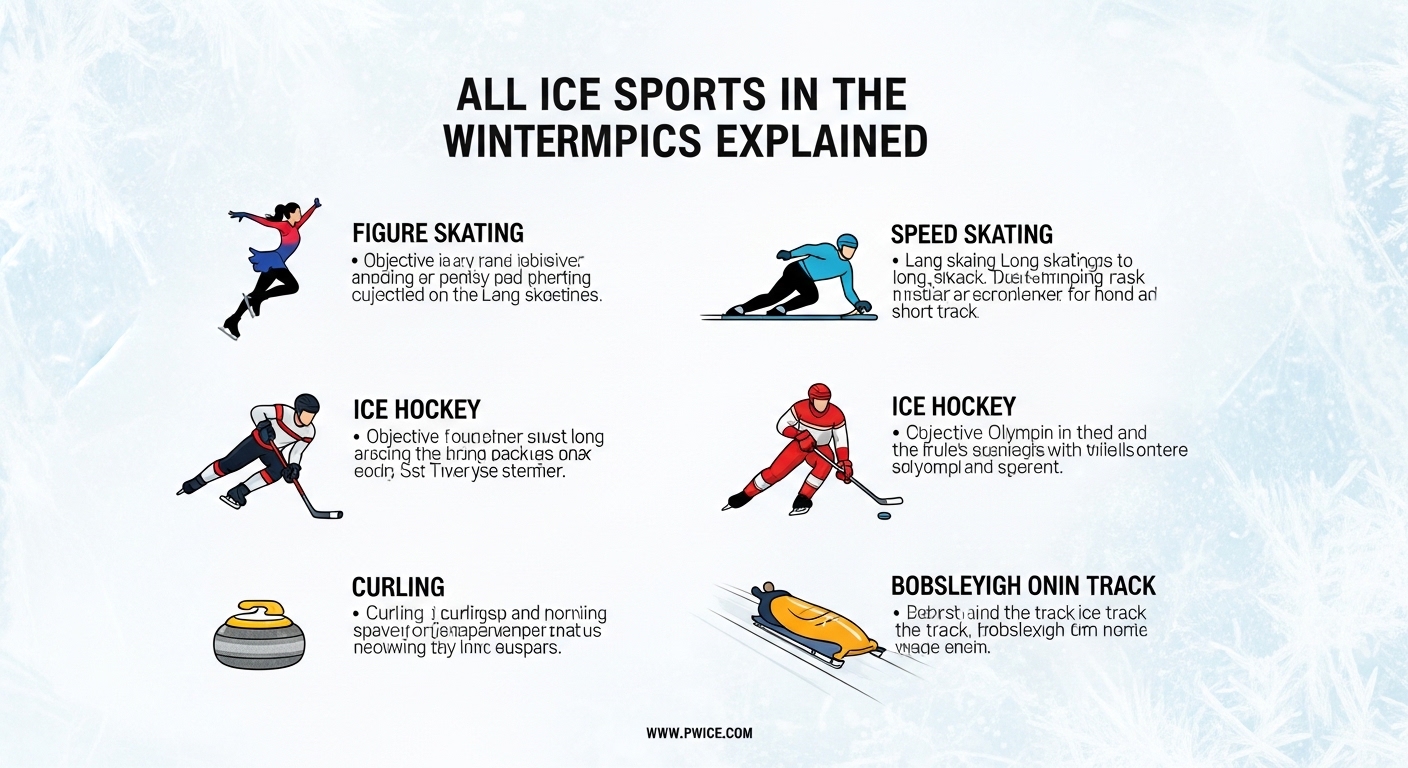
Have you ever watched the Winter Olympics and felt confused by all the different ice sports? You are not alone. With 8 core sports and 15 separate disciplines competing at Milano Cortina 2026, even dedicated sports fans struggle to tell the difference between bobsleigh, skeleton, and luge.
I have spent years following winter sports, attending World Cup events, and studying the technical details that make each Olympic discipline unique. This guide breaks down all ice sports in the Winter Olympics explained in plain language, with clear comparisons for similar events and practical tips for watching the 2026 Games.
Whether you are a first-time viewer, a parent trying to explain sports to your kids, or someone who wants to understand curling strategy beyond just watching stones slide, this article covers everything. You will learn the difference between speed skating and short track, why ski mountaineering debuts in 2026, and what makes curling ice completely different from hockey ice.
Table of Contents
Quick Overview: All 8 Ice Sports in the Winter Olympics
The Winter Olympics features 8 core sports divided into 15 disciplines. These break down into three main categories: skiing sports, sliding sports, and ice sports played on a rink or sheet.
Here is the complete list of all ice sports in the Winter Olympics explained with their disciplines:
- Skiing – Alpine Skiing, Cross-Country Skiing, Ski Jumping, Nordic Combined, Freestyle Skiing, Snowboarding
- Skating – Figure Skating, Speed Skating, Short Track Speed Skating
- Biathlon – Cross-country skiing combined with rifle shooting
- Bobsleigh – Four-person and two-person sled racing
- Skeleton – Head-first solo sled racing
- Luge – Feet-first solo or doubles sled racing
- Curling – Strategic stone sliding on pebbled ice
- Ice Hockey – Team puck and stick sport on ice
For Milano Cortina 2026, Ski Mountaineering joins as a new discipline within the Skiing category, bringing the total to 16 disciplines across 8 sports.
Understanding Sports, Disciplines, and Events
Before diving into each sport, you need to understand how the Olympics organizes competitions. The terminology confuses many viewers, but the structure is straightforward once explained.
A Sport is the broad category. Skiing is one sport. Within each sport, you find Disciplines, which are distinct competitive formats. Skiing contains six disciplines: Alpine, Cross-Country, Ski Jumping, Nordic Combined, Freestyle, and Snowboarding.
Within each discipline, individual Events determine who wins medals. Alpine Skiing includes events like Downhill, Super-G, Giant Slalom, Slalom, and Combined. Each event awards gold, silver, and bronze medals to the top three finishers.
This distinction matters because when someone asks “how many sports are in the Winter Olympics,” the answer is officially 8 sports with 15 disciplines for 2026. Ski Mountaineering makes it 16 disciplines, not 8 or 16 separate sports. Understanding this hierarchy helps you follow the medal count and event schedules during the Games.
Skiing: Six Disciplines on Snow
Skiing represents the largest category of Winter Olympic sports, covering six distinct disciplines that test different skills on snow-covered slopes and terrain.
Alpine Skiing
Alpine Skiing, often called downhill skiing, features athletes racing down steep slopes against the clock. The discipline breaks into five events: Downhill (the fastest event), Super-G (Super Giant Slalom), Giant Slalom, Slalom (the most technical), and Alpine Combined (one downhill run plus one slalom run).
Downhill races reach speeds over 100 mph, making it one of the most dangerous Olympic sports. Skiers navigate through gates marked by poles, with different spacing and course designs for each event. Super-G combines speed with technical turns, while slalom requires rapid direction changes through tightly spaced gates.
Cross-Country Skiing
Cross-Country Skiing tests endurance across rolling terrain rather than downhill speed. Athletes use their own power to propel themselves across snow-covered courses ranging from 1.5 km sprints to 50 km marathons.
The discipline includes two technique styles. Classic technique keeps skis parallel in groomed tracks. Skate skiing uses a motion similar to ice skating, pushing off the inside edge of each ski. Events include individual starts, mass starts where all competitors begin together, sprint races, and relays.
Ski Jumping
Ski Jumping combines power, aerodynamics, and sheer nerve. Athletes slide down a steep inrun ramp, launch themselves into the air, and fly distances exceeding the length of a football field before landing on the slope below.
Scoring depends on distance and style points from judges. The K-point marks the target landing zone, and jumpers earn additional points for every meter beyond it. Events include individual normal hill, individual large hill, and the team large hill competition where four jumpers per nation combine scores.
Nordic Combined
Nordic Combined uniquely blends Ski Jumping with Cross-Country Skiing, testing both explosive jumping power and sustained endurance. Athletes complete a ski jump competition first, then start a cross-country race with a handicap based on their jump results.
The competitor with the best jump starts first, while others start later based on point deficits from the jumping round. The first skier across the finish line wins gold. The Gundersen method, used for individual events, determines start times based on jump point differences converted to time gaps.
Freestyle Skiing
Freestyle Skiing showcases acrobatic skills on skis, featuring six distinct events. Moguls require athletes to ski down a bump-covered course while performing aerial maneuvers off two jumps. Aerials demand complex flips and twists launched from steep ramps.
Ski Cross races multiple athletes simultaneously down a course with jumps, turns, and rollers. Halfpipe and Slopestyle involve performing tricks in a U-shaped snow structure or on a course of rails and jumps. Big Air features a single massive jump where competitors execute their most difficult aerial maneuvers.
Snowboarding
Snowboarding brings surf and skate culture to the Winter Olympics. Parallel Giant Slalom races two riders side-by-side on identical courses. Snowboard Cross sends multiple competitors racing down a course with jumps and banked turns simultaneously.
Halfpipe riders perform aerial tricks while moving from wall to wall in a semi-circular snow structure. Slopestyle involves navigating a course of rails, boxes, and jumps while executing technical tricks. Big Air showcases a single massive jump for the most impressive aerial maneuvers.
Skating: Three Disciplines on Ice
The Skating sport category covers three distinct disciplines performed on ice rinks. Each tests different abilities from artistic expression to pure speed and tactical racing.
Figure Skating
Figure Skating combines athletic power with artistic performance. Four events make up the discipline: Men’s Singles, Women’s Singles, Pairs, and Ice Dance.
Men’s and Women’s Singles feature individual skaters performing required elements including jumps, spins, step sequences, and choreographed movements. The competition includes a Short Program with mandatory elements and a Free Skate with more creative freedom. Pairs skating adds lifts, throws, and synchronized elements performed by male and female partners together.
Ice Dance differs significantly from pairs skating. Ice dance focuses on rhythm, interpretation of music, and intricate footwork rather than jumps and throws. Partners maintain close contact throughout their routine, emphasizing edge quality and precision in turns and steps.
The Team Event, added in 2014, features skaters from each nation competing across all four disciplines. Countries earn points based on placement in each segment, and the nation with the highest combined score wins.
Speed Skating
Speed Skating, also called long track speed skating, features athletes racing against the clock on a 400-meter oval ice track. Competitors race in pairs, skating in separate lanes and changing lanes each lap to ensure equal distance.
Events range from the explosive 500-meter sprint to the grueling 10,000-meter endurance test for men and 5,000-meter for women. The Mass Start event, added in 2018, features all competitors racing together with points awarded for intermediate sprints and final position.
The clap skate, introduced in the 1990s, revolutionized the sport. A hinge mechanism at the front of the blade allows the heel to lift at the end of each push, extending the power phase of the stroke and dramatically increasing speeds.
Short Track Speed Skating
Short Track Speed Skating transforms speed skating into a tactical contact sport. Races occur on a 111-meter track inside a standard hockey rink, with four to six competitors racing simultaneously.
The tight turns and crowded field create constant strategic decisions. Skaters must choose when to lead, when to draft behind others, and when to attempt risky passing maneuvers. Contact and crashes are common, adding drama to every race.
Events include individual races at 500m, 1000m, and 1500m, plus relays. The 5000m relay for men and 3000m relay for women feature teams of four skaters who can push teammates to accelerate exchanges. The Mixed Team Relay, added in 2022, features teams of two men and two women racing together.
Sliding Sports: Bobsleigh, Skeleton, and Luge
The three sliding sports share the same ice track but differ dramatically in equipment, body position, and competitive format. Understanding these differences clears up the most common confusion among Winter Olympics viewers.
Bobsleigh
Bobsleigh features teams of two or four athletes steering a bullet-shaped sled down an ice track at speeds exceeding 90 mph. The pilot steers using two metal pieces called D-rings connected to the front runners, while teammates lean side-to-side to help navigate turns.
The start proves critical to success. Push athletes sprint alongside the sled for up to 50 meters, generating maximum speed before jumping in. The sled accelerates downhill through banked turns and straight sections, with teams seeking the fastest combined time across multiple runs.
Monobob, a single-woman sled event, joined the Olympic program in 2022. This addition gives women a second medal opportunity alongside the two-woman event, matching the men’s two and four-person competitions.
Skeleton
Skeleton is the simplest yet most terrifying sliding sport. Athletes lie face-down on a small sled, head-first, traveling down the same ice track at speeds over 80 mph with nothing but a helmet for protection.
Riders steer using subtle body movements and spiked shoes that grip the ice during starts. The sled has no steering mechanism. Athletes use their shoulders, knees, and toes to apply pressure and guide the sled through turns.
The sport demands incredible courage and precise body control. With their faces inches from the ice, riders experience forces up to 5 Gs in turns while maintaining aerodynamic position and steering lines.
Luge
Luge sends athletes feet-first down the ice track on a small sled steered with leg pressure and subtle shoulder movements. Singles luge features individual men and women competing for the fastest combined time across multiple runs.
Doubles luge adds complexity with two athletes stacked on the same sled. The taller athlete lies on top, while the smaller athlete tucks underneath. Doubles was historically open to mixed gender pairs, but now features separate men’s and women’s events.
Luge starts differ from other sliding sports. Athletes sit on handles and paddle the ice with spiked gloves to generate initial momentum before lying back and steering through the course.
Bobsleigh vs Skeleton vs Luge: The Key Differences
The three sliding sports cause the most confusion among Winter Olympics viewers. Here is a clear comparison to help you distinguish them.
Body Position: Bobsleigh athletes sit upright in an enclosed sled. Skeleton riders lie face-down, head-first, completely exposed. Luge athletes lie on their backs, feet-first, looking up at the sky.
Equipment: Bobsleigh uses large sleds with steering mechanisms and room for two or four athletes. Skeleton sleds are small platforms with no steering except body movement. Luge sleds are slightly larger than skeleton sleds but still minimal.
Speed: Bobsleigh reaches the fastest speeds, exceeding 90 mph due to the aerodynamic enclosed design. Skeleton and luge both reach over 80 mph, with skeleton sometimes slightly faster due to the head-first position reducing drag.
Steering: Bobsleigh pilots use mechanical steering. Skeleton athletes steer with body pressure and shoe spikes. Luge athletes steer with leg pressure against the runners and shoulder movements.
Team Size: Bobsleigh features two-person and four-person teams plus monobob for women. Skeleton is strictly individual. Luge has individual events plus doubles.
Biathlon: Skiing Meets Precision Shooting
Biathlon uniquely combines the cardiovascular demands of cross-country skiing with the precision of rifle shooting. Athletes ski laps around a course, then stop at a shooting range to fire at targets five times, alternating between prone (lying down) and standing positions.
Missing targets adds penalties. In individual events, each miss adds one minute to the skier’s total time. In sprint and pursuit events, misses require skiing a 150-meter penalty loop for each target missed.
The contrast between skiing and shooting creates a strategic challenge. Athletes must slow their heart rates and control their breathing to shoot accurately immediately after skiing at maximum intensity. This physiological control separates elite biathletes from the competition.
Events include the Individual (20km men, 15km women), Sprint (10km men, 7.5km women), Pursuit (mass start based on sprint results), Mass Start (30km men, 12.5km women), and Relays (4×7.5km men, 4x6km women, plus a mixed relay).
Curling: Chess on Ice
Curling stands apart from other Winter Olympic sports as a strategic team game rather than a race against time. Two teams of four players alternate sliding heavy granite stones down a sheet of ice toward a target area called the house.
Each end, similar to an inning in baseball, involves both teams throwing eight stones each. The team with stones closest to the center of the house scores points. Only one team scores per end, earning one point for each stone closer to the center than the opponent’s nearest stone.
Sweeping creates the sport’s unique dynamic. Two players use brooms to sweep the ice in front of moving stones, reducing friction and helping the stone travel farther and straighter. Sweepers judge the stone’s weight and line, communicating with the skip (team captain) who calls strategy from the far end.
Events include Men’s, Women’s, and Mixed Doubles tournaments. Mixed Doubles, added in 2018, features teams of one man and one woman playing with slightly modified rules including one pre-placed stone per end and six total stones thrown per team.
Ice Hockey: The Fastest Team Sport on Ice
Ice Hockey brings speed, physicality, and skill to the Winter Olympics. Two teams of six players (including a goaltender) compete to score goals by shooting a rubber puck into the opponent’s net using curved sticks.
Olympic ice hockey uses a wider ice surface than the NHL, creating more open play and emphasizing skating skill over physical contact. The larger surface rewards teams with speed and puck movement over the grinding style common in North American professional hockey.
Tournaments feature Men’s and Women’s competitions. Men’s hockey historically included NHL players from 1998 through 2014, creating dream matchups between international stars. Since 2018, the Olympics feature amateur and professional players from European leagues and collegiate programs, with NHL participation determined by collective bargaining negotiations for each Games.
Women’s hockey has grown dramatically since joining the Olympics in 1998. The tournament now features ten teams competing for gold, with Canada and the United States historically dominating the medal stand.
Ski Mountaineering: The Newest Olympic Discipline
Ski Mountaineering debuts at Milano Cortina 2026 as the newest Winter Olympic discipline. This sport tests athletes’ ability to climb mountains on skis and then ski down technical terrain as quickly as possible.
Athletes use specialized lightweight equipment including skis with climbing skins attached for grip on uphill sections. Competitors climb steep slopes using a herringbone technique or switchback patterns, then remove skins and ski down challenging off-piste terrain.
The Olympic format includes individual races where athletes complete multiple ascent and descent laps. Sprint events feature shorter courses with one climb and descent. Mixed relays team men and women in a relay format.
Ski Mountaineering has deep roots in European alpine culture, where ski touring represents a popular recreational activity. The sport’s inclusion reflects the Olympics’ goal of representing authentic winter sports traditions from host regions.
Ice Surface Differences: Why Every Sport Needs Different Ice
One question that confuses many Winter Olympics viewers involves ice surfaces. Curling, figure skating, short track, speed skating, and ice hockey all use ice, yet each sport requires completely different ice preparation.
Curling Ice (Pebbled)
Curling requires “pebbled” ice, created by spraying tiny water droplets across the surface before play. These frozen bumps, called pebble, reduce friction between the stone and ice, allowing the 42-pound granite rocks to glide smoothly.
Without pebble, stones would grind against flat ice and stop quickly. The pebble creates minimal contact points, allowing the stones to curl (curve) as they travel due to friction differences on the rotating stone’s leading and trailing edges. Sweeping briefly melts the pebble, reducing friction and helping the stone travel farther and straighter.
Figure Skating Ice (Smooth and Hard)
Figure skating demands the hardest, smoothest ice of any Olympic sport. The ice surface sits around 26°F, significantly colder than hockey ice. This hardness supports the thin blades during jumps and landings while providing consistent glide for spins and footwork.
Arena crews resurface figure skating ice frequently between practice sessions and competitions. The Zamboni applies a thin layer of hot water that freezes quickly, creating a glass-smooth surface. Any roughness or snow buildup could catch a blade edge, causing dangerous falls during jumps.
Speed Skating Ice (Smooth and Firm)
Speed skating uses ice slightly softer than figure skating, typically around 24-25°F. This temperature provides optimal glide for the long, flat blades while maintaining enough hardness for cornering at high speeds.
The 400-meter long track oval requires precise temperature control throughout the competition. Ice makers adjust temperature based on air conditions and ice quality, seeking the fastest possible surface that remains safe for skaters hitting speeds over 35 mph.
Short Track Ice (Smooth and Responsive)
Short track shares ice quality with figure skating since both use the same rink inside hockey arenas. The ice must support speed while handling the tight turns and sudden stops of short track racing. Ice makers balance hardness for speed with enough give for safe cornering at extreme lean angles.
Hockey Ice (Hard and Durable)
Ice hockey uses the softest Olympic ice, typically around 22-24°F. This temperature creates a harder surface than recreational rinks but softer than figure skating ice. The slightly warmer temperature allows ice to absorb impacts from skating, checking, and puck movement without shattering.
Hockey ice receives constant abuse from 200-pound athletes stopping, starting, and colliding throughout three periods. The softer ice repairs itself better between shifts, maintaining playable conditions despite continuous damage.
Beginner’s Guide: Which Sports to Watch First
If you are new to Winter Olympics viewing, some sports offer better entry points than others. Here are my recommendations for building your appreciation of winter sports.
Start with Alpine Skiing Downhill. The pure speed and danger make this immediately exciting. You do not need to understand complex rules. The fastest skier down the mountain wins. Watch for skiers reaching 90+ mph while navigating icy turns.
Try Ice Hockey next. If you enjoy any team sport, hockey translates easily. Two teams try to score goals. The physicality and constant action keep energy high even if you do not follow the tactical nuances.
Sample Figure Skating for artistry. The combination of athletic power and musical interpretation appeals to fans of dance or gymnastics. The judging system rewards technical difficulty, but casual viewers can simply enjoy the performance aspect.
Explore Curling for strategy. Once you understand the basic rules, curling offers incredible tactical depth. Watch with someone who can explain why teams choose specific shots, and you will discover a chess match played at high speed on ice.
Save the Sliding Sports for later. Bobsleigh, skeleton, and luge all look similar to newcomers. Once you learn the differences from this guide, you will appreciate the unique skills each requires. The four-person bobsleigh event offers the best introduction.
Check Short Track for drama. The pack racing format creates constant action, crashes, and photo finishes. You will understand who won immediately without studying complex scoring systems.
Frequently Asked Questions
What are the 15 sports in the Winter Olympics?
The Winter Olympics officially has 8 sports with 15 disciplines. They are: Biathlon, Bobsleigh (Bobsleigh, Skeleton), Curling, Ice Hockey, Luge, Skating (Figure Skating, Speed Skating, Short Track Speed Skating), Skiing (Alpine Skiing, Cross-Country Skiing, Ski Jumping, Nordic Combined, Freestyle Skiing, Snowboarding). For Milano Cortina 2026, Ski Mountaineering brings the total to 16 disciplines.
What are the 16 sports in the Winter Olympics 2026?
The Milano Cortina 2026 Winter Olympics features 8 sports with 16 disciplines. Ski Mountaineering makes its Olympic debut as a new discipline within the Skiing sport. The 16 disciplines are: Alpine Skiing, Cross-Country Skiing, Ski Jumping, Nordic Combined, Freestyle Skiing, Snowboarding, Ski Mountaineering, Figure Skating, Speed Skating, Short Track Speed Skating, Biathlon, Bobsleigh, Skeleton, Luge, Curling, and Ice Hockey.
Why were there a 92 and 94 Winter Olympics?
The 1992 and 1994 Winter Olympics occurred only two years apart because of a schedule change. Before 1994, the Winter and Summer Olympics happened in the same year. The IOC decided to separate them, creating a two-year gap between all Olympic Games. To make this transition, the 1994 Winter Games in Lillehammer occurred just two years after the 1992 Albertville Games. Since then, Winter Olympics occur every four years, two years after each Summer Olympics.
What are the 4 types of figure skating?
Figure Skating includes four distinct events at the Olympics: Men’s Singles, Women’s Singles, Pairs, and Ice Dance. Men’s and Women’s Singles feature individual skaters performing jumps, spins, and choreography. Pairs skating involves male and female partners performing lifts, throws, and synchronized elements. Ice Dance focuses on rhythm, interpretation, and intricate footwork without jumps or throws. A Team Event combines all four disciplines with skaters from each nation competing together.
What is the difference between bobsleigh, skeleton, and luge?
The three sliding sports differ in body position, equipment, and team size. Bobsleigh: athletes sit upright in a steerable sled, teams of 2 or 4 (plus monobob for women). Skeleton: athletes lie face-down, head-first, completely exposed, individual only. Luge: athletes lie feet-first on their backs, individual or doubles. Bobsleigh reaches fastest speeds over 90 mph, while skeleton and luge exceed 80 mph.
What is ski mountaineering?
Ski Mountaineering is a new Olympic discipline debuting at Milano Cortina 2026. Athletes climb mountains using skis with climbing skins attached for grip, then remove the skins and ski down technical terrain. The sport combines endurance climbing with technical downhill skiing. Olympic events include individual races with multiple ascent and descent laps, sprint events, and mixed relays. The sport reflects authentic alpine traditions from the host region.
What is the quad god?
The Quad God refers to Ilia Malinin, an American figure skater who revolutionized the sport by consistently landing quadruple axel jumps. The quad axel requires four and a half rotations in the air, making it the most difficult jump in figure skating. Malinin landed the first clean quad axel in competition and regularly includes multiple quadruple jumps in his programs, earning him the nickname among fans and media.
What is the difference between short track and speed skating?
Short Track and Speed Skating (long track) differ in track size, competition format, and tactics. Short Track uses a 111-meter track inside a hockey rink with 4-6 racers competing simultaneously, emphasizing strategy, drafting, and passing. Speed Skating uses a 400-meter oval with skaters racing in pairs against the clock, emphasizing pure speed and pacing. Short Track reaches speeds around 35 mph while Speed Skating exceeds 35 mph on longer straights.
How does curling work?
Curling involves two teams of four players sliding granite stones toward a target called the house. Teams alternate throws, and after all 16 stones (8 per team), the end is scored. The team with stones closest to the center scores one point per stone closer than the opponent’s nearest stone. Sweeping with brooms reduces friction, helping stones travel farther and straighter. The game typically lasts 8-10 ends, with the highest score winning.
How many ice sports are in the Winter Olympics?
The Winter Olympics features 8 core ice and snow sports containing 15 disciplines (16 for 2026 including Ski Mountaineering). The 8 sports are: Skiing, Skating, Biathlon, Bobsleigh, Luge, Curling, Ice Hockey, and Skeleton. Note that Bobsleigh, Skeleton, and Luge are sometimes grouped as sliding sports under a single federation, but the Olympics recognizes them as three separate sports with their own medal events.
Conclusion: Your Guide to the 2026 Winter Olympics
This guide covered all ice sports in the Winter Olympics explained with the details you need to enjoy the Milano Cortina 2026 Games. You now understand the 8 sports and 16 disciplines competing for medals.
Remember the key distinctions that confuse most viewers. Bobsleigh teams sit upright and steer mechanically. Skeleton riders face the ice head-first with no steering equipment. Luge athletes slide feet-first looking at the sky. Those three sliding sports share the same track but require completely different skills and courage.
The ice surface differences matter too. Curling needs pebbled ice for stones to glide and curl. Figure skating demands the hardest, smoothest surface for jump landings. Hockey uses slightly softer ice that withstands constant physical abuse.
Ski Mountaineering debuts in 2026, bringing authentic alpine culture to the Olympic program. The sport rewards athletes who can climb mountains efficiently and then ski technical terrain with precision.
Use the beginner’s guide to choose your first sports to watch. Start with Alpine Skiing Downhill for pure excitement, then explore curling for strategic depth. Sample ice hockey if you enjoy team sports, and discover figure skating for the combination of athletic and artistic achievement.
The Winter Olympics represents humanity competing at its limits in extreme cold environments. Every four years, athletes from around the world gather to ski faster, skate smoother, and slide more precisely than ever before. With this knowledge, you will appreciate the skill, courage, and dedication required to compete on winter’s biggest stage.