

A jigsaw is judged by straight cuts, and straight cuts are forgiving. A curve is not. The moment the blade has to turn, every weakness in the tool shows up at once: the blade deflects, the saw leaves your pencil line, and a plywood edge that looked clean at the start ends in a torn-out kink. That is why picking among the best jigsaws for curved cuts comes down to one question: does this saw hold the blade on line when the blade has to turn?
The short answer is that the best jigsaws for curved cuts are barrel-grip or low-handled saws with tight blade guide support, a variable speed trigger with a separate maximum-speed dial, and an orbital setting you can turn fully off. Pair one of those with a narrow fine-tooth scrolling blade, and you can follow a pencil line through a tight inside corner. Leave orbital on high and feed too fast, and no saw on the market will save the cut.
We put 10 saws through the same filter: how the blade is supported, how the speed is controlled mid-turn, whether the handle sits low enough to steer, and whether the shoe stays flat through a radius. Every pick below is here because it earned its place on those four points, not because it sits near the top of a general-purpose ranking. We also named the blade to pair with each one, because as the woodworking forums keep reminding people, the blade does more of the curve work than the saw does.
If you are still working out the basics of jigsaw work, our general jigsaw roundup covers the tool category end to end. This one is narrower: it is only about following a curve.
Table of Contents
Top 3 Picks for Curved Cuts in 2026

BLACK+DECKER BDEJS600C
- 4 curve settings
- Variable speed to 3000 SPM
- T-shank and U-shank tool-free blade change

Quick picks if you want the short version:
BLACK+DECKER BDEJS600C – best all-round jigsaw for curved cuts on a budget, with four dedicated curve settings.
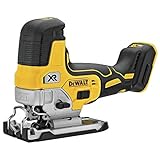
DEWALT DCS334B – best cordless jigsaw for curved cuts, brushless motor plus a speed dial you can set and forget.
DEWALT DCS335B – best barrel grip jigsaw for curves, the handle geometry most often credited with tight-radius control.
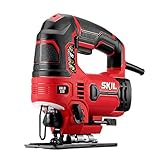
SKIL JS314901 – best budget saw that takes both shank types, so your existing blade collection still works.
Bosch JS260 – best corded saw for thick hardwoods and heavy sheet metal.
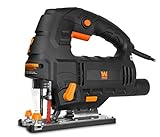
WEN 33606 – best value pick with a laser guide for tracing a line you can actually see.
10 Best Jigsaws for Curved Cuts Compared in 2026
| Product | Specifications | Action |
|---|---|---|
| BLACK+DECKER BDEJS600C Corded Jigsaw |
|
Check Latest Price |
| DEWALT DCS334B 20V MAX XR Cordless |
|
Check Latest Price |
 DEWALT DCS331B 20V MAX Cordless DEWALT DCS331B 20V MAX Cordless |
|
Check Latest Price |
 BLACK+DECKER BDCJS20C 20V MAX Cordless BLACK+DECKER BDCJS20C 20V MAX Cordless |
|
Check Latest Price |
 SKIL JS314901 6-Amp Corded SKIL JS314901 6-Amp Corded |
|
Check Latest Price |
 WEN 33606 6.6-Amp Corded with Laser WEN 33606 6.6-Amp Corded with Laser |
|
Check Latest Price |
| DEWALT DCS335B Barrel Grip Cordless |
|
Check Latest Price |
 CRAFTSMAN CMES610 5-Amp Corded CRAFTSMAN CMES610 5-Amp Corded |
|
Check Latest Price |
 Bosch JS260 6.0-Amp Top Handle Bosch JS260 6.0-Amp Top Handle |
|
Check Latest Price |
 CRAFTSMAN CMCS600B V20 Cordless CRAFTSMAN CMCS600B V20 Cordless |
|
Check Latest Price |
What Actually Makes a Jigsaw Cut a Clean Curve
Yes, jigsaws are good for cutting curves, but only with a narrow fine-tooth blade, a speed you can feather down through the turn, and the orbital setting at zero. Ask anyone who has chased a wandering cut across a sheet of plywood and they will say the same thing: the saw is rarely the problem.
Four things decide whether a curve comes out clean.
Blade support. A guide roller above the work and a clamp below it keep the blade vertical. Saw quality here varies more than spec sheets admit, and a roller that is loose or undersized is the single most common reason a cut drifts.
Cutting on the upstroke. The blade cuts as it travels upward and comes back down empty, which is why a jigsaw naturally pulls itself into the material. That pull is constant, so the harder you lean into a turn the more the blade is loaded sideways.
Blade width against curve radius. A wide blade cannot bend into a tight radius. It gets forced sideways until it deflects, and deflection compounds with every degree of turn. This is why the same blade that slices a sheet of plywood in half will refuse a 2 inch inside corner. Narrower blade, tighter curve, less deflection.
Tooth shape. Scrolling blades have teardrop, or J-hook, teeth that push chips down and away. Standard wood blades have non-teardrop, T-hook, teeth that cut upward into the material. For fine interior curves the scrolling tooth pattern is the right pick, and the trade-off is real: those teeth cut slowly and break sooner in thick material.
T-shank and U-shank is a separate question. T-shank is the modern standard that gives you a much wider choice of curve-capable blades, and it is what most current saws accept. U-shank is the older, narrower mount. Shank choice has nothing to do with blade width, so a T-shank saw can still take a blade too wide for the curve you are cutting.
How We Picked These Jigsaws
Most jigsaw roundups rank general-purpose saws, which makes curve performance an accidental by-product. We inverted that. Every saw here had to hold a line through a turn, so we weighted blade guide support first, then speed control you can adjust under load, then handle geometry, then shoe rigidity through a radius.
Power came last on purpose. A 6-amp saw with tight guide support will trace a curve better than a 20V brushless machine with a loose roller, and the forum consensus on expensive saws for curve work is not that price fixes the problem. We also read the review data for each tool, looking specifically for wander, blade flex and tearout reports rather than counting horsepower.
1. BLACK+DECKER BDEJS600C – Best Jigsaw for Curved Cuts Overall
BLACK+DECKER Jig Saw, 5-Amp, 3,000 Blade Speed, 45 Degree Beveled Cuts, ¾-Inch Orbital Blade, 4 Curve Settings, Corded (BDEJS600C)
5 amps corded
0-3000 SPM variable speed
4 curve settings
T and U shank tool-free blade change
Pros
- Four dedicated curve settings
- Variable speed to 3000 SPM
- Quick lever blade change takes T-shank and U-shank
- Light at 4.6 lbs for tight work
Cons
- Bevel lock needs a screwdriver
- Shoe adjusts only to preset 45 degree slots
- Dust airflow blows forward and right
This is the saw I reach for when someone asks for one tool that handles curves, laminate and framing wood without a battery in the way. Four curve settings is a rare feature at this level, and it maps directly onto the way curve work actually proceeds: up-stroke only at the start, a touch of orbital as the radius opens up, and back to up-stroke for the inside corner.
Numbers to know: 5 amp corded motor, 0 to 3,000 SPM, 4 curve settings, 4.6 pounds, 600 watts, 45 degree bevel. That is a light tool, and weight matters more here than it does for straight cuts, because a heavy saw is harder to pivot through a turn.
The quick lever blade change accepts both T-shank and U-shank blades, so a scrolling blade is a swap away from the one in the box. Owners specifically call out the lever as fast, and that matters more for curve work than for straight cuts because you will change blades constantly as the radius changes.
Pair it with a narrow scrolling blade for tight curves and a general-purpose wood blade for open arcs. The dust blower is the weak point here: airflow pushes debris forward and to the right rather than into a port, so on fine detail work I keep a brush within reach. The screw-driven bevel lock is the other irritation, since the shoe only sits at preset angles and any adjustment needs a driver.
Recommended blade: a narrow scrolling blade with teardrop teeth, roughly 1-1/8 inch wide with fine teeth, for anything under a 3 inch radius.

Worth knowing before you buy: there is no trigger lock, so the saw runs the moment the trigger is touched. That catches people out on a bench where the handle is easy to brush against. It is a small thing, but on a tool this light it is one of the few genuine safety complaints in the reviews.
Several owners also report overheating under constant heavy use, and the same reviews note it is not the tool for very small circles, at around 10 cm diameter and under. For a first serious curve-cutting project, a larger open shape is the right starting point. Once you have the speed dialled back and the blade changed, this saw will trace open curves in plywood all day without complaint.
How it holds a curve compared with the others
Against the cordless saws in this list, the BDEJS600C feels noticeably lighter in the hand, and that translates into a lazier pivot through a turn. Its four curve settings give finer control than the three-position orbital on the CRAFTSMAN CMCS600B and are the equal of the four-position control on the DEWALT models.
Its limit is the shoe. Preset slots and a screw-driven bevel mean a compound curve at an angle is awkward, but for a flat sheet with a line drawn on it, that never comes up.
Who should skip it
If your work is mostly thick hardwood or sheet metal, five amps will feel slow and the narrower curve blades will load the motor faster than they would on a six-amp machine. Buyers who want one tool for both jobs should look at the Bosch JS260 instead.
Southpaw users should also note the trigger and dust blower sit on the same side, and reviewers of corded jigsaws in this class frequently report the blower is right-handed. Anyone cutting very small inside circles will find the tool’s response too abrupt at low speed, and a scroll saw is the better answer.
2. DEWALT DCS334B – Best Cordless Jigsaw for Curved Cuts
DEWALT 20V MAX XR Jig Saw, 3,200 Blade Speed, Cordless, Brushless Motor, LED Light, Bare Tool Only (DCS334B)
20V MAX brushless
0-3200 SPM with dial
4-position orbital
All-metal keyless blade change
Pros
- Brushless motor for longer runtime
- Compact body is easy to steer through a turn
- Speed trigger plus a separate max-speed dial
- 4-position orbital action
- LED and dust blower keep the line clear
Cons
- Sold as bare tool with no battery or charger
- T-shank only so U-shank blades will not fit
This is the pick I recommend to anyone already invested in a 20V MAX battery platform. It holds a 4.8 rating across more than 9,600 reviews, and the reason curve work likes it is simple: a trigger for fine control and a separate dial for the ceiling speed, so you can set the maximum and feather down through the tight part of the turn without thinking about it.
Numbers to know: brushless motor, up to 3,200 blade speed, 4-position orbital action, 4.2 pounds bare, 20V MAX battery platform. At 4.2 pounds it is the lightest saw in this roundup, and that is a real advantage when the workpiece is large and you are trying to pivot the whole tool around a radius.
The 4-position orbital is the piece most owners mention. Position zero gives a pure up-and-down stroke for finish curves, and stepping up adds chip clearing for open cuts in thicker material. The all-metal lever-action blade change is fast and durable, and the keyless bevel shoe has detents at 0, 15, 30 and 45 degrees, which is more granular than most of the corded saws here.
Pair it with a narrow scrolling blade for interior work and keep the speed dial below maximum through any turn. Running max speed on a curve is the fastest way to make a fine blade grab, buckle and snap, and this saw’s trigger makes it easy to avoid doing that.
Recommended blade: a narrow T-shank scrolling blade, teardrop teeth, around 1-1/8 inch wide, for plywood, veneer and soft hardwood.

One buyer note worth repeating: this saw accepts T-shank blades only. If you have accumulated a drawer of U-shank wood blades, they will not fit, and the curve-capable narrow blades you are most likely to want are predominantly T-shank anyway, so in practice this costs you less than it sounds.
The no-mar shoe cover also earns its place here. On a finished plywood face, protecting the surface matters as much as the cut itself, and it is one of the few premium touches on a bare-tool listing.

Why it outranks the other cordless saws here
Against the DCS331B, the brushless motor and lower weight make it easier to hold a curve, and against the DCS335B it is lighter but lacks the barrel-grip geometry. If you are not already committed to a barrel-grip hand position, the speed trigger plus dial is the more complete control package for scroll-style work.
Against the CRAFTSMAN CMCS600B it adds a fourth orbital position, a work light, and finer bevel detents. The CRAFTSMAN still has the advantage of accepting U-shank blades.
Where it falls short
Bare tool only. If you do not already own 20V MAX packs and a charger, the real cost of this pick climbs fast, and the BLACK+DECKER BDCJS20C is the alternative if you want a complete cordless kit from one purchase.
It is a top-handle body rather than a barrel grip, so for the tightest inside corners the DCS335B below remains the better tool. For everything from open arcs through medium-radius shapes, this is the machine I would pick.
3. DEWALT DCS331B – Reliable Cordless Jigsaw for Curved Work
DEWALT 20V MAX Jig Saw, Tool Only (DCS331B)
20V MAX cordless
0-3000 SPM variable speed
4-position orbital
All-metal keyless blade change
Pros
- Wide 0-3000 SPM speed range
- 4-position orbital for speed versus finish
- Durable all-metal keyless blade change
- Keyless bevel shoe with four detents
- Two blades in the box
Cons
- Bare tool so battery and charger are extra
- Heavier and larger than newer brushless rivals at 5.6 lbs
The DCS331B is the older sibling of the DCS334B and it is still a very good curve-cutting saw, mostly because the speed control is the part that matters and it has all of it: a true 0 to 3,000 SPM variable speed with four orbital positions.
Numbers to know: 0 to 3,000 SPM, 4-position orbital action, 5.6 pounds, all-metal lever-action keyless blade change, T-shank blades, 45 degree bevel with detents at 0, 15, 30 and 45 degrees.
The metal shoe and metal blade clamp are the parts reviewers single out. A rigid shoe matters on a curve because a plate that flexes changes the blade angle mid-turn, and a clamp that grips properly keeps the blade vertical as the radius tightens. This saw has both, and that is why it holds a line better than lighter plastic-bodied machines of similar price.
For curve work the four orbital settings are useful in a specific way. Set it to zero for the tight inside corner, then step up one position when the radius opens out, which is exactly the sequence the BDEJS600C’s curve settings automate. Two blades ship in the box, though neither is a narrow scrolling blade, so budget for one.
Recommended blade: a narrow T-shank scrolling blade for tight curves; the included blades are fine for open shapes only.
The anti-slip rubber grip is worth mentioning for a subtle reason. On a long curve, a grip that lets the saw rotate in your hand compounds wander, and a grippy surface means you are steering with your wrist rather than fighting the tool.
Buyers already running 20V MAX packs rate this extremely highly for that ecosystem fit. It is a mature, well-supported tool with a 3 year limited warranty, which is longer than most of the cordless picks here.
Where it beats the newer models
The all-metal construction and the wider speed range at the low end. The brushless DCS334B is lighter and more efficient, but if your curve work involves thicker material and you want more control near the bottom of the range, this saw’s 0 SPM start is genuinely useful.
It is also the pick for anyone who wants a second tool without a new battery ecosystem, since it shares the platform with the saw above.
Where it loses
At 5.6 pounds it is the second-heaviest cordless saw in this roundup, and weight is the enemy of a tight turn. The brushless model is a full pound and a half lighter.
It is also a bare tool. If you are starting from nothing in cordless, this is the wrong door to walk through, and the BDCJS20C below is the one that arrives complete.
4. BLACK+DECKER BDCJS20C – Best Cordless Jigsaw for Curves on a Single Purchase
BLACK+DECKER 20V MAX* POWERCONNECT Cordless Jig Saw (BDCJS20C)
20V MAX cordless kit
0-2500 SPM variable speed
Tool-free U and T shank changes
Pros
- Arrives with battery and charger ready to use
- Tool-free blade change accepts both U and T shank
- Variable speed trigger handles detailed curves
- 45 degree bevel shoe both directions
- Wire guard and dust blower for line of sight
Cons
- Roughly 15 minutes of cutting per charge
- Some units report a battery that would not charge
- Noisier than premium brushless jigsaws
This is the pick for someone who wants to cut curves without first buying a battery ecosystem. The box contains the saw, a blade, a 20V MAX battery and a charger, which removes the biggest cost objection to cordless.
Numbers to know: 0 to 2,500 SPM variable speed trigger, tool-free blade change for both U and T shank blades, 45 degree bevel shoe, 5 pounds, two-year limited warranty.
Accepting both shank types is genuinely useful here and not a minor point. If a friend lends you a narrow scrolling blade in the other mount, this saw will take it, and that flexibility removes a real barrier for anyone just getting into curve work.
The bevel shoe works in both directions, which matters for compound cuts through a curve, and the wire guard plus dust blower combination gives a cleaner view of the line than most corded saws in this roundup. On a slow, tight curve, seeing your pencil line is half the battle.
Recommended blade: a narrow scrolling blade in whichever shank the curve needs, since this saw takes both.
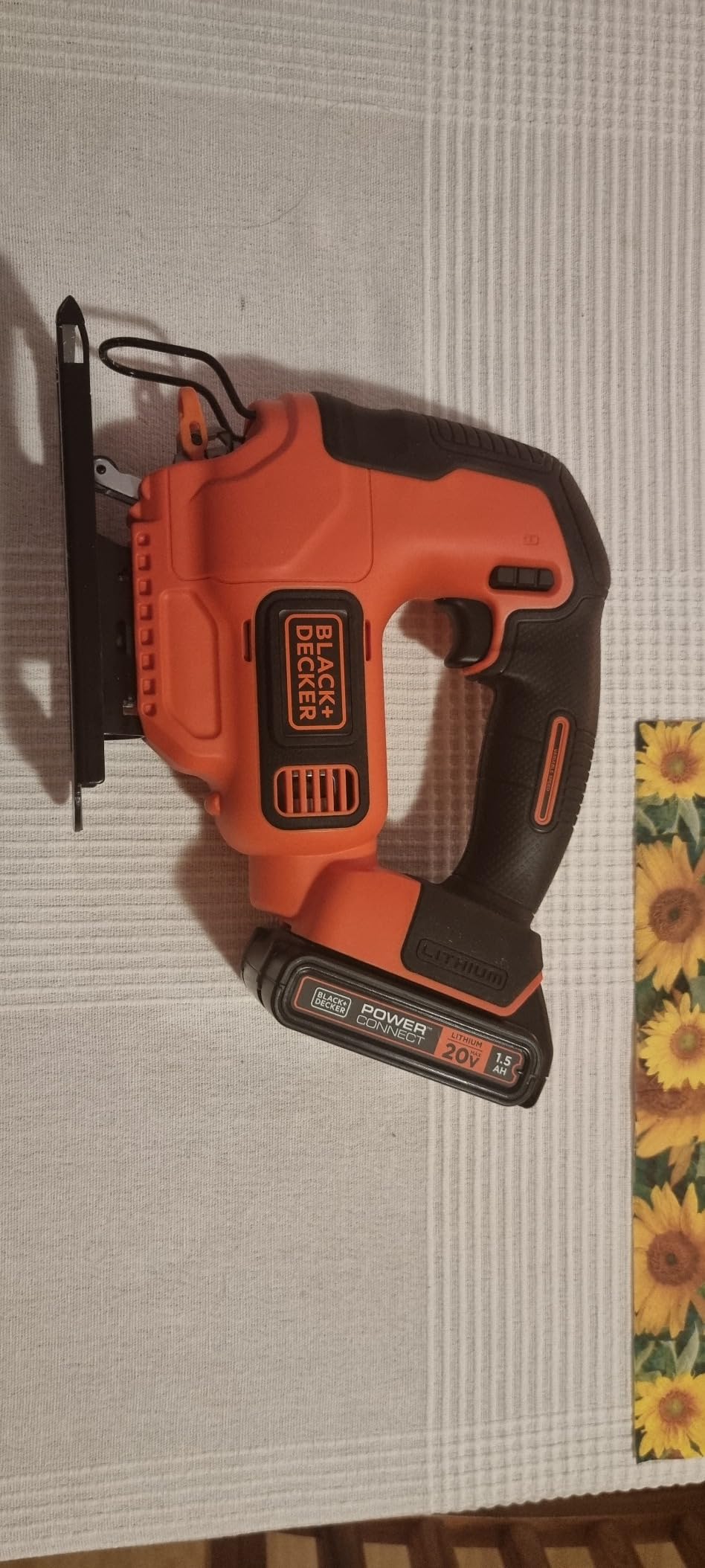
The variable speed trigger is what makes the curve work possible, and reviewers consistently single it out. A curve demands you slow down as the radius tightens, and a trigger-only speed control is faster to modulate than a dial alone.
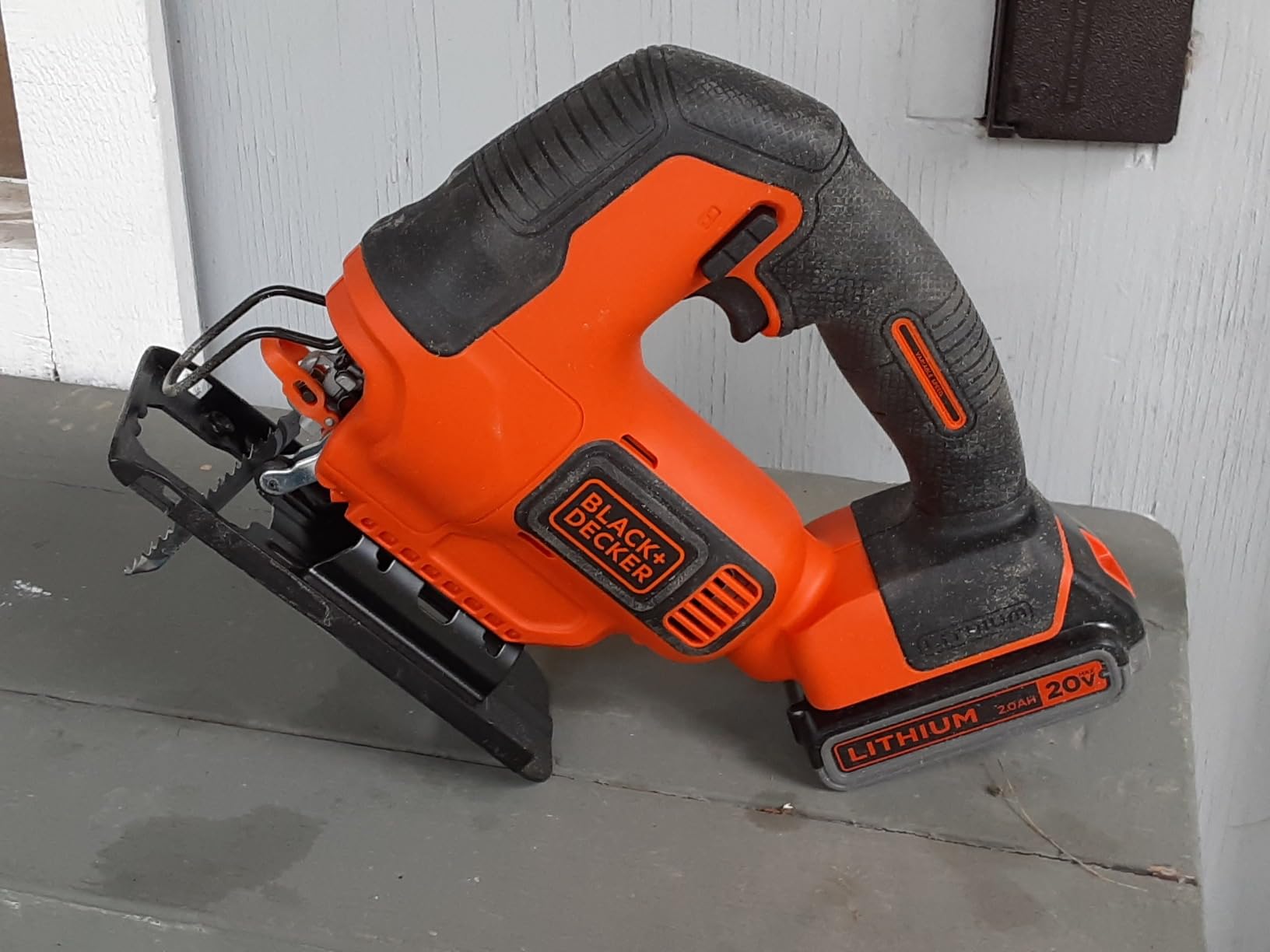
That same review set is blunt about the endurance. Multiple owners report roughly 15 minutes of cutting per charge, which is rarely enough to finish a large curved cutout. Plan on a second pack or choose a different saw for big sheets.
How it compares to the DEWALT cordless picks
The DEWALT saws are lighter, faster and have a fourth orbital position, so they are better tools if you have the batteries. What this saw wins is completeness: two shank standards, a working bevel shoe in both directions, and no separate battery purchase.
On curve finish quality specifically, the 2,500 SPM ceiling is lower than the DEWALT’s 3,200, which is arguably a small advantage, since the top of the range is rarely where you want to be on a radius.
Who should skip it
Anyone cutting large sheets. A 15 minute runtime on a full sheet of plywood means stopping mid-curve, and stopping mid-curve is exactly when wander gets worse. For outdoor or on-site work with no outlet nearby, it is a genuinely capable tool, but buy a spare battery first.
5. SKIL JS314901 – Best Budget Jigsaw for Curved Cuts
SKIL 6 Amp Corded Jig Saw with Tool-Free Blade Change – JS314901
6 amp corded
4-stage orbital function
2-finger speed trigger with dial
Tool-free blade clamp
Pros
- Blade roller guide reduces flex on thicker material
- Takes both T-shank and U-shank blades
- Tool-free blade change in seconds
- Bright halo LED and switchable dust blower
- Strong cutting ability for the class
Cons
- Trigger is more sensitive than older SKIL models
- No vacuum port despite the blower switch
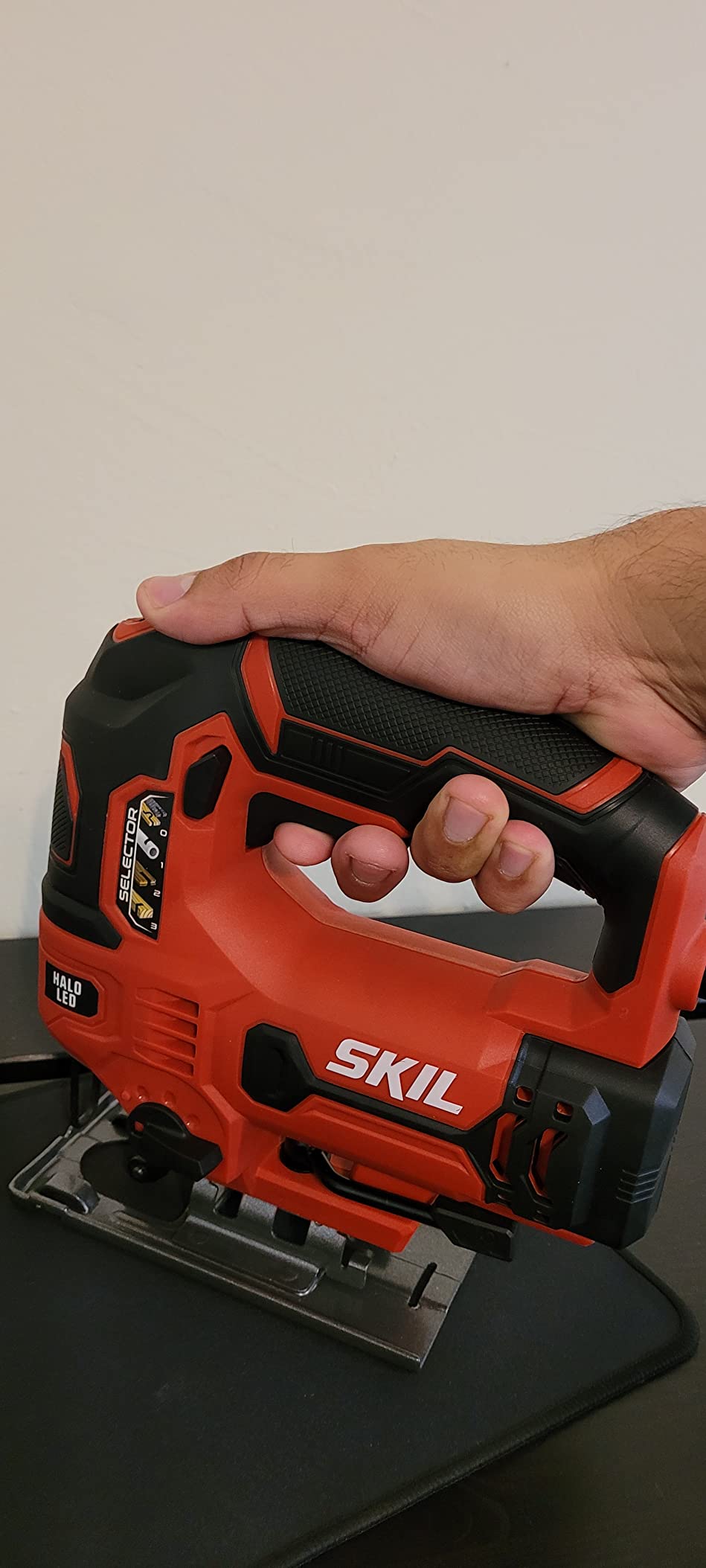
The roller guide is the reason this saw is in a roundup about curves. Reviewers specifically credit it with reducing blade flex and unwanted bevel on thicker material, and blade flex is the mechanical cause of nearly every wandering cut complaint we found in the forums.
Numbers to know: 6 amp corded, 4-stage orbital function, 2-finger trigger with a speed control dial, 4.9 pounds, tool-free blade clamp, 1 year limited warranty.
It also takes both T-shank and U-shank blades, which preserves an existing blade collection and means a scrolling blade is whatever mount you already own. The tool-free blade clamp changes blades in seconds, and on curve work you will be swapping more often than you think as the radius changes.
The halo LED is unusually bright for this class, and the on/off dust blower switch lets you redirect airflow away from the cut line when you are tracing a fine curve on a pale surface. That sounds trivial until you are following a pencil line through sawdust.
Recommended blade: a narrow scrolling blade, teardrop teeth, in either shank. The included wood and metal blades are general-purpose only.
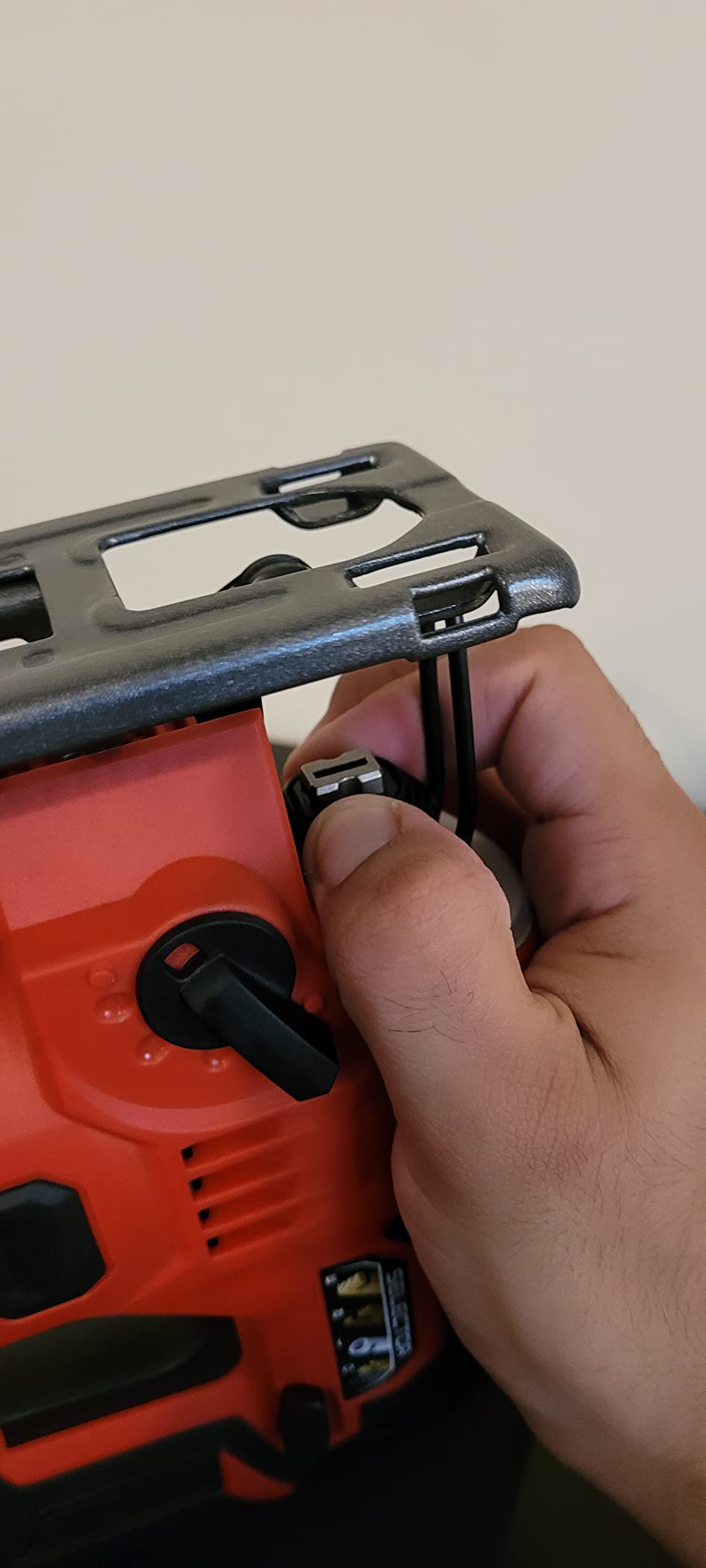
One reviewer story is worth repeating because it explains the tool’s main quirk. They initially docked a star for what they thought was an on/off trigger, then updated to confirm it is a proper variable speed that is simply more sensitive than on older SKIL models. The advice was to set the dial and modulate with the trigger.
That is good practical advice for curves. Set the dial to your maximum working speed, then feather the trigger down as the radius tightens.
Why it edges out the WEN for curve work
Two reasons, both mechanical. The roller guide supports the blade where the WEN’s shoe does not offer the same assistance, and the two-finger trigger gives finer low-speed modulation than the WEN’s lock-on switch arrangement for delicate radius work.
The WEN does have the laser, which is a real advantage when you are tracing rather than freehand cutting, and it has more cutting power at 6.6 amps.
Where it falls short
There is no vacuum port despite the blower switch, so dust control is airflow only. The bevel lock still needs a tool for some adjustments, and the one-year warranty is the shortest here.
The trigger sensitivity is a genuine acclimation issue rather than a defect. Anyone used to a firmer trigger should spend ten minutes on scrap before starting a real project.
6. WEN 33606 – Best Value Jigsaw for Traced Curves
WEN 33606 6.6-Amp Variable Speed Orbital Jig Saw with Laser and LED Light,Black, Silver
6.6 amp corded
0-3300 SPM variable speed
4-position orbital knob
Laser and LED illumination
Pros
- Onboard laser plus LED illuminate the line
- 0-3300 SPM gives a wide control range
- 4-position orbital knob with visible effect
- Two-year warranty
Cons
- Lowest average rating in this roundup with more critical reviews
- Lightweight plastics and brushed motor feel less refined
- Heavier than expected for the class at 5.4 lbs
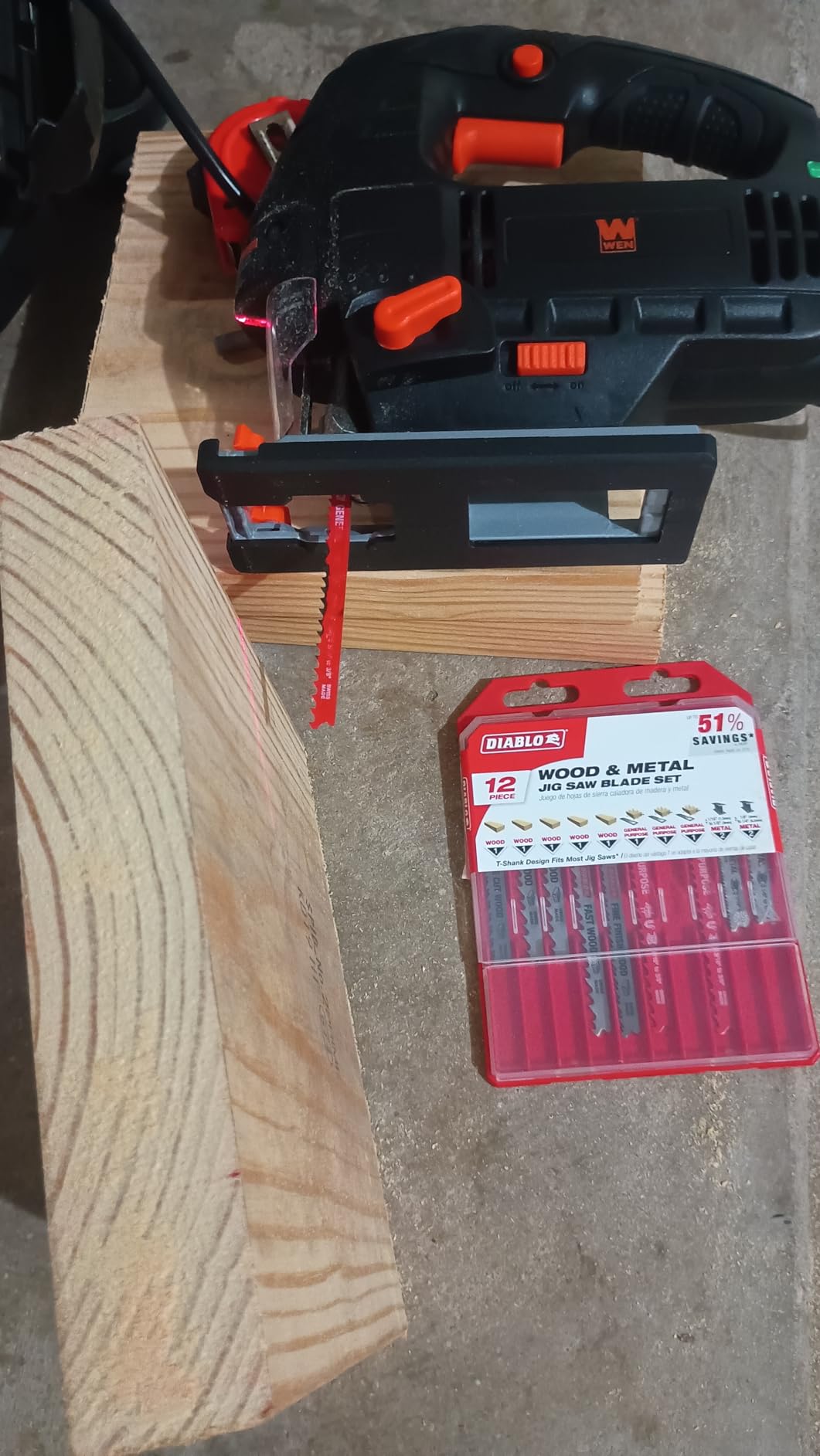
The laser is the reason to look at this one. If you are tracing a pattern rather than freehand cutting, a laser line plus an LED removes an entire class of wander, because you are following a reference that does not get covered in dust.
Numbers to know: 6.6 amp corded, 0 to 3,300 SPM variable speed, 4-position orbital selection knob, 5.4 pounds, 1-1/2 inch dust port, two-year warranty. That 3,300 SPM ceiling is the highest in this roundup, and more speed is not what you want on a curve, so the useful range is the lower half.
The orbital knob shifts blade movement from up-and-down to circular in four steps, which is the same control structure as the four-position systems on the DEWALT saws, expressed as a front knob. It is easy to find and adjust mid-cut without taking your eyes off the line.
Recommended blade: a narrow scrolling blade with teardrop teeth. The included wood and metal blades are for straight work and general cuts.
Reviewers consistently point to the combination of the orbital knob, the wide speed range and the two lighting systems as the features that make curved work easier to see and control. The included parallel fence bracket is unusual at this level, though it is more useful for straight cuts than curves.
The dust port is a genuine plus here, and it is one of only two saws in this roundup with a real vacuum connection. On a curve in plywood, a vacuum matters because fine dust settling on the line is a direct cause of drift.
How it compares with the SKIL at a similar level
The WEN wins on power, on the laser, and on dust extraction. The SKIL wins on blade support from the roller guide, on trigger feel for fine modulation, and on review sentiment, where its 4.7 sits well above this saw’s 4.5.
For traced work with a vacuum nearby, the WEN is the better tool. For freehand radius work, the SKIL’s roller guide is worth more to you than the laser.
Who should skip it
Anyone who is bothered by a higher share of one and two-star reviews, which this saw carries relative to the rest of the list. The lightweight plastics and brushed motor feel less refined under load, and at 5.4 pounds it is heavier than the class suggests it should be.
It is still a capable curve cutter with the right blade. I would just pair it with a scrolling blade immediately rather than relying on the supplied one.
7. DEWALT DCS335B – Best Barrel Grip Jigsaw for Tight Curves
DEWALT 20V MAX Jig Saw, Cordless, Barrel Grip, 3,200 Blade Speed, Bare Tool Only (DCS335B)
20V MAX brushless
Barrel grip body
4-position orbital
Keyless bevel shoe
Pros
- Barrel grip lowers the centre of gravity for tight turns
- Brushless motor is strong and efficient
- Speed dial plus 4-position orbital covers detail through rough cuts
- Keyless bevel shoe with 0/15/30/45 detents
- LED and dust blower keep the line visible
Cons
- Thumb on/off button sits in an awkward spot
- Not advised for southpaw users
- Feels unbalanced with smaller battery packs
Handle geometry is the whole argument for this saw. The barrel grip puts your hand low and close to the work, which drops the centre of gravity and turns a turn of the wrist into a smaller, more controlled arc. Professionals and serious hobbyists credit this geometry with the tightest turns in this roundup, and it is the reason the barrel-grip saw keeps coming up in woodworking discussions of curve work.
Numbers to know: 20V MAX brushless motor, variable speed dial, 4-position orbital action, barrel grip body, 3,200 blade speed, keyless bevel shoe with detents at 0, 15, 30 and 45 degrees.
Owners report it replacing a corded Bosch for coping, crown moulding and scroll work, and it works well with a coping jig for inside corners on moulding. That is a specific and demanding test, and passing it tells you a lot about how tightly this saw holds a radius.
The orbital settings are described as visibly different from one position to the next, which matters because a control you cannot feel is a control you will not set correctly mid-cut. Combined with the speed dial, the range runs from fine scroll cuts to rough work in the same curve.
Recommended blade: a narrow scrolling blade, teardrop teeth, for the tightest inside corners. A coping jig plus a flush-cutting blade extends the range for moulding work.
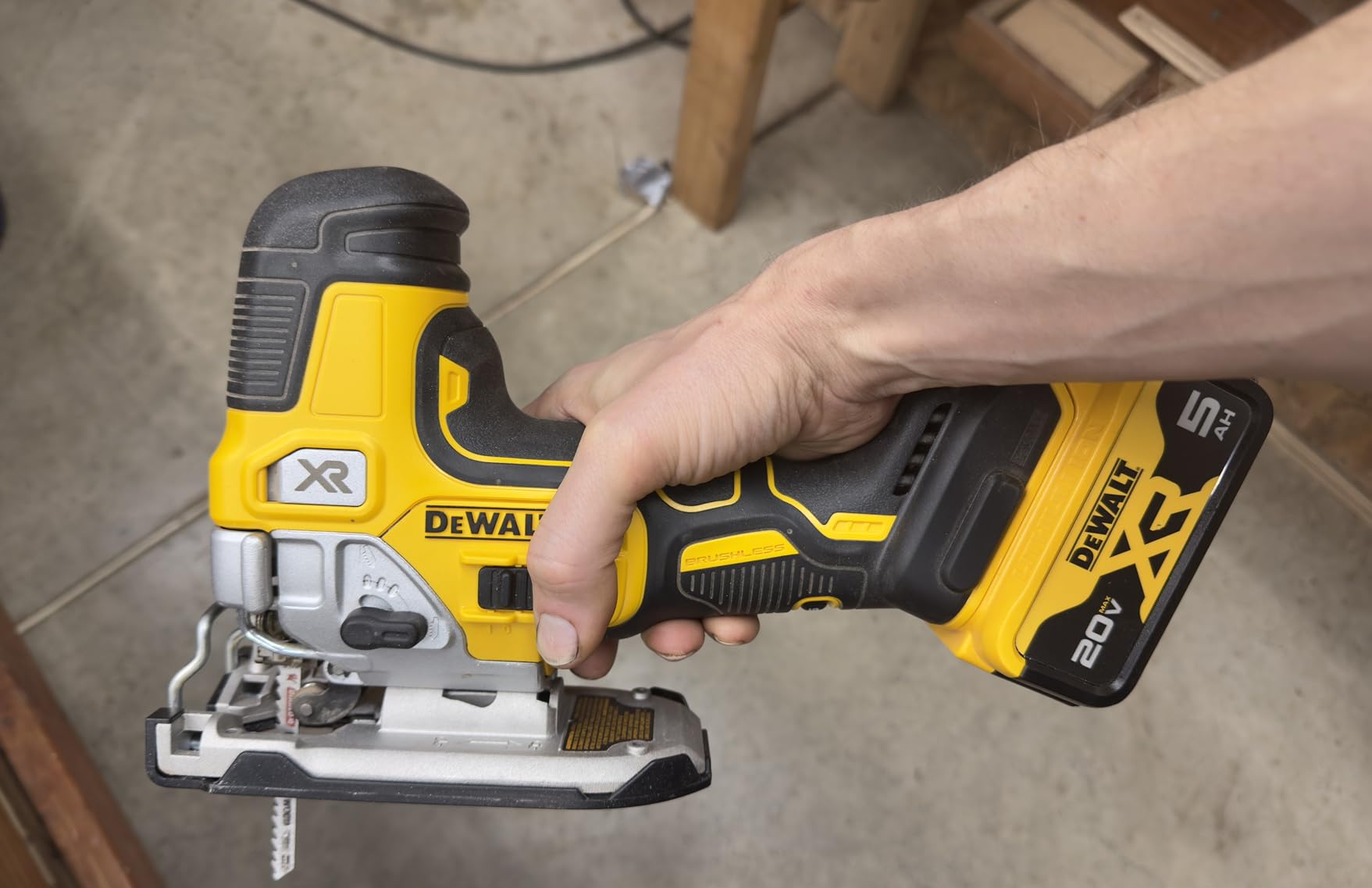
The all-metal lever-action blade change takes T-shank blades, and the no-mar shoe cover protects a finished face. Both are the same well-regarded mechanisms found on the DCS334B, so the curve hardware is comparable; the difference is entirely in how you hold it.
Speed control is a dial rather than a trigger plus dial combination, so for very slow work you feather the dial rather than the trigger. That is slightly less fine-grained than the DCS334B but perfectly workable once you set the right ceiling for the material.
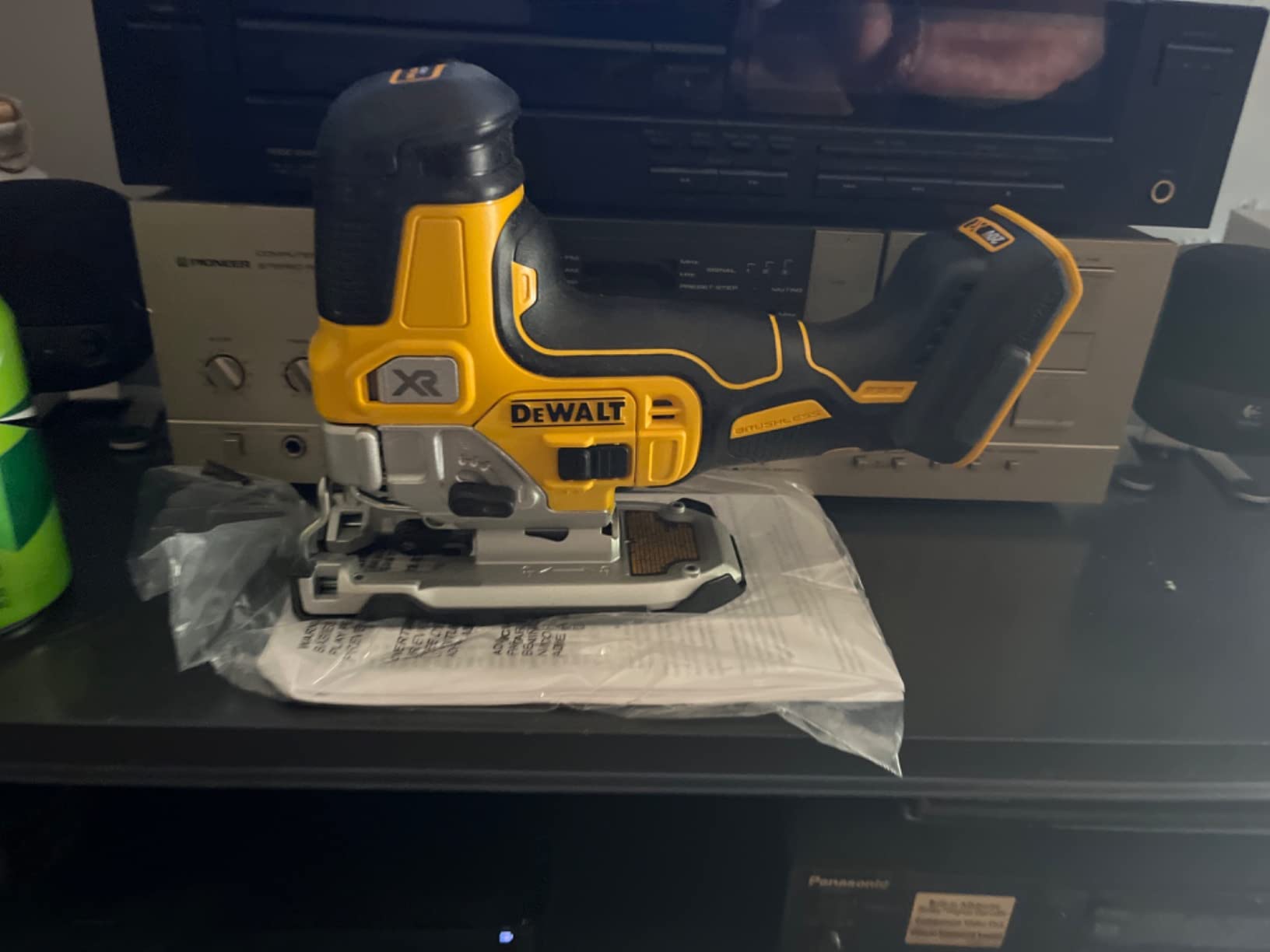
When the barrel grip is the right answer
It wins on tight inside corners, on coping and scroll work, and on anything where you are steering continuously rather than positioning the saw and cutting. The low hand position gives you leverage to resist the constant upstroke pull that a jigsaw generates.
It is the correct tool for long, open, gentle curves, where light weight matters more than hand position. For tight work, the barrel grip geometry wins.
Fit problems to know about before buying
This saw suits very large hands, and it is not advised for left-handed users. The thumb on/off button sits in an awkward location and is hard to find without looking down, which is worth a moment of practice before you start a long cut.
It is also sold without a carrying case, which buyers note at this level. With smaller battery packs the saw feels unbalanced; larger 5Ah or 6Ah packs balance it properly. If you are buying into the platform, size the battery accordingly.
8. CRAFTSMAN CMES610 – Straightforward Corded Jigsaw for Curved Cuts
CRAFTSMAN Jig Saw, 4 Orbital Settings, Up to 3,000 SPM, 5 Amp, Corded (CMES610)
5 amp corded
0-3000 SPM variable speed trigger
4 orbital settings
Accepts T and U shank blades
Pros
- True 0-3000 SPM variable speed trigger
- Four orbital settings for cut aggressiveness
- Accepts both T and U shank blades
- Contoured over-molded handle for long sessions
Cons
- No dust blower or work light in the feature set
- Only one wood blade in the box
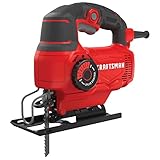
Nothing about this saw is clever, and that is its strength for curve work. It has a true 0 to 3,000 SPM variable speed trigger and four orbital settings, which is the complete control package you need, with nothing else to learn.
Numbers to know: 5 amp corded, 0 to 3,000 SPM, 4 orbital settings, accepts both T-shank and U-shank blades, 5.4 pounds, 45 degree bevel capability, contoured over-molded handle.
Accepting both shank types keeps this saw usable with whatever narrow blade you already own or can borrow, which removes the most common reason people buy a jigsaw and then do not cut the curve they bought it for.
The handle deserves a specific mention. A contoured over-molded grip matters on a curve because your hand stays on the tool for the entire turn, and a comfortable grip is what lets you keep pressure consistent instead of shifting your wrist mid-arc.
Recommended blade: a narrow scrolling blade in either shank. The single wood blade in the box is a general-purpose blade and will resist tight curves.
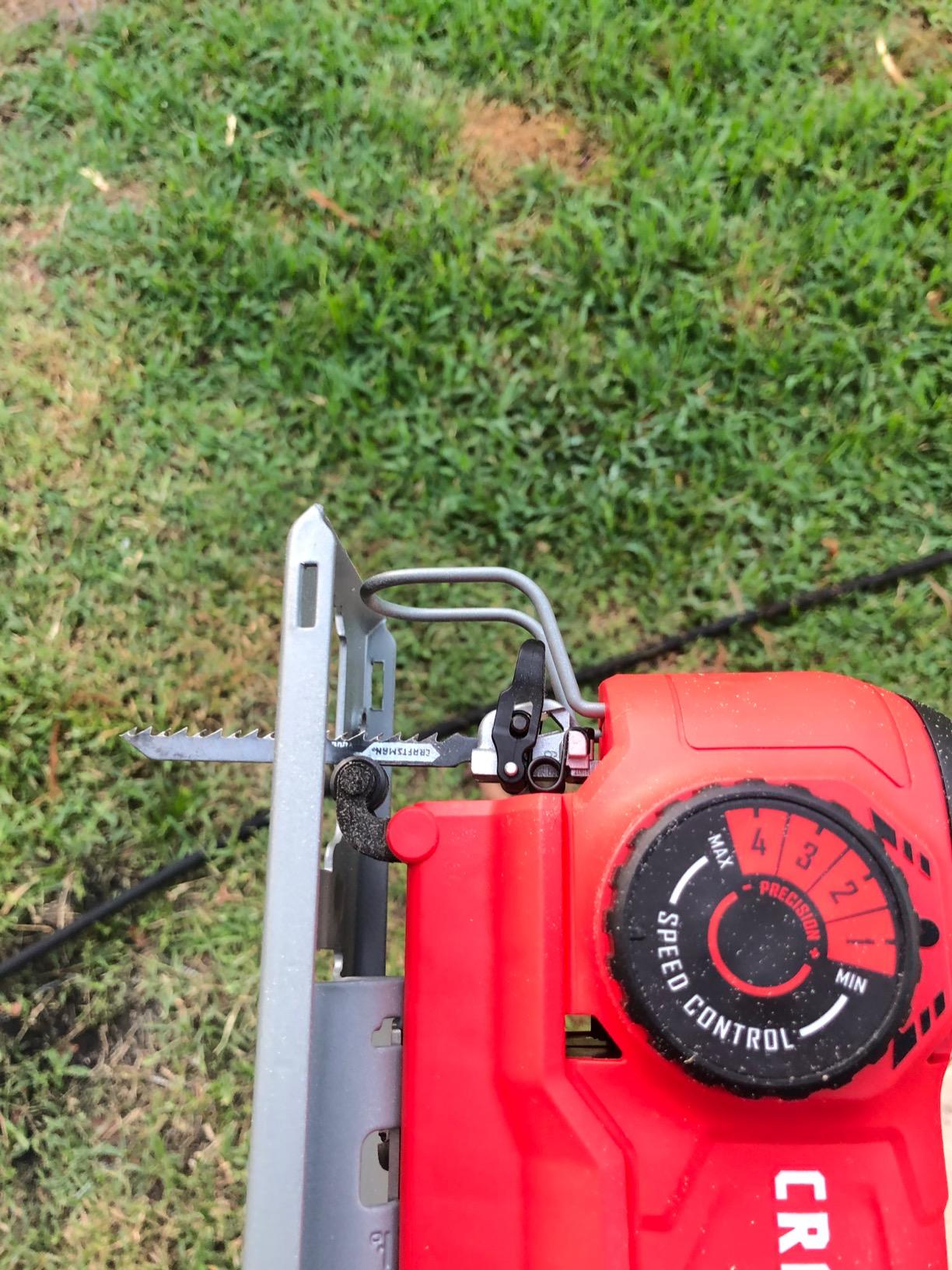
Reviewers highlight the combination of a true variable speed trigger with four orbital settings as the main curved-cutting advantage, along with the flexibility to use existing blade stock. Comfort and build quality are also praised.
Being corded also removes a variable entirely. For extended session cutting where you want consistent speed without watching a battery gauge, that simplicity is not a small benefit.
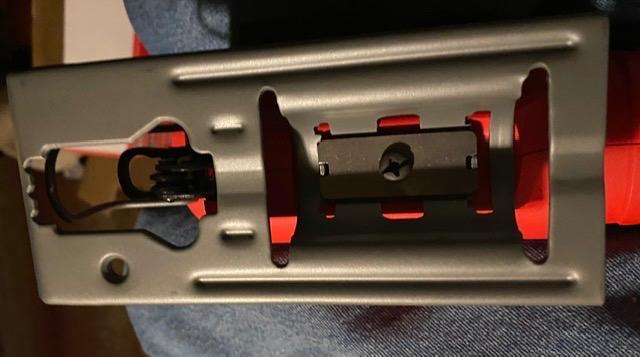
How it compares with the SKIL and WEN
It sits between them on power at 5 amps, matches the SKIL on shank flexibility, and matches both on having four orbital settings. Where it falls behind is in the supporting hardware: no light and no dust blower means you are tracing a line in whatever light you have with dust accumulating on it.
For a shop with good lighting and a vacuum brush, that is a manageable gap. For working in a dim garage on a dark board, it is a real one.
Who should skip it
Anyone cutting curves in low light or on a dark workpiece, because visibility is a prerequisite for following a line. For thick hardwood, five amps is modest and the Bosch JS260 is the stronger corded option.
Only one blade is included, so treat the purchase as incomplete until you add a narrow scrolling blade.
9. Bosch JS260 – Best Corded Jigsaw for Curved Cuts in Thick Material
BOSCH JS260 Top-Handle Jig Saw – 6.0 Amp Motor, Variable Speed Control, Low-Vibration Plunging Design, Toolless Blade Change System – Ideal for Accurate and Smooth Cutting
6.0 amp corded
Up to 3100 SPM
Four orbital settings
Precision-machined low-vibration plunging
Pros
- Four orbital settings from smooth to aggressive
- Max speed dial plus accelerator trigger
- Solid build with no play in the action
- Low-vibration design improves accuracy
- Cuts hardwoods and heavy-gauge sheet metal
Cons
- Sight notch sits far from the blade so the line is hard to track
- Takes T-shank blades only
- Heaviest saw in the roundup at 6.9 lbs
This is the saw for curves in thick material, where blade load is the problem rather than blade width. At 6.0 amps and up to 3,100 strokes per minute it keeps a fine-tooth blade moving through hardwood instead of stalling and letting the blade flex, which is the mechanism behind most bent-blade complaints.
Numbers to know: 6.0 amp motor, up to 3,100 SPM, four orbital-action settings, max speed dial plus accelerator trigger, 6.9 pounds, T-shank blades only, 1 year warranty with a 30-day money-back guarantee.
The low-vibration design and precision-machined plunging mechanism are the standout features for accuracy. Reviewers report it cutting hardwoods and heavy-gauge sheet metal with minimal vibration, and that stability is what keeps a blade tracking through a radius in dense material.
The anti-splinter insert in the box is directly relevant to curve work on plywood. It sits just ahead of the blade to support the top surface, which reduces the chipping that a fine-tooth blade can otherwise leave on the exit side of a curved cut.
Recommended blade: a narrow T-shank scrolling blade for detail work, and a bi-metal blade for hardwoods and sheet metal. Both blades must be T-shank.

Users report large-radius cutting capability and a tendency not to break blades, which is a meaningful curve-related data point. The toolless blade change system is also repeatedly preferred over lever systems for safety and speed.
A carrying bag and bevel wrench are included, which is useful given the 6.9-pound weight. One owner received no blade despite the listing, so check the box on arrival.

The one significant problem for curve work
The cut-line notch sits far enough from the blade that tracking your line is hard once the saw turns. That is a geometry compromise, and it directly affects the one thing this roundup cares about.
At least one reviewer limits this saw to rough cuts and bought a separate tool for fine scroll work for exactly that reason. If your curves are traced rather than freehand, or if you are cutting tight inside corners with an inside line, choose a saw with the line closer to the blade.
Where it wins anyway
Thick hardwood, heavy-gauge sheet metal, and any cut where blade heat and motor load are the limiting factors. At 6.9 pounds it is the heaviest saw here, and that is a real cost for a tight turn, but the rigidity it buys is worth it once the material gets serious.
10. CRAFTSMAN CMCS600B – Best Cordless Jigsaw for Fine Curved Plywood
CRAFTSMAN V20 Cordless Jig Saw, 3 Orbital Settings, Up to 2,500 SPM, Bare Tool Only (CMCS600B)
20V V20 cordless
0-2500 SPM variable speed trigger
3 orbital settings
Accepts T and U shank blades
Pros
- Variable speed gives real finesse on delicate curves
- Cordless power with minimal vibration
- Easy blade changes and accepts legacy blades
- Clean cuts on plywood with little tear-out
- Three-year limited warranty
Cons
- No work light on the tool
- Bulky body compared with compact rivals
- Bevel stops at 0 and 45 degrees only
Reviewers describe this saw’s variable speed as giving a high degree of control and finesse for delicate curved cuts, and that is the single most relevant compliment for a roundup about curves. On shaped plywood, the ability to slow right down is what separates a clean silhouette from a wander.
Numbers to know: 20V V20 cordless platform, 0 to 2,500 SPM variable speed trigger, 3 orbital settings, bevel to 45 degrees, 3 year limited warranty, compatible with VERSATRACK storage.
It also reports clean cuts on plywood, 16mm hardwood strip and 2×4 lumber with little tear-out, and it handles reinforced fiberglass decking over marine plywood. Low vibration under load is the quiet advantage here, and low vibration means the blade is not being shaken off line.
Accepting both T and U shank blades keeps the blade choice wide, and the easy blade change means you can move between a coarse blade for a straight approach cut and a fine one for the curve without slowing down.
Recommended blade: a narrow scrolling blade in either shank, running at the lower end of the speed range through any turn.
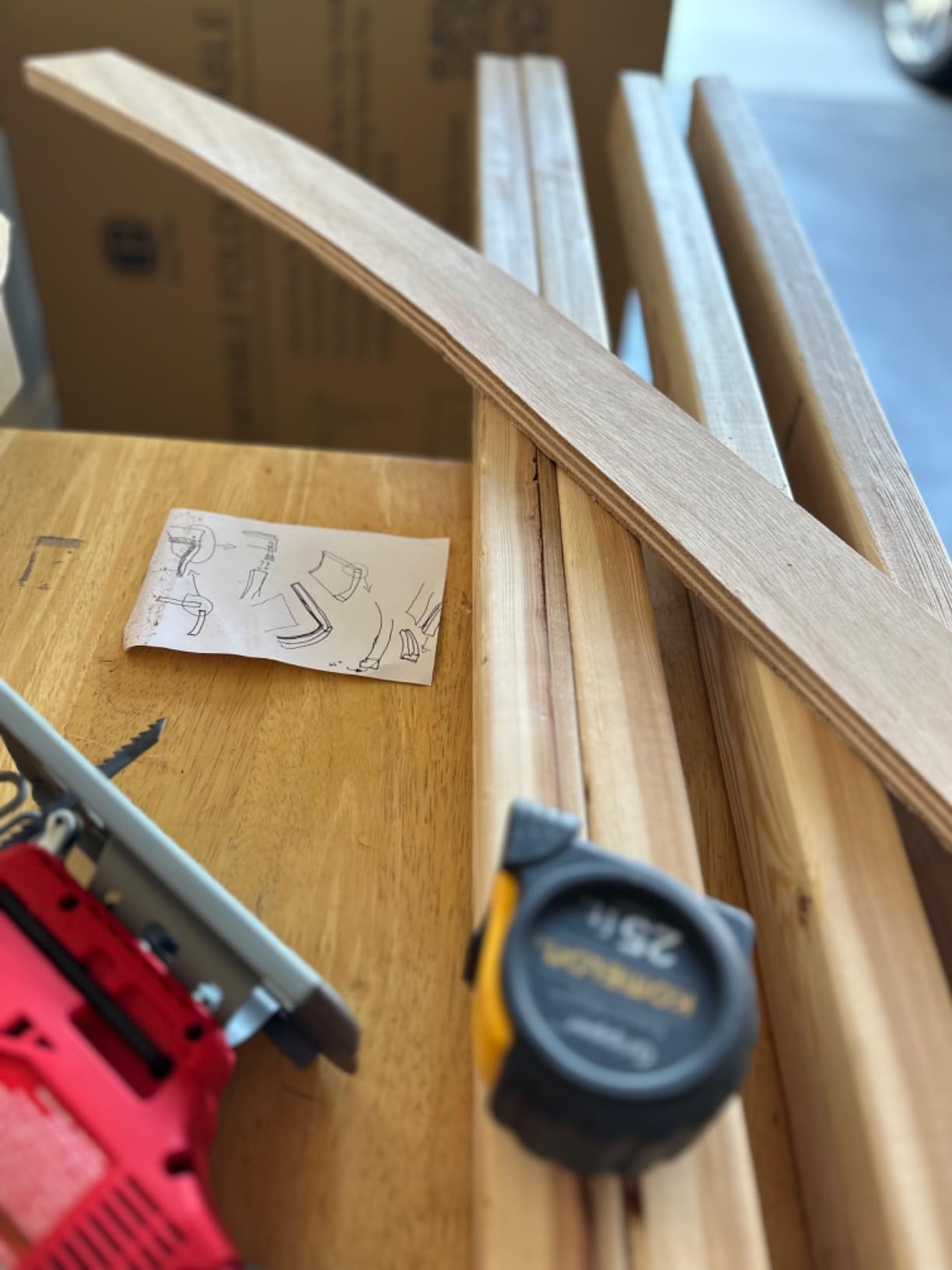
Owners praise the smooth, low-vibration cordless cutting and the tool-free blade changes. The most common complaints are about missing features rather than performance, which is a reasonable trade at this level.
It is also part of the V20 system and works with VERSATRACK wall storage, which matters if you are organising a shop rather than buying one tool.
How it compares with the other cordless picks
It has fewer orbital settings than the DEWALT saws and the BLACK+DECKER kit, at three, and no work light at all. Its speed ceiling of 2,500 SPM is the lowest among the cordless picks, which is not a disadvantage on a curve.
What it has that the BLACK+DECKER cordless kit does not is a three-year warranty and lower reported vibration. For fine plywood work specifically, that combination is worth more to a curve cutter than an extra orbital setting.
Who should skip it
Anyone working in poor light, because there is no LED and no laser here. The body is also bulkier than the compact DEWALT cordless saws, and at 3 orbital settings you have less room to trade chip clearance against finish.
The bevel stops at 0 and 45 degrees with no intermediate detent, so bevel curves through an angle are limited. Battery and charger are sold separately.
Which Jigsaw Blade to Pair With Each Saw?
This is the part most roundups skip, and it is the answer to the most common question on the search page: what is the best jigsaw blade for curved cuts in wood? The shortlist is short, and the choice depends on how tight the radius is.
Narrow scrolling blades (teardrop or J-hook teeth). This is the blade for tight curves, inside corners and detailed silhouettes. The teardrop tooth pattern pushes chips downward so the blade is not cutting upward into the material, which is what stops it binding and snapping on a radius. The trade-off, as experienced users describe it, is that the high tooth count makes them slow and they are thin, so they break in thick material.
Fine-tooth wood blades with T-hook teeth. Better for open curves and medium radii, and much stiffer. Use these when the radius is wider than the blade is narrow, or when you are cutting across the grain where a scrolling blade would be working too hard.
Bi-metal blades. The durable choice for hardwoods, plywood and sheet metal. Pair with any of the saws above for open-radius work in dense material.
Pairing by saw: all ten saws here accept a narrow scrolling blade, so this is a blade purchase rather than a saw limitation. The corded BLACK+DECKER BDEJS600C, SKIL JS314901, CRAFTSMAN CMES610 and CRAFTSMAN CMCS600B and the BLACK+DECKER BDCJS20C accept both T-shank and U-shank, so you can use either mount. The DEWALT DCS334B, DEWALT DCS331B, DEWALT DCS335B and Bosch JS260 are T-shank only, and most narrow scrolling blades come in T-shank.
One rule covers all of them: the narrower the blade relative to your curve radius, the less it can deflect. A wide blade forced into a tight radius is the mechanical cause of most wandering cuts, and no saw on this list will overcome it.
Jigsaw vs Scroll Saw vs Band Saw vs Coping Saw
What is better than a jigsaw for cutting curves in wood? It depends entirely on how many pieces and how precisely. Here is the honest version.
Scroll saw. More accurate than a jigsaw for repeated precision work at a fixed station, because the blade is guided from both above and below and the workpiece stays put while the table moves. If you are cutting twenty identical shapes for inlay, a scroll saw is faster and cleaner. If you are cutting one large sheet of plywood freehand, its limited throat and the size of the machine make it a poor fit.
Band saw. The right tool for thick hardwood and for resawing, which no jigsaw can do. A band saw is more accurate than a jigsaw on a curve, but it is a floor-standing machine with a minimum blade size that makes very tight radii impossible. For a scroll pattern in 2 inch hardwood, a jigsaw with a suitable blade is the more practical tool.
Coping saw. For small, precise interior cutouts in thin material and for tight corners a jigsaw cannot reach. Slower, manual, and unbeatable on small detail.
Track saw or circular saw. Not a curve tool, but it is the right answer for the straight cuts that frame a curved project, and it will be straighter and faster than a jigsaw on any straight line.
The honest summary: a jigsaw wins on one-off freehand shapes in sheet goods, at any thickness a thin blade can handle. Everything repeated and precision-bound is better on a stationary machine.
Why Curves Go Wrong: Troubleshooting by Symptom
The cut wanders off your line. In order of likelihood: the blade is too wide for the radius, the feed rate is too high, the blade is dull, or blade support is loose. A guide against the workpiece helps with position but not with deflection. Widen the radius, slow down, change the blade, and check that the roller and clamp are holding the blade vertical.
The blade bends or snaps on a turn. The blade is wider than the radius allows, or you are pushing too hard, or the cut is closing in on itself with no relief. Reduce pressure, take smaller bites, and step down to a narrower blade. Users who wedge a closing cut with a scrap block report it stops the bending immediately.
The cut edge is burned or smoked. You are running maximum speed on a curve, or the blade is dull, or orbital action is set too high for the material. Slow the speed down, set orbital to zero or the lowest setting, and change the blade.
Plywood tears out on the exit side. Wrong blade for the job, a dull blade, or too much feed rate. A masking tape strip over the cut line is the standard fix and it works, and clamping sacrificial wood alongside the cut moves the tearout onto the scrap piece instead of your work.
High-tooth-count blades feel slow and break. That is the scrolling-blade trade-off, not a fault. Use them for tight curves in thin material and switch to a stiffer blade once the radius opens out.
One last warning that gets repeated constantly: never run orbital action on a hot blade or in dense material. It is designed to clear chips from a straight cut, and on a curve or in metal it generates heat and destroys blades quickly.
How to Choose a Jigsaw for Curved Cuts
1. Blade support. The guide roller above the work and the clamp below it are the most important mechanical features on the tool. This is the least advertised spec and the one that most affects whether a curve comes out clean.
2. Speed control with a maximum dial. A trigger alone means you modulate by feel on every cut. A trigger plus a dial lets you set the ceiling and feather down through a turn without breaking concentration.
3. Orbital action you can fully disable. Four settings with a clean zero is the target. Orbital adds chip clearance for straight cuts and gets in the way of fine curves.
4. Handle geometry. Barrel grip and low-handle bodies put your hand close to the work and give finer steering on tight corners. Top handles suit one-handed work and thicker material but give less precision on a radius.
5. Shoe rigidity. A stiff cast or heavy-gauge plate keeps the blade angle constant through a turn. A flexible plate changes the angle mid-arc, which is deflection you did not ask for. Keyless bevel adjustment with multiple detents beats a screw-driven lock.
6. Visibility. A dust blower clears the line, an LED or laser lights it, and a dust port removes the debris. On a curve, a line you cannot see is a line you will miss.
7. Power under load. Five to six amps handles roughly 2 inches of hardwood with a thin blade, and more for sheet goods. Beyond that the blade deflects regardless of the saw. A brushed motor will do; a brushless one simply runs longer between charges.
On corded versus cordless: corded is heavier and steadier, which helps through dense material. Cordless is more convenient, and the current brushless platforms have closed most of the power gap. Weight is the deciding factor for curves, and the lightest cordless saws on this list now weigh less than the corded ones.
On T-shank versus U-shank: T-shank is the modern standard, fits the clamp systems on most current saws, and opens up the widest selection of narrow curve-capable blades. U-shank is the older mount. The saws that accept both, including the SKIL, the CRAFTSMAN CMES610 and the BLACK+DECKER BDCJS20C, are the most flexible buys for anyone building a blade collection.
Frequently Asked Questions
Are jigsaws good for cutting curves?
Yes, but only with a narrow fine-tooth blade, a variable speed you can slow down through a turn, and the orbital setting at zero. A wide blade forced into a tight radius deflects, and deflection compounds around the curve until the saw leaves your line. The saw matters far less than the blade.
What is the best jigsaw blade for curved cuts in wood?
A narrow scrolling blade with teardrop, or J-hook, teeth. The tooth pattern pushes chips down and away so the blade is not cutting upward into the material, which is what stops it binding on a radius. The trade-off is that high tooth count blades cut slowly and break sooner in thick material.
Why does my jigsaw blade bend while cutting?
The blade is too wide for the radius you are cutting, you are feeding too fast, the blade is dull, or the cut is closing in on itself with no relief. Step down to a narrower blade, reduce pressure, and take smaller bites. A scrap block wedged into a closing cut stops the bending immediately.
Is a scroll saw more accurate than a jigsaw?
For repeated precision work at a fixed station, yes. A scroll saw guides the blade from above and below while the workpiece stays put, so it holds a tight tolerance on identical parts. For one-off freehand shapes in large sheet goods, a jigsaw is faster and handles material a scroll saw throat cannot reach.
What are the differences between U-shank and T-shank jigsaw blades?
T-shank is the modern mounting standard used by most current jigsaws, and it gives you a much wider selection of narrow curve-capable blades. U-shank is the older, narrower mount. Shank type is independent of blade width, so a T-shank saw can still take a blade too wide for a tight curve.
Why doesn’t my jigsaw cut straight?
Most often the blade is dull, the feed rate is too high, or the blade is too wide for the cut. Less commonly the base plate is flexing or the blade guide is not holding the blade vertical. Change the blade, slow down, and check that the roller and clamp are gripping properly.
The Best Jigsaws for Curved Cuts: Final Verdict
The BLACK+DECKER BDEJS600C is our pick for the best jigsaws for curved cuts overall, because four dedicated curve settings, a 0 to 3,000 SPM variable speed, tool-free blade changes that take both shank types, and a 4.6 pound body give you everything a curve needs without a battery in the way.
Buy the DEWALT DCS334B if you already run 20V MAX batteries, and the DCS335B if your curves are tight inside corners where the barrel-grip geometry earns its keep. Above all, change the blade before you change the saw: a narrow scrolling blade will do more for your curves than any saw on this list.