
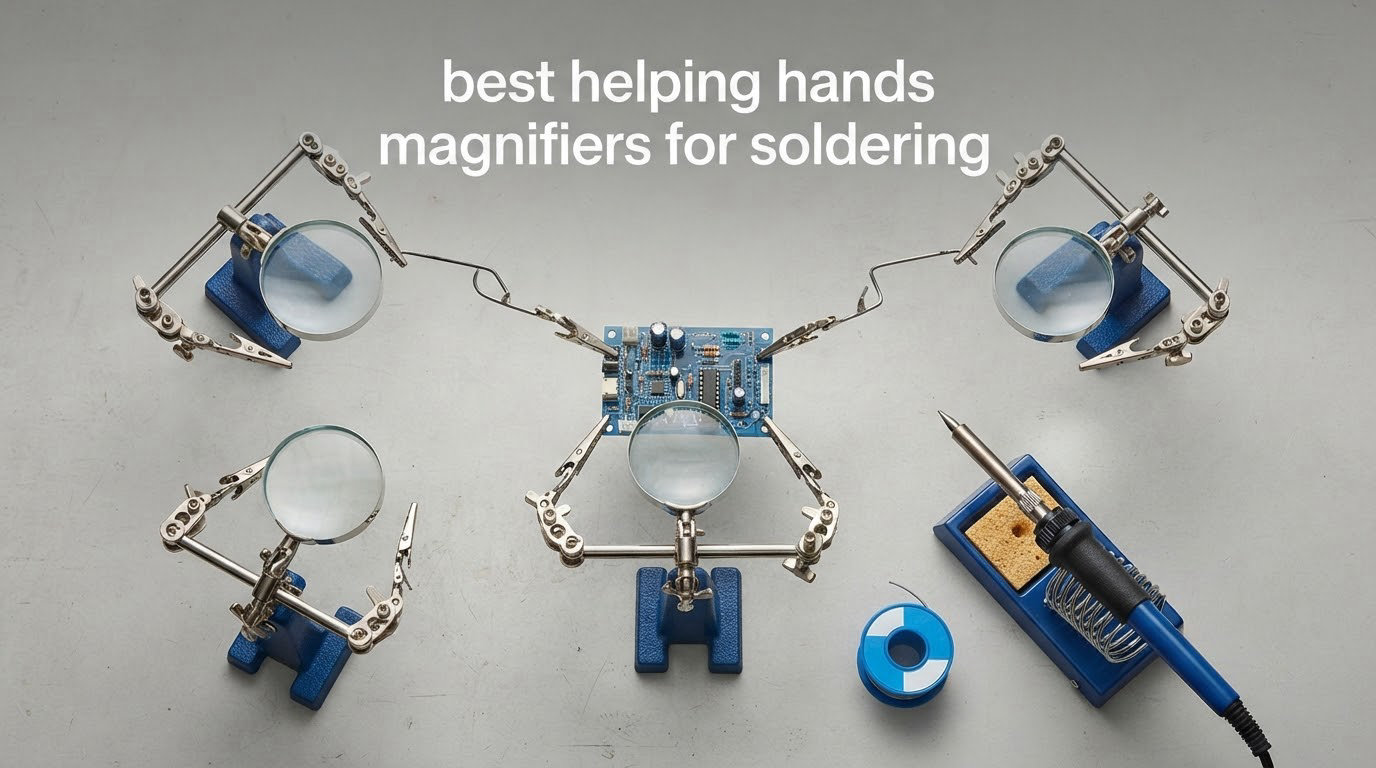
After a couple of months of putting a dozen different helping hands magnifiers through real bench work, the short answer is that most people should start with the NEIKO 01902. Its cast-iron base does not budge, the two alligator clips hold a small PCB exactly where you put them, and its 2x lens is honest about what it is. If your work is fine enough that you need real magnification or two extra arms, move up to a magnetic station like the SainSmart PCBH.
That is the honest version of the best helping hands magnifiers for soldering question, so we will not bury it. The rest of this guide covers ten stands we put to work on through-hole joints, surface mount rework, wire tinning and jewelry-scale projects, plus what to look for when the clip count does not matter but base weight and lens quality do.
Before the picks, one quick answer to the other question people always ask: 2.5x to 3x is the sweet spot for through-hole joints and general PCB work, 4x to 5x is right for surface mount chips and dense boards, and anything above 10x is for inspection rather than for soldering because the working distance drops to a few millimetres. There is a full magnification guide further down, and we link the iron and station picks so you can match the holder to the rest of the bench.
Table of Contents
Top 3 Picks for Helping Hands Magnifiers for Soldering in 2026

NEIKO 01902 Helping Hand
- 2x lens on adjustable arm
- Heavy cast-iron base
- Dual alligator clips on ball joints
AORAEM Magnifier with Dual Clips
- 2.5x glass lens 63mm
- Two alligator clips on 4-way swivels
- Cast-iron base

MMOBIEL LED Magnifier Station
- Three alligator-clip helping hands
- USB or 4 AAA battery power
- Iron holder
- tray and spool bracket
Best Helping Hands Magnifiers for Soldering (October 2026)
| Product | Specifications | Action |
|---|---|---|
| NEIKO 01902 Helping Hand |
|
Check Latest Price |
 RamPro Magnifier Glass Stand RamPro Magnifier Glass Stand |
|
Check Latest Price |
 LXIANGN 3.5X12X Station LXIANGN 3.5X12X Station |
|
Check Latest Price |
| AORAEM Dual Clip Magnifier |
|
Check Latest Price |
| MMOBIEL LED Magnifier Station |
|
Check Latest Price |
 Weller WLACCHHB-02 Helping Hands Weller WLACCHHB-02 Helping Hands |
|
Check Latest Price |
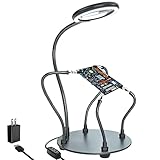 XYK Four Arm Magnifier Station XYK Four Arm Magnifier Station |
|
Check Latest Price |
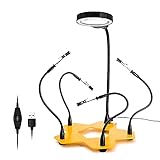 KOTTO Five Arm Magnifying Station KOTTO Five Arm Magnifying Station |
|
Check Latest Price |
 SainSmart Magnetic Helping Hands SainSmart Magnetic Helping Hands |
|
Check Latest Price |
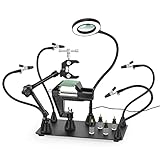 NOEVSBIG Magnetic Bench Workstation NOEVSBIG Magnetic Bench Workstation |
|
Check Latest Price |
1. NEIKO 01902 Helping Hand: Best Overall Helping Hands Magnifier for Soldering
NEIKO 01902 Adjustable Helping Hand with Magnifying Glass, Third Hand Solder Aid, Soldering Wire Station Stand with Dual Alligator Clips and a Heavy Base, Beading & Jewelry Making Tools, Solder Holder
Cast-iron base
2x adjustable magnifier arm
Dual alligator clips on ball joints
480 °C upper rating
Pros
- Heavy cast-iron base that stays put under a hot iron
- 2x lens on a ball-joint arm for steady viewing angle
- Dual alligator clips hold small parts firmly
- Huge review base shows long-term reliability
Cons
- 2x magnification is modest next to 3x-5x lenses
- Compact 5 x 3 inch footprint limits clamp capacity
- Bulky frame crowds a small bench
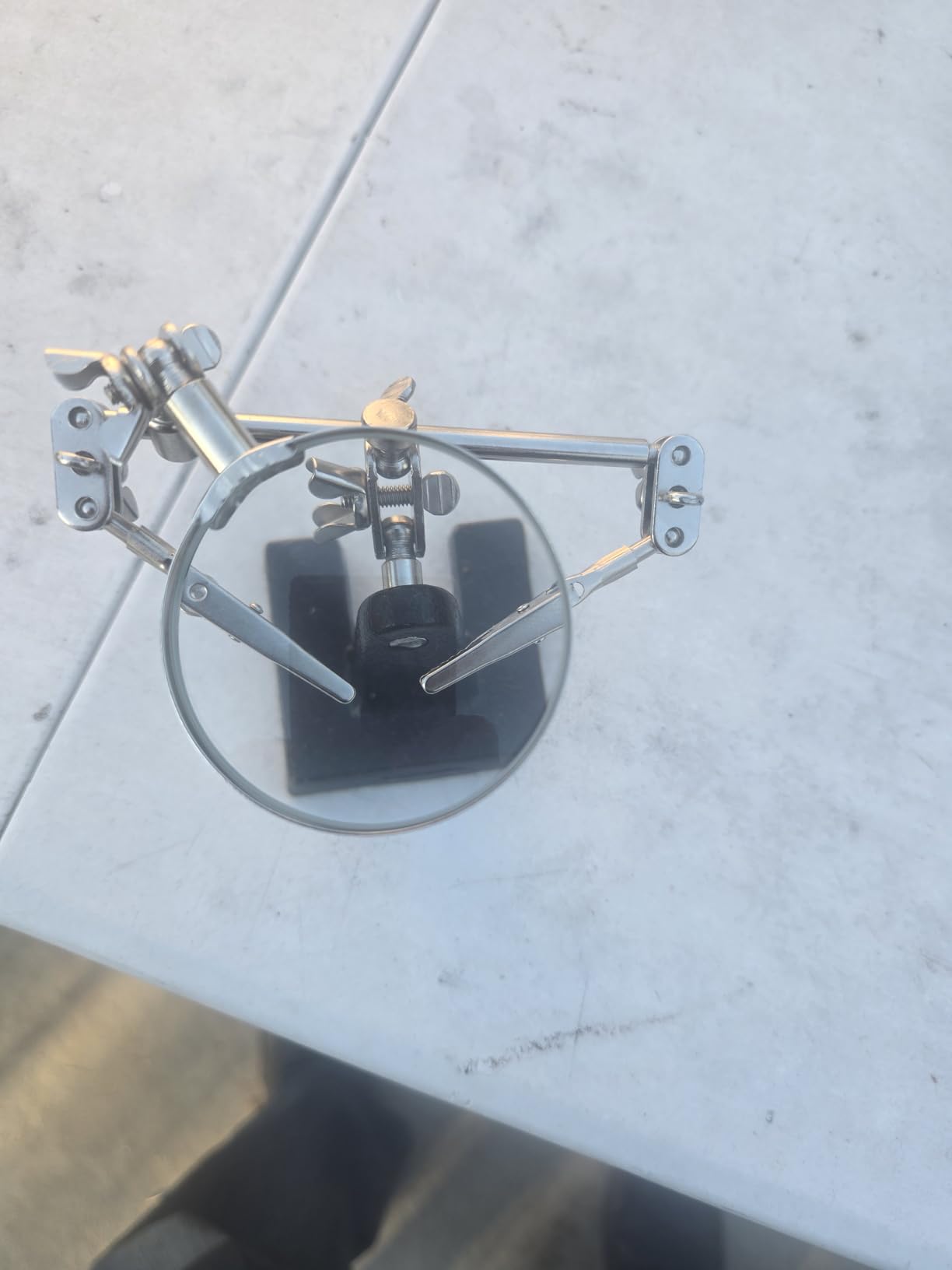
This is the stand that ended up on our main bench and stayed there. The cast-iron base is the reason. You can lean a clip onto a board, rest a lead against the second clip and nudge the whole thing around without the stand walking across the table, which is exactly what happens with lighter stamped steel bases.
The two clips sit on independent ball joints, so getting a board angled the way you want takes a couple of seconds rather than a fight. For through-hole joints and simple sensor modules, the 2x lens is genuinely useful because it pulls the joint slightly toward you and reduces parallax when the tip and the pad are not directly under your eye.
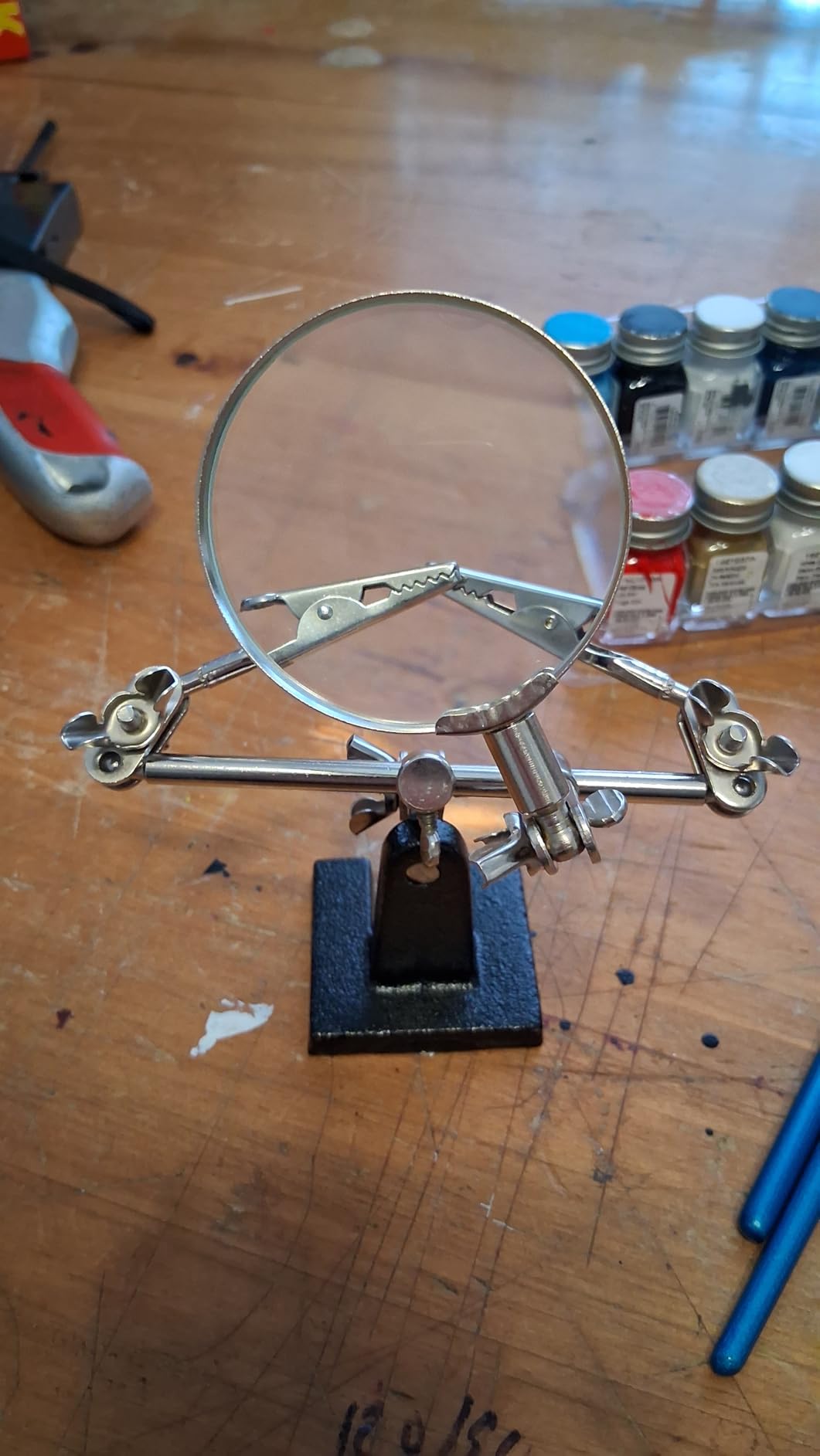
What it does not do is magnify much. At 2x the 2 inch lenses show you a wider field than a 3x or 5x glass, so dense surface mount boards still need head tilt and patience. The upper temperature rating of 480 °C is a nice detail for a stand that sits next to an iron, though the base itself is far enough away that we never worried about it.
Dimensions are 5 inch deep by 3 inch wide by 2.68 inch high, so plan on roughly a 6 inch circle of bench space. The frame is heavier than it looks, which is the point. If you are moving between benches rather than dedicating a spot, the Weller and AORAEM stands are easier to carry.
Is 2x magnification enough for surface mount work?
For 0805 parts and headers, yes. For 0402 components or fine-pitch ICs, no. The lens is there to steady your viewing angle and reduce glare rather than to resolve individual pads, so treat it as a comfort tool for through-hole and mid-size SMD jobs. If you spend most of your time on boards with 0.4mm pitch parts, budget for a 5x head instead.
It also helps that the arms are ball joints rather than fixed gooseneck. Fine-pitch work needs the board tipped toward you, not just held level, and a ball joint gets there without you re-clamping.
Who should skip this one?
Skip it if your bench is a small shelf or you clamp large panels and heavy assemblies. Two clips and a 5 inch footprint will feel cramped the first time you try to hold a 4 inch heatsink bracket. Multi-arm stations handle bigger work because you can brace the panel in two places at once.
It is also not the pick if you work in a dim room, since it carries no lighting. A clip-on LED on a flexible neck solves that for less than this stand costs plus a lamp. Our [best soldering irons for hobbyists guide](https://www.pwice.com/best-soldering-irons-for-hobbyists/) covers the temperature control side of the same bench.
2. RamPro Magnifier Glass Stand: Best for Jewelry, Beading and Craft Work
RamPro – Helping Hand Magnifier Glass Stand – Magnifying Lens, Perfect for Soldering, Crafting & Inspecting Micro Objects
3x 12 diopter glass lens
Retractable lens arm
LED light
Cast-iron base
Pros
- Real glass lens with clean edges and no acrylic distortion
- Retractable lens slides back when you do not need it
- Cast-iron base resists rust and stays stable
- Rotatable lens and clips cover most angles
Cons
- Battery LED is dimmer than USB or mains lighting
- 10.25 inch width is a lot of bench space
- Magnification listed inconsistently across variants
This one came onto the bench for beading and jewelry work rather than electronics, and it earned its spot. The lens is glass, not acrylic, and you notice the difference at the edge of the field where cheaper acrylic stands turn soft and rainbow-fringed. The lens is 2-1/2 inch in diameter at 12 diopter, which is 3x.
The retractable arm is the detail that made it stick. When you are soldering a through-hole joint you slide the lens back, and when you are placing a small bead or inspecting a solder fillet you pull it forward. That matters more than raw magnification on mixed work.
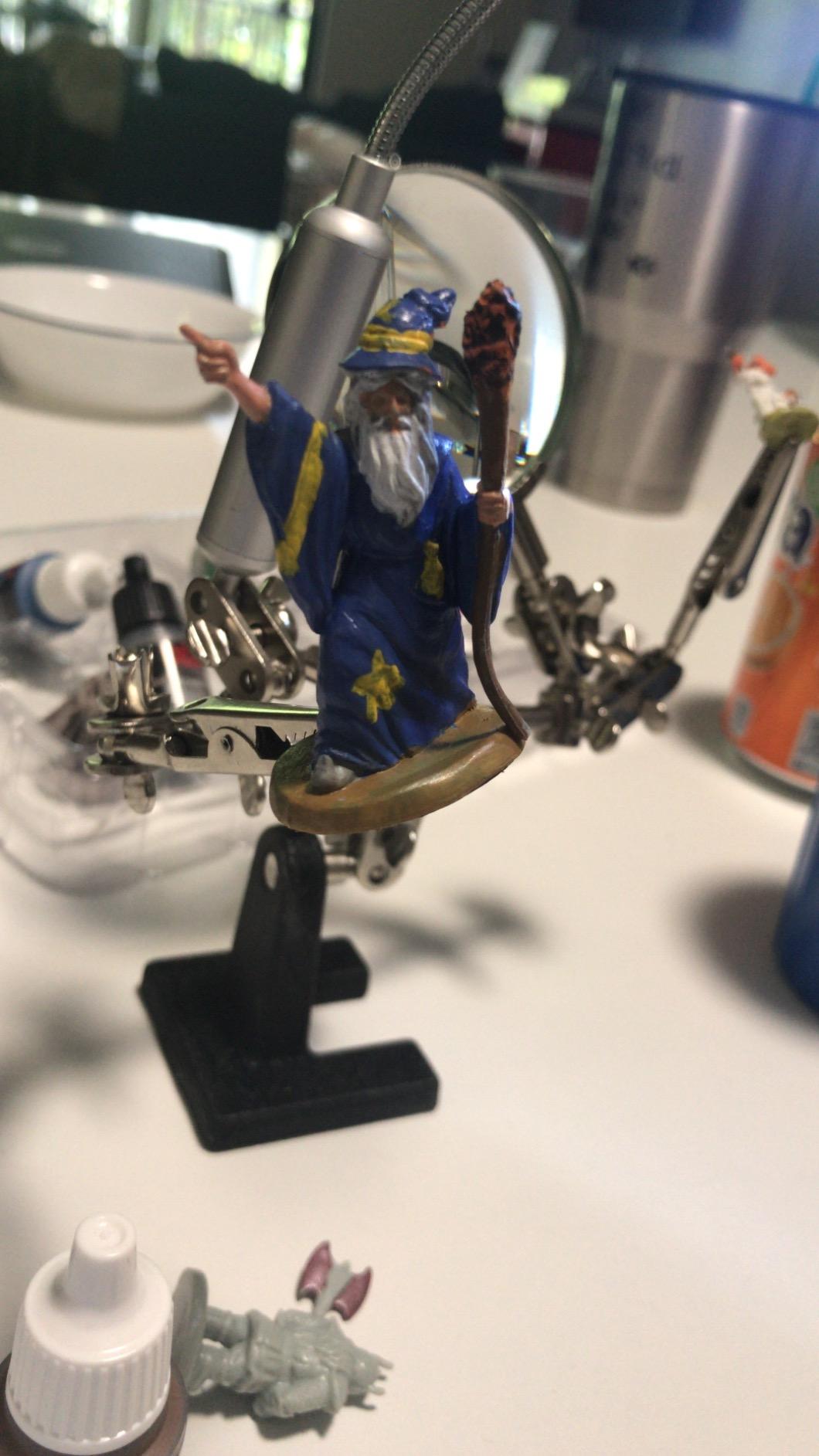
The battery-powered LED is the weak point. It is fine for adding a bit of fill to a shadowed corner, but it is not going to light a deep box or a board held in a dark corner. Plan to add a proper task light if your soldering is precision heavy.
Footprint is 12 inch by 10.25 inch and the weight is 12.5 oz, so it is a wide but light stand. That width is what gives you the swing range for non-electronics work like stained glass and model building, and it is the reason it feels bulky next to the NEIKO.
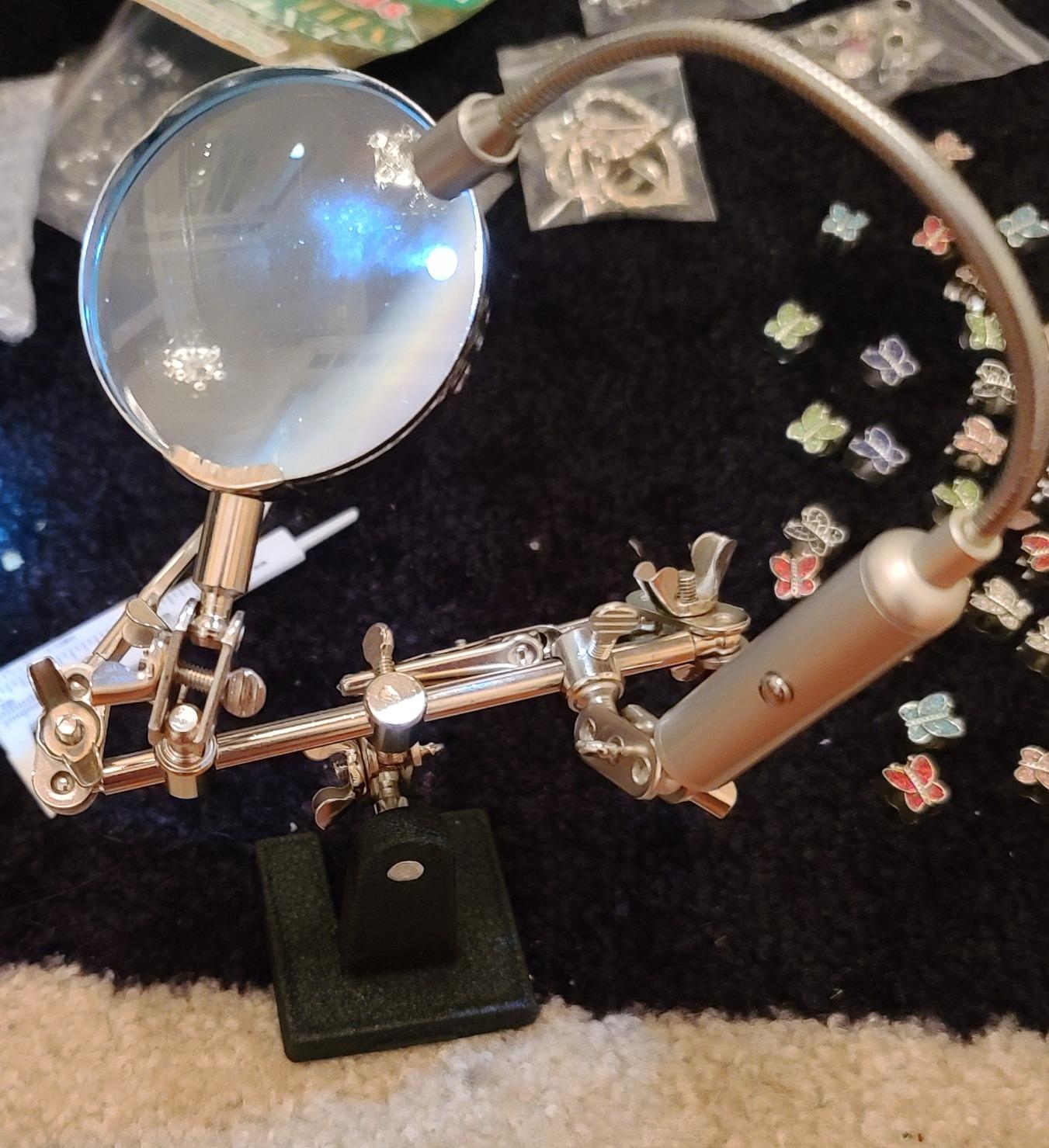
Does the glass lens make a real difference over acrylic?
Yes at the edges, and barely at all in the centre. If you spend most of your time with your eye pressed close to the middle of the lens, an acrylic stand will serve you fine. If you move the lens around and want a clean image at any position, glass holds up better over the life of the product.
One caution: check the variant you actually receive. This model is listed at 3x, while a sibling variant in the same family is 4x, and buyers regularly mention the confusion in reviews.
Is this a good first helping hands for a beginner?
It is a reasonable first pick, with one caveat. The 12.5 oz base is light enough that a heavy board held at full arm extension can tip it, so mount it toward the back of the bench or keep clamps close to the post.
For a beginner doing through-hole joints and kit building, the retractable lens plus glass clarity is a better experience than a fixed 2x. For a beginner doing fine SMD, look for more magnification instead.
3. LXIANGN 3.5X12X Station: Best for Inspection and Close Detail Tweaks
3.5X12X Helping Hands Soldering Station with LED Light & Alligator Clips
3.5x and 12x lenses
Acrylic lens 65mm
Dual flexible LED arms
Steel-weighted base
Pros
- Dual 3.5x and 12x covers overview and fine inspection
- Two flexible LED arms remove shadows from the work zone
- Steel-weighted base cuts wobble
- Anti-dizziness lens design for long sessions
Cons
- Acrylic lens has softer edges than optical glass
- LED needs 3 AAA batteries that are not included
- Small 5.2 x 4.69 inch footprint
- Manual is Chinese and English only
Two magnification levels in one head is a clever trick and it changes how you work. The 3.5x side gives you a workable field for actually soldering, and the 12x side turns the same head into an inspection loupe for checking solder fillets, checking for bridges between pads, and reading tiny silkscreen before you power a board up.
The two flexible LED arms are the part we underestimated. Being able to swing light in from two directions separately is the difference between seeing into a crowded joint and guessing. Both are on 360-degree joints, and the metal arms rotate through 180 degrees.
The clips are multi-joint rather than simple swivels, which gives you more ways to angle a wire into a pad. That is what makes this stand useful for wire tinning and connector work, not just board holding.
Two practical notes. The LED runs on 3 AAA batteries and they are not in the box, so budget for a fresh set before your first session. And the lens is acrylic at 6.5 cm, so edge clarity is softer than glass, which is fair given this sits at the low end of the price range.
Is 12x magnification too strong to solder with?
Far too strong, and that is fine because you are not meant to. Above roughly 5x the working distance collapses and you end up working around the lens rim with your hand. Treat 12x as a magnifier for inspection and use the 3.5x side for the actual joint.
The anti-dizziness lens design helps during long inspection sessions, but if you get eye strain quickly, take breaks every 20 minutes or so. Lens stands are easy to forget you are leaning into.
How do the flexible LED arms compare to a bench lamp?
For close work they beat a bench lamp because the light comes from wherever you put it, usually over your shoulder opposite to your dominant hand. A bench lamp is still better for the wide view of an entire board before you start.
Best setups use both: this stand for the joint, a lamp for the board context. It pairs naturally with one of the soldering irons in our [best soldering irons for hobbyists guide](https://www.pwice.com/best-soldering-irons-for-hobbyists/).
4. AORAEM Dual Clip Magnifier: Best Value Helping Hands Magnifier
AORAEM Helping Hands Magnifier with Dual Adjustable Alligator Clips
2.5x glass lens 63mm
Two clips on 4-way swivels
360 degree lens rotation
Cast-iron base
Pros
- Glass lens in a chrome metal frame at a budget price point
- 4-way swivel clips grip without slipping
- Highest five-star share of the entry-level options
- Can be screwed or glued to a board for heavier work
Cons
- Light base tips if holding heavier items untouched
- Adjustment screws are stiff to set precisely
- 2.5x is the lowest magnification here
- Not suited to large workpieces out of the box
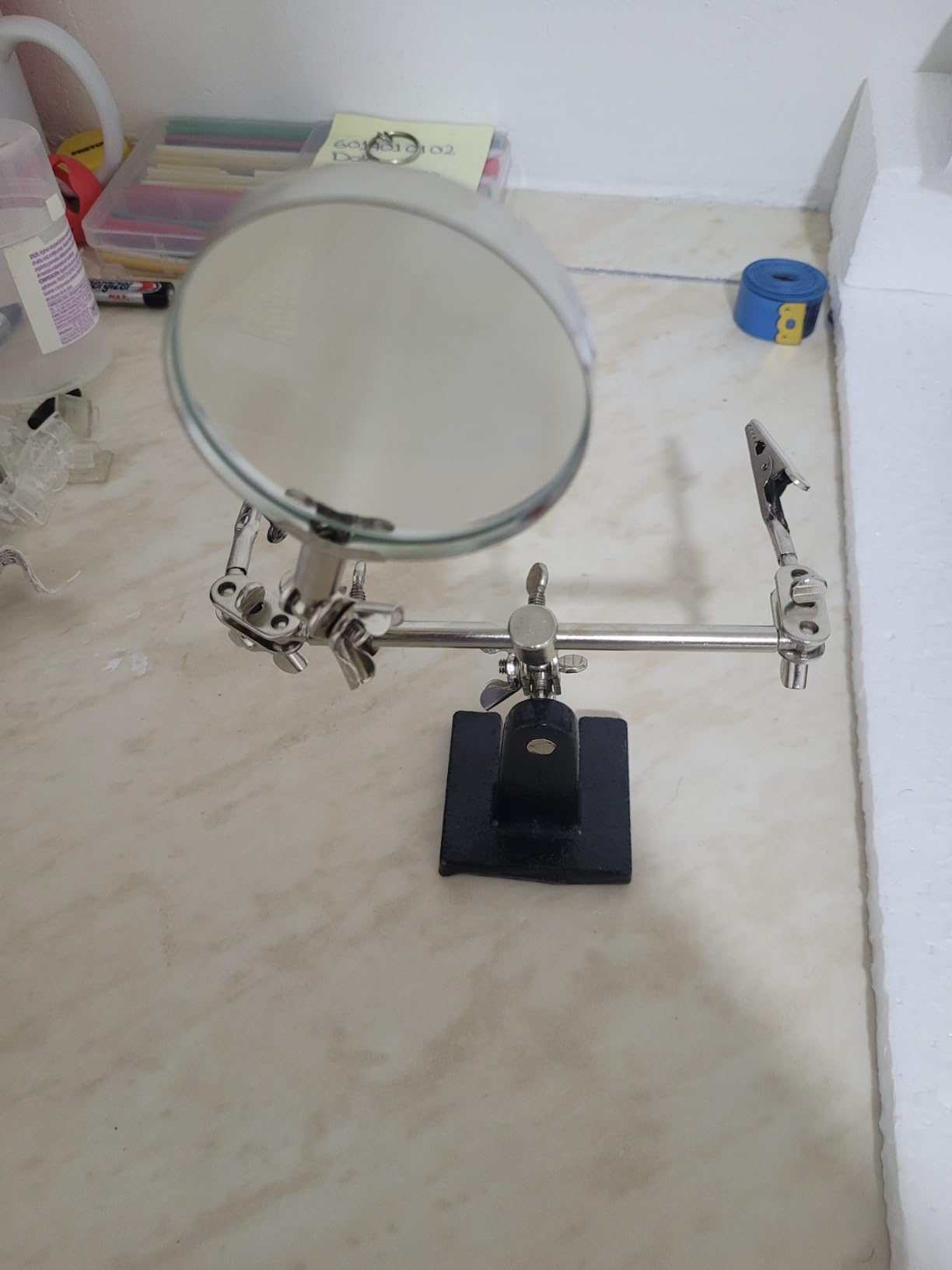
This is the one we recommend to people who ask for a single recommendation and do not want to think about it. A 2.5x glass lens in a chrome frame on a cast-iron base with two clips on four-way swivels is a genuinely complete tool for the price tier it sits in, and the 4.4 star rating from 1430 ratings is the strongest satisfaction score in the entry group.
Four-way swivels are more capable than they sound. The clip can be rotated so the jaw opens sideways, vertically or diagonally, which is what you need to hold a lead coming off a board edge without blocking your view of the pad.
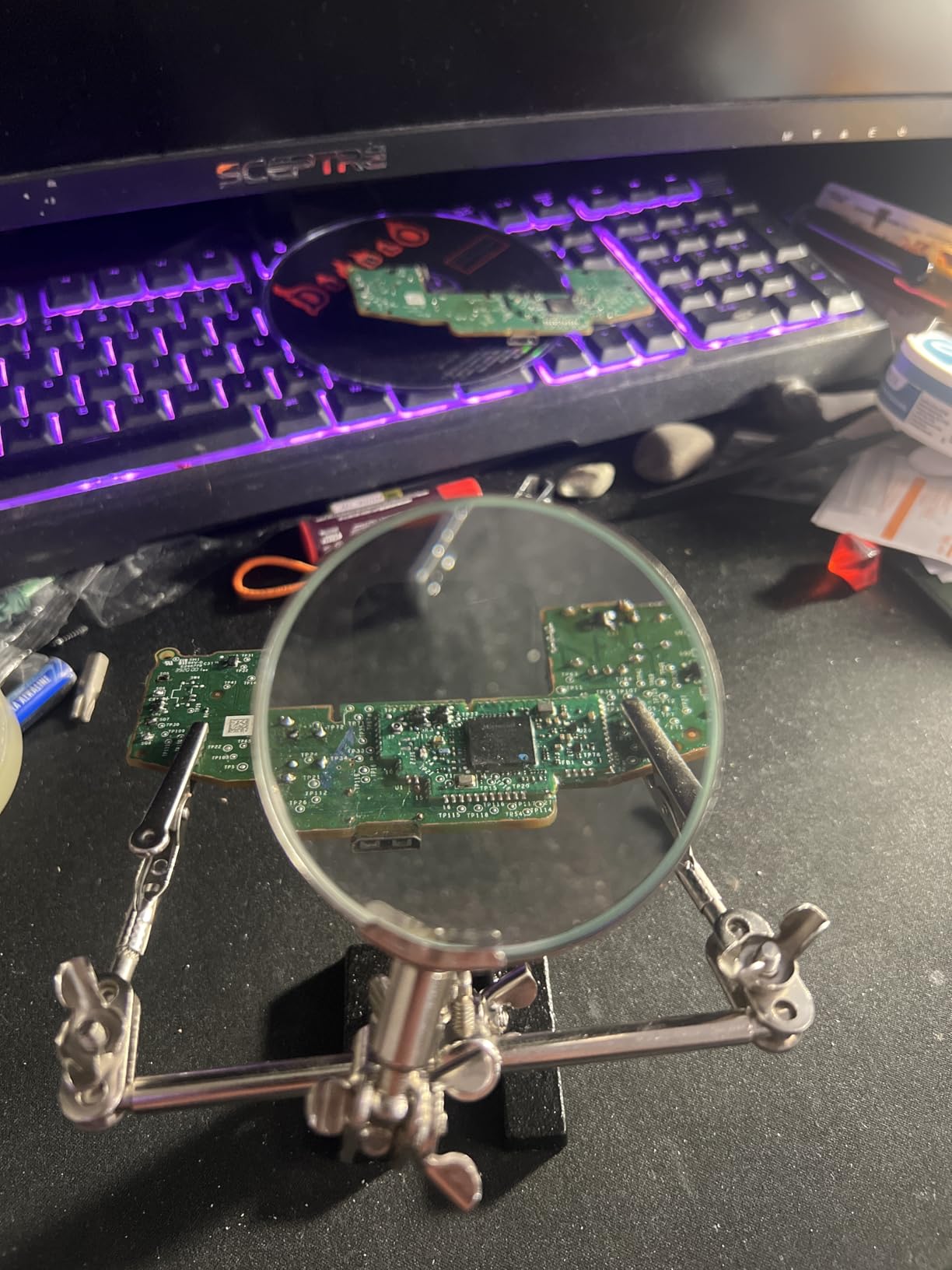
The recurring owner fix is worth knowing about in advance: several reviewers screw or glue this base down to a wooden board to stop it tipping on heavier jobs. It weighs 10.88 oz, which is real cast iron but not much of it. Two minutes with a screwdriver solves the issue permanently.
The screws are stiff when new, which is a common complaint. Loosen everything, set your positions, then tighten in a cross pattern. It is a five-minute job and it stops the clamps drifting mid-joint.
Is a 2.5x lens too weak for surface mount chips?
For 0603 and 0805 parts, 2.5x with a good light is workable. For 0402 parts and anything under 0.5mm pitch, you will be leaning in with your own face. The lens is also only 63mm across, so it frames a small patch of board rather than a whole module.
If your work is mostly through-hole, sensor modules and wire work, 2.5x is genuinely enough. Treat it as the sensible starting point and upgrade the magnification only when you feel you are squinting.
Should I mount this one down permanently?
Yes, and it takes one screw. Owners of heavier boards consistently report that fixing the base to a scrap of wood or a thick board is the single change that turns this into a reliable stand. The cast iron is already flat and heavy enough to hold screws well.
The chrome frame and 360 degree lens rotation mean you can also mount the whole thing on a swing arm if you share a bench with someone else. That is the flexibility that makes it a favourite in shared workshop spaces.
5. MMOBIEL LED Magnifier Station: Best All-in-One Kit for a New Bench
MMOBIEL LED Light Helping Hand Magnifier Station for Soldering, Assembly, Repair,Modeling, Hobbies and Crafts – 2.5X /4X LED Light – Hands-Free Magnifying Glass Stand – Incl. Clamp and Alligator Clips
16 SMD LEDs on 265mm neck
Three helping hands
USB or 4 AAA power
Iron holder, tray and spool bracket
Pros
- Most complete kit here with three clips plus iron holder
- tray and spool bracket
- USB cable or 4 AAA batteries with auto-switching
- Solid stamped steel base resists tipping
- 265mm bendable neck reaches over tall work
Cons
- Post screws in from underneath and loosens when arms turn counter-clockwise
- 4x lens area is small and awkward
- LED is dimmer than the price suggests
- Flimsy battery cover and screws often need re-tightening
Start with the accessories list, because that is the argument. Three alligator-clip helping hands, a clamp, an iron holder, a small tray and a soldering spool bracket, all in one box. If you are setting up a bench from nothing, this removes four separate purchases and the hunt for a bench-mounted iron cradle.
The lighting is 16 SMD LEDs on a 265 mm bendable neck, which is long enough to arc over a tall assembly and shine down into a deep joint. The station runs from the included USB cable or from 4 AAA batteries and switches between them automatically.
Two clips plus a magnifier head plus an iron holder means you can solder and hold two wires, a board, and a spool at the same time. For someone building sensor modules or drone flight controller boards where you are juggling four or five leads, that is the difference between a smooth build and a build spent re-gripping things.
There is one design flaw to plan around. The centre post screws in from the base underside, and if you rotate an arm counter-clockwise the post can back out and introduce wobble. Check it with a fingertip after a long session. It is a two-second fix, but you should know about it before you blame the arms.
Does the 4x lens work for fine pitch chips?
Marginally, and the area is the limitation rather than the power. Four times is enough to see a bridge, but the lens itself is small enough that you are constantly sliding the work around underneath it. Owners who do fine SMD mostly use it for inspection and keep a bigger stand for the joint.
There is a 2.5x variant of the same station if you prefer a wider field for general board work. Check which variant you are buying, because the accessories list is the same for both.
Is USB or battery power better for a soldering bench?
USB, without much argument. A bench that is already powered for an iron and a station is the natural place for a USB-powered lamp, and you avoid a battery that fades halfway through a long session.
The battery path exists for portability, such as taking the stand to a class or a shared table with no free outlet. The auto-switching means the same box handles both. If you are still choosing an iron and station, our [soldering stations guide](https://www.pwice.com/best-soldering-stations-for-electronics/) covers the power and tip side of the setup.
6. Weller WLACCHHB-02 Helping Hands: Best for Buyers Who Want a Known Brand
Weller Genuine Helping Hands with Magnifier | WLACCHHB-02
4x magnifying glass
Two clamps on 4-way swivels
0.43 kg weight
Model WLACCHHB-02
Pros
- 4x lens is stronger than most options at this price
- Recognisable soldering tool brand with a long service history
- 4-way swivel clamps hold parts at precise angles
- Light enough at 0.43 kg to move between benches
Cons
- No integrated lighting for dark work areas
- Only two alligator clips
- Fewer configuration options than LED-equipped stations
Weller has made soldering tools for a very long time, and that history shows in the details rather than the spec sheet. The 4x lens is the headline number here, and 4x is a genuinely useful step up from the 2x and 2.5x stands that dominate the cheap end of the market.
At 0.43 kg it is the easiest stand in this group to pick up and move, which matters if you share a bench or work from a kitchen table. The clamps are on 4-way swivels, the same mechanism that makes the AORAEM clips flexible, so you can orient the jaw around a board edge.
The 4.5 star rating with 72 percent five-star is the best star distribution among the lower-cost options, and that tends to track with fewer returns. For someone buying their first helping hands and worried about a part arriving bent, that reliability matters as much as any feature.
There is no lighting here at all. That is the one gap. A flexible-neck LED clipped to the arm, or a desk lamp on a swing arm, turns this into a complete station. Several buyers do exactly that and end up with a setup that costs less than an integrated LED model, and the same pairing works with anything in our [soldering stations guide](https://www.pwice.com/best-soldering-stations-for-electronics/).
Is a branded stand worth it over an unbranded one?
Often, yes, and specifically here. Weller is a soldering tool maker rather than a general hardware brand, so the stand is designed around a soldering bench. The materials and the joint quality are the parts that separate a stand that stays smooth from one that develops play in the ball joint after a year.
The counter-argument is features per unit of money. Unbranded multi-arm stations give you four arms and a lamp where this gives you two arms and no light. If your bench is already lit, the Weller is the better-made tool. If it is not, buy a lit stand.
Will 4x magnification be my limit for SMD work?
It handles 0603 and 0805 comfortably and 0402 with effort. Beyond that you want 5x with a larger lens, which is where the magnetic stations come in. A useful test: if you find yourself pulling the board right up to your eye to check a joint, you need more power.
One more thing worth noting. A 4x lens narrows the field of view, so the 2 inch lenses on cheaper stands frame more of the board at once. If you like to see an entire module in context, 4x can feel tighter than you expect.
7. XYK Four Arm Magnifier Station: Best for Multi-Arm Holding
XYK Helping Hands Soldering Station with 3X Magnifying Glass with light, 4 Flexible Helping Hand Arms Magnifier and Third Hand Soldering Tool for Electronic Repair Soldering Jewelry Crafts
3x dimmable lamp at 500 lumens
Four gooseneck arms, two 7.5 inch and two 5 inch
Rubber-sleeved 360 degree clips
7 inch steel base
Pros
- Four arms of mixed lengths give real holding flexibility
- 500 lumen dimmable magnifier lamp with six brightness levels
- Rubber sleeves stop clips scratching boards and jewelry
- 7 inch powder-coated steel base with rubber pads
- Tool and spare screw kit included
Cons
- 3x is the lowest magnification among multi-arm LED stations
- Mains corded lamp with no battery option
- Gooseneck arms hold position but are not ball-joint flexible
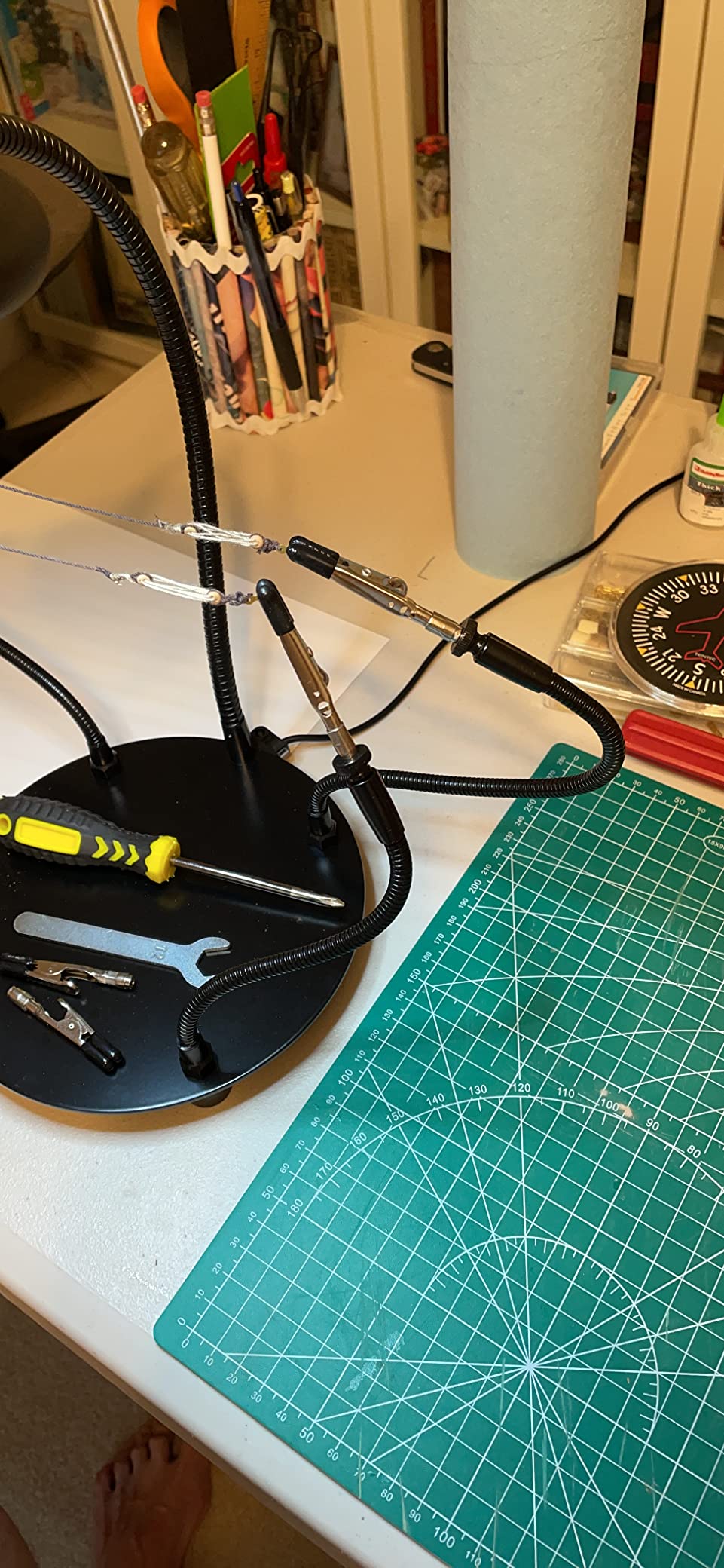
Four arms is the number that changes how a build feels. With two clips you spend your time swapping them, and with four you set the board, the connector, and two leads into position and leave them there while you work through a sequence of joints. The mix of two 7.5 inch and two 5 inch arms is deliberate, with the shorter ones for close work and the long ones for reaching across a larger board.
The lamp is the second reason to choose this one. 28 LED beads, 500 lumens, six brightness levels, on a flexible arm. That is enough output to light a crowded board properly rather than just filling a shadow, and the dimming lets you drop the level when working on polished or reflective surfaces.
The rubber sleeves on the clips are a small feature that matters more than it sounds. Bare steel jaws can scratch a finished board and can sit against a component lead and cause trouble if the board is powered. Sleeved jaws let you hold a populated board without worrying.
It weighs 1.46 kg on a 7 inch powder-coated steel base with four non-slip rubber pads, so it stays put when you push a clip against a stiff wire. Layout changes are less flexible than a magnetic system because accessories are screw-mounted, but the screw fixings mean nothing slides once set.
Are gooseneck arms as good as ball joints?
For holding a position, gooseneck is arguably better. Bend the arm to the shape you want and it stays there, whereas a ball joint needs a knob tightened every time. Gooseneck loses on repositioning speed and on fine angle changes, which is why it suits a fixed setup more than a quick swap.
The trade-off only shows on work where you repeatedly change the board angle. If you are reworking a single board, four fixed arms are the better arrangement.
How many arms do different projects actually need?
Two arms cover most through-hole soldering, a small sensor module, and wire tinning. Three arms is the comfortable number for a connector with three wires, a board and a spare lead. Four arms is what you want for multi-board builds, flight controller assembly, and anything where you are tinning several conductors at once.
If you are not sure where you fall, count the number of separate things that need holding at the same moment rather than the number of joints in the project.
8. KOTTO Five Arm Magnifying Station: Best for Stainless Clamp Tips and Heavy Duty
KOTTO LED Lighted Magnifying Third Hand Soldering PCB Holder Tool Five Arms
Four stainless tip gooseneck arms
360 degree locking rotation
Weighted base with rubber feet
LED magnifying lamp
Pros
- Stainless steel alligator tips outlast plated steel jaws
- Weighted base with anti-slip feet holds position on a busy bench
- Four arms hold board and wires simultaneously
- 360 degree rotation that locks in place
Cons
- Heaviest of the mid-priced stations at 1.88 kg
- Gooseneck arms are fixed length and less freely posable
- Magnification and lamp output are not stated in the listing
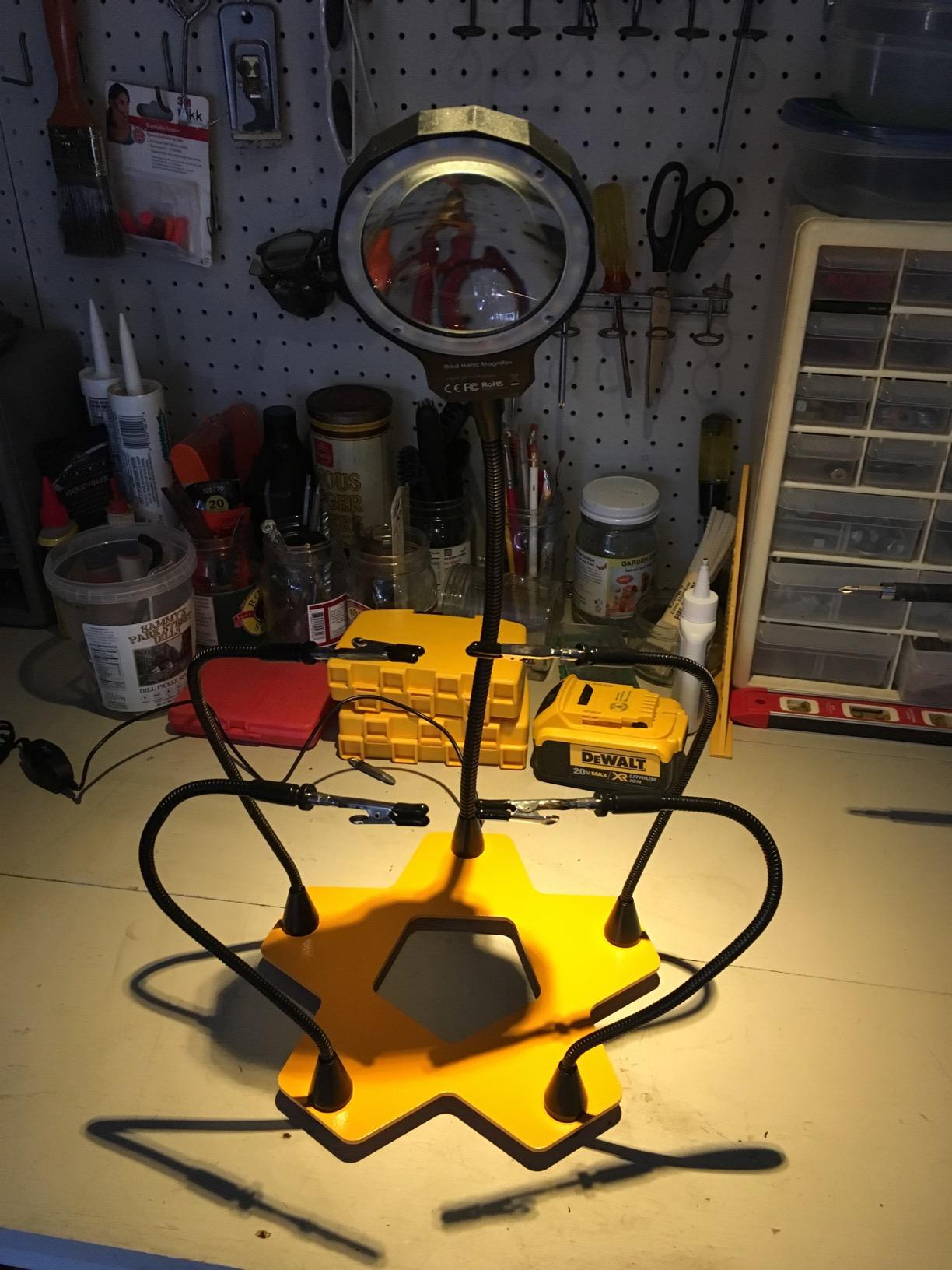
The reason to pick this station over a similar four-arm model is the stainless steel clamp tips. Plated steel jaws dull, rust and eventually lose grip, and a clip that slips mid-joint is a cold joint and a restart. Stainless tips are the part of a helping hands stand that actually touches your work, and it is the part worth paying for.
At 1.88 kg this is a firmly planted station. The weighted base with anti-slip rubber feet stays put when you push against a stiff wire or brace the arms while positioning a clip, which is the moment when lighter stands creep across the bench.
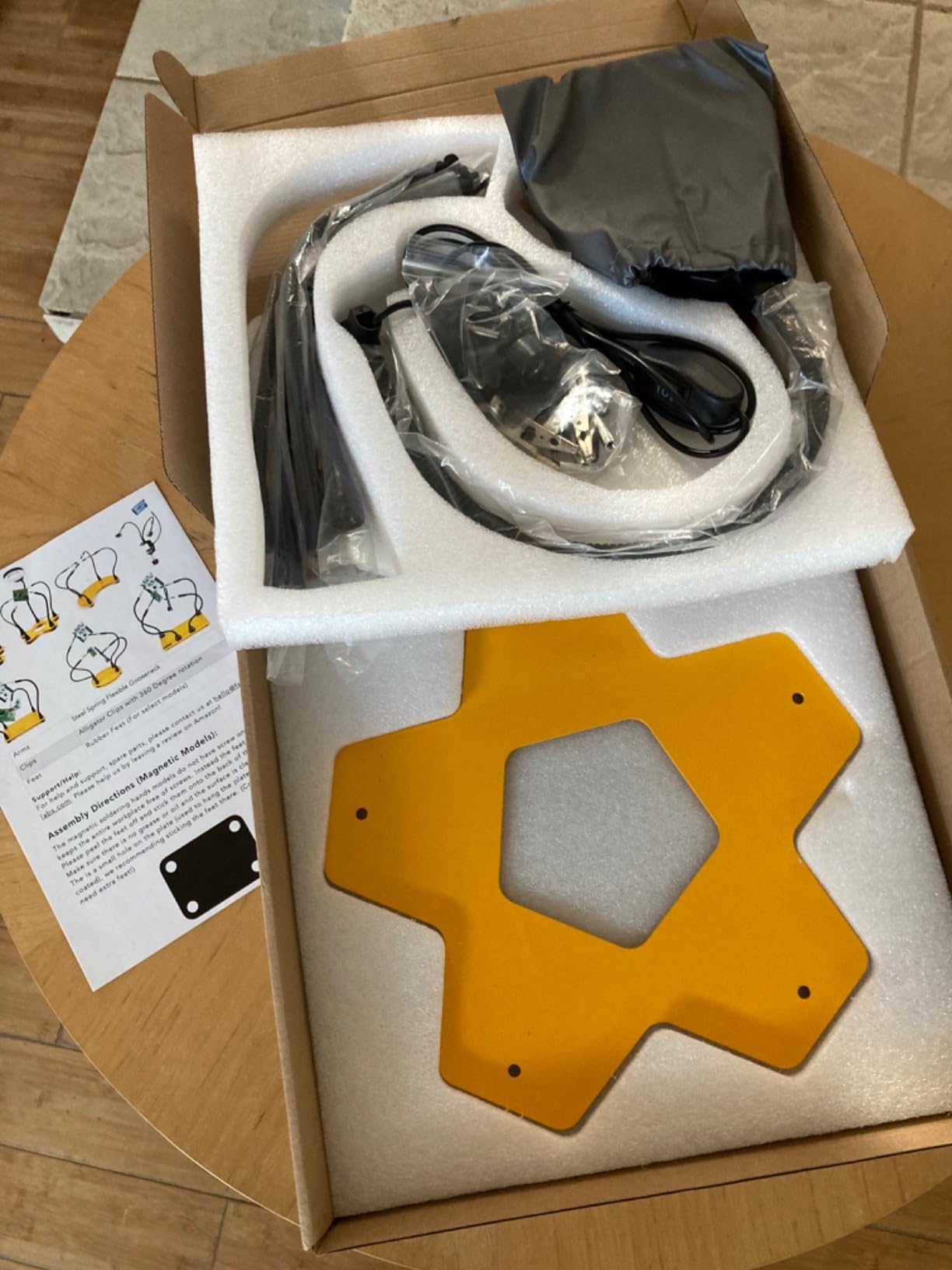
Rotation is 360 degrees with a locking grip, so once you have an arm where you want it, turning it does not undo your work. That sounds trivial until you have spent twenty minutes repositioning a four-arm setup on a stand that will not hold its angle.
One thing to be aware of is that the listing does not state a magnification figure or lamp output. Reviewers also tend to comment on the build and the tips rather than the optics, which tells you where the value in this stand sits. Buy it for the clamps and the base, not for the lens.
Do stainless steel clip tips actually last longer?
Yes, and it is the difference you notice after a year of daily use rather than on day one. Plated jaws wear through at the teeth and start slipping on smooth component leads. Stainless keeps its tooth definition and its grip on a wire jacket much longer.
The upgrade is only worth it if you clip a lot. If your helping hands mostly hold a board steady, clip material matters far less to you than base weight.
Is a heavy base always better?
Up to a point, then it becomes a space problem. A heavy base resists tipping and resists the sideways push that creeps a light stand across a bench, but it also stops you moving the station between projects and takes up a fixed circle of table.
Around 1.5 to 2 kg is the sweet spot for a bench that stays in one place. Beyond that you are buying permanence, and permanence only suits a dedicated workstation.
9. SainSmart Magnetic Helping Hands: Most Versatile, Best Magnification at 5x
SainSmart Magnetic Helping Hands Soldering Station with an 11.1 x 7.1 Inch Larger Base, 5X LED Magnifying Lamp, 4 PCB Circuit Board Holder & 4 Flexible Magnetic Helping Hands
5x LED magnifier with 3 color temperatures
11.1 x 7.1 inch steel base
Four magnetic arms plus 4 PCB pillars
Rubber-sleeved clips
Pros
- 5x magnification with 3 color temperatures and 10 brightness levels
- Largest working area here at 11.1 x 7.1 inch base
- Magnetic arms and PCB pillars reposition anywhere on the plate
- Rubber sleeves protect boards and jewelry
- Modular so you can strip it back to a simpler setup
Cons
- Magnifier head does not hold position and tilts out of alignment
- Alligator clamps are hard to tighten so they do not twist
- No wide clamp included for larger parts
- Rubber feet are on paper backing and must be applied
- LED lamp needs USB power
The 4.7 star rating here is the highest in our group, with 85 percent of ratings at five stars. That number comes from people doing micro-soldering, and it is not mysterious once you use the thing. Five times magnification is the point: it is the only lens in this roundup that comfortably resolves fine-pitch pads without you pressing your face into it.
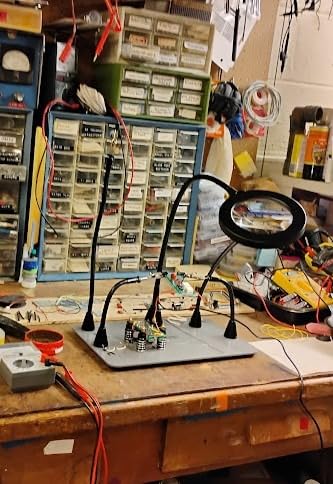
The magnetic system is the second idea. Four flexible magnetic gooseneck arms, two 7.5 inch and two 14 inch, plus four magnetic PCB holder pillars. You place an arm anywhere on the plate and it locks, so changing from one board to another takes seconds instead of a re-clamp, and the pillars hold a PCB off the surface while you work on the underside.
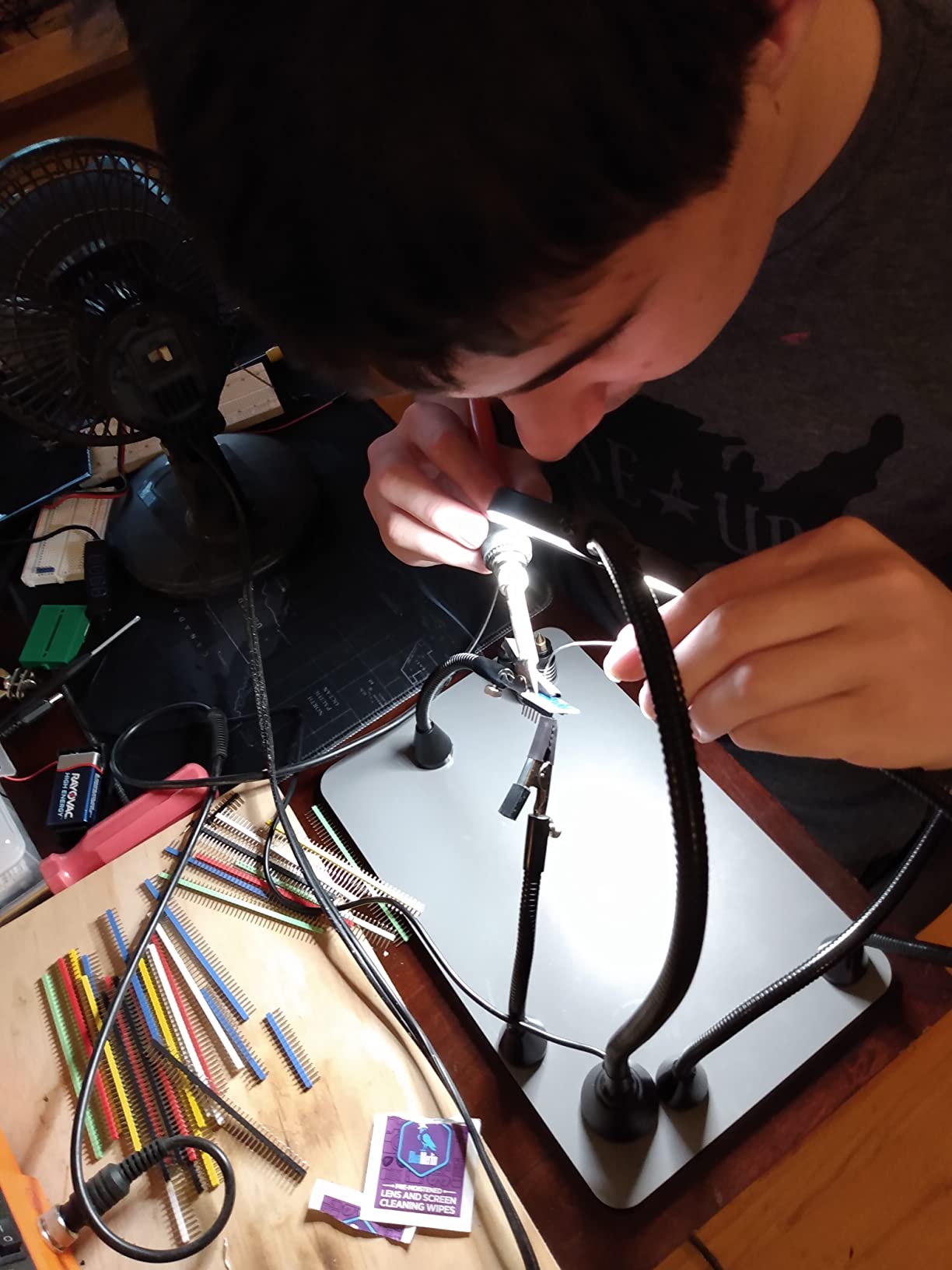
The magnifier lamp has three colour temperatures and ten brightness levels. Being able to shift to a cooler white for inspecting a matte board and a warmer tone for jewellery is a small control that makes long inspection sessions easier on the eyes.
The base is 11.1 by 7.1 inch powder-coated steel at over 2.4 pounds, so this is a bench fixture rather than a portable stand. The rubber feet arrive on paper backing and have to be applied before you put any weight on the plate, and the lamp needs USB power, so plan the cable route.
Are magnetic arms better than gooseneck arms?
For switching between boards, clearly. Positioning is a placement rather than a bend, you can move an arm to any point on the plate, and nothing needs re-tightening. For a single fixed project, gooseneck is marginally more rigid because the arm itself resists being knocked.
Two cautions. Magnets sit close to your work, so keep magnetically sensitive parts and some older analogue boards clear of the plate. And a magnetic arm cannot be anchored to a specific spot as precisely as a screwed clamp, so for repeatable production work the fixed stands are still better.
How much magnification do SMD work really need?
Five times is the practical ceiling for soldering. At 5x you can see a 0.5mm pitch pad and a solder bridge clearly, and the working distance is still short enough to place an iron. Above that, the light and the field of view get in the way and you are better off inspecting with a loupe and soldering at 3x.
The trade-off of the 5x head is the same one you get from any high-power lens: a smaller field of view, so the board moves around under it more. The ten brightness levels and three colour temperatures are what keep that from becoming tiring.
10. NOEVSBIG Magnetic Bench Workstation: Best Full Workstation for a Fixed Bench
Magnetic Helping Hands Soldering Third Hand, PCB Circuit Board Holder with 3X LED Magnifying Lamp, 360 Hot Air Gun Holder, Extra Large & Heavy Duty Base Plate | Flexible Arms for Soldering Station
11.4 x 7.1 inch base at 7.6 pounds
3x optical glass magnifier
Hot air gun frame and bench vise
Four magnetic arms and 4 PCB clips
Pros
- Most complete workstation here with a hot air gun frame and a bench vise
- Very heavy 11.4 x 7.1 inch base keeps everything solid
- Real optical glass 3x lens with dimmable 3 colour LED
- Magnetic arms and clips arrange anywhere on the plate
- 5V/2A adapter included
Cons
- Heaviest item here at 7.6 pounds so it is a fixed installation
- 3x magnification is lower than the 5x alternative despite the higher cost
- 20.4 inch overall height needs vertical clearance
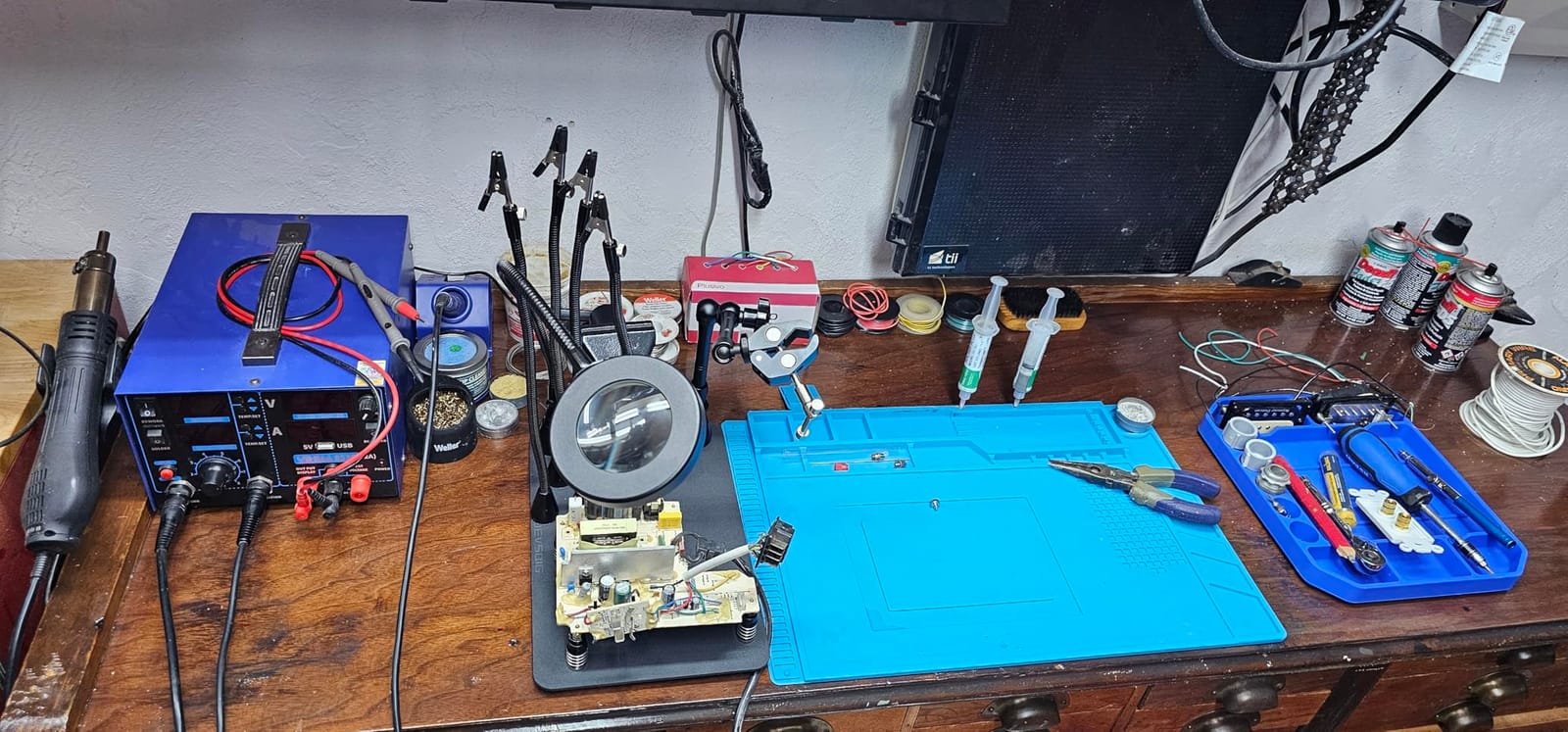
This is not really a helping hands tool, it is a bench workstation that includes helping hands, and buyers consistently describe it that way. The extra pieces are a 360-degree rotating hot air gun frame with an adjustable clamp width, and a 2.1 inch jaw workbench vise that adjusts from 0 to 55mm.
For someone doing rework or shrink wrapping alongside soldering, the hot air gun frame alone justifies the footprint. It holds the gun at a fixed angle and distance over a board, which turns a two-handed operation into a one-handed one.
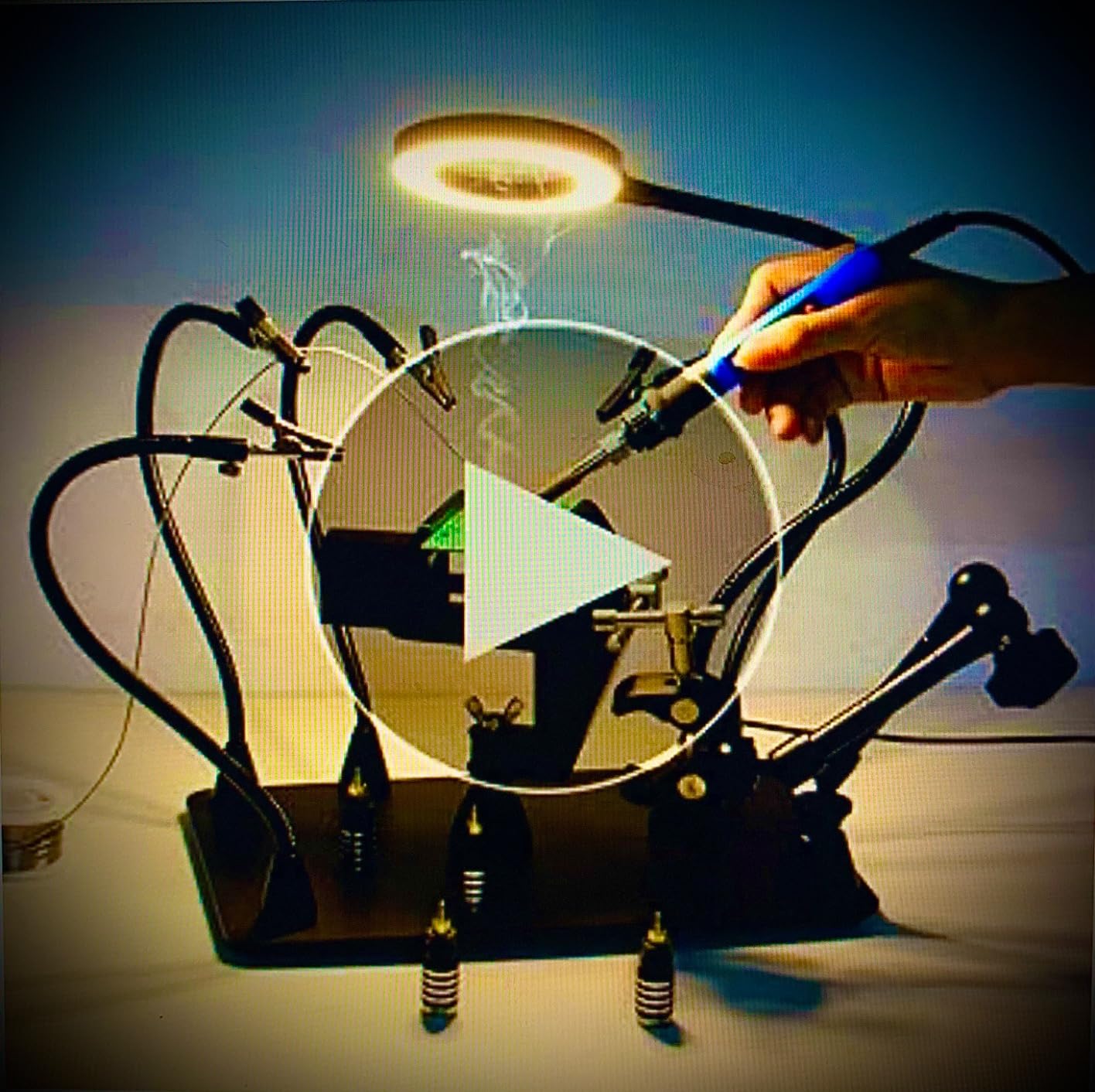
The lens is 3x optical glass with three colour temperatures and ten brightness levels, driven from the included 5V/2A adapter. Optical glass holds its clarity at the edges where acrylic softens, which is a real difference on a large-diameter head.
The 7.6 pound base plate is 11.4 by 7.1 inch with rubber feet, and four magnetic arms with four fixed PCB clips sit on it. Nothing moves when you lean on it, and the plate has enough free area that you can run two projects side by side.
Who is this workstation actually for?
For a dedicated electronics bench where the same spot is used daily. At 7.6 pounds and 20.4 inches tall it is a fixed installation, so it needs vertical clearance above and a permanent square of table. A renter or a small kitchen table is not the place for it.
It also makes sense if you already own a hot air gun and a small vise. If you do not, you are paying for two extra tools bundled into a stand, and a four-arm station with a 5x lens would serve the same soldering work.
Is a 3x lens acceptable when a 5x option exists?
Yes, because the reason to buy this is the workstation, not the lens. Three times with optical glass and a 500-plus lumen equivalent dimmable lamp is enough for through-hole, most SMD, and connector work. The 5x on the SainSmart exists because it is a dedicated magnifier stand with a smaller bench footprint.
If your priority is magnification alone, take the 5x. If your priority is a complete fixed station with a hot air holder and a vise, this is the one to consider.
How to Choose a Helping Hands Magnifier for Soldering in 2026
Start from the work, not the spec sheet. Count how many separate items need holding at once, look at how small the smallest component you regularly solder is, and then decide whether the stand lives on one spot on the bench or moves with you. Get those three answers right and the rest of the spec sheet sorts itself out.
Arm type: ball-joint, gooseneck or magnetic
Ball-joint arms are the most flexible. Each joint clamps at a chosen angle and you can reposition in seconds, which suits mixed work where the board angle changes constantly. The NEIKO and the AORAEM both use them.
Gooseneck arms are shaped and stay where you put them. They hold a fixed setup better, need no re-tightening, and are cheaper to make. The compromise is repositioning speed and angle control, and it is the right choice when your bench is arranged one way.
Magnetic arms lock anywhere on a steel plate. They are the fastest to rearrange and let you place a clip precisely where the joint is, which suits swapping between boards. The trade-off is that a magnet near the work can bother sensitive or older analogue boards, and a magnetic arm does not anchor to one spot as rigidly as a fixed clamp.
What magnification is good for soldering?
Here is the short version by task. For through-hole joints, wire tinning, and connector work, 2x to 2.5x is plenty and the wider field helps you see the whole joint at once. For general PCB work and 0805 or 0603 surface mount parts, 3x to 3.5x is the comfortable middle and is the most common choice in this roundup.
For 0402 parts, fine-pitch ICs, and dense boards, 4x to 5x is the right band. Five times is the practical limit for soldering because working distance drops sharply beyond it. For checking a solder fillet, looking for a bridge between pads, or reading a serial number, 10x and above is an inspection tool rather than a soldering tool.
Two practical rules. Higher magnification means a narrower field of view, so the board moves around under the lens more, and it means a shorter working distance, so the lens rim gets in your way. Above 4x, good lighting stops being optional.
Base size and weight decide what you can clamp
A base is a stability claim. Under about 1 pound, expect to mount the stand to something or keep loads close to the post. Between 1 and 2 kg is the practical sweet spot for a stationary bench. Beyond 3 kg you are installing equipment, and the weight stops being a feature and starts being a commitment.
Footprint matters as much as weight. Small cast-iron stands around 5 inch across handle boards and wires. A base of 11 inch or more gives you room for two projects, a hot air gun, and a spool, and it will take the space whether you use it or not.
Lighting: mains, USB or batteries
Light from two sides beats a bright lamp in one place, because the shadow cast by your hand and your iron is the real problem at a joint. Flexible LED arms on the neck are the most useful version of this. Dimmable output and selectable colour temperature help more than raw brightness on long sessions.
Power source is a convenience question. USB is the cleanest on a bench that already has a powered station. Batteries make the stand portable for classes and shared tables, and a battery that fades mid-session is a small daily irritation. Corded mains is fine if you have the outlet.
Clip sleeves and board protection
Bare steel jaws can scratch a finished board and can press on a component lead. Rubber or silicone sleeves cost very little and remove the problem entirely, and on the four-arm and magnetic stations in this roundup they are the difference between a comfortable and a fussy setup. The AORAEM and the Weller clips run without sleeves, so add them yourself if you work on populated boards.
Two final checks. Make sure the arms can be tightened firmly without the whole joint turning, and check whether the base needs to be fixed down. Those two details cause more complaints than anything else on a helping hands stand.
Frequently Asked Questions
What is the best helping hand for soldering?
The NEIKO 01902 is the best all-round helping hand for soldering because the cast-iron base stays put, the two clips sit on independent ball joints, and 2x magnification is enough for through-hole and most surface mount work. If your work needs more magnification or more arms, the SainSmart PCBH gives you 5x with four magnetic arms, and the XYK station gives you four fixed arms with a 500 lumen dimmable lamp.
What is the best magnifying tool for soldering?
For soldering itself, a 3x to 5x lens on a flexible arm is the right range, with three colour temperatures and dimmable output preferred so you can match the light to the board. Higher power is for inspection rather than soldering, because working distance collapses above roughly 5x. Many bench builders also pair a helping hands stand with a separate task lamp, since the two solve different problems.
What is the best magnifying glass for soldering?
A glass lens beats acrylic on edge clarity, so the RamPro stand and the NOEVSBIG workstation are the picks if you care about how the image looks at the edge of the field. The RamPro uses a 3x 12 diopter glass lens on a retractable arm, which is convenient when you want the magnifier out of the way for general soldering. The SainSmart uses 5x with a glass lens, which is the strongest magnification here for fine-pitch surface mount work.
What magnification is good for soldering?
Use 2x to 2.5x for through-hole joints, wire tinning and connector work, 3x to 3.5x for general PCB work and 0805 or 0603 parts, 4x to 5x for 0402 parts and fine-pitch ICs, and 10x or more only for inspecting a joint rather than soldering it. Above 5x the working distance becomes so short that the lens rim gets in the way, and you also need good lighting to see anything at all.
How many arms do I need for helping hands?
Two arms cover most through-hole soldering, small sensor modules and wire tinning. Three arms is the comfortable number when a board, a connector and a spare lead all need holding at once. Four arms suit multi-board builds, drone flight controller assembly and any job where you are tinning several conductors together. Count the separate items that need holding simultaneously, not the total number of joints in the project.
Are magnetic helping hands better than gooseneck ones?
Magnetic arms are faster to rearrange, which makes them better for swapping between boards, and you can place an arm exactly where the joint is. Gooseneck arms hold a fixed setup more rigidly and never need re-tightening, so they are better for a bench arranged one way. Magnetic arms also sit close to your work, so keep magnetically sensitive parts and some older analogue boards clear of the plate.
Final Verdict: Which Helping Hands Magnifier Should You Buy in 2026?
The NEIKO 01902 remains our pick for the best helping hands magnifiers for soldering because it does the two things that matter at once: it stays exactly where you put it, and it holds small parts without drifting. Buy it, mount it near the front of the bench, and add a flexible-neck LED when you notice yourself squinting.
Move up a tier when a specific limit gets in your way. Two clips and 2x means switch to the Weller for 4x, the XYK for four arms and bright lighting, or the SainSmart for 5x and magnetic repositioning. If you want one box to build a whole bench, the MMOBIEL station includes the iron holder, tray and spool bracket. And if your bench is a permanent installation with a hot air gun, the NOEVSBIG workstation covers the whole bench rather than just the board.
Whichever you pick, spend the first ten minutes tightening every joint and marking the base position. A helping hands tool is only better than a steady hand if it holds still.