
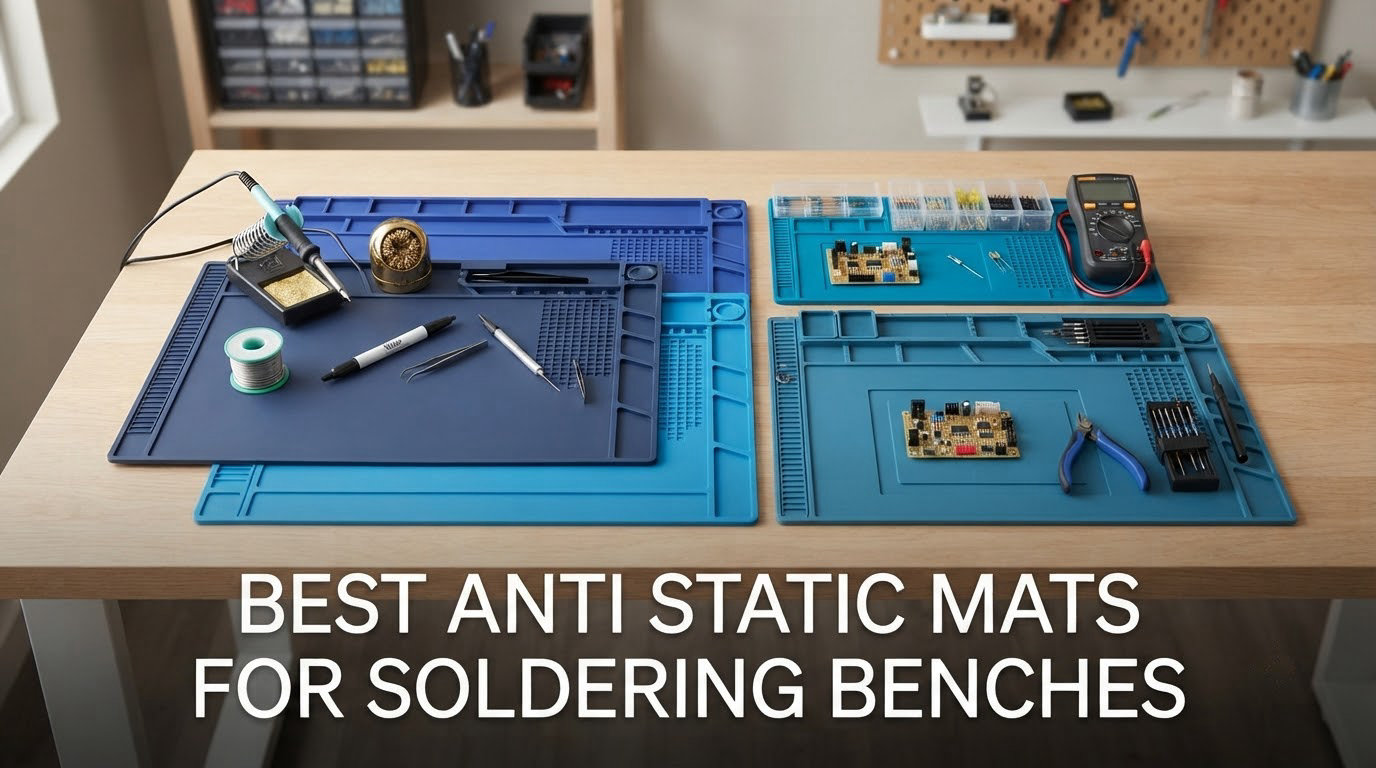
Is an anti-static mat necessary for soldering? For pure through-hole work on cheap discrete circuits, it is optional. For SMD rework, dense boards, CMOS parts, and phone, laptop, or console repair, it is effectively mandatory, because those boards can be killed by a few thousand volts of discharge you cannot even feel.
The catch is that most mats sold with the word “anti-static” on the label are not really ESD-safe, and an ungrounded ESD mat does almost nothing. That distinction is the single most useful thing in this guide, and it is the question a buyer on r/AskElectronics asked with nothing answering it.
We assessed ten mats sold for soldering benches right now, reading every published specification, checking which ones ship a ground cord and snap terminal, and separating the ones that survive a soldering iron from the ones meant only for assembly and disassembly. The result is a list where four products genuinely deserve the term ESD-safe, four are heat-tolerant silicone pads with partial or no grounding, and two are assembly mats that will melt if you touch them with an iron.
If you are also choosing the tool that sits on the mat, our soldering station guide covers the irons these mats get paired with most often.
Table of Contents
Top 3 Picks for Anti Static Mats for Soldering in 2026

HPFIX Silicone Soldering Mat
- 10^6-10^8 ohm resistivity
- 932F heat resistant
- Mat plus wristband and ground cord

Smlirop 932F Silicone Soldering Pad
- 17.7 x 11.8 inch pad
- 124 screw slots and 4 magnetic zones
- 932F direct iron contact
CPB 932F Magnetic Soldering Mat
- Food grade silicone
- 124 screw positions and 42 spares
- Anti-slip both faces
Best Anti Static Mats for Soldering Benches (October 2026)
| Product | Specifications | Action |
|---|---|---|
| HPFIX Silicone Soldering Mat 15.9 x 12 inch |
|
Check Latest Price |
 Bertech ESD Table Mat Kit 16 x 24 inch Bertech ESD Table Mat Kit 16 x 24 inch |
|
Check Latest Price |
| Smlirop Silicone Soldering Pad 17.7 x 11.8 inch |
|
Check Latest Price |
| CPB 932F Silicone Soldering Mat 17.8 x 11.8 inch |
|
Check Latest Price |
 KooMall 36 x 24 inch Anti Static Rubber Mat Kit KooMall 36 x 24 inch Anti Static Rubber Mat Kit |
|
Check Latest Price |
 Weller ESD Mat 600 x 900 mm Grey Weller ESD Mat 600 x 900 mm Grey |
|
Check Latest Price |
 LUTICO Anti Static ESD Mat 24 x 36 inch LUTICO Anti Static ESD Mat 24 x 36 inch |
|
Check Latest Price |
 Kaisi Large Anti Static Soldering Mat 21.6 x 16.9 inch Kaisi Large Anti Static Soldering Mat 21.6 x 16.9 inch |
|
Check Latest Price |
 Kaisiking Anti-Static Mat Kit 15.7 x 11 inch Kaisiking Anti-Static Mat Kit 15.7 x 11 inch |
|
Check Latest Price |
 Hooandxk Black Soldering Mat 27.6 x 15.7 inch Hooandxk Black Soldering Mat 27.6 x 15.7 inch |
|
Check Latest Price |
1. HPFIX Silicone Soldering Mat – Best Overall, Ships Grounded
Anti-Static Mat ESD Safe for Electronic Includes ESD Wristband and Grounding Wire, HPFIX Silicone Soldering Repair Mat 932°F Heat Resistant for iPhone iPad iMac, Laptop, Computer, 15.9” x 12” Grey
15.9 x 12 inch silicone
10^6-10^8 ohm resistivity
932F heat resistant
Grounding cord, plug and wristband
Pros
- Only top pick that ships with cord
- plug and wristband together
- Published 10^6-10^8 ohm resistivity
- 932F rating holds up for soldering directly on it
- Built-in ruler and screw compartments
- Rolls flat and stores easily
Cons
- Working area is small for large boards
- Ground cord is short
- Compartments are not magnetized
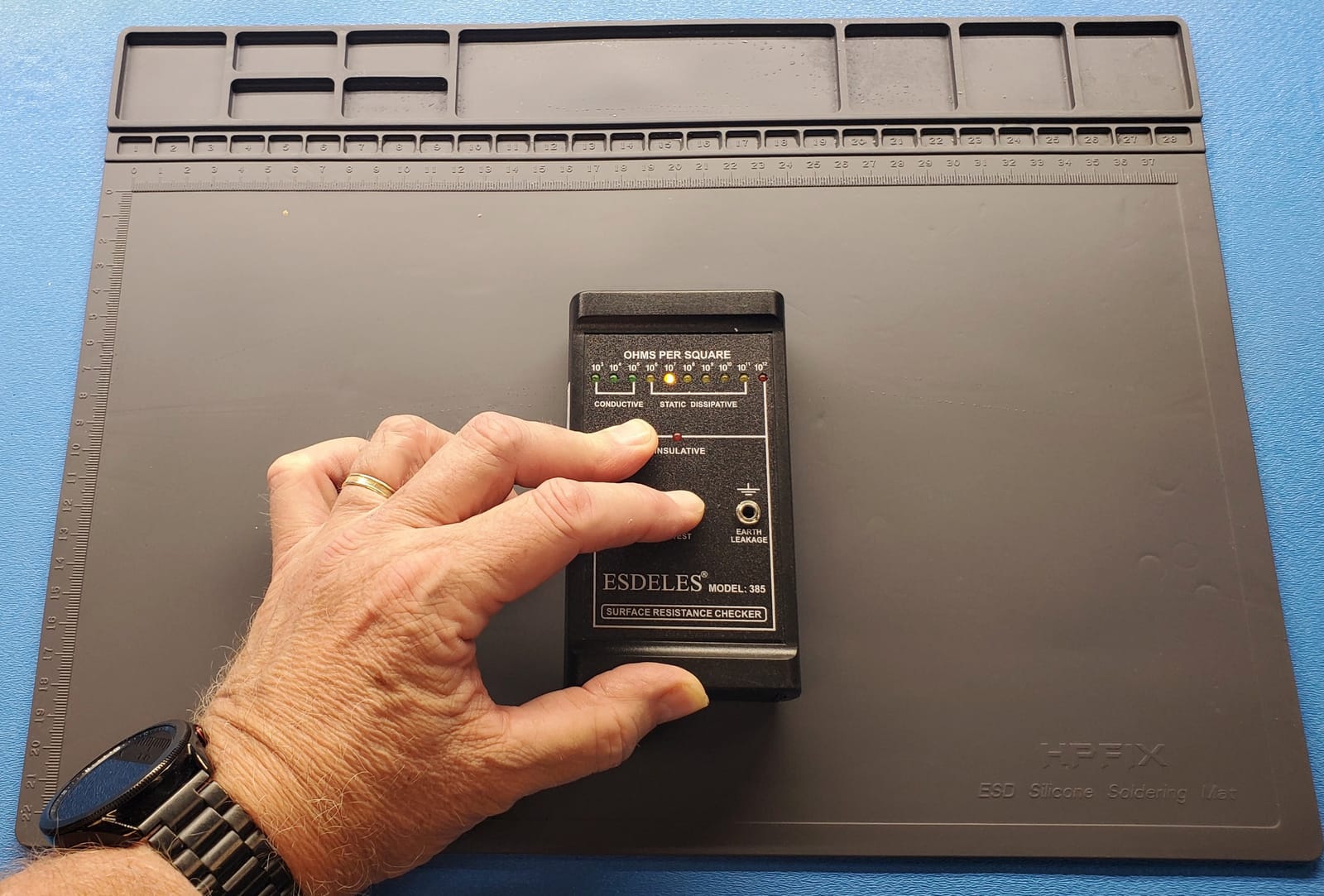
I have a small mat like this on the bench I use for laptop battery swaps and phone screen replacements, and it is the one I keep reaching for. The 15.9 by 12 inch footprint is deliberately modest, which is exactly right for a repair bench where a laptop or a phone is laid flat and you want your hands and the board on the same surface.
What sets it apart from the cheaper silicone pads is the box contents. You get the mat, an ESD wristband, a grounding cord, and a grounding plug in one package, so you can actually complete the circuit from mat to earth rather than buying a second accessory. The published surface resistivity is 10^6 to 10^8 ohms, which is a real dissipative range rather than a marketing claim with no number attached.
The heat rating is 932F, so you can set an iron down on the surface without worrying about melting it. That matters more than it sounds, because the reflex when a joint goes wrong is to park the iron somewhere for a second, and on a bare bench that leaves a mark.
Two details make it feel like a tool rather than a tray. There is a printed ruler and a set of numbered compartments and screw slots, so screws from a teardown stay classified instead of migrating under the mat. The silicone is non-slip on both faces and rolls up for storage, and it flattens out again after a couple of days of being rolled, which is more than I can say for most mats in this category.
When this mat is the right call
This is the pick for a hobbyist who wants a genuinely complete grounded ESD station without buying four parts separately. It suits phone, laptop, and small board repair, and it is the one we would put on a bench that has one dedicated soldering corner and not much room.
Its 4.7 star rating across more than 2400 reviews makes it the most proven mat here by a wide margin, and the review data backs up the spec sheet: owners consistently report zero zapped components and praise the included grounding accessories.
When this mat is the wrong call
If you routinely rework full-size ATX boards or laptop motherboards laid flat, 15.9 by 12 inches is cramped, and you will spend more time sliding the board than working on it. A larger surface in this roundup is the Hooandxk at 27.6 by 15.7 inches or the KooMall at 36 by 24.
Two smaller annoyances: the grounding cord is short enough that you may need an extension to reach a wall outlet from the back of a deep bench, and the compartments are not magnetized, so loose screws still shift when you bump the mat. Neither is a dealbreaker at this level, but both are things you notice on day one.
2. Bertech ESD Table Mat Kit – Toughest Long-Term Mat, Not for Hot Irons
Bertech ESD Anti-Static Table Mat Kit, 16 In. x 24 In., Blue, Includes an ESD Wrist Strap and ESD Grounding Cord, MADE IN USA
16 x 24 inch blue vinyl
10^9-10^10 ohm resistivity
Made in USA
Service range -20F to 160F
Pros
- Measured surface resistivity with a megohmmeter
- Thick single layer homogenous polymer that lasts years
- Two snap connectors at opposing ends
- Chemical resistant to acids
- detergents and alcohols
- Can be cut down to fit
Cons
- Vinyl is not heat resistant and melts under iron contact
- Strong off-gassing smell for days after delivery
- Wrist strap uses an alligator clip instead of a snap
- Cord relies on a receptacle screw
This is the mat I would put on a bench that does assembly and disassembly all day: PC builds, connector work, drive swaps, anything where the tools are cold. It is a 0.094 inch thick single layer homogenous polymer, made in the USA, and it feels closer to a piece of industrial belting than to a rubber mat.
The credibility marker here is the spec. Surface resistivity is published as 10^9 to 10^10 ohms measured with a megohmmeter, and the manufacturer also quotes tensile strength of 900 lbs per square inch. That is a real engineering datasheet, not a sticker.
Long-term owners report that after two years of daily use the mat still performs, with no zapped components, and that it shrugs off spilled flux, alcohol, and solder blobs without staining. The 4.5 rating across 372 reviews is lower than the top pick, but the complaints are about comfort, not function.
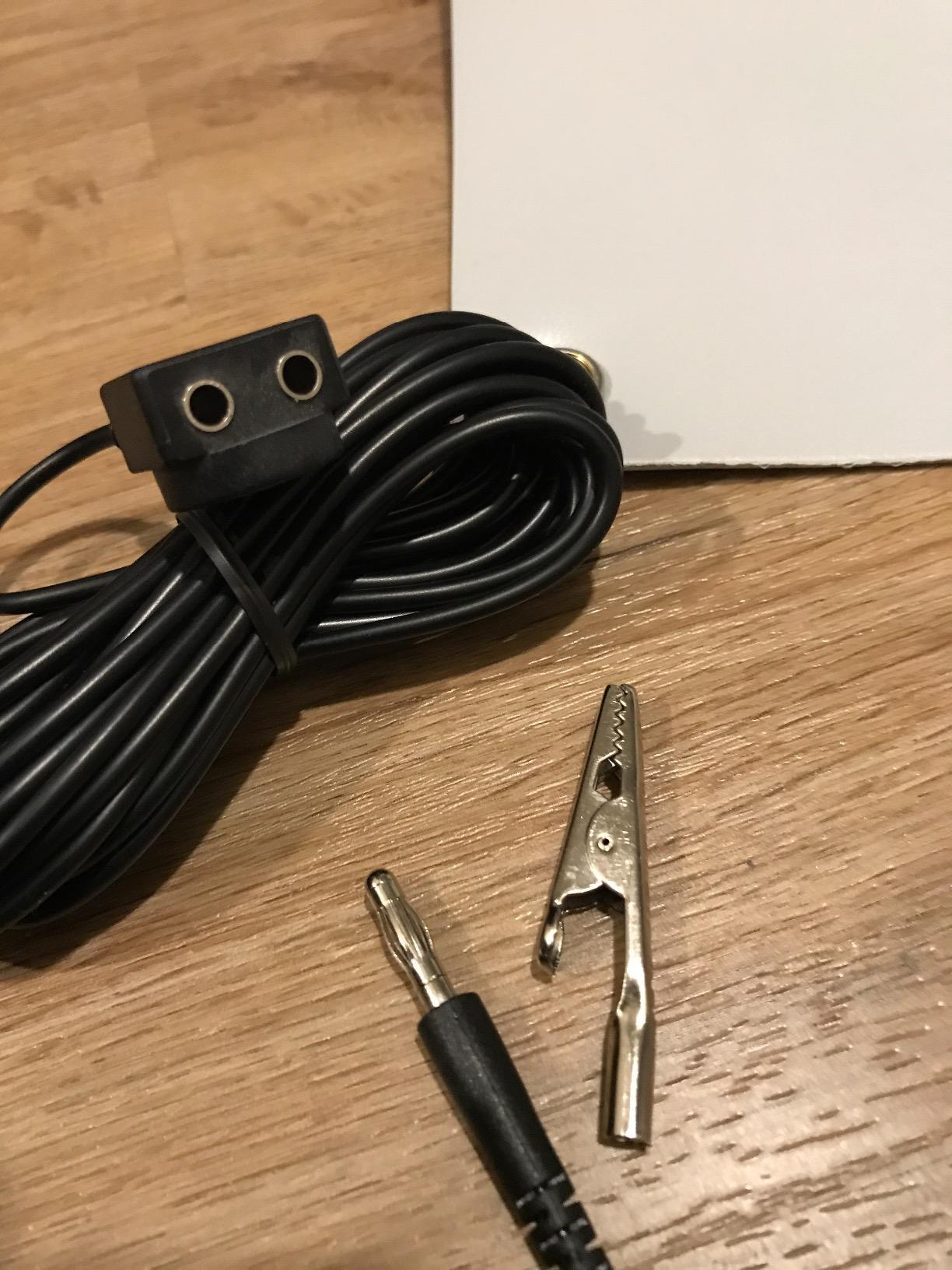
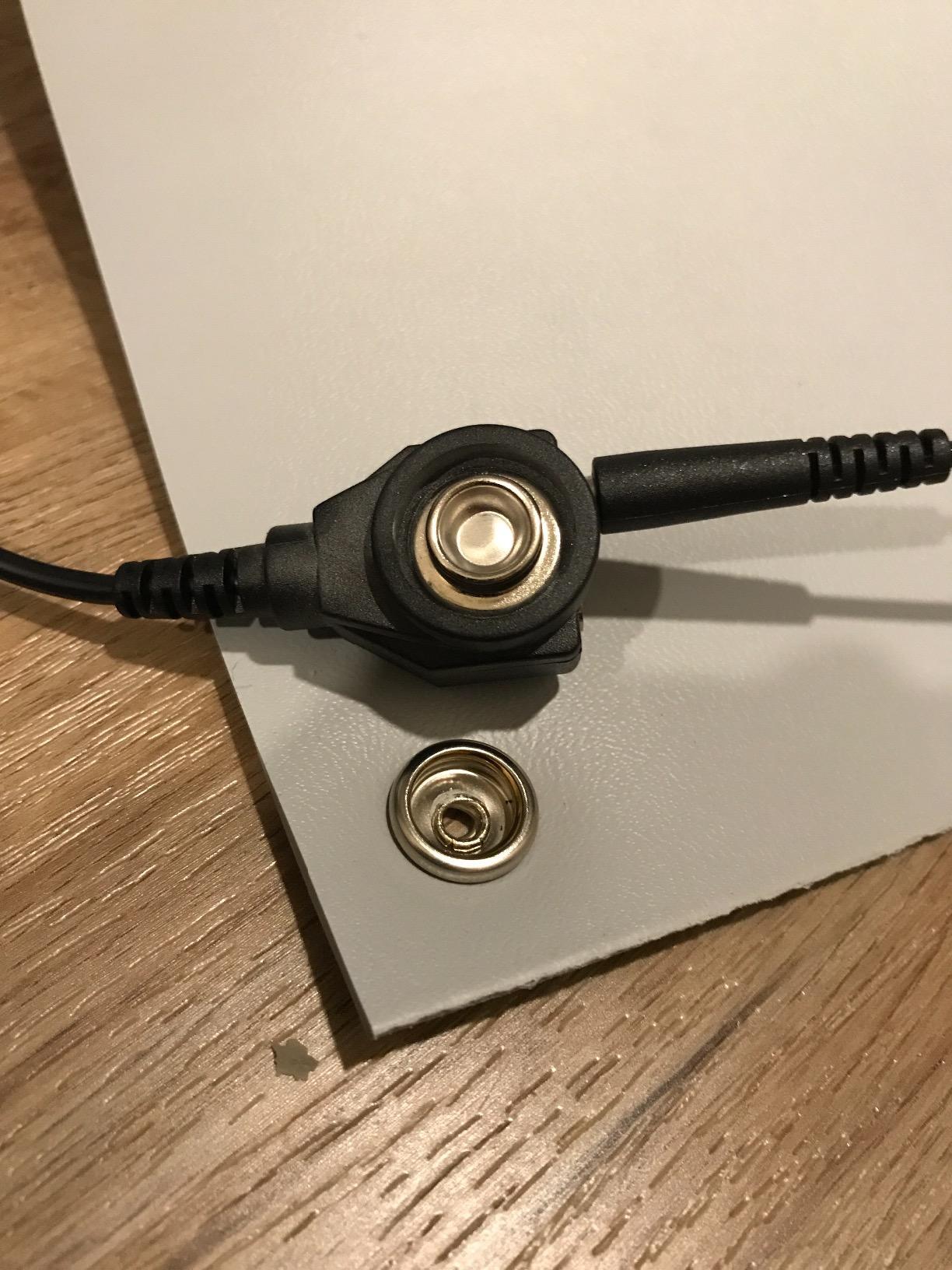
Two snap grounding connectors sit at opposing ends so the cord can run to whichever side suits a left- or right-handed setup, which is a small detail that eliminates cable drag on a crowded bench. The mat can be cut down to a smaller workspace without losing its properties.
When this mat is the right call
Choose this for assembly, disassembly, and PC building where durability over years matters more than surviving a hot iron. It is also the mat to buy if you want a verified resistivity figure rather than a vague claim, and if you work in a small enclosed room where a chemical-resistant surface that wipes clean is valuable.
Owners frequently buy multiple sizes from the same line for different benches, which tells you something about how it wears.
When this mat is the wrong call
Do not solder directly on this mat. Vinyl melts under iron contact, and the published service range stops at 160F, which is well below any working iron temperature. If your work involves actually touching a tip to a surface, you need a silicone pad instead.
Two practical warnings: the vinyl off-gases strongly on arrival and needs days of airing in a closed room, and the supplied wrist strap terminates in an alligator clip rather than a matching snap, so it does not share the same ground point as the mat.
3. Smlirop 932F Silicone Soldering Pad – Best Value for Soldering Directly
SMLIROP Silicone Soldering Mat, 17.7 x 11.8 in Electronics Repair Mat
17.7 x 11.8 inch silicone
Rated to 932F
124 screw slots, 42 spares, 4 magnetic areas
Includes 36 cm ruler
Pros
- Handles direct iron contact up to 932F
- Unusually thorough parts organization for the price
- Large enough for phone
- laptop and PCB repairs
- Non-slip surface that cleans easily
- 86% of ratings are five stars
Cons
- No grounding cord
- plug or wrist strap included
- Light duty construction versus heavier rubber mats
If you want a soldering surface first and an ESD surface second, this is the strongest pick in the roundup for the money. The silicone is rated from minus 40F to 932F, so the iron can sit on it directly, and at 17.7 by 11.8 inches it is large enough to lay a laptop panel or a decent sized PCB on flat.
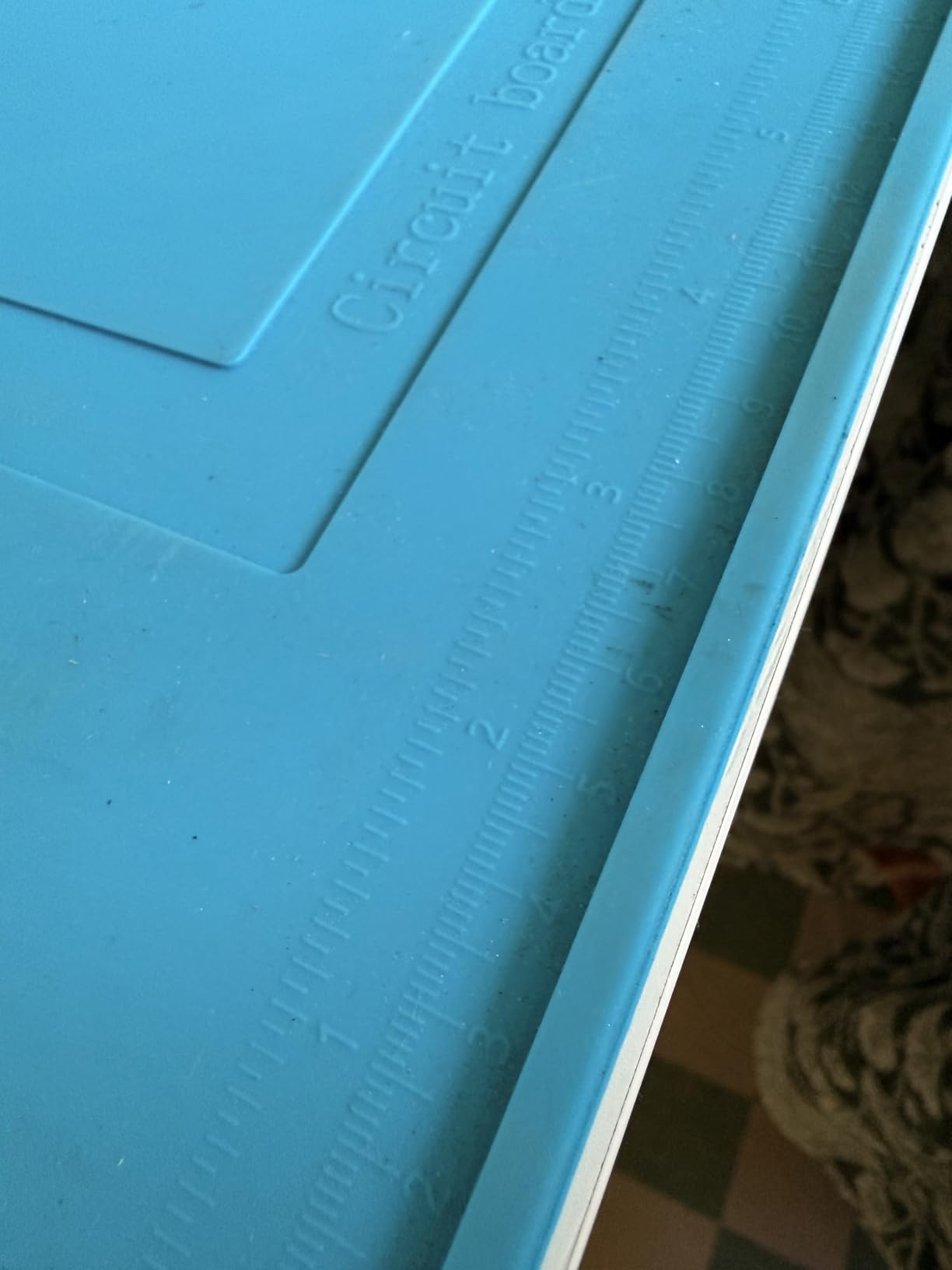
The organization is what surprises people. You get 124 screw slots, 42 spare part slots, 15 notches, three covered compartments, and four magnetic areas sized to hold chips and small metal parts. A 36 cm ruler is printed along one edge. For teardown work that is more than most rubber mats offer at any price.
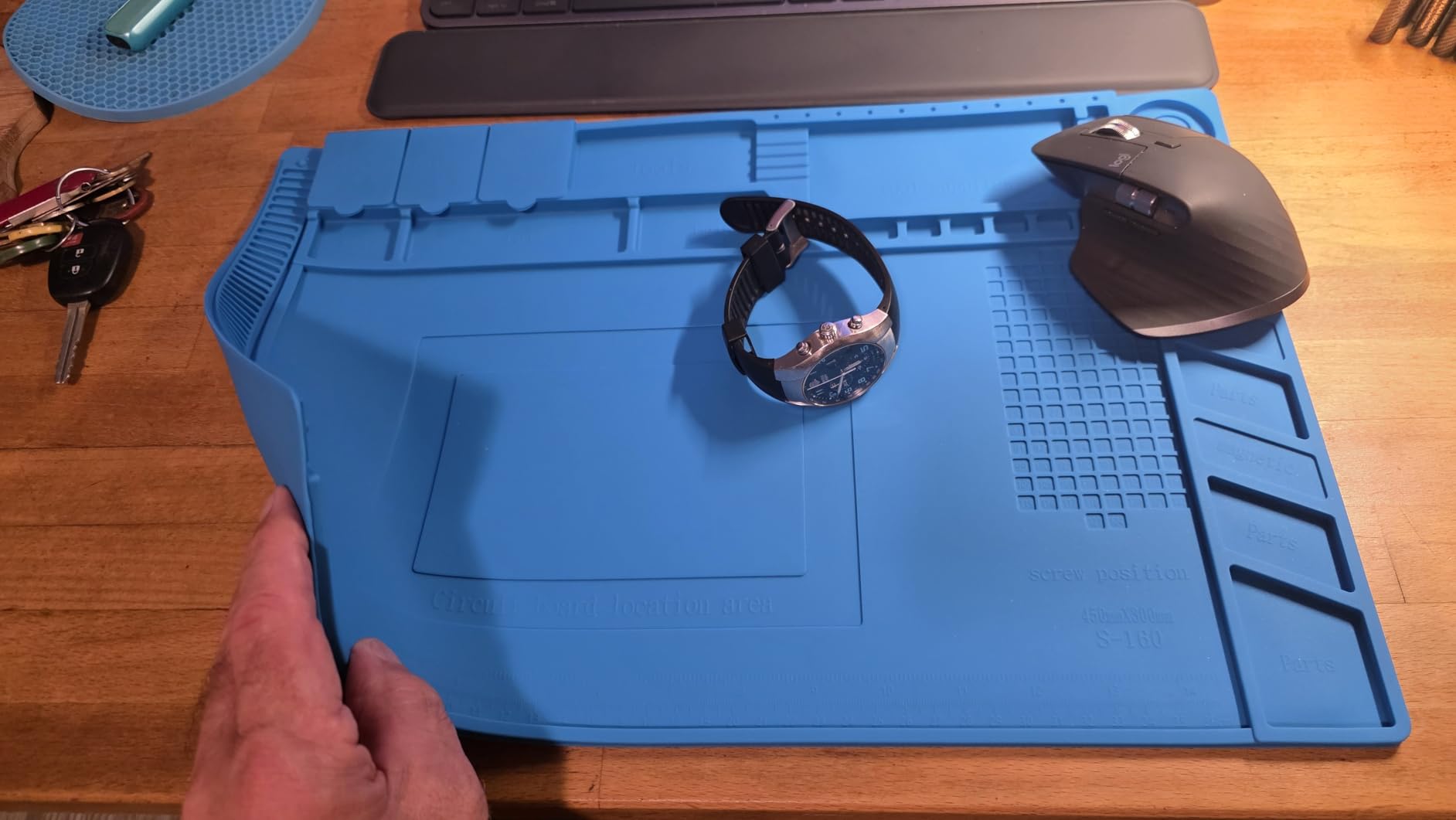
The review profile is unusually clean, with 86 percent five-star ratings out of 462 reviews. Owners treat it as a budget bench mat that punches well above its class, and the recurring note is that the heat rating is real rather than printed on the packaging.
Because there is no magnetic debris trap at the edges, the four magnetic zones matter more than they would on a plain pad. Small screws and shields stay where you put them instead of walking off the surface.
When this mat is the right call
This is the mat for a bench where the iron is going to touch the surface constantly and you want a forgiving, non-slip, easy-to-clean pad. It suits BGA and chip work, phone and laptop repair, and anyone who wants a magnetic parts area without paying for a two-layer rubber mat.
It is also the easiest recommendation in this guide to pair with a separate wrist strap, since you will need one to make the station complete.
When this mat is the wrong call
It is not a grounded ESD station out of the box. No grounding cord, no plug, and no wrist strap are included, so the anti-static claim works as a dissipative surface but has no path to earth until you add accessories yourself.
The construction is light duty next to a thick rubber or vinyl mat. If you want a surface that survives years of daily abuse rather than a few, look at the Bertech or the KooMall instead.
4. CPB 932F Magnetic Soldering Mat – Densest Parts Grid
CPB Heat Resistant 932°F Silicone Soldering Mat, Anti-static Magnetic Mat
17.8 x 11.8 inch silicone
932F food grade silicone
124 screw positions, 42 spare slots
4 magnetic areas, 3 covered boxes
Pros
- Genuinely heat resistant silicone for direct iron contact
- Densest and most varied grid of parts positions
- Anti-slip and anti-scratch on both faces
- Independent sub-grids let you run two jobs at once
- Tweezers included
Cons
- Solder and flux residue clings to the surface and needs cleaning
- No wrist strap or grounding cord included
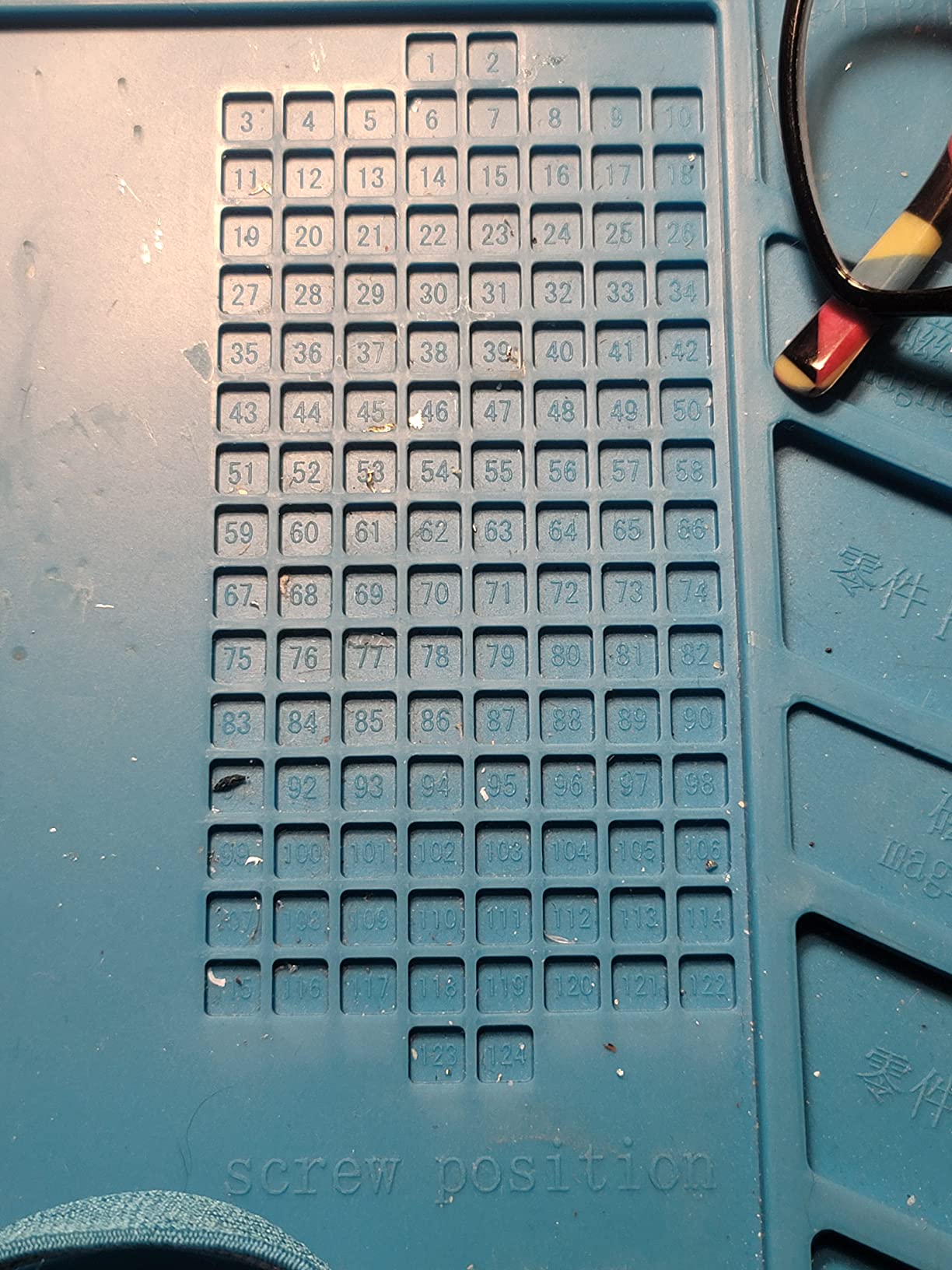
This is the mat we recommend when a teardown produces more screws than you can keep track of. Alongside the 124 screw positions and 42 spare unit positions, it has 15 notches, four magnetic areas, and three covered part boxes that small components will not fall out of.
At 45 by 30 cm it is almost the same footprint as the Smlirop pad, and the silicone is food grade and rated to 932F, so the same direct-contact rules apply. Both faces are anti-slip and anti-scratch, which means you can flip it and keep working if one side gets marked up.
The grid layout is the reason reviewers keep mentioning it. People like that the sub-grids are independent, so you can set a phone teardown on one half and a laptop job on the other without mixing screws between them. Eighty percent of its 308 reviews are five star.
At 0.79 kg it has enough weight to stay put on a bench, which is a genuine improvement over thin pads that skate around when you push a board across them.
When this mat is the right call
Pick this if your work is repetitive disassembly: phone repair, console teardown, watch or small device work where every screw has a home. The covered boxes and magnetic zones are the best combination of part retention in the silicone mats we assessed.
It is also a good second mat for a bench that already has a grounded rubber mat but wants a heat-rated surface for the soldering side.
When this mat is the wrong call
Like the Smlirop pad, it ships without a wrist strap or grounding cord, so it is a soldering pad with anti-static properties rather than a complete grounded station.
Solder and flux residue clings to silicone and has to be cleaned off periodically. It is not a criticism unique to this mat, but if you leave rosin flux sitting overnight you will find it has to come off before the next job.
5. KooMall 36 x 24 Inch Rubber Mat Kit – Best Full Bench Coverage
KooMall 36×24 Inch Anti Static Rubber Mat Kit for ESD Sensitive Electronic Device Repair, Soldering, PC Building, Assembly, Table Work, With Grounding Plug Cord, Antistatic Wrist Strap, Heat Resistant
36 x 24 inch rubber
10^3-10^5 ohms both faces
Heat resistant to 250C
Two 10 mm stud grounding points
Pros
- Full 36 by 24 inch coverage for serious bench work
- Stud-mounted grounding that does not rely on a receptacle screw
- Conductive on both sides so it works either way up
- Rubber wipes clean with water
- Complete kit with cord
- plug and wrist strap
Cons
- Heavy and bulky next to silicone mats
- Less forgiving than silicone for high-temperature iron contact
- A small share of reviews report surface wear over time
This is the mat for someone whose soldering bench is their whole workbench. At 36 by 24 inches it covers a large table, and unlike the adhesive-backed tray liners on the market, it is a proper mat you lay flat and ground with a positive mechanical connection.
Two 10 mm male studs are mounted as grounding points, one near each end, so the cord reaches whichever side your bench outlet is on. The surface resistance is published as 10^3 to 10^5 ohms and the mat is conductive on both faces, which means it works either way up. The temperature rating is 250C, comfortably above through-hole work.
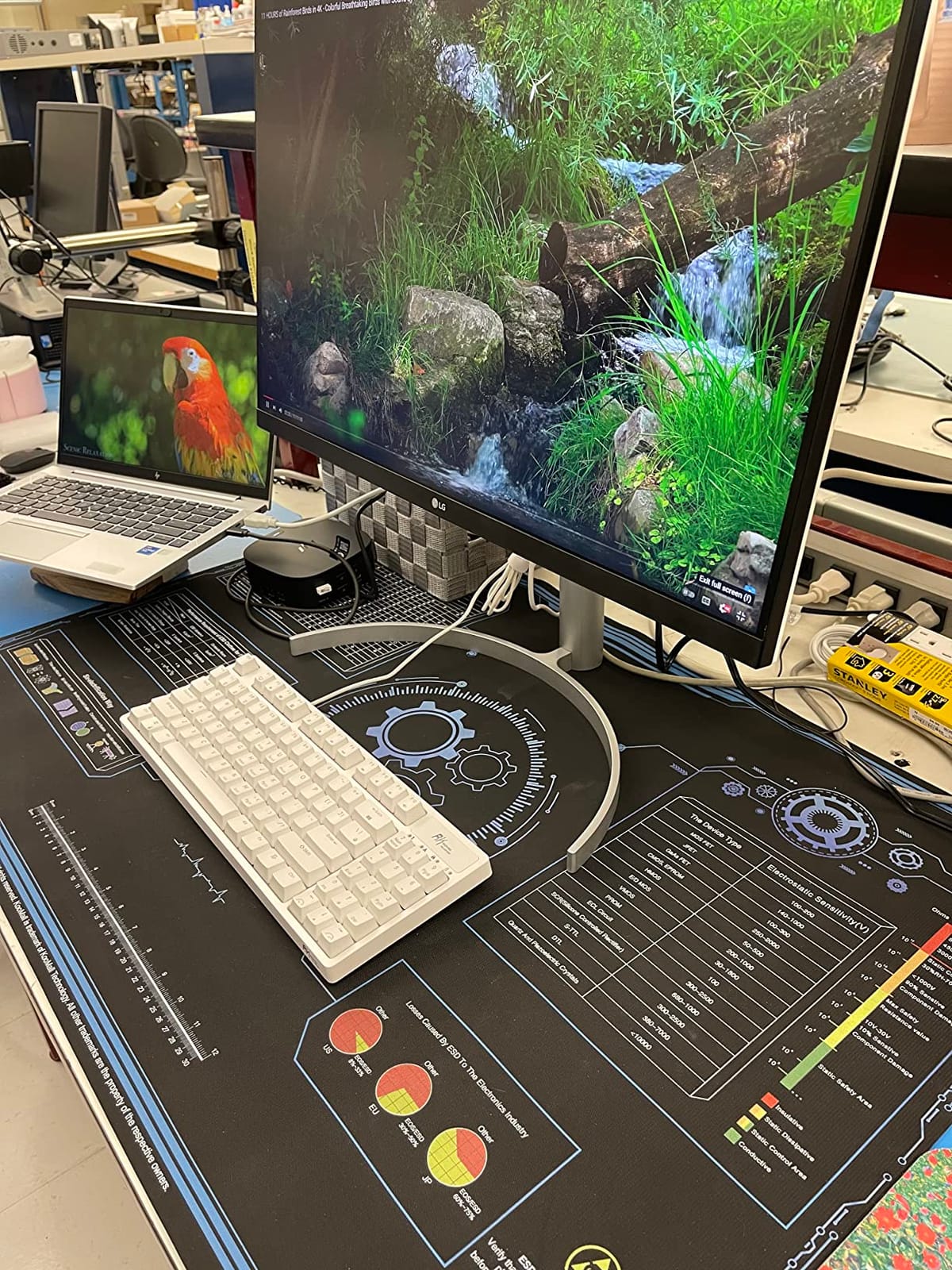
The kit is complete for grounding: mat, cord, US grounding plug, and an antistatic wrist strap. That combination means you do not have to source an earth ground adapter, which is the most common reason a grounding chain gets left unfinished.
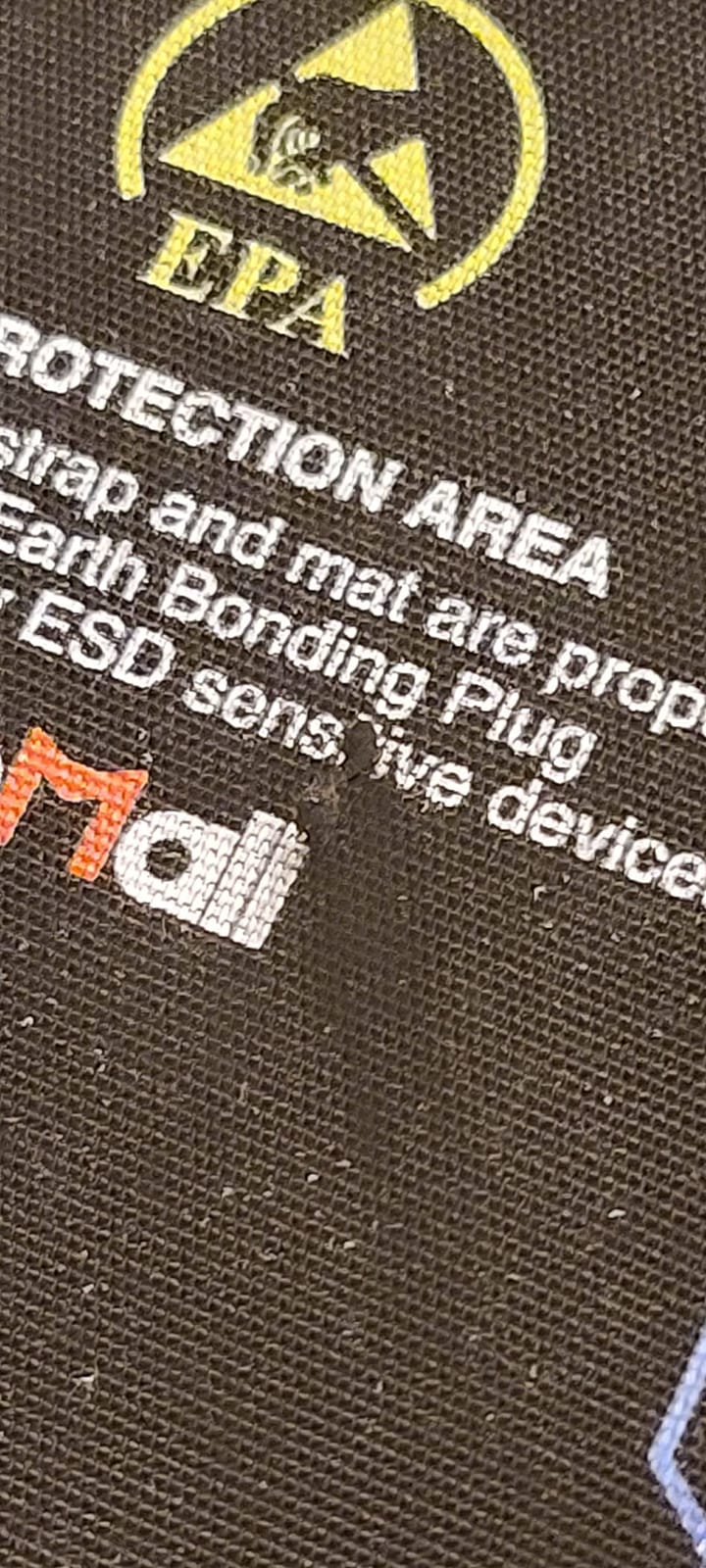
Reviewers use this one for PC building and assembly rather than as a direct soldering surface, and the front face has a non-slip dotted texture plus printed ESD awareness marking so anyone else at the bench understands what the mat is for.
When this mat is the right call
Choose this for a full-size electronics bench, a PC build station, or a shared work table where you want the whole surface protected. The stud grounding and included plug make it the most complete large-format kit in this roundup.
It is also a good choice if you dislike the chemical smell of vinyl, since this is flexible rubber that is water-cleanable and described as non-toxic.
When this mat is the wrong call
It weighs 1 kg and covers a lot of bench, so on a small desk it will dominate the workspace. It is also not the mat to solder directly on for high-temperature work: the 250C rating is well below the 500C figure the silicone pads claim.
A small minority of reviews report flaking or surface wear after extended daily use, so if you want a surface guaranteed to look new in several years, the Bertech is the more conservative pick.
6. Weller ESD Mat 600 x 900 mm – Best Recognized Pro Bench Mat
Weller ESD Mat, Grey 900 x 600 – T0051403599
600 x 900 mm grey mat
Two 10 mm press studs
Heat, solder chemical and oil resistant
Permanently elastic surface
Pros
- 10MOhm top-to-bottom conductivity funnels static to the studs
- Recognized professional bench brand
- Twin studs suit either hand position
- Resists solder chemicals
- oils and heat
- Stays elastic and abrasion resistant
- RoHS compliant
Cons
- No grounding strap or earth plug included
- Slight rubber odor for the first few days
- No parts storage or ruler features
Weller is the only name in this roundup most technicians already have in their hand, and technicians consistently rate this as the best true ESD mat they have used. At 600 by 900 mm it is a bench mat rather than a full bench covering, so it pairs well with a larger surface if you need both.
Owners test the conductive bottom layer and confirm 10MOhm top-to-bottom conductivity, with static draining to the two 10 mm press studs. That is exactly the behaviour an ESD mat is supposed to have, and buyers specifically contrast it with cheap blue silicone pads that do not dissipate at all.
The surface is described as permanently elastic and abrasion resistant, and it is rated against heat, solder chemicals, and oils. Grey is the color, which is a mid-tone that shows flux residue without the glare that a light surface produces under a bench lamp.
Two press studs sit at opposite ends, so the cord can run left or right depending on where your bench ground is. The mat is RoHS compliant.
When this mat is the right call
Pick this if you work at a professional or institutional bench and want a mat with a brand and datasheet behind it rather than a generic listing. The conductivity behaviour is verified by owners with a meter, which is rare in this category.
It is a good bench mat for professional assembly and light soldering work, especially where oil and chemical resistance matters.
When this mat is the wrong call
Only the mat ships in the box. There is no grounding strap, no earth plug, and no wrist strap, so on its own it is a dissipative surface waiting for a ground path rather than a working station.
There are also no parts storage features at all, no compartments, no ruler, and no magnetic areas. If your bench does teardown work, the CPB or Smlirop silicone mats organise parts far better. Expect a mild rubber odor for the first few days.
7. LUTICO 24 x 36 Inch ESD Mat – Two-Layer Build for Assembly Work
Anti Static ESD Mat for Electronics Repair, 24″X36″, Grounding Kit
24 x 36 inch blue mat
Surface 10^6-10^8 ohms
Multi-layer dissipative and conductive
Upper temperature rating 82C
Pros
- Large 24 by 36 inch bench coverage
- Correct two-layer construction with a dissipative top and conductive base
- Grounding kit includes wrist strap
- coil cord and ring terminal cord
- Multiple sizes and colors available
Cons
- Rated to only 82C so no direct hot-iron contact
- Outlet ground adapter not included
- Widest rating spread here at 4.2 with a 9% one-star share
This is the one product in the roundup that describes its construction in the correct engineering terms. It is a multi-layer composite: a blue dissipative top layer that absorbs and spreads static, over a black conductive bottom layer that discharges it. That is the textbook two-layer ESD mat design.
Surface resistivity is published at 10^6 to 10^8 ohms and volume resistivity at 10^5 to 10^8 ohms. At 24 by 36 inches it gives serious bench coverage for PC builds and general electronics assembly.
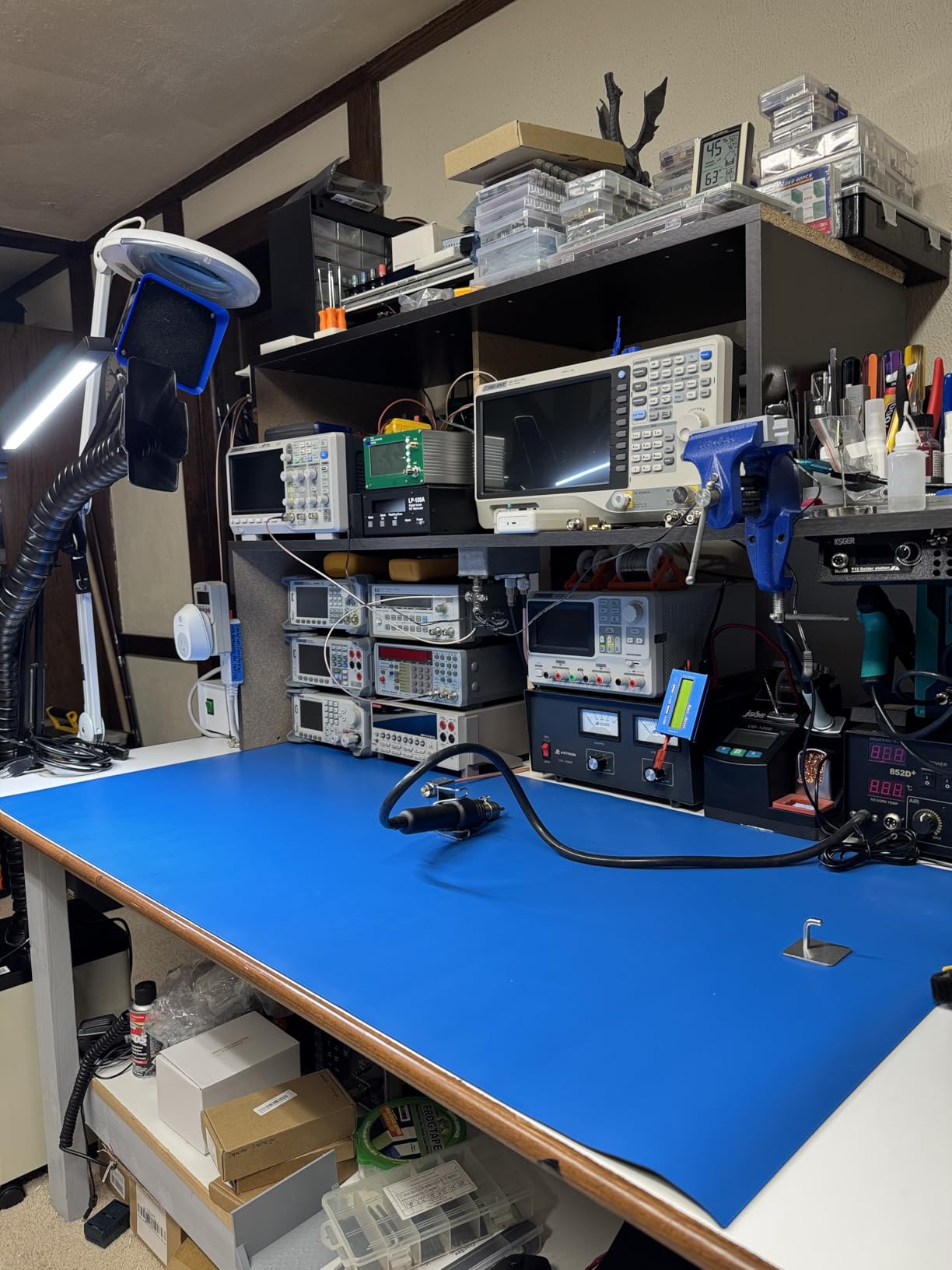
The grounding kit is the best assembled in the box, including a wrist strap, a coil cord, and a common-point ground cord with a ring terminal, so you can tie the mat and your wrist to the same point. Multiple sizes and colors are available for different benches.
It scores 4.2 across 193 reviews, the lowest average in this roundup, and the distribution is wider than the rest, with 65 percent five star and a 9 percent one-star share. The complaints are consistent and understandable rather than random.
When this mat is the right call
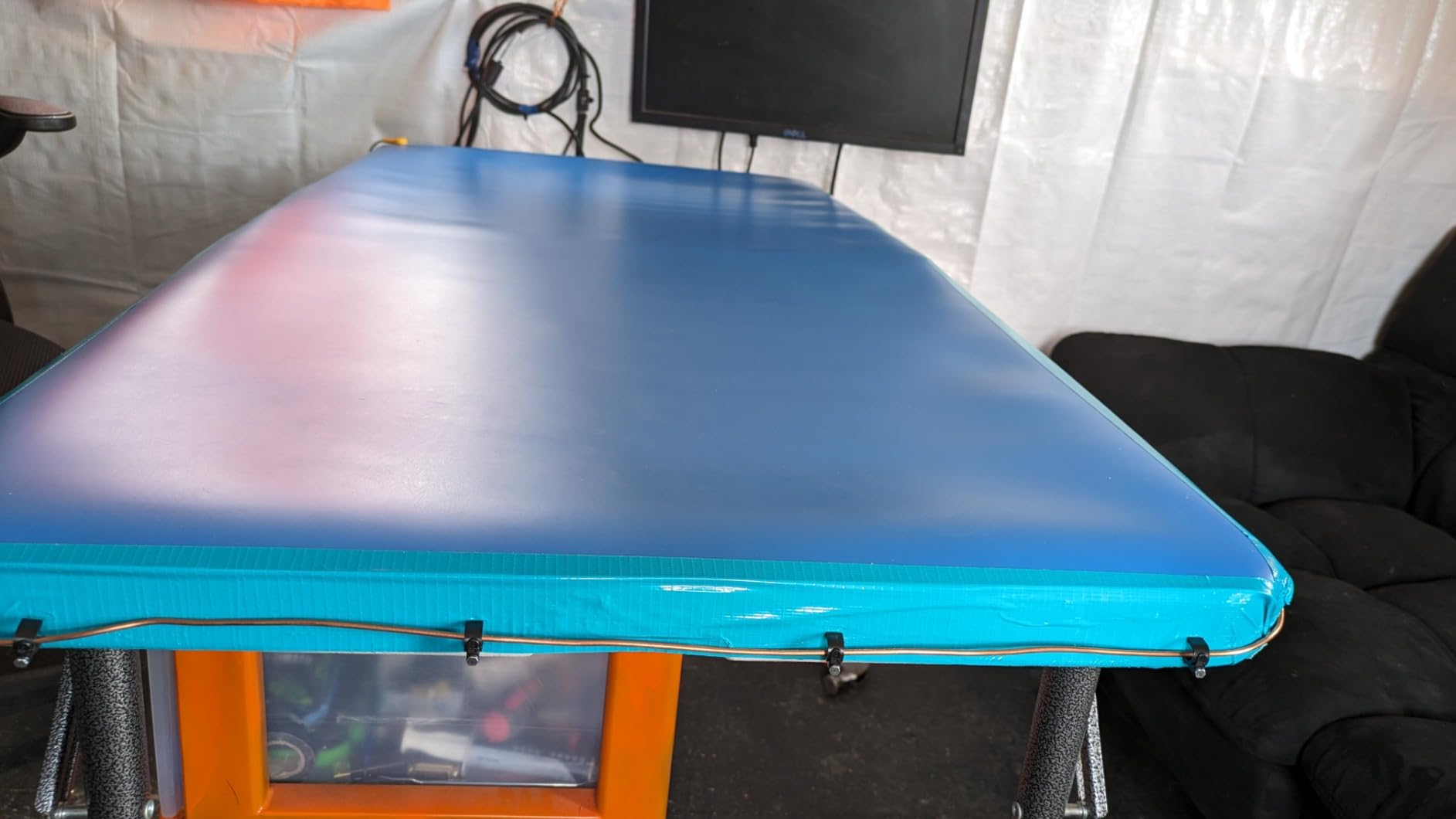
This is the pick for assembly and disassembly on a large bench: PC builds, drive and cable work, and any process where boards are handled but not soldered. The two-layer construction means it discharges properly once grounded.
If you have a wrist strap habit, the common-point cord is a genuinely good piece of kit that many cheaper mats do not include.
When this mat is the wrong call
The upper temperature rating is 82C, which rules out direct hot-iron contact entirely. This is not a soldering mat in the sense the rest of this list uses the phrase; soldering on it will damage it.
And the outlet ground adapter is not included, so the chain is incomplete until you buy one. The Weller has the same gap, but the Weller at least sits closer to the resistance figures most professional buyers expect.
8. Kaisi Large Anti Static Soldering Mat – Best Heat-Resistant Area Per Dollar
Kaisi Large Anti Static Mat with Grounding Accessories,Soldering Mat
21.6 x 16.9 inch silicone
932F heat resistant, corrosion resistant
Resistivity 10^6 ohms
Grounding line, plug and wristband included
Pros
- Large 21.6 by 16.9 inch surface for the money
- Combines 932F heat resistance with included grounding accessories
- 48 screw and parts positions
- Soft silicone protects the bench from iron and hot air
- Covers laptops
- drones and large PCBs
Cons
- Grounding accessories are hidden inside the cardboard tube
- Only 48 parts positions versus 124 on the CPB and Smlirop
- Modest 4.4 rating with a 5% one-star share
This is the pick if you want a large surface you can solder on directly and still have a complete grounding kit in the box. At 21.6 by 16.9 inches it is one of the bigger silicone mats we assessed, and at 2.4 pounds it stays flat rather than skating around.
The silicone is rated to 932F, which is 500C, and the manufacturer states it will not damage a workbench under heat. It supports both soldering iron and hot air station contact, which is the real test for any mat used on a rework bench.
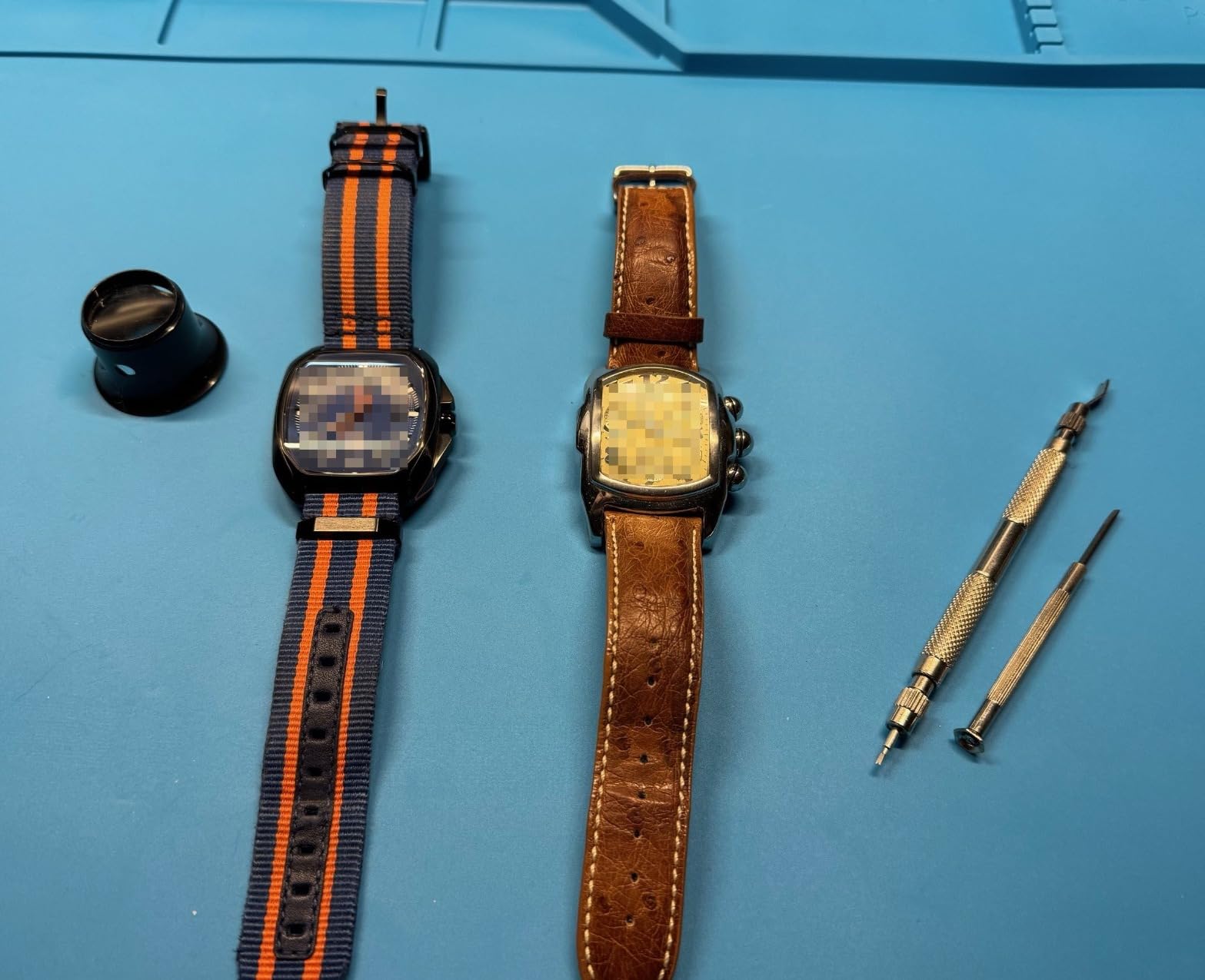
Resistivity is listed as 10^6 ohms and the surface is described as corrosion resistant, which is useful for a bench that sees flux, moisture, and repeated wipe-downs. The kit includes a grounding line, a grounding plug, and an anti-static wristband.
Buyers like the combination of area and heat rating at this price point. The single most repeated practical complaint is not about the mat at all: the grounding accessories are packed inside the cardboard tube rather than visible in the box, and plenty of owners discovered them late.
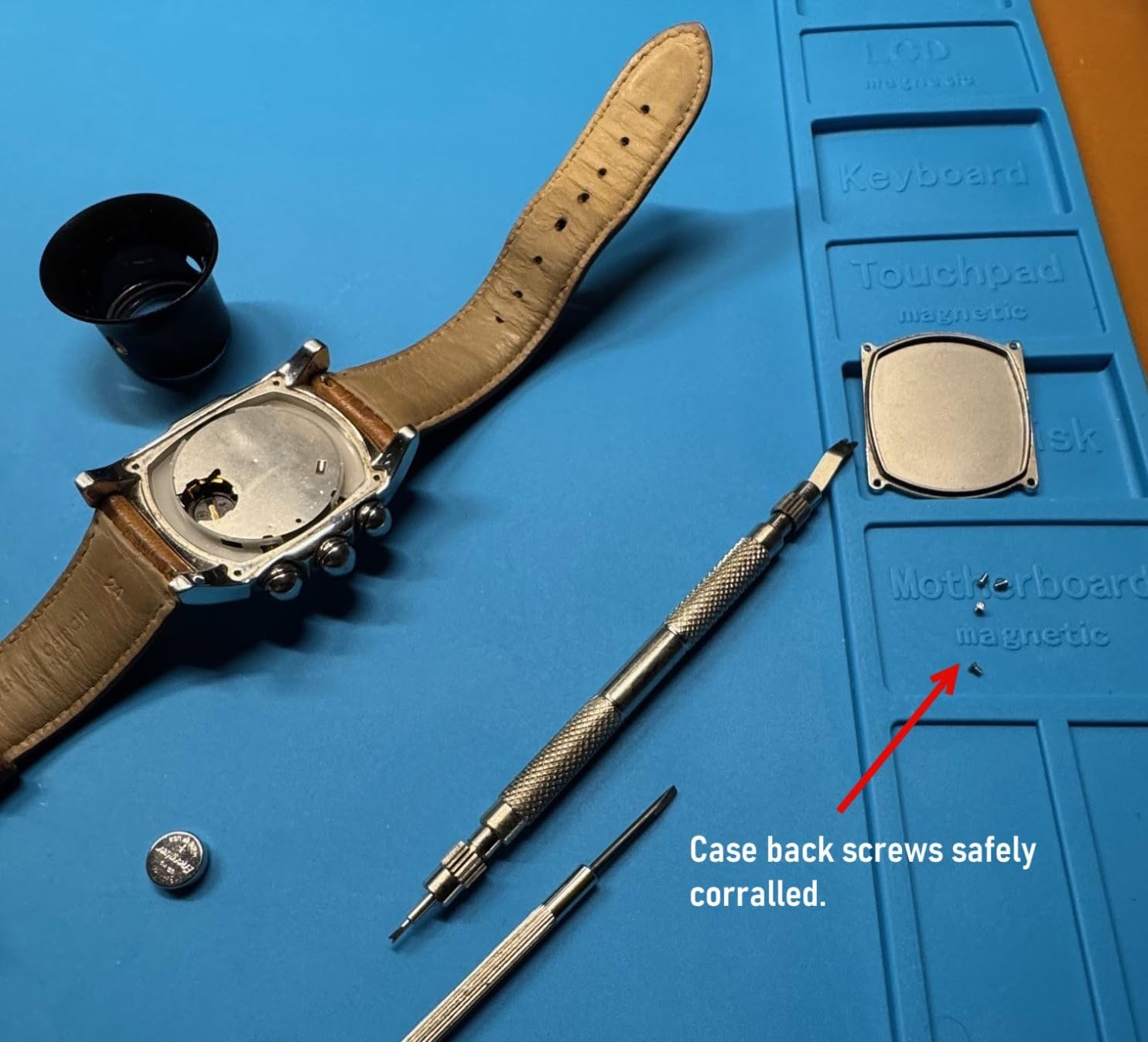
When this mat is the right call
Choose this for laptop, drone, and larger PCB work where you need both a hot-iron-tolerant surface and more area than a phone-sized pad. It is also one of the few mats that ships grounded and heat-rated in the same box.
The soft silicone is a genuine advantage if you occasionally park a hot air rework gun on the bench surface, which would mark most rigid mats.
When this mat is the wrong call
The organization is thin by comparison. Forty-eight screw and parts positions is less than a third of what the CPB and Smlirop mats provide, so if your work involves a large teardown you will be sorting screws by hand.
And open the tube before you assume your kit is incomplete. More than one owner has posted about finding the cord, plug, and wristband buried in the packaging rather than laid out with the mat.
9. Kaisiking Anti-Static Mat Kit – Highest Rated, Densest Screw Grid
Kaisiking Anti-Static Mat Kit for Electronics Computer Repair or Soldering
15.7 x 11 inch anti-static silicone
932F heat resistant
210 screw positions, 12 large slots
Mat, strap, wire and plug included
Pros
- Highest average rating here at 4.8 with zero one-star reviews
- Complete kit with strap
- wire and plug in one box
- 210 screw positions is the densest grid in the roundup
- Silicone infused with anti-static material rather than plain silicone
Cons
- Smallest working area here at 15 by 7.8 inches
- Only 50 reviews so the rating rests on a small sample
- Not magnetic so loose chips can wander
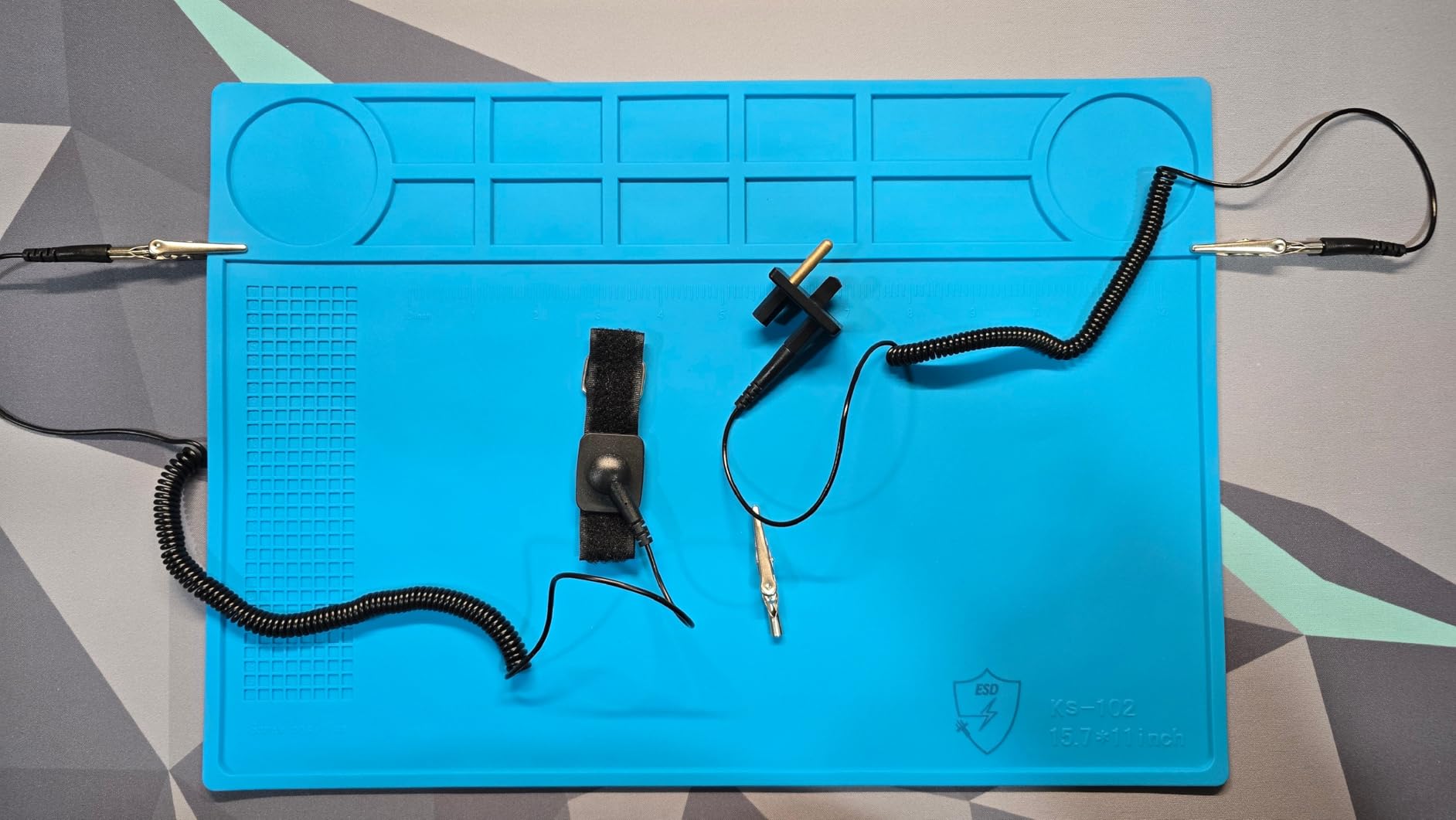
The 4.8 stars here are the highest average in the roundup, with 84 percent five star and no one-star reviews at all. It is also a properly complete kit: mat, anti-static wrist strap, grounding wire, and grounding plug in one box, which is the part most budget silicone pads skip.
What separates it from a generic heat-resistant silicone pad is the material claim. This one states the silicone is infused with anti-static material rather than being a standard silicone mat, and it pairs that with 932F heat resistance for direct soldering.
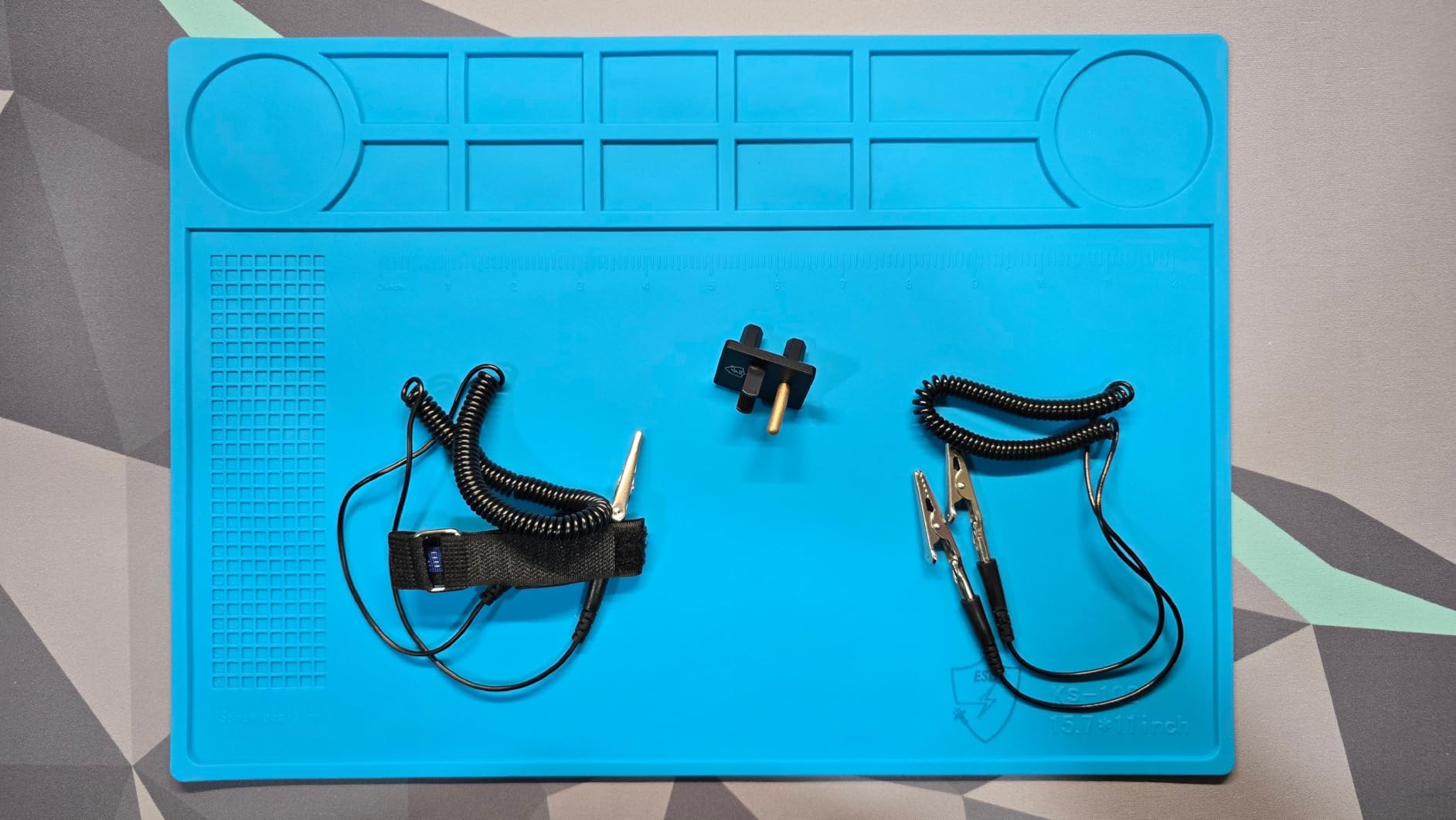
The organization is the standout: 210 mini screw positions plus 12 large slots. For phone, watch, and small circuit board work that density means a complete teardown stays laid out in the order you removed it, which is where the review praise concentrates.
At 15.7 by 11 inches the mat itself is compact, and the usable working area inside the grid is quoted at 15 by 7.8 inches, so the physical footprint is the limit rather than the features.
When this mat is the right call
This is our recommendation for phone, watch, and small board repair, where the screw grid density matters more than surface area. It is also the safest pick for a first soldering mat, because everything needed to ground it arrives in the box.
If you have been putting off a wrist strap because you did not know which to buy, this kit removes that decision.
When this mat is the wrong call
The working area is the smallest here, and reviewers specifically note it is tight for laptops. If your work involves opening anything bigger than a phone, step up to the Kaisi at 21.6 by 16.9 inches or the Hooandxk.
Two honest caveats. The 4.8 rating comes from only 50 reviews, so it is a small sample compared with the top pick’s 2421. And there are no magnetic areas, so loose chips and very small parts can still move.
10. Hooandxk Black Soldering Mat – Best Black Mat for Reflective Displays
Anti Static Soldering Mat, Extra Large 27.6″ x 15.7″ Heat Resistant 932°F Silicone ESD Safe Work Mat for Electronics, Cellphone, Computer, Laptop, Watch (Black)
27.6 x 15.7 inch black silicone
10^6-10^9 ohm surface resistivity
932F heat resistant
Foldable and portable
Pros
- Largest silicone surface in the roundup at 27.6 by 15.7 inches
- Black surface avoids reflections on instruments
- 932F rating confirmed for direct iron contact
- Documented 10^6-10^9 ohm resistivity
- Folds flat for storage under a bench
Cons
- No grounding accessories included at all
- No magnetic areas or screw grid
- Smallest review base here at 35 ratings with an 8% one-star share
Black mats are hard to find in this category, and the reason is documented: buyers on r/AskElectronics want black specifically because blue and grey mats reflect on instruments with reflective displays, which makes them harder to read and harder to photograph. This is the only black bench mat in our list.
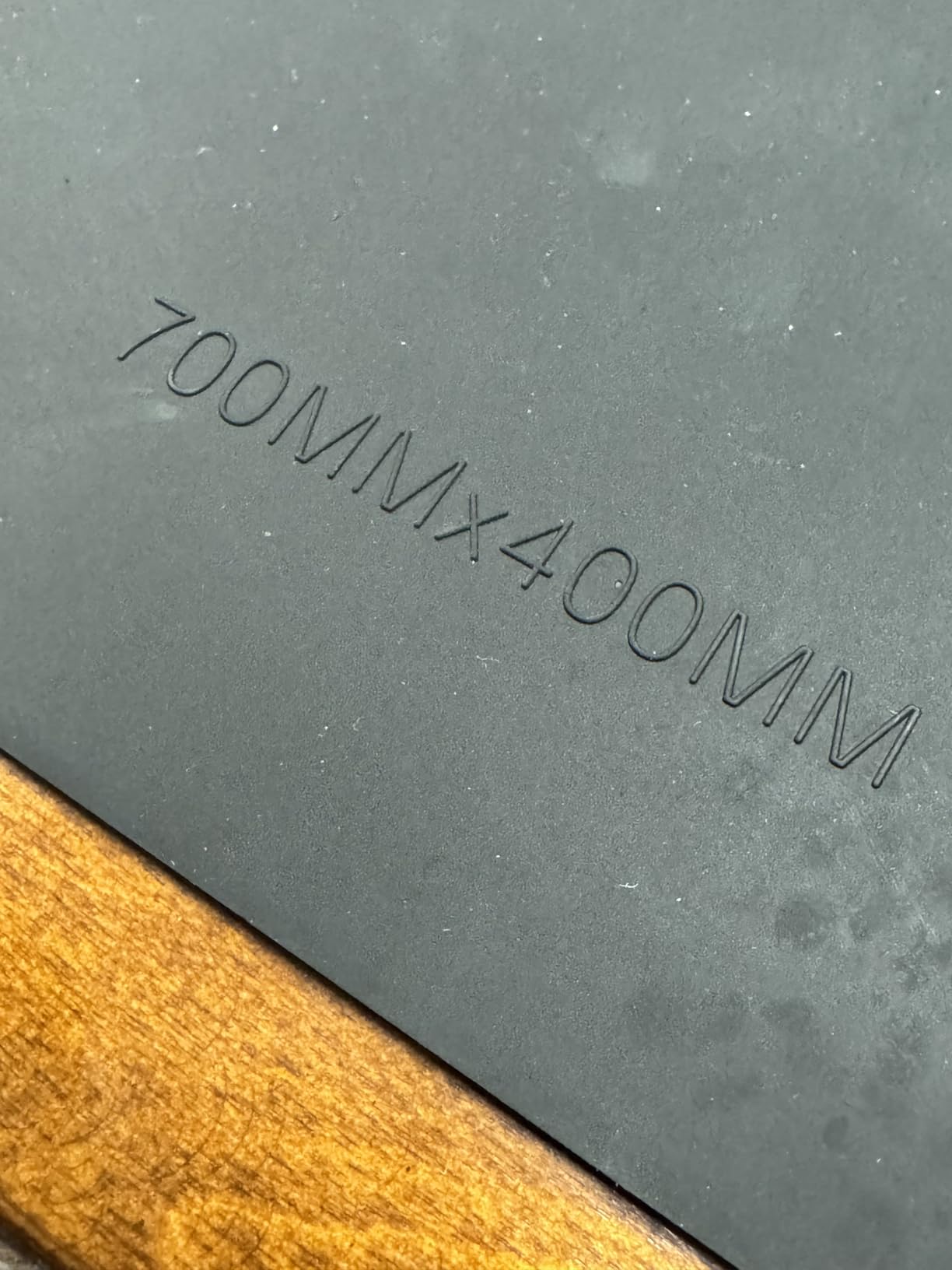
It is also the largest silicone surface here at 27.6 by 15.7 inches, or 70 by 40 cm, which is enough to lay a laptop flat with tools alongside it. Surface resistivity is published at 10^6 to 10^9 ohms and the silicone is rated to 932F for direct iron and hot air contact.
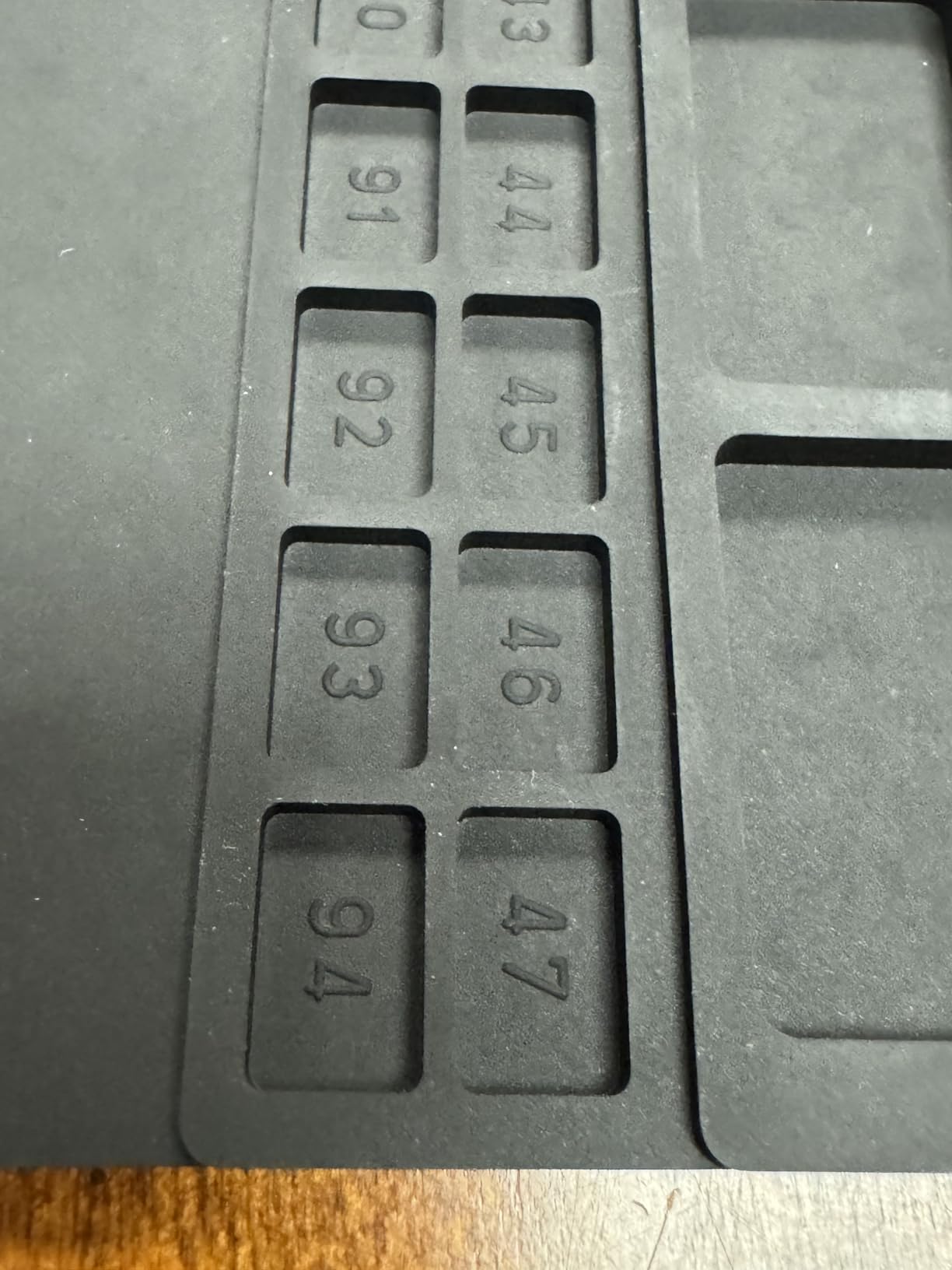
Owners highlight the area per dollar more than anything else, and the heat rating is confirmed in reviews rather than just claimed. It folds flat, so it stows under a bench and does not occupy shelf space the way a rigid mat does.
It is a plain work surface, though. There is no ruler, no screw grid, no magnetic areas, and no included grounding cord, plug, or wrist strap, so the ESD claim is a surface property rather than a complete station.
When this mat is the right call
Pick this if you work on devices with reflective or glossy screens and the glare from a blue or grey mat is a genuine problem, or if you photograph repair work for documentation or tutorials. It is also the best area-per-dollar silicone surface in the roundup.
For a large but unlit bench, the 36 by 24 inch KooMall covers more ground if you can spare the space.
When this mat is the wrong call
It ships with nothing but the mat, so building a grounded station means sourcing a cord, an earth adapter, and a wrist strap separately. On a bench where static damage is the real risk, that is the dealbreaker.
With 35 ratings it has the thinnest review base in the roundup, and 8 percent of those are one star, the highest one-star share of the silicone mats here. Treat the 4.4 as provisional rather than settled.
How to Ground an ESD Soldering Mat
A grounded mat is what makes the difference between a real ESD station and a rubber sheet. The chain is short, and almost every question we saw on r/electronics came down to one point: does the mat need a resistor between it and earth ground? It does.
Find the grounding point on the mat. Look for a 10 mm stud, a press stud, or a snap connector. In this roundup the KooMall and the Weller use 10 mm studs, the Bertech uses snap connectors at both ends, and several silicone kits terminate the cord at a stud on the mat edge.
Install a 1 megaohm safety resistor in series. This resistor limits fault current so that if a mains voltage ever appears on the mat, it cannot push dangerous current through you to ground. It is the single step most often skipped, and it is the one to insist on.
Connect to earth ground. Run the cord to a properly earthed outlet. The kits that include a plug or ring terminal are using the receptacle earth, which is the correct reference point. Kits that rely on a receptacle screw are workable but far less convenient.
Add the wrist strap as a parallel branch. The strap goes to the same common ground point as the mat, either through a bench-mounted terminal or through the mat’s own stud with a second cord. Both paths then share the 1 megaohm protection on the way to earth.
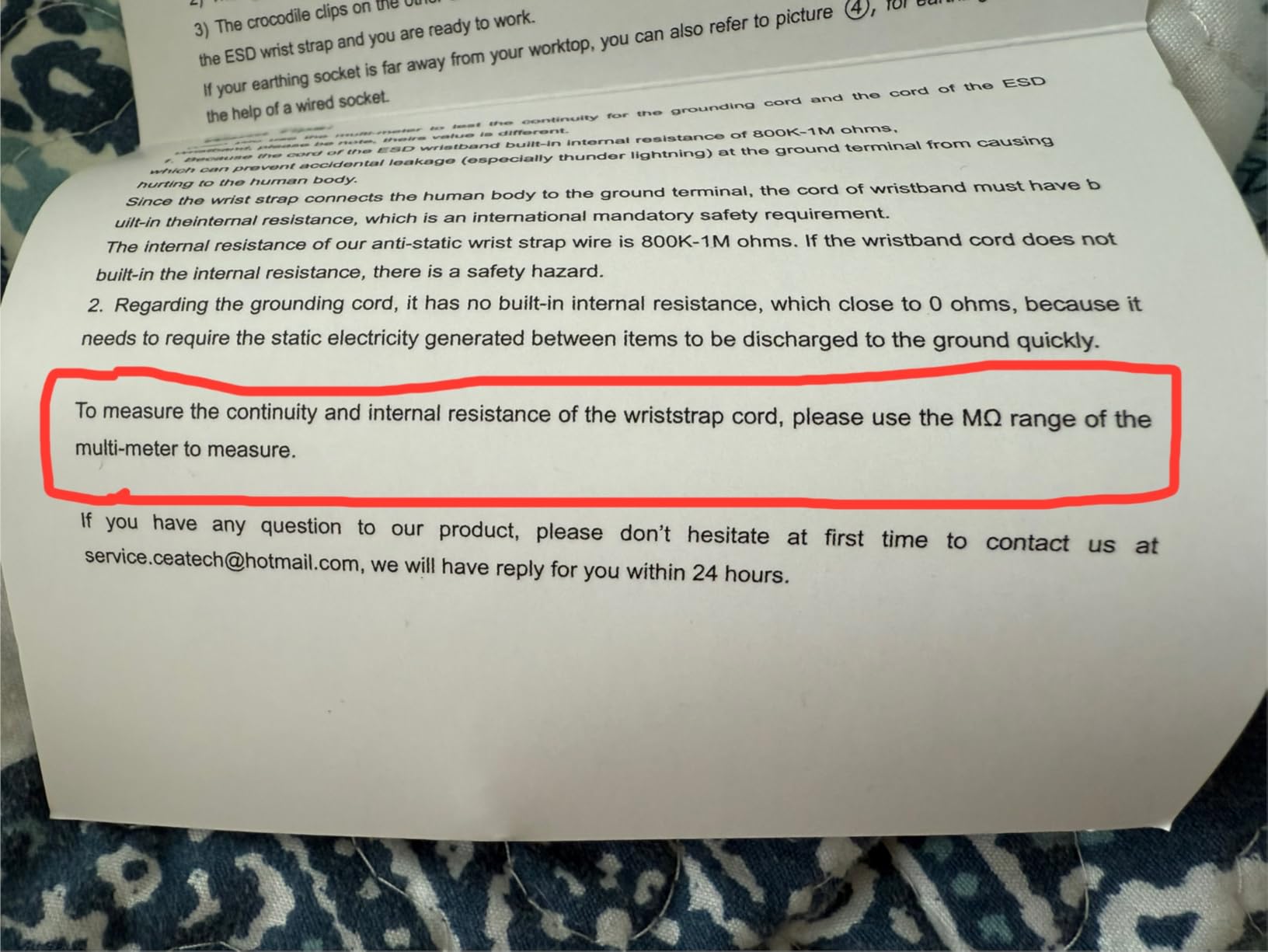
Verify the whole path. With a meter, you should see continuity from the mat surface to the earth pin, and resistance in the megaohm range rather than a dead short or an open circuit.
Never bond the mat directly to earth without the resistor. A directly grounded mat is a conductive surface connected to mains earth, and that is a serious hazard if the bench wiring is faulty.
ESD-Safe vs Anti-Static: How to Tell the Difference
“Anti-static” on a retail listing means almost nothing. On a datasheet, an ESD-safe mat has a specific meaning: a controlled surface resistance, normally somewhere between 10^6 and 10^10 ohms, and a documented construction.
Two terms do the real work. A dissipative surface lets charge flow across it slowly, at a measured rate, which is what you want on a bench. A conductive surface drains charge fast, almost like a conductor, and works well for tray liners and packaging but is not ideal under a board where you want controlled bleed-off. The KooMall is a rare mat in this list that is conductive on both faces, at 10^3 to 10^5 ohms, which is a deliberate choice for assembly coverage rather than fine SMD work.
Two resistance figures matter, and they are not the same number. Point-to-point resistance is measured across the surface of the mat, and for a proper two-layer ESD mat it typically falls between 10^8 and 10^9 ohms. Point-to-ground resistance is measured from the surface to earth, and it needs to be much lower, often 10^5 to 10^6 ohms, because that is the path the charge actually takes. A listing quoting only one of them, with no measurement method, is telling you half the story.
What to look for in practice: a stated ohm range, a named material rather than “premium silicone”, a snap or stud grounding point, and a ground cord in the box. The mats in this roundup that fail that test are the ones where we flagged grounding accessories as a con.
For a hobbyist without a megohmmeter, you can get part of the way with a standard multimeter. Continuity from the mat surface to the earth pin of a grounded outlet should read high but finite, and a surface that reads as a dead short or as completely open is telling you something real. It will not give you a calibrated ohm figure, but it will catch a mat that is not connected at all.
How to Choose an Anti Static Mat for Soldering
Material types compared
Silicone is the hobbyist default and the reason most of this list is silicone. It survives direct iron contact up to 932F, resists flux and rosin, and is easy to wipe clean. It is a heat material first and an ESD material second, and its published resistivity numbers range from 10^6 to 10^9 ohms.
Two-layer ESD rubber or vinyl puts a dissipative layer over a conductive base. This is the correct construction for real ESD work because charge is spread on top and discharged underneath. The tradeoff is heat: the Bertech is rated only to 160F and the LUTICO to 82C, because the layered construction and the vinyl top layer cannot take an iron.
Single layer homogenous polymer, which is what the Bertech is, sits between the two. It is one material with anti-static properties mixed through it, which makes it very tough and gives it a long service life, but it does not add heat resistance.
Solid vinyl with a buried conductive fleece is the third option you will see in industrial catalogs. It is a workhorse assembly surface, chemically resistant, and not a soldering surface.
If you solder directly on your mat, silicone is the only one of those four that survives it.
Heat resistance: what temperature the mat must survive
Through-hole soldering typically runs around 700F, or 370C. Surface-mount work is gentler, closer to 600F or 315C. Your mat has to tolerate an iron tip touching it, because that is going to happen sooner or later.
That is why the silicone pads in this roundup claim 932F, which is 500C, comfortably above both working temperatures. The rubber and vinyl mats do not: the KooMall is rated to 250C and the Bertech to 160F, which is why those are assembly mats. A mat rated to a temperature only survives it in sustained contact, so treat a stated rating as a ceiling rather than a licence to park an iron indefinitely. If you are still choosing tools, our soldering iron guide covers the temperature ranges these mats need to handle.
One more practical point from the CEED Wiki: touching plastics with a hot iron leaves a film on the tip that inhibits soldering. That is the concrete reason heat resistance is a soldering feature and not a cosmetic one.
Size and bench layout
Match the mat to the largest thing you routinely work on, not to your bench. Roughly, a 12 by 9 or 15 by 11 inch mat suits phones, watches, and small boards. A 17 by 12 inch pad covers laptop panels and mid-size PCBs. A 20 by 14 to 22 by 17 inch mat is the sweet spot for laptop and console repair. A 24 by 36 or 36 by 24 inch mat is a full workbench surface for PC builds and assembly.
Two sizing realities. There is no clean 12 by 24 inch bench mat in this category, which is why buyers on forums end up cutting larger mats down, and that works fine on every mat here that is described as cuttable. And the physical mat size is often larger than the usable working area once screw grids and rulers are printed on it, so check the working area figure rather than the outer dimensions.
Color and optical reflection
Blue and grey dominate because they are the default industrial colors, and for most benches that is fine. Black is harder to source at bench size and is worth the hunt if you work on devices with reflective displays or photograph your repairs, because a light mat bounces glare across a glossy screen and a dark one does not.
Two secondary considerations. A very light surface shows every flux stain permanently, and a highly reflective silkscreened surface can create its own glare problem. If your bench is lit by a strong task lamp, a mid or dark grey is usually the least tiring choice over a long session.
Kit contents and grounding accessories
Sorting the kits by what actually arrives in the box changes the ranking fast. Complete kits with mat, cord, plug, and wrist strap: HPFIX, KooMall, Kaisi, and Kaisiking. Mat plus cord and strap but no earth adapter: the Bertech and the LUTICO. Mat only, everything else sold separately: the Smlirop pad, the CPB mat, the Weller, and the Hooandxk.
An ungrounded mat is a dealbreaker, because the grounding cord is not an accessory, it is the feature. The cheapest fix is buying a mat you like and then adding a cord, a 1 megaohm safety resistor, and an earth ground adapter yourself, which is often cheaper than paying for a kit that includes features you will not use.
What a mat cannot do
A mat does not protect against mains leakage from a poorly grounded soldering iron. That is a separate electrical safety problem, and it is why grounding your iron matters independently of your mat.
A mat does not replace a wrist strap. For fine SMD and CMOS work, the strap is the part that protects the part you are holding; the mat protects what is lying on it.
A mat does not stop flux burns or solder splatter, and it does not stop a lifted pad from a cold joint. It also will not protect the bench under a 500C tip unless its rating says so. And a mat is not a substitute for a bonded bench top in a production environment, where the whole surface, not a mat laid on it, is the ESD control.
Frequently Asked Questions
Is an anti-static mat necessary for soldering?
For pure through-hole work on cheap discrete circuits, it is optional. For SMD rework, dense boards, CMOS parts, and phone, laptop or console repair, it is effectively mandatory, because those boards can be destroyed by a few thousand volts of electrostatic discharge you cannot feel. A mat only works when it is grounded through a cord and a 1 megaohm safety resistor.
What is the best material for anti-static mats?
Two-layer ESD rubber or solid vinyl with a buried conductive layer is the correct choice for real ESD work, typically measuring 10^8-10^9 ohms point-to-point and 10^5-10^6 ohms point-to-ground. For a soldering bench where the iron touches the surface, silicone is the practical answer, because it survives 932F contact while vinyl melts.
What is the best heat-resistant mat for soldering irons?
Silicone mats rated to 932F, or 500C, are the best heat-resistant option because through-hole soldering runs near 700F and SMD work near 600F. The HPFIX, Smlirop, and CPB pads in this roundup all carry that rating. Rubber and vinyl mats rated to 250C or below are assembly surfaces and will not survive direct iron contact.
What is the best soldering mat?
The HPFIX Silicone Soldering Mat is the best all-round choice because it is heat rated to 932F, publishes 10^6-10^8 ohm resistivity, and ships with a wristband, grounding cord and plug in one box. For large-area budget work the Smlirop pad offers more surface, and for teardown-heavy phone repair the Kaisiking kit has the densest screw grid.
Do I need to ground an anti static mat?
Yes. An ungrounded ESD mat does very little, because charge needs a path to earth. The chain is mat stud, then a 1 megaohm safety resistor in series, then an earth ground outlet, with the wrist strap wired in as a parallel branch to the same point. Never bond a mat directly to earth without that resistor.
Conclusion
The best anti static mat for soldering is the HPFIX Silicone Soldering Mat, because it is the only pick that combines a 932F heat rating, a published 10^6 to 10^8 ohm resistivity, and a full grounding kit in the box at a size that fits a real repair bench.
If your work is assembly rather than soldering, the Bertech is the more durable choice, and if you need black, the Hooandxk is the one to find. Whatever you pick, check the resistance figure, confirm the ground cord is included, and wire the 1 megaohm safety resistor into the path. Our soldering station guide covers the other half of the bench.