
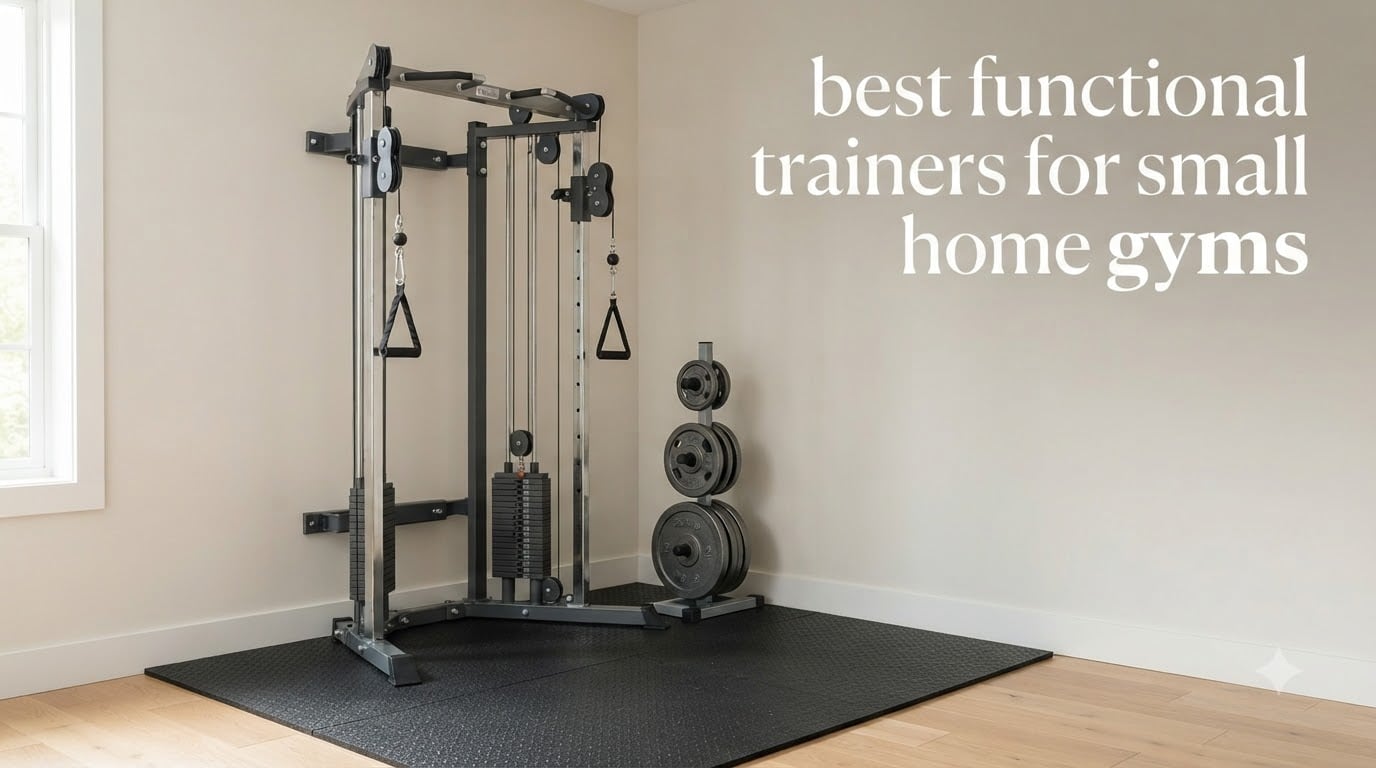
Functional trainer definition: a functional trainer is a cable machine built around two independently adjustable pulley columns plus a resistance source, either a selectorized weight stack or your own plates, so you can perform presses, rows, pulldowns, flyes and rotational work from one machine footprint.
Here is the honest version of the buying problem. Most roundups rank functional trainers by price tier, and none tell you whether the machine will physically sit in your room. For a small home gym the width, the height against your ceiling, the working space in front of it and whether it must be bolted down matter more than the badge on the box. So we ranked all ten picks by room size instead.
The category splits into two camps: true dual-stack machines that behave like a commercial cable crossover, and compact plate hybrids that trade total weight for footprint. A wall-mounted station at three square feet and a dual-stack tower at 62 inches wide are both legitimately functional trainers, and for a spare room they are not comparable purchases. If you are still mapping out the rest of the room, our small-space home gym guide covers the other half of the layout problem.
Our overall winner for tight rooms is the Valor Fitness BD-62 wall mount. At 25 inches wide by 25 inches deep it takes roughly four square feet and has switchable 1:1 and 2:1 ratios. With a full garage bay and commercial weight wanted, the Inspire Fitness FTX is the better machine. Every measurement below comes from the manufacturer listing, checked on 29 September 2026. We may earn a commission if you buy through links on this page, and it never changes our ranking.
Table of Contents
Top 3 Picks for Small-Space Home Gyms in 2026

Valor Fitness BD-62 Wall Mount
- Roughly 4 sq ft wall-mounted footprint
- 16 pulley height positions
- Switchable 1:1 and 2:1 cable ratios

Inspire Fitness FTX Compact
- Two independent 165 lb weight stacks
- 40 inch wide with sliding pulleys
- Accessory kit and device shelf included

Goimu WM1 Wall Cable Station
- Smallest footprint here at 3.28 sq ft
- 17 pulley positions with 1:1 and 2:1 switch
- 300 lb capacity on 14-gauge steel
The Valor takes the overall spot because it solves the actual constraint: it is the only machine here giving a genuine two-column cable station while using under five square feet and no floor footprint at all. The Inspire FTX is the better buy with a garage bay and 165 pounds of selectorized resistance per side. The Goimu WM1 is the pick if you want the same idea for less and are willing to tune the cable tension yourself.
Best Functional Trainers for Small Home Gyms (October 2026)
| Product | Specifications | Action |
|---|---|---|
| Valor Fitness BD-62 Wall Mount |
|
Check Latest Price |
| Inspire Fitness FTX |
|
Check Latest Price |
 Body-Solid Powerline PFT100 Body-Solid Powerline PFT100 |
|
Check Latest Price |
 DONOW Smith Machine with Stacks DONOW Smith Machine with Stacks |
|
Check Latest Price |
 Mikolo M-G3 Wall Cable Station Mikolo M-G3 Wall Cable Station |
|
Check Latest Price |
| Goimu WM1 Wall Cable Station |
|
Check Latest Price |
 MAJOR FITNESS F22 Power Rack MAJOR FITNESS F22 Power Rack |
|
Check Latest Price |
 Mikolo Folding Squat Rack WR00 Mikolo Folding Squat Rack WR00 |
|
Check Latest Price |
 MAJOR FITNESS Drone1 Power Cage MAJOR FITNESS Drone1 Power Cage |
|
Check Latest Price |
 SincMill Multifunctional Gym SCM-1148L SincMill Multifunctional Gym SCM-1148L |
|
Check Latest Price |
Will It Fit? Measure These Four Numbers First
Almost every functional trainer return traces back to a room measurement rather than a quality complaint. The tallest machine here stands 88 inches and the shortest 78.74, which is the difference between a pull-up bar that works and one that clips your joists. Measure before you order.
1. Machine width. This kills most small-room plans. The three wall-mounted stations are 18 to 26 inches wide, so they disappear into a corner. The freestanding units run from 40 inches on the Inspire FTX to nearly 79 on the DONOW, wider than a single-car bay once you add a walking lane.
2. Machine depth. A wall station projects 24 to 28 inches from the wall, so the room you lose is a strip rather than a zone. Freestanding machines are 42 to 69 inches deep because the weight stack sits in front of the open rack area, which is the layout question forum buyers ask most.
3. Ceiling height and pulley travel. A machine can be 80 inches tall and still be unusable for lat pulldowns if the top pulley position is blocked. Valor owners report the top peg is unusable because the cable trolley fouls the front pulleys, and Inspire owners above six feet say the highest slider still feels low. Leave a few inches of headroom and check top pulley travel in reviews.
4. Working clearance in front. Crossover and push-pull work needs a clear zone, and three feet is the figure most home gym reviewers use. For a wall mount that is a three-foot strip in an otherwise empty room. For the 79-inch DONOW it is the machine plus a working lane, a dedicated corner rather than a spare room.
As a rough tier guide: under 84 inches of ceiling and a narrow room points to a wall mount, 84 to 96 inches opens up compact towers like the Inspire FTX or the Body-Solid Powerline, and 100 inches or more plus a full bay makes the all-in-one racks realistic. With the room sorted, our picks for trap bar accessories and hack squat machines cover the free-weight half of the floor.
1. Valor Fitness BD-62 Wall Mount Cable Machine – Best Overall for Rooms Under 100 Square Feet
Valor Fitness Wall Mounted Cable Machine with Dual Adjustable Pulley System, 16 Height Positions, Compact Home Gym for LAT Pulldowns, Rows, Triceps, and Full Body Strength Training
25 inch W x 25 inch D x 80 inch H
Alloy steel wall mount
Plate loaded to 200 lb
16 pulley positions
Pros
- Roughly 4 square feet of floor space so it works in a spare room or corner
- 16 pulley positions cover pulldown row pressdown face pull fly and curl patterns
- Switchable 1:1 and 2:1 ratios for heavy work and drop sets
- Accepts 1 inch plates and 2 inch Olympic plates via an inexpensive adapter
- Nearly 700 owner ratings give well-sampled feedback
Cons
- Top peg position is unusable because the cable trolley fouls the front pulleys
- Limited vertical travel for users 6 foot 2 and taller without a riser platform
- Supplied nylon pulleys add noticeable system resistance
The BD-62 is the machine I keep coming back to for genuinely small rooms. It hangs on the wall, takes about four square feet and gives a real dual-pulley station rather than one fixed cable. Nearly 700 owner ratings at 4.6 stars is a well-sampled feedback pool, and the pattern in it is consistent: people love the footprint and find two specific quirks.
Those quirks are the top pulley position and the pulley hardware. The highest peg on the carriage cannot be used because the cable trolley hits the front pulleys, and users above six foot two say vertical travel is short for a full lat pulldown without building a riser platform. Owners also report more system resistance than expected from the supplied nylon pulleys, and many have swapped to aftermarket aluminum ones.
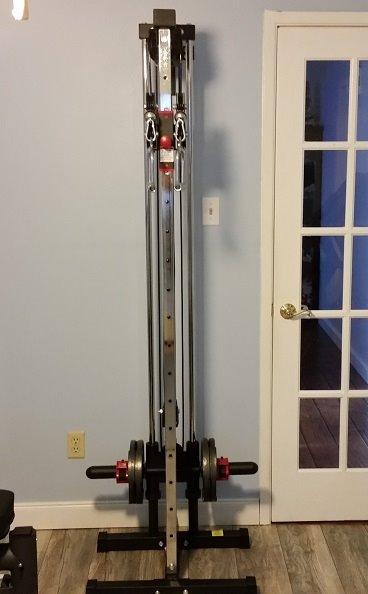
You get a two-column wall unit rated to 200 pounds of tension, with a cable, two straps and 16 pulley height positions covering pulldown, row, pressdown, face pull, fly and curl. The bracket sets for unilateral or bilateral work, so single-arm rows and anti-rotation presses are on the menu.
It loads with your own plates. One-inch plates fit the pegs directly and two-inch Olympic plates need a small adapter sleeve, so there is no weight stack to service but also no stack to grow into. A simple platform raises the carriage for taller lifters, the most common owner upgrade.
Who the Valor BD-62 suits
It suits a corner, a spare room or a basement with low ceilings and stud walls you can reach. No floor bolts are needed, and it is the easiest machine here to move between homes.
Who should skip the Valor BD-62
Skip it if you are over six foot two and want maximum pulldown range without a riser, if you have no stud wall, or if you want near-commercial cable feel and would rather not upgrade pulleys yourself.
2. Inspire Fitness FTX Functional Trainer – Best Compact Dual-Stack Machine
Inspire Fitness FTX Functional Trainer – Compact at Home Workout Machine with Accessories – Space Saving Design – Home Gym Cable Machine and Two 165 lb Weight Stacks
40 inch W x 54 inch D x 82 inch H
Two 165 lb weight stacks
544 lb machine weight
Pros
- Two independent 165 lb stacks give constant selectorized resistance with no plate loading
- One of the smallest full functional trainer footprints at 40 inches wide
- Sliding pulley system runs friction free and feels commercial
- Accessory storage rack and device shelf are built in
- Arrives with tricep rope two D handles curl bar and chin/dip belt
Cons
- Heaviest unit here at 544 lb so moving and assembly needs two or three people
- Weight stacks cannot be upgraded on this model
- Tall users may find the top pulley position too low for full pulldown range
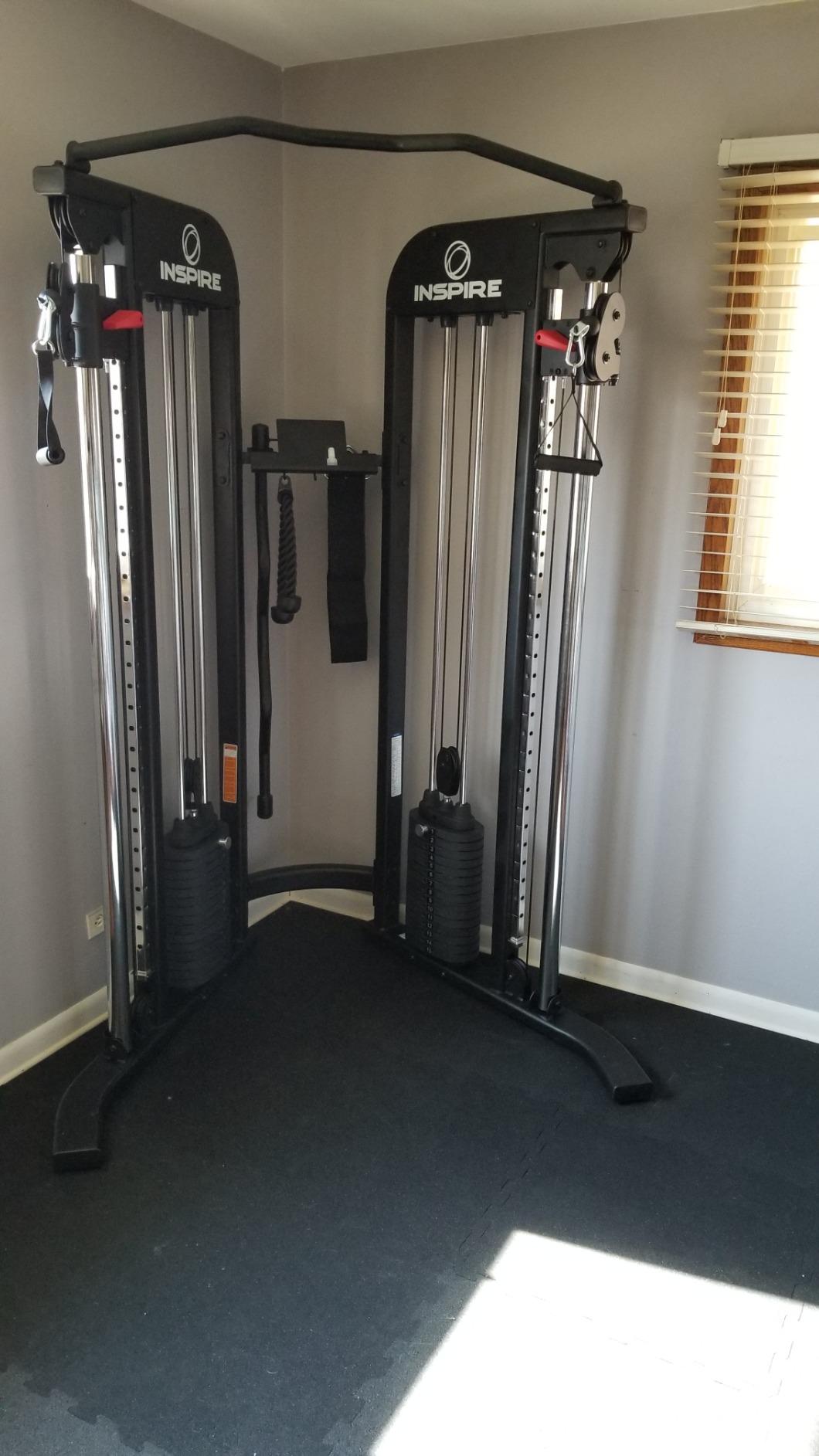
The FTX is what I would buy with a dedicated half-bay when I wanted something that feels commercial. Two independent 165-pound stacks, sliding pulley columns that glide rather than bind, and a frame owners describe as squeak-free and wobble-free once bolted down. At 40 inches wide it is the narrowest freestanding dual-stack trainer here, which matters beside a bench.
The catch is logistics. The machine weighs 544 pounds and arrives in seven boxes, and owners are unambiguous that two people are required and three are better. One r/homegym owner who anchored a floor unit of this class reports it does not budge during heavy single-arm rows, and the same advice applies here: bolt the base before you pull.
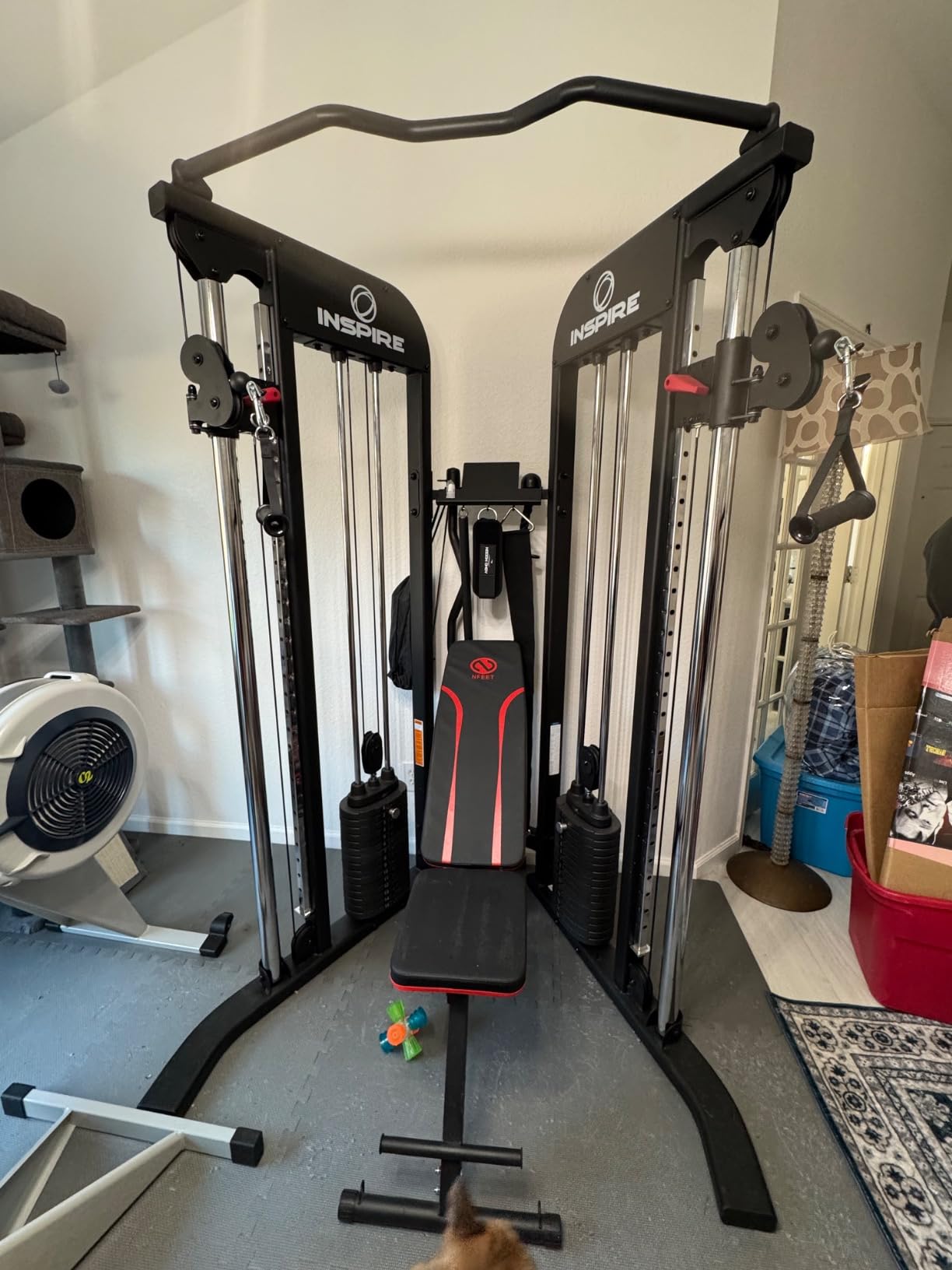
It is a genuine dual-stack design, so both sides move independently. Two people can train at once, or you can set different loads for a superset without touching plates. A 165-pound stack is real working weight for press, row, pulldown and fly work, and the selector pin gives instant changes between sets.
The extras matter more than they sound. There is a device shelf, a storage rack, and a chin and dip belt in the box with the rope, D handles and curl bar. The constraint to plan around is pulley height: owners above six feet report the highest slider still limits full pulldown range, and the stacks cannot be upgraded on this model.
Who the Inspire FTX suits
It suits a real garage bay or finished basement corner where you want constant-tension cables and spotter-free pressing in one footprint. It also suits two people training in the same room, and the 40-inch width lets it sit against a wall with a bench in front.
Who should skip the Inspire FTX
Skip it if the machine has to get through a narrow staircase alone, if you are very tall and need maximum overhead range, or if you want room to grow the stack later. Read the seven-box shipping note twice before ordering.
3. Body-Solid Powerline PFT100 – Best Value Dual-Stack Cable Crossover
Body-Solid Powerline (PFT100) Cable Crossover Exercise Machine for Home & Commercial Gym, Functional Training Center with Dual 160lbs. Weights Stack for Cable Workout
62.6 inch W x 42.3 inch D x 83 inch H
Dual 160 lb stacks
10 year frame warranty
Pros
- Silky weight glide with no friction grinding or noise
- Well machined parts with holes and bolts that align without modification
- Freestanding so no wall anchoring needed and it does not rock fully loaded
- Backed by a 10 year frame warranty and 1 year parts warranty
- Owners rate it as strong value against commercial crossover pricing
Cons
- Assembly takes roughly 2.5 to 4.5 hours and a second person is effectively required
- Manual is vague and lists at least one part as pre-installed when it is not
- 62.6 inch width makes it one of the biggest footprints in this roundup
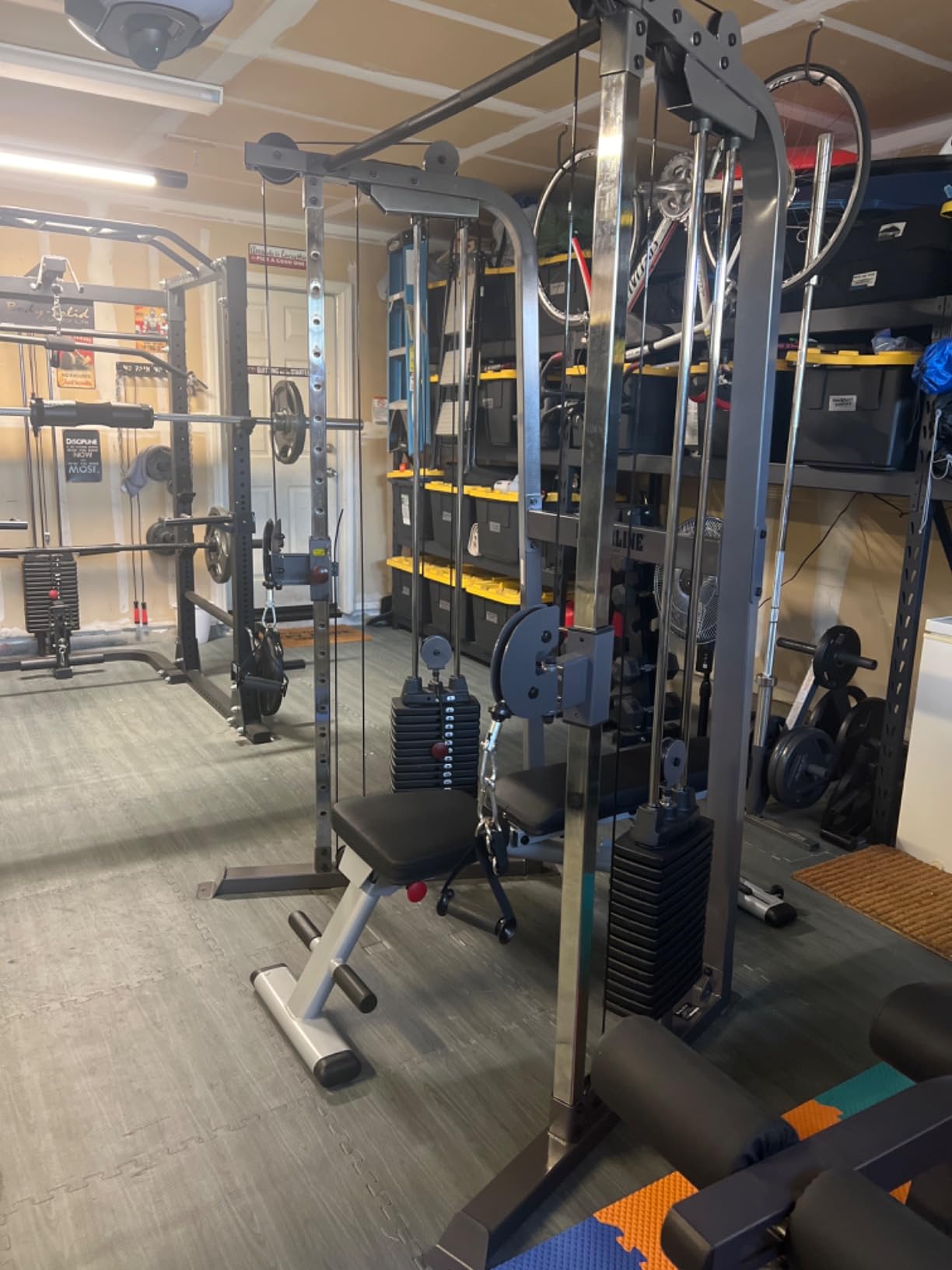
The PFT100 convinced me that weight stacks can feel good in a home gym. Owners describe the stack glide as silky, with no grinding, no noise and no friction at the top of the pull, and that comes from a double pulley arrangement with a half-to-one weight ratio. Both sides function independently, so it is a proper isolational cable station rather than a compromise machine.
This is also the one pick where the complaints are almost entirely about assembly. Owners put the build at two and a half to four and a half hours, with a second person needed for the uprights. A few report missing plates or damaged cable on arrival, both resolved by Body-Solid support.
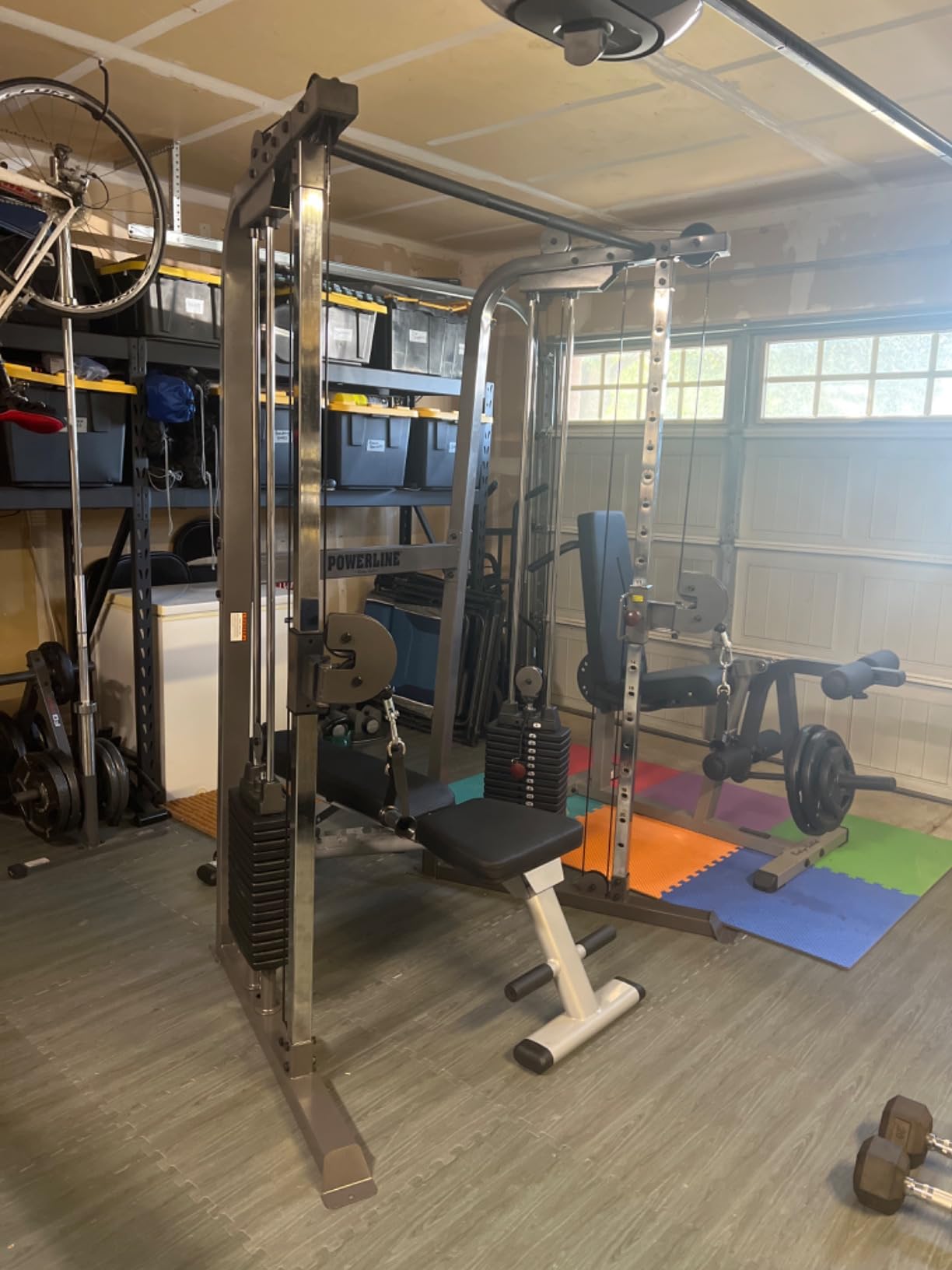
At 62.6 inches wide and 42.3 deep, plan for a gym corner rather than a wall unit. The depth is generous because the stacks sit in front of the open rack area, which is the layout question forum buyers ask most. The 83-inch height clears a seven-foot ceiling, but only just, so measure first.
The exercise list is long: pec fly, bench, incline, crossover, upright row, pressing, pulldown, row, crunch, pressdown, abductions, calf press, reverse fly and glute kickback. The 10-year frame warranty is the longest here, it is freestanding so there is no stud-finding, and it does not rock, fully loaded.
Who the Body-Solid Powerline suits
It suits owners with a full garage bay who want crossover performance and near-commercial smoothness at a mid-range outlay. It suits training alone with no spotter, and anyone who reads a 10-year frame warranty as worth paying for. A 210-pound stack version exists separately.
Who should skip the Body-Solid Powerline
Skip it if floor space is tight, because 62.6 inches wide and 42.3 deep is a dedicated zone. Skip it with low joists and a 7-foot ceiling, since 83 inches leaves almost no pull-up headroom. And skip it if you cannot commit most of a day and a second person to the build.
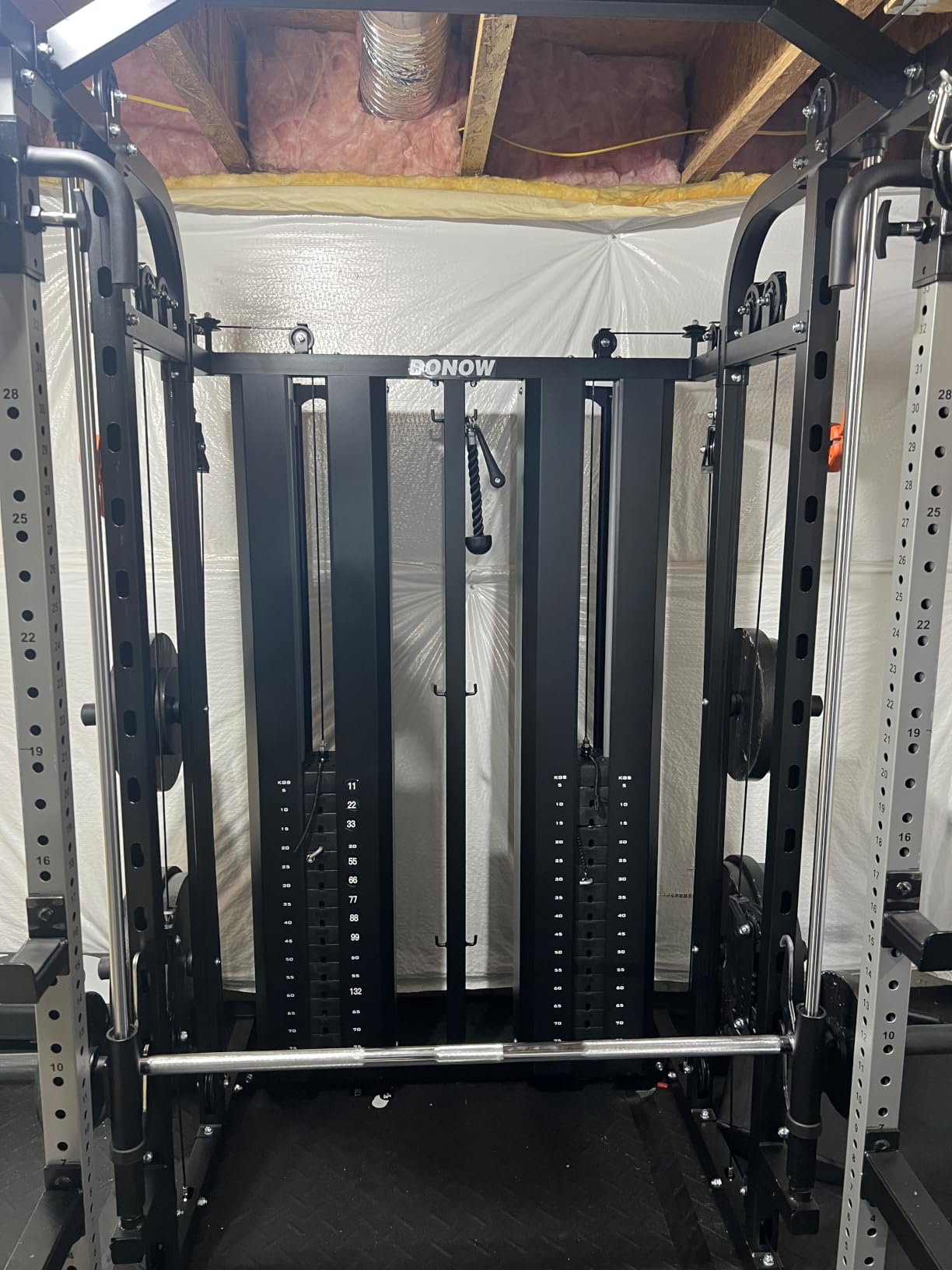
4. DONOW Smith Machine with Dual Weight Stacks – Best Full All-in-One
DONOW Smith Machine with Weight Stacks Home Gym System Cable Crossover
78.58 inch W x 54.7 inch D x 88 inch H
352 lb weight stacks
2:1 cable ratio
Pros
- Smith bar power rack with safety arms crossover and pull-up station on one frame
- Two heavy selectorized stacks give smooth resistance between sets
- Enclosed steel stack covers keep cables contained and the unit tidy
- Linear bearing Smith poles deliver stable commercial style bar motion
- Large accessory kit includes leverage bar lat bar rope and ankle strap
Cons
- Widest footprint here at nearly 79 inches so it needs a dedicated gym zone
- Selectorized stacks top out well below the rack's free weight capacity
- Arrives as eight separate boxes which makes assembly and moving substantial jobs
The DONOW is what you buy when the goal is to stop shopping for gym equipment. One frame carries a Smith bar with linear-bearing poles, a power rack section with safety arms, a dual cable crossover, a lat pulldown and a multi-grip pull-up station. If you have thought you might need a separate machine for each, this is the argument for a single purchase.
It is also the least compact machine here, and that is not a small print detail. At 78.58 inches wide it is six and a half feet across, and it stands 88 inches tall. Owner feedback is warm about everything except floor space, which is what you would expect from a unit designed to be the only thing in the room.
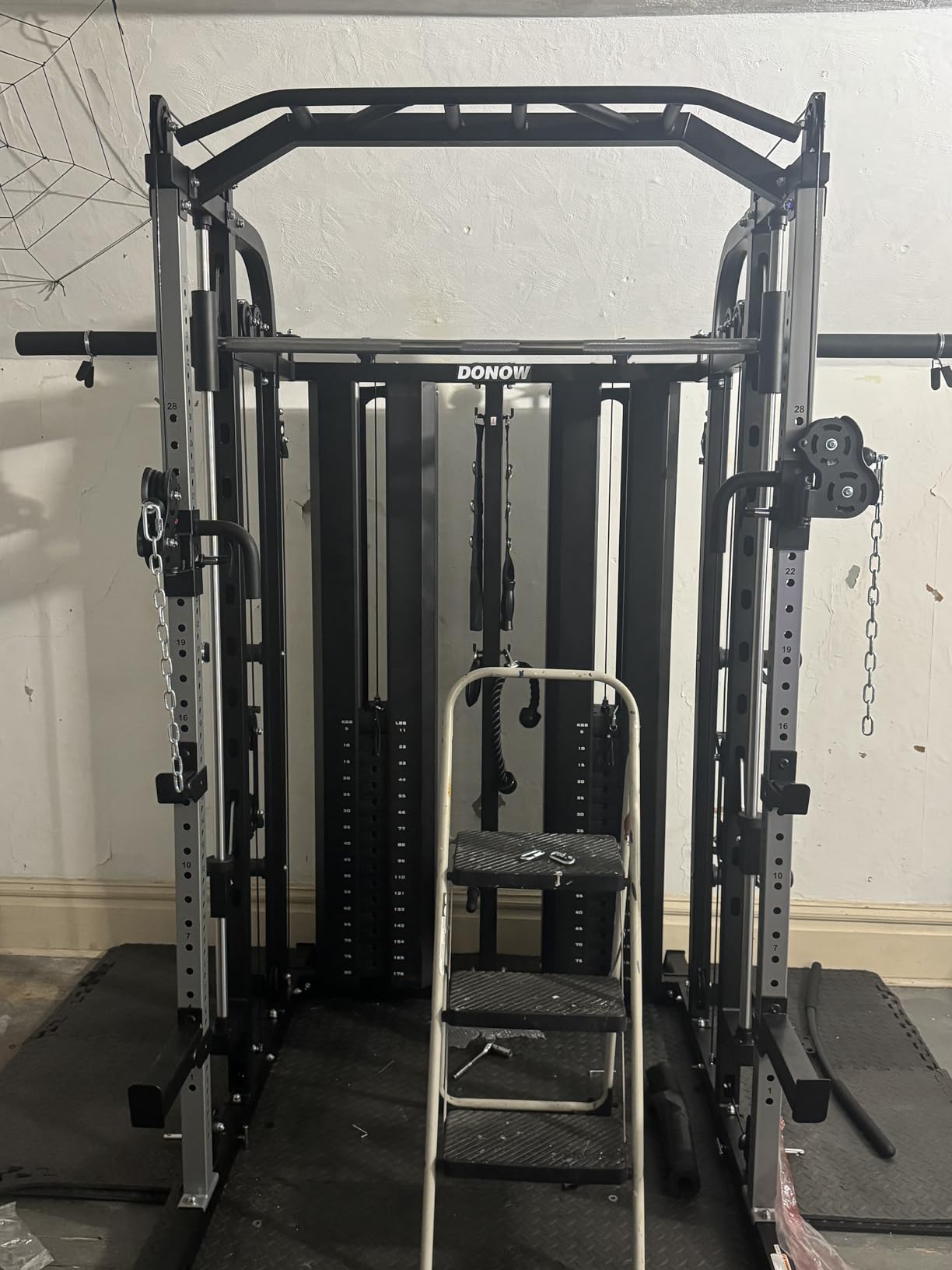
The 2:1 ratio means roughly half the stack weight arrives as pulling force per side, so the stacks feel usable for heavy lat and row work. With 352 pounds in the stacks there is real resistance available, though the cables top out below what the rack section holds with loaded plates. Enclosed steel stack covers keep the unit tidy and the plates contained.
Assembly is the other thing to plan. It arrives as eight boxes, and the frame is 2-inch by 2-inch steel, so building and moving it is a genuine project. The included accessories cover most early needs: a leverage bar, lat bar, straight cable bar, bicep rope and ankle strap.
Who the DONOW suits
It suits a dedicated garage or basement gym area where you want barbell and cable work in one footprint. It fits beginners who would otherwise buy four separate stations one at a time, and anyone training alone who wants a Smith bar plus cables. The 2:1 ratio also makes it approachable for people who find a 1:1 cable hard to control.
Who should skip the DONOW
Skip it if your room is under roughly ten by ten feet of usable floor, because the width leaves no working lane. Skip it if it must move through tight doorways regularly. And skip it if small-increment cable loading matters, since selectorized stacks on a 2:1 ratio cannot match plate-loading for tiny resistance jumps.
5. Mikolo M-G3 Wall Cable Station – Best Capacity in a Corner
Mikolo Wall Mount Cable Station, Cable Crossover Machine with Dual Pulley System and 19 Adjustable Positions for Home Gym Fitness Equipment, Black
25.6 inch W x 26.9 inch D x 82 inch H
Plate loaded to 400 lb
14-gauge powder-coated frame
Pros
- Just over 3 square feet of floor for a full dual pulley cable station
- 19 height positions with a rotating bracket for unilateral work
- 400 lb maximum load on cables rated to 2200 lb tensile strength
- Detachable sleeves accept both 1 inch and 2 inch plates with upward angled pegs
- Includes lat bar cable bar tricep rope and a large footboard for rows
Cons
- Wall anchored installation is required so it is not a freestanding option
- Baseboard trim and stud placement can complicate mounting height
- Basic steel pulleys on the standard version
The M-G3 is the wall mount that makes most sense if you want to load heavy plates onto your cables. Rated maximum load is 400 pounds, supported by nylon-coated aircraft cable rated to 2200 pounds of tensile strength, on a 14-gauge powder-coated steel frame. Among the compact stations here it has the most headroom for heavy work, and 19 pulley positions is the highest of the three wall mounts here.
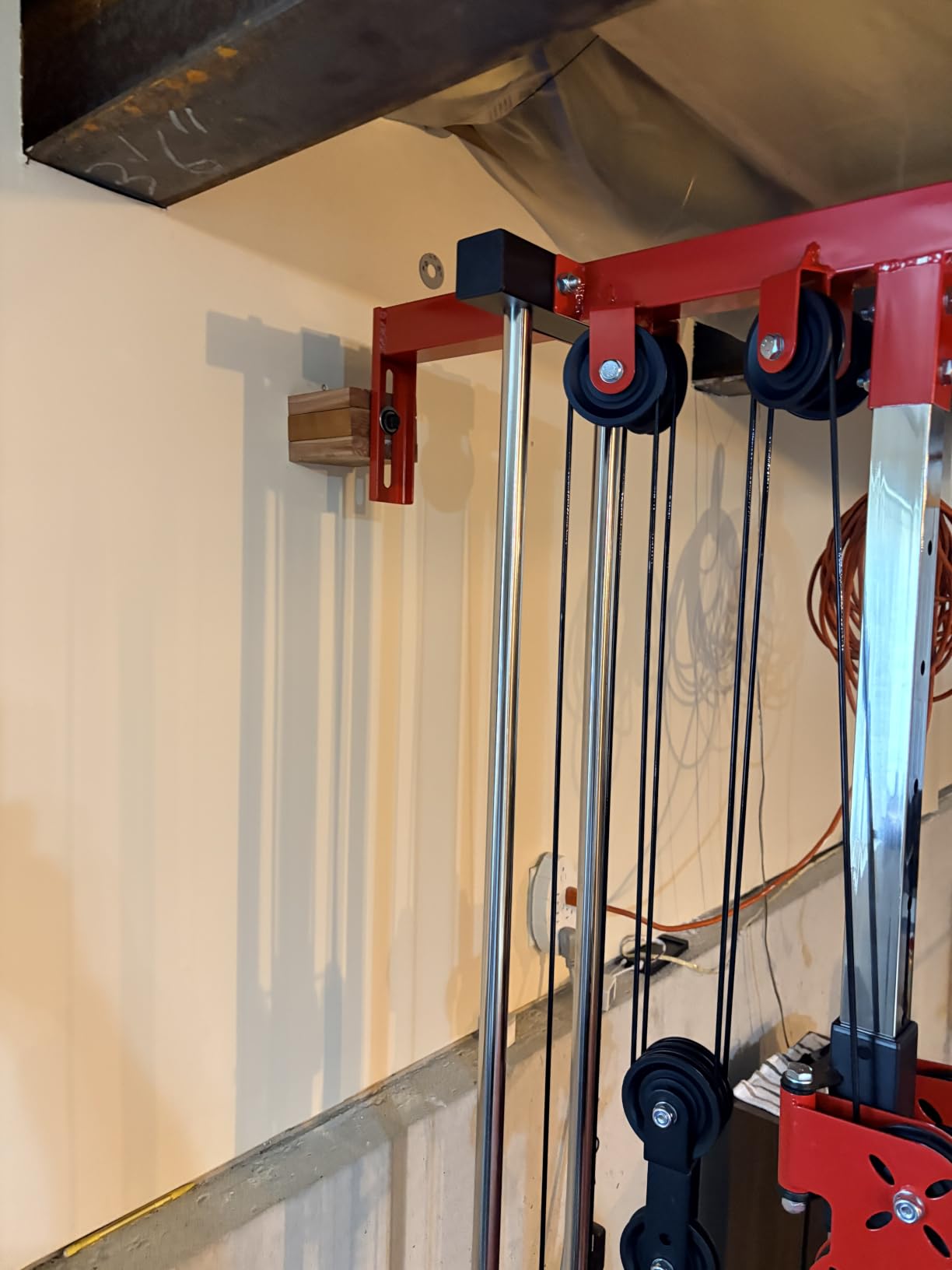
It also demands the most planning. Installation is into studs, and several owners note that baseboard trim and uneven stud spacing can force a riser or backing board to get the mounting height right. On a clean stud wall it is a two-hour job, and the finished footprint is barely larger than a floor fan.
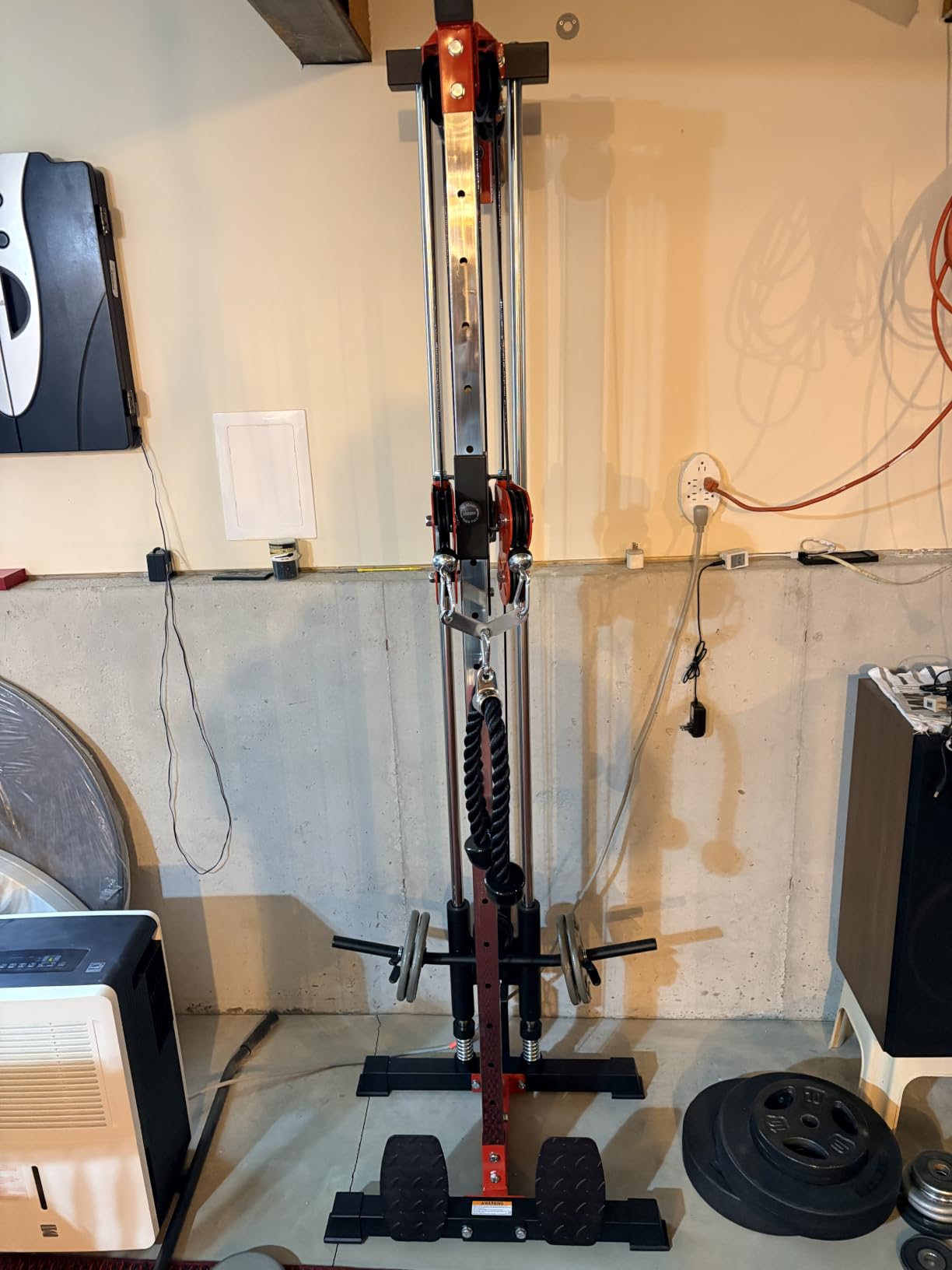
The detail that makes this one pleasant day to day is the plate pegs. They angle upward by about ten degrees, which is minor on paper and not minor in practice, because it stops loaded plates sliding off the sleeves during a heavy pull. The sleeves detach so one-inch and two-inch plates both fit, and the rotating bracket allows unilateral or bilateral work. The large footboard is what makes a seated row workable at this size.
Two notes. The standard version uses basic steel pulleys and the smoother aluminum pulley version costs more, which matters on a machine you use daily. The included attachments are a lat bar, straight cable bar and tricep rope, with a two-year warranty listed.
Who the Mikolo M-G3 suits
It fits apartment and condo owners who can drill into a stud wall and want a serious 400-pound cable option in three square feet. It suits intermediates who already own plates and want to load them rather than fight a selector pin. The 19-position range also serves tall users who need a low-row start as well as an overhead one.
Who should skip the Mikolo M-G3
Skip it if you rent and cannot drill, or if you want a freestanding machine you can reposition. Skip it if your wall has deep trim, unusual stud spacing or a window in the way. And if smoothest cable feel on a budget is the priority, the Goimu WM1 is the more sensible first step.
6. Goimu WM1 Wall Cable Station – Budget Pick Wall Mount
Goimu Wall Mount Cable Station, WM1 Cable Crossover Machine with 17 Positions, High and Low Cable Crossover Machine with Removable Footplate for Garage Home Gym (WM1 Cable Station RD)
18.11 inch W x 24.8 inch D x 78.74 inch H
Plate loaded to 300 lb
17 pulley positions
Pros
- Smallest footprint here at roughly 3.28 square feet so it tucks flush to a wall
- Dual pulley system switches between 1:1 and 2:1 ratios in seconds
- 17 height positions support presses rows and flyes at usable angles
- Assembly reported at about an hour with hardware sorted by step
- Weld quality and finish repeatedly praised as above the price level
Cons
- Some units arrive with cables too long which must be trimmed with cable clamps
- Occasional cosmetic damage and one report of a weld impeding swivel action
- No dedicated lat carriage so the included lat bar uses the pulley positions
The WM1 is the cheapest way to get a real two-column cable station into a small room, and the narrowest machine here at 18.11 inches. That width is the difference between fitting into a corner beside a bookshelf and not. The dual pulley system switches between 1:1 and 2:1 in a few seconds, letting you test heavier and lighter options from the same plates.
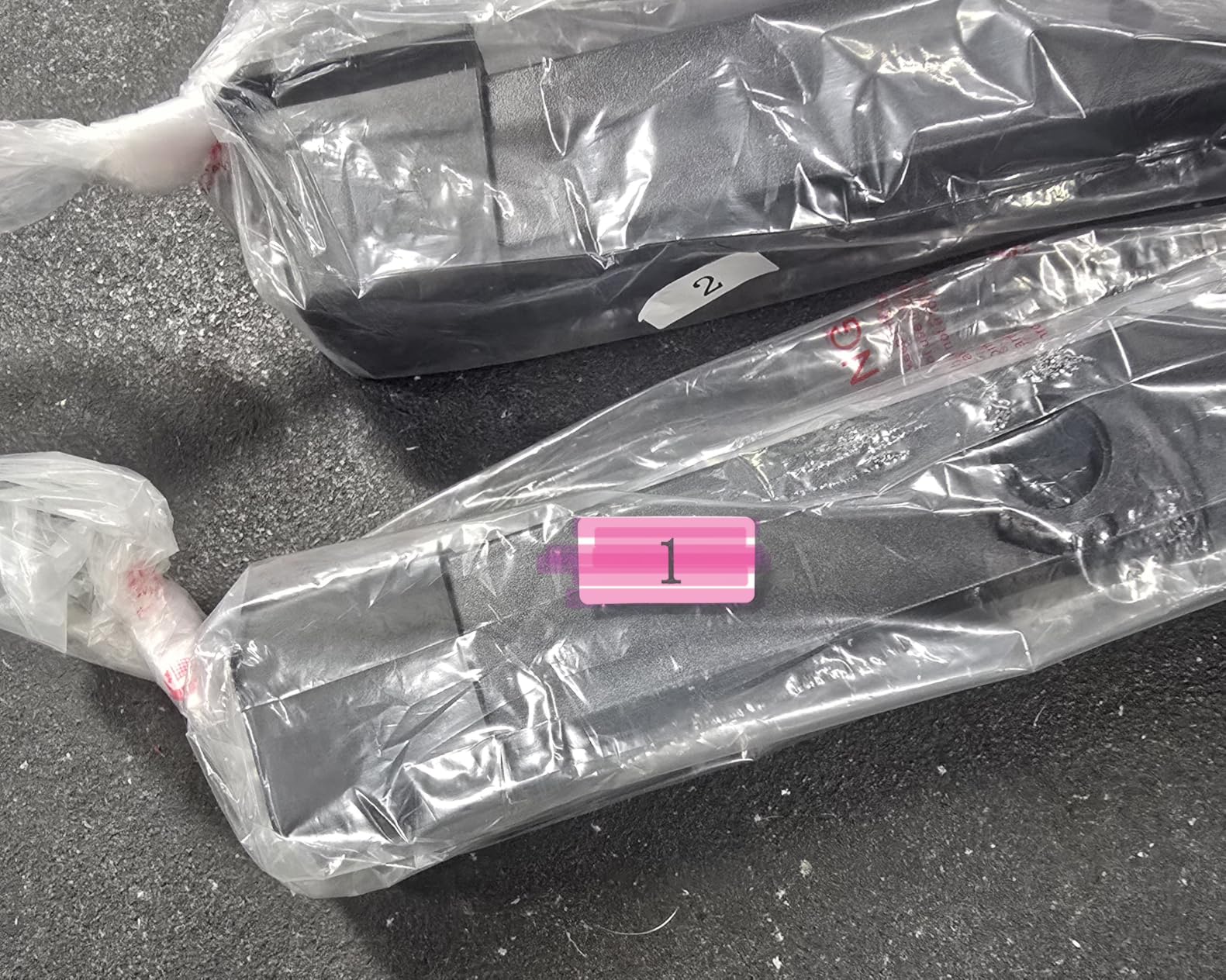
Owners single out the assembly as better than expected. Hardware arrives sorted by build step, instructions are clear, and people report finishing in about an hour. Reviews also praise weld quality and finish more than the price would suggest, and at 81.4 pounds this is a machine one person can lift onto a wall.
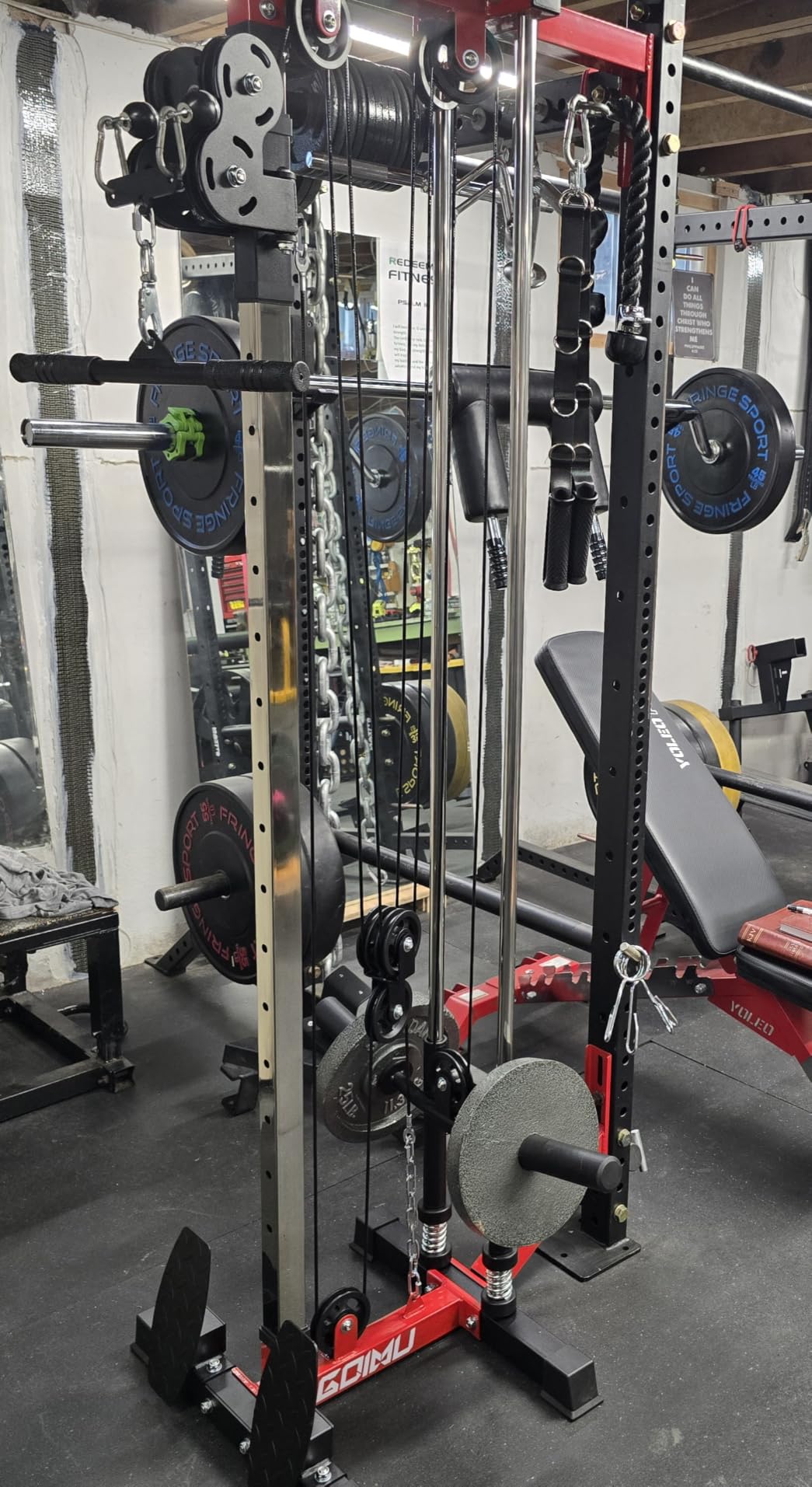
Two things to expect. Some units arrive with cables longer than needed, which creates slack until you trim them with cable clamps. And there is no separate lat pulldown carriage, so the included lat bar runs off the pulley positions rather than a dedicated track. That is the main reason this is not the pick for people who care most about overhead work.
The frame is 14-gauge industrial steel with reinforced brackets and an anti-sway H-shaped base, rated to 300 pounds, with a two-year warranty. Seventeen pulley positions cover presses, rows, flyes and curls, and the box includes an adaptor, T bar, lat pull bar, curl rope and a pair of handles.
Who the Goimu WM1 suits
It suits renters and apartment dwellers with a stud wall who want a cable station without a big spend. It suits beginners not ready to buy a machine with a few hundred ratings behind it, and anyone who wants 1:1 and 2:1 options to test which ratio they prefer. The narrow width makes it the easiest corner unit here to position.
Who should skip the Goimu WM1
Skip it if you are impatient with small assembly adjustments, since cable slack and cosmetic flaws are the common first-week complaints. Skip it if you need a dedicated lat carriage or want to load above 300 pounds. And skip it if the lowest friction pulley feel matters more than the outlay.
7. MAJOR FITNESS F22 Power Rack – Best Rack and Cable Combo for Basements
MAJOR FITNESS F22 Power Rack, 1600lbs All-in-One Squat Rack with Cable Crossover, Dual Pulley System, Heavy-Duty Steel Frame, Attachments & Storage for Home Gym Strength Training, Khaki
55.5 inch W x 68.9 inch D x 82.5 inch H
2 by 3 inch 14-gauge steel
1600 lb capacity
Pros
- Combines a power cage squat rack and dual cable crossover in one footprint
- Dual triangle base design removes the need to bolt to the floor
- Independent dual trolleys let two people train or set different loads
- 82.5 inch height suits low ceilings while still allowing pull-up clearance
- Large attachment bundle includes J-hooks safety arms landmine T-bar and dip bars
Cons
- Plate loading means weight changes mid-workout are slow
- Dip bar handles are narrow and some hooks are too short for the tubing
- Assembly runs about 3 to 4 hours
The F22 is the compromise that makes sense when you want barbell and cable work in one machine and no room for two. The frame is 2-inch by 3-inch 14-gauge commercial-grade steel with a 1600-pound static rating, and the dual-triangle base is why owners report zero wobble without bolting anything down. That no-bolt design makes it the friendliest option here for anyone not allowed to drill.
What stands out for low-ceiling rooms is the height. At 82.5 inches it is the second shortest machine here, and owners running it in basements report pull-up clearance still works. The cable side runs independent dual pulleys at a 2:1 ratio, so you can set different loads for a superset or train two people at once.
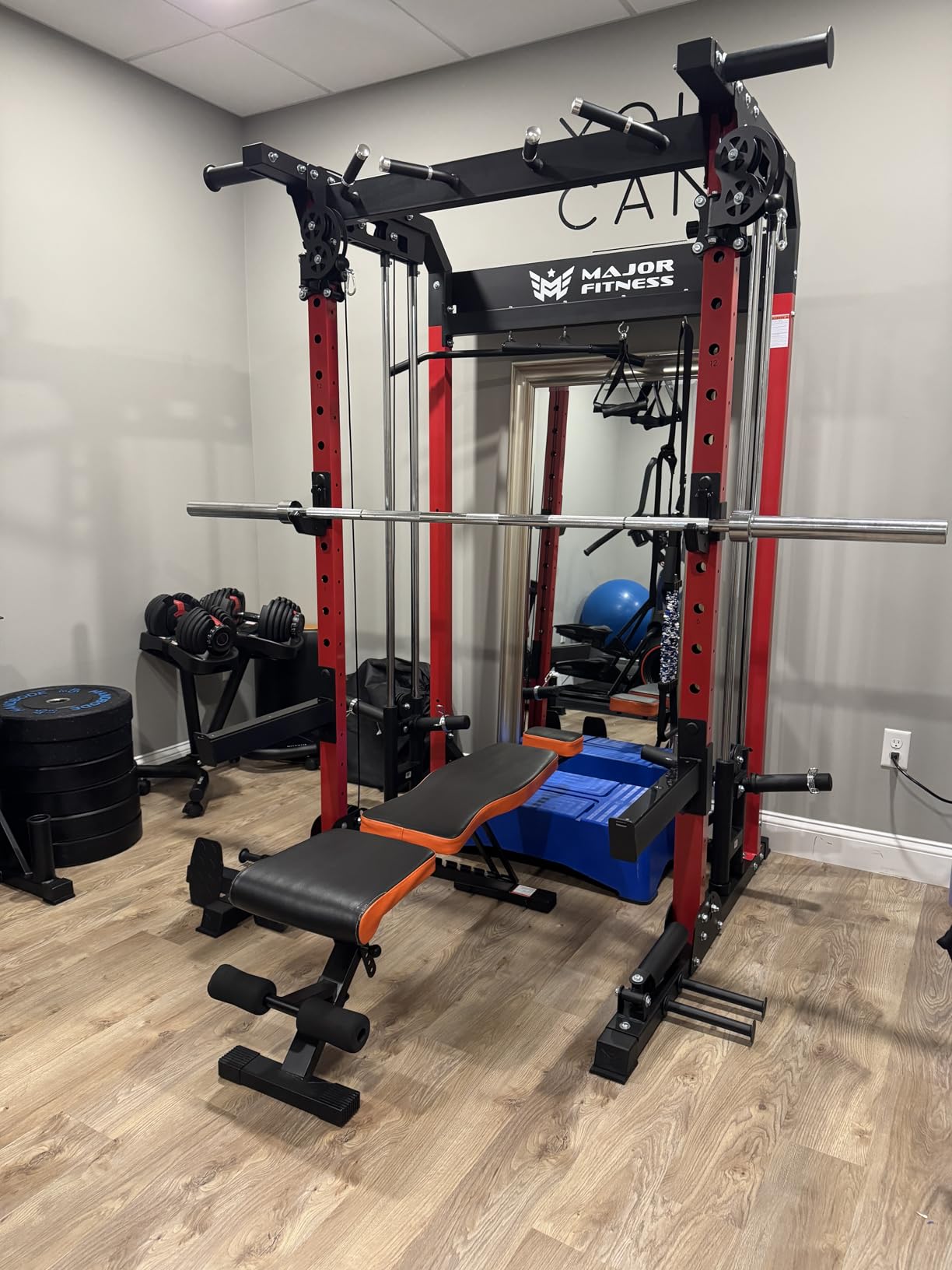
The ergonomic complaints are consistent enough to plan around. Cable loading uses standard round plates, so changing resistance means changing plates, the slowest part of any session. Dip bar handles are narrow, the lat bar is narrower than ideal, and a few hooks ship too short for the tubing. None of that is structural, but upgrading the handles and bar is an early, cheap improvement most long-term owners make.
The attachment bundle is generous: J-hooks, safety arms, foot pedals, a landmine, a T-bar, dip bars, band pegs and accessory hooks. The warranty is one year, the shorter end of what we see here. Assembly takes three to four hours and a few owners needed extra washers.
Who the MAJOR F22 suits
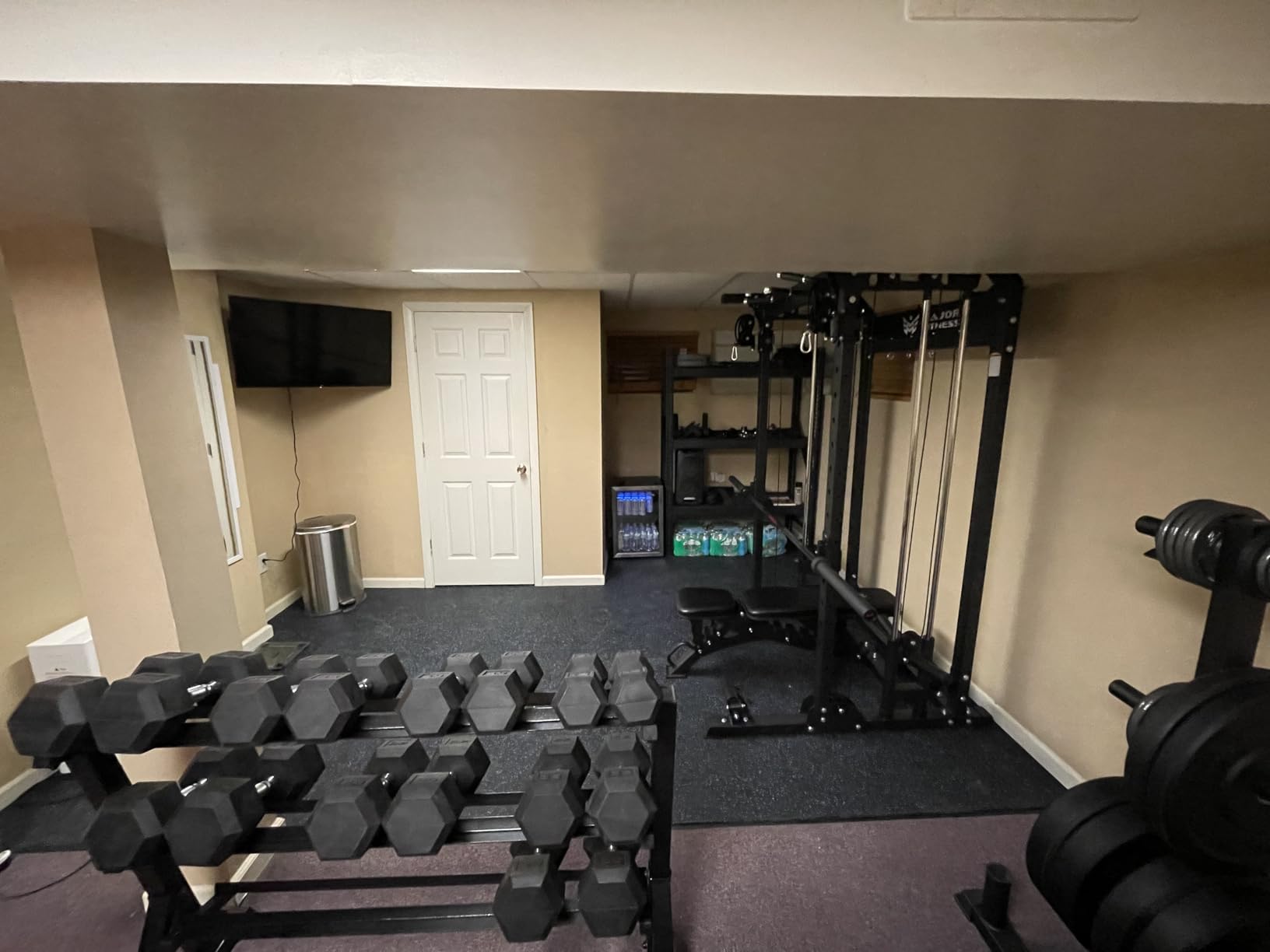
It suits basements and low-ceiling garages where 82.5 inches of machine height is the realistic limit. It suits anyone who cannot or will not anchor equipment to the floor. And it suits people who want to squat and deadlift as well as row and press, which no pure cable machine here can do.
Who should skip the MAJOR F22
Skip it if fast, fine-grained resistance changes are the priority, because plate loading is the bottleneck. Skip it if your floor space is under about ten by seven feet, since 68.9 inches of depth is the deepest machine here. And if warranty length decides it, this is not the one.
8. Mikolo Folding Squat Rack WR00 – Best Fold-Away Storage
Mikolo Folding Squat Rack, Wall Mounted Power Rack with Cable Crossover Machine & LAT Pull Down, Functional Trainer with 5 Adjustable Function Modes, for Home Gym and Space Saving(Black)
68 inch W x 30 inch D x 86 inch H
Folds from 9.5 to 3 sq ft
1:1 pulley ratio
Pros
- Folds from 9.5 square feet down to about 3 square feet for storage
- Five configurable modes including rack functional trainer and crossover
- 1:1 cable ratio makes the training load easy to calculate with plates
- Reinforced wall mounts and four adjustable ground feet rated to 1000 lb
- Detachable pull-up bar J-hooks and a single-handed pulley system
Cons
- Wall anchoring is required which rules it out for renters
- Crossover rack and trainer modes cannot all run at full capacity at once
- 68 inch width is still substantial in rack mode
The WR00 exists for one problem: a room that has to be a gym some days and storage the rest. Folded flat it takes about three square feet, down from 9.5 open, the tightest storage footprint of anything here. Five configurations are available, including power rack, functional trainer and cable crossover, so the machine earns its floor space on most days rather than only the cable ones.
The trade-off is that you cannot run every mode at full capacity at once, and the folding linkage adds moving parts. The ratio is 1:1, so the load equals the plate weight exactly, an advantage if you want to know what you are pulling and a disadvantage if you need small jumps. Low ceilings are the other constraint owners flag, since the wall mount and the width decide where it can stand.
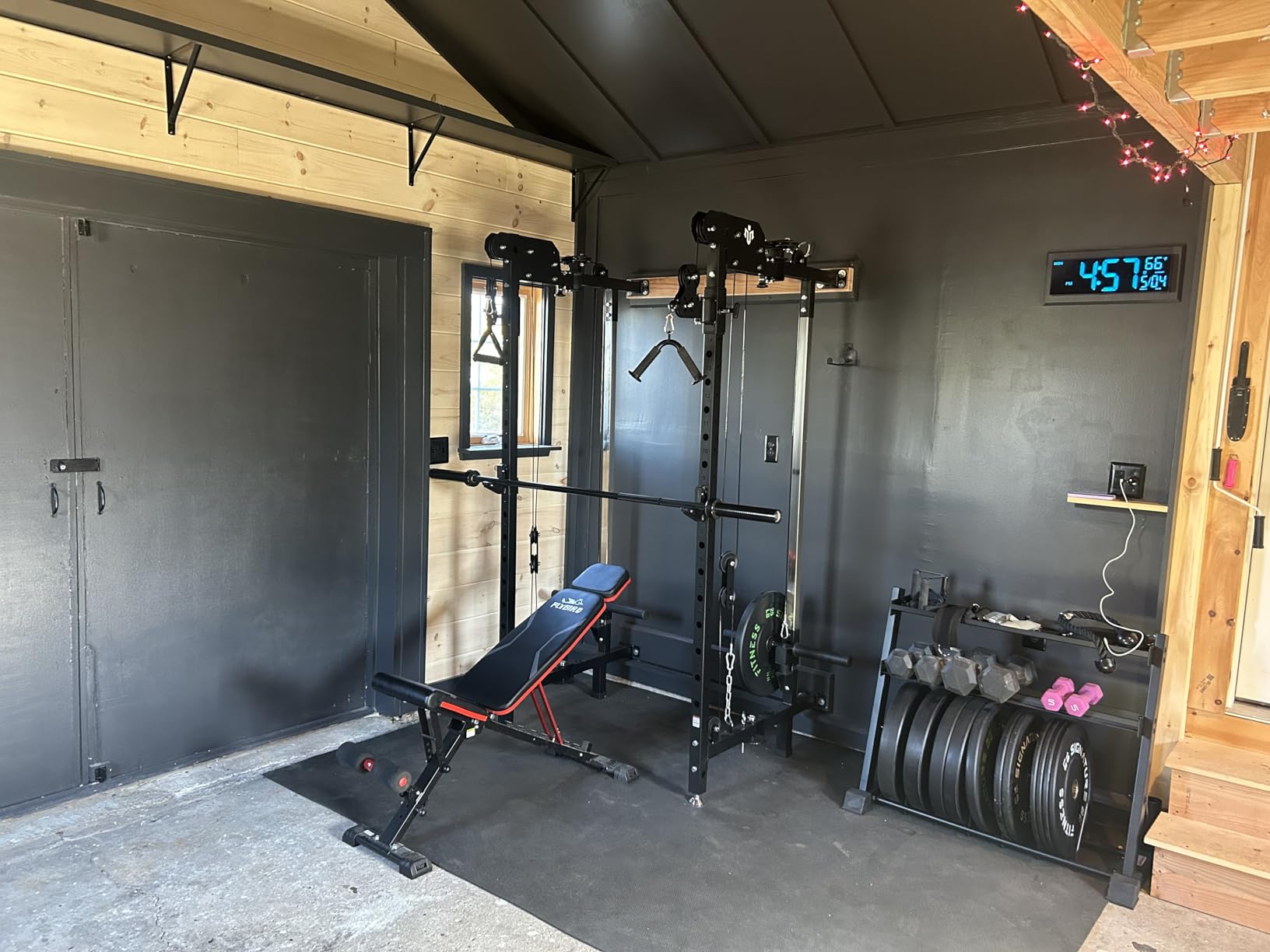
The structure is straightforward: 2-inch by 2-inch 14-gauge steel, reinforced screw-in wall mounts and four adjustable ground support feet, rated to 1000 pounds. The detachable pull-up bar helps when width is tight. Fifteen pulley height options are claimed, and at 150 pounds listed it can be repositioned once assembled.
Plan the installation before you order. It has to go into studs, and because the frame folds against the wall, the wall position determines the whole layout. Forum buyers repeat the same lesson: mark the height you can actually achieve between studs and check that the folding path clears the skirting board. The one-year warranty is the shortest here.
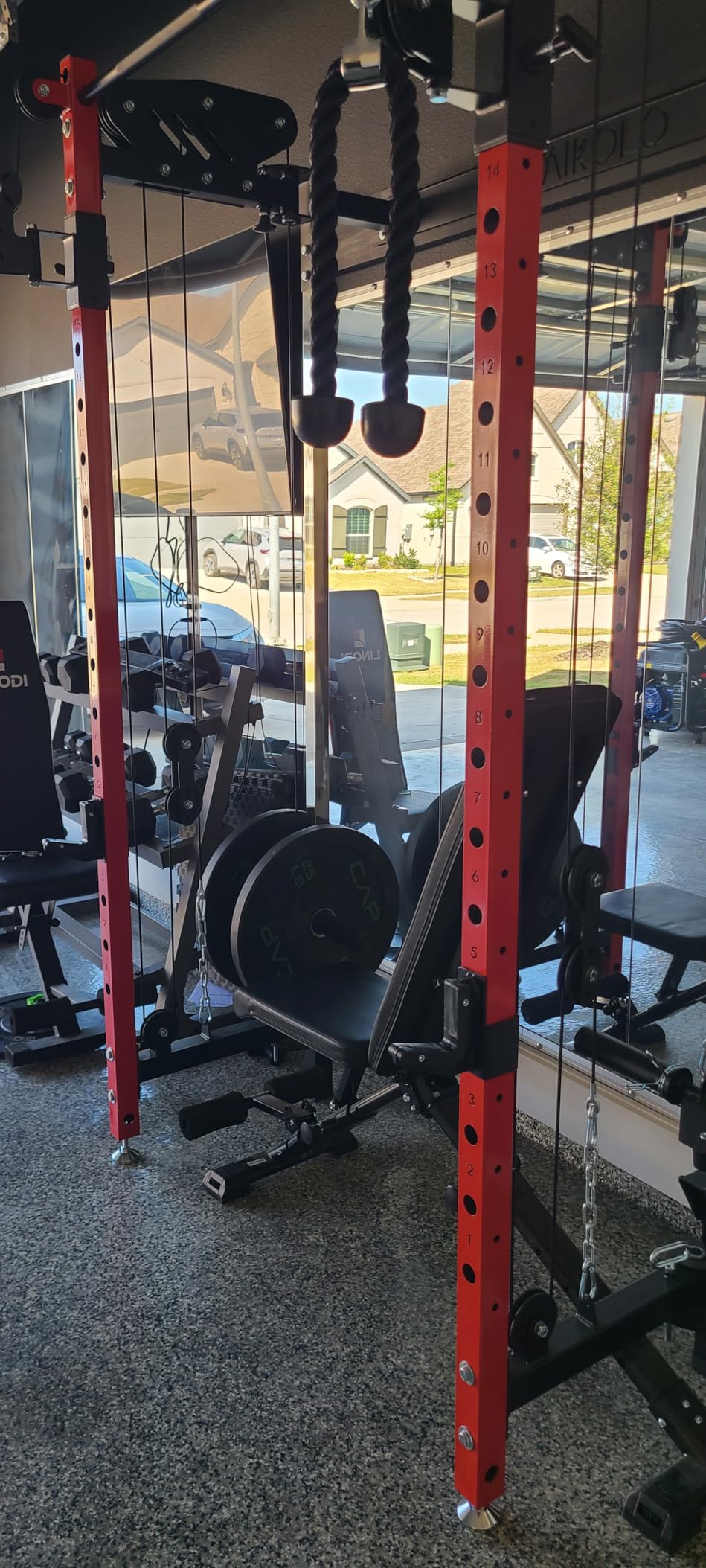
Who the Mikolo WR00 suits
It suits a multi-use room, a converted garage or a spare bedroom doubling as storage, where a permanent cable tower would be unwelcome. It suits beginners who want a squat rack and cable station in one purchase and will load their own plates. Anyone who values knowing the exact resistance will like the 1:1 ratio.
Who should skip the Mikolo WR00
Skip it if you rent and cannot drill, because wall mounting is mandatory. Skip it if you want to rack heavy and cable at full capacity in the same session, since the modes compete. And skip it if you are very tall, because the height range and 1:1 loading make heavy overhead work harder to set up.
9. MAJOR FITNESS Drone1 Power Cage – Best Mid-Price Cage for Barbell and Cable
MAJOR FITNESS Drone1 Power Cage, All-in-One Home Gym with Cable Crossover, LAT Pulldown, Squat Rack & Landmine Attachment, Heavy-Duty Strength Training System for Home Gym
63.38 inch W x 65.9 inch D x 84.84 inch H
1500 lb rated frame
Landmine included
Pros
- Packs power rack cable system pull-up bar and landmine into a 63 by 66 inch footprint
- Reinforced 2 inch by 2 inch uprights rated to 1500 lb with J-hooks and safety arms
- Integrated cables cover pulldowns low rows flyes pushdowns and curls
- Lifetime customer support reported for assembly questions and parts
- 84.84 inch height still accommodates barbell work and pull-ups
Cons
- 66 inch width is larger than the wall-mount cable stations here
- Cable resistance is plate loaded so weight changes need plate changes
- Fewer dedicated cable heights than a purpose-built wall station
- Only a one year warranty
The Drone1 is the mid-point machine here and does something the others at this size do not: it gives a genuine power cage rating alongside an integrated cable system. The reinforced 2-inch by 2-inch uprights carry a 1500-pound rating, J-hooks and safety spotter arms are in the box, and a landmine attachment is included.
The cable side is plate loaded, so resistance changes are plate changes. That is fine if you already train barbell and keep plates on a nearby tree, and annoying if you mostly want cables. Owners also note fewer dedicated cable heights than a purpose-built station, limiting fine angle adjustments on low rows and reverse flyes.
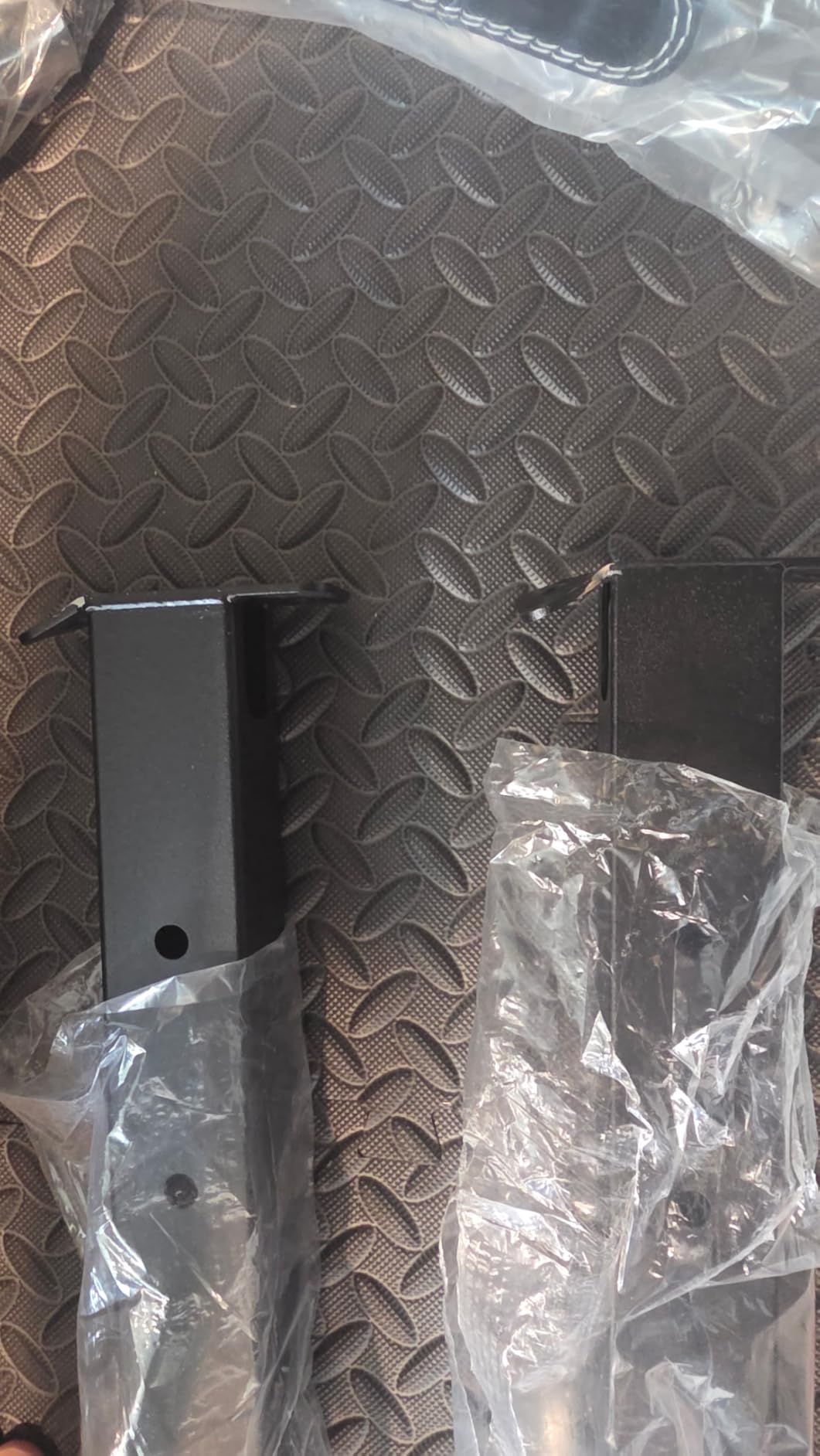
At 63.38 inches wide and 65.9 deep it is one of the larger footprints here, and 84.84 inches tall makes it one of the taller units. That rules out small rooms but works well in a garage corner or a basement with full-height joists, which is a fair summary of where this machine belongs.
Over a pure rack, you gain a cable system covering lat pulldowns, low rows, flyes, pressdowns and curls without a separate machine. You give up the one-year warranty, the shortest here, and the fine-grained loading control of a stack. Owners report lifetime customer support for assembly and parts, which softens that.
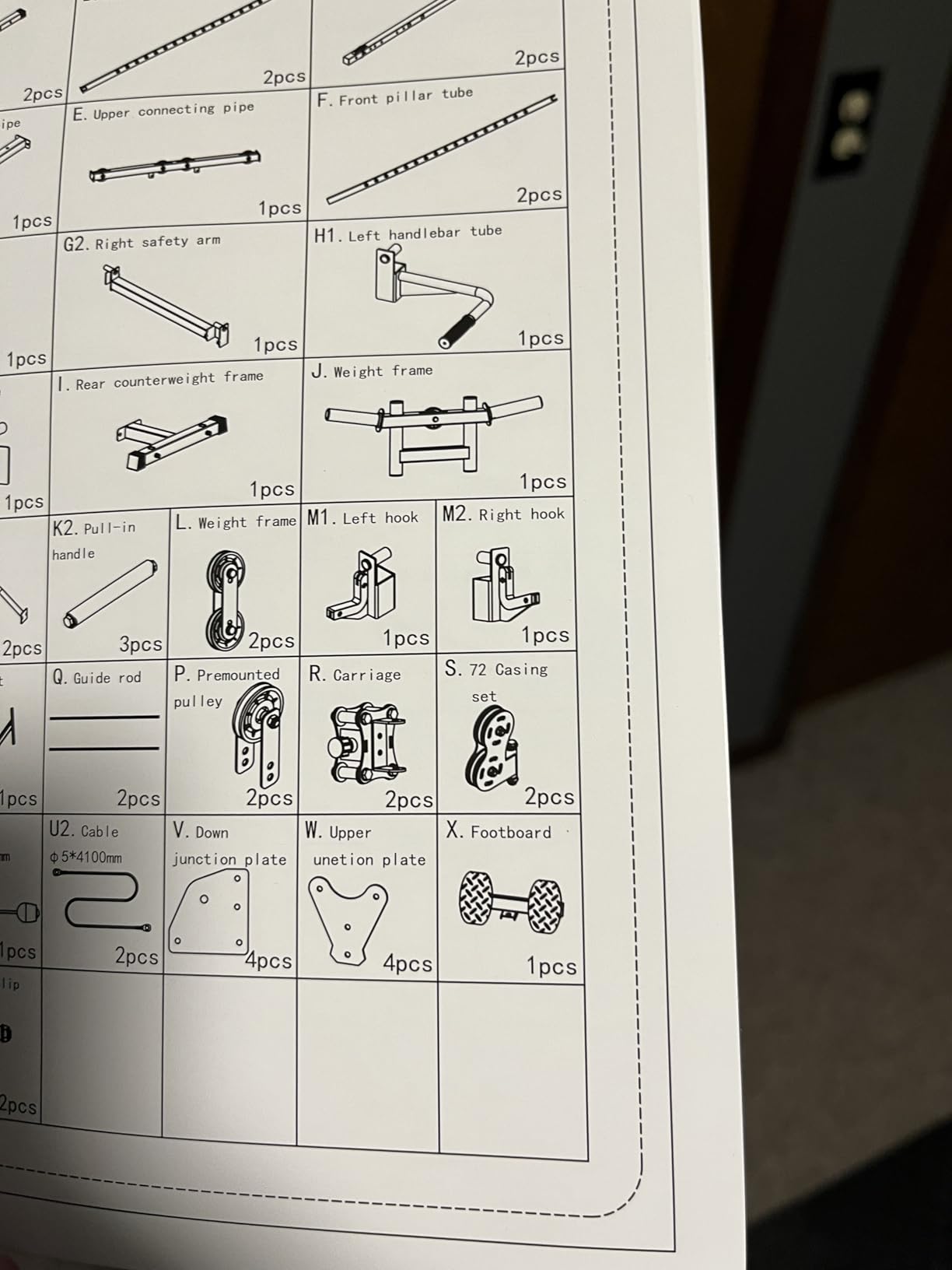
Who the MAJOR Drone1 suits
It suits people whose training is mostly barbell work with cables added, who want one frame instead of a rack and a separate cable machine. It suits intermediates who need a 1500-pound cage rating with safety arms. The landmine attachment also makes it a good fit for anyone adding landmine presses and rotational work.
Who should skip the MAJOR Drone1
Skip it if your room is small, because 66 inches of width plus nearly 66 inches of depth is a gym zone. Skip it if you want smooth, quick resistance changes without touching plates. And skip it if warranty length decides it, given one year here against much longer frame warranties elsewhere.
10. SincMill Multifunctional Gym SCM-1148L – Best Single-Stack Multi-Station
Home Gym SCM-1148L 148LB Multifunctional Full Body Home Gym Equipment for Home Workout Equipment Exercise Equipment Fitness Equipment SincMill
40.7 inch W x 69 inch D x 80 inch H
148 lb selectorized stack
Around 59 lb machine weight
10 year warranty
Pros
- Largest review base here at more than 1400 ratings so owner feedback is well sampled
- 148 lb selectorized stack gives smooth quiet resistance across press row fly curl and leg work
- 40.7 inch width keeps the footprint workable in a basement or garage corner
- Numbered step-sorted hardware plus a 3D assembly video make a solo build feasible
- Ten year warranty and reported fast replacement part service
Cons
- Tight for users around 5 foot 9 to 6 foot and taller who report cramped leg press and butterfly range
- Stacked pulleys make felt resistance heavier than the printed plate weight
- Pulley and roller contact points are noisy without silicone lubricant which is not included
- Ankle strap Velcro wears quickly
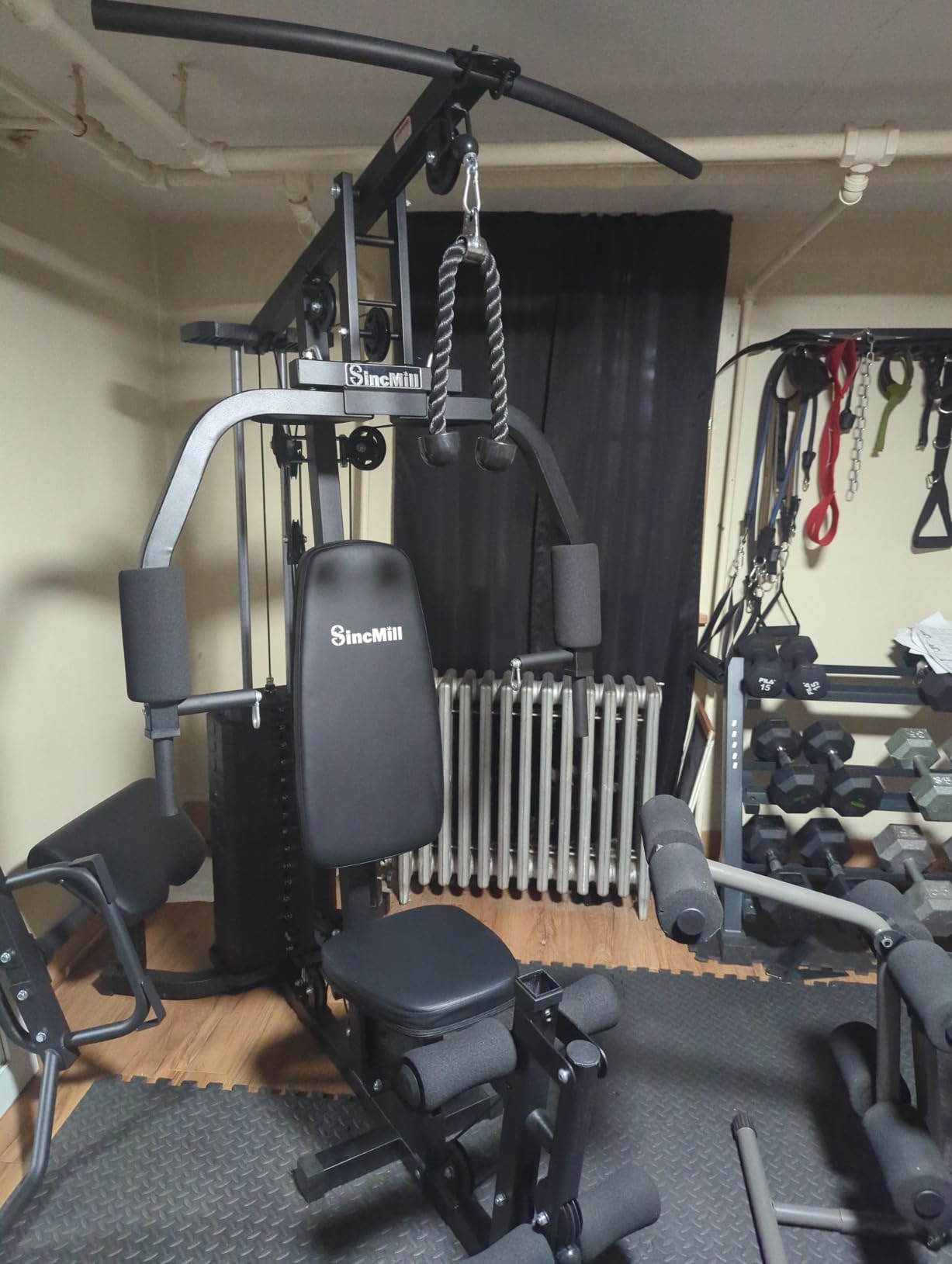
The SCM-1148L is the odd one out: a single-stack multi-station machine rather than a true two-column functional trainer, and the most reviewed product here at more than 1,400 ratings. You get a 148-pound selectorized stack driving a press station, a pec deck, a lat station, a curl pad and a leg exercise pedal.
User height is the decisive question and it comes up in almost every longer review. Shorter users love the compactness and value. Anyone from about five foot nine upward reports that seat travel and the leg press feel cramped, and butterfly range suffers too. There is no dedicated leg curl or inner-thigh station, and the stacked pulleys make felt resistance noticeably heavier than the printed plate weight.
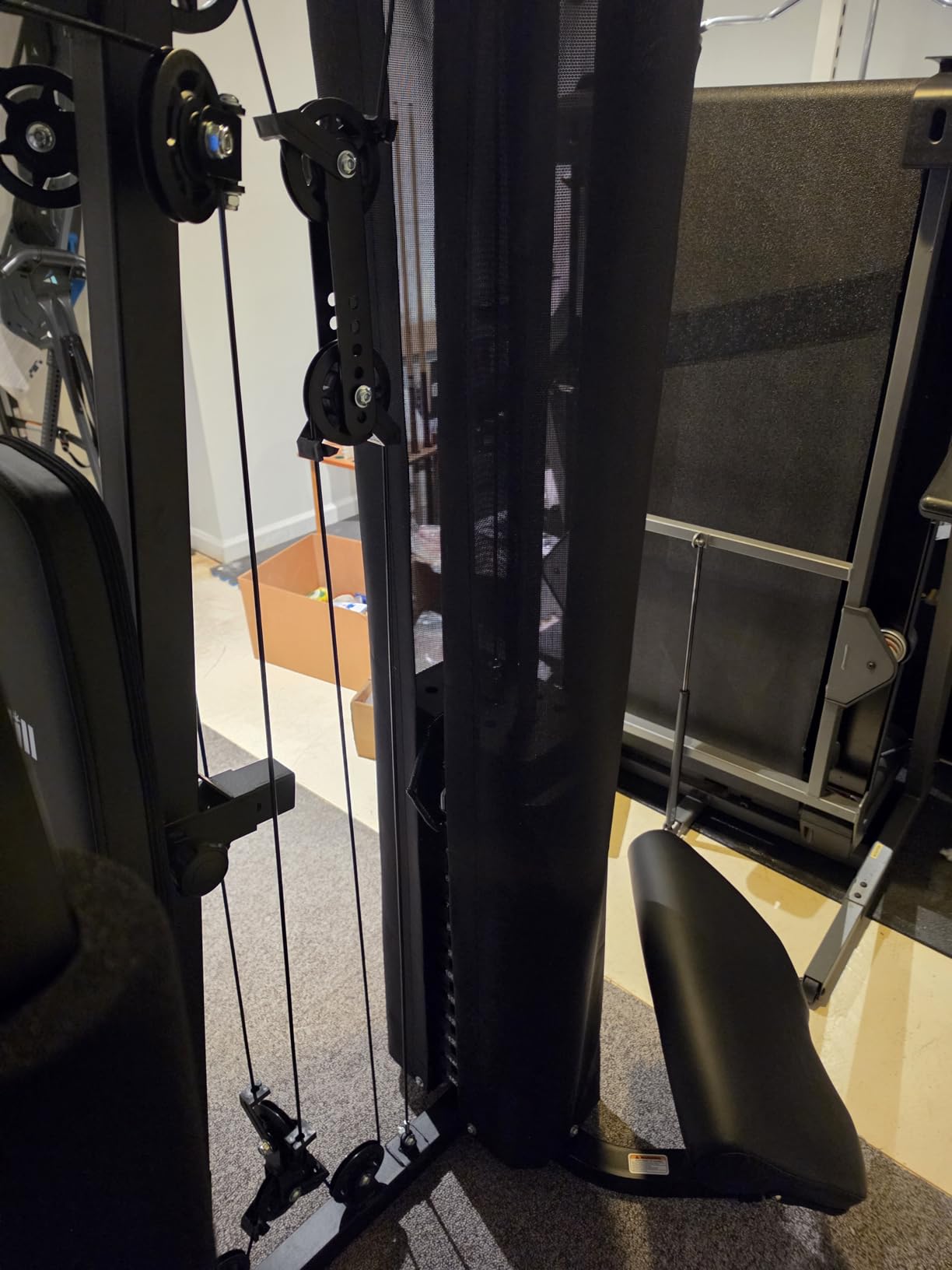
Build quality is a real strength. The frame and weight guards use thick steel, hardware arrives numbered and sorted by build step, and a 3D assembly video makes a solo build feasible in three to six hours. The stack action is described as smooth and quiet, the 40.7-inch width is the most space-efficient of the multi-station machines here, and the kit includes two single-hand bars, ankle straps, quick release latches with chain, and curl bars.
Two annoyances are worth knowing. Pulley and roller contact points can be noisy without silicone lubricant, which is not in the box, and the ankle strap Velcro wears quickly. The paper instructions skip some required hardware steps, so the video matters more here. The ten-year warranty is among the best terms here.
Who the SincMill SCM-1148L suits
It suits shorter users, roughly under five foot nine, who want press, row, fly, curl and leg work in one machine with a 148-pound stack. It suits beginners replacing several single-purpose stations at once, and anyone who prefers a selector pin to loading plates. The 40.7-inch width makes it the most space-efficient multi-station option here.
Who should skip the SincMill SCM-1148L
Skip it if you are near six feet or taller, because the seat and leg press range is the most common complaint in the reviews. Skip it if you want true dual-stack unilateral training, since this is a single stack driving several stations. And skip it if small resistance increments matter, because the stacked pulleys make the felt load heavier than the label.
How to Choose: Weight System, Cable Ratio and Anchoring
Plate loaded or selectorized? Plate-loaded machines use your own plates, so the resistance ceiling is whatever you own and changing it costs a trip to the plate tree. Selectorized stacks use a pin, giving instant changes and no loose plates, but a fixed ceiling you cannot grow past. Forum advice is consistent: if you do not own plates yet and cables are your main training, buy the stack. If you already lift barbell, a plate-loaded wall unit is the better use of the same money.
1:1 or 2:1 cable ratio? A 1:1 system means the cable moves the same distance as the weight, so 100 pounds of plate gives 100 pounds of pull and feels heavy and direct. A 2:1 system means the cable travels twice as far, so 100 pounds in the stack gives about 50 pounds of pulling force per side, which feels smoother and is easier to control at the top of a lift. The Goimu WM1 and the Valor BD-62 switch between the two; MAJOR and DONOW use 2:1. Lower effective resistance suits heavy lifters and rope work, higher ratios suit beginners and drop sets.
Single stack or dual stack? Dual stack means two independent weight sources, so both sides can be set differently and two people can train at once. That is the functional trainer in its purest form. A single stack driving several stations is cheaper and more compact, but both sides always match. The SincMill is the single-stack option here and everything else is dual or plate-loaded on both sides.
Pulley height range and anchoring. A near-continuous slider range matters more than buyers expect, because it decides whether you can do a low row and an overhead press on one machine. On anchoring the rule is simple: any unit you will load heavy or yank on one side should be bolted to the floor, and several forum owners report machines that never budged after anchoring. If you cannot drill, restrict yourself to the wall-mount units or the MAJOR F22, whose dual-triangle base is designed to stand alone.
Attachments and buying used. Most machines ship with a rope and a bar or two, and the rest is a short list: a single D handle, an ankle strap, a short straight bar and a face-pull attachment cover almost everything missing. Add them slowly, because attachment quality is where cable feel really shows. Buying used is reasonable for a plate-loaded machine, but a selectorized stack is only worth it if the cables are rust-free and the stack glides without catching.
Apartment and Renter’s Guide: Rules, Noise and Plate Storage
No competitor page we reviewed covers renting, and it is the loudest repeated question in the forums. Before ordering, read your lease or condo documents for rules on wall anchoring, floor loading and permitted equipment. Condo boards in particular regulate weight limits in shared structures and noise hours, and finding out afterwards that a machine must come out is an expensive lesson several buyers describe.
Noise is the second issue. Cable machines are not the problem; dropping plates is. If you live above someone, use a rubber mat under the machine and under your plate storage, and avoid dropping loaded plates. A wall station with plates loaded high is the loudest arrangement there is, which is the opposite of what people assume when they picture a tidy corner.
Store plates vertically on a wall-mounted or slim tree so the round footprint of a plate tree adds nothing to your floor. Keep total room weight in mind too, since a dense plate collection on a timber subfloor is a real load. If you cannot drill at all, the MAJOR F22 is the only free-standing machine here built not to need floor bolts, and the two wall stations are out.
Frequently Asked Questions
What is the most compact functional trainer?
The most compact functional trainer is a wall-mounted cable station rather than a floor-standing tower. In this roundup the Goimu WM1 is the narrowest at 18.11 inches wide by 24.8 inches deep, and the Mikolo M-G3 takes just over three square feet while holding up to 400 pounds. Both hang on a stud wall, so the floor space they use is effectively zero.
Which is better for a small home gym, a functional trainer or a power rack?
It depends on whether you want constant-tension cable work or heavy barbell work. A functional trainer gives you pulldowns, rows, presses and rotational work in a small footprint, while a power rack gives you squats and deadlifts. In a small room, a wall-mounted cable station plus a pair of adjustable dumbbells usually covers more ground than either machine alone.
How much ceiling height do I need for a functional trainer?
Give yourself at least a few inches of headroom above the machine height, and check the top pulley travel in reviews. Machines in this roundup run from 78.74 inches to 88 inches tall, so a 7-foot basement ceiling rules out the taller units. Remember that a machine can physically fit and still be too short for a full overhead lat pulldown range.
Do I need to bolt a functional trainer to the floor?
For any plate-loaded or selectorized machine you will load heavy, yes. Owners report that anchored units do not budge during heavy single-arm rows, and forum advice is consistently to bolt down rather than hope. Wall-mounted units anchor into studs instead. The MAJOR F22 is the exception in this roundup, with a dual-triangle base designed to stand without floor bolts.
Can I put a home gym in my apartment?
Usually yes, but check your lease or condo rules first, particularly on wall anchoring, floor loading and permitted equipment. Noise is the real issue rather than weight: use a rubber mat, avoid dropping loaded plates and store plates vertically so they add no floor footprint. If drilling is not allowed, a free-standing machine built not to require bolts is your only route.
Are functional trainers worth the money?
For cable work in a small space, yes, because one machine replaces a rack, a cable crossover and several single-purpose stations. A plate-loaded wall station is the most common recommendation in home gym forums precisely because it delivers a lat pulldown and a low row in under five square feet. The value drops if you already own a rack and a good set of cables and only need one or two extra movements.
Can beginners use a functional trainer safely?
Yes, and a 2:1 cable ratio makes it one of the easier machines to learn on, because the cable moves twice as far as the weight and the resistance feels smoother and more controllable. Selectorized stacks also let you change weight with a pin instead of handling plates. Anchor the machine before you start, and check the manufacturer instructions for the pulley positions you are using.
Conclusion: Match the Pick to Your Room
The best functional trainers for small home gyms are decided by the room, not the spec sheet. A corner with a stud wall goes to the Valor Fitness BD-62, our editor’s choice, with the Mikolo M-G3 beside it if you want 400-pound capacity and the Goimu WM1 if you want the narrowest footprint on the wall. A low-ceiling garage that cannot be drilled goes to the MAJOR F22. A full bay and a tall ceiling goes to the Inspire FTX for dual-stack smoothness or the DONOW for everything in one frame.
Measure your four numbers before you order: width, depth, ceiling height and the three feet of working clearance in front. Get those right and the machine will fit your training for years. Get them wrong and you will be reading return policies instead of using cables, so measure first, then pick from the list above.