
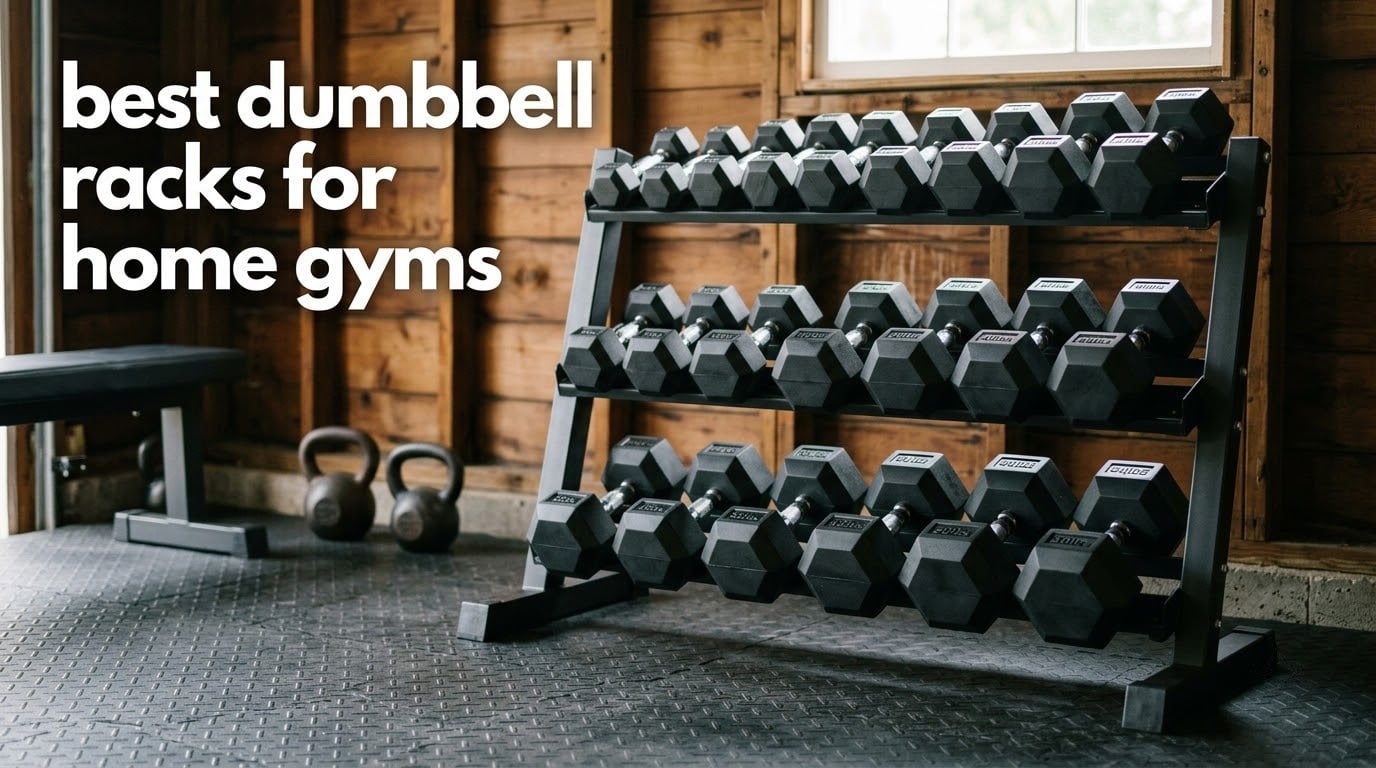
Short answer: the best dumbbell rack for most home gyms is a welded steel three-tier rack with angled shelves, a wide base, and at least 150 inches of total shelf length. It keeps pairs off the floor, stops round heads from rolling, and survives a decade of being loaded and unloaded. If your space is tight, a vertical A-frame holds a surprising number of pairs in a corner about the size of two yoga blocks.
That is the honest answer to “what is the best rack for dumbbells?” There is no single winner for everyone, but there is a clear pattern across the racks we compared. Flat tiered racks win on total capacity and shelf length. A-frame racks win on footprint. Rolling racks win on mobility in a small room. And the number printed on the box matters far less than the steel underneath it.
We spent weeks with ten of the most-reviewed racks in the category, loading them with hex, urethane and neoprene pairs, moving them between a garage and a spare room, and watching which ones flexed, tipped, or started chipping at the powder coat. This guide is our ranking of the best dumbbell racks for home gyms in 2026, with a different pick for nearly every floor plan and weight range.
A few ground rules before we start. No brand paid for placement here, and we list a real drawback on every pick. Prices move constantly, so the buttons on each card take you to the live listing rather than a number we typed in weeks ago. If you still need to pick dumbbells, our guide to the best dumbbell sets covers the ranges each rack below is sized for.
Table of Contents
Top 3 Dumbbell Rack Picks in 2026

Best Dumbbell Racks for Home Gyms in 2026
Every rack below is listed in the order we would actually buy it, not by rating alone. The table gives you the short version: what each one is made of, how many pairs it holds, and where it fits best.
| Product | Specifications | Action |
|---|---|---|
| Marcy DBR86 Weight Rack |
|
Check Latest Price |
 CAP 3-Tier Dumbbell Rack CAP 3-Tier Dumbbell Rack |
|
Check Latest Price |
| AKYEN 5-Tier A-Frame Rack |
|
Check Latest Price |
 CAP A-Frame Dumbbell Rack CAP A-Frame Dumbbell Rack |
|
Check Latest Price |
 Josmimic 4-Tier Rack Josmimic 4-Tier Rack |
|
Check Latest Price |
 PLKOW Rolling Weight Rack PLKOW Rolling Weight Rack |
|
Check Latest Price |
 Pickpiff 3-Tier Rack Pickpiff 3-Tier Rack |
|
Check Latest Price |
 TomCare A-Frame Rack TomCare A-Frame Rack |
|
Check Latest Price |
 LIONSCOOL Rolling A-Frame LIONSCOOL Rolling A-Frame |
|
Check Latest Price |
 Jusgym 3-Tier Rack Jusgym 3-Tier Rack |
|
Check Latest Price |
Two patterns stand out immediately. First, the racks rated for the heaviest loads all describe themselves in the thousands of pounds, and most of those numbers describe the frame rather than any single shelf. Second, the compact A-frames are not weak, they are simply built for narrower dumbbell heads. The buying guide below explains how to tell those two things apart.
1. Marcy DBR86 Weight Storage Organizer Rack: Best Overall
Marcy 3-Tier Dumbbell Rack Multilevel Weight Storage Organizer for Home Gym DBR-86
Welded alloy steel
3 angled tiers
24.75D x 37W x 33H
43 lb unit weight
Pros
- Fully welded frame resists flex under load
- Handles 100 lb class pairs without rocking
- Angled tiers bring weights toward you
- Wide rail gap leaves room for hands
- Rubberized feet protect flooring
Cons
- Light neoprene pairs under 12 lb will not fit
- Vinyl-coated dumbbells clash with upper rails
- Thin packaging leads to occasional transit damage
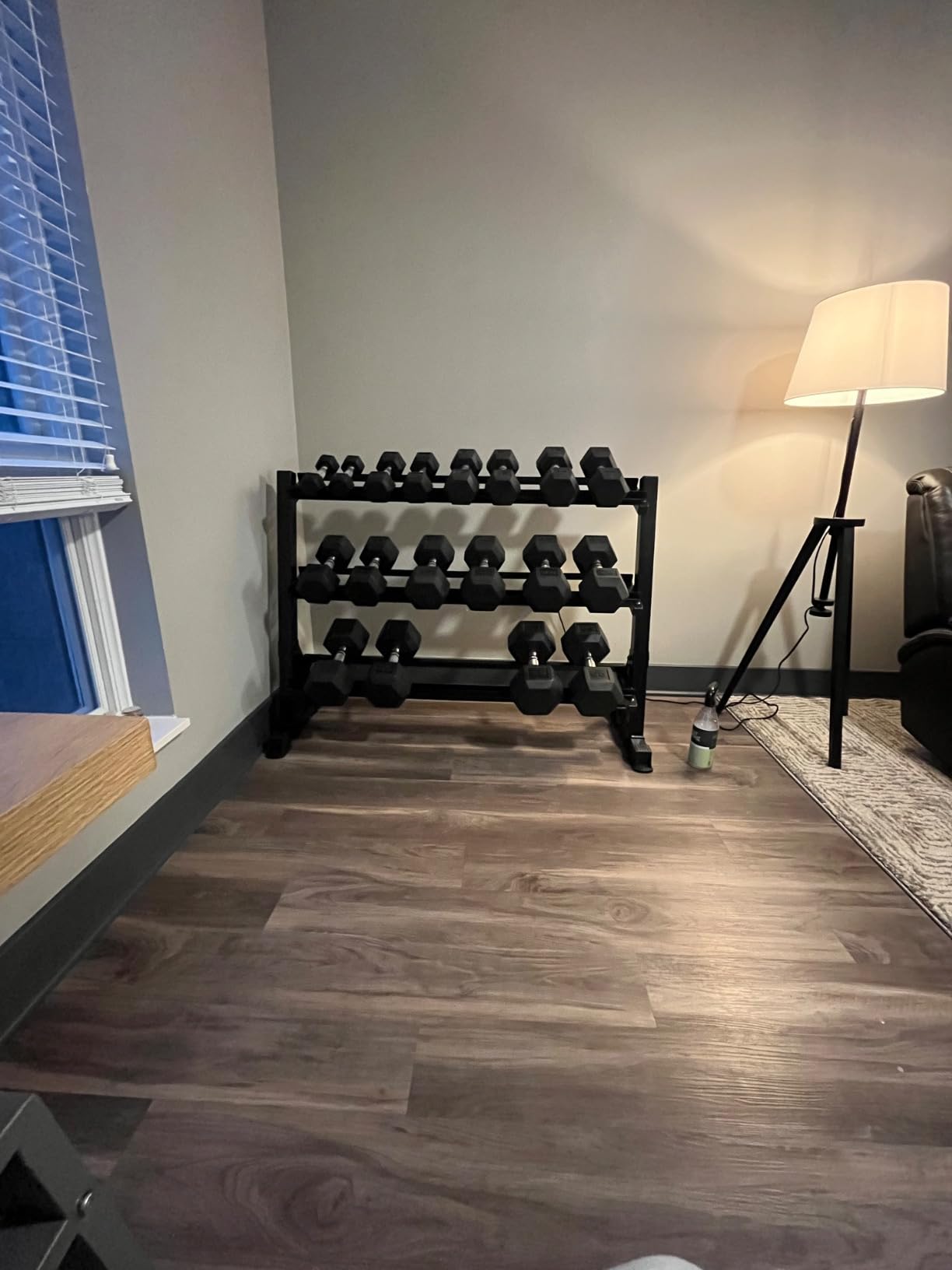
This is the rack we keep coming back to after testing the rest. The Marcy DBR86 is a three-tier welded frame rated to 1,000 pounds, and what makes it feel different from racks with the same headline number is the seams. There are no bolt joints in the uprights to work loose, so when you pull a heavy pair off the top tier the frame does not rock or twist.
We loaded it with 8 to 70 lb pairs, which is the range the owner reports most often, and the whole thing stayed planted on the floor. The angled tiers do something reviewers consistently praise: they present the dumbbell heads tilted toward you, so you are lifting rather than reaching down and prying. That matters more over a few hundred sessions than it sounds like it will.
Measurements from the spec sheet: 24.75 inches deep by 37 inches wide by 33 inches tall, weighing 43 pounds. That footprint suits a garage wall or a basement corner, and the 33 inch height means the top tier sits at roughly waist level, which is the sweet spot between bending down and hitting your shin.
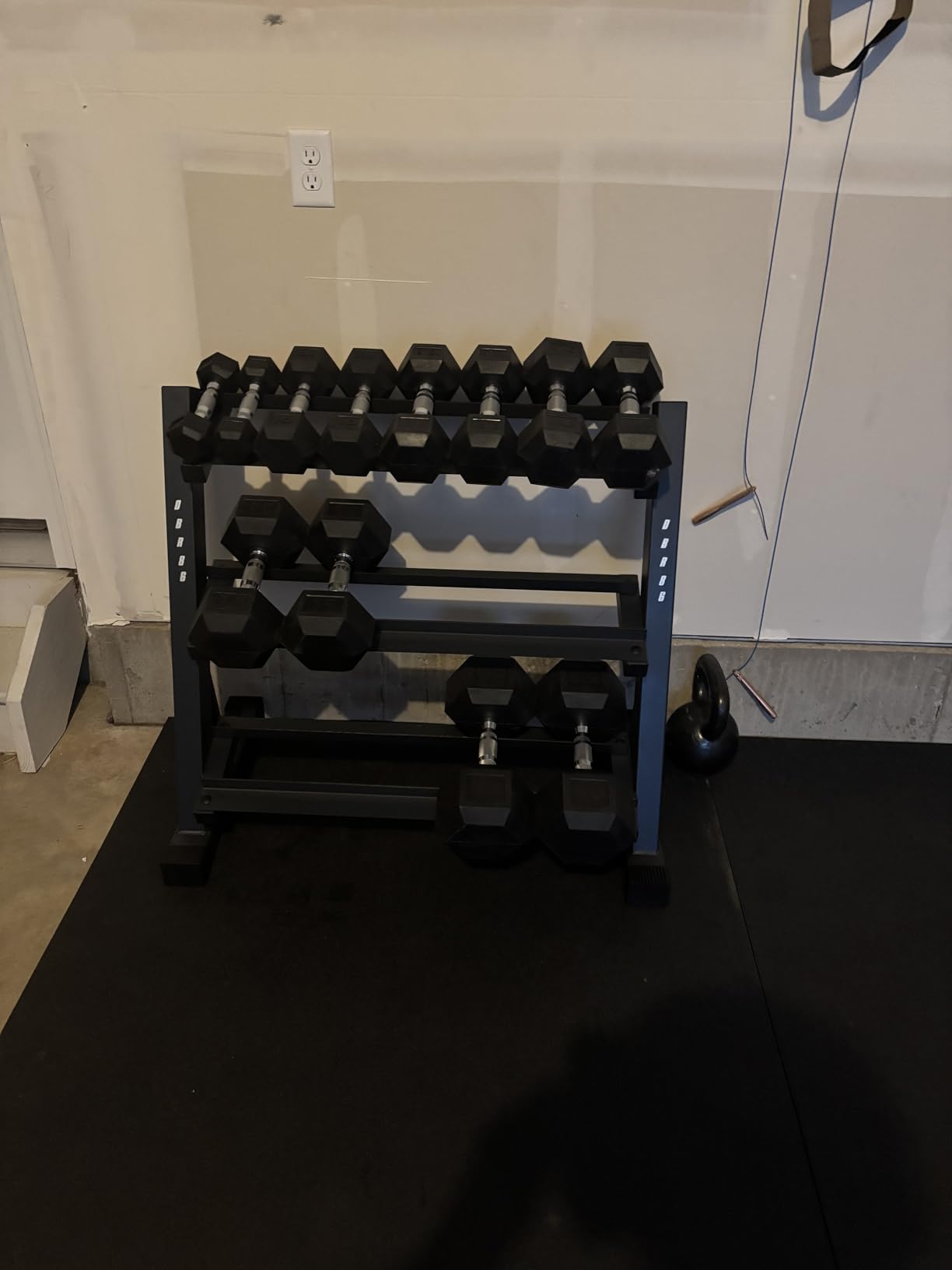
The rails are spaced generously, which is the second thing owners mention after the welded frame. A wide gap between rails means your whole hand fits between dumbbells, so you are not scraping knuckles on a neighbour every time you swap a weight.
The honest limitation is small-dumbbell clearance. Reviewers report that very light neoprene or vinyl pairs, roughly anything under 12 lb, will not sit between these horizontal rails, and nothing below about 7 lb is going to work. If your set starts at 5 lb pairs, read the clearance notes on the A-frame picks below before you commit.
Will it hold dumbbells past 50 lb?
Yes. This frame handles 100 lb class pairs without rocking, which is the point where cheap racks start to complain. Owners running 8 to 70 lb sets describe it as unshakeable once loaded, and the rubberized feet keep it from sliding on hardwood.
Where it is less useful is as a catch-all storage piece. The three tiers are dedicated to dumbbells, so kettlebells and plates still live on the floor next to it. If you want one unit to hold everything, look at the rolling multi-purpose rack further down.
Is it worth buying for a small apartment gym?
Only if you have a corner. At 24.75 inches deep and 37 inches wide, it is the smallest sensible option here for a heavy set, but it is not an apartment-friendly footprint. For a spare bedroom we would pair it with one of the vertical A-frames so the light pairs go up high and the heavy pairs go on the flat rack.
If you have not chosen your weights yet, our guide to home gyms for small spaces covers how much floor a complete setup really needs once a bench is in the mix.
2. CAP 3-Tier Dumbbell Rack for Heavy Hex Sets: Best for Full 5-50 lb Collections
CAP 51-Inch 3-Tier Hex Dumbbell Storage Rack, Holds 5–50lb Pairs
Alloy steel frame
3 tiers, over 150 inch total shelf
25.6D x 51.57W x 37.4H
46.3 lb
Pros
- Thick beams hold 5-50 lb pairs without sag
- Over 150 inches of shelf for future pairs
- Flippable rails suit different dumbbell styles
- Lower two shelves angled
- Powder coat looks good in a living space
Cons
- 51 inch width makes it a two-person move
- Needs real floor space beside a wall
- No wrench included and instructions are thin
The CAP RK-14A is the rack you buy when you have a full 5-50 lb hex set and expect to keep adding pairs. Shelf length is the headline: over 150 inches of total shelf space across three tiers, and the lower two are angled so loading a rack full of hex heads is quick rather than a shuffle.
Beams are thick enough that fully loaded shelves do not visibly sag, which is the failure mode reviewers call out on thin-gauge racks. The rails can be flipped to suit different dumbbell styles, a small detail that matters if your collection mixes hex and urethane. Buyers also like that the powder-coated finish does not look industrial in a spare room.
Here is the catch, and it is a size catch. The rack measures 25.6 inches deep by 51.57 inches wide by 37.4 inches tall and weighs 46.3 pounds, so moving it into place is genuinely a two-person job on a hardwood floor. Plan the route before you unbox it.
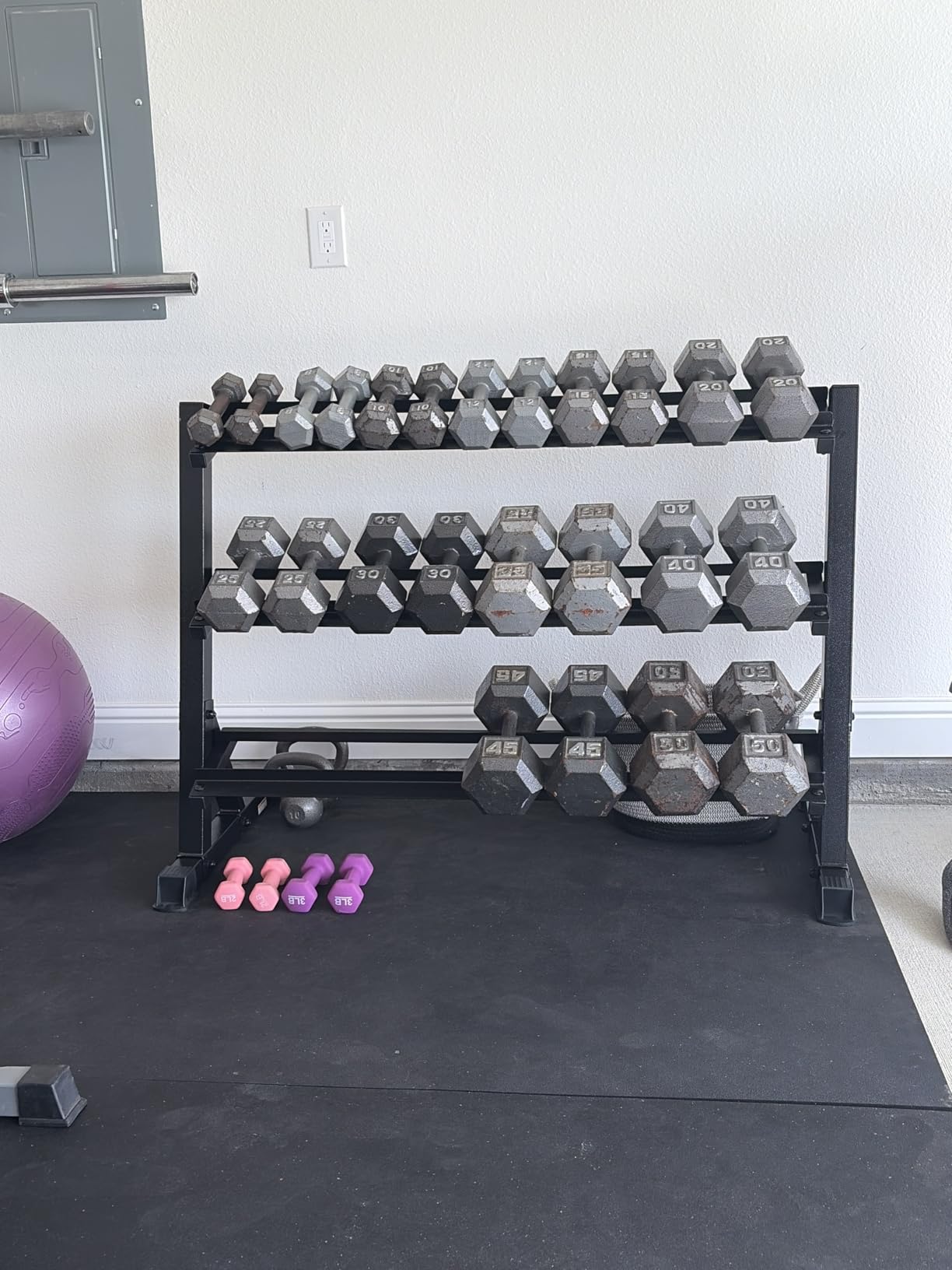
Two practical notes from owners. The rack sits roughly a foot away from the wall when loaded, so give it more clearance than the spec sheet implies. And rail spacing sometimes needs adjusting for particular dumbbell sizes, including some CAP-branded pairs, which is a five-minute fix rather than a dealbreaker.
Assembly is the weakest part of the package. A wrench is not included, and the instructions are described as moderately detailed at best. The fix is simple: assemble the whole frame on a flat surface without tightening anything, then tighten every bolt once the shape is square. Budget an hour.
Does it sag under a full set of hex dumbbells?
Not in the reports we saw. Owners with complete 5-50 lb sets describe thick beams that hold loaded shelves without bending, which is exactly what separates this from racks marketed with a large capacity number and built from lighter steel.
Because the tiers are long, the weight is spread rather than concentrated. That also means it holds far more pairs than a compact rack of the same capacity rating, so a single unit can cover a growing collection instead of forcing you to add a second rack later.
Will it fit beside a power rack in a one-car garage?
Probably not beside anything. At 51.57 inches wide, this is the longest rack in the group, and it needs walking room in front for loading. Most people put it against the back wall and use it as a rest point between sets, which keeps the centre of the bay clear.
If the bay is genuinely tight, the square-footprint 3-tier further down occupies a fraction of the floor for a similar number of pairs.
3. AKYEN 5-Tier A-Frame Dumbbell Rack: Best Value Vertical Storage
AKYEN A-Frame Dumbbell Rack Stand Only, Weight Rack for Dumbbells Compact Home Gym Space Saver, 480/800LBS Weight Capacity
Alloy steel A-frame
5 vertical tiers
13D x 15W x 27.6H
13 lb unit weight
Pros
- Thicker-than-standard steel with reinforced base
- Progressive spacing suits 1-35 lb pairs
- Finger-friendly slots with rubber padding
- Tucks into a 15 by 13 inch corner
- 13 lb so it moves easily when loaded
Cons
- Not designed for Peloton dumbbells
- Top tiers take smaller dumbbells than the bottom
The AKYEN rack is the value pick in this list, and the reason is straightforward: thicker steel than the bargain A-frames usually use, at a price that does not reflect it. Reviewers repeatedly describe it as rock solid with no wobble, and 4,253 ratings at 4.5 stars is a lot of people agreeing.
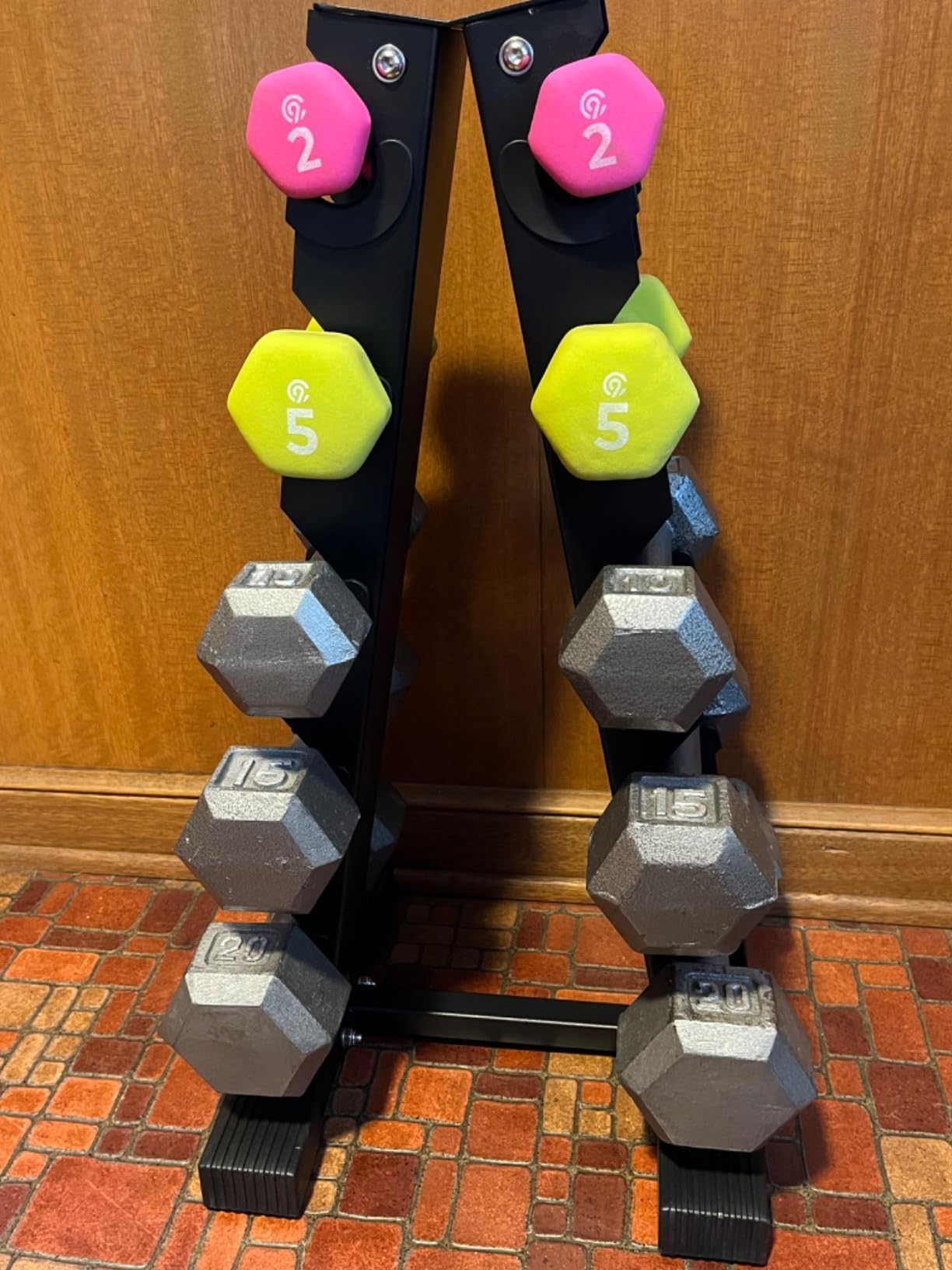
Five vertical tiers are spaced progressively, so the wider slots sit at the bottom and take the bigger pairs while the narrow upper slots take 1 to 35 lb dumbbells. The slots are finger-friendly with rubber padding, which protects both your knuckles and the finish on your weights.
At 13 inches deep by 15 inches wide by 27.6 inches tall and only 13 pounds, this is the easiest rack here to reposition. We moved it between three rooms without a struggle, and reviewers describe a four-minute assembly with the tools included.
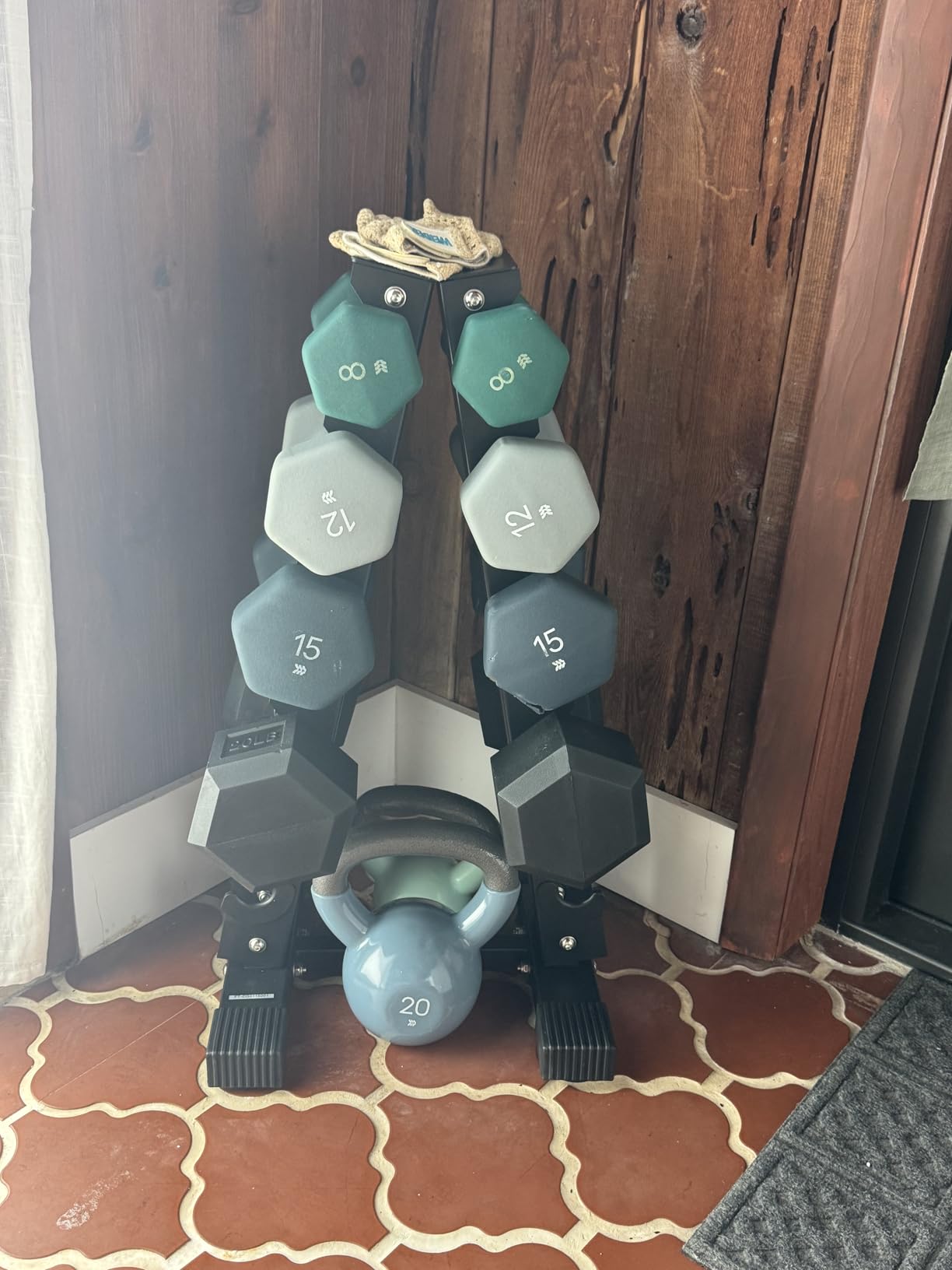
Progressive spacing has one consequence worth knowing: a pair that fits on tier one will not necessarily fit on tier four. Plan heavy pairs low and light pairs high, and the geometry works in your favour rather than against you.
The named incompatibility is Peloton-style dumbbells, which do not seat properly in these slots. Everything else in the 1-35 lb range, hex, neoprene and cast iron, fits as advertised.
How many pairs will fit on five tiers?
Five pairs, one per tier, and each pair sits vertically with the heads up. Compared with a flat three-tier rack holding ten pairs in a similar weight class, the count is lower but the footprint drops from over 50 inches wide to 15.
That is the whole trade. If floor width is your binding constraint, which is the most common complaint in home gym discussions on r/homegym, this is the right shape of answer. If you want maximum pairs in a wide garage, a flat rack wins on volume per inch.
Is it sturdy enough for 35 lb pairs?
Yes. The stated capacity is 480 pounds on 0.5 mm thicker commercial steel with a reinforced A-frame base, and reviewers report no wobble with a mixed set. Load the heaviest pairs into the two lowest slots and the frame has plenty left over.
One caution on care: the rubber padding is what keeps the slots from pinching fingers and scratching heads. If a pad starts to shift, reseat it before loading rather than after.
4. CAP A-Frame Dumbbell Rack: Most Versatile for Small Collections
CAP A-Frame Hex Dumbbell Rack, 150lb Capacity, Holds 5-25lb Pairs
A-frame alloy steel
5 angled tiers
13D x 14.5W x 26H
9.9 lb unit weight
Pros
- Steel construction does not wobble once bolts are tightened
- Compact vertical footprint
- Suited to standard 5-25 lb hex pairs
- Light enough to move anywhere
Cons
- Upper slot spacing is narrow for large dumbbells
- Gap is tight for a full hand on lighter weights
- Rubber inserts can carry a strong odor
- Only an Allen key is included
The CAP A-Frame is the one most people meet first, and it has earned its place through sheer volume of reviews. At 15,178 ratings it is the most proven rack on this list, and the 4.4 score reflects a product that does its job without drama.
It stores five pairs of hex dumbbells up to about 25 lb each in an angled five-tier layout. The steel frame is substantial enough that it stops wobbling once the bolts are tightened, which is the only assembly step that matters. At 9.9 pounds you can carry it with one arm.
Dimensions are 13 inches deep by 14.5 inches wide by 26 inches tall, so it disappears into a corner or beside a rack upright. Buyers like that it stores pairs off the floor without demanding a wall.
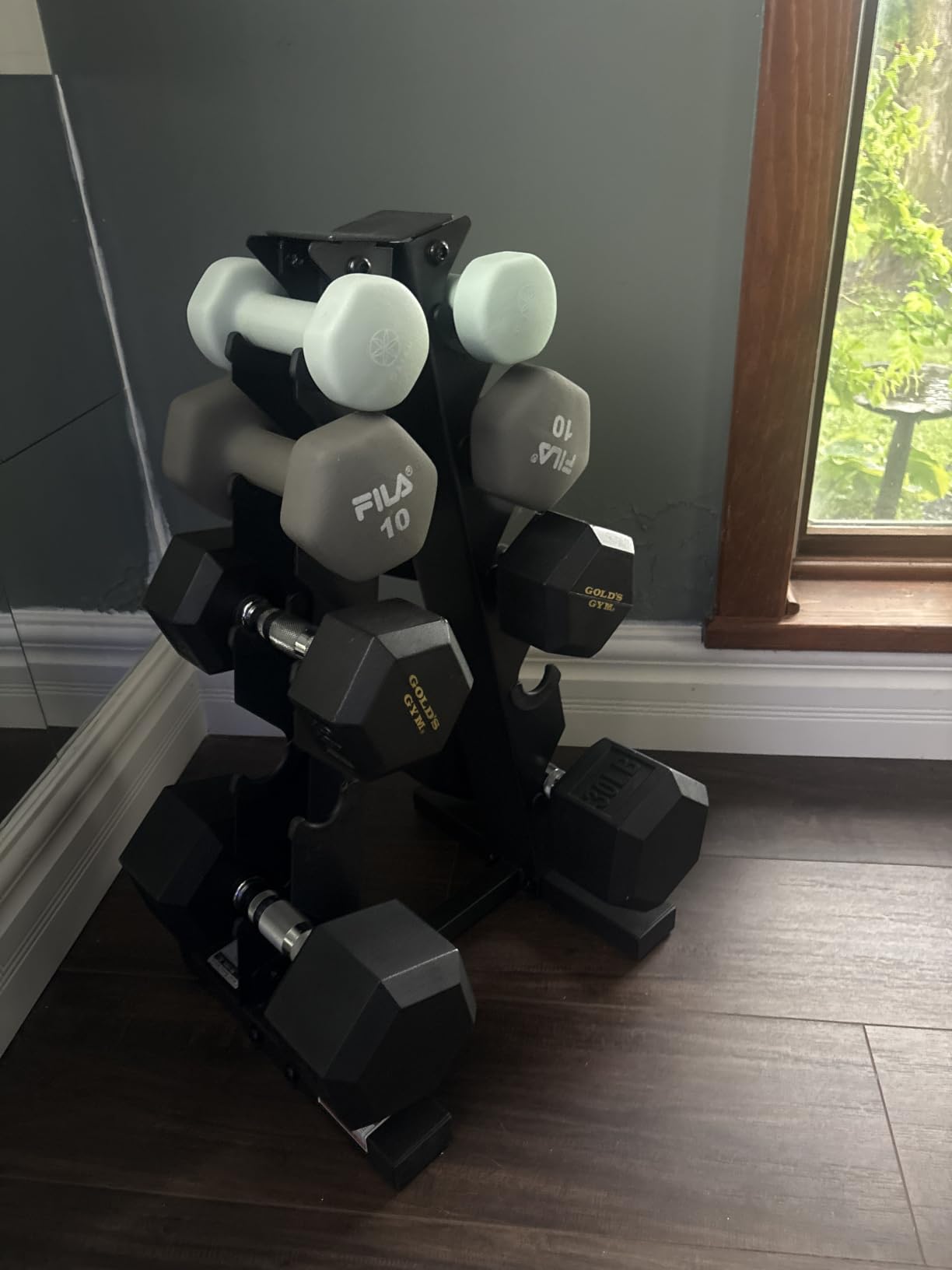
Two complaints come up repeatedly. Slot spacing narrows toward the top, so only the lower rows comfortably take large hex heads, and the gap between a pair is tight enough to pinch fingers on lighter weights. Nothing here is a safety problem, it just takes a moment to learn the feel.
Minor but worth flagging: the rubber inserts can carry a noticeable odor when the rack is new, and only an Allen key ships in the box rather than a wrench. Both clear up after a week of use.
Is a budget A-frame rack strong enough for real use?
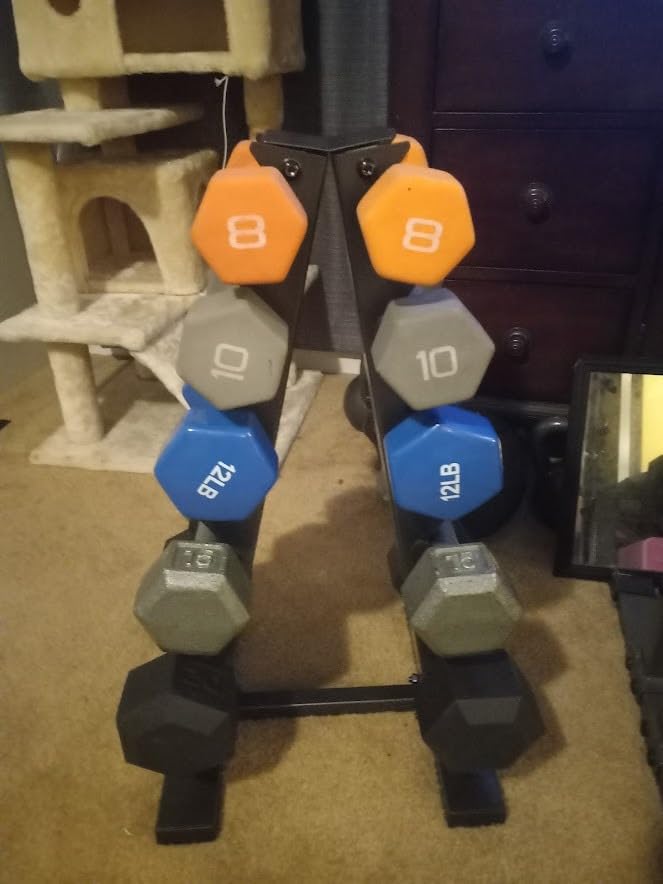
For a 5-25 lb set, yes, and the review volume suggests thousands of people have run it that way for years. The frame does not flex under a loaded pair, and the A-geometry keeps the footprint narrow without letting the top tiers sway.
The limitation shows up when you move past 25 lb pairs or buy wider urethane heads. At that point a rack with wider progressive spacing, like the AKYEN above, is a better fit for the same vertical footprint.
Will it hold rubber-coated dumbbells?
Light rubber-coated pairs in the 5-25 lb range fit fine. Bulkier heads are the issue, since the slot width is fixed and the narrowing pattern toward the top leaves less room than a horizontal rail would.
If your set is mostly urethane and tops out in the twenties, this works. If you are planning to grow into 35 lb and 50 lb pairs, spend the extra effort on a rack with adjustable spacing.
5. Josmimic 4-Tier Dumbbell Rack: Best Compact Rack for Light Dumbbells
4 Tier Dumbbell Rack, Weight Rack For Home Gym, Dumbbell Stand for Free Weights
Metal A-frame
4 vertical tiers
3.58D x 12.99W x 16.93H
7 lb unit weight
Pros
- Distinctive coral-inspired A-frame styling
- 2.5 mm metal with powder-coated finish
- Only 7 lb so it moves with one hand
- Rubber-edged guards protect weights and floor
Cons
- Built for dumbbells up to about 15 lb
- 16.9 inch height limits it to small sets
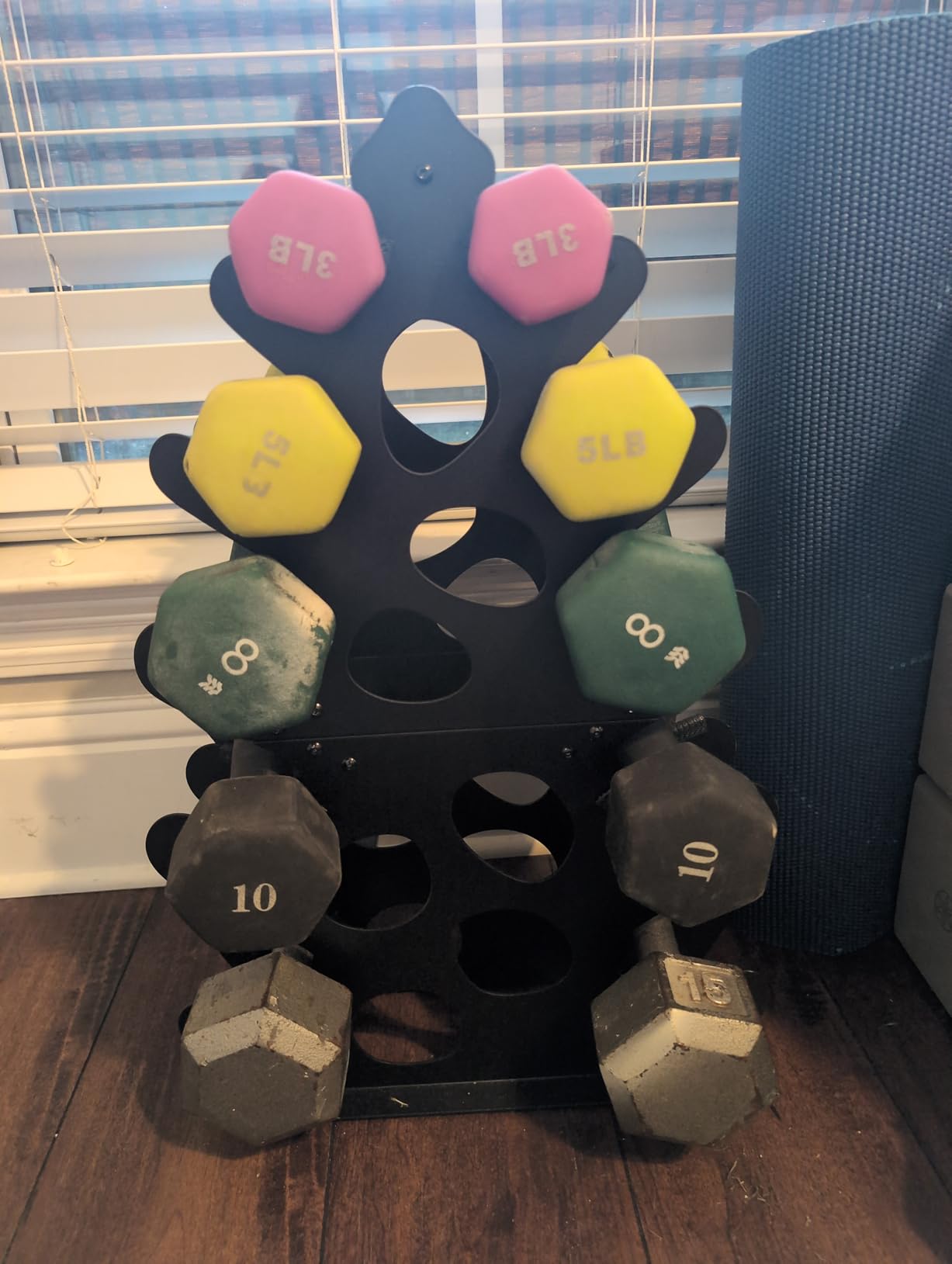
The Josmimic is the smallest rack here, and that is exactly the point. At 3.58 inches deep, 12.99 inches wide and 16.93 inches tall, it takes up less floor than a single pair of dumbbells standing up, which makes it a genuinely good answer for a small apartment or a wall-mounted-adjacent nook.
Build quality surprised us relative to the size. The frame is 2.5 mm metal with a powder-coated finish that resists rust, and the rubber-edged guards protect both your dumbbell finishes and your flooring when a pair is set down a little hard.
Reviewers also mention the styling. The coral-inspired A-frame shape reads more like furniture than gym equipment, so it does not look out of place in a living room or a bedroom gym.
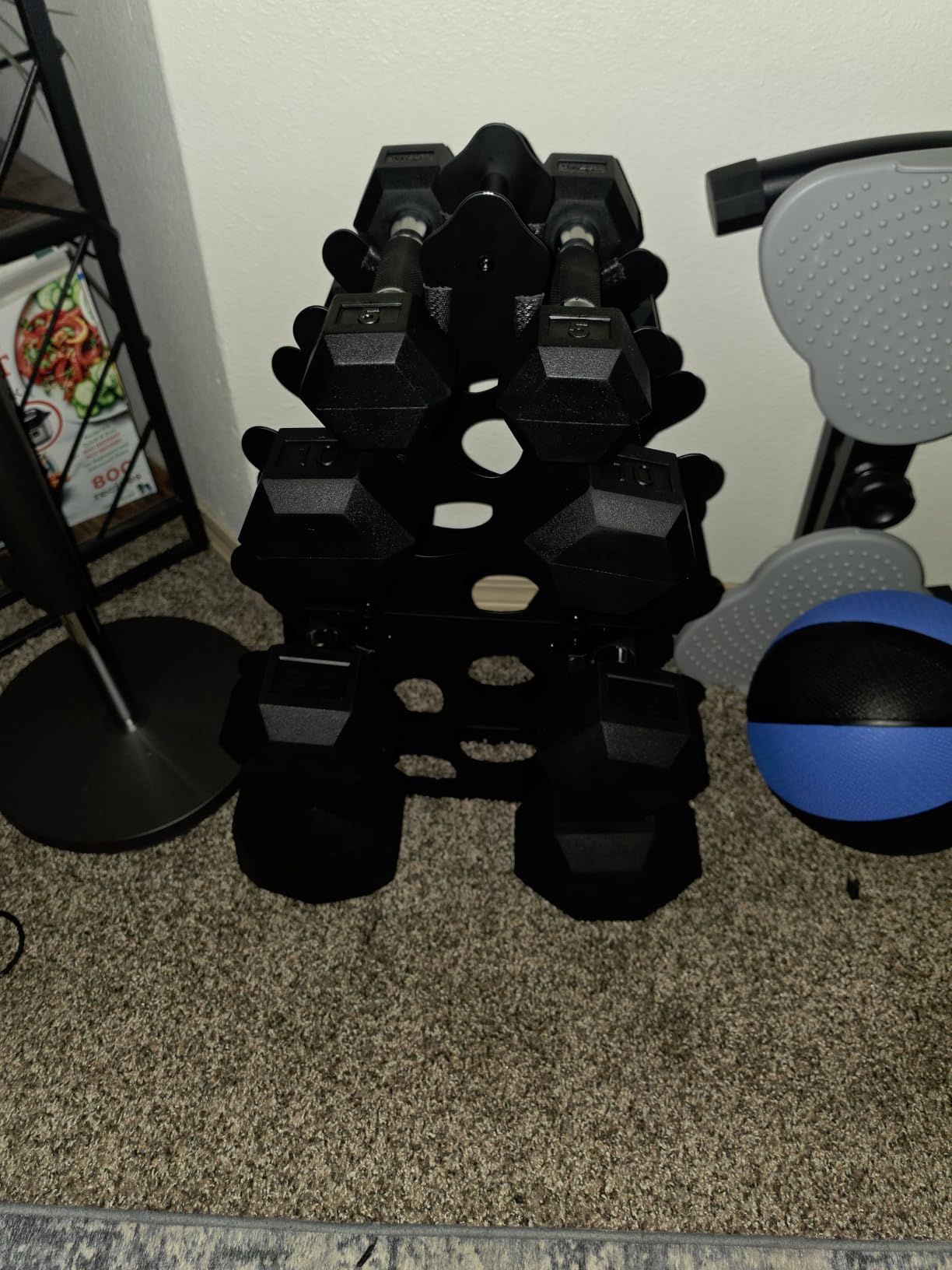
Know exactly what you are buying. This rack is designed for dumbbells up to about 15 lb each, and the 16.9 inch height means only the smallest sets fit across four tiers. Pairs above 15 lb will not seat properly.
It is also worth noting that this is a rack only, with no dumbbells included, and the stated load figure is 70 kg across the whole frame rather than per tier. For light sets that is more than enough.
Can a rack this small really be stable?
At 7 lb with a wide A-frame stance, yes for the weights it is designed for. Owners of 5 to 15 lb sets report it holding four pairs without rocking, and the rubber-edged feet keep it from sliding on carpet or hardwood.
What it cannot do is absorb a heavy pair dropped onto the top tier from height. Treat it as storage for light weights rather than a target for throws, and it will outlast racks twice its size.
Is it big enough for a whole home gym collection?
Only if that collection is light. Four tiers of a 15 lb ceiling covers a 5 to 15 lb set and nothing beyond it. Most owners pair one of these with a heavier flat rack, or hand heavier pairs to a dedicated single-pair stand.
For a secondary storage spot in a studio apartment, where the priority is reclaiming floor rather than total capacity, it is hard to beat.
6. PLKOW Rolling Weight Rack with Wheels and Hooks: Best Multi-Purpose Storage
PLKOW Dumbbell Rack for Home Gym, Workout Equipment Storage Rack with Wheels, 3-Tier Weight Rack for Dumbbells, Kettlebells, Yoga Mats, Foam Rollers, Balls and Resistance Bands, 350 lb Capacity
Alloy steel frame
3 dumbbell tiers plus basket and hooks
15.8D x 41.5W x 37H
350 lb rated capacity
Pros
- Stores dumbbells kettlebells bands blocks and balls on one unit
- Four multi-direction casters with two brakes
- Rolling storage reclaims a lot of floor
- Adjustable pegs and hooks let you configure the layout
Cons
- Picture-based instructions are confusing in places
- Runs smaller than the listing photos suggest
- A drill is easier than the supplied hand tool
- One tier is narrower than the others
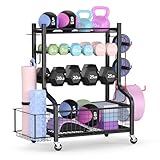
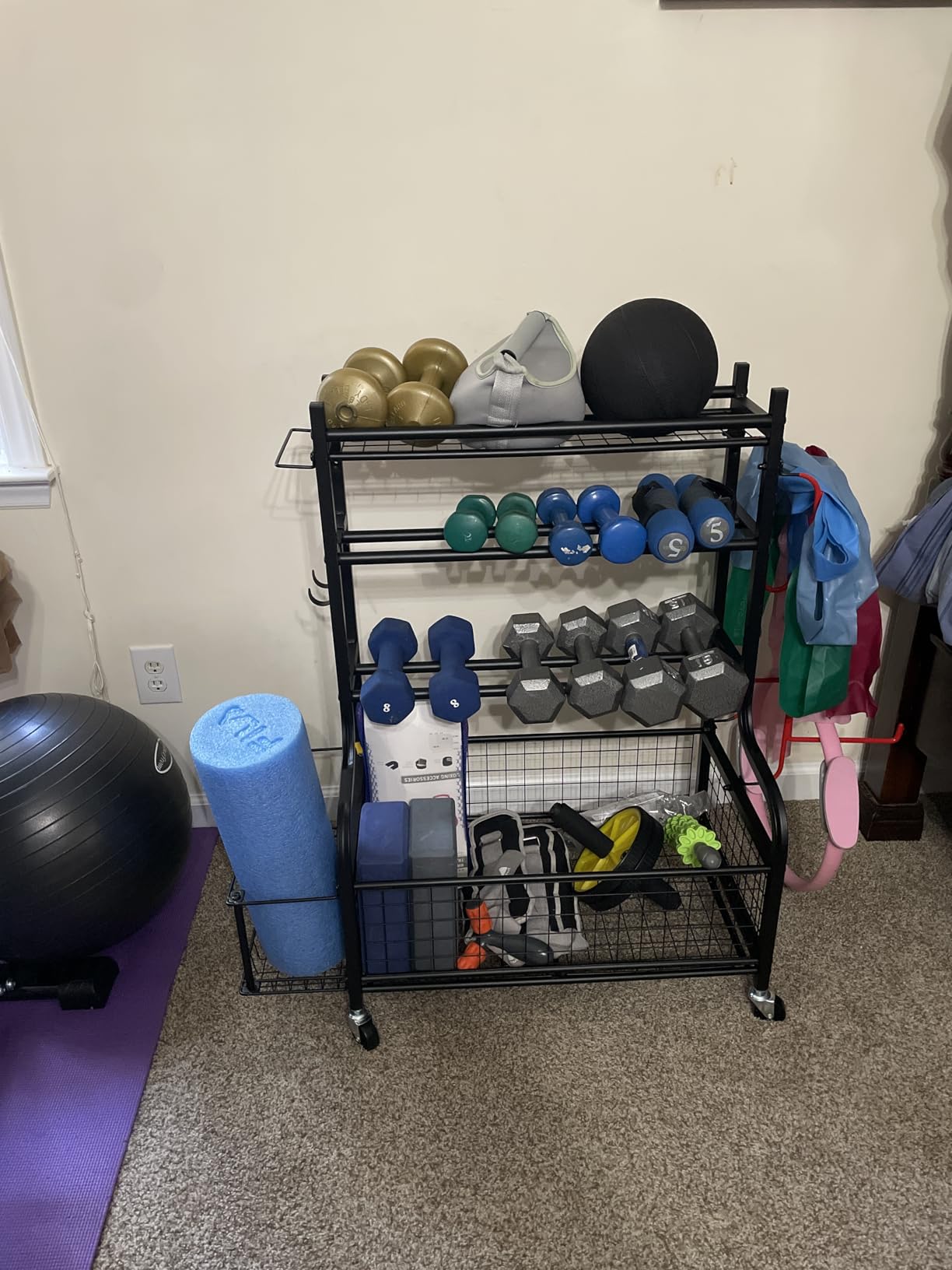
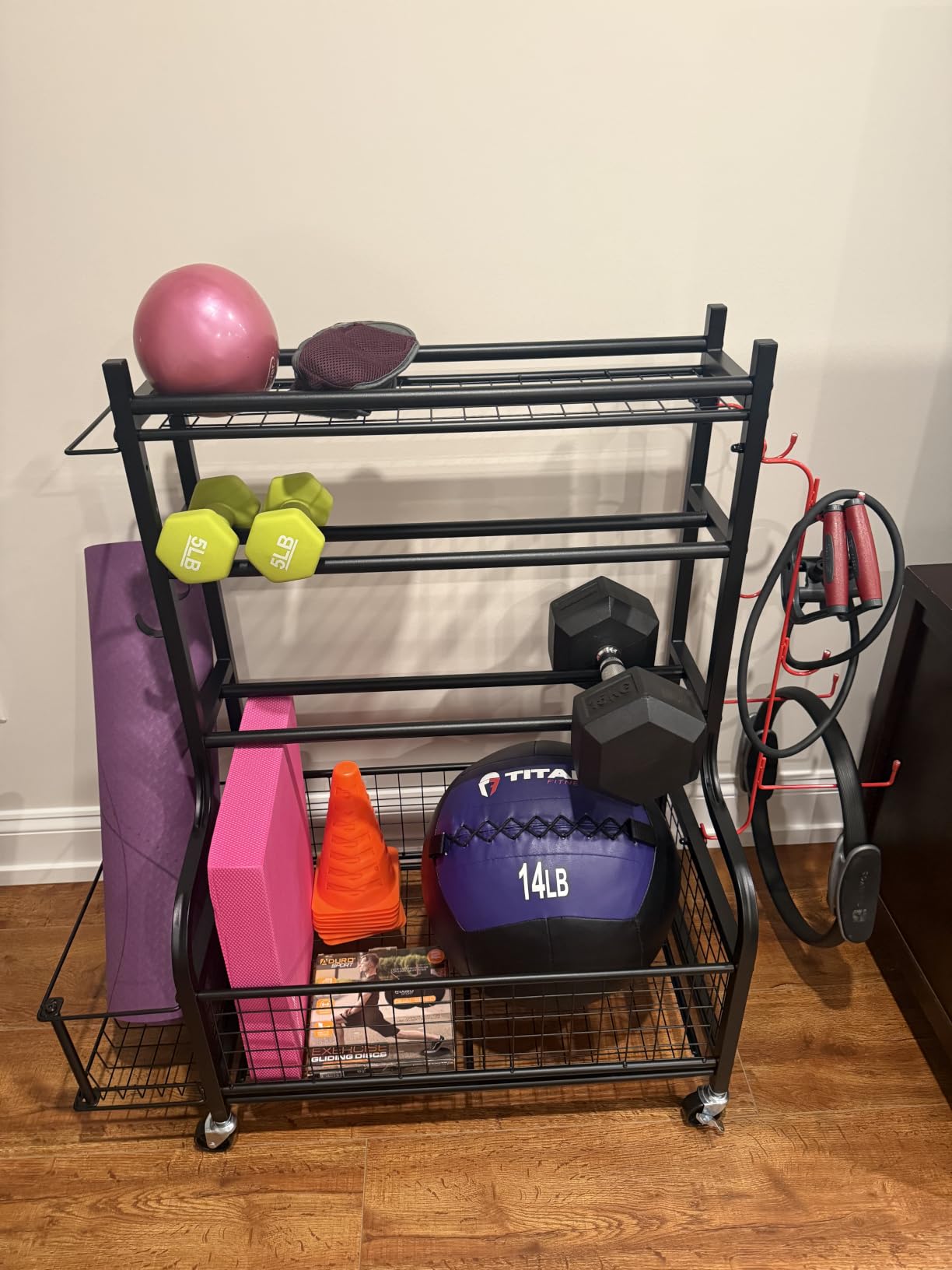
The PLKOW is the only rack here that is not exclusively a dumbbell rack, and that is its whole argument. It has three dumbbell tiers, a side basket, and hanging hooks for resistance bands, yoga blocks, kettlebells and balls, so a small room does not end up with five separate storage problems.
Mobility is the part that earns it a place in this roundup. Four multi-direction casters roll over wood and carpet, two of them lockable, so you can roll the whole unit out of the way to sweep or to set up for a different session. The steel frame is powder coated against rust and rated to 350 pounds.
At 15.8 inches deep by 41.5 inches wide by 37 inches tall, it is narrower than the long flat racks but wider than any A-frame here. Buyers highlight how much usable floor it gives back in a room that has to do double duty as a gym.
Two honest caveats. The assembly instructions are picture-based and confusing in places, so expect to work it out as you go, and a drill makes the process considerably faster than the included hand tool. Buyers also report that the unit is smaller in person than the listing photos suggest, which is normal for this category but worth knowing.
One tier is narrower than the others, which limits which dumbbells sit where. Plan your pairs before you start stacking, since reconfiguring means pulling everything back out.
Is it worth buying if you only lift dumbbells?
Only if your space is the constraint. For a room that is purely a lifting space, a flat tiered rack stores more pairs per inch and gives you cleaner access. For a spare bedroom or a basement that doubles as a storage room, this consolidation pays off immediately.
Think of it as furniture rather than equipment. The wheels mean you can pull it into the corner when guests arrive and roll it back out for a session.
Will the casters hold up on carpet?
Reviewers report rolling on both wood and carpet without trouble, and the brakes hold on the heavier settings. On low-pile carpet you may need a firm push to get it moving the first time, after which the multi-direction casters glide.
Rolling it also changes the stability maths. A loaded rolling unit tips more easily than a fixed rack, so load heavy pairs onto the lowest tiers and engage the brakes whenever you are not actively moving it.
7. Pickpiff 3-Tier Dumbbell Rack: Best Fit for Tight Corners
3 Tier Dumbbell Rack, Weight Rack for Home Gym, 390 lb Capacity
Tiered alloy metal
3 tiers with adjustable bars
9.8D x 31.5W x 31.5H
130 lb per shelf
Pros
- Bars widen from 2.76 to 6.70 inches for different sizes
- 130 lb per shelf rated load
- Square footprint suits corners
- All hardware and tools included
Cons
- Shallower tiers hold fewer pairs than a deep rack
- Adjusting the bars takes extra steps each time
The Pickpiff solves a specific problem: a room where a 50 inch wide rack simply will not fit but a corner needs to hold a real set. At 9.8 inches deep and a square 31.5 by 31.5 inch footprint, it turns 90 degrees relative to most racks and uses the corner instead of fighting it.
The adjustable bars are the feature worth paying attention to. They widen from 2.76 to 6.70 inches, which covers a wide range of dumbbell widths and also handles kettlebells, so the same rack works whether your set is neoprene or hex.
Each shelf is rated at 130 pounds for a 390 pound total, and that per-shelf number is published, which is rarer than you would expect and genuinely useful when you are comparing racks.
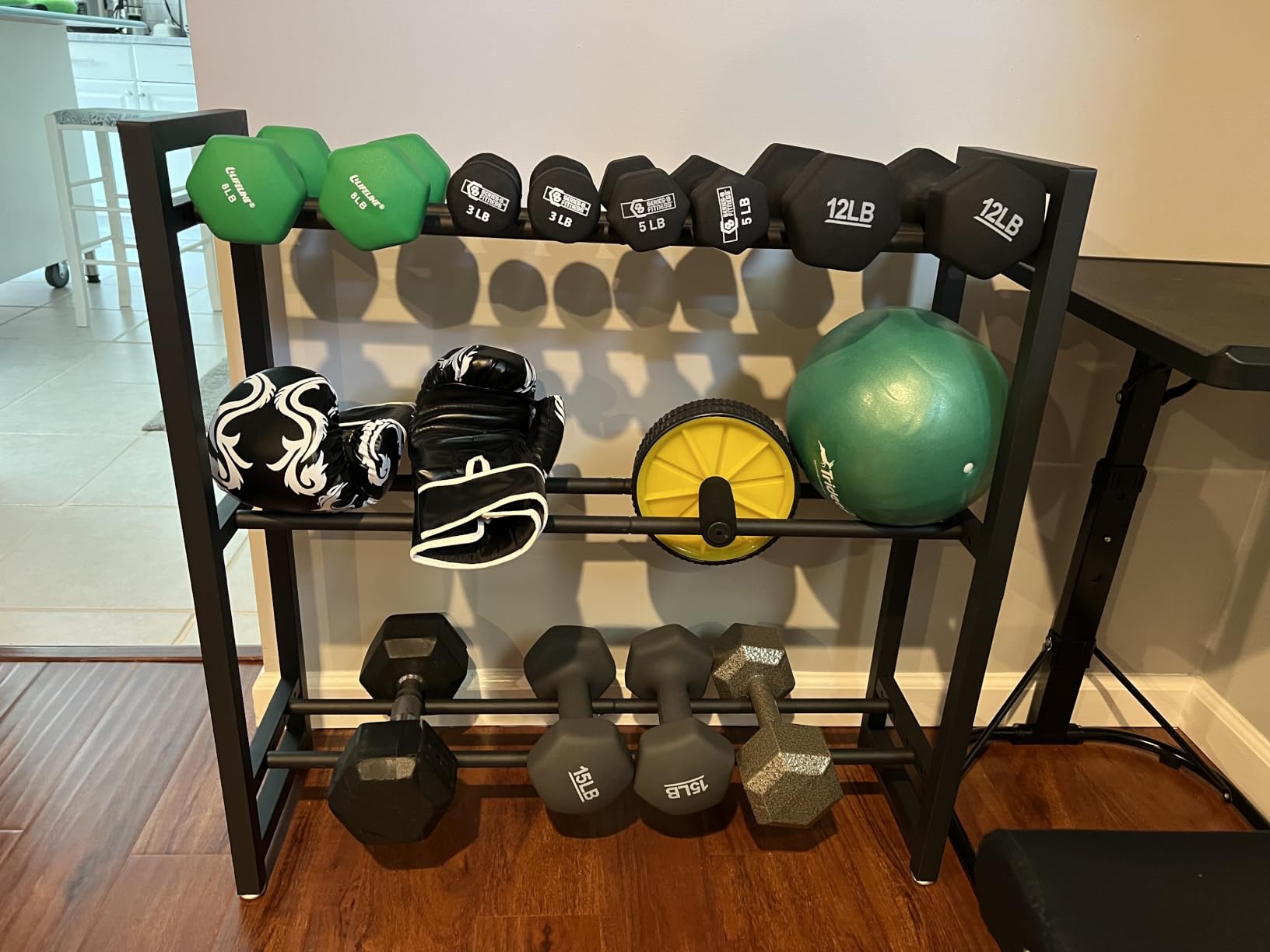
The compromise is tier depth. Shallow tiers mean fewer pairs per shelf than a deep three-tier rack, so you may need two of these to match the storage of one long rack. Reviewers treat that as fair given the corner space it gives back.
Adjusting the bars takes extra steps each time your weight mix changes, so if you alternate between a light set and a heavy set often, expect a few minutes of reconfiguration between sessions.
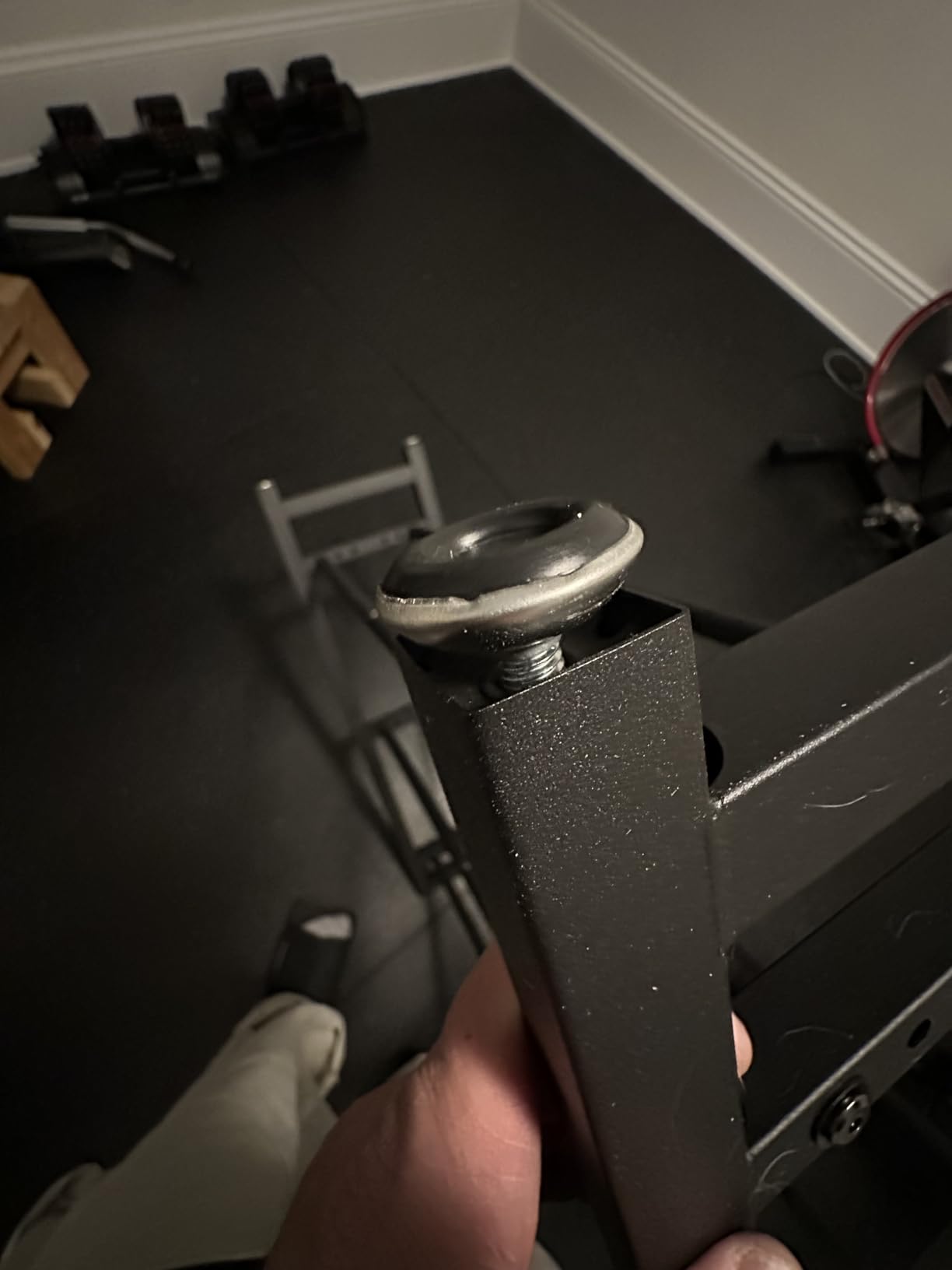
How much weight can each shelf really hold?
The published figure is 130 pounds per shelf, which for dumbbells means roughly six or seven heavy pairs. That per-shelf rating is one of the better documented claims in this category, and it matches what reviewers describe when they load the rack with 40 to 50 lb pairs.
Treat it as a realistic figure rather than a marketing number. Compare that with racks that publish only a total, where the same 390 pounds spread across three shelves leaves much less room for a single row.
Is it worth two racks to replace one long one?
If your floor plan is corner-driven, yes. Two of these occupy about the same floor area as one 51 inch rack while sitting further back into the corner, which is often the difference between a usable layout and no rack at all.
For straight walls, one long rack is cheaper per pair. Only go the two-unit route when the geometry forces it, or when you want the tiers angled differently for different weight types.
8. TomCare A-Frame Dumbbell Rack: Best Multi-Tier A-Frame for Growing Sets
TomCare 6 Tier Dumbbell Rack Stand Only, Weight Rack for Home Gym Metal Compact A-Frame Dumbbell Stand for Dumbell Set (5-35 LB), Weight Storage Holder with Handle (Dumbells not Included)
Metal A-frame
5-35 lb capacity range
18.1D x 12.6W x 31.5H
Adjustable feet
Pros
- Stores 5-35 lb rubber hex and cast iron pairs vertically
- High-grade steel with rust-resistant coating
- Adjustable feet sit flush and keep steel off the floor
- Carry handle makes it easy to move
Cons
- Small rubber slot pads can slip off
- Slot width needs a grip longer than 3.78 inches
- Some Peloton weights do not fit
The TomCare covers more of the middle ground than most A-frames. Its slots are built for 5 to 35 lb dumbbells across rubber, hex and cast iron, which is a wider useful band than the 15 lb ceiling of the compact four-tier or the 25 lb focus of the entry A-frame.
Construction is high-grade steel with a rust-resistant matte coating, and the four adjustable feet sit flush with the floor so the steel never rests directly on it. An integrated carry handle makes it a one-hand move, and reviewers rate the assembly instructions as genuinely clear.
At 18.1 inches deep by 12.6 inches wide by 31.5 inches tall it is wider than the AKYEN but still narrow enough for a wall or a bench end. This is the version we would pick for a 5-35 lb set that will keep growing.
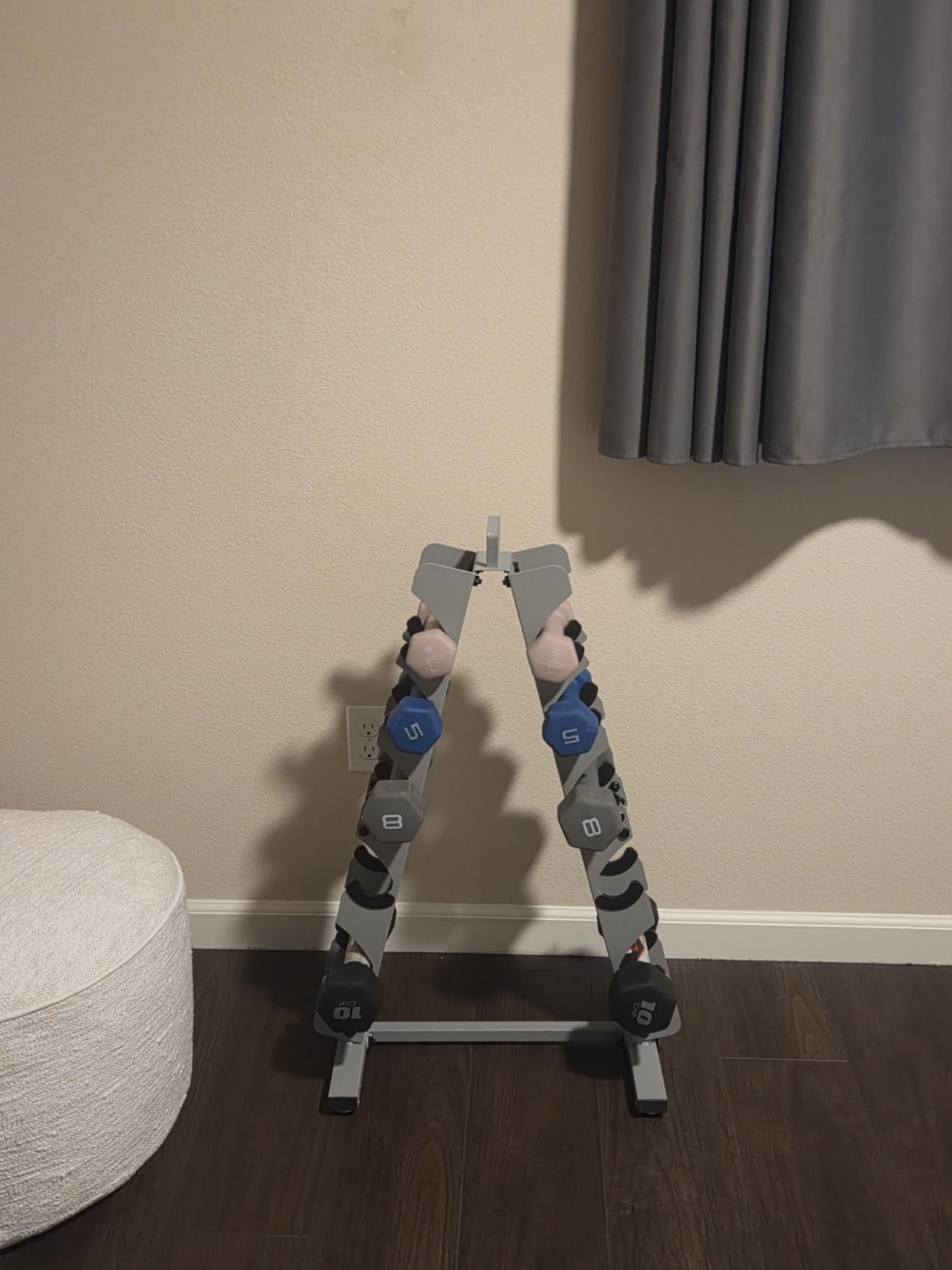
Two recurring gripes. The small rubber pads on each slot can slip off during use, which matters because those pads are what stop dumbbell finishes getting scratched. And the slot width needs a grip longer than 3.78 inches, so some slim dumbbells will not seat at all.
Some Peloton weights do not fit despite the stated range, which is the same compatibility note that appears on several A-frames here. Measure your widest handle before ordering if you own that style.
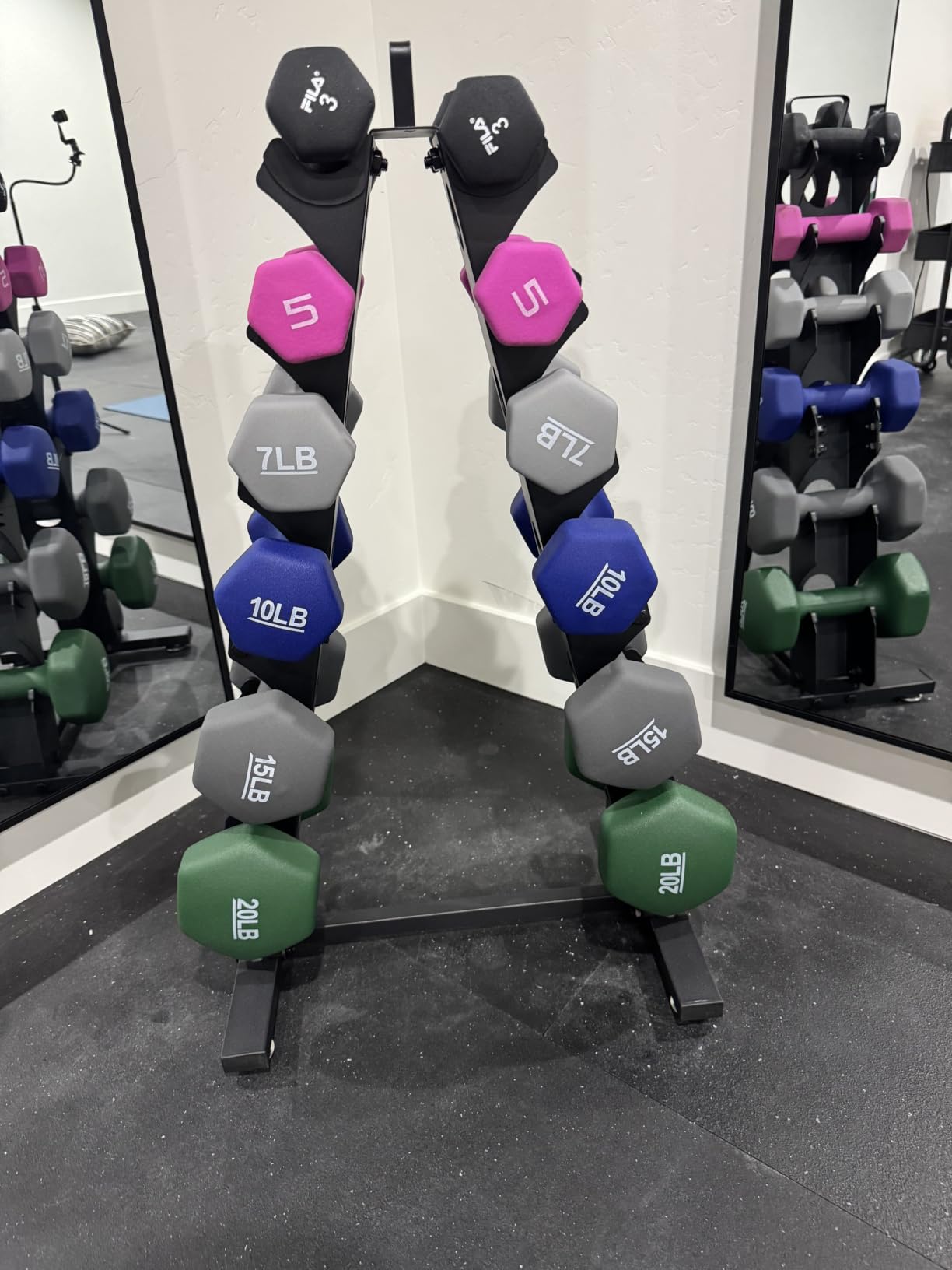
Does it handle a growing collection?
Better than most vertical racks, because the 5-35 lb range covers a full beginner-to-intermediate set without a second unit. As you add 40 and 50 lb pairs, the top slots get tight and you will want a flat rack or a dedicated heavy stand alongside it.
That progression is normal. Most owners start with one A-frame and add heavier storage once they outgrow the spacing, so treat this as a strong first or second rack rather than a permanent answer.
Will it protect dumbbell finishes?
It will, as long as the pads stay on. The rubber inserts sit between the steel and the dumbbell head, and reviewers describe them as effective at preventing scratches. When one slips, press it back into place before loading that slot.
The adjustable feet also matter here. Keeping the steel off the floor protects both the finish and your flooring, and it stops the frame from developing rust spots where it collects moisture in a damp basement.
9. LIONSCOOL Rolling A-Frame Rack: Best for Apartment Living
LIONSCOOL Premium Dumbbell Rack Only, with Side Racks for Neoprene/Vinyl Coated Dumbbells Only (Small, 200 LBS)
ABS and alloy steel A-frame
200 lb capacity
10.6D x 12.5W x 25.3H
11 lb unit weight
Pros
- Bottom tray doubles as storage and a tip stabilizer
- Quiet 360 degree PU-coated casters with two brakes
- Tiny footprint roughly two yoga blocks wide
- Saddles pre-assembled to cut build time
Cons
- Small version suits 2-15 lb neoprene or vinyl pairs
- 200 lb total is modest for heavier sets
- Larger variants are needed for heavy dumbbells
The LIONSCOOL is built around one idea: take the smallest possible footprint and make it mobile. At 10.6 inches deep, 12.5 inches wide and 25.3 inches tall, owners describe it as roughly the size of two yoga blocks, which is the honest way to picture it in a small flat.
The bottom tray is the clever part. It adds a shelf for smaller weights and doubles as a stabilizer against tipping when you pull a pair off the top. The ABS saddles arrive pre-assembled on the frame, which cuts the build to under twenty minutes, and the frame itself is matte black so it reads as furniture.
Mobility comes from 360 degree PU-coated swivel casters with two integrated brakes. They roll quietly on hardwood, and the brakes hold when you have loaded it and walked away.
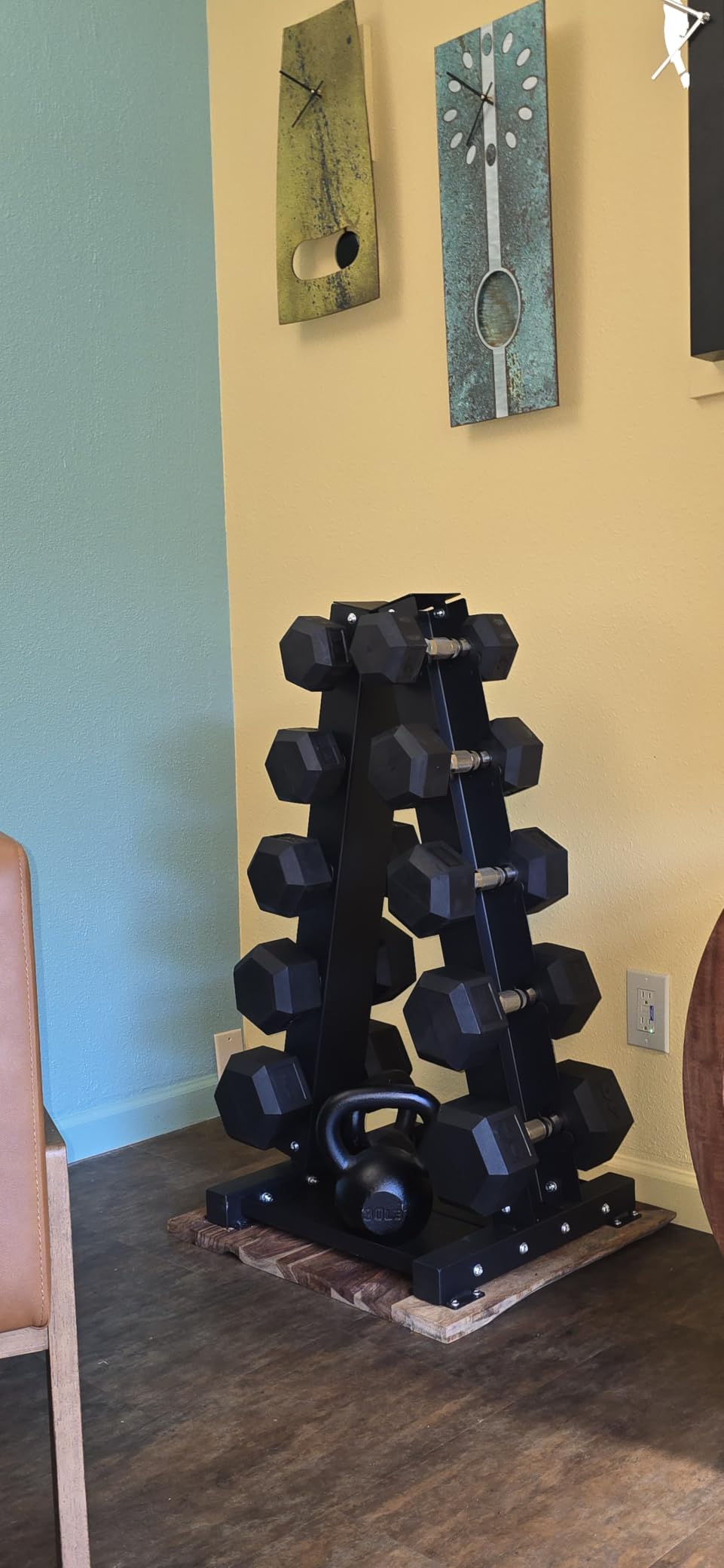
The limitation is weight range. This small version is tailored to 2-15 lb neoprene or vinyl dumbbells with 3 inch slot spacing, and the stated total capacity is 200 pounds. It is not a rack for heavy hex or metal sets, and larger variants are needed for those.
That makes this a secondary piece of kit for most people rather than a primary rack. If your set is entirely 15 lb and under, it is more than enough.
Can casters work on a hardwood floor?
Yes, and the PU coating on the casters is designed for exactly that. They roll quietly, and the two integrated brakes stop the unit drifting when you are mid-set. On carpet they will roll but need more of a push to start.
The trade-off of wheels is stability under load. A loaded rolling rack tips more easily than a fixed one, so keep heavy pairs low and engage the brakes whenever you step away.
Is it too small for a serious home gym?
For a serious set, yes. Serious collections mean heavy hex pairs, wide urethane heads, and a dozen or more pairs, none of which suit 3 inch slot spacing or a 200 pound total.
Where it earns its place is a compact flat, a rental, or a second storage point for the light pairs you use for accessories and warm-ups. The carry-friendly size also makes it the easiest rack here to move between rooms when the floor plan changes.
10. Jusgym 3-Tier Adjustable Dumbbell Rack: Best for Kettlebells and Plates Too
Jusgym Dumbbell Rack Stand Only, 3 Tier Adjustable Height & Angle 1100LBS
Welded alloy steel
3 tiers rated 1100 lb
18.78D x 34.45W x 36.54H
28 lb unit weight
Pros
- Highest stated capacity with a welded H-frame
- Tiers switch between horizontal and angled
- Bar spacing adjusts from 2.6 to 7.5 inches
- Grade 8.8 screws and rubber end caps
- Tools and instructions included
Cons
- Adjustable tiers mean more assembly and bolt work
- Spacers need re-setting when the weight mix changes
- Larger footprint than a small A-frame
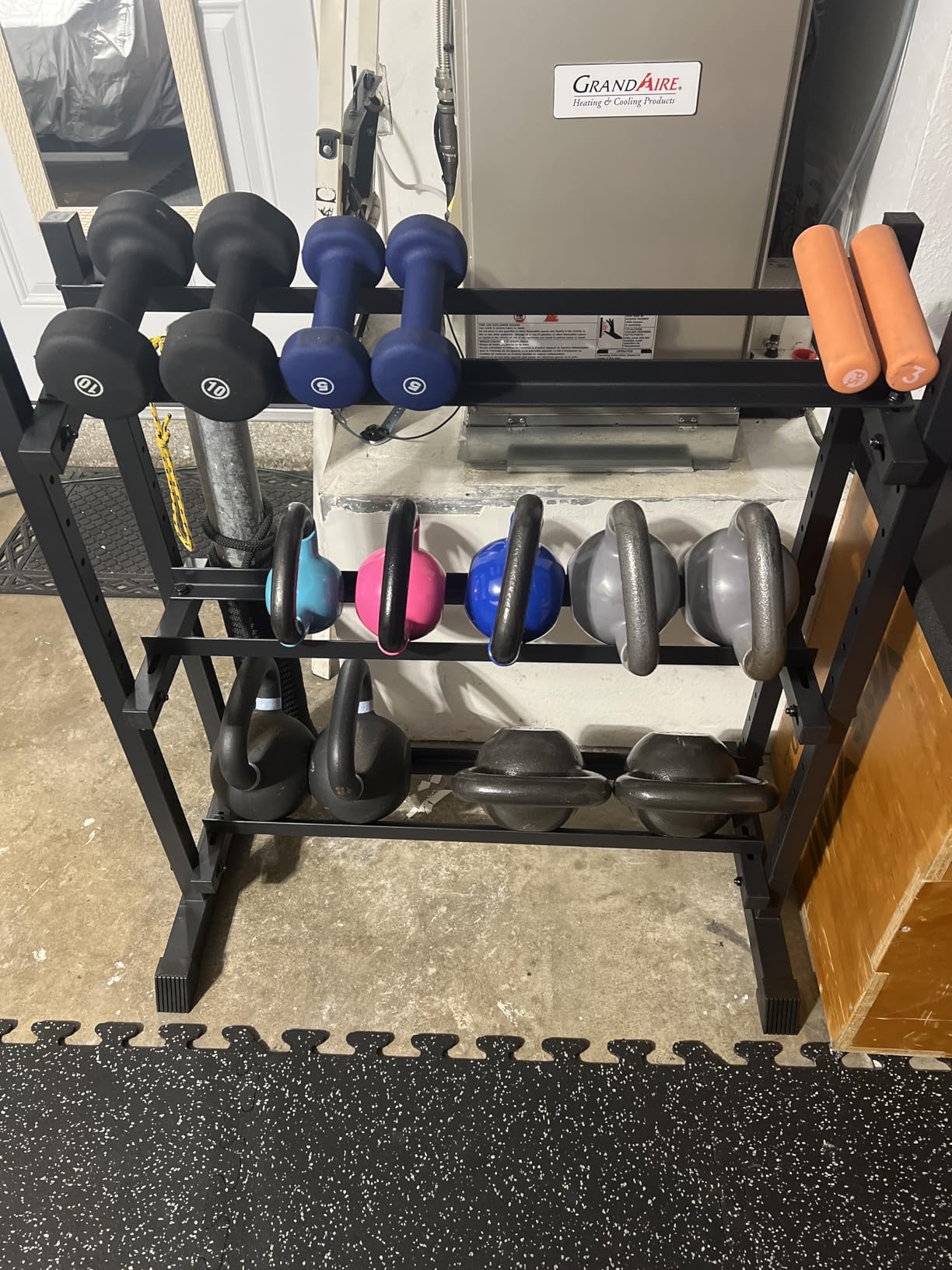
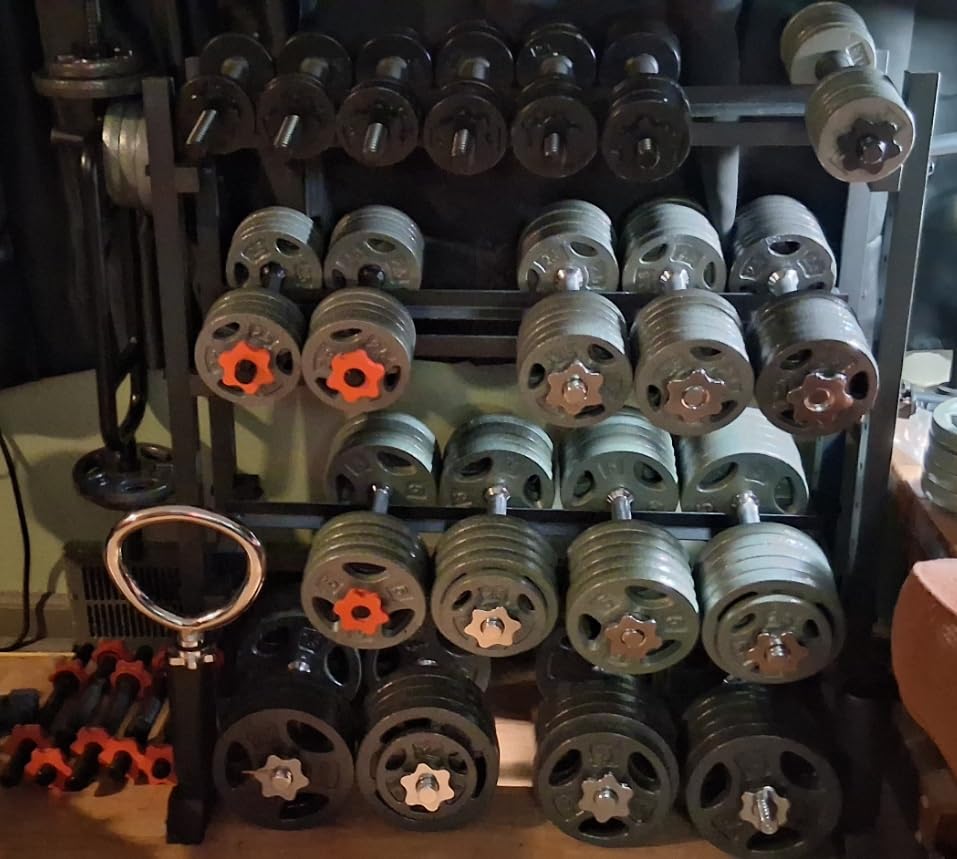
The Jusgym is the most reconfigurable rack in this roundup, and the flexibility is the reason to buy it. Each of the three tiers can be set horizontal or angled through corner irons, with height and a 10 degree angle adjustment, so the same unit can hold dumbbells one day and kettlebells the next.
Bar spacing adjusts from 2.6 to 7.5 inches using four screw holes and two spacers per level, which covers both narrow neoprene pairs and bulky urethane or hex heads. It also handles kettlebells and weight plates, so it stretches beyond dumbbell storage.
The frame is a welded alloy steel H-shape stated to hold 1,100 pounds, with grade 8.8 hardware and rubber end caps that protect the floor and absorb shock when you re-stock. Tools, a wrench and instructions are in the box, with a one-year warranty.
The cost of that flexibility is assembly effort. Adjustable tiers mean more steps and more bolt work than a fixed three-tier, and the angles and spacers need re-setting whenever your weight mix changes. Plan ten minutes rather than five the first time.
At 18.78 inches deep by 34.45 inches wide by 36.54 inches tall and 28 pounds, it is larger than a small A-frame but smaller than the 51 inch long rack, so it is a reasonable middle ground for a garage.
Can one rack hold dumbbells and kettlebells?
Yes, that is what the adjustable tiers are for. Set a tier horizontal for kettlebells and plates, and an angled tier for dumbbell pairs, and you get mixed storage out of one footprint instead of two separate stands.
The adjustment range of 2.6 to 7.5 inches covers most kettlebell handle and plate widths, which is why buyers running mixed equipment keep this rack above standalone dumbbell racks.
Is 1,100 pounds of capacity realistic?
It is a frame rating, not a per-shelf promise, and nobody publishes the per-shelf figure for this one. What you can say is that the welded H-frame and 28 pound build are consistent with a rack that takes a heavy mixed load without flexing.
Load heavy pairs onto the lowest tier regardless of the headline number. Keeping the centre of gravity low is what prevents tipping, and it costs nothing to do.
How to Choose a Dumbbell Rack: A Buying Guide for 2026
Most racks look similar in a listing photo and differ in the four things that decide whether you still like them in two years: real steel thickness, honest per-shelf capacity, tier spacing that matches your dumbbells, and a base wide enough not to tip. Here is how to read those from a product page.
A quick note on rack styles before the details. A flat tiered rack stores the most pairs and needs the most wall width. An A-frame angles outward from a central spine and packs more pairs into a narrow footprint, at the cost of some hand clearance. A vertical stand stores a handful of heavy pairs in a very small space. A wall-mounted rack frees the floor completely but needs solid studs and a drill. A dedicated adjustable-dumbbell stand fits block-style dumbbells that will not sit on standard angled tiers at all.
Total capacity vs per-tier capacity
A rack advertised at 1,000 pounds may only support around 130 pounds on any single shelf. Divide the total by the number of tiers and you get a realistic per-shelf figure, and that number is the one that matters when you are loading 50 lb pairs onto the top row.
Rare racks publish the per-shelf rating outright, and when they do, the number is usually credible. Prefer those. Where only a total is given, treat it as a frame strength claim rather than a loading instruction, and keep heavy pairs low.
Steel gauge, welds and bolt-together frames
Steel gauge is the most useful durability signal, and most product pages never mention it. In this category, 11-gauge steel is the commercial standard, and anything above 14-gauge is thin enough to flex under a loaded top tier. If a listing gives you no gauge at all, judge by frame weight instead. A rack weighing under 10 pounds is very likely light steel.
Next, look at how the frame is joined. A fully welded frame has no structural bolts to work loose, which is why the welded racks in this roundup feel the most planted under load. A bolt-together tube-and-bracket frame can still work well, but only if every bolt is torqued properly during assembly.
Finish matters less than structure but still shows. Powder coat resists scratches better than bare chrome and, unlike chrome, will not show every nick as a bright spot.
Tier spacing and dumbbell shape matching
Measure the widest dumbbell head you own and the thickest handle grip before you buy. Hex heads are compact, neoprene and vinyl heads are bulkiest, and rubber-coated heads sit in between. Fixed narrow slots that look generous in a photo will reject a 50 lb urethane pair.
Adjustable bar spacing, which appears on a couple of the picks here, solves this by letting you widen or narrow each tier. It is worth paying a little more for if your collection will change over time. Adjustable block-style dumbbells are a separate case entirely: they need a dedicated stand and will not sit correctly on standard angled tiers.
Footprint and base stability
Check three dimensions, not one. Width along the wall is what you plan for. Depth front to back is what you forget, and angled racks push roughly a foot out from the wall when loaded. Height matters most for the top tier, where a top shelf between 36 and 42 inches sits at a comfortable lifting height without you swinging a heavy pair into your shin.
For stability, look for a base that is long front to back rather than just wide. A wide but shallow rack tips forward when you pull a heavy pair off the top tier, which is the complaint that shows up most often about three-tier units. Rolling racks add another variable, so treat the brakes as part of the design.
Feet, flooring and anti-tip loading
Rubber or PU-coated feet, raised end caps, and adjustable feet that hold the steel clear of the ground all protect your flooring and reduce noise. On hardwood and vinyl plank, feet matter because steel-to-steel contact is what dents and scuffs. On carpet, a wide rubber foot prevents the rack from creeping every time you pull a pair off.
Loading order is the free fix for tipping. Heavy pairs go on the lowest tier, light pairs go on top, and the centre of gravity stays down no matter how large the capacity claim. This is the single most useful piece of advice in this guide, and it costs nothing.
If you are planning the whole room rather than one rack, budget walking clearance in front of the rack for loading, plus enough floor to lay a flat bench down without moving the rack. Our trap bar guide covers the layout maths if you are also adding a barbell station, and hack squat machines are worth a look once floor space stops being the constraint.
Frequently Asked Questions
What is the best rack for dumbbells?
For most home gyms, a welded steel three-tier rack with angled shelves and at least 150 inches of total shelf length is the best dumbbell rack. It stores the most pairs, keeps weights off the floor and survives repeated loading. If floor space is the constraint, a vertical A-frame holds five pairs in roughly a 15 inch corner instead.
What are the differences between a vertical and a horizontal dumbbell rack?
A horizontal tiered rack stores dumbbells across long shelves, so it holds many more pairs but needs a wide stretch of wall and about 25 inches of depth. A vertical or A-frame rack angles pairs upward from a central spine, cutting the footprint to roughly 15 inches wide at the cost of capacity and some hand clearance for lighter weights.
Should heavy dumbbells be placed on top or bottom of the rack?
Always on the bottom. Heavy pairs on the lowest tier keep the centre of gravity low, which is what prevents a rack tipping when someone pulls a weight off an upper shelf. Light pairs belong on top, and saving heavy pairs for the end of the set avoids walking to the far end of a rack mid-workout.
How much weight can a dumbbell rack hold?
Read the per-shelf rating rather than the total. A rack listed at 1,000 pounds may only carry about 130 pounds on any single shelf. Divide the stated total by the number of tiers for a realistic per-shelf figure, and prioritise racks that publish the per-shelf rating outright, since that number is usually more honest.
Will a dumbbell rack fit adjustable dumbbells?
Not always. Block-style adjustable dumbbells do not sit properly on standard angled tiers, because their rectangular bodies need flat shelves and their changing width defeats fixed slots. If you own that style, buy a dedicated adjustable dumbbell stand with wide flat trays, or a rack whose bar spacing can be widened per tier.
Are bolted or welded dumbbell racks better?
Welded is generally better for a fixed dumbbell rack, because there are no structural bolts to loosen under repeated loading, which is why welded frames feel planted while bolt-together frames can develop a wobble. A bolt-together frame is fine if every bolt is tightened properly during assembly, and it is easier to move or repair.
Do dumbbell racks damage flooring?
They can, mostly through bare steel feet and through weights being dropped rather than placed. Rubber or PU-coated feet, raised end caps and adjustable feet that hold the frame clear of the ground prevent dents on hardwood and scuffs on vinyl plank. On carpet, a wide rubber foot stops the rack creeping every time you pull a pair off.
The Verdict on the Best Dumbbell Racks for Home Gyms
After all ten, the Marcy DBR86 remains our pick for the best dumbbell racks for home gyms in 2026. The welded frame, angled tiers and generous rail spacing handle anything from 8 to 70 lb without a wobble, and at 4.8 stars across more than 12,800 reviews it has the strongest combination of rating and owner history in this group.
Take the CAP 3-Tier if you have a full 5-50 lb hex set and more than four feet of wall to give up. Take the AKYEN A-frame if floor width, not capacity, is what is stopping you. Take the PLKOW rolling rack if your room has to be a gym and a storage closet at the same time.
Whichever you choose, load heavy pairs onto the lowest tier, check the slot width against your widest dumbbell head, and put rubber feet under the frame. Those three habits decide whether a rack still feels solid in year three.