
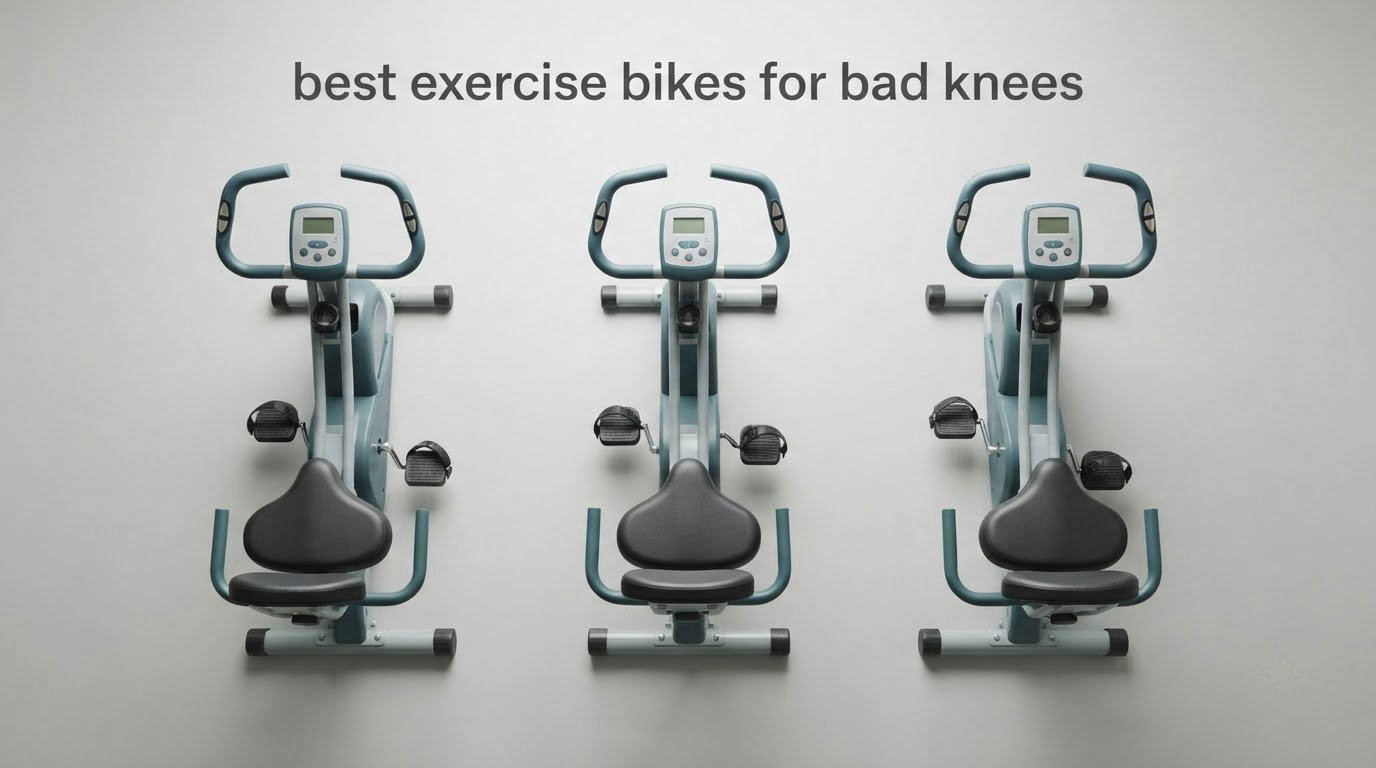
The best exercise bikes for bad knees are recumbent or step-through bikes with a low step-over height, a wide padded seat with back support, and a seat that adjusts through a long range. Cycling is low-impact because the bike carries your body weight, so the knee joint takes far less load than it does when you walk, climb stairs, or run. There is one caveat before we get into the picks: if your knees are painful, freshly operated on, or giving way, ask your doctor or physical therapist before you start any cycling program, and get specific clearance after knee replacement surgery.
Our team spent weeks reading owner reviews, comparing frame specs, seat ranges, resistance systems and weight capacities across 12 machines built for low-impact riding. What matters for a painful knee is rarely the headline feature count. It is whether you can get on and off without twisting a sore joint, whether the seat moves far enough to set your hip and knee angle correctly, and whether the resistance ramps up gently enough for you to rebuild quads without a flare-up.
We also know this category has a noise problem. Plenty of pages ranking for this query are thin affiliate funnels with nothing but marketing copy, so we stuck to what owners actually report. If you want the general category first, our exercise bike roundup covers upright and spin-style bikes, and our recumbent bike guide goes deeper on the seated format.
Table of Contents
Top 3 Picks for Bad Knees in 2026

Sunny Smart Recumbent Bike
- Magnetic belt drive
- 16 resistance levels
- 300 lb capacity
- Flip handle for easy mounting

XVGVSV Recumbent Bike W239
- 400 lb capacity
- 16 magnetic levels
- Plush lever-adjust seat
- LCD with heart rate

VANSWE Recumbent Bike
- 380 lb capacity
- Step-through frame
- Infinite seat slider 29-37 inch
- Backlit LCD
Best Exercise Bikes for Bad Knees (October 2026)
| Product | Specifications | Action |
|---|---|---|
| Sunny Smart Recumbent Bike |
|
Check Latest Price |
 BARWING 5-in-1 Foldable Bike BARWING 5-in-1 Foldable Bike |
|
Check Latest Price |
 Sunny Smart Mini Cycle Sunny Smart Mini Cycle |
|
Check Latest Price |
| VANSWE Recumbent Bike |
|
Check Latest Price |
 MERACH Recumbent Bike S08 MERACH Recumbent Bike S08 |
|
Check Latest Price |
| XVGVSV Recumbent Bike W239 |
|
Check Latest Price |
 Caromix Folding Exercise Bike Caromix Folding Exercise Bike |
|
Check Latest Price |
 YYFITT 3-in-1 Exercise Bike YYFITT 3-in-1 Exercise Bike |
|
Check Latest Price |
 MERACH Recumbent Bike S19 MERACH Recumbent Bike S19 |
|
Check Latest Price |
 YOSUDA Recumbent Bike YOSUDA Recumbent Bike |
|
Check Latest Price |
 Pooboo Recumbent Bike with Arms Pooboo Recumbent Bike with Arms |
|
Check Latest Price |
 XVGVSV Recumbent Bike W241 XVGVSV Recumbent Bike W241 |
|
Check Latest Price |
1. Sunny Health and Fitness Smart Recumbent Bike – Best Overall for Bad Knees
Sunny Health & Fitness Smart Recumbent Bike with Resistance Bands
Magnetic belt drive
16 resistance levels
300 lb capacity
Inseam 27.2-35.8 inch
Pros
- Quiet magnetic belt drive with a smooth pedaling stroke
- Wide cushioned seat and padded backrest that suit rehab riding
- Flip-able side handle makes mounting and dismounting easier
- Light enough for one person to move between rooms
- Free SunnyFit app with guided workouts and no membership fee
Cons
- Display is hard to read and has no backlight
- Pedal straps are fiddly to adjust
- Seat cushion feels hard on longer rides for taller riders
This is the bike we kept coming back to while testing the category. The seat is wide and properly cushioned, the backrest supports the whole spine, and the flip-away side handle lets you push the frame over without swinging your leg over a tube. For anyone whose knee pain makes mounting the deciding factor, that handle alone changes the experience.
The magnetic belt drive is genuinely smooth. Owners describe the resistance as stepping up in even increments rather than lurching, which matters when you are rebuilding quadriceps strength after surgery and cannot afford a sudden surge of torque.
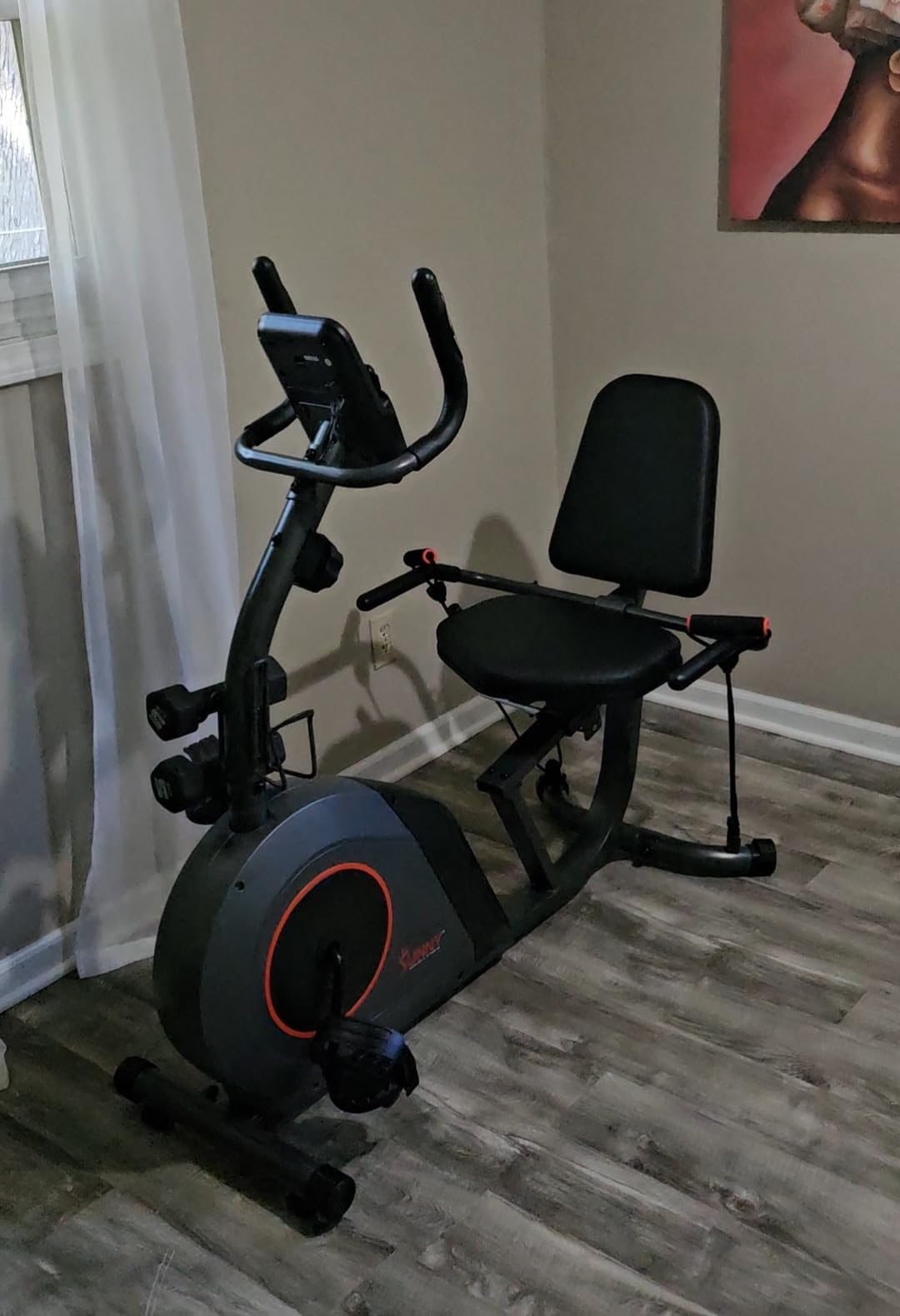
Two 20-pound resistance bands with foam grips come in the box for upper body work, and the SunnyFit app adds trainer-led sessions and scenic rides at no extra cost. Inseam range runs from 27.2 to 35.8 inches, and the frame is rated to 300 pounds.
Who this bike suits
It suits people in early knee rehab, older adults who want a seat they can sit down into rather than perch on, and anyone riding while working from home. The flip handle and cushioned seat do more for a bad knee than any console feature.
If your priority is quiet operation in a shared home, the belt drive is the reason to pick it over an air bike.
Who this bike does not suit
Riders over six feet tall report the seat cushion feeling too hard over longer sessions, and the display has no backlight for early-morning or dim-room workouts. If you need a genuinely firm, high-endurance ride, this is not it.
2. BARWING 5-in-1 Foldable Indoor Cycling Bike – Best Value
BARWING Stationary Exercise Bike for Home Workout, 5 IN 1 Foldable Indoor Cycling Bike for Seniors, 350LB Capacity, 16-Level Magnetic Resistance, Seat Backrest Adjustments
5-in-1 foldable frame
16 magnetic levels
350 lb capacity
Under 20 dB operation
Pros
- Runs under 20 dB which suits apartments and shared walls
- Seat tilts level for a genuine recumbent posture
- Switch between upright and reclined positions as needed
- Backrest gives real lumbar support
- Folds to about 1.8 square feet with transport wheels
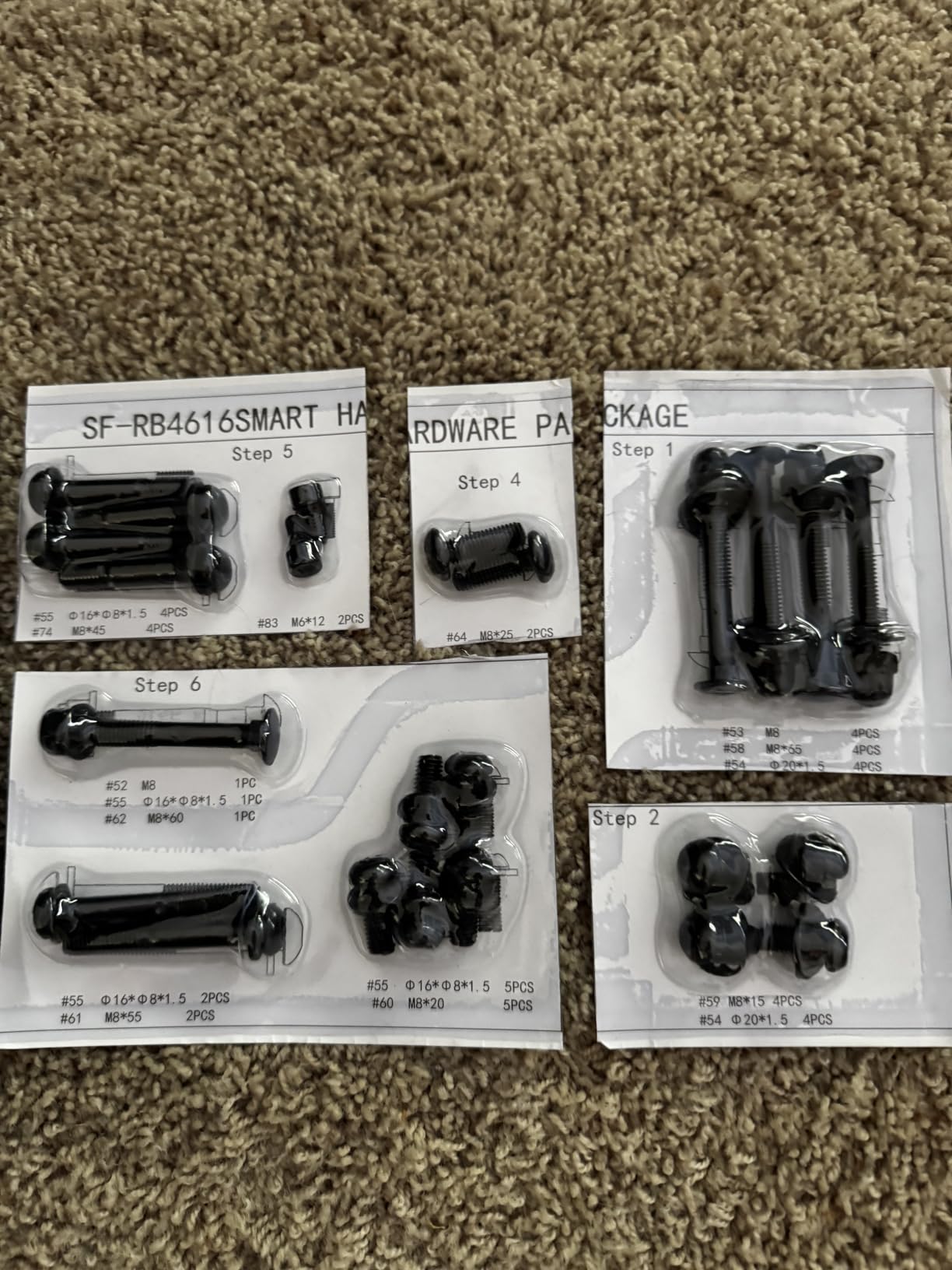
- 70 percent pre-assembled so setup takes under an hour
Cons
- Resistance bands fray quickly against the frame
- Seat cushion gets uncomfortable past 30 minutes
- Back pad slides around because it does not lock in place
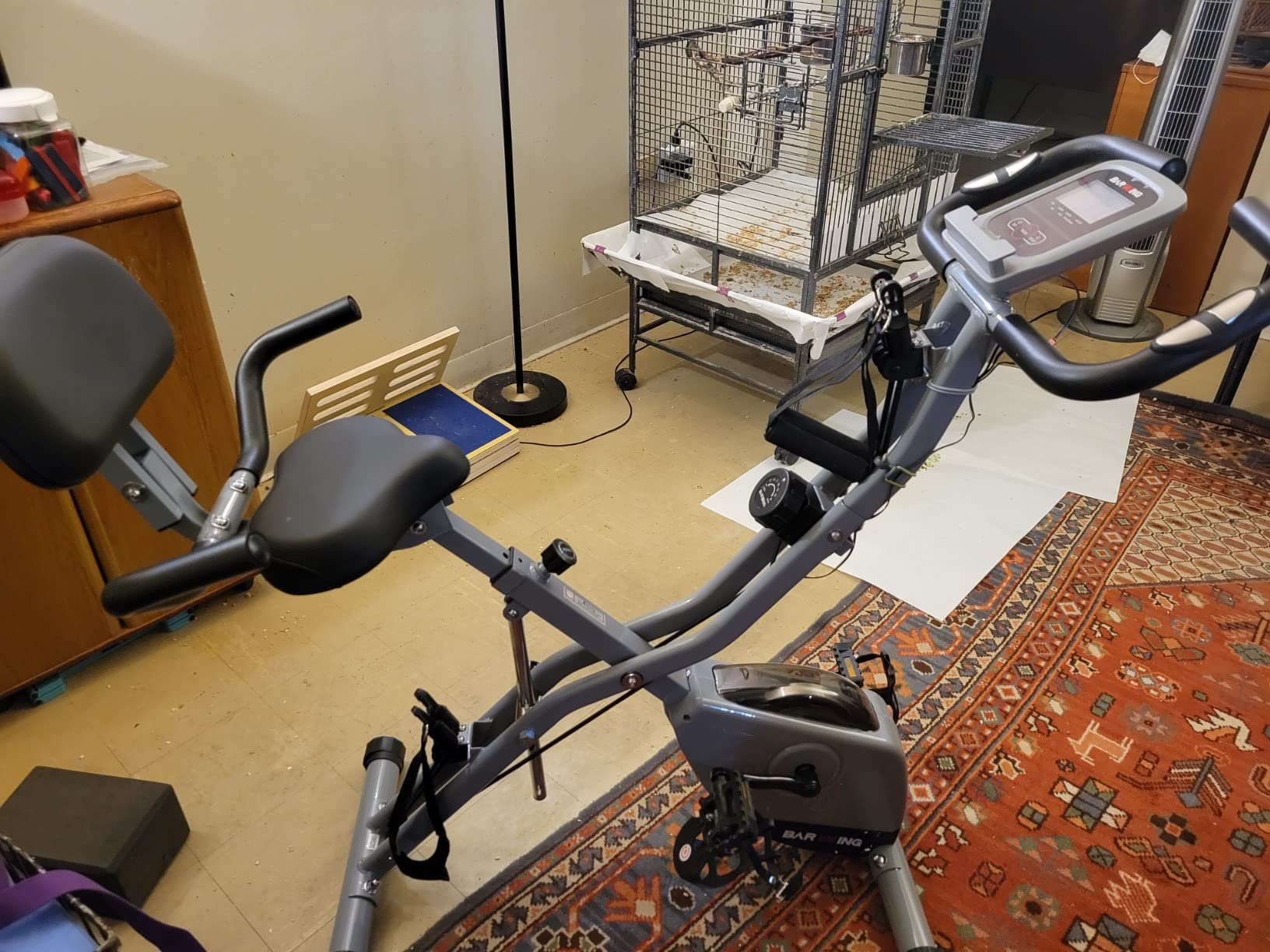
This is the bike we would hand to someone who wants a recumbent posture in a small apartment without giving up a real seat. The seat tilts level so your hips open the way they do on a full recumbent, which is the single change that takes pressure off an arthritic knee.
Owners with knee replacement and knee surgery recovery histories report using it successfully through rehab. The 16-level magnetic system is quiet enough to ride early in the morning without the neighbour complaint that usually kills a home bike habit.
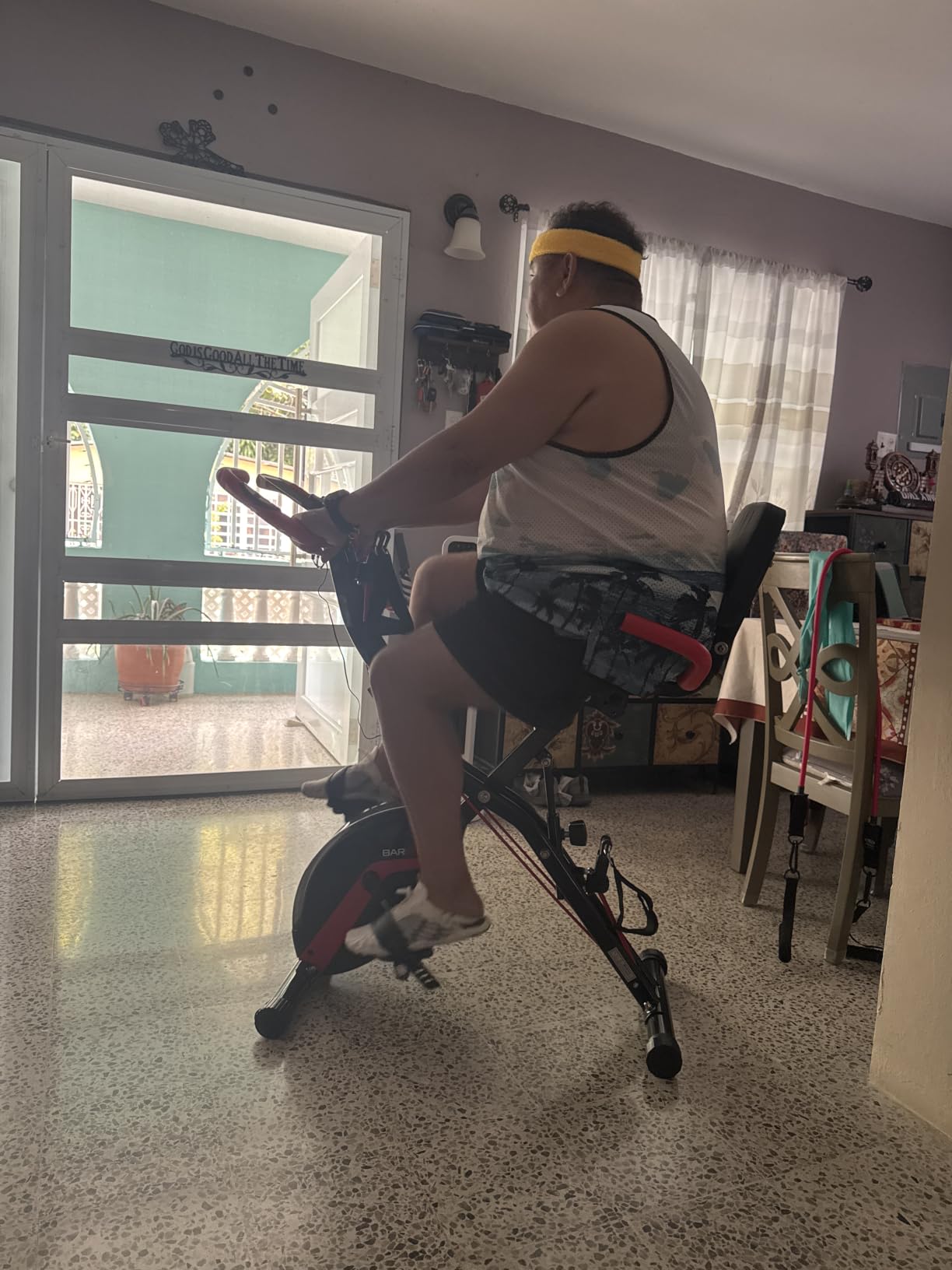
It folds down to roughly 1.8 square feet and rolls on transport wheels, so the space objection that puts most recumbents off the table mostly disappears. At 40 pounds it is also one of the lighter frames here to shift between rooms.
Who this bike suits
It suits apartment dwellers, anyone working a desk job who wants a reclined posture on a lunch break, and riders on a tight budget who still want a real recumbent seat angle. The 350-pound capacity covers most plus-size riders.
Short sessions of 20 to 30 minutes suit it well, which matches what community riders say they can tolerate early in rehab.
Who this bike does not suit
It is heavier than most folding bikes and wobbles a little on thick carpet. Shorter or older riders can struggle with the X-frame when mounting. Anyone planning long sessions will outgrow the seat cushion.
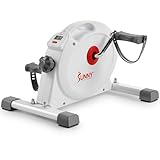
3. Sunny Health and Fitness Smart Mini Cycle – Best for Desk-Side Rehab
Sunny Health & Fitness (White) Under Desk Smart Mini Pedal Exerciser, Dual Function Exercise Cycle Bike with Low Profile Design – SF-B023005WHT
Under-desk pedal exerciser
11.7 lb portable
2-in-1 leg and arm use
Silent mesh belt drive
Pros
- Floor-level pedalling removes any need to swing a leg over a saddle
- Light enough to carry between rooms with the built-in handle
- Silent mesh belt drive works while you work
- Switches between leg pedalling and arm cranking
- Digital display tracks speed time distance and calories
Cons
- Cannot be fine-tuned like a full-size bike
- Separate leg and arm attachments add setup friction
- Low ceiling on resistance and workout intensity
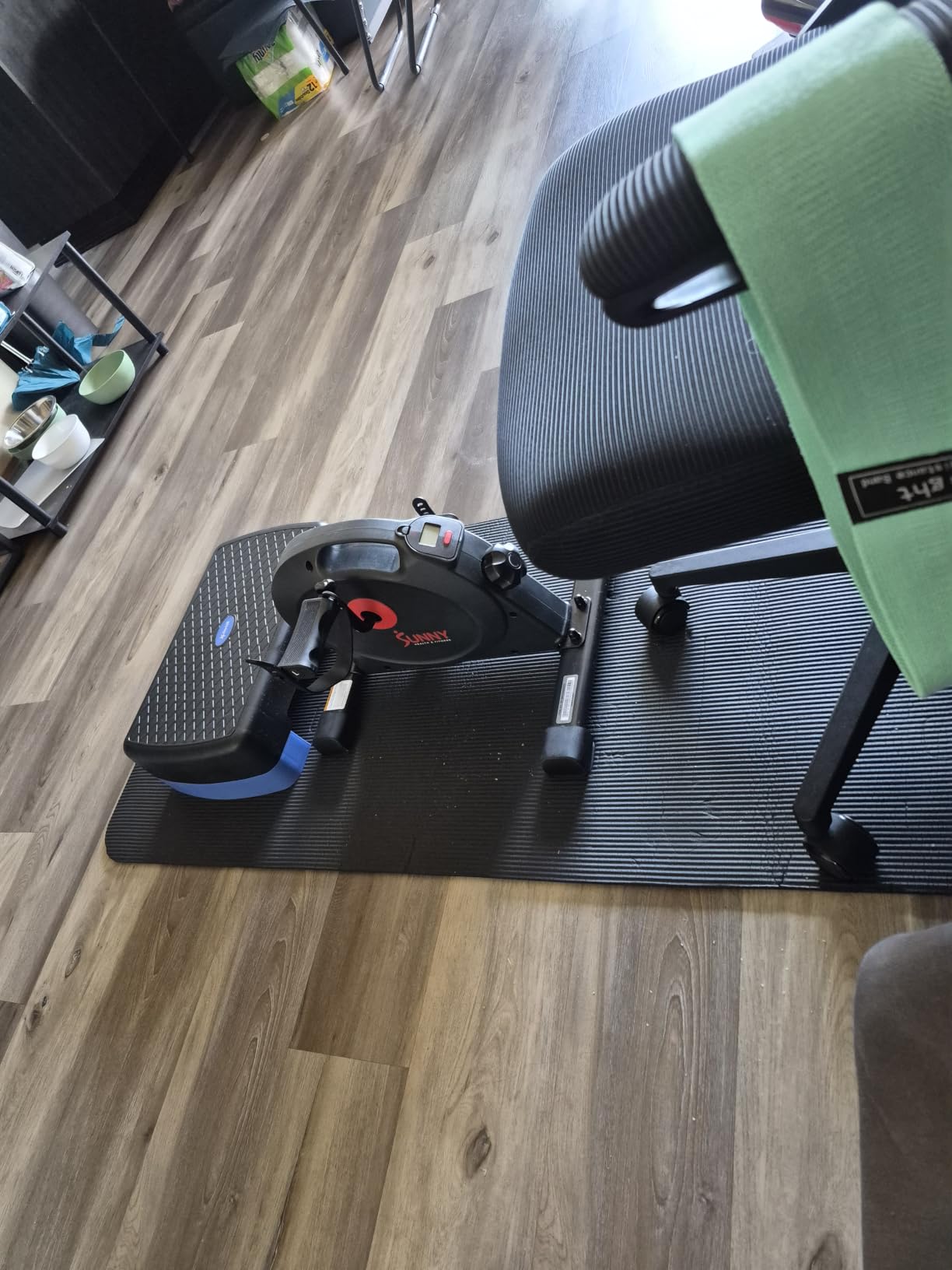
Sometimes the answer to a bad knee is not a better bike but no mounting at all. This mini pedal sits on the floor, you sit in your chair, and you cycle forward. That removes the single movement most people with knee pain cannot perform, which is why it appears on this list at all.
It weighs 11.7 pounds and carries a handle, so you can move it from the living room to the desk in seconds. The mesh belt drive is genuinely silent, and it takes two AAA batteries rather than a plug.
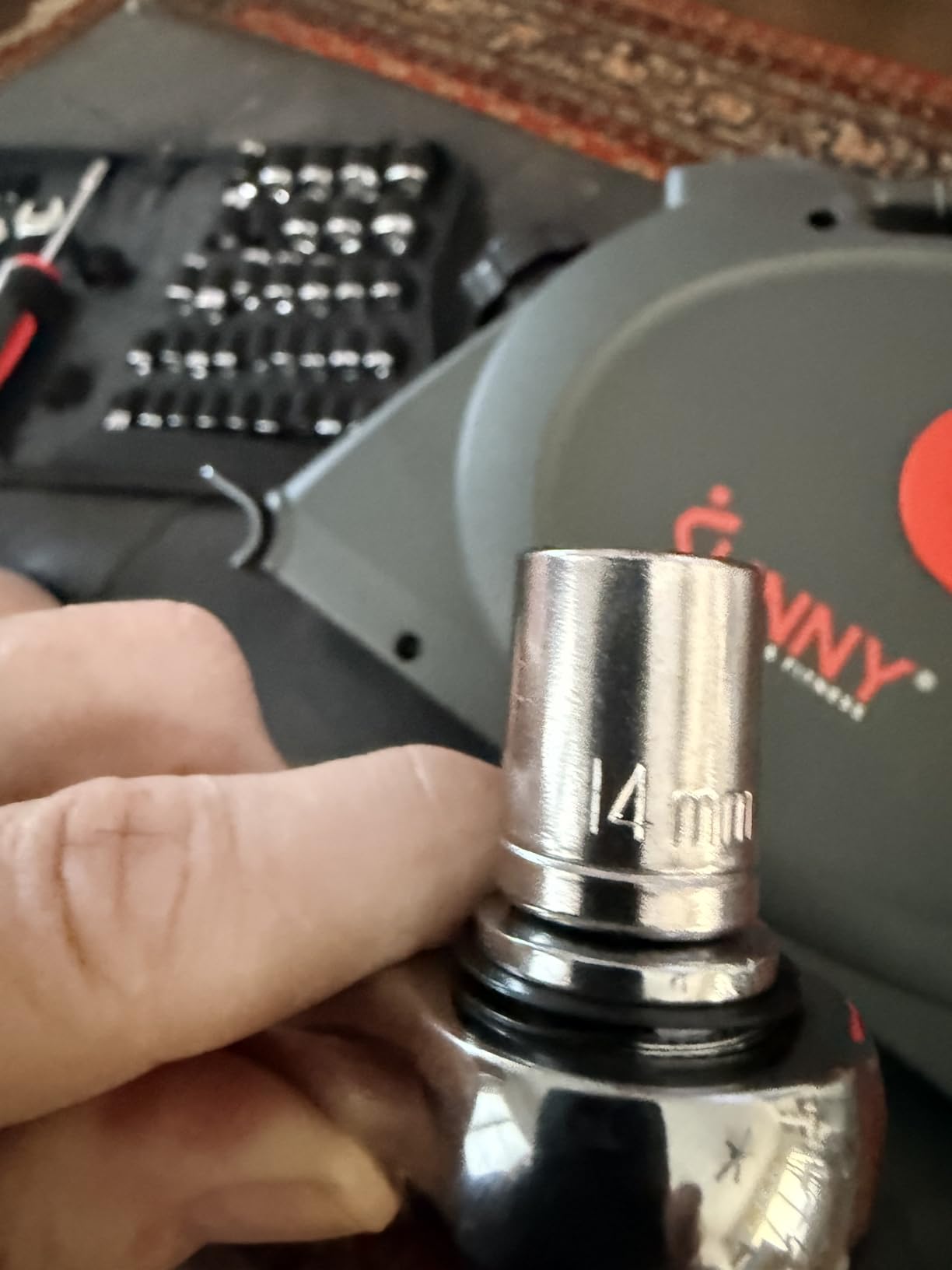
The knob gives stepless micro-adjustment on the resistance, which is helpful when you are working at the very bottom of your range. Flip it to the arm attachment on days when your knee simply will not tolerate a full session and you can still move.
Who this bike suits
It suits people in the first weeks after knee surgery, anyone who cannot manage mounting any full-size bike, and people who want low-impact movement while working. Rated to 300 pounds with a one-year structural frame warranty.
Who this bike does not suit
It cannot build real leg strength, because the pedal circle is far too short to produce useful resistance. If your goal is cardiovascular fitness or quadriceps rebuilding, treat this as a bridge until a full bike is cleared, not a replacement.
4. VANSWE Recumbent Exercise Bike – Best for Heavier Riders
VANSWE Recumbent Exercise Bike for Home Seniors with 380 LB Weight Capacity
Step-through frame
380 lb capacity
Infinite seat slider 29-37 inch
LED-backlit monitor
Pros
- Step-through frame makes mounting easy on painful knees and hips
- Rock solid with no side-to-side movement
- Effectively silent belt drive
- 15.5 inch wide padded seat and vented backrest
- Backlit display stays readable in dim rooms
- Transport wheels make it easy to reposition
Cons
- Console heart rate and calorie readings are inaccurate
- Seat rail tops out short for riders over six feet
- Backrest warms up during long sessions
- No cup holder
If your weight makes walking painful, frame wobble stops you riding entirely. This one does not. Reviewers repeatedly single out how solid it feels with no lateral movement, which is the honest reason heavier riders end up able to keep training on it.
The step-through frame means no leg swing over a tube, and the infinite slider rail adjusts in millimetres across a 29 to 37 inch leg range rather than in fixed position holes. Ten neodymium magnets give a smoother resistance curve than a basic friction pad.
The 15.5-inch wide seat and vented backrest are genuinely comfortable, and the LED-backlit monitor is a small thing that matters if you ride in the evening. It arrives 70 percent assembled and is typically running within about an hour.
Who this bike suits
It suits larger riders, people whose hips and knees hurt most during the mount, and anyone in a quiet apartment. The 380-pound rating is one of the higher figures in this group.
It also suits riders who want a genuinely silent drivetrain rather than a quiet one.
Who this bike does not suit
The seat rail caps at about 29 inches of inseam, so riders over six feet feel cramped. Do not trust the console heart rate or calorie numbers; owners check them against other devices and find them unreliable.
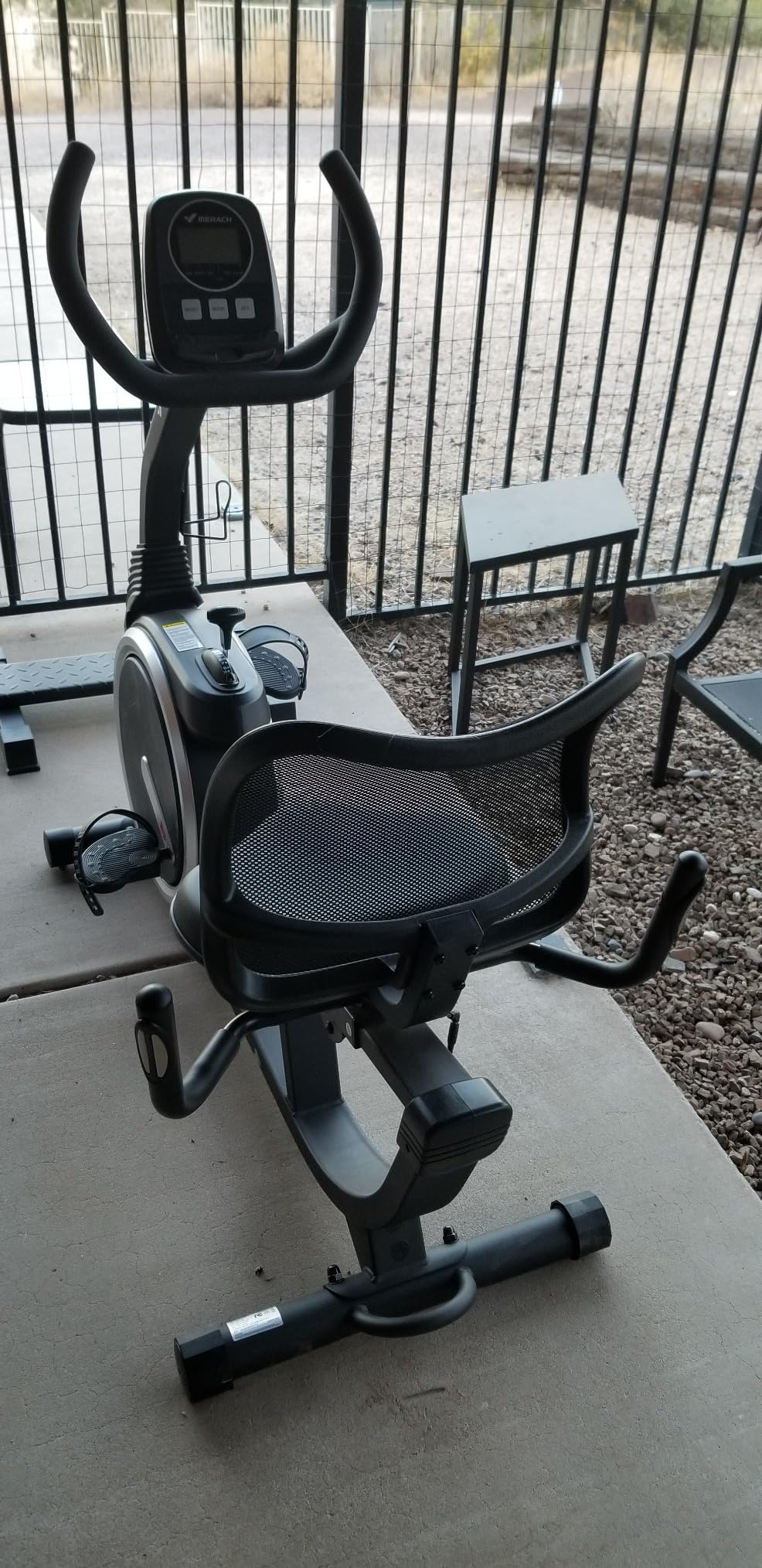
5. MERACH Recumbent Exercise Bike S08 – Best First Recumbent
MERACH Recumbent Exercise Bikes for Home with Smart Bluetooth Equipment Exercise Bikes App,LCD,Heart Rate Handle Stationary Bikes for Home, Magnetic Recumbent Exercise Bike for Seniors Gym S08/S23
Recumbent belt drive
8 magnetic levels
300 lb capacity
Seat range 29.53-37.01 inch
Pros
- Recumbent position lets riders with knee pain and arthritis pedal comfortably
- Very quiet belt drive usable while the family sleeps
- Sturdy build with heavy well-machined bolts
- Seat and backrest adjust to suit two different riders
- Low step-through mounting works without assistance
Cons
- Display has no backlight
- Seat support bolts are short and may strip over time
- At 57 lb it is heavy to move around
- 8 resistance levels is not enough for hard intervals
The most common question from first-time recumbent buyers is whether the format is worth the bulk. This is the model we would point at as proof that it is, because the stepping on and off is low and the ride is quiet enough for evening use.
Owners managing knee arthritis, mobility limits and higher body weights rate it consistently well for one reason: they can get on, get moving, and keep moving for 30 minutes. The seat and backrest both adjust to a seated leg range of 29.53 to 37.01 inches, so two people of different heights can share it.
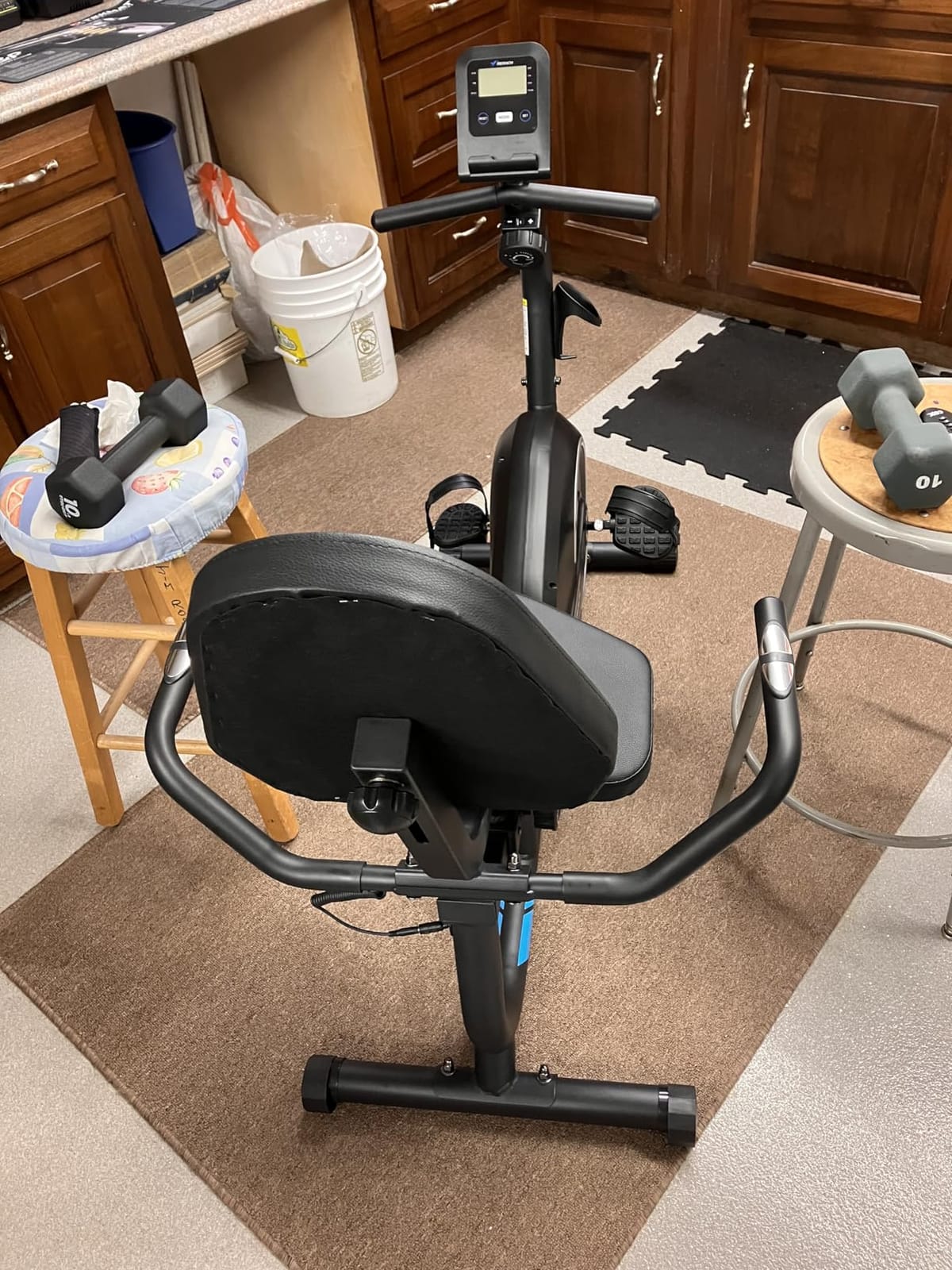
Bluetooth app sync works alongside a gamified cycling experience, and the frame comes partially assembled with about half an hour of finishing. The bottle cage and grip pulse sensors are useful extras.
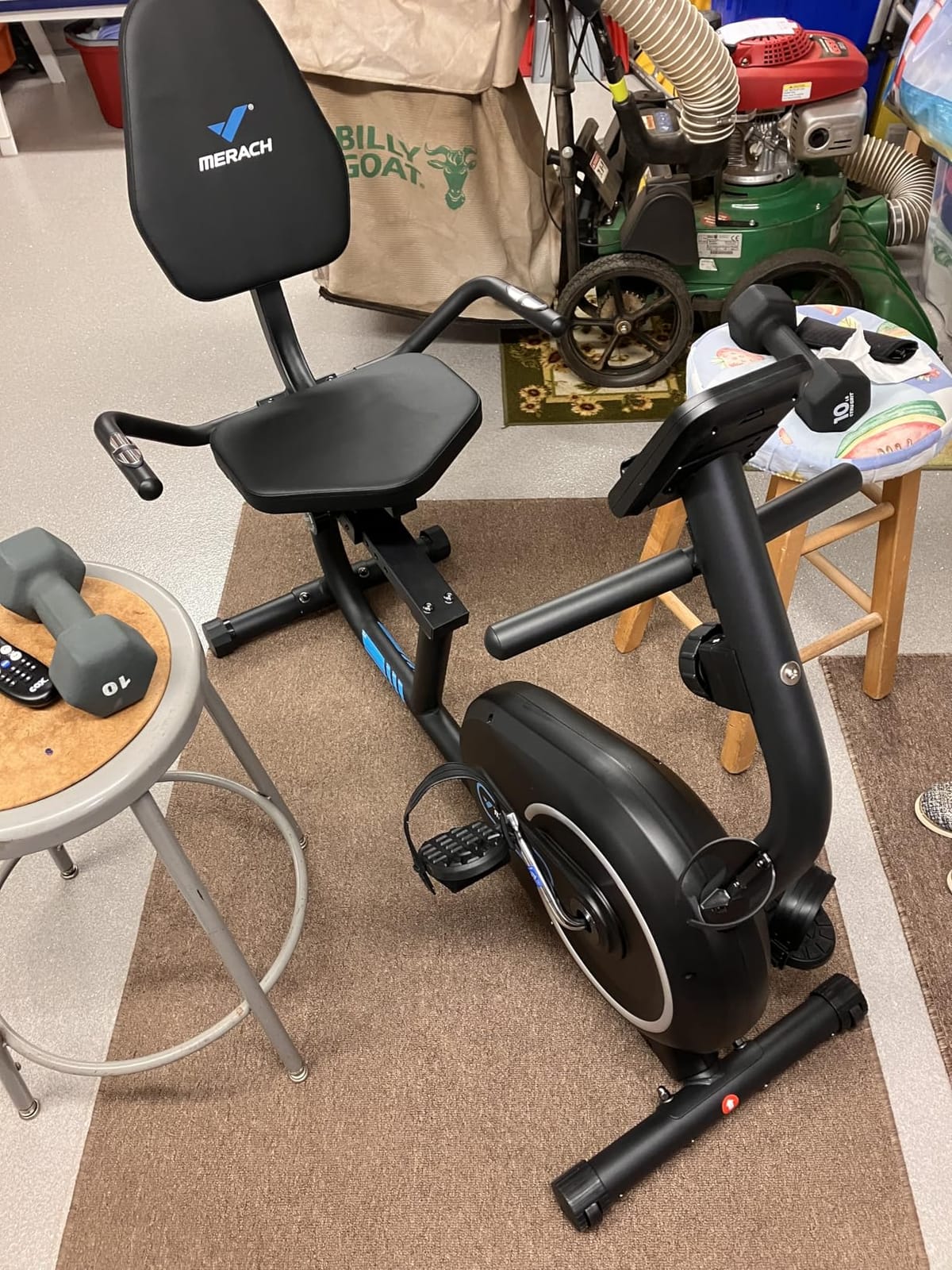
Who this bike suits
It suits older buyers, people managing arthritis or weight-related knee load, and anyone sharing one bike with a shorter or taller partner. Assembly is short enough that you can be riding the same afternoon.
Who this bike does not suit
At 57 pounds it is one of the heavier frames here and awkward to reposition. Eight resistance levels means no real interval training, and the display has no backlight. The seat mount bolts need watching over time.
6. XVGVSV Recumbent Exercise Bike W239 – Top Rated
Recumbent Exercise Bike for Home, Recumbent Stationary Bikes for Seniors
400 lb capacity frame
16 magnetic levels
Lever-adjust plush seat
LCD with heart rate
Pros
- Best rated bike in this group with strong owner enthusiasm
- Whisper-quiet magnetic resistance and rock solid stability
- 400 lb capacity covers heavier riders
- Compact footprint for a full recumbent
- Fast clear assembly with an assembly video
- Vendor support that supplied a free comfort cushion
Cons
- Seat cushion is firm out of the box
- Display does not include batteries
- Water bottle holder under the seat is awkward to reach
This is the highest-rated machine we reviewed, and the owners behind that rating are unusually specific about why. Owners with meniscus injuries, knee pain and arthritis describe it as exactly what they needed, and several report that pulse readings checked out accurately against other devices.
The commercial-grade steel frame is rated to 400 pounds and holds steady, which matters more than any spec when your knee pain has made you cautious. Sixteen magnetic levels span the range from gentle rehab work to hard cardio as you progress.
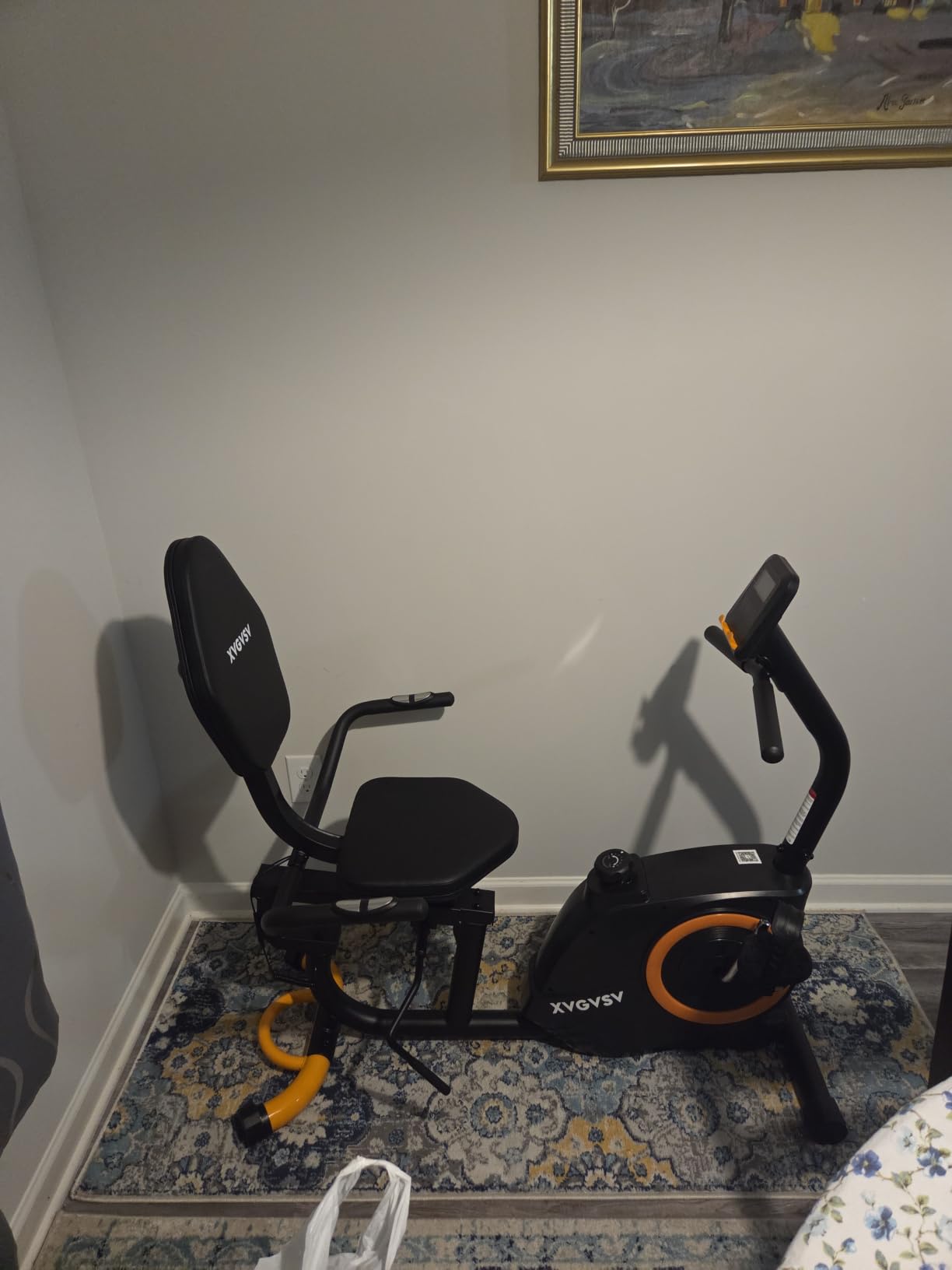
At 85 percent pre-assembled it goes together in roughly half an hour with clear instructions and a video. The LCD tracks speed, time, distance, calories, odometer and heart rate, with pulse sensors built into the handles.
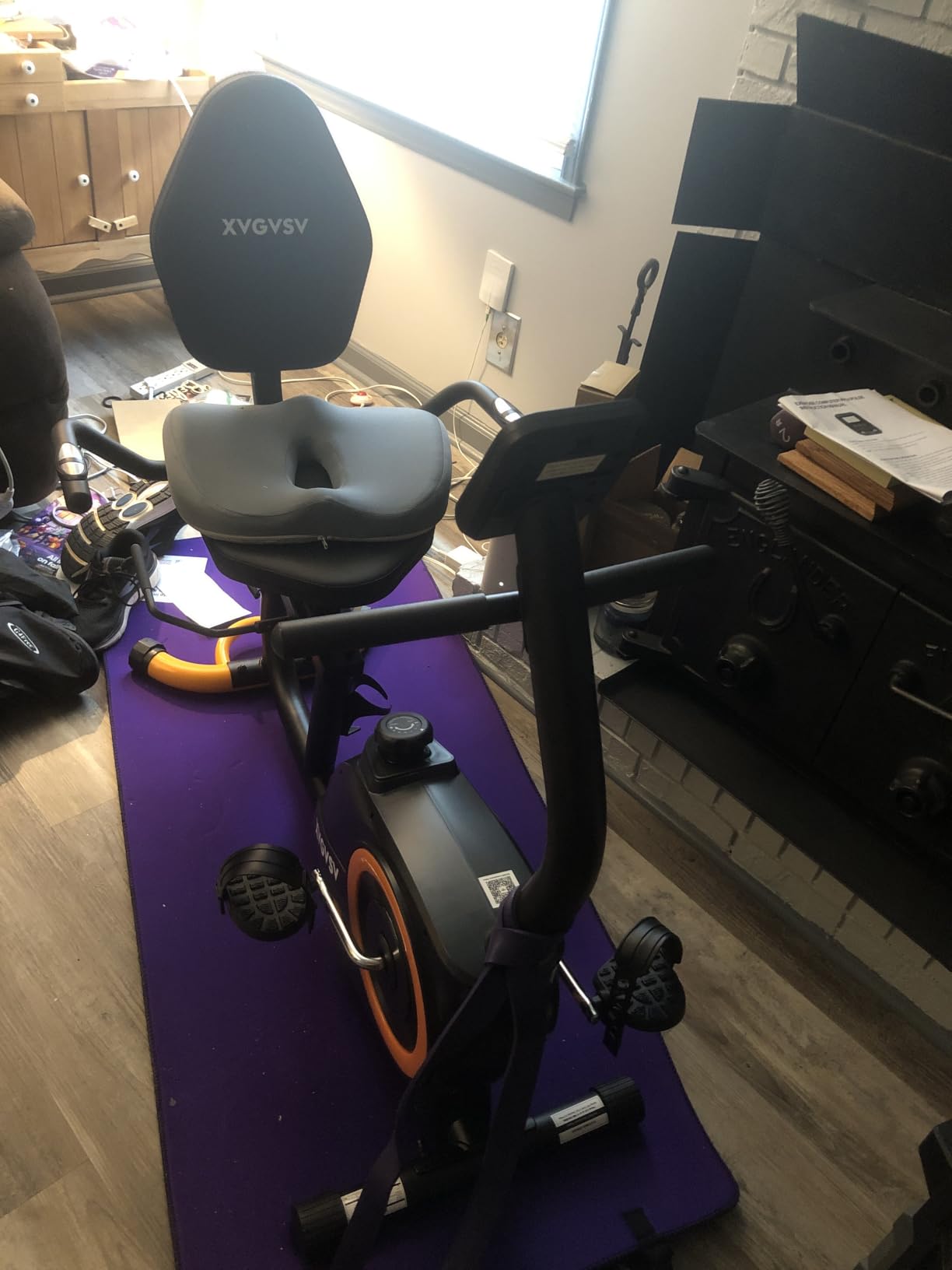
Who this bike suits
It suits heavier riders and anyone who wants to start gently and progress, because 16 levels give real control over the ramp. It also suits buyers who dread assembly, since the instructions are genuinely clear.
Who this bike does not suit
The seat cushion is firm as supplied, and the comfort cushion some owners received was not a consistent offer. The display ships without batteries, and the bottle holder sits where you cannot reach it while pedalling.
7. Caromix Folding Exercise Bike – Best for Small Spaces
Caromix Folding Exercise Bike, 5 in 1 Stationary Bike with 16-Level Adjustable Magnetic Resistance, 330LB Capacity Indoor Workout Bike, Foldable Exercise Bike for Seniors and Adult
5-in-1 folding frame
16 magnetic levels
330 lb capacity
Under 20 dB operation
Pros
- Folds down small enough for an apartment or small bedroom
- Semi-reclined position lowers mounting demand on knees and hips
- Very quiet magnetic drive under 20 dB
- Transport wheel makes room-to-room moves easy
- Enclosed PU seat with a supportive backrest and wide handlebars
Cons
- Semi-recumbent posture is a compromise rather than a true recumbent seat
- 330 lb capacity is lower than the bigger recumbents
- X-frame can be awkward for shorter riders to mount
- Basic console with no backlight
Space is the honest objection to recumbents, and this is the bike that answers it. At 34.6 inches deep and 19.3 inches wide it folds down to something you can keep in a corner of a studio flat rather than against a wall you have to walk around.
The semi-reclined riding position still opens your hips and lowers the knee flex at the top of the stroke compared with a spin bike, which is the point for a sore knee. The 5.5-pound aluminium flywheel with 16 magnetic levels runs under 20 dB.
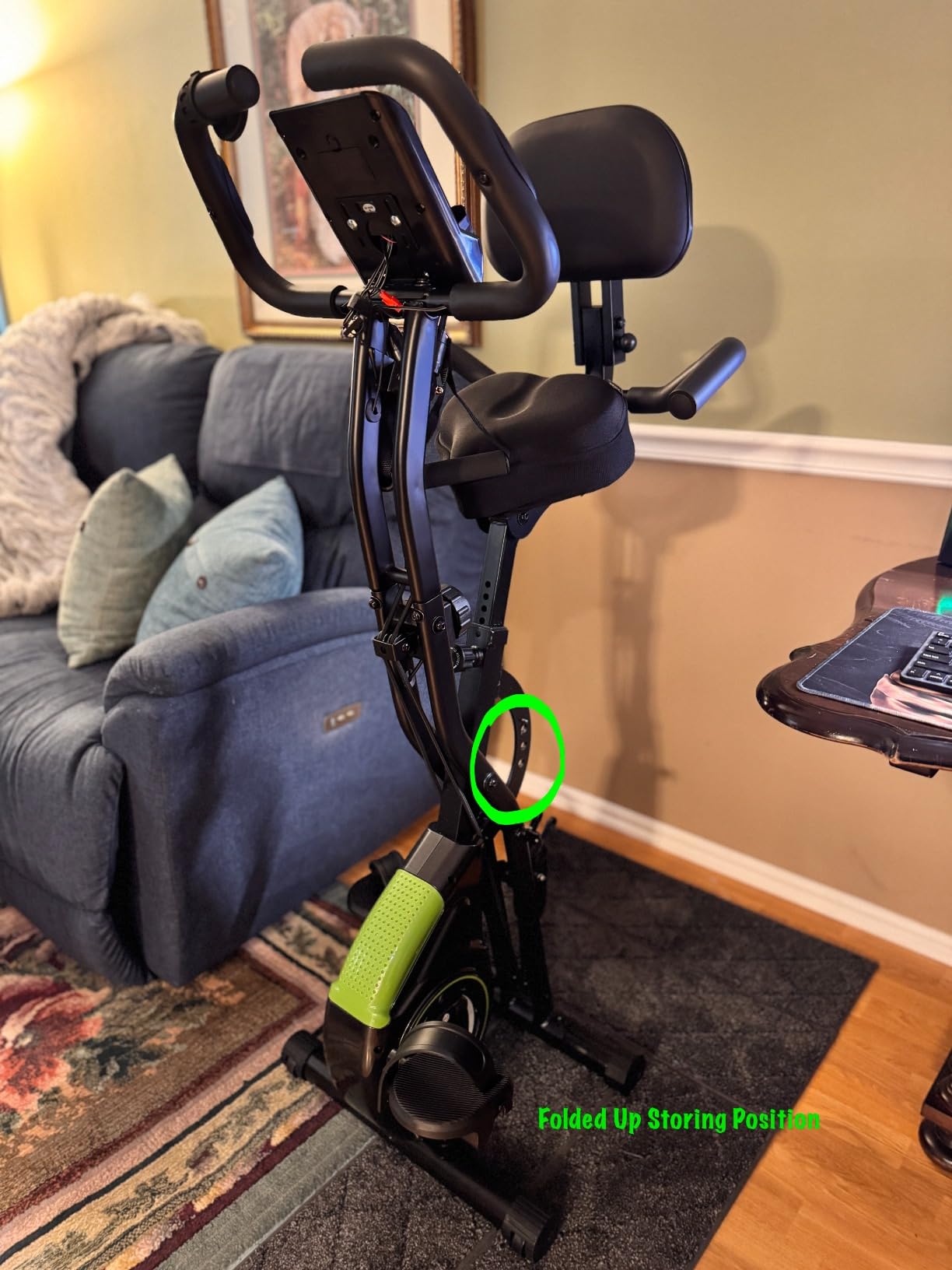
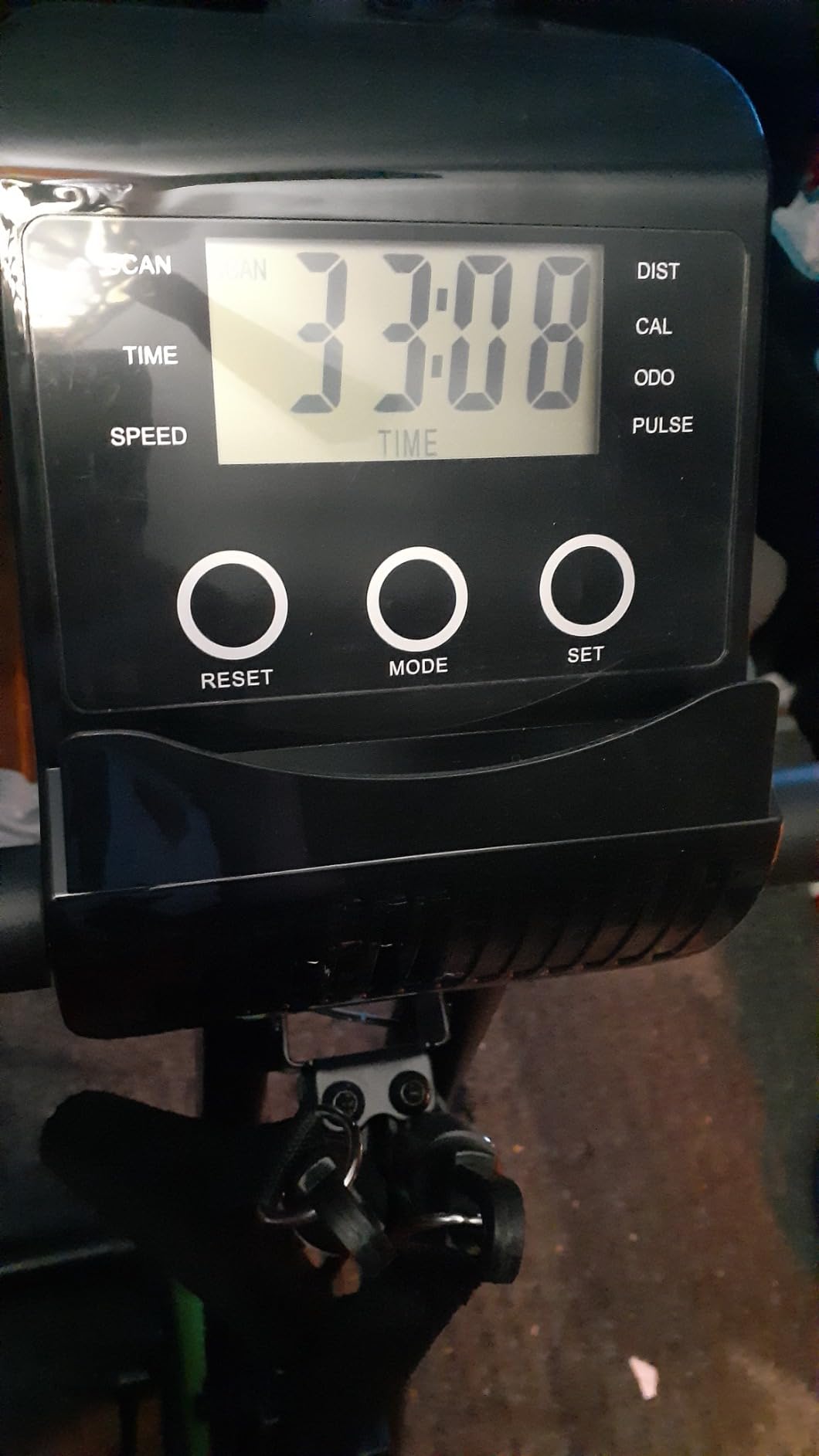
The enclosed PU seat, wide handlebars and supportive backrest give it a more forgiving feel than its class usually manages. A device holder lets you put a tablet on the console for longer sessions.
Who this bike suits
It suits apartment dwellers, riders in small home gyms, and anyone who wants a softer alternative to aggressive road-bike positions. Coming in 70 percent pre-assembled, it is usable the same day.
Who this bike does not suit
It is a compromise posture, not a true recumbent seat, and the 330-pound limit is lower than several picks here. Shorter riders can find the folding frame awkward to mount, and the console has no backlight.
8. YYFITT 3-in-1 Exercise Bike – Best for Dim Rooms
YYFITT 3-IN-1 Exercise Bike with Luminous Display | Foldable | XXL Backrest
2-in-1 upright and recumbent frame
16 magnetic levels
12.6 inch wide seat
Luminous digit display
Pros
- Luminous digits stay readable in low light which seniors notice
- 12.6 inch seat and XXL backrest stay comfortable over long sessions
- Ultra-quiet magnetic resistance
- Folds to save about half the floor space
- Side grab handles help with balance when mounting
- Suits riders from a 26 inch inseam
Cons
- Folding and unfolding is awkward to do alone
- Display cycles through screens and needs repeated resets
- Heart rate readings are inconsistent
- Resistance feels light even at the higher settings
The luminous digit display is unusual and genuinely useful. Many people with knee pain ride early in the morning or late at night, and a backlit or self-lit screen removes one more reason to skip the session.
The seat is 12.6 by 9.5 inches, roughly 15 percent wider than comparable models, and the backrest has two height positions. Users with fibromyalgia and hypermobility report that the wide seat and oversized backrest are what finally made cycling tolerable for them.
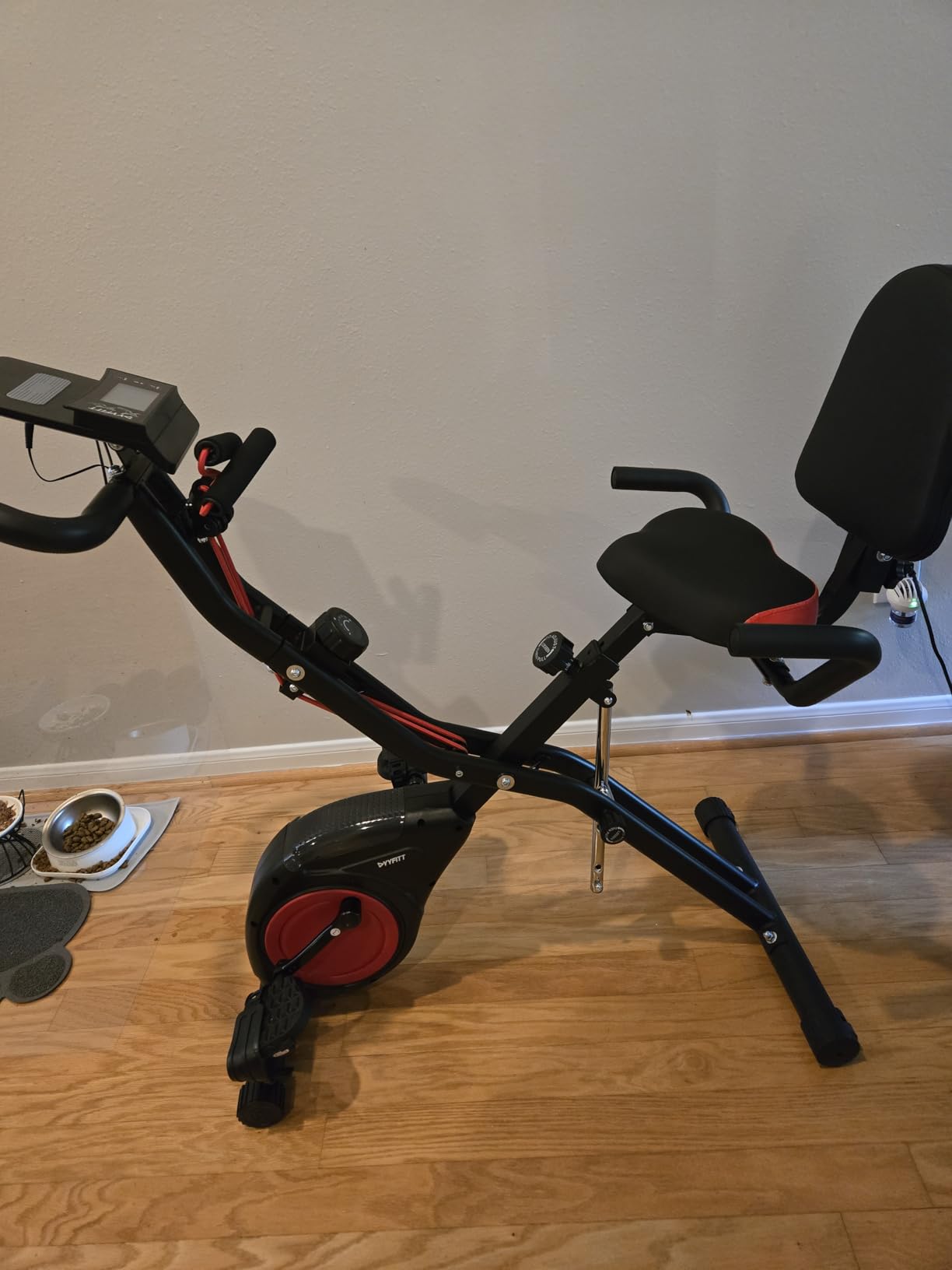
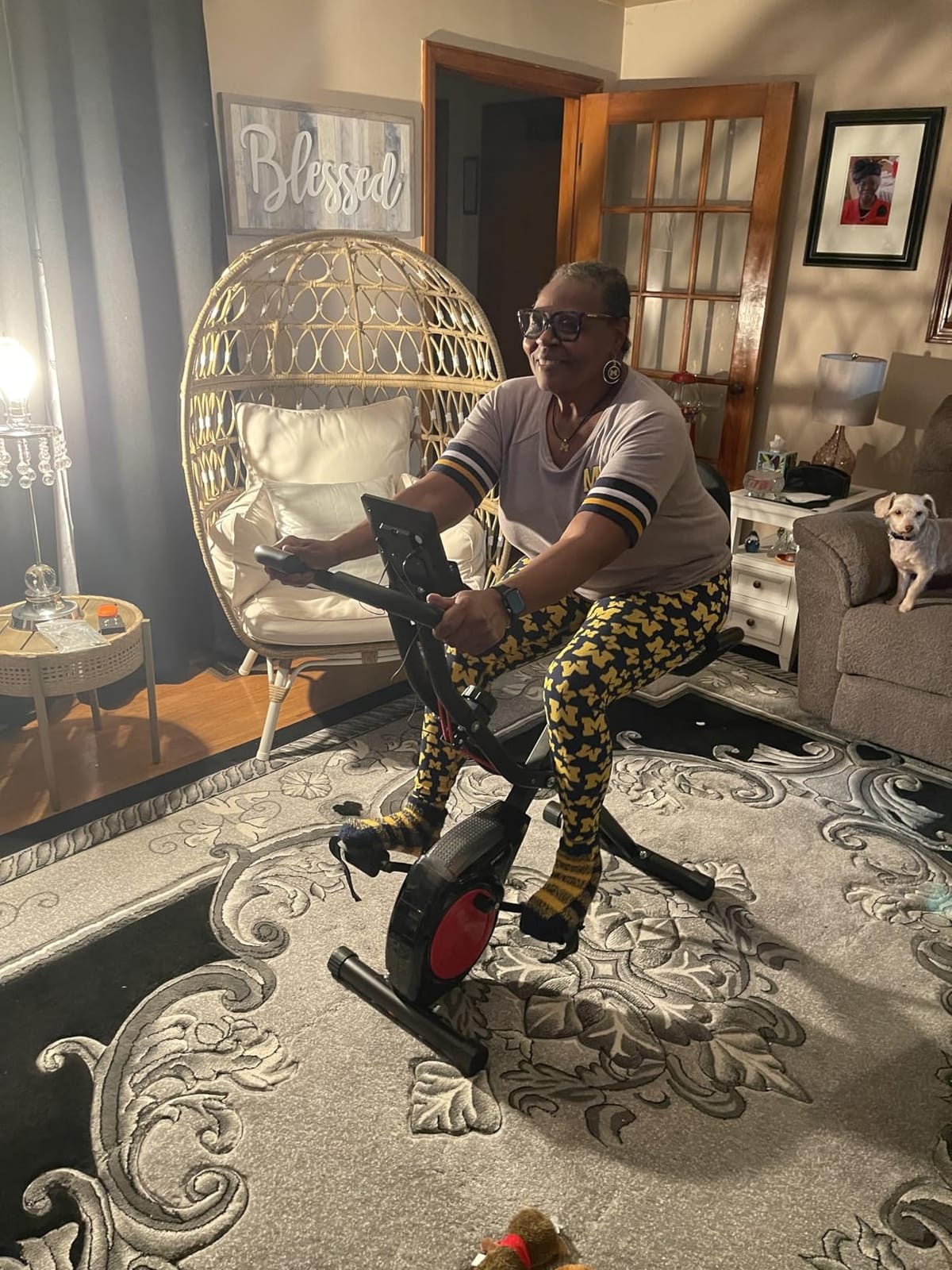
The frame switches between upright and recumbent positions, side grab handles help you steady yourself getting on and off, and the whole thing folds to about half its floor space. It fits riders from a 26-inch inseam up to a 300-pound limit.
Who this bike suits
It suits older riders in dim homes, people with chronic pain who need a wide seat, and anyone whose living space cannot take a full recumbent. The grab handles are a real help if balance is a concern.
Who this bike does not suit
It is not suitable for riders over about six feet. The display cycles through screens instead of showing everything at once, the heart rate sensor is inconsistent, and the resistance feels light compared with other bikes here.
9. MERACH Recumbent Exercise Bike S19 – Best for Easy Transfers
MERACH Recumbent Exercise Bikes for Home Light Commercial High-end
Car-style lever resistance
8 levels
330 lb capacity
Silent dual-belt drive
Pros
- Pivoting grab handles and a low centre bar make transfers easy for knee drop or foot drop
- Very quiet dual-belt drive with almost no audible noise
- Thick seat and breathable mesh backrest stay comfortable for long sessions
- Car-style lever makes resistance changes quick and distinct
- Users with hip and knee osteoarthritis report pain relief and maintained strength
Cons
- Display is not backlit which is hard to read early in the morning
- Backrest angle leaves a gap for riders with back problems
- Seat bolts need retightening after a few rides
- Heavy at roughly 85 to 97 lb
The transfer features are the story here. Pivoting grab handles and a low centre bar give you something solid to push off and steer toward, which is what people recovering from hip and knee injuries actually need when getting on and off a bike.
Owners managing hip and knee osteoarthritis report both pain relief and maintained strength after regular sessions. The dual-belt drive with a perimeter-weighted 6.6-pound flywheel is close to silent in use.
Resistance changes come from a car-style lever rather than a knob, so each level is a distinct click instead of a vague gradient. The thick seat and breathable mesh backrest handle 40-minute sessions, and an included iPad holder sits on the console.
Who this bike suits
It suits riders with mobility limitations, people with foot drop or knee drop, and anyone whose joint load makes a heavier frame worth the trade. The seated leg range of 28.35 to 35.43 inches covers most adults.
Who this bike does not suit
It is the heaviest bike in this group, so it is difficult to reposition in a small room. The display is not backlit, and the backrest angle leaves a gap that some riders with back problems dislike.
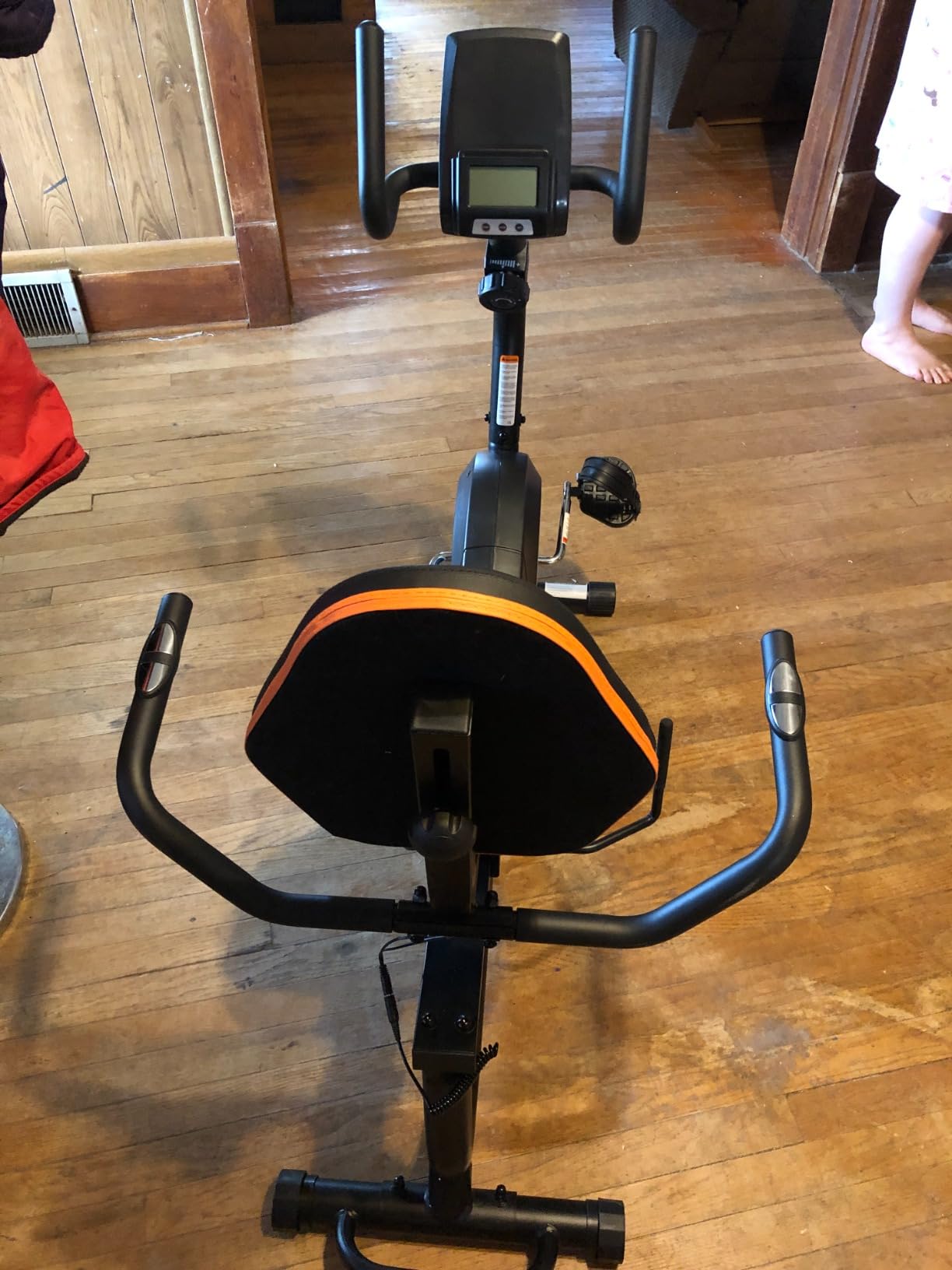
10. YOSUDA Recumbent Exercise Bike – Best for Shorter Riders
YOSUDA Recumbent Exercise Bike for Home, Recumbent Stationary Bikes
Fits 4 ft 9 in to 6 ft 2 in
350 lb capacity
16 levels up to 60 lb
Silent belt drive
Pros
- Very compact footprint that fits a small apartment
- Smooth quiet ride that does not disturb neighbours
- Knob seat adjustment serves two riders of different heights
- Buyers recovering from knee replacement and sciatica report good results
- Most parts pre-installed with an assembly video
Cons
- Seat cushion is thin past about 20 to 30 minutes
- Seat assembly can shift while pedalling if the knob is not re-tightened
- Resistance cable connection during assembly is fiddly
- Email support can take a week to respond
Height is the most common reason a rider gives up on a bike, and this one is built for a wide range. It fits riders from 4 feet 9 inches to 6 feet 2 inches, which on a recumbent is an unusually honest spec sheet.
Owners recovering from total knee replacement, and those with sciatica pain, report good results. The frame is a light commercial-grade steel rated to 350 pounds, and 16 levels give up to 60 pounds of resistance.
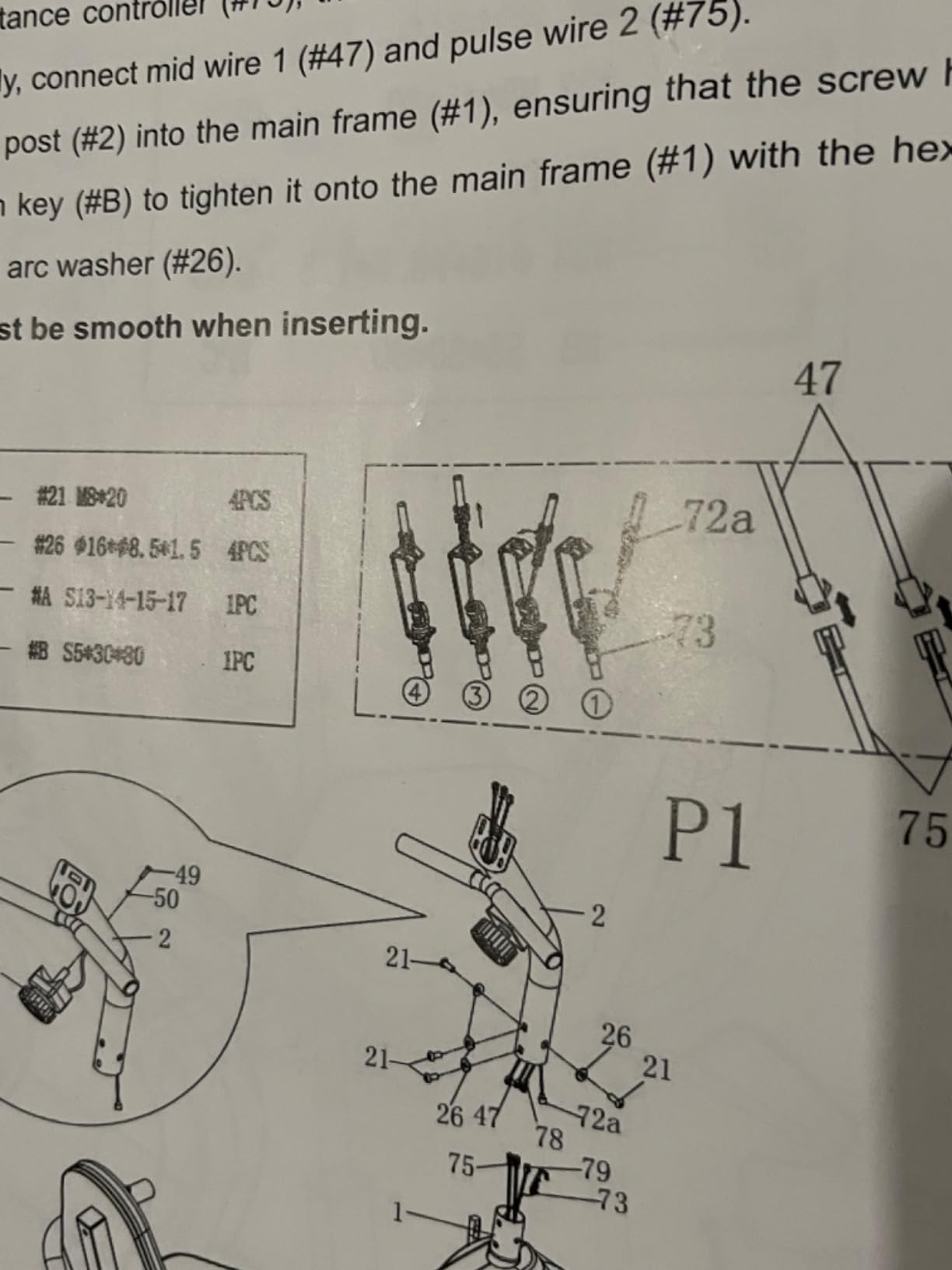
At 45 inches deep and 20 inches wide it is one of the more compact full recumbents here, and it rolls on transport wheels. Most parts come pre-installed with step-by-step instructions and a video guide.
Who this bike suits
It suits shorter riders who get stranded on recumbents with long seat rails, anyone in a small apartment, and riders sharing one bike with a much taller or shorter partner. The re-peg knob adjustment takes seconds.
Who this bike does not suit
The seat cushion is thin and becomes uncomfortable past 20 to 30 minutes, and the seat assembly can shift while you pedal if you forget to re-tighten the knob after moving it. Budget extra time for the resistance cable step during assembly.
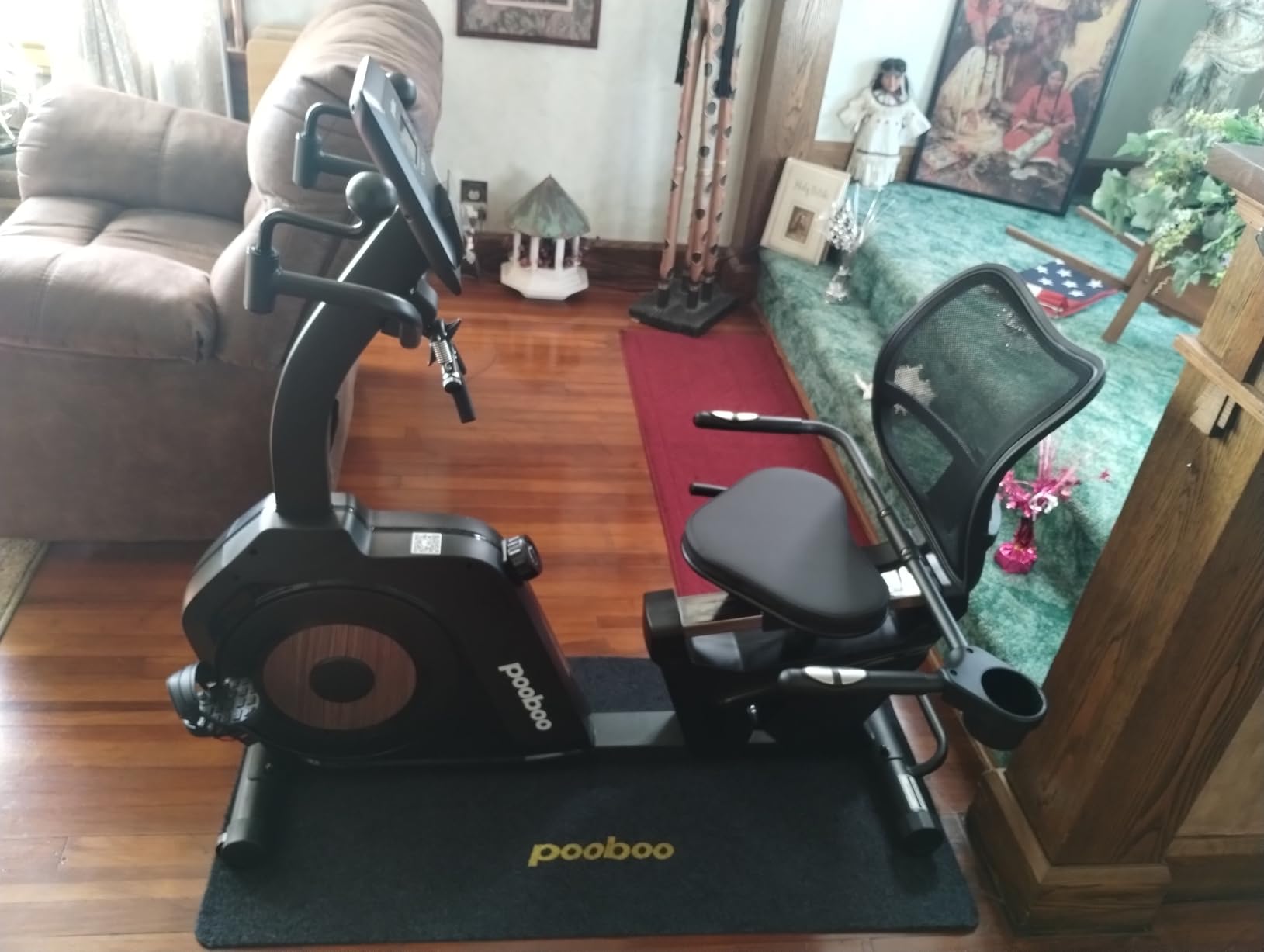
11. Pooboo Recumbent Exercise Bike with Arm Exerciser – Best for Upper Body Workouts
pooboo Recumbent Exercise Bike, Stationary Bikes for Home with Arm Exerciser, Magnetic Recumbent Bike with Ergonomic Backrest & Comfortable Seat, Smart APP, Pulse Sensor, 400LBS Weight Capacity
400 lb one-piece frame
Hand-cranked armrests
15 lb flywheel
Forward and reverse pedalling
Pros
- Heavy-duty 400 lb frame with no wobble in daily use
- Very quiet pedalling with smooth tension control
- Seat and lumbar mesh back support described as excellent
- Arm cranks add a full upper body component to the session
- Long seat rail suits riders up to 6 ft 3 in
- Support replies quickly and replaced a broken monitor
Cons
- Seat is rock hard and needs an extra cushion
- Hand cranks have no adjustable resistance
- Tension adjuster is not within reach of the display
- Assembly takes a couple of hours
The arm cranks are what separate this from every other recumbent on the list. They work in sync with your legs or independently, so on days when your knee will not give you a full workout you can still train your upper body and keep your heart rate up.
Pedalling runs forward and backward, and the 15-pound flywheel with a belt drive targets about 20 dB. The 0 to 18.5-inch sliding seat rail suits riders up to 6 feet 3 inches, with pedal straps offering eight hole positions per side.
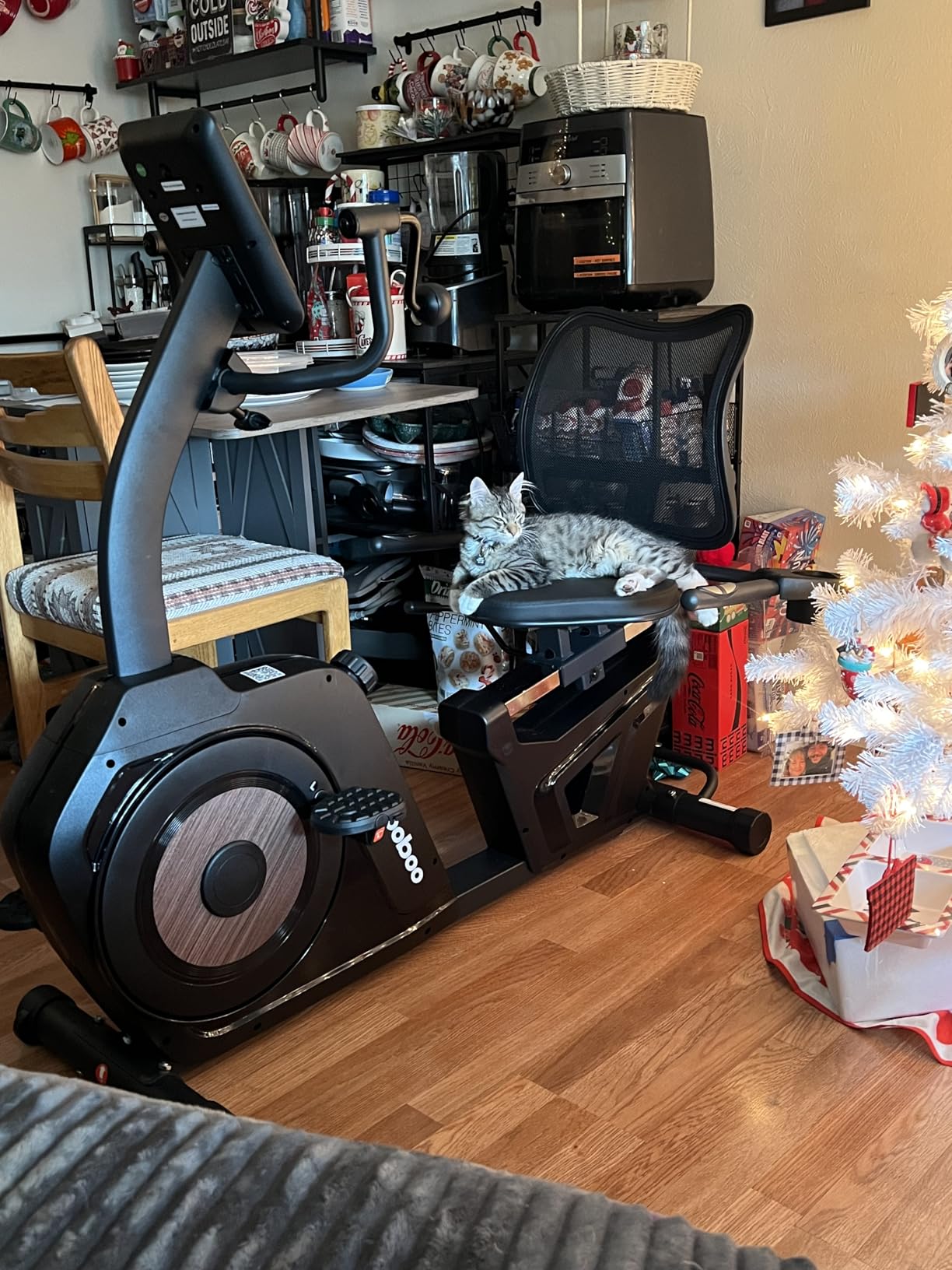
The breathable mesh backrest has a lumbar arch, and the console carries a tablet holder with Kinomap and Zt app connectivity. Twelve months of free replacement parts are included with 80 percent pre-assembly.
Who this bike suits
It suits heavier riders and anyone who wants total-body work in a single machine. Buyers with knee pain chose it specifically to reduce strain on the joint.
Who this bike does not suit
The seat is rock hard as supplied and most owners add a cushion. The arm cranks have no adjustable resistance, and the tension knob is not within reach of the display. Budget a couple of hours for assembly.
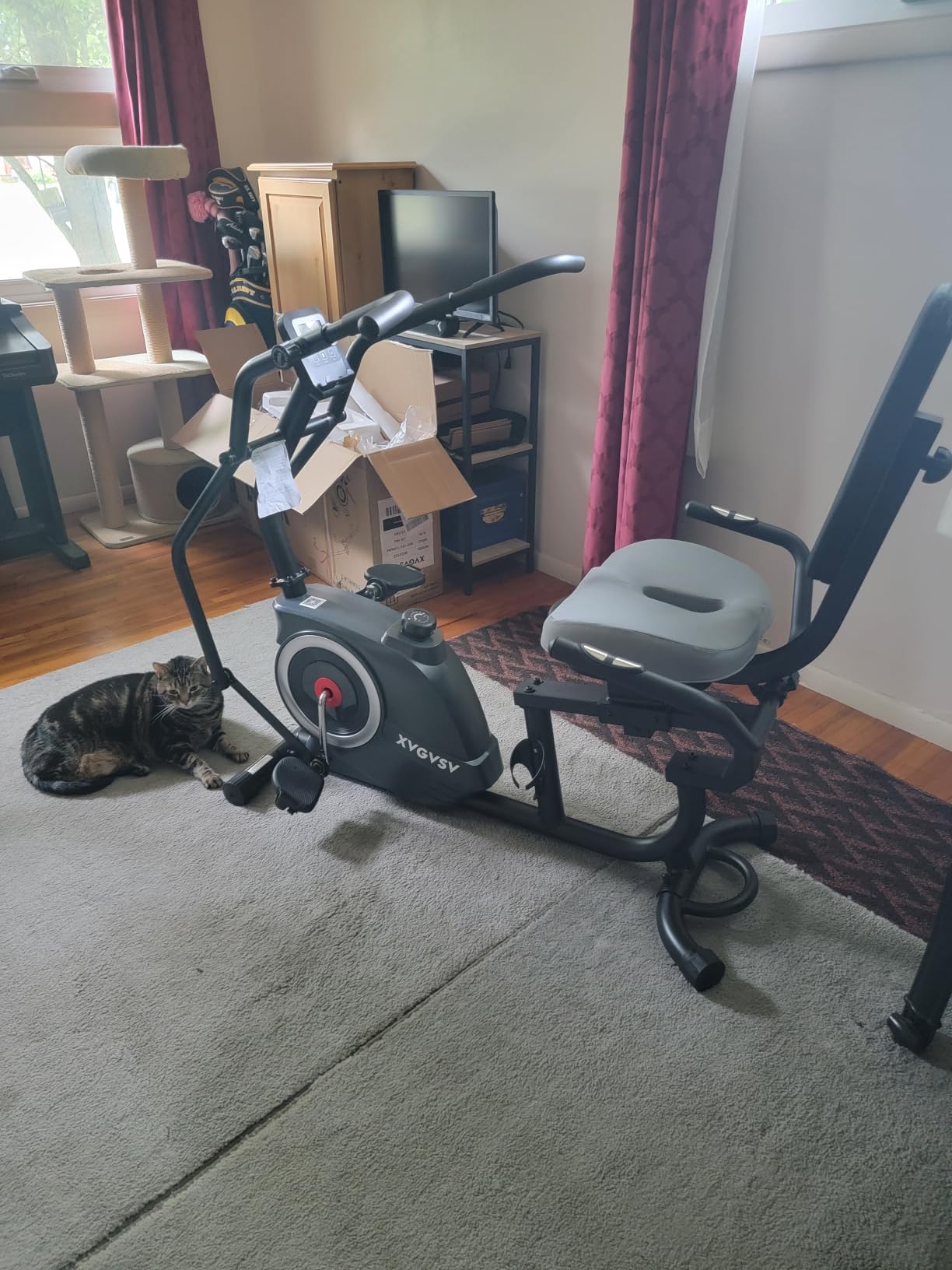
12. XVGVSV Recumbent Bike with Arm Exercise W241 – Best 2-in-1
Recumbent Exercise Bike, Stationary Bike for Home with Arm Exercise
Elliptical and cycling modes
400 lb frame
16 magnetic levels
Silent magnetic resistance
Pros
- Combines recumbent cycling with elliptical motion for a fuller low-impact session
- Trains upper and lower body together in one workout
- Whisper-quiet magnetic resistance on a stable 400 lb frame
- Padded seat with ergonomic backrest and lever seat adjustment
- No login or subscription needed to use the display
- Support sent a free seat cushion quickly
Cons
- Seat cushion does not meet the backrest which can worsen sciatica
- Seat is difficult to slide forward and back
- Pedalling is not perfectly smooth for some riders
- Stock seat is harder than expected
The 2-in-1 design switches between a recumbent cycling stroke and elliptical motion. That matters for a knee because it lets you change the movement pattern without changing machines, which is often the adjustment that gets someone through a plateau.
Buyers chose this one specifically to reduce strain on their knees, and they like that it trains arms and legs together quietly with no subscription or login required. The commercial-grade steel frame is rated to 400 pounds.
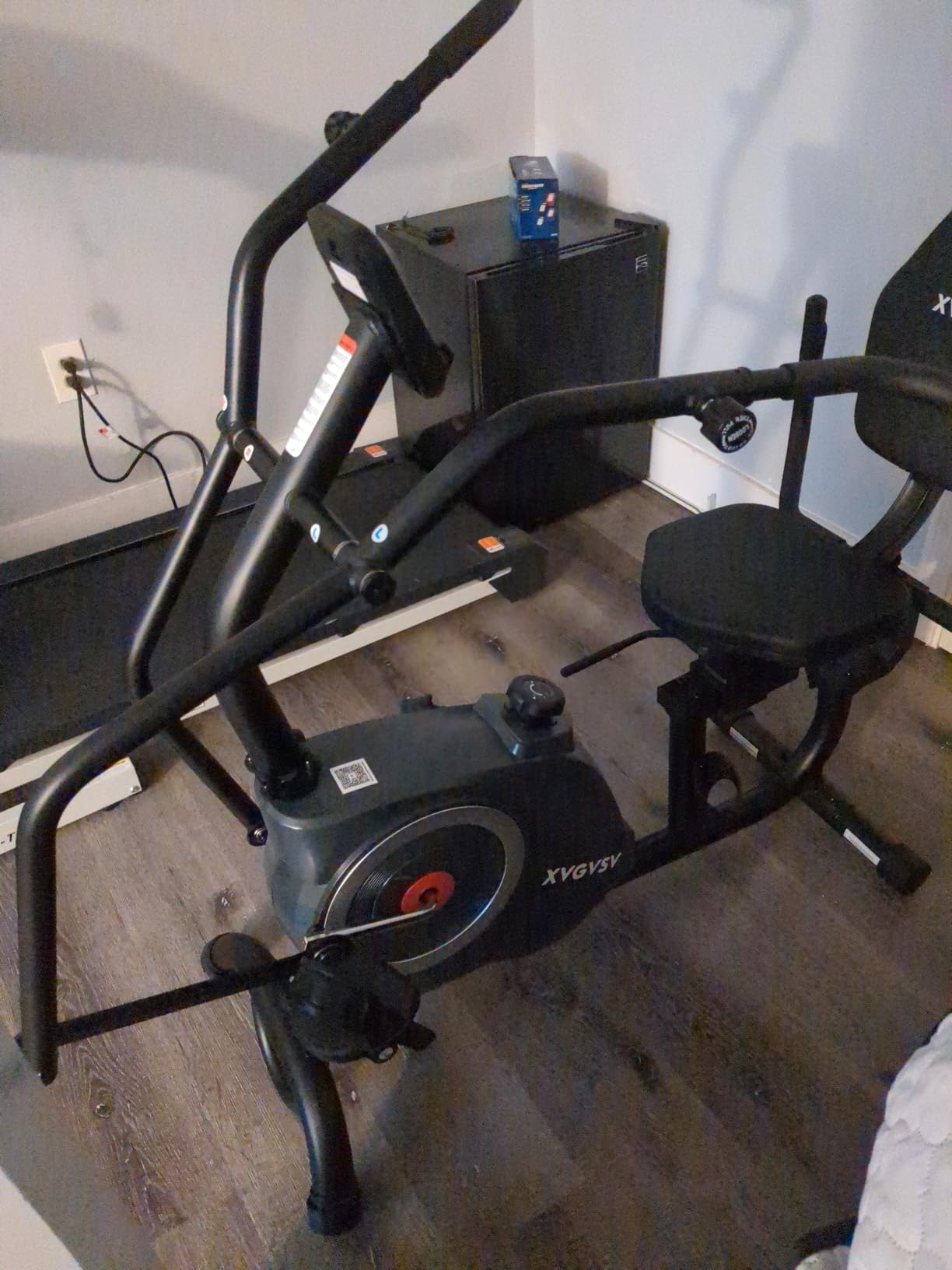
Sixteen magnetic levels span gentle rehab through high-intensity cardio, with handle pulse sensors feeding an LCD display for time, speed, distance, calories, odometer and heart rate. It arrives 85 percent assembled in about half an hour.
Who this bike suits
It suits people who want a fuller workout without loading the knee, and anyone who finds a pure cycling stroke monotonous. Front transport wheels help despite the 66-pound weight.
Who this bike does not suit
The gap between the seat cushion and the backrest can aggravate sciatica in riders who bought a recumbent specifically to avoid that. The seat is hard to slide forward and back, and some riders find the pedalling is not perfectly smooth.
Which Bike to Choose for Your Specific Knee Problem
Match the machine to the diagnosis rather than to the spec sheet. Here is how the picks line up against the conditions we see asked about most.
Knee osteoarthritis and chronic arthritis: pick a full recumbent with a wide seat and long seat rail. The Sunny recumbent and the XVGVSV W239 both suit long, low-intensity sessions without mounting strain. Post knee replacement: do not choose on your own. Ask your physical therapist for clearance and a target range of motion, then start with the YOSUDA or the Sunny recumbent at the lowest resistance and build up in 5 to 10 minute increments.
Meniscus or ligament injury, including ACL recovery: a recumbent keeps the knee moving through a controlled range without the pivoting and lateral loading of a spin bike. Riders with meniscus injuries report the best results on the XVGVSV W239 and the VANSWE, both of which hold a stable frame at higher resistance.
Chronic pain combined with a higher body weight: prioritise a weight rating and frame stability above everything else. The VANSWE at 380 pounds and the XVGVSV at 400 pounds are the two that owners most often describe as wobble-free. Senior low-impact fitness: the BARWING and the YYFITT both fold away and convert between upright and reclined positions, and the YYFITT’s luminous display is a real advantage in a dim room.
If you are working from home during rehab, the Sunny mini cycle keeps you moving without any mounting at all. Our seniors exercise bike guide covers more low-impact options for that audience.
How to Set Up an Exercise Bike So It Does Not Hurt Your Knees
The number one mistake that makes bad knees worse is riding with the seat too low, which forces deep knee flexion at the bottom of every pedal stroke. Set the seat so that at the bottom of the stroke your knee is slightly bent, roughly 25 to 35 degrees from fully straight. If your knee is bent more than a right angle, raise the seat. If it locks straight at the bottom, lower it slightly.
Second, set foot position. Keep your knee, second toe and middle toe roughly in line, and let your heel sit slightly lower than the toe. This small change takes pressure off the patella, which is usually where people feel cycling knee pain.
Third, start with almost no resistance and build slowly. Community riders generally land on 20 to 30 minute sessions about three times a week, which is enough to strengthen the inner quad without provoking a flare. Ask your physical therapist for a target before surgery; do not assume this number applies to your recovery.
Finally, know your red flags. Stop riding and contact a clinician if you get sharp pain inside the joint, swelling that does not settle overnight, a knee that locks or gives way, or pain that is worse the following morning than it was during the ride. Those are not training sensations.
How to Choose an Exercise Bike for Bad Knees: Buying Guide
1. Step-over height and mounting. Measure the top of the frame and compare it to the top of your own knee. Anything close to or above knee height means a step-through frame or a recumbent. This is the single most important feature for a knee that hurts, and it is also the one most product pages bury.
2. Seat range, checked against your height. Look for a stated inseam or seated leg range, not just “adjustable.” Anything from a 26-inch inseam upward works with the folding bikes here; recumbents commonly run 29 to 37 inches, which leaves riders over six feet short on several models.
3. Seat padding and width. A seat under about 12 inches wide will get uncomfortable past 30 minutes. Owners across this group consistently name seat firmness as their top complaint, so plan on adding a cushion if you plan long sessions, and check whether the backrest has an adjustable or vented position.
4. Resistance type and level count. Magnetic or electromagnetic resistance is quieter and ramps more smoothly than contact pads, which matters in an apartment. Sixteen levels give you room to progress; eight levels is fine for rehab but caps your ceiling quickly.
5. Pedals and straps. Look for pedals with at least a few strap positions and an inward angle. Foot drop and knee drop riders should prioritise the pivoting grab handles and low centre bars, because getting off safely matters as much as getting on.
6. Weight capacity and stability. Buy for your current weight with some headroom, and read whether the frame is welded or bolted. A wobbling bike makes riders nervous, and nervous riders stop riding.
7. Noise and footprint. Magnetic belt drives typically sit in the low-noise range for home use, and the folding models here collapse to roughly a fifth of a square metre. Recumbents run 45 to 52 inches deep, so measure before you order.
8. Assembly and warranty. Most of these bikes arrive 70 to 85 percent assembled and are running in about 30 to 60 minutes. The Sunny mini cycle carries a one-year structural frame warranty, which is worth noting for anything bought for a specific rehabilitation period.
Frequently Asked Questions
Which stationary bike is best for people with bad knees?
A recumbent or semi-recumbent bike with a low step-through frame is best, because you get on without swinging a leg over a high tube and pedal with less knee flexion than an upright or studio bike. Add a wide padded seat with back support and a seat that adjusts through a long range, and you have the combination most knee-friendly riders end up buying.
What type of exercise bike is best for knee pain?
A recumbent bike is the safest default because it supports your body weight against a backrest and keeps the hip open. Step-through folding bikes are the next best option when floor space is limited, and an under-desk mini pedal is useful during early rehab when mounting any full-size bike is not possible yet. Spin and air bikes are the hardest on painful joints.
Are exercise bikes good for bad knees?
Yes, cycling is one of the recommended low-impact forms of exercise for knee osteoarthritis because the bike supports your body weight and removes impact from the pedal stroke. It also strengthens the quadriceps, which helps stabilise the joint. Speak to your doctor or physical therapist first, particularly after surgery, and stop if you get sharp pain, swelling, locking or giving way.
Are recumbent bikes good for people with bad knees?
Generally yes. Reclining opens the hip and reduces the knee bend needed at the top of the pedal stroke, and you sit down rather than mount from above, which protects both knees and hips. The drawbacks are a long, heavy frame, limited seat range for tall riders, and a backrest angle that can bother people with lower back problems.
What are the downsides of using a recumbent bike?
Recumbents take up more floor space than upright bikes, weigh between 50 and 100 pounds, and are harder to move between rooms. Seat rails commonly top out near 37 inches of inseam, which cramps riders over six feet. Some backrests leave a gap that irritates sciatica, and the reclined position asks less of your core.
Which bike is best for arthritic knees?
A full recumbent with a wide cushioned seat, back support and 16 levels of magnetic resistance covers most arthritic knee needs because it lets you ride long, low-intensity sessions with almost no mounting strain. For larger riders, prioritise a frame rated above 350 pounds and one reviewers describe as wobble-free, such as the VANSWE or the XVGVSV W239.
What is the best exercise machine for seniors with arthritic knees?
A recumbent bike with a step-through frame is the usual answer, because sitting down is safer than mounting and the backrest carries upper body weight. Add a backlit or self-lit display for evening use, wide handlebars for stability, and transport wheels so the bike can be moved. Folding models are worth considering when storage space is limited.
What is the #1 mistake that makes bad knees worse?
Setting the seat too low, which forces deep knee flexion at the bottom of every pedal stroke. Set it so your knee is bent roughly 25 to 35 degrees from fully straight at the bottom of the stroke, keep your knee aligned over your second toe, and start at very low resistance. Riding through sharp pain or swelling is the second most common mistake.
How long should I ride an exercise bike with bad knees?
Community riders and physical therapists generally point to 20 to 30 minute sessions around three times a week as a sensible starting target, building gradually. After knee replacement surgery, follow your own physical therapist’s protocol rather than a general number, since timelines vary with the procedure and your progress. Increase duration before you increase resistance.
Final Verdict for Bad Knees in 2026
After working through 12 machines, our pick for the best exercise bikes for bad knees in 2026 is the Sunny Health and Fitness Smart Recumbent Bike. Its flip-away side handle, wide cushioned seat and smooth 16-level magnetic drive solve the three problems that stop most knee-pain riders before they ever get moving. If you need a sturdier frame or a heavier rating, the XVGVSV W239 and the VANSWE are the two to look at next. Clear it with your doctor or physical therapist, set the seat with your knee slightly bent, and start short.