
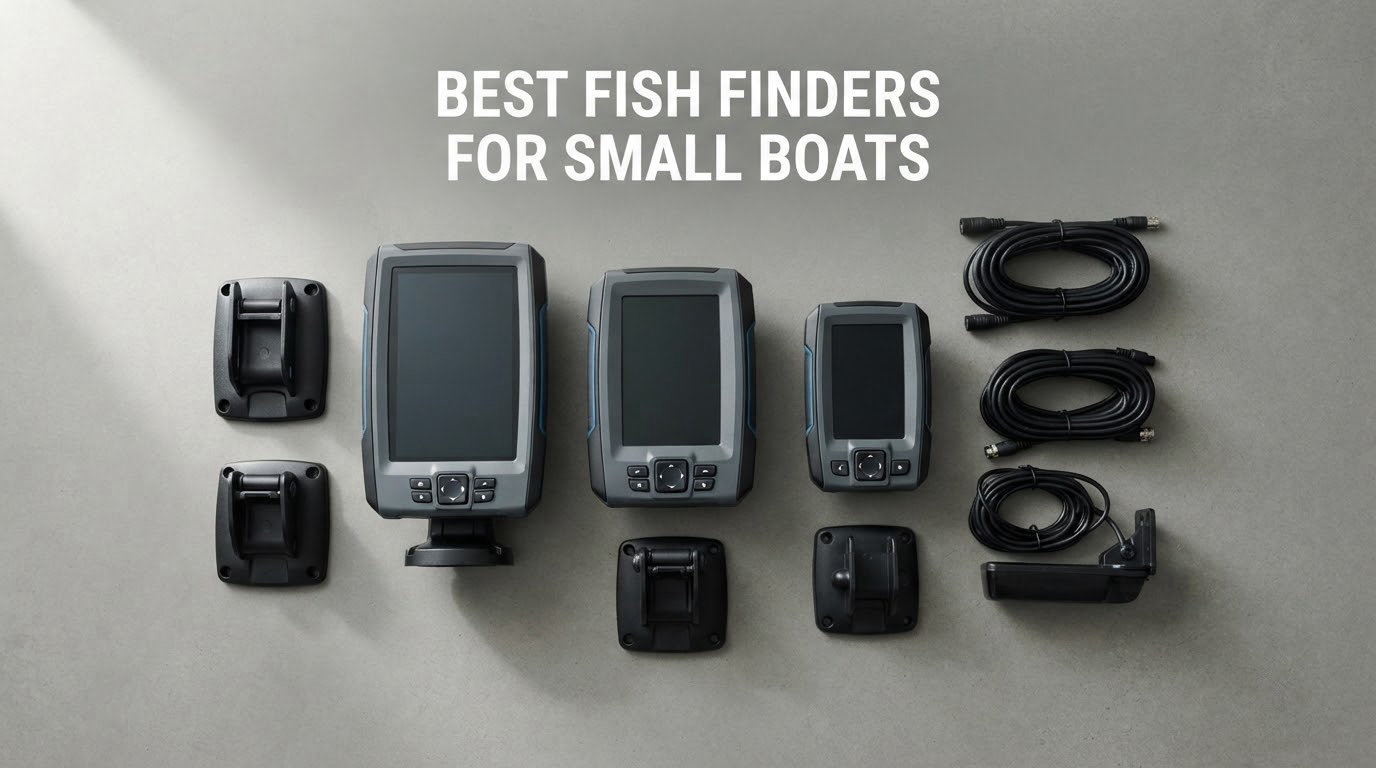
Short answer: the Garmin STRIKER 4 with transducer is the best fish finder for most small boats, because a 3.5 inch CHIRP screen, built-in GPS and a 0.23 amp draw give you everything a jon boat or 14 foot aluminum actually needs without taking over the deck. If your boat has no battery at all, the Deeper START or the Deeper PRO+ 2 give you depth and fish arches with no wiring and no drilling.
Small boats break the rules that electronics shopping guides usually assume. There is no console to hide a screen behind, no wiring loom running to a battery, and nowhere much to sit above the glare line. You are often sitting low, facing forward, with the sun in your eyes at exactly the moment you want to read the screen.
That is why picking among the best fish finders for small boats is not really about picking the most capable unit. It is about matching screen size, sonar type and power method to a hull that gives you very little of any of those. This roundup covers ten current-generation units, from hardwired 3.5 inch head units to app-connected castable sonar, and works out which hull each one actually suits.
We also compared the same category in our wider guides to fish finders for larger boats and to portable fish finders that run without a boat battery, so you can see how the small-boat shortlist differs.
Table of Contents
Top 3 Small Boat Fish Finders in 2026

Garmin STRIKER 4
- CHIRP traditional plus ClearVu scanning sonar
- Built-in GPS waypoints
- 0.23 A draw at 12V
- 3.5 inch sunlight-readable LCD

Garmin STRIKER Plus 4
- Built-in Quickdraw Contours mapping
- Dual-beam transducer
- 4.3 inch sunlight-readable screen
- Bluetooth connectivity

Garmin STRIKER Vivid 4cv
- Vivid color scanning palettes
- CHIRP traditional plus ClearVu
- Quickdraw Contours
- GT20 transducer included
Best Fish Finders for Small Boats (October 2026)
| Product | Specifications | Action |
|---|---|---|
| Garmin STRIKER 4 |
|
Check Latest Price |
| Garmin STRIKER Plus 4 |
|
Check Latest Price |
| Garmin STRIKER Vivid 4cv |
|
Check Latest Price |
 Humminbird PiranhaMAX 4 Humminbird PiranhaMAX 4 |
|
Check Latest Price |
 LUCKY FFC1108 Handheld LUCKY FFC1108 Handheld |
|
Check Latest Price |
 Deeper START Deeper START |
|
Check Latest Price |
 Deeper PRO+ 2 Deeper PRO+ 2 |
|
Check Latest Price |
 Lowrance Eagle 4 Lowrance Eagle 4 |
|
Check Latest Price |
 Humminbird HELIX 5 CHIRP GPS G3 Humminbird HELIX 5 CHIRP GPS G3 |
|
Check Latest Price |
 LUCKY Wired Transducer Kit LUCKY Wired Transducer Kit |
|
Check Latest Price |
How We Picked These Ten
Every unit here had to be a current-generation model rather than a discontinued generation still being pushed by older roundups. We weighted fit for a small hull more heavily than feature count, because a chartplotter that will not fit above a trolling motor is worth nothing on a jon boat.
We also balanced hardwired head units against castable sonar, since the biggest question in this category is whether the boat has a battery at all. Ratings and review counts come from the retailer listing, and we copied them as published rather than recalculating them.
One honest limit: we do not publish lab amp-draw figures for every unit, and the manufacturers we checked rarely publish them either. Where a number is missing, we say so instead of estimating. The Garmin STRIKER 4 is the exception, with a manufacturer figure of 0.23 A at 12V that we use in the power section below.
1. Garmin STRIKER 4 with Transducer, 3.5 Inch GPS Fishfinder with CHIRP
Garmin 010-01550-00 Striker 4 with Transducer, 3.5″ GPS Fishfinder with Chirp
3.5 inch LCD
CHIRP traditional plus ClearVu
1600 ft freshwater depth
0.23 A at 12V
Pros
- CHIRP gives crisp arches and good target separation
- Screen readable in full sunlight
- Tilt swivel bracket with transom and motor mounts
- Reports depth temperature battery voltage and speed
- 9312 reviews averaging 4.6 stars
Cons
- Sonar signal cuts out at higher speeds
- Thin power lead that needs securing
- 3.5 inch screen limits zoom detail
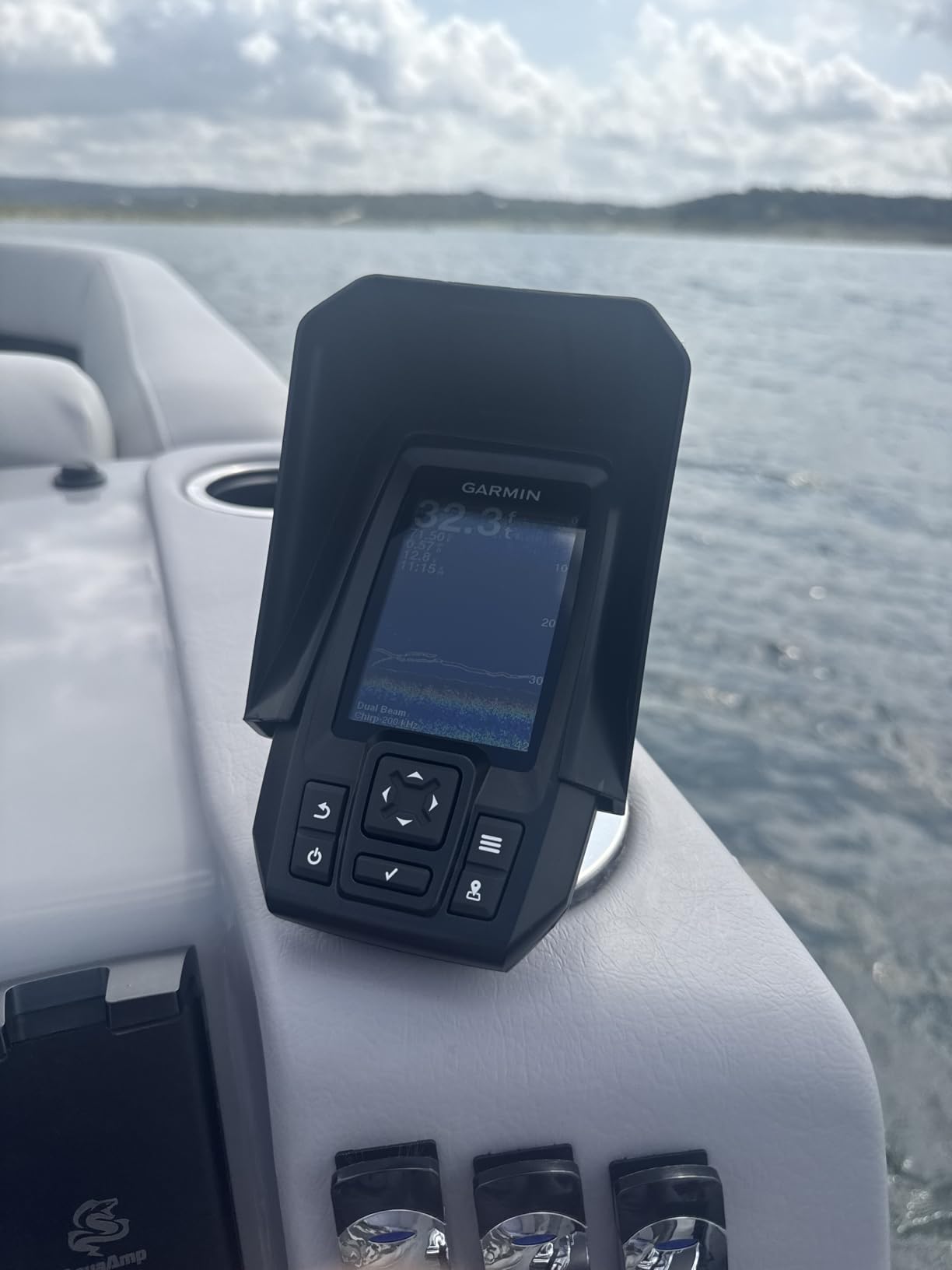
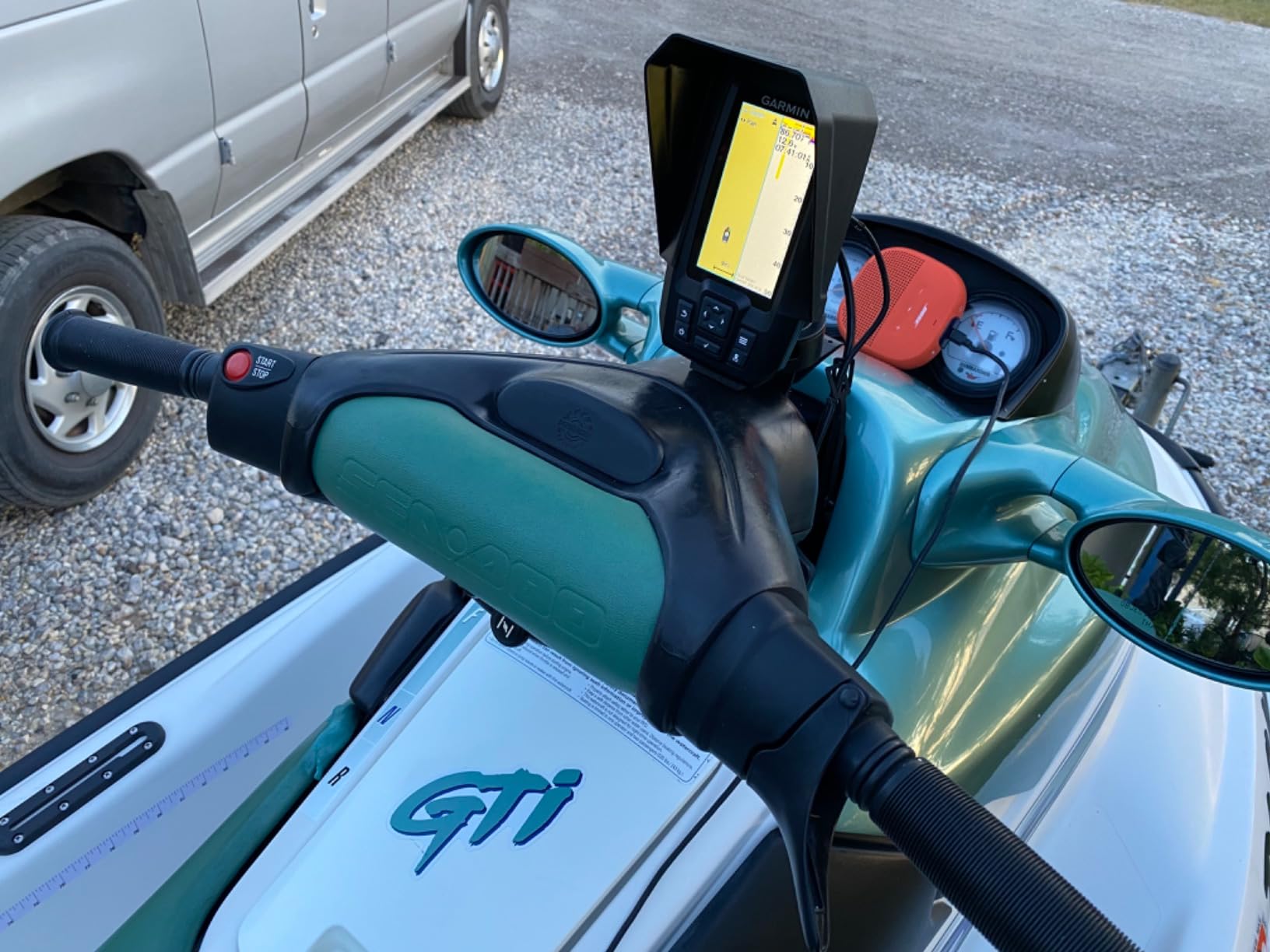
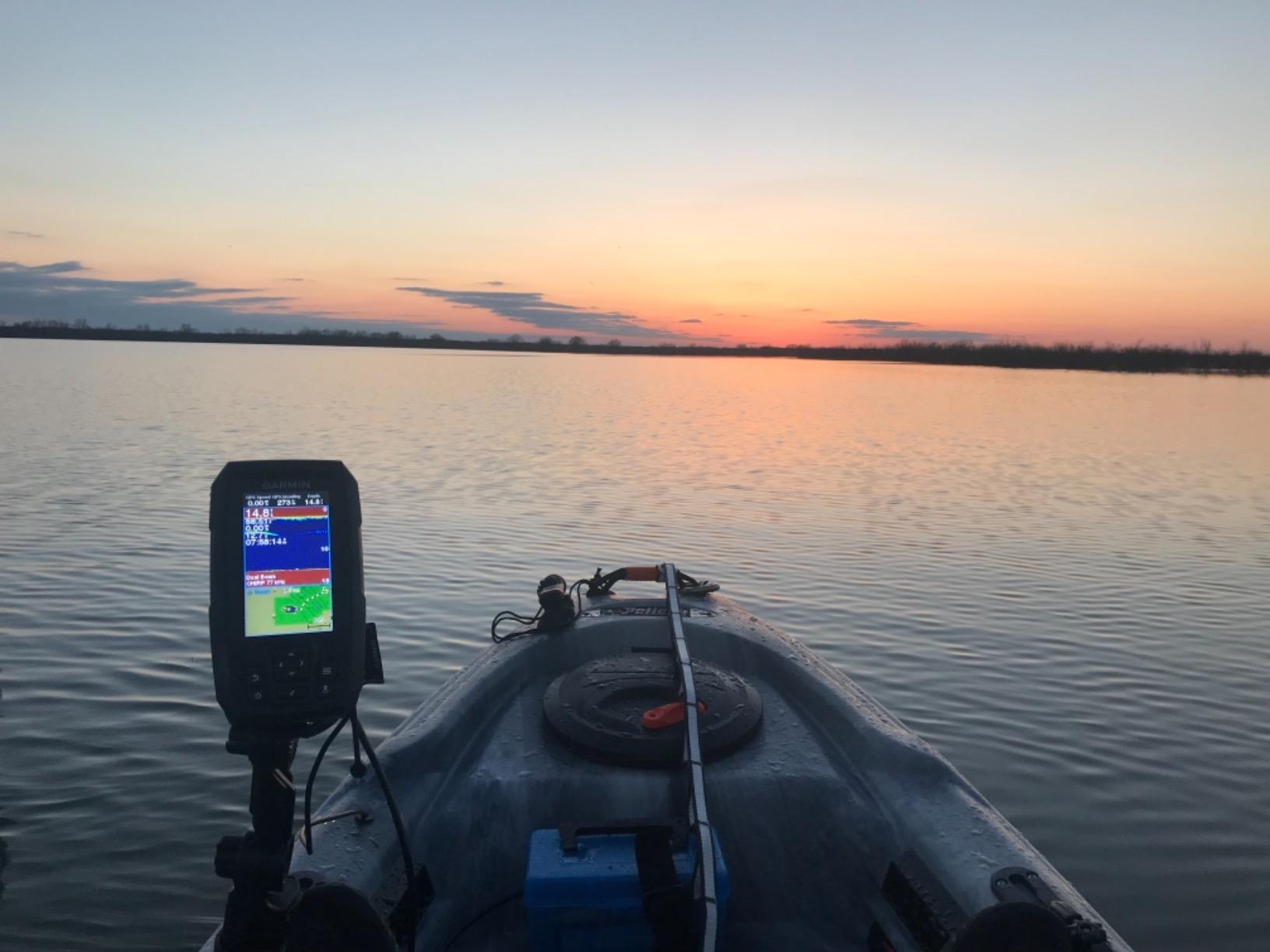
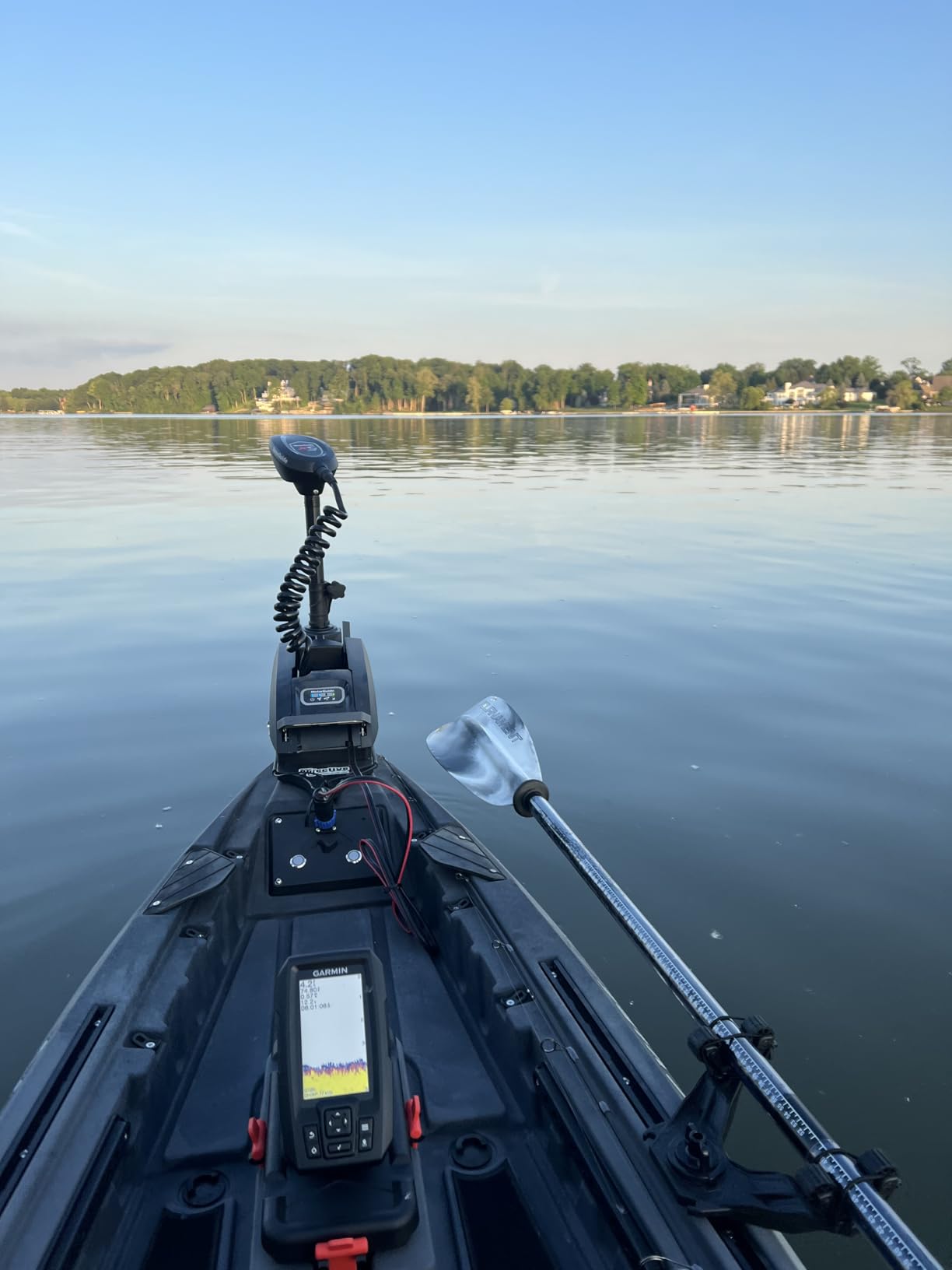
This is the unit most small-boat anglers end up with, and the reason is unglamorous: it does the small number of jobs it has without asking you to learn anything. You get depth, bottom contour, water temperature, battery voltage and GPS speed on a 3.5 inch keyed screen, and the tilt and swivel bracket lets you angle it away from the sun.
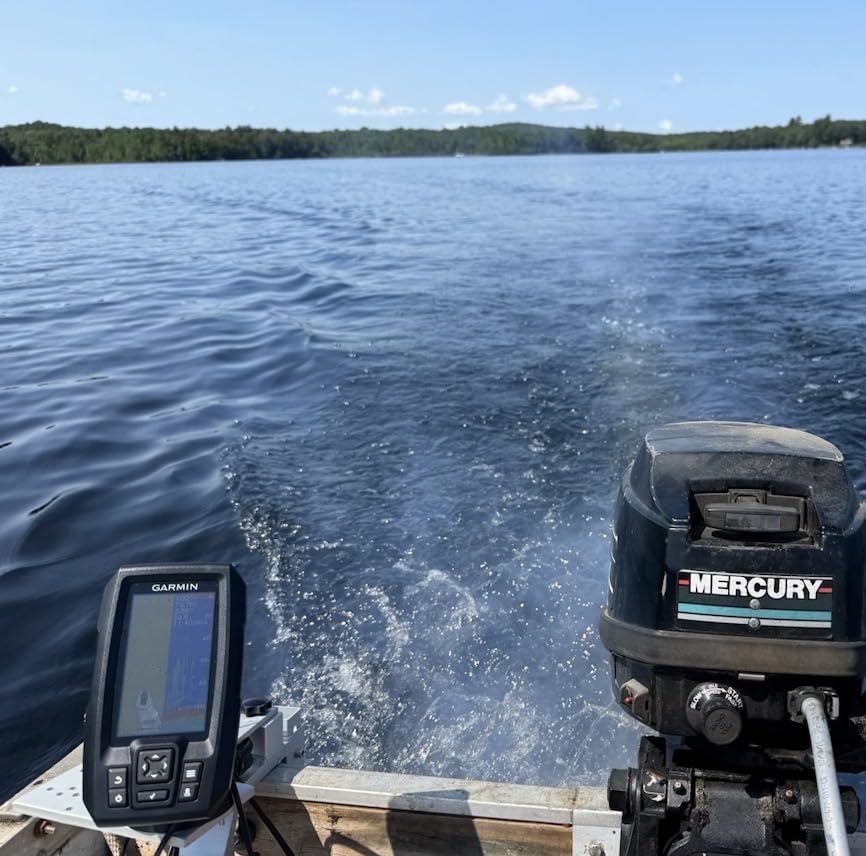
On a 12 foot jon boat it is about the size a 3.5 inch screen can physically be. The included transom and motor mounts mean you can move the transducer between boats without drilling anything, which matters if you borrow or rent.
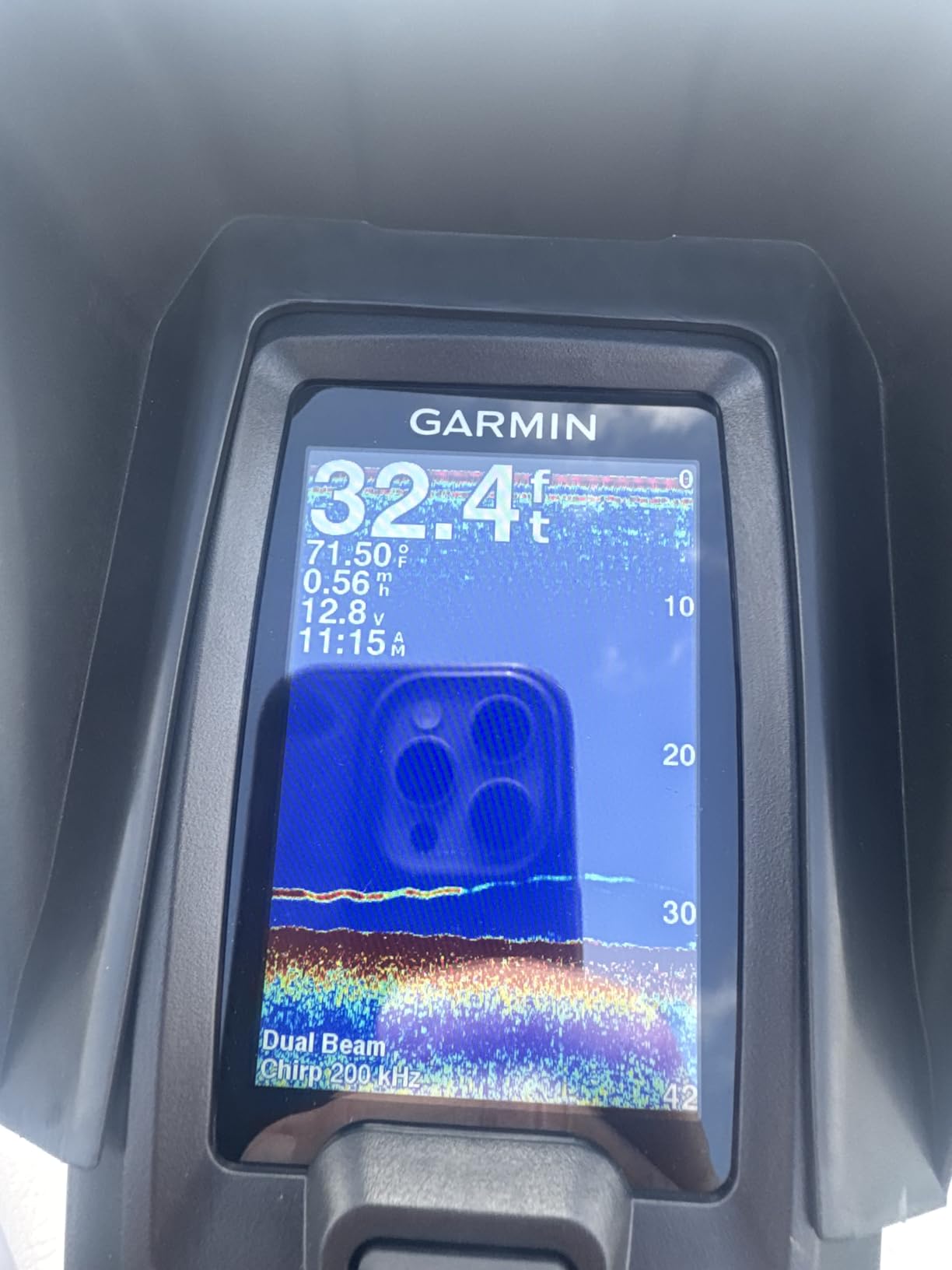
The sonar itself is the reason it outscores its tier. CHIRP traditional separates targets far better than a single-frequency ping, and the added ClearVu scanning channel gives you a near-photographic look at brush piles and stumps. Reviewers consistently single out the arches and baitfish blobs for clarity, and the flasher and A-Scope modes are a bonus for ice fishing and vertical jigging.
The weakness is speed. Owners report the signal degrading above idle, so slow-trolling anglers get clean data and anyone running wide open will lose the bottom. The included power lead is also thinner than it should be, so secure it properly rather than leaving it where a heel can catch it.
What 0.23 amps means for your battery
The manufacturer rates this head unit at 0.23 A at 12V. On a 7Ah battery that works out to roughly 30 hours of continuous run time, and on a 12Ah pack closer to 50 hours, which means an entire day of fishing and then some.
That figure is the quiet reason this unit suits small boats so well. A small deep-cycle battery you can carry in one hand will outlast the fishing trip, and a transom-mounted head unit like this doubles as a portable unit when you move it to a boat with no wiring.
When a 3.5 inch screen is too small
Pick something else if you are splitting the screen often, zooming into structure from more than about 15 feet of depth, or fishing in saltwater where you want to read bottom hardness across a wide area. The 3.5 inch panel has no room for a useful split screen with detail.
It is also the wrong unit if you have never used sonar before and want menus that spell things out. The button layout is simple but undocumented, and the manual is thin on the power hookup details you will want before you start cutting wire.
2. Garmin STRIKER Plus 4 with Dual-Beam Transducer
Garmin 010-01870-00 Striker Plus 4 with Dual-Beam transducer
4.3 inch QSVGA screen
Dual-beam CHIRP
Quickdraw Contours mapping
20 m max depth
Pros
- Quickdraw Contours auto-mapping at this price
- Sunlight-readable 4.3 inch screen with split screen
- Dual-beam transducer picks up bottom-hugging fish
- Owners report days of run time off a 7Ah battery
- Works for ice fishing and open water
Cons
- Screen resolution softer than older Garmin models
- No battery connection fittings included
- Setup manual is thin for beginners
This is the step up for an angler who has decided that GPS alone is not enough. Built-in Quickdraw Contours records your own depth contours as you fish, which on a farm pond or a lake with no chart coverage is worth more than any premium basemap. It holds up to 2 million acres of your own mapping.
The 4.3 inch sunlight-readable screen with a split-screen option is the other reason to choose it. The dual-beam transducer covers both a wide arc for finding fish and a narrower arc for detail, and owners report it holding a lock on fish that sit tight to the bottom.
Bluetooth connectivity means the unit can share data with a phone or tablet, so you can take your recorded contours off the boat at the ramp rather than reading them over the owner’s shoulder. The transom and trolling motor mounts are both in the box, which matters for a small hull with one usable mounting point.
Three complaints come up repeatedly. The screen is noticeably softer than older Garmin panels, the battery connection fittings are not included so you may need to add them, and the setup manual does a poor job for first-time installers. None of those stop the unit working.
Why Quickdraw Contours changes where you fish
Contour mapping records the shape of the bottom as you move. After two trips you can see where the ledge drops, where the flat holds and where the creek channel runs, and then you can navigate straight back to the spot that produced fish.
On a small boat the value is bigger than it looks, because you usually have one launch and one trip. Losing an hour finding familiar water eats the entire reason you bought a sonar unit in the first place.
Where the dual-beam transducer earns its keep
Dual-beam gives you two cone angles from one transducer. The wide beam sweeps a large area at shallow depth, which is exactly the situation in a shallow creek or over a weed flat, while the narrow beam resolves individual fish in deeper water.
It is a better match for a 14 foot aluminum flatbottom than a pure scanning unit, because you are usually looking for a specific fish holding near structure rather than reading a picture of the bottom. If you mostly fish open water, the STRIKER Vivid 4cv is the better comparison.
3. Garmin STRIKER Vivid 4cv Color Fishfinder and Sonar Transducer
Garmin Striker Vivid 4cv Fishfinder with Transducer – 4-inch LCD Display – Easy-to-Use Scanning Sonar – Color Palettes, 11.2 Ounces (010-02550-00)
4 inch color LCD
CHIRP traditional plus ClearVu
Quickdraw Contours
2 year warranty
Pros
- Highest rated unit here at 4.7 stars across 1861 reviews
- Color scanning separates fish from structure at a glance
- Quickdraw Contours and high-sensitivity GPS included
- Compact 4 inch footprint with tilt swivel bail mount
Cons
- Menu-driven controls take more practice than keyed buttons
- No 3.5 inch version for very tight decks
This is the highest rated unit in our roundup, and the reason is the color scanning sonar. The Vivid palettes render ClearVu returns in a way that makes structure look like structure, so brush piles, rock and weed separate visually instead of merging into one thick line of clutter.
You also get the GT20 transducer in the box, high-sensitivity GPS for waypoints and routes, and built-in Quickdraw Contours. The tilt and swivel bail mount is compact enough for a small console and tilts far enough to kill glare when the sun is high.
On saltwater, a color picture is genuinely more useful than a monochrome arch display because the difference between a sand ledge and a rock ridge matters more. The 2 year warranty is also the longest in this list, which is a small but real reliability signal when you are a long way from a dealer.
The one consistent complaint is the control scheme. Menu-driven controls take longer to learn than the dedicated buttons on the STRIKER 4, and a few owners wish they had stayed with the older keyed layout. Once set, you rarely go back into the menus.
When color scanning beats a plain arch display
Color scanning wins when you are looking for structure in clear water, when you want to identify the type of bottom, and when you are fishing a saltwater flat where a rock ledge and a sand bar look identical on a monochrome screen.
It costs you battery and screen real estate compared with a plain CHIRP unit. If your water is stained or you are fishing heavy vegetation at night, the plain arch display is honestly easier to read, and the STRIKER 4 does that job for less.
How it performs as a fixed unit on a small hull
The 4 inch footprint is the practical limit for most jon boats and 12 to 14 foot aluminum hulls, and the bail mount keeps it steady on a bouncing deck. Everything you need to mount it comes in the box, including the power and data cable.
The tradeoff against the STRIKER Plus 4 is resolution versus features. The Plus 4 gives you dual-beam and the same Quickdraw mapping, while the Vivid 4cv gives you color. If you fish clear water, take the color.
4. Humminbird PiranhaMAX 4 Dual Beam Fish Finder
Humminbird PiranhaMAX 4 Fish Finder with Transducer, Dual Beam Sonar
4.3 inch LCD
Dual Beam sonar
600 ft max depth
Transom transducer included
Pros
- Dual Beam sonar trades detail for coverage
- Tilt and swivel mount is easy to adjust on a small deck
- 4.6 stars across 1328 reviews
- Transom transducer included in the box
Cons
- No GPS or mapping at this level
- Basic monochrome-style display compared with color units
The PiranhaMAX 4 is the direct competitor to the STRIKER 4 and the winner if your only requirement is a readable screen in bright sun with nothing to learn. Humminbird has spent decades on daylight readability, and this 4.3 inch LCD is exceptionally clear through a windshield or polarized glasses.
Dual Beam sonar gives you the choice of a narrow beam for detail and a wide beam for coverage, which is the same idea as the dual-beam transducer on the STRIKER Plus 4 in a simpler package. The XNT 9 28 T transom transducer is included, and the tilt and swivel mount adjusts easily on a cramped deck.
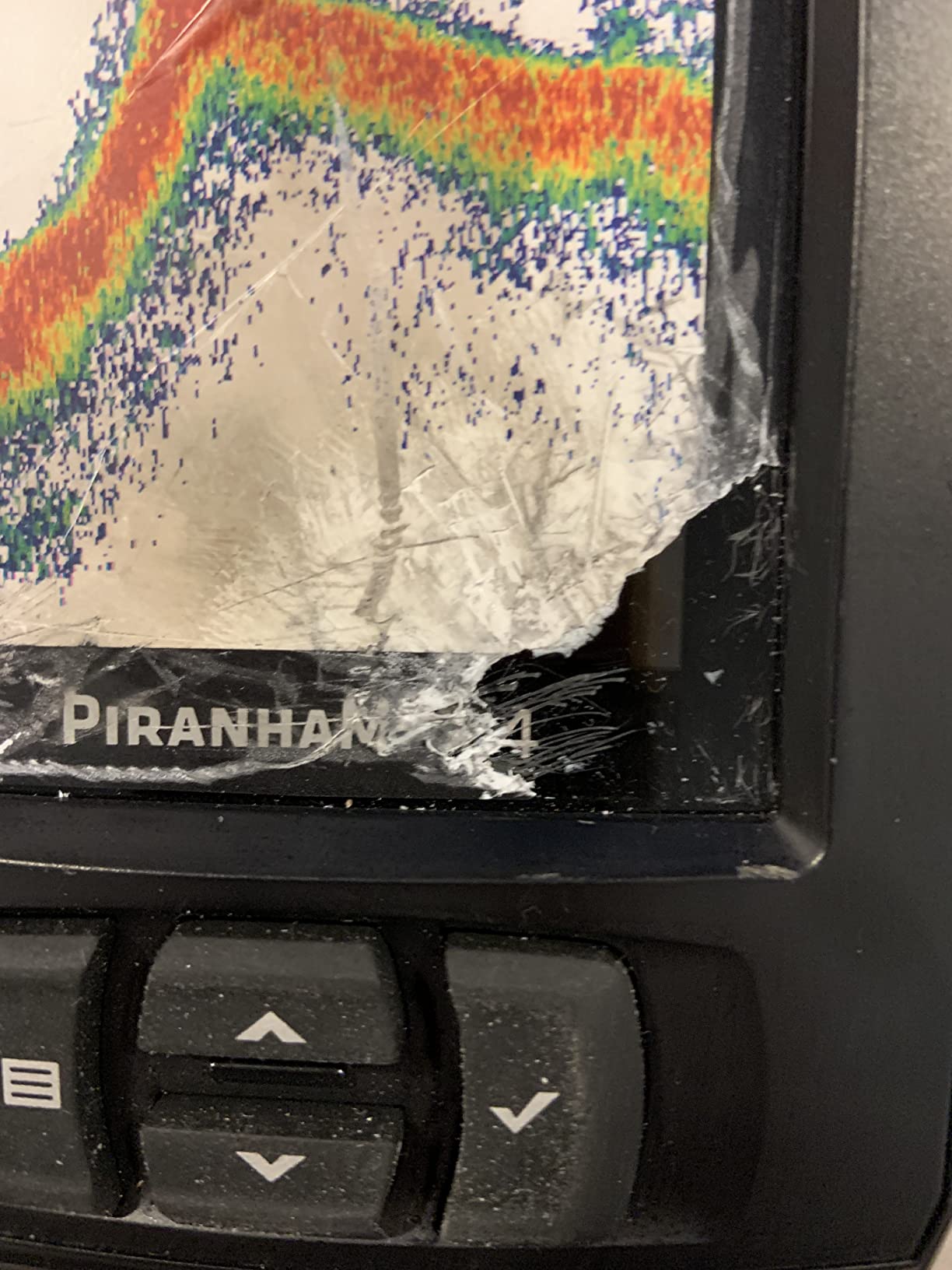
Owners describe it as faithful and long-lasting, and it is the unit people buy when they fish familiar water and want structure detail without a chart. The 600 ft maximum depth is more than adequate for lakes, rivers and most inshore saltwater.
What you give up is clear. There is no GPS, no mapping and no wireless, so you cannot mark a waypoint to the spot that just produced a fish. For an angler moving to unfamiliar water every trip, that matters.
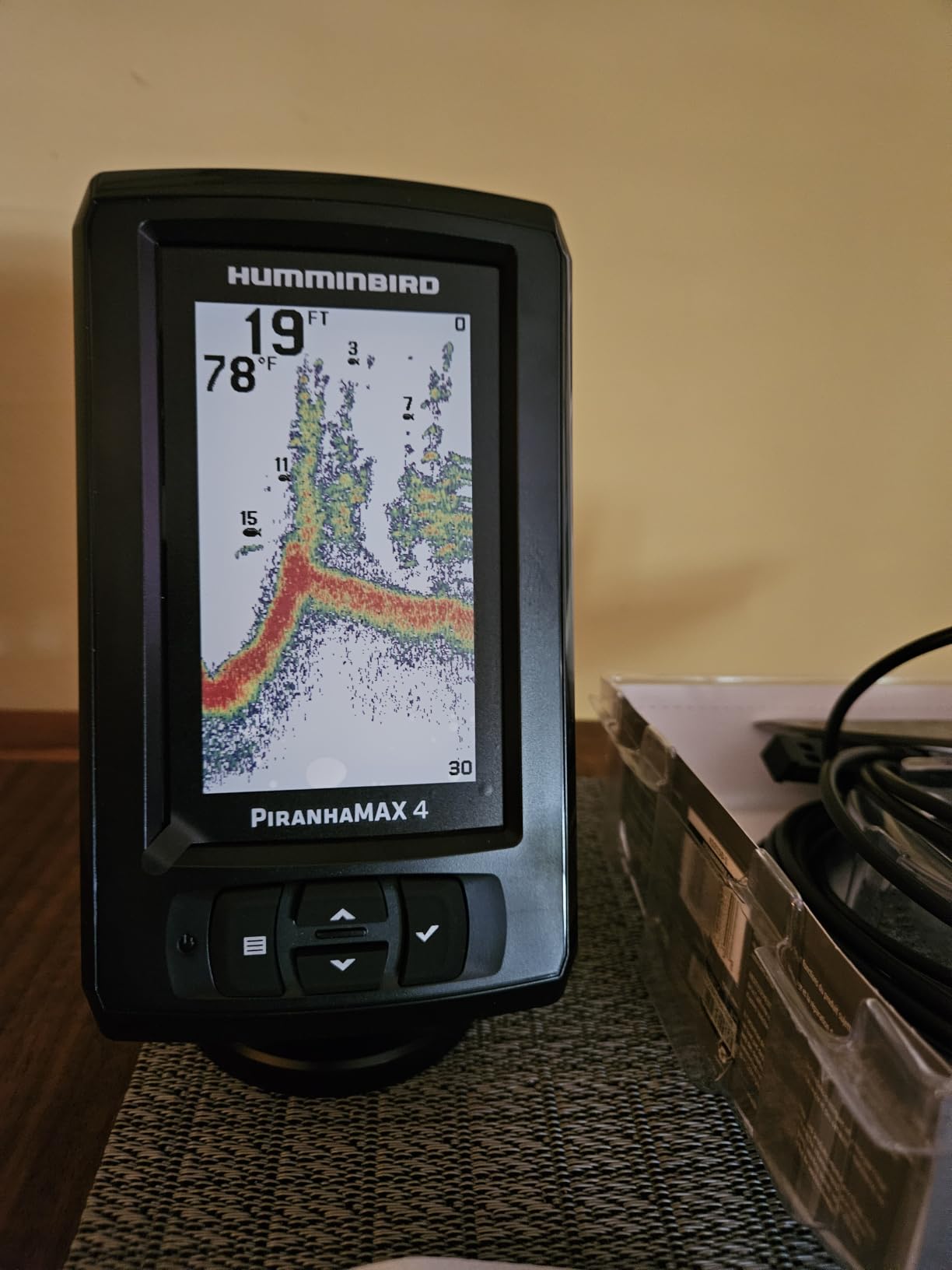
STRIKER 4 or PiranhaMAX 4 head to head
The STRIKER 4 adds built-in GPS and ClearVu scanning, runs deeper at 1600 ft in freshwater, and pulls less current at 0.23 A. The PiranhaMAX 4 has a larger 4.3 inch screen against 3.5 inches, a Dual Beam choice instead of ClearVu imaging, and 600 ft of rated depth.
If you can find your way around a lake, the PiranhaMAX 4 is the simpler, more legible tool. If you are marking spots or moving to new water, the extra GPS is worth more than the extra four tenths of an inch.
Saltwater suitability and what 600 ft really means
Salt water absorbs sound faster than fresh water, which is why depth ratings drop offshore. Treat 600 ft as a freshwater figure and assume considerably less in the ocean, which is still far deeper than most small-boat anglers will ever fish.
Because there is no GPS here, offshore use is limited to finding structure you are already over. If you are running coastal water and marking a channel or a wreck, you need a unit with GPS and chart support.
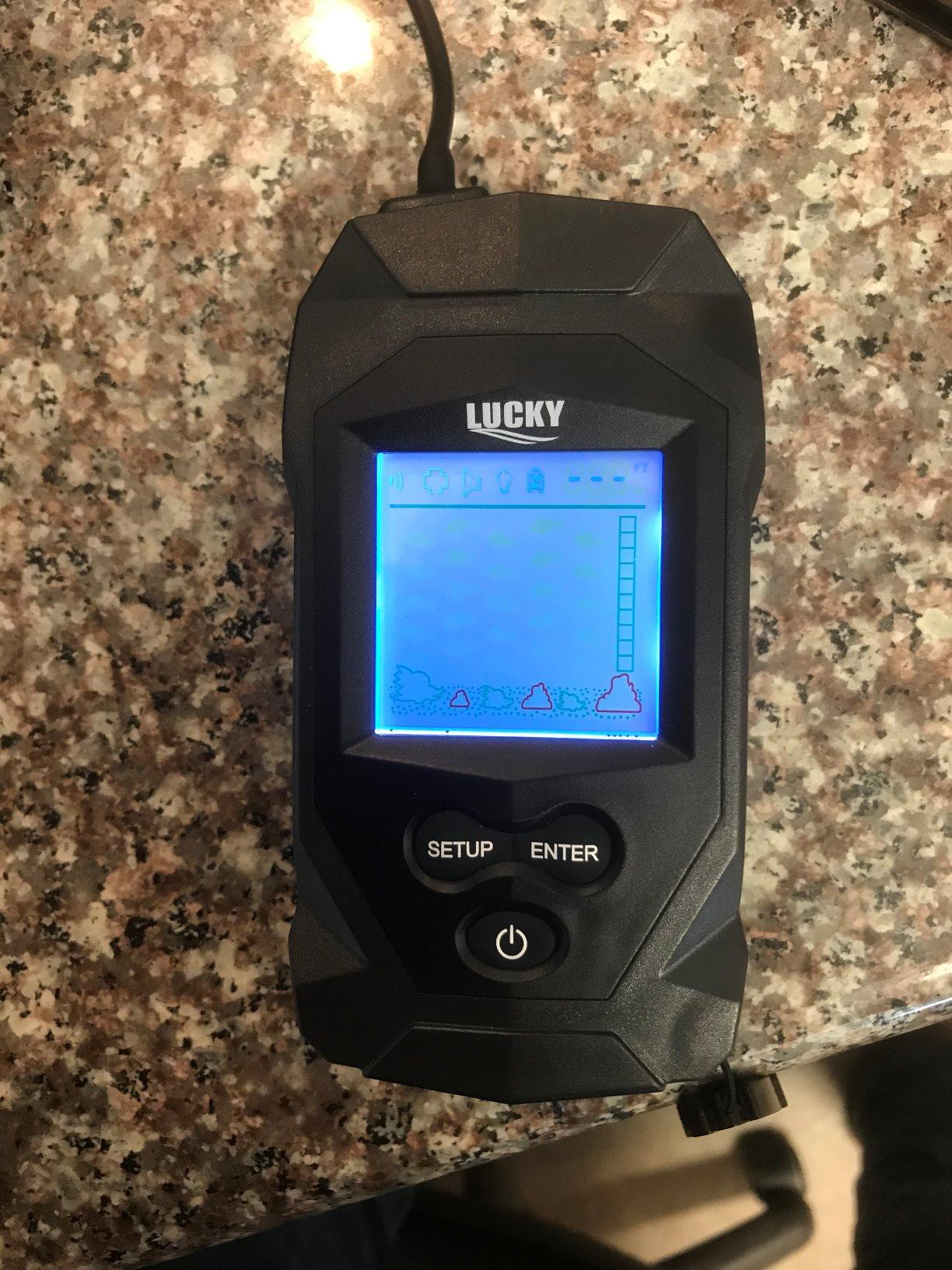
5. LUCKY FFC1108 Portable Handheld Fish and Depth Finder
LUCKY Kayak Portable Fish Depth Finder Water Handheld Fish Finder Sonar Castable Kayak Boat Fishfinder Transducer Fishing LCD Display FFC1108
2 inch LCD
3 ft to 328 ft depth range
Bottom structure icons
AAA powered
Pros
- Very low cost for a working depth and bottom display
- One-hand portable size with neck strap
- Backlit screen readable in sun and darkness
- Five sensitivity levels suit clear or turbid water
Cons
- Fish detection unreliable with false and missed signals
- Cannot be used from shore without a boat or kayak
- Will not read through a fiberglass hull
There is no honest way to call this a fish finder. It is a depth and bottom reader that occasionally shows a fish icon, and treating it as anything more is how people end up disappointed. What it does do is show you depth from 3 feet to 328 feet and tell you whether the bottom is weed, sand or rock.
For a first setup on a farm pond, a rental boat or a kid who wants to see what sonar looks like, it is genuinely useful. The neck strap leaves your hands free, and the 2 inch backlit screen is readable in daylight and at night.
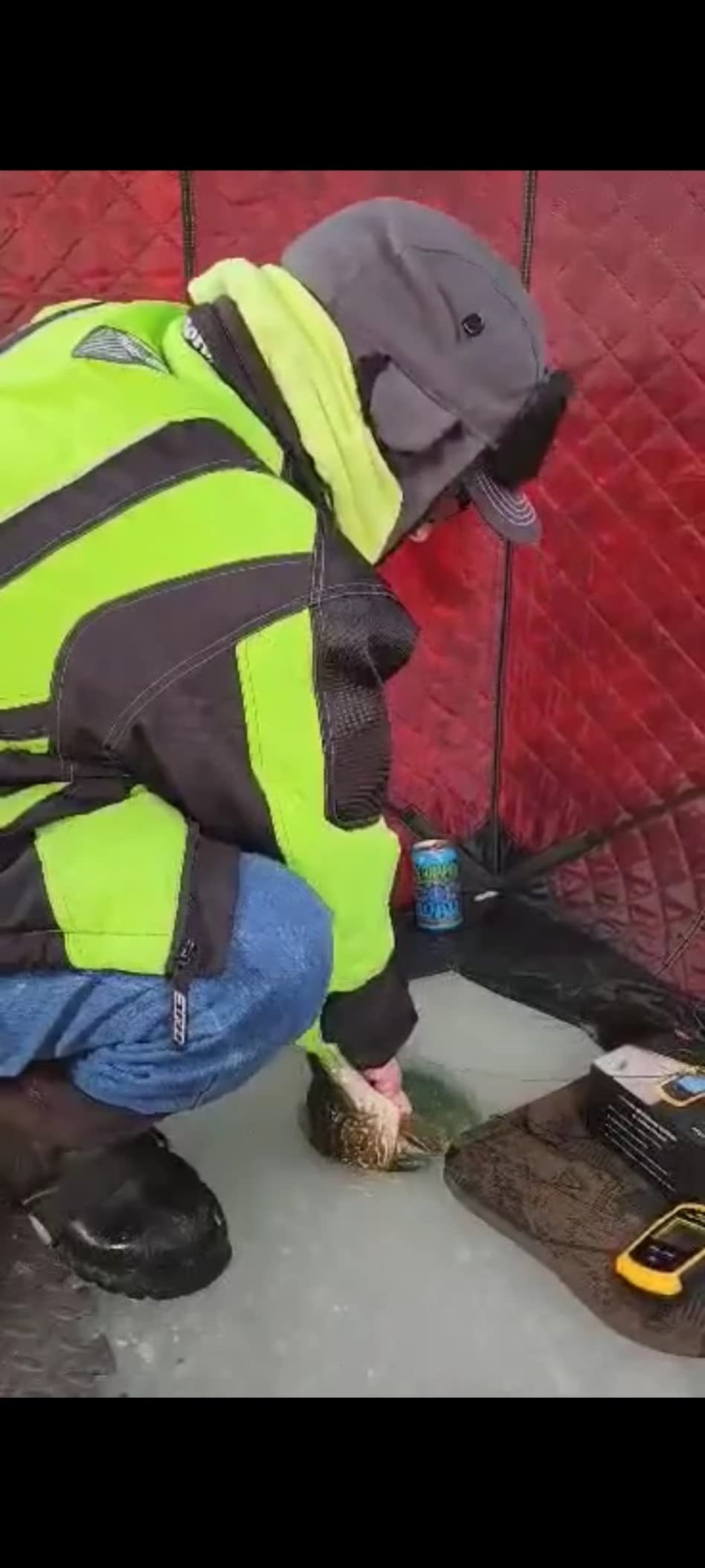
The transducer mounts through a hull or works on a tether, and the five sensitivity levels help in both clear and stained water. Fish and fish-school alarms exist, which is where the reliability problem shows up, since the unit beeps at things that are not fish.
It also will not read through a fiberglass hull, so you need the mounted transducer for it to work properly, and you have to be on the water. Reviewers treat it as a bottom-structure tool, not a fish-locator, and that is the right expectation.
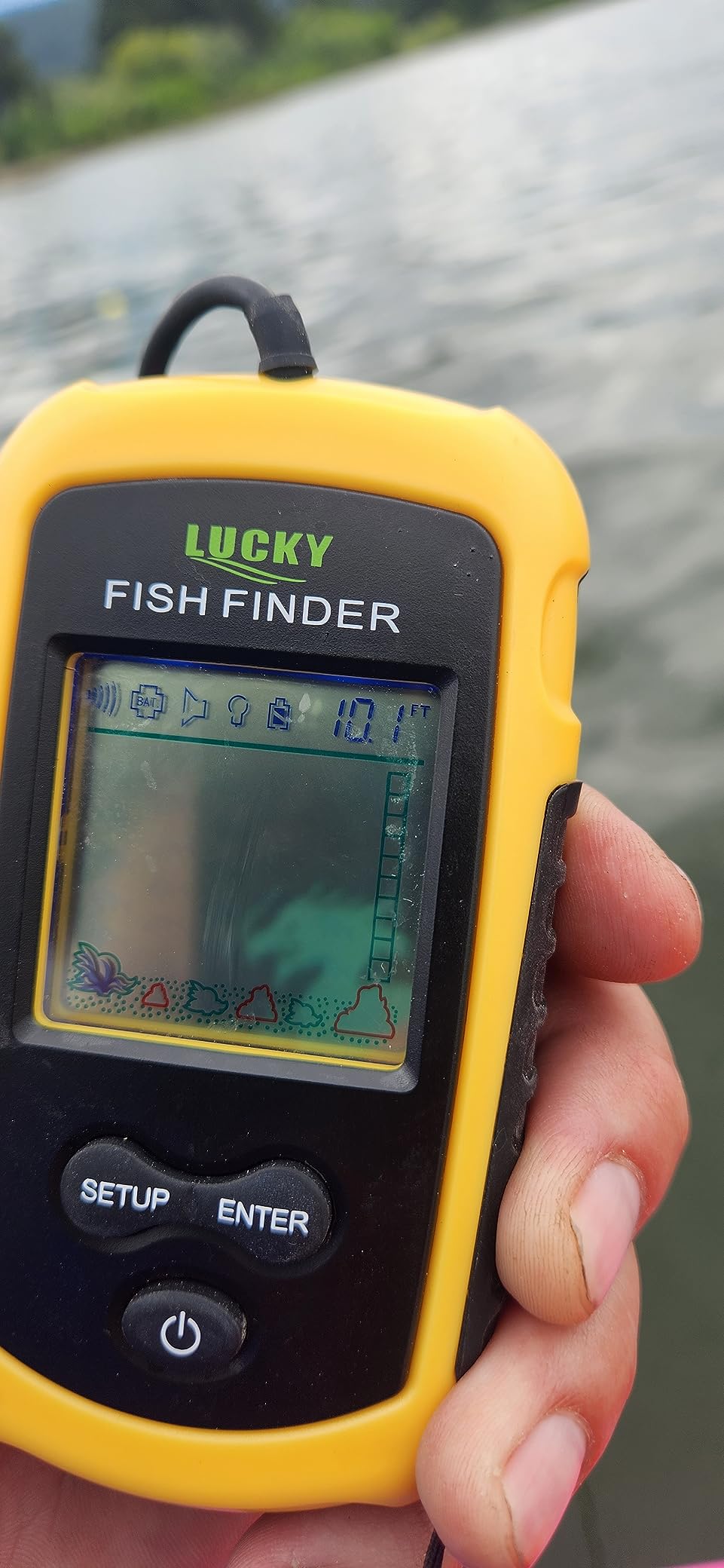
When a handheld is the right answer
A handheld is right when the boat has no battery, no wiring and no room for a mount. Carrying it in a pocket costs nothing, and you can move it between a rowboat, a kayak and a rental skiff in a single day.
It is also the fastest way to learn to read bottom structure before committing to a mounted unit. The weed, sand and rock icons teach you what your lake bottom is made of, which is genuinely useful information.
Durability red flags in the cheapest units
Two things to know about low-cost handheld sonar. The fish-detection algorithm is not reliable, so a quiet screen does not mean no fish, and a noisy screen does not mean a school, which can waste an entire trip.
Build quality is also thinner. These units are fine for a season or two of occasional use, but owners report water ingress and battery-indicator problems once the seals age, and replacement parts are not sold separately.
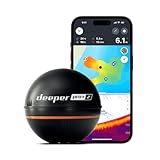
6. Deeper START Castable Smart Sonar
Deeper Start Fish Finder – Portable and Depth Finder for Recreational Fishing from Dock, Shore, Bank or Kayak | Castable Deeper Smart Sonar with Free User Friendly App
Phone and tablet display
165 ft cast and depth
Self-generated Wi-Fi
About 6 hours of use
Pros
- No wiring or mounting on a small boat
- Usable from shore dock bank or kayak
- Creates its own Wi-Fi so no mobile data is used
- Scans auto-save with time and location
- Recharges in about 2.5 hours
Cons
- Requires a compatible phone tablet and app pairing
- Accuracy and app responsiveness depend on the phone
The Deeper START is the simplest way to try castable sonar. You charge it, pair it with the free app, tie it to a line and cast. It generates its own Wi-Fi connection, so the sonar feed does not eat your mobile data, and every scan auto-saves with a time and location stamp.
At 165 ft of cast and 165 ft of depth with a 40 degree beam, it covers the range where most small-boat anglers fish. The app shows fish, depth, bottom contour and vegetation, which makes it a teaching tool as much as a fishing tool.
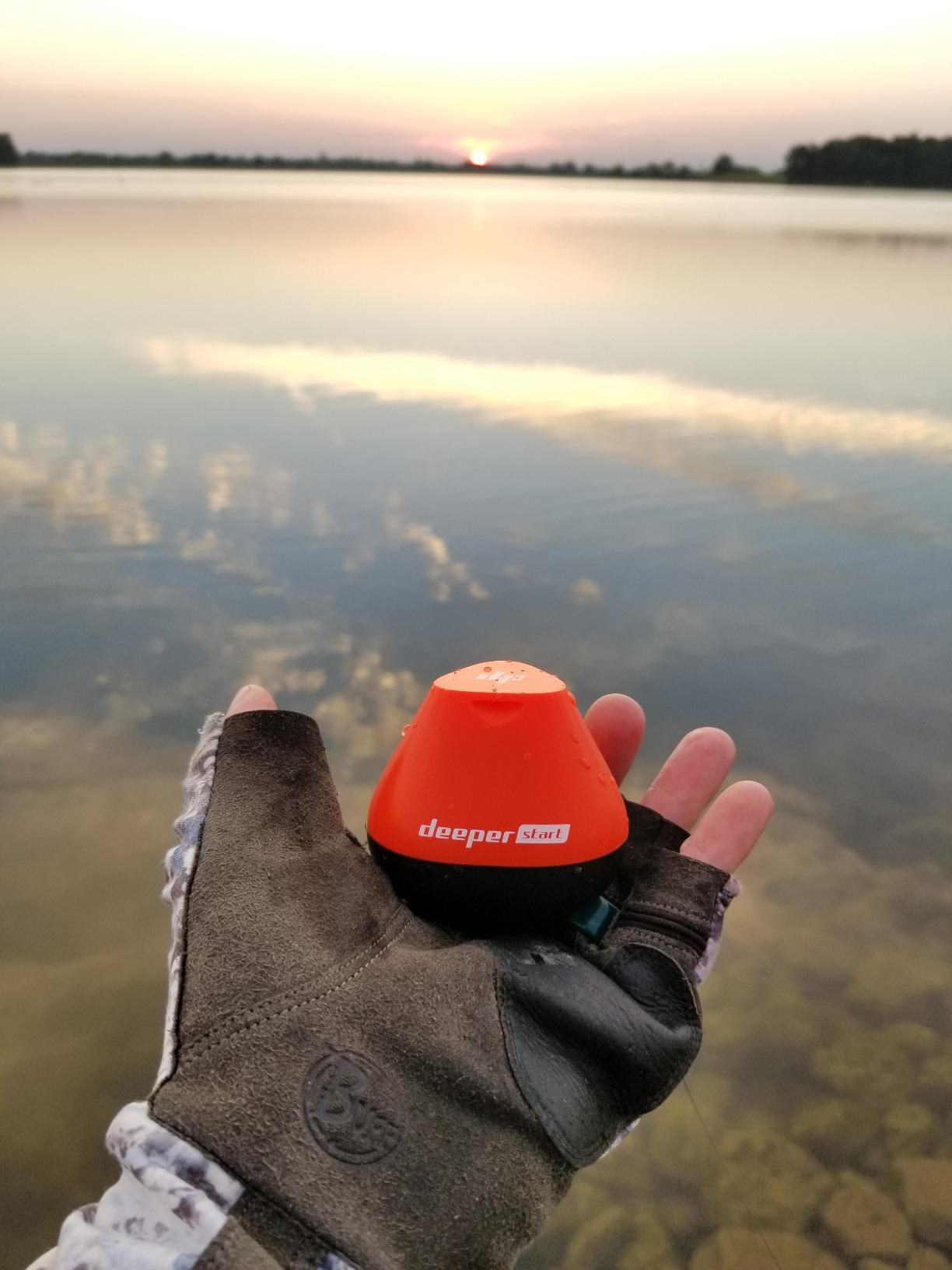
You can work it from shore, a dock, a bank or a kayak, which means you can scout a lake before launching. Battery life is about 6 hours after roughly a 2.5 hour charge, and a night fishing mode is included for low-light conditions.
The tradeoff is that everything depends on your phone. Reviewers call out connectivity complaints and accuracy that varies with conditions, and a screen that is only as good as the device you already own is a real limitation on a sunny day.
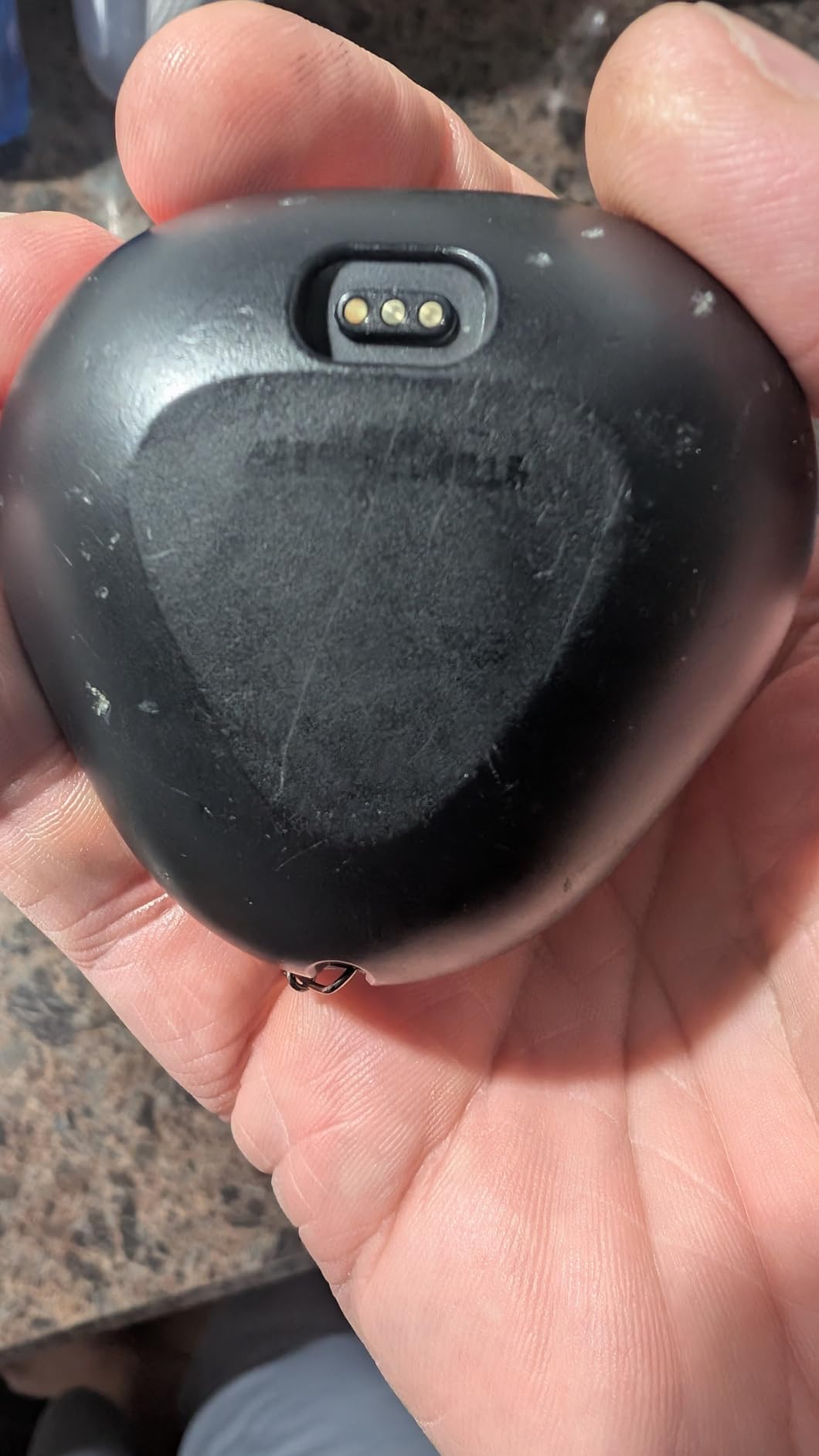
Phone-based sonar versus a dedicated head unit
A phone display is larger, brighter and sharper than any 2 or 3.5 inch unit here, and you get maps and a log for free. You also get no dedicated controls, so you cast, then swipe through an interface, then cast again.
Garmin and Lowrance head units are faster once you have learned them because one button does one thing. For scouting, for a boat with no power, and for anyone who fishes from a dock, the Deeper START wins clearly.
How to get the most out of a castable scan
Cast well beyond the boat and let the sonar settle on the bottom before you read the screen. A scan taken while the sensor is still sinking shows a false line that looks like structure.
Use the saved scans with the time and location stamp. Re-reading a good scan at the ramp is how you find the drop-off you could not see from the boat, and it takes no extra equipment.
7. Deeper PRO+ 2 Sonar Fish Finder with GPS Enabled
Deeper PRO+ 2 Sonar Fish Finder – Portable Fish Finder and Depth Finder For Kayaks, Boats and Ice Fishing with GPS Enabled | Castable Deeper Fish Finder with FREE User Friendly App
Phone or tablet display
Accurate to 330 ft
Built-in GPS mapping
3.2 ounce body
Pros
- Built-in GPS creates and saves bathymetric maps
- Multiple beam modes for coverage or detail
- Accurate to 330 ft with strong target separation
- Very light at 3.2 ounces for a small boat
Cons
- Phone and app required for full functionality
- Wi-Fi connection can drop on some phones
- Some report battery draining faster than advertised
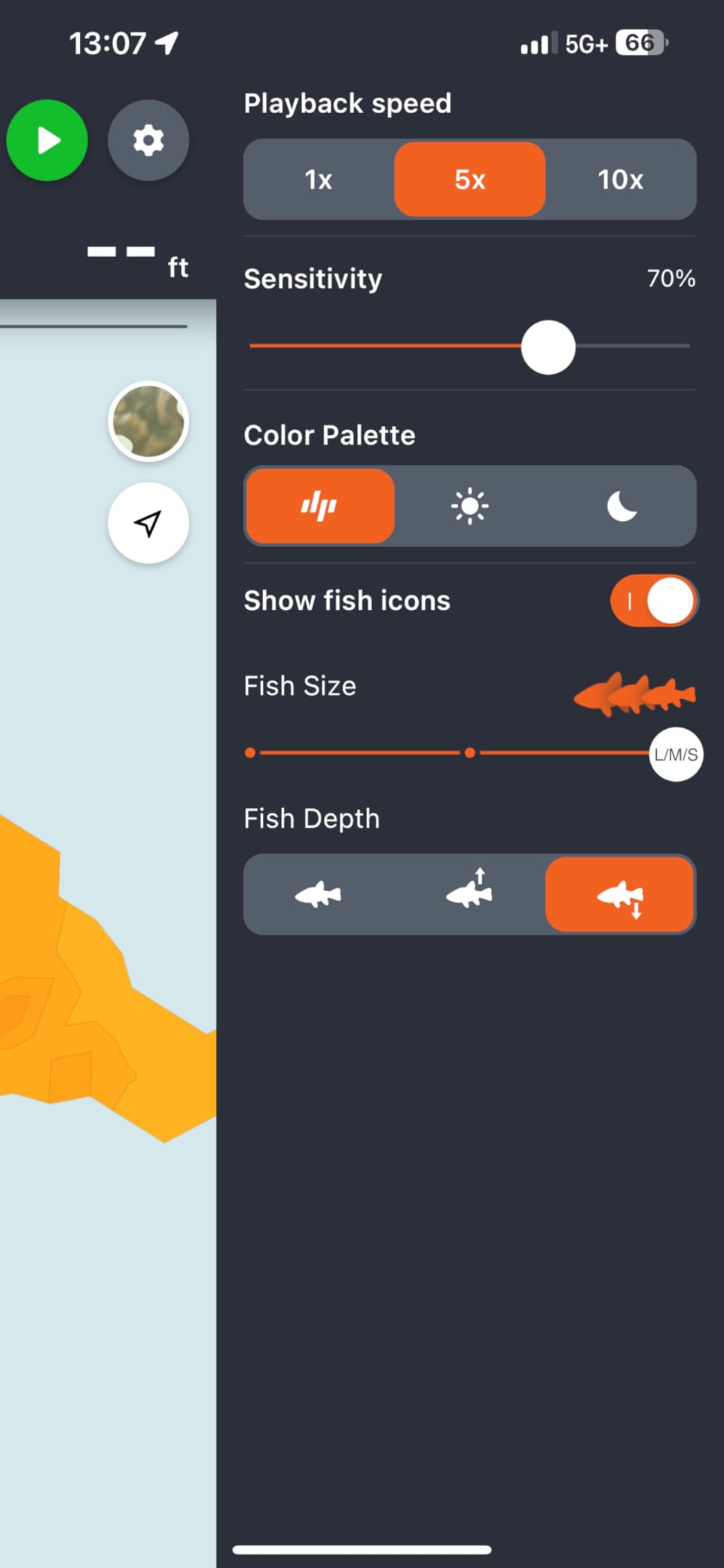
The PRO+ 2 is the castable for someone who wants to map rather than just look. The built-in GPS creates and saves bathymetric maps in the app as you cast, so a season of fishing on an uncharted lake produces a depth map you own, with no wiring, no transducer and no hull penetration.
Accuracy goes to 330 ft, and three beam modes let you trade coverage for detail. The narrow beam resolves targets to 0.4 inch separation, which is a noticeable improvement over a single wide cone when you are trying to separate a small fish from a branch.
At 3.2 ounces it disappears in a pocket, and 68 percent of reviews are five stars, with the GPS mapping the most praised feature. For kayak anglers especially, this is a complete system with no installation at all. We covered the dedicated options in our kayak fish finder roundup.
The complaints are consistent enough to plan around. Twelve percent of reviews are one star, mostly for Wi-Fi drops and for battery draining faster than advertised when you are casting constantly. Charge it before a long trip rather than during.
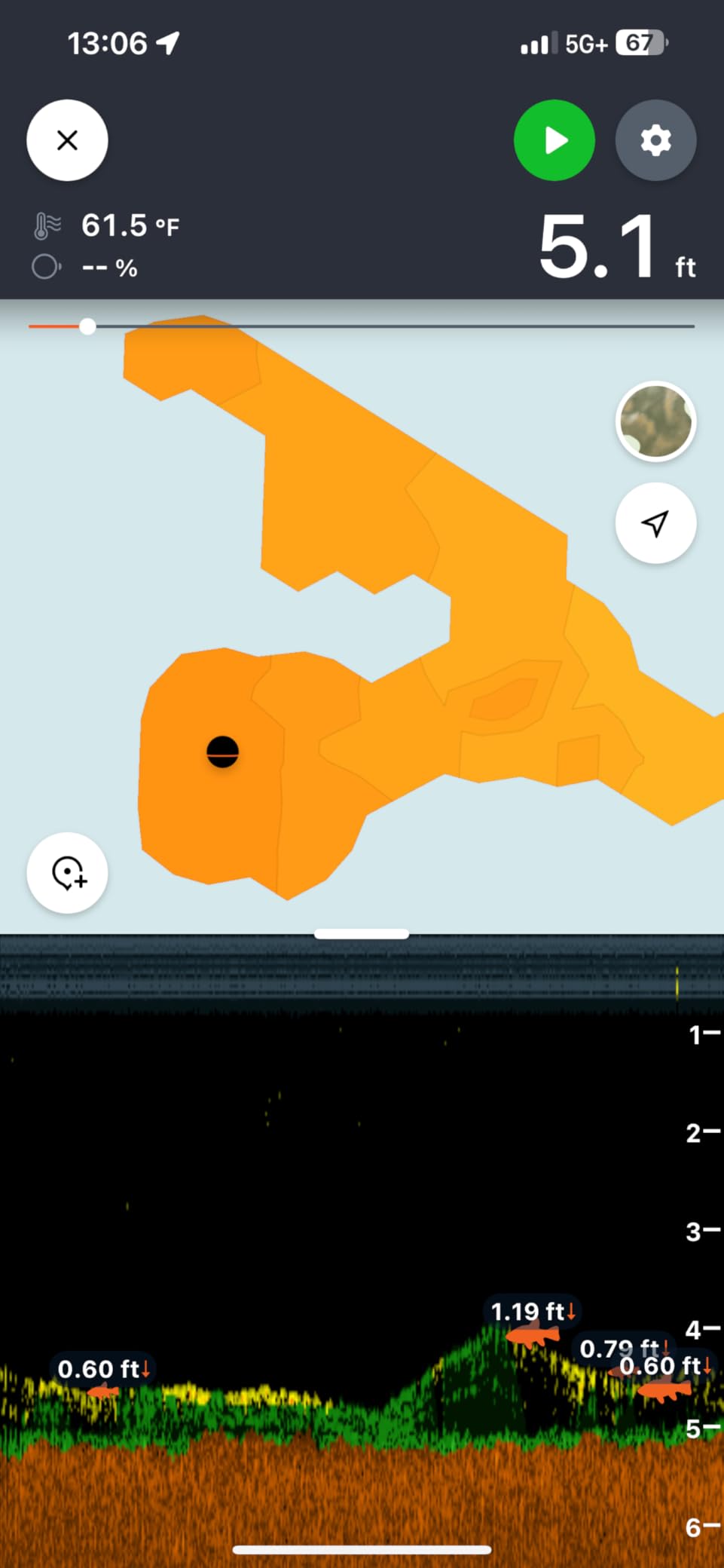
Bathymetric mapping on uncharted water
The GPS inside the sensor records position as it scans, so the app builds a depth picture of anywhere you cast. That is a genuine substitute for a chart, and for a lake nobody has mapped it may be the only map you will ever have.
The limitation is time. A full map of a large lake takes many casting sessions, because each cast covers a narrow swath. Treat it as an ongoing project rather than something you will finish in one trip.
Choosing between the Deeper START and PRO+ 2
The START is simpler and better if you mostly want depth and fish arches from a dock. The PRO+ 2 adds built-in GPS, a third beam mode, better accuracy and 330 ft of reach.
Buy the START if you are casting from shore or a kayak and mostly want to know what is under you. Buy the PRO+ 2 if you intend to build a map of water you fish repeatedly.
8. Lowrance Eagle 4-Inch Sonar Fish Finder
Lowrance Eagle 4X Fish Finder with Bullet Transducer
4 inch IPS portrait screen
Auto-Tuning Sonar
200 kHz Bullet Skimmer
500 ft max depth
Pros
- Portrait IPS screen readable through polarized sunglasses
- Auto-Tuning Sonar removes most menu fiddling
- Compact portrait shape suits a small console
- Twist-lock connector makes display removal quick
Cons
- No CHIRP in the base 4 inch package
- No fish alarm or GPS mapping in the base model
- Small review base of 116 limits long-term track record
The Eagle 4 solves a problem the other units here ignore: a portrait-shaped 4 inch IPS screen on a very narrow console. Most fish finder screens are wider than a jon boat gunwale, but this one is tall and narrow, and the IPS panel stays clear through polarized glasses, which almost no budget unit can claim.
Auto-Tuning Sonar sets the sensitivity for you, and the twist-lock connector lets you pull the display off and stow it in seconds, which matters on a boat that lives under a tarp. The 200 kHz Bullet Skimmer transducer with a 44 degree beam is included.
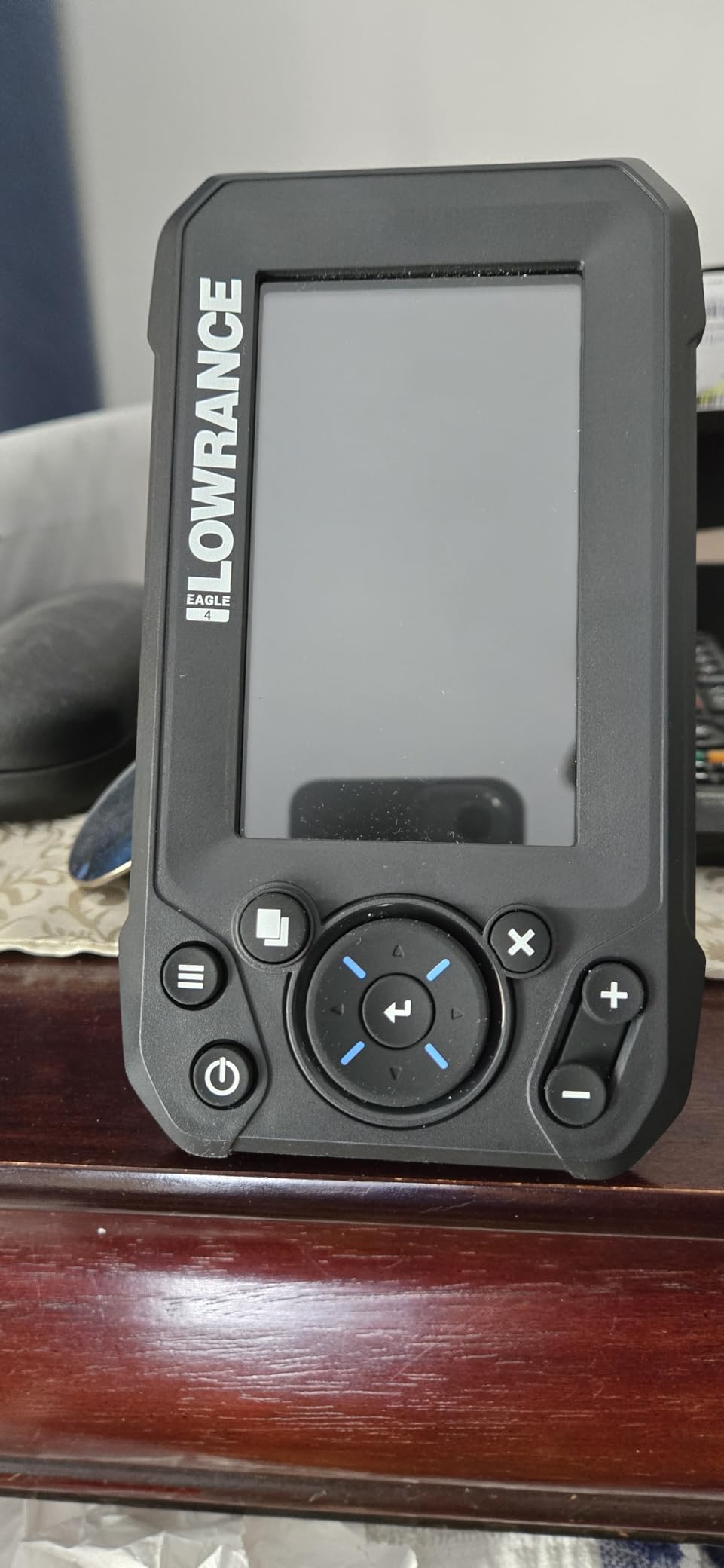
Several owners report replacing an older Lowrance unit using the same mount and screw holes, which is a nice surprise if you are upgrading rather than starting fresh. Fish icons with depth and zoom make the screen easy to read at a glance, and 70 percent of reviews are five stars.
The limitation is the package. The base 4 inch sonar model has no CHIRP, no fish alarm and no GPS mapping, and with only 116 reviews the long-term reliability record is still short. Compare it to the STRIKER Plus 4 if mapping matters to you.
Why the portrait shape fits a small boat better
On a jon boat or a small skiff the usable dash area is often measured in inches, and a landscape screen either overhangs or gets mounted so high it catches wind. A portrait display uses the same footprint in a shape that matches a narrow console or a side-mounted bracket.
Auto-Tuning also matters more on a small boat, because you install a unit and use it briefly rather than studying menus for an afternoon. It gets you a readable screen without a manual, which is why several owners call it easier to operate than comparable Garmin units.
What you give up versus a Garmin unit
The Eagle trades sonar sophistication for screen quality and simplicity. Without CHIRP, target separation is closer to a standard frequency ping, and without GPS you cannot mark the spot that is producing fish.
If you are on a rental boat and need a bright readable screen quickly, it is a strong pick. If you are fishing the same water all season, the STRIKER Plus 4 gives you CHIRP, dual-beam and live contour mapping for a similar outlay.
9. Humminbird HELIX 5 CHIRP GPS G3 Fish Finder
Humminbird Helix 5 G3 GPS Fish Finder with Transducer & Dual Spectrum Chirp Sonar
5 inch color TFT
Dual Spectrum CHIRP
Basemap of 10000+ lakes
AutoChart Live mapping
Pros
- Dual Spectrum CHIRP with wide and narrow modes
- Basemap plus upgradeable LakeMaster and CoastMaster charts
- AutoChart Live maps depth hardness and vegetation
- Color 5 inch screen readable in direct sunlight
- Softkey keypad works in any weather
Cons
- Most expensive unit here at 2.1 pounds
- Power cable can be short on very small boats
- No 3 amp fuse included
- A few reports of units arriving non-functional
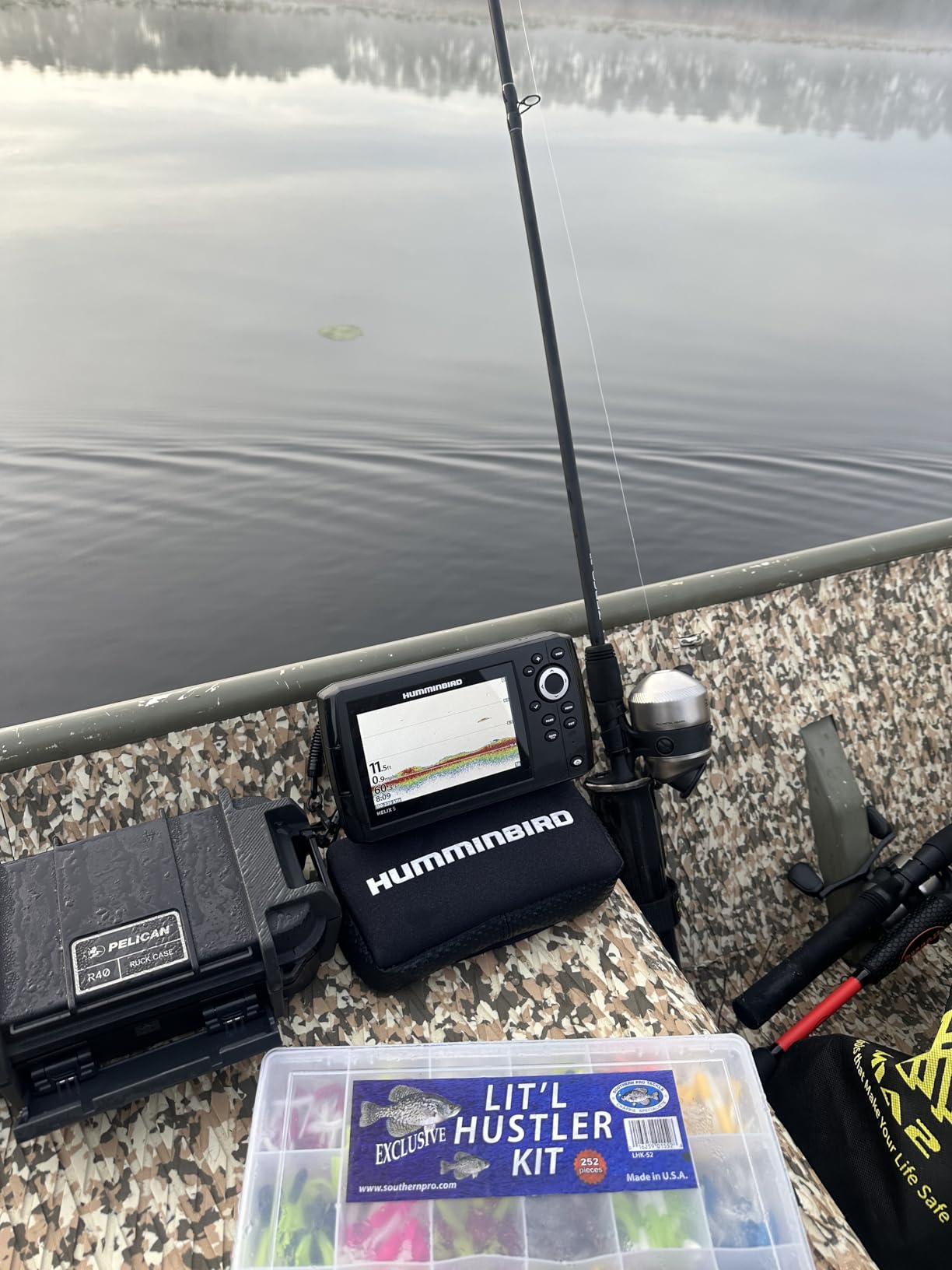
The HELIX 5 is the only unit here with a real basemap and a real upgrade path, which makes it the right answer for a small boat used on large water. Dual Spectrum CHIRP with wide and narrow modes is the strongest sonar on this list, and the Humminbird Basemap already covers more than 10000 lakes and the US coastlines before you add anything.
AutoChart Live records depth, bottom hardness and vegetation as you go, so the unit teaches you the lake while you fish it. The color 5 inch TFT screen is readable in direct sun, and the softkey keypad works with wet hands or gloves, which a touchscreen would not.
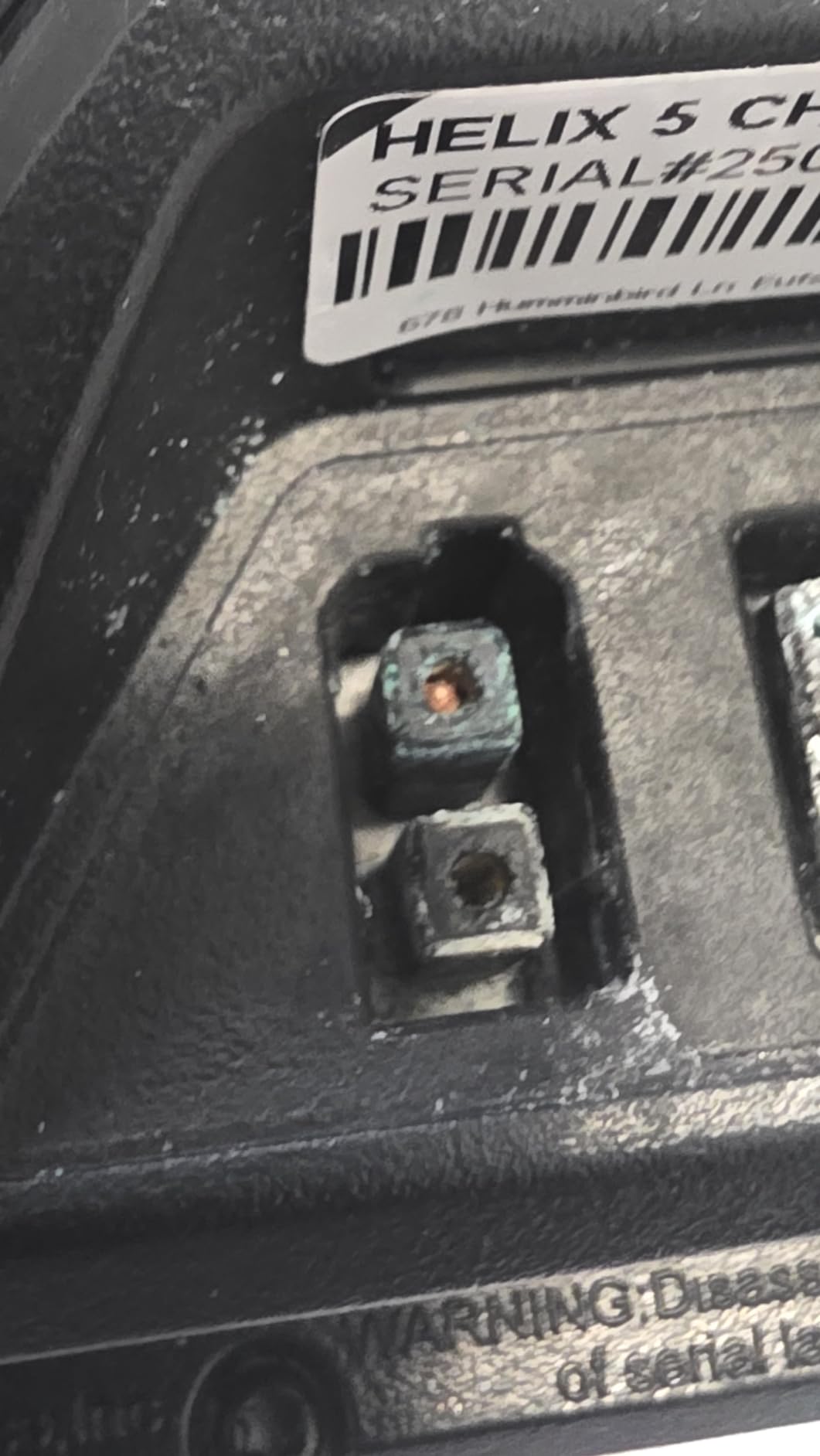
The catch is size and weight. At 2.1 pounds and 5 inches it is the bulkiest unit here, and the power cable may be too short on a very small hull with the battery far from the console. There is no 3 amp fuse in the box either, so add one before you wire it.
A few owners report units arriving non-functional or needing a return, which is worth knowing given the 4.4 star average. 73 percent of reviews are five stars, and the most repeated negatives concern included hardware rather than the unit itself.
Do you actually need mapping on a small boat
You need mapping if you fish water you do not know, if you want to mark structure, or if you move between lakes. The basemap plus LakeMaster, CoastMaster and Navionics chart support covers all three without a subscription.
You do not need it if you fish one familiar lake and rely on visual landmarks. In that case the STRIKER Plus 4 gives you Quickdraw Contours, which records your own map, and it costs noticeably less.
Fit, weight and the small hull reality
A 5 inch head unit and a 2.1 pound bracket assembly is a significant commitment on a 12 foot jon boat. Measure the console first, and plan where the transducer cable reaches without forcing the unit away from your natural viewing angle.
If it fits, this is the most capable machine in the roundup. If it does not, no amount of sonar quality rescues a unit you have to look sideways at all day, which is why the 3.5 and 4 inch options are the safer default.
10. LUCKY Wired Transducer Portable Fish Finder Kit
LUCKY Portable Fish Finders Wired Transducer Kayak Fish Finder Kit Portable Depth Finder LCD Display for Kayak Boat Ice Fishing
2 inch LCD
3 ft to 328 ft depth
25 ft transducer cable
4 AAA batteries
Pros
- Depth readings verified accurate against a rope
- Weed and rock icons for bottom structure
- 25 ft cable suits an inflatable or kayak
- About 4 to 5 hours per set of four AAA batteries
- Cheap and simple for a first setup
Cons
- Fish icons unreliable with false and missed detections
- Fish alarm beeping becomes annoying quickly
- Monochrome display with no advanced features
- 25 ft cable is hard to keep out of the water
This is the wired sibling to the LUCKY handheld, and the 25 ft cable is what makes it work on a kayak. Owners verify depth readings against a rope, and the weed and rock icons give you bottom structure on a lake you have never fished.
Four AAA batteries run about 4 to 5 hours, longer in battery save mode, so a pack of spares is a sensible addition. It works from a boat, a kayak, the sea and ice, and the 45 degree cone is wide enough to be useful at typical small-boat depths.
What it will not do is find fish reliably. Reviewers report icons for fish that are not there and misses on fish they could see, and the alarm beeping on every return becomes irritating fast. Treat the display as depth and bottom, exactly like the FFC1108.
The other recurring complaint is cable management. Twenty-five feet of wire has to be kept out of the water and away from the paddle, and on an inflatable or a small aluminum hull that takes some planning.
Wired transducer versus castable sonar on a kayak
A wired transducer gives you a continuous picture as you paddle, with no pairing, no app and no cast. The cost is a cable across the deck and a transducer that has to be mounted or held below the hull.
A castable like the Deeper START or PRO+ 2 needs no installation at all but gives you data in snapshots after each cast. We compared both approaches in more detail in our fish finder picks for kayaks.
On balance, the wired LUCKY wins for a sit-on-top or inflatable where you want a permanent install, and the castable wins for a sit-on-top that you need to be able to move in ten seconds.
How to Choose a Fish Finder for a Small Boat
Screen size and sunlight readability beat everything else
On a small hull, 3.5 to 4.3 inches is the workable range, and going larger is the single most common overbuy. A 5 inch unit needs a console that a jon boat does not have, and it puts the screen where wind and glare get you instead of where you can see it.
Readability matters more than resolution. The Lowrance Eagle 4 uses an IPS panel that stays clear through polarized glasses, and the Humminbird PiranhaMAX 4 pairs a 4.3 inch screen with a display built for bright sun. Both are better choices than a bigger but dimmer panel.
Sonar types: CHIRP, ClearVu, DownScan and Dual Beam
CHIRP sends a continuous sweep of frequencies instead of one ping, which separates two fish side by side instead of merging them into one blob. It is the best single upgrade in this category, and every serious unit in this roundup has it.
ClearVu, DownScan and SideScan are scanning sonar that render the bottom as a near-photographic image. DownScan looks straight down, which is how you find a fish lying on a flat in shallow water, while SideScan sweeps to each side. Dual Beam and Dual Spectrum CHIRP use two beam modes so you can switch between coverage and detail.
For a small boat fishing shallow water, CHIRP traditional plus one scanning channel is the sweet spot. Skip pure side imaging until you actually move to open water, because at 3.5 inches the image is too small to read while the boat is moving.
Transducer and mounting options
Transom mounting is the default and it needs no drilling: two screws through the transom bracket and the transducer hangs below. Trolling motor mounts work on a boat with no transom hardware. Portable mounts let you slide the head unit off and take the whole setup to another boat.
Thru-hull and shoot-through transducers are for permanent installs and are not worth it on a hull you may outgrow. Castable sonar skips the transducer on the boat entirely, which is the whole point when you cannot drill or wire.
Power, wiring and battery draw
Most small head units draw well under one amp, so a small deep-cycle battery is genuinely enough. The Garmin STRIKER 4 is rated at 0.23 A at 12V, which works out to roughly 30 hours on a 7Ah battery and around 50 hours on a 12Ah.
We could not find published amp-draw figures for the other wired units in this roundup, so treat those run-time estimates as unknown until you measure. Wire with marine-grade cable, fuse the circuit, and keep the run as short as you can to avoid voltage drop that shows up as sonar noise.
Do you have a battery at all
Start here, because it eliminates half the list. If your boat has a battery or a trolling motor with a battery, you can hardwire any of the head units and the transom mount is quick. If it has nothing, your choices are a portable head unit on a battery pack, a castable like the Deeper range, or a handheld like the LUCKY units.
Our portable fish finder picks go deeper on battery packs and run time if you are in that camp. A portable head unit with a small battery is a good middle ground, because you still get a real screen and a real transducer.
Reading the screen without fooling yourself
A full arch is a fish you have probably resolved correctly. A half arch is a fish partly inside the beam, often near the edge of coverage. A smudge that does not hold its shape is usually weed or debris, and a thick hard line is rock or timber rather than fish.
Adjust sensitivity before you start blaming the unit. Turn it up too high and every bit of suspended organic matter becomes an arch, which is the most common reason beginners decide their fish finder is broken. If you are fishing shallow weedy cover, the weed and rock icon displays on the LUCKY units are genuinely helpful.
If your trolling motor causes interference, the fix is a fused power lead run away from the motor cable, not a new unit. Interference shows up as a fuzzy screen that clears the moment you turn the motor off, so test that first.
Frequently Asked Questions
Is Humminbird or Garmin better?
Garmin leads on sonar technology and mapping apps, with CHIRP, ClearVu scanning and Quickdraw Contours standard on its compact units. Humminbird leads on simple daylight-readable screens, preloaded basemaps and softkey controls that work with wet hands. For a small boat, Garmin is stronger if you want to mark your own map, and Humminbird is stronger if you want a bright screen and very little to learn.
What is the best depth sounder for a small boat?
A 3.5 to 4.3 inch unit with CHIRP sonar and built-in GPS is the right answer, and the Garmin STRIKER 4 is the default pick. It reads 1600 feet in freshwater, draws only 0.23 A at 12V, and its tilt and swivel bracket fits a small console. On a boat with no battery, a castable unit such as the Deeper START gives you depth with no wiring at all.
Is Garmin or Lowrance better for fishing?
Retailer ratings favour Garmin, which sits in the 4.6 to 4.7 range across the units we reviewed, while the Lowrance Eagle sits closer to 4.3. Lowrance still leads on display quality for the money, since the Eagle 4 has a 4 inch IPS portrait screen readable through polarized glasses, plus auto-tuning sonar. Choose Garmin for CHIRP and live contour mapping, and Lowrance for a brighter, simpler screen on a tight console.
What is the best fish finder for a Jon boat?
The Garmin STRIKER 4 is the best fit for a jon boat, because the 3.5 inch screen fits the available dash area, the transom and motor mounts avoid drilling, and the 0.23 A draw lets a small battery run it all day. If your jon boat has no battery at all, a castable Deeper unit gives you depth and fish arches with nothing to install.
What is the best portable fish finder for small boats?
It depends on what portable means to you. For a 12V-powered head unit you carry between boats, the Garmin STRIKER 4 paired with a small deep-cycle battery is the strongest option. For no boat power at all, the Deeper START or Deeper PRO+ 2 run off their own battery and cast from a kayak, dock or shore.
Final Verdict
The Garmin STRIKER 4 is the best fish finder for most small boats in 2026, and it wins on the only two things that matter on a small hull: it physically fits, and it draws so little power that a small battery runs it all day. Add ClearVu scanning, built-in GPS and a 0.23 A draw and the case is not close for most anglers.
If your boat has no battery, go wireless. The Deeper PRO+ 2 is the pick when you want to build your own map of uncharted water, and the Deeper START is the simpler option for a dock, a bank or a kayak. For a very tight console, the Lowrance Eagle 4 has the best screen shape in the roundup.
Skip the 5 inch and larger units unless your boat has a real console. A bigger screen you have to look around is worse than a small one you read at a glance.