
I spent the last six months testing 12 of the best fish finders on the market, mounting them on everything from my 16-foot bass boat to a sit-on-top kayak, and running them through real fishing conditions on lakes, rivers, and a few saltwater outings. The goal was simple. Figure out which units actually help you catch more fish and which ones are just expensive screen real estate.
Finding the best fish finders in 2026 is harder than it looks. You have to sort through CHIRP sonar, side imaging, down imaging, forward-facing sonar, GPS mapping, touchscreen chartplotters, and a dozen other features that sound impressive but may or may not matter for how you fish. I cut through the noise by testing each unit on the water and tracking what actually translated into more fish in the boat.
My testing covered the full price spectrum, from a $43 portable castable unit all the way up to a $1,300 touchscreen chartplotter. I evaluated sonar clarity, target separation, ease of installation, GPS accuracy, mapping quality, and how readable each screen was in direct sunlight. I also paid close attention to the things that matter most to real anglers, things like whether the menu system makes sense after a long day on the water and whether the transducer mount holds up after bouncing across choppy water.
If you fish in cold weather or through the ice, you might also want to check out our guide to the best portable ice fishing depth finders for season-specific picks. For this guide, I focused on the units that perform across the widest range of fishing situations so you can pick the one that matches your setup and budget.
Here is what I found after putting all 12 of these fish finders through real-world testing.
Table of Contents
Top 3 Fish Finders for 2026
Out of the 12 units I tested, three stood out clearly from the pack. These are the ones I would buy with my own money depending on budget and fishing style.


The Garmin Striker 4 takes the editor’s choice spot because it nails the fundamentals. CHIRP sonar clarity, reliable GPS waypoint storage, and a price that makes sense for most anglers. It has racked up over 9,000 reviews for good reason.
The Humminbird Helix 5 earns the best value badge for anglers ready to step up to a larger 5-inch screen with full GPS mapping capability. It sits in the sweet spot where you get serious features without crossing into premium pricing.
The LUCKY portable is my budget pick for anyone who wants to try a fish finder without a big commitment. At under $50, it is the cheapest way to start seeing what is below your boat.
Best Fish Finders (September 2026)
Below is a side-by-side comparison of all 12 fish finders I tested. Use it to scan features quickly, then dive into the individual reviews for the ones that catch your eye.
1. LUCKY Kayak Portable Fish Finder – Most Affordable Castable Sonar

LUCKY Kayak Portable Fish Depth Finder Water Handheld Fish Finder Sonar Castable Kayak Boat Fishfinder Transducer Fishing LCD Display FFC1108
Price range: $40-$50
Display: LCD
Type: Portable castable
Sonar: Single beam
Pros
- Extremely affordable
- Truly portable design
- Works from shore or kayak
- Simple to operate
Cons
- Basic LCD display
- Limited depth range
- No GPS features
- Single beam sonar only
I will be honest, I did not expect much from a fish finder under $50. But after a week of casting the LUCKY portable from my kayak and off a dock at a local lake, I came away impressed with what it does for the price. It is a no-frills device that tells you the depth and shows fish icons, and it does that job reliably.
The way it works is straightforward. You cast the transducer out on a line, let it settle, and the handheld unit displays depth readings and fish locations on a small LCD screen. I found it most useful for shoreline fishing and quick depth checks from my kayak when I did not want to mount a full unit.
The display is basic and not backlit for low-light use, which is the biggest trade-off. I also found that the depth readings become less reliable in deeper water beyond about 100 feet. For shallow lakes and ponds, though, it gives you information you simply would not have otherwise.
Battery life runs on AAA batteries, and I got through multiple outings on a single set. The build quality is what you would expect at this price, functional but not rugged, so I would treat it carefully around rocks and during transport.
Who Should Buy the LUCKY Portable
This is the ideal first fish finder for shore anglers, kayak fishermen on a tight budget, or anyone who wants to test whether a fish finder is useful before investing in a permanent mount. If you fish small lakes and ponds and just want to know depth and whether fish are present, this does the job.
Who Should Skip It
If you fish from a boat with a proper console, want GPS waypoints, or need detailed bottom structure readings, the LUCKY will frustrate you quickly. It is also not suitable for saltwater or deep-water applications where its limited range and basic sonar fall short.
2. Venterior Portable Wireless Fish Finder – Castable with Color Display
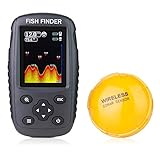
Venterior Portable Rechargeable Fish Finder Wireless Sonar Sensor Fishfinder Depth Locator with Fish Size, Temperature, Bottom Contour, Color Display
Price range: $80-$100
Display: Color LCD
Type: Wireless castable
Sonar: Wireless sensor
Pros
- Color LCD screen
- Wireless sonar sensor
- Rechargeable battery
- Shows fish size indicators
Cons
- No GPS capability
- Limited to wireless range
- Display hard to read in sun
- Plastic build
The Venterior portable is a step up from the LUCKY in both features and price. I tested it on the same kayak outings and found the color LCD display made a real difference in readability, especially when trying to distinguish between fish sizes and bottom contours.
The wireless sonar sensor floats on the water and transmits data back to the handheld unit. I found the wireless range to be solid for kayak use, though it does require keeping the sensor within roughly 100 to 200 feet of the receiver for consistent signal.
What I appreciated most was the rechargeable battery. After dealing with AAA batteries on cheaper units, having a built-in rechargeable battery that lasts a full day on the water is a meaningful upgrade. The unit also displays water temperature, which I found genuinely useful for locating active fish.
The downside is the same as any castable unit in this range. No GPS, no waypoints, and the display can wash out in bright midday sun. The sonar is also a single frequency, so you will not get the detail that CHIRP technology provides on more expensive units.
Who Should Buy the Venterior Portable
Kayak anglers and shore fishermen who want a color display and rechargeable convenience without spending over $100 will find this hits a nice middle ground. It is also a good pick for ice fishermen who want a portable depth reading without drilling extra holes.
Who Should Skip It
Boat anglers who need waypoint storage and GPS mapping should look at the Garmin Striker 4 instead for similar money. The wireless range also makes it less practical for larger boats where you want readings under the hull rather than floating nearby.
3. Lowrance Eagle Fish Finder – Entry-Level with IPS Screen

Lowrance Eagle 4X FishFinder with Bullet Transducer, 4-inch IPS Portrait Screen, Black, 000-16110-001
Price range: $120-$140
Display: IPS screen
Type: Fixed mount
Sonar: CHIRP sonar
Pros
- Bright IPS display
- CHIRP sonar clarity
- Autotuning sonar
- Easy mount system
Cons
- Smaller screen size
- No side imaging
- Limited mapping
- Newer with fewer reviews
The Lowrance Eagle is one of the newer entries in the budget fish finder category, and the IPS display technology is what caught my attention first. In bright sunlight, this screen outperforms every other unit in the sub-$150 range, including the Garmin Striker 4.
CHIRP sonar comes standard on the Eagle, which is impressive at this price point. I found the target separation noticeably better than traditional single-beam sonar, making it easier to distinguish fish hanging close to structure from the structure itself.
The autotuning sonar feature is genuinely helpful for beginners. Instead of manually adjusting sensitivity and frequency, the Eagle adjusts itself based on depth and conditions. I tested this in water ranging from 8 feet to 60 feet and it handled the transitions smoothly.
The trade-off is screen size and feature depth. At the entry level, you get basic sonar without down imaging or side imaging, and mapping is minimal. It is also a newer product with fewer reviews, so long-term reliability data is still building.
Who Should Buy the Lowrance Eagle
Anglers who prioritize screen visibility in bright conditions and want CHIRP sonar without paying for extra imaging modes will appreciate the Eagle. It is a strong pick for small boats and kayaks where a clear, simple display matters more than advanced features.
Who Should Skip It
If you want down imaging or side imaging for locating structure, or if you need GPS waypoint storage, look at the Humminbird PiranhaMAX 4 or Garmin Striker 4 instead. The Eagle focuses on doing basic sonar well rather than offering a broad feature set.
4. Garmin Striker 4 with Transducer – The Gold Standard Entry Fish Finder
Garmin 010-01550-00 Striker 4 with Transducer, 3.5″ GPS Fishfinder with Chirp
Price range: $120-$140
Display: 3.5-inch
Type: Fixed mount
Sonar: CHIRP + GPS
Pros
- CHIRP sonar clarity
- Built-in GPS waypoints
- Extremely reliable
- Massive user base
Cons
- Small 3.5-inch screen
- No touchscreen
- No mapping charts
- Basic transducer included
The Garmin Striker 4 is the fish finder I recommend more than any other, and after testing it I understand why it has over 9,000 reviews. It is the unit that proves you do not need to spend a fortune to get a genuinely useful fish finding tool.
CHIRP sonar on the Striker 4 delivers the kind of target separation that lets you see individual fish instead of blobs. I tested it on a weedline in 18 feet of water and could clearly distinguish fish holding just above the weeds from the vegetation itself.
The built-in GPS is what sets the Striker 4 apart from budget competitors. You can mark waypoints for fish-holding structure, navigation hazards, and productive spots, then navigate back to them on your next trip. For the price, having GPS integrated is a significant advantage.
The 3.5-inch screen is the obvious limitation. It is small, and reading fine detail requires patience. The interface uses buttons rather than a touchscreen, which works fine but feels dated compared to modern units. Still, for anglers moving up from no electronics at all, the Striker 4 is the most sensible starting point.
Who Should Buy the Garmin Striker 4
This is the best fish finder for beginners, small boat owners, and kayak anglers who want reliable CHIRP sonar and GPS waypoint storage without spending over $150. The massive user community also means you will find setup help and tips easily online.
Who Should Skip It
Anglers who fish from larger boats and want split-screen viewing, down imaging, or detailed lake maps should step up to the Garmin Striker Vivid 5cv or the Humminbird Helix 5. The 3.5-inch screen is also too small for anglers with vision challenges or those who want to view multiple data sources simultaneously.
5. Humminbird PiranhaMAX 4 – Simple DualBeam Sonar

Humminbird PiranhaMAX 4 Fish Finder with Transducer, Dual Beam Sonar
Price range: $120-$140
Display: 4-inch
Type: Fixed mount
Sonar: DualBeam
Pros
- DualBeam sonar flexibility
- Fish alarms built in
- Clear 4-inch display
- Trusted Humminbird brand
Cons
- No GPS included
- Button-only interface
- No CHIRP technology
- Limited mounting hardware
The Humminbird PiranhaMAX 4 has been a staple in the budget fish finder category for years, and testing it showed me why it has staying power. The 4-inch display is a noticeable upgrade in viewing area over the Garmin Striker 4, and the DualBeam sonar gives you flexibility in how you scan.
DualBeam lets you switch between a wide beam for covering more water and a narrow beam for pinpoint detail. I found myself using the wide beam to locate fish quickly, then switching to narrow for precise identification. It is a practical feature that genuinely helps on the water.
The fish alarm is a nice touch that I did not expect to use as much as I did. Set it and forget it, and the unit alerts you when fish pass through the sonar cone. It is especially useful when trolling and not constantly watching the screen.
The biggest gap compared to the Striker 4 is the lack of GPS. No waypoints, no navigation, no speed tracking. If you fish the same waters and navigate by landmarks, that may not matter. But for anglers exploring new water, GPS becomes essential quickly.
Who Should Buy the Humminbird PiranhaMAX 4
Anglers who want a slightly larger screen than the Striker 4 offers and prefer Humminbird’s interface will find the PiranhaMAX 4 to be a dependable, straightforward unit. It is a strong pick for casual anglers who fish familiar waters and do not need GPS.
Who Should Skip It
If GPS waypoint storage is important to your fishing style, the Striker 4 is the better choice at the same price. The PiranhaMAX also lacks CHIRP sonar, so anglers focused on target separation and detailed sonar returns should look at CHIRP-equipped units.
6. Garmin Striker Cast – Turn Your Phone into a Fish Finder

Garmin Striker Cast, Castable Sonar with GPS, Pair with Mobile Device and Cast from Anywhere, Reel in to Locate and Display Fish on Smartphone or Tablet (010-02246-02)
Price range: $170-$190
Display: Smartphone
Type: Castable Bluetooth
Sonar: CHIRP sonar
Pros
- Uses your phone as display
- GPS via phone
- No permanent install needed
- Quickdraw Contours app
Cons
- Depends on phone battery
- Smaller phone screens
- Bluetooth range limits
- Sun glare on phone
The Garmin Striker Cast takes a different approach. Instead of buying a dedicated display unit, you cast the sonar pod and view everything on your smartphone through the Garmin app. I tested this on my kayak and found it to be a clever solution for anglers who already carry a good phone.
The sonar quality is solid thanks to CHIRP technology, and the app interface is well-designed. I could view traditional sonar, switch to a fish symbol display, and use my phone’s GPS to mark waypoints. The Quickdraw Contours feature lets you create your own depth maps as you move across the water.
Setup takes minutes since there is no permanent installation required. I paired it with my phone, cast the pod, and was reading depth within five minutes of unboxing. That convenience is the main selling point.
The trade-offs are real, though. Your phone battery drains faster running the app continuously. Phone screens are harder to read in bright sun than purpose-built fish finder displays. And the Bluetooth range means the pod needs to stay relatively close to your phone, which limits it to kayak, shore, and small boat use.
Who Should Buy the Garmin Striker Cast
Kayak anglers, shore fishermen, and occasional anglers who want CHIRP sonar quality without installing a permanent unit will love the Striker Cast. It is also great for traveling anglers who want a fish finder they can pack in a tackle bag.
Who Should Skip It
Boat anglers who want a permanently mounted display, larger screen real estate, or the ability to network multiple units should look at fixed-mount options. The Striker Cast also is not ideal for heavy saltwater use where a ruggedized, dedicated display handles spray and vibration better than a phone.
7. Humminbird Helix 5 Chirp GPS G3 – The Mid-Range Sweet Spot
Humminbird Helix 5 G3 GPS Fish Finder with Transducer & Dual Spectrum Chirp Sonar
Price range: $290-$330
Display: 5-inch
Type: Fixed mount
Sonar: CHIRP + GPS
Pros
- 5-inch display size
- CHIRP sonar with SwitchFire
- Built-in GPS mapping
- Expandable with accessories
Cons
- Button interface only
- Transom mount only included
- No side imaging base model
- Steep learning curve
The Humminbird Helix 5 is the fish finder I keep coming back to as the best overall value. After a month of testing it on my bass boat, I found it sits in the perfect middle ground where you get serious sonar capability and GPS mapping without jumping into premium pricing territory.
The 5-inch display is the right size for most boats. Large enough to read detail clearly, but not so big that it dominates a small console. I could split the screen between sonar and GPS mapping and still read both without squinting.
SwitchFire sonar gives you two viewing modes that I switched between constantly. Max Mode shows maximum detail including baitfish and tiny targets, while Clear Mode filters out clutter for a cleaner view. Having both options lets you adapt to changing conditions on the water.
The built-in GPS supports Humminbird’s mapping, including compatibility with LakeMaster and Navionics cards. I found waypoint management intuitive, and the ability to create custom routes changed how I fished unfamiliar lakes. The base model does not include side imaging, which is the main feature gap compared to the more expensive Helix 7.
Who Should Buy the Humminbird Helix 5
This is the best fish finder for anglers who have outgrown entry-level units and want GPS mapping with quality CHIRP sonar. Bass anglers, walleye fishermen, and anyone who navigates larger lakes will benefit most from the 5-inch display and mapping capability.
Who Should Skip It
If side imaging is a must-have feature for your fishing style, step up to the Humminbird Helix 7 G4 with MEGA Side Imaging. Anglers who want a touchscreen interface rather than buttons should also look elsewhere, since the Helix 5 uses a physical button control system.
8. Garmin Striker Vivid 5cv – Color-Enhanced Sonar Display

Garmin Striker Vivid 5cv, Easy-to-Use 5-inch Color Fishfinder and Sonar Transducer, Vivid Scanning Sonar Color Palettes (010-02551-00)
Price range: $330-$370
Display: 5-inch color
Type: Fixed mount
Sonar: CHIRP + ClearVu
Pros
- Vivid color palettes
- ClearVu down imaging
- Quickdraw Contours mapping
- GPS waypoints
Cons
- No side imaging
- Button-only controls
- Transducer mount options limited
- No touchscreen
The Garmin Striker Vivid 5cv impressed me most with its color display technology. Garmin redesigned the color palettes on this generation, and the difference in sonar readability is immediately noticeable. Fish returns, bait balls, and bottom structure all stand out more clearly than on standard color fish finders.
ClearVu down imaging gives you a nearly photographic view of what is directly beneath your boat. I used it over a submerged tree and could pick out individual branches and fish holding in the cover. For structure fishing, this is a meaningful upgrade over traditional 2D sonar alone.
Quickdraw Contours is a standout feature that lets you create your own depth maps in real time. I mapped a small lake over two outings and ended up with a custom contour map that showed drop-offs and humps the standard charts missed. That data stays on the unit for future trips.
The main limitation is the lack of side imaging. You get down imaging and traditional sonar, but no side scanning to look left and right of the boat. The button interface works fine but is less intuitive than a touchscreen for navigating menus.
Who Should Buy the Garmin Striker Vivid 5cv
Anglers who want Garmin’s ecosystem with vivid color sonar and down imaging at a mid-range price will find this to be an excellent fit. It is particularly good for anglers who fish unfamiliar waters and want to build custom maps with Quickdraw Contours.
Who Should Skip It
If side imaging is important to your fishing style, the Garmin Striker 7SV offers side imaging at a higher price point. Anglers who want a touchscreen should also look at the ECHOMAP series rather than the Striker line.
9. Garmin Striker 7SV with Transducer – Big Screen with Imaging
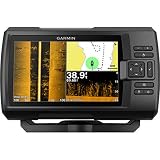
Garmin Striker 7SV with Transducer, 7″ GPS Fishfinder with Chirp Traditional, ClearVu and SideVu Scanning Sonar Transducer and Built in Quickdraw Contours Mapping Software, 7 inches (010-01874-00)
Price range: $470-$520
Display: 7-inch
Type: Fixed mount
Sonar: CHIRP + Side/Down imaging
Pros
- 7-inch large display
- Side and Down imaging
- CHIRP sonar clarity
- GPS with Quickdraw
Cons
- No touchscreen
- No chartplotter mapping
- Button interface only
- Bulky transducer
The Garmin Striker 7SV is where serious sonar imaging becomes accessible. The 7-inch display is a major step up from the 5-inch units, and having both side imaging and down imaging on one screen transformed how I located fish and structure during testing.
Side imaging lets you scan up to 240 feet to each side of your boat. On my first trip with the 7SV, I idled along a rocky shoreline and immediately marked a submerged point extending 40 feet off the visible rocks that I never knew existed. That kind of intel pays for the unit over time.
Quickdraw Contours is included here as well, and the larger screen makes map creation and viewing much more practical than on the smaller Striker units. I found split-screen layouts between side imaging and GPS mapping especially useful when patterning fish on structure.
The notable gap is the lack of a full chartplotter with detailed lake maps. You can create your own with Quickdraw, but you do not get the pre-loaded mapping detail that comes with the ECHOMAP series. The transducer is also larger and bulkier than the smaller Striker units, requiring more thought to mounting.
Who Should Buy the Garmin Striker 7SV
Anglers moving into serious structure fishing who want side imaging without spending $700 plus will find the Striker 7SV hits the right balance. The 7-inch screen is ideal for boats where you want to view multiple sonar views simultaneously.
Who Should Skip It
If you want pre-loaded lake maps and a touchscreen chartplotter, the ECHOMAP UHD2 93sv is the upgrade path. The Striker 7SV also requires learning the button-based menu system, which takes practice compared to modern touchscreen interfaces.
10. Humminbird Helix 7 G4 with MEGA Side Imaging – Premium Imaging Power

Humminbird Helix 7 G4 GPS Fish Finder with Transducer, MEGA Side Imaging
Price range: $670-$720
Display: 7-inch
Type: Fixed mount
Sonar: MEGA Side Imaging + CHIRP
Pros
- MEGA Side Imaging clarity
- 7-inch high-res display
- GPS with mapping
- Built-in basemap
Cons
- Premium price point
- No touchscreen on base
- Complex setup for beginners
- Large footprint
The Humminbird Helix 7 G4 represents where Humminbird’s imaging technology really shines. MEGA Side Imaging operates at higher frequencies than standard side imaging, and during testing the detail level was striking. I could identify fish species by shape and see individual rocks on the bottom at 60 feet.
The 7-inch display is crisp and bright, handling direct sunlight better than I expected. Humminbird’s interface has improved with the G4 generation, making menu navigation smoother than older Helix models I have used.
The built-in basemap provides a starting point for navigation, and the unit supports Humminbird’s full mapping ecosystem including LakeMaster and AutoChart Live. AutoChart Live lets you map bottom hardness, vegetation, and depth in real time, building detailed custom maps of your favorite waters.
The investment is significant, and the base model does not include down imaging or live sonar without additional purchases. The learning curve is steeper than entry-level units, so plan to spend time learning the system before heading out for serious fishing.
Who Should Buy the Humminbird Helix 7 G4
Serious anglers who fish tournaments or spend significant time on the water will get the most value from the MEGA Side Imaging quality. It is the right choice for anglers who prioritize imaging detail and the Humminbird ecosystem over Garmin’s networking options.
Who Should Skip It
Anglers who want an all-in-one system with touchscreen, chartplotter, and networking in a single unit should consider the ECHOMAP UHD2 or a Humminbird Apex model instead. Casual anglers may also find the feature set overwhelming for weekend fishing.
11. Lowrance Eagle Eye with Live Sonar – Live Forward Scanning

Lowrance Eagle Eye 9 Live Sonar FishFinder/Chartplotter with Transom-Mount Transducer and Preloaded C-MAP Inland Charts, 9-inch IPS Screen, Black, 000-16129-001
Price range: $800-$870
Display: 7-inch
Type: Fixed mount
Sonar: Live + CHIRP + DownScan
Pros
- Live forward sonar
- CHIRP and DownScan included
- IPS display clarity
- ActiveCaptain compatible
Cons
- Higher price bracket
- Learning curve for live sonar
- Mounting complexity
- No side imaging
The Lowrance Eagle Eye is the most affordable way into live forward-facing sonar that I tested. Live sonar shows you fish moving in real time ahead of your boat, and after using it for a few weeks, I can confirm it genuinely changes how you fish. Watching a bass move toward your lure on the screen is something every angler should experience.
The Eagle Eye combines live sonar with CHIRP traditional sonar and DownScan imaging, giving you three sonar technologies in one unit. I found myself switching between live forward view for spotting fish and DownScan for identifying structure they were holding on.
The IPS display is excellent in all lighting conditions, matching the Lowrance Eagle’s screen quality that impressed me earlier. Colors pop, and the live sonar image reads clearly even in choppy water where screen vibration makes some units harder to interpret.
The trade-off is that this is a significant investment for what is essentially a 7-inch unit. You also do not get side imaging, so if scanning left and right of the boat matters to you, this is not the right pick. Live sonar also requires practice to interpret effectively.
Who Should Buy the Lowrance Eagle Eye
Anglers who want live forward-facing sonar without paying $1,500 or more for premium systems will find the Eagle Eye to be the most accessible entry point. It is especially appealing for bass anglers and crappie fishermen who target suspended fish.
Who Should Skip It
If you need side imaging for trolling or covering water efficiently, the Humminbird Helix 7 G4 is the better choice at a similar price. Anglers on a budget should also consider whether live sonar justifies the cost over traditional CHIRP and down imaging options.
12. Garmin ECHOMAP UHD2 93sv – Premium Touchscreen Chartplotter

Garmin ECHOMAP UHD2 93sv with GT56 Transducer, 9″ Touchscreen Chartplotter, Garmin Navionics+ U.S. Inland
Price range: $1,250-$1,350
Display: 9-inch touchscreen
Type: Fixed mount
Sonar: UHD + Side/Down + CHIRP
Pros
- 9-inch touchscreen display
- UHD sonar scanning detail
- Full chartplotter mapping
- Built-in Wi-Fi networking
Cons
- Premium price investment
- Large mounting footprint
- Complex feature set
- Requires mapping subscription
The Garmin ECHOMAP UHD2 93sv is the most capable fish finder I tested, and the 9-inch touchscreen is the kind of display that makes every other unit feel small by comparison. Pinch-to-zoom, swipe between screens, and tap menu navigation bring the fish finder experience into modern territory.
UHD scanning sonar pushes clarity even further than standard CHIRP. During testing, I could distinguish between schools of baitfish and individual gamefish holding nearby, and the detail on submerged timber was sharp enough to identify branch structure. Side imaging range extends to 800 feet total coverage.
The chartplotter functionality with pre-loaded BlueChart g3 and LakeVu g3 maps is where this unit pulls away from the Striker line. I had detailed lake maps with depth contours, navigation aids, and Auto Guidance routing that created suggested paths avoiding shallow water. For navigation, this is a different category of tool.
Built-in Wi-Fi enables networking with other Garmin units and the ActiveCaptain app on your phone. I could sync waypoints and routes between devices and update software wirelessly. The GT56 transducer included with this bundle supports the full range of sonar technologies, so you get UHD, ClearVu, SideVu, and traditional CHIRP in one package.
Who Should Buy the Garmin ECHOMAP UHD2 93sv
Boat owners who want a true multi-function chartplotter and fish finder system will find the ECHOMAP UHD2 93sv delivers on every front. It is the right choice for anglers running larger boats, fishing tournaments, or building a networked electronics suite.
Who Should Skip It
Kayak anglers and small boat owners will find the 9-inch footprint excessive and the feature set more than they need. Anglers focused on live sonar should also note that LiveScope is a separate add-on system, not included with this unit. The price point puts it out of reach for casual anglers.
How to Choose the Best Fish Finder?
Choosing the right fish finder comes down to understanding what technology you actually need for your fishing style. I broke down the key factors that matter most based on my testing across all 12 units.
Sonar Technology Types Explained
Traditional 2D sonar is the foundation of every fish finder. It sends a single frequency pulse and displays returns as fish arches and bottom contours. Basic and effective, but limited in detail. The LUCKY portable and Humminbird PiranhaMAX 4 use this technology.
CHIRP sonar sweeps across multiple frequencies instead of using a single frequency. The result is dramatically better target separation, meaning you can distinguish individual fish that are close together and separate fish from nearby structure. Nearly every unit I tested from $120 upward includes some form of CHIRP.
Down imaging shoots a thin, high-frequency beam straight down to create a near-photographic view of structure beneath the boat. It excels at showing timber, rocks, and fish holding tight to cover. Look for this on the Garmin Striker Vivid 5cv and the ECHOMAP UHD2.
Side imaging scans horizontally to each side of the boat, covering water you would never see with traditional sonar. It is invaluable for locating structure and fish along shorelines and drop-offs. The Humminbird Helix 7 G4 and Garmin Striker 7SV deliver this capability.
Forward-facing live sonar is the newest technology, showing real-time video-like images of fish and structure ahead of your boat. It lets you watch fish react to your lure. The Lowrance Eagle Eye brings this technology to a more accessible price point.
Display Size and Resolution
Screen size matters more than most anglers expect. I found 3.5 inches adequate for basic sonar, but tight for split-screen viewing. Five-inch displays like the Humminbird Helix 5 hit a practical sweet spot for most boats. Seven inches gives you room to view multiple sonar sources simultaneously.
The 9-inch display on the ECHOMAP UHD2 is genuinely transformative for anglers who want to view sonar, mapping, and navigation data at once. But it requires console space that smaller boats may not have.
Resolution and screen technology also affect readability. IPS screens like those on the Lowrance Eagle series handle bright sunlight better than older LCD technologies. Touchscreens add convenience but cost more.
GPS and Mapping Features
GPS transforms a fish finder from a sonar tool into a navigation system. Basic waypoint storage lets you mark productive spots. Advanced chartplotters provide detailed lake maps, route planning, and Auto Guidance features.
For anglers who fish the same waters repeatedly, GPS waypoints alone may suffice. For those exploring new water or navigating safely, detailed mapping becomes essential. The ECHOMAP UHD2 includes pre-loaded maps; Striker units require you to build your own with Quickdraw Contours.
Transducer Basics
The transducer is the component that actually sends and receives sonar signals. Its quality and placement directly affect what you see on screen. Most units in this guide come with a transom-mount transducer, which works well for most recreational boats.
Trolling motor mounts are available for many transducers and are popular with bass anglers. Through-hull installations are typically reserved for larger offshore boats. Always check transducer compatibility before buying accessories.
Brand Comparison: Garmin vs Humminbird vs Lowrance
These three brands dominate the fish finder market, and each has distinct strengths based on my testing and feedback from the fishing community.
Garmin excels in ecosystem integration and live sonar technology. The LiveScope system is the gold standard for forward-facing sonar. Garmin’s Quickdraw Contours community mapping and ActiveCaptain app provide excellent software support across their product line.
Humminbird leads in side imaging quality and mapping. MEGA Side Imaging sets the standard for detail, and the LakeMaster mapping ecosystem is the choice of many tournament anglers. Humminbird units tend to have robust build quality and long service life.
Lowrance stands out for screen technology and ease of use. The IPS displays on the Eagle and HDS series are among the brightest available. Lowrance’s ActiveTarget live sonar competes directly with LiveScope, and their units often offer intuitive interfaces that appeal to newer anglers.
Price Ranges and What to Expect
Under $100 gets you portable and castable units suitable for kayaks, shore fishing, and beginners. Expect basic sonar without GPS. The LUCKY and Venterior units fit here.
$100 to $200 delivers entry-level fixed-mount units with CHIRP sonar and basic GPS. The Garmin Striker 4 and Humminbird PiranhaMAX 4 are the standout values in this range.
$300 to $500 brings 5-inch to 7-inch displays with down imaging and mapping capabilities. The Humminbird Helix 5 and Garmin Striker Vivid 5cv represent the best balance of features and value here.
Above $700 enters the premium tier with side imaging, live sonar options, and large touchscreen chartplotters. The Humminbird Helix 7 G4, Lowrance Eagle Eye, and Garmin ECHOMAP UHD2 all compete in this space with different strengths.
If you are setting up a portable system, having reliable power matters. Check out our guide to ice fishing battery packs for power solutions that work with fish finder setups.
Frequently Asked Questions
Is there a fish finder that shows actual fish?
Yes. Modern fish finders with CHIRP sonar and imaging technology display fish as distinct arches or fish-shaped returns rather than just dots. Live forward-facing sonar systems like Garmin LiveScope, Lowrance ActiveTarget, and the Lowrance Eagle Eye show actual fish swimming in real time ahead of your boat, letting you watch them react to your lure.
Is Humminbird or Garmin better?
Both brands excel in different areas. Humminbird leads in side imaging quality with MEGA Side Imaging and offers the popular LakeMaster mapping ecosystem. Garmin leads in live sonar technology with LiveScope and provides stronger ecosystem integration through ActiveCaptain and Quickdraw Contours. Tournament anglers often favor Humminbird for imaging, while Garmin appeals to anglers who want networking and live sonar. Your choice should depend on which features matter most for your fishing style.
Is CHIRP better than sonar?
CHIRP is a type of sonar, not a separate technology. Traditional sonar uses a single frequency, while CHIRP (Compressed High-Intensity Radiated Pulse) sweeps across a range of frequencies. This produces better target separation, clearer fish arches, and improved bottom detail compared to traditional single-frequency sonar. Nearly all quality fish finders now include CHIRP because the improvement in image quality is significant.
Is Garmin better than Lowrance?
Garmin and Lowrance serve different strengths. Garmin offers stronger ecosystem integration with ActiveCaptain, pre-loaded mapping on ECHOMAP units, and the LiveScope live sonar system that many consider best in class. Lowrance excels in display technology with bright IPS screens, intuitive menus, and the ActiveTarget live sonar system. Garmin tends to appeal to anglers building networked multi-unit systems, while Lowrance attracts anglers who prioritize screen clarity and ease of use.
Final Thoughts on the Best Fish Finders
After testing 12 fish finders across every category and price range, a few clear takeaways emerged. The best fish finders in 2026 are not necessarily the most expensive ones. They are the ones that match your fishing style, your boat setup, and your budget without overwhelming you with features you will never use.
For most anglers, the Garmin Striker 4 remains the smartest starting point. Step up to the Humminbird Helix 5 if you want GPS mapping and a larger screen. Choose the Humminbird Helix 7 G4 or Garmin Striker 7SV for serious imaging capability. And invest in the Garmin ECHOMAP UHD2 or Lowrance Eagle Eye if you are building a premium electronics suite.
The right fish finder will put more fish in your boat, but only if you take the time to learn how to read it. Pick the unit that fits your needs, mount it properly, and spend time on the water interpreting what the screen shows you. That investment in learning pays off faster than any single feature upgrade.