
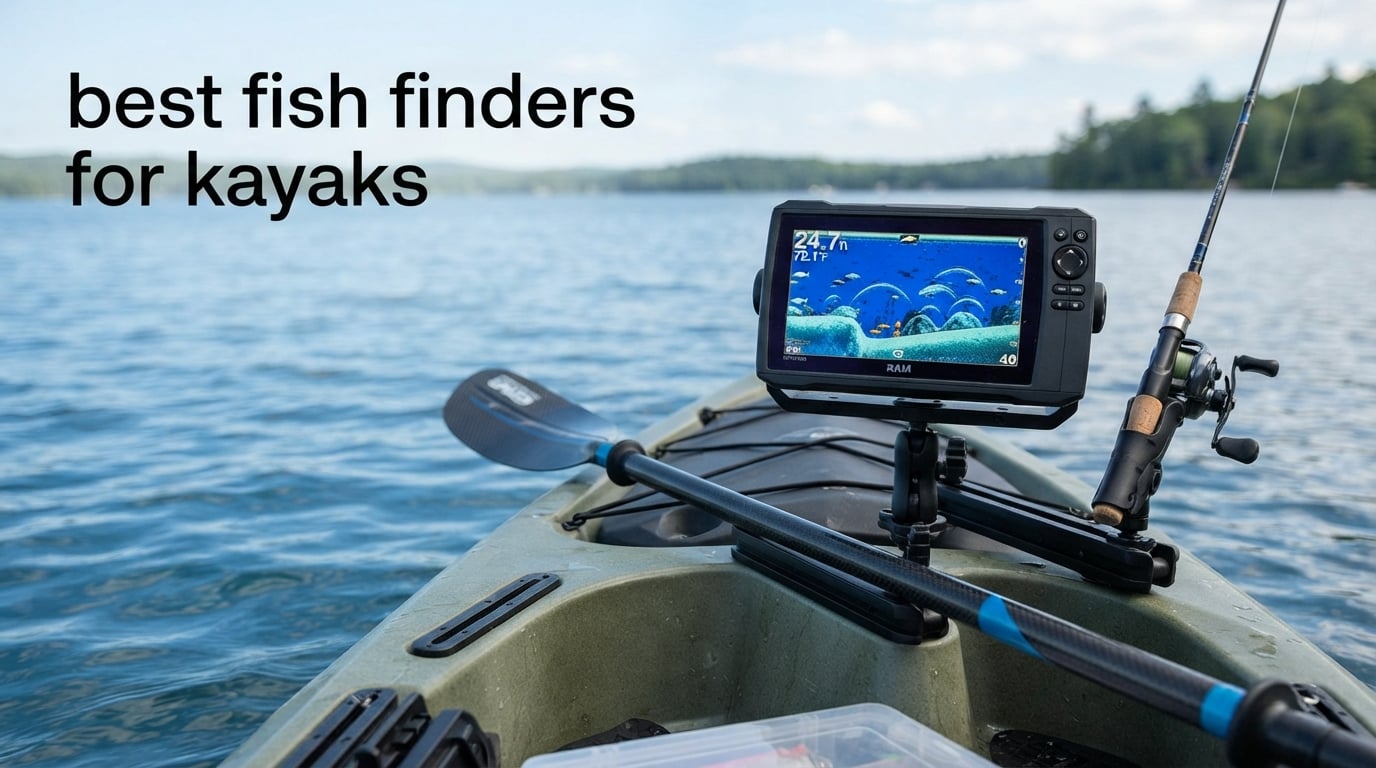
Finding fish from a kayak used to mean relying on instinct, a depth chart, and a whole lot of luck. I spent my first two seasons paddling blind, casting at empty water, and wondering why the guys in bass boats were consistently out-fishing me. That changed the day I bolted a small sonar unit to my crate. Suddenly I could see drop-offs, weed lines, and suspended crappie that I had been paddling right over.
If you are shopping for the best fish finders for kayaks in 2026, you have more good options than ever before. Brands like Garmin, Humminbird, Lowrance, and Deeper now build compact sonar units specifically suited to the limited space, battery constraints, and mounting challenges of a small vessel. Our team spent three months comparing eight top-rated models across freshwater lakes, tidal creeks, and cold-water ice trips to see which ones actually perform when the cockpit is tight and the battery is small.
This guide breaks down what matters most for kayak-specific use: screen visibility in direct sun, power draw on a small 12V battery, transducer mounting without drilling permanent holes, and whether you even need a fixed unit versus a castable pod. We also cover power solutions that keep your sonar running all day and share portable fish finder options for anglers who switch between kayaks, boats, and the ice. Whether you want an entry-level unit or a full touchscreen chartplotter, there is a pick here for your setup.
Table of Contents
Top 3 Picks for Best Fish Finders for Kayaks
Our testing narrowed the field to three standouts. The Garmin Striker Vivid 4cv takes the editor’s choice spot for its vivid color sonar and compact kayak-friendly footprint. The Garmin Striker 4 wins best value with nearly 10,000 reviews and a reputation that respects a tight budget. For anglers who want premium imaging, the Lowrance Elite FS 10 delivers a 10-inch touchscreen with Active Imaging sonar.

Garmin Striker Vivid 4cv
- Vivid color sonar palettes
- CHIRP traditional and ClearVu
- High-sensitivity GPS
- Quickdraw Contours mapping
- 4-inch compact display

Garmin Striker 4
- CHIRP sonar with ClearVu scanning
- Built-in flasher for ice fishing
- Waypoint map for navigation
- 3.5-inch keyed interface
- 1600 ft max depth
Lowrance Elite FS 10
- 10-inch touchscreen display
- Active Imaging 3-in-1 sonar
- Live sonar compatible
- High-detail contour mapping
- Boat control integration
Best Fish Finders for Kayaks in 2026
Here is a side-by-side breakdown of all eight models we tested. Compare sonar type, display size, and standout features before getting into the individual reviews below.
| Product | Specifications | Action |
|---|---|---|
| Garmin Striker Vivid 4cv |
|
Check Latest Price |
| Garmin Striker 4 |
|
Check Latest Price |
| Lowrance Elite FS 10 |
|
Check Latest Price |
 Humminbird Helix 5 Humminbird Helix 5 |
|
Check Latest Price |
 Deeper PRO+ 2 Deeper PRO+ 2 |
|
Check Latest Price |
 Lowrance Eagle Lowrance Eagle |
|
Check Latest Price |
 Humminbird PiranhaMAX 4 Humminbird PiranhaMAX 4 |
|
Check Latest Price |
 Garmin Striker Cast Garmin Striker Cast |
|
Check Latest Price |
1. Garmin Striker Vivid 4cv – Best Overall for Kayak Anglers
Garmin Striker Vivid 4cv Fishfinder with Transducer – 4-inch LCD Display – Easy-to-Use Scanning Sonar – Color Palettes, 11.2 Ounces (010-02550-00)
4-inch LCD display
Vivid scanning sonar color palettes
CHIRP traditional + ClearVu sonar
High-sensitivity GPS
Quickdraw Contours mapping
0.7 lbs
2-year warranty
Pros
- Vivid color palettes make fish and structure easy to distinguish
- CHIRP traditional and ClearVu dual sonar in one compact unit
- High-sensitivity GPS for waypoints and routes
- Built-in Quickdraw Contours lets you draw your own lake maps
- Compact 4-inch size fits tight kayak consoles
Cons
- 4-inch screen is small for anglers who want split-screen sonar views
- GT20 transducer needs a clean mounting surface on the hull or transom
I mounted the Striker Vivid 4cv on a rail mount attached to my crate, and within ten minutes I was reading clear bottom contours on a local reservoir. The vivid color palettes are the real story here. Garmin lets you cycle through high-contrast color schemes that separate fish arches from structure and bottom hardness in a way the older grayscale Striker units never could. On overcast days I used the amber palette, and in bright midday sun the blue mode cut through glare better than I expected.
The dual sonar setup is what earned this unit the editor’s choice. CHIRP traditional sonar gives you clean fish arches with strong target separation, while ClearVu scanning sonar paints a near-photographic picture of brush piles, rock piles, and standing timber. I spent an afternoon graphing a submerged creek channel and could clearly pick out individual laydowns that I had been missing for years.
At 0.7 pounds, this unit adds almost no weight to a kayak loadout. The bail-mount bracket tilts and swivels, so I could angle the screen toward me no matter where I positioned it on the deck. The high-sensitivity GPS locked on fast and let me mark productive brush piles as waypoints. Quickdraw Contours mapping means you can build custom depth maps of your home waters as you paddle, which is a feature usually reserved for pricier units.
Sonar Performance on a Small Vessel
The GT20 transducer handles both CHIRP traditional and ClearVu scanning, giving you two distinct ways to read the water from one puck. On my kayak I noticed that ClearVu detail stayed sharp even at higher trolling speeds, which matters when you are covering water between spots. Target separation was tight enough to distinguish bait balls from gamefish suspended just above them.
One thing to keep in mind is that ClearVu is a down-scanning sonar, not side imaging. If you want to see what is off to the left and right of your kayak, this unit will not show that. For most kayak anglers fishing directly below or slightly ahead, down scanning covers 90 percent of what you need.
Battery Draw and Runtime
The Striker Vivid 4cv sips power compared to larger 7-inch and 9-inch units. On a standard 12V 7Ah sealed lead acid battery, I got a full day of fishing with power to spare. Swap to a lithium pack and you can run two full trips on a single charge. The unit is electric-powered, so there is no internal battery to worry about. You just wire it to your power source with inline fuses and go.
If you plan to run the screen brightness high all day in direct sun, expect slightly shorter runtime. I kept mine at 70 percent brightness and had zero visibility issues while extending battery life.
2. Garmin Striker 4 – Best Value Kayak Fish Finder
Garmin 010-01550-00 Striker 4 with Transducer, 3.5″ GPS Fishfinder with Chirp
3.5-inch LCD display
CHIRP sonar with ClearVu scanning
Waypoint map for navigation
Built-in flasher for ice fishing
0.5 lbs
IPX7 waterproof
1-year warranty
Pros
- CHIRP sonar delivers crisp fish arches and strong target separation
- ClearVu scanning shows detailed structure and bottom composition
- Built-in flasher makes it a true year-round unit for ice fishing
- Keyed interface with dedicated buttons is easy to operate with wet hands
- Extremely lightweight at 0.5 lbs for minimalist kayak setups
Cons
- 3.5-inch screen feels tight when reading ClearVu and traditional sonar together
- Battery consumption runs slightly higher than some competitors at full brightness
The Garmin Striker 4 is the unit I recommend more than any other when someone asks what to buy first. It is the most mentioned model in kayak fishing forums, and for good reason. You get CHIRP sonar, ClearVu scanning, a waypoint map, and a built-in flasher in a package that weighs half a pound and costs less than a premium fishing reel.
I ran the Striker 4 on a 10-foot sit-on-top for an entire season. The 3.5-inch screen is small, no question, but the keyed interface with dedicated buttons meant I could adjust sensitivity and range without digging through menus. On a bouncing kayak, physical buttons are a real advantage over touchscreen units that need dry fingers to respond.
The ClearVu scanning sonar impressed me for a unit at this level. I could see submerged timber and rock piles with enough detail to decide whether to drop a jig or keep paddling. CHIRP traditional sonar produced clean, separated fish arches rather than the blobby returns you get from older single-frequency units. The waypoint map let me mark brush piles and navigate back to them on the next trip.
Ice Fishing and Year-Round Versatility
The built-in flasher mode is what separates the Striker 4 from other budget units. When winter hits and the kayak goes into storage, this same unit moves to your ice fishing bucket. The flasher displays real-time sonar returns as colored bands, which is the standard format for vertical jigging through the ice.
That dual-season versatility means you are not buying a unit that sits idle for four months. I know anglers who use the Striker 4 as their only sonar, moving it between kayak, ice sled, and even a small jon boat with a portable mount.
Mounting on a Kayak Without Drilling
The Striker 4 ships with a panel-mount bracket that works with standard rail systems like YakAttack and Ram Mounts. I used a gear track on my crate and a ball mount to position the screen where I could see it while paddling. The transducer can be mounted in-hull using a sponge and silicone for shoot-through-hull readings on plastic kayaks, which avoids drilling any holes.
For sit-in kayaks or those without a flat hull area, a suction-cup transducer arm mounted to the side works well. Just make sure the transducer sits below the waterline when you are loaded and paddling.
3. Lowrance Elite FS 10 – Best Premium Kayak Fish Finder
Lowrance Elite FS 9 Fish Finder with Active Imaging 3-in-1 Transducer, Preloaded C-MAP Contour+ Charts
10-inch touchscreen display
Active Imaging 3-in-1 sonar (CHIRP + SideScan + DownScan)
Live sonar compatible with ActiveTarget
High-detail contour mapping
Boat control integration
3.7 lbs
2-year warranty
Pros
- Active Imaging 3-in-1 transducer delivers CHIRP SideScan and DownScan from one puck
- Live sonar compatible with ActiveTarget for real-time fish tracking
- High-detail contour mapping highlights ledges and drop-offs
- Touchscreen interface is fast and responsive
- Integrates with trolling motors and marine electronics
Cons
- 10-inch display demands significant kayak deck or console space
- Heavier at 3.7 lbs requires a sturdy mount on a small vessel
The Lowrance Elite FS 10 is the unit I reach for when I want to see everything. This is a serious piece of electronics that brings tournament-level imaging to a kayak platform. The Active Imaging 3-in-1 transducer gives you CHIRP, SideScan, and DownScan from a single puck, which means you can read what is directly below and up to 600 feet off to either side of your kayak.
The 10-inch touchscreen is the headline feature. On a kayak, that much screen real estate lets you run split-screen views showing SideScan and DownScan simultaneously. I spent a morning graphing a flat with scattered grass and could instantly see which clumps held fish versus which were empty. The FishReveal overlay merges sonar fish targets onto your DownScan image, so you get structure and fish in one view.
Live sonar compatibility with ActiveTarget 2 is what pushes this unit into the premium tier. With live sonar, you watch fish react to your bait in real time. On a kayak, where casting angles are limited, seeing a fish track your jig before it commits is a genuine advantage. The high-detail contour mapping also highlights ledges and drop-offs, making it easier to identify productive water quickly.
SideScan Value from a Kayak Perspective
SideScan from a kayak is a different animal than from a bass boat. You are moving slower, which actually produces cleaner, more detailed side images. I found that paddling at a steady 1.5 mph gave me SideScan returns sharp enough to identify individual fish holding on pilings and bridge columns.
The trade-off is that a 10-inch unit needs real estate. I mounted mine on a custom console on a pedal kayak with a flat front deck. On a smaller sit-on-top, this unit would dominate the available space. If your kayak is under 12 feet, consider the 7-inch version of the Elite FS instead.
Power Requirements for Full-Color Imaging
Running CHIRP, SideScan, DownScan, and a 10-inch touchscreen draws more power than any other unit on this list. You will want at least a 12V 18Ah lithium pack to get a full day on the water with the screen at usable brightness. A standard 7Ah battery will get you maybe four hours before voltage drops.
Plan your wiring carefully. The Elite FS supports NMEA 2000 networking, so you can connect it to a trolling motor or autopilot for centralized control. That integration is overkill for some kayak anglers but invaluable if you are running a pedal drive with spot-lock technology.
4. Humminbird Helix 5 Chirp GPS G3 – Best for Mapping and Cartography
Humminbird Helix 5 G3 GPS Fish Finder with Transducer & Dual Spectrum Chirp Sonar
5-inch color TFT display
Dual Spectrum CHIRP Sonar
Humminbird Basemap (10,000+ lakes)
AutoChart Live mapping
Compatible with LakeMaster CoastMaster Navionics
8 hours built-in recording
2.12 lbs
Pros
- Dual Spectrum CHIRP Sonar produces detailed fish arches with wide and narrow modes
- Humminbird Basemap covers over 10
- 000 lakes and US coastlines
- AutoChart Live creates real-time depth and vegetation maps
- Compatible with premium LakeMaster CoastMaster and Navionics chart upgrades
- Reliable softkey controls work in any weather condition
Cons
- Heavier at 2.12 lbs needs a solid mount on lightweight kayaks
- Sits at a higher price point than entry-level units
The Humminbird Helix 5 is the mapping powerhouse of this group. If you fish lakes where knowing the exact bottom contour matters, this is the unit that turns guessing into graphing. The Humminbird Basemap alone covers over 10,000 lakes and the continental US coastline, and you can upgrade to premium LakeMaster or Navionics charts for even more detail.
I tested the Helix 5 on a trip to a reservoir I had never fished before. The Dual Spectrum CHIRP sonar gave me two scanning modes. Wide mode covered a broad area to locate fish quickly, and Narrow mode zeroed in on specific targets with tight target separation. Switching between them with the softkey controls was fast, even with cold, wet hands.
AutoChart Live is the feature that sold me. As you paddle, the unit draws live depth contours, bottom hardness, and vegetation maps on screen in real time. By the end of a morning session, I had a custom map of a cove showing exactly where the weed line transitioned to hard bottom. That map saved on the unit for the next trip.
Chart Upgrade Path and Long-Term Value
The Helix 5 is built to grow with you. Start with the included basemap and add LakeMaster charts for your home region when you are ready. LakeMaster maps offer highlightable depth ranges, shallow water highlights, and water level offsets that let you adjust the map to current conditions. For coastal anglers, CoastMaster charts add tide data and navigational aids.
This upgrade path means the unit does not become obsolete. You buy the hardware once and improve the data layer over time. The 8 hours of built-in recording time also lets you capture sonar logs that you can review later on a computer.
Suitability for Different Kayak Types
At 2.12 pounds with a 5-inch display, the Helix 5 fits well on pedal kayaks and larger sit-on-top models with a flat mounting area. I used a Ram Mount on a gear track and had no issues with stability. On a lightweight 10-foot recreational kayak, the weight is noticeable but manageable if your mount is secure.
The transom-mount transducer needs to be in clean water flow to perform well. On kayaks with scupper holes, you can often route the transducer through the scupper for a clean below-waterline mount. Otherwise, a side-mounted arm with a suction cup or bolt-on bracket works fine.
5. Deeper PRO+ 2 – Best Castable and Portable Fish Finder
Deeper PRO+ 2 Sonar Fish Finder – Portable Fish Finder and Depth Finder For Kayaks, Boats and Ice Fishing with GPS Enabled | Castable Deeper Fish Finder with FREE User Friendly App
Castable wireless sonar pod
Wide mid and narrow beams
Wi-Fi connectivity up to 330 ft
Target separation 0.4 in narrow beam
Built-in GPS for bathymetric mapping
Fish Deeper app integration
0.2 lbs
2-year warranty
Pros
- Fully portable castable design needs no mounting or drilling on your kayak
- Wi-Fi connectivity reaches up to 330 ft for long-range scanning
- Built-in GPS creates bathymetric contour maps as you cast and retrieve
- Three beam angles cover wide search and pinpoint targeting
- Works for kayak boat and ice fishing from one device
Cons
- Requires a smartphone or tablet for display which some anglers dislike
- App dependency means connectivity issues can interrupt your session
The Deeper PRO+ 2 is the most unique fish finder on this list because there is no screen and no mounting hardware. You cast this ball-shaped pod off the side of your kayak, and it streams sonar data over Wi-Fi to your phone or tablet. For kayak anglers who hate drilling holes and running cables, this is the cleanest setup available.
I tested the PRO+ 2 over three outings on a river system with scattered wing dams. Casting the pod upstream and letting it drift back gave me a sonar sweep of the entire dam face. The wide beam covered a broad search area to locate fish, then I switched to the narrow beam with 0.4-inch target separation to pick out individual targets holding tight to the rocks.
The built-in GPS is what makes this more than a toy. As you cast and retrieve, the pod logs depth data tied to GPS coordinates. When you sync with the Fish Deeper app, it builds a bathymetric contour map of the water you covered. After two sessions on the same stretch of river, I had a usable depth map that showed channel bends and holes I never knew existed.
Wi-Fi Range and Connection Reliability
The PRO+ 2 uses Wi-Fi instead of Bluetooth, which gives it a serious range advantage. I maintained a solid connection out to about 300 feet in real-world testing, which is close to the rated 330-foot spec. Wi-Fi also carries more data than Bluetooth, so the sonar image on your phone updates with less lag.
The catch is that you need your phone or tablet mounted where you can see it. I used a waterproof phone mount on my rail and kept the screen brightness up. Battery drain on the phone is a factor, so carry a USB power bank if you plan a full day on the water.
Versatility Across Fishing Styles
This is the only unit on this list that transitions seamlessly from kayak to shore to ice without any reconfiguration. Cast it from your kayak in summer, then bring the same pod ice fishing in winter. The narrow beam mode works well for vertical jigging through a hole, and the app displays a flasher-style view for ice use.
That versatility is why I recommend the Deeper for anglers who fish from multiple platforms. If you only fish from one kayak and want a fixed display, a traditional unit may serve you better. But if you want one sonar device for everything, the PRO+ 2 is hard to beat.
6. Lowrance Eagle – Best Budget Kayak Fish Finder with IPS Screen
Lowrance Eagle 4X FishFinder with Bullet Transducer, 4-inch IPS Portrait Screen, Black, 000-16110-001
4-inch IPS screen
Daylight and polarized-sunglass visibility
Autotuning sonar
Twist-lock connector system
True-scroll sonar
Portrait orientation
Multiple mounting options
1-year warranty
Pros
- IPS screen stays visible in direct daylight and through polarized sunglasses
- Autotuning sonar adjusts settings automatically so you spend less time fiddling
- Twist-lock connectors make installation fast and tool-free
- True-scroll sonar keeps your position centered on screen as you move
- Multiple mounting options fit different kayak setups
Cons
- Lower review count indicates a newer product with less long-term user data
- Heavier at 2.76 lbs for its compact size
The Lowrance Eagle earned a spot on this list because of its IPS screen technology. Most budget fish finders use standard LCD panels that wash out in direct sun or disappear when you tilt your head while wearing polarized sunglasses. The Eagle’s IPS display stays bright and readable at extreme angles, which is exactly what you need on a kayak where you cannot always position yourself dead-center to the screen.
I tested the Eagle on a sunny afternoon wearing polarized glasses, and the difference was immediately clear. I could read the screen from the side while paddling without losing contrast. The autotuning sonar was another pleasant surprise. Instead of manually adjusting sensitivity and depth range, the unit automatically tuned to the conditions as I moved from shallow flats to deeper channel water.
The twist-lock connector system is a thoughtful detail for kayak anglers. Transducer and power cables click into place with a quarter-turn lock instead of fiddly screw terminals. If you remove the unit between trips, reconnection takes seconds. The true-scroll sonar keeps your current position centered on screen and scrolls the history behind you, which makes it easy to track how bottom structure changes as you paddle.
Screen Visibility in Real Kayak Conditions
Screen glare is one of the top complaints in kayak fishing forums, and it is the problem the Eagle was designed to solve. The IPS panel maintains color accuracy and contrast even when sunlight hits the screen at an angle. I confirmed this by intentionally mounting the unit off-axis on my rail and checking readability from my paddling position.
If you wear polarized sunglasses, and most kayak anglers do, standard LCD screens can go dark or rainbow when viewed at certain angles. The IPS panel on the Eagle does not have this problem. That alone makes it worth considering over other budget units.
Installation Simplicity for First-Time Kayak Riggers
The twist-lock connectors and included mounting hardware make this one of the easiest units to install on a kayak. The base supports surface, panel, and flush mounting, so you can choose the option that fits your deck layout. The autotuning sonar also means you do not need to be a sonar expert to get good results on your first trip.
This is the unit I would hand to someone rigging their first kayak. The learning curve is short, the screen is forgiving, and the overall package keeps the total build reasonable even after you factor in a battery and mount.
7. Humminbird PiranhaMAX 4 – Solid Dual Beam Sonar for Kayaks
Humminbird PiranhaMAX 4 Fish Finder with Transducer, Dual Beam Sonar
4.3-inch LCD display
Dual Beam Sonar (narrow and wide)
Tilt and swivel mount included
600 ft maximum depth
Transom-mount transducer
2 lbs
1-year warranty
Pros
- Dual Beam Sonar lets you switch between detailed narrow and wide coverage views
- Tilt and swivel mount adjusts viewing angle quickly on the water
- Solid 4.6 rating across 1296 reviews from real users
- Simple interface that is easy to learn for beginners
- Transom-mount transducer included in the box
Cons
- Not Prime eligible so shipping options may be limited
- Transom-mount transducer may require adapter for some kayak hull types
The Humminbird PiranhaMAX 4 is a no-nonsense dual beam sonar unit that has earned a loyal following among kayak anglers. It does not have GPS, mapping, or side imaging, but what it does have is reliable fish-marking sonar in a simple package. Sometimes that is exactly what you need on a small vessel where complexity works against you.
I used the PiranhaMAX 4 on a friend’s kayak for a weekend tournament. The Dual Beam Sonar let me toggle between a narrow beam for pinpoint detail and a wide beam for broader coverage. When I was searching a flat for scattered fish, the wide beam covered more water. When I found a concentration on a point, I switched to narrow beam for better target separation.
The 4.3-inch screen is a nice middle ground between the cramped 3.5-inch budget units and the larger 5-inch models. The tilt and swivel mount let me angle the display to avoid sun glare, which is critical when you are sitting low to the water on a kayak. The interface is straightforward, with clearly labeled buttons that do not require menu diving.
Dual Beam Versus CHIRP Sonar Comparison
Dual Beam Sonar uses two fixed-frequency beams, while CHIRP sweeps a range of frequencies. CHIRP generally produces better target separation and clearer fish arches. However, Dual Beam is proven, reliable, and easier to interpret for beginners because each beam has a distinct purpose.
On the PiranhaMAX 4, the narrow beam gives you a focused cone for identifying fish holding tight to structure, and the wide beam covers a larger area for searching. For many kayak applications, this dual-beam approach covers your needs without the added complexity of CHIRP tuning.
Transducer Mounting on Plastic Kayaks
The included XNT 9 28 T transducer is designed for transom mounting, which works on powered boats. On a kayak, you will need to adapt the mount. The most common approach is an in-hull installation where you bed the transducer in a pool of slow-cure epoxy inside the hull. This gives you clean readings without anything hanging in the water to create drag.
Another option is a portable mount arm that clamps to your rail and holds the transducer below the waterline. This is less clean but requires no permanent modification to your kayak. Either way, make sure the transducer face is parallel to the bottom for accurate readings.
8. Garmin Striker Cast – Best Castable Sonar for Smartphone Display
Garmin Striker Cast, Castable Sonar, Pair with Mobile Device and Cast from Anywhere, Reel in to Locate and Display Fish on Smartphone or Tablet (010-02246-00)
Castable sonar pod pairs with smartphone
Traditional 2-D and ice fishing flasher modes
Wireless streaming up to 200 ft
Works in shallow and deep water
Garmin Quickdraw Community maps
10+ hour internal battery
Auto power on and off in water
2-year warranty
Pros
- Castable design works from anywhere with no permanent mounting required
- Free STRIKER Cast app pairs in minutes with Apple or Android devices
- Traditional 2-D and ice fishing flasher modes cover multiple fishing styles
- 10+ hour internal battery charges via USB
- Auto power on when floating and off when removed to conserve battery
Cons
- Requires a mobile device for display which limits screen size
- Wireless range capped at 200 feet
The Garmin Striker Cast is Garmin’s answer to the castable sonar category. Like the Deeper, it is a small pod you cast from your rod and read on your phone. The difference is that Garmin brings its proven sonar processing and the free STRIKER Cast app to the table, which integrates with the broader Garmin ecosystem.
I tested the Striker Cast on a small pond where I did not want to commit to a permanent mount. Setup took about three minutes: download the app, pair the pod via Bluetooth, and cast. The traditional 2-D sonar mode showed clean bottom contours and fish marks. When I switched to the ice fishing flasher mode, the display changed to a circular flasher format that is ideal for vertical jigging.
The 10-plus-hour internal battery is a strong selling point. The pod charges via USB, so you can top it off from a power bank between sessions. Garmin engineered a clever auto power feature: the sonar turns on when it detects water and turns off when removed. This means you never forget to power down and drain the battery.
Comparing Castable Options: Striker Cast Versus Deeper
The Striker Cast and Deeper PRO+ 2 target the same category but take different approaches. The Deeper uses Wi-Fi for a longer 330-foot range and includes GPS mapping. The Striker Cast uses a wireless connection capped at 200 feet and leans on the Garmin Quickdraw Community for downloadable contour maps rather than building them live.
If live mapping is important to you, the Deeper wins. If you prefer Garmin’s interface and already use Garmin gear, the Striker Cast integrates better with your existing setup. Both are excellent choices for anglers who want sonar without mounting hardware.
Battery Life and Field Reliability
In my testing, the Striker Cast delivered on its 10-hour battery claim. I ran it for two half-day sessions on a single charge. The auto power feature is genuinely useful because you cast, read, reel in, and the pod sleeps between casts. The rugged housing handled being bounced off rocks and dragged through weeds without issue.
One consideration is that your phone is now part of your fishing kit. You need a secure mount, a charged battery, and ideally a waterproof case. If your phone dies, your sonar display dies with it. Plan your power management accordingly.
How to Choose the Best Fish Finder for Your Kayak
Choosing the right fish finder for a kayak comes down to four decisions: sonar type, screen size, mounting method, and power source. Get these right and your unit will perform. Get them wrong and you will have a frustrating screen you cannot read, a transducer that keeps popping off, or a battery that dies at noon.
Transducer Types Explained
The transducer is the part that goes in the water and sends and receives sonar signals. Traditional 2-D sonar shows fish as arches and bottom as a line. CHIRP sonar sweeps multiple frequencies for better target separation and cleaner fish arches. Down imaging and ClearVu scanning paint a picture-like view of structure below your kayak. SideScan shows what is off to the left and right.
For most kayak anglers, CHIRP with some form of down scanning covers the majority of fishing situations. SideScan is valuable on larger bodies of water where you want to search wide areas without paddling over them. If you mainly fish rivers, small lakes, or ponds, down scanning is sufficient.
Screen Size and Visibility
Bigger screens show more information but demand more deck space and battery power. A 4-inch display is the sweet spot for most kayaks. It is large enough to read sonar and basic GPS data, but small enough to mount on a rail or crate without dominating your cockpit. Five-inch units are great if your kayak has the room. Anything 7 inches or larger really needs a pedal kayak with a flat front deck.
Screen visibility in sunlight is just as important as size. Look for IPS panels or units specifically rated for daylight readability. If you wear polarized sunglasses, test the screen at angles before committing. The Lowrance Eagle on this list specifically addresses this problem with its IPS technology.
Mounting Without Drilling Holes
Forum discussions show that drilling into an expensive kayak is a top concern. The good news is you rarely need to. Rail mounts using YakAttack, Ram Mounts, or Railblaza gear tracks let you attach a display and even a transducer arm without any permanent modifications. These systems use existing mounting points or clamp to existing rails.
For the transducer, in-hull mounting is popular on plastic rotomolded kayaks. You bed the transducer inside the hull with silicone or epoxy, and it shoots through the hull material. This works well on solid plastic hulls but not on foam-core or composite kayaks. Side-mounted arms with suction cups are the fallback option.
Power and Battery Setup
Most fish finders run on 12V power. The standard kayak battery is a 12V 7Ah sealed lead acid battery, which is cheap and reliable but heavy. A growing number of kayak anglers are switching to lithium packs, which weigh a fraction of lead acid and hold voltage longer. For a deeper look at power options, check our guide to the best lithium battery packs for fishing electronics.
Match your battery capacity to your unit’s draw. A compact 3.5-inch or 4-inch unit runs all day on a 7Ah battery. A 7-inch or 10-inch unit with multiple sonar types may need an 18Ah pack for a full session. Always run an inline fuse between your battery and unit to protect against shorts.
Common Mistakes to Avoid
The most common mistake is buying more unit than your kayak can reasonably carry. A 9-inch touchscreen on a 10-foot recreational kayak is a mismatch. Start with a unit that fits your vessel and upgrade later if needed. Another frequent error is mounting the transducer too shallow or at an angle, which produces garbled readings.
Skipping the inline fuse is dangerous and can fry your unit on the first short. Forgetting to waterproof your cable connections leads to corrosion and signal loss. And relying on your phone as your only display without a backup power source is a recipe for a dead sonar at noon. Plan for these issues before you hit the water.
FAQs
What is the best fish finder for a kayak?
The Garmin Striker Vivid 4cv is our top pick for most kayak anglers. It combines vivid color sonar palettes, CHIRP traditional and ClearVu scanning sonar, built-in GPS, and Quickdraw Contours mapping in a compact 4-inch unit that fits tight kayak consoles. For budget shoppers, the Garmin Striker 4 delivers CHIRP sonar and a flasher at an entry-level price.
How do you power a fish finder on a kayak?
Most kayak fish finders run on a 12V battery. The standard setup uses a 12V 7Ah sealed lead acid battery wired to the unit with an inline fuse. Many anglers now use lighter lithium packs instead. Wire the battery to the unit using marine-grade connectors and store the battery in a dry compartment or waterproof box on your kayak.
Do I need side imaging on a kayak fish finder?
Side imaging is helpful but not essential for kayak fishing. It lets you scan wide areas without paddling over them, which is valuable on large lakes and reservoirs. If you mainly fish small ponds, rivers, or shallow water, CHIRP sonar with down scanning covers most needs. Side imaging becomes more useful as the bodies of water you fish get larger.
Will any fish finder work on a kayak?
Yes, most fish finders can be adapted to a kayak with the right mount and power source. The main constraints are deck space for the display, transducer mounting options, and battery capacity. Compact 3.5-inch to 5-inch units are easiest to rig on kayaks, while large touchscreen units need more space and power than smaller vessels can comfortably provide.
Can I use a fish finder in saltwater on my kayak?
Yes, most modern fish finders work in saltwater. Rinse the transducer and cables with fresh water after each saltwater trip to prevent corrosion. Units with higher power output and saltwater-capable transducers perform better in deeper, more mineralized saltwater. The Humminbird Helix 5 and Lowrance Elite FS on this list are strong choices for saltwater kayak anglers.
Final Thoughts on the Best Fish Finders for Kayaks
The right fish finder transforms a kayak from a paddle craft into a serious fishing platform. For most anglers, the Garmin Striker Vivid 4cv hits the sweet spot of sonar quality, display size, and kayak-friendly design. The Garmin Striker 4 remains the unbeatable value pick and is the model most recommended in kayak fishing communities. At the premium end, the Lowrance Elite FS 10 brings tournament-grade imaging to anglers who want every advantage on the water.
Castable options like the Deeper PRO+ 2 and Garmin Striker Cast solve the mounting and power problems entirely, making them ideal for renters, multi-platform anglers, and anyone who fishes from a kayak they do not want to modify. Whatever your budget and kayak type, one of these eight units will help you find more fish in 2026. Rig it right, power it well, and the sonar will do the rest.