
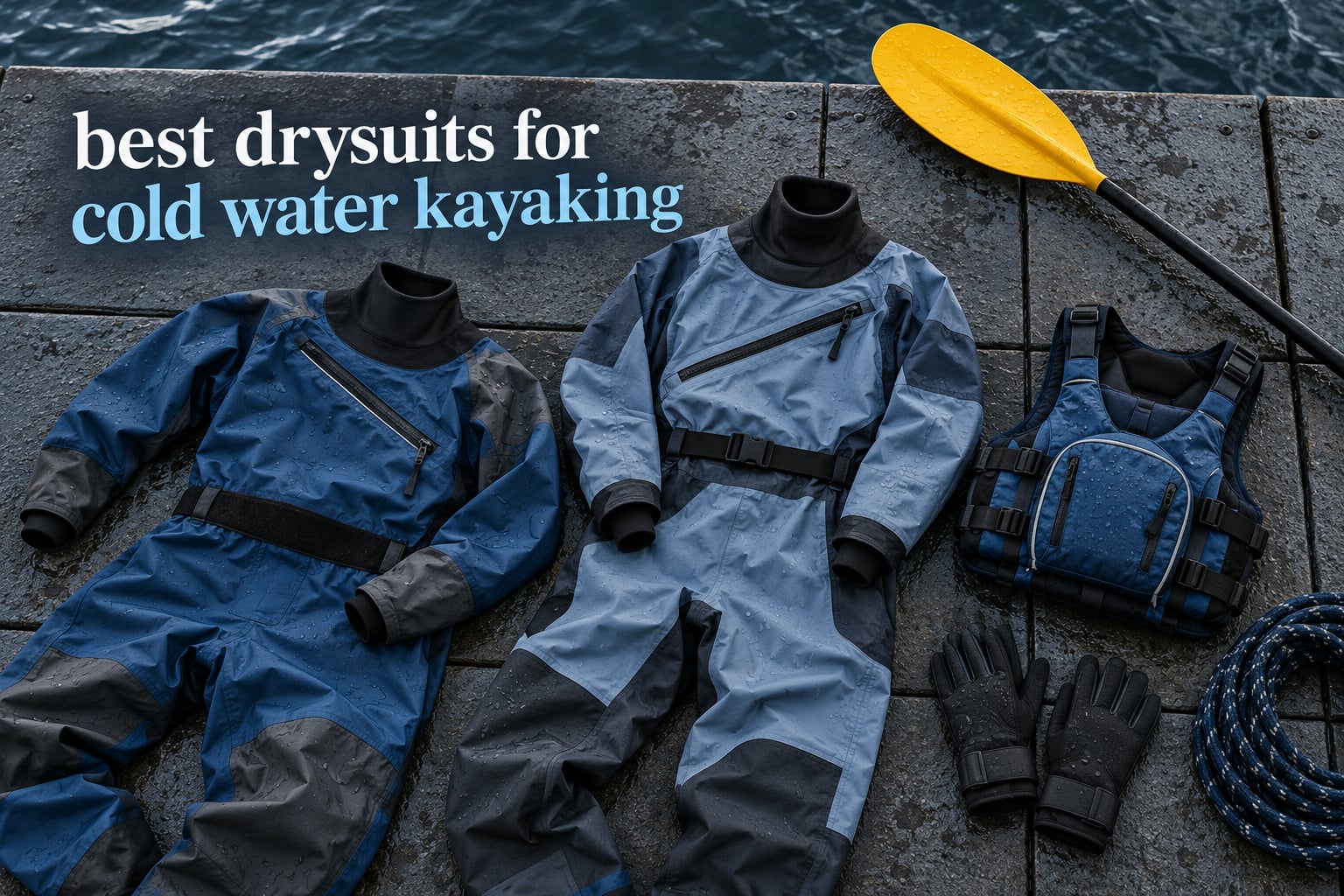
A drysuit is a full-body waterproof garment that seals water out at the neck, wrists and ankles while letting sweat vapour escape. A wetsuit works the opposite way, trapping a thin layer of water against your skin and relying on your body to keep it warm. That single design difference is why the best drysuits for cold water kayaking are a separate category of gear rather than a thicker wetsuit.
We spent weeks reading spec sheets, owner reviews and forum threads to build this list, and one pattern came up constantly. Cold hands and cold feet push people off the water far more often than a leaky torso does. Most roundups list suits by activity, and none list them by water temperature, which is the decision a cold water paddler actually makes.
Every suit below is rated for paddling in genuinely cold water. We have included fabric suits for shoulder-season outings, neoprene suits for people who work in the cold, and three women’s specific patterns that most roundups skip entirely. Prices move daily, so use the buttons rather than any figure you may remember. If you have read our winter drysuit guide already, this is the cold-focused companion to it.
Table of Contents
Top 3 Picks for Best Drysuits for Cold Water Kayaking (October 2026)

Gill Pro Drysuit
- XPLORE+ 3 layer fabric
- PFAS free water repellent
- Taped seams with reinforced knees
- Fabric socks

PKEDW Women’s Hooded Dry Suit
- Three layer waterproof fabric
- OEKO-TEX 160D P/Taslon FD
- Integrated latex socks
- Removable hood

Level Six Emperor
- exhaust 3.0 fabric
- Cordura at shoulders and knees
- Adjustable neoprene overcuffs
- Front relief zipper
Best Drysuits for Cold Water Kayaking in 2026
Membrane type, seal material and entry style decide most of the outcome before brand does.
| Product | Specifications | Action |
|---|---|---|
| Gill Pro Drysuit |
|
Check Latest Price |
| PKEDW Women’s Hooded Dry Suit |
|
Check Latest Price |
| Level Six Emperor |
|
Check Latest Price |
 Hollis NeoTek 8/7/6mm Hollis NeoTek 8/7/6mm |
|
Check Latest Price |
 NRS Ascent NRS Ascent |
|
Check Latest Price |
 Drryfsh Men’s Rescue Suit Drryfsh Men’s Rescue Suit |
|
Check Latest Price |
 Drryfsh Men’s Kayaking Drysuit Drryfsh Men’s Kayaking Drysuit |
|
Check Latest Price |
 Drryfsh Women’s Cold Water Dry Suit Drryfsh Women’s Cold Water Dry Suit |
|
Check Latest Price |
 Gill Verso Women’s Gill Verso Women’s |
|
Check Latest Price |
 Cressi 4mm Compressed Neoprene Cressi 4mm Compressed Neoprene |
|
Check Latest Price |
 Bare Aqua Trek Tech Bare Aqua Trek Tech |
|
Check Latest Price |
 SCUBAPRO Definition HD SCUBAPRO Definition HD |
|
Check Latest Price |
1. Gill Pro Drysuit – The Editor’s Choice Cold Water Suit Here
Mens Pro Drysuit – Fully Waterproof, PFAS Free Water Repellent, Windproof, & Highly Breathable (Black, XL)
XPLORE+ 3 layer fabric
PFAS free water repellent
Taped seams, reinforced knees
Fabric socks
Pros
- Dry and warm on multi-week cold water projects
- Lightweight and quick to don and doff
- Inseam works well for taller paddlers
- Good construction for the money
Cons
- No relief zipper for onshore breaks
- Runs about one size large
- Neck seal trimming is required out of the box
This is the suit we kept reaching for, because it does not behave like specialist cold water kit. Sailors, canoeists and instructors all use the same pattern, and the XPLORE+ three-layer fabric handled anything from drizzle to a full swim-bridge without complaint.
There is no neoprene bulk here, so the suit goes on and comes off in a way that makes a 6 am launch feel normal. The internal adjustable elastic suspenders and stretch waist do more for comfort than the marketing language suggests.

Owners repeat two things. Cold-water users report staying dry and warm across multi-week projects, and the inseam is reported as genuinely long, which matters if you are tall and slide forward in the cockpit.
The one complaint worth taking seriously is the missing relief zipper. On a day of launching, landing and beach breaks that is a real inconvenience. There is also a single report of water tracking in at the armpit seams, which other owners did not reproduce.
What to check before you order
Trimming the pre-marked Glideskin neck and cuff seals is part of the first outfit and catches people out, so allow ten calm minutes and read the lines before cutting. Sizing runs large, so take the smaller size if you are between sizes and want a thermal layer underneath.
Who should skip it
Skip it for whitewater or surf. There is no reinforced seat and knee system like the Drryfsh and Level Six suits carry, and the fabric socks are not grippy, so anything past a calm sheltered paddle wants neoprene boots over the top.
2. PKEDW Women’s Hooded Dry Suit – Three-Layer Construction Without the Premium
PKEDW Women’s Hooded Dry Suits for Cold Water Kayaking & Whitewater Paddling – Waterproof & Lightweight (Green, Small)
Three layer fabric
OEKO-TEX 160D P/Taslon FD
Latex neck and wrist seals
Integrated socks
Pros
- Three layers of waterproof material with coatings
- Integrated socks and removable hood for full coverage
- Self-draining neoprene over-cuffs
- OEKO-TEX certified fabric
Cons
- No written customer reviews to draw on
- Limited independent brand reputation
- Latex seals are not suitable for every paddler
Most drysuits in the guides we read are cut for a male torso, which leaves many women with a stocky chest and long arms. This one is patterned for women and specified for cold water kayaking and whitewater.
The construction is the interesting part: three layers of advanced waterproof material with special coatings, OEKO-TEX certified 160D P/Taslon FD fabric, British imported latex gaskets at the neck and sleeves, and integrated waterproof latex socks.
A detachable hood, adjustable internal suspenders and a dual-adjustable overskirt show that someone thought about actual paddling. The bungee drawcord waist pulls in excess suit, and the sleeve and thigh pockets mean you are not storing kit in a deck bag.
Why the self-draining cuffs matter
The over-cuffs do not stop water past the gasket, but they let any small seep run out of the cuff rather than pool inside the sleeve. Over a long day that is the difference between a damp wrist and a wet arm.
The fabric is a lightweight nylon with medium stretch, cut standard rather than race, which is the right call when you want room for a thermal layer. If you paddle in near-freezing conditions, check the sleeve length with your underlayer on.
What to watch for
The honest caveat is the review base. All eight ratings are five star with no written commentary, so you are buying on construction detail rather than years of owner reports. Try it on with a thermal layer underneath, which is the only way to know whether the cuff trim suits you.
3. Level Six Emperor – Cordura Where Your Paddle Actually Wears
Level Six Emperor Dry Suit-CraterBlue-S
exhaust 3.0 fabric
Cordura at shoulders and knees
Neoprene overcuffs
Front relief zip
Pros
- Cordura at the high-abrasion zones
- Neoprene overcuffs adjustable at neck and wrist
- Front relief zipper for onshore breaks
- Unrestricted movement pattern
Cons
- Listing text was ambiguous about entry zipper side
- Only two colour and size variants listed
Level Six built this one for paddlers rather than adapting a pattern, and the specification shows it. Cordura sits at the shoulders, wrists and knees, which are the three places a drysuit fails first after a season of putting the paddle down on gravel ramps.
The exhaust 3.0 fabric is a three-layer waterproof material that vents well, and the unrestricted movement pattern keeps the shoulders free for a full rotation. The front relief zipper handles the repeated launch-and-land cycle of a river trip without an undress.
Adjustable neoprene overcuffs at the neck and wrist are the detail we would single out. They sit over the gasket, add warmth at the joint and are trimmable, so you can tune the seal after the first few sessions.
Why the reinforcement layout matters
The weak point of a drysuit is rarely the fabric, it is the seam tape. Shoulders, seat and knees behind the knee take both abrasion and repeated flexing, which is exactly where Cordura pays for itself on a hard-wearing suit.
The overcuffs also cut the water that tracks down your arm after a swim-bridge, and they are far easier to live with than a stiff bare gasket. If you are sensitive to latex, this is one of the safer picks here.
Confirm before you buy
The listing text was ambiguous about whether the entry is front or rear, and the buyer who flagged it got a correction from the seller. Confirm it, because a rear entry seals better but is much harder to put on alone. Size availability is also narrow, so buy from a seller with a straightforward return policy.
4. Hollis NeoTek 8/7/6mm – The Thickest Insulation in the Group
Hollis Mens NeoTek 8/7/6mm Semidry Dive Drysuit – Large
8mm, 7mm and 6mm neoprene
Full body with neck and wrist seals
Thigh pockets with D-rings
4 pounds
Pros
- Reported warm in 49 to 53F water
- Comfortable for hours of continuous use
- Thigh pockets with internal D-rings
- Manufacturer sizing chart reported accurate
Cons
- Runs small
- most buyers size up one or two
- Hard to don and doff especially head and arms
- Pockets have no drain holes
This is the only suit here built primarily for scuba work rather than paddling, and that is exactly why it belongs. Divers report using it in 49 to 53 degree Fahrenheit water without discomfort, which is colder than most paddlers will ever see.
The construction is multi-thickness neoprene at 8mm, 7mm and 6mm with a full body cut and neck and wrist seals. The horizontal front zipper with internal bib runs across the chest rather than over the shoulders, so it does not fight your range of motion.
At four pounds it is light for a suit this thick, and the thigh pockets with internal D-rings are useful for clipping a light. Owners repeatedly call out the quality of the stitching and lining.
The neoprene trade-off
Neoprene insulates by trapping water, the opposite of what a drysuit shell does. That buys warmth and gives up breathability, so a suit this thick is comfortable underwater and stuffy on a long paddle in air.
Donning is the other cost. Getting your head and arms through 8mm neoprene alone is a genuine chore, and doing it on a windy shoreline is where cold fingers first appear. Practice at home before you need it.
Who this is wrong for
Skip it if you want to layer, because the thickness fills the cockpit space you would use for a base layer. Sizing runs small, and most buyers recommend one or two sizes up, so follow the manufacturer chart rather than your usual brand size.
5. NRS Ascent – Built for Cold Rivers and Rescue Work
NRS Ascent SAR Dry Suit-Red-L
3 layer TriTon fabric
YKK Aquaseal front entry
Cinchable neoprene neck
Shoulder badge patches
Pros
- Reported dry on a cold wet river in heavy water
- Durable 3 layer TriTon construction
- Cinchable neoprene neck closure
- Shoulder patches for department badges
Cons
- Small size range with no XL in the current set
- Only three reviews with no failure modes documented
The NRS Ascent comes out of a search and rescue lineage, and the details make that obvious. Hook and loop shoulder patches let a team put a department badge on, and the safety yellow colourway exists for exactly the situation where you need to be found.
The fabric is 3-layer TriTon, a durable laminate built for abrasion and repeated flexing rather than for weight. Front entry uses a YKK Aquaseal zipper, standard on good drysuits because the coil stays smooth across the membrane when it flexes.
The written owner review is the most useful single piece of evidence on this list. A paddler on a cold wet river in heavy water reports staying dry and calls it the best river investment they have made.
Why the neck closure matters
The cinchable neoprene neck will not give you the long life of latex, but it is far more forgiving on a cold morning and far less likely to end your session at neck level. It also avoids latex entirely, which removes one variable when testing a new suit.
Limits of the evidence
Three reviews is not a track record, and all of them are positive, so no failure modes are documented anywhere. Check the size run before ordering, because the current variant set tops out at large with no extra large listed.
6. Drryfsh Men’s Cold Water Rescue Suit – The Most Complete Package
Dry Suits for Men in Cold Water Water Rescue Suit with Detachable Hood for Whitewater Canyoneering Kayaking Exploring (Red, X-Large)
Recycled 3 layer nylon
British latex gaskets with overcuffs
Reflective trim
Relief zip
Pros
- Stays dry and warm over thermal layers
- Double-tunnel overskirt seals to a sprayskirt
- Removable seat and knee pads
- Whistle and repair kit included
Cons
- Neck seal requires trimming before first use
- Small review pool with no long term reports
Everything you would want in a boat or on a riverbank arrives in the box. The whistle, the repair kit, the removable seat and knee pads and the reflective stripe are not small extras, and most suits at this level ship without them.
The fabric is 3-layer nylon made from 100 percent recycled materials, with British latex neck and wrist gaskets protected by fabric overcuffs. Verified buyers report the material quality as excellent and the suit keeping them dry and warm over thermal layers.
The double-tunnel neoprene waist overskirt with double-pull closure is what makes this a paddling suit rather than a general drysuit, because it seals to a sprayskirt tunnel and stops water tracking into the cockpit on a wet day.
Visibility and the rescue angle
Reflective patches and a stripe do nothing at midday and everything at a winter dusk launch. Removable seat and knee pads take the abrasion that would otherwise go through the membrane at your heaviest contact point, and they can be swapped when they wear out.
What to expect on day one
The neck seal needs trimming before the first use, and every suit here does, so budget the time to do it calmly at home. A rushed first trim in a car park is how people end up with a seal that never stops leaking.
7. Drryfsh Men’s Kayaking Drysuit – Made to Layer Over Thermals
Drryfsh Mens Drysuits for Kayaking & Cold Water Sports (Large)
3 layer tricot backed nylon
Fully taped seams
Relaxed cut for thermals
Removable knee pads
Pros
- Relaxed cut designed for thick thermal layers
- Fully taped seams on tricot backed nylon
- Removable knee and drop seat pads
- Every suit is fill tested by the manufacturer
Cons
- No written customer reviews
- Only four sizes with no Small offered
- Rear entry is harder to put on alone
This is the suit to look at if your plan is serious insulation. The specification says it plainly: a slightly relaxed fit to allow thicker thermal layers, in 3-layer nylon with a tricot finish and fully taped seams. Most drysuits are cut close, which is comfortable alone and useless the moment you need a fleece underneath.
Everything else follows from that decision. Removable knee and drop seat pads reduce abrasion in the two places a kneeling paddler wears through first, and two splashproof zippered thigh pockets keep kit out of the cockpit.
Rear entry with a relief zipper and double waist overskirt suits a touring paddler. Rear entry seals better and leaves the front free for a PFD, and the relief zipper handles the onshore break without a full undress.
Why layering room decides it
Warmth in a drysuit comes almost entirely from what is underneath. A suit that fits close locks you out of the layering options you will need on the coldest days, which is why we call this one out separately.
The tradeoff is cockpit space. A relaxed suit with a thick underlayer takes noticeably more room between your knees, which is a non-issue in a wide touring boat and cramped in a short narrow kayak. Try it seated before you commit.
What the size run tells you
Four sizes are offered with no small, and sizing varies considerably between drysuit makers. One paddler in a forum sizing thread found the same nominal size fitted two brands completely differently, so measure against the chart rather than trusting your usual size.
8. Drryfsh Women’s Cold Water Dry Suit – Back Entry and a Drop Seat
Drryfsh Women’s Cold Water Dry Suits for Kayaking, Rafting,Canoeing,Paddling,Sailing,Boating (Medium)
Tri-laminate with taped seams
Back entry TIZIP
Drop seat relief zipper
Contoured panels
Pros
- Back entry removes front pressure points
- Drop seat for long days on the water
- Contoured panels reduce snagging
- Full size range from Small to XX-Large
Cons
- Single review with no written detail
- No published long term waterproofing history
Back entry is the quiet luxury in a drysuit. You step in, pull the suit up and zip it behind you, and the front of the body is uninterrupted, so there is no zipper digging into your chest under a PFD during a forward lean.
This model uses a back-entry TIZIP waterproof zipper, a smooth-seal style that stays flexible across the shoulders. With contoured body panels and reinforced seat and knees, it is a sensible pattern for a woman who wants to stay in the boat all day.
A drop seat relief zipper, a self-drain chest pocket, a stowable hood, removable suspenders and a twin waist overskirt with a bungee drawcord add up to a complete suit rather than a shell with accessories.
Why the drop seat matters more than it sounds
A full undress to use the toilet is how people get cold. A drop seat is a fabric flap with a waterproof zip that opens at the back, so you can do the job and stay dry. On a twelve-hour trip in cold water, that is the difference between a comfortable day and a ruined one.
What you are buying on faith
There is exactly one review and it carries no text, so the rating tells you nothing about warmth, fit or longevity. The size range from Small to XX-Large is unusual in this category, though, and worth something on its own.
9. Gill Verso Women’s – A Drop Seat Entry and a Grown-On Hood
Gill Womens Verso Drysuit – Fully Taped & Waterproof for Watersports Dinghy, Sailing, Kayaking, Canoeing, SUP, Paddleboard (Marine Blue, 8)
XPLORE 3 layer fabric
Women's drop seat entry
Grown-on adjustable hood
Neoprene gaskets
Pros
- Women's specific drop seat entry
- True to size on a 5 foot 4 curved frame
- Velcro waist cinches excess suit
- Reinforced backseat and knees
Cons
- Only one customer review
- Costs more than other entry-level drysuits
The owner review describes the fit problem almost every woman reports. It is a women’s specific cut that fits a 5 foot 4 curved body properly, unlike most drysuits, and the reviewer cinches the excess suit with the Velcro waist to get a true-to-size fit.
The grown-on hood with two-way adjustment and a shock cord retaining loop stays put when you look where you are going. The offset YKK anti-corrosion zip has a fleece inner chin guard and laser-cut ventilation holes, which is thoughtful engineering for a garment zipped to your neck for hours.
Inner neoprene gaskets at the neck and cuffs avoid latex entirely, and a PFD friendly zip sleeve pocket keeps a whistle accessible without opening the suit. Reinforced backseat and knees match the wear pattern of a seated paddler.
The hood and gasket combination
Neoprene is warmer and far easier to live with than bare latex, at the cost of some seal longevity, and it is the right default for a first cold water suit. A seal you can keep wearing beats a better seal you loosen the moment it bites.
Where it falls short
There is one customer review, so durability is untested, and the XPLORE fabric has no stretch listed, so it will not take a heavy thermal layer as gracefully as a stretch panel suit. A fixed hood is also one more thing you cannot strip on a warm day.
10. Cressi 4mm Compressed Neoprene – Warmth at a Lighter Weight
Cressi Desert 4 mm Men’s Drysuits, Black, L
4mm pre-compressed neoprene
Liquid sealed seams
BDM dorsal zipper
Soles-less booties
Pros
- Warmth at lower weight than 7mm neoprene
- Liquid-sealed seams resist wear and fraying
- Dorsal zipper keeps elasticity in the back
- Less bulky undergarments needed
Cons
- Markedly higher cost than fabric suits for similar warmth
- Soles-less booties give limited traction
- Review spread includes three and one star responses
Cressi compresses 7mm neoprene down to 4mm, which keeps most of the thermal performance at a noticeably lower weight and with less bulk than a traditional thick suit. The specification also notes a reduced weight belt requirement and less bulky undergarments.
The liquid seal on all seams is the durability story. Rather than just tape, the seams are liquid sealed, which adds wear and fray resistance over years. The marine brass BDM dorsal zipper keeps the suit’s elasticity in the back where a front zip would restrict it.
It carries one of the larger review pools on our list, and the feedback is genuinely mixed at 4.0 stars with 55 percent five star responses and a meaningful share of three and one star responses. We would rather show that spread than hide it.
The cost question
This costs markedly more than fabric drysuits that deliver comparable warmth for paddling, and that is the honest headline. Neoprene construction is not the efficient choice for kayak drysuits, because it exists for underwater work where pressure and compression matter.
If you only paddle, the same money spent on a three-layer suit plus a thermal layer and neoprene boots will keep you warmer for longer. If you occasionally dive for a line or work in the water, the extra cost buys something fabric cannot give you.
Boots and traction
The booties are reinforced only at the support areas and have no soles, so traction is limited. Add proper boots for a rocky shore. The suit is designed in Italy and made in Cambodia, and sizing runs from small through 3X-large.
11. Bare Aqua Trek Tech – Lightweight Stretch for Moving Fast
Bare Mens Aqua Trek Tech Dry Drysuit… (Medium Large)
Lightweight stretch nylon
Front zipper entry
Double-taped wear seams
Hand wash care
Pros
- Stretch fit gives good range of motion
- Lightweight fabric class for a membrane drysuit
- Double-taped reinforcement at critical wear points
Cons
- Only two reviews
- so durability is unproven
- Hand wash only care limits convenience
Most membrane drysuits here are quiet, stiff and slightly restrictive, which is the correct trade for abrasion resistance but tiring over a long paddle. The Bare Aqua Trek Tech is built the other way, with a stretch fit noted for mobility and a lightweight fabric class.
Durability comes from construction rather than fabric. Flexible double taped reinforcement at critical wear seam points adds a second layer exactly where flexing and abrasion meet, which is the right approach on a stretch shell.
Both available ratings are four and five stars with no critical feedback, which is a positive but very small signal. Two reviews cannot tell you how a suit looks after a winter of putting the paddle down on gravel.
When stretch actually helps
Range of motion is not a comfort luxury in a kayak. Every forward reach and every brace uses your shoulders far more than walking does, and a shell that resists at the shoulder forces you to sit rotated in the seat. A stretch panel keeps you square.
Before you commit
Buy this if you paddle fast, paddle a narrow recreational kayak, or want the least effort at the ramp. Do not buy it if you plan to wear thick insulation, because the close stretch fit is the entire point. Care is hand wash only, which is gentler on taped seams and more annoying than most people expect.
12. SCUBAPRO Definition HD – The Heaviest Build and a Two-Year Warranty
SCUBAPRO Definition Dry HD Men’s Scuba Diving Drysuit, Heavy-Duty Trilaminate Design, X-Large
Poly/butyl/poly trilaminate
BDM front diagonal dry zipper
Latex seals with neoprene collar
Si-Tech valves
Pros
- Stitched
- glued and double taped seams
- Hood
- hose
- repair kit and manual included
- Latex seals with neoprene collar
- Two-year warranty
Cons
- Highest cost in the group
- Only two reviews with no long term feedback
- Heaviest build at 5.5 kilograms
This is the suit you buy when the answer to how cold it is does not matter. The construction is heavy-duty poly/butyl/poly trilaminate, and the seams are stitched, glued and double waterproof taped, the most thorough seam specification on this list.
Everything else follows an expedition brief. Latex wrist and neck seals with a neoprene collar, Si-Tech valves on stitched and glued pads, two large cargo pockets with D-rings and bungee, and attached semi-rigid dive boots with soft anti-slip soles.
It ships as a complete package with a hood, bag, hose, repair kit and manual, and carries a two-year warranty, the clearest warranty commitment anywhere in this roundup. Verified buyers describe the build quality as excellent.
What the heavyweight build buys you
Trilaminate suits put a barrier fabric on both sides of the membrane, which is what stops a puncture from becoming a hole. Stitched, glued and double taped seams apply the same reasoning to the weak points, which is a suit meant to be repaired rather than replaced.
Where it does not fit
At 5.5 kilograms for a medium it is by far the heaviest suit here, and that is felt immediately in a kayak. There are two reviews and no long term owner feedback, so keep the proof of purchase, because warranty service at this level is worth using.
Drysuit vs Wetsuit for Cold Water Kayaking
In cold water, the drysuit wins, and not by a small margin. A wetsuit traps a layer of water against your skin and lets your body heat it, and that layer insulates only while it stays put and warm. Once you are moving hard or after a swim-bridge flushes it out, you lose insulation at the moment you need it.
A drysuit keeps water out entirely. It traps still air and your insulation between your body and the shell, and because that air is not being replaced with cold water, the suit keeps working as you paddle. That is also why a thin fabric suit can feel warm when a thick wetsuit does not.
There is a real cost to that. A wetsuit is easier to get into, it flexes with you, and it needs no base layer above about 15 degrees Celsius. For a sheltered lake in mild weather a few times a summer, a wetsuit is the correct and cheaper answer.
The switch-over point in most forum advice is simple. A calm lake paddle on a mild day is fine with a good wetsuit and genuinely cold water is not. Below roughly 10 degrees Celsius, a full drysuit with an insulating underliner is standard practice, because the failure mode is hypothermia and not technique.
Neither system solves cold hands. Our picks for insulated swimming boots matter more to most paddlers’ comfort than the choice between a 3mm and a 5mm wetsuit, and a drysuit without neoprene gloves will end your day early.
What to Wear Under a Drysuit in Cold Water
This is the most repeated question on paddling forums and the one most roundups skip. The rule is simple: the shell stops water, the underlayer creates warmth.
Above 15 degrees Celsius (59 degrees Fahrenheit), a short-sleeve synthetic or merino base layer is enough for a recreational paddler. A wetsuit top under a drysuit is overkill on a moving boat.
Between 10 and 15 degrees Celsius (50 and 59 degrees Fahrenheit), add a long-sleeve base layer plus a light fleece or grid fleece. Grid fleece moves moisture off your skin while trapping little heat, which makes it the safest all-round choice.
Between 5 and 10 degrees Celsius (41 and 50 degrees Fahrenheit), you want a proper thermal suit or a two-piece fleece and windproof system. This is where the layering room in your suit decides whether you are comfortable.
Below 5 degrees Celsius (41 degrees Fahrenheit), treat it as an immersion problem. Carry a change of clothing, a whistle and a plan for getting warm again immediately after a capsize. One warning deserves repeating: overheating inside a drysuit is real, because sweating in a cold environment cools you faster than the air would.
How to Choose a Cold Water Drysuit
Buying in the wrong order wastes money. Membrane first, then gaskets, then entry, then fit. Here is how we would work through it.
Pick the membrane, not the label
A three-layer laminate puts a face fabric on both sides of a waterproof membrane, which is the paddling standard and what all but the neoprene options here use. Four-layer adds a liner for abrasion resistance, which helps on rock and in a boat but adds bulk.
Premium membranes such as the Mil-Spec GORE-TEX used in rescue suits cost more and among them are the most breathable, which reduces sweat build-up over a long day. That matters more than raw waterproofness, because a suit that makes you sweat makes you cold later.
Budget PVC-backed nylon suits are the entry point, and the forum verdict is consistent: they are uncomfortable before you even get wet, especially sitting on a windy beach between runs. Fine on a sheltered lake, not what you want in genuinely cold water.
Choose gaskets you can live with
Gaskets are the seal at the neck, wrists and ankles, and they are where most leaks and complaints come from. Latex seals better and lasts longer than anything else, but a measurable minority of paddlers develop a sensitivity and need to move to neoprene or silicone.
Neoprene is warmer, more forgiving and easier to trim, at the cost of seal longevity. Many brands add a fabric or neoprene overcuff, which reduces water tracking after a swim-bridge. We would prioritise a trimmable seal of any material over a better seal of one you cannot tolerate.
Decide on entry and relief
Front entry is easiest to handle alone at a windy launch ramp, and a front relief zipper handles onshore breaks without undressing. Rear entry seals better and leaves the front free for a PFD but is much harder to put on by yourself. A diagonal zip is a compromise most people accept.
A relief zipper is not a luxury. Across a trip with multiple launches, a lunch stop and a swim-bridge, the difference between a zip and a full undress is the difference between staying dry and not. The women’s suits here are best on this point, with a drop seat that needs no undress at all.
Get the fit right, then add the rest
A drysuit should fit close enough not to balloon in the cockpit and loose enough to take your base layers. Sizing varies considerably between brands, so measure height, chest and inseam against the chart rather than trusting your usual brand size.
For tall and skinny paddlers, made-to-measure is worth the cost and is actively sought on forums, where people report the same nominal size fitting two brands completely differently. Finally, think about what fails first: seam tape at the shoulders, behind the knees and across the seat.
Cold Water Safety: What a Drysuit Can and Cannot Do
A drysuit is a survival garment, not a guarantee. It keeps you dry and it keeps your insulation working, and that buys you time. It does not make cold water safe, and it does nothing for a paddler who is cold, tired and slow to respond.
Many paddlers carry what is known as the 120 rule: if the water is at or below 60 degrees Fahrenheit, which is about 15 degrees Celsius, you should be wearing a drysuit. It is a simple default for anyone who is not certain.
Beginners asking on forums whether it is safe to paddle in cold water often cite a survival window of roughly three to thirty minutes after immersion, depending on water temperature and clothing. That framing is right. Treat any capsize in cold water as an emergency requiring immediate self-rescue and immediate rewarming.
Finally, wear the suit. A drysuit that stays folded in a garage through October is the most expensive piece of gear you never used, and the least safe. Get in it, get it wet in a bathtub, learn to trim the gaskets, and know what you are doing before the water is at its coldest.
Frequently Asked Questions
Do drysuits keep you warm in cold water?
Yes, but only with the right underlayer. A drysuit keeps water out and traps still air and insulation against your body, unlike a wetsuit which relies on a warm water layer against your skin. That trapped air is not flushed out as you paddle, so a thin fabric suit can feel warm where a thick wetsuit feels cold after a capsize. The warmth itself comes from what you wear underneath, so below about 10 degrees Celsius you need a proper thermal underliner as well as the shell.
What should I wear under a drysuit in cold water?
Match the underlayer to the water. Above 15C a short-sleeve synthetic or merino base layer is enough. Between 10 and 15C add a long-sleeve base and a light grid fleece. Between 5 and 10C use a full thermal underlayer or a two-piece fleece and windproof system. Below 5C treat it as immersion clothing and carry a dry change of clothes, a whistle and a plan to get warm fast. Grid fleece moves sweat off your skin, which matters because sweating inside a drysuit cools you quickly.
Is latex or neoprene better for drysuit gaskets?
Latex seals better and lasts longer, and it remains the default for good drysuits. Neoprene is warmer, softer against the skin and far easier to trim, and it is the right choice for anyone with a latex sensitivity. Many suits add a neoprene or fabric overcuff over the seal to cut down water tracking after a swim-bridge. We would prioritise a trimmable seal in a material you can tolerate over a marginally better seal in one you cannot.
How should a drysuit fit?
Close enough that it does not balloon in the cockpit, loose enough to take your base layers. A close fit cuts bulk and improves mobility but eliminates your layering options, while a relaxed fit gives you room for thick thermals at the cost of cockpit space. Sizing varies considerably between brands, so compare your height, chest and inseam against the manufacturer chart rather than relying on your usual brand size. Read the fit reviews before you order, and try it on seated if you can.
Do you need a relief zipper on a drysuit?
For most winter paddling, yes. A relief zipper lets you handle onshore breaks without undressing, and a drop seat goes further by letting you use the toilet in a suit that stays on your body. On a trip with multiple launches, a swim-bridge and a lunch stop, the difference between a zip and a full undress is often the difference between staying dry and not. Several of the women-specific suits here use a drop seat rather than a standard relief zip.
What is the 120 rule in kayaking?
It is a widely used rule of thumb: if the water is at or below 60 degrees Fahrenheit, which is about 15 degrees Celsius, you should be wearing a drysuit. It is not a hard safety boundary, but it is a simple default for paddlers who are unsure. Below that temperature a wetsuit loses its insulating advantage once you are moving hard or after a capsize, and a full drysuit with an insulating underliner becomes the standard rather than the optional choice.
Conclusion: Which Cold Water Drysuit Should You Buy
The Gill Pro Drysuit is our pick as the best drysuits for cold water kayaking choice in 2026, because it does the fundamentals well, weighs almost nothing, and works across kayaking, canoeing and sailing without changing anything. If you need a women’s specific pattern, the PKEDW suit gives you full three-layer construction and integrated socks, and the Drryfsh women’s model adds a back entry and a drop seat.
Match the suit to your water temperature, buy the underlayer at the same time, and do not skip the gloves and boots. If you split your season between sitting and standing on the water, our winter SUP drysuit guide covers the standing version.