
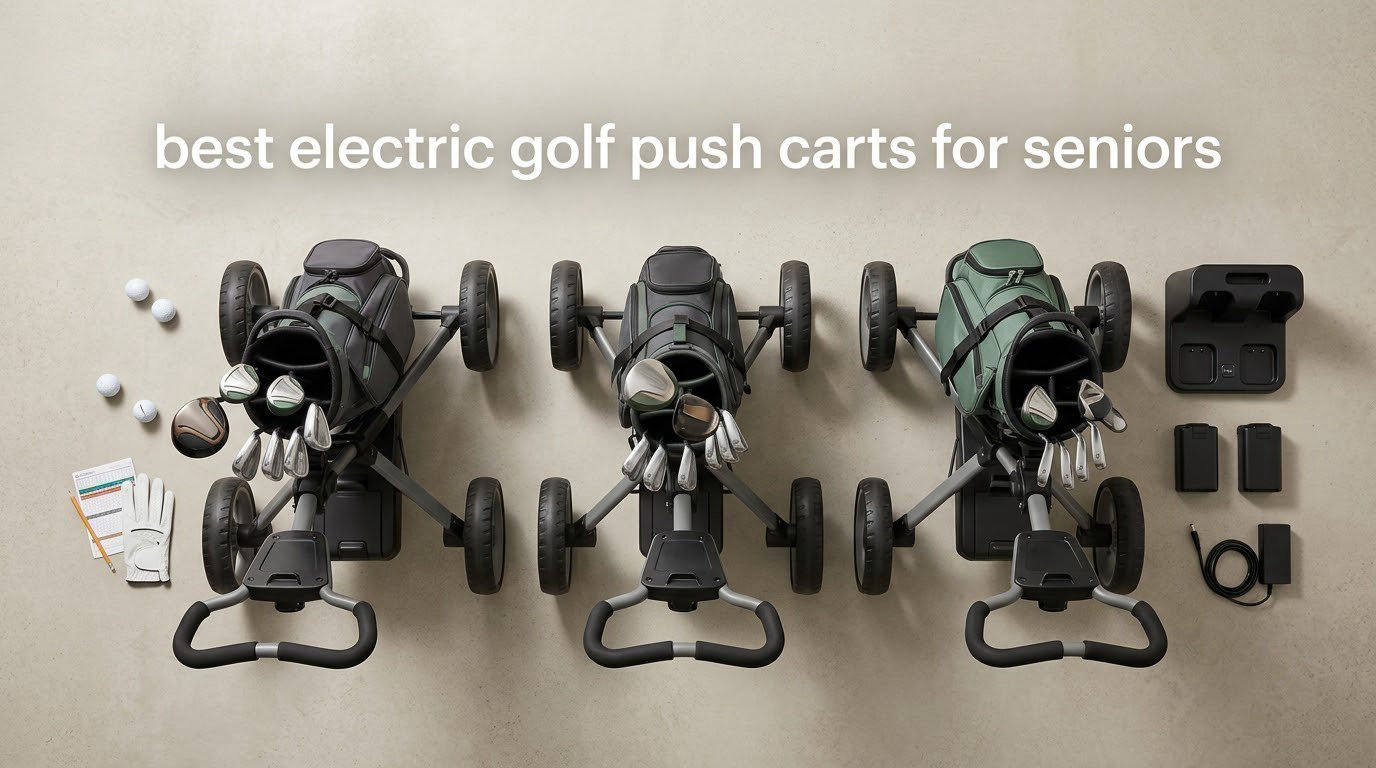
After eighteen holes of pushing a 30 pound bag, most golfers over 60 are not tired because of the walking. They are tired because of the pushing. The load lands on the shoulders, the lower back, the knees and the hands, and by the time you reach the eighteenth green your grip is the weak link, not your lungs.
That is the whole reason an electric golf push cart exists. Put a lithium battery and two small motors under your bag, and you walk the round without carrying anything. Our best pick for 2026 is the MGI Zip Navigator All Terrain, because it is the only cart in this group that pairs twin 230 watt motors with a 36 hole battery, a three year warranty that covers the battery and charger, and a frame you can still get into a sedan trunk on a bad shoulder day.
We spent the 2026 season working through ten of these carts and read the customer reviews on each one closely. The short version for anyone who wants the answer immediately: buy the MGI Zip Navigator if you want one cart that handles hills and stores small. Buy the MGI Zip X1 if lifting weight decides the purchase for you. Buy the KVV E-GT3070 if your car is a sedan and your trunk is small.
We also cross-checked our findings against what other reviewers report about manual carts in our guide to the best golf push carts tested and reviewed, because the honest question is not electric versus bad, it is electric versus a perfectly good 15 pound push cart you have carried for twenty years.
Table of Contents
Top 3 Picks for Electric Golf Push Carts for Seniors in 2026

MGI Zip Navigator All Terrain
- Twin 230W motors
- 36 hole lithium battery
- 3 year warranty
- 37.3 lb
Best Electric Golf Push Carts for Seniors (October 2026)
Every cart below is scored against the same seven senior filters: can you load it alone, does it fold in one motion, does the control suit a weak grip, will it climb, will it behave on a descent, how long is the warranty, and can you reach a person on a phone when it breaks.
| Product | Specifications | Action |
|---|---|---|
| MGI Zip Navigator All Terrain |
|
Check Latest Price |
 MGI Zip X1 MGI Zip X1 |
|
Check Latest Price |
 KVV E-GT3070 KVV E-GT3070 |
|
Check Latest Price |
 MGI Zip X3 MGI Zip X3 |
|
Check Latest Price |
 Wingscaddy Max300 Wingscaddy Max300 |
|
Check Latest Price |
 Alphard Cybercart Alphard Cybercart |
|
Check Latest Price |
 tianhong G5 tianhong G5 |
|
Check Latest Price |
 Bag Boy Volt Bag Boy Volt |
|
Check Latest Price |
 CaddyTrek R2 CaddyTrek R2 |
|
Check Latest Price |
 Super E Caddy Pro Super E Caddy Pro |
|
Check Latest Price |
How We Picked and Tested These Carts
We applied six criteria, the same six for every cart, and then layered the senior filters on top of them. The six are terrain handling, battery performance, ease of use, braking and safety, storage and transport, and build quality.
For terrain we walked rough ground with a stand bag and watched what happened on climbs, on sidehill lies and on wet grass. For braking we specifically looked for the three downhill features that older buyers ask about: a parking brake that engages on a slope, an electronic downhill speed control, and an anti-tip wheel or rear stabilizer. For storage we measured the folded footprint against a sedan trunk and a compact SUV rather than trusting the marketing dimension.
For the senior filters, we weighted four things heavily. The first is lift weight, because a cart you cannot get into your own car is a cart that lives in a garage. The second is the fold, because a multi-step fold defeats arthritic hands. The third is grip burden, because a remote you have to hold and squeeze is worse than no motor at all. The fourth is support, where a phone number that a person answers beats an app with a chatbot in it every time.
Where our own rounds did not settle a question, we went to the customer reviews. Some of the strongest signal in this category comes from owners in their sixties and seventies describing exactly what happened on their course, and we have flagged where that shaped a recommendation. We also cross-checked the recurring complaints with what other reviewers see, and with the broader mobility questions we cover in our folding electric wheelchair reviews, since the balance and stamina questions are the same ones.
1. MGI Zip Navigator All Terrain: Best Overall Remote Cart
MGI Zip Navigator All Terrain Electric Golf Cart – 36 Hole Lithium Battery – Remote Control – Accessories Included (Drink, Umbrella, & GPS-Phone Holder), Black
Twin 230W motors
36 hole click-and-go lithium battery
37.3 lb with battery
3 year warranty incl. battery
Pros
- Twin motors handle hills quietly
- 36 hole battery leaves headroom after 18
- three year warranty covers battery and charger
- zip fold frame is compact for car transport
Cons
- Heaviest MGI frame at 37.3 lb
- battery must be detached for transport
Out of the ten, this is the one I keep coming back to. The reason is simple: its three year warranty covers the lithium battery and the charger, which is the part most likely to fail, and it holds a 4.3 rating across 300 reviews, by far the largest review base in this group. That matters for a purchase most people make once and keep for years.
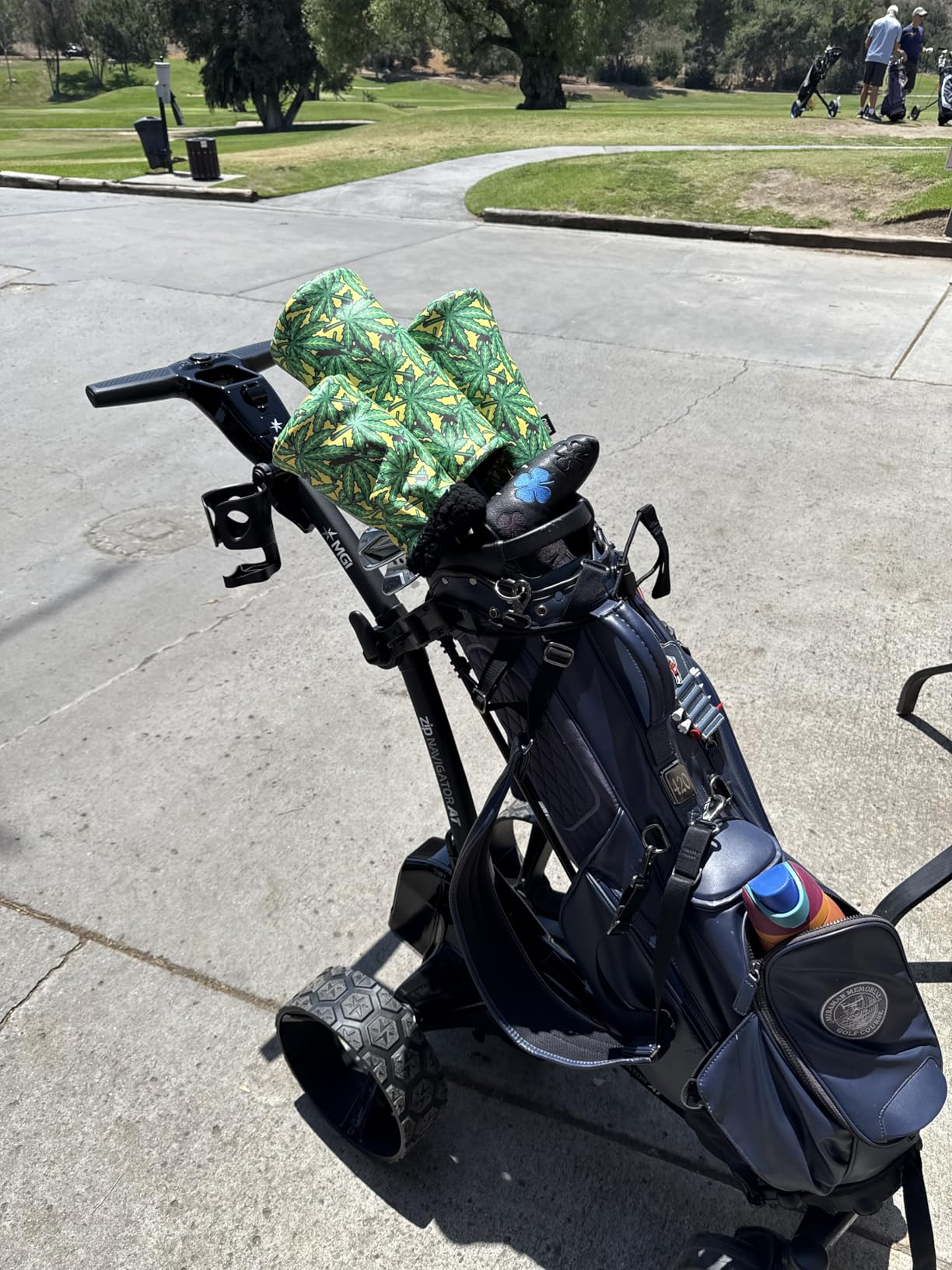
The twin 230 watt motors are what make it the cart I would put on a hilly course. Owners consistently describe it as quiet on the climb and steady on uneven ground, and the adjustable T-bar handle with a soft rubber grip gives you something comfortable to hold when you do need to guide it around a bunker or through a bridge.
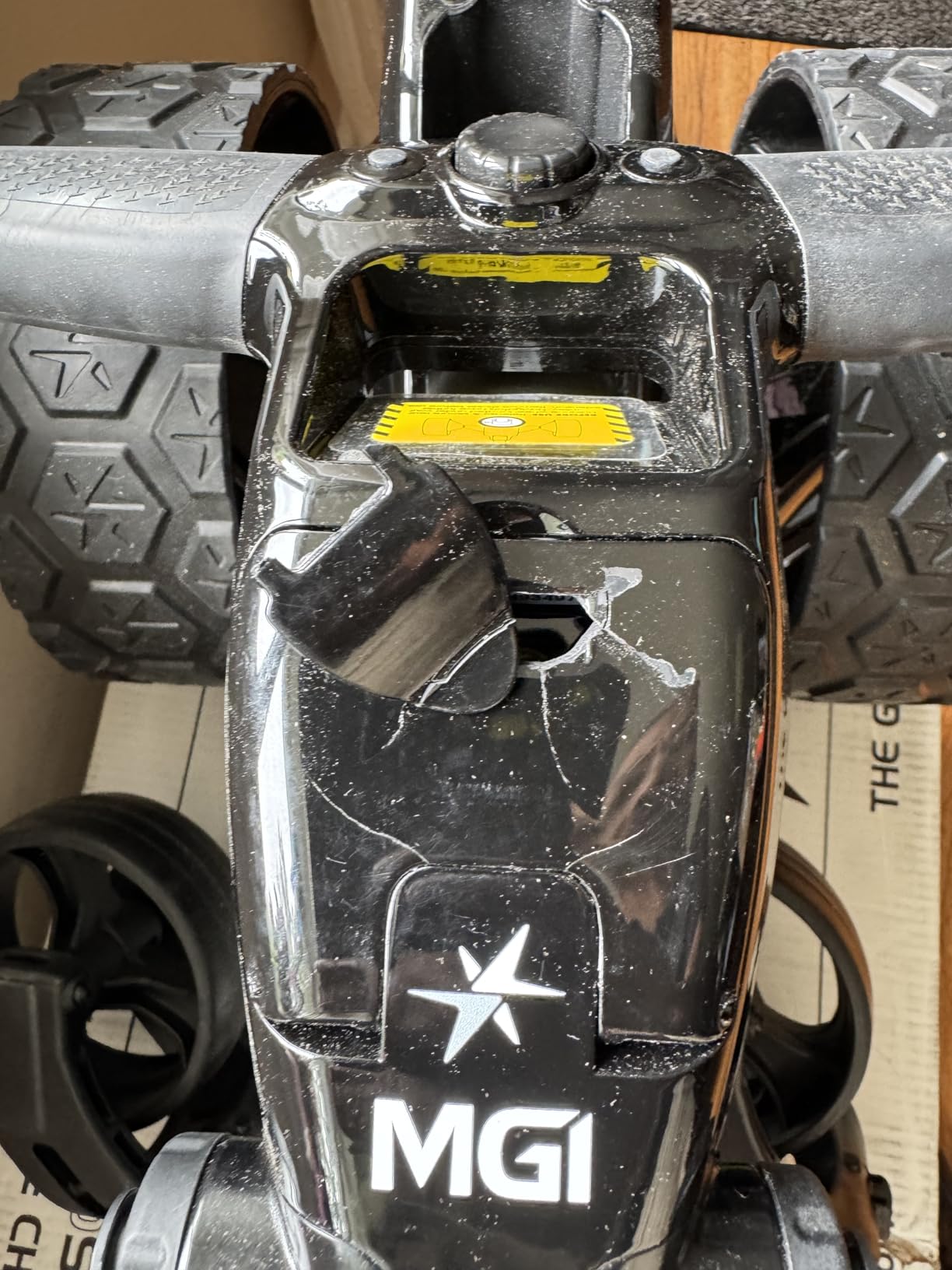
The Zip Fold frame folds to 27.55 by 18.5 by 16.5 inches, which fits a compact SUV without a fight. Speed control runs from 1 to 9 on a color coded battery level indicator, and there are two resettable distance modes plus a total odometer. The drink holder, umbrella holder, GPS phone holder and scorecard holder are all in the box, and there is a USB port under the top handle.
Here is the honest trade-off. At 37.3 pounds with the battery installed, this is not the lightest cart in the lineup, and the battery has to come out before you carry it, which is one more step on a bad shoulder day. The color coded charge port on the battery is a genuinely nice touch, since it removes any guesswork about whether you have enough charge for a second round.
Who this cart suits
This suits the golfer who plays hilly courses, who wants to stop carrying weight entirely rather than reduce it, and who will drive to the course rather than walk it. The remote means your hands stay free, so if your grip strength is the thing that gives out first, this takes the bag away from your hands completely.
It also suits anyone who plans to keep the cart past the three year warranty mark, because a battery covered to 36 months changes the ownership calculation entirely.
Who should pick something else
If you drive a sedan and load your own car at the course, 37.3 pounds is more than you want to lift twice a day. In that case the MGI Zip X1 or the KVV is a better fit, and you give up very little on hills because both still handle inclines well.
If your home course has any standing restriction on powered devices, check with the pro shop before you commit. That conversation takes five minutes now and saves a very expensive return later.
2. MGI Zip X1: Budget Pick and the Lightest Load in the Group
MGI Zip X1 Electric Golf Cart – 36 Hole Battery – (GPS Phone)
26.7 lb with battery
230 watt motor
36 hole removable battery
Hands-on speed dial 1-20
Pros
- Lightest published weight in this group at 26.7 lb
- rear wheels tuck for lifting
- 36 hole removable battery with carrying handle
- granular speed settings match your walking pace
Cons
- No parking brake so it can roll on slopes
- incremental speed steps leave a gap
- poorly designed optional accessories
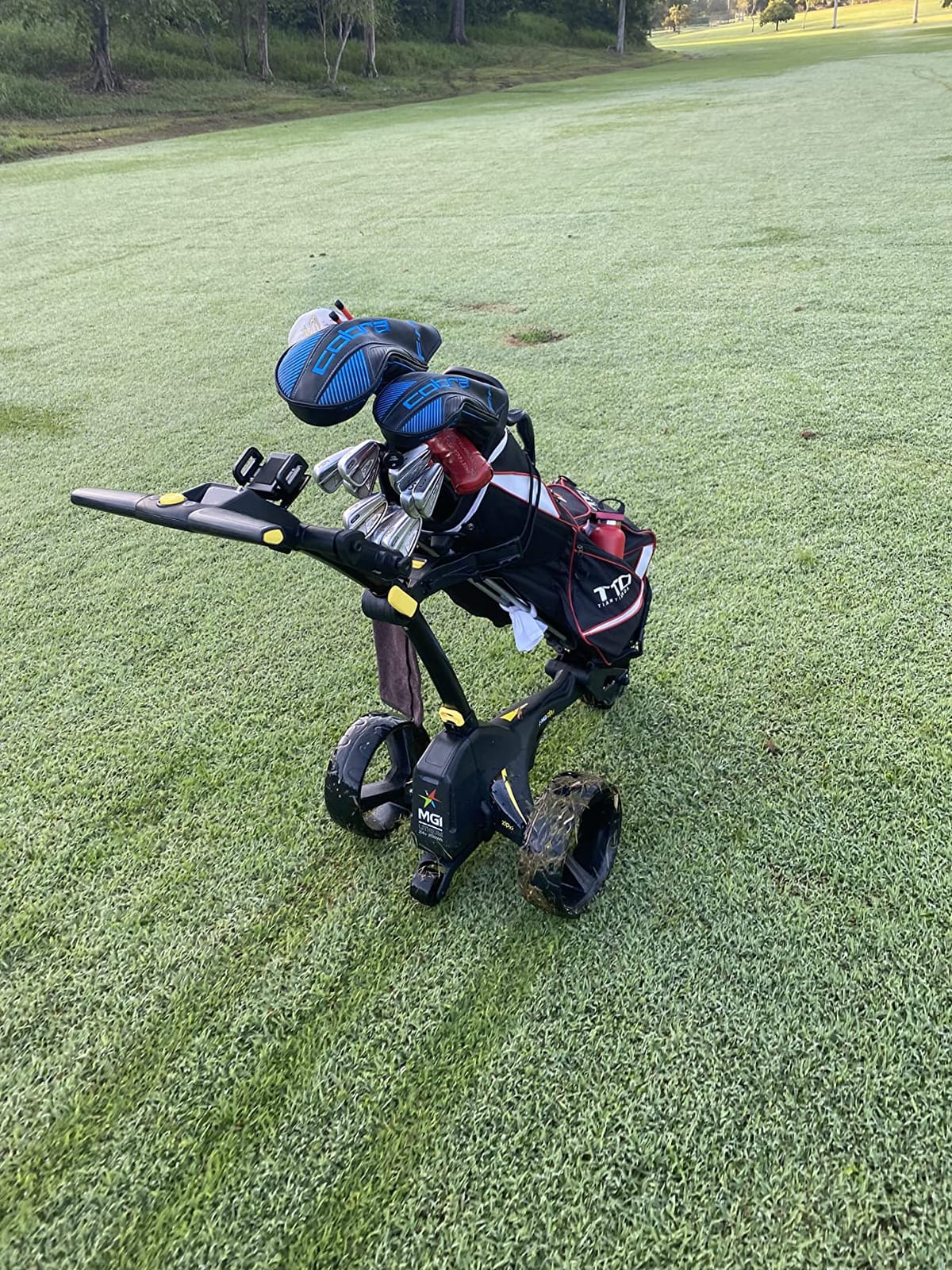
This is the cart I recommend to anyone whose hands and shoulders are the problem rather than their legs. You still hold the handle, but the motor does the pushing, and 26.7 pounds is the lightest published figure in this group. The battery comes out and has a built-in carrying handle, so what you actually lift is 22 pounds.
The control is a start-stop speed dial with 20 settings and a 2.5 inch LCD display. For many older golfers that is easier than a remote, because there is nothing to pair, nothing to charge and nothing to lose. The trade is that you keep a hand on the handle, which for someone with genuinely painful arthritis is a real cost.
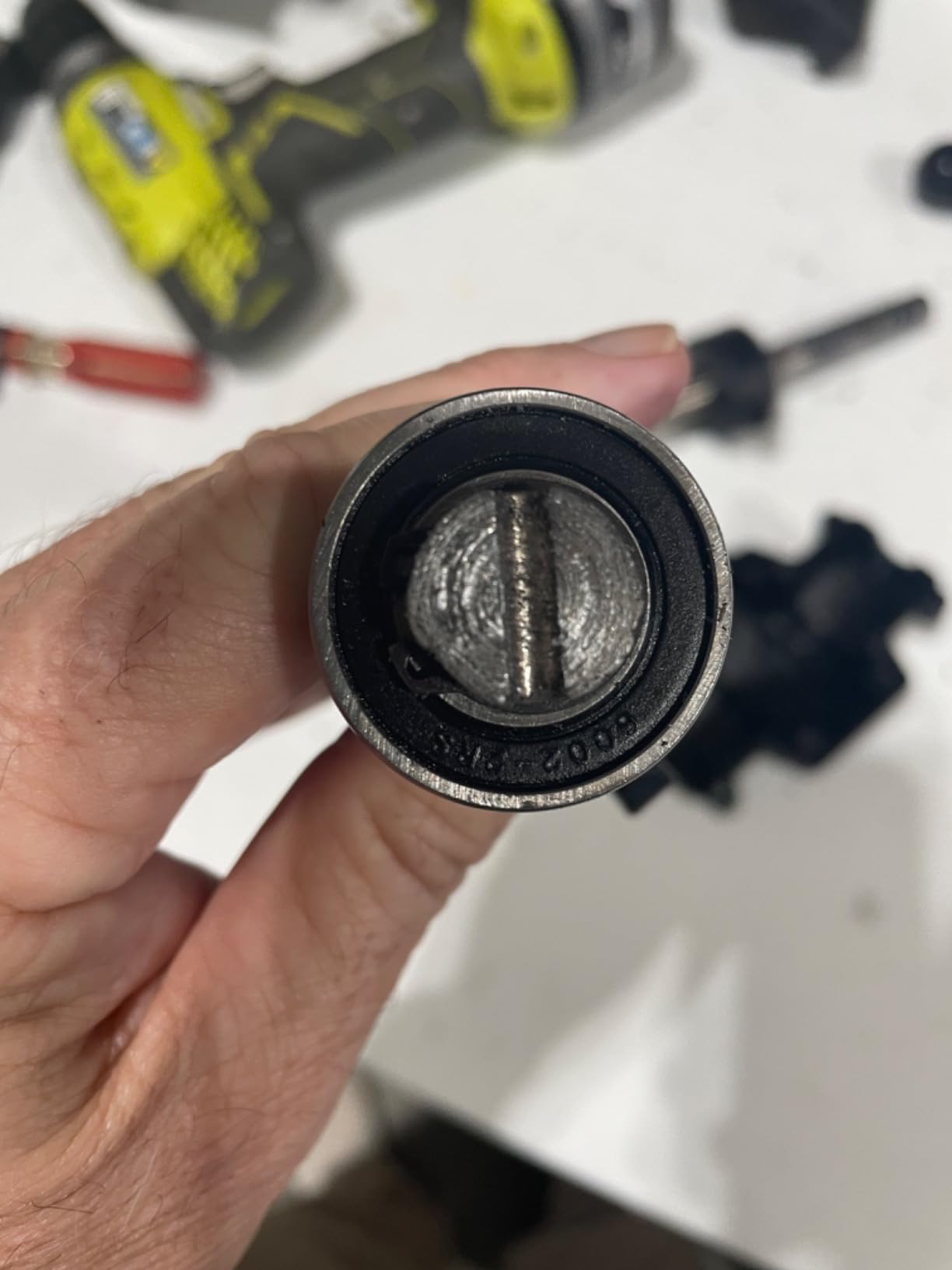
Reviewers in their sixties and seventies describe this cart as the reason they can still walk eighteen holes, and the fold with tucking rear wheels is the feature they mention most. It also holds a 4.3 rating on 150 reviews, and the three year manufacturer warranty covers manufacturing defects including the lithium battery and charger.
The steering is the weak point. Owners note the rear-weighted battery position tips the bag back on an uphill pull and keeps the fourth wheel stabilizer engaged, and the speed steps are incremental rather than truly variable, so there is a gap between settings that you will feel on a fast walk.
Who this cart suits
This suits golfers who want the pushing removed but still want their hand on the handle, because they like the control and they do not want to manage a remote. It suits solo loaders, because 22 pounds without the battery is a genuinely manageable lift into a sedan trunk.
It also suits buyers on a fixed income who want the motor benefit at the lower end of this category, with the same three year battery-inclusive warranty as our top pick.
Who should pick something else
Do not choose it on a course with real hills if balance is a concern, because there is no parking brake. Several owners report the cart rolling on slopes or in wind, and that is exactly the runaway fear that keeps some older golfers on manual carts.
Skip the optional accessories. Reviewers specifically call the cup holder and scorecard holder on this model poorly designed, and the accessories on the Alphard or the KVV are the better buys if you want somewhere to put a drink.
3. KVV E-GT3070: Best Smallest Folded Footprint and Best Dual-Mode Backup
KVV Electric Golf Push Cart with Remote Control, Smallest Folding Size, Suitable for All Terrains, Lightweight and Super Compact Electric Golf Cart
27.9 lb
Folds to 17.5 x 18.7 x 22 in
Remote plus manual push
Aluminum frame with cooler
Pros
- Smallest folded footprint here
- remote and manual dual mode
- wide 30.5 in rear wheelbase for stability
- aluminum frame with insulated cooler included
Cons
- Remote is not waterproof and pairs awkwardly at first
- command response lags and can replay a previous command
- jerky turning between speed settings
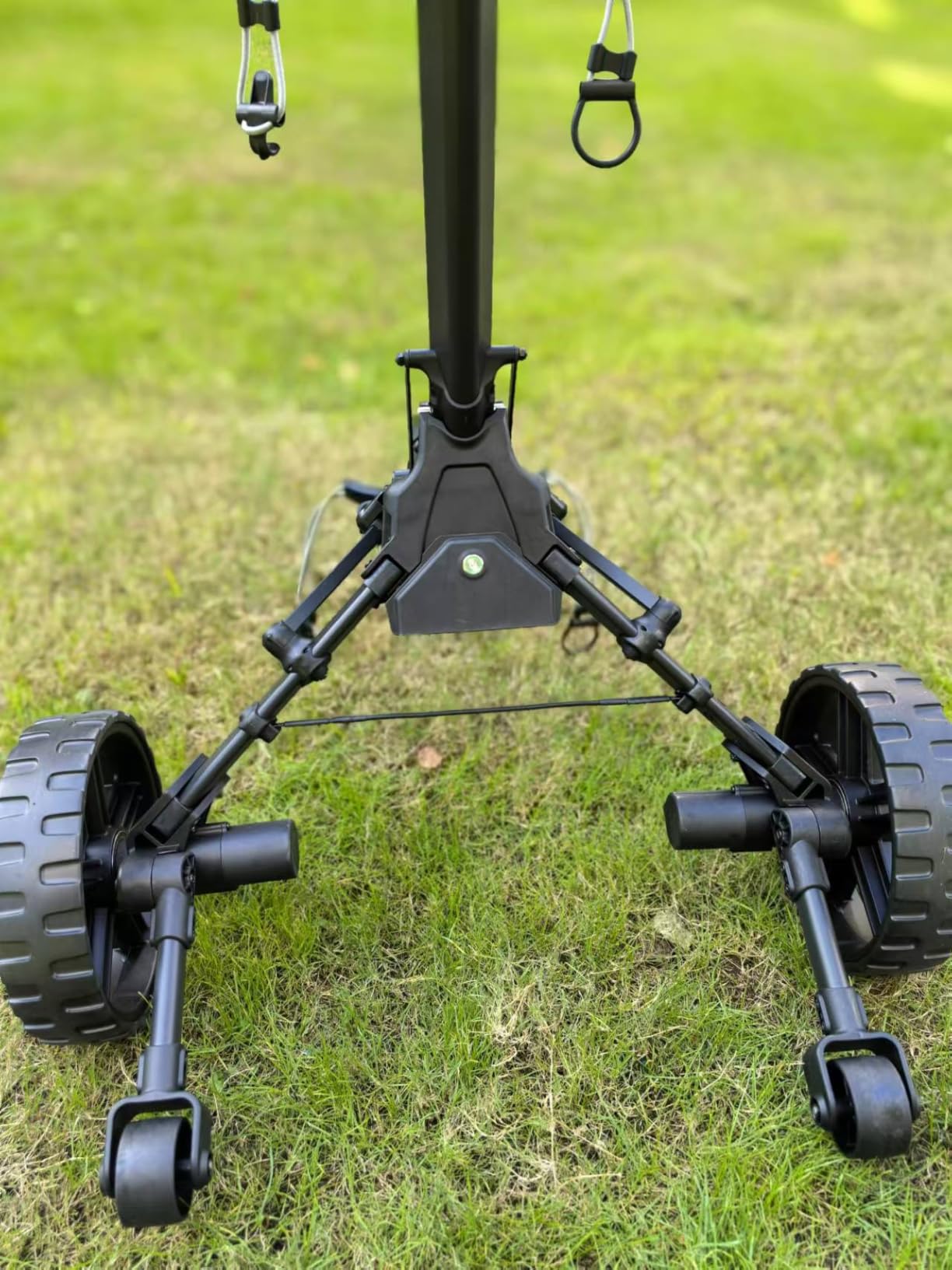
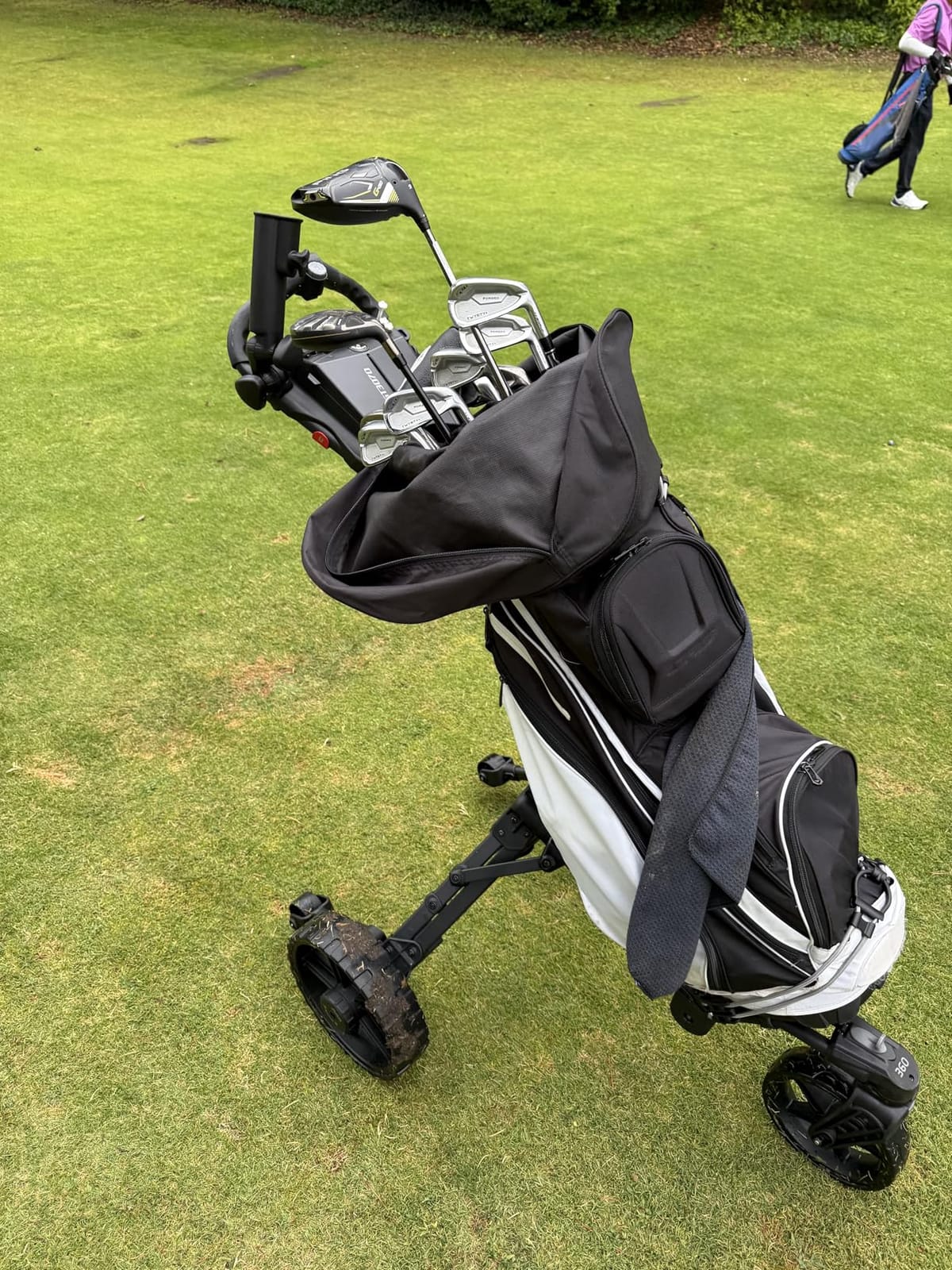
The KVV is the one to look at if your car is a sedan rather than an SUV. It folds to 17.5 by 18.7 by 22 inches, which is the most compact folded footprint in this group. At 27.9 pounds with an aluminum frame, it also carries a 4.4 rating across 113 reviews, which puts it near the top of the field on satisfaction.
Two things set it apart for older golfers. The dual mode design means it works as a remote cart or as a manual push cart, so a flat battery on the back nine is an inconvenience rather than the end of the round. The 30.5 inch rear wheelbase plus two training wheels and a straight line tracker is the stability package that most carts at this weight leave out.
Owners frequently report that the cart changed how they play hilly courses and noticeably reduced back and joint pain, and the response from customer support on faulty handle parts is a genuine plus for a buyer who would rather not phone a generic call center. The insulated cooler bag, carry bag, drink holder and umbrella holder are all included.
Now the problems, and they are worth being blunt about. The remote is not fully waterproof and several owners found pairing difficult the first time. Command response lags, which means the cart can carry out a previous command after you have issued a new one, and turning between speed settings is described as jerky and inconsistent.
Who this cart suits
This suits anyone whose storage problem is volume rather than weight, which usually means a small trunk, a small garage, or a cart barn with limited floor space. The manual fallback also suits golfers who play nine holes often and want the reassurance of a cart that still works if the battery is not charged.
The wide wheelbase and training wheels suit players who have felt a lighter cart tip on a sidehill lie. That fear is real and it is a common reason people abandon a cart in the first season.
Who should pick something else
Buy something else if you play in the rain regularly, because the remote is not waterproof and a rainy round is common in the shoulder golf season. The dual mode does give you a manual fallback, but not in bad weather.
If you are impatient with electronics during setup, the pairing process is the part you will be least patient with. The faster alternative is the MGI Zip X3, which has no remote to pair at all.
4. MGI Zip X3: Easiest to Learn and No Electronics to Pair
MGI Zip X3 Electric Golf Cart – 36 Hole Battery – (Drink, Umbrella, & GPS Phone)
29.5 lb
Single 230W motor
36 hole battery
Hands-on control, no remote
Pros
- No remote to pair or charge
- swiveling front wheels plus a fifth wheel stabilizer
- 36 hole battery covers a round and more
- 3 year warranty including battery
Cons
- Single 230W motor has less climbing power than the twin-motor Navigator
- hands-on control only with no remote or follow mode
If the phrase remote control makes you tense, this is the cart to buy. There is nothing to pair, nothing to charge overnight and nothing to drop in a puddle. You turn the speed dial, the motor assists, and you walk. For a lot of golfers over 60 that simplicity is worth more than any feature on a spec sheet.
At 29.5 pounds with the battery and 24.80 pounds without, it is one of the lighter published weights in this group, and the removable Click and Go lithium battery means the difference is a separate carry rather than part of the lift. Owners consistently highlight how much energy it saves across eighteen holes.
The chassis is better than the price and weight suggest. Swiveling front wheels, all-terrain rear wheels and a fifth wheel stabilizer is the same basic stability package as the KVV, and the 2.5 inch LCD display adds a controlled distance function on top of the 1 to 20 speed dial.
Who this cart suits
This suits a first-time electric cart buyer who wants zero learning curve, and anyone who would rather not charge a second device every night. The fifth wheel stabilizer makes it a reasonable choice for courses with sidehill lies if the ground is not severe.
It also suits buyers who want the three year battery-inclusive warranty and the 36 hole battery without paying for twin motors they will never use on a flat parkland course.
Who should pick something else
Do not choose it for a mountain course. Owners note the single 230 watt motor is less forceful on steep climbs than the twin-motor models in the same MGI line, and that is exactly the terrain where a senior wants the extra power.
It is also not a fit if you have already decided you want to walk with both hands free. There is no remote and no auto-follow mode, so the motor assists you rather than carrying the bag.
5. Wingscaddy Max300: Best for Hilly Courses and Three Ways to Drive It
Wingscaddy Electric Golf Push Cart with Remote Control – Up to 36 Hole & 1500 Life Cycle Lithium Battery Twin Motors Lightweight MAX-300 Silver Body
Dual 200W motors
Three modes: remote, trolley, free-wheel
Lithium battery rated 36 holes
Standard anti-tip wheel
Pros
- Three operating modes so you are never stranded
- dual 200W motors with a standard anti-tip wheel
- lithium battery rated 36 holes with 1500 life cycles
- customer service answers the phone
Cons
- Remote can be twitchy if the turn key is held past a click
- included scorecard and drink holders are flimsy plastic
- USB port use has caused irregular control behaviour
The Wingscaddy sits near the top of the ratings at 4.5, and the reason is not subtle. It is the only one that gives you three ways to operate it, remote, trolley and free-wheel, which means the motor is an assist rather than a commitment.
For hilly ground the hardware matters more than the software, and here you get dual 200 watt motors plus a standard anti-tip wheel. That combination is what stops the cart walking off a sidehill lie and taking you with it. There are 9 speed settings and a timed distance advance of 10, 20 or 30 meters so you can send it ahead to the next tee.
The lithium battery is rated up to 36 holes with 1500 life cycles, and owners report roughly two and a half rounds of real use. The umbrella holder, scorecard holder, drink holder and a tool kit are included, and the assembly is quick even with the sparse instructions.
Who this cart suits
This suits golfers who want the motor to help but who do not want to give up manual pushing entirely, and it suits anyone nervous about a cart running away on a descent because free-wheel and trolley modes let you take over manually at any point. The nine speed settings give fine control on a climb.
It is a sensible pick for a buyer who will be annoyed by an unanswered email. Owners report that customer service answers the phone and resolves issues quickly.
Who should pick something else
Buy something else if you have arthritic hands, because the remote can be twitchy when the turn key is held past a click and can throw the cart into a spin. That is a poor pairing with reduced grip strength, and it is a real safety consideration on uneven ground.
Plan on replacing the included drink and scorecard holders. Owners describe the plastic as flimsy and note that they can arrive broken, and a magnetic clamp holder costs very little and survives far longer than the original.
6. Alphard Cybercart: Best for Slope Safety and Predictable Downhill Control
Alphard Cybercart Electric Golf Cart | Remote Control & Compact Folding
Automatic parking brake holds any slope
Downhill speed control
6 axis gyro
40 lb
Pros
- Automatic parking brake that holds on any slope
- downhill speed control stops runaway carts
- low center of gravity with anti-tip wheels
- one-click fold
- freewheel manual fallback
Cons
- Heaviest published cart here at 40 lb
- remote only with no hands-free auto-follow mode
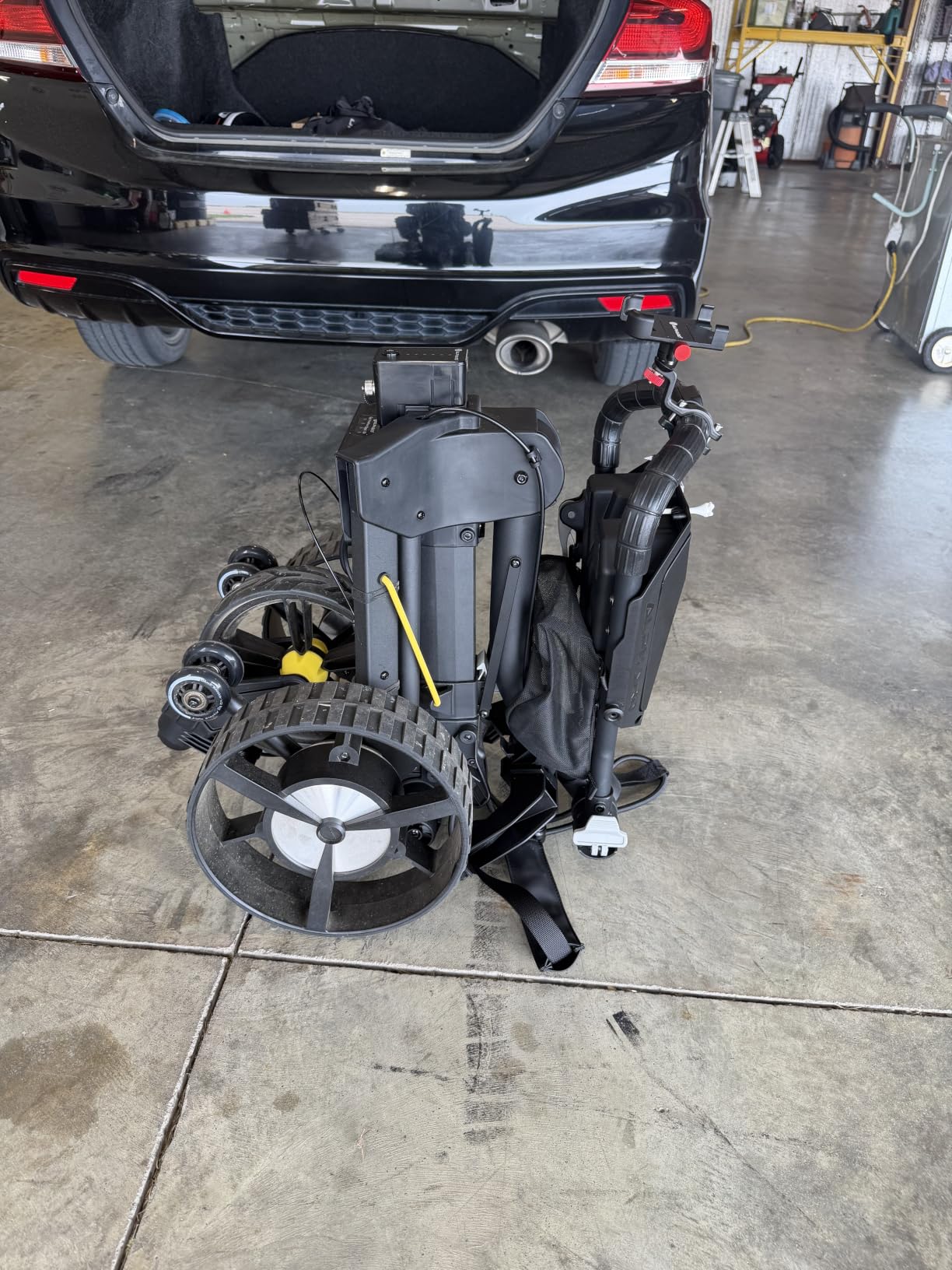
This is the cart I would hand to a golfer whose balance is the concern rather than their strength. It is the only one in this group with an automatic parking brake that holds on any slope, and that single feature removes the runaway-cart fear that keeps a lot of older buyers on a manual cart.
Downhill speed control works with it, so the cart will not build speed on a descent while you are walking behind it. The 6 axis gyro handles the straight-line correction that normally needs constant input, the low center of gravity and anti-tip wheels add margin on uneven ground, and the LCD remote has an out-of-range auto stop as a backstop.
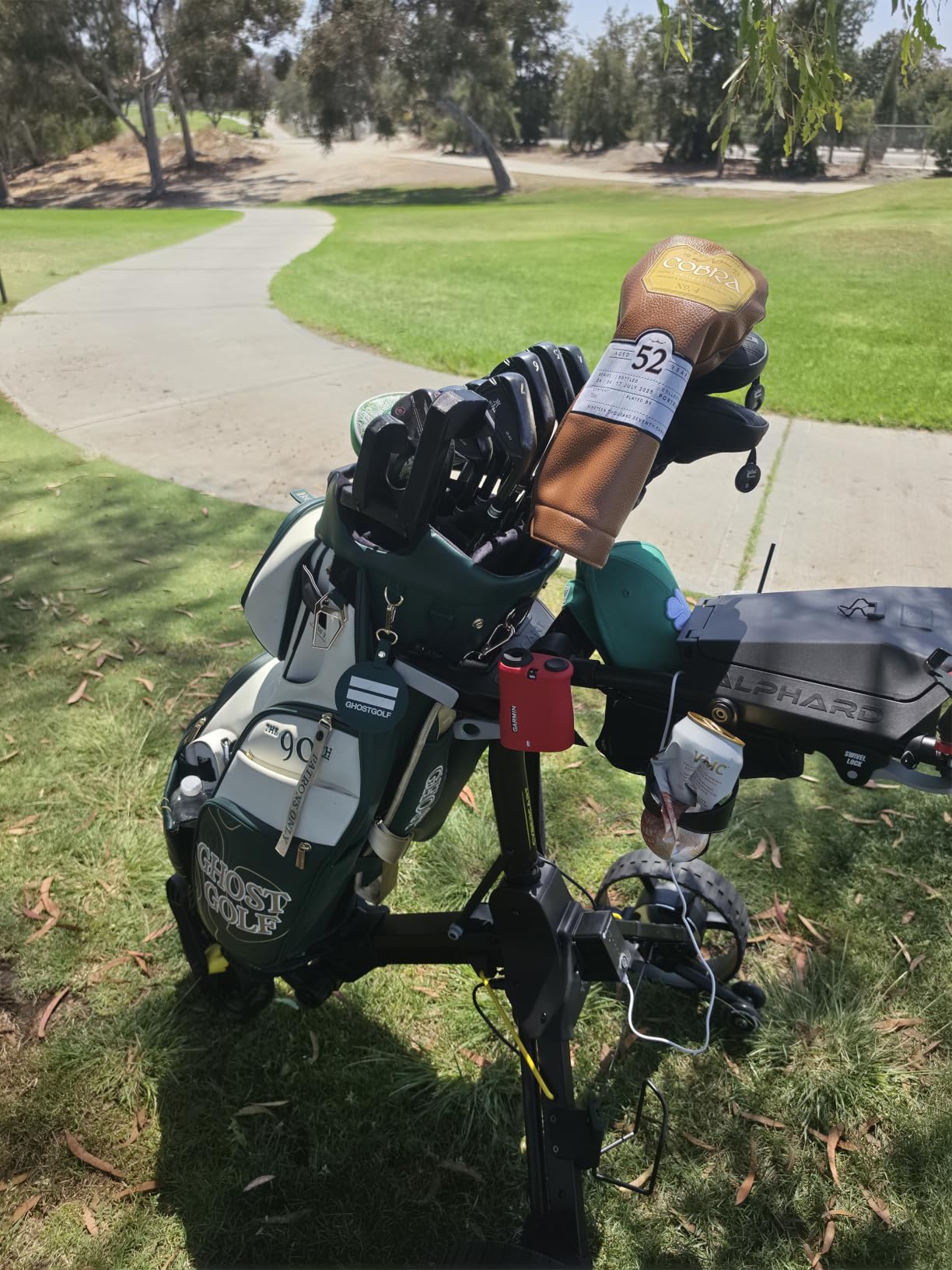
Owners single out the automatic parking brake and downhill speed control as the features that make slopes manageable, which matters most for golfers with balance concerns. The one-click fold, the extra large storage console, the cup and umbrella holders and the freewheel mode round out a well equipped package at a 4.5 rating on 46 reviews.
Weight is the reservation, and it is a real one. Forty pounds is the heaviest published figure in this group, and with a 46 review base there is less long-term owner feedback than the top picks have. If loading is your problem, this is the wrong cart.
Who this cart suits
This suits golfers on hilly or mountain courses who want a cart that stays put when they stop, and who are not worried about lifting weight because someone else loads the car or the cart lives in a garage. The auto stop out of range is a genuine comfort on a course with trees and water hazards.
It is also the cart to pick if you have had a previous cart roll away from you. Several owners describe the parking brake as the reason they stopped worrying about it.
Who should pick something else
Do not choose it if you load your own vehicle. Forty pounds is a two-person lift for most golfers over 60, and nothing else on the specification sheet compensates for that.
If you want to walk with your hands in your pockets, the remote only control means you are still steering, just with a handset. For true hands-free walking the tianhong G5 or the CaddyTrek R2 is the answer.
7. tianhong G5: Best for Truly Hands-Free Walking
tianhong G5 Electric Golf Cart,Electric Golf Push cart Auto-Follow You,45 Hole Battery,All-Terrain Anti-Tipping,Electric Golf Push cart with Remote(APP/Manual Control), Foldable,Black+Orange
45 hole lithium battery
Five control modes incl. auto-follow
IPX5 rated
Dual anti-tip wheels, stable on 30 degree slopes
Pros
- Auto-follow sensors track you hands-free
- 45 hole battery covers about two rounds
- five modes including one-touch recall and constant speed cruise
- folds in three seconds
- IPX5 waterproof rating
Cons
- Follow mode needs the battery powered and the remote carried
- one year warranty is shorter than rivals
This carries the highest average rating in the group at 4.6, and the reason is the auto-follow mode. The cart tracks you with sensors at a set distance, so you walk with your hands free and it comes along. For a golfer with arthritis in both hands, that is the entire argument.
The battery is rated at 45 holes, which is roughly two full rounds, so this is the cart with the most genuine headroom in the lineup. That matters if you play 27 holes in a day, and it is also the difference between finishing a round comfortable and finishing it watching the gauge.
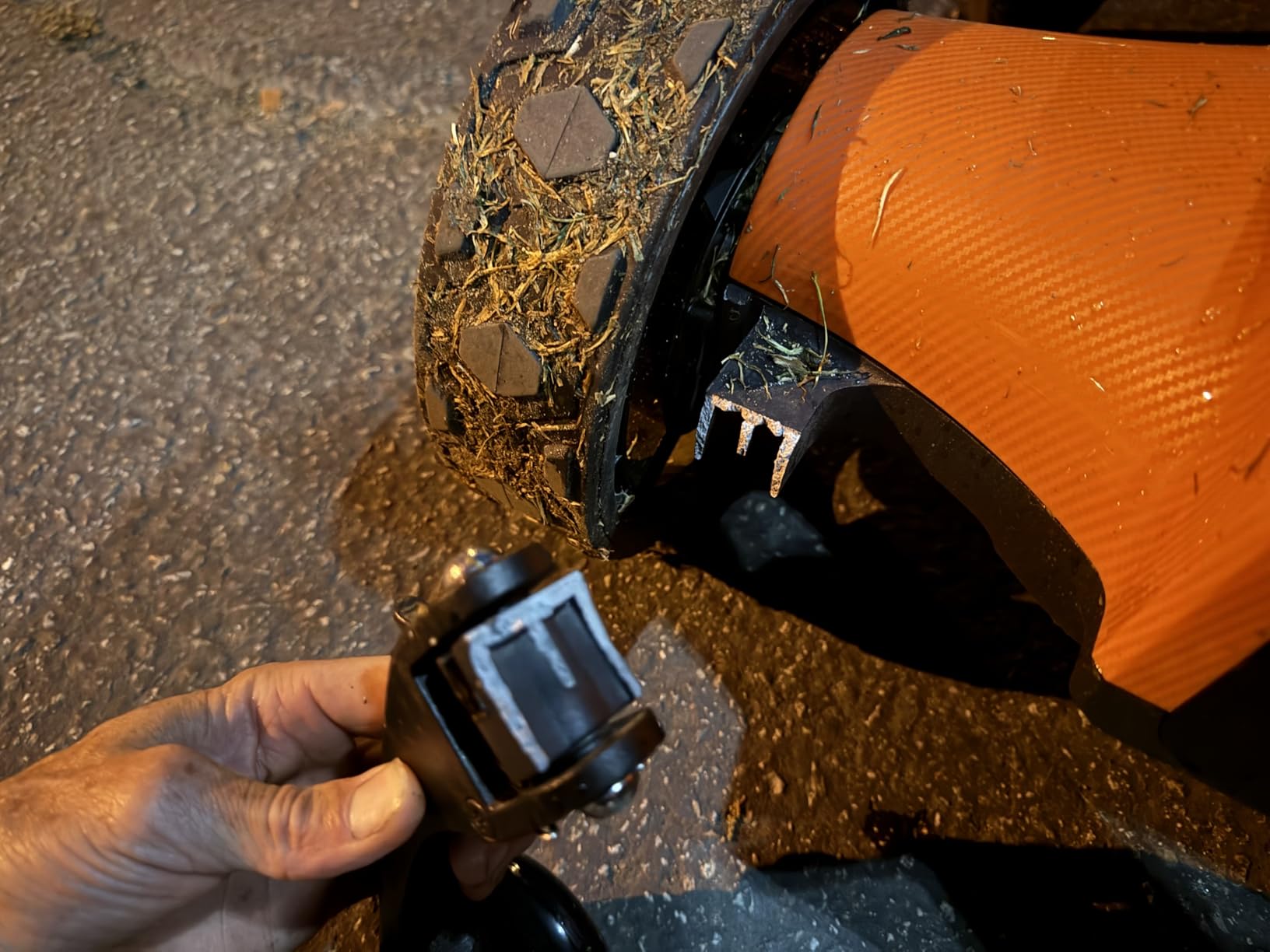
There are five control modes: hand push, remote, one-touch recall, follow-me and constant speed cruise. The dual anti-tip wheels are rated stable on slopes up to 30 degrees, the all-terrain tires cover flat, mud and steep conditions, and the IPX5 rating means a shower is not a reason to leave the bag behind. It is 90 percent pre-assembled and the three second fold lands it at 28.7 by 24.8 by 14.1 inches.
Two cautions. Auto-follow requires the battery to stay powered on and the handheld remote to be carried on your person, so you are not as free as the marketing implies. And the warranty is one year, which is the shortest meaningful protection in this group and a genuine trust problem for a long-term owner.

Who this cart suits
This suits golfers whose hands are the limiting factor rather than their legs, and it is the most rain-ready cart here with an IPX5 rating and UL 2271 certified safety. The one-touch recall is useful when you want the cart to come to you across a fairway rather than wait for you.
It is also the strongest fit for long days, since 45 holes means a second round without an overnight charge.
Who should pick something else
Buy something else if you plan to keep the cart for more than three or four seasons, because a one year warranty on the weakest link in the machine is a poor bet. The three year battery-inclusive warranties on the MGI carts are the better long-term story.
Also consider the CaddyTrek R2 if you want follow mode with a two year warranty, or the MGI Zip Navigator if you would rather not depend on a sensor for the cart to move.
8. Bag Boy Volt: Best Straight-Line Tracking in a Lightweight Remote Cart
Bag Boy Volt Electric Golf Push Cart | Compact Remote Controlled Trolley with 36 Hole Lithium Battery, 9 Speeds, Excess Storage Space, Anti-Tip 4th Wheel, 2 Step Fold and TrueLine Tracking
28.6 lb
TrueLine Tracking course correction
9 speed remote
Lithium battery charges in four hours
Pros
- Lightweight at 28.6 lb for a remote cart
- folds to 29 x 16.5 x 14.5 in
- TrueLine tracking holds a straight line on uneven ground
- rear stabilizer wheel helps on steep slopes
- disengageable battery for manual pushing
Cons
- Battery life often falls short of 18 holes in real use
- replacement batteries sold only by the manufacturer past a one year warranty
- speed knob will not hold a constant speed
The Volt is a good machine with a battery problem, and the battery problem is severe enough that you should read it before anything else. This is the lowest rated cart in the group at 3.7, and the reasons are concentrated: owners report the battery often falls short of eighteen holes in real use, and several report battery failures within a year.
That matters more here than on any other cart in this list. The replacement battery is only sold by the manufacturer, it is one of the most expensive parts in the category, and the battery warranty runs one year. For a buyer planning to keep the cart for a decade, that combination is a real long-term liability even though the starting figure looks reasonable.
What the Volt does well is genuinely useful. At 28.6 pounds it is among the lightest remote-controlled carts we looked at, it folds to 29 by 16.5 by 14.5 inches which fits a sedan trunk or a locker, and TrueLine Tracking software is the straight-line correction system on offer here. Owners also like the rear stabilizer wheel on steep slopes and the generous storage console.
Who this cart suits
This suits a buyer who wants a lightweight remote cart with the best straight-line tracking and who intends to keep it for a season or two rather than a decade. If your club has smooth cart paths and few severe sidehill lies, the tracking system does the work for you.
The disengageable battery means you can still push it manually, which softens the risk of a battery that fades mid-round.
Who should pick something else
Pick something else if you plan to keep it long term, and that is most people. A manufacturer-only replacement battery paired with a one year battery warranty is the single worst ownership number in this roundup.
Also look elsewhere if you walk at a varied pace, because owners report the speed control knob is difficult to adjust and will not hold a constant speed, and it must be switched to remote mode when parked or it can roll downhill.
9. CaddyTrek R2: Best for Long Remote Range and Four-Mode Flexibility
CaddyTrek R2 Electric Golf Follow Cart, Black
Ultrasound and RF follow tracking
100 foot remote send distance
Onboard gyroscope
2 year warranty
Pros
- Follow mode tracks you hands-free with ultrasound and RF sensing
- remote can send the cart 100 feet to the next tee
- gyroscope assists straight-line tracking
- four modes
- five accessories included
Cons
- 39 lb is one of the heavier units here
- only 22 reviews means limited long-term owner feedback
The CaddyTrek does one thing that no other cart in this group does: the remote can send the cart up to 100 feet ahead to the next tee box. For a golfer who tires walking with equipment, that means you press once at the tee and the cart is already heading down the fairway.
The follow mode is the other headline. It uses ultrasound and RF signals to calculate speed, distance and angle to the player, so the cart tracks in front of or behind you hands-free. An onboard gyroscope handles straight-line tracking over uneven terrain, and there are four modes: follow, marching, remote control and manual push.
Two things to weigh. At 39 pounds it is the second heaviest published figure here, though the battery is removable and cuts the lift for carrying. And with 22 reviews the owner base is small, so there is less long-term feedback to draw on than the MGI carts have.
Who this cart suits
This suits golfers who want genuine hands-free walking plus the option to send the cart ahead when they want to walk up to a shot unencumbered. The four modes mean you can pick the right behavior for a cart path, a tight green and a climb rather than living with one setting.
It is also a strong gift choice, because the five included accessories cover the cup holder, scorecard holder, phone holder and umbrella holder in one box, plus a CaddyBelt.
Who should pick something else
Choose something else if you load your own car, because 39 pounds is a two-person lift for most golfers in this age group and the battery removal only helps with the carry, not the trunk load.
And if you want a proven long-term record, the 22 review base is thin. The MGI Zip Navigator has 300 reviews behind it, which tells you much more about what happens in season three.
10. Super E Caddy Pro: Best With a Built-In Seat and Cooler
Super E Caddy Pro Electric Golf Cart – Black Foldable Motorized Caddy with Remote, Seat, 6-Pack Cooler, 24v Li Battery Lasts 36 Holes, USB Port, Scorecard Holder, Umbrella Mount
Built-in 6 pack cooler and seat
12V lithium battery rated 27 holes
High torque twin motors, sealed gearbox
44 lb
Pros
- Built-in seat and six pack cooler let you rest between holes
- all metal frame and metal wheels
- twin motors with sealed gearbox run quietly
- doubles as a manual push cart when flat
Cons
- Heaviest cart in the group at 44 lb
- 27 hole rating is below the 36 hole figure common on rivals
- one year warranty
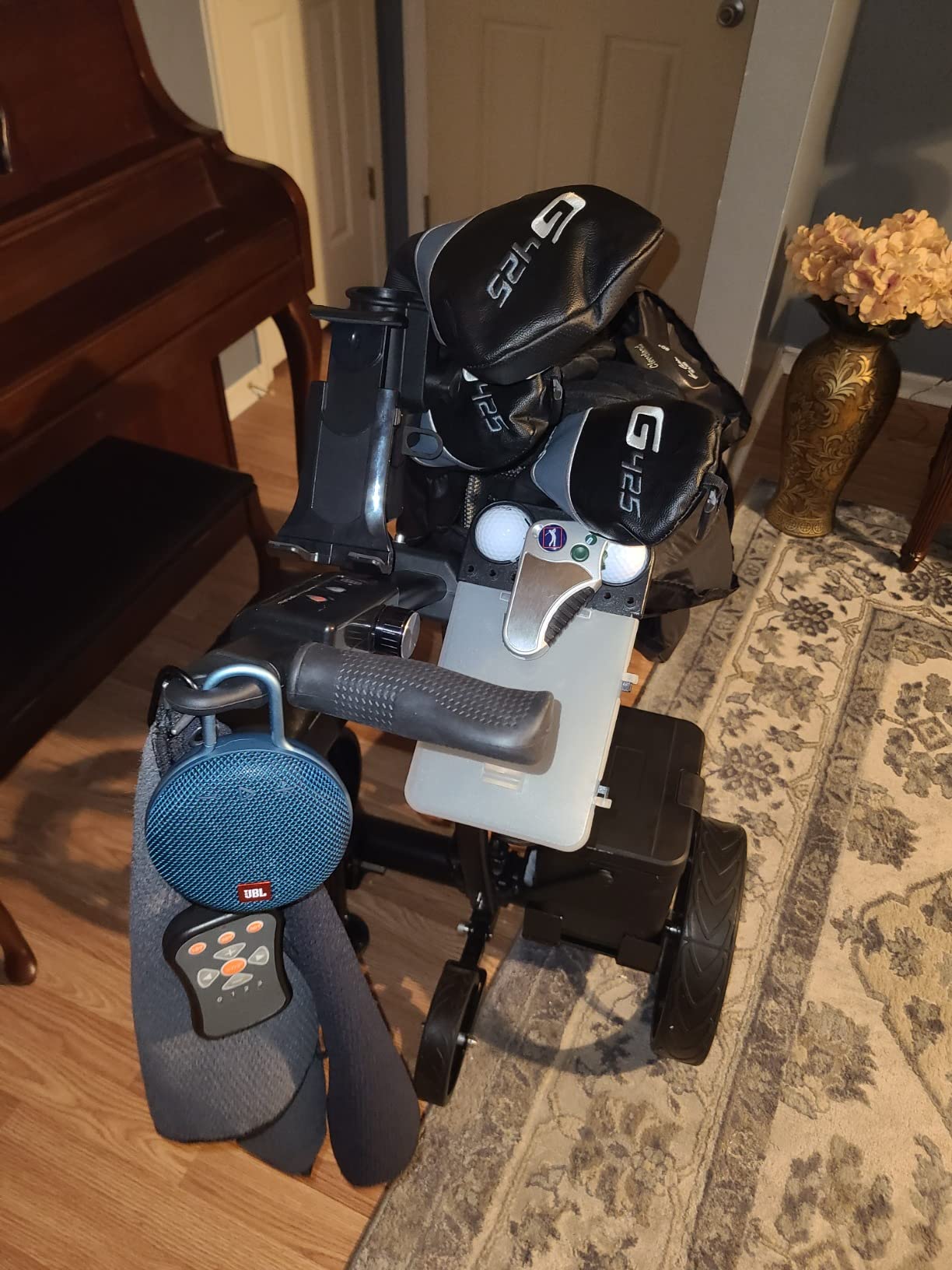
This is the only cart in the group with a built-in seat, and for a specific kind of buyer that is not a gimmick. If the reason you struggle to finish eighteen holes is fatigue at the fifteenth tee rather than load on the shoulders, a seat and a six pack cooler in the console change what the rest of the round feels like.
Underneath it is a serious machine. High torque twin motors with a sealed gearbox run quietly, which matters more than it sounds, because higher frequency whine is more noticeable with age. The all metal frame and metal wheels, larger rear wheels and bungee strap bag attachment are a durable package, and freewheel mode means it still pushes manually when the battery is flat.
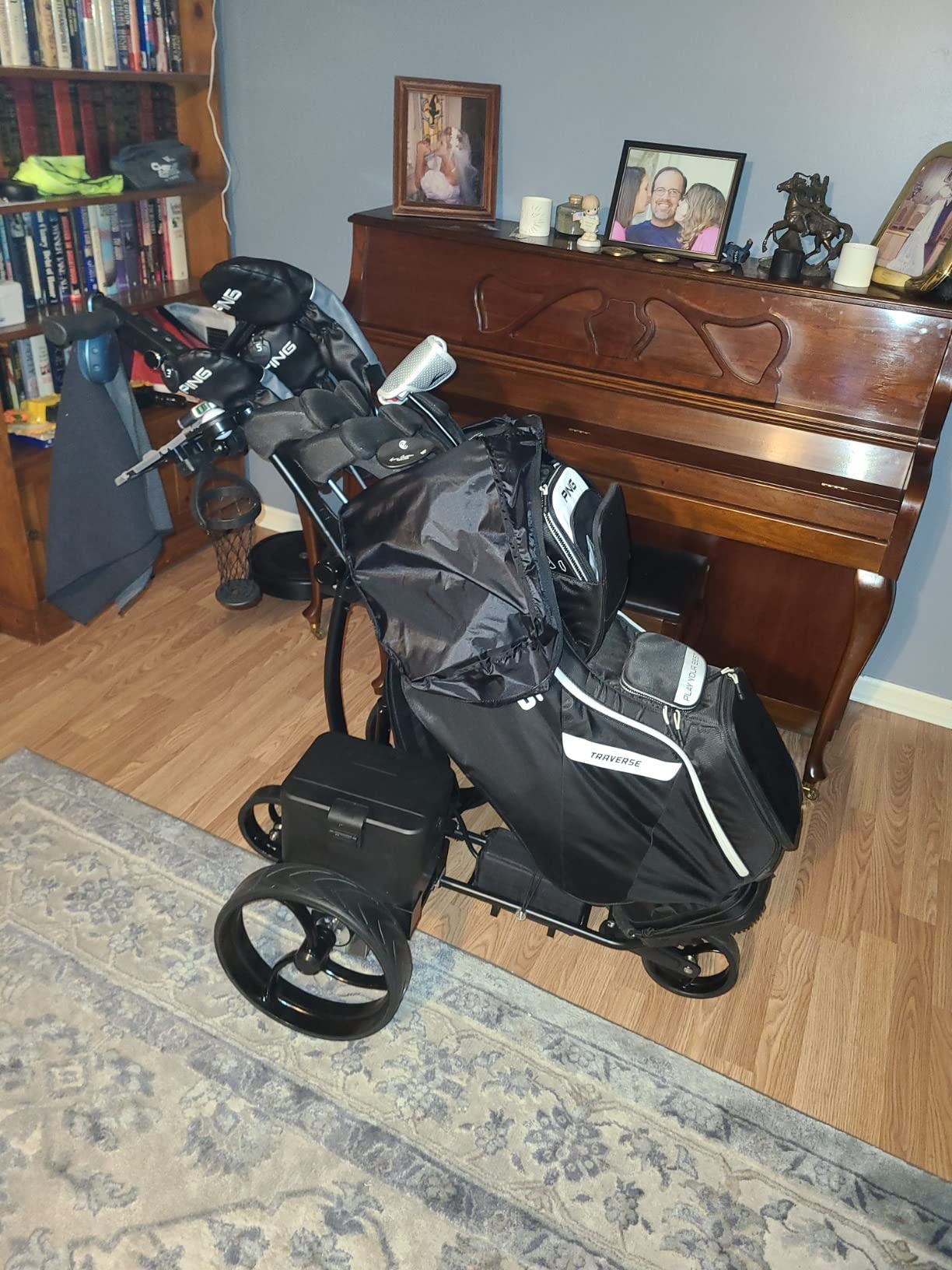
The USB port, umbrella holder, drink holder, ball, tee and scorecard holders round out the console, and setup takes only a few minutes. Buyers value the cooler and seat as rare extras and like the quiet ride at a walking pace.
But 44 pounds is the heaviest cart here and the main barrier for older buyers, and the 27 hole battery rating is the second lowest in the group. The 1 year warranty is the other soft spot. If you will ever load the car yourself, that weight is the deal breaker.
Who this cart suits
This suits golfers who want to keep walking but want somewhere to sit and something cold to drink at the turn, and who are not the person loading the car. Golfers who play on a cart barn storage arrangement or with a spouse who drives will find the weight irrelevant.
The quiet sealed gearbox and all metal construction also suit buyers who have owned lighter plastic-framed carts and found them flex on sidehill ground.
Who should pick something else
Pick something else if you play 36 holes in a day, because 27 holes is a tight margin over a single round and you will be charging overnight more often than not.
And if you are buying this as a gift for a parent who drives themselves, check the weight first. The seat is genuinely useful, but a 44 pound lift into a trunk is the most common reason a thoughtful electric cart ends up in a garage unused.
The 7 Checks That Matter Most Before You Buy
Every cart in this roundup is a good cart in the right hands. The difference between a cart you use for ten seasons and one you abandon after a month comes down to seven checks, and none of them involve the motor wattage first.
1. Lift weight and trunk fit. Measure your trunk opening before you buy, not after. The published weight of senior-appropriate carts here runs from 26.7 pounds to 44 pounds, and the honest threshold is around 33 pounds for solo loading into a sedan. If a cart is over 35 pounds, plan on a two-person lift or a garage-only arrangement. The removable batteries on the MGI carts help because the frame is 5 to 6 pounds lighter on its own.
2. One-motion fold. A multi-step or latch-dependent fold is a deal-breaker for arthritic hands. The Alphard uses a one-click fold, the tianhong folds in three seconds, and the MGI Zip line uses Zip Fold Technology. Test the fold in a parking lot with your own hands before you commit, and prefer a fold that stands upright on its own so you are not laying it flat on a wet trunk liner.
3. Hill performance. Dual motors plus a fifth wheel, rear stabilizer or anti-tip wheel is the combination that holds on a climb. The MGI Zip Navigator, the Wingscaddy and the Super E Caddy all have twin motors. The single 230 watt motor in the MGI Zip X3 is fine on parkland and short on a mountain course.
4. Battery headroom, not hole count. A 36 hole rating is the usable figure to plan on, and a 45 hole battery is the one that lets you play 27 holes without a second charge. Charge after every round rather than after every other round, and remember that a cold morning costs you range. Several owners of the Bag Boy Volt report falling short of 18 in real use, which is the argument for buying headroom rather than buying on the sticker figure alone.
5. Downhill braking. This is the runaway-cart fear, and it is the single feature that resolves it. Look for an automatic parking brake that engages on a slope, electronic downhill speed control, and an anti-tip wheel. The Alphard Cybercart is the clearest example, and the MGI Zip X1 is the clearest counter-example because it has no parking brake at all.
6. Warranty length. A three year warranty that explicitly includes the lithium battery and charger is the standard worth paying for, because the battery is the expensive failure. The MGI carts meet that bar. A one year warranty, or a battery warranty that expires at twelve months with manufacturer-only replacement, is a real long-term cost.
7. Support you can reach. Older buyers consistently rate a US phone number above email or an app. Ask one question before you buy, and see whether a person answers it. It is the cheapest due diligence in this entire guide.
Remote, Follow-Me or Push-Assist: Choosing Your Control Type
The control type matters more for this group than any other single specification, because it decides whether the cart removes strain or transfers it. Three types cover nearly every cart in this roundup.
Remote control is the default. You clip a handset to your belt, pocket or wrist and the bag travels on its own, which removes the load from your shoulders, your back and your hands completely. The trade is a device to charge, pair and store, and a learning curve of a few holes. The MGI Zip Navigator, the Alphard, the KVV and the Bag Boy Volt all work this way.
Follow-me or auto-follow uses sensors to keep the cart at a set distance behind you, so you walk with your hands free without touching anything at all. This is the most arthritis-friendly option and the one to pick when grip strength is the first thing to go. The tianhong G5 and the CaddyTrek R2 are the follow-mode carts here, and the tianhong adds one-touch recall, which sends the cart to you when you want it faster.
Hands-on assist or push-assist is the gentlest learning curve because there is no second device at all. You hold the handle and set a speed, and the motor matches your walking pace. The MGI Zip X1 and Zip X3 work this way. It suits golfers who like the feeling of holding the cart and who want the motor to reduce effort rather than remove it, and it is the only option that keeps manual pushing available at all times.
If you are not sure, the tie-breaker is your hands. Aching or arthritic hands point to follow-me. Normal hands and a desire to stop carrying weight point to remote. A preference for simplicity and a dislike of charging two devices point to hands-on assist.
Battery Care, Charging and Winter Storage
Lithium batteries do not fail suddenly when treated properly. They lose capacity gradually when they are stored hot, fully empty, or left at a full charge for months, and a few habits will protect most of the life you paid for.
Charge after every round, not every other round. A partial top-up is gentler on the cells than a full discharge followed by a full charge, and it removes the mid-round anxiety that shows up on the back nine of an eighteen hole round.
Store between 40 and 80 percent if the cart is sitting unused. A battery parked at full charge for a winter loses more capacity than one parked at half. This matters most for a cart that lives in an unheated garage between November and March.
Keep it above freezing. Charging a lithium pack below 32F is the fastest way to damage it, and cold mornings cost you range even when you do not deep charge. If your cart lives outdoors or in a cold shed, bring the battery inside. If it stays in a garage all winter, a cover is worth having, and our winter cover guide covers the fit for the common electric cart shapes.
Clean the terminals and check the wheels. A wipe of the battery contacts and a check for grass in the wheel wells takes a few minutes twice a season and is genuinely all the mechanical maintenance required. There is no fuel, no oil and no cable to service, which is a real advantage over a gas cart.
Charge the remote the night before a round. A remote that is low on charge is the failure mode most likely to end a round early, and several owners of follow-mode carts report erratic behaviour when their remote is flat. A ten dollar lanyard also stops the handset dropping into a bunker.
When a battery does reach the end of its life, recycle it through a proper lithium collection point rather than putting it in household waste.
When an Electric Golf Push Cart Is the Wrong Purchase
There are buyers for whom an electric cart is a mistake, and telling you who they are is more useful than another roundup.
If you only ever play nine holes on a flat course and your existing manual cart works fine, a motor adds weight, charging and storage to a problem you do not have. A good light manual cart is a legitimate answer, and we cover the category separately.
If you drive a sedan and load the car yourself, anything over 35 pounds is a genuine struggle twice a day, and the ones that load well are the ones without the largest brakes and consoles. Buying heavy and then leaving it in the garage is the most common failure mode we see in this category.
If your balance is the problem rather than your strength, a cart that rolls away from you on a slope makes the situation worse, not better. In that case the cart to buy is one with an automatic parking brake and downhill control, and if you cannot find one you like, an electric cart is not the answer yet.
And check with your pro shop before a high-ticket purchase. Most courses allow standard single rider electric push carts, but restrictions vary, and larger powered devices are where the rules differ. That five minute phone call protects the whole decision.
Frequently Asked Questions
Are electric golf push carts worth it for seniors?
Yes, for most golfers. The cart removes the load of a 30 pound bag from your shoulders, back, knees and hands, which is the specific thing that ends an eighteen hole round early. The trade is the up-front cost and the charging routine against a manual cart, so the honest test is whether you will actually keep walking the course.
What is the best golf push cart for seniors?
The MGI Zip Navigator All Terrain is the best overall pick because it combines twin 230 watt motors, a 36 hole battery and a three year warranty that covers the battery and charger. If loading weight decides it for you, the MGI Zip X1 at 26.7 lb is the one to look at instead.
What is the best value electric golf push cart?
The MGI Zip X1 is the best value in this group, combining the lightest published weight in the category at 26.7 lb with a hands-on speed dial, a 36 hole removable battery and a three year warranty that includes the battery and charger. If your priority is the smallest folded footprint rather than weight, the KVV E-GT3070 folds down to 17.5 inches in one dimension and still works as a manual push cart when the battery is flat.
How heavy is an electric golf push cart?
The senior-appropriate carts in this roundup run from 26.7 lb to 44 lb. The MGI Zip X1 is the lightest published figure at 26.7 lb with the battery and 22.05 lb without, and the Super E Caddy Pro is the heaviest at 44 lb. Around 33 lb is the practical threshold for loading into a sedan by yourself, and most of these carts have a removable battery that cuts the frame weight further.
Can seniors use electric golf push carts on hilly courses?
Yes, provided the cart has dual motors plus downhill control. The MGI Zip Navigator, the Wingscaddy Max300 and the Super E Caddy Pro all have twin motors, and the Alphard Cybercart adds an automatic parking brake that holds on any slope. The configuration that fails on a climb is a single motor with no anti-tip wheel, like the MGI Zip X3 on a mountain course.
What is the difference between a remote and follow-me electric golf cart?
A remote cart is steered by a handset you carry, so your hands stay free but you have a device to pair, charge and learn. A follow-me cart uses sensors to keep a set distance behind you with no input at all, which is the most arthritis-friendly option. Follow-me suits limited grip strength, remote suits anyone who wants the load gone entirely, and hands-on assist suits golfers who dislike charging a second device.
Do electric golf push carts work in the rain?
Most are weather resistant rather than waterproof. The tianhong G5 carries an IPX5 rating and UL 2271 certified safety, which covers a shower and a wet fairway. Remote handsets and charging ports are typically less protected than the chassis, so keep the remote in a pocket in bad weather, and follow the KVV manual rather than the manufacturer instructions on a wet morning.
How do you charge an electric golf push cart?
Most carts charge from a wall outlet with the battery seated in the cart, though the Click and Go lithium batteries on the MGI range lift out and charge separately. The Bag Boy Volt lithium battery takes four hours. Charge the handheld remote separately, and charge it the night before a round so it is not flat when you need it.
Are electric push carts allowed at my golf course?
Most courses permit single rider electric push carts, but rules vary and restrictions are most common for larger stand-on or two-passenger devices. Check with the pro shop before a high-ticket purchase. It takes five minutes and it protects the whole decision.
Final Verdict
The best electric golf push carts for seniors in 2026 all solve the same problem, and the difference between them is how gracefully they solve the parts nobody advertises. The MGI Zip Navigator All Terrain is the pick because it is the only cart here that gets the motor, the battery, the warranty and the fold right at the same time, and 300 reviews suggest that combination holds up over seasons rather than months.
If you load your own car, the MGI Zip X1 is the pick at 26.7 pounds, with the caveat that it has no parking brake and belongs on a course without serious descents. If your trunk is small rather than your back is weak, the KVV E-GT3070 folds down to a compact 17.5 inches in its narrowest dimension and still works as a manual push cart when the battery is flat.
Whatever you choose, do the three things before you pay: measure your trunk opening, fold it in a parking lot with your own hands, and ask one question by phone to see whether a person answers. Those three checks take twenty minutes and they have prevented more bad purchases than any spec sheet on this page.