
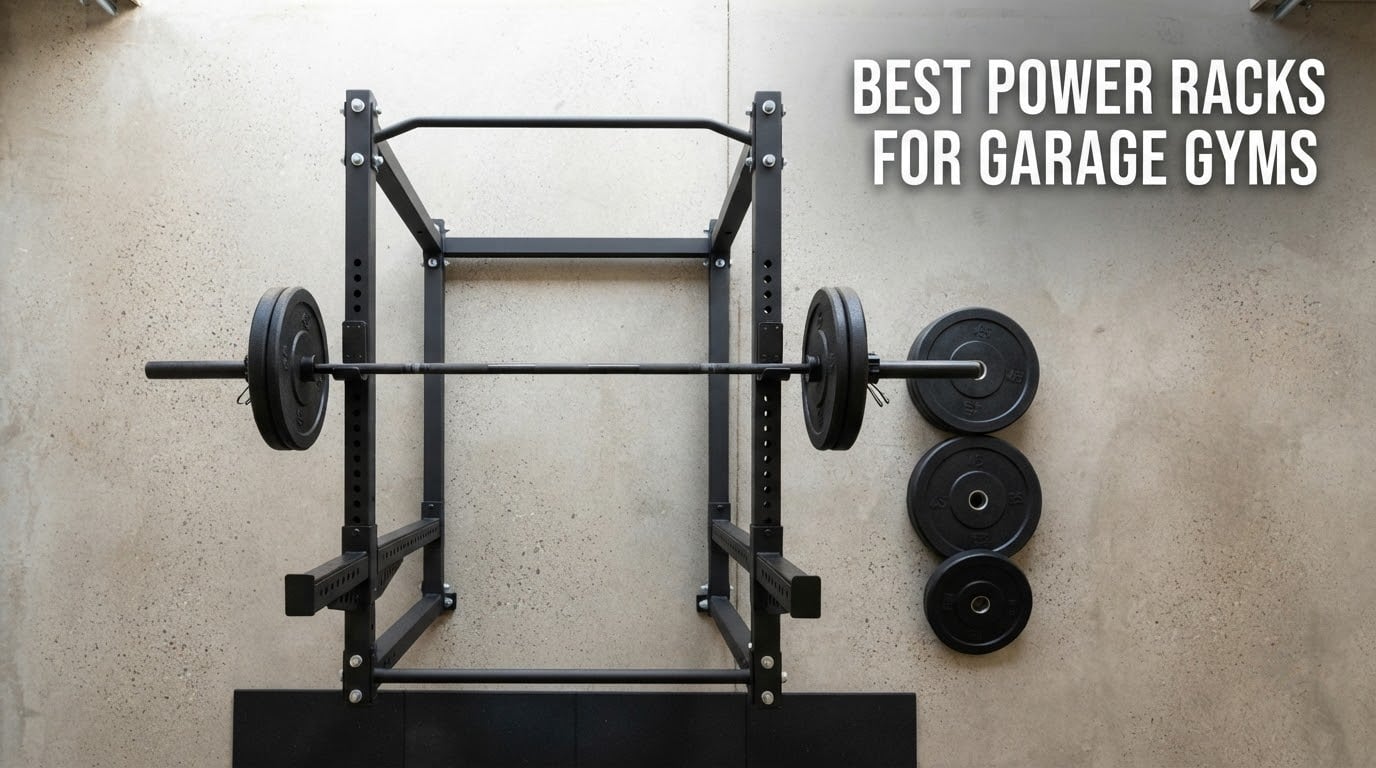
A power rack is the piece of equipment that turns a patch of bare concrete into a gym. Four steel uprights, adjustable J-hooks and a pair of safeties let you squat, bench and press heavy barbell work alone in a garage with no spotter and no second opinion. Everything else in a home gym hangs off that frame.
We spent weeks going through owner reviews on the racks below, checking gauge, tube size, hole spacing, real clearances and the complaints that only show up after a few months of use. If you want the short answer first: the Sunny Health & Fitness Full Size Power Rack is the best power rack for most garage gyms, because it pairs a 4.7 rating across nearly 3900 reviews with a footprint that still leaves room for a car.
Below that, we break down twelve racks across entry-level, mid-range and feature-heavy builds, then explain the specs that actually decide the outcome: steel gauge, hole spacing, ceiling clearance, and whether you can bolt the thing to the slab. If you want the wider picture of racking options, our general power rack guide covers the categories this roundup skips, like half racks and squat stands.
Table of Contents
Top 3 Power Rack Picks for Garage Gyms in 2026
These three cover the most common garage situations: a compact full-size rack, a full cage with more attachment points, and a value cage that arrives with pulleys. Each one earned its place on rating, review volume and the number of problems owners actually reported.

Sunny Full Size Power Rack
- Alloy steel frame
- 18-point J-hook adjustment
- Safety lock spotter arms
- 38 x 53 x 87 inch footprint

Sunny Power Rack and Cage
- 14-gauge full cage
- 2130 lb combined capacity
- 18 numbered heights
- 2 plate storage pegs
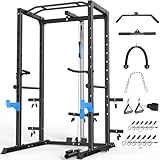
ULTRA FUEGO Power Cage
- 1.5mm steel with 50mm uprights
- 1.14 inch holes
- 10-level height adjustment
- optional pulley system
Best Power Racks for Garage Gyms (October 2026)
Every rack below appears with its own key specs. Use this table to narrow the field, then read the full review for the one or two that fit your ceiling height and floor space.
| Product | Specifications | Action |
|---|---|---|
| Sunny Health & Fitness Full Size Power Rack |
|
Check Latest Price |
| Sunny Power Rack & Cage Systems |
|
Check Latest Price |
| ULTRA FUEGO Power Cage |
|
Check Latest Price |
 CAP Barbell FM-8000F Deluxe Power Rack CAP Barbell FM-8000F Deluxe Power Rack |
|
Check Latest Price |
 CANPA Multifunction Power Rack CANPA Multifunction Power Rack |
|
Check Latest Price |
 SPORTSROYALS Power Rack with Pulley System SPORTSROYALS Power Rack with Pulley System |
|
Check Latest Price |
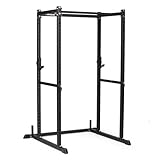 Titan Fitness T-2 Short Power Rack Titan Fitness T-2 Short Power Rack |
|
Check Latest Price |
 FLYBIRD SR1 Squat Rack FLYBIRD SR1 Squat Rack |
|
Check Latest Price |
 Mikolo Folding Wall Mounted Squat Rack Mikolo Folding Wall Mounted Squat Rack |
|
Check Latest Price |
 SunHome Power Cage with Pulley System SunHome Power Cage with Pulley System |
|
Check Latest Price |
 JELENS S11 Power Cage JELENS S11 Power Cage |
|
Check Latest Price |
 Goimu C1-V4 Power Cage Goimu C1-V4 Power Cage |
|
Check Latest Price |
1. Sunny Health & Fitness Full Size Power Rack for Complete Strength Training
Sunny Health & Fitness Full Size Power Rack for Complete Strength Training
Alloy steel frame
18-point J-hook adjustment
Safety lock spotter arms
Compact 38 x 53 x 87 in
Pros
- Stable frame with solid welds
- Compact 38 x 53 x 87 inch footprint
- Tools and hardware included
- 18-point height adjustment
- 8-position angled pull-up bar
Cons
- 0.8 inch peg holes block most third-party attachments
- Shifts on re-racks unless bolted down
- Short spotter arms for wide benchers
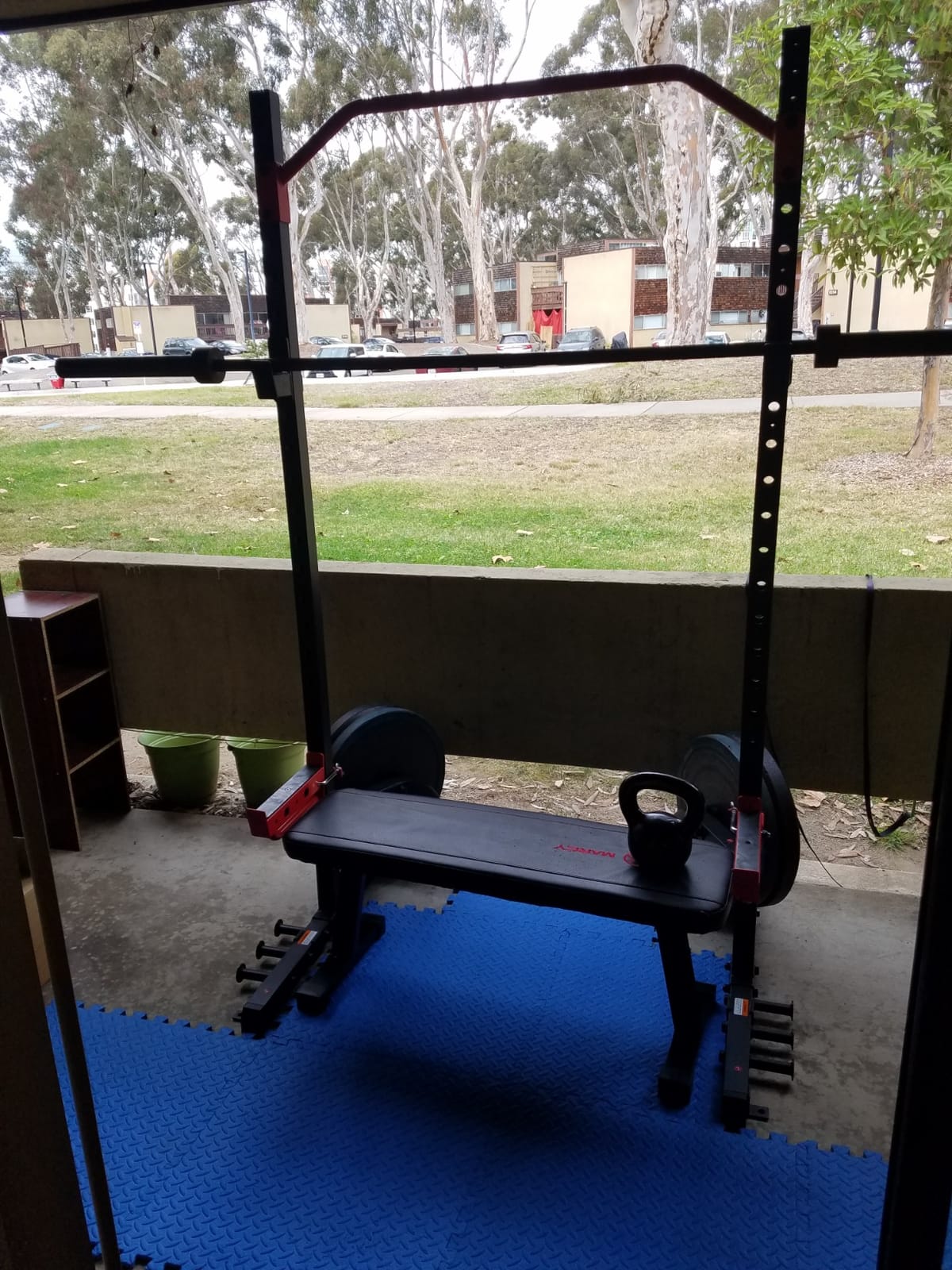
This is the rack we keep coming back to for one-car garages. At 38 by 53 by 87 inches it takes up close to nothing, and the frame itself carries more mass than the build tier suggests. The 18-point J-hook adjustment, the safety lock spotter arms and the angled pull-up bar are all standard kit, which covers everything a beginner or intermediate lifter will put on a bar for years.
Assembly took well under an hour for us with the included tools. The instructions are clear and the hardware arrives in the order you need it, which is more than we can say for several cages further down this list. The 8-position angled pull-up bar is genuinely useful because you can change grip angle without swapping hardware.
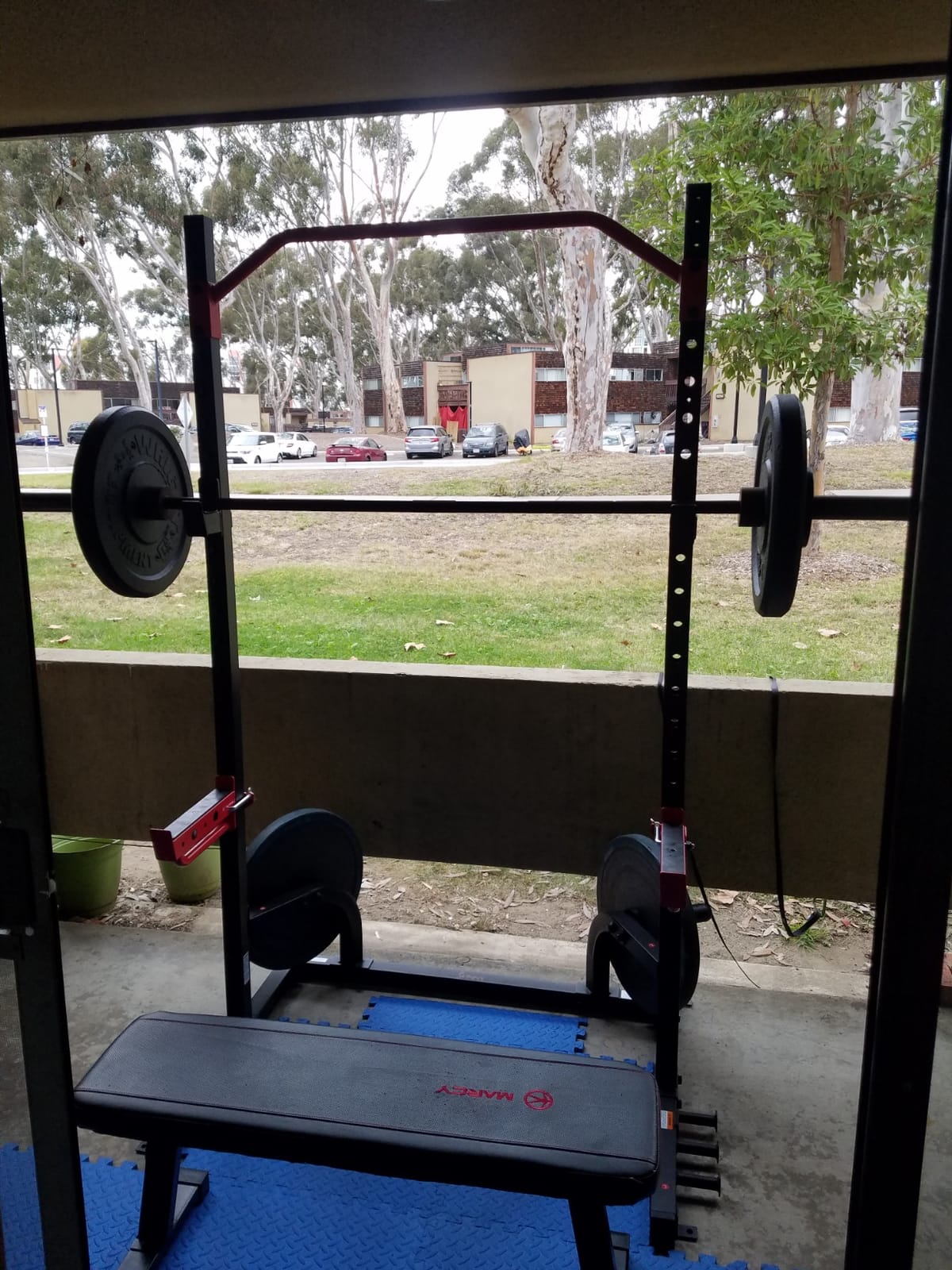
The one spec that trips people up is the hole diameter. These peg holes measure 0.8 inch, which is narrower than the 1 inch standard used by most Monster-style rack ecosystems. If your plan involves adding a third-party cable system or storage peg later, check that fit before you buy anything else.
Two other things come up repeatedly. The rack will walk across concrete during a heavy set unless you anchor it or load the base with real plates, and the spotter arms are short, so wide benchers need to keep elbows tucked. The pull-up bar grip is not knurled and can feel slick when your hands are chalk-free and wet.
Top pull-up position needs roughly 8 ft of ceiling clearance, so measure before ordering. In a standard 8 ft garage you will fit, but with ducting or a garage door opener in the way, the top setting may be unusable.
Is this rack strong enough for heavy squats alone?
For loads up to a few hundred pounds on the bar, yes. The alloy steel frame stays planted once it is anchored or loaded, and the safety lock spotter arms catch a failed rep at the height you set them.
If your plan involves grinding heavy triples, a rackable dumbbell setup, or anything with a monolift attached, move up to a heavier frame with thicker uprights and pin-and-pipe safeties.
Will it fit in a one-car garage?
It is one of the more compact full-size racks we looked at, and the narrow depth makes under-bench storage realistic. Measure your garage door swing and the ceiling height above the rack position before ordering, because the 87 inch frame height uses most of a standard 8 ft ceiling.
Pair the rack with a flat storage platform underneath, and check our overhead garage storage rack guide if you need the ceiling space more than the floor space.
2. Sunny Health & Fitness Power Rack & Cage Systems for Home Gym Training
Sunny Health & Fitness Full Size Power Cage for Home Gym Training
14-gauge full cage
2130 lb combined capacity
18 numbered heights
2 plate storage pegs
Pros
- Full cage feels sturdier than 14-gauge suggests
- Numbered height settings
- Reversible pull-up bar
- Plate and band storage posts included
Cons
- 3/4 inch holes block most third-party accessories
- Only two plate storage pegs
- Pull-up bar tapers at the ends
- Some sway under heavy load
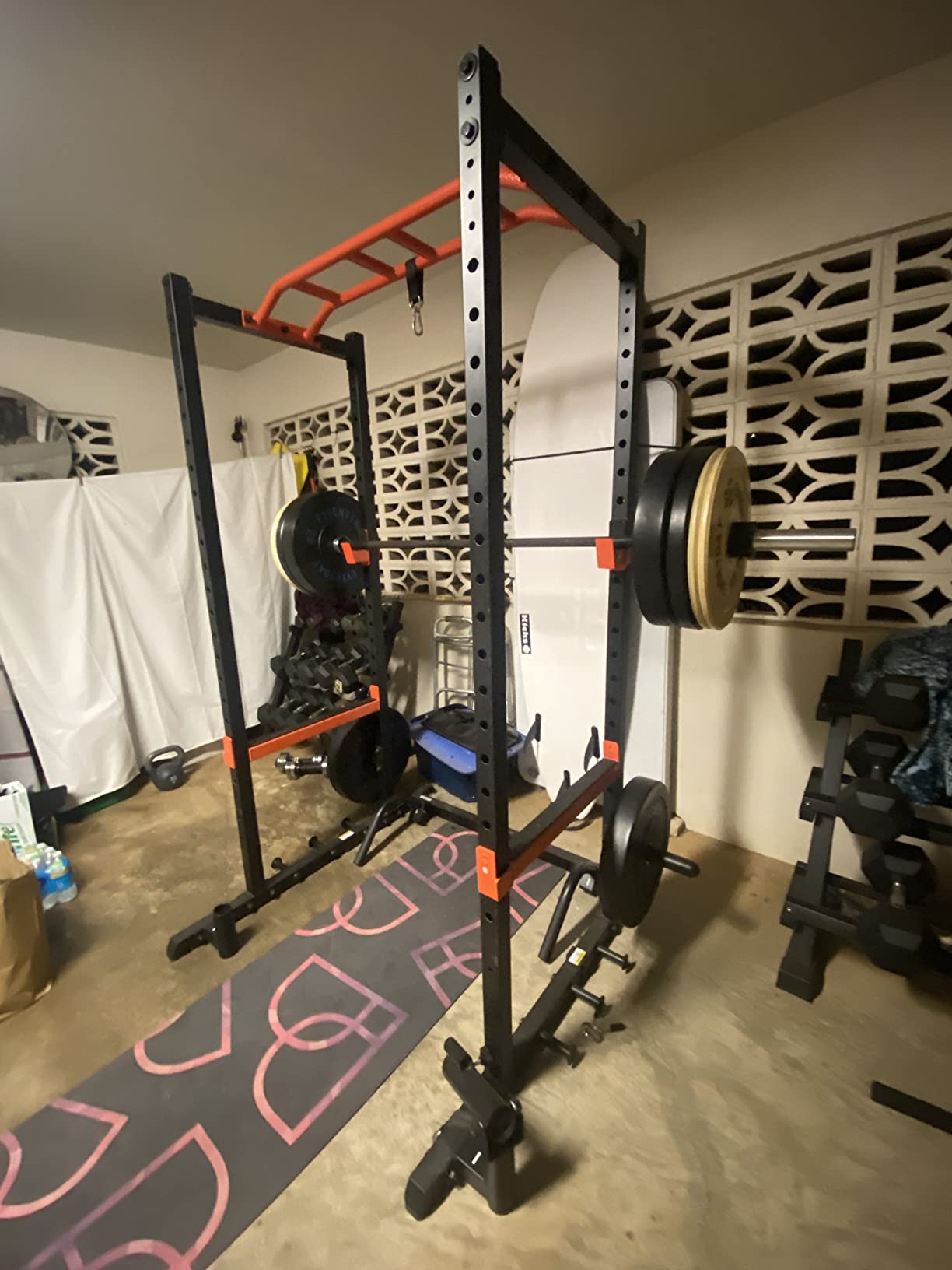
This is the full-cage option from the same brand as our top pick, and it is the better choice if you want four sides of steel instead of two. The 14-gauge frame carries a 2130 lb combined capacity figure, and at 133 lb the unit itself has enough mass to feel planted without being impossible to move.
The numbered height settings are the feature we appreciated most during setup. With 18 numbered J-hook and spotter arm positions, switching from squats to bench is a two-minute job instead of a guessing game. Owners who added the matching lat pulldown cable attachment report it transforms the exercise variety of the rack.
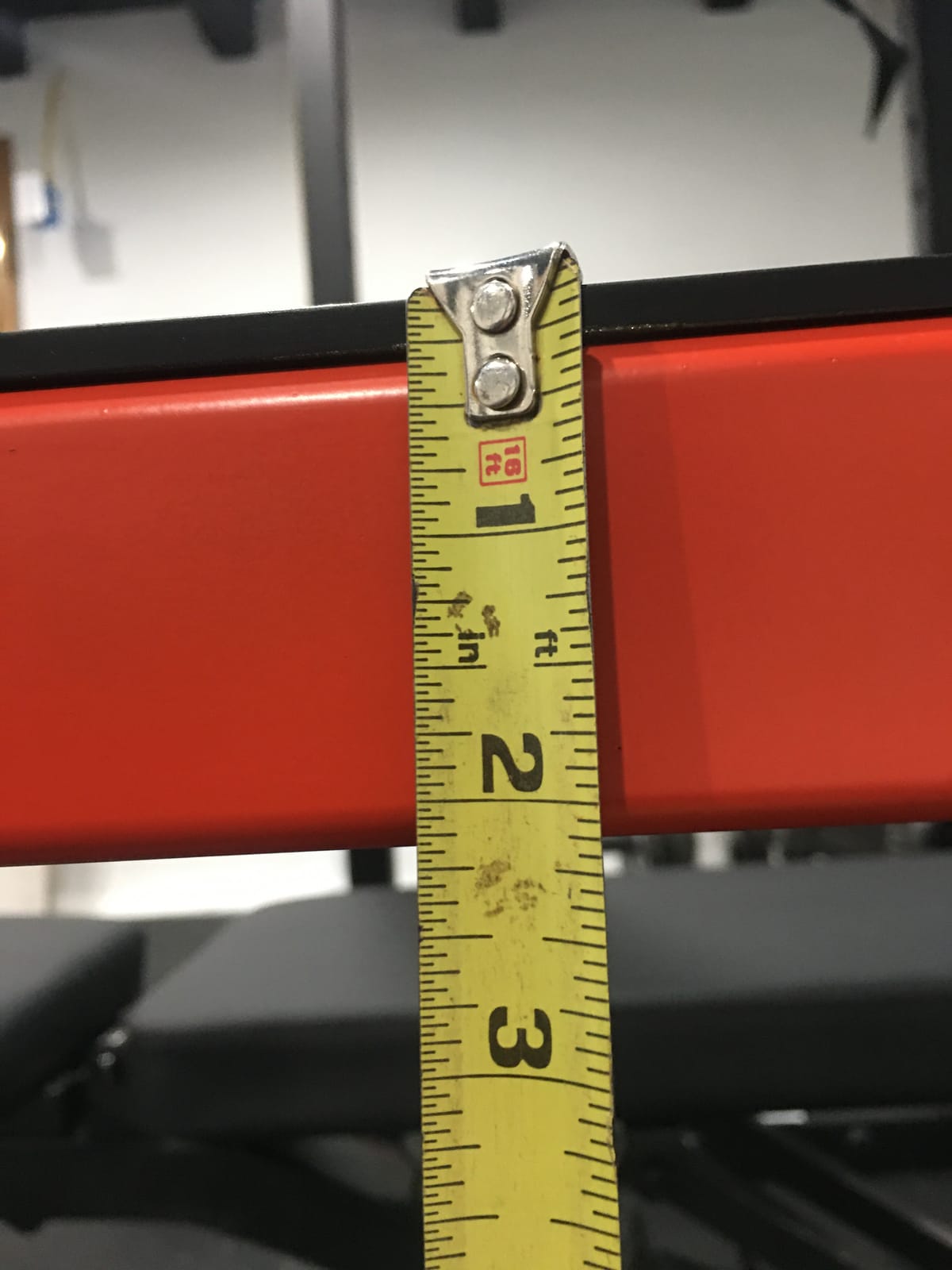
Attachment compatibility is the tradeoff. The holes measure 3/4 inch, which blocks most third-party rack accessories, so plan on staying inside this brand’s own accessory line. Plate storage is limited to two pegs, and the brand does not sell extras.
The reversible pull-up bar is a nice touch, because the intersecting bars let you do neutral-grip pull-ups. Just note that the bar tapers downward at each end, which limits grip width for taller lifters, and the knurling sits under the paint so it is minimal.
Under heavy loading you will notice some sway unless the frame is bolted to the slab. The rubber-protected spotter bars are a genuine plus in an attached garage, because they are much quieter than bare steel at 6 am.
How does a 14-gauge cage hold up under real training?
It holds up well for recreational lifting up to a few hundred pounds, and the full cage gives you more protection on a failed squat than a half rack. What it cannot do is absorb the kind of repeated 500 lb drops that heavy pullers generate.
Judge capacity by the thinnest component, not the headline number. With thin-gauge steel, replace the J-hooks early and bolt the frame down.
Is this better than the compact Sunny rack for a garage?
Choose the cage if you want a pull-up station plus a full enclosure plus storage pegs in one frame. Choose the compact rack if floor space is the constraint, since the cage takes noticeably more width and depth.
Either way, check ceiling clearance. At 82.9 inches tall, this cage needs a ceiling with real headroom above the pull-up bar before you plan overhead work.
3. ULTRA FUEGO Power Cage with Pulley System and Landmine
ULTRA FUEGO Power Cage, Multi-Functional Power Rack with J-Hooks, Dip Handles, Landmine Attachment and Optional Cable Pulley System for Home Gym
1.5mm steel with 50mm uprights
1.14 inch holes
10-level height adjustment
Pulley system
Pros
- Wide heavy base resists tipping
- 1.14 inch holes fit many accessories
- Smooth lat pulldown and pulley system
- Landmine included
- Large accessory bundle
Cons
- Included J-hooks rated around 220 lb
- Several hours to assemble
- 82.7 inch total height
- Narrow interior depth
This is the value pick of the group, and the reason is the accessory package. You get the cage, a lat pulldown bar, a tricep rope, a landmine attachment, dip handles, J-hooks and safety bars in one box, which is a lot of machine for the money.
Frame specs are respectable too: 1.5mm steel with 50 by 50mm uprights, a laser-cut and powder-coated finish, and a wide heavy base that resists tipping once assembled. The 1.14 inch hole diameter accepts a much wider range of third-party attachments than the two Sunny racks above.
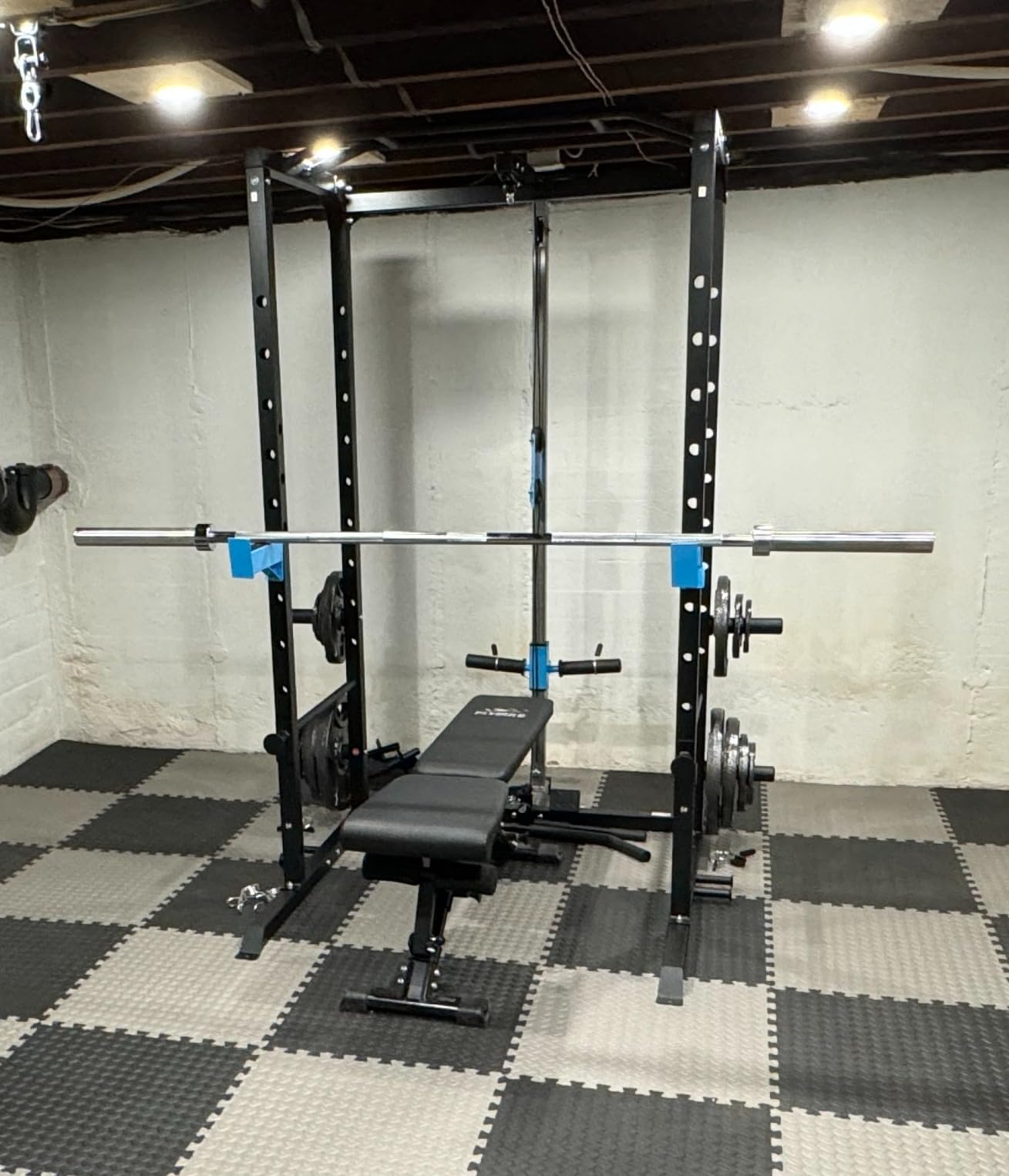
The upgrade almost everyone makes first is the J-hooks. The included pair is rated around 220 to 225 lb, so lifters moving heavier bars swap them early. One owner reported a 495 lb bar dropping onto the safeties without issue once better hooks were fitted, which tells you the frame itself holds up.
Two more practical notes. The assembled height is 82.7 inches to the top of the pull-up bar, which is less obvious from the listing photos than you would expect. And the interior depth is narrow, which limits bar travel for inside squatting.
The parts come in multiple cartons and broken down logically, but assembly takes several hours for a first-time builder. Budget an evening rather than an afternoon.
Will this handle heavy loads like a commercial rack?
No. Reviewers consistently describe it as excellent value for low-to-medium weight lifters, and the frame is not designed for club-level loading. Any headline capacity figure on a rack like this is a structural claim, not an invitation to drop heavy singles onto the safeties.
If you need club-level loading, look at the heavier frames further down, and swap the J-hooks regardless of the load you plan to train at.
Is the pulley system any good?
For the money, yes. The pulley system and lat pulldown run smoothly, and the landmine attachment adds pressing and rotational movement that most racks at this level leave out entirely.
Expect to add carabiners for a cleaner attachment setup, and check the ceiling height before ordering because the top of the pull-up bar sits at 82.7 inches.
4. CAP Barbell FM-8000F Deluxe Power Rack
CAP Barbell FM-8000F Deluxe Power Rack, Gray
12 and 14 gauge steel
600 lb rack capacity
1 inch holes on 3x3 posts
Wide 47 x 61 inch base
Pros
- Very wide base resists tipping
- 1 inch holes accept Monster-style arms
- Sub-hour solo assembly
- Plate posts and band posts included
- Can be bolted down
Cons
- Thin steel with safety arms some owners report flexing
- Weak packaging leads to bent or missing parts
- J-cup rubber pads wear out
- Replacement service is slow
This rack has been around for years, and the review record shows it clearly: a 4.2 rating across 2245 reviews is a split verdict, not a consensus. Owners who lift recreationally love the wide base and the low entry cost. Owners who lift heavy rate it low for thin steel and flexing safety arms.
The reason it still earns a place is the footprint. At 45.6 inches deep and 61.4 inches wide with a heavily weighted base, it resists tipping better than most half racks in its class, and it can be bolted down for zero movement once assembled.
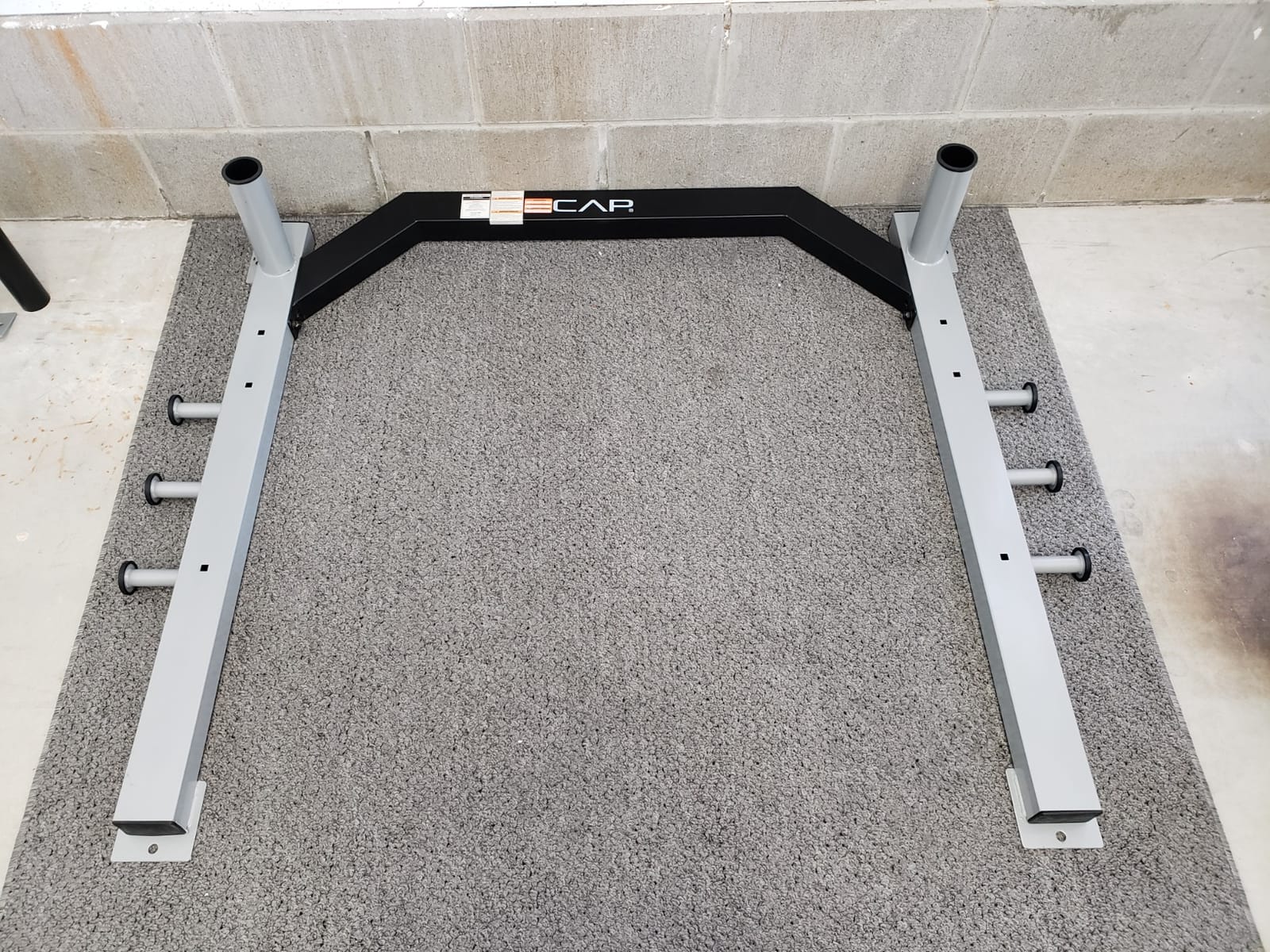
Specification-wise it does some things right. The holes are standard 1 inch on 3 by 3 inch posts, so Monster-style rack ecosystem arms fit, which is rare at this tier. Plate posts, three band posts per side, two J-cups and two safety catches are all included, and assembly is under an hour with the picture-based instructions.
The packaging is the weak point. Owners report bent or missing parts on arrival fairly often, and some holes need grinding to line up. J-cup rubber pads wear through and need taping or replacing, and the pull-up bar sits on the flimsier side.
The most common piece of advice across reviews is to tighten every bolt fully, use the anchor points, and upgrade the J-cups. Do all three and most of the complaints disappear.
Is the flexing safety arm issue real?
It is real and it is the main reason for the low rating. A vocal group of owners reports flex in the safety arms at loads around 135 lb, which is far below the 300 lb per-bar-catch rating. Treat that rating as optimistic on this model.
If you plan to bench anything heavy, budget for replacement safeties from another brand, and verify the holes line up before you start.
Who should still buy this rack?
Beginners, anyone lifting mostly dumbbells and light bars, and buyers who want a standard 1 inch hole pattern on a 3 by 3 inch post without stepping up a tier. It also survives years and multiple house moves once bolted down.
Skip it if you are chasing heavy singles, or if you cannot tolerate a support process that reviewers describe as slow and hard to reach.
5. CANPA Multifunction Power Rack for Home Gym Equipment
CANPA Multifunction Power Rack with Pull up Bar, Heavy Capacity and Adjustable Squat Stand Rack for Home Gym Equipment, Power Rack Cage (Black)
800 lb load capacity
Front and rear double support
Standard 1 inch holes
43 x 41 inch footprint
Pros
- Very compact footprint
- 1 inch holes for accessory fit
- Video-assisted assembly in 30 to 60 minutes
- All tools included
- Stable once loaded
Cons
- Narrow mid-width suits 6 ft bars better
- Reracking height awkward for short lifters
- Lowest holes unusable with longer hooks
- No safeties unless bought separately
This is one of the smallest footprints in the roundup, and that is the whole pitch. At 43.03 inches deep by 40.75 inches wide it tucks into a basement corner or the strip of floor beside a parked car better than any other rack here, and it holds an 800 lb load rating on a front and rear double support design.
Assembly is genuinely quick. Owners following the video guide report 30 to 60 minutes, wrenches and all hardware included, and the rack is stable once loaded with plates or a mat. The rear Olympic plate storage bar also acts as extra bracing under load.
What you give up is geometry. The mid-width frame suits 6 ft bars better than 7 ft Olympic bars, and the narrow interior limits grip width on squats and deadlifts. Several buyers point out that the height adjustment is constrained by the lower, wider half of the frame, which can leave the bar too high for lifters under about 5 foot 7.
Two more things. Incline benching inside the rack is awkward because of the hook hole placement, and the lowest holes cannot be used with longer J-hooks or safety arms. There are no true safety arms unless you buy compatible ones separately, which is the one gap we would not accept for solo heavy benching.
Buyers treat this as a recreational rack, not a powerlifting platform. Damaged parts on arrival were reported by some, though the seller replaced them quickly.
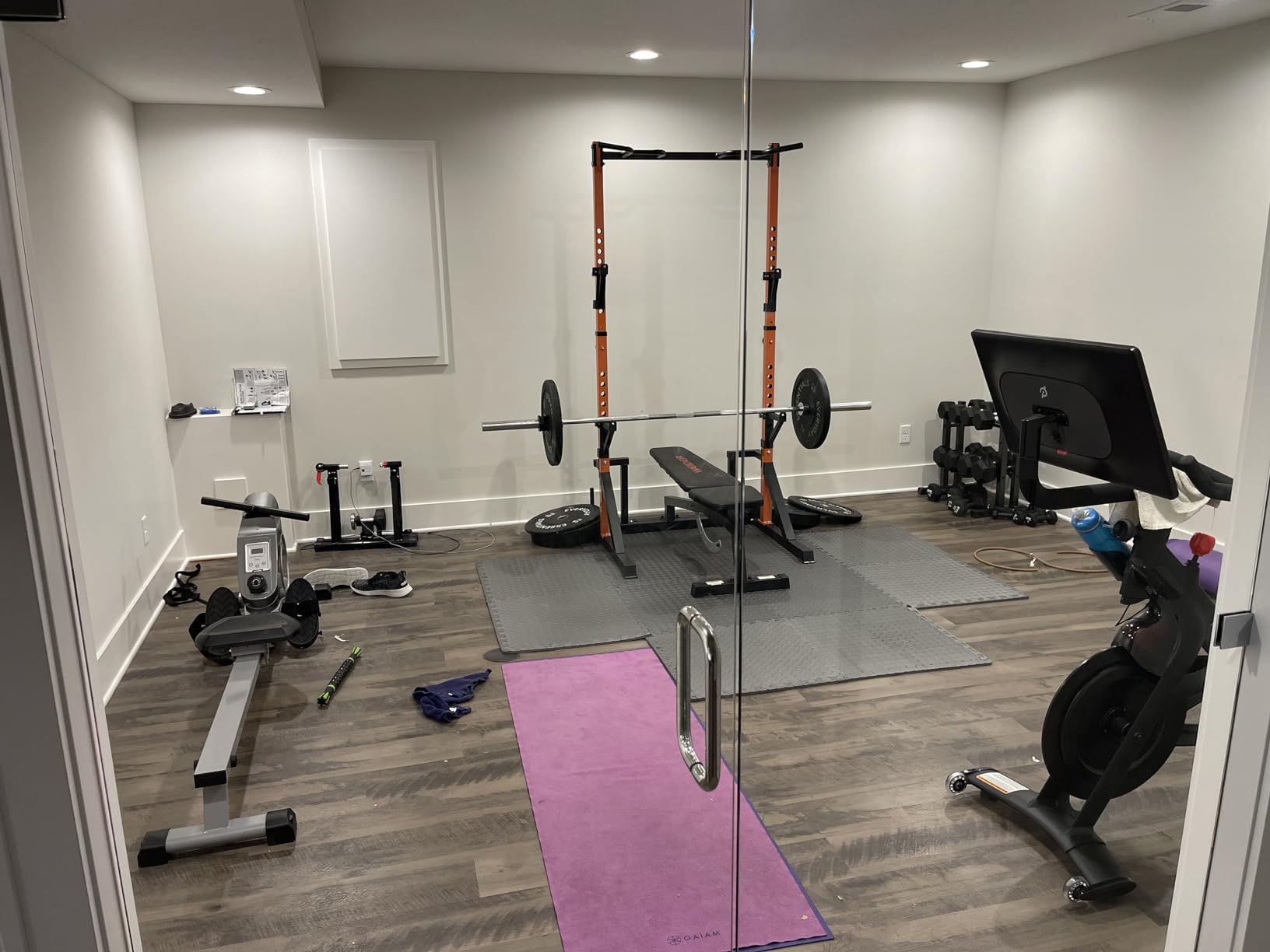
Is this safe enough for solo benching?
Only if you add safeties. Out of the box it is a squat stand with a pull-up bar, and the absence of included safety arms is the deciding factor for anyone training heavy alone.
Buy compatible 1 inch safeties and the picture changes entirely. The 1 inch hole spacing is the main reason this rack works as a budget choice, since third-party parts fit.
Will it actually fit in a packed garage?
It is one of the strongest candidates in this list for a one-car garage where the car stays parked. Very little else here is this narrow, and the 85.71 inch height still needs a ceiling above 86 inches.
Because the frame is light and compact, it is also the easiest to move when you need the floor back. That matters more than people expect in a shared garage space.
6. SPORTSROYALS Power Rack with Pulley System and Lat Pull Down
SPORTSROYALS Squat Rack, 1200 lb Power Cage with LAT Pulldown for Home Gym
150 lb frame
1200 lb capacity claim
Upper and lower pulley system
61.6 inch cage width
Pros
- Heavy frame with reinforcing tabs feels solid
- Smooth upper and lower pulleys
- Huge accessory bundle
- Rubber pads reduce noise
- 61.6 inch width fits two users
Cons
- 150 lb weight needs two or three people to assemble
- Two-box packing slows the build
- Cable parts are wear items
- Holes are not numbered
If cable work is your priority, this is the rack to look at first. The upper and lower pulley system uses precision bearings with electroplated telescopic poles, and owners single out the smoothness of the pulleys as the standout feature. The 500 lb PU-coated steel cable is a sensible spec choice.
At 150 lb the frame is among the heaviest in this roundup, and that mass is a feature. With reinforcing tabs at the joints it feels planted and does not rattle, and the rubber pads on the safety arms and bars protect the bar knurling while cutting noise in an attached garage.
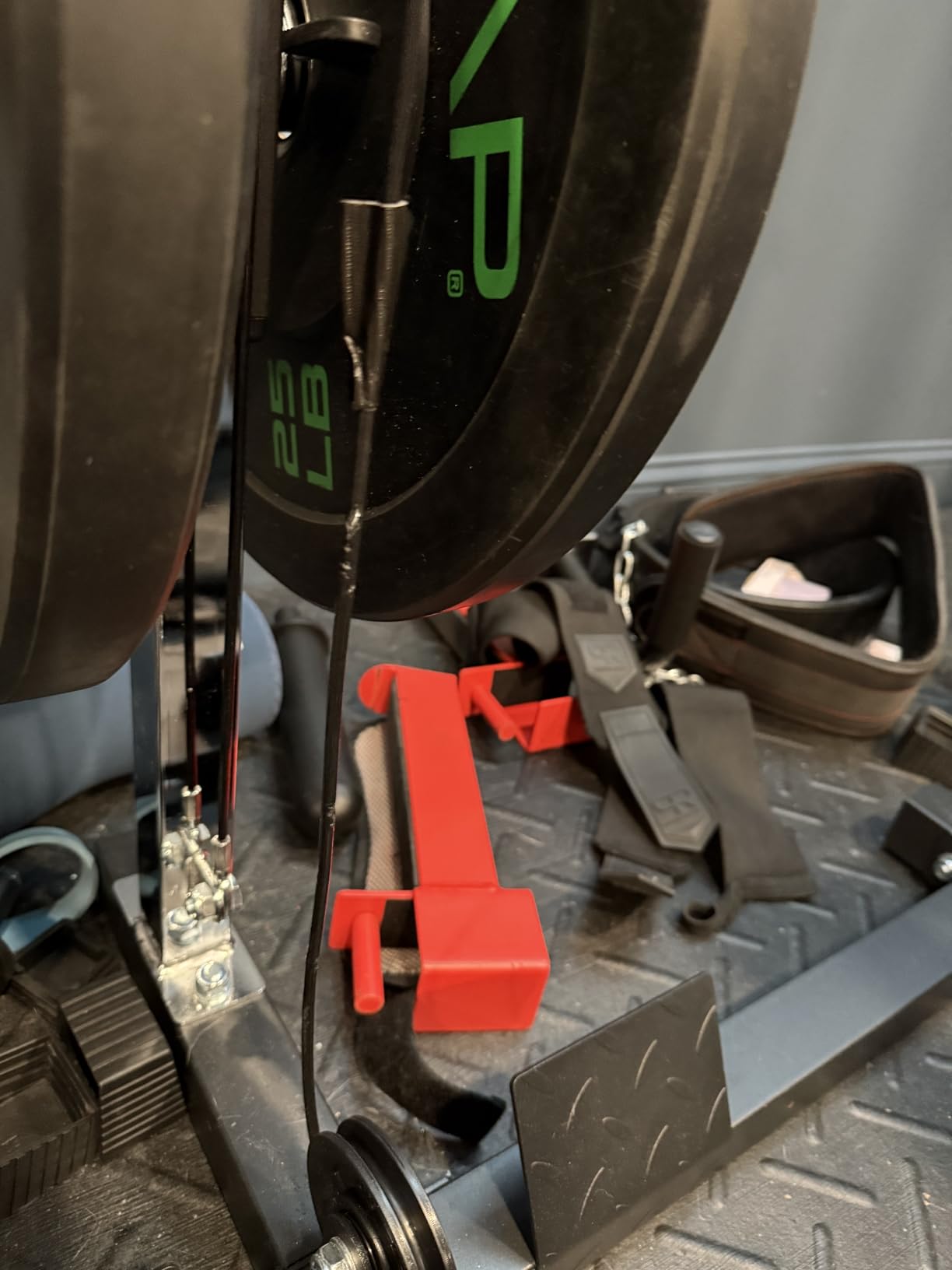
The accessory list is enormous: rowing bar, four weight plate storage pegs, six band pegs, lat pulldown bar, two safety arms, two J-hooks, two safety bars, two dip stands, tricep rope, ankle strap, six barbell clamps, two cable handles, a wide and narrow pull-up frame, a 360 degree landmine and a foot board. Most buyers pair it with their own bench and weights.
The friction is logistics and bulk. At 150 lb, assembly needs two or three people, and the pieces are packed into two separate cartons. Cables and pulleys are wear items, and with unnumbered adjustment holes setup involves trial and error.
The frame is 50 by 50mm square steel with 1.5mm thickness and 14 adjustable height levels, rated to a 1200 lb claim that owners consider appropriate for intermediate home lifting.
Is it worth the assembly effort?
Yes if cable work matters to you, and no if you want the rack standing the same afternoon. Two or three people and a couple of hours is a realistic estimate, not a worst case.
The 61.6 inch width also means two people can train inside the cage at once, which no other rack in this list offers.
How does it handle a low ceiling garage?
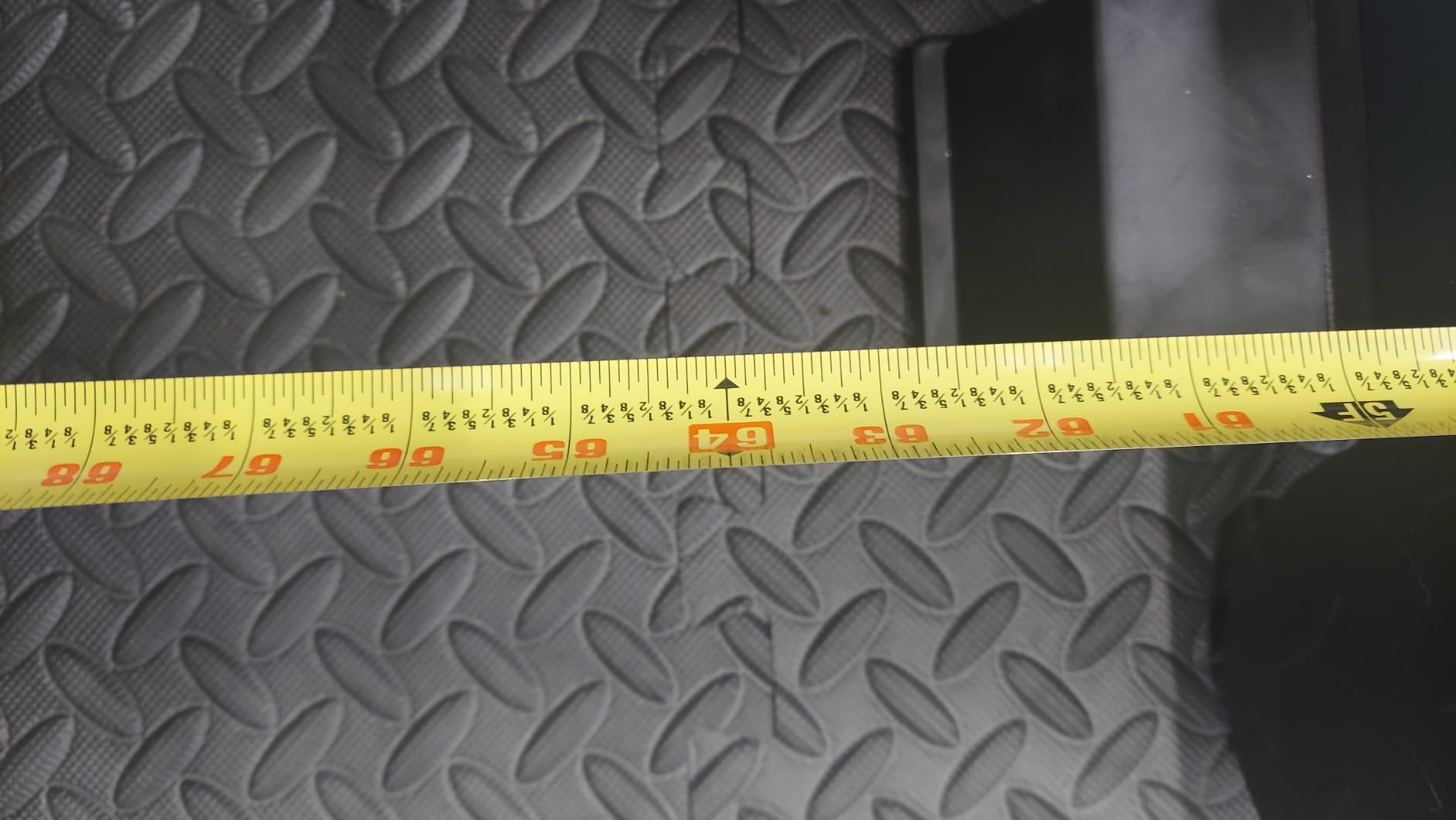
Poorly. At 82.6 inches overall it is one of the taller frames here, and owners note it is not sized for low-ceilinged garages at all.
If you have under 8 ft of clearance, look at the shorter Titan T-2 or the folding wall-mounted Mikolo instead.
7. Titan Fitness T-2 Series Short Power Rack
Titan Fitness T-2 Series Tall 83″ Black Power Rack, 850 LB Rackable Capacity, Skinny Pull Up Bar, Pin and Pipe Safeties, Standard J-Hooks, for Home Garage Gym Weightlifting and Strength Training
14-gauge 2x2 laser-cut uprights
71 in or 83 in heights
1000 lb J-hooks
Pin and pipe safeties
Pros
- Short 71 inch version fits low basements
- More stable than other 2x2 racks
- Heavy dependable safeties
- J-hooks protect bar knurling
- Large Titan attachment catalogue
Cons
- Holes not numbered
- Tight reracking clearance around 3 inch uprights
- Powder coat chips over time
- Uneven drilling on some pieces
Titan Fitness builds the only rack here that comes in a genuine short version. The 71 inch height exists specifically for basements and low-clearance spaces where a full-size cage will not go, and that option alone puts it near the top of this list for anyone with ceiling problems.
Owners consistently note that it feels more stable than other 2×2 racks they have used, with solid welds and side bracing on the laser-cut uprights. The pin and pipe safeties feel heavy and dependable for solo work, and the J-hooks are rated to 1000 lb with a nylon plastic core that protects bar knurling.
Capacity is 850 lb rackable and 2200 lb total, which is a realistic split for a rack like this: the rackable figure is the honest number for planning your loads. The pull-up bar is a 1.25 inch diameter single bar built into the front crossmember, not a separate add-on.
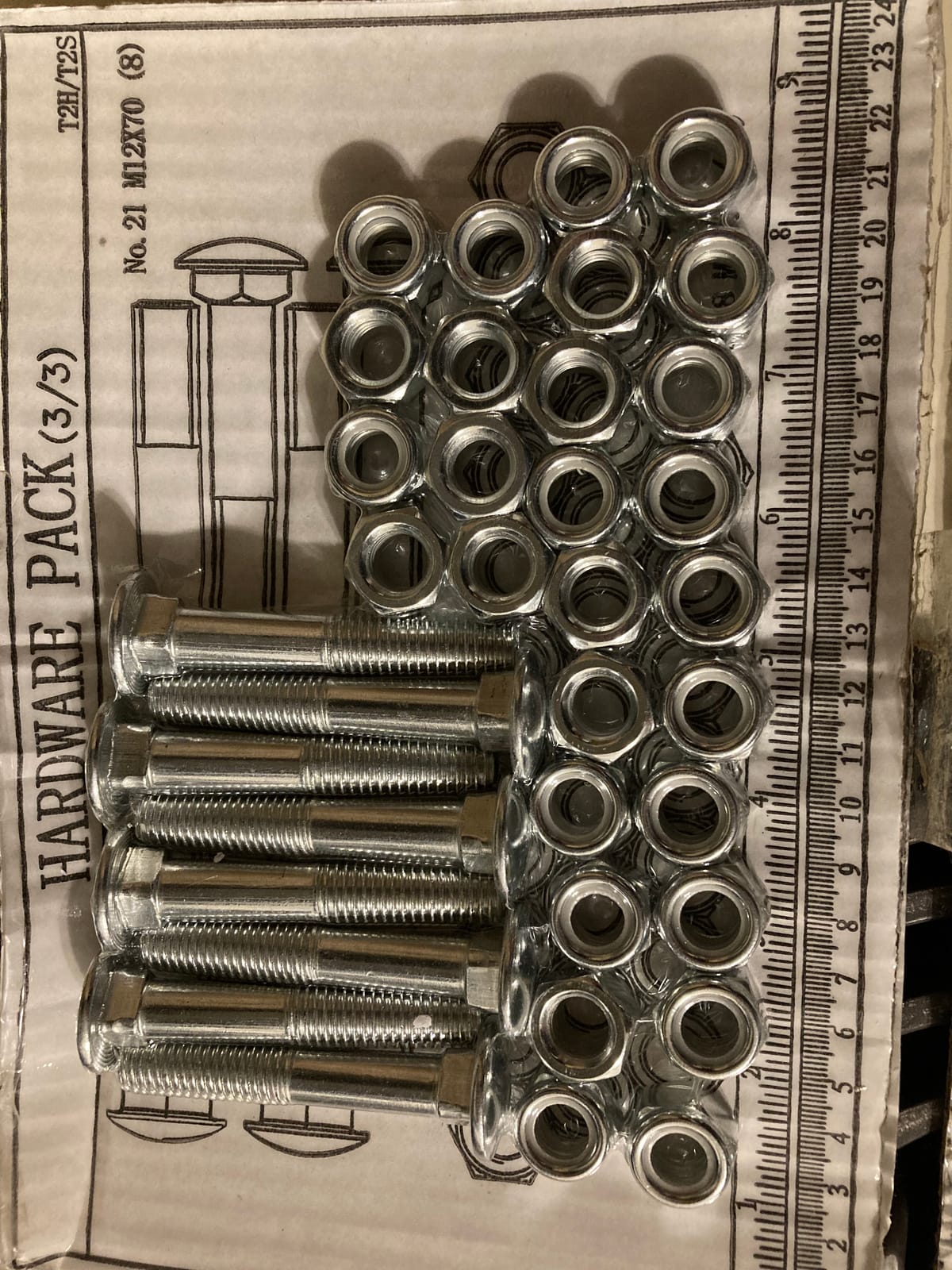
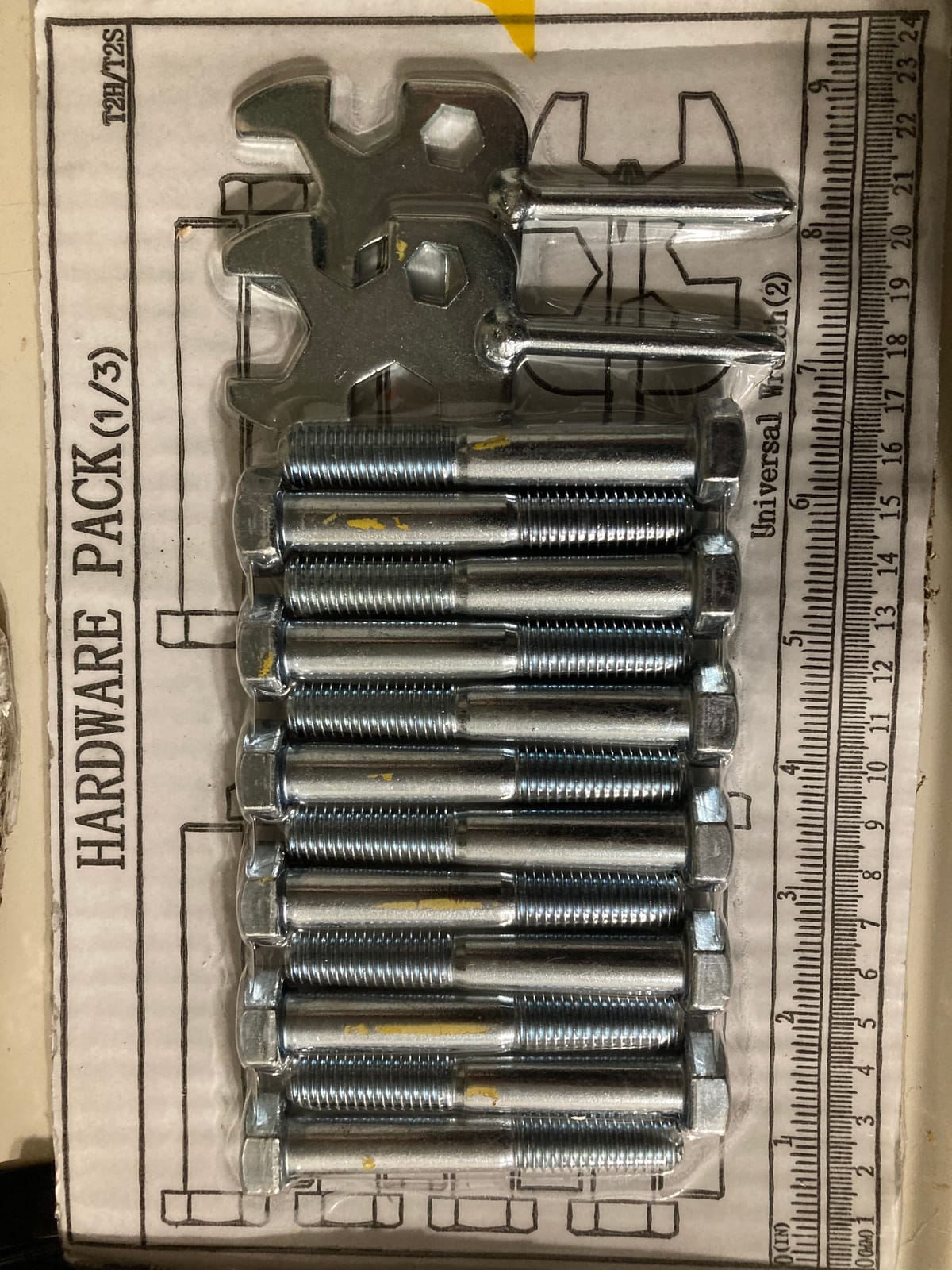
Three practical complaints recur. The adjustment holes are not numbered, which makes repeatable setups harder. The 3 inch wide uprights leave less than an inch of clearance between the hook end and the bar sleeve, which can make reracking a powerlifting bar with long sleeves tight.
Some arrive with missing washers or unevenly drilled uprights. Owners consistently recommend inspecting every hole and fastener before loading a bar, and checking the powder coat before you accept the delivery.
Is Titan quality control consistent?
Mostly, with a tail of fit and finishing issues. Owners report missing washers and uneven drilling on some units, and the powder coat chips with use. Buyers on r/GarageGym threads frequently recommend inspecting every hole and fastener before loading a bar.
The welds draw far more praise than complaints, which is the opposite pattern to some budget cages. At 130 lb, a two-person assembly is effectively required.
Why bolt it down?
Because the flat base still moves under a heavy re-rack, and bolting to the floor or a platform makes it immovable.
Titan also runs a large catalogue of add-on attachments for the platform, so the ecosystem is deeper than most brands at this level.
8. FLYBIRD SR1 Squat Rack for 6FT and 7FT Barbells
FLYBIRD SR1 Squat Rack with Pull-Up Bar, Multi-Functional Power Rack for Home Gym, 22 Safety Position Height & Adjustable Width for 6/7ft Barbells, Includes Extended J-Hooks & Landmine Attachment
2x2 steel rated to 950 lb
22 height settings
16.7 inch safety arms
Adjustable bar width
Pros
- 950 lb capacity with minimal wobble
- Standard 1 inch holes
- 22 height settings
- Long 16.7 inch safety arms
- Adjustable width for 6 ft and 7 ft bars
Cons
- Width adjustment adds assembly steps
- Foam padding wears over time
- 68 lb frame moves more when unloaded
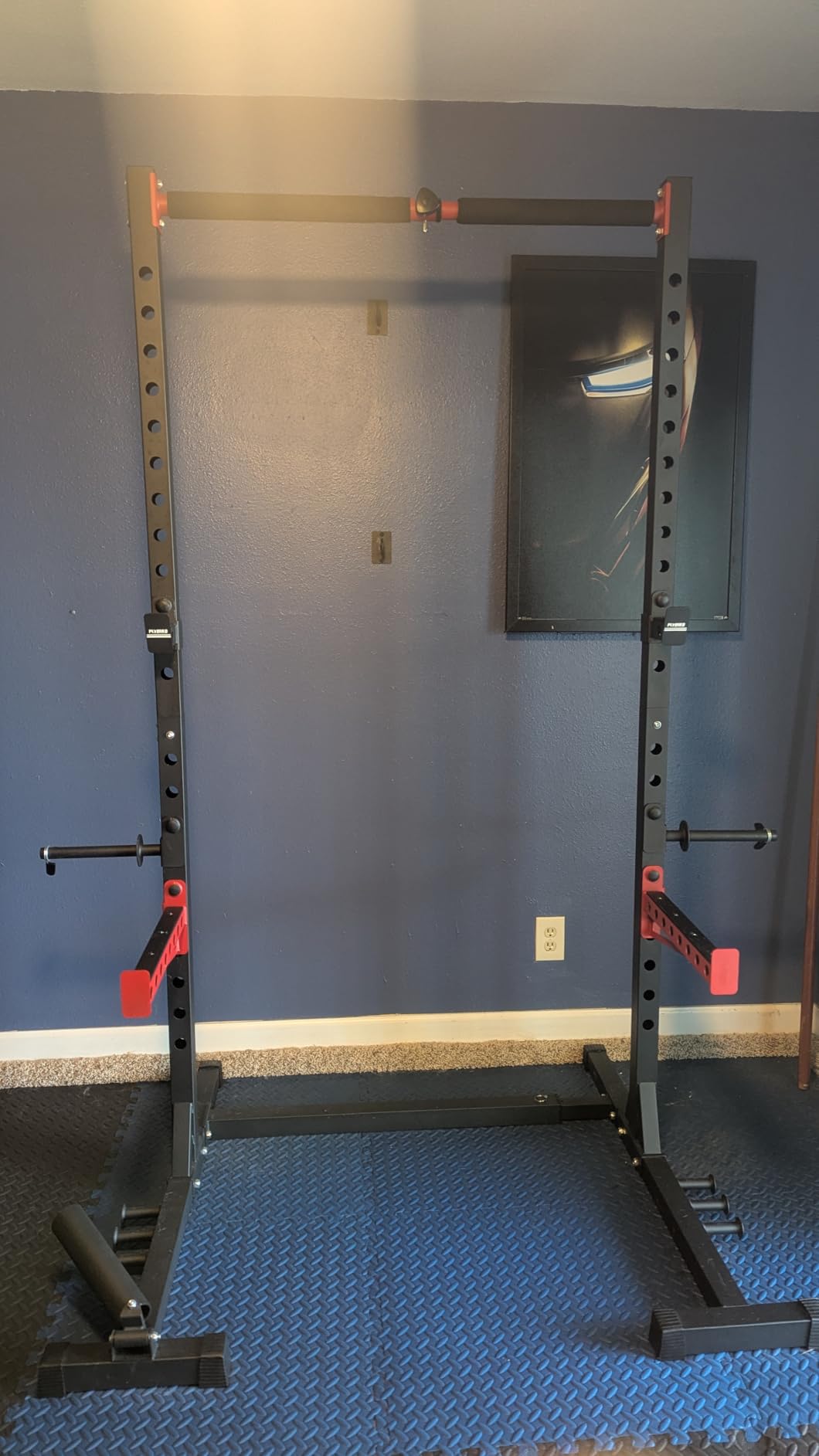
The FLYBIRD SR1 stands out for one reason: 22 height settings on standard 1 inch holes. Most racks in its class give you 10 to 14 positions at irregular spacing, and the finer adjustment here makes a visible difference when you are dialing in a squat depth or a bench position for one specific lifter.
The safety arms are the other differentiator. At 16.7 inches extended and built from 1.2 by 1.2 inch solid steel, they give real catch space for solo benching, which is where most cheap squat stands fall short.
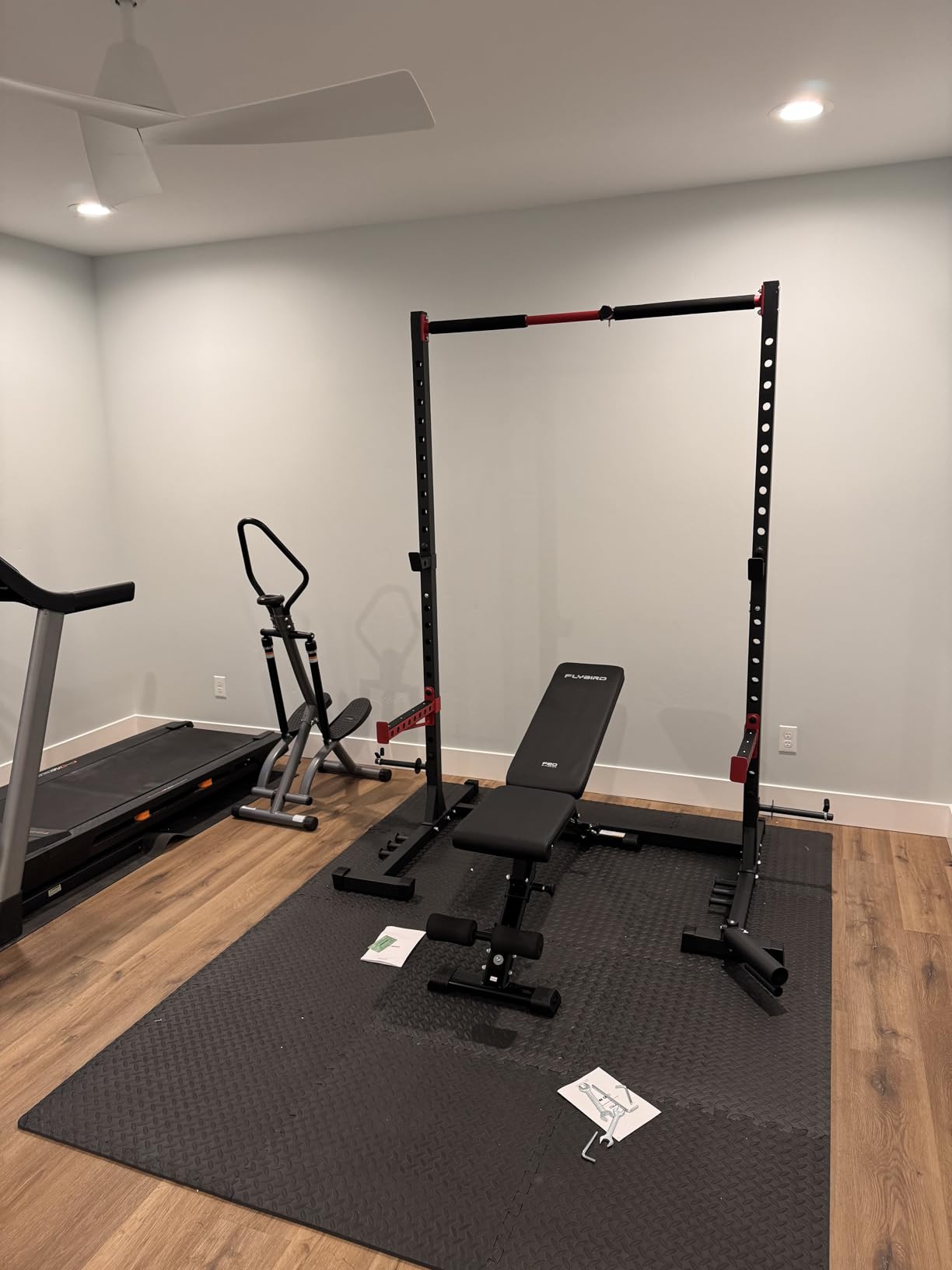
The frame is 2×2 commercial-grade steel rated to 950 lb, and at 68 lb it is light enough for one person to move but light enough to notice when it is unloaded. The compact footprint of roughly one square metre works well in a garage where floor space is tight.
The adjustable width mechanism is both the best and worst feature. It accepts both 6 ft and 7 ft barbells, which is unusual, but it adds assembly steps and complexity compared with a fixed half rack. The foam padding on the pull-up bar also wears down over time.
Owners are mostly beginner to intermediate lifters building a first garage gym, and they report solid stability for 200 to 300 lb of work.
Is 22 height settings actually better?
For a household with more than one lifter, yes. Fine adjustment lets you set the bar for a 5 foot 4 lifter and a 6 foot lifter without compromise, which coarse 10-position racks handle poorly.
The 1 inch hole spacing is the more important spec long term, because it locks in access to the widest range of third-party attachments.
Will it stay put without being anchored?
It holds steady under working loads, but at 68 lb it is more prone to movement when empty than heavier cages. Loading the base or anchoring it removes the issue.
Landmine attachment, six resistance band pegs and the foam-padded pull-up bar are included, so it doubles as a band training station out of the box.
9. Mikolo Folding Wall Mounted Squat Rack
Mikolo 2″ x 2″ Folding Wall Mounted Squat Rack, 1000 Pounds Capacity Power Rack with Safety Catches, Pull Up Bar, J Hooks and Landmine Attachment, Space-Saving Home Gym(Black
2x2 13-gauge uprights
Folds to 2 inch depth
1000 lb capacity
Pull-up bar to 89 inches
Pros
- Frees an entire wall when not lifting
- 1000 lb capacity
- Forgiving lag bolt slots
- UHMW inserts protect bar knurling
- Includes pull-up bar and attachments
Cons
- Confusing install diagram causes remounting
- Some bent parts reported on arrival
- Needs sound wall structure
- Cannot be repositioned
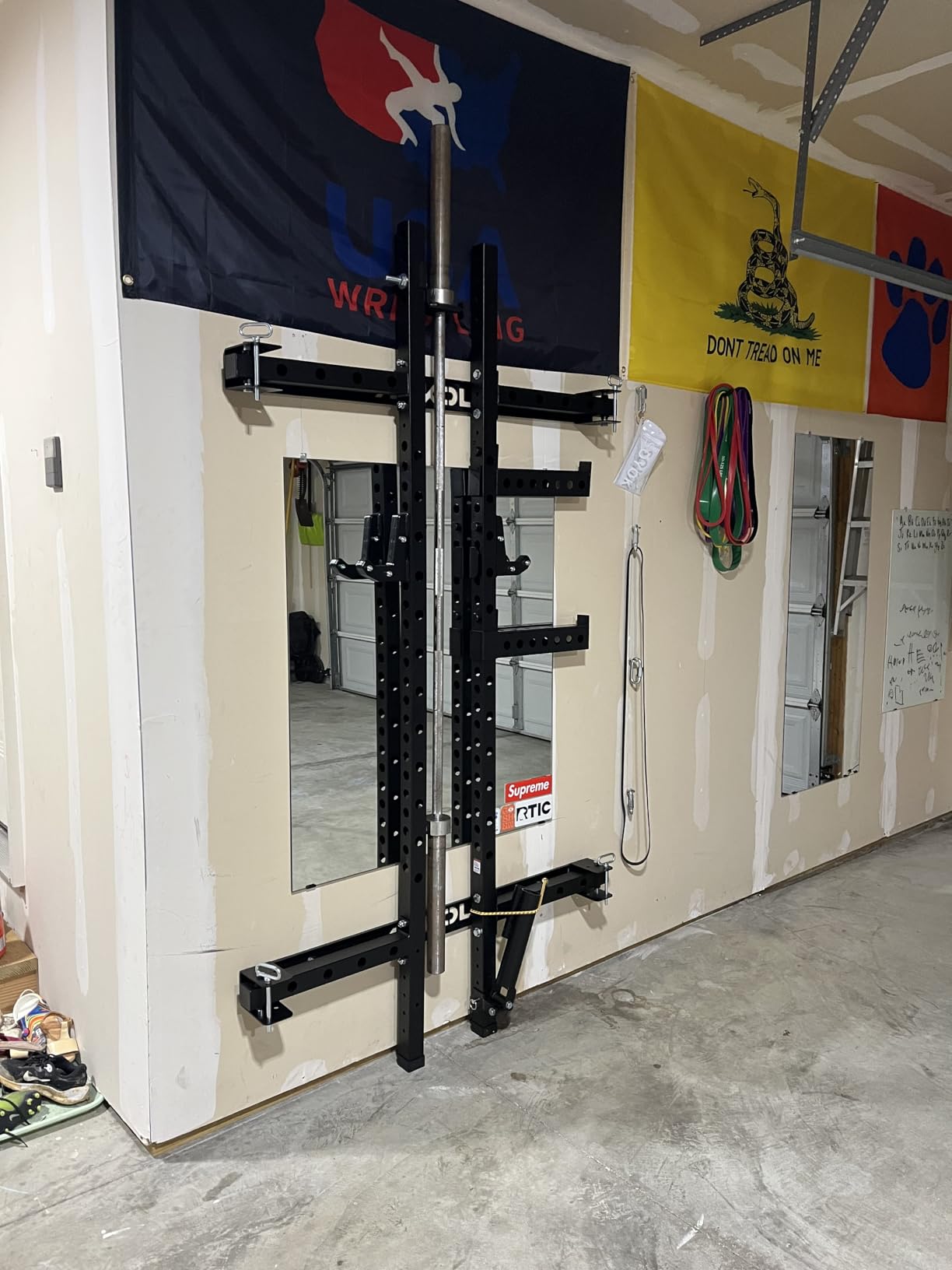
When floor space is the binding constraint, a folding wall-mounted rack solves a problem no freestanding model can. This one collapses from 47 by 19.7 inches open to just 47 by 2 inches deep against the wall in roughly 15 seconds, so the whole bay returns to parking space.
It is also rated to 1000 lb on 2×2 13-gauge uprights, which is genuinely heavy for a wall-mounted design, and owners report using well over 300 lb of total plate weight on it without trouble.
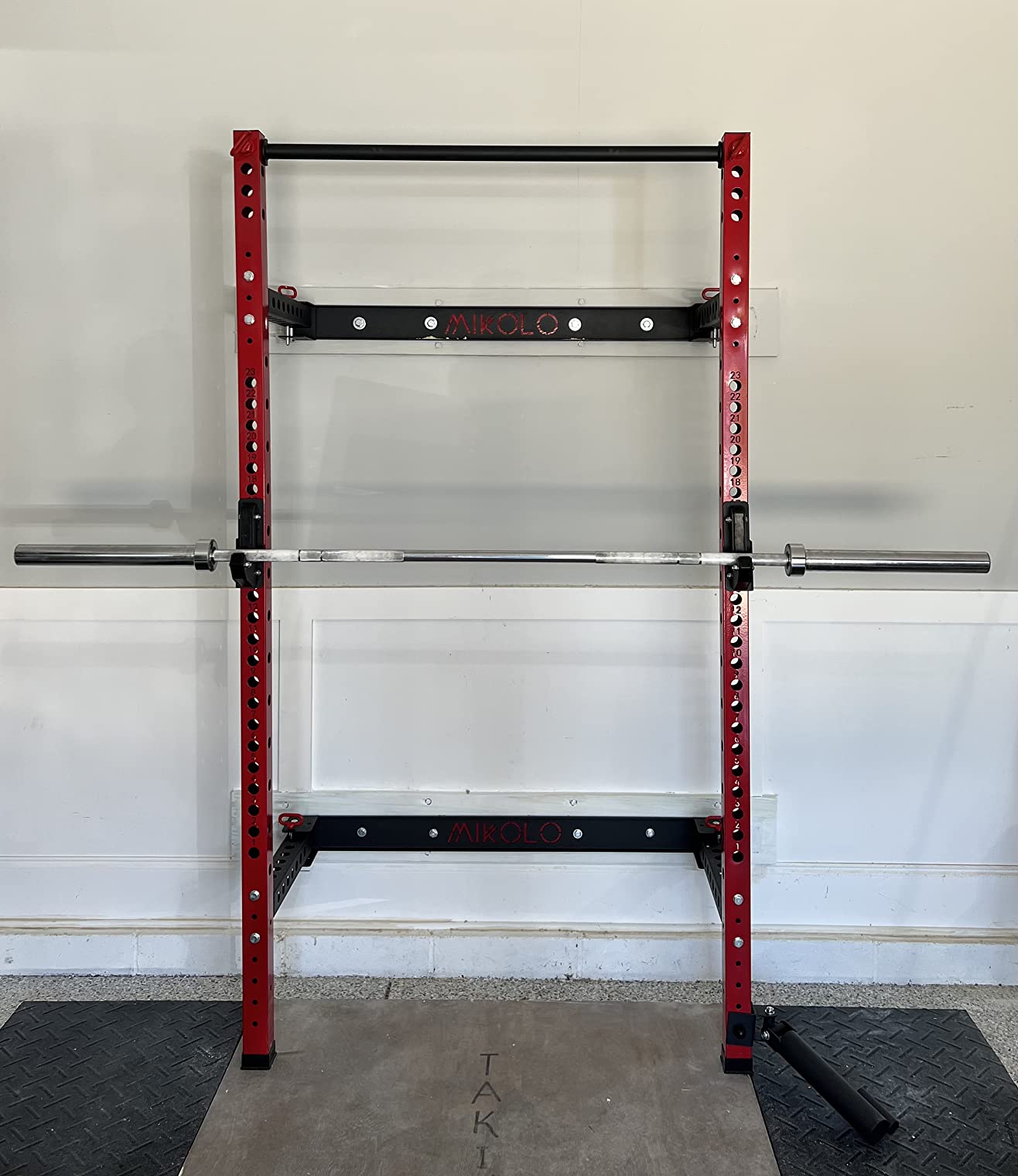
The installation details are what make or break this product, and they run both ways. The wide lag bolt slots are forgiving of off-centre studs, vertical leg adjustability lets you level an out-of-square mount, and a mounting stringer plus metal studs are included, so installation is a 15 to 30 minute job with basic tools.
Against that, the measurement diagram in the manual is confusing and several buyers had to remount. Wide slots are useful but they do not fix a badly located mount, so find your studs carefully before drilling.
Also worth knowing: it is not freestanding, so it stays on that wall, and the separately sold safety bar has been hard for some buyers to source.
Is a wall-mounted rack safe for heavy work?
It can be, provided the structure behind it is sound. The 13-gauge uprights and 1000 lb rating are not the weak link; the studs and header are. A folding rack bolted into inadequate framing is the one setup we would not lift heavy in.
J-cups use UHMW plastic inserts that protect bar knurling, and a 360 degree dual-size T-bar row attachment is included for cable-free rows.
Does this work in a one-car garage?
It is one of the few options here that genuinely does. Owners running one-car garages, small workshops and converted corners describe it as the only full rack that disappears when not in use.
Remember the folded depth still takes about 2 inches plus the pull-up bar, and check the open depth of 19.7 inches for your squat clearance.
10. SunHome Power Cage with Cable Crossover System
SunHome Power Cage Squat Rack, Multi-Functional Power Rack with J-Hooks, Dip Handles, Weight Plate and Olympic Bar Storage Home Gym
1500 lb cage claim
2x2 steel tube
28 adjustable positions
Pulley and crossover system
Pros
- High capacity claim for the tier
- 28 adjustment positions
- Built-in cable crossover
- Four plate posts and bar hooks
- Compact 42.4 inch width
Cons
- 84.9 inch height needs high clearance
- Open back gives less safety than a full cage
- Limited third-party attachment options
- Some parts arrive damaged
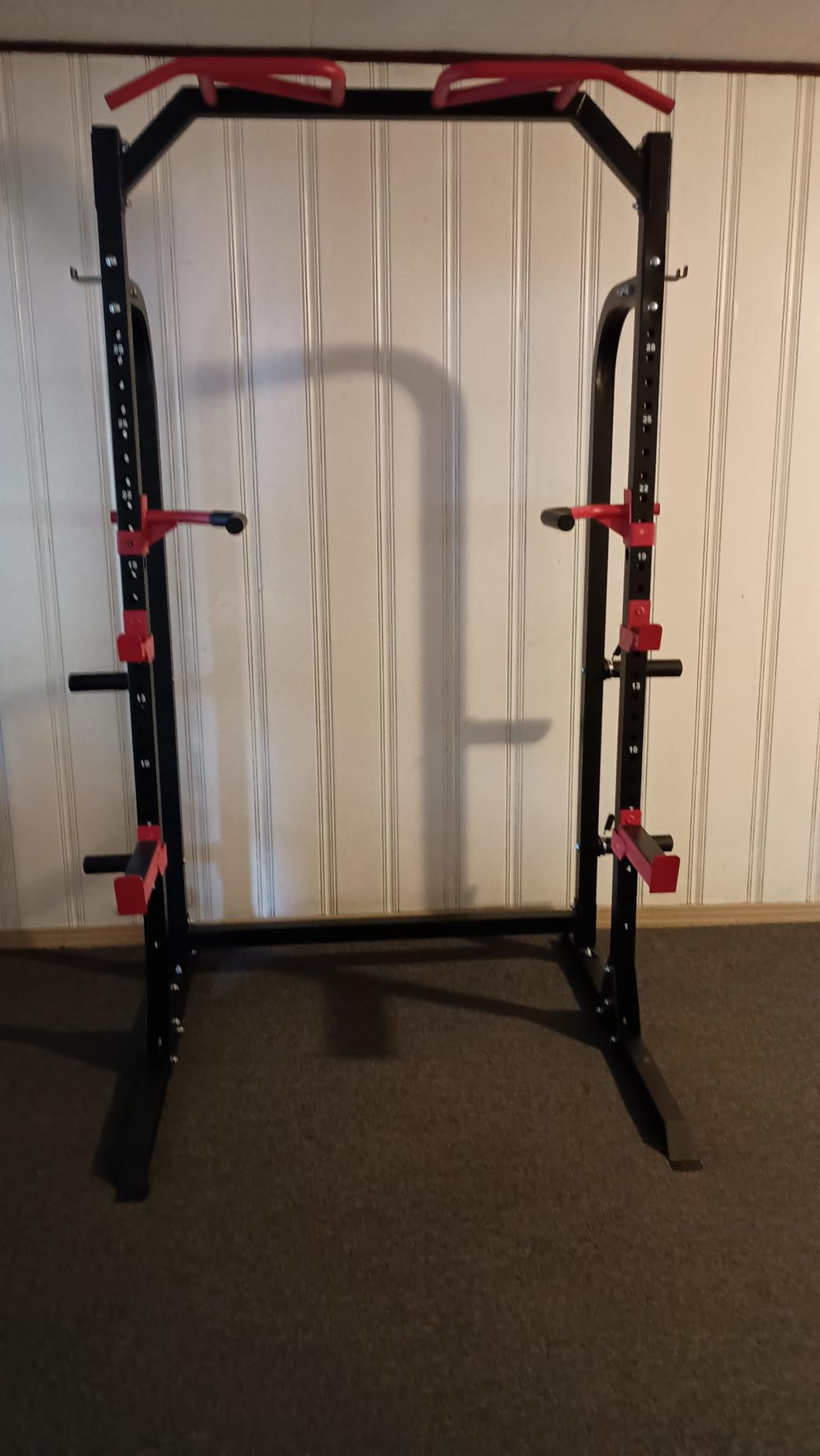
The SunHome cage is defined by two numbers: a 1500 lb capacity claim on 2×2 inch steel tube, and 28 adjustable J-hook and spotter arm positions. That adjustment range is the highest in this roundup, and it means you can move quickly between a heavy squat and an inclined press without hunting for holes.
Unlike most racks at this level, it includes a pulley and cable crossover system in the main frame, plus an integrated dip station and pull-up capability. Four plate storage posts and two barbell hooks keep the floor clear, which matters in a small bay.
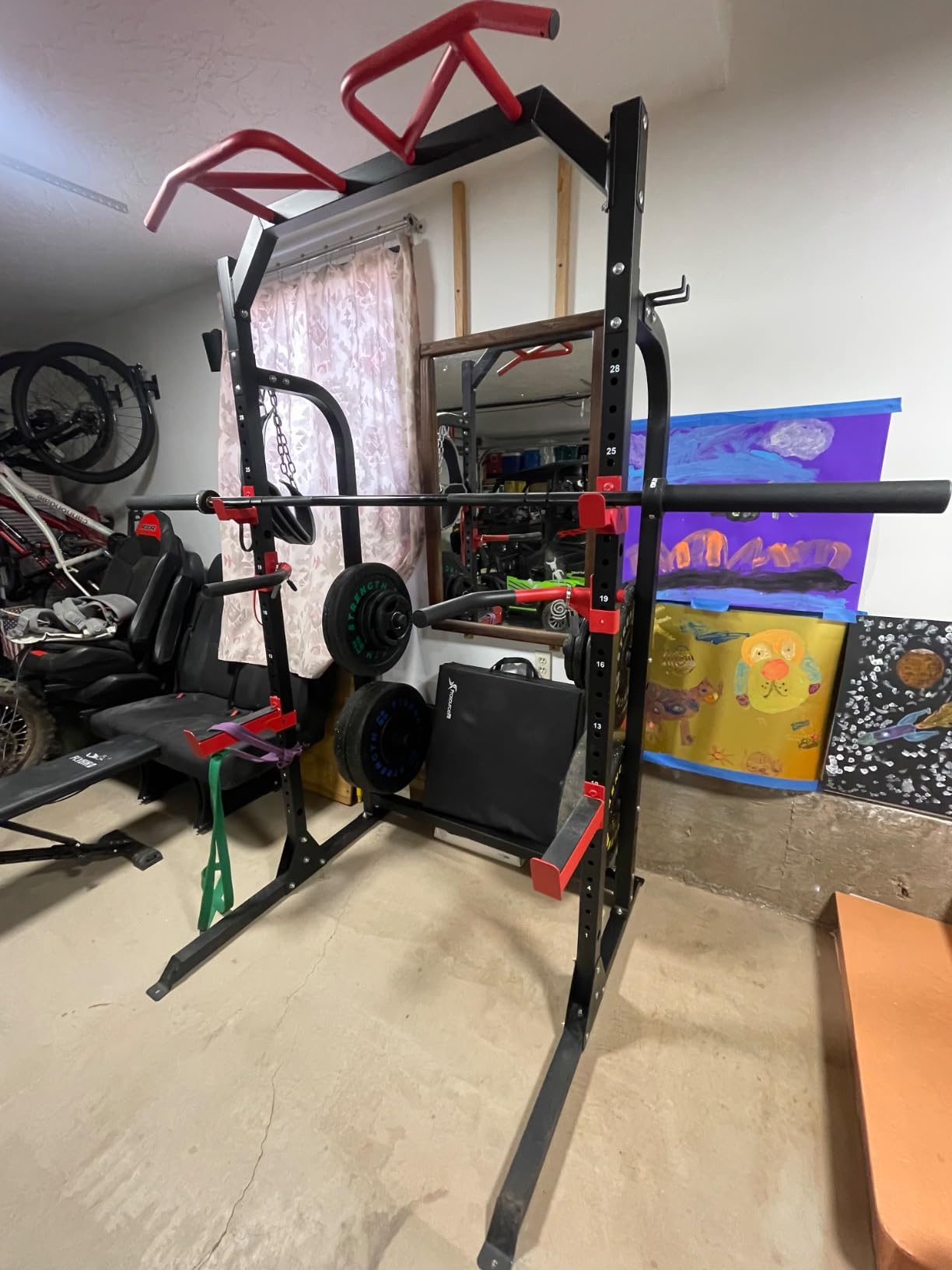
It is a half power cage rather than a full enclosure, and that design choice shows up in safety. The open back gives you less protection on a failed lift than a four-post cage, which is a real consideration for anyone squatting heavy alone.
At 84.9 inches tall it is one of the taller frames here, so you need ceiling clearance above 85 inches. The 42.4 inch width is one of the more compact footprints, which helps offset the height.
Attachment compatibility beyond the included parts is limited, so treat it as a self-contained system rather than an expandable platform. Some owners reported packaging damage on arrival.
Is 28 height positions useful in practice?
More useful than the number suggests, because fine adjustment shortens the walk from bench to squat. In a shared garage where two people train different body types, that range removes most of the readjustment friction.
The catch is that none of the positions are laser-numbered like some competitors, so you are still eyeballing it.
Half cage or full cage for a garage?
Choose a half cage if you squat inside the rack and want cable work in the same footprint. Choose a full cage if you bench heavy, rack pulls, or want a bar to stop in every direction.
There is also an optional bench variant rated to 660 lb if you want the rack and bench as one unit.
11. JELENS S11 Power Cage with Lat Pulldown
JELENS S11 Power Cage, 2000LB Multi-Function Power Rack with LAT Pulldown, Squat Rack with Adjustable Pulley System and Training Attachments, Weight Rack for Home Gym
50mm steel pipe frame
2000 lb rating
13 laser-cut numbered heights
Steel shaft pulleys
Pros
- 2000 lb rated 50mm frame
- Laser-numbered heights
- Quiet smooth pulleys
- Complete attachment bundle
- Compact 12.5 sq ft footprint
Cons
- Packed into two cartons
- Accessories hard to source individually
- Heavy welded frame is hard to move
- Short one year warranty
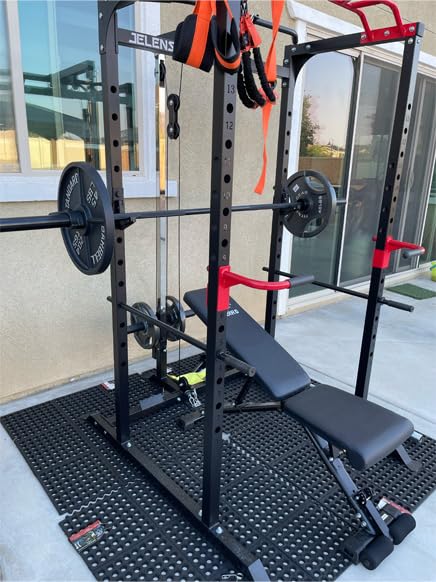
The JELENS S11 is the most compact of the heavy-duty cages in this list, and the numbers back that up: a 50mm by 50mm steel pipe frame rated to 2000 lb across a cage footprint of 57.48 by 44.49 by 82.6 inches, roughly 12.5 square feet.
Buyers highlight the pulleys more than anything. The upgraded precision steel shaft pulleys with polished high-strength steel cable run quietly and smoothly, and several owners describe it as a clear improvement over an earlier pulley model. The sandblasted finish also produces a cleaner surface than typical powder coat alone.
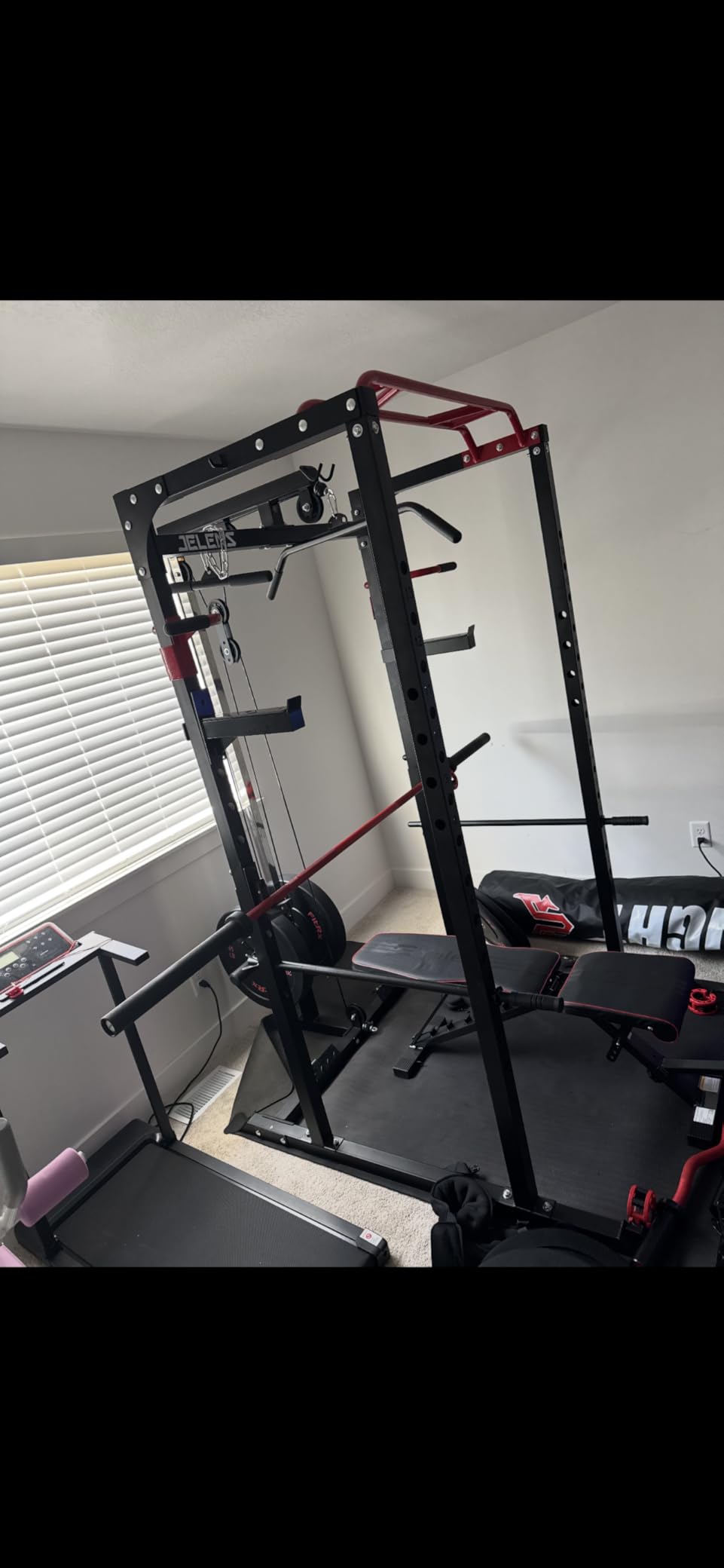
Second on the feature list is the 13 laser-cut numbered height positions. Numbering means your bench setup is repeatable, and if two people share the rack, each can find their height without trial and error.
The attachment set is complete: lat pull-down bar, cable bar, T-bar, pull-down bar, two J-hooks, two safety rods, a 360 landmine and four counterweight racks. All of it disassembles quickly for switching modes, and it is compact enough to move through a standard door.
Assembly takes patience because the pieces are packed into two cartons, and the accessories can be hard to source individually if one is lost. The welded frame is heavy enough that repositioning it takes real effort, and the one year warranty is the shortest here.
Does a 2000 lb rating mean anything in a home garage?
It means the frame is not the limiting factor, which is the point. Most home lifters never approach that number, but a 2000 lb claim indicates 50mm pipe stock rather than the thin-gauge tube used on entry racks.
Read the rating as frame capacity. The components you actually load, like J-hooks and safeties, have their own separate ratings.
Is the compact footprint realistic?
It is one of the most compact heavy-duty cages here, and about 12.5 square feet fits a standard single garage bay alongside a bench. The trade-off is a heavier welded frame that is harder to move later.
Plan where it will live before assembly, because that is the one job you only want to do once.
12. Goimu C1-V4 Power Cage with Lat Pulldown
Goimu C1-V4 Power Cage, 2000LBS Squat Rack with LAT Pulldown, Multi-Function Weight Cage Strength Training Machine, Workout Cage with More Attachments for Home Gym Garage (RD Power Cage C1-V4)
2x2 alloy steel full cage
2000 lb rating
43.35 inch internal depth
1:1 pulley ratio
Pros
- Rigid bolted frame feels commercial
- 30 plus accessories included
- High-low pulley works well
- Dip and pull-up bars feel solid
- Two year warranty
Cons
- Diagram-only instructions slow assembly
- Missing hardware and bent parts on some orders
- Upper plate posts interfere with lifting
- Some screws arrive loose
Reviewers comparing this cage to welded commercial racks usually mean it as a compliment. The rigid bolted 2×2 inch alloy steel frame, the expanded base and the 43.35 inch internal depth give it a genuinely planted feel, and owners report spotting 225 bench, 315 squat and 405 deadlift work without drama.
The accessory list is the headline number: more than 30 items including a 360 degree landmine, pulley system, T-bar, V-handle, elastic band bar, chains, cable bar, six OB bushings, six counterweight racks with clamps and two small clamps. Most of those would normally be bought separately as add-ons, so the effective saving is substantial.
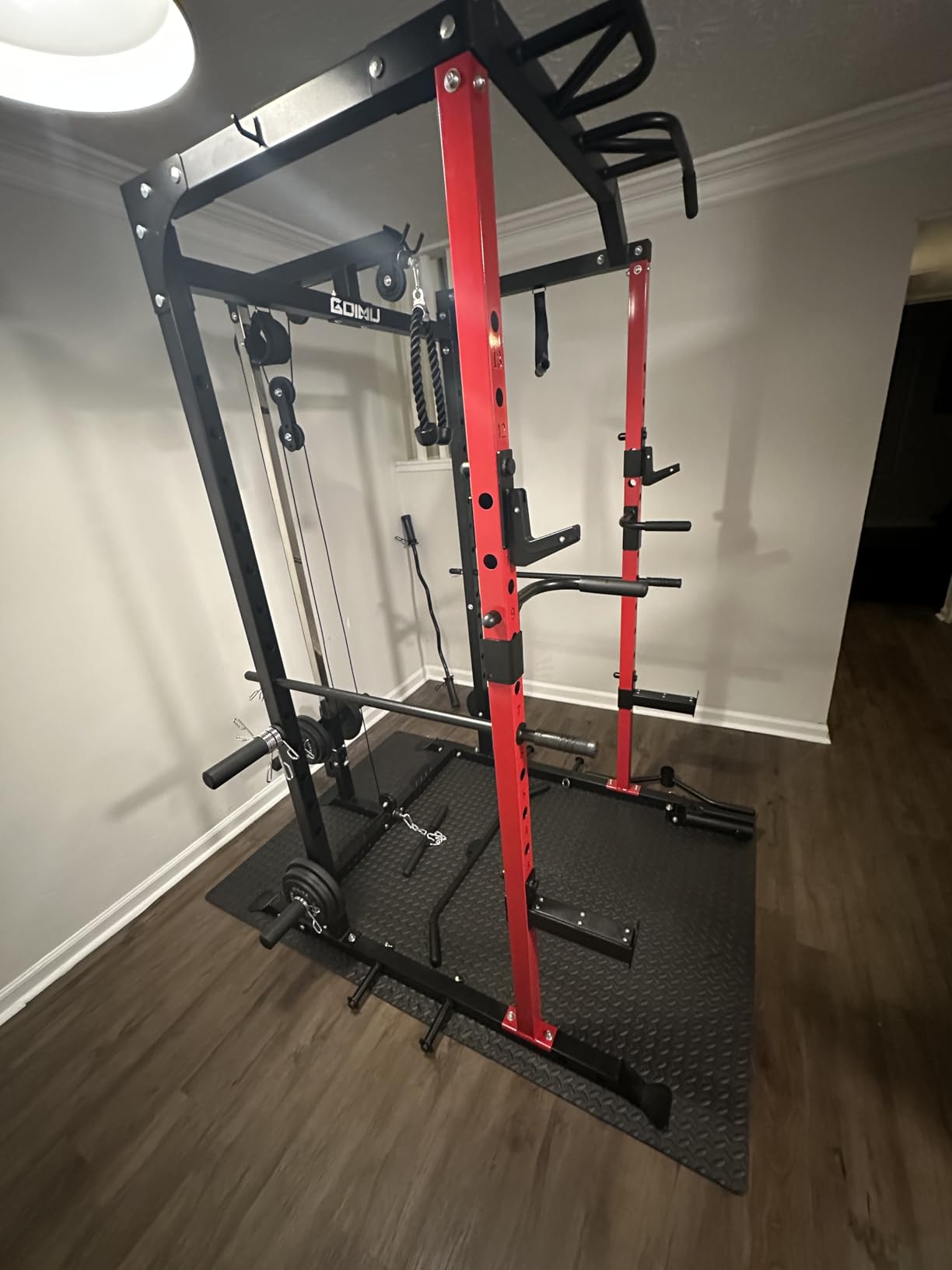
The 1:1 high-low pulley ratio covers most cable exercises, and buyers generally praise how the system works. One reviewer did report the cable rubber coating stripping and jamming a pulley on first use, so treat cables as a serviceable wear item.
Assembly is the recurring complaint, and the cause is the manual. It is diagrams only with no written steps, which turns a four-hour build into a multi-day project for a first-time buyer. Several buyers also received missing small hardware or a bent spotter arm, and replacement took several attempts, though the manufacturer did respond and refund.
Two other details: the upper plate storage posts get in the way of squats and bench press unless you reposition them, and some screws arrive not fully tightened. Check every fastener during assembly.
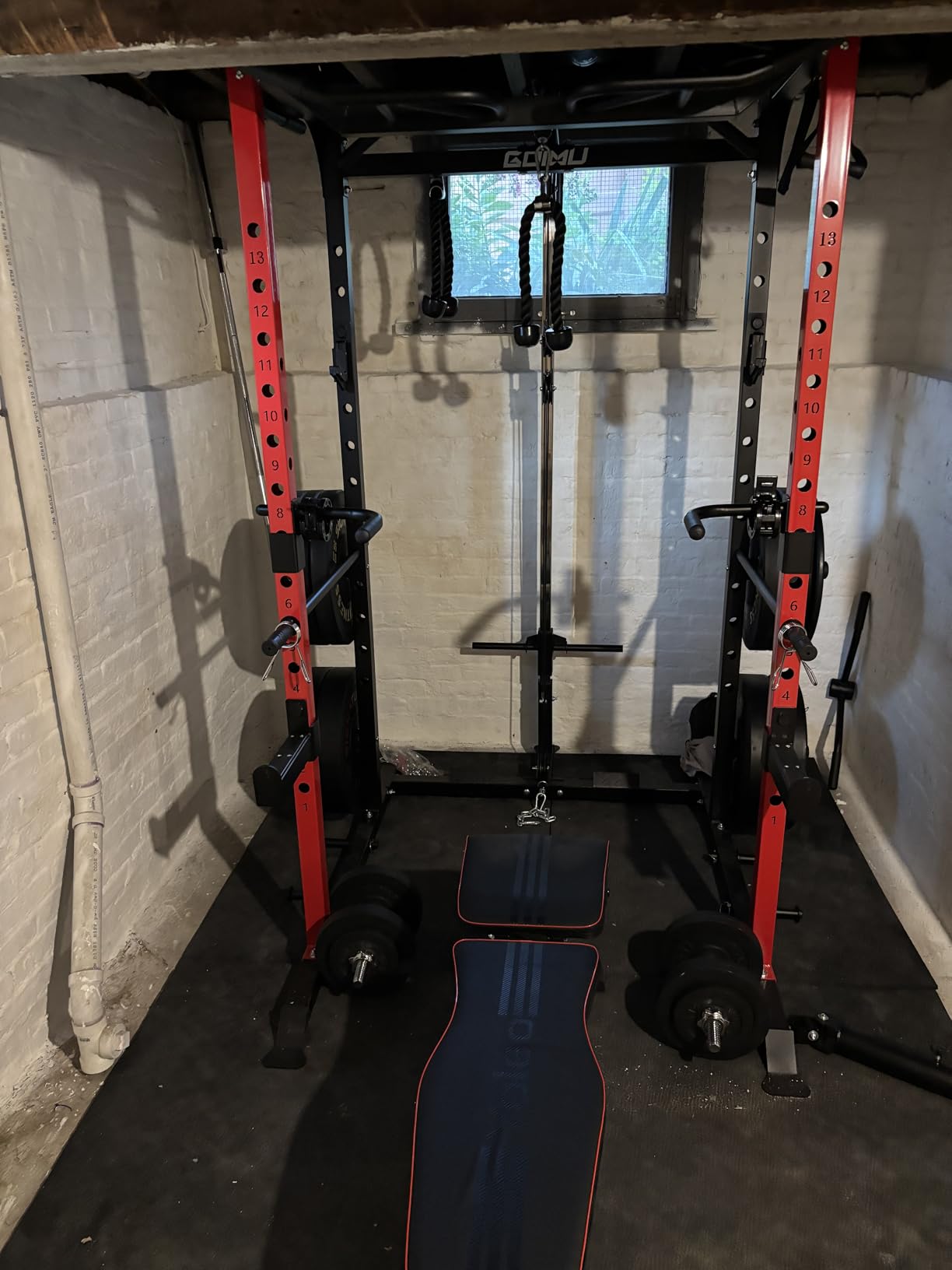
Is the 17.9 square foot footprint workable in a garage?
Yes for a single bay, and it is a full cage rather than a half rack, so you get protection on all sides. Measure the 57.56 by 44.72 by 83.46 inch footprint against your bay and your door swing before assembly.
The 2 year manufacturer warranty is longer than most racks here, which partly offsets the rougher start some buyers reported.
Is it worth it versus buying accessories separately?
For most home gyms, yes. More than 30 accessories at no extra line item is the single strongest argument for this cage, and most of them are the parts you would otherwise add in year two anyway.
The counterweight racks and OB bushings are the pieces buyers most often find hard to replace individually later, so having them from day one removes a real problem.
How to Choose a Power Rack for a Garage Gym
Seven specs decide the outcome, and none of them is what you pay. Work through these in order and the right rack becomes obvious quickly.
Steel gauge and tube size are separate numbers
Most buyers conflate gauge with tube size and regret it. Gauge describes how thick the steel is: 11-gauge is heavy commercial steel, 12 and 14-gauge sit in the middle, and 16-gauge is entry-level material. Tube size describes the width and depth of the upright itself, typically 2×2 inch or 3×3 inch.
A 14-gauge 2×2 upright and a 14-gauge 3×3 upright are very different pieces of steel. The 3×3 version has materially more material in it, which is one reason the CAP Barbell rack above feels more stable than its rating suggests. Match gauge to your training: 11 or 12-gauge 3×3 for heavy lifting, 14-gauge 2×2 for general strength work.
Westside hole spacing versus standard spacing
Hole spacing determines how precisely you can set the bar. Standard racks use 1 inch spacing between holes, which gives a usable adjustment roughly every inch. Westside pattern racks use a 1 inch hole on a 2 inch center, combining large holes with tight spacing, and the result is the finest adjustment available on the market.
Does Westside matter for bench press? Only marginally. It matters if you share a rack with lifters of very different heights, or if you want repeatable settings you can laser-mark. Several owners of the Titan and JELENS racks in this roundup specifically appreciate numbered holes, which is a different but equally useful form of repeatability.
Hardware diameter matters more than most people expect. Racks with 0.8 inch or 0.75 inch holes, like the two Sunny models, block the majority of third-party attachments. If you plan to add a cable system or storage pegs later, standard 1 inch holes are close to a requirement.
Weight capacity: read the rackable number
Capacity claims come in two forms and they mean different things. Total capacity is the sum of everything the frame can hold at once. Rackable capacity is the realistic maximum for a bar resting in the hooks, which is the number that actually matters for squatting and benching.
For most home lifters, 800 to 1000 lb rackable is plenty. Judge the rack by its thinnest component, not its headline figure, because it is the J-hooks and safeties that fail first on lighter builds. Several owners in this roundup replaced the factory J-hooks within a year for exactly that reason.
Ceiling height and footprint planning
Full cages in this roundup top out between 82.6 and 87 inches. That means you need at least 7 to 7.5 ft of clear height, and a full 8 ft ceiling leaves almost no margin once the top pull-up bar is installed.
Measure three things before you order: total ceiling height, the depth of the bay including the rack, and the garage door swing path. If your ceiling is short, the Titan T-2 71 inch version or the folding Mikolo are the realistic options, and no amount of cleverness makes an 87 inch frame fit under a 7 foot ceiling.
For depth, budget for bar travel on squats as well as the frame width. A 47 inch deep rack leaves room for a barbell plus plates, while a 40 inch rack can catch collars mid-descent if you squat inside it.
Safety systems compared
Three approaches dominate. Flip-down safety spotter arms are simple, fast and always positioned under the bar, which makes them the easiest to use correctly. Pin and pipe safeties are heavy, rackable and adjustable in small increments, so they suit heavy lifters who want precise placement. Strap safeties are cheap and flexible but need two hands to set, which is awkward alone.
Whatever you choose, replace or upgrade factory J-hooks on any budget rack, and set the safeties just below the bar’s unracked position so a failed rep has nowhere to go.
Attachment ecosystem compatibility
Standard 1 inch holes unlock the widest selection of third-party accessories, including Monster-style rack ecosystem arms, storage pegs and cable attachments. Racks with 0.8 or 0.75 inch holes restrict you to that brand’s own line, which is a genuine long-term cost if your training changes.
Buying a rack without included safeties, as the CANPA model does, means budgeting for a separate purchase before your first heavy bench session. Do that math before you order.
Bolt-down versus flat-foot
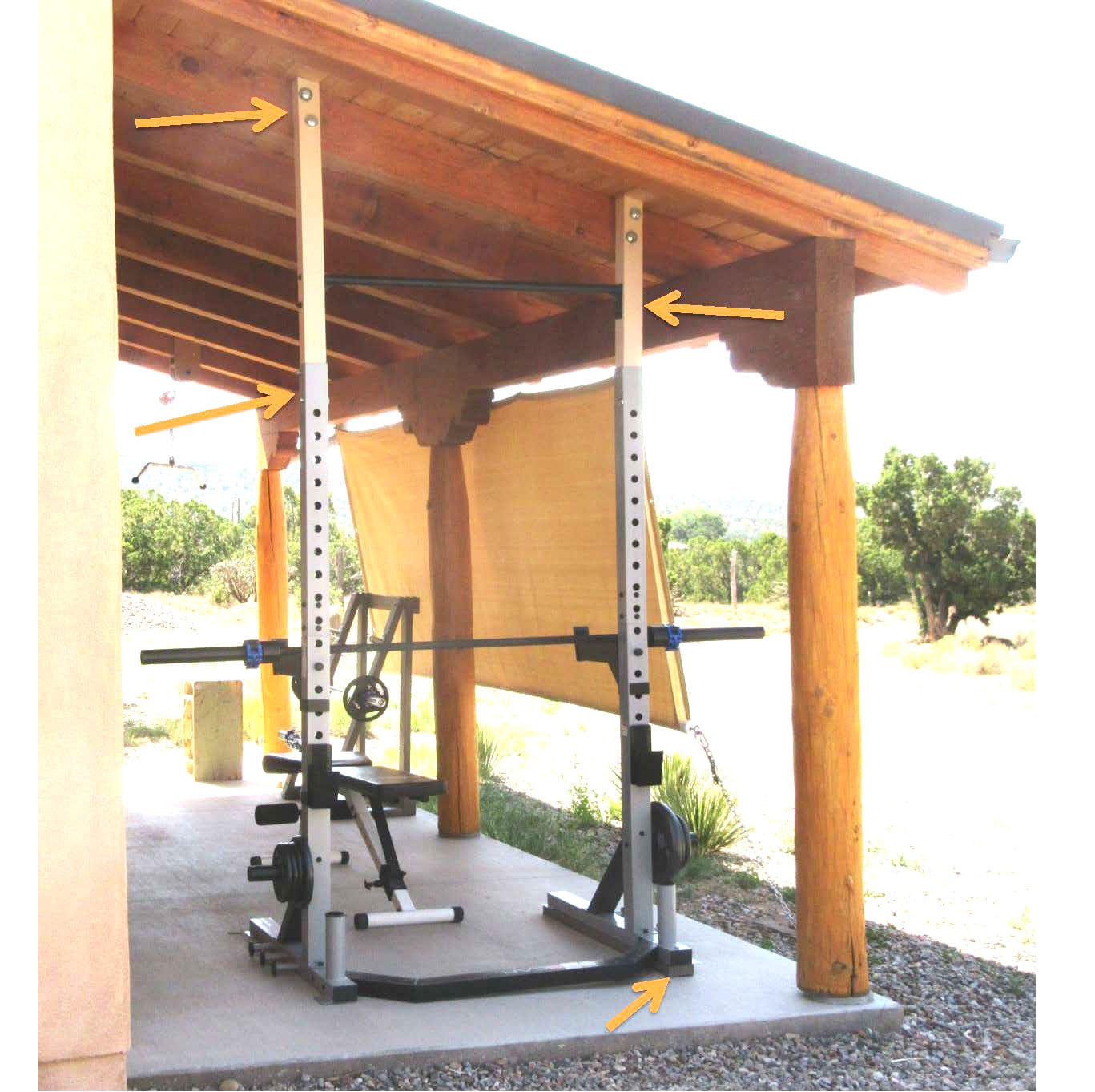
Flat-foot racks rely on mass and a wide base to stay put, and they are easier to move. Bolt-down racks transfer load into the slab and become effectively immovable, which removes the walk-across-concrete problem that owners of the compact Sunny and FLYBIRD racks both describe.
Whichever you choose, bolting through the slab is a straightforward job with a rotary hammer and an anchor kit. Owners who anchor their rack report no movement at all, and it is the cheapest upgrade available.
Real Owner Complaints and Quality Patterns
Owner reviews across these racks repeat the same handful of problems, and knowing them in advance saves both money and frustration.
Damage in transit is the most common issue
Scratched paint, bent uprights and missing washers show up repeatedly across brands, including the CAP Barbell, Mikolo, SunHome and Goimu racks. The pattern is consistent enough to plan around: inspect every part before assembly, photograph any damage immediately, and file the claim before you build.
Rough welds and scratched powder coat out of the box are a separate pattern owners discuss across garage gym forums, particularly on budget racks where the finish is the first thing to go.
Unnumbered holes and misleading height listings
Unnumbered adjustment holes appear on the Titan T-2 and SPORTSROYALS, and laser-numbered holes on the JELENS and Sunny cage. It sounds cosmetic until two people share a rack. Several owners also point out that listed heights exclude the top of the pull-up bar, which is where the surprise ceiling problems come from.
Cable and pulley wear on all-in-one racks
Every cage with built-in cables treats those cables as a consumable. Owners report sticking, hitching resistance and stripped coating on budget pulley systems, and the standard advice is to keep spare clips and cable on hand rather than assuming a lifetime part.
Assembly time is routinely underestimated
Realistic estimates from owners run 30 to 90 minutes for simple half racks, several hours for cable-equipped cages, and much longer when the manual is diagrams only with no written steps. Budget an evening, and count on two people for anything over 100 lb.
Resale value differs sharply by brand
Well-known brands in the commercial and mid tiers tend to hold value better when you eventually sell, while entry-level racks depreciate quickly. That is a real factor if you plan to move house, and it is worth more thought than most buyers give it before purchase.
Garage Gym Setup Checklist Before the Rack Arrives
Thirty minutes of measuring saves a very bad afternoon. Work through this list before the rack is delivered.
Measure the ceiling height at the intended rack position, not at the garage door. Write down the number and compare it against the assembled height of the rack, not the frame height on the listing. Most full cages here need 7 to 7.5 ft of clear space, and a few need more.
Measure the depth of the bay including the open garage door and any shelving. If a car is staying in the space, the folding wall-mounted category becomes the realistic shortlist, and floor storage becomes essential.
Check the slab. A cracked or uneven slab affects bolt-down options, and a rack in a shared garage needs to be movable. If you plan overhead storage above the rack, our overhead garage storage rack guide covers the load limits worth checking first.
Budget for the accessories a rack does not include: safeties, upgraded J-hooks, a bench, plates and storage. The racks that skip safeties in the box, like the CANPA, need that purchase made on day one.
Plan the rest of the gym around the rack. Our trap bar guide covers a common deadlift add-on, and mirror wall guides help you check squat depth form safely. If bikes share the bay, garage bike rack picks keep the floor clear.
Finally, decide about noise. In an attached garage, rubber-padded safeties and a platform under the plates make a measurable difference at early hours, and two racks in this roundup include padded bars as standard.
Frequently Asked Questions
What is the best power rack for a garage gym?
For most one-car garages, the Sunny Health u0026amp; Fitness Full Size Power Rack is the best overall choice, with a 4.7 rating across nearly 3900 reviews, an 18-point J-hook adjustment and a compact 38 by 53 by 87 inch footprint. Lifters who want a full enclosure and more attachment points should look at the Sunny Power Rack u0026amp; Cage Systems instead.
What is the best power rack for a home gym?
The best power rack for a home gym depends on your ceiling height and whether a car stays parked. Compact full-size racks work when the car moves, while folding wall-mounted racks such as the Mikolo are the realistic option when floor space must stay free. Match the assembled height to your ceiling before anything else.
What is the best rack for a home gym under a low ceiling?
Under a low ceiling, height options matter more than capacity. The Titan Fitness T-2 Series is available in a 71 inch version specifically for low basements, and the Mikolo folding wall rack opens to a fixed depth that suits tight walls. Most full cages here stand between 82.6 and 87 inches and need 7 to 7.5 ft of clear height.
What is the best all-in-one gym rack?
The Goimu C1-V4 and the JELENS S11 lead on included accessories, with more than 30 items on the Goimu and a complete bundle on the JELENS. The SPORTSROYALS Power Rack is the pick for cable quality specifically, with precision bearing pulleys above and below and a 500 lb PU-coated cable. All three carry heavy frame claims in the same range.
Do I need to bolt down a power rack in a garage?
Bolting down is the cheapest stability upgrade available and owners who anchor their rack report no movement at all. Unbolted racks can walk across concrete during a heavy re-rack, which is the most common complaint on flat-foot models. Use a rotary hammer and an anchor kit, and confirm the slab is sound before drilling.
What gauge steel does a home power rack need?
Most home lifters are fine with 14-gauge steel, and 11 or 12-gauge is worth paying for above 500 lb of working weight. Gauge describes steel thickness while tube size describes the upright dimensions, so a 14-gauge 3×3 upright carries far more material than a 14-gauge 2×2. Check both numbers, not just the gauge.
What is Westside hole spacing and do I need it?
Westside pattern uses a 1 inch hole on a 2 inch center, which gives the finest bar height adjustment available. Standard racks use 1 inch spacing with no center adjustment. For solo benching the practical benefit is small, but if several lifters share a rack, or you want repeatable laser-marked settings, tighter spacing helps.
How much does a good power rack cost?
Prices across this category span a very wide range, from entry racks with thin-gauge steel to heavy all-in-one systems with large frame claims. Use the price button on any card to see current figures, and budget extra for safeties, J-hooks and a bench, which most racks leave out.
Final Verdict: Which Power Rack Should You Buy in 2026
For most people building a garage gym, the Sunny Health & Fitness Full Size Power Rack is the best power rack for garage gyms in 2026. It holds a 4.7 rating across nearly 3900 reviews, stays stable at working loads, and takes up less floor space than almost anything else in this roundup.
Match it to your garage instead. Low ceiling means the Titan Fitness T-2 in its 71 inch configuration. A car that never moves means the Mikolo folding wall rack. Cable work and accessories included from day one means the Goimu C1-V4 or the SPORTSROYALS cage. Heavy lifting above 500 lb means the JELENS S11 or the Titan T-2 at full height.
Whichever one you choose, anchor it to the slab, upgrade the J-hooks if the rack is entry-level, and buy your safeties on the same day. Those three steps prevent most of the complaints we read across hundreds of owner reviews, and they turn any of these racks into a setup you will actually enjoy using.