
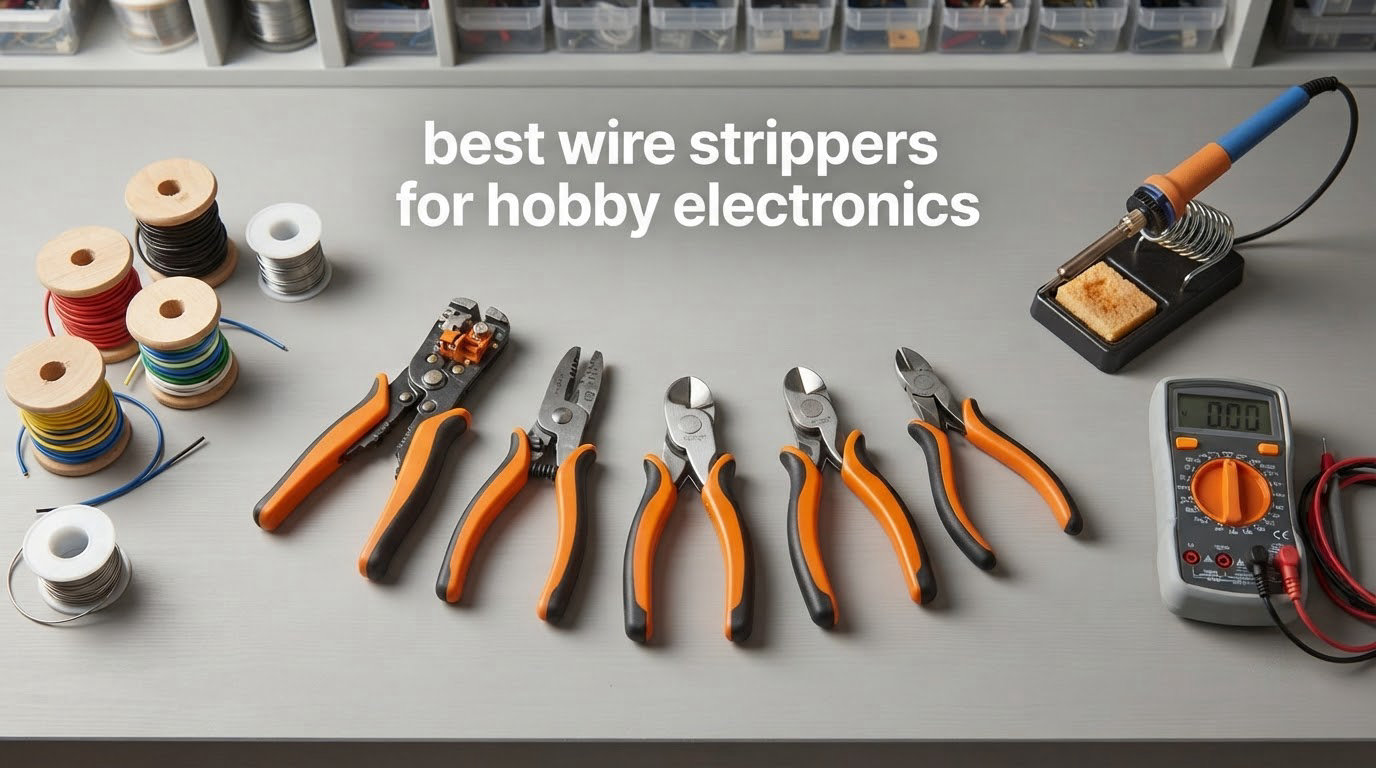
Most hobby electronics projects start with a small mistake that is easy to make and hard to diagnose. You strip a length of 24 AWG silicone wire for a JST connector, you catch the conductor with the blade, and two hours later the joint you soldered is intermittent. The wire was fine, the board was fine, and the only fault was a nick you could not see without a loupe.
That is the whole reason the best wire strippers for hobby electronics are not the same tools electricians reach for. An electrician strips 12 or 14 AWG Romex with a heavy automatic stripper. You are cutting 26, 28, 30 and sometimes 34 AWG stranded wire that has to survive a solder joint, and the failure mode is completely different. This roundup covers twelve strippers built for that bench work, from a compact Japanese precision stripper that handles micro-thin wire to a self-adjusting tool that eats through bulk harness work.
We put each one through a strip-and-inspect routine: pull the insulation, look at the conductor, and check whether the blade touched the copper. A tool that nicks on the gauge you care about drops. We also weighed strip length repeatability, because a connector crimp fails when the exposed conductor is too long or too short, and we noted which tools can crimp rather than only strip. Last updated for 2026, this guide is built for people wiring breadboards, perfboard, Raspberry Pi and Arduino projects, drone and RC builds, and panel-mount connectors.
One note before we start: if you have not done much bench work yet, the soldering side matters as much as the stripper. Our soldering station guide for electronics covers the iron and tip sizes that pair well with fine wire work.
Table of Contents
Top 3 Wire Stripper Picks for Hobby Electronics in 2026
Three tools earned a place on the shortlist above the rest. The Klein Tools 11057 is the most complete stripper here for general bench work, the DOWELL covers the fine 22-30 AWG range that most hobbyists actually live in, and the haisstronica set is the one to buy if you crimp your own terminals.

Klein Tools 11057
- Strips 20-30 AWG solid and 22-32 AWG stranded
- Precision ground stripping holes
- Shears 6-32 and 8-32 screws
- Made in USA

DOWELL 22-30 AWG Stripper
- Strips 22-30 AWG insulated wire
- Stainless steel with TPE handle
- Integrated cutter for copper and fine iron wire
- Gauge sizes marked on stripping area

haisstronica 3-in-1 Set
- Strips AWG 24-10
- Crimps AWG 26-10
- Ratchet action with adjustable pressure
- Quick release
Best Wire Strippers for Hobby Electronics (October 2026)
| Product | Specifications | Action |
|---|---|---|
| Klein Tools 11057 Wire Cutter/Stripper |
|
Check Latest Price |
| DOWELL Wire Stripper 22-30 AWG |
|
Check Latest Price |
| haisstronica Stripper and Crimper Set |
|
Check Latest Price |
 Hakko CSP-30-1 Wire Stripper Hakko CSP-30-1 Wire Stripper |
|
Check Latest Price |
 Knipex Automatic Wire Stripper 10-24 AWG Knipex Automatic Wire Stripper 10-24 AWG |
|
Check Latest Price |
 Capri Tools 20011 Automatic Stripper Capri Tools 20011 Automatic Stripper |
|
Check Latest Price |
 Klein Tools 1003 Compact Stripper Klein Tools 1003 Compact Stripper |
|
Check Latest Price |
 ENGINEER PA-06 Precision Wire Stripper ENGINEER PA-06 Precision Wire Stripper |
|
Check Latest Price |
 ENGINEER PA-14 Micro-Thin Stripper ENGINEER PA-14 Micro-Thin Stripper |
|
Check Latest Price |
 KATA 7 Inch Precision Wire Stripper KATA 7 Inch Precision Wire Stripper |
|
Check Latest Price |
 iFixit Mandible Wire Strippers iFixit Mandible Wire Strippers |
|
Check Latest Price |
 Gardner Bender GS-361 Wire Stripper Gardner Bender GS-361 Wire Stripper |
|
Check Latest Price |
How We Picked and Tested These Wire Strippers
Our disqualification rule is simple and it costs us tools we like. Any stripper that nicks or gouges the conductor on the gauges it claims to cover gets ranked at the bottom, no matter how good it feels in the hand or how strong its review count is.
For each tool we ran the same routine across the gauge range the manufacturer lists, using both solid and stranded wire, and including the silicone, PTFE and jacket types that show up in electronics work. After each pull we checked the exposed conductor under good light, looking for flattened strands, score marks and loose strands at the cut end. We also stripped the same gauge ten times in a row to see whether the strip length stayed consistent, since a stripper that wanders by a millimetre every time is a problem the moment you start crimping connectors.
Beyond the wire itself we looked at four things: whether the tool can crimp the terminals you actually use, whether the handles stay comfortable over a long session, whether the spring returns cleanly, and whether the gauge markings are readable without guessing. Where reviewers have reported long-term problems such as spring fatigue or blades dulling faster than expected, we passed that along rather than repeating the spec sheet.
1. Klein Tools 11057 – Best All-Round Stripper for a Hobby Bench
Klein Tools 11057 Wire Cutter/Stripper, Made in USA, Heavy Duty Cutter for 20-30 AWG Solid and 22-32 AWG Stranded Wire
Strips 20-30 AWG solid and 22-32 AWG stranded
Shears 6-32 and 8-32 screws
Made in USA
Pros
- Precision ground holes strip fine wire without nicking the conductor
- Cuts strips loops and shears screws in one tool
- Coil spring gives fast self-opening action
- Solid alloy steel build with no play at the joints
Cons
- Built-in cutter is adequate rather than excellent on heavy multi-strand wire
- Not suited to household mains-scale conductor
The Klein 11057 is the tool I keep within reach on the bench. It is a gauged stripper with precision ground holes, and it covers 20-30 AWG solid and 22-32 AWG stranded, which spans almost every hookup wire a hobbyist buys.
What sold me is the quality of the stripping holes rather than the list of features. The blades are ground rather than stamped, and the insulation comes off in one clean pull with no strands severed and no coating residue left behind. Reviewers report the same thing after thousands of uses, which is the sort of comment that tells you a tool is doing its job quietly for years.
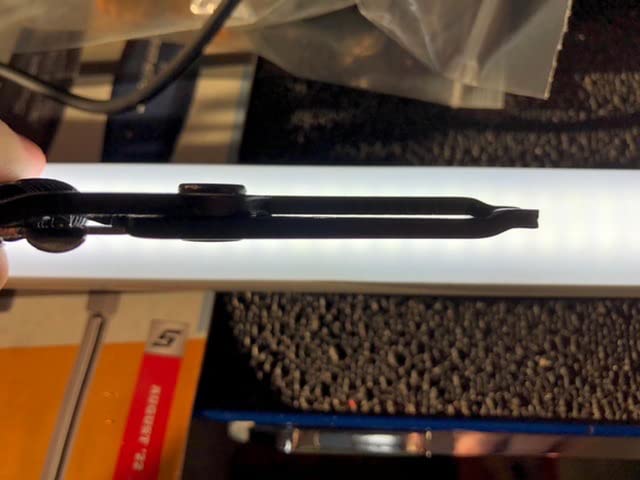
The other half of the appeal is that it is four tools in one. It cuts, strips, loops and bends wire, and it shears 6-32 and 8-32 screws, which saves a second tool in a small pouch. The serrated nose is genuinely useful for shaping a conductor before you drop it into a breadboard.
The coil spring is the detail that matters most in daily use. It snaps the jaws open the moment you release, so you are not levering the handles apart after every strip. At 5.1 ounces it stays comfortable through a long session, and the whole tool is made in the USA.
When the Klein 11057 is the right choice
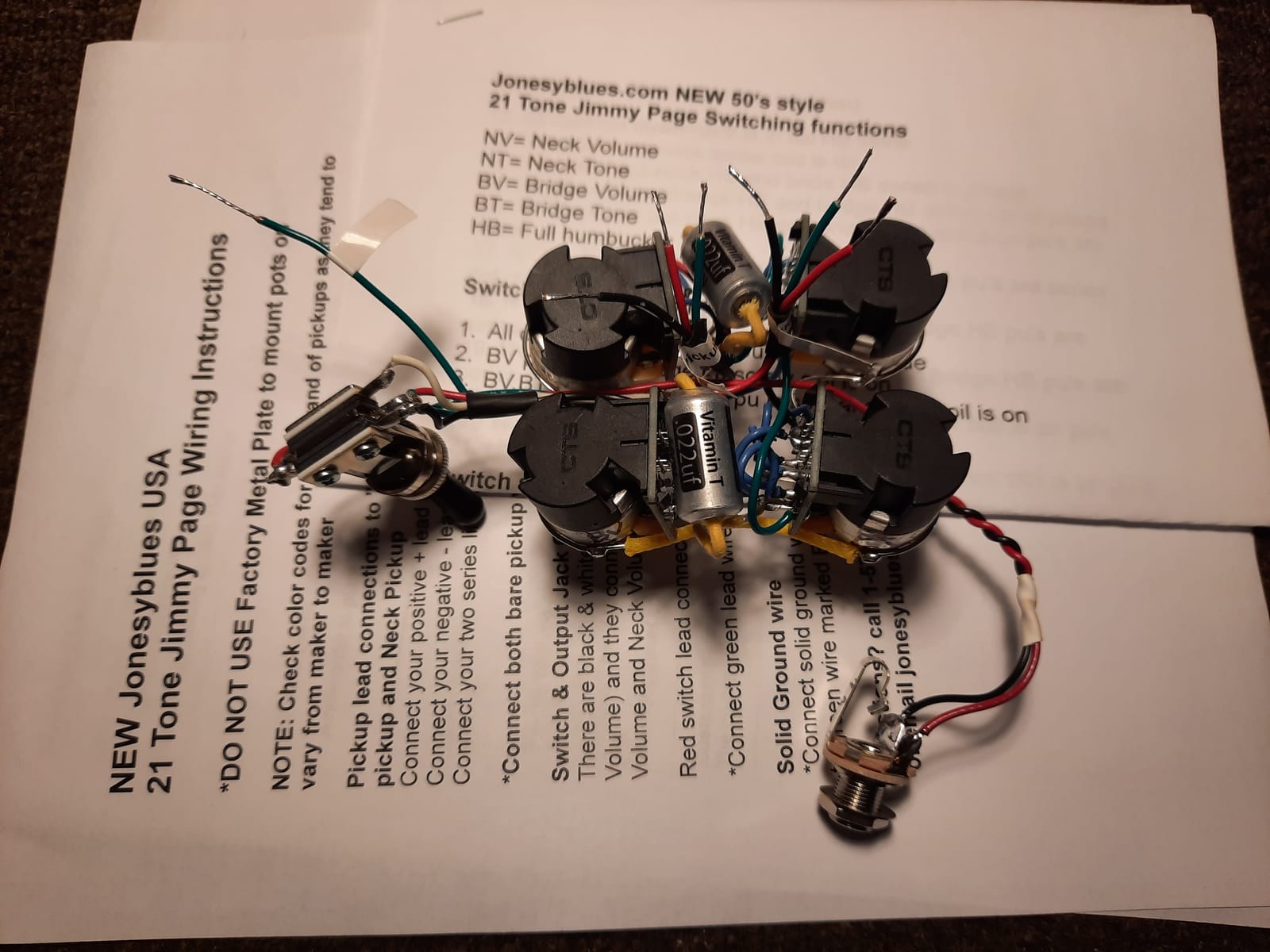
Buy this one if your work spans 20 AWG down to 30 AWG and you want a single tool that also cuts and bends. It handles silicone hookup, standard hookup wire and light multi-conductor cable without changing anything. If you are doing a Raspberry Pi or Arduino build with 22 AWG and 24 AWG wire, this covers you end to end.
It is also a good first serious stripper. Owners with 2333 reviews rate it highly for exactly the reason new builders need: it does not require adjustment, so there is no wrong setting to learn.
Where it falls short
The integrated cutter is the weak point. It is fine for bench wire but only adequate on heavy multi-strand cable, and reviewers most often mention this as the single reservation. If you routinely cut thick loom or outdoor cable, you will want a separate heavy cutter.
The screw shears cover 6-32 and 8-32 only, and this is not a tool for household mains wiring. Both are honest limits of a fine-wire tool rather than flaws in the design.
2. DOWELL Wire Stripper – Best Budget Pick for 22-30 AWG Work
DOWELL Wire Stripper, 22-30 AWG Wire Cutter, Stripping Tool
Strips 22-30 AWG insulated wire
Integrated cutter for copper and fine iron wire
Stainless steel with TPE handle
Pros
- Clean precise strips with no nicks and no coating residue
- Reaches down to 30 AWG which is finer than most common strippers
- Spring return is tight and the grip holds well
- Gauge sizes printed on the stripping area
Cons
- Safety lock has no real catch and can pop open
- Arrives with light manufacturing oil that needs wiping off
- Limited to 22-30 AWG so it cannot handle heavier wire
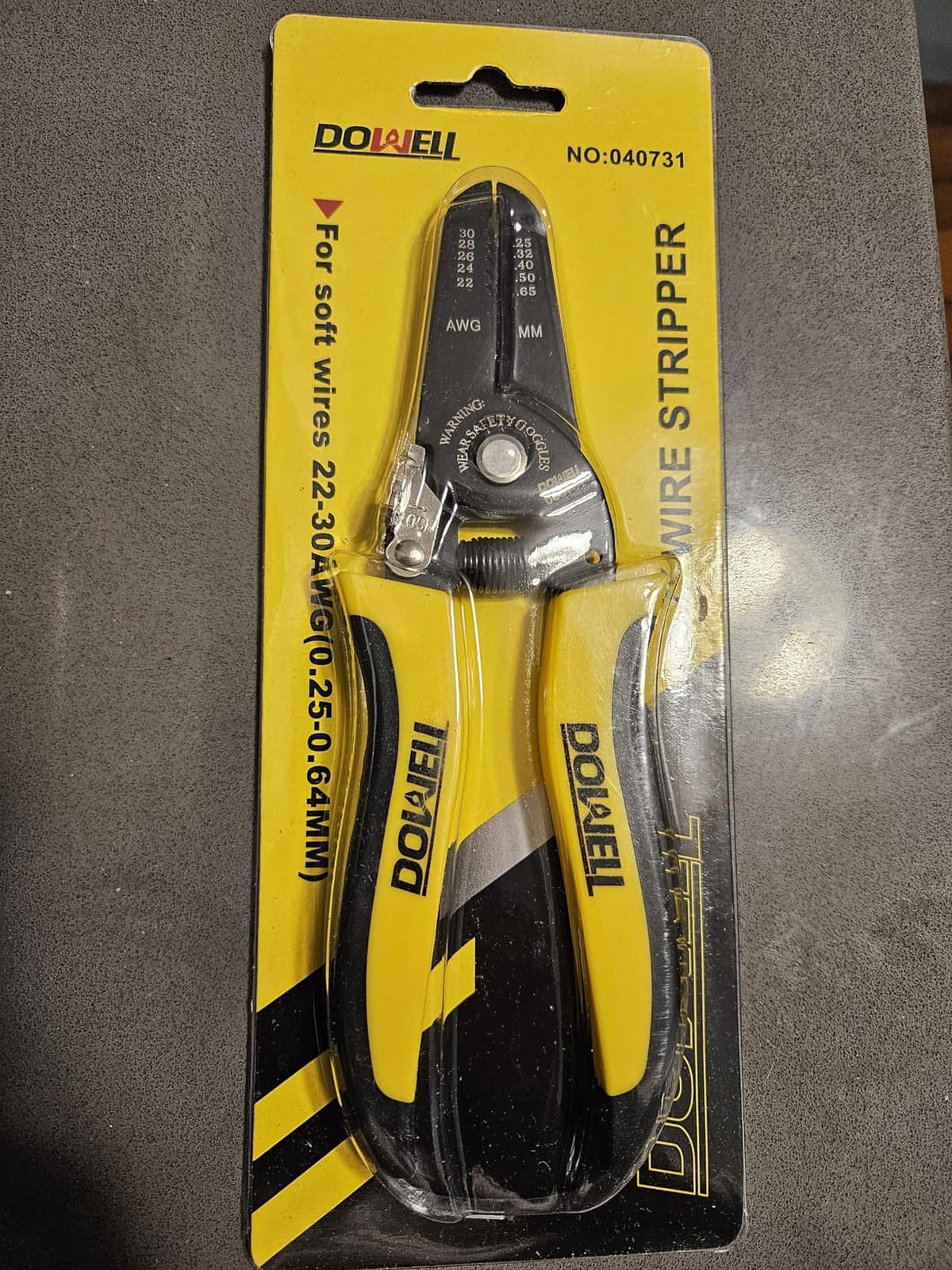
If your entire wire inventory is 22, 24, 26, 28 or 30 AWG, this stripper does the job and the price barely registers against the rest of a bench kit. The gauges are printed right on the stripping area, which sounds minor until you have fumbled a tool in poor light at midnight.
On the wire, the results are better than the price suggests. Buyers report clean, nick-free strips on fine electronics and Ethernet wire, with many comparing the result favourably to tools costing several times more. The stainless steel construction and TPE handle keep the grip workable with slightly damp or oily hands, which happens more often than you would expect during a teardown.
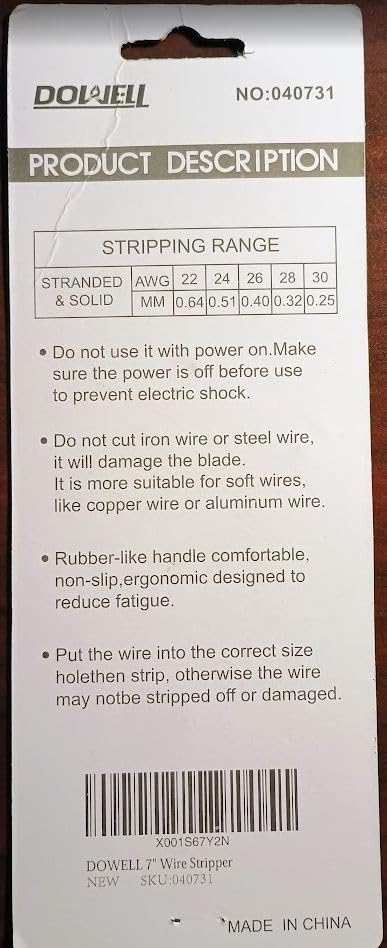
It also cuts, which turns it into a reasonable bench companion for trimming leads before you solder. At 127 grams it is light enough for fine work and still feels substantial rather than flimsy.
Two things to know before you buy. The spring return is tight and immediate, so the strip happens the moment you squeeze, which is good for speed and worth slowing down for if you are new to it. And the gauge marking area is small, so read it before you start rather than mid-strip.
Who should pick the DOWELL
This suits students, first-build projects and anyone working through a spool of 22-30 AWG hookup wire for a breadboard or a sensor harness. If you are only ever handling electronics-scale wire, the narrower range is a feature, because you are not carrying dead weight or paying for capacity you will not use.
It is also a sensible second stripper to keep in a drawer at a workbench, so the sharp precision tools stay reserved for magnet wire and fine harnesses.
Where it falls short
The safety lock is the most-cited complaint and it is real. There is no dependable catch, so the tool can spring open in a toolbox or fall out of a bag. Treat the lock as decoration and store it closed against a flat surface.
It also ships with light manufacturing oil on the metal, so wipe the jaws before your first strip. And if you ever need 18 or 16 AWG, this is the wrong tool, since the range stops at 22 AWG.
3. haisstronica Stripper and Crimper Set – Best Value for Connector Work
haisstronica Wire Stripper and Crimper Set, AWG 26-10 for Heat Shrink
Strips AWG 24-10
Crimps AWG 26-10
Ratchet action with adjustable pressure
Pros
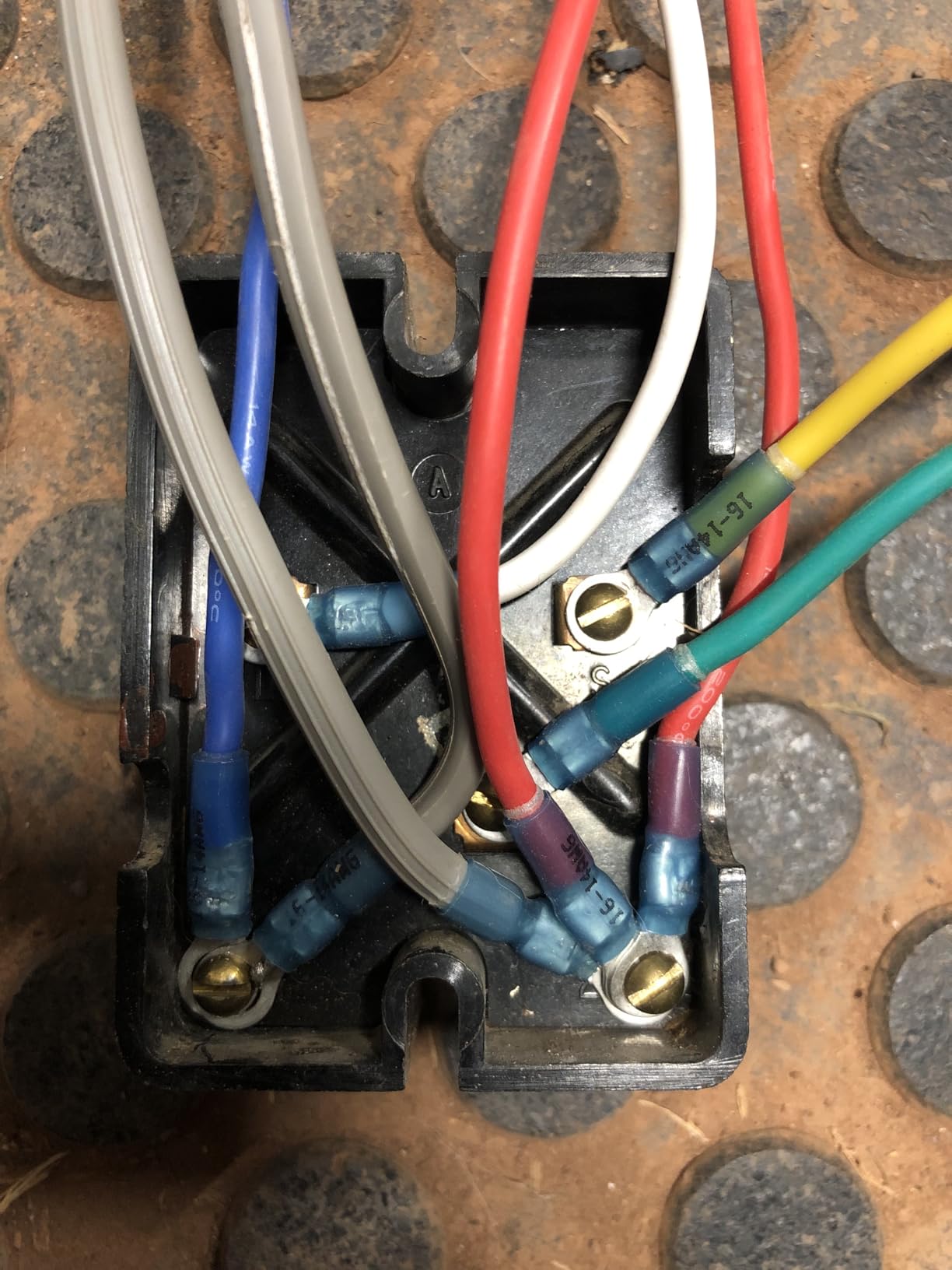
- Crimper forms firm mechanically secure butt splices on small insulated terminals
- Covers stripping and crimping in one set
- Ratchet action with adjustable pressure for repeat results
- Non-slip handles reduce hand fatigue
Cons
- Strip length stop is not especially precise
- Replacement crimper heads cannot be bought separately so a damaged head means a new tool
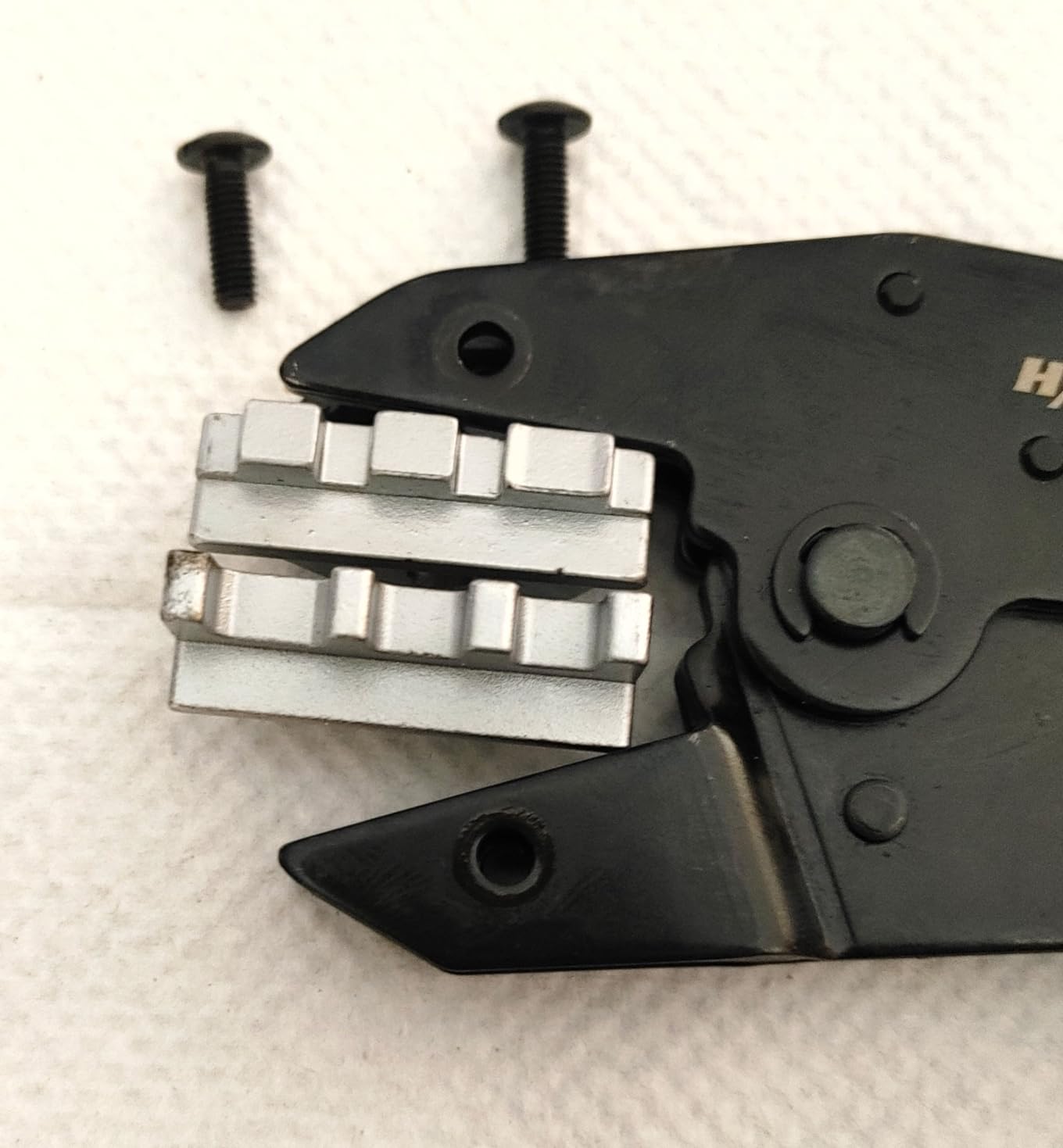
This is the pick for anyone whose projects end in a crimped terminal rather than a solder joint. It strips 24-10 AWG and crimps 26-10 AWG in one tool, which covers hookup wire and the insulated butt splices that show up in panel and automotive-style wiring.
The crimper is the reason to buy it. Owners repeatedly single it out as performing better than cheaper all-in-one crimpers, particularly on small 20 and 22 AWG insulated terminals where cheap dies produce a splice that looks fine and pulls out by hand. The ratchet action with adjustable pressure means the tool does most of the work, so your result is consistent whether the terminal is on the first or the fortieth wire.
Heat-shrink users get a bonus here, since the tool suits the combination of stripping and shrinking that automotive and low-voltage work demands. The quick release means you can bail out of a squeezed crimp if you put the terminal in backwards.
It is a chunky tool, and at just over a kilogram the nylon handles have real presence. That weight is the trade for a crimper that has enough mass behind it to finish the squeeze.
Who should pick the haisstronica set
Choose it if you build harnesses, wire panels, or make your own JST and Molex-style terminations in volume. Having strip, cut and crimp in a single tool means fewer places for a wire to snag and fewer tools to lay out on a crowded bench.
It is also a good pairing with a kit-bag approach to bench work. If you like the idea of a self-contained tool roll rather than individual purchases, this fits that pattern well.
Where it falls short
The strip length stop is not precise enough for delicate electronics work. If you are crimping fine connectors where the exposed conductor length is tight, you will want to measure rather than trust the stop.
Be aware that the crimper heads cannot be replaced separately, so if the dies deform you are replacing the whole tool. This is common in the category rather than unique to this one, but it is a real long-term consideration.
4. Hakko CSP-30-1 – Best for Fine Wire Down to 30 AWG
Hakko CHP CSP-30-1 Wire Stripper, 30-20 Gauge Maximum Cutting Capacity
30-20 AWG range
Heat-treated steel construction
Gauge markings on both jaw sides
Pros
- Strips down to 30 AWG wire-wrap cleanly without nicking the core
- Gauge sizes labelled on both sides of the jaws
- Spring action is smooth with no flex or sloppiness
- Metal stopper holds the jaws partly open for fine wire work
Cons
- Embossed gauge numbers are hard to read without enhancement
- Not designed for household mains wiring
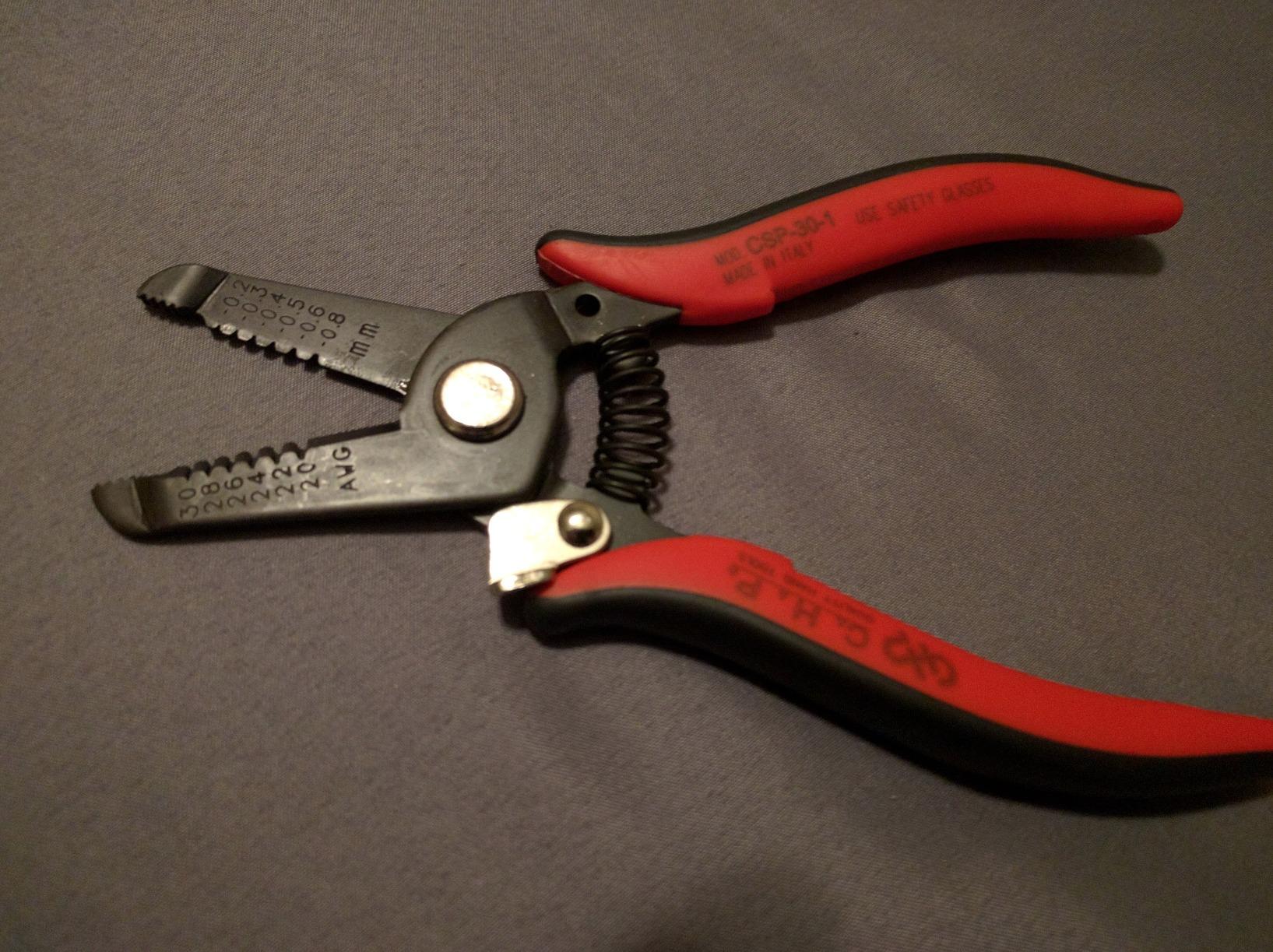
Hakko built this for electronics rather than electrical work, and the details show it. It strips 30-20 AWG, includes a shear and needle-nose pliers in the same frame, and weighs only 1.28 ounces. That is a tool you can hold in one hand while the other hand holds a part over a bench.
The 30 AWG end of the range is the part that matters for hobby electronics. Reviewers report clean strips on 30 AWG wire-wrap with no nicking of the core, which is the hardest part of the range to do properly. The heat-treated steel construction and smooth spring action mean there is no flex in the jaws, and that is what keeps the cut predictable.
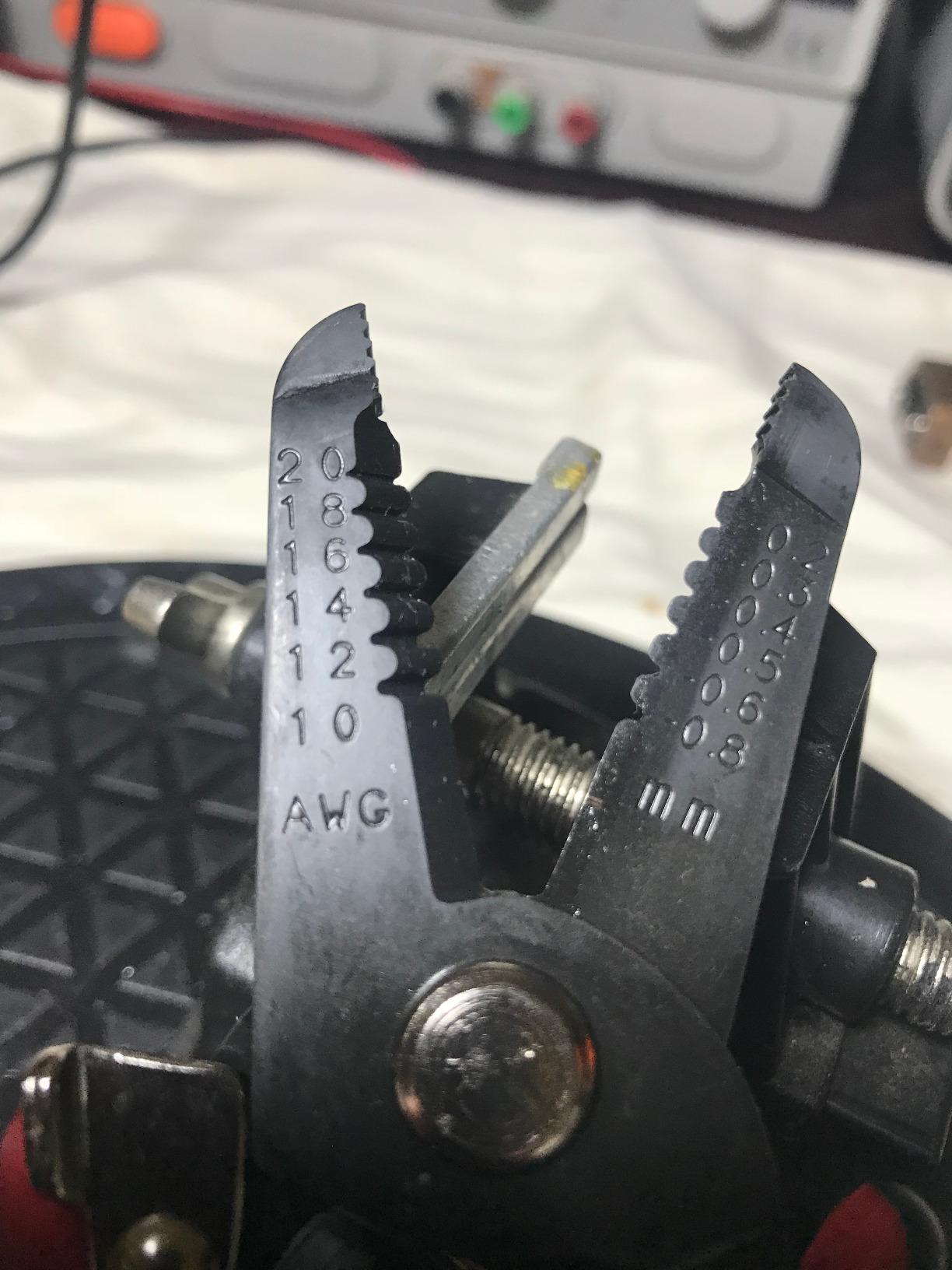
Two design choices set it apart from generic strippers in the same class. The gauge sizes are labelled on both sides of the jaws, so you can read them whether the tool is in your left or right hand or held at an angle. And the metal stopper holds the jaws partly open, which gives you fine control on thin wire instead of an all-or-nothing squeeze.
The soft rounded rubber grips stay comfortable over long sessions, which matters more than it sounds if you are building an entire set of sensor leads in one sitting.
Who should pick the Hakko CSP-30-1
It suits anyone working with 22-30 AWG wire who wants a single lightweight tool that also cuts and grips. Breadboard builders, LED sign builders and people wiring small sensor harnesses all benefit from the combination of stripper, shear and pliers in a 1.28 ounce frame.
Because it is so light, it also works well as a secondary tool carried in a small pouch, for field repair or for building at a meet rather than at home.
Where it falls short
The gauge numbers are embossed rather than printed, and reviewers regularly note they are hard to read without magnification or enhancement. You will learn your gauges by feel quickly, but write them down for the first week.
It is a 30-20 AWG tool. Anything heavier than 20 AWG, and anything to do with household mains wiring, is outside what it was built for.
5. Knipex 12 62 180 – Premium Automatic Stripper for Repetitive Work
KNIPEX Automatic Wire Stripper 10-24 AWG, 7.25
Self-adjusting stripping 10-24 AWG
Adjustable strip length stop
Integrated cable cutter
Pros
- Self-adjusting mechanism gives consistent clean strips across 10-24 AWG
- Single squeeze is far faster than manual strippers on repetitive work
- Adjustable stop produces repeatable strip length
- Light balanced frame stays comfortable over long sessions
Cons
- Struggles with stiff nylon jacket such as THHN at the heavy end of the range
- Mostly plastic construction feels less rigid than the price suggests
- Minimum practical strip length is around 5 mm
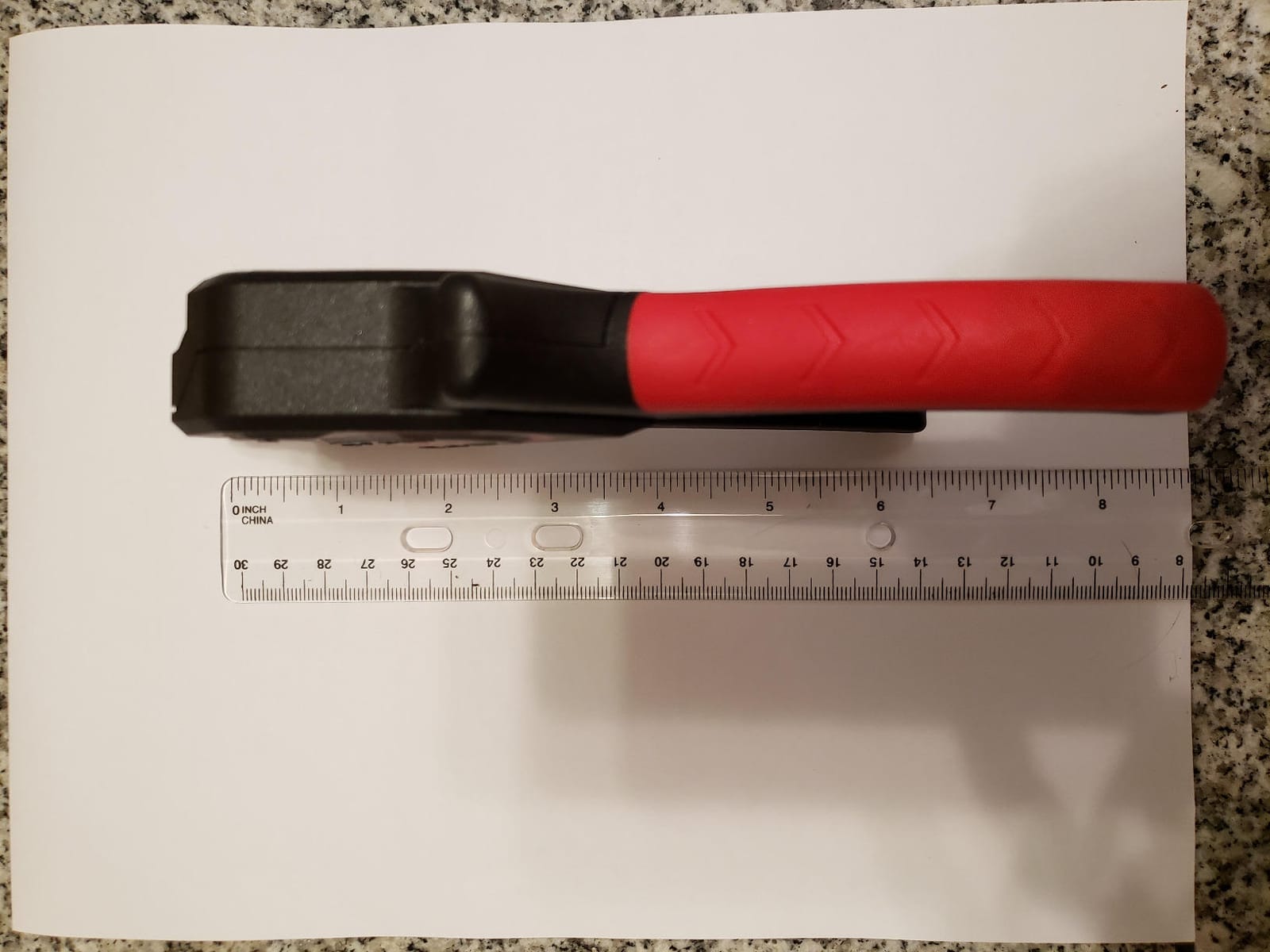
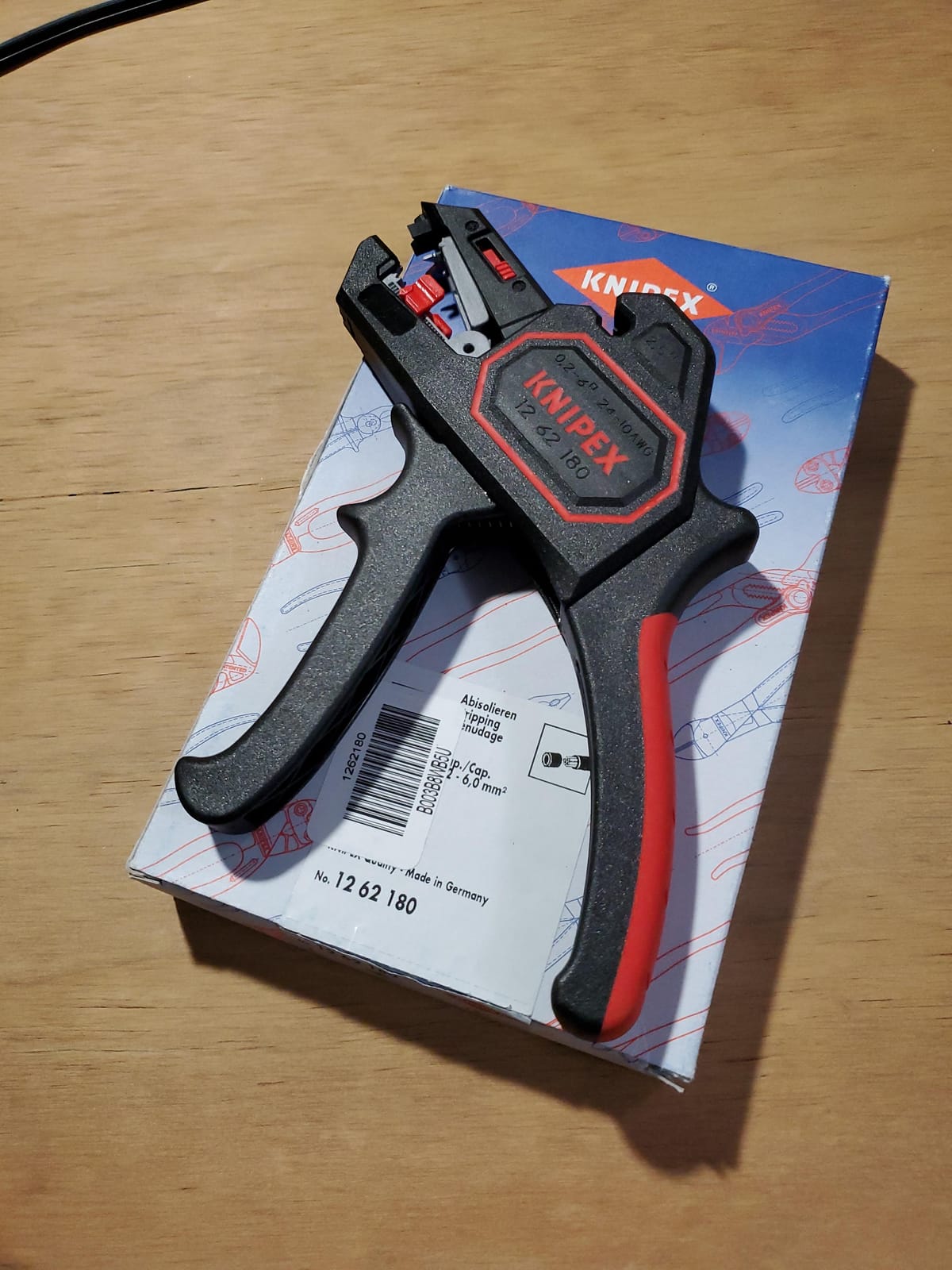
The Knipex is the tool you buy when stripping stops being occasional. It senses the wire thickness and strips 10-24 AWG in a single squeeze, pulling the insulation off as it cuts, so the offcut never has to be picked off by hand. That last part is the detail hobbyists notice first.
Strip length repeatability is the second reason it earns its place. The adjustable stop means a batch of ten connectors gets the same exposed conductor length every time, which is exactly what a good crimp needs. With 1853 reviews, this is also the most established reputation in the automatic category among experienced users, and Knipex warranty service is frequently singled out as a reason to stay with the brand.
On repetitive bench work the single-squeeze action is transformative. Where a gauged stripper asks you to line up a notch, look at the marking and squeeze carefully, this measures and cuts in one movement, so a long run of hookup wire goes quickly.
At 5.6 ounces with a pistol-grip handle, it stays balanced through long sessions. The integrated cable cutter in the handle removes the need for a second tool on panel and loom work.
Who should pick the Knipex
It fits makers who strip wire in batches: people building control panels, wiring a boat or vehicle harness, or assembling electronics enclosures with dozens of terminations. If you strip more than a few lengths a day, the speed difference pays for the tool quickly.
It is also a good partner to a precision stripper rather than a replacement for one. Many builders keep a fine precision tool for magnet wire and the Knipex for 18-24 AWG production work.
Where it falls short
It is not the right tool for the very fine wire at the bottom of this roundup. The minimum practical strip length is around 5 mm, and the mechanism is designed for a thicker range than 30 AWG and below.
Two more honest notes. Stiff nylon-jacketed wire such as THHN is difficult at the 10 AWG end, and the construction is mostly plastic, which feels less rigid than the price implies. It is a well-engineered tool with a specific envelope, not a universal answer.
6. Capri Tools 20011 – Best for Panel Wiring and Automotive Work
Capri Tools 20011 Automatic Wire Stripper and Cutter
Self-adjusting stripping 24-10 AWG
Cuts wire up to 12 AWG
Strip length adjustment between 8 and 12 mm
Pros
- Fast and easy on larger gauges from roughly 14 AWG upward
- Lightweight enough for comfortable one-handed use
- Useful built-in cutter
- Suited to panel wiring and automotive work
Cons
- Build feels inexpensive and the jaws can jam and need prying apart
- Needs a gentle squeeze and practice to avoid nicking 24 AWG stranded
- Minimum strip length of 8 mm is too long for most electronics work
- No user-replaceable blades once they dull
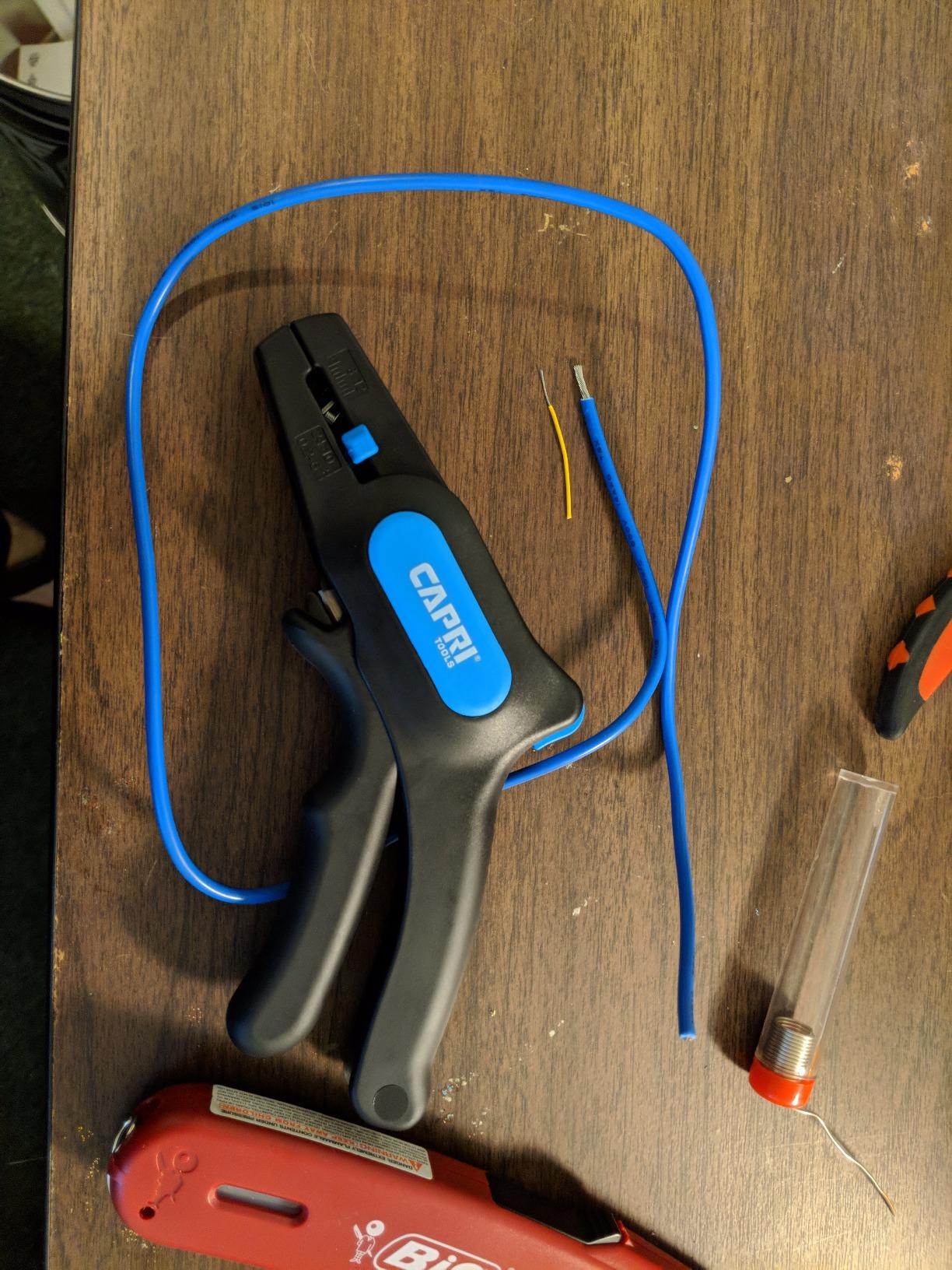
The Capri Tools 20011 is a self-adjusting stripper built for wire that is bigger than most electronics hookup. It handles 24-10 AWG automatically, and the built-in cutter takes wire up to 12 AWG, which puts it squarely in panel wiring and vehicle-style harness territory.
Where it shines is speed on thicker gauges. From roughly 14 AWG upward it strips cleanly in one fast motion, and the narrow profile helps when you are working inside a panel box or behind a dash rather than at an open bench. The strip length adjustment between 8 and 12 mm covers the common range for insulated terminals.
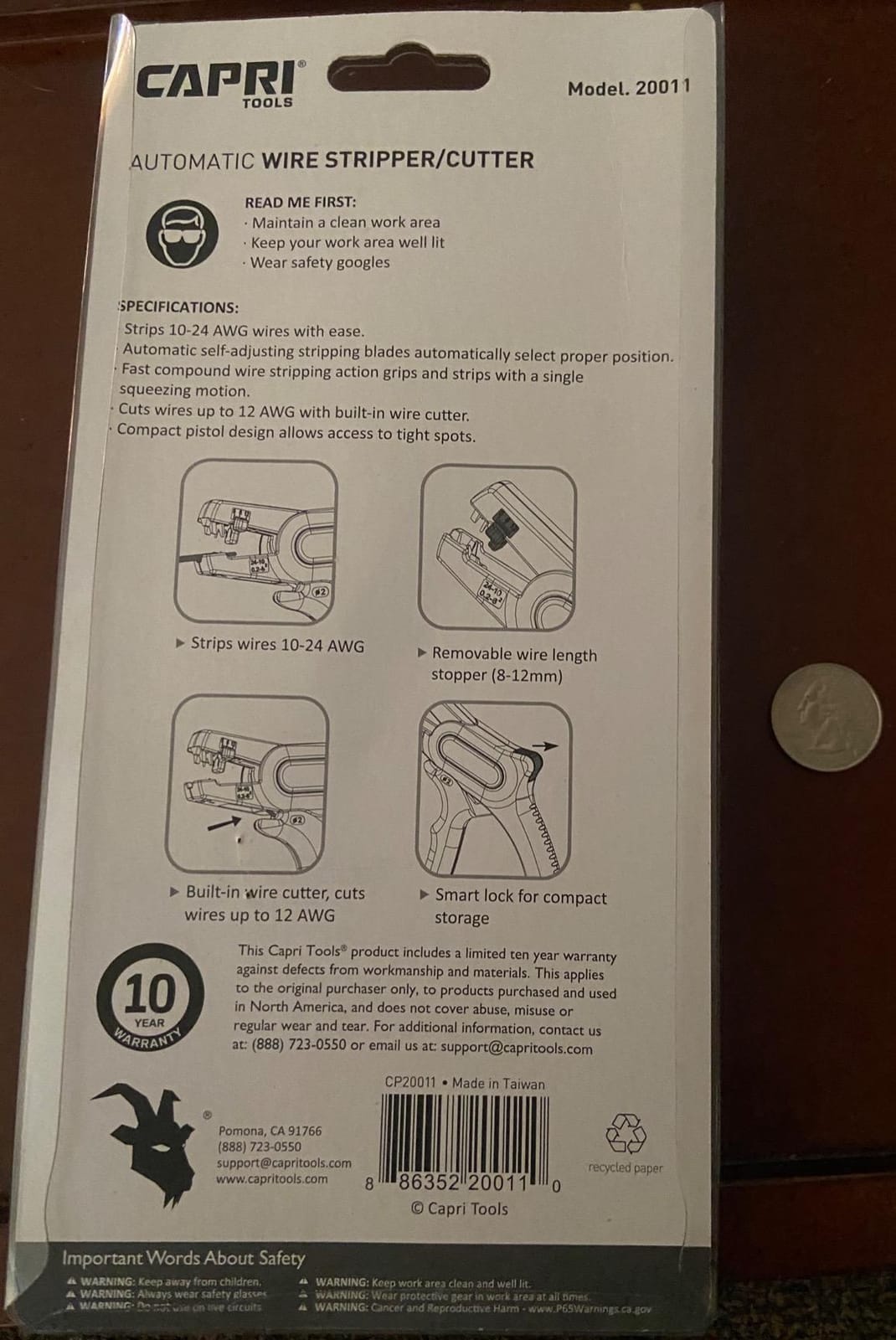
It is light at 0.16 kg and comfortable to operate one-handed, and the 10-year warranty is a real commitment from the manufacturer. Reviewers using it for panel and automotive wiring report consistent results once they have found their rhythm.
The compound stripping action is worth understanding: the jaws grip, cut and pull in sequence, so the pressure you apply controls how the cut is made.
Who should pick the Capri 20011
Choose it for control panel wiring, automotive accessory circuits, speaker cable runs and any build where the wire is 14 AWG or heavier and you are doing a lot of it. The automatic action removes the gauge-matching step, which is where a lot of nicking happens on small tools under time pressure.
It is a reasonable bench tool too, as long as you are not dependent on very short strip lengths.
Where it falls short
This is not a fine electronics stripper. The 8 mm minimum strip length is too long for most breadboard and small-connector work, and owners report it needs a gentle squeeze and some practice to avoid nicking 24 AWG stranded conductor.
Build quality is the other concern. Several users report the jaws jamming with debris in the track and needing the handles pried apart, and the blades have no user-replaceable option once dulled. For 30 AWG and finer, use a precision stripper instead.
7. Klein Tools 1003 – Best for a Compact 5-Inch Stripper
Klein Tools 1003 5-Inch Compact Wire Stripper/Cutter
Compact 5-inch design
Strips 12-26 AWG solid and 14-28 AWG stranded
Adjustable slide stop with set screw
Pros
- Very compact and light enough for a small tool pouch
- Adjustable slide stop gives repeatable strip length on repeat work
- Covers a useful 12-26 AWG solid and 14-28 AWG stranded range
- Made in USA with typical Klein durability
Cons
- Does not reach the 30-32 AWG gauges common in fine electronics wiring
- Lightweight plastic construction offers less rigidity for heavy cutting
The Klein 1003 exists because most bench strippers are too big to carry. At five inches it slips into a pocket or a small pouch, and it still cuts, strips, loops and bends 12-26 AWG solid and 14-28 AWG stranded wire.
For repeated stripping of ordinary hookup wire it performs well. The adjustable slide stop with a set screw locks your strip length in place, so once you have set it for a given connector you can stop thinking about it, which is the same repeatability idea that makes the expensive automatic tools worth it for production work.
Made in the USA with the sort of tight build people expect from Klein, it is a tool that outlasts the pouch it lives in. Reviewers with 670 ratings point to the compact format as the reason to buy, and it is a fair reason.
Who should pick the Klein 1003
It suits repair work where you need a stripper on a site visit, a class, or a makerspace bench that does not have room for a full tool roll. The looping and bending hole at the nose is a nice touch for forming a conductor to a screw terminal.
It is also a good light-duty companion to a precision stripper, handling 22-26 AWG while the finer tool covers the bottom of the range.
Where it falls short
The range bottoms out around 28 AWG stranded, which means it does not reach the 30-32 AWG wire common in fine electronics work. If your project needs those gauges, this is not the tool.
The plastic construction offers less rigidity for heavy cutting, so it is a stripper first and a cutter second. It is built for hookup wire, not for cable or loom.
8. ENGINEER PA-06 – Best for PTFE and Silicone Wire
ENGINEER PA-06 Precision Wire Stripper For Thin Wires AWG 30-18
Strips solid AWG 28-16 and stranded AWG 30-18
High carbon steel jaws
Made in Japan
Pros
- Strips 30 AWG and finer cleanly with no nicking of the copper
- Handles PTFE FEP and silicone insulation without damaging the jacket
- Jaws arrive sharp and aligned with no burrs or touch-ups
- Slim nose and light spring action work well in tight spaces
Cons
- Gauge markings are small and hard to read at a glance
- Markings refer to stranded wire and the metric figures are conductor diameters not AWG
- Higher cost than generic precision strippers
The PA-06 is the tool for the wire that frustrates everyone else. PTFE, FEP and silicone insulation are smooth, slippery and tough at the same time, and cheap strippers either crush it or drag it off in pieces. The high carbon steel jaws on this one cut through that jacket and leave the conductor alone.
It covers solid wire from 28 to 16 AWG and stranded wire from 30 to 18 AWG, with a slim nose that reaches into tight spaces and light spring action that does not tire the hand. The jaws are aligned out of the box, with no burrs and no need for a touch-up file, which matters when you have just paid for precision.
Reviewers from electronics hobby and audio work describe it as among the best fine-wire strippers available, specifically noting zero broken strands on PTFE and silicone wire and no post-strip cleanup needed. It is made in Japan with a play-free hinge.
Who should pick the ENGINEER PA-06
It is the natural choice for anyone building with modern bench wire: silicone hookup in 24 and 26 AWG, PTFE in 28 AWG, or audio and instrument cable work. If you have been disappointed by strippers that leave insulation residue on smooth jackets, this solves that.
It also makes a good second fine-wire tool, because its solid and stranded ranges are broad enough to cover most bench work up to 16 AWG solid.
Where it falls short
The gauge markings are small and hard to read at a glance, so expect a short learning period. Be aware that the markings refer to stranded wire, and the metric figures printed alongside are conductor diameters rather than AWG values, which trips people up.
It costs more than generic precision strippers, and the range starts at 28 AWG solid. If you need 32 AWG or finer, go to the PA-14 instead.
9. ENGINEER PA-14 – Best for 32-34 AWG Micro-Thin Wire
ENGINEER PA-14 Precision Wire Stripper for Micro-Thin Wire Made in Japan
Strips stranded AWG 34-22 and solid AWG 32-20
High carbon steel jaws with rounded finishing edge
Made in Japan
Pros
- Strips 32-34 AWG cleanly with no nicks visible under magnification
- Rounded low-friction blade geometry feels effortless on hair-thin wire
- Handles tough insulation such as CAT7 slim network cable without damage
- Play-free hinge and precise milling typical of Japanese manufacturing
Cons
- A minority of users report the smallest slots cutting through the wire if handles are fully closed
- Narrower overall range than the PA-06 topping out around 20-22 AWG
- Hanger opening is too narrow for a standard hook
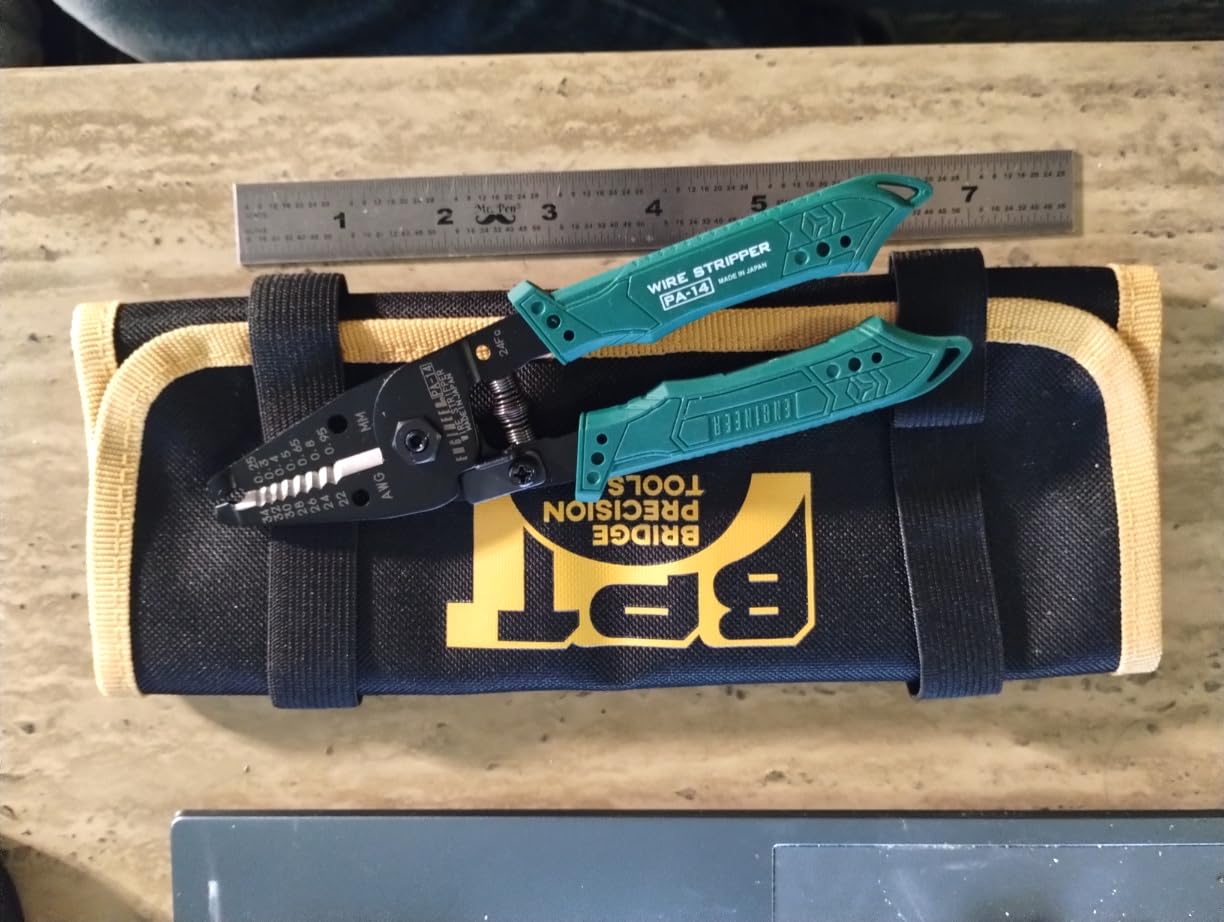
The PA-14 is the finest-wire tool in this roundup. It strips stranded wire from 34 down to 22 AWG and solid wire from 32 down to 20 AWG, and the rounded finishing edge on the jaws is what makes hair-thin wire practical to handle.
Owners working with micro-thin wire report clean strips with no nicks even under magnification. That is the standard that matters here, because on 32 AWG the conductor is thin enough that a single nick is a broken connection waiting to happen. The low-friction geometry also means the insulation releases without force, so you are not levering against a wire thinner than a pencil lead.
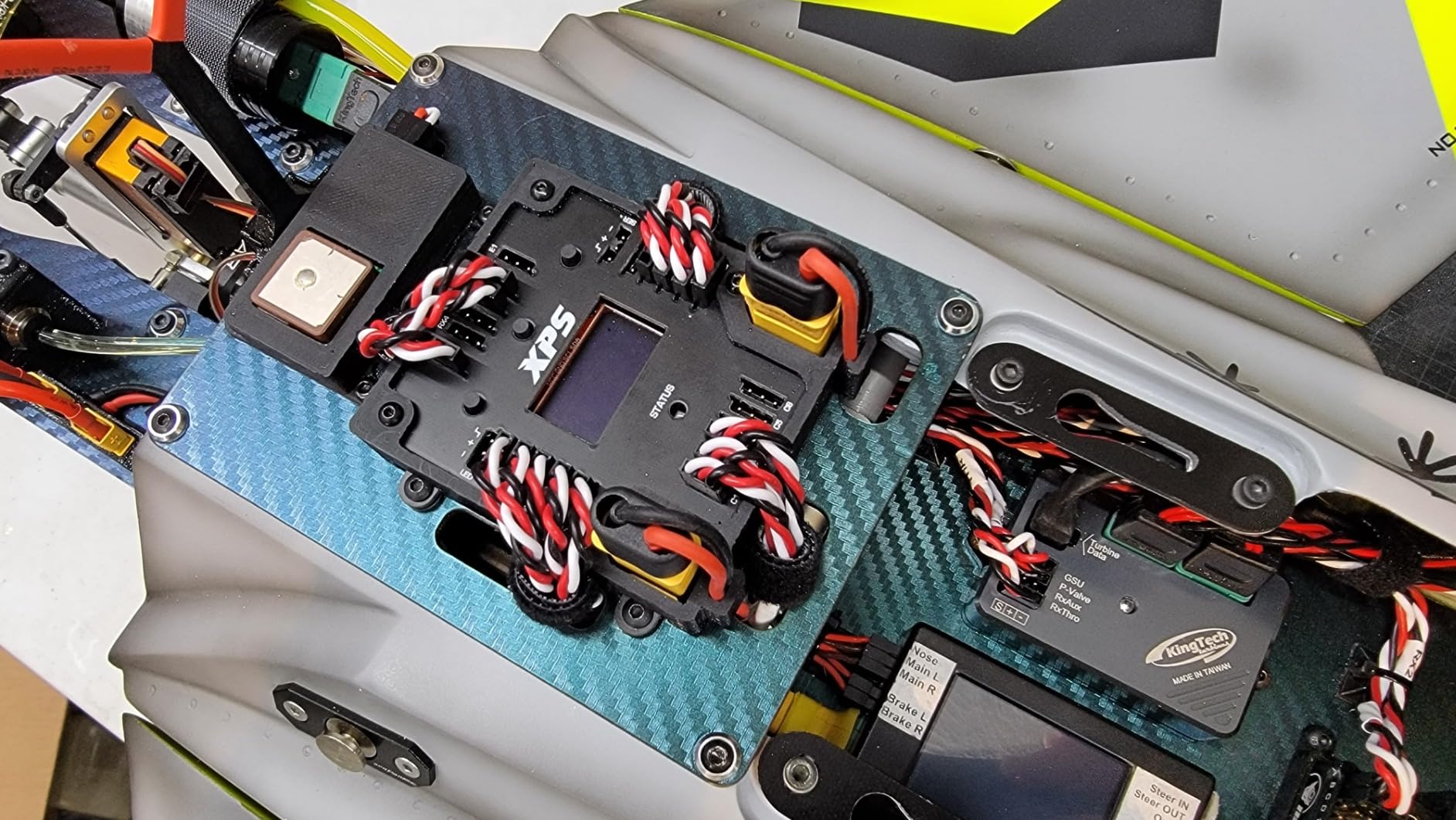
It is also more capable than the gauge range suggests. Reviewers use it for CAT7 slim network cable and SMD LED harnesses, where tough insulation would defeat a less precise blade.
Who should pick the ENGINEER PA-14
Pick it for the projects that defeat everything else: micro controllers and sensor leads, LED sign and SMD harness wiring, tonearm and audio rewiring, and any hair-thin wire pulled from a device. If you repair modern electronics rather than build from scratch, this is the tool that keeps working.
Because the rounded edge stays sharp as it works through fine wire, it is a companion rather than a replacement for a mid-range stripper, and many builders keep both.
Where it falls short
A minority of users report that the smallest slots cut through the wire when the handles are fully closed, though most dispute this once they check the openings in good light. Close the handles gently and the issue disappears.
The range is narrower than the PA-06 at the heavy end, topping out around 20-22 AWG, and the hanger opening is too narrow for a standard peg hook.
10. KATA 7 Inch Precision Wire Stripper – Best for First-Time Builders
KATA 7 Inch Precision Wire Stripper, 20-32 AWG Tool for Electronics DIY
20-30 AWG solid and 22-32 AWG stranded
#50 heat-treated carbon steel
7-inch compact frame
Pros
- Handles 30 AWG stranded where many local alternatives stop at 22 AWG
- Sharp heat-treated carbon steel blades cut insulation easily
- Feels solid and better made than big-box budget strippers
- Strips cuts clamps and crimps in one tool
- Comfortable grip even with arthritic hands
Cons
- Blades can be slightly misaligned causing very fine stranded wire to bend before release
- Explicitly not rated for household mains wiring
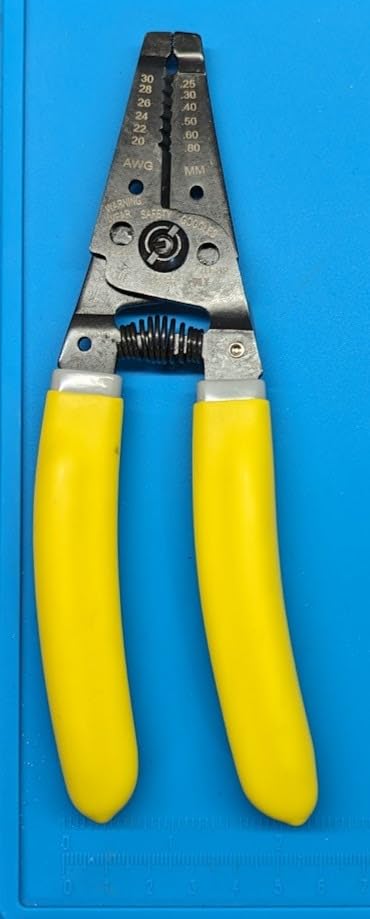
The KATA is a sensible first electronics stripper, and the reason is range. It handles 20-30 AWG solid and 22-32 AWG stranded, which is wider than most tools at this level, and the manufacturer states plainly that it is intended for low-voltage electronics, maker and 3D printer projects.
It is also more capable than its price suggests. The #50 heat-treated carbon steel gives it sharp blades that cut insulation easily, and it strips, cuts, clamps and crimps terminals in one frame. Users with arthritic hands specifically praise the grip, which is worth noting if fine motor control is a factor.
Reviewers describe feeling that it is better made than big-box budget strippers, which is the practical test for a first purchase. The 7-inch frame suits a small workspace where a full-size automatic stripper would be in the way.
Who should pick the KATA
It suits students, first Arduino or Raspberry Pi builds, and anyone who wants one tool to cover 3D printer wiring, LED projects and general bench leads. The crimp and clamp capability means you do not need a second tool for terminal work while you are learning.
It is also a good gift for a young maker, because the range covers most of what they will touch for years.
Where it falls short
The main report is blade alignment. One detailed review notes that very fine stranded wire can bend before the insulation releases, which happens when the blades are slightly out of line. Check the cut under light on your first few wires and adjust your expectations accordingly.
It is explicitly not rated for household mains wiring, and the frame is a single fixed-size tool with no strip length stop, so repeatability on connector work comes from measuring rather than from the tool.
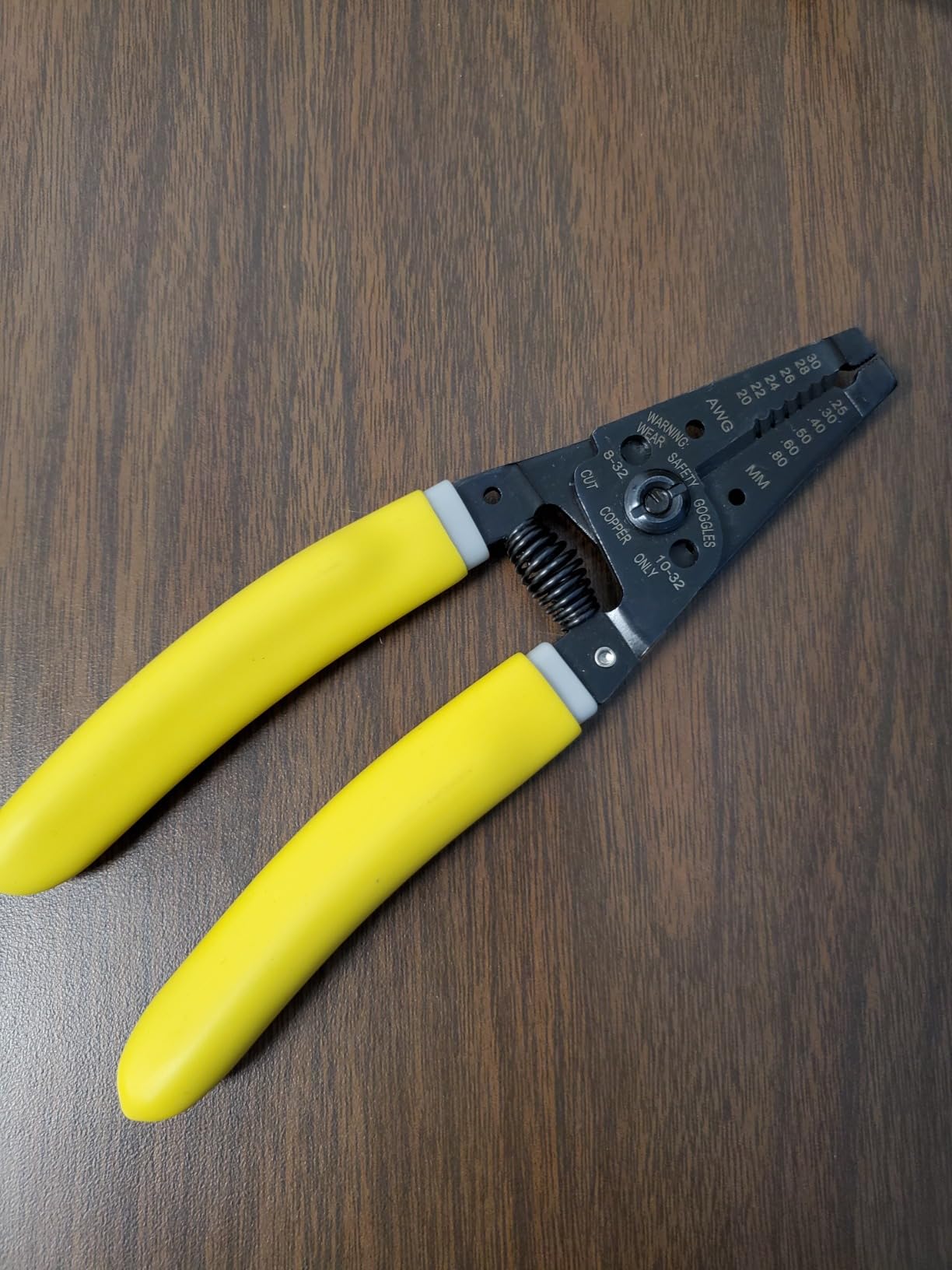
11. iFixit Mandible Wire Strippers – Best for a Repair Kit
iFixit Mandible Wire Strippers – Auto-Open Latch for Electronics Repair
30-10 AWG cutting stripping and bending
Spring-loaded auto-reset handle
Locking latch for storage
Pros
- Strips 30-10 AWG cleanly without nicking once the correct slot is selected
- Auto-open spring handle and latch make repeated one-handed work easy
- Compact and ergonomic compared with strippers built for house wiring
- Rubberized handles give good control for breadboard and rework work
Cons
- Not intended for heavy industrial or thick cable work
- Locking latch can pop open inside a crowded tool bag
- Needs a short adjustment period to reliably select the right gauge slot
iFixit built the Mandible for electronics repair rather than installation, and the ergonomics reflect it. At 3.2 ounces with an alloy steel frame and rubberized handles, it is noticeably more compact than the strippers designed for house wiring, which matters when you are working on a device in front of you.
It covers 30-10 AWG, which is broad enough for most bench wiring, and the spring-loaded handle resets automatically after each use. That means you can strip with one hand while the other holds a part, and the insulation offcut is pulled away rather than left for you to pick off.
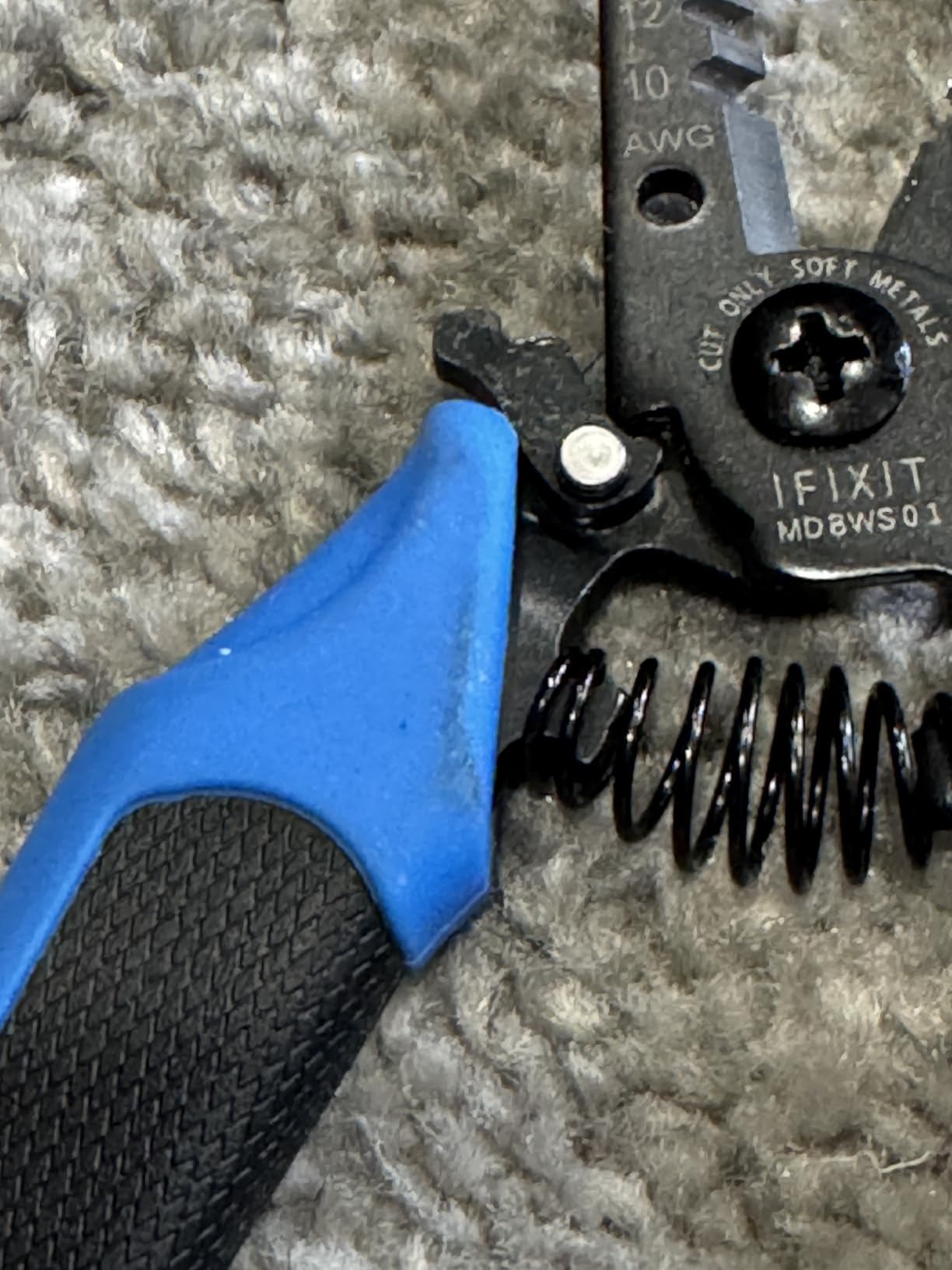
Repair hobbyists report cleaner and more reliable results than similarly positioned automatic strippers, plus a lifetime guarantee from the manufacturer. The small plier tips at the nose are handy for shaping a conductor into a solder joint or a screw terminal.
Who should pick the iFixit Mandible
It fits people who repair rather than build: opening devices, replacing damaged leads, or working through a queue of small electronics jobs. The 30 AWG end of the range means it handles the fine wire found inside consumer electronics.
It also makes sense for a portable kit. If you already have a full-size stripper at the bench, this is a compact second tool for field work.
Where it falls short
It is a light-duty tool. Heavy industrial work and thick cable are outside what it is built for, and forcing it will show.
The locking latch can pop open inside a crowded tool bag, which is the most common complaint. It also needs a short adjustment period before you reliably select the right gauge slot every time, so give it a few strips before you judge it.
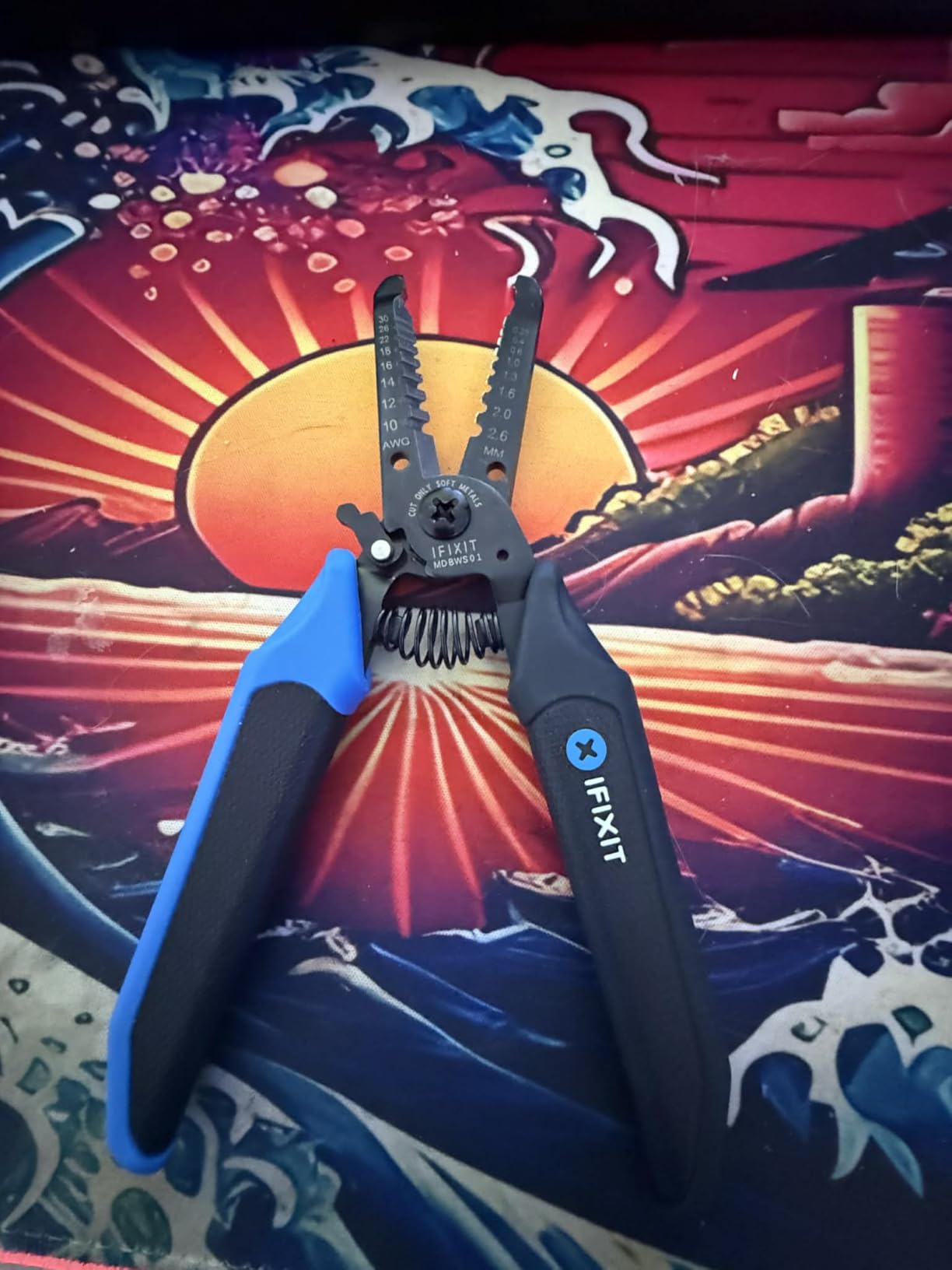
12. Gardner Bender GS-361 – Best for Long-Term Daily Service
Gardner Bender GS-361 Wire Stripper, 16-32 Awg, 6-1/4 in Oal
16-30 AWG solid and 18-32 AWG stranded
Color-coded laser-etched gauge markings
6-1/4 inch overall length
Pros
- Very sharp and accurate especially on fine wire down to 28-32 AWG
- Power spring return reduces hand fatigue over repeated stripping
- Color-coded laser-etched markings stay legible over time
- Owners report a decade of service before wear
Cons
- No keep-closed lock so the handles spring open in storage
- Smallest slots are the only ones needed for most hobby electronics work
- Looping hole is small relative to the fine wire it is used with
The GS-361 is the stainless steel workhorse of this group, and the distinguishing feature is durability. Owners report a decade of service before wear, which for a hand tool is the metric that actually matters over a hobbyist’s lifetime.
It covers 16-30 AWG solid and 18-32 AWG stranded, and the marks that matter most for electronics are at the fine end, where owners report sharp and accurate strips on 28-32 AWG wire. The precision ground pliers nose and curved cutting blade are what make that possible, and the anti-glare black oxide treatment helps you read the jaws under a bench lamp.
The colour-coded laser-etched gauge markings stay legible where stamped paint on a cheaper tool wears off within a year. The power spring return reduces hand fatigue during long stripping sessions, which is a real benefit in a tool this small.
Who should pick the Gardner Bender GS-361
It suits the builder who has decided to stop buying tools and buy one properly. Model makers, micro-electronics hobbyists and anyone who strips wire daily will get more from this tool than from anything else in the list in terms of years of service.
At 6-1/4 inches it is still compact, and the looping hole is there when you need to form a termination.
Where it falls short
There is no keep-closed lock, so the handles spring open when the tool is stored and you end up using an elastic band or a pouch to keep it together. That is the most common complaint and the one piece of friction in an otherwise durable tool.
Also note the practical limitation: for most hobby electronics work you will only ever use the smallest slots, so the wide range is headroom rather than a daily benefit. The rating here is the lowest in the group, and it reflects build consistency rather than how the tool performs on the wire.
How to Choose a Wire Stripper for Electronics Work
The wrong stripper is not a small mistake. A tool that nicks the conductor produces a joint that passes a visual check and fails three months later, and a stripper that cannot reach your gauge wastes the whole purchase. Five things decide whether a tool is right for your bench.
Match the tool to your AWG range first
AWG is the American Wire Gauge system, and the numbers run backwards: higher numbers mean thinner wire. Most hobby electronics work lives between 22 and 30 AWG. Breadboard jumper and hookup wire is typically 22 or 24 AWG, sensor and LED leads run 26 to 28 AWG, and internal device wiring often drops to 30 AWG or below.
Buy for the thinnest wire you actually plan to use. A tool that covers 12-24 AWG is excellent until you need 28 AWG, at which point it becomes dead weight. Most of the fine-wire tools in this roundup reach 30 AWG or beyond, and two of them go to 32 and 34 AWG.
Know the five stripper types
Gauged strippers have a notch cut for each wire size. You put the wire in the matching hole and pull, which is fast once learned and completely predictable when you use the right hole. Adjustable strippers use a screw to set a blade opening, which is flexible but, as forum users point out, leaves you constantly deciding whether the hole is too big or too small. Self-adjusting or automatic strippers sense the wire thickness and cut and pull in one squeeze, which is the fastest option on repeated work. Precision electronics strippers are gauged plier-type tools with very sharp jaws, built for the bottom of the AWG range. Thermal strippers use heat to burn insulation away instead of a blade, which is genuinely nick-free but has largely fallen out of fashion as a hobby option.
Electricians mostly reach for automatic or heavy-gauge gauged tools because their wire is thick. For 24 AWG and finer, a precision plier-type stripper gives you more control than the same price of automatic tool.
Strip length control is the connector story
Strip length is the least discussed and most consequential setting on any stripper. Too little exposed conductor and the crimp cannot form; too much and the bare wire shorts to the neighbouring pin. The tools with an adjustable stop, such as the Klein 11057, the Klein 1003 and the Knipex, let you set the length once and repeat it, which is what makes batch crimping consistent.
For finer connector work, measure the first one with calipers and get it right before you commit to a run. This is also where the difference between tools shows: a tool with a minimum 8 mm strip length is fine for panel terminals and wrong for a small JST housing.
Crimping capability for JST, Dupont and Molex
Only one tool in this roundup crimps as well as strips, the haisstronica set, and it covers insulated terminals from 26 to 10 AWG. That is a real gap in most hobby kits, because a proper ratcheting crimper for small connectors is a separate purchase. If your builds end in crimped housings rather than solder joints, budget for that tool too, and match the crimper die to the terminal rather than forcing a mismatched one.
Our soldering station guide covers the alternative path: many hobbyists strip, twist and solder rather than crimp, and for short leads a good joint is easier to achieve.
How to strip small electronic wire without nicking it
Method matters as much as the tool. First, cut the wire square so the end is flat and square to the insulation. Next, select the gauge hole that matches the wire rather than the one that feels close, and check the marking on the tool before each change. Insert the wire with a gentle twist as you close the jaws so it seats fully in the notch instead of riding up. Close only until the jaws bite the insulation, then pull the wire away from the tool while the offcut stays gripped, so the insulation is removed rather than peeled off in shreds. Finally, inspect the conductor under good light before it goes anywhere near a solder joint. That last step takes five seconds and catches a nick while it is still free to cut off and redo.
If you are stuck with a knife, stop. Stripping wire with a blade and your fingers is how people end up with a scar and a shorted board, and the whole point of a proper tool is that it holds the wire for you.
Precision, comfort and blade quality
Blade quality shows up in the finish of the cut. Ground jaws, as on the Klein 11057 and both ENGINEER tools, leave a clean edge and hold their sharpness longer than stamped blades on budget tools. Comfort matters too: a spring that returns fully and grips that stay comfortable in a sweaty hand will save you more time over a year than any feature list suggests.
Finally, think about where the tool lives. If it will sit in a small pouch or a crowded field kit, the iFixit Mandible and the Klein 1003 make more sense than a full-size automatic. If you already own a portable tool roll, our portable hobby tool kit guide covers what else belongs in one.
Frequently Asked Questions
How to strip small electronic wire?
Insert the correct gauge hole, close the jaws only until they bite the insulation, then pull the wire away while the tool grips the offcut. Cut the end square first, seat the wire fully in the notch with a slight twist, and inspect the conductor under good light before soldering. Stop using a knife and your fingers.
What is a good wire stripping tool for stripping small wires?
For 22-30 AWG electronics wire, the Hakko CSP-30-1 and the DOWELL 22-30 AWG stripper both handle fine wire cleanly. Below 30 AWG, go finer: the ENGINEER PA-06 covers solid 28-16 AWG and stranded 30-18 AWG, and the PA-14 reaches 34 AWG stranded. Match the tool to the thinnest wire you plan to use.
What AWG wire stripper do I need for electronics?
Most hobby electronics work sits between 22 and 30 AWG, so look for a tool covering 30 AWG stranded at minimum. Breadboard jumper and hookup wire is 22-24 AWG, sensor and LED leads are 26-28 AWG, and internal device wiring can be 30 AWG or thinner. Buy for the finest gauge in your plans, not the thickest.
What do electricians use to strip wires?
Electricians usually use self-adjusting automatic strippers or heavy gauged tools built for 12-14 AWG building wire, sometimes with a crimper and cutter built in. Those tools are the wrong shape for hobby electronics, where 24-30 AWG wire needs finer control and a shorter strip length than a mains stripper produces.
Do I need a crimper and stripper combo for electronics?
Only if you build with connector housings rather than soldering. A combo tool such as the haisstronica 3-in-1 set strips 24-10 AWG and crimps insulated terminals from 26-10 AWG, which covers most hobby harness work. If you solder every joint, a dedicated stripper plus a separate precision crimper is the better split.
The Best Wire Strippers for Hobby Electronics in 2026
The Klein Tools 11057 is the best wire stripper for hobby electronics overall, because its precision ground holes clean 20-30 AWG solid and 22-32 AWG stranded wire without touching the conductor, and it needs no adjustment to do it. If your wire is 22-30 AWG and you want the shortest path to a clean strip, the DOWELL does the same job for a fraction of the outlay. For the fine end of the range, the ENGINEER PA-06 handles PTFE and silicone cleanly down to 30 AWG, and the PA-14 goes to 34 AWG stranded for micro-thin device wiring.
Match the tool to the thinnest wire in your parts bin, strip length matters more than any other feature once you start crimping connectors, and inspect the conductor before every joint. Our picks for the best wire strippers for hobby electronics in 2026 will still be on your bench in a decade if you buy the one that fits your gauges.