
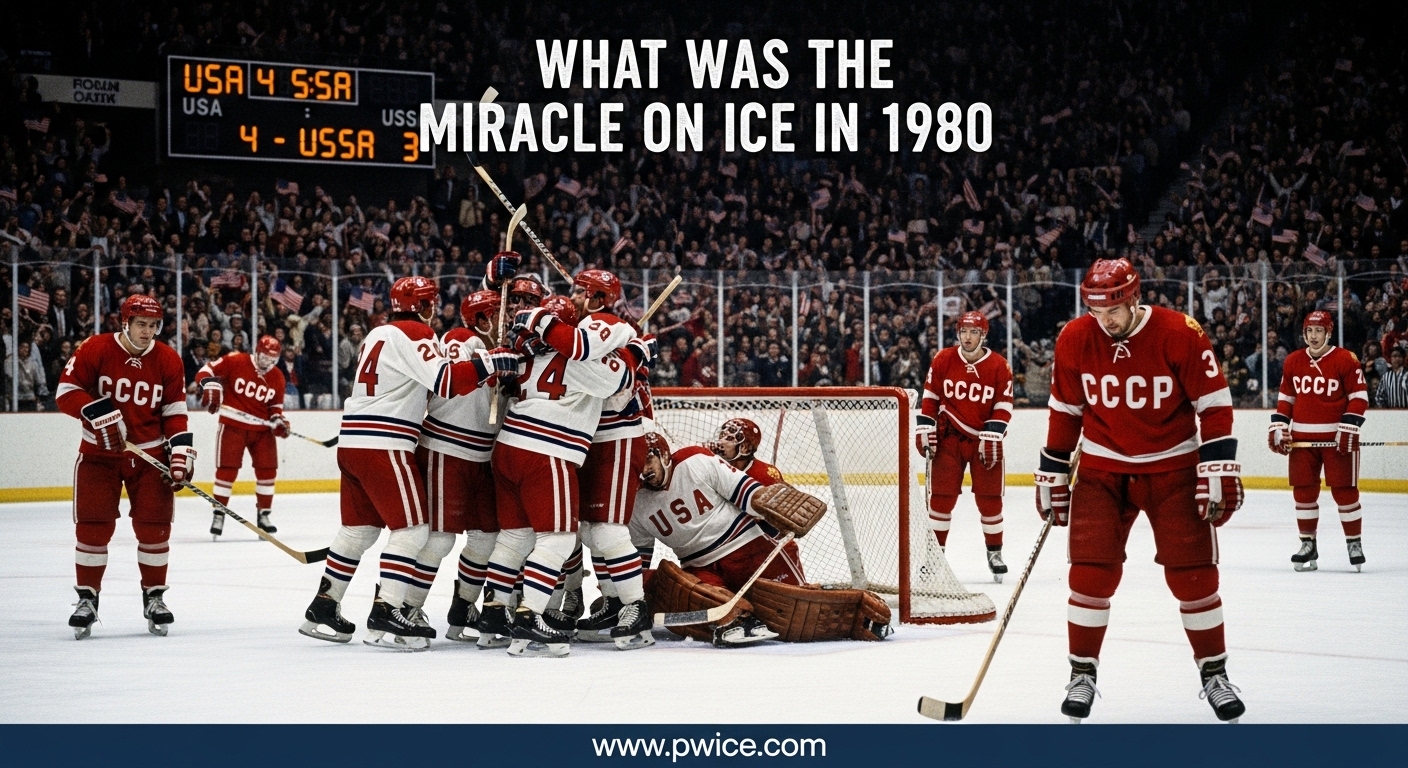
The Miracle on Ice was the nickname given to a medal-round men’s ice hockey game at the 1980 Winter Olympics in Lake Placid, New York. The United States national team, composed of amateur and college players, defeated the heavily favored Soviet Union national team 4-3 on February 22, 1980. This stunning upset occurred during a time of intense Cold War tensions and became one of the most iconic moments in sports history.
I remember first hearing about this game from my father, who watched it live on television. He still gets emotional talking about Al Michaels’ famous call in the final seconds. The Miracle on Ice wasn’t just a hockey game. It was a moment that united a nation during one of the darkest periods in modern American history.
Table of Contents
Historical Context: America in 1980
To truly understand what was the Miracle on Ice in 1980, you need to understand what America was going through at the time. The late 1970s and early 1980s were incredibly difficult for the United States. The country faced a severe economic recession with runaway inflation and gas shortages. Lines at gas stations stretched for blocks.
The Iran hostage crisis dominated headlines. Fifty-two Americans were being held captive in the US Embassy in Tehran since November 1979. Every night, the evening news ended with a count of how many days the hostages had been imprisoned. Americans felt helpless and frustrated.
The Soviet Union had just invaded Afghanistan in December 1979. President Jimmy Carter called it the most serious threat to peace since World War II. He announced the United States would boycott the upcoming 1980 Summer Olympics in Moscow. Tensions between the superpowers were at their highest point in decades.
The Cold War wasn’t just a political conflict. It was an ideological battle between capitalism and communism, democracy and authoritarianism. Every sporting event between American and Soviet athletes carried political weight. The 1980 Lake Placid Olympics became a proxy battleground in this larger struggle.
The Teams: David vs Goliath
The contrast between these two teams could not have been more dramatic. On paper, this matchup looked like a complete mismatch. The Soviet Union was the most dominant hockey team in the world. The Americans were a group of unproven college kids.
The American Underdogs
Herb Brooks coached the 1980 US Olympic hockey team. He was a former Olympic player who had been the last man cut from the 1960 team that won gold. Brooks brought an unconventional coaching style that emphasized conditioning, discipline, and team unity over individual talent.
The American roster consisted entirely of amateur players. Most were college students with an average age of just 21 years old. Only one player, Buzz Schneider, had any Olympic experience from the 1976 Games. The team was built around players from Minnesota, Boston University, and the University of Wisconsin.
Just one week before the Olympics began, the Americans faced the Soviets in an exhibition game at Madison Square Garden in New York. The result was devastating. The Soviet Union crushed the United States 10-3. It wasn’t even close. The Soviets toyed with the Americans, showing off their superior skill and experience.
Brooks pushed his team harder than any American squad had ever been pushed. His infamous “Herbies” drill had players skating full-speed sprints until they literally could not stand. The team hated it. They hated Brooks. But they became the best-conditioned team in the tournament.
The Soviet Machine
The Soviet Union team was essentially a professional all-star squad disguised as amateurs. Soviet players were technically military members who played hockey full-time. They had won gold medals in four of the previous five Olympics. Their record in Olympic competition since 1960 was 27 wins, 1 loss, and 1 tie.
Vladislav Tretiak was their goaltender. Many considered him the best in the world. The Soviet roster included seasoned veterans who played together year-round. They practiced constantly and had a system of play that was years ahead of any other country. Their passing was crisp, their skating fluid, their tactical understanding unmatched.
Just months earlier, these same Soviet players had defeated a team of NHL all-stars 6-0 in the Challenge Cup. They were that good. Many experts believed this Olympic team might be the greatest hockey team ever assembled. The Americans were given virtually no chance to compete, let alone win.
What Was the Miracle on Ice? The Game Itself
The game was played on Friday, February 22, 1980, at the Olympic Fieldhouse in Lake Placid, New York. It was not actually the gold medal game, as many people mistakenly believe. It was a medal-round game that determined who would advance to play for gold. But the winner of this game was essentially guaranteed a medal.
First Period: A Shocking Start
The game began with the Soviets dominating play. They outshot the Americans 12-6 in the first period and took a 1-0 lead on a goal by Vladimir Krutov. The US team seemed overmatched, just as everyone predicted.
But with just seconds left in the period, something remarkable happened. Dave Christian fired a shot from center ice toward the Soviet goal. Tretiak made the save but gave up a rebound. Mark Johnson streaked toward the net and knocked the puck in with exactly one second remaining on the clock.
The crowd erupted. The Americans tied the game 1-1 heading into intermission. This single play changed everything. The Soviets were rattled. In a shocking move, Soviet coach Viktor Tikhonov pulled Tretiak from the game and replaced him with backup Vladimir Myshkin. It was a decision that Soviet players and fans would question for decades.
Second Period: Soviet Dominance
The middle frame belonged to the Soviets. They outshot the Americans 12-2 and scored two goals to take a 3-2 lead. Aleksei Kasatonov and Sergei Makarov found the back of the net. The American team was on the ropes, pinned in their own zone for long stretches.
Goalie Jim Craig kept the United States in the game with spectacular saves. He faced 39 shots total and stopped 36 of them. Without Craig’s heroics, the score could have been 6-2 or worse. The Soviets were clearly the better team on the ice.
Despite being outplayed, the Americans only trailed by one goal heading into the final period. Brooks told his team in the locker room, “You were born to be here. This moment is yours.” His words would prove prophetic.
Third Period: The Miracle Unfolds
The final period began with the United States facing a 3-2 deficit. Just 8 minutes and 39 seconds into the period, Mark Johnson struck again. He scored his second goal of the game on a power play, tying the score at 3-3. The momentum had shifted.
Less than two minutes later, team captain Mike Eruzione picked up a loose puck in the Soviet zone. He skated to the middle of the ice and fired a wrist shot that beat Myshkin high on the glove side. The United States led 4-3 with exactly 10 minutes remaining.
The final ten minutes felt like hours. The Americans abandoned any offensive ambitions and focused entirely on defense. They blocked shots, cleared the zone, and relied on Jim Craig to make save after save. The Soviets pressed hard but could not find the equalizer.
Many people wonder why the Soviets didn’t pull their goalie for an extra attacker. The answer is simple: they never practiced playing with an empty net. They were so dominant historically that they rarely trailed late in games. Coach Tikhonov also reportedly believed pulling the goalie would look desperate.
Al Michaels’ Famous Call
ABC broadcast the game on tape delay because they wanted to show it during prime time hours. Commentator Al Michaels was assigned to call the game alongside former Montreal Canadiens goalie Ken Dryden. Neither could have imagined what was about to happen.
As the final seconds ticked away, Michaels’ voice rose with emotion. “Eleven seconds. You’ve got ten seconds. The countdown going on right now. Morrow, up to Silk. Five seconds left in the game. Do you believe in miracles? YES!”
That call became one of the most famous in sports broadcasting history. It perfectly captured the emotion of the moment. A miracle was exactly what had just happened. The United States had defeated the Soviet Union 4-3.
Key Players and Heroes
Several individuals rose to legendary status that night in Lake Placid. Their performances are still celebrated decades later.
Mike Eruzione was the team captain and Boston University forward who scored the winning goal. His shot from the slot beat Myshkin and gave the Americans their 4-3 lead. Eruzione’s celebration, leaping into the air with arms raised, became an iconic image. He never played professional hockey after the Olympics, choosing instead to capitalize on his newfound fame through speaking engagements.
Jim Craig was the goaltender who made 36 saves against the Soviet onslaught. Just 21 years old, Craig played the game of his life. His mask, adorned with an American flag design, became a symbol of the team. Craig’s emotional embrace with the American flag after the game is one of the most enduring images from the 1980 Olympics.
Mark Johnson scored two crucial goals in the first and third periods. The son of former NHL player Bob Johnson, Mark was just 22 years old. His first goal tied the game with one second left in the opening period. His second goal tied it again early in the third, setting the stage for Eruzione’s winner.
Herb Brooks was the architect of the victory. His coaching philosophy emphasized conditioning, defensive responsibility, and team unity over individual ego. Brooks pushed his players to levels they didn’t know they could reach. His pre-game and intermission speeches became legendary. Tragically, Brooks died in a car accident in 2003 at age 66.
Buzz Schneider scored the opening goal for the United States in the first period against the Soviets. Mark Pavelich, the small but skilled center from Minnesota, set up both of Johnson’s goals with brilliant passes. Dave Silk and John Harrington made key plays throughout the game.
For the Soviet Union, the decision to pull Vladislav Tretiak proved catastrophic. Myshkin played well but wasn’t the game-changer Tretiak was. Coach Viktor Tikhonov’s second-guessing of that move haunted him for years.
Aftermath: The Gold Medal Game
Here’s something many people don’t realize: the game against the Soviet Union was not the gold medal game. It was a medal-round semifinal. The Americans still had to defeat Finland two days later to actually win the Olympic gold medal.
Herb Brooks knew this better than anyone. After the euphoric celebration of the Soviet victory died down, Brooks told his team, “If you lose to Finland, you’ll take this to your graves.” He wanted to ensure his players didn’t celebrate too early.
The Finland game was tense. The Americans trailed 2-1 after two periods. But they scored three goals in the third period to win 4-2. Goals from Steve Christoff, Rob McClanahan, and Mark Johnson secured the gold medal. When the final horn sounded, the American players poured onto the ice in celebration.
Jim Craig draped an American flag over his shoulders and skated around the rink. He found his father in the crowd and embraced him. The image captured everything the victory meant: a son honoring his father, a team honoring its country, and a nation finding reason to celebrate.
Cultural Impact and Legacy
Sports Illustrated named the Miracle on Ice the greatest sports moment of the 20th century. It topped their list ahead of Jesse Owens at the 1936 Berlin Olympics, Babe Ruth’s called shot, and the first Super Bowl. That’s how significant this hockey game was.
The victory provided exactly what America needed in February 1980. People poured into the streets to celebrate. Cars honked horns across the country. Complete strangers hugged each other. For one night, the hostages in Iran, the recession, and the Cold War tensions faded into the background.
The game changed USA Hockey forever. Youth hockey participation exploded across the country. The program became more professional and better funded. American players began getting drafted into the NHL in larger numbers. The victory proved that American hockey could compete with anyone.
Hollywood came calling decades later. The 2004 Disney film “Miracle” starred Kurt Russell as Herb Brooks. The movie introduced the story to a new generation who hadn’t been alive in 1980. While some scenes were dramatized, the core story remained true to history.
Documentaries continue to examine the game from new angles. Netflix and other streaming services feature content about the 1980 team. The surviving players still make appearances together, and their bond remains incredibly strong.
Most importantly, the Miracle on Ice stands as a testament to what can happen when belief, preparation, and opportunity align. A group of college kids defeated the best hockey team in the world. They proved that the impossible is possible. That message transcends sports and speaks to anyone facing an uphill battle.
Frequently Asked Questions
Who did the United States beat in The Miracle on Ice?
The United States beat the Soviet Union (USSR) 4-3 in the medal round of the 1980 Winter Olympics in Lake Placid, New York. The game took place on February 22, 1980.
Who was president during Miracle on Ice?
Jimmy Carter was president during the Miracle on Ice. The game occurred during a difficult period in American history that included the Iran hostage crisis and economic recession.
Why didn’t Russia pull their goalie in 1980?
The Soviet Union never practiced playing with an empty net because they were historically so dominant that they rarely trailed late in games. Coach Viktor Tikhonov also believed pulling the goalie would appear desperate.
Why did Tretiak get pulled?
Soviet coach Viktor Tikhonov made the shocking decision to pull legendary goaltender Vladislav Tretiak after the first period. He replaced him with Vladimir Myshkin. Tikhonov was reportedly furious about Mark Johnson’s goal with one second left in the period, and the move proved catastrophic for the Soviets.
Who is still alive from the 1980 Olympic hockey team?
As of 2026, most members of the 1980 US Olympic hockey team are still alive, including Mike Eruzione, Jim Craig, and Mark Johnson. Players who have passed away include coach Herb Brooks (2003), defenseman Bob Suter (2014), and forward Mark Pavelich (2021).
What is Mike Eruzione doing today?
Mike Eruzione works as a motivational speaker and Director of Special Outreach at Boston University. He remains active in hockey-related events, speaking engagements, and charitable work. Eruzione capitalized on his game-winning goal to build a successful post-hockey career without playing professionally.
Did the movie Miracle actually happen?
The 2004 Disney movie Miracle starring Kurt Russell is largely historically accurate but dramatized some scenes for cinematic effect. The famous skating drill scene where Brooks has the team skate Herbies after a tie game is based on real events, though the timing and specific circumstances were condensed for the film.
What was the final score of the Miracle on Ice?
The United States defeated the Soviet Union 4-3. The American goals were scored by Buzz Schneider, Mark Johnson (2), and Mike Eruzione. The Soviet goals came from Vladimir Krutov, Aleksei Kasatonov, and Sergei Makarov.
Did the USA win gold after the Miracle on Ice?
Yes, but not immediately. The game against the Soviet Union was a medal-round semifinal, not the final. The Americans had to defeat Finland 4-2 two days later to actually win the Olympic gold medal.
The Miracle on Ice in 1980 remains one of the most inspiring moments in sports history. A group of young American college players defeated the best hockey team in the world at a time when their country desperately needed something to celebrate. The 4-3 victory over the Soviet Union transcended athletics and became a symbol of American resilience, determination, and the power of belief.
More than four decades later, the game still resonates. Parents tell their children about it. Documentaries explore its meaning. The surviving players continue to share their story. Al Michaels’ question – “Do you believe in miracles?” – has only one possible answer. Yes.