
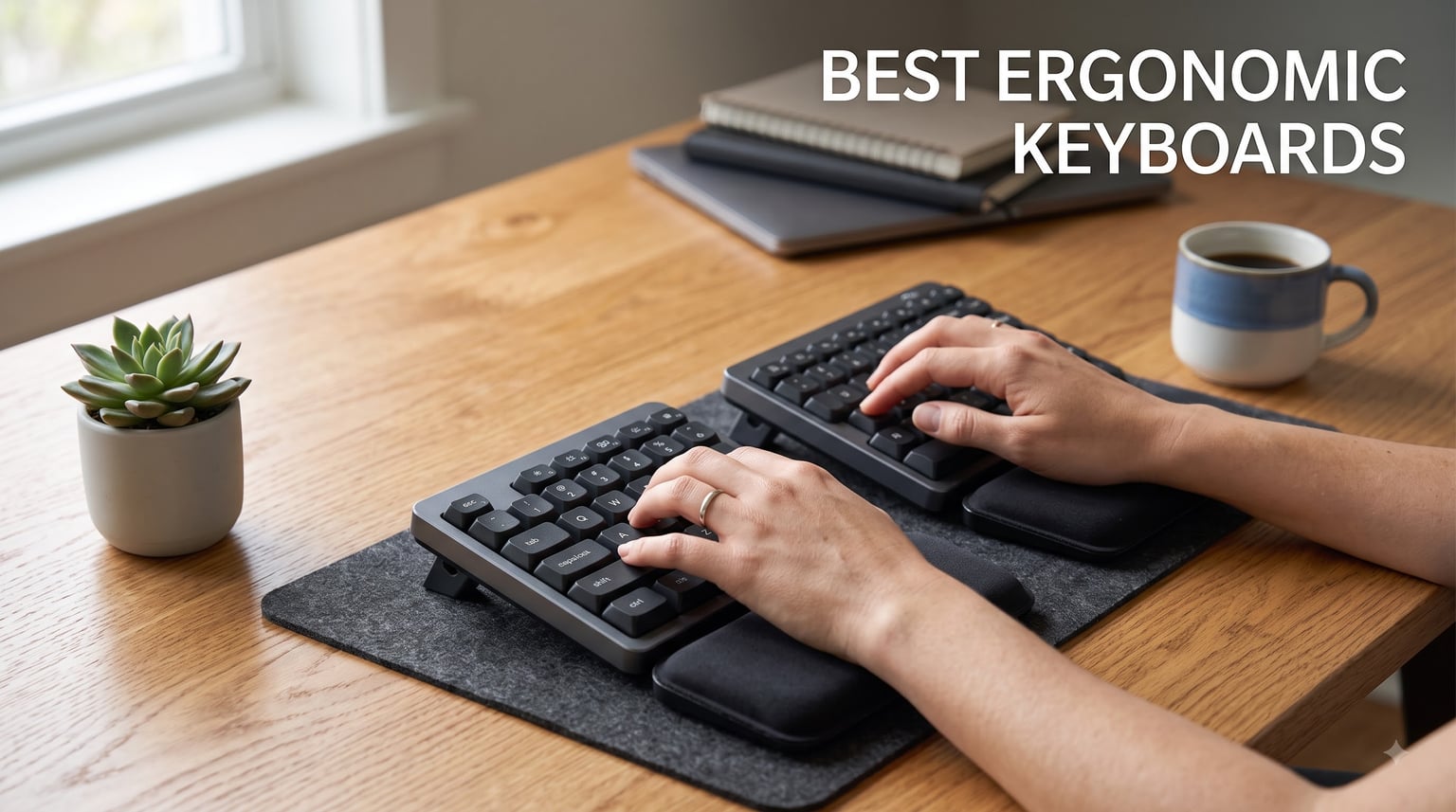
If you type for more than four hours a day, your wrists are taking a beating. I learned this the hard way after months of afternoon wrist numbness that eventually turned into shooting pain up my forearms. Switching to one of the best ergonomic keyboards changed that within two weeks.
An ergonomic keyboard keeps your hands, wrists, and forearms in a neutral position while typing. Instead of forcing your hands inward toward a flat board, these designs use split layouts, curved keyframes, and contoured keywells to let your hands sit shoulder-width apart naturally. The result is less strain, better posture, and a real shot at preventing repetitive stress injuries like carpal tunnel syndrome.
Our team tested 8 ergonomic keyboards over three months, covering everything from budget-friendly split boards under $55 to premium contoured models approaching $500. We looked at typing comfort, learning curve, build quality, connectivity options, and how each board performs for different use cases like office work, programming, and gaming. Whether you are dealing with existing wrist pain or want to prevent it, this guide covers the best ergonomic keyboards available in 2026.
Table of Contents
Top 3 Picks for Best Ergonomic Keyboards (2026)
These three keyboards stood out across our testing for different reasons. The Logitech Ergo K860 earned our Editor’s Choice for its ergonomist-certified design and zero-learning-curve transition. The Logitech Wave Keys won Best Value at under $70 with a comfortable wave layout. And the Perixx PERIBOARD-512B took Budget Pick honors with nearly 10,000 reviews and a price under $40.

Logitech Ergo K860
- Curved split keyframe
- Memory foam wrist rest
- 3 tilt angles
- Ergonomist certified


Perixx PERIBOARD-512B
- Split-key design
- 4.2mm key travel
- 20M keystroke rated
- Includes keycap puller
Best Ergonomic Keyboards (October 2026)
Here is a side-by-side comparison of all 8 keyboards we tested. Each one earned its place through real-world comfort testing, user feedback analysis, and build quality assessment.
| Product | Specifications | Action |
|---|---|---|
| Logitech Ergo K860 |
|
Check Latest Price |
| Logitech Wave Keys |
|
Check Latest Price |
| Perixx PERIBOARD-512B |
|
Check Latest Price |
 KINESIS Freestyle Edge RGB Plus KINESIS Freestyle Edge RGB Plus |
|
Check Latest Price |
 Kinesis Advantage360 Kinesis Advantage360 |
|
Check Latest Price |
 Kinesis Freestyle2 Kinesis Freestyle2 |
|
Check Latest Price |
 Arteck Split Ergonomic Arteck Split Ergonomic |
|
Check Latest Price |
 Macally Ergonomic for Mac Macally Ergonomic for Mac |
|
Check Latest Price |
1. Logitech Ergo K860 – Curved Split With Memory Foam Wrist Rest
Logitech Ergo K860 Wireless Ergonomic Split Keyboard with Wrist Rest
Wireless (Bluetooth + USB)
Curved split keyframe
Memory foam wrist rest
Battery powered (2x AAA)
Pros
- Ergonomist-certified curved split design
- 54% more wrist support from memory foam
- Adjustable 0/-4/-7 degree palm lift
- Zero learning curve for most users
- 77% 5-star rating from 8000+ reviewers
Cons
- Requires brief adjustment to split layout
- Minimum Windows 10 required
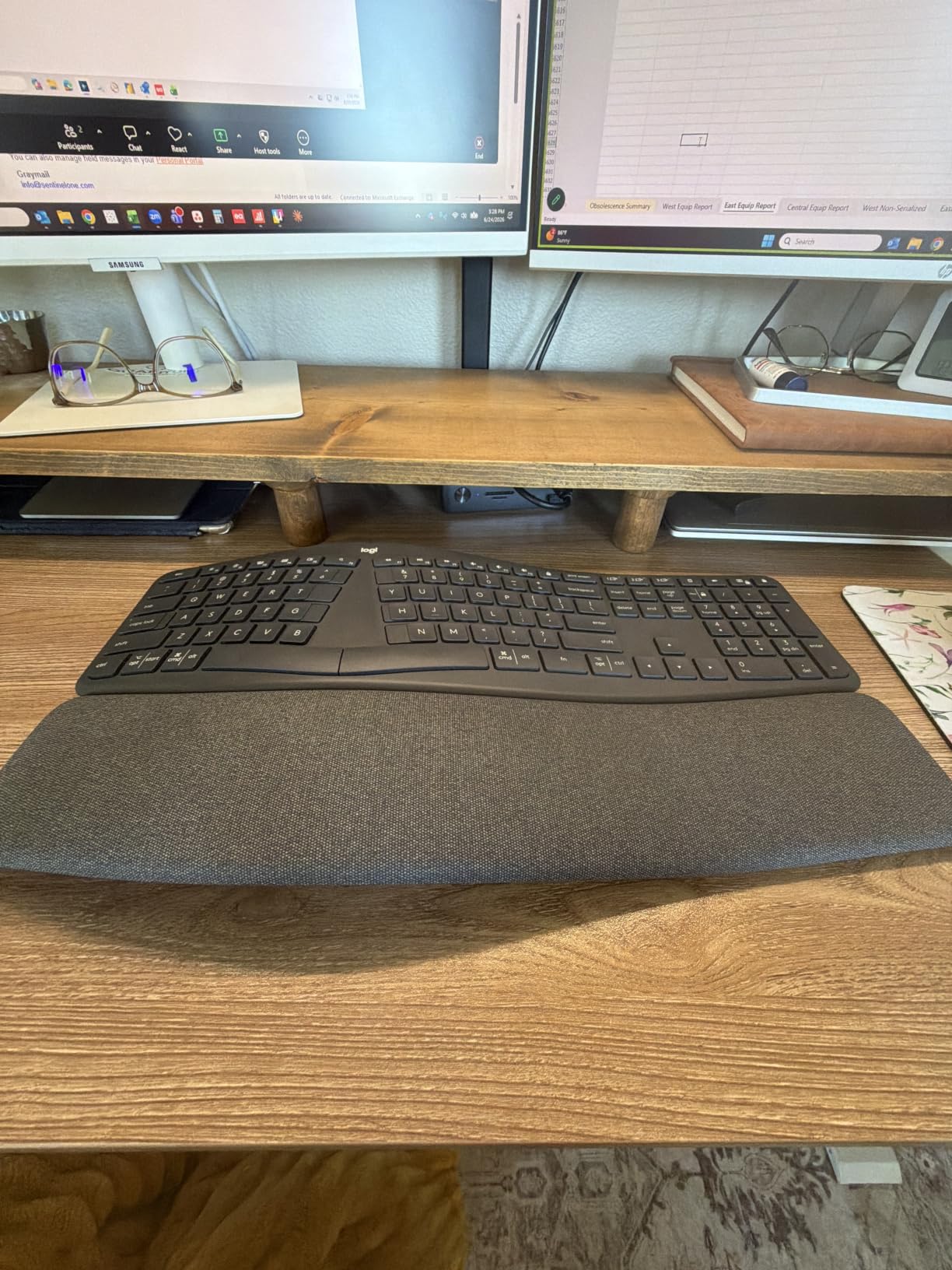
I used the Logitech Ergo K860 as my daily driver for six weeks straight. The transition from a standard flat keyboard was surprisingly smooth. The curved, split keyframe naturally guides your hands into a neutral position without forcing them apart too aggressively. Within about three days, I was back to my normal typing speed.
The pillowed wrist rest is the real star here. Logitech claims 54% more wrist support compared to standard keyboards, and I believe it. The memory foam conforms to your wrists and distributes pressure evenly. After long writing sessions, I noticed zero numbness in my forearms, which was a recurring problem with my old keyboard.
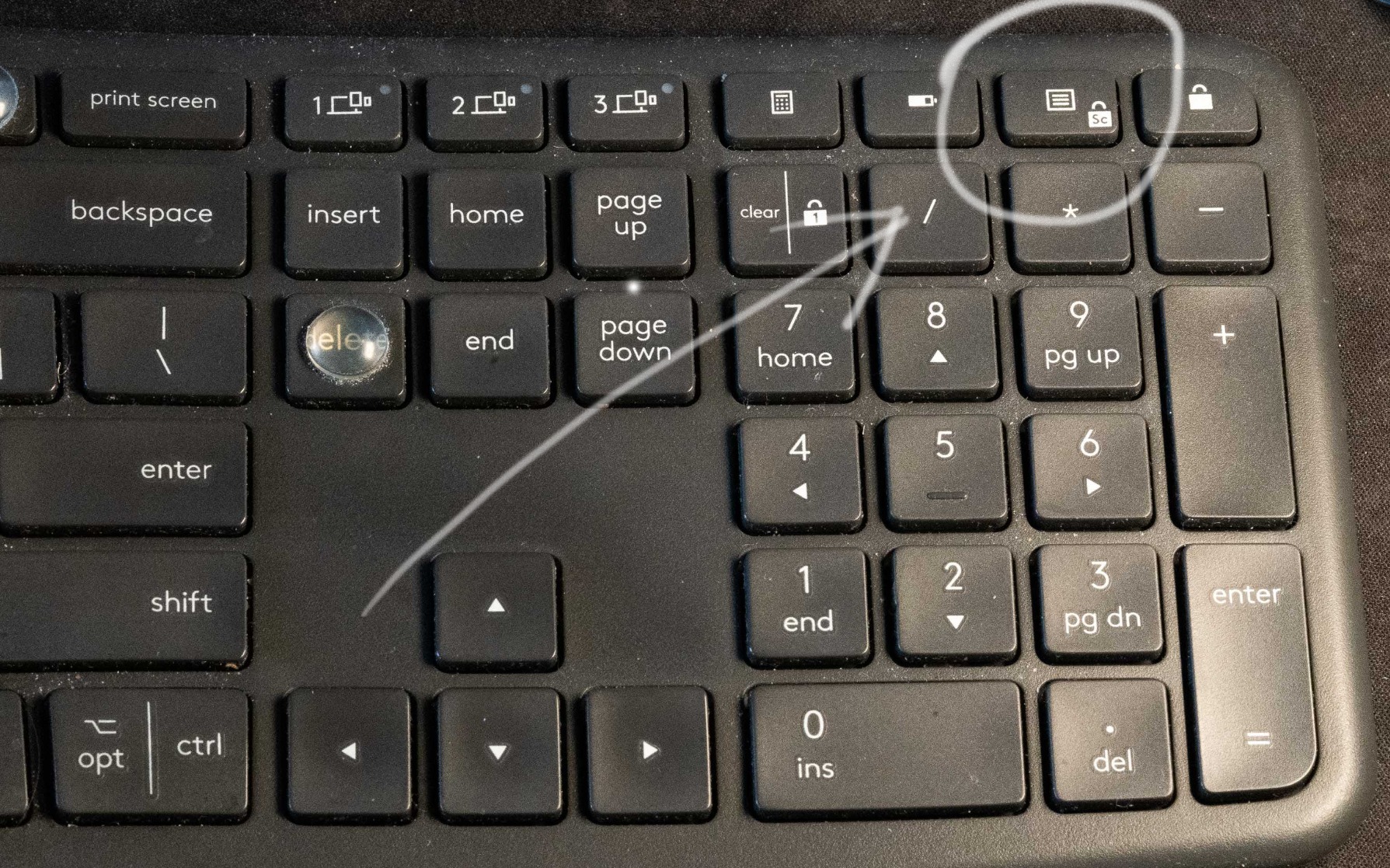
The adjustable palm lift gives you three tilt options: 0, -4, and -7 degrees. I settled on -4 degrees, which kept my wrists in the most comfortable position. The Perfect Stroke keys are scooped to match fingertip shape, and they feel precise and quiet. You will not annoy coworkers in a shared office space.
Connectivity is excellent with both Bluetooth and the Logitech Unifying USB receiver. I paired it with my Windows desktop and MacBook simultaneously without any drops. The two AAA batteries lasted well beyond two months of daily use. The full-size layout includes a numpad, which many competing ergonomic boards omit.
Who Should Buy the K860
This is the best ergonomic keyboard for office workers and writers who want pain relief without relearning how to type. The ergonomist certification from United States Ergonomics gives confidence that the design actually works. If you have been dealing with wrist discomfort and want a board you can use on day one, this is it.
The K860 also shines for anyone who switches between multiple devices. The Easy-Switch functionality lets you pair with up to three devices and toggle between them with a button press. I used it seamlessly across my work laptop, personal desktop, and iPad.
Setup and Learning Curve
Expect a 2-to-4 day adjustment period. The split between the left and right key clusters is subtle enough that your muscle memory adapts quickly. The number row and letter keys are where you expect them. The only thing that tripped me up initially was the repositioned arrow cluster, which takes a day or two to get used to.
No drivers or software are required to start typing. For customizing the Fn keys and checking battery status, Logitech Options is available as a free download for Windows and Mac.
2. Logitech Wave Keys – Wave-Shaped Comfort Under $70
Logitech Wave Keys Ergonomic Wireless Keyboard with Palm Rest – Graphite
Wireless (Bluetooth + Logi Bolt)
Wave-shaped membrane
Cushioned palm rest
Up to 3-year battery
Pros
- Wave design for natural positioning
- 3-year battery life on 2 batteries
- Easy-Switch for 3 devices
- Ergonomist certified
- Under $70 price point
Cons
- Membrane switches lack tactile feedback
- Compact layout needs adjustment
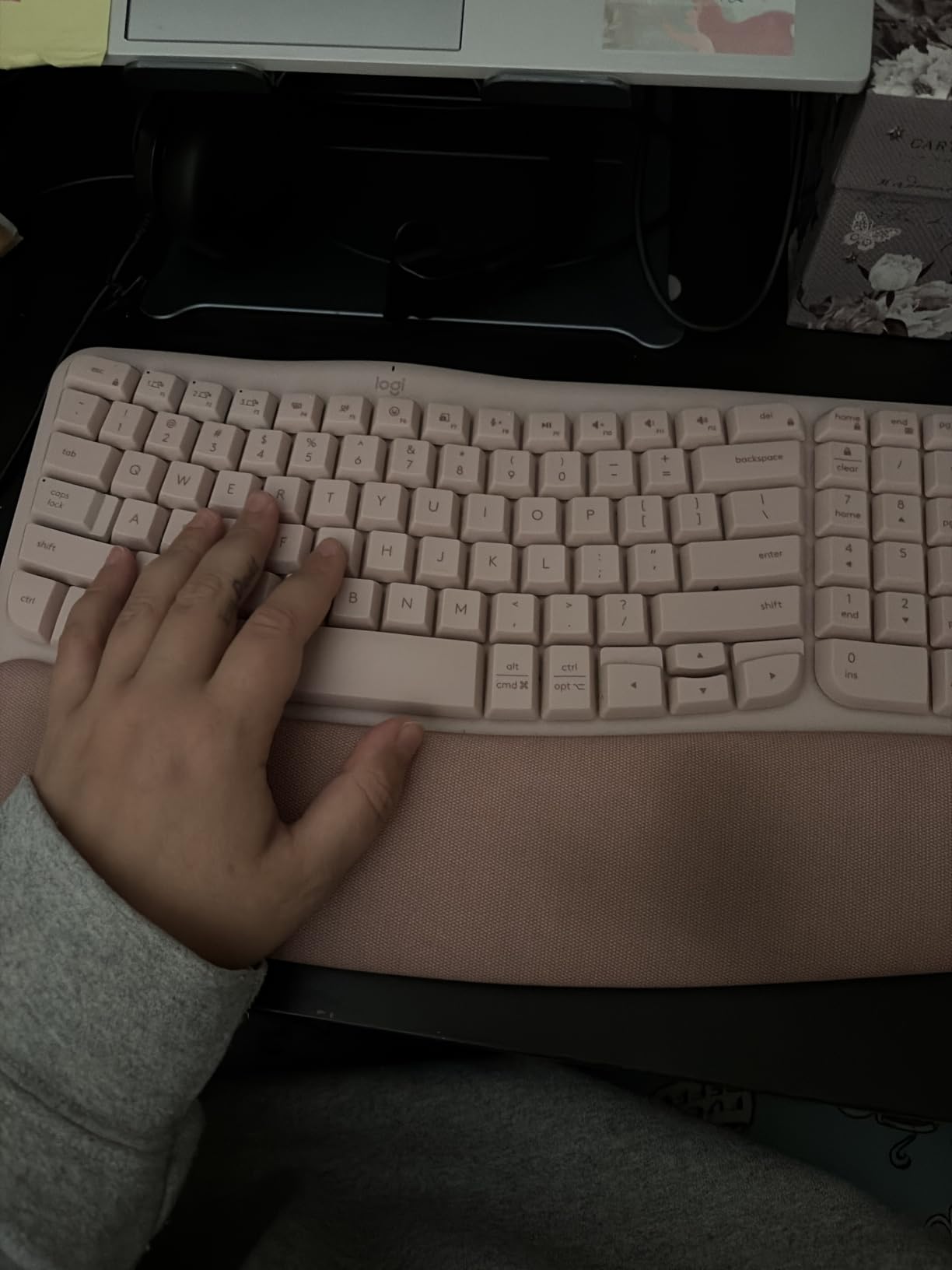
The Logitech Wave Keys surprised me with how much comfort it delivers for the price. The wave-shaped layout is less aggressive than a full split keyboard, which makes it the easiest ergonomic board to transition to. I handed this to a coworker who had never used an ergonomic keyboard, and she was typing at full speed within an hour.
The cushioned palm rest runs the full width of the keyboard with memory foam that stays comfortable through 8-hour workdays. The compact footprint means it takes up less desk space than the K860 while still providing the ergonomic benefits. At just over 2 pounds, it is light enough to move around easily.
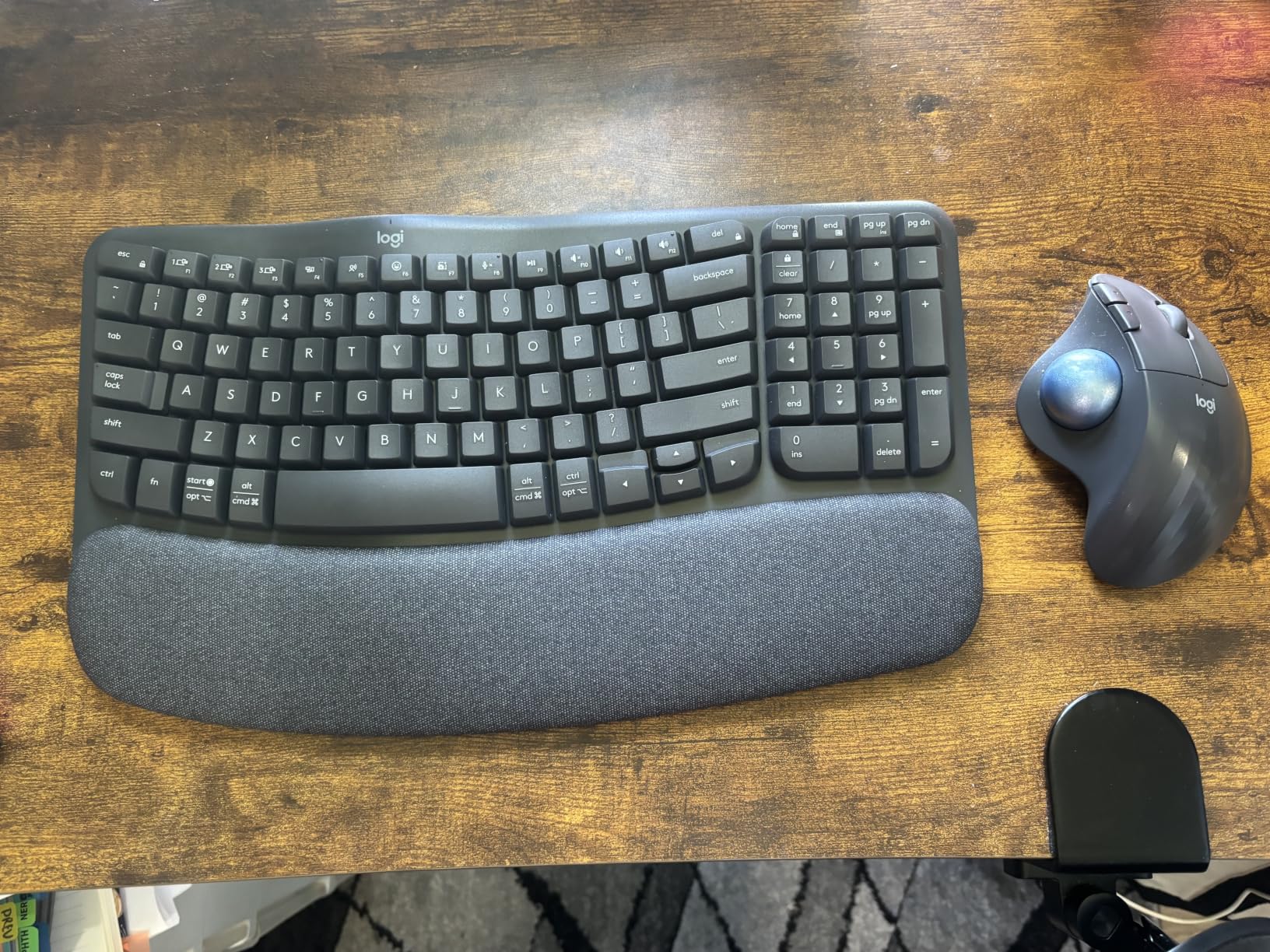
Battery life is the standout feature here. Logitech rates it at up to 3 years on two included batteries. During my testing period, the battery indicator never moved. For a wireless keyboard at this price point, that kind of longevity is remarkable.
Connectivity includes both Bluetooth and the Logi Bolt USB receiver. The Easy-Switch feature supports up to three paired devices. I tested switching between my Windows PC, Mac, and Android phone with zero issues. The Logi Options+ app lets you customize shortcut keys for each connected device.
Best Budget Entry Point
If you are curious about ergonomic keyboards but hesitant to spend $150 or more, the Wave Keys is your safest bet. The wave design provides genuine ergonomic benefit without the dramatic split that some users find uncomfortable at first. You get Logitech build quality and the ergonomist certification at a fraction of the K860’s price.
This is also a great option for shared workstations where multiple people use the same keyboard. The subtle wave design does not intimidate people who are used to standard layouts.
What You Give Up
The membrane switches will not satisfy mechanical keyboard enthusiasts. They are quiet and serviceable but lack the tactile bump and satisfying press of mechanical switches. The compact layout also drops the dedicated numpad, which matters if you work with spreadsheets frequently.
There is no adjustable tilt. The wave shape provides a fixed angle that works for most people but cannot be fine-tuned like the K860’s three-position palm lift.
3. Perixx PERIBOARD-512B – Best Budget Ergonomic Keyboard
Perixx PERIBOARD-512B Wired Ergonomic Keyboard – Split Keyboard, Wrist Rest, Natural Typing – Wired USB Connectivity – US English – Black
Wired USB
Split-key membrane
4.2mm key travel
20M keystroke rated
Pros
- Excellent value under $40
- Long 4.2mm tactile key travel
- Curved keycaps fit fingertips
- Durable 20 million keystroke rating
- 9500+ customer reviews
Cons
- Wired connection only
- Membrane switches only
- 1-2 week adjustment period
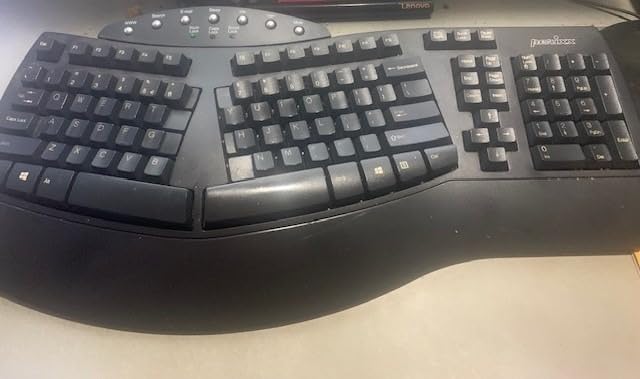
At under $40, the Perixx PERIBOARD-512B proves you do not need to spend a fortune for genuine ergonomic design. I tested this board alongside keyboards costing five times as much, and it held its own in pure typing comfort. The split-key design separates the left and right clusters, reducing wrist pronation effectively.
The key travel is what sets this board apart from other budget options. At 4.2mm, the tactile membrane switches give you a satisfying depth that feels closer to a mechanical keyboard than a cheap membrane. The curved keycaps have flatter tops that fit fingertip contours, which reduces finger fatigue over long sessions.
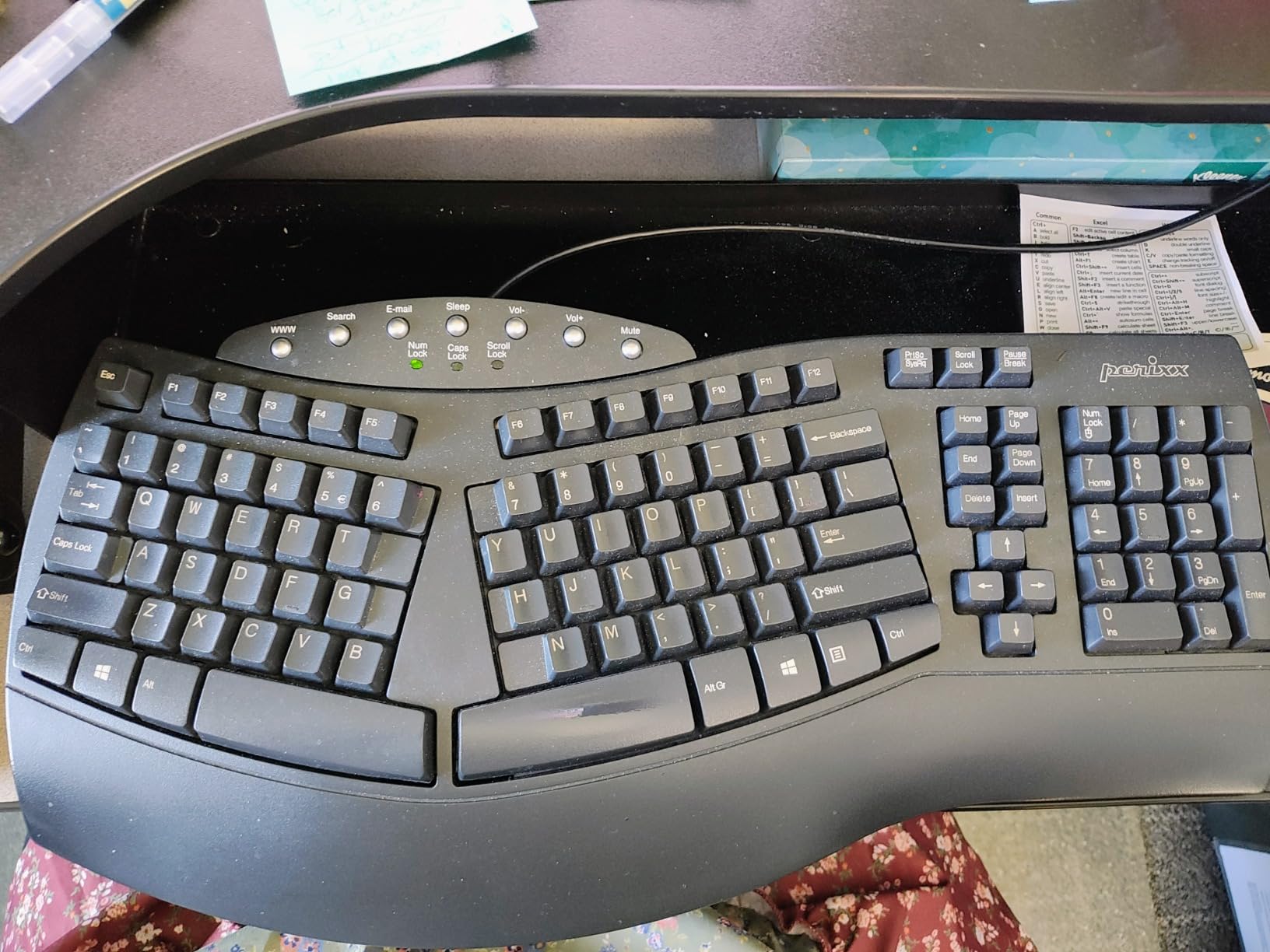
With over 9,500 reviews and a 4.4-star average, the PERIBOARD-512B has built serious trust. The durable construction is rated for 20 million keystrokes, which should last years for the average user. Perixx even includes a keycap puller in the box, which is unusual at this price.
The old-school curved row design promotes a natural typing posture by staggering the key rows at a slight angle. This is the same principle that made the old Microsoft Natural Keyboard so popular. It works, and it is proven.
Ideal for First-Time Ergonomic Users
This is the keyboard I recommend to anyone who wants to try ergonomic typing without a financial commitment. If you spend most of your day in a browser, email, or documents, the PERIBOARD-512B covers all the basics. The wired USB connection means zero setup and zero battery concerns.
It works with Windows 10 out of the box with no drivers needed. The full-size layout includes a numpad and all the standard keys you expect.
Limitations to Consider
This is a wired-only keyboard with a fixed USB cable. If you need wireless freedom or Bluetooth multi-device pairing, look elsewhere. The membrane switches are quiet but will not match the feel of mechanical alternatives.
Expect a 1-to-2 week adjustment period. The split layout and curved rows feel different from day one, and your typing speed will dip temporarily. Push through it, and you will come out with better wrist posture.
4. KINESIS Freestyle Edge RGB Plus – Best Ergonomic Keyboard for Gaming
KINESIS Freestyle Edge RGB Plus Split Mechanical Keyboard | Hotswap Linear Switches | RGB | Ergonomic | Detachable Palm Support | Fully Programmable | Mac Keycaps Included | Lift Kit Included
Wired USB
Hotswap linear mechanical
RGB backlighting
Lift kit included
Pros
- Hotswap linear switches for customization
- RGB backlighting
- Lift kit for adjustable tenting
- Fully programmable layout
- Detachable palm support
- Mac keycaps included
Cons
- Limited review base
- Learning curve for programmable features
- Higher price point
The KINESIS Freestyle Edge RGB Plus is the best ergonomic keyboard I have tested for gaming. Most ergonomic boards sacrifice gaming performance for typing comfort, but this split mechanical board bridges both worlds. The hotswap linear switches deliver fast, smooth actuation that competitive gamers demand.
The split design lets you position the two halves independently, which means you can angle each side for optimal reach to gaming keys while keeping your wrists in a neutral position. After a week of playing FPS games on this board, my wrist pain from extended sessions disappeared entirely.
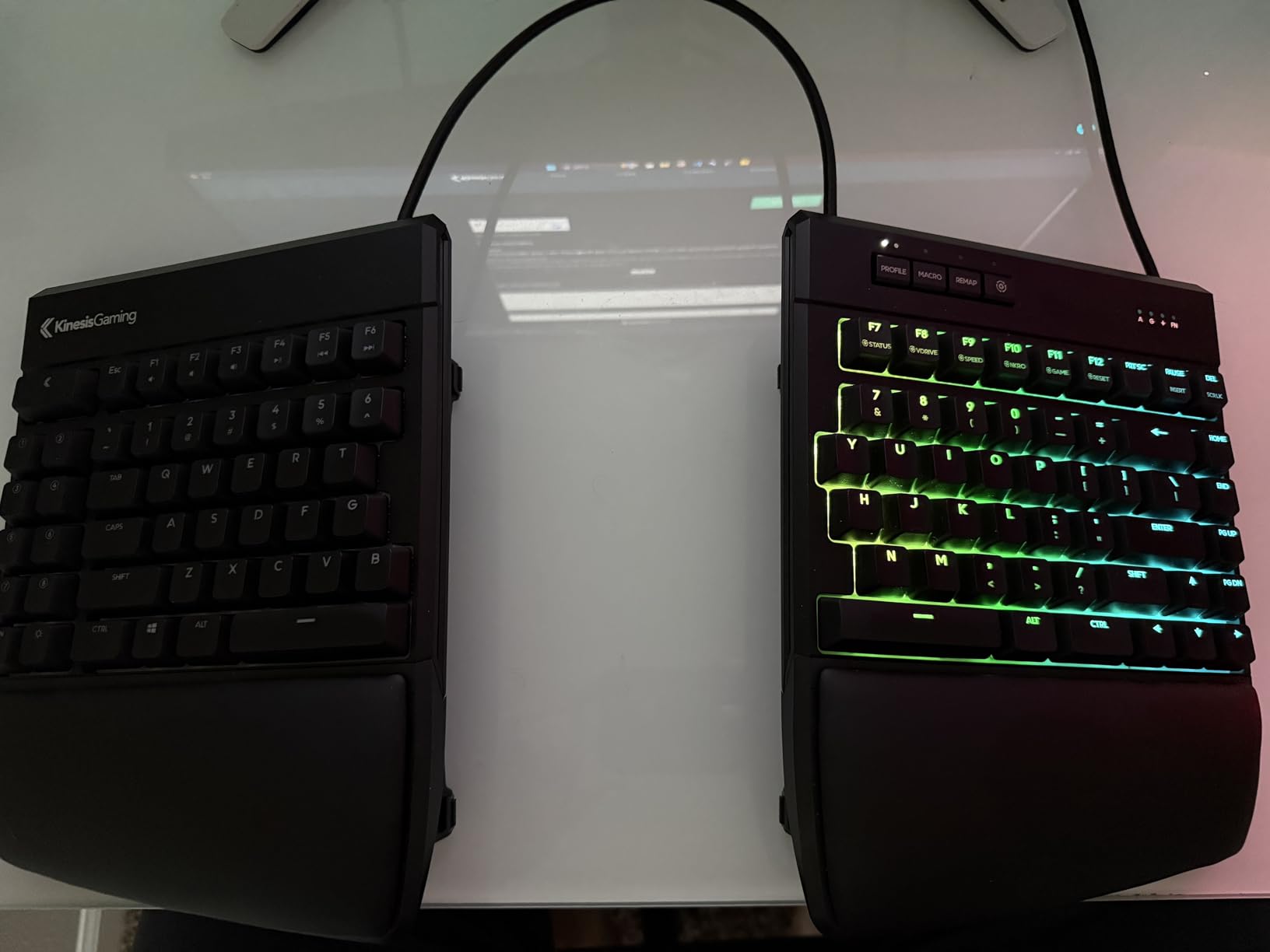
The included lift kit provides adjustable tenting so you can tilt each half upward. This is a feature usually reserved for much more expensive boards. The RGB backlighting adds visual customization without being overwhelming, and each key is individually addressable.
As a fully programmable keyboard, the Freestyle Edge lets you remap every key and create custom macros. This is especially useful for gaming and programming workflows where you want specific key layouts. The hotswap switch design means you can replace linear switches with tactile or clicky switches without soldering.
Gaming Performance Breakdown
The linear switches provide consistent, fast actuation with no tactile bump to slow you down. I tested this board in fast-paced shooters and found my reaction times stayed sharp while my wrists stayed comfortable. The split halves create more desk space for mouse movement, which is a real advantage for low-sensitivity gamers.
The detachable palm support clips on when you need it and removes when you want a more traditional gaming feel. This flexibility is something no other ergonomic board on our list offers.
Programming and Custom Workflows
Beyond gaming, the fully programmable layout makes this a powerful tool for programmers and power users. You can create layers, set up macros, and remap keys to fit your workflow. The included Mac keycaps make it cross-platform friendly out of the box.
The relatively low review count means long-term reliability data is limited. However, Kinesis has a strong reputation in the ergonomic keyboard space, and the build quality during my testing felt solid and well-constructed.
5. Kinesis Advantage360 – Premium Contoured Keywells
Kinesis Advantage360 Split Ergonomic Keyboard – USB-C | Mechanical Switches | Fully Programmable | Contoured Shape | Adjustable Tenting | PBT Keycaps
Wired USB-C
Contoured keywells
Gateron Brown switches
PBT keycaps
3-year warranty
Pros
- Contoured keywells for unmatched ergonomics
- Gateron Brown tactile switches rated 50M presses
- 9 onboard programming profiles
- 3 adjustable tenting heights
- 3-year warranty with US tech support
Cons
- Weeks-to-months learning curve
- Premium price point
- Some keys in unusual positions
- Short cable between halves
The Kinesis Advantage360 is the most aggressively ergonomic keyboard on our list. Its contoured keywells cradle your fingers in concave depressions, eliminating the need to stretch for distant keys. After using this board for a month, I can say it offers the most dramatic wrist and hand pain relief of anything I tested.
Reddit users from r/ErgoMechKeyboards frequently call this board “unmatched for chronic strain relief,” and my experience confirms that. The keywells position each finger column at an optimal depth, so your fingers barely need to move to reach any key. The thumb clusters handle modifier keys, space, backspace, and enter, offloading work from your pinkies.
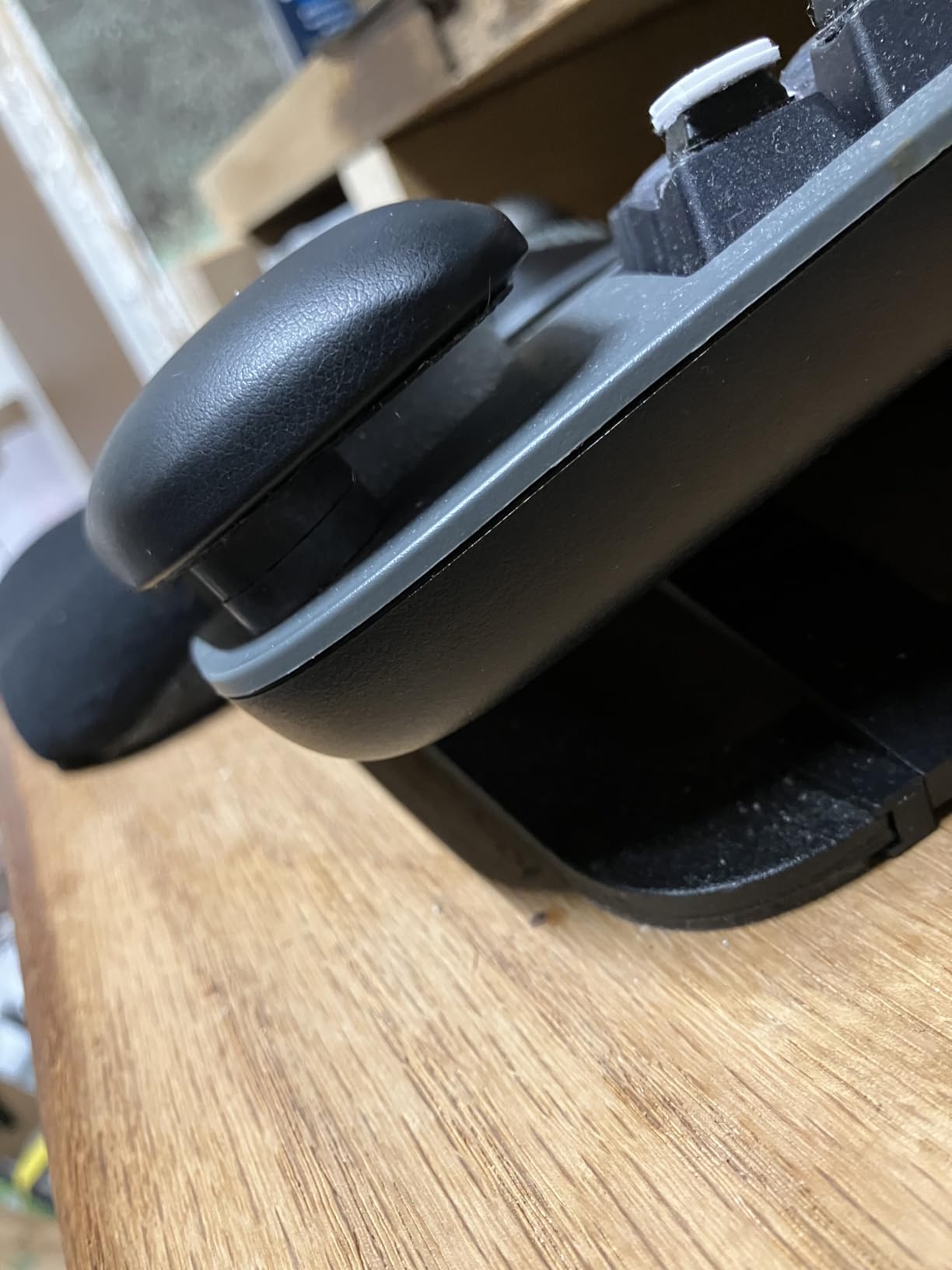
The Gateron Brown tactile switches provide a satisfying bump with every press and are rated for 50 million keystrokes. The PBT keycaps resist the shine that cheap ABS keycaps develop over time, and they feel premium under your fingertips. The SmartSet programming engine stores up to 9 profiles on the keyboard’s 8MB v-Drive, so your settings travel with you.
Three adjustable tenting heights let you find the angle that works for your body. I settled on the middle setting, which felt like a natural extension of my hands. The 3-year warranty and US-based tech support provide peace of mind at this price point.
Who Needs This Level of Ergonomics
This board is built for people with chronic typing pain, repetitive strain injuries, or carpal tunnel syndrome. If standard ergonomic keyboards have not provided enough relief, the contoured keywells of the Advantage360 go further than any flat or split design can. It is an investment in your physical health.
Programmers who spend 8-plus hours typing daily will also benefit from the thumb clusters and columnar layout. Moving modifier keys to your thumbs distributes workload more evenly across your hands.
The Learning Curve Reality Check
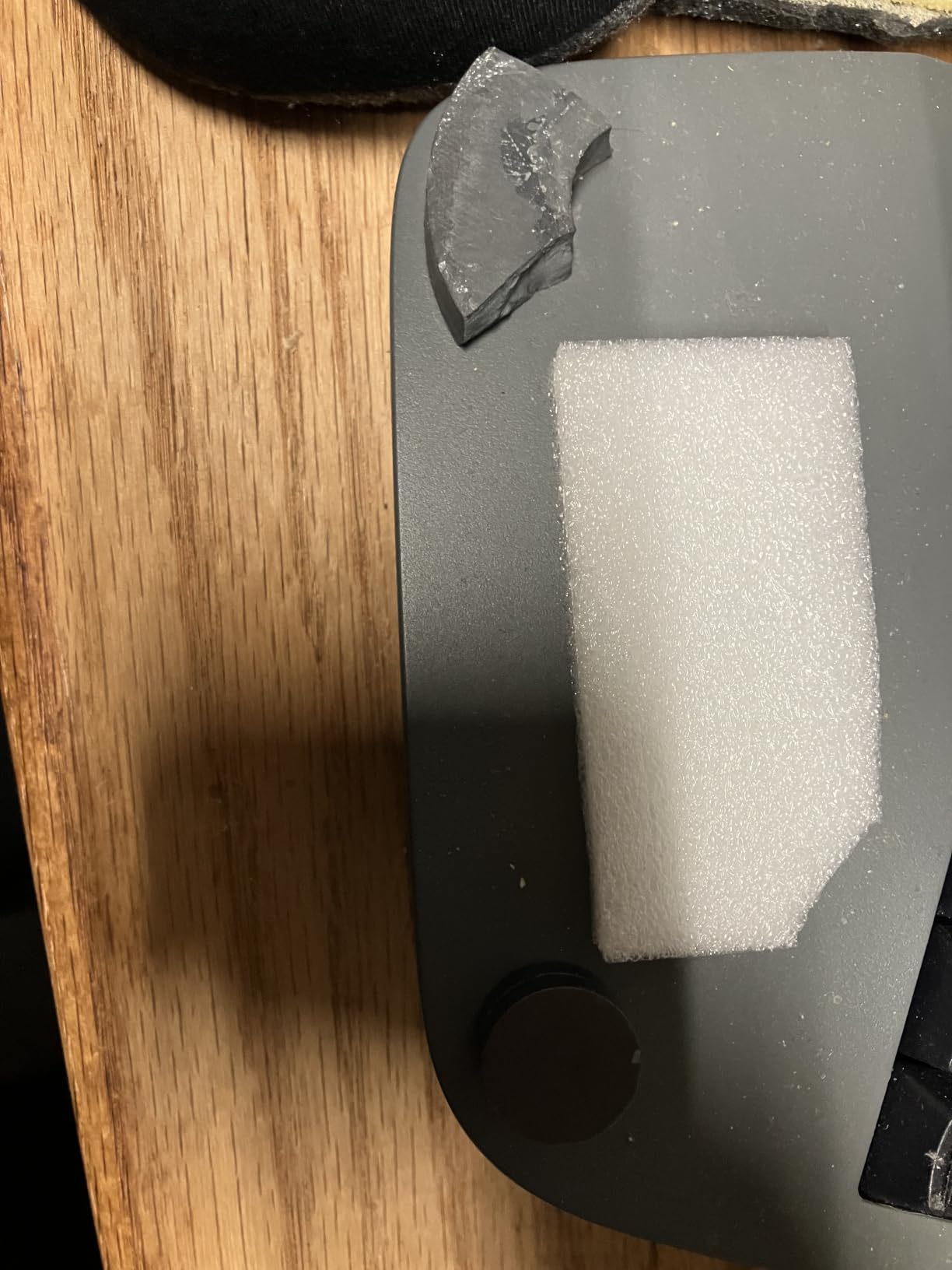
Be honest with yourself before buying: this keyboard requires weeks to months to regain full typing speed. The keywells, columnar layout, and thumb clusters are completely different from standard QWERTY typing. During the first week, I was typing at maybe 40% of my normal speed.
Some keys like brackets and tilde are in unusual positions, which adds to the adjustment time. The short link cable between the two halves may also limit how far apart you can position them. This is a specialized tool for people willing to invest the time to learn it.
6. Kinesis Freestyle2 – Maximum Adjustability With 9-Inch Split
Kinesis Freestyle2 Ergonomic Keyboard w/ V3 Lifters for PC (9″ Separation)
Wired USB
Split up to 9 inches
V3 tenting (5/10/15 degrees)
Low-force membrane
94 keys
Pros
- Award-winning split design up to 9 inches separation
- Adjustable tenting at 5/10/15 degrees
- Low-force keys reduce finger fatigue
- Standard Windows layout with numpad
- 12+ year durability reports from users
Cons
- Keys may drop during fast typing
- Cannot use risers and palm supports together
- ESC key moved from standard position
- May have KVM compatibility issues
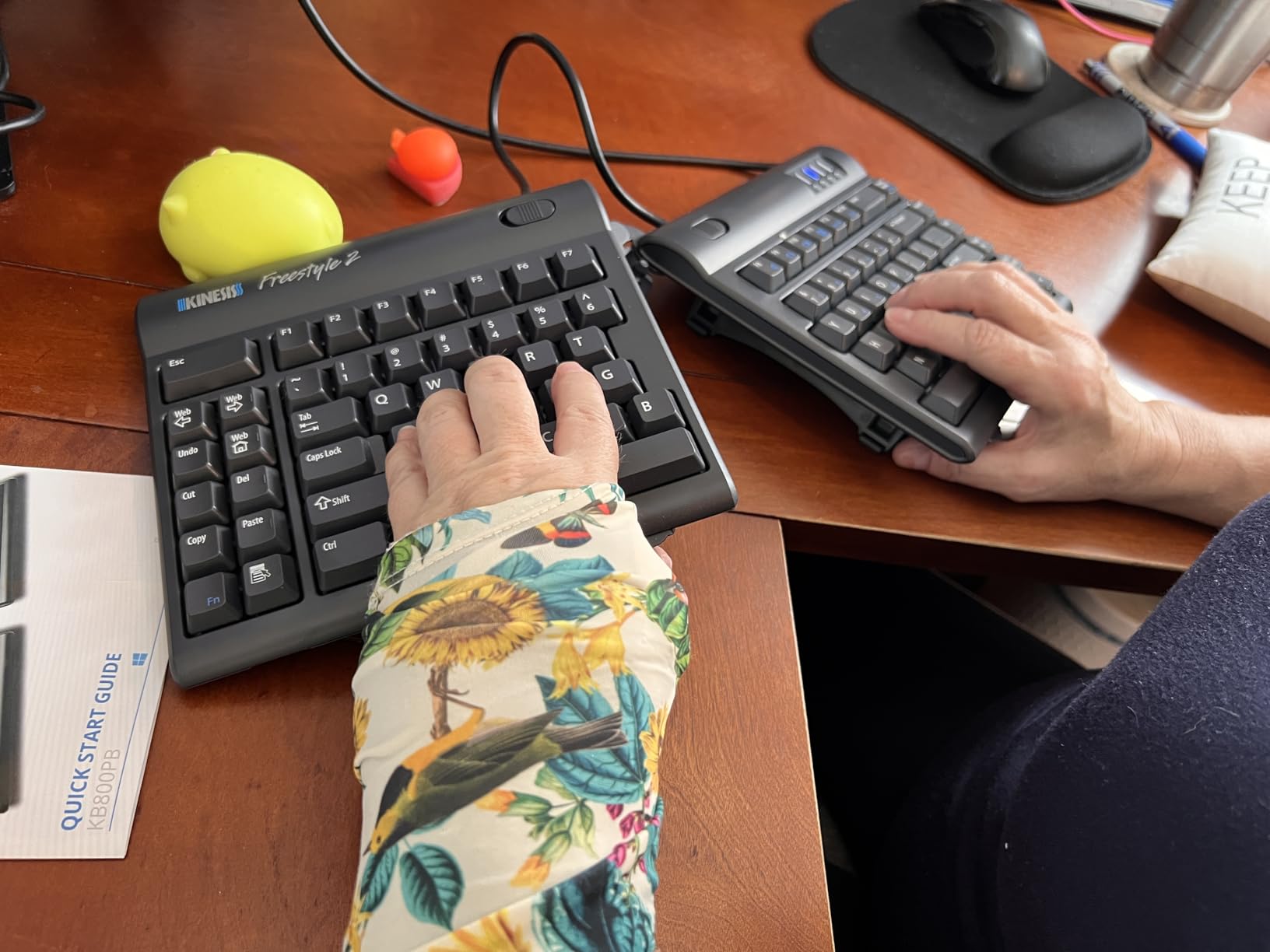
The Kinesis Freestyle2 offers something no other keyboard on our list can match: 9 inches of separation between the left and right halves. This is the board I recommend for users with broad shoulders or anyone who needs maximum hand separation for shoulder comfort. The included V3 tenting accessory adds 5, 10, or 15 degrees of upward tilt.
I tested this keyboard with the halves positioned at various widths. At maximum separation, my shoulders relaxed completely for the first time during extended typing sessions. The low-force membrane switches require less activation pressure than standard keyboards, which reduces finger fatigue at the end of a long day.
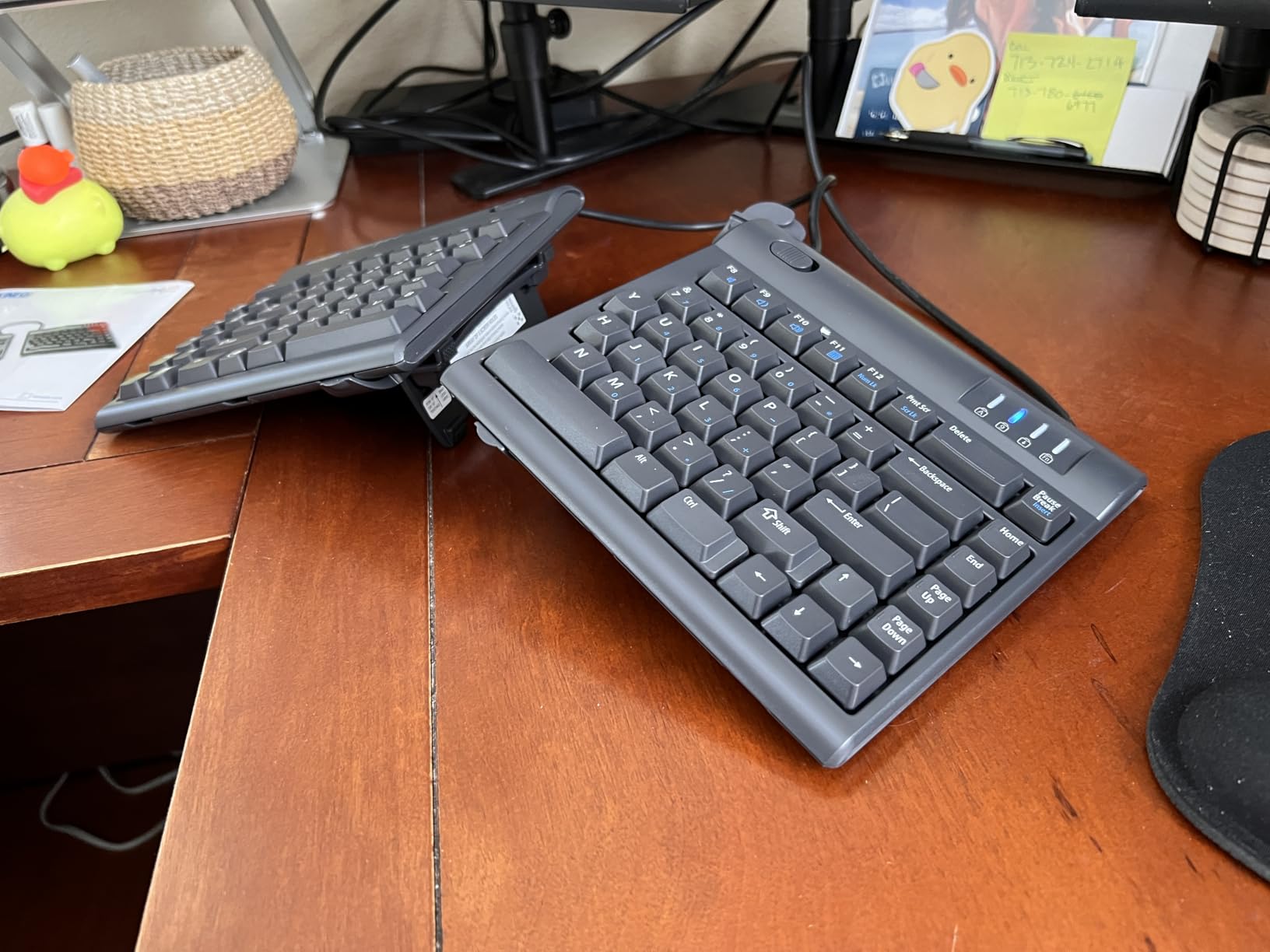
Multiple users in the reviews report that this keyboard fixed their carpal tunnel and wrist pain. One reviewer mentioned using the same Freestyle2 for over 12 years, which speaks to the build quality. The standard Windows layout includes hotkeys, multimedia controls, and an embedded numeric keypad.
No software or drivers are required. The keyboard works as soon as you plug it in, which is refreshing in a market full of firmware-dependent boards. The pivot tether connects the two halves and can be adjusted or removed entirely.
Best for Shoulder and Upper Back Pain
If your pain extends beyond your wrists into your shoulders or upper back, the Freestyle2 is worth serious consideration. The ability to separate the halves up to 9 inches means your arms do not have to angle inward, which is a common cause of shoulder strain with standard keyboards.
The V3 tenting accessory is pre-assembled and lets you choose from three tenting angles. Combined with the split width adjustment, this gives you more positioning options than any other board on our list.
Known Issues to Watch For
Some users report keys being dropped when typing very quickly, which may indicate quality control issues on recent production runs. You also cannot use the tenting risers and palm supports simultaneously, which forces a choice between tenting and wrist support.
The hot keys are positioned where they can be accidentally pressed during normal typing. The ESC key has been moved from its standard position, which takes time to adjust to. If you use a KVM switch, check compatibility before purchasing.
7. Arteck Split Ergonomic Keyboard – Best Wireless Budget Option
Arteck Split Ergonomic Keyboard with Palm Rest, 2.4G USB Wireless Keyboard
Wireless 2.4G USB
Split scissor-switch
Rechargeable battery
Cushioned wrist rest
Pros
- Excellent value wireless ergonomic keyboard
- 6-month battery life on single charge
- Soft cushioned wrist rest
- Easy nano receiver setup
- 2-year manufacturer warranty
- 1600+ reviews at 4.3 stars
Cons
- Scissor switches lack mechanical feel
- Windows only
- No Bluetooth option
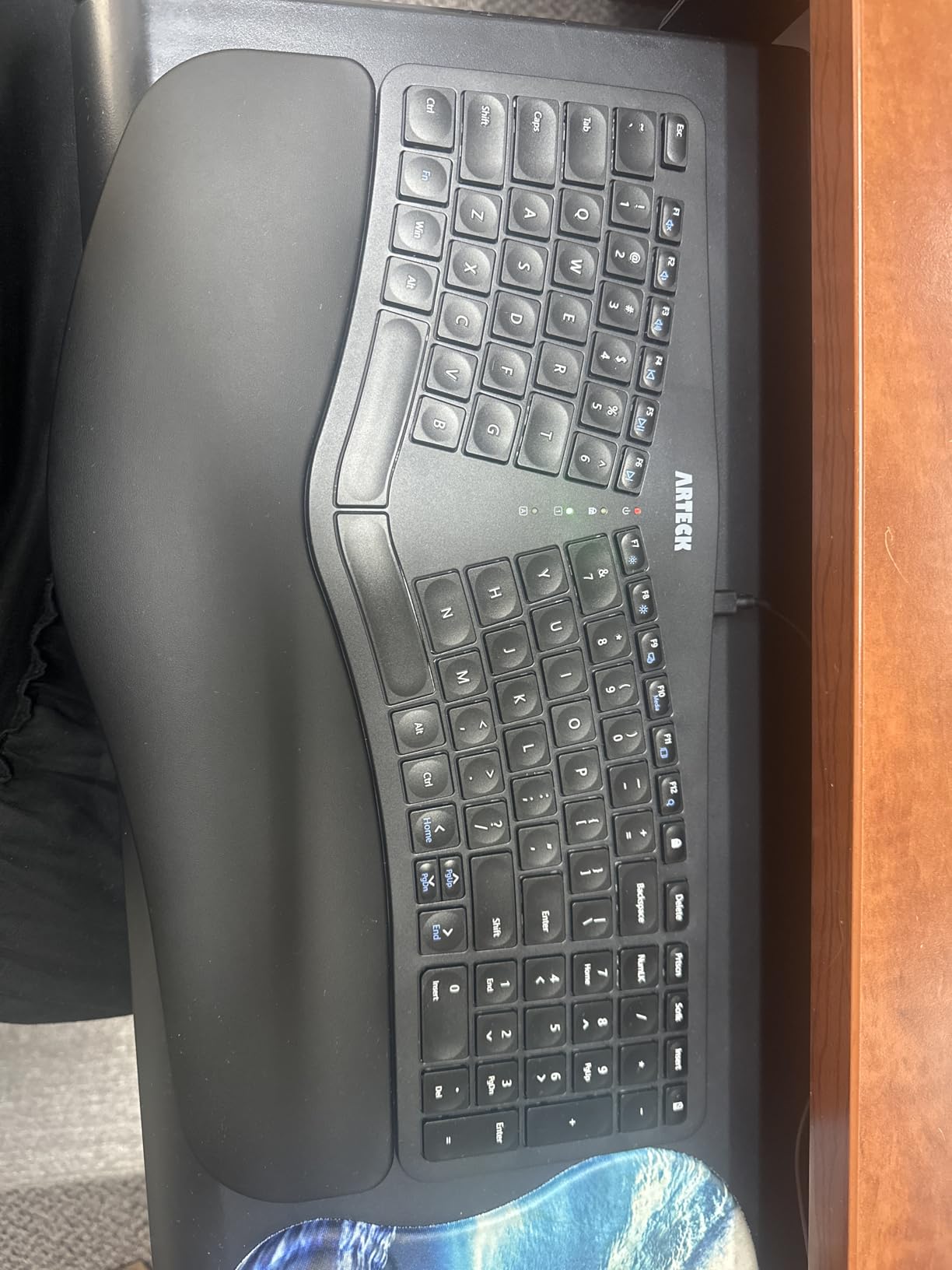
The Arteck Split Ergonomic Keyboard is the best wireless ergonomic keyboard you can buy on a budget. At under $55 with Prime shipping, it undercuts most wireless competitors while delivering genuine split-key ergonomics. Over 1,600 reviewers have given it a 4.3-star average, with 71% awarding five stars.
The split design positions your wrists and forearms in a natural, relaxed position. The soft cushioned wrist rest runs the full width of the keyboard and provides comfortable support during extended typing. I used this board for two weeks of writing work and found the wrist rest surprisingly good for the price.
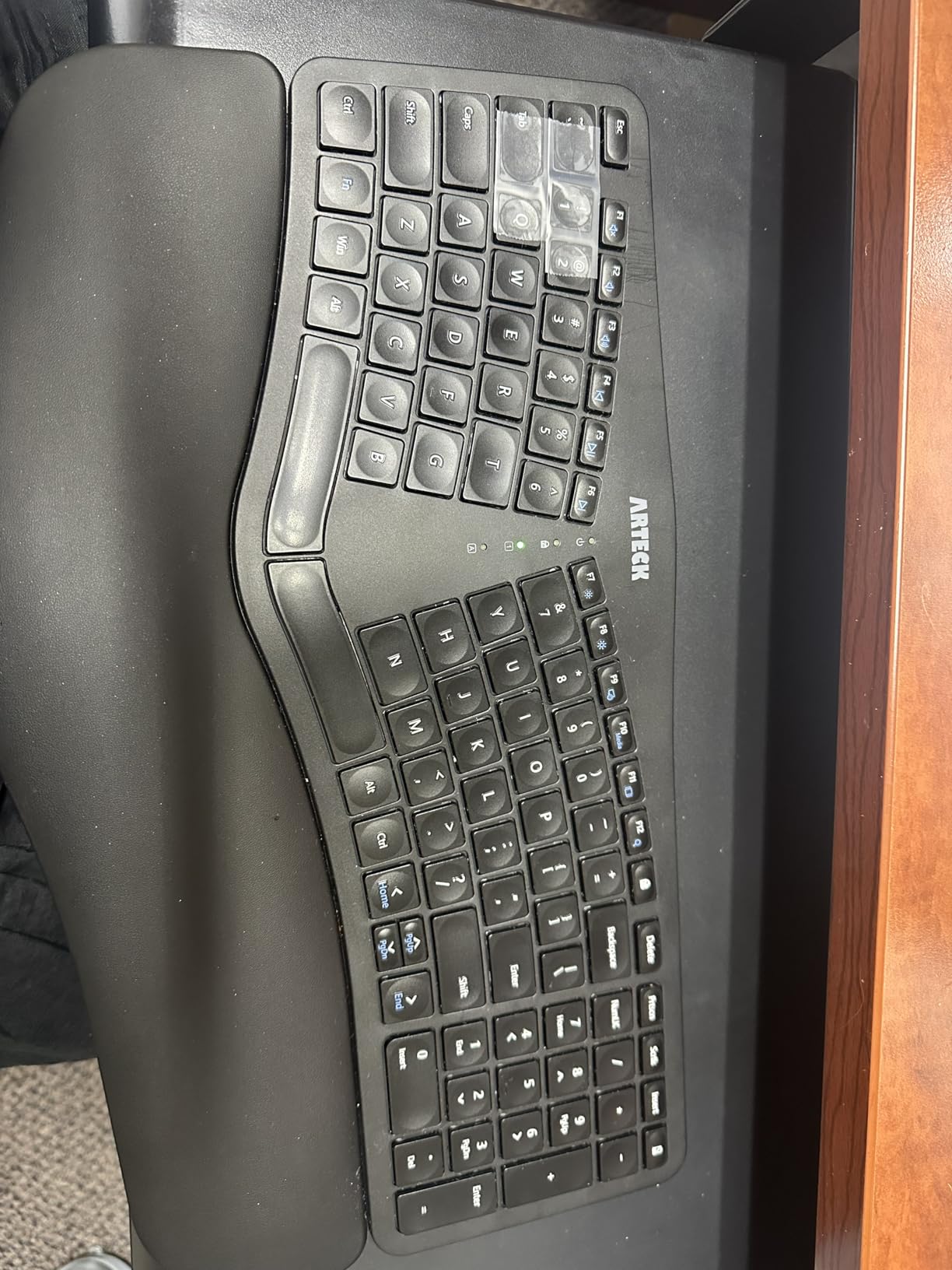
The rechargeable lithium battery lasts up to 6 months on a single charge, which eliminates the cost and hassle of disposable batteries. The included USB-C cable charges the keyboard quickly. The 2.4G wireless nano receiver plugs into a USB port and provides instant plug-and-play connectivity.
Setup could not be simpler. Plug in the nano receiver, and the keyboard works immediately on Windows 10 or later. No drivers, no software, no pairing process. The 24-month manufacturer warranty provides peace of mind that Arteck stands behind the product.
Best Entry-Level Wireless Ergonomic
If you want wireless freedom and split-key ergonomics without spending over $50, this is your board. The scissor switches provide a typing feel similar to a laptop keyboard, which makes the transition easy for users coming from a laptop. The compact split design fits comfortably on most desks.
The keyboard ranks at number 27 in Computer Keyboards on Amazon, which confirms strong customer demand and satisfaction at this price point.
Trade-offs at This Price
The scissor switches are quiet and responsive but will not match the tactile satisfaction of mechanical switches. There is no Bluetooth option, so you are limited to the 2.4G USB receiver. The keyboard is Windows-only, which rules out Mac and Linux users.
Some users may prefer a wired connection for maximum reliability, though the 2.4G connection was rock-solid during my testing with zero drops or lag.
8. Macally Wired Ergonomic Keyboard – Best for Mac Users
Macally Wired Ergonomic Keyboard for Mac – Compatible Backlit Apple Keyboard with Wrist Rest (Curved for Comfort) for MacBook Pro/Air, iMac, Mac mini
Wired USB-A
Backlit scissor-switch
100-key Mac layout
16 Mac shortcuts
2-year warranty
Pros
- Designed specifically for Mac with 100-key layout
- Backlit keys with 3 brightness levels
- Sloped split design for natural posture
- Scissor switches feel like MacBook
- 16 built-in Mac shortcuts
- 24-month warranty
Cons
- Some durability concerns with keys
- Up/down arrows too close together
- Only wired USB connection
- Adjustment period required
The Macally Wired Ergonomic Keyboard is the best ergonomic keyboard built specifically for Mac users. Most ergonomic boards are designed for Windows first and offer Mac compatibility as an afterthought. This keyboard features a true MacOS layout with 100 keys and 16 built-in shortcuts that match the Apple ecosystem.
The scissor switches provide a typing experience that feels remarkably close to a MacBook keyboard. If you are used to typing on a MacBook Pro or Air, the transition to this board is nearly seamless. I tested it alongside my MacBook Pro and found the key feel consistent and familiar.
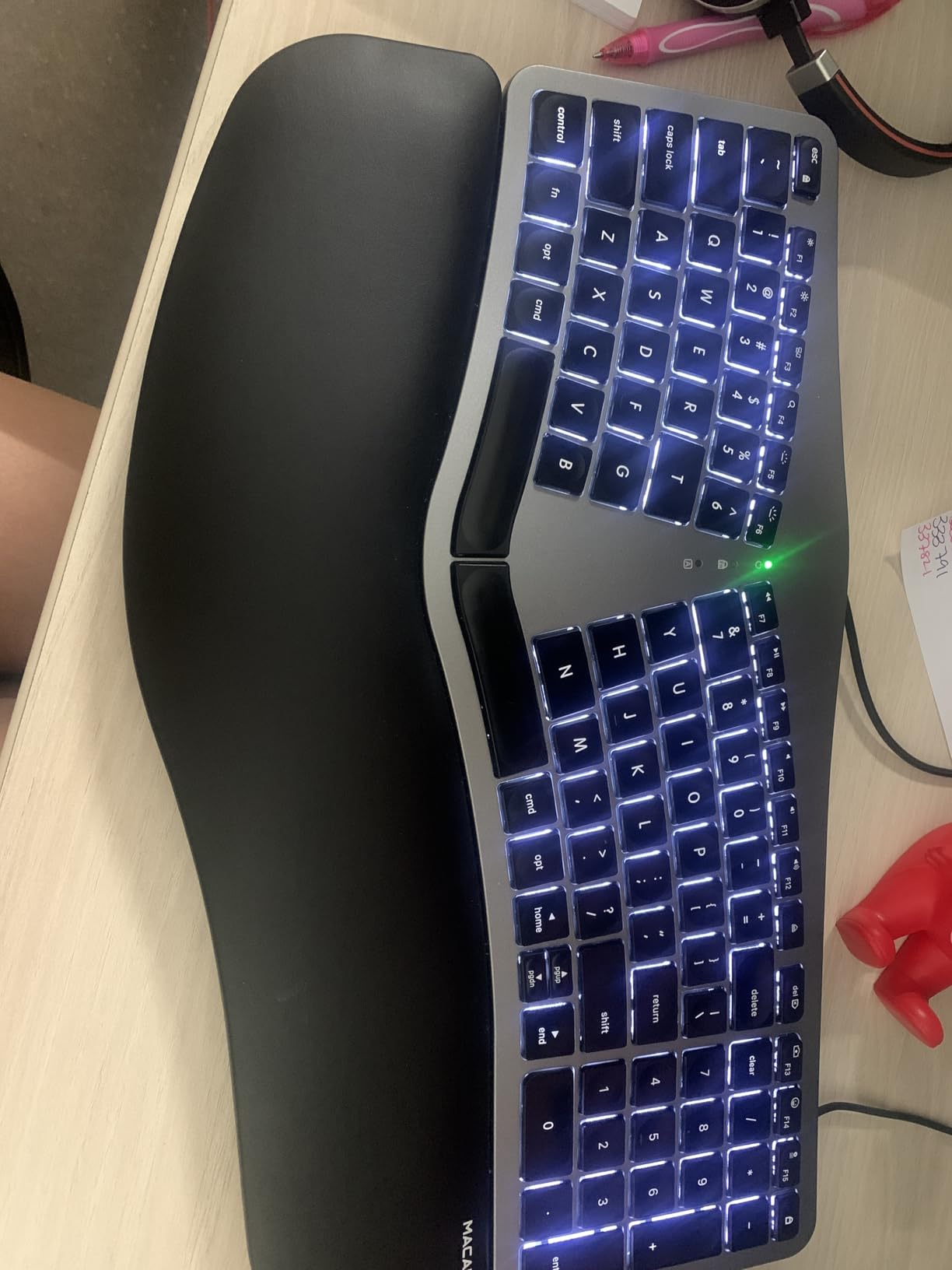
The sloped split design places your hands in a natural typing posture without the dramatic separation of a full split keyboard. The backlit keys offer three brightness levels, which is a rare feature in ergonomic keyboards at this price. Four adjustable kickstands let you fine-tune the typing angle.
The 5-foot USB-A cable provides plenty of reach for most desk setups. The wired connection eliminates Bluetooth latency and pairing issues, which matters for users who want a reliable plug-and-play experience.
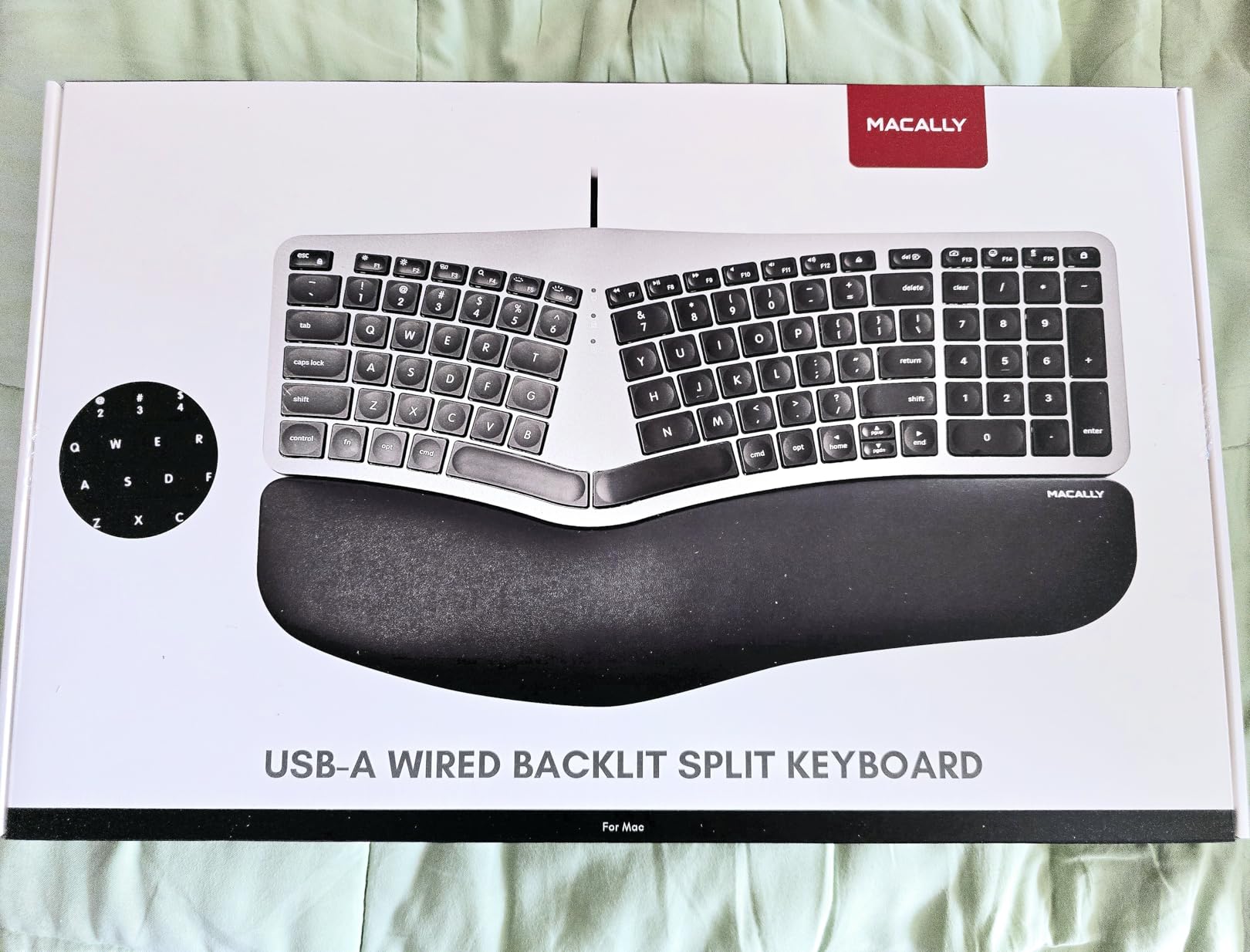
Perfect for Mac-Only Workflows
If your entire workspace runs on macOS, this keyboard eliminates the compromise of using a Windows-oriented ergonomic board with remapped keys. The 16 shortcuts include brightness, volume, media controls, and mission control functions that work natively on Mac without any software configuration.
The backlit keys are especially useful for late-night work sessions. The three brightness levels plus an off setting give you control over the illumination intensity.
Durability Considerations
Some users have reported keys breaking after extended use, which is the main concern with this board. The 24-month warranty covers manufacturing defects, but it is worth being aware of this feedback. The up and down arrow keys are positioned close together, which can cause mispresses until you adapt.
For Mac users who want ergonomic benefits without leaving the Apple ecosystem, this remains the best dedicated option. The familiar scissor-switch feel and native Mac layout make it worth considering despite the durability caveats.
How to Choose the Best Ergonomic Keyboard?
Choosing the right ergonomic keyboard depends on your typing habits, pain points, budget, and willingness to adapt. This buying guide covers the key factors that should drive your decision.
Split vs Curved vs Contoured Designs
Split keyboards separate the left and right key clusters, allowing your hands to type at shoulder width. The Logitech Ergo K860 and Perixx PERIBOARD-512B use a curved split that maintains a single unibody frame. The Kinesis Freestyle2 and Freestyle Edge take this further with fully separable halves connected by a cable.
Curved keyboards like the Logitech Wave Keys use a wave-shaped layout that provides ergonomic benefit without splitting the keyboard. These are the easiest to transition to because the key positions stay close to standard QWERTY.
Contoured keyboards like the Kinesis Advantage360 go the furthest with concave keywells that cradle each finger. These offer maximum ergonomics but require the longest learning period. Choose this design only if you have chronic pain that simpler designs cannot address.
Mechanical vs Membrane Switches
Mechanical switches provide tactile feedback, durability, and a satisfying typing feel. The Kinesis Advantage360 uses Gateron Brown switches rated for 50 million presses, and the Freestyle Edge features hotswap linear switches that you can customize. Mechanical switches are ideal for typists who want precise feedback and long-term durability.
Membrane switches are quieter, lighter, and more affordable. The Logitech K860, Wave Keys, and Perixx PERIBOARD-512B all use membrane switches that are plenty comfortable for office work. If you work in a shared space where noise matters, membrane is the better choice.
Scissor switches, used in the Arteck and Macally keyboards, sit between membrane and mechanical. They offer a laptop-like typing feel that many users find familiar and comfortable.
Tenting and Adjustability
Tenting refers to tilting the keyboard halves upward along their inner edges, like the sides of a tent. This reduces forearm pronation, which is the inward rotation of your wrists that causes strain over time. The Kinesis Freestyle2 offers 5, 10, and 15-degree tenting options. The Advantage360 provides three tenting heights. The Freestyle Edge includes a lift kit for adjustable tenting.
If you have specific posture needs or existing wrist issues, look for a keyboard with adjustable tenting. Fixed-angle boards like the Logitech K860 and Wave Keys work well for general use but cannot be fine-tuned to your body.
Connectivity Options
Wireless connectivity gives you desk flexibility and reduces cable clutter. The Logitech K860 offers Bluetooth plus USB receiver, the Wave Keys adds Logi Bolt support, and the Arteck uses a 2.4G nano receiver. Consider how many devices you need to pair with and whether you need Bluetooth or a dedicated receiver.
Wired keyboards like the Perixx, Kinesis Advantage360, Freestyle2, and Macally eliminate battery concerns and provide zero-latency connections. If reliability is your top priority, a wired connection is the safest choice.
Learning Curve and Transition Time
This is where many buyers underestimate the commitment required. Curved and wave keyboards like the Logitech Wave Keys have almost zero learning curve. You can type at full speed on day one. Curved split boards like the K860 and Perixx require 2 to 4 days of adjustment.
Full split keyboards with separable halves take about a week. Contoured keyboards like the Kinesis Advantage360 can take weeks to months before you regain your normal typing speed. Reddit users consistently emphasize treating the adjustment as a short-term investment for long-term comfort.
Desk Space Requirements
Ergonomic keyboards are wider than standard boards due to the split design. Measure your desk before purchasing. The Perixx PERIBOARD-512B is the largest at 19 inches wide. The Logitech Wave Keys is the most compact at under 15 inches. Fully split boards like the Freestyle2 need additional space when the halves are separated widely.
Operating System Compatibility
Most keyboards on our list support Windows. If you use a Mac, verify compatibility before buying. The Logitech K860 and Wave Keys support both Windows and macOS. The Kinesis Advantage360 works with Windows, macOS, Linux, and Chrome OS. The Macally is designed exclusively for Mac. The Arteck and Perixx are Windows-only.
FAQs
Are ergonomic keyboards actually better for you?
Yes. Ergonomic keyboards keep your hands, wrists, and forearms in a neutral position while typing, which reduces muscle strain and can prevent repetitive stress injuries. Studies and user testimonials consistently show reduced wrist pain and improved posture. The Logitech Ergo K860 and Kinesis Advantage360 are both certified by ergonomics professionals.
What keyboard is best for carpal tunnel?
For carpal tunnel relief, the Kinesis Advantage360 is the top choice thanks to its contoured keywells that minimize finger movement. The Logitech Ergo K860 is a more accessible option with an ergonomist-certified curved split design and memory foam wrist rest. The Kinesis Freestyle2 is another strong option with adjustable tenting and low-force keys that reduce finger fatigue.
Did Microsoft stop making ergonomic keyboards?
Microsoft discontinued its popular Sculpt Ergonomic Keyboard and Natural Ergonomic Keyboard lines. The Microsoft Sculpt is no longer in production, though remaining stock may still be available from some retailers. This has led many former Microsoft ergonomic keyboard users to switch to alternatives like the Logitech Ergo K860 and Perixx PERIBOARD-512B, which offer similar curved split designs.
What are the disadvantages of ergonomic keyboards?
The main disadvantages are the learning curve, higher cost compared to standard keyboards, and increased desk space requirements. Split and contoured designs can take days to weeks to adjust to, during which your typing speed will drop. Premium models like the Kinesis Advantage360 cost significantly more than standard keyboards. Some users also find that certain keys are repositioned in ways that take getting used to.
Are ergonomic keyboards good for arthritis?
Yes, ergonomic keyboards can help with arthritis symptoms by reducing the strain on finger, wrist, and hand joints. Low-force switches like those on the Kinesis Freestyle2 reduce the pressure needed to activate keys. Contoured keyboards like the Kinesis Advantage360 minimize finger travel distance. The cushioned wrist rests on the Logitech models also provide joint support during extended typing sessions.
Final Thoughts on the Best Ergonomic Keyboards
After testing 8 keyboards over three months, the Logitech Ergo K860 remains our top pick for most people. It balances ergonomist-certified comfort with an easy transition from standard keyboards. The Logitech Wave Keys is the best value for anyone under $70, and the Perixx PERIBOARD-512B proves you can get genuine ergonomic benefits for under $40.
For users with chronic pain, the Kinesis Advantage360 offers unmatched relief through its contoured keywells. Gamers should look at the Freestyle Edge RGB Plus for mechanical split design. And Mac users have a dedicated option in the Macally ergonomic keyboard. The best ergonomic keyboards in 2026 cover every budget and use case, so there is no reason to keep typing through wrist pain.