
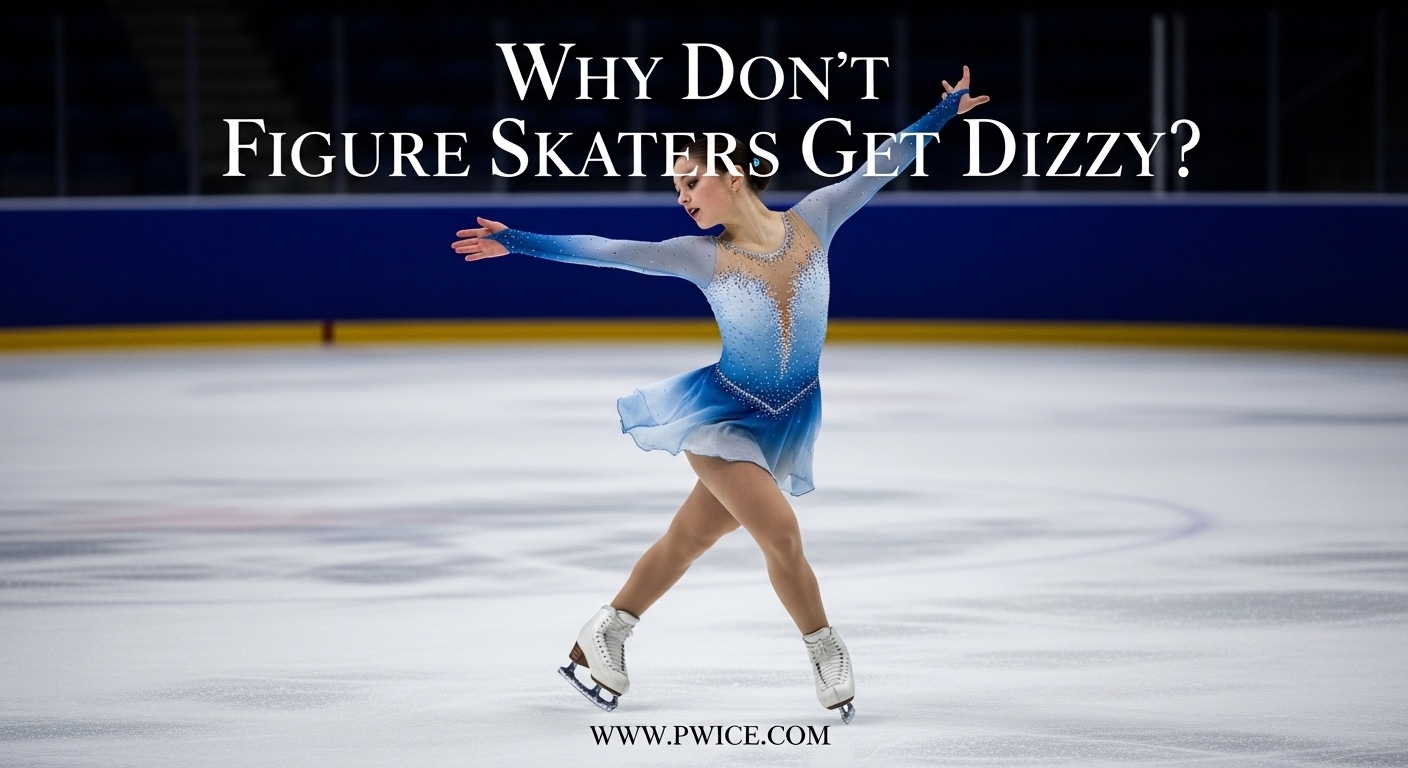
Have you ever watched a figure skater launch into a spin and counted the rotations? Twenty. Thirty. Sometimes more. Your head spins just thinking about it. Yet when they finally stop, they glide away perfectly balanced, ready for their next element.
Most of us would be on the ice clutching our heads, the world whirling around us. So why don’t figure skaters get dizzy when they spin? The answer isn’t that they’re somehow immune to dizziness. They’ve simply trained their brains to ignore it.
This phenomenon fascinated me after watching the 2026 Winter Olympics. I dug into the neuroscience behind it, and what I found is remarkable. Figure skaters rewire their vestibular systems through years of deliberate practice, exploiting a quirk of human neurobiology that anyone can understand.
Table of Contents
Why Don’t Figure Skaters Get Dizzy When They Spin?
Figure skaters do feel dizzy when they first start learning spins. The difference is that years of training teaches their brains to suppress signals from the vestibular system, the balance organs in the inner ear that normally trigger vertigo.
According to Dr. Kathryn Cullen, a neurologist at Johns Hopkins University, skaters essentially train their brains to “dampen the vestibular response.” Through repetition, the brain learns that the signals coming from the inner ear during spinning are not actually threatening, and it stops creating the dizzy sensation.
The process involves several mechanisms working together: neuroplasticity that dulls vestibular sensitivity, eye movement techniques that counteract natural reflexes, and physical strategies that minimize the sensory input causing dizziness in the first place.
The Science Behind Dizziness: Your Vestibular System
Your inner ear contains the vestibular system, a network of fluid-filled chambers and sensory cells that detect motion and maintain balance. At the heart of this system are three semicircular canals, oriented at right angles to each other like a three-dimensional coordinate system.
Each canal is filled with endolymph, a fluid that moves when your head rotates. As the fluid shifts, it bends tiny hair cells lining the canals. These hair cells convert mechanical movement into electrical signals that travel to your brain, telling it which direction your head is turning.
The problem is that these sensors are designed to detect changes in speed, not constant motion. When you spin continuously at a uniform velocity, the fluid eventually moves at the same speed as the canal walls. The hair cells stop bending. Your brain receives confusing signals when you suddenly stop, creating the disorienting sensation we call dizziness.
What Is Nystagmus and Why It Makes You Dizzy
Nystagmus is the involuntary eye movement that makes you feel dizzy after spinning. Your eyes naturally try to track a fixed point while your head rotates, then snap back when they can’t keep up. This creates the characteristic jerking motion you see in someone who has just gotten off a merry-go-round.
The lag between your head turning and your eyes catching up sends conflicting signals to your brain. Your vestibular system says you’re rotating, but your visual system can’t find a stable reference point. The mismatch triggers vertigo, the spinning sensation that makes ordinary people stumble and feel nauseated.
For untrained individuals, this reflex is automatic and impossible to suppress. The eyes will jerk regardless of conscious effort. Figure skaters, however, develop a counter-reflex through years of training that cancels out this natural response.
Optokinetic Nystagmus: The Brain’s Secret Weapon
Trained figure skaters engage something called optokinetic nystagmus, a specialized eye movement that counters the natural nystagmus reflex. Instead of fighting to keep their eyes fixed on one point while spinning, they train their eyes to make smooth, controlled movements in the opposite direction of rotation.
Dr. Cullen explains that this technique allows skaters to maintain visual stability without the violent snapping motion that causes dizziness. The eyes track smoothly, feeding the brain consistent visual information that matches what the vestibular system is reporting. The result is no sensory conflict and no dizziness.
This isn’t something skaters learn consciously. It develops gradually through repetition as the brain rewires itself to handle the unique demands of spinning. Studies using brain imaging have shown that the areas processing vestibular input actually change in skaters compared to non-athletes.
How Training Changes the Brain
Neuroplasticity is the brain’s ability to reorganize itself by forming new neural connections throughout life. Figure skating provides a perfect example of this principle in action. Through thousands of repetitions, skaters’ brains literally restructure how they process balance information.
The process is called vestibular habituation. With repeated exposure to spinning, the brain learns to reduce its response to the signals coming from the inner ear. What starts as an overwhelming flood of sensory data becomes background noise that the brain filters out automatically.
Research published in the journal “Cerebral Cortex” found that professional dancers and skaters show reduced activation in brain regions associated with dizziness compared to control subjects. Their brains have learned that spinning is normal and not threatening, so they don’t trigger the vertigo response.
Beginners experience intense dizziness that can last for minutes after just a few rotations. Intermediate skaters might handle ten to fifteen spins before feeling effects. Professional skaters can execute thirty or more rotations and recover within seconds, their brains having essentially turned down the volume on vestibular input.
Techniques Skaters Use to Prevent Dizziness
Beyond neuroplasticity, figure skaters employ specific physical techniques that help minimize dizziness. The first is maintaining uniform speed. The vestibular system detects acceleration and deceleration, not constant velocity. Skaters who can spin at a steady rate generate fewer confusing signals than those who speed up and slow down.
Some skaters use a technique called counter-spinning to recover quickly after completing a spin. This involves performing a brief rotation in the opposite direction, which seems to cancel out the residual vestibular disturbance. While not commonly taught, many elite skaters report using this method instinctively.
Focusing on a distant fixed point immediately after stopping also helps. This gives the visual system a stable reference to reorient itself, reducing the duration of post-spin dizziness. Skaters will often exit a spin and immediately pick a spot on the arena wall to stare at while their vestibular system settles.
How Other Athletes Handle Spinning
Ballet dancers use a different technique called spotting to manage dizziness. They keep their eyes fixed on a single point in the audience, turning their head quickly to refocus on that same point with each rotation. This minimizes the time their eyes are moving and reduces the nystagmus effect.
Figure skaters generally don’t spot the way dancers do because their spins are too fast. At three or more rotations per second, there’s no time to snap the head around. Instead, they rely more heavily on the optokinetic nystagmus response and uniform speed control.
Gymnasts and platform divers face similar challenges but for shorter durations. A diver might complete two or three somersaults, while a gymnast’s floor routine involves brief tumbling passes. Neither requires the sustained spinning tolerance of a figure skater holding a camel spin for eight seconds at competition speed.
Interestingly, some individuals are naturally more resistant to dizziness than others. Research suggests this may be genetic, with some people having vestibular systems that are simply less reactive to rotational input. These individuals have a natural advantage in spinning sports, though training remains essential to reach elite levels.
Frequently Asked Questions
How do ice skaters not get dizzy?
Ice skaters avoid dizziness through years of training that teaches their brains to suppress vestibular signals from the inner ear. They develop optokinetic nystagmus (a counter-rotating eye movement), maintain uniform spin speeds, and undergo neuroplastic changes that reduce their brain’s dizziness response over time.
What is the forbidden move in ice skating?
The backflip is banned in figure skating competition by the International Skating Union. While not physically forbidden to perform, executing a backflip in competition results in immediate disqualification. The rule exists because backflips were deemed too dangerous and not artistic enough for competitive figure skating.
How does Ilia Malinin not get dizzy when spinning?
Ilia Malinin, like other elite figure skaters, has trained his vestibular system over many years to tolerate extreme spinning. His quadruple axel and complex spin combinations require the same neuroplastic adaptations all professional skaters develop: suppressed vestibular response, optokinetic nystagmus control, and exceptional balance management through repetition.
Do figure skaters actually get dizzy when learning?
Yes, beginners experience intense dizziness when learning to spin. Most skaters can only handle one or two rotations before feeling nauseated when they start. The tolerance builds gradually over months and years of practice. Even professional skaters may feel some dizziness after extremely long spins, but they recover within seconds rather than minutes.
How long does it take to stop getting dizzy from spins?
Most figure skaters report significant improvement within six months of regular practice, though full tolerance takes years to develop. Beginners start with single rotations and gradually add more as their vestibular system adapts. Professional-level tolerance typically requires five to ten years of consistent training.
Why do some people never get dizzy from spinning?
Individual variation in vestibular sensitivity means some people naturally resist dizziness better than others. Genetics play a role in how reactive the inner ear’s semicircular canals are to motion. However, even naturally resistant individuals need training to handle the extreme spinning demands of competitive figure skating.
The Takeaway
The mystery of why figure skaters don’t get dizzy when they spin comes down to one word: adaptation. Through years of deliberate practice, these athletes rewire their brains to handle sensory input that would overwhelm ordinary people.
The vestibular system, nystagmus reflex, and neuroplasticity work together to create something that looks like magic but is actually solid neuroscience. Figure skaters prove that the human brain is far more adaptable than we often assume, capable of learning to ignore dizziness signals that are normally impossible to suppress.
Whether you’re an aspiring skater, a curious viewer, or someone interested in the limits of human performance, the lesson is clear. What starts as an overwhelming physiological response can become manageable through consistent, progressive training. The body adapts. The brain rewires. And what once seemed impossible becomes routine.