
Walking into your first youth hockey registration meeting can feel overwhelming. You’re surrounded by terms like mites, squirts, peewees, and bantams, along with numbers like 8U, 10U, and 12U that don’t make immediate sense. I remember sitting in that exact spot three years ago, scrambling to Google what division my son belonged in while other parents confidently checked boxes on their forms.
Understanding youth hockey age divisions matters because it affects everything from your child’s development to your family’s schedule and budget. This guide breaks down the USA Hockey classification system, explains the difference between traditional names and the modern 8U/10U format, and tells you exactly what to expect at each level. By the end, you’ll know whether your child should play mites or squirts, what AA versus AAA really means, and when body checking enters the picture.
Table of Contents
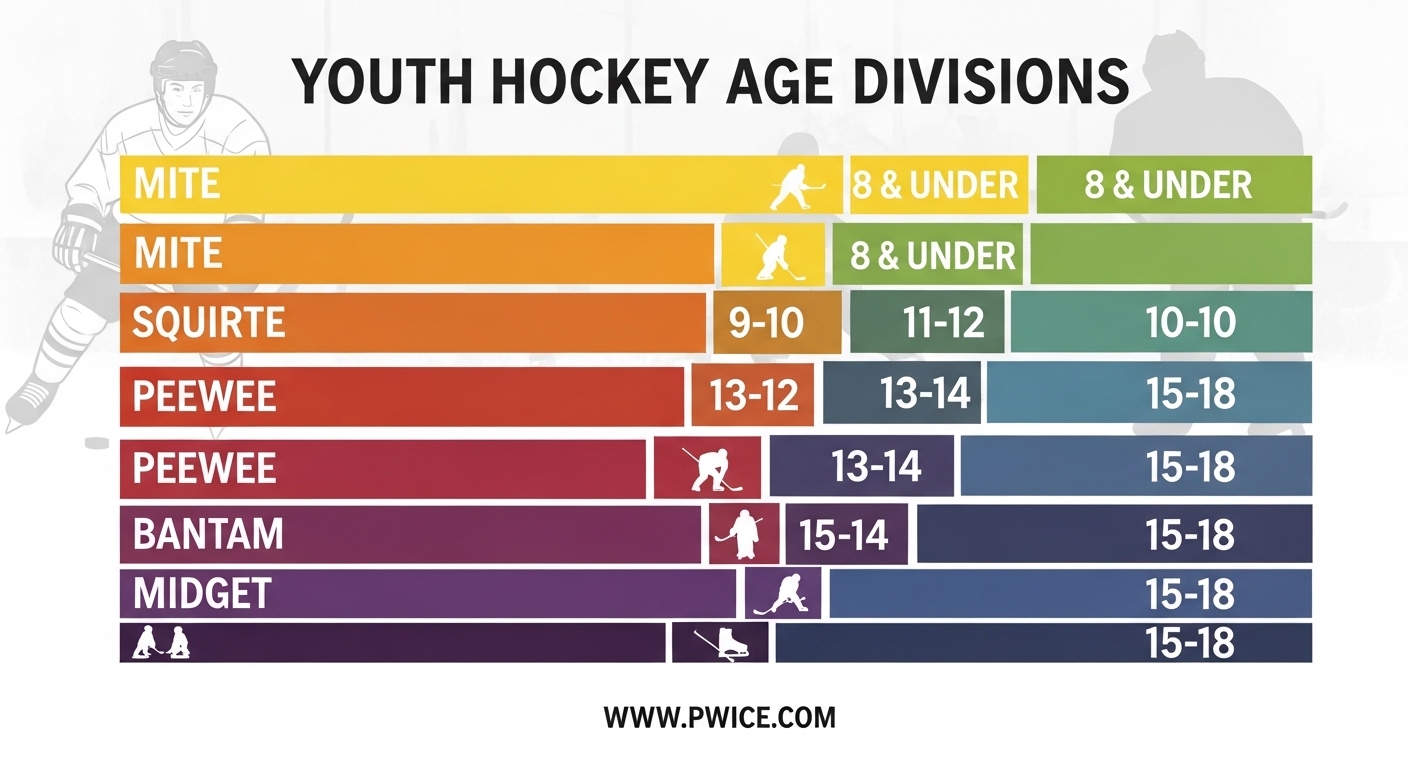
Quick Reference: Youth Hockey Age Divisions
USA Hockey uses a birth-year based classification system with two naming conventions running side by side. The traditional names (Mite, Squirt, Peewee, Bantam) have been used for decades, while the newer 8U/10U/12U format emphasizes the maximum age allowed in each division. Here’s the complete breakdown:
| Traditional Name | USA Hockey Classification | Age Range | Birth Year (2026–2026) |
|---|---|---|---|
| Mini Mite | 6U | 5-6 years old | 2026–2026 |
| Mite | 8U | 7-8 years old | 2026–2026 |
| Squirt | 10U | 9-10 years old | 2026–2026 |
| Peewee | 12U | 11-12 years old | 2026–2026 |
| Bantam | 14U | 13-14 years old | 2026–2026 |
| Minor Midget | 16U | 15-16 years old | 2026–2026 |
| Major Midget | 18U | 15-18 years old | 2026–2026 |
The birth years listed above shift annually based on the current season. USA Hockey publishes updated age classification charts each year on their official website, so always verify your child’s specific division before registering.
Youth Hockey Age Divisions Explained: The Complete System
USA Hockey organizes youth programs into age-specific divisions that align with child development stages and skill progression. The system ensures players compete against others with similar physical maturity and experience levels. Each division builds on the previous one, gradually introducing more complex rules, larger playing surfaces, and higher competitive intensity.
Understanding the Birth Year System
USA Hockey switched to a pure birth-year classification model in 2016, replacing the previous age-based cutoff system. Under the current rules, your child’s division is determined entirely by their birth year, not their age on a specific date. This means a player born in January and another born in December of the same year will be in the same division, even though they might be eleven months apart in actual age.
The birth-year approach aligns USA Hockey with international standards used by the IIHF and most other countries. It simplifies administration for associations and ensures consistent progression for players. However, it can create situations where younger players within a birth year compete against significantly older peers.
The Two Naming Systems: Traditional vs Modern
Hockey families encounter two naming conventions, often used interchangeably. The traditional names (Mite, Squirt, Peewee, Bantam) originated in the early 20th century and remain deeply embedded in hockey culture. Many longtime coaches, parents, and rinks still use these terms exclusively.
The modern 8U, 10U, 12U designation comes from USA Hockey’s shift toward age-specific development models. The “U” stands for “and Under,” making 8U literally “8 and Under.” This naming convention is more intuitive for new families and aligns better with other youth sports like soccer and lacrosse.
Complete Breakdown: Mites (8U)
Mite hockey serves as the entry point for most young players, typically covering ages 7 and 8 under the USA Hockey system. Some associations offer Mini Mite or 6U programs for 5 and 6-year-olds as an introductory experience. This is where fundamentals develop and kids either fall in love with the sport or decide it is not for them.
The mite level follows the American Development Model (ADM), emphasizing skill development over competition. Games use cross-ice or half-ice formats rather than full ice, keeping players closer to the puck and maximizing touches. Instead of traditional 5-on-5 games with goalies, you might see 4-on-4 cross-ice games or small-area games designed to teach skating edges, puck handling, and spatial awareness.
What Happens at the Mite Level
Slapshots are not allowed in mite hockey, and body contact is minimal. The focus stays on skating fundamentals, stick handling, passing, and basic positioning. Practices typically involve station-based drills where kids rotate through skill stations, keeping everyone moving rather than standing in lines.
Time commitment at the mite level is relatively light compared to older divisions. Expect one or two practices per week plus a game on weekends. Travel is usually limited to local rinks within your association or nearby communities. Costs remain manageable, mainly covering registration, basic equipment, and association fees.
Skill Levels Within Mites
Most mite programs offer multiple skill tiers, often labeled Red, White, and Blue or A, B, and C depending on your association. These designations separate players by ability while keeping everyone in the same age group. House league or in-house mites play entirely within your local association, while travel mites compete against teams from other rinks and towns.
Complete Breakdown: Squirts (10U)
Squirt hockey marks a significant transition in youth hockey, covering ages 9 and 10 under USA Hockey classifications. This is where players experience full-ice hockey for the first time, complete with faceoff circles, blue lines, and all the rules that govern standard play. Many parents describe the mite-to-squirt transition as the biggest adjustment their child faces in youth hockey.
The jump from cross-ice to full-ice hockey challenges young players physically and mentally. The playing surface effectively doubles in size, requiring significantly more skating stamina. Players must learn positioning concepts like defensive coverage, offensive support, and line changes that were unnecessary in the small-area games at the mite level.
What Changes at the Squirt Level
Slapshots become legal at the squirt level, adding a new element to offensive play. Goalies face harder shots and must manage rebound control more carefully. Defensive positioning becomes critical as players learn to use the larger ice surface effectively. Offside and icing rules are enforced strictly, teaching players to think ahead and manage zone entries.
Practice frequency typically increases to two or three sessions per week. Games become more competitive, and the skill gap between house league and travel players widens noticeably. Some associations begin tiering squirt teams into A, B, and C levels based on tryout performance, creating distinct paths for different skill levels.
Time and Cost Expectations
Squirt hockey demands more family commitment than mite hockey. Travel expands beyond your immediate area to include regional opponents, sometimes requiring overnight stays for tournaments. Equipment needs grow as kids outgrow their mite gear and may want upgraded sticks or accessories. Registration fees increase to cover additional ice time, referees, and league memberships.
Complete Breakdown: Peewees (12U)
Peewee hockey covers ages 11 and 12, representing a crucial developmental window before the major transition to body checking. At this level, the game becomes noticeably faster and more strategic. Players who developed strong skating fundamentals at the mite and squirt levels begin separating themselves from peers who still struggle with edges or transitions.
The peewee level emphasizes hockey IQ and tactical understanding. Coaches spend significant time on systems play, special teams, and situational awareness. Players learn to read plays developing, anticipate passes, and make decisions under pressure. Individual skill work continues, but team concepts take on greater importance as players prepare for the checking game at bantam.
Skill Progression at Peewee
Skating ability becomes the great differentiator at peewee hockey. Players with powerful strides, quick transitions, and confident backward skating control games regardless of their stickhandling prowess. This reality drives many families to invest in power skating lessons or off-ice training to close gaps with more developed peers.
Body contact exists at the peewee level even though checking remains illegal. Players learn to use their bodies to protect the puck, establish position, and battle along the boards. These skills become essential preparation for the bantam level where full body checking enters the game. Many associations offer checking clinics during the peewee years to teach proper technique before it becomes legal.
Competitive Structure
The peewee division typically offers the widest range of competitive options. House leagues serve recreational players who want to enjoy hockey without massive time commitments. Tier 2 or A-level travel teams compete regionally against similarly skilled opponents. Tier 1 or AA and AAA programs draw elite players willing to commit to extensive travel and intensive training schedules.
Complete Breakdown: Bantams (14U)
Bantam hockey covers ages 13 and 14, introducing the most significant rule change in youth hockey: legal body checking. This transition fundamentally alters how the game plays and requires a new layer of awareness and physical preparation. Many parents express anxiety about their child’s first bantam season, wondering if they are ready for the physicality and increased intensity.
The bantam level represents where serious hockey truly begins. Players who have developed proper skating, positional awareness, and hockey IQ now add physical engagement to their toolkit. Games become faster, hits become harder, and the margin for error shrinks dramatically. College and junior scouts begin attending bantam tournaments to identify promising young players.
Body Checking Introduction
USA Hockey permits body checking in the bantam division for boys’ hockey. Players learn to give and receive checks safely, using shoulder-to-shoulder contact rather than dangerous hits from behind or to the head. Proper checking technique emphasizes angling, timing, and protecting yourself when receiving contact.
Girls’ hockey does not include body checking at any level, though body contact remains part of the game through positioning and puck protection. Players heading into bantam hockey should expect pre-season checking clinics that teach proper technique and safety protocols. Associations typically require completion of these clinics before players can participate in contact games.
The Bantam Commitment
Bantam hockey demands significant time and financial investment. Travel teams play in showcases and tournaments across multiple states, often requiring flights and hotels. Practice schedules expand to include skills sessions, off-ice training, and video analysis. Equipment costs rise as players need properly fitting gear that can withstand physical play.
At the elite levels, bantam players might practice four or five times weekly with games on weekends and additional training commitments. The family schedule revolves around hockey, and siblings often get dragged along to rinks multiple nights each week. This reality forces many families to evaluate whether the commitment aligns with their priorities and lifestyle.
Skill Level Classifications: Understanding A, AA, and AAA
Beyond age divisions, youth hockey separates players by skill level using letter designations. These tiers create appropriate competitive environments where players develop without becoming overwhelmed or bored. Understanding the differences helps parents make informed decisions about which level suits their child’s abilities and commitment level.
| Level | Also Called | Typical Commitment | Travel Range |
|---|---|---|---|
| C or House | In-House, Rec | 1-2 practices/week, local games | Local only |
| B | Tier 2 | 2 practices/week, weekend games | Regional (1-2 hours) |
| A | Tier 2 | 2-3 practices/week, competitive schedule | Regional + some travel |
| AA | Tier 1 | 3-4 practices/week, intense training | Multi-state |
| AAA | Tier 1, Elite | 4-5 practices/week, full commitment | National |
Choosing the Right Skill Level
Selecting the appropriate level for your child involves honest assessment of their abilities, your family’s resources, and their long-term goals. Playing up a level sounds prestigious but can backfire if your child struggles to contribute or loses confidence. Playing down might seem safe but can stunt development if the competition fails to push them.
The best environment typically places your child in the middle third of their team’s talent level. They should contribute meaningfully to games without being the dominant player or constantly overwhelmed. This middle ground challenges them to improve while building confidence through successful moments.
Tier 1 vs Tier 2 Hockey
USA Hockey classifies travel programs as either Tier 1 or Tier 2. Tier 1 includes AA and AAA programs with the highest competitive standards, most extensive travel, and significant financial commitments. These programs operate under stricter rules regarding player movement and coaching credentials. Tier 2 covers A and B level travel hockey with more regional focus and moderate time requirements.
What to Expect at Each Division: Time, Cost, and Travel
Understanding the practical realities of each division helps families prepare for the journey ahead. The progression from mites to bantams brings exponential increases in time commitment, financial investment, and travel requirements. Knowing these expectations upfront prevents surprises and helps you make informed decisions about your family’s hockey path.
Mites (8U): The Foundation Phase
Mite hockey typically requires 2-4 hours of ice time weekly, split between practices and games. Registration costs range from $500 to $2,000 depending on your association and whether you choose house or travel programs. Equipment represents a one-time investment of $300 to $800 for proper fitting gear. Travel remains local, rarely extending beyond 30 minutes from your home rink.
Squirts (10U): The Transition Phase
Squirt hockey demands 4-6 hours of weekly ice time plus occasional off-ice activities. Registration fees jump to $1,000-$3,500 as ice costs increase and programs become more structured. Equipment needs refresh as kids outgrow their mite gear, costing another $400-$900. Travel expands to regional opponents within 1-2 hours driving distance, with 2-4 away tournaments per season.
Peewees (12U): The Development Phase
Peewee hockey consumes 6-10 hours weekly at the travel level, with practice, games, and training sessions. Costs range from $2,000-$6,000 depending on skill tier and association. Equipment replacement continues as kids grow, with some families investing in higher-end gear at this stage. Travel includes multi-state tournaments for competitive teams, requiring significant family logistics.
Bantams (14U): The Commitment Phase
Bantam hockey at elite levels can demand 10-15 hours weekly plus off-ice training and travel. Costs escalate to $4,000-$12,000 or more for AAA programs with extensive travel and professional coaching. Equipment requires premium fitting for safety in contact play, costing $600-$1,500 annually. Travel becomes national for top teams, with families spending weekends in hotels across multiple states.
Moving Up: Tips for Level Transitions
Every division transition brings challenges that catch families off guard. The jump from cross-ice to full-ice hockey at squirt, the introduction of checking at bantam, and the increased pace at peewee all create adjustment periods. Preparing your child for these transitions helps them succeed and enjoy the experience.
Mite to Squirt Transition
The mite-to-squirt transition challenges kids physically and mentally. Preparing during the offseason through skating camps or power skating clinics builds the stamina needed for full-ice play. Practicing stop-starts, transitions, and backward skating specifically helps with the increased ice coverage demands. Playing summer 3-on-3 or small-area games maintains hockey feel while building fitness.
Mentally, kids need to understand that full-ice hockey requires more positional discipline. Reviewing basic concepts like staying between your man and the net, supporting the puck on breakouts, and managing line changes helps them feel prepared. Watching squirt games together before their season starts familiarizes them with the faster pace and different flow.
Peewee to Bantam Transition
The introduction of body checking at bantam creates understandable anxiety for players and parents. Attending checking clinics offered by your association builds confidence and teaches proper technique. Practicing puck protection skills and awareness drills helps kids learn to protect themselves while maintaining possession. Emphasizing that checking is about separating the player from the puck, not injuring opponents, reframes the experience positively.
Physical preparation matters significantly for the bantam transition. Players should enter the season with adequate strength and conditioning to handle contact safely. Core strength, neck strength, and overall fitness reduce injury risk when checks occur. Many families work with trainers or follow off-ice programs specifically designed for pre-bantam players.
Frequently Asked Questions
What age is Bantam in youth hockey?
Bantam hockey covers players who are 13 and 14 years old under the USA Hockey classification system. Bantams are also known as 14U (14 and Under). This division introduces legal body checking for boys’ hockey and represents the transition to serious competitive hockey where college and junior scouts begin evaluating players.
What are the levels of mite hockey?
Mite hockey (8U) typically includes three skill levels: Mini Mites or 6U for ages 5-6 as an introduction, House or In-House Mites for recreational players ages 7-8, and Travel Mites for more competitive players ages 7-8. Some associations use color designations like Red, White, and Blue to separate players by ability. All mite levels use cross-ice or half-ice formats under the American Development Model (ADM).
What are the divisions of youth hockey?
Youth hockey divisions progress from Mini Mite (6U, ages 5-6), to Mite (8U, ages 7-8), Squirt (10U, ages 9-10), Peewee (12U, ages 11-12), Bantam (14U, ages 13-14), Minor Midget (16U, ages 15-16), and Major Midget (18U, ages 15-18). Each division offers multiple skill levels from recreational house leagues to elite AAA travel programs. Girls’ hockey uses the same age classifications.
What is the Bantam level in hockey?
Bantam is the youth hockey division for players ages 13-14, also called 14U. This level introduces legal body checking for boys and represents a major step up in game speed, physicality, and strategic complexity. Bantam hockey demands significant time and financial commitment, with extensive travel for competitive teams and year-round training expectations at elite levels.
Are slapshots allowed in mites?
No, slapshots are not allowed in mite hockey. The USA Hockey American Development Model (ADM) prohibits slapshots at the 8U level to emphasize proper shooting mechanics, puck control, and safety. Slapshots become legal at the squirt level (10U) when players transition to full-ice hockey. Coaches focus instead on wrist shots, snap shots, and proper passing technique during the mite years.
What comes after mites in hockey?
Squirt hockey (10U) comes after mites in the USA Hockey progression. Players typically move to squirts around age 9, experiencing full-ice hockey for the first time with complete rules including offside, icing, and legal slapshots. This transition represents one of the biggest adjustments in youth hockey as the playing surface doubles and games become more structured and competitive.
What age does squirt hockey start?
Squirt hockey starts at age 9 and covers players who are 9 and 10 years old. Under USA Hockey’s birth-year system, children born in the same calendar year enter the squirt division together. Squirts are also called 10U (10 and Under) in the modern classification system. This level marks the transition to full-ice games with complete hockey rules and increased competitive intensity.
When do kids start checking in hockey?
Body checking becomes legal in USA Hockey at the Bantam level for boys ages 13-14. Girls’ hockey does not include body checking at any level. Many associations offer checking clinics during the peewee years (ages 11-12) to teach proper technique before it becomes legal. These clinics focus on angling, timing, and safe contact to prepare players for the physicality of bantam hockey.
Final Thoughts on Youth Hockey Age Divisions
Understanding youth hockey age divisions removes the confusion that overwhelms so many new hockey families. The progression from Mites (8U) through Squirts (10U), Peewees (12U), and Bantams (14U) follows a logical developmental path. Each division builds skills that prepare players for the next level, gradually introducing complexity as children mature physically and mentally.
Remember that the birth-year system exists to create fair competition, not to frustrate parents. Your child will play with peers of similar developmental stages, and the skills they build at each level serve them throughout their hockey journey. Whether your family chooses house league recreation or elite travel competition, understanding these divisions helps you make informed decisions that match your child’s abilities and your family’s resources.
The transitions between levels challenge every player. Those who thrive typically have families who prepare them for what’s coming, support them through adjustments, and keep the focus on development rather than immediate results. Youth hockey age divisions exist to serve that development, creating the right environment for kids to fall in love with a sport that can last a lifetime.