
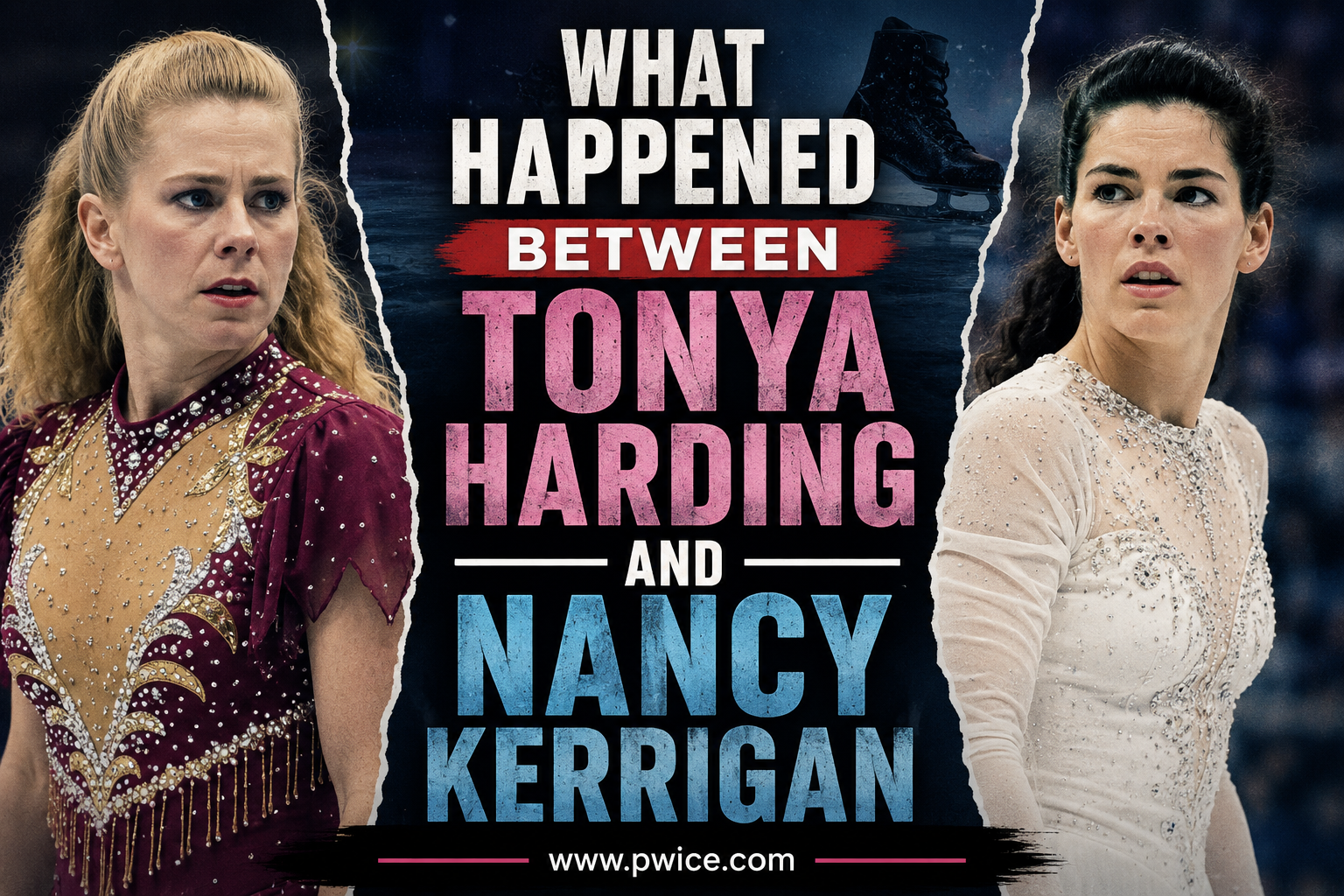
The question what happened between Tonya Harding and Nancy Kerrigan opens the door to one of the most shocking scandals in sports history. On January 6, 1994, figure skater Nancy Kerrigan was attacked with a metal baton after a practice session in Detroit. The assault was orchestrated by associates of her rival Tonya Harding, igniting a media firestorm that would forever change both women’s lives and captivate the world.
This guide covers the complete timeline of events, the key players involved, the legal consequences, and the aftermath that continues to generate discussion more than three decades later.
Table of Contents
Who Were Tonya Harding and Nancy Kerrigan?
Before the scandal erupted, both women were elite American figure skaters competing for national and Olympic glory. Nancy Kerrigan was seen as the elegant, privileged “America’s Sweetheart” of figure skating. She came from a working-class Massachusetts family but projected a refined image that appealed to skating’s traditional establishment. Kerrigan won bronze at the 1992 Winter Olympics and was favored to win gold in 1994.
Tonya Harding represented a stark contrast. She was a technical powerhouse from Portland, Oregon, known for being the first American woman to land a triple axel in competition. Harding came from a rougher background and often clashed with figure skating’s image-conscious culture. Her working-class roots, homemade costumes, and unconventional training methods made her an outsider in a sport that valued polish and pedigree.
The rivalry between them intensified at the 1991 U.S. Figure Skating Championships, where Harding won and Kerrigan placed third. By 1994, both were competing for spots on the Olympic team. The pressure was immense, and the stakes could not have been higher.
What Happened Between Tonya Harding and Nancy Kerrigan: Complete Timeline
Here is the complete chronological breakdown of the scandal, optimized for quick reference and featured snippet capture:
- January 6, 1994: Nancy Kerrigan is attacked at Cobo Arena in Detroit after a practice session. An assailant strikes her right knee with a metal baton.
- January 7-10, 1994: Initial investigation begins. Kerrigan is unable to compete at the U.S. Championships due to her injuries.
- January 11, 1994: Harding wins the U.S. Championships, securing her spot on the Olympic team.
- January 18, 1994: Jeff Gillooly, Harding’s ex-husband, is implicated in the attack plot.
- January 27, 1994: Shane Stant and Derrick Smith are arrested. The conspiracy begins to unravel.
- February 1994: Both skaters compete at the Winter Olympics in Lillehammer, Norway amid massive media attention.
- March 16, 1994: Harding pleads guilty to conspiracy to hinder prosecution. She admits knowing about the plot after the attack occurred.
- June 1994: The U.S. Figure Skating Association bans Harding for life from sanctioned events.
The Attack on Nancy Kerrigan: January 6, 1994
The attack occurred at Cobo Arena in Detroit, Michigan, during the U.S. Figure Skating Championships. Nancy Kerrigan had just finished a practice session and was walking through a corridor when a man approached her. He struck her right knee with a collapsible metal baton.
The assailant was Shane Stant, a 22-year-old who had been hired to carry out the attack. Stant fled the scene as Kerrigan collapsed to the ground, screaming in pain and confusion. “Why? Why me?” she cried out, unaware of what had just happened or why.
Kerrigan suffered bruising and swelling to her right knee and quadriceps. While the injury was painful and prevented her from competing at the U.S. Championships, it was not permanent. Medical experts determined that the attacker likely missed his intended target – the kneecap itself – which would have caused far more devastating damage.
The immediate aftermath was chaotic. Kerrigan was rushed for medical treatment while the skating community reeled from the news. The attack was so brazen and bizarre that many initially suspected a deranged fan rather than a coordinated conspiracy. That assumption would change within days.
The Conspiracy Uncovered
Investigators quickly uncovered a conspiracy that led directly to Tonya Harding’s inner circle. The plot was orchestrated by Jeff Gillooly, Harding’s ex-husband, who had arranged the attack to eliminate Kerrigan from Olympic competition.
Gillooly contacted Shawn Eckardt, Harding’s bodyguard and self-proclaimed security expert. Eckardt then recruited his nephew, Derrick Smith, to help carry out the plan. Smith in turn brought in Shane Stant as the actual attacker. The conspirators paid Stant approximately $6,500 to assault Kerrigan and injure her leg.
The investigation moved quickly once authorities identified the pattern. Eckardt was the first to crack under questioning. He confessed to investigators and implicated Gillooly, Stant, and Smith. Recordings surfaced of conversations discussing the plot, including references to creating an “alibi” for Harding.
Harding’s involvement remained the central question. She initially denied knowing anything about the plot. Her story shifted over time, eventually admitting she had learned about the conspiracy after the attack but failed to report it to authorities. The question of when exactly she knew – and what she did with that knowledge – became the focus of legal proceedings.
The FBI questioned Harding extensively in January 1994. She maintained that she only discovered her ex-husband’s involvement after the attack had occurred. However, investigators found evidence suggesting she may have known beforehand, including phone records and witness statements.
Legal Consequences for Everyone Involved
All four conspirators faced federal charges and received varying sentences for their roles in the attack.
Jeff Gillooly, as the mastermind, received the harshest punishment. He was sentenced to two years in prison and ordered to pay a $100,000 fine. He also received a stern lecture from the judge about his manipulation of others and betrayal of trust.
Shawn Eckardt received an 18-month prison sentence for his role as the intermediary. Shane Stant, the actual attacker, also received 18 months for carrying out the assault. Derrick Smith, who served as the getaway driver, received probation and community service.
Tonya Harding’s legal outcome was different. She was never charged with direct involvement in the attack itself. Instead, she pleaded guilty to conspiracy to hinder prosecution on March 16, 1994. This charge acknowledged that she knew about the conspiracy after the fact and failed to report it to authorities.
Harding received three years of probation, 500 hours of community service, and a $100,000 fine. She was also ordered to pay $50,000 to the Special Olympics as restitution. The plea deal allowed her to avoid prison time while accepting responsibility for her actions.
Is Tonya Harding a felon? Yes, her guilty plea to conspiracy to hinder prosecution constitutes a felony conviction. This distinction is important – she was not convicted of assaulting Kerrigan or ordering the attack, but of covering up the crime after learning about it.
In June 1994, the U.S. Figure Skating Association took additional action. They banned Harding for life from participating in any sanctioned events or holding any position within the organization. This effectively ended her competitive skating career at age 23.
The 1994 Winter Olympics in Lillehammer
Despite the scandal, both skaters competed at the 1994 Winter Olympics in Lillehammer, Norway. The media circus surrounding the event was unprecedented. Over 400 journalists covered the figure skating competition, compared to the usual contingent of about 30.
The women’s figure skating event became the highest-rated Olympic broadcast in history at that time. An estimated 48 million Americans watched the competition live. The public could not look away from the drama playing out on the ice.
Kerrigan delivered a strong performance and won the silver medal. She skated beautifully under immense pressure, though she was edged out for gold by Ukraine’s Oksana Baiul. Kerrigan’s medal was a remarkable achievement given that she had been unable to compete at the U.S. Championships just weeks earlier due to her injuries.
Harding finished in 8th place. Her Olympic experience was marred by controversy before she even skated. During her free skate performance, she stopped mid-routine claiming a broken skate lace. Officials allowed her to reskate her program after a makeshift repair, but the incident damaged her already tarnished reputation.
The “broken lace” moment became symbolic of Harding’s Olympic experience. Many viewers saw it as a stunt for attention or an excuse for a poor performance. Others believed it was genuine bad luck compounding an already disastrous situation. Either way, it added to the drama that defined these Olympics.
Public reaction to Harding was overwhelmingly negative. She was booed during her performances and vilified in the press. The contrast between Kerrigan’s silver medal celebration and Harding’s 8th place finish crystallized their positions in the public eye. One was the triumphant victim; the other, the disgraced villain.
Aftermath and Where They Are Today
The scandal’s aftermath shaped both women’s lives in dramatically different ways. Nancy Kerrigan leveraged her Olympic success into a successful post-skating career. She performed professionally, did television commentary, and became a respected figure in the sport. In 2004, she was inducted into the U.S. Figure Skating Hall of Fame.
Kerrigan married her agent, Jerry Solomon, and raised three children. She has occasionally spoken about the attack in interviews, generally taking a measured approach that avoids dwelling on the past. Her focus has been on her family and promoting figure skating positively.
Tonya Harding’s path was far rockier. After being banned from competitive skating, she struggled to find stability. She pursued various careers including professional boxing, where she fought several matches in the early 2000s with mixed results. She also worked as a welder, a painter, and appeared in reality television.
Harding’s personal life included multiple marriages and public struggles. She gave birth to a son in 2011 and has worked to build a quieter life in recent years. In interviews, she has maintained that she did not plan the attack on Kerrigan, though she accepts responsibility for not reporting what she knew.
The 2017 film “I, Tonya” brought renewed attention to the scandal. Starring Margot Robbie as Harding and Allison Janney as her mother LaVona Golden, the movie portrayed Harding as a victim of circumstance and class prejudice. The film earned Janney an Academy Award and sparked fresh debate about Harding’s culpability and the media’s treatment of her.
Public opinion has shifted somewhat over the decades. Some viewers of “I, Tonya” came away with sympathy for Harding, seeing her as a working-class woman exploited by the men around her and vilified by an elitist sport. Others maintain that she was complicit in a criminal conspiracy against a fellow athlete.
As of 2026, both women are in their 50s. Kerrigan occasionally appears at skating events and has done commentary work. Harding lives a more private life, though she has participated in documentaries and interviews about the scandal. They have never reconciled and reportedly have not spoken since the 1994 Olympics.
Frequently Asked Questions
What did Harding do to Nancy Kerrigan?
Tonya Harding did not physically attack Nancy Kerrigan herself. However, Harding pleaded guilty to conspiracy to hinder prosecution for knowing about the attack plot after it occurred and failing to report it. The actual assault was carried out by Shane Stant, who was hired by Harding’s ex-husband Jeff Gillooly through intermediaries.
What happened to Nancy Kerrigan’s knee?
Nancy Kerrigan was struck on her right knee with a collapsible metal baton. She suffered bruising and swelling to her knee and quadriceps muscle. The injury was painful but not permanent – she recovered in time to compete at the 1994 Winter Olympics and won the silver medal.
What happened to the guy who attacked Nancy Kerrigan?
Shane Stant, the man who attacked Nancy Kerrigan, was arrested in January 1994. He pleaded guilty to conspiracy to commit second-degree assault and was sentenced to 18 months in prison. Stant had been paid approximately $6,500 to carry out the attack.
How long did it take for Nancy Kerrigan to recover?
Nancy Kerrigan recovered remarkably quickly from the attack. Despite being injured on January 6, 1994, she was able to compete at the Winter Olympics in February 1994 – just over one month later. She won the silver medal at those Olympics, demonstrating that her injuries, while painful, were not career-threatening.
Is Tonya Harding a felon?
Yes, Tonya Harding is a felon. She pleaded guilty to conspiracy to hinder prosecution on March 16, 1994. This felony charge acknowledged that she knew about the attack conspiracy after it occurred and failed to report it to authorities. She received three years probation, 500 hours community service, and a $100,000 fine.
The Legacy of the 1994 Figure Skating Scandal
Understanding what happened between Tonya Harding and Nancy Kerrigan requires looking beyond the tabloid headlines to the complex web of ambition, desperation, and manipulation that defined this scandal. The attack on January 6, 1994, was not just a crime against an athlete – it was a window into the pressures facing elite competitors and the dark places those pressures can lead.
The scandal also exposed class tensions within figure skating. Harding was punished not just for her legal wrongdoing, but for being an outsider in a sport that valued tradition and image over raw athleticism. Kerrigan, despite being the victim, also faced criticism for being perceived as aloof and ungracious in victory.
Media coverage played a massive role in shaping public perception. The story dominated news cycles for months, creating a narrative of good versus evil that oversimplified a complex situation. The “whack heard round the world” became cultural shorthand for scandal in sports.
More than 30 years later, the story still resonates. It raises uncomfortable questions about ethics in competition, the treatment of working-class athletes in elite sports, and how quickly the media can condemn or exonerate public figures. Both women were forever changed by those events in Detroit, and American figure skating was never quite the same.
Their story reminds us that behind every headline are real people whose lives were altered by choices made in moments of pressure and desperation. Whether viewed as villain or victim, Harding and Kerrigan remain linked by a scandal that continues to fascinate and provoke debate in 2026 and beyond.