
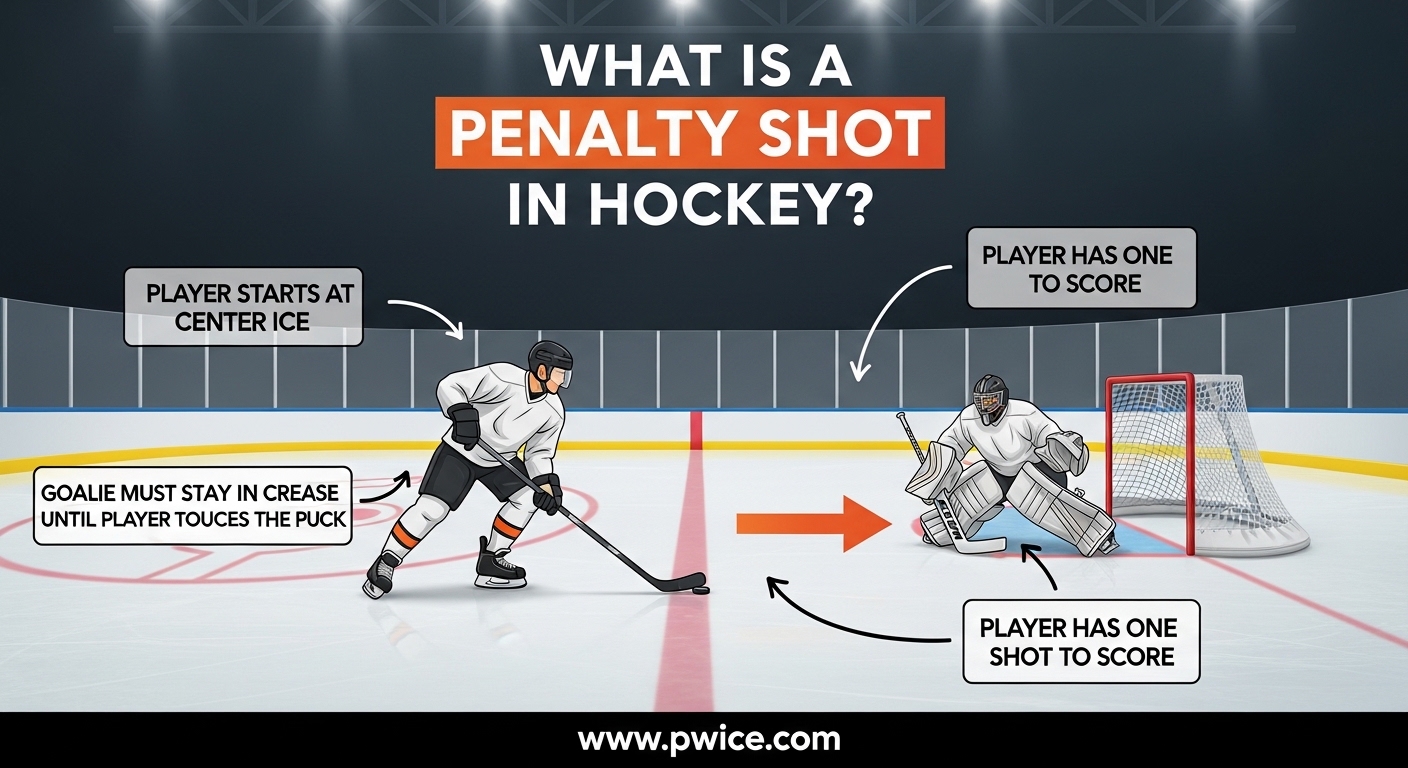
Have you ever watched a hockey game and suddenly seen one player skate alone toward the goal while the rest of both teams watched from the sidelines? That electrifying moment is a penalty shot. It is one of the most dramatic and pressure-packed scenarios in all of sports.
In this comprehensive guide, I will explain everything you need to know about penalty shots in hockey. You will learn when they are awarded, how the procedure works, and what rules both the shooter and goalie must follow. Whether you are a new fan trying to understand the rules, a youth hockey parent, or a player preparing for your first penalty shot opportunity, this guide covers it all.
By the end of this article, you will understand the complete penalty shot rules for NHL, USA Hockey, and international play. You will know the difference between a penalty shot and a shootout, understand why some fouls result in penalty shots while others do not, and learn the fascinating history behind this unique hockey rule.
Table of Contents
What Is a Penalty Shot in Hockey?
A penalty shot in hockey is a one-on-one scoring opportunity awarded to a player who was illegally fouled during a clear breakaway, giving them an unobstructed chance to score against only the goaltender. It is designed to restore a scoring chance that was unfairly taken away by an opposing player’s infraction.
When a penalty shot is awarded, all other players from both teams must go to their respective players’ benches. The fouled player then starts with the puck at center ice and attempts to score on the opposing team’s goaltender with no defenders in the way. The shooter has a limited time to complete their attempt, and specific rules govern how both the shooter and goalie must behave during this isolated confrontation.
Unlike a regular power play where the non-offending team has a one or two-player advantage for several minutes, a penalty shot is a single, decisive opportunity. The outcome is immediate: either the shooter scores a goal, or the attempt fails. There are no rebounds that count, and the play does not continue after the shot concludes.
When Is a Penalty Shot Awarded in Hockey?
Understanding when a penalty shot is awarded in hockey requires knowing three specific conditions that must all be met simultaneously. Referees must evaluate each situation carefully to determine if a penalty shot is warranted or if a standard minor penalty would be more appropriate.
A penalty shot is not simply awarded every time a foul occurs during a game. The circumstances must involve a clear scoring opportunity that was directly denied by an illegal action. This high threshold ensures that penalty shots remain rare and dramatic moments rather than common occurrences.
The Three Requirements for a Penalty Shot
Three conditions must be met for a referee to award a penalty shot. If any one of these conditions is missing, the referee will likely call a standard minor penalty instead.
1. The player must be on a breakaway. A breakaway means the attacking player has gotten past all defending players except the goaltender. They have a clear path to the goal with no teammates or opponents between them and the net except the goalie.
2. There must be a clear scoring opportunity. The player must have possession and control of the puck with a reasonable chance to score. Simply being ahead of defenders is not enough; the player must actually have the puck and be in a position to shoot.
3. The foul must be committed from behind or involve specific illegal actions. The defending player must foul the attacker from behind, or the foul must involve throwing a stick, dislodging the net, or other specific violations that directly prevent a scoring chance.
Specific Fouls That Result in Penalty Shots
Several types of fouls can trigger a penalty shot when they occur during a breakaway situation. Understanding these specific infractions helps players and fans recognize when a penalty shot might be coming.
Tripping or hooking from behind: When a defending player trips or hooks an attacking player from behind during a breakaway, this is the most common reason for a penalty shot. The illegal action directly prevents what would likely have been a goal.
Throwing a stick: If a defending player throws their stick (or any other equipment) at the puck or the puck carrier during a scoring opportunity, a penalty shot is awarded. This is an automatic penalty shot regardless of whether it is a breakaway situation.
Deliberately dislodging the net: When a defending player deliberately knocks the net off its moorings to prevent a goal during a breakaway or clear scoring opportunity, the referee will award a penalty shot. This is considered an intentional delay of game with severe consequences.
Illegal entry by a substitute: If a player enters the game illegally from the penalty bench or players’ bench and prevents a breakaway or clear scoring opportunity, a penalty shot may be awarded against their team.
Covering the puck in the crease: If a defending player (other than the goaltender) falls on, gathers, or covers the puck in the goal crease, a penalty shot is awarded to the non-offending team. The rationale is that this action prevented a goal that would have likely been scored.
Common Misconceptions About When Penalty Shots Are Awarded
Many hockey fans, especially those new to the sport, have misconceptions about penalty shots. One common misunderstanding is that any foul during a breakaway automatically results in a penalty shot. In reality, the foul must be committed from behind or involve specific illegal actions like throwing a stick.
Another frequent confusion involves the difference between a delayed penalty and a penalty shot. A delayed penalty occurs when a foul is committed but the non-offending team retains possession, allowing play to continue until they lose control. A penalty shot is an immediate stoppage and isolated scoring chance.
Some fans also believe that if a penalty shot is missed, the non-offending team should get a power play afterward. This is not the case in most leagues, including the NHL. The penalty shot is the entire penalty; there is no additional power play for a missed attempt.
How Does a Penalty Shot Work? The Complete Procedure
The procedure for a penalty shot follows a specific sequence that ensures fairness and clarity for all participants. Both teams must understand their roles during this stoppage in play.
When the referee determines that a penalty shot is warranted, the process unfolds in a standardized way across most hockey leagues. This consistency helps players know what to expect and ensures the rule is applied uniformly.
Step 1: The Referee Signals and Stops Play
The referee signals a penalty shot by extending one arm straight out horizontally, palm down, toward the non-offending team’s attacking zone. This distinct signal differs from other penalty calls and immediately alerts everyone that a special procedure is about to occur.
The referee blows the whistle to stop play. All players except the designated shooter and the goaltender must proceed immediately to their respective players’ benches or the penalty bench. The ice is cleared to create a one-on-one confrontation.
Step 2: Player Selection
The captain of the non-offending team (or a designated alternate if the captain is not on the ice) selects which player will take the penalty shot. This is a strategic decision based on which player has the best chance to score.
According to USA Hockey rules, the player who was fouled must take the penalty shot unless they are injured or have been penalized. In those cases, the captain can choose any player who was on the ice at the time of the infraction. NHL rules have similar restrictions on who can be selected.
The selected player must be someone who was on the ice at the time the infraction occurred. A team cannot bring a specialist off the bench who was not playing when the foul happened. This rule prevents teams from subbing in their best shootout performer for a penalty shot.
Step 3: Positioning at Center Ice
The shooter takes position at the center ice face-off spot with the puck. The goaltender takes position in their goal crease, ready to defend. The referee ensures both are properly positioned before allowing the attempt to begin.
The goaltender must remain in the crease until the shooter touches the puck and begins their approach. Once the shooter makes contact with the puck and starts moving toward the goal, the goalie is free to challenge and move out of the crease to cut down the angle.
Step 4: The Shot Attempt
The shooter begins by touching the puck and skating toward the goal. The puck must remain in continuous motion toward the goal line. Once the shooter begins their approach, they have a limited time window to release their shot.
Under most rule sets including the NHL, the shooter must complete their attempt within a reasonable time, typically interpreted as keeping the puck in continuous forward motion. The shooter cannot stop, reset, or circle back. They must proceed directly toward the goal in a continuous attempt to score.
Step 5: After the Shot Concludes
The penalty shot ends when the puck crosses the goal line (resulting in a goal), the puck comes to a complete stop, the puck is frozen by the goaltender, the puck deflects off the goal frame and away from the goal, or the shooter loses control of the puck.
Importantly, rebounds do not count on penalty shots. If the goaltender makes a save and the puck rebounds to the shooter, they cannot score on that rebound. The attempt is over once the initial shot is stopped or misses, regardless of where the puck goes afterward.
Rules the Shooter Must Follow
The player taking the penalty shot must follow several specific rules during their attempt. Violating these rules can result in the attempt being stopped and no goal being awarded.
Understanding these restrictions is crucial for players who might find themselves in this high-pressure situation. Breaking even a minor procedural rule can nullify the opportunity.
The Continuous Motion Rule
The most important rule for shooters is that the puck must remain in continuous motion toward the goal line. The shooter cannot stop and restart, spin in circles, or move backward once they have begun their approach.
This rule prevents shooters from gaining unfair advantages through hesitation or deception tactics that go beyond normal stickhandling moves. The shooter is expected to proceed directly toward the goal with the intent to score.
If the shooter stops their forward momentum or allows the puck to stop moving toward the goal, the referee will blow the whistle and declare the attempt over. No goal can be scored once continuous motion is broken, even if the shooter subsequently regains momentum.
Starting Position and Approach
The shooter must begin at the center ice face-off spot. They cannot start closer to the goal or from an angle that provides an unfair advantage. The referee will ensure proper positioning before signaling for the attempt to begin.
Once the referee signals (usually by dropping the arm or blowing a short whistle), the shooter may touch the puck and begin their approach. They can choose any path toward the goal, including deking from side to side, as long as the puck maintains forward progress toward the goal line.
What Happens with a Rebound?
One of the most frequently asked questions about penalty shots concerns rebounds. Many fans wonder what happens if the goaltender makes the initial save but gives up a rebound.
The answer is that rebounds do not count on penalty shots. If the goaltender stops the initial shot attempt and the puck rebounds to the shooter, the play is dead. The shooter cannot legally score on that rebound, even if they have a wide open net.
This rule exists to give the goaltender a fair chance to defend. In a regular game situation, defenders would be available to clear rebounds, but in a penalty shot, there are no defenders. The no-rebound rule prevents the shooter from having multiple scoring chances while the goalie must defend alone.
The penalty shot attempt is officially over when the puck comes to rest in the goal crease, hits the goal post or crossbar and deflects away, is frozen by the goaltender, or otherwise ceases to be in play after the initial shot attempt.
Prohibited Actions for Shooters
Shooters are prohibited from several specific actions during a penalty shot. These include making contact with the goaltender inside the crease, deliberately shooting the puck wide to create a rebound opportunity, and using any equipment in an illegal manner.
If the shooter makes contact with the goaltender within the crease before the puck enters the goal, the goal will be disallowed. The goaltender is entitled to defend their crease without interference during a penalty shot.
Intentionally shooting the puck wide of the net to create a bank shot or rebound opportunity is also prohibited. The referee will stop the play if they determine the shooter deliberately missed the net to create a secondary scoring chance.
Rules the Goalie Must Follow
The defending goaltender is also bound by specific rules during a penalty shot. While they have more freedom than in a shootout, certain restrictions apply to ensure fair competition.
Goalies must understand these limitations to avoid giving the shooter an automatic goal through a rule violation. Some restrictions are designed to prevent goalies from gaining unfair advantages through equipment violations or illegal positioning.
Crease Violations
The goaltender must remain within their goal crease until the shooter makes contact with the puck. Once the shooter touches the puck to begin their approach, the goalie is free to move anywhere to defend the goal.
If the goaltender leaves the crease before the shooter touches the puck, the referee will stop the attempt and allow the shooter to restart. Repeated violations could result in disciplinary action against the goaltender.
Once the approach begins, the goalie can challenge aggressively by moving far out of the net to cut down the shooter’s angle. This is a common strategy that forces the shooter to make quicker decisions.
Throwing the Stick
One of the most serious violations a goaltender can commit during a penalty shot is throwing their stick. If a goalie deliberately throws their stick or any piece of equipment at the puck or shooter during a penalty shot, an automatic goal is awarded.
This rule exists because throwing equipment is considered an intentional act to prevent a goal through means other than legitimate goaltending. The automatic goal penalty reflects the severity of this unsportsmanlike action.
The rule applies to any equipment, not just the goalie’s stick. Throwing a blocker, catcher, or any other piece of equipment would result in the same automatic goal penalty. The goalie’s equipment is meant for protection and playing the puck within the rules, not for throwing at opponents.
Equipment and Substitution Rules
The defending team cannot substitute their goaltender during a penalty shot once the shooter has been announced. The goalie who was in net when the infraction occurred must defend the penalty shot.
If the goaltender is injured during the penalty shot attempt, the referee may allow a substitution. However, the original goalie must make a genuine effort to defend the shot before injury can be claimed as a reason for substitution.
The goaltender must wear all required protective equipment during the penalty shot. If a goalie loses equipment during the attempt, play continues unless the referee determines there is a safety concern. The shooter is not required to stop if the goalie’s equipment becomes dislodged.
What Happens After the Penalty Shot?
The aftermath of a penalty shot depends entirely on whether the shooter successfully scores or fails to convert the opportunity. Different procedures follow each outcome.
Understanding what happens after a penalty shot helps players and fans know what to expect and where play will resume. The location of the subsequent face-off varies based on the result.
If the Shot Results in a Goal
When a penalty shot results in a goal, the score is recorded immediately. The goal counts as a regular goal for the shooter’s statistics, and their team is credited with the score just as if they had scored during normal play.
After a successful penalty shot, play resumes with a face-off at center ice. Both teams line up for a standard center ice face-off to restart the game, just as they would after any other goal during regulation play.
The player who scored the goal receives credit for the goal in the official statistics. This is an important distinction from a shootout, where shootout goals do not count toward a player’s regular season goal totals in the NHL.
If the Shot Is Missed or Saved
If the goaltender makes a save, the shooter misses the net, or the attempt otherwise fails to produce a goal, play stops immediately. No rebound opportunity exists, and the penalty shot is simply over.
Following a missed penalty shot, play resumes with a face-off at one of the end zone face-off spots in the zone where the penalty shot was attempted. The specific spot is determined by which side of the ice the attempt was made from.
The defending team does not receive any additional advantage from stopping the penalty shot. There is no power play given to the defending team, and the non-offending team receives no further compensation for the foul that occurred.
Is There a Power Play After a Missed Penalty Shot?
One of the most common questions from fans, particularly those new to hockey, concerns what happens after a missed penalty shot. Many assume the non-offending team should receive a power play to compensate for the missed opportunity.
In the NHL and most professional leagues, there is no power play after a missed penalty shot. The penalty shot itself is considered the full penalty for the infraction. Whether the shooter scores or misses, the penalty has been served through the shot attempt.
However, under USA Hockey rules for certain youth and amateur levels, there is an important difference. For some infractions, the non-offending team’s captain can elect to take a minor penalty (resulting in a two-minute power play) instead of the penalty shot. But once the penalty shot is chosen and attempted, there is no additional power play if it fails.
This distinction between penalty shots and power plays is a frequent source of confusion, even among experienced fans. The penalty shot is designed to be a single, decisive opportunity that replaces a standard penalty, not an additional advantage on top of one.
Penalty Shot vs Power Play: Which Is Better?
One of the most interesting strategic elements of penalty shots occurs in leagues where teams have a choice between accepting the shot or taking a power play. Understanding when to choose each option requires analyzing statistics and situational factors.
USA Hockey rules allow the non-offending team’s captain to elect between a penalty shot and a minor penalty (two-minute power play) for certain infractions. This choice adds a layer of strategy that does not exist in the NHL, where penalty shots are mandatory when awarded.
When Can Teams Choose?
Under USA Hockey Rule 406, the captain of the non-offending team has the option to elect a minor penalty instead of a penalty shot when the infraction would normally result in a minor penalty if it had not occurred during a breakaway.
This election must be made immediately after the penalty shot is awarded. The referee will ask the captain for their decision before the shot is set up. Once the choice is made, it cannot be changed.
If the captain elects the minor penalty, the offending player serves two minutes in the penalty box, and their team plays short-handed. The fouled player does not get the one-on-one opportunity against the goaltender.
Success Rates Compared
Statistical analysis can help inform the decision between a penalty shot and a power play. NHL data shows that penalty shots are converted into goals approximately 30-35% of the time on average.
Power play success rates vary significantly based on the team’s skill level and the specific situation, but a two-minute power play typically results in a goal 15-25% of the time for average teams. Elite power play units may convert at higher rates, while weaker units convert less frequently.
Based on these numbers, the penalty shot appears to offer a higher probability of scoring than a standard two-minute power play. However, power plays offer multiple scoring chances and the possibility of wearing down the opposing penalty killers. They also carry the risk of the shorthanded team clearing the puck and killing time.
Youth hockey statistics may differ from professional numbers. Younger players often have lower penalty shot conversion rates due to less developed shooting skills and more nervousness in pressure situations. At youth levels, a power play with multiple chances might be preferable to a single high-pressure shot.
Strategic Considerations
Several factors should influence the decision between a penalty shot and a power play. The skill level of the potential shooter is paramount. If your best scorer was the player fouled, the penalty shot might be the clear choice.
The quality of the opposing goaltender also matters. Facing an elite NHL goaltender might make a power play more attractive than facing a youth league goalie who is more likely to be beaten on a breakaway.
Game situation plays a role as well. Late in a close game, a penalty shot offers an immediate chance to take the lead. A power play provides sustained pressure but no guarantee of scoring before time expires.
The confidence and preference of the fouled player should also be considered. Some players love the spotlight of a penalty shot, while others prefer the team dynamics of a power play. Good captains know their teammates’ strengths and preferences.
Penalty Shot vs Shootout: Understanding the Difference
Many hockey fans, particularly those who learned the game through video games, confuse penalty shots with shootout attempts. While they look similar, these are distinct procedures with different purposes and rules.
A penalty shot occurs during regulation play or overtime as a penalty for a specific foul. A shootout occurs after overtime ends in a tied game to determine a winner. The contexts, rules, and statistical tracking differ significantly.
During a penalty shot, all other players must remain on the benches. In a shootout, players wait at center ice and take turns attempting to score. The procedure for each attempt follows similar but not identical rules.
In the NHL, penalty shot goals count toward a player’s regular season goal total and shooting percentage. Shootout goals do not count as official goals in player statistics; they only determine the game’s outcome. This is an important distinction for fans tracking player performance.
Both procedures feature a one-on-one confrontation between shooter and goaltender. However, shootouts allow for more elaborate moves, including complete stops and restarts that would be illegal in a penalty shot. The continuous motion rule is more strictly enforced in penalty shots than in shootout rounds.
Another key difference is the number of attempts. A penalty shot is a single, isolated event that happens once and ends. A shootout consists of multiple rounds with several players from each team taking turns until a winner is determined.
Penalty Shot Rules in Youth Hockey
Youth hockey follows the same basic penalty shot concepts as professional hockey, but some modifications exist to accommodate younger players and different developmental priorities. Understanding these differences helps parents and young players know what to expect.
USA Hockey, which governs most amateur hockey in the United States, has specific rules for youth penalty shots that differ slightly from NHL regulations. These rules account for the developmental stage of young players.
Key Differences at the Youth Level
The most significant difference in USA Hockey youth rules is the election option mentioned earlier. The non-offending captain can choose between a penalty shot and a minor penalty, adding a strategic element that does not exist in the NHL.
Youth referees are also given more discretion in interpreting “clear scoring opportunity.” The breakaway standard may be applied more loosely for younger age groups, recognizing that young players’ judgment of defensive positioning is still developing.
Some youth leagues modify the continuous motion rule to be less strict, allowing younger players more time to complete their approach. The exact enforcement varies by league and age division, with stricter standards applied as players advance to higher levels.
Time limits for completing the attempt may be more flexible in youth hockey. Referees understand that young players may need more time to settle their nerves and set up their approach compared to professional athletes.
Common Questions from Parents and Coaches
Parents new to hockey often have questions about penalty shots that experienced fans might take for granted. One common question concerns why some fouls result in penalty shots while seemingly similar fouls do not.
The answer usually lies in the three requirements discussed earlier. A foul during a breakaway must meet all three conditions to warrant a penalty shot. If the player did not have clear possession, if there was a defender who could have caught up, or if the foul was not from behind, a minor penalty is more appropriate.
Another frequent question involves who can take the penalty shot. Parents sometimes wonder if their team’s best scorer can be substituted in even if they were not on the ice. USA Hockey rules require that the fouled player take the shot unless injured or penalized, and any substitute must have been on the ice at the time of the infraction.
Coaches often ask about preparation strategies. Should teams practice penalty shots? Most coaches agree that some practice is beneficial, though not to the extent of shootout preparation. Having players comfortable with the procedure reduces anxiety when a real penalty shot occurs in a game.
NHL vs USA Hockey vs IIHF: Rule Variations
While penalty shots share common foundations across hockey leagues, specific rules vary between the NHL, USA Hockey, and the International Ice Hockey Federation (IIHF). Understanding these differences is important for players and fans who follow multiple levels of competition.
These variations are relatively minor but can affect how penalty shots are awarded and conducted. Players transitioning between leagues must be aware of the specific rules that apply to their current competition level.
NHL Penalty Shot Rules
The NHL has the strictest standards for penalty shots among the major leagues. Penalty shots in the NHL are mandatory when the criteria are met. There is no option to choose a power play instead.
NHL referees apply the breakaway and clear scoring opportunity standards rigorously. Because of the high skill level of NHL players and the importance of game outcomes, officials are careful to ensure penalty shots are awarded only in clear-cut situations.
The NHL also has specific procedures for video review of penalty shot situations. If there is any question about whether the criteria were met, the situation can be reviewed to ensure the correct call was made.
NHL penalty shot statistics are meticulously tracked. Goals count toward official player statistics, and save percentages for goaltenders on penalty shots are recorded separately from regular save percentages.
USA Hockey Rules
USA Hockey governs amateur hockey in the United States, including youth leagues, high school hockey, and adult recreational leagues. Their penalty shot rules are documented in Rule 406 of the USA Hockey Official Rulebook.
The key distinctive feature of USA Hockey rules is the election option. For infractions that would normally result in a minor penalty, the non-offending captain can choose between the penalty shot and the minor penalty. This applies to most youth and amateur levels under USA Hockey jurisdiction.
USA Hockey also has specific rules about player designation. The fouled player must take the penalty shot unless they are injured or have been assessed a penalty. If they cannot take the shot, the captain chooses from among players who were on the ice at the time of the infraction.
Referee discretion plays a larger role in USA Hockey penalty shot decisions. The standard for a “clear scoring opportunity” is interpreted with consideration for the age and skill level of the players involved.
IIHF (International) Rules
The IIHF governs international hockey, including Olympic competition and the World Championships. Their rulebook contains penalty shot provisions that are similar to but not identical with NHL and USA Hockey rules.
IIHF rules tend to align more closely with NHL standards than USA Hockey rules in terms of mandatory penalty shots. There is generally no election option in IIHF competition. When a penalty shot is warranted, it must be taken.
International play sometimes features different interpretations of crease violations and goaltender interference. IIHF referees may apply different standards for what constitutes illegal contact between shooter and goaltender.
The IIHF rulebook is updated periodically for World Championship and Olympic play. Players competing internationally should always verify they are using the current version of the rules for their specific tournament.
Quick Comparison Summary
Here is a quick reference for the key differences between the three major rule sets:
NHL: Mandatory penalty shots, no election option, strict breakaway standards, goals count in statistics.
USA Hockey: Election option for certain infractions, fouled player must take shot unless injured, more referee discretion in youth levels.
IIHF: Mandatory penalty shots similar to NHL, international officiating standards, updated periodically for tournaments.
The History of the Penalty Shot in Hockey
The penalty shot has a fascinating history that dates back over a century. Understanding its origins helps appreciate why this rule exists and how it has evolved to its current form.
The concept of awarding a special scoring opportunity to compensate for a denied breakaway was revolutionary when first introduced. It has since become one of hockey’s most recognizable and exciting features.
Origins in [cy-85]
The penalty shot was invented by Frank Patrick, a legendary figure in early hockey history. Patrick introduced the penalty shot in [cy-85] when he was managing the Pacific Coast Hockey Association (PCHA), a professional league operating in western Canada and the United States.
The PCHA was known for innovation in hockey rules. Frank Patrick and his brother Lester were instrumental in developing many aspects of modern hockey, including the blue line, the forward pass, and numbered jerseys. The penalty shot was one of their most enduring inventions.
The original penalty shot was different from today’s version. Initially, the shooter was not allowed to skate with the puck. They had to take a stationary shot from ten feet in front of the goal, similar to a soccer penalty kick. The rule was modified over time to allow the shooter to approach while moving.
Adoption by the NHL
The NHL adopted the penalty shot in [cy-35], long after the PCHA had introduced it. The early NHL version allowed the shooter to skate in from a longer distance than modern rules permit.
For many years, penalty shots were extremely rare in the NHL. The standards for awarding them were strict, and the league maintained a conservative approach to implementing this dramatic rule. As offensive hockey became more emphasized, penalty shots became more common.
The first recorded penalty shot in the NHL was taken by Ralph Bowman of the St. Louis Eagles in [cy-35]. He did not score on the attempt, beginning a tradition of high drama surrounding these unique opportunities.
Evolution of the Rules
The penalty shot procedure has undergone several modifications since its introduction. The most significant change was allowing the shooter to skate with the puck rather than shooting from a stationary position. This made penalty shots more exciting and gave skilled players more opportunities to showcase their talents.
In [cy-55], the NHL modified the rule to require the shooter to keep the puck in continuous motion. This prevented players from stopping completely and deking repeatedly, which had become a tactic some shooters employed.
The current NHL rulebook contains detailed specifications for penalty shots that have been refined through decades of experience. Modern rules address video review, goalkeeper equipment violations, and specific criteria for what constitutes a breakaway.
The introduction of the shootout in [cy-5] for regular season games changed how penalty shots are perceived. While related in concept, penalty shots and shootouts are now clearly distinguished in both rules and fan expectations.
Famous Penalty Shot Moments in NHL History
Throughout NHL history, certain penalty shots have become legendary moments that fans remember for years. These high-pressure situations have created some of the most dramatic scenes in hockey.
Recent seasons have continued to produce memorable penalty shot moments. The pressure of a one-on-one confrontation with the game on the line brings out both the best and worst in players and goaltenders.
In [cy-1], Toronto Maple Leafs star Auston Matthews scored a dramatic penalty shot against the Montreal Canadiens, showcasing the quick hands that make him one of the league’s most dangerous scorers. The goal came at a crucial moment in the game and demonstrated why coaches trust their stars in these situations.
Connor McDavid of the Edmonton Oilers has taken several penalty shots in recent seasons, converting many with his explosive speed. His approach typically involves gaining speed through the neutral zone and forcing the goalie to commit before making his final move.
Perhaps the most famous penalty shot in recent NHL history occurred in the [cy-10] Stanley Cup Playoffs when Philadelphia Flyers captain Mike Richards scored a shorthanded penalty shot against the Montreal Canadiens. The shorthanded penalty shot is one of the rarest occurrences in hockey and represents a unique combination of circumstances.
Goaltenders have also made their mark on penalty shot history. Henrik Lundqvist of the New York Rangers was known for his exceptional penalty shot save percentage during his career. His ability to stay patient and force shooters to make the first move made him particularly difficult to beat in these situations.
In [cy-2], Los Angeles Kings goaltender Jonathan Quick stopped a penalty shot in overtime of a playoff game, preserving his team’s chance to win. The save was credited with turning the momentum of the series.
Frequently Asked Questions About Penalty Shots
What makes it a penalty shot in hockey?
A penalty shot is awarded when three conditions are met: (1) the player is on a breakaway with a clear path to the goal, (2) they have possession and control of the puck with a clear scoring opportunity, and (3) they are fouled from behind or by specific illegal actions like throwing a stick or dislodging the net.
Can anyone on the ice take a penalty shot?
No, not anyone can take a penalty shot. Under most rules including USA Hockey and NHL regulations, the player who was fouled must take the penalty shot unless they are injured or have been penalized. If they cannot take it, the captain selects from players who were on the ice when the infraction occurred.
Why would you get a penalty shot in hockey?
You get a penalty shot when an opposing player fouls you from behind during a breakaway, denying you a clear scoring opportunity. Other reasons include a defending player throwing their stick, deliberately dislodging the net, or covering the puck in the crease to prevent a goal.
What happens if you miss a penalty shot?
If you miss a penalty shot, play stops immediately and no goal is scored. In the NHL and most leagues, there is no power play awarded after a missed penalty shot. The game resumes with a face-off at one of the end zone face-off spots in the zone where the attempt occurred.
Can you score on a rebound from a penalty shot?
No, you cannot score on a rebound from a penalty shot. If the goaltender makes a save and the puck rebounds to the shooter, the play is immediately dead. Rebounds do not count on penalty shots, which is a key difference from regular gameplay.
How often do penalty shots happen in the NHL?
Penalty shots are relatively rare in the NHL. On average, there are approximately 40-50 penalty shots awarded across the entire league per season. With 1,271 regular season games in a full NHL season, this averages to about one penalty shot every 25-30 games.
What is the success rate for penalty shots?
The success rate for penalty shots in the NHL is approximately 30-35%. This means roughly one-third of penalty shots result in goals. Success rates vary based on the shooter’s skill, the goaltender’s ability, and the pressure of the specific game situation.
What is the rarest penalty in the NHL?
The rarest penalty in the NHL is typically considered to be a penalty shot awarded while already shorthanded, creating a shorthanded penalty shot opportunity. Other extremely rare penalties include match penalties for attempting to injure and specific equipment violations that are seldom called.
What is a 2 minute penalty in hockey called?
A 2 minute penalty in hockey is called a minor penalty. Common minor penalties include tripping, hooking, slashing, holding, and interference. If a penalty shot is not awarded, these fouls typically result in the offending player serving two minutes in the penalty box while their team plays shorthanded.
Can a player refuse to take a penalty shot?
A player cannot refuse to take a penalty shot once the captain has designated them and the referee has announced the shooter. If the fouled player is unable to take the shot due to injury, the captain may select another eligible player who was on the ice at the time of the infraction.
Conclusion
A penalty shot in hockey represents one of the most exciting and pressure-filled moments in all of sports. It is a one-on-one confrontation between shooter and goaltender that can change the outcome of a game in an instant. Understanding what is a penalty shot in hockey helps fans appreciate the strategy, skill, and drama that make this rule one of hockey’s most distinctive features.
Throughout this guide, we have covered the complete rules for penalty shots across NHL, USA Hockey, and international competition. You now know when penalty shots are awarded, how the procedure works, what rules apply to both shooters and goalies, and what happens after the attempt concludes. We have also explored the history of this fascinating rule and answered the most common questions fans have about penalty shots.
Whether you are watching an NHL game, coaching a youth team, or stepping onto the ice yourself, the knowledge you have gained here will help you understand and appreciate every penalty shot situation. The combination of fair play restoration, high-stakes pressure, and individual skill makes the penalty shot one of hockey’s greatest traditions.
If you found this guide helpful, consider exploring other hockey rules explanations to deepen your understanding of this fast-paced and exciting sport. The more you know about the rules, the more you will enjoy every game you watch or play.